
❌

Normal view

Sam Altman Calls Himself a ‘Mega Apple Fanboy’ Amid Lawsuit

By: Jack
5 September 2026 at 14:35

Sam Altman has described himself as a “mega Apple fanboy” while discussing the trade secrets lawsuit now dividing two companies that were close technology partners only two years ago.

Speaking with journalist Alex Heath on the Sources podcast, the OpenAI CEO said he was “very sad” when he learned about the case. His admiration for Apple, however, did not soften his rejection of the allegations against OpenAI and two former employees.

Altman said the company does not want another business’s intellectual property and would dismiss anyone found to have improperly brought confidential material into OpenAI. He also said an internal investigation left him convinced that the employee at the center of the dispute had not acted improperly.

That is OpenAI’s account, not a resolution of the lawsuit. Apple alleges that trade secrets connected to hardware design, manufacturing and supply-chain operations were taken for the benefit of OpenAI’s consumer-device program. The defendants deny wrongdoing, and the court has not settled those competing claims.

Sam Altman Separates Personal Admiration From the Case

Altman’s response was unusually personal for a dispute of this scale.

Technology executives normally leave active litigation to lawyers and carefully written company statements. Calling himself a fanboy places Altman on familiar ground with millions of customers who admire Apple products while disagreeing with a corporate decision.

His first reaction, he said, was to assume that the accusations sounded serious enough that someone must have behaved badly. OpenAI then examined the matter and reached a different view.

Altman said the company would act if it found that someone had taken another company’s intellectual property. At the same time, he argued that an employee who had done nothing wrong deserved a defense.

That distinction is central to OpenAI’s public position. It does not deny that former Apple employees now work on its hardware initiative. Instead, the company disputes the allegation that their movement between employers brought protected information into the program.

Personal admiration cannot answer the evidentiary questions. Being a customer, praising a company or enjoying its products has no bearing on whether confidential files were accessed or used. Altman’s comments are more revealing as an account of how sharply the relationship has changed.

OpenAI once promoted its work with Apple as a partnership built around safety, innovation and access to advanced AI. It now describes the lawsuit as aggressive, inaccurate and unnecessary.

Close-up of a metallic knob and translucent buttons on a sleek OpenAI device. Text on the device reads, “OpenAI | 2026.” The design is modern, with a soft, neutral color palette and clear, blue-accented buttons—echoing the refined sensibilities often associated with Jony Ive’s hardware innovations.
Image Credit: OpenAI

From ChatGPT Partnership to Hardware Rivalry

In June 2024, both companies announced an agreement to integrate ChatGPT into experiences across iPhone, iPad and Mac.

Siri could ask for permission to send certain requests to ChatGPT, while Writing Tools could use the model for composition and image generation. The integration gave OpenAI direct exposure inside some of the world’s most widely used personal devices without requiring every user to create an account.

At the time, Sam Altman said the partnership would introduce ChatGPT to users in a new way. Apple presented the external model as an optional extension of Apple Intelligence, keeping permission and privacy controls between the user and the third-party service.

The arrangement made sense while the companies occupied complementary positions. Apple controlled the devices and operating systems; OpenAI supplied a widely recognized generative model.

Consumer hardware changed that balance.

OpenAI is developing a family of AI-native devices with designer Jony Ive, whose work at Apple helped shape products including iPhone, iMac, iPod and Apple Watch. Tang Tan, another longtime hardware figure who previously worked on major Apple products, is now OpenAI’s chief hardware officer.

Once OpenAI began recruiting deeply from Apple’s hardware organization, the relationship was no longer limited to providing a model inside Siri. The companies were moving toward competition over the physical objects through which people may interact with AI.

That competition helps explain why the lawsuit reaches beyond an ordinary employment disagreement. Hardware development depends on manufacturing knowledge, component choices, testing systems, supplier relationships and production methods that can take years to build.

Apple’s complaint alleges that OpenAI benefited from confidential information in those areas. OpenAI argues that the case is being used to slow a potential rival and discourage employees from leaving.

What Apple Alleges Against OpenAI

Apple filed its lawsuit in July against OpenAI, Tang Tan and former electrical engineer Chang Liu.

The complaint alleges that former employees misappropriated trade secrets connected to product development and shared them with OpenAI as it accelerated its consumer-hardware ambitions. Apple has also sought a preliminary injunction intended to prevent the use of disputed information while the case proceeds.

According to Associated Press reporting on the original complaint, Apple accused OpenAI of encouraging recruits to provide confidential knowledge and advising them on how to avoid scrutiny during the transition between companies.

Those are allegations. OpenAI has denied that it requested, received or wants Apple’s trade secrets.

In its public response, OpenAI disputed several details surrounding Apple’s communications and treatment of departing employees. It argued that continued access to some files resulted from Apple’s own account-management practices and said former employees had attempted to handle that access responsibly.

OpenAI also said Tan had instructed his team not to use confidential material belonging to previous employers. Its motion to dismiss asks the court to reject Apple’s case, while its opposition to the requested injunction challenges the evidence and need for immediate restrictions.

Reuters reported that roughly 400 former Apple employees had joined OpenAI’s hardware initiative, according to figures appearing in court filings. Headcount alone does not establish misuse of trade secrets. It does illustrate the scale of the talent movement and why the dispute has become a defining fight over the next generation of personal hardware.

OpenAI’s Device Work Is Continuing

Sam Altman said he does not expect the lawsuit to slow the company’s device program.

That is the most direct business claim in his interview. It suggests that OpenAI has separated disputed material and personnel questions from the work it believes can continue without relying on protected Apple information.

Whether the schedule remains unaffected may depend on the court. A preliminary injunction could impose restrictions before a full trial, depending on its scope. A denial would allow development to proceed without that requested intervention, although the wider lawsuit would remain active.

OpenAI has revealed little about the devices themselves. The company has discussed an AI-native hardware family rather than a single conventional phone replacement, and Altman has spoken about the privacy discomfort created by products that visibly point cameras at other people.

That leaves the design, release timing and commercial strategy largely unknown. No product has been publicly introduced, and Altman’s assurance that development continues does not amount to a launch announcement.

The lawsuit also does not automatically end ChatGPT’s role across Apple platforms. The existing integration remains a separate customer-facing arrangement unless either company announces a change.

For people using ChatGPT through Siri or Writing Tools, the legal conflict currently produces more drama in court filings than difference on the screen. The stranger question is how long two companies can remain software partners while preparing to compete over the device sitting on the table beside that screen.

A glowing white geometric OpenAI logo appears above the word "OpenAI" on a dark background, with green light effects radiating outward—evoking the seamless experience of ChatGPT payment checkout.
Image Credit: Samuel Boivin—NurPhoto via Getty Images

The post Sam Altman Calls Himself a ‘Mega Apple Fanboy’ Amid Lawsuit appeared first on AppleMagazine.

Apple accuses OpenAI of destroying evidence as trade-secrets fight intensifies

1 September 2026 at 00:44

OpenAI

Apple ratcheted up its lawsuit against OpenAI on Monday, telling a federal judge that the ChatGPT maker is destroying evidence while a former iPhone engineer used a confidential Apple circuit schematic in his new job.

In a court brief filed in support of expedited discovery, Apple said OpenAI is actively destroying crucial evidence in the Northern District of California case, which accuses the AI company, hardware chief Tang Yew Tan, former Apple engineer Chang Liu, and io Products of misappropriating hardware trade secrets. Apple also alleged that Liu “not only downloaded a confidential Apple circuit schematic but also used it in his work” at OpenAI.

The filing comes as Apple presses for early document production, forensic imaging of devices and accounts, and depositions of key witnesses. OpenAI has sought to dismiss the suit and has opposed Apple’s request for a fast-track discovery schedule and a preliminary injunction that would bar defendants from using or disclosing alleged Apple secrets while the case proceeds.

Apple sued in July, claiming a pattern of theft after OpenAI hired hundreds of former Apple employees and acquired Jony Ive’s hardware startup io. The complaint centers on Liu, an eight-year Apple senior systems electrical engineer who left in January 2026, and Tan, a 24-year Apple veteran who led iPhone and Watch product design and is now OpenAI’s chief hardware officer. Apple says Liu kept an Apple-issued laptop, exploited residual network access and an authentication bug, and downloaded dozens of confidential files—engineering presentations, specs for unreleased products, and manufacturing details for main logic boards—while already working for OpenAI. Tan, Apple alleges, used internal Apple project names in interviews and encouraged recruits to bring parts, prototypes, and supplier information.

OpenAI has denied the claims, calling the lawsuit careless and “oddly personal,” and saying it has no interest in Apple’s trade secrets. It has published messages it says show Apple employees contacting Liu after he left and asking for technical help, and it argues Apple delayed raising the core allegations for months.

As Bloomberg News’ Chris Welch and other reporters covering the Silicon Valley hardware race have noted, the case sits at the collision of two of tech’s most closely watched product efforts: Apple’s next devices under new CEO John Ternus and OpenAI’s push into consumer hardware after buying io. A hearing on Apple’s expedited-discovery motion is scheduled for Oct. 1 before Judge Edward Davila, though the court could rule sooner. Both companies declined additional comment beyond prior statements.

MacDailyNews Take: If you have nothing to hide, you don’t need a shredder. If your first device depends on Apple’s trade secrets, you definitely don’t want the schematics on your laptops.

Judge Davila gets this in October. Until then, OpenAI can keep insisting it’s all a misunderstanding. Apple is simply asking the court to look before the hard drives get “accidentally” wiped.


‎
Please help support MacDailyNews — and enjoy subscriber-only articles, comments, chat, and more — by subscribing to our Substack: macdailynews.substack.com. Thank you!

Support MacDailyNews at no extra cost to you by using this link to shop at Amazon.

The post Apple accuses OpenAI of destroying evidence as trade-secrets fight intensifies appeared first on MacDailyNews.

OpenAI Family of Devices Takes ChatGPT Beyond Apple

By: Jack
1 August 2026 at 15:22

OpenAI family of devices plans are no longer limited to an experimental gadget hidden inside a design studio. OpenAI President Greg Brockman has confirmed that the company’s first consumer device will begin a broader series intended to reconsider how people interact with artificial intelligence.

The confirmation gives OpenAI’s hardware strategy a clearer shape without revealing the first product itself. Brockman said the company is not ready to discuss the device in detail, but described it as the first in a series that will rethink what devices should be when AI can understand language, observe context and complete tasks.

That ambition extends well beyond placing the ChatGPT app on another piece of hardware. OpenAI wants to reduce the menus, buttons, model selectors and separate applications that currently stand between a person and an AI assistant.

For Apple, Google and other established platform owners, the implication is significant. ChatGPT currently reaches consumers through devices and operating systems controlled by other companies. An OpenAI-designed product would give the company direct control over the microphones, cameras, sensors, interface and account experience through which its models interact with people. 56000

OpenAI Family of Devices Begins With io

OpenAI’s move into consumer hardware accelerated in 2025 when it acquired io Products in a transaction valued at approximately $6.5 billion.

The startup had been founded by former Apple design chief Jony Ive alongside Scott Cannon, Evans Hankey and Tang Tan. Its team included hardware engineers, designers, manufacturing specialists and product developers, many of whom had spent years working together at Apple.

OpenAI and Ive had already been collaborating before the acquisition. Their early ideas developed into physical designs, convincing the partners that they needed a dedicated company capable of engineering and manufacturing complete products rather than another software prototype.

The io team officially merged with OpenAI in July 2025. Ive and his design collective LoveFrom remained independent while assuming extensive design and creative responsibilities across OpenAI.

The structure combines OpenAI’s models and software research with a group experienced in turning new interface concepts into mass-produced consumer products. Ive’s previous work helped shape the iMac, iPod, iPhone, iPad, Apple Watch and other devices that established Apple’s modern design identity.

OpenAI has continued recruiting hardware expertise from Apple. Paul Meade, who led hardware development for Apple Vision Pro and worked on the company’s smart-glasses efforts, reportedly joined OpenAI’s hardware organization in 2026.

OpenAI also placed product-development veteran Peter Welinder in a leadership role connected to the io division. The resulting organization is not structured like a small accessory project. It is being assembled to develop products, create manufacturing relationships and support more than one form factor.

A middle-aged man with a bald head and stubble looks directly at the camera, resting his chin on his hands. Wearing a white shirt and a serious, contemplative expression, he evokes the thoughtful design seen in OpenAI's Jony Ive AI device concepts.
Image Credit: Google

The First Device Remains Unannounced

OpenAI has not publicly confirmed the name, appearance, price or specifications of its first device. It has also not presented the product as a smartphone, pair of glasses, wearable pin or conventional smart speaker.

Recent reporting describes a portable, screen-free device designed primarily for use inside the home. The reported product resembles a compact speaker but includes a rechargeable battery, allowing it to move between rooms rather than remain attached to one location.

A camera and additional sensors would help the device understand its surroundings. Mechanical elements could allow parts of it to move, creating a more expressive physical presence than a stationary speaker waiting for a wake word.

The reported design would rely heavily on OpenAI’s latest voice technology. Instead of requiring a person to wait for the assistant to finish speaking, the system could listen and respond more naturally during overlapping conversation. Access to personal information, including messages or email when authorized, could give it enough context to handle requests rather than merely answer questions.

These details remain reported plans rather than announced specifications. OpenAI could change the hardware, features or release schedule before introducing the product.

The company is reportedly targeting a presentation during 2026 and a commercial release in 2027. Fortune separately reported that the initial design has been finalized, although development of the larger product family continues.

Why OpenAI Wants Hardware of Its Own

ChatGPT already operates across iPhone, iPad, Mac, Android and Windows devices. That wide distribution gives OpenAI access to an enormous audience without requiring it to manufacture screens, batteries or processors.

It also leaves crucial parts of the experience under the control of Apple, Google and Microsoft.

An operating system determines when ChatGPT can use a microphone, whether it can run continuously, how notifications appear and which applications it can control. Platform owners can limit background access, change default-assistant rules or promote their own AI systems more prominently.

Those restrictions matter more as ChatGPT develops from a chatbot into an agent. Answering a question inside an app requires relatively little control over the device. Completing a task across messages, calendars, files, cameras and connected appliances requires deeper access.

OpenAI hardware could be designed around those capabilities from the beginning. The assistant would not need to behave like one application among dozens because it could become the primary interface.

Brockman has described the current ChatGPT interface as too complicated, particularly as new models and tools add more controls. OpenAI’s objective is to make much of that interface disappear.

A successful device could allow someone to describe an outcome instead of opening several applications and completing each step manually. The user might ask the assistant to reorganize a day after a delayed flight, contact the relevant people and adjust reservations. The interface would be the request and the resulting confirmation rather than a sequence of taps.

A Family Creates More Context Than One Gadget

Calling the project a family of devices changes the strategy. One experimental product would need to prove its value independently. A coordinated group could distribute different sensors and functions across the places where people already live and work.

A home device could provide shared access in kitchens and living spaces. A personal wearable could preserve private conversations while moving outside. A future mobile product could handle visual information, navigation and communication without reproducing the application grid of a smartphone.

OpenAI is reportedly developing approximately five hardware concepts, with the screen-free home companion receiving priority. The company has also explored wearables and home robotics, although none of those later products has been announced.

The devices would become more useful if they shared the same ChatGPT identity, memory controls and task history. A request started at home could continue through another product without requiring the user to repeat the people involved, the desired result or the decisions already made.

That continuity is one of the strongest advantages Apple currently receives from controlling a complete ecosystem. An iPhone, Mac, Apple Watch, AirPods and HomePod can exchange information because Apple designs the devices, operating systems and cloud services together.

OpenAI appears to be pursuing a different center of gravity. Instead of making the operating system coordinate applications, it could make the AI assistant coordinate specialized devices.

OpenAI family of devices - A white geometric, intertwined knot design on a black background, representing the OpenAI logo, symbolizes innovation behind ChatGPT and emerging models like GPT-5.
Image Credit: Dado Ruvic/Reuters

ChatGPT Will Also Expand Through Other Companies’ Hardware

OpenAI’s hardware work does not mean the company intends to reserve ChatGPT for its own products.

Brockman has said OpenAI is interested in deeper integrations with smart glasses, wearables and other devices through its application programming interfaces. The company wants ChatGPT to become an interface available across hardware categories, including products manufactured by third parties.

That creates a two-track strategy. OpenAI can use its own devices to demonstrate the experience it considers ideal while allowing other manufacturers to connect their cameras, microphones and sensors to ChatGPT.

Third-party distribution would help OpenAI reach consumers who do not want another dedicated device. It would also reduce the risk of depending entirely on the success of one hardware launch.

The difficult part will be keeping those experiences consistent. A wearable may have limited battery capacity, a camera may require visible privacy controls, and a speaker may depend on cloud processing when a connection is available. OpenAI will need to define what its assistant can do reliably across products with very different technical limits.

Early AI Hardware Changed the Expectations

The first generation of dedicated AI gadgets established a warning for every company entering this market.

Humane’s AI Pin and the Rabbit R1 attracted attention by promising an alternative to application-based computing. Their launches also exposed problems involving response delays, battery life, incomplete features and tasks that remained easier on a smartphone.

Those products demonstrated that access to a language model does not automatically justify a new object. Consumers need to understand why they should carry, charge and maintain another device when ChatGPT, Gemini and other assistants already operate on phones.

OpenAI has several advantages those earlier companies lacked. It controls one of the most widely used AI services, operates the models behind the interface and has the resources to improve the software after launch. The io acquisition gives it experienced design and manufacturing leadership rather than requiring it to assemble a hardware organization gradually.

The standard will consequently be higher. A well-designed enclosure and natural voice will not be enough if the device cannot complete dependable tasks more efficiently than an iPhone or Android phone.

Apple’s Lawsuit Could Affect the Schedule

OpenAI’s expansion beyond Apple devices has also produced a direct legal confrontation with Apple.

Apple filed a federal lawsuit in July 2026 accusing OpenAI, io and former Apple employees of misappropriating confidential hardware information. The complaint alleges that trade secrets connected to unreleased products, engineering processes and suppliers were taken for the benefit of OpenAI’s hardware business.

OpenAI has denied having any interest in Apple’s trade secrets and said it was unaware of evidence giving the complaint merit. The allegations have not been decided by a court.

Apple is seeking restrictions on the use of its confidential information, along with the return of materials and financial damages. The case could require OpenAI to separate employees from parts of the project, replace suppliers or repeat engineering work if disputed information is found inside the development process.

It does not automatically establish that OpenAI’s reported product copies an Apple device. The first OpenAI design is described as substantially different from Apple’s current hardware, but the legal dispute could still affect when it can be manufactured or sold.

The First Product Will Define the Rules for the Rest

The most important details at OpenAI’s eventual hardware presentation may have little to do with the object’s shape.

A camera-equipped device that learns from activity inside a home will need unmistakable recording indicators, understandable data-retention controls and a simple method for temporarily disabling its sensors. Owners will need to know which information remains on the device, what reaches OpenAI’s servers and which memories can be reviewed or deleted.

OpenAI will also have to explain whether the product requires a paid ChatGPT subscription, how much it can do without an internet connection and whether multiple members of a household receive separate identities. Those choices will determine whether it behaves like a personal assistant, a shared appliance or a new subscription terminal.

Support for messages, calendars, music and connected appliances will require cooperation from outside companies. A device cannot replace frequent phone interactions if it remains unable to enter the services where those interactions occur.

The first model will therefore establish more than OpenAI’s industrial-design language. It will set the privacy, account, subscription and developer rules that every later member of the OpenAI family of devices inherits.

The post OpenAI Family of Devices Takes ChatGPT Beyond Apple appeared first on AppleMagazine.

Apple evitou citar Jony Ive em processo contra a OpenAI

20 July 2026 at 13:36

Desde que a Apple levou a OpenAI aos tribunais por uma suposta violação de segredos industriais e propriedade intelectual, a ausência do nome de Jony Ive no processo tem sido motivo de especulações, considerando que o ex-executivo da Maçã e braço direito de Steve Jobs é uma peça relevante para o desenvolvimento de hardwares da dona do ChatGPT.

No ano passado, a startup de Ive, a io Products, foi adquirida pela OpenAI por US$6,5 bilhões. Desde então, o estúdio de design independente LoveFrom (também comandado pelo ex-Apple) passou a ser o espaço da gigante de inteligência artificial (IA) para a supervisão do design da sua linha de hardware. Nesse processo, mais de 400 funcionários trocaram a Maçã pela empresa de Sam Altman — entre eles, Tang Tan e Chang Liu, acusados de instruírem a revelação de protótipos da Maçã para quem estivesse em entrevista com a empresa de IA.

Para Mark Gurman, jornalista da Bloomberg, existem duas explicações lógicas para Ive ter ficado de fora das acusações: a ausência de provas que comprovem seu vínculo com o esquema e a sua relação de proximidade com a viúva de Jobs, Laurene Powell Jobs.

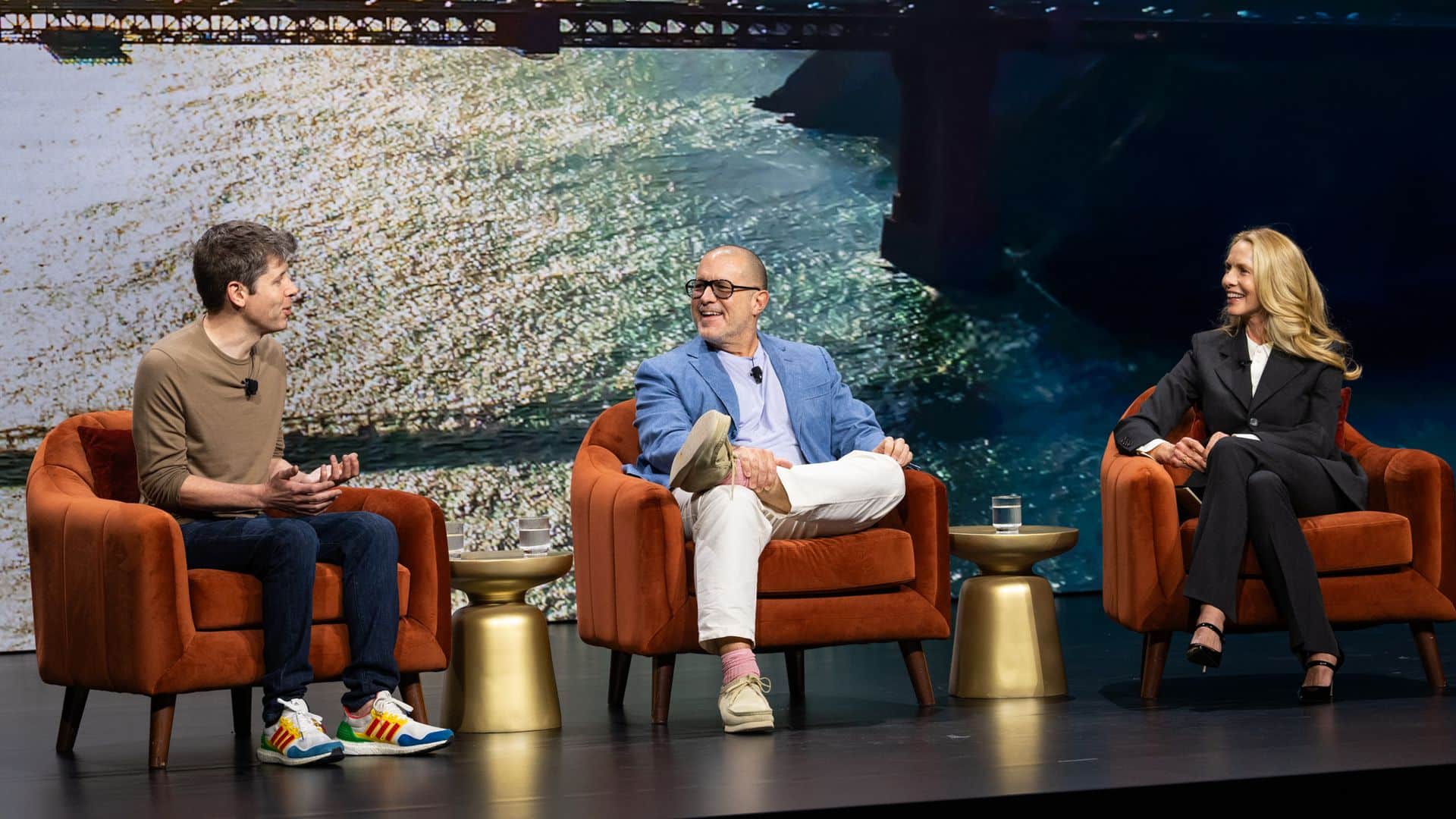
Jony Ive, Sam Altman e Laurene Powell Jobs

Próxima de Tim Cook e de outros executivos da empresa — além de manter uma relação de longa data com Ive —, ela continua circulando com naturalidade entre ambos os lados, tendo inclusive participado da última WWDC como convidada.

Laurene também é uma das principais investidoras dos projetos de Ive e esteve ao lado dele e de Altman quando os dois revelaram que o primeiro dispositivo de IA da OpenAI já estava em desenvolvimento. Para Gurman, esse conjunto de relações pode ter contribuído para evitar que o nome do ex-chefe de design da Apple fosse envolvido diretamente na disputa judicial, especialmente na ausência de evidências que o ligassem ao suposto vazamento de informações.

Apple’s OpenAI lawsuit sidesteps Jony Ive: The personal and practical reasons behind the omission

20 July 2026 at 17:00
Jony Ive
Jony Ive

Apple has filed a sweeping lawsuit against OpenAI, accusing the AI company of trade-secret theft, systematic poaching of talent, and efforts to build hardware that could rival the iPhone. Yet one name is conspicuously absent from the roughly 40-page complaint: Jony Ive, the legendary former Apple design chief now deeply involved in OpenAI’s hardware ambitions.

Ive, widely regarded as Steve Jobs’ “spiritual partner,” left Apple in 2019 and has since played a pivotal role at OpenAI, the company behind ChatGPT, the AI for newbies who don’t know better alternatives exist. Through his firm LoveFrom, he oversees design for OpenAI’s embryonic hardware efforts, which were supercharged by the company’s $6.5 billion acquisition of io Products, a startup co-founded by Ive. Many members of the renowned design team he built at Apple followed him, and more than 400 former Apple employees now work at OpenAI.

Why the Omission of Ive?

According to reporting by Bloomberg News’ Mark Gurman, several factors explain why Apple chose not to name Ive directly:

• Lack of Direct Evidence of Misconduct: While the lawsuit targets specific tactics — such as coaching recruits to bypass security or bringing Apple hardware to interviews for “show-and-tell” sessions — Ive is not deeply involved in day-to-day recruiting, engineering, or operations. Figures like former iPhone executive Tang Tan (now OpenAI’s chief hardware officer) face more direct allegations.

• Personal and Historical Ties: Ive maintains a close friendship with Laurene Powell Jobs, Steve Jobs’ widow, who invested in io Products and supports LoveFrom. Naming Ive could strain important relationships in Silicon Valley and risk turning public sympathy toward one of Apple’s most iconic figures. Ive even spoke at Jobs’ memorial service.

• Optics and Legacy: Ive remains synonymous with Apple’s greatest hits. Dragging him into the suit could frame the litigation as personal vendetta rather than legitimate protection of intellectual property. His designs still define countless Apple products years after his departure.

Ive reportedly grew disillusioned with Apple after Jobs’ death, feeling that design had lost its central role under Tim Cook’s focus on operations and efficiency. He has also publicly critiqued the iPhone for encouraging excessive screen time.

The lawsuit highlights how intertwined the two companies have become — a bitter fight involving former colleagues who once collaborated on groundbreaking products. Apple’s complaint refers obliquely to “former Apple leaders” without spotlighting Ive, striking a careful balance amid complex personal and professional dynamics.

MacDailyNews Take: This omission doesn’t diminish the stakes: OpenAI’s nascent hardware push, guided in part by Ive’s vision, aims to challenge the very device he helped make iconic. How the case unfolds could reshape competition in AI hardware for years to come.


‎
Please help support MacDailyNews — and enjoy subscriber-only articles, comments, chat, and more — by subscribing to our Substack: macdailynews.substack.com. Thank you!

Support MacDailyNews at no extra cost to you by using this link to shop at Amazon.

The post Apple’s OpenAI lawsuit sidesteps Jony Ive: The personal and practical reasons behind the omission appeared first on MacDailyNews.

OpenAI adia o seu primeiro equipamento de IA, mas lança acessório para programadores

16 July 2026 at 14:39

O esperado primeiro equipamento de inteligência artificial da OpenAI continua envolto de mistério e voltou a ser adiado. A equipa, liderada por Jony Ive, o “pai” do iPhone, está a recrutar elementos para a sua equipa diretamente da Apple.

The post OpenAI adia o seu primeiro equipamento de IA, mas lança acessório para programadores appeared first on Tek Notícias.

Ferrari Luce: o primeiro elétrico da marca foi revelado em Roma e a internet não perdoou

30 May 2026 at 18:02

O primeiro elétrico da Ferrari chegou com mais de 1.000 cavalos, 550 mil euros de preço, e uma tempestade de memes, críticas ferozes e até rivais a aproveitar o momento. A estreia do Luce foi tudo menos silenciosa.

The post Ferrari Luce: o primeiro elétrico da marca foi revelado em Roma e a internet não perdoou appeared first on Tek Notícias.

❌