Alors que l’Europe travaille dans une logique de décarbonation à faire émerger une économie de l’hydrogène à l’échelle continentale, son développement reposera autant sur sa production que sur les infrastructures nécessaires pour relier les bassins de production aux bassins de consommation.
Le HP OmniBook 3 16-by0012nfx met son grand écran 16 pouces et son Ryzen 5 à prix plus léger chez Cdiscount. Une remise qui tombe à pic pour changer de PC portable sans mettre son budget sous pression.
En quelques heures seulement, cette fleur peut changer complètement de visage. Ses couleurs éclatantes apparaissent, disparaissent, puis se réinventent au rythme de la journée. Derrière cette étonnante métamorphose se cache un mécanisme fascinant qui montre à quel point les plantes sont capables...
Avec 200 Go en France et 40 Go depuis 135 destinations, le forfait Voyage de Sosh à 15,99 € mise sur un roaming généreux pour voyager sans multiplier les options.
AirPods 5 bring Active Noise Cancellation to Apple’s most affordable current AirPods while pushing the open-ear design closer to capabilities previously associated with more expensive models. The new generation starts at $129 and uses redesigned acoustics and computational audio to remove up to 50% more external noise than AirPods 4 with Active Noise Cancellation.
Apple is also splitting the range into two versions. The standard $129 AirPods 5 include ANC and USB-C charging, while a $149 model adds a Wireless Charging Case, longer battery life, a case speaker for Find My, and volume adjustment directly from the stems.
Both models are available for preorder ahead of their September 18 release in the U.S. and more than 65 other countries and regions.
The changes make the distinction between Apple’s entry-level AirPods and its more advanced headphones less dependent on headline software features. Adaptive Audio, Transparency, Conversation Awareness, Personalized Spatial Audio, Live Translation, and Siri AI are all part of the AirPods 5 experience.
Image Credit: Apple Inc.
AirPods 5 push open-ear ANC further
Active Noise Cancellation is particularly difficult to implement in an open-ear earbud because there is no silicone tip forming a physical seal inside the ear canal.
Apple has approached that limitation with a new multiport acoustic architecture, revised computational audio algorithms, and the H2 headphone chip. The company says AirPods 5 can cancel up to 50% more noise than AirPods 4 with ANC.
That improvement does not turn the design into an AirPods Pro-style sealed earbud. AirPods 5 remain open-ear headphones, retaining the fit preferred by people who dislike the pressure or isolation associated with in-ear tips.
The acoustic system has also been redesigned around a wider variety of ear shapes. Next-generation Adaptive EQ continuously adjusts sound based on how each earbud sits, while Apple says the revised architecture produces richer and more detailed playback.
Transparency mode has been updated to reproduce voices and environmental sounds more naturally. Adaptive Audio can move between Transparency and noise cancellation according to surrounding conditions, while Conversation Awareness automatically reduces media volume when the wearer begins speaking to someone nearby.
Personalized Spatial Audio with dynamic head tracking remains supported for compatible music, movies, and other content.
AirPods 5 are rated IP57 for dust, sweat, and water resistance, making them better suited to workouts and changing weather conditions, although they are not waterproof.
Two AirPods 5 models create a meaningful $20 decision
Apple’s pricing makes the $149 Wireless Charging Case version more than a different charging option.
Standard AirPods 5 provide up to four hours of listening on one charge with ANC enabled and up to 20 hours when the USB-C case is included.
AirPods 5 with Wireless Charging Case increase those figures to five hours from the earbuds and up to 22 hours with the case while ANC is active.
The upgraded case can charge through USB-C, an Apple Watch charger, or a Qi-certified wireless charger. It also contains a speaker that can assist with locating the case through Find My.
The more expensive model introduces another difference directly on the earbuds. Users can swipe up or down on a stem to adjust volume, bringing a control familiar from AirPods Pro to Apple’s open-ear form factor.
That leaves buyers with a relatively straightforward tradeoff. The $129 version provides the central audio experience, including ANC, without requiring a step up for the main listening features. Spending another $20 adds more convenient charging, slightly longer battery life, Find My assistance from the case speaker, and physical volume adjustment.
Placing either AirPods 5 model in its charging case for five minutes provides about one additional hour of listening.
Image Credit: Apple Inc.
Siri AI and Live Translation extend the earbuds beyond music
AirPods 5 arrive as Apple makes voice interaction a larger part of the AirPods experience.
When paired with a compatible iPhone, Siri AI can be accessed hands-free. The assistant can work with personal context from information such as messages, emails, and photos, respond to open-ended questions, and perform supported actions in apps.
Head gestures remain part of the experience. Users can nod to accept certain Siri prompts or shake their head to decline them, allowing calls and notifications to be handled without speaking or touching the earbuds.
Live Translation provides another use for the microphones and ANC system.
After compatible languages are downloaded and the feature is configured through Apple’s Translate app, a user can hear another person’s speech translated through AirPods. Translation can be started through Siri, the iPhone Action button, the Translate app, or by pressing and holding both AirPods stems simultaneously.
When two people are each using compatible AirPods and supported iPhones, both participants can hear translated versions of the conversation in their chosen languages.
Live Translation requires an Apple Intelligence-enabled iPhone 15 Pro or later, compatible AirPods, current software, and the latest AirPods firmware, with availability varying by language and region. Apple also notes that generated translations can contain errors, making verification appropriate when accuracy is especially significant.
AirPods 5 narrow the gap within the lineup
The fifth-generation model represents a different kind of upgrade from simply adding another listening mode.
ANC is now standard across both AirPods 5 configurations, instead of requiring buyers to choose a separate ANC version as they did with AirPods 4. Apple has then moved the pricing distinction toward charging, battery endurance, Find My hardware, and physical controls.
The earbuds continue to use Bluetooth 5.3 and the H2 chip, with dual beamforming microphones, an inward-facing microphone, optical in-ear detection, motion and speech accelerometers, and force sensors built into the stems.
Each earbud weighs 4.3 grams, preserving the lightweight character of the open-ear line despite the additional capabilities.
The new acoustic architecture may be the more consequential change over time. Open-ear earbuds cannot rely on a tight seal to block surrounding sound, so gains in ANC depend heavily on microphone placement, acoustic design, fit, and real-time processing. Apple’s claim of up to 50% more noise removal over the previous generation represents a substantial step for that format rather than simply matching the behavior of sealed earbuds.
AirPods 5 start at $129, while AirPods 5 with Wireless Charging Case cost $149. Both reach stores on September 18, giving the open-ear AirPods line a standard feature set that now includes noise cancellation without pushing buyers to a higher-priced model to get it.
Widow’s Bay has turned its first season into one of the most decorated comedy debuts in Emmy history, collecting 14 awards at the 78th Primetime Emmy Awards and giving Apple TV its biggest awards performance for a single series this year.
The comedy-horror series won Outstanding Comedy Series alongside major acting, writing, directing, casting, cinematography, music, production design, and sound honors. Its 14 victories also set a record for the most Emmy wins by a comedy series in a single season, surpassing the benchmark established by The Studio a year earlier.
The sweep came after Widow’s Bay entered the awards cycle with 19 nominations. Apple finished the 2026 Emmys with 29 awards overall, with Widow’s Bay accounting for nearly half of the total.
Image Credit: Apple Inc.
Widow’s Bay dominates the major Emmy categories
Matthew Rhys won Outstanding Lead Actor in a Comedy Series for his performance as Mayor Tom Loftis, the well-intentioned but frequently overwhelmed leader of a remote New England island community.
Kate O’Flynn won Outstanding Supporting Actress in a Comedy Series, while Stephen Root took Outstanding Supporting Actor. Betty Gilpin had already secured Outstanding Guest Actress during the Creative Arts Emmys.
Creator Katie Dippold won Outstanding Writing for a Comedy Series for the premiere episode, while Hiro Murai received Outstanding Directing for a Comedy Series. The Television Academy also recognized Murai as the first Asian director to win the comedy directing category.
Those awards gave the show victories across nearly every major creative discipline involved in building the series. Widow’s Bay also received Emmys for production design, casting, cinematography, original dramatic score, music supervision, sound editing, and sound mixing.
The breadth of the wins is notable because the show was not carried solely by one high-profile performance or writing prize. Acting, directing, writing, visual design, music, and technical execution all received separate recognition.
Apple says Widow’s Bay also earned more performance awards than any other series at the 2026 Emmys.
Widow’s Bay found a distinctive balance between horror and comedy
Created by Dippold, Widow’s Bay follows Tom Loftis as he tries to transform an isolated island town into a viable tourist destination despite warnings from residents that the community is cursed.
The premise initially plays on civic frustration and small-town politics. The island has unreliable connectivity, a skeptical population, and a mayor determined to prove that local superstition is holding economic development back. As visitors begin to arrive, the supernatural stories that Loftis has dismissed start becoming harder to explain away.
That structure allows the series to operate as both a character comedy and a genuine horror story rather than treating supernatural events simply as setups for jokes.
Dippold, whose earlier work includes The Heat and Ghostbusters, serves as creator, showrunner, writer, and executive producer. Murai, known for visually distinctive television work including Atlanta, directs and executive produces.
The executive-producing team also includes Carver Karaszewski, Claudia Shin, and Rhys.
Apple and Television Academy records list Apple Studios and Chum Films among the production companies behind the series. The directing roster extends beyond Murai to Ti West, Sam Donovan, and Andrew DeYoung.
The main cast includes Rhys, O’Flynn, Root, Kingston Rumi Southwick, Kevin Carroll, and Dale Dickey.
Image Credit: Apple Inc.
A debut season becomes an awards benchmark
Widow’s Bay premiered globally on Apple TV on April 29, 2026. The first two episodes were released together before the remaining episodes arrived weekly.
Its Emmy performance places the series alongside a growing run of Apple comedies that have performed strongly with Television Academy voters.
Ted Lasso previously won Outstanding Comedy Series, followed by The Studio in 2025. Widow’s Bay gives Apple consecutive wins in the category and its fourth Outstanding Comedy Series victory across the past six Emmy ceremonies.
Apple also became the most awarded network at the 2026 Emmys with 29 wins. Pluribus contributed six, including awards for Rhea Seehorn and creator Vince Gilligan, while Margo’s Got Money Troubles and Palm Royale each received three.
Slow Horses won for directing, and Mr. Scorsese received Outstanding Documentary or Nonfiction Series.
For Widow’s Bay itself, the 14-win total is especially significant because this is the show’s freshman season. The Television Academy confirmed six of those awards during the main September 14 telecast, while eight had already been announced during the Creative Arts ceremonies.
The combination took Widow’s Bay beyond The Studio’s previous record for a debut comedy and established a new single-season high for the category.
Matthew Rhys adds another unusual Emmy milestone
Rhys had an especially unusual night beyond his Widow’s Bay victory.
In addition to winning Lead Actor in a Comedy Series, he received another lead-actor Emmy for Netflix’s The Beast in Me in the limited or anthology series or movie category, making him the first performer to win two lead acting awards in different categories during the same Emmy year.
His Widow’s Bay performance is deliberately restrained compared with the increasingly strange circumstances surrounding Loftis. Rather than treating the island’s supernatural events as an invitation to broaden the comedy, Rhys largely plays the mayor as someone trying to maintain a rational civic response while the situation deteriorates.
That tonal approach runs through the rest of the production. Root and O’Flynn’s supporting performances received individual recognition, while Murai’s directing and Dippold’s writing awards reinforced how closely the series depends on maintaining tension without losing its comic rhythm.
All 10 episodes of the first season are currently available to stream on Apple TV. With the Emmy campaign complete, the show now carries a benchmark that future comedy debuts will be measured against: 14 awards from 19 nominations, capped by Outstanding Comedy Series and wins across nearly every part of the production.
A zoomed-in view of the Moon made from images from NASA’s Lunar Reconnaissance Orbiter Camera. (More information at the bottom of article.)
Credits: NASA Goddard/Intuitive Machines/Robert Wagner
It started as a routine data-quality check. But as Robert Wagner, a scientist with NASA’s Lunar Reconnaissance Orbiter (LRO), scanned a giant Moon map on his computer screen, an unusually large bright spot circled by a dark halo caught his eye, as it implied that surface material in that area had been shaken up.
“I just stopped, dropped everything, and started looking into what that spot was,” said Wagner, an image-processing specialist from Intuitive Machines who works with data from the Lunar Reconnaissance Orbiter Camera (LROC) system.
By comparing before and after images of the Moon, Wagner realized he had discovered the largest, newly formed crater ever found in the solar system, as scientists reported Wednesday in Science Advances. This discovery highlights the value of NASA’s Moon orbiter data in studying a dynamic landscape as the agency advances a sustained human presence and expanded scientific and commercial activity on the Moon.
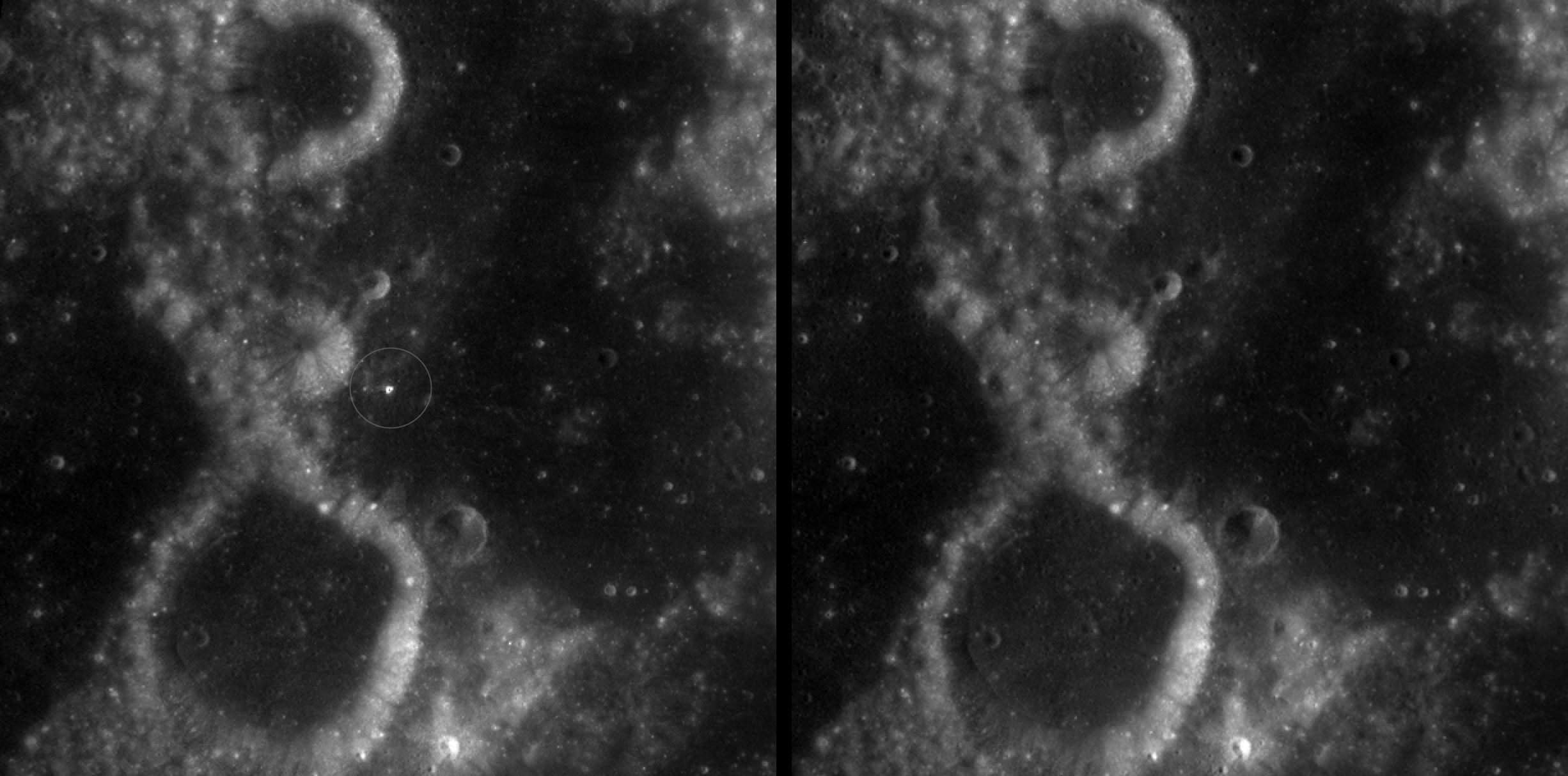
A zoomed-in view of McGetchin crater, circled on the left, next to a “before” image on the right. The panel on the left is made from images captured by NASA’s Lunar Reconnaissance Orbiter Wide-Angle Camera in summer 2025; the right panel was made from images taken in spring 2011. The white spot is not the crater itself, but rather material flung out of the crater, which formed when a rock, possibly this size of a three- to six‑story building, crashed into the Moon between April 11 and May 22, 2024 – a once-in-a-century event, as scientists reported on Sept. 15, 2026, in a pair of papers in Science Advances. The area shown in the images is 38 miles wide.
NASA Goddard/Intuitive Machines/Robert Wagner
Officially named McGetchin after pioneering lunar scientist Tom McGetchin, the crater formed on the Moon’s eastern edge sometime between April 11 and May 22, 2024, after a comet or asteroid the size of a three- to six-story building hit the surface.
The crash left a crater, 728 feet wide, that spans the length of two football fields. And at 141 feet deep, the crater could fit three vertically stacked yellow school buses.
Scientists estimate that an impact of this magnitude happens on the Moon about once in a century or even longer.
Moon takes some hits
For more than 17 years, LRO has been circling the Moon and using its seven instruments to map the topography, surface composition, temperature, and radiation environment there. The spacecraft’s team has identified at least 1,000 new impact craters throughout the mission and flagged 100,000 more surface changes from an object smashing into the Moon or from the debris that flung out after.
With no atmosphere to slow them or burn them up, space rocks and other objects easily reach the lunar surface. Most are much smaller compared to the object that carved out McGetchin crater. The smallest craters scientists can distinguish from LRO images are about 30 feet wide, the length of a three-story building laid on its side, made by rocks about 43 inches wide, the size of a monster-truck tire. Scientists estimate that impacts of this scale produce about 140 new craters across the Moon each year. But most new ones are made by microscopic projectiles that leave holes too small to identify in orbital images.
With its numerous instruments, the spacecraft can observe changes to the lunar surface that aren’t apparent in the LROC images alone. After the crater was discovered, scientists working with LRO’s thermal instrument, Diviner, made follow-up observations of the site. They found a 4-mile-wide area around the crater that is about 16 degrees Fahrenheit cooler at night than its surroundings.
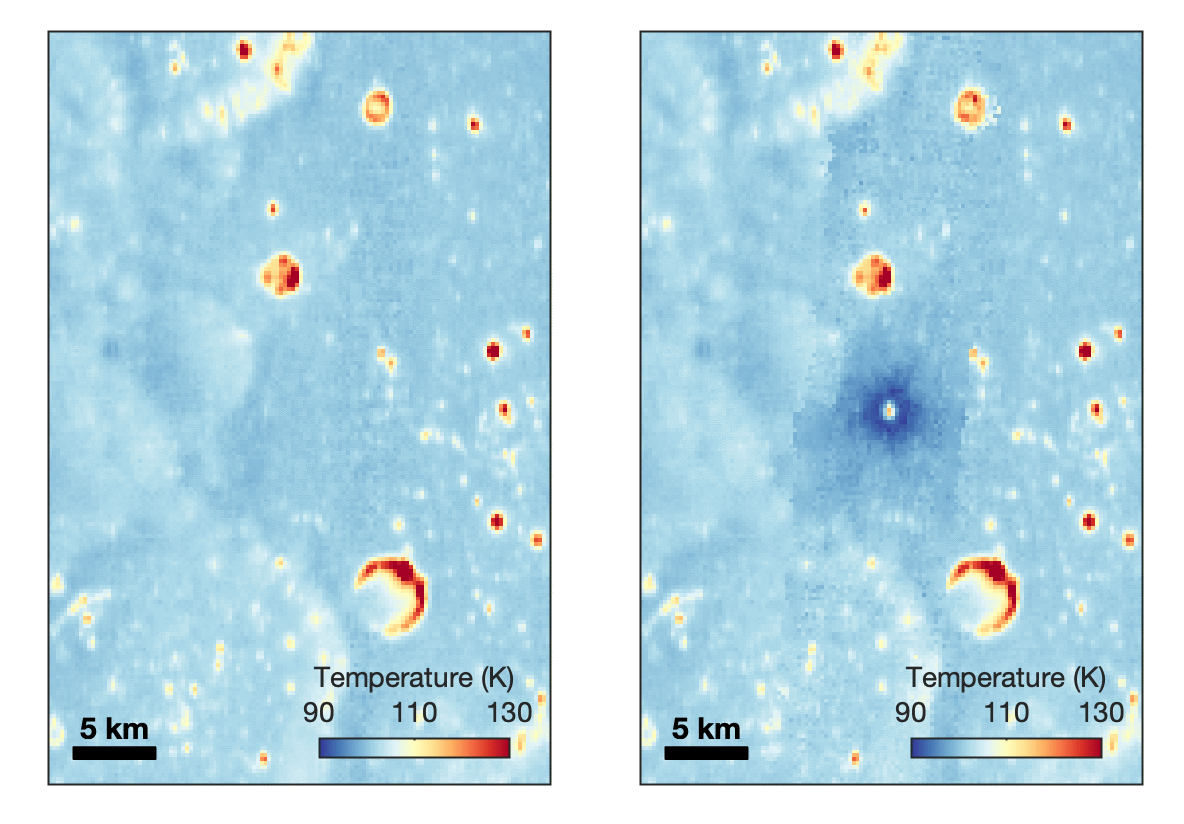
This animated image set shows an area on the eastern limb of the Moon before and after McGetchin crater formed there sometime between April 11 and May 22, 2024. The post-impact image was constructed using data taken by NASA’s Lunar Reconnaissance Orbiter (LRO) thermal instrument, Diviner, between Nov. 15, 2025, and Feb. 18, 2026, after scientists discovered the crater in visible-light images taken by LRO’s Wide-Angle Camera. Pre-impact temperatures are from the Diviner Global High-Resolution Mosaics (GHRM). The crater formed on the Moon after a comet or asteroid, possibly the size of a six-story building, hit the surface in a rare, once-in-a-century collision. The dark blue strip that flashes into view reveals a 4-mile-wide “cold spot” around the crater that is about 16 degrees Fahrenheit cooler at night than its surroundings. This cooling happens because an impact fluffs up regolith around a crater, making it less dense and therefore less able to retain heat. Scientists on the Diviner team reported this finding in a paper published on Sept. 16, 2026, in Science Advances. The red and yellow spots indicate areas typically associated with rocks excavated by long-ago impacts which, though still at cryogenic temperatures like their surroundings, remain slightly warmer at night.
NASA Goddard/UCLA/JHU APL
Reporting in a second paper Wednesday in the same journal, researchers say that the cooling happens because the impact fluffs up the regolith around the crater, making it less dense and therefore less able to retain heat.
The large extent of this “cold spot” is striking, scientists say, because it shows that impacts can modify the Moon’s surface far beyond the crater itself. These physical changes could affect how rover wheels interact with the surface, for instance.
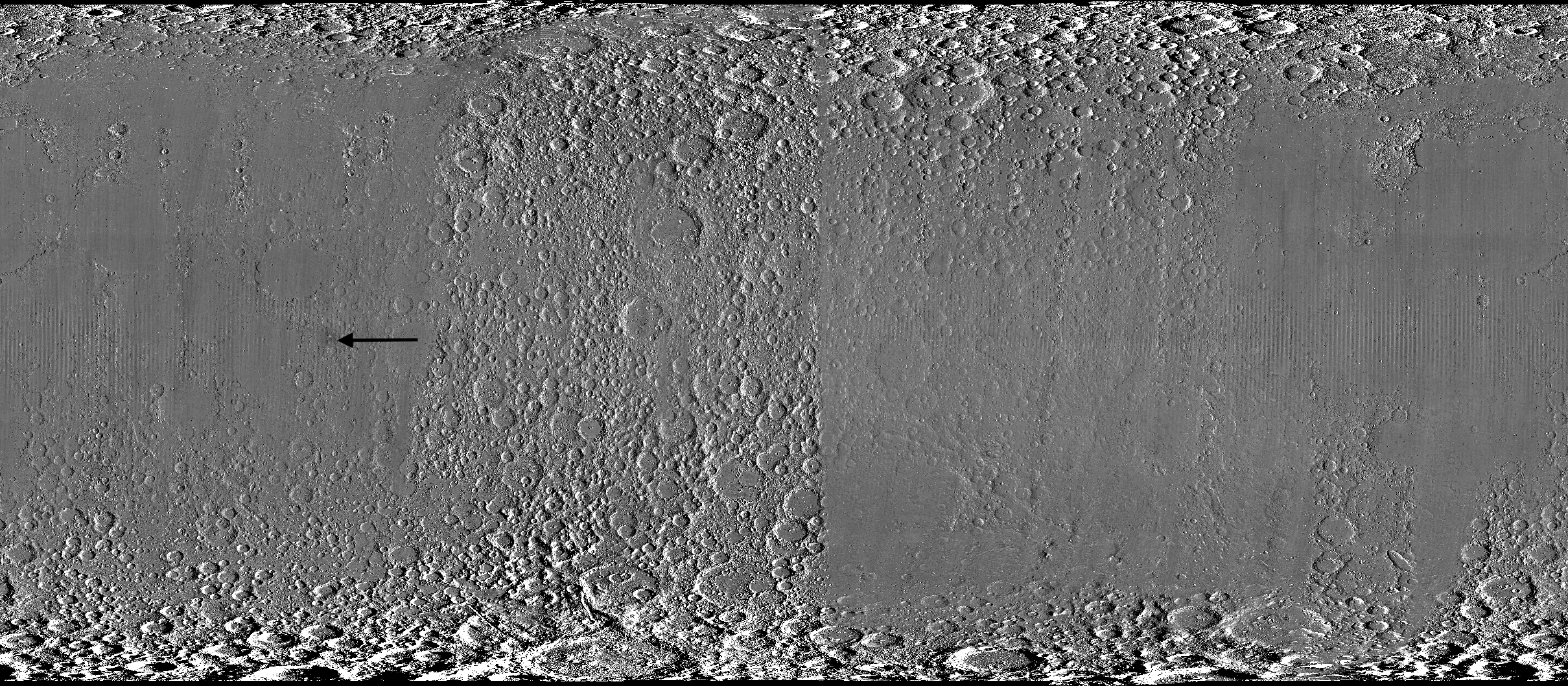
A global view of the Moon made by stitching together hundreds of images from the Wide-Angle Camera aboard NASA’s Lunar Reconnaissance Orbiter (LRO). Robert Wagner, image processing specialist for LRO, made this map using two sets of mages taken several years apart. He used a software designed to highlight any changes between the two sets. Anything that stayed the same turned gray; anything different showed up as bright or dark patches. A black arrow just left of center points to McGetchin crater.
NASA Goddard/Intuitive Machines/Robert Wagner
Road to discovery
The LROC system collects images from about 60 miles above the Moon as LRO loops from pole to pole. The system includes two cameras that capture high‑resolution black‑and‑white images and one camera for moderate‑resolution multispectral images. Over the years and thousands of passes, scientists have built maps detailed enough to spot not only new craters, but also landslides, landers, seismic faults, and even hints of lava tubes.
LROC scientists regularly analyze close-up images of small portions of the Moon’s surface taken by the Narrow-Angle Camera. Using these images, they look for changes that are typically less than 30 feet across. But every few years the team searches for large (wider than 150 feet) features by creating global Moon maps and comparing them to older versions.
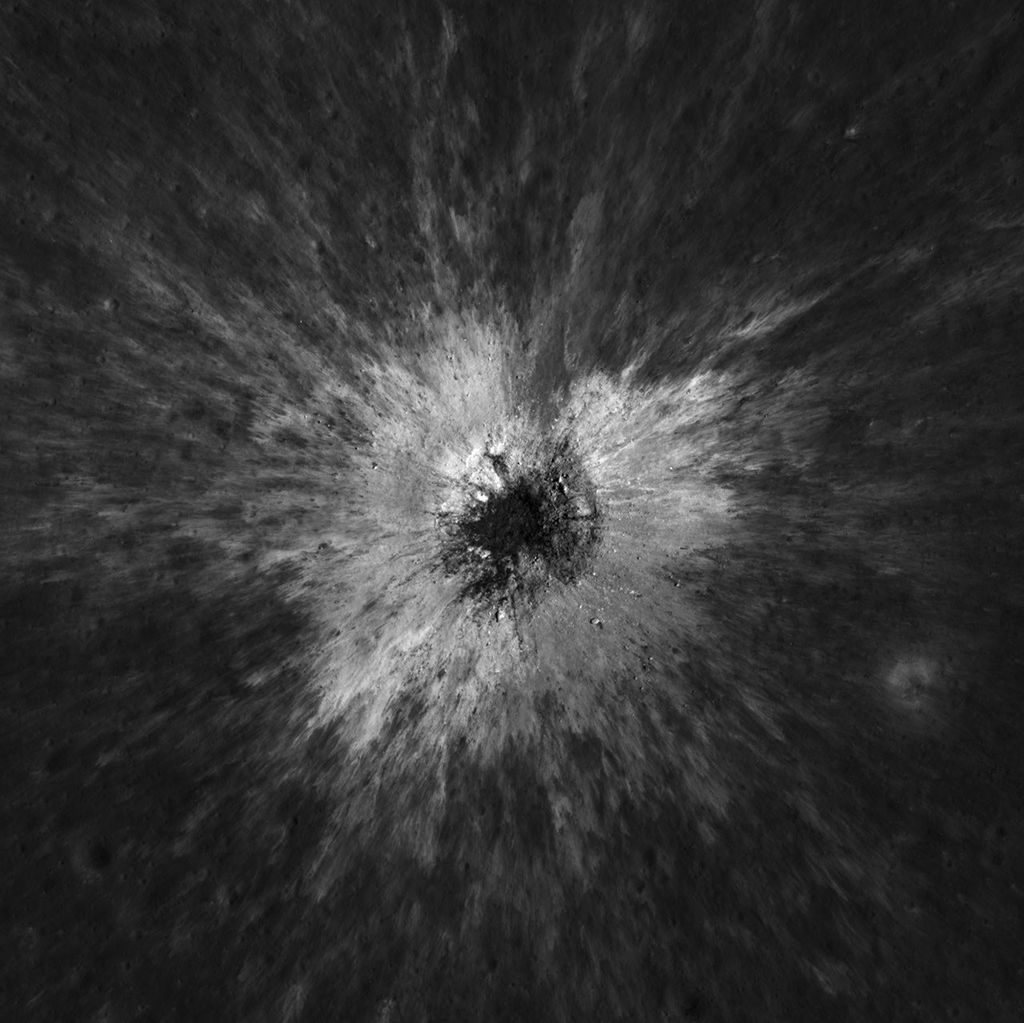
An overhead, close-up view of McGetchin crater that was taken on Dec. 5, 2025, by NASA’s Lunar Reconnaissance Orbiter (LRO) Narrow-Angle Camera (NAC). After the crater was discovered on Oct. 24, 2025, in global images from LRO’s Wide-Angle Camera, which captures broad views with pixels the size of American football fields, scientists turned to the NAC, which takes much sharper views at about 3 feet per pixel. The NAC images, taken as LRO flew over the impact site again, revealed the crater size, shape, and how the surrounding terrain was affected by the impact that carved McGetchin. The image covers an area that’s ¾ mile wide.
NASA Goddard/Intuitive Machines
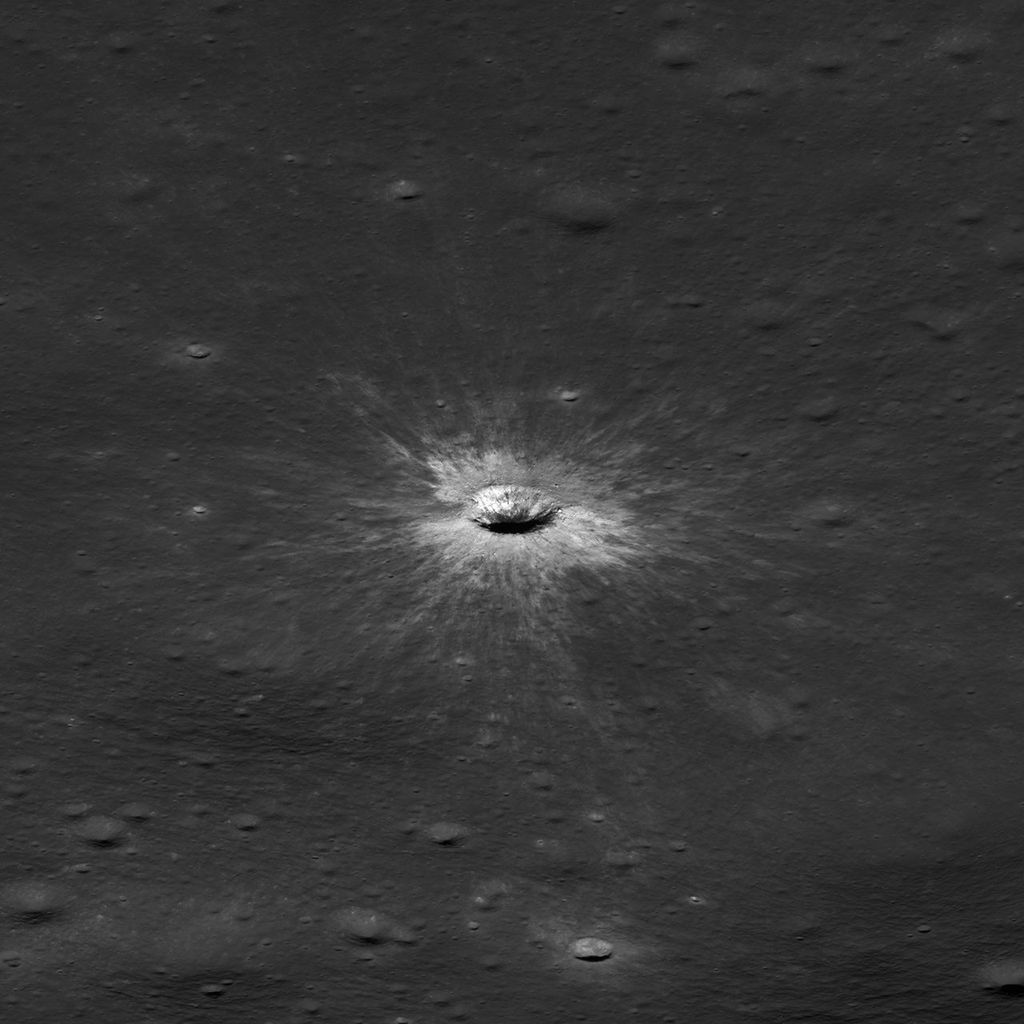
This view from the side (55° away from straight down) towards the east, covers an area of the Moon that’s about 1.5 miles wide. It was taken by NASA’s Lunar Reconnaissance Orbiter Narrow-Angle Camera on March 3, 2026.
NASA Goddard/Intuitive Machines
That’s what Wagner was doing on Oct. 24, 2025, when he came across McGetchin. Using images from LROC’s Wide-Angle Camera, which captures broad views with pixels the size of football fields, he stacked hundreds of “before” and “after” frames with software designed to highlight change. Anything that stayed the same turned gray while anything different showed up as bright or dark patches.
While the process sounds straightforward, spotting real craters requires a lot of manual work. The software flags every tiny shift in lighting or shadow, generating hundreds of false alarms. For this reason, Wagner typically verifies the software, looking for small fuzzy halos around pixel‑wide bright points, which indicate splashes of regolith around a new crater.
Spanning hundreds of pixels, McGetchin stood out immediately. “It was by far the most obvious impact debris pattern I’ve ever seen in one of these images,” Wagner said.
After his discovery, scientists turned to the Narrow-Angle Camera, which takes much sharper views at about 3 feet per pixel. This camera’s close-up images, taken as LRO flew over the impact site again, revealed the crater size, shape, and how the surrounding terrain was affected. These images also helped researchers estimate the size and force of the rock fragment that formed the new crater, details that are expected to appear in a future paper.
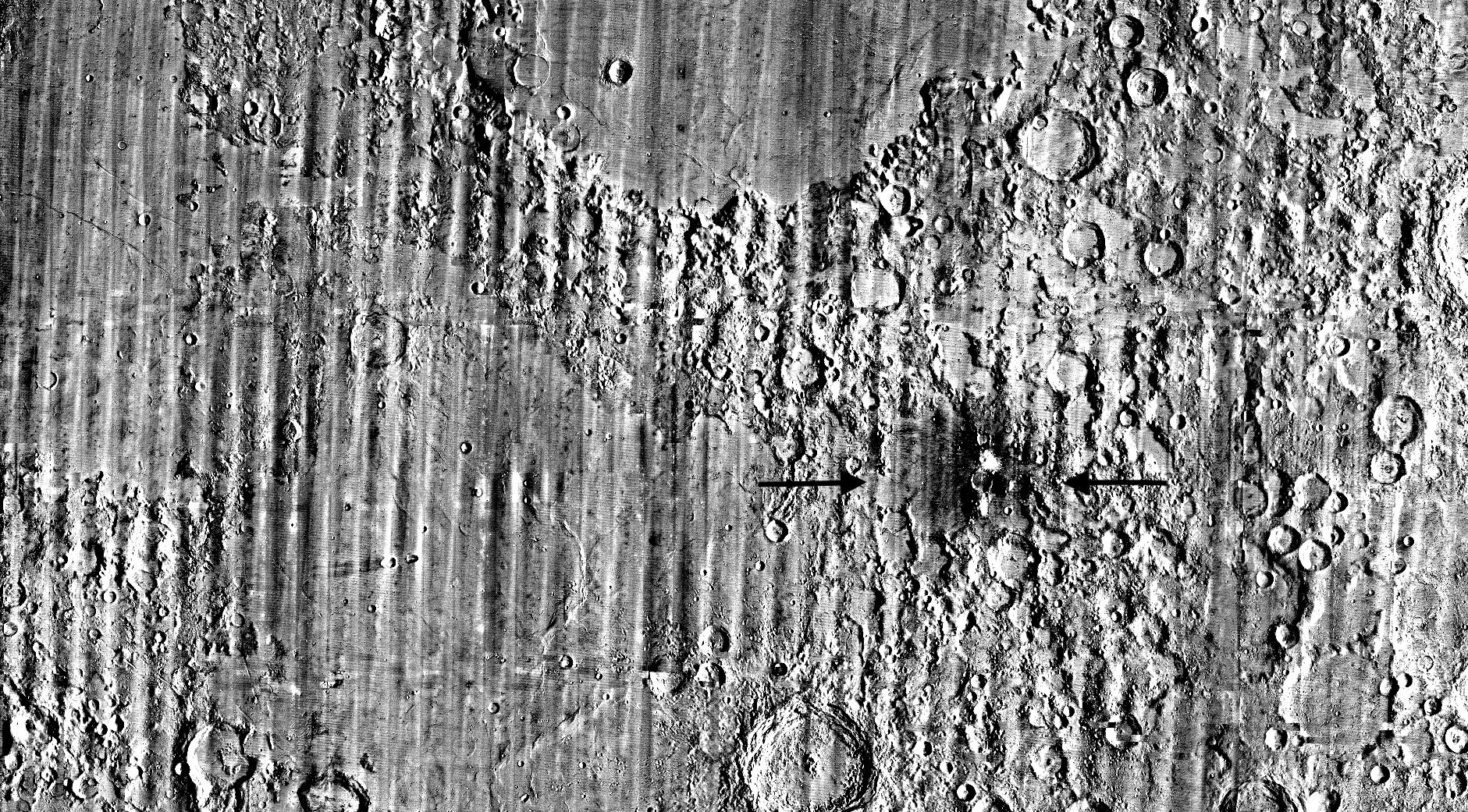
Banner image caption: A zoomed-in view of the Moon, with debris around McGetchin crater visible as a white spot circled by a dark halo just right of center of the image (marked with black arrows). This is the view that Robert Wagner saw on Oct. 24, 2025, during a routine data-quality check. Wagner is an image processing specialist for NASA’s Lunar Reconnaissance Orbiter Camera, a system of three cameras. Using images from the Wide-Angle Camera (WAC), which captures broad views with pixels the size of American football fields, he stacked hundreds of images captured by WAC over the last several years with software designed to highlight change. Anything that stayed the same is gray; anything that changed showed up as bright or dark patches. The stripes in the image are due to slight changes in lighting between the older and newer images. This image composite shows an area of the Moon approximately 900 miles across.
About the Author
Lonnie Shekhtman
Senior Science Writer
Shekhtman helps communicate NASA planetary science to the world through news and feature stories on NASA.gov, videos for NASA+ and YouTube, and by working with the media. She reports on lunar and Mars science and exploration; NASA's search for life; missions to Venus, Titan, and Jupiter's Trojan asteroids; and many other topics related to NASA's exploration of our solar system and beyond.
Scientists discovered a crater on the Moon that formed sometime between April 11 and May 22, 2024, after a comet or asteroid the size of a three- to six-story building hit the surface.
The crash left a crater, 728 feet wide, that spans the length of two football fields. And at 141 feet deep, the crater could fit three vertically stacked yellow school buses.
A zoomed-in view of the Moon made from images from NASA’s Lunar Reconnaissance Orbiter Camera. (More information at the bottom of article.)
Credits: NASA Goddard/Intuitive Machines/Robert Wagner
It started as a routine data-quality check. But as Robert Wagner, a scientist with NASA’s Lunar Reconnaissance Orbiter (LRO), scanned a giant Moon map on his computer screen, an unusually large bright spot circled by a dark halo caught his eye, as it implied that surface material in that area had been shaken up.
“I just stopped, dropped everything, and started looking into what that spot was,” said Wagner, an image-processing specialist from Intuitive Machines who works with data from the Lunar Reconnaissance Orbiter Camera (LROC) system.
By comparing before and after images of the Moon, Wagner realized he had discovered the largest, newly formed crater ever found in the solar system, as scientists reported Wednesday in Science Advances. This discovery highlights the value of NASA’s Moon orbiter data in studying a dynamic landscape as the agency advances a sustained human presence and expanded scientific and commercial activity on the Moon.
A zoomed-in view of McGetchin crater, circled on the left, next to a “before” image on the right. The panel on the left is made from images captured by NASA’s Lunar Reconnaissance Orbiter Wide-Angle Camera in summer 2025; the right panel was made from images taken in spring 2011. The white spot is not the crater itself, but rather material flung out of the crater, which formed when a rock, possibly this size of a three- to six‑story building, crashed into the Moon between April 11 and May 22, 2024 – a once-in-a-century event, as scientists reported on Sept. 15, 2026, in a pair of papers in Science Advances. The area shown in the images is 38 miles wide.
NASA Goddard/Intuitive Machines/Robert Wagner
Officially named McGetchin after pioneering lunar scientist Tom McGetchin, the crater formed on the Moon’s eastern edge sometime between April 11 and May 22, 2024, after a comet or asteroid the size of a three- to six-story building hit the surface.
The crash left a crater, 728 feet wide, that spans the length of two football fields. And at 141 feet deep, the crater could fit three vertically stacked yellow school buses.
Scientists estimate that an impact of this magnitude happens on the Moon about once in a century or even longer.
Moon takes some hits
For more than 17 years, LRO has been circling the Moon and using its seven instruments to map the topography, surface composition, temperature, and radiation environment there. The spacecraft’s team has identified at least 1,000 new impact craters throughout the mission and flagged 100,000 more surface changes from an object smashing into the Moon or from the debris that flung out after.
With no atmosphere to slow them or burn them up, space rocks and other objects easily reach the lunar surface. Most are much smaller compared to the object that carved out McGetchin crater. The smallest craters scientists can distinguish from LRO images are about 30 feet wide, the length of a three-story building laid on its side, made by rocks about 43 inches wide, the size of a monster-truck tire. Scientists estimate that impacts of this scale produce about 140 new craters across the Moon each year. But most new ones are made by microscopic projectiles that leave holes too small to identify in orbital images.
With its numerous instruments, the spacecraft can observe changes to the lunar surface that aren’t apparent in the LROC images alone. After the crater was discovered, scientists working with LRO’s thermal instrument, Diviner, made follow-up observations of the site. They found a 4-mile-wide area around the crater that is about 16 degrees Fahrenheit cooler at night than its surroundings.
This animated image set shows an area on the eastern limb of the Moon before and after McGetchin crater formed there sometime between April 11 and May 22, 2024. The post-impact image was constructed using data taken by NASA’s Lunar Reconnaissance Orbiter (LRO) thermal instrument, Diviner, between Nov. 15, 2025, and Feb. 18, 2026, after scientists discovered the crater in visible-light images taken by LRO’s Wide-Angle Camera. Pre-impact temperatures are from the Diviner Global High-Resolution Mosaics (GHRM). The crater formed on the Moon after a comet or asteroid, possibly the size of a six-story building, hit the surface in a rare, once-in-a-century collision. The dark blue strip that flashes into view reveals a 4-mile-wide “cold spot” around the crater that is about 16 degrees Fahrenheit cooler at night than its surroundings. This cooling happens because an impact fluffs up regolith around a crater, making it less dense and therefore less able to retain heat. Scientists on the Diviner team reported this finding in a paper published on Sept. 16, 2026, in Science Advances. The red and yellow spots indicate areas typically associated with rocks excavated by long-ago impacts which, though still at cryogenic temperatures like their surroundings, remain slightly warmer at night.
NASA Goddard/UCLA/JHU APL
Reporting in a second paper Wednesday in the same journal, researchers say that the cooling happens because the impact fluffs up the regolith around the crater, making it less dense and therefore less able to retain heat.
The large extent of this “cold spot” is striking, scientists say, because it shows that impacts can modify the Moon’s surface far beyond the crater itself. These physical changes could affect how rover wheels interact with the surface, for instance.
A global view of the Moon made by stitching together hundreds of images from the Wide-Angle Camera aboard NASA’s Lunar Reconnaissance Orbiter (LRO). Robert Wagner, image processing specialist for LRO, made this map using two sets of mages taken several years apart. He used a software designed to highlight any changes between the two sets. Anything that stayed the same turned gray; anything different showed up as bright or dark patches. A black arrow just left of center points to McGetchin crater.
NASA Goddard/Intuitive Machines/Robert Wagner
Road to discovery
The LROC system collects images from about 60 miles above the Moon as LRO loops from pole to pole. The system includes two cameras that capture high‑resolution black‑and‑white images and one camera for moderate‑resolution multispectral images. Over the years and thousands of passes, scientists have built maps detailed enough to spot not only new craters, but also landslides, landers, seismic faults, and even hints of lava tubes.
LROC scientists regularly analyze close-up images of small portions of the Moon’s surface taken by the Narrow-Angle Camera. Using these images, they look for changes that are typically less than 30 feet across. But every few years the team searches for large (wider than 150 feet) features by creating global Moon maps and comparing them to older versions.
An overhead, close-up view of McGetchin crater that was taken on Dec. 5, 2025, by NASA’s Lunar Reconnaissance Orbiter (LRO) Narrow-Angle Camera (NAC). After the crater was discovered on Oct. 24, 2025, in global images from LRO’s Wide-Angle Camera, which captures broad views with pixels the size of American football fields, scientists turned to the NAC, which takes much sharper views at about 3 feet per pixel. The NAC images, taken as LRO flew over the impact site again, revealed the crater size, shape, and how the surrounding terrain was affected by the impact that carved McGetchin. The image covers an area that’s ¾ mile wide.
NASA Goddard/Intuitive Machines
This view from the side (55° away from straight down) towards the east, covers an area of the Moon that’s about 1.5 miles wide. It was taken by NASA’s Lunar Reconnaissance Orbiter Narrow-Angle Camera on March 3, 2026.
NASA Goddard/Intuitive Machines
That’s what Wagner was doing on Oct. 24, 2025, when he came across McGetchin. Using images from LROC’s Wide-Angle Camera, which captures broad views with pixels the size of football fields, he stacked hundreds of “before” and “after” frames with software designed to highlight change. Anything that stayed the same turned gray while anything different showed up as bright or dark patches.
While the process sounds straightforward, spotting real craters requires a lot of manual work. The software flags every tiny shift in lighting or shadow, generating hundreds of false alarms. For this reason, Wagner typically verifies the software, looking for small fuzzy halos around pixel‑wide bright points, which indicate splashes of regolith around a new crater.
Spanning hundreds of pixels, McGetchin stood out immediately. “It was by far the most obvious impact debris pattern I’ve ever seen in one of these images,” Wagner said.
After his discovery, scientists turned to the Narrow-Angle Camera, which takes much sharper views at about 3 feet per pixel. This camera’s close-up images, taken as LRO flew over the impact site again, revealed the crater size, shape, and how the surrounding terrain was affected. These images also helped researchers estimate the size and force of the rock fragment that formed the new crater, details that are expected to appear in a future paper.
Banner image caption: A zoomed-in view of the Moon, with debris around McGetchin crater visible as a white spot circled by a dark halo just right of center of the image (marked with black arrows). This is the view that Robert Wagner saw on Oct. 24, 2025, during a routine data-quality check. Wagner is an image processing specialist for NASA’s Lunar Reconnaissance Orbiter Camera, a system of three cameras. Using images from the Wide-Angle Camera (WAC), which captures broad views with pixels the size of American football fields, he stacked hundreds of images captured by WAC over the last several years with software designed to highlight change. Anything that stayed the same is gray; anything that changed showed up as bright or dark patches. The stripes in the image are due to slight changes in lighting between the older and newer images. This image composite shows an area of the Moon approximately 900 miles across.
About the Author
Lonnie Shekhtman
Senior Science Writer
Shekhtman helps communicate NASA planetary science to the world through news and feature stories on NASA.gov, videos for NASA+ and YouTube, and by working with the media. She reports on lunar and Mars science and exploration; NASA’s search for life; missions to Venus, Titan, and Jupiter’s Trojan asteroids; and many other topics related to NASA’s exploration of our solar system and beyond.
Scientists discovered a crater on the Moon that formed sometime between April 11 and May 22, 2024, after a comet or asteroid the size of a three- to six-story building hit the surface.
The crash left a crater, 728 feet wide, that spans the length of two football fields. And at 141 feet deep, the crater could fit three vertically stacked yellow school buses.
La marque américaine Cosori (qui appartient au groupe VeSync) se démarque par la qualité de ses airfryers, notamment. Cosori nous a habitués à proposer des produits innovants et efficaces. L’airfryer Cosori TurboBlaze est équipé d’un moteur Turbo Blaze qui fait circuler efficacement l’air dans...
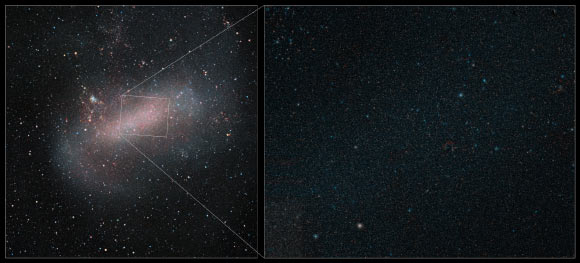
Astronomers using ESO’s Visible and Infrared Survey Telescope for Astronomy (VISTA) have observed the densest, most crowded regions at the centers of the Large and Small Magellanic Clouds, our Milky Way Galaxy’s closest dwarf companions, offering an unprecedented look at areas that have long resisted detailed study.
La préparation d'un espresso avec une machine manuelle demande de contrôler plusieurs étapes, du broyage du café à l'extraction. La De'Longhi La Specialista Arte Evo regroupe justement ces différentes fonctions dans un même appareil, avec notamment un broyeur intégré et une buse vapeur manuelle....
Console de jeu hydride récente et adaptée aux jeunes joueurs comme aux adultes, la Nintendo Switch 2 séduit de nombreux joueurs depuis son lancement en juin 2025. En ce moment, et alors que son prix officiel vient de passer à 499,99 €, vous pouvez vous l'offrir pour moins de 420 € sur Amazon.
A new stretchablequantum-dot light-emitting diode (QLED) delivers incredibly high resolution while producing record brightness that can be clearly viewed even outside in direct sunlight.
In a recent paper published in Nature Nanotechnology, Korean researchers unveiled a new QLED material with applications far beyond televisions, stretching into many future daily-use technologies.
This new QLED can stretch in every direction, just like organic skin, making it extremely useful in future wearable applications and as a covering for soft robots. Unlike earlier attempts to make a stretchable QLED, this one doesn’t lose picture quality when it stretches, delivering high resolution and extreme brightness under tension.
QLED Explained
For most of us, QLEDs are familiar as one of the technologies available in modern televisions. Conventional QLED TVs use quantum dots—nanoscale semiconductor crystals—to help produce exceptionally bright and vivid colors. OLED displays, by comparison, use self-emissive pixels that can switch off individually, allowing them to produce deeper blacks. While OLEDs perform particularly well in dark viewing environments, the high brightness achievable with quantum-dot displays can make them especially well-suited for brightly lit environments.
Despite the technology’s suitability for the bright world around us rather than just darkened environments, major challenges remained in producing a stretchable version. Early attempts addressed the problem by allowing the wiring to stretch while the light-emitting pixels remained unchanged in size. This meant that as the material expanded, its effective resolution dropped because the same number of pixels became spread across a wider area, much like enlarging a low-resolution digital image.
Building on these efforts, some researchers attempted to replace conventional materials with more stretchable alternatives, but these tended to make achieving high resolutions and efficiently moving electrical charge through the material difficult. As a result, these systems produced dimmer, lower-resolution images, limiting their utility.
A New Process
The researchers developed a new fabrication approach to address some of the major problems facing stretchable QLED technology. Central to their innovation is the use of an elastic polymer incorporating MPA as a ligand, or bonding molecule. This approach improves charge injection efficiency while helping eliminate the image stretching and smearing that have affected previous stretchable displays.
Using this new process, the researchers produced a display with a resolution of about 16,000 pixels per inch, with features spaced at roughly 700 nanometers. Red, green, and blue emissive layers can also be precisely arranged, allowing the stretchable material to produce full-color images.
Testing a New QLED
In tests, the team’s new QLED proved to be a major advance. They successfully stretched the material to 1.65 times its original size with no damage to its light-emitting performance. Additionally, their stretchable QLEDs were the brightest ever tested at 53,300 nits, more than triple the brilliance of prior attempts.
Based on these tests, the researchers see numerous future applications for their material in extended reality devices, soft robots, electronic skin, wearable technologies, health care, and automotive displays.
“We resolved both the drop in resolution and the limits on light-emitting performance, which had been the biggest challenges for stretchable displays, and secured core technology for commercialization,” concluded co-author Professor Moon Kee Choi of Ulsan National Institute of Science and Technology in Korea. “It will be used widely as a manufacturing platform for various next-generation soft devices, including wearables and electronic skin.”
Ryan Whalen covers science and technology for The Debrief. He holds an MA in History and a Master of Library and Information Science with a certificate in Data Science. He can be contacted at ryan@thedebrief.org, and follow him on Twitter @mdntwvlf.
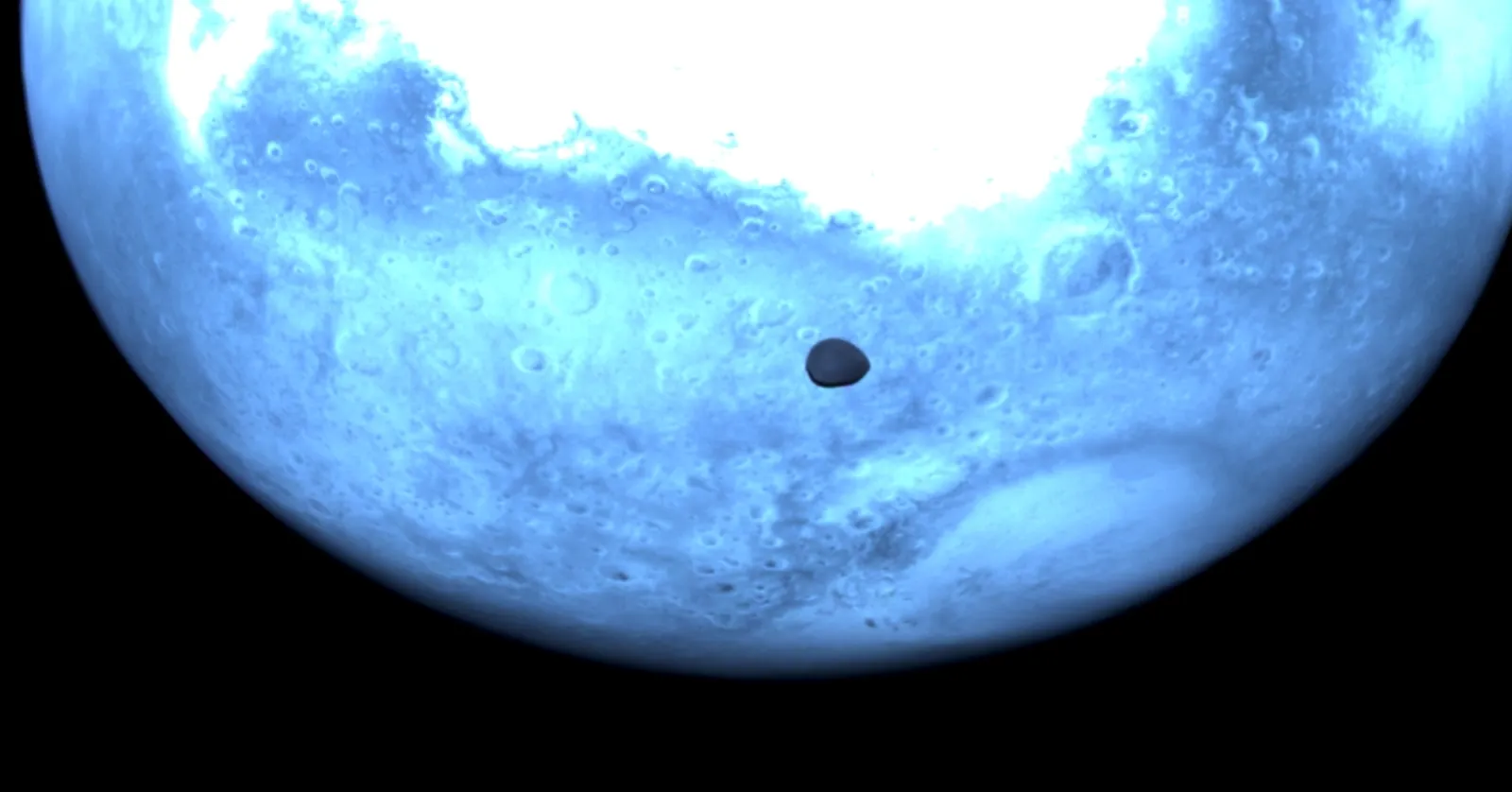
University of Bern simulations and ESA Hera observations point to one non-destructive asteroid impact as the source of Deimos’ southern depression and dusty surface.
Le Samsung Galaxy Book4 joue la carte du PC portable fin, polyvalent et bien équipé. Avec son écran Full HD de 15,6 pouces et Windows 11, il a de quoi réveiller les journées de travail sans alourdir le sac.
Assinantes do Apple TV já podem conferir o primeiro episódio da aguardada sexta temporada de “Slow Horses”, série de espionagem estrelada por Gary Oldman, que retorna hoje.
Aos que nunca deram uma chance para a série, “Slow Horses” acompanha uma equipe de agentes da inteligência britânica, os quais servem em um departamento do MI5 conhecido como Slough House. Oldman assume o papel de Lamb, o brilhante (mas rabugento) líder dos espiões, que acabam indo para a Slough House devido a erros que acabaram com suas carreiras.
Reveja o trailer da sexta temporada a seguir:
A nova parte da produção acompanhará a fuga dessa equipe, enquanto Diana Taverner (interpretada por Kristin Scott Thomas) os envolve em um jogo de retaliação e vingança com riscos e consequências fatais.
Alguns desses nomes, vale notar, marcaram presença na première da sexta temporada, organizada pelo Apple TV na última sexta-feira (11/9) no TIFF Lightbox Theater, em Toronto (Canadá):
Como dito, apenas o primeiro dos seis episódios da sexta temporada foi liberado hoje. Os capítulos remanescentes serão disponibilizados semanalmente, às quartas-feiras, até 21 de outubro.
O Apple TV está disponível no aplicativo Apple TV em mais de 100 países e regiões, seja em iPhones, iPads, Apple TVs, Macs, dispositivos Android, smart TVs ou online — além de estar em aparelhos como Roku, Amazon Fire TV, Chromecast com Google TV, consoles PlayStation e Xbox. O serviço custa R$34,90 por mês, com um período de teste gratuito de 7 dias. Por tempo limitado, quem comprar e ativar um novo iPhone, iPad, Apple TV ou Mac ganha 3 meses do Apple TV. Ele também faz parte do pacote de assinaturas da empresa, o Apple One.
NOTA DE TRANSPARÊNCIA: O MacMagazine recebe uma pequena comissão sobre vendas concluídas por meio de links deste post, mas você, como consumidor, não paga nada mais pelos produtos/serviços usando os nossos links de afiliado.

 Login