A report claims that Samsung's Galaxy S27 Ultra has run into extreme overheating issues with the Snapdragon 8 Elite Extreme Gen 6.
These issues have reportedly caused "throttling" in the device, lowering its performance significant; a problem Samsung has reached out to Qualcomm to solve.
Reports say time is ticking, and if these issues aren't solved, Samsung might have to go with the Exynos 2700.
These issues are familiar, considering Samsung's own chips have struggled in the past with overheating problems, but the Exynos 2600 tried to solve that.
While we're eagerly awaiting the next Ultra flagship from Samsung, a report states the company's run into a problem. The issue lies with its chip and its supposed performance hiccups.
A report late this week by SEDaily (Korean) claims that Samsung's run into problems with Qualcomm's Snapdragon 8 Elite Extreme Gen 6 on the Galaxy S27 Ultra (via SamMobile). Samsung reportedly observed that the chip pushed the phone's temperatures beyond acceptable thresholds. Much like a computer, if the device begins to overheat, performance issues will occur.
Samsung has reportedly experienced "throttling" with the Galaxy S27 Ultra. This hasn't sat well with the Korean OEM. The publication reports that Samsung holds the device to the highest standards and that it must "stably run high-performance cameras, graphics, and AI features" (machine-translated).
Presently, if the S27 Ultra continues to experience issues with the SD 8 EE Gen 6, then Samsung may switch to the Exynos 2700. This is a reality that has yet to happen.
The post states that Samsung has reached out to Qualcomm about these issues. Time is of the essence; however, the OEM has given the chipmaker until "mid-October" to rectify the problems. The problem Samsung experienced is interesting, considering it mirrors the gripes consumers have had with its Exynos series in the past.
Overheating chips
(Image credit: Samsung)
Qualcomm split its flagship chips going into 2027 with the Snapdragon 8 Elite Gen 6 and the 8 Elite Extreme Gen 6. The latter is designed to push the boundaries of mobile phone technology and targets Ultra phones. Qualcomm built the chip on a 2nm process with its new Adreno Neural Fusion technology. This leans on AI to boost graphics performance for gamers during longer sessions.
As we alluded to before, Samsung's Exynos chips were infamous for overheating. We'd like to remind you of the Exynos 2600 from 2025. This chip was a significant step for Samsung in the right direction compared to previous generations. Not only was it the world's first 2nm chip, but its CPU and GPU upgrades were also important. What's more, the company introduced a new Heat Path Block (HPB) to fix overheating and performance issues.
While these overheating fixes did well, Samsung could do better. Rumors about the Exynos 2700 say the company wants to introduce a next-generation HPB, reducing heat generation further.
Android Central's Take
This is textbook tech. If it can output graphic or whatever at a higher strength, it will generate more heat. Look at gaming PCs. Why do you think they have so many fans? Why do you think the graphics card has its own fan—or maybe two or three! There's a chance that Samsung and Qualcomm will have to reconfigure some things in the Galaxy S27 Ultra and the chip. Beyond this, there's also public perception. Samsung hesitates to drop an Ultra with Exynos in the States because it could impact sales.
Then there's overall performance. Can the Exynos 2700 go blow for blow with the SD 8 EE Gen 6?
A rumor claims that Samsung may introduce DC dimming to the Galaxy S27 Pro and S27 Ultra.
The company is reportedly working with "various safety firms" to understand how to reduce eye strain on its future Galaxy phones.
Nicholas Sutrich dove deep into PWM dimming and DC dimming once upon a time, and his feelings side with the latter that's more human-friendly.
Amongst all of the Galaxy S27 series rumors, this one deserves some attention. Rumors claim Samsung might start taking eye strain reduction seriously.
Rumors about this stem from tipster Walle on X, who states Samsung is looking to integrate new eye strain reduction tech into the Galaxy S27 Pro and S27 Ultra (via Android Headlines). The post claims both devices could benefit from DC dimming. It's been reported that Samsung is allegedly beginning to "collaborate" with "various safety firms to understand how to lessen eye strain problems."
Walle adds that these improvements (and more) will arrive for Samsung's Eye Comfort Shield. Currently, you can find this option in your Galaxy device's Display settings. When toggled, your device will limit its blue light by using warmer colors. Moreover, it will automatically adjust your screen's colors based on the time (if set to automatic).
On the surface, this rumor sounds like a win for people who suffer from headaches and eye strain when using their phones for extended periods. But there's more to know, considering Samsung's Galaxy phones already use PWM dimming.
We love using our phones. What hurts is having to stop. Whether you're reading or watching a show or playing a game, the last thing you want is to feel a horrendous headache. If we can have phones that reduce that risk for those prone to it, that'd make the user experience that much better. We're paying hundreds and even thousands for these phones. Why are side effects included?
My former colleague Nicholas Sutrich was the person to go to whenever PWM dimming was brought. But what is it? In Sutrich's own words, "...modern smartphone displays don't dim like they used to, or even like a traditional lightbulb. Instead, they often rapidly turn on and off to fool your eyes into seeing a dimmer image."
This is Pulse Width Modulation (PWM dimming). This is a piece of technology most commonly used in OLED and AMOLED. Sutrich said, "Companies use PWM dimming because OLEDs can exhibit visual problems when trying to dim them like a traditional light source." However, the most clever ones realize they could "just turn it on and off very rapidly, and the human brain does the rest."
While PWM dimming is fine, Sutrich felt that DC dimming is better. DC-like dimming on OnePlus phones activates when your brightness is over 25%. If it dips below this line, the phone reverts to the crazy flickering of PWM dimming. Why? Sutrich said, "This is because, unlike PWM dimming, DC-like dimming never turns the entire display off when it refreshes. There's just a small brightness drop as each pixel is refreshed."
Hopefully we see this change for the Galaxy S27 Pro and S27 Ultra, but who knows.
Googlebook is finally adding Better Together support for Samsung Galaxy phones after leaving them out at launch.
Samsung phones running One UI 9.0 based on Android 17 can access Continue On, Cast My Apps, Quick Access, and Notification Sync.
A separate Google Play services update fixes a pairing bug that leaves the QR code onscreen after a successful connection.
Google is finally addressing one of the biggest issues with Googlebook at launch by bringing some of Googlebook’s Better Together features to Samsung Galaxy phones and making the initial setup less frustrating.
The big draw for the Googlebook is its deep integration with your phone. You can stream mobile apps to the laptop, sync notifications, access phone files, and use Continue On to pick up supported activities on another device. However, Samsung users were left out when Googlebook launched, despite Samsung being one of the biggest names in the Android ecosystem. Google had promised support would come in the next few weeks.
The rollout, as revealed by Google’s Mishaal Rahman on Reddit, is essentially a fix for a pairing bug, but Galaxy owners will need the right software versions before their phones can fully take advantage of the laptop’s Android integration.
This update works with Samsung smartphones with One UI 9.0 based on Android 17. Supported features include Continue On, Cast My Apps, Quick Access, and Notification Sync.
Another separate update to Google Play services should make the setup process easier and fix an annoying bug that sometimes leaves the pairing QR code onscreen even after the phone has connected.
Google says the changes will be rolled out automatically in the coming days via updates through Google Play and background services. To get everything working sooner, make sure Google Play services is version 26.37 or newer and Cross-device services is version 1.0.1346 or newer. Both devices need to use the same Google account, with Bluetooth and Wi-Fi turned on.
Your network can make a difference too. Google recommends using a private home network because connections between devices may be blocked on public Wi-Fi networks at hotels, offices, and cafes. Disabling a VPN or DNS blocker temporarily can also help with pairing issues.
Early feedback indicates the rollout is already making a difference. Some Galaxy S26 Ultra owners have reported that app casting now works while others wait for compatibility on their devices.
The update is a welcome fix but also points to a problem with the launch of Googlebook: core features weren’t ready for a large percentage of Android users. Samsung support would make the platform more convincing if Google can deliver a consistent experience across supported phones.
Samsung is reportedly rolling out its October 2026 security patch to Galaxy S26 users in the U.S.
The patch is ~530MB, and delivers over 60 security fixes for the flagship series.
This October patch arrives a week (or two) after One UI 9 (Android 17) rolled out in the U.S. for S26 users.
Samsung is reportedly rolling out its latest security update for its 2026 flagship phones. There are also expectations for when it could arrive for the Galaxy S25 series.
This week, tipster Kailash on X reported that the October 2026 security patch has started arriving globally on the Galaxy S26 series (via SamMobile). Kailash states the update has reached devices in the U.S. and Canada with a 531MB download. Users will download the following version for the Galaxy S26, S26 Plus, and S26 Ultra, respectively: S948U1UES4BZIG, S948U1OYM4BZIG, and S948U1UES4BZIG.
The patch notes are incredibly light. Samsung only details security improvements once the update hits a user's device. There's a large portion of security fixes rolling out for the series—approaching 50 fixes from Google, to be frank. Samsung includes roughly 13 fixes of its own, pushing that total to 62.
Many of Samsung's fixes involve Android 14 to Android 17. It's rolling out fixes to stop malicious attackers from "executing arbitrary code" or accessing system privileges without permission.
On X, Kailash responded to a user regarding the Galaxy S25 series. These phones may see the update "next week." This may involve a global release as well, which would involve the U.S. and other North American regions. But that remains to be seen. Right now, it's the Galaxy S26 series.
An updated future
(Image credit: Android Central)
The updates are rolling out fast and furious for Samsung (kind of). This is a monthly security update, and Samsung is (typically) punctual with them. However, this update is following the full release of One UI 9 (Android 17) for the latest flagship series. The Android upgrade was spotted for the S26 Ultra in the U.S., but T-Mobile users were among the first to receive it.
The Android 17 update was ~4GB, and it was released in September 2026. That security update was late, likely because Samsung wanted to pair it with the Android 17 update. Other devices, such as unlocked models and users with AT&T and Verizon services, hadn't seen the update at the same time. Those users should have started downloading the update in mid-to-late September.
A fresh leak claims that Samsung's adding a mid-tier Galaxy S27 Pro to its early 2027 roster, slotting between the Plus and Ultra models.
Preliminary U.S. launch targets start at $899 for the base S27, $1,099 for the S27 Plus, $1,299 for the S27 Pro, and $1,399 for the S27 Ultra.
Samsung could reserve its newer M16 OLED panels (and their built-in privacy features) for the Pro and Ultra, leaving the standard S27 and S27 Plus on older M14+ panels.
The Samsung Galaxy S27 lineup could be a relief for shoppers worried about another round of flagship price hikes, but the good news may come with a catch. A fresh leak indicates the company will introduce four models in early 2027, with more sophisticated OLED displays reserved for its two priciest phones.
According to pricing details shared by tipster @phonefuturist on X, the Galaxy S27 could start at $899 in the US. The S27 Plus may cost $1,099, followed by the S27 Pro at $1,299 and the S27 Ultra at $1,399. Pricing is expected to vary internationally, with the Ultra potentially priced as high as $1,499 depending on configuration.
The leaked lineup would be a change for Samsung, which may be adding a Pro model between the Plus and Ultra. The company, though, has not confirmed the phones or their prices, and the tipster describes the figures as preliminary targets.
The more interesting detail is the split display. The regular S27 and S27 Plus are said to come with Samsung’s M14+ OLED panels, while the Pro and Ultra are said to have the newer M16 panels. That difference could see the privacy-display tech included on the more expensive models, while the cheaper-phone buyers miss out.
There is also a financial reason to be cautious. If prices rise, Samsung may have to tweak them pre-launch, possibly negating the perceived savings on the entry-level model. And here’s the awkward flip side: Samsung’s chip business is enjoying a boost from surging AI demand and tight memory supply — but those same market pressures could make its next phones more difficult for regular buyers to afford.
As someone who wants a reliable phone without spending over $1,000, I’d welcome a cheaper standard Galaxy S27. But I’d be annoyed if good screen tech were used as an excuse to push buyers toward more expensive models. Most people shouldn’t have to pay Ultra money to get a premium everyday experience.
These numbers could change as Samsung's next-generation flagship is still months away. Until the company makes an official announcement, buyers should consider the leak as an early pricing guide.
If you're in the market for a new Android smartphone and want a no-nonsense flagship experience with built-in privacy features and productivity tools like the S Pen, the Galaxy S26 Ultra is probably one of the best phones you can buy right now. And thanks to Amazon's Prime Big Deal Days sale, you can grab it at a much lower price than usual.
The Galaxy S26 Ultra is probably one of the best Android smartphone you can buy right now and it is down to a record low price during the Prime Big Deals Day. The company is offering a no strings attached $450 discoun. Just be sure to sign into your Prime account (or sign up for Amazon's 30-day free trial) to enjoy the savings. View Deal
✅ Recommended if: You want a premium Android flagship with a built-in Privacy Display, powerful cameras, S Pen support, and Samsung's latest Galaxy AI features, especially at $450 off.
❌ Skip this deal if: You prefer smaller phones, don't need the S Pen or Privacy Display, or already own a recent Galaxy S Ultra that still works perfectly well.
The Galaxy S26 Ultra has earned plenty of praise for being one of the best Android smartphones of the year. Not only does Samsung offer top-tier specs, premium materials, and a great design, but the company also introduced one of my favorite smartphone features this year with the Galaxy S26 Ultra: Privacy Display.
With Privacy Display, you no longer need a separate privacy screen protector to keep people from peeking at your phone. The Galaxy S26 Ultra has the technology built directly into its display, allowing you to make the screen difficult to see for people looking from the sides. You can even configure it to activate only for specific apps or when sensitive information appears on the screen, such as notifications or when entering your PIN.
(Image credit: Sanuj Bhatia / Android Central)
And that's not all. The Galaxy S26 Ultra is powered by the Snapdragon 8 Elite Gen 5 for Galaxy chipset, which remains one of the most powerful smartphone processors out there. You also get a capable 200MP main camera on the back, alongside the built-in S Pen that lets you quickly jot down notes or annotate things on the go.
Samsung has packed plenty of Galaxy AI features into the phone as well, including conversational photo editing and Now Nudge. One of my favorite additions, though, is My FanCam, which lets you turn horizontal videos into vertical clips with automatic subject tracking, making it particularly useful for creating social media content.
Following the recent price increase, the Galaxy S26 Ultra now starts at $1,400 in the U.S. But Amazon's $450 discount brings it down to just $950 during Prime Big Deal Days. That's a pretty substantial saving and one of the lowest prices we've seen for Samsung's flagship since the price increase.
Samsung has reportedly asked suppliers to cut Q4 smartphone production by 20% to 30%.
The cuts could drop Samsung’s total 2026 production from an expected 270 million units down closer to the 200-million range.
Skyrocketing smartphone DRAM prices are said to be squeezing margins, forcing Samsung to absorb higher manufacturing expenses or risk alienating buyers with steep price hikes.
Samsung looks set to do something counterintuitive in the smartphone market: make fewer phones rather than continue to build devices that barely make money.
Samsung was previously expected to produce around 270 million smartphones in 2026. The latest cuts could push that total into the 200-million range, the report said. Some seasonal slowdown is expected as buyers wait for the next Galaxy S series, but this year's drop is said to be significantly more than expected.
Based on estimates from TrendForce cited in the report, Samsung produced around 240 million smartphones in 2025, which put it on par with Apple as the world’s biggest smartphone maker by volume. This demonstrates the scale that Samsung has been able to hold onto even as competition gets tougher.
The issue apparently has to do with memory chips: Smartphone DRAM prices have skyrocketed, forcing manufacturers to either raise prices or take a hit on their margins.
That makes a dirty equation for Samsung. Raising phone prices too quickly risks cooling demand, while taking on the higher component costs leaves less cash on every device sold. Making millions more of them doesn’t resolve the problem of a phone making little or no profit.
For consumers it could mean fewer low-margin models, higher prices, and even more focus on Samsung’s premium Galaxy lineup.
Samsung has not officially confirmed the production cuts it is reportedly planning, so the next few months will show if the change is a temporary adjustment or a bigger shift in its smartphone strategy.
To get the cheapest Samsung or Google flagship in 2026, you'll need to choose a smaller phone. The Samsung Galaxy S26, for instance, is a 6.3-inch smartphone. If you want to splurge for a 6.7-inch display, you'll need to pay $1,200 for the Galaxy S26 Plus. That's $200 more than than the Galaxy S25 Plus went for, and $100 more than the Galaxy S26 Plus originally cost when it launched in March.
Phones with large screens are expensive, in other words — but the Samsung Galaxy S26 FE is an outlier. It offers the same 6.7-inch screen size as the Galaxy S26 Plus for $500 less, and it's worth your attention for that reason alone. I've used the Galaxy S26 FE for weeks, and it's closer to flagship territory than you may think.
But it also makes a handful of cost-cutting measures to hit that attractive $700 price point, and other phones provide a better value.
The price hike is hard to ignore
(Image credit: Brady Snyder / Android Central)
Samsung's "Fan Edition" phones have always been in a tough spot in terms your wallet will understand. They're typically priced well above Google's midrange A-series models, as well as Samsung's own A-series phones. They're cheaper than Galaxy S series phones, but not by a whole lot. Further complicating matters is that the Galaxy FE phones have a screen size matching the Plus model of the Galaxy S lineup, making them attractive to people who want a larger display.
This year, the Galaxy S26 FE ships with a $50 price hike. That might not raise alarm bells considering the rising prices around the industry, but it should. The Google Pixel 11 and Samsung Galaxy S26 each saw a $100 price increase this year, and buyers get double the base storage in exchange. The Galaxy S26 FE, by comparison, still comes with the same 128GB of storage as standard.
If you want to match the 256GB storage of the rest of the Galaxy S26 series, get ready to pay $100 more for a Galaxy S26 FE. The 128GB model costs $699.99 and the 256GB version costs $799.99. This creates a puzzling lineup where the midrange Galaxy S26 FE and the flagship Galaxy S26 both launched at the exact same price, provided you got 256GB of storage for both.
Samsung retroactively raised Galaxy S26 and Galaxy S26 Plus prices, and the base model now costs $999.99. That does give the Galaxy S26 FE a better value proposition, but only slightly.
I'm starting off with pricing because it's the most important thing about the Galaxy S26 FE. As you'll learn throughout this review, Samsung's new midranger is as solid as ever, and it beats the Galaxy S25 FE in performance. However, it has the base Galaxy S26 and cheaper Android midrangers like the Google Pixel 10a and the OnePlus 13R breathing down its neck.
From a design perspective, the Galaxy S26 FE shares a few similarities with the Galaxy S26 Plus; it's only a millimeter thicker and three grams heavier. Due to the larger bezels, the Galaxy S26 FE has a bigger overall footprint. Reachability is a bit of an issue due to the form factor, as it's both wider and taller than the Galaxy S26 Plus.
On the back, the key difference is the glossy Gorilla Glass Victus Plus. I prefer the matte look and feel of the Galaxy S26 Plus back, and that phone has newer Gorilla Glass Victus 2. But the colors for the Galaxy S26 FE are gorgeous. I reviewed the subtle Pistachio model, but you can also get the phone in Blueberry or Graphite colorways.
The Galaxy S26 FE uses a mix of glass and aluminum for materials, and it's IP68 certified against dust and water ingress. I had no problems with durability, and you shouldn't either. The device feels more premium compared to midrange phones with plastic backs, like the Pixel 10a.
(Image credit: Brady Snyder / Android Central)
The Galaxy S26 FE finds a niche thanks to its 6.7-inch display. It's the same size as the one on the Galaxy S26 Plus, albeit with a lower 1080p resolution. The screen isn't perfect — it has larger bezels, and more importantly, they aren't uniform. The Galaxy S26 FE has a "chin," and the lack of a consistent bezel size is unsightly to my eyes.
The chin has long been a sign you're looking at a Samsung budget or midrange phone compared to a flagship, and I think Samsung could've changed this by now. Google's midrange phone, the Pixel 10a, is cheaper and has uniform bezels.
(Image credit: Brady Snyder / Android Central)
Bezel talk aside, the Galaxy S26 FE isn't nearly as bright as its flagship counterparts. The phone has a peak brightness of 1,900 nits, whereas the Galaxy S26 and Galaxy S26 Plus top out at 2,600 nits. In practice, this means the Galaxy S26 FE won't be as easy to see outdoors. Without an anti-reflective coating, something becoming more popular on flagships, this phone is tricky to view in direct sunlight.
Otherwise, the display feels responsive with a 120Hz refresh rate. It's a fine panel for the price, even if there is clear room for improvement here. This is the exact same display we saw on the Galaxy S25 FE, and the Galaxy S24 FE for that matter. If you have one of these older phones, the Galaxy S26 FE's screen isn't a reason to upgrade.
A fresh chip, but the same slow charging
(Image credit: Brady Snyder / Android Central)
Samsung's midrange phones have come a long way in a few short years in terms of performance. As a refresher, the Galaxy S24 FE had an Exynos 2400e chip and the Galaxy S25 FE got the boost to the regular Exynos 2400 chip. This year, the Galaxy S26 FE runs on the Exynos 2500. It's a mobile processor built on a 3nm process (a major improvement over the 4nm Exynos 2400) that recently powered flagships like the Galaxy Z Flip 7 worldwide.
I tested the Galaxy Z Flip 7 firsthand, so I expected the Galaxy S26 FE to be a strong performer. I didn't expect for Samsung to pull so much extra power out of the Exynos 2500 for the Galaxy S26 FE. In the benchmark results below, you'll see the Galaxy S26 FE not only handily beat the Galaxy Z Flip 7, but also crush Google's Tensor G4-powered Pixel 10a.
Samsung Galaxy S26 FE benchmark results
Geekbench 6 (single-core / multi-core)
Geekbench AI (quantized score)
3DMark Wild Life Extreme (score / fps)
Samsung Galaxy S26 FE (Exynos 2500)
2,362 / 7,848
4,643
5,253 / 31.46
Samsung Galaxy Z Flip 7 (Exynos 2500)
1,849 / 6,822
3,581
4,400 / 26.35
Google Pixel 10a (Tensor G4)
1,707 / 4,512
3,109
2,667 / 15.97
I'm surprised that Samsung is doing that with only 8GB memory onboard the Galaxy S26 FE. The Galaxy S26 FE ships with Android 17 and will get seven years of full Android OS support. Despite the RAM limitations, this phone will be a strong performer for a very long time.
The battery life is rock solid, too. It has the same 4,900mAh capacity as the Galaxy S26 Plus, but the Galaxy S26 FE's lower-resolution display and weaker chip combine to hep you squeeze a longer runtime out of it. The charging, unfortunately, is still too slow. The 45W wired speeds are fine, but 15W wireless charging is disappointing when the Qi2.2 25W standard exists.
(Image credit: Brady Snyder / Android Central)
It's worth revisiting the storage options. The Galaxy S26 FE ships with 128GB of storage by default, and you can upgrade it to 256GB or 512GB at the time of purchase. I think 128GB of storage is starting to stretch users thin because of growing app and operating system sizes. But if you upgrade the Galaxy S26 FE to 256GB or 512GB storage, you end up paying flagship prices for a midrange phone.
It's quite the dilemma, and one Samsung could've avoided by making 256GB standard, like the Galaxy S26 series. If you're fine with a 128GB phone, the Galaxy A57 is lurking in the corner at $599.99, but it does come with additional compromises.
The cameras are underwhelming for the price
(Image credit: Brady Snyder / Android Central)
Samsung isn't one to upgrade its phone cameras often, and the Galaxy S26 FE is no exception. It's using the same 50MP primary shooter, 8MP telephoto, and 12MP ultrawide lens we've seen on prior generations of Galaxy FE phones. The selfie camera is a 12MP, f/2.2 lens.
The telephoto only goes up to 3x optical zoom, but you may find digital zoom to produce passable results beyond that. Here's how the Galaxy S26 FE telephoto camera looks at 2x, 3x, and 10x zoom:
As for the main camera and ultrawide, it's a mixed bag. The 50MP sensor at the heart of the Galaxy S26 FE's rear camera system packs enough detail, and low-light performance is impressive. The photo of the "Aloha" sign in the gallery of camera samples below is as good of a night shot as I've taken recently. And for context, I've been using phones like the iPhone 18 Pro, Google Pixel 11, and Samsung Galaxy Z Fold 8 Ultra.
However, the phone's color science in daylight shots leaves a lot to be desired. Often, there's one part of the image that's brighter and color-saturated, by the overall scene is dark. The beach shots in particular stand out as looking darker as captured by the Galaxy S26 FE than the setting looked in real life.
I don't think the Galaxy S26 FE camera system is terrible, but I do think budget phones like the Pixel 10a and iPhone 17e will produce more desirable photos.
Should you buy the Samsung Galaxy S26 FE?
(Image credit: Brady Snyder / Android Central)
The Galaxy S26 FE only looks competitive on the surface of a smartphone market riddled with price hikes over the past year. Samsung's new $1,000 and $1,200 prices for the Galaxy S26 and Galaxy S26 Plus, respectively, make the Galaxy S26 FE at $700 seem like a discount. I want to emphasize that the Galaxy S26 FE is a great phone that I could absolutely use as my daily driver, despite its compromises.
That said, I still think you can do better. For example, last year's Galaxy S25 is available at the same $700 price as the Galaxy S26 FE at Target and Amazon. It has a smaller screen and battery, but it's a bona-fide flagship with a better camera and chip. If you're willing to compromise on screen size but want a cheaper phone, Google's Pixel 10a stands out. But it justgot a price hike as well, and it's only $100 cheaper than the Galaxy S26 FE.
Looking at the Galaxy S26 FE in isolation, it's a solid phone. With OnePlus on its way out in the U.S., the Galaxy S26 FE represents one of your only options to get a plus-sized Android midranger. If it's important that you get a 6.7-inch Android phone for under a grand, I can recommend the Galaxy S26 FE — just be aware of the drawbacks, and consider your other options.
Samsung
Galaxy S26 FE
A pricey midranger
The Samsung Galaxy S26 FE delivers a 6.7-inch display at a $700 price point, which is worthy of your attention. However, the hardware compromises make cheaper phones like the Google Pixel 10a or last-gen flagships like the Galaxy S25 a more compelling option.
The Galaxy S27 Ultra will reportedly launch in Black, White, Blue, and Light Pink.
These initial options are designated as "base" colors, meaning they should be available through general carrier and retail channels rather than locked to Samsung’s website.
Following Samsung's typical playbook, additional store-exclusive finishes will likely follow at launch beyond the core four.
The rumor mill is already buzzing with Samsung's next high-end flagship, and the latest details are about the color options. According to a new leak, the upcoming Galaxy S27 Ultra will be available in four standard colors: black, white, blue, and light pink.
These colors, as per leaker Ice Universe, are said to be the four “base” colors of the phone. That language may suggest that they're meant for broader retail distribution rather than being exclusive to Samsung's online store.
Exclusive: Samsung Galaxy S27 Ultra base color options:Black, Blue, Light Pink, White.October 5, 2026
The exact shades, however, are still unknown, so there’s still no confirmation whether the blue will be like the Galaxy S26 Ultra’s Sky Blue or if the pink will be anything like its Pink Gold finish.
Samsung could have even more colors in store. The Galaxy S26 Ultra came in four standard colors: Black, Cobalt Violet, Sky Blue, and White, plus Pink Gold and Silver Shadow, which are only available on Samsung's online store. That said, more S27 Ultra color options are a real possibility.
What’s particularly interesting here is the rumor that Pink Gold might be moving from an online-exclusive finish to Light Pink possibly being one of the S27 Ultra’s main colors. If Samsung does release it widely, pink could be a much more prominent color in its Ultra lineup than in recent years.
The color leak also arrives as Samsung is reportedly gearing up for a bigger visual overhaul for the S27 Ultra, including a horizontal camera bar instead of the current camera setup.
Samsung hasn’t officially confirmed the colors or the phone yet. More leaks are expected before the Galaxy S27 Ultra arrives in early 2027.
Carbon is the 4th most abundant element in the universe. It’s everywhere, from the air you breathe to the carbohydrates in your food to the petroleum in the Earth’s crust. Like most elements, carbon was not created by the Big Bang, but came from 2 different types of stars that fuse lighter elements together.
Massive stars at least 8 times the Sun’s mass fuse 3 helium atoms into a carbon atom in their cores, through a mechanism called the triple-alpha process. They eventually expel this carbon into space, either through a stream of material called astellar wind or at the end of their lives during a core-collapse supernova.
Meanwhile, low-to-intermediate-sized stars between ½ and 8 times the Sun’s mass also induce the triple-alpha process. But unlike massive stars, they produce carbon not in their cores, but in a dense shell of helium that surrounds them during an advanced stage known as the asymptotic giant branch or AGB. AGB stars undergo cycles of swelling and contraction, during which they shed some of their material into space.
While scientists understand these processes, the contribution of each star type to the carbon supply in the universe remains uncertain. To address this, a team of scientists modeled how the chemical elements in the Milky Way Galaxy change over time with different contributions from the 2 carbon-creating processes. They then verified their findings by comparing them with the actual carbon concentration in the Milky Way.
To obtain the benchmark for the Milky Way Galaxy’s carbon content, the team turned to the catalog of stars observed by the Apache Point Observatory Galactic Evolution Experiment (APOGEE) survey. They selected 14,066 stars that were large and bright enough to yield reliable data but, unlike AGB and massive stars, were still at a stage of life when their newly produced carbon was still confined to their cores. The researchers used the carbon in the outer layers of these stars, known as subgiants, as a compositional record of the gas from which they formed, thereby estimating the Galaxy’s carbon content during their formation.
The scientists started with a computer program developed by another team that models how the Milky Way’s chemistry changes over time. First, the team calculated the potential amount of carbon produced by different types of stars using estimates from earlier studies. Then, they incorporated these results into a model that accounts for how stars form, fuse elements, and release carbon into the Galaxy, using a simulation program called the Versatile Integrator for Chemical Evolution, or VICE. The researchers ran 14 versions of this model, each assuming a different contribution of carbon from AGB stars relative to massive stars.
In their computer model, the Milky Way Galaxy began as a set of 200 concentric rings, each containing its own population of stars, different speeds at which stars form, and varying amounts of gas available to form new stars. The team then stitched these rings together by having stars migrate between them. They allowed these model Galaxies to settle over 10 billion years, then picked a random sample of 14,066 simulated stars to compare their carbon content with carbon in the same number of observed subgiants from APOGEE.
The team’s model most closely reproduced the actual carbon content of the Milky Way’s subgiant stars when AGB stars contribute between 10% and 40% of the Galaxy’s carbon, with the strongest agreement occurring at 15% to 30%. Even though they found that massive stars are the dominant source of carbon, they also found that smaller AGB stars could produce carbon more efficiently than previously thought, though they take longer to become carbon sources than their larger counterparts.
The team concluded that their estimates of how much carbon comes from AGB and massive stars provide a benchmark for future studies, as the connection between the production of elements inside stars and the processes by which those same stars lose mass remains poorly understood. They suggested that future researchers analyze larger sample sizes, examine other galaxies, and use data from future surveys to better understand the chemical history of the universe.
Astronomers using ESO’s Visible and Infrared Survey Telescope for Astronomy (VISTA) have observed the densest, most crowded regions at the centers of the Large and Small Magellanic Clouds, our Milky Way Galaxy’s closest dwarf companions, offering an unprecedented look at areas that have long resisted detailed study.
Samsung's OneDrive Gallery integration is ending soon, but Google Photos appears ready to take its place.
A new Gallery Cloud Sync service has appeared on the Galaxy Store with support for backing up to Google Photos.
Samsung hasn't announced the Google Photos integration yet, but it could start rolling out within weeks.
Samsung has started laying the groundwork for what appears to be the replacement for its outgoing OneDrive integration, and unsurprisingly, it's Google Photos.
Earlier this year, Samsung announced that users would no longer be able to use OneDrive to back up photos and videos directly through the Samsung Gallery app. Until now, Galaxy users have been able to automatically sync their Gallery photos and videos with OneDrive without needing to use another app or service.
However, that partnership is coming to an end later this month. And now, Samsung appears to be preparing its replacement with none other than Google Photos.
X user Sandeep Adap has spotted a new Samsung service called "Gallery Cloud Sync" on the Galaxy Store, which appears to be designed to take over from the existing Gallery OneDrive Sync integration. The app listing says Gallery Cloud Sync will safely back up your memories, including photos and videos, to "Google Cloud" so you can access them across your devices.
The mention of Google Cloud might sound slightly confusing, but it appears Samsung is actually referring to Google Photos here.
(Image credit: X / That Josh Guy)
User That Josh Guy on X was able to preview the upcoming functionality, which isn't live just yet, and found that Samsung Gallery will offer an option to sync directly with Google. The Gallery settings will reportedly show your available Google storage, let you choose which albums to sync, and offer controls to sync over Wi-Fi or while roaming.
This could be a big change if you currently rely on OneDrive for Samsung Gallery backups, since you'll likely need to switch to Google Photos. That said, the overall experience should remain pretty similar, with the sync controls still built directly into the Gallery app.
The OneDrive sync option has already started disappearing from Samsung Gallery for some users and is expected to be discontinued completely later this month. Thankfully, Samsung's upcoming Google Photos integration looks like it could be an even more natural replacement.
Samsung hasn't officially announced Galaxy Cloud Sync or started rolling out the Google Photos integration just yet. But with OneDrive support ending soon, we expect the new option to become available sometime later this month or in early October.
Samsung introduces the Galaxy S26 series to its Certified Re-Newed program.
The S26 Ultra starts at $1,099 (a ~$200 price drop), while the S26 and S26 Plus start at $759 and $929.
The company highlights that buyers can grab Samsung Care Plus protection with Loss and Theft during checkout for unlimited battery repairs and free screen replacements.
If you're looking to save some money, Samsung announced that its latest Galaxy S26 series is now available in its Certified Re-Newed program.
Today (Sept. 14), Samsungannounced that its Certified Re-Newed program has welcomed the Galaxy S26, S26 Plus, and S26 Ultra. You can view this program as Samsung's refurbished phone line. As always, the company says its "Certified Re-Newed devices offer a like-new phone experience." It has taken in Galaxy S26 devices and equipped them with new (genuine) parts and a "brand-new battery."
A Certified Re-Newed Galaxy S26 Ultra starts at $1,099. This is roughly a $200 price drop from the standard, new flagship starting price (256GB). When it comes to the S26 and S26 Plus, the program shifts these prices to $759 and $929, respectively.
What's more, Samsung says if you are purchasing a Certified Re-Newed Galaxy S26 device, you can add Samsung Care Plus (with Loss and Theft) protection. This protection plan features unlimited battery repairs and free screen replacements.
We're a couple of months early, but Samsung brought the Galaxy S25 series into the Re-Newed program last November. The price drops were fairly similar to what we're seeing this year for the S26 series. Costs dropped anywhere from $150 to $260. The model and configuration (RAM/storage) made the difference here. The "cheapest" option last year was the Galaxy S25 with 256GB of storage for $709.
Joining the Galaxy S25 was the Galaxy Z Fold 6, as well as the Galaxy S25 Edge and the Flip 6.
At the time of writing this post (around 3:15 pm ET), the devices are not listed on Samsung's storefront. That should change. If you're interested, check back later today or perhaps later this week. You shouldn't fret about the refurbished tag; you'll still receive all of Samsung's newest features. Now Nudge and Now Brief were highlighted, and if you're getting the Galaxy S26 Ultra, you'll find the Privacy Display.
Rumors claim we might have a Galaxy Z TriFold 2 in 2027, as Samsung is supposedly moving ahead with development.
The TriFold 2 could feature a "more durable," thinner, and lighter design with a price tag similar to the original model ($2,800).
It's worth remembering the struggles Samsung encountered with the first TriFold (component prices/prices in general) and that it was a "limited release."
The TriFold lasted for three months before Samsung pulled the plug.
It's been almost a year since Samsung debuted its Galaxy Z TriFold. Rumors say there's a sequel on the way next year.
Over the weekend, tipster Lanzuk on Naver stated Samsung is already working on a Galaxy Z TriFold 2 (via 9to5Google). One thing the tipster mentions is the phone's price. Samsung could face issues; however, they claim this supposed TriFold 2 could be priced "similarly" to the original—around $2,899. When it comes to upgrades, Samsung is supposedly looking at three areas.
This alleged TriFold 2 could debut as a thinner, lighter, and "more durable" phone. Looking at what Samsung did with the Galaxy Z Fold 7 (and 8), reducing the thickness of that phone, this rumor strikes a chord. What's more, the idea of a "more durable" TriFold likely concerns its hinge/display for longevity.
Right now, these rumors suggest Samsung is sticking to its "original schedule" of releasing this "TriFold 2" in 2027. Additionally, rumors say Samsung might reveal a "slideable" phone, too. If it's what we presume it is, Samsung has shown off concepts of this type of phone several times over the past few years.
The TriFold was an interesting device. Could you image the price tag of a sequel? If the original was around $2,800, what would part two be? Over $3,000? How many people are willing to throw down $3,000 on a folding phone? That's gaming PC money. That's money put toward something far more important. This is going to be interesting.
Maybe this wasn't so surprising. Samsung always positioned the Galaxy Z TriFold as a "limited release." These rumors about a TriFold sequel mention something Samsung struggled with before: components. Developing the Galaxy Z TriFold was already incredibly strenuous due to high manufacturing and rising component costs. If Samsung is considering a TriFold 2, in the current climate, that might be difficult (on our wallets).
Nevertheless, it remains to be seen how Samsung would treat a TriFold 2. Another limited release might seem strange, but we'll have to see. The Galaxy Z TriFold debuted with a huge, tablet-like 10-inch internal display and a 6.5-inch cover.
Overseas rumors claim Samsung's Galaxy S26 series could see a ~$100/149,000 KRW price increase.
Samsung is reportedly grappling with various issues impacting the phone market (RAM/memory).
This increase has been rumored for Korean consumers; however, Samsung's official statement says nothing is set in stone yet as rumors say this could all happen in October.
Prices are soaring all over the place, whether it's phones or gaming consoles. A recent rumor from overseas says Samsung's latest flagship phones might be next on the list.
A report by Hans Economy (Korean) claims Samsung is mulling over a potential price increase for the Galaxy S26 series (via SamMobile). According to the publication's sources, Samsung is now facing "difficulties" with "maintaining its existing pricing structure." The post alludes to the current stress placed on the phone industry: RAM and memory prices. With that in mind, Samsung is supposedly increasing its Galaxy S26 series prices by ~$100 (USD)/~149,000 KRW.
If this happens, it would push the Galaxy S26 to a ~$999 starting price, and the Galaxy S26 Ultra to ~$1,400. The post claims a mobile carrier started informing consumers about an impending price hike for the Galaxy S26 series. Here's the thing: nothing is confirmed. In fact, Samsung provided an official comment to Hans Economy about these rumors.
The company states that while it has been "internally reviewing" the idea of "adjusting" prices, "nothing has been finalized as of now" (machine-translated).
There's more to consider with these rumors. On one hand, it was suggested that Samsung could hike S26 prices in October for Korean consumers if its internal review finds success. However, it's unclear how widespread this hike could be—meaning it's not clear if the U.S. would see it, too.
Prices are soaring
(Image credit: Derrek Lee / Android Central)
Let's not kid ourselves, Samsung (technically) already raised prices for the Galaxy S26. It was around the time the series debuted earlier this year. Compared to the S25 and S25 Plus, the S26 and S26 Plus cost roughly $100 more. The S26 Ultra's price remains the same compared to its past-gen counterpart. However, despite the price hikes to the first two models, Samsung's phones still performed well.
Specifically, the Galaxy S26 Ultra performed the best. According to early analytics, the Galaxy S26 Ultra achieved 71% of sales in the first three weeks. This year's Ultra has a lot going on, like the Privacy Display, so that might've helped.
And since we're talking about Samsung price hikes, it's hard not to bring up the horrendous streak it went on in the U.S. in April. Someone needs to save our wallets, because Samsung's Galaxy tablets were hit hardest. The Galaxy Tab S11 Ultra (1TB) jumped by $280 earlier this year to $1,899.
Android Central's Take
Price hikes are becoming quite the unsettling "norm." Looking at devices in a smart way has never mattered more. We might love to chase after "what's new," but when it starts hitting your wallet, you'll reconsider. Not everyone's in that sort of position where they can chase after every new phone or what-have-you. To be honest, it is that majority that gives companies pause. If they drop out, that's when they're in trouble.
A reliable tipster says the rumored 50MP 4x telephoto with a large 1/1.9-inch sensor may not make it to the Galaxy S27 Ultra.
The upcoming phone is said to retain a 5x periscope with a smaller 1/2.52-inch sensor.
Samsung may ditch the dedicated 3x telephoto camera entirely, leaving the 5x periscope as its sole zoom hardware.
Samsung’s Galaxy S27 Ultra is reportedly getting a major zoom rethink after recent rumors suggested a 50MP 4x telephoto with a much larger 1/1.9-inch sensor. The supposed plan was to swap out the familiar 3x and 5x cameras for a single, larger sensor that could handle more of the zoom range.
Now that upgrade seems a lot less certain. Ice Universe claims on X that the Galaxy S27 Ultra will instead feature a 5x periscope camera with a 1/2.52-inch sensor, which would be pretty much the same sensor size as the one used by recent Ultra models. The competing 4x rumor was described as false, suggesting Samsung could remove the 3x camera while leaving the 5x unit as its only dedicated telephoto.
Don't believe that source, which has a long history of spreading false information.The Galaxy S27 Ultra will, of course, continue to use a 1/2.52-inch sensor for its 5x periscope telephoto camera.The recent claim that Samsung will "drop the 5x telephoto and switch to a…September 14, 2026
Samsung has a practical reason for going the safer route. The 5x module is already compatible with the company’s existing camera strategy, but a switch to a new 4x system would mean spending more on sensor development, optics, tuning, and production. If the difference isn’t dramatic enough, it may make more financial sense to stick with proven hardware.
Plus, native 5x optical reach means you'll still get sharp long-range detail at 10x and above with high-resolution sensor cropping, something a 4x lens can have a hard time with when pushed to high magnification.
But that doesn’t mean the 4x idea was for nothing. A 1/1.9-inch sensor would be much larger than the 1/2.52-inch 5x component, possibly allowing for cleaner zoom shots, enhanced low-light performance, improved dynamic range, and stronger portraits.
For now, the safer bet is one 5x telephoto with the 200MP main camera for lower zoom levels. Samsung has time to change course before launch, and with multiple S27 Ultra prototypes reportedly under evaluation, the final camera setup may not be set in stone yet.
The real test for Samsung will be whether its image processing can compensate for not having a bigger sensor if it sticks with the old 5x hardware. Otherwise, axing the 3x camera could be viewed as Samsung simply cutting the spec sheet.
There's a lot to like in the Galaxy Z Fold 8 Ultra, and although Samsung didn't make too many changes this year, the bigger 5,000mAh silicon battery means the foldable lasts considerably longer than its predecessor.
Thankfully, there's an easy way to boost the battery life even more. Samsung offers performance profiles within One UI, and I switched over to the Light mode, netting me a decent uptick in battery life. So let's take a look at what the mode has to offer, and why you should consider using it.
Standard vs. Light profiles: Is there a difference?
By default, all Samsung phones run the Standard profile out of the box, but there's a Light mode that's designed to prioritize battery life and thermal efficiency. These performance profiles are located in the Device care section, and you can easily switch between the two as needed.
Unlike Energy Saver mode, the Light profile doesn't actually make a difference in regular daily use. You still get 120Hz refresh and similar levels of fluidity when navigating the UI or browsing. What is does instead is reduce the clock frequencies of the processor, so it isn't using as much power all the time. This is absolutely fine on a high-end foldable, as Qualcomm's latest-gen silicon has plenty of power to spare.
As I said, I didn't see any difference after switching to the Light profile, and the device continued to be lag-free even while multitasking. Notably, the profile is only active in regular use; if you launch a game, it uses Game Booster (which is another thing entirely), so you don't need to limit the hardware if you play games regularly.
There's a clear benefit to using the Light profile. I got close to an additional hour of usage (not SOT) over the course of a day, and it meant I didn't need to plug in the phone until the end of the day. It particularly makes a difference with outdoor use, as the profile does a good job balancing thermals.
Switching between the Standard and Light modes is as easy as it gets. This is how to do it:
Go to Settings.
Navigate to Device care.
Select Performance profile.
Choose Light.
That's all there is to it. The best part about this is that the feature is available on all Samsung devices, so if you're using an older Galaxy phone and need it to last a little longer, you should give it a try.
TL;DR: Forget the iPhone 18 Pro, you can score $1,100 off the Galaxy S26 Ultra when you add a line with an eligible unlimited plan at T-Mobile deal.
Apple unveiled the iPhone 18 Pro earlier this week, and for folks who are tempted to try it out: I get it. Even as a representative of Android Central, I have to admit that the 18 Pro is going to give the Samsung Galaxy S26 Ultra a run for its money when we start ranking the best smartphones of 2026.
The iPhone 18 Pro utilizes a new A20 Pro chip that might match the performance of the Galaxy S26 Ultra's Snapdragon 8 Elite Gen 5 processor (time will tell), plus the Apple device boasts a larger battery and the ability to shoot video with Dolby Vision support. On the other hand, the Samsung Galaxy S26 Ultra is considerably lighter than the iPhone, and you get unique features like Privacy ID and an embedded S Pen stylus.
It's a close race, and it's one of those debates that will probably be raging for many months to come. While the tech sites sort it out, there's probably only one factor that really matters to you: whether or not you can get a good deal.
Purchase the Samsung Galaxy S26 Ultra with a new line on the Experience More or Experience Beyond plan and T-Mobile will give you $1,100 in promo credits over 36 months. That knocks the price of the premium flagship down to just $5.56 per month, no trade-in required.View Deal
Both of the unlimited plans included in the T-Mobile promotion give you unlimited talk, text, and premium data on the carrier's vast 5G network, a high-speed mobile hotspot, and a ton of international benefits. Going with the more-expensive Experience Beyond plan also gets you free Hulu and Netflix streaming, plus access to the same deals that are usually exclusive to new customers.
The Experience More and Experience Beyond plans start at $90 and $100 per month for a single line, respectively, but you can drop that price down considerably by adding multiple lines and using AutoPay. Adding four lines of the Experience More plan, for instance, will drop the price down to $42.50 per month for each line ($170 total).
The fact is, both the Galaxy S26 Ultra and the iPhone 18 Pro are excellent smartphones with prohibitively expensive price tags. Regardless of the device you choose, you're going to want a good deal, and this Galaxy S26 promo from T-Mobile is one of the best on the web today.
Whether you've just joined the foldable revolution or you've been a long-time foldable phone user, you're probably already aware of how amazing it is to have a mini tablet that folds and fits easily in your pocket. That feels more true than ever since the Galaxy Z Fold 8 came along.
But did you know that your Galaxy Z Fold 8 isn't just a massive canvas for one big app? Samsung makes it easy to run more than one app on your screen at once, and a handful of nifty new multitasking features on the Galaxy Z Fold 8 line further enhance what was already one of the best multitasking experiences in the business.
Whether you want to juggle two apps more efficiently, use a 3-way split screen, or run even more apps at once, the Galaxy Z Fold 8 is a great way to get things done without a laptop or another larger device.
The taskbar is the key
When you open your Galaxy Z Fold 8, you've probably seen that little floating taskbar appear at the bottom of the screen. By default, this taskbar isn't meant to stick around for long, but one setting changes that.
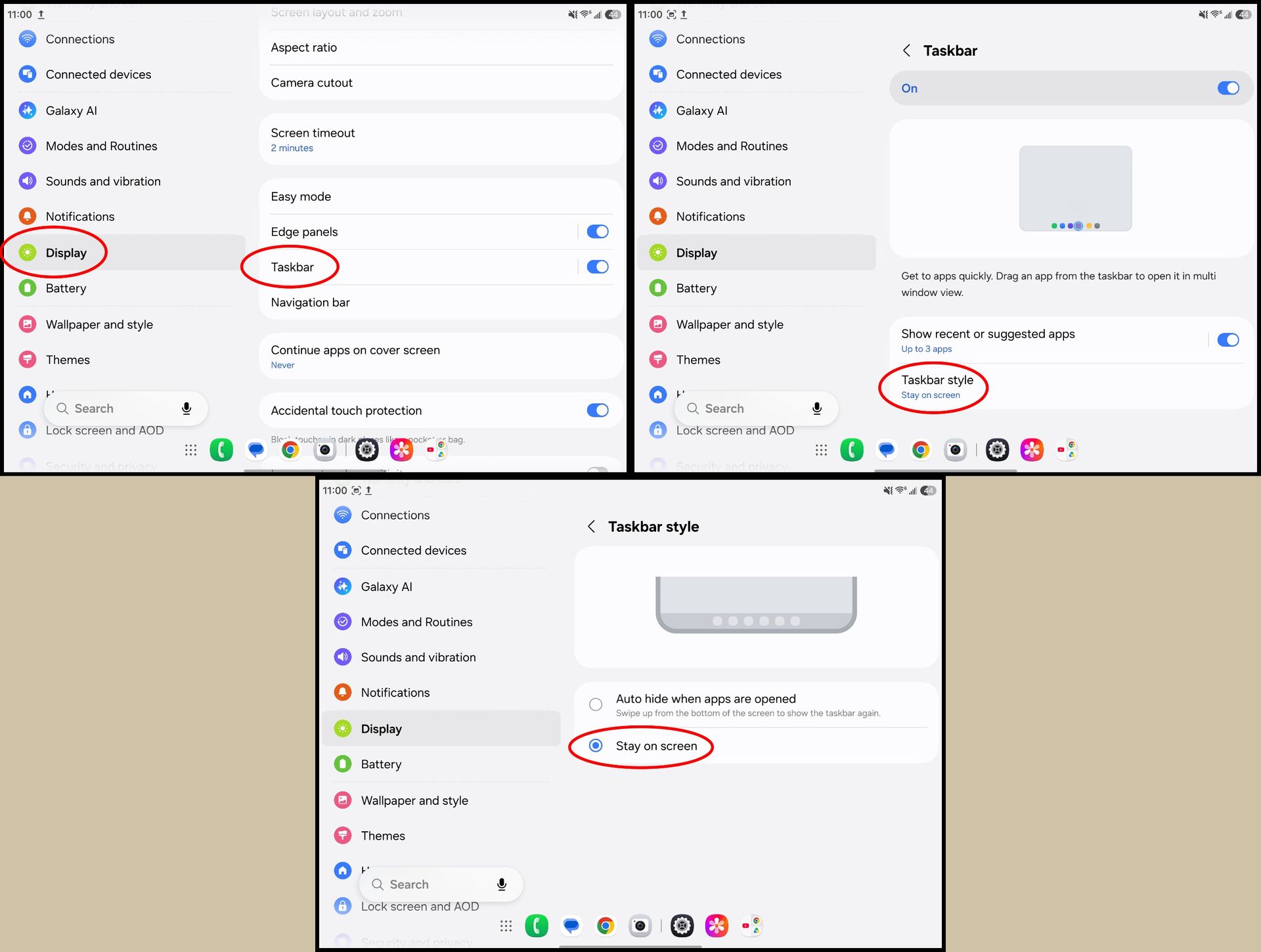
By pinning the taskbar, you can effortlessly open multiple apps at once, or quickly juggle between apps faster than you can by constantly going back to the home screen. Here's how to supercharge the taskbar:
1.Unfold the phone to use the larger inner display.
2. Open the Settings app.
3. Scroll down and tap Display.
4. Scroll down and tap Taskbar.
5. Tap Taskbar style.
6. Select Stay on screen.
(Image credit: Android Central)
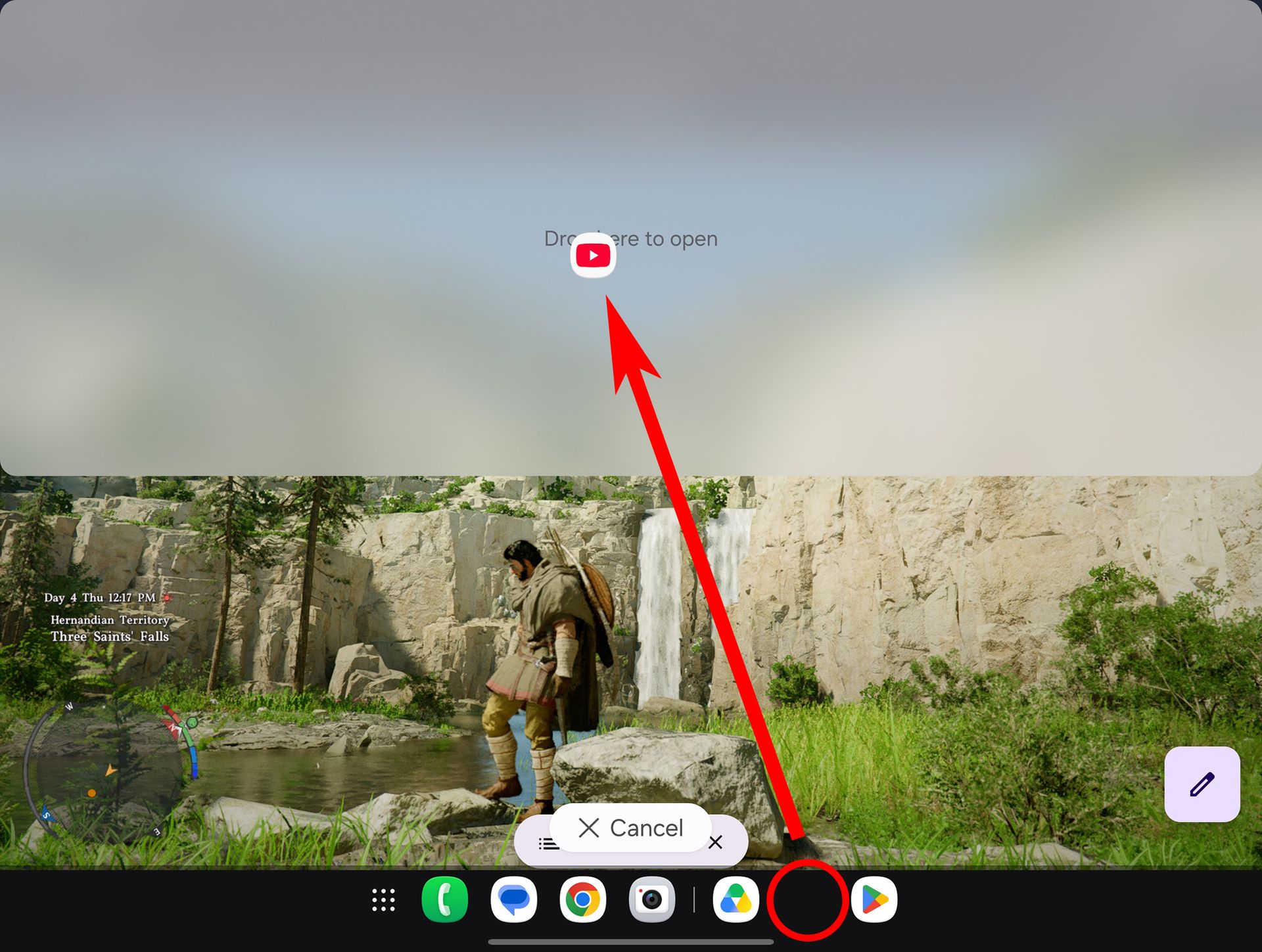
Now, the taskbar will always be visible on the inner display. You can tap any app icon to open that app, but the real magic happens when you press and hold an icon, then drag it around the screen. This lets you easily launch multiple apps at a time and split them any way you want.
Splitting the action
(Image credit: Nicholas Sutrich / Android Central)
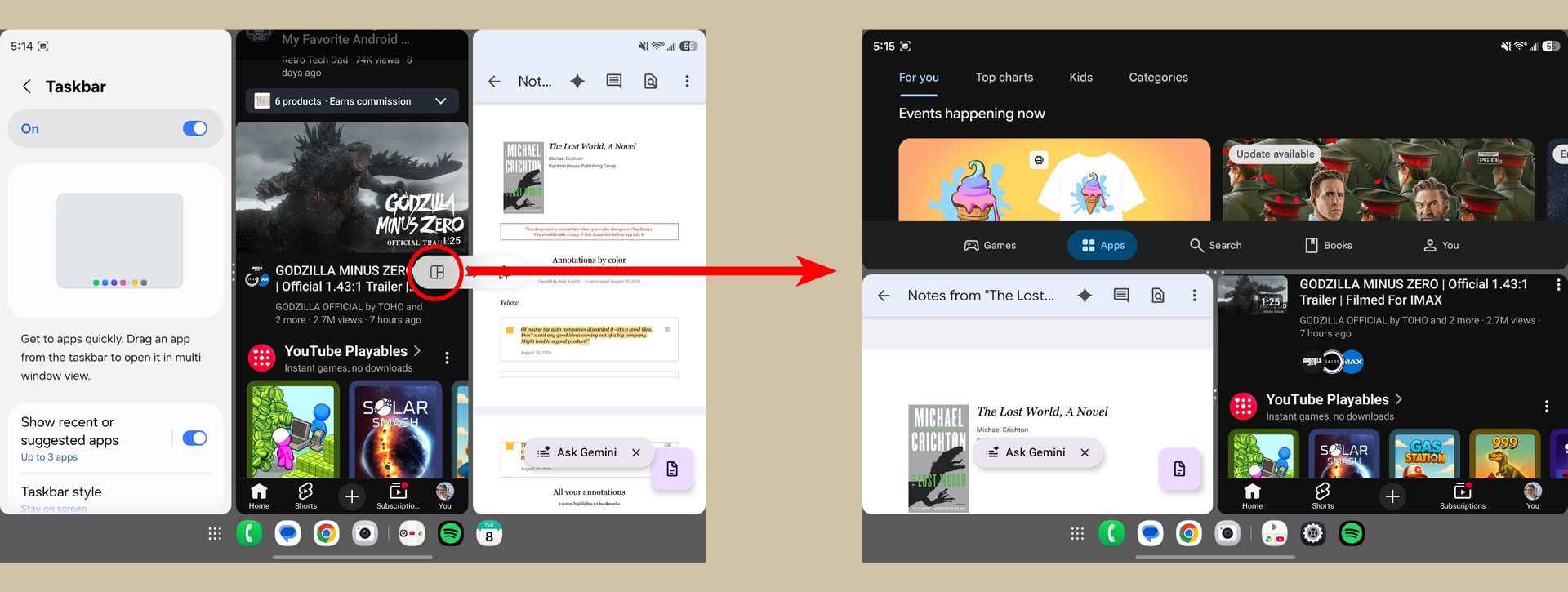
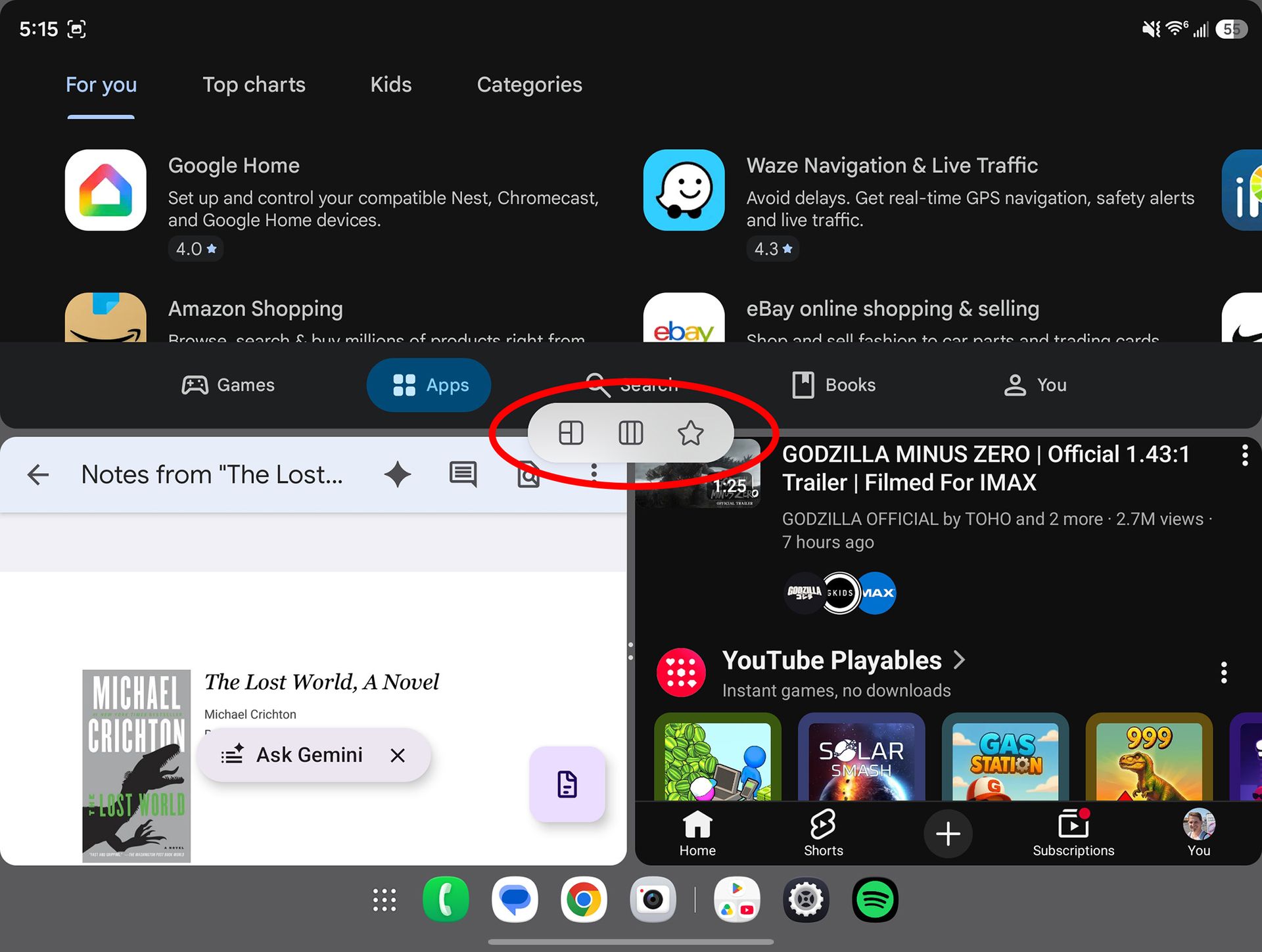
Samsung launched two new multitasking features with the Galaxy Z Fold 8, including 3-way split screen and a new way to juggle between layouts. To get started, choose three apps you want to run side by side. For this example, I'm using YouTube, Chrome, and Google Docs.
1.Unfold the phone to use the larger inner display.
2.Open any app of your choosing. I started with Chrome.
3.Press and hold another app's icon, then drag it to any side of the screen. You'll see indicators to snap the app to a specific area on the screen.
(Image credit: Android Central)
4. Choose another app from the taskbar. If you don't see the app you want, tap the app drawer button on the left side and choose it from there.
5. Drag this new app to a third section of the screen. Your Galaxy Z Fold 8 will show indicators for where you can drop the app.
(Image credit: Android Central)
Now that you have three apps running at once, you can play around with the layout. Most commonly, this means three apps run side by side, but Samsung offers many layout options. Personally, I think three apps side-by-side makes them a bit too small to be useful, and that's where we'll start.
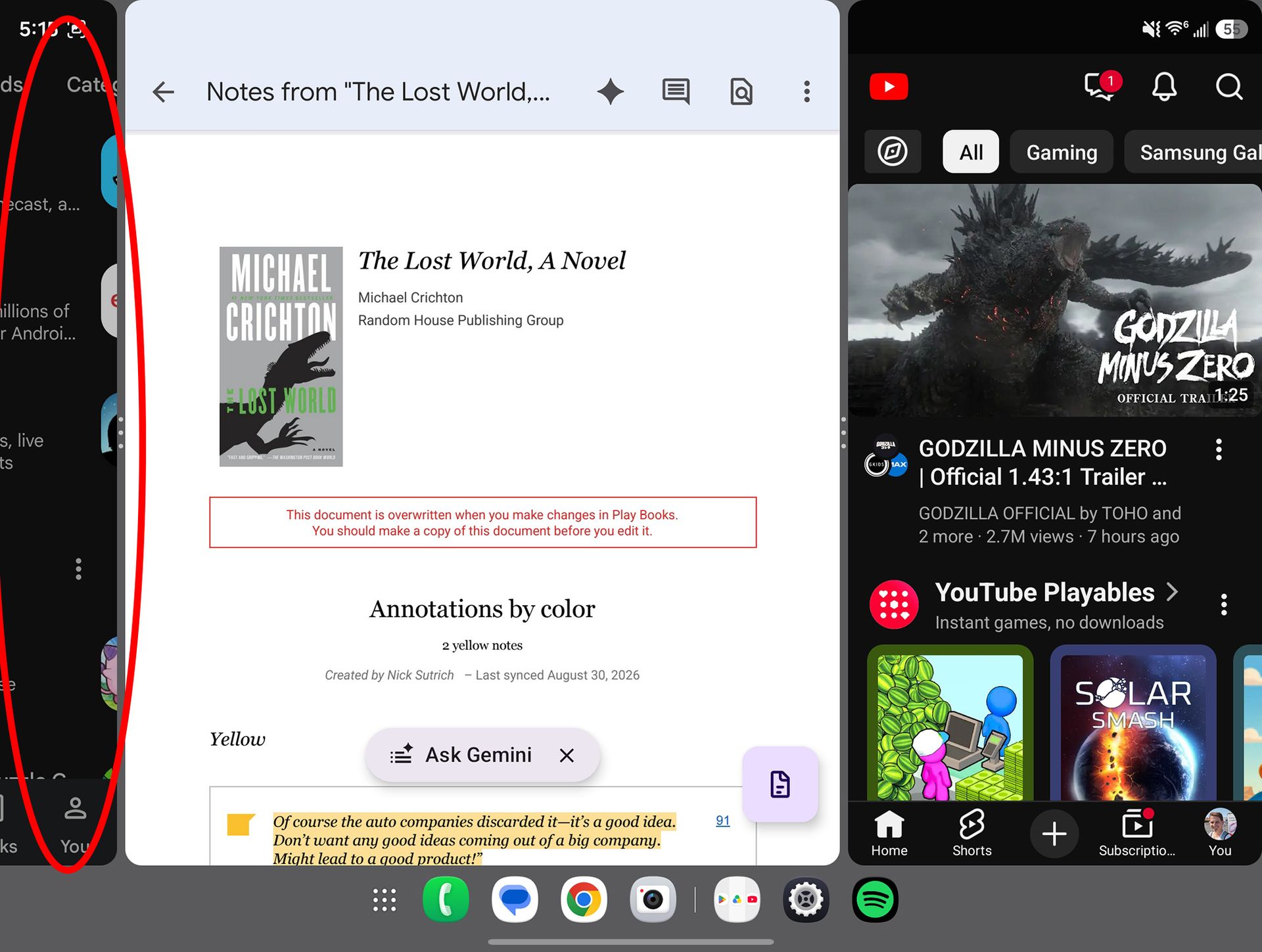
To enlarge an app, grab any separation bar by the "handle" — the part with the dots — and drag it outward. When running three apps at once, this will enlarge one app while leaving the others at the default size.
(Image credit: Android Central)
Here's the coolest part about this setup: when you've got multiple larger apps running at once, the others will hang "off to the side." That lets you run nearly full-screen apps and quickly switch between them by just tapping the app that's off to the side.
But if you want all the apps on one screen and don't want them all vertical, tap any of the "handles" — remember, that's the part of the separator line with the dots — then tap the grid icon that appears. Your apps will now be separated into one half-sized app alongside two quarter-sized apps.
(Image credit: Android Central)
Tapping the handle also brings up additional options. You can easily swap apps between frames by tapping the handle between those two apps, then tapping the "swap" arrow icon. Additionally, you can tap the other grid icon to swap the location of the grid. That lets you move quarter-sized apps from the left to the side half of the screen, and vice versa.
You can even hover an app by dragging the app icon to the center of the screen, letting you run four or more apps at once, similar to a desktop OS. Which layout is your favorite? Let us know in the comments!
It's official: Apple's first ever iPhone foldable has been unveiled, but why wait for that October release date when you can still get the Galaxy Z Fold 8 for FREE with T-Mobile's latest deal? Process a trade-in and add a line with the Experience Beyond plan and T-Mo will give you the passport-style Samsung Galaxy Z Fold 8 for free, weeks before the iPhone Duo even goes on sale.
Don't have anything to trade in? Skip that part of the process and you can still score $1,100 off the Galaxy Z Fold 8 when you add a line with the Experience More or Experience Beyond plans on T-Mobile's website.
Sure, T-Mobile's Experience plans aren't exactly cheap, but when I'm looking at grabbing a $1,900 smartphone, I'll take just about any deal I can get. It doesn't hurt that they are also two of the best unlimited plans in the business. If you're interested in one of the most innovative phones of 2026 and you were planning to update your wireless service anyway, this deal is worth grabbing ASAP.
Forget the iPhone Duo: grab a FREE Galaxy Z Fold 8 with trade at T-Mobile
Trade in an old or broken phone and add a line with the Experience Beyond plan and T-Mobile will give you up to $1,900 off the new Samsung Galaxy Z Fold 8, enough to make the innovative foldable phone completely free!
Don't have anything to trade in? Skip that part of the process altogether and you'll still enjoy $1,100 off the phone with any Experience plan, or you can save $900 by adding a line with "most plans" on T-Mobile's site. View Deal
Samsung just unveiled the Galaxy Z Fold 8 (alongside the Z Fold 8 Ultra and Z Flip 8) during a Galaxy Unpacked event a few months back, and the phones are already turning heads. For starters, it's hard to describe the Z Fold 8 as a true successor to last year's Galaxy Z Fold 7, as Samsung has given the phone a shorter and wider, "passport-style" design.
This new look makes the phone easy to pocket and use with one hand while folded, while unfolding the device gives you an experience akin to an Android tablet. And as usual, the foldable phone's two AMOLED display are absolutely stunning and smooth as butter.
Under the hood, you still get the powerful Z Fold experience that we've all come to know and love, with a Snapdragon 8 Elite Gen 5 chipset, 12GB of RAM, and all of the latest AI-boosted software tricks. The phone does clock in at $1,899, however, so deals like the T-Mobile promotion above are essential.

 Login