❌

Reading view

First-Generation Stars Provide Better Fit than a Black Hole for Early-Universe Gas Clump

Star formation in the early universe.

An unusual clump of gas 450 million years after the Big Bang may contain stars hailing from the universe’s elusive first generation of stars. New research examines an alternative explanation involving an accreting black hole.

Meet Hebe

Hebe and GN-z11

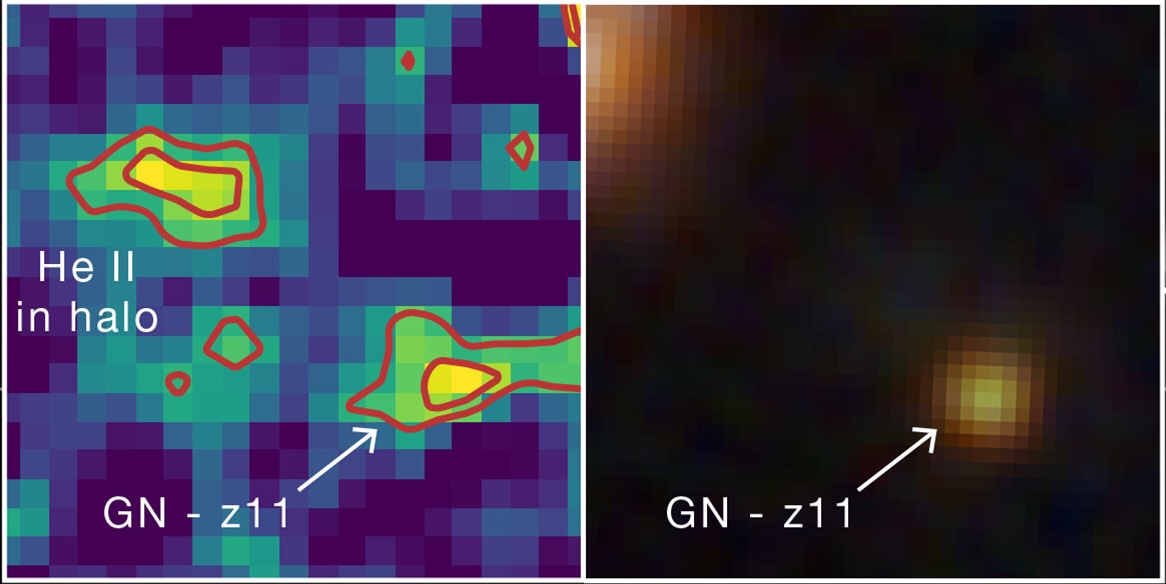
Hebe is visible in the image on the left as a prominent blob of helium emission up and to the left from GN-z11, a luminous galaxy hosting an accreting supermassive black hole. On the right is an infrared image of the same region, in which Hebe is not visible. Click to enlarge. [Adapted from NASA, ESA, CSA, Ralf Crawford (STScI)]

Initially spotted in 2024, an early-universe gas clump nicknamed Hebe has now been identified as a possible hiding place of Population III (Pop III) stars — the universe’s first generation of stars. Pop III stars are thought to be massive and chemically pristine, containing only hydrogen, helium, and a whisper of lithium. This exciting hypothesis was prompted by the detection of recombination lines from helium, which could be ionized by the high-energy radiation of the first stars.

Before the community settles on this exciting explanation, however, the hypothesis must withstand all the tests astronomers can throw at it. In a recent research article, Junehyoung Jeon, Tae Bong Jeong, and Saiyang Zhang (The University of Texas at Austin) along with Volker Bromm (The University of Texas at Austin) attempted to explain Hebe’s properties in another way.

Considering Alternatives

Hebe glows with distinctive helium emission that requires a source of high-energy radiation. This radiation could be provided by a cluster of Pop III stars, but it could also, in theory, arise from an accreting supermassive black hole embedded within the gas clump.

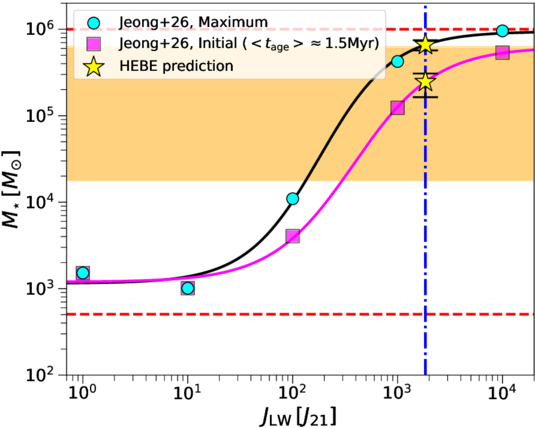
predicted Pop III star mass in Hebe

Predicted total mass of Hebe’s Pop III stars as a function of the Lyman–Werner flux from the nearby galaxy GN-z11. Click to enlarge. [Jeon et al. 2026]

The authors used models to explore both possibilities. For the first scenario, in which the telltale helium emission is driven by a cluster of Pop III stars, the team calculated the maximum possible mass of the cluster, which sets how much high-energy radiation is produced. The cluster mass is moderated by high-energy radiation from another source: GN-z11, a starburst galaxy situated about 10,000 light-years from Hebe. For the second scenario, the team modeled the spectral energy distribution arising from a supermassive black hole — either a direct-collapse black hole or a primordial black hole — accreting pristine gas from the surrounding cloud.

Still a Leading Explanation

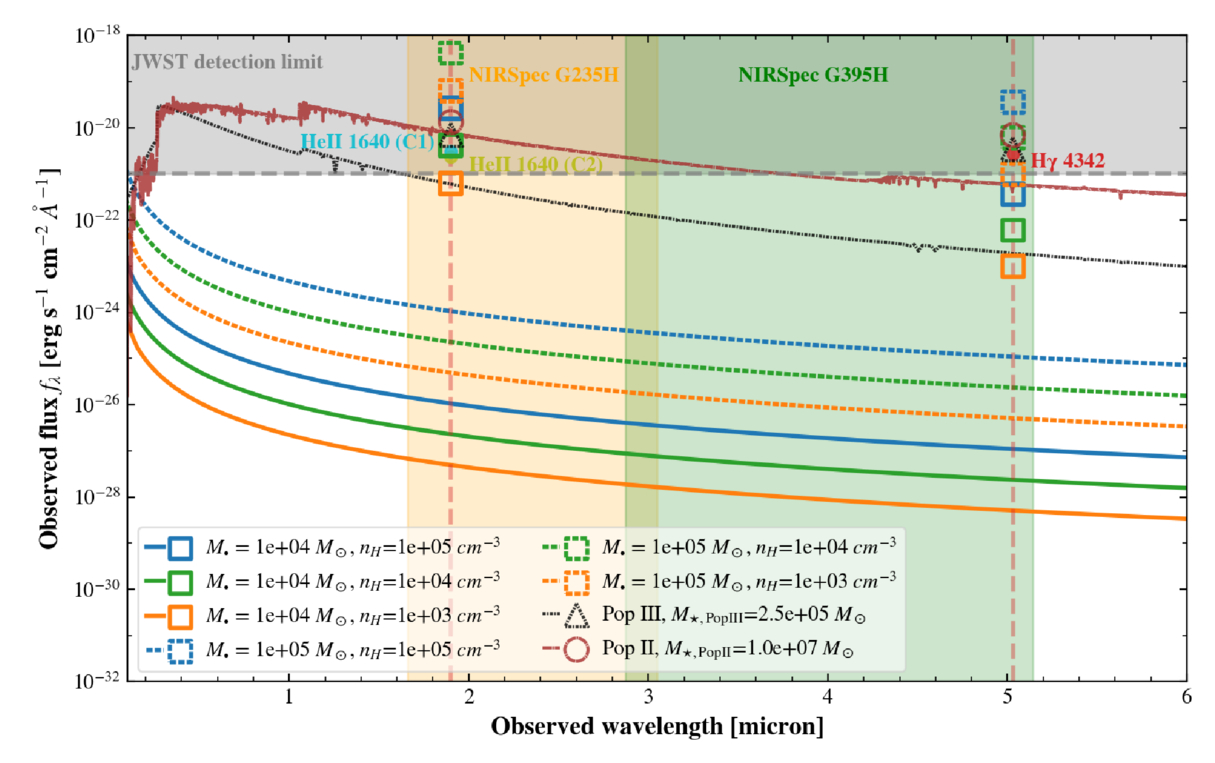
While the black hole scenario could, with reasonable black hole masses, gas densities, and accretion rates, reproduce individual flux measurements drawn from JWST observations, this hypothesis struggled to simultaneously match multiple measurements. The Pop III star cluster scenario, with a cluster mass of a few hundred thousand solar masses, provided the best fit to the JWST data.

modeled spectral energy distributions for Hebe based on the black hole or Pop III star hypotheses

Modeled spectral energy distributions (lines) and predicted line flux densities (open symbols) for the accreting black hole, Pop III star, and Pop II (second-generation) star hypotheses. The observed JWST line fluxes are shown as filled circles. Click to enlarge. [Jeon et al. 2026]

As a final test, the team introduced a third possibility involving a population of second-generation stars, which are more chemically enriched than Pop III stars. While this model fit well, the number of stars necessary to match the data — roughly 10 million — would produce a stellar continuum detectable (but so far not seen) by JWST.

While a cluster of Pop III stars is still the leading explanation for Hebe’s properties, the team noted that the Pop III star and black hole hypotheses aren’t mutually exclusive; Hebe could very well harbor a primordial black hole and a smattering of Pop III stars. Regardless of what powers its characteristic helium emission, Hebe offers an enticing glimpse into the early universe, and more work is needed to understand this intriguing object.

Citation

“What Is Powering the Enigmatic He II Emitter Hebe: The First Stars or Black Holes?” Junehyoung Jeon et al 2026 ApJ 1006 27. doi:10.3847/1538-4357/ae7bea

The post First-Generation Stars Provide Better Fit than a Black Hole for Early-Universe Gas Clump appeared first on AAS Nova.

  •  

Euclid Discovers Earliest Quasars Ever Seen

This collage shows 15 of the 31 newly discovered quasars by ESA’s Euclid space telescope. EUCL J172902.75+641018.1 and EUCL J125308.55+705432.3 are visible on the first row, the first and second from the left, respectively. Image credit: ESA / Euclid / Euclid Consortium / NASA / Euclid Science Ground Segment / Antoine Basset, CNES.

Astronomers using ESA’s Euclid space telescope have discovered 31 ancient quasars from a time when the Universe was just 670 to 800 million years old. One of these objects, dubbed EUCL J172902.75+641018.1, sets the new record for the most distant quasar ever reported.

The post Euclid Discovers Earliest Quasars Ever Seen appeared first on Sci.News: Breaking Science News.

  •  

ESA’s Euclid Telescope Just Spotted Two Record-Breaking Ancient Giants Among the Most Remote Objects in the Cosmos

The European Space Agency’s (ESA) Euclid Space Telescope has just revealed new evidence for the existence of more than two-and-a-half dozen objects that are among the oldest and most remote in the universe.

These 31 massive objects, known as quasars, rank among the oldest objects astronomers have ever seen, including two that are believed to originate from a period in the universe when our cosmos was only 5% of its current age.

The discoveries, revealed in a new study appearing in the journal Astronomy & Astrophysics, provide a remarkable look at the earliest generations of galaxies, as well as a rare look at the dynamics of the ancient black holes that once powered them.

Quasar Questions

As some of the brightest objects anywhere in our universe, quasars are remote objects resembling stars in appearance that emit unprecedented amounts of energy. They are the result of creation processes that involve enormous quantities of gas and dust, which spiral into supermassive black holes.

During the gravity-driven inward acceleration process, immense friction causes temperatures that can reach millions of degrees, which generates large amounts of energy. The resulting celestial features produce enough light to outshine entire galaxies.

Despite their brightness, the 31 newest additions to our growing collection of known quasars were difficult for astronomers to spot, given their extreme distances from Earth. The light that documents their ancient presence in the universe has traveled more than 13 billion years to make its way here, causing it to be extremely faint, and thereby very difficult to distinguish from surrounding stars whose light normally outshines them with ease.

Rotating Quasars from the Early Universe

A dozen of the newly discovered collection of quasars date to within the first 770 million years our universe existed. Add to that the fact that two of the ancient objects are believed to have formed just 670 million years after the Big Bang—at such ages, these quasars are among the oldest astronomers have ever observed.

The weight of the discoveries goes beyond just record-breaking astronomical observations, since the data they provide could help astrophysicists unravel some of the most enduring mysteries of cosmology. For instance, these quasars could help to reveal answers to questions about how supermassive black holes grew so quickly while the universe was still in its infancy.

Additionally, studying these energetic ancient giants could help to provide new insights into the formation of the earliest galaxies and the evolution of the universe while it was still in its relative infancy.

Answering Questions About the Cosmos

The recent research, led by the ESA and with contributions from its partners at NASA, has helped to place the Euclid mission in an ideal place to carry out its mission of mapping billions of galaxies. Doing so may help scientists uncover clues about the questions surrounding mysterious dark energy, which is widely believed to be the force behind the accelerating expansion of the cosmos.

Additionally, the Euclid mission’s findings could be pivotal in helping shape the future work of NASA’s Nancy Grace Roman Space Telescope, which will continue the quest to unravel the nature of dark energy and help astronomers understand the nature of the universe at large scales. Additional details about the recent quasar discoveries by Euclid can be found at the ESA’s website and on NASA’s FAQ page.

The new findings were detailed in a recent study, “Euclid: Discovery of 31 new quasars at 6.6 < z < 7.8” published in Astronomy and Astrophysics. 

Micah Hanks is the Editor-in-Chief and Co-Founder of The Debrief. A longtime reporter on science, defense, and technology with a focus on space and astronomy, he can be reached at micah@thedebrief.org. Follow him on X @MicahHanks, and at micahhanks.com.

  •  

Interstellar Comet 3I/ATLAS Formed Up To 12 Billion Years Ago, New Observations Suggest

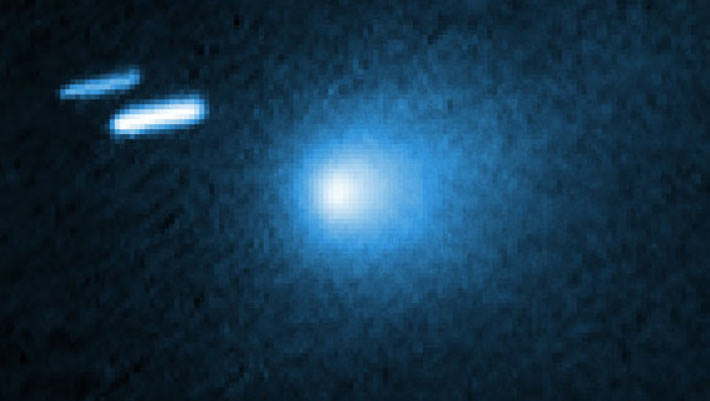
Hubble captured this image of 3I/ATLAS on July 21, 2025, when the comet was 446 million km (277 million miles) from Earth. Image credit: NASA / ESA / David Jewitt, UCLA / Joseph DePasquale, STScI.

The interstellar comet 3I/ATLAS carries a chemical fingerprint unlike anything in our Solar System, and it may have formed 10 to 12 billion years ago, before our Sun even existed, according to two papers published in the journal Nature.

The post Interstellar Comet 3I/ATLAS Formed Up To 12 Billion Years Ago, New Observations Suggest appeared first on Sci.News: Breaking Science News.

  •  

Astronomers Trace Elusive High-Energy Neutrino to Star-Forming Galaxy in Early Universe

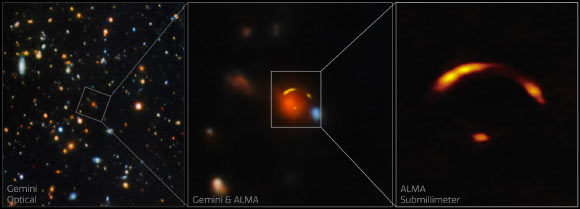
The origin of high-energy astrophysical neutrinos remains unresolved, and secure electromagnetic counterparts to individual events are rare despite rapid follow-up. Dusty star-forming galaxies at cosmic noon (redshift of z ≈ 1-4) are natural cosmic-ray calorimeters, yet observational links between these galaxies and neutrinos have remained unknown. Urata et al. report a compact-core, dusty star-forming galaxy within an IceCube localization, JCMT0402-0424, a quadruply lensed galaxy at z = 2.988 located inside the 90% containment region of the IceCube event IC 210922A. Image credit: International Gemini Observatory / NOIRLab / NSF / AURA / ALMA / ESO / NAOJ / NRAO / T.A. Rector, University of Alaska Anchorage & NSF’s NOIRLab / D. de Martin & M. Zamani, NSF’s NOIRLab / Yuji Urata. MITOS Science Co., LTD.

JCMT0402-0424, a dusty starburst galaxy around 11 billion light-years away, is the strongest candidate yet for the source of the high-energy neutrino event IC 210922A, according to a team of astronomer led by Yuji Urata of MITOS Science Co.

The post Astronomers Trace Elusive High-Energy Neutrino to Star-Forming Galaxy in Early Universe appeared first on Sci.News: Breaking Science News.

  •  

NASA’s James Webb Space Telescope Spots a Hidden ‘Galaxy Killer’ Lurking in the Early Universe


The James Webb Space Telescope (JWST) has revealed a cosmic catastrophe, as winds extinguished a star-forming galaxy in the early universe, offering new insight into earlier strange observations.

Cosmic winds may destroy entire galaxies, according to new JWST research exploring the lingering mystery of why certain parts of the universe are unexpectedly devoid of growth.

The findings were published in a recent paper in the Monthly Notices of the Royal Astronomical Society, revealing galactic-scale death in a universe just one billion years old, and potentially answering questions about previous troubling JWST observations.

James Webb Space Telescope Observation

Observations made by the JWST revealed cold gas, an essential star-forming material, blowing out of the CRISTAL-2 galaxy in a massive plume, severely degrading its ability to produce new stars. According to the researchers, it would take less than 50 million years for the galaxy to be completely dead if this activity keeps up, a mere blink in the scheme of a 13.8 billion-year-old universe.

Astronomers consider galaxies to be “dead” if they are no longer capable of producing fresh stars. Traditionally, astronomers expected that it would take billions of years for an old galaxy to slowly run out of fuel and burn out. However, JWST observations have continually captured events in the early universe that were not expected to occur until much later.

One of these was finding a host of dead galaxies in the early universe shortly after it first became operational in 2022. How galaxies could die so close to the beginning of the universe, without sufficient time to burn through their cold gas supplies, has long perplexed scientists.

Explaining Galaxy Death

As researchers began considering various explanations for the phenomenon, they initially settled on dark energy, essentially explaining one unknown with another. Dark energy is a theoretical substance that scientists believe drives the expansion of the universe and was once a stronger force than it is now. While the Dark Energy Spectroscopic Instrument survey revealed last year that dark energy appears to be weakening over time, an exotic galaxy-killer is not required, according to this latest research.

Instead, researchers offer a much simpler explanation of powerful cosmic winds in the remote past. Conventional thinking has it that such powerful winds could only be generated by a supermassive black hole, yet these new observations challenge that assumption.

JWST Reveals the Culprit

CRISTAL-02 is a galaxy still in the making, composed of several smaller galaxies in the final stages of merging into a single system. Because the early universe was far denser than it is today, such collisions were much more common. During these mergers, gravitational forces funnel vast amounts of gas toward the galactic centers, triggering intense bursts of star formation.

Observations of CRISTAL-02 by the James Webb Space Telescope and the Atacama Large Millimeter/submillimeter Array (ALMA) revealed a star formation rate roughly twice that of similar galaxies. Ironically, this extraordinary burst of stellar activity is also generating a powerful cosmic wind that is stripping away the very gas needed to form new stars.

Compounding the effect, many of the newly formed stars rapidly exhaust their fuel and end their lives as supernovae, producing additional outflows that further deplete the galaxy’s star-forming material.

Together, these processes appear capable of shutting down star formation far more quickly than astronomers previously believed possible. Going forward, ongoing JWST observations are likely to continue challenging astronomers’ assumptions, as more evidence indicates that nearly half of the early universe’s massive galaxies were interacting—a finding which also suggests early “galactic deaths” like these may not be all that rare, after all.

The paper, “Multiphase Images of a Powerful Supernova-Driven Wind in the Early Universe,” appeared in Monthly Notices of the Royal Astronomical Society on June 10, 2026.

Ryan Whalen covers science and technology for The Debrief. He holds an MA in History and a Master of Library and Information Science with a certificate in Data Science. He can be contacted at ryan@thedebrief.org, and follow him on Twitter @mdntwvlf.

  •  

This James Webb Space Telescope Discovery Could Finally Solve the Mystery Behind “Little Red Dots”


James Webb Space Telescope (JWST) observations of what astronomers call “little red dots” have intrigued researchers since their discovery in 2022.

Now, new data on the spectra of one of these dots, made possible with imagery obtained by Webb, may hold the answers researchers have long sought.

In a recent paper published in The Astrophysical Journal, a team of astronomers led by the University of Texas at Austin’s Vasily Kokorev revealed their intriguing observations of the little red dot GLIMPSE-17775 using the JWST.

Data collected by the JWST support the BH* scenario, the hypothesis that little red dots are supermassive black holes surrounded by a cloud of partially ionized gas.

JWST and the Little Red Dot

The recent JWST observation of GLIMPSE-17775 is the deepest spectral view of a little red dot ever captured, spanning 40 spectral lines and offering a powerful opportunity to compare the data with various theories about the object’s origins. Born only about 1.8 billion years after the Big Bang, or about 12 billion years ago, the object hails from the universe’s early days.

As with many of science’s most interesting discoveries, this observation was a fortunate accident, captured as the JWST was observing the Abell S1063 galaxy cluster, located in front of GLIMPSE-17775 from our point of view.

Gravitational lensing magnifies GIMPSE-17775, allowing JWST a better look at the object despite its extreme distance, and making the 30-spectrum JWST captured equivalent to hours of observations. 

“When we saw the spectrum for the first time, it was like having all the pieces of a puzzle scattered on the floor,” said Kokorev. “We picked up each piece of the puzzle, measured the lines, and started combining the different pieces into a mosaic. Maybe a few pieces looked like nothing at first, but then a couple of them came together, and we realized that there was something there.”

Explaining Little Red Dots

First appearing at around 600 million years after the Big Bang, the mysterious little red dots have puzzled scientists since they first came to light. The black hole scenario is just one of several that researchers have proposed as a possible explanation, although it is currently gaining the most support as more data comes in.

“I think part of the scientific community is converging on a singular picture — that little red dots can be explained by black hole star models. But none of the previous little red dots have all of the pieces of evidence in the same place,” Kokorev said. “With GLIMPSE-17775, we can test these models because of how deep and amazing this source’s spectrum is.”

The researchers interpret the data as showing a rapidly accreting black hole covered by a dense gas cocoon that reprocesses the black hole’s light into the spectrum observed by JWST.

Comparing the spectra to various models revealed some intriguing evidence for the BH* scenario. The helium, oxygen, and hydrogen lines don’t fit a simple rotating gas cloud model, but do correspond to an electron scattering, a broadening effect associated with a dense, layered gas cocoon.

Other lines, such as the 16 iron lines, suggest a powerful energy source, which could indicate a rapidly accreting black hole. Additionally, helium absorption and fluorescence are seen in the spectrum, signs that a powerful energy source is enveloped in a dense medium.

What JWST Didn’t See

Beyond this incredibly deep spectrum, other little red dot observations have been faint in X-rays, a form of emission that the gas cocoon, in the BH* scenario, is likely to absorb.

One strange quirk of GLIMPSE-17775 is that the spectrum was missing the portion that would indicate the little red dots’ signature dip in light emission, known as a Balmer break. However, supplementary data collected by the Hubble Space Telescope resolved this issue, identifying that interference from a giant host galaxy is the root cause.

“Everything fits, nothing is broken, and I think that makes the puzzle that is our universe even better,” Kokorev concluded. “Looking ahead, I’m eager to dive deeper and learn about what is powering the central engines of little red dots. While we think it’s a black hole, there are some other interesting theories being proposed, which is exciting. Maybe in a year or two, we’ll have the final answer to what powers these sources.”

The paper, “The Deepest GLIMPSE of a Dense Gas Cocoon Enshrouding a Little Red Dot,” appeared in The Astrophysical Journal on June 10, 2026.

Ryan Whalen covers science and technology for The Debrief. He holds an MA in History and a Master of Library and Information Science with a certificate in Data Science. He can be contacted at ryan@thedebrief.org, and follow him on Twitter @mdntwvlf.

  •  

The Oldest Starlight

illustration of stars in the early universe

Editor’s Note: Astrobites is a graduate-student-run organization that digests astrophysical literature for undergraduate students. As part of the partnership between the AAS and astrobites, we occasionally repost astrobites content here at AAS Nova. We hope you enjoy this post from astrobites; the original can be viewed at astrobites.org.

Title: Hunting for the First Explosions at the High-Redshift Frontier
Authors: Junehyoung Jeon et al.
First Author’s Institution: The University of Texas at Austin
Status: Published in ApJ

Back in the 1920s, astronomers discovered that we live within just one of many, many galaxies in the big, wide universe. Since then, we’ve been racing to search for the most distant galaxy that can be observed — in other words, searching for the oldest starlight we can see, since the light from these distant sources has been travelling towards us for most of the age of the universe. (Remember: more distant = higher redshift = longer lookback time.)

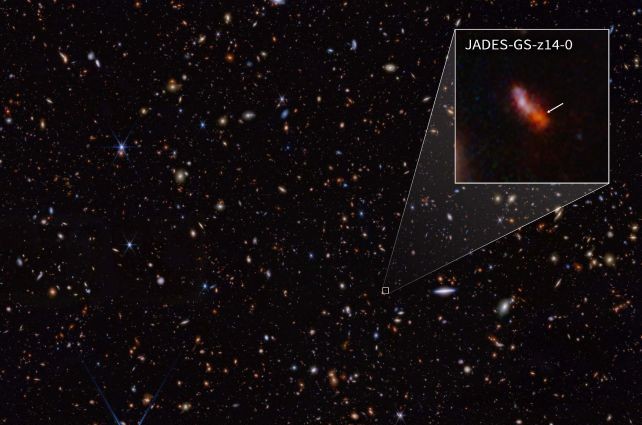
This race to the redshift frontier has had a pretty eventful history (see a great overview video here), which became even more eventful with the launch of JWST. JWST rapidly smashed the previous redshift (z) record of z = 10.6 by discovering a galaxy at z = 13.2, and then it broke its own record twice more. The current title holder sits at z = 14.4, observed less than 300 million years after the Big Bang.

Several galaxy candidates (to date unconfirmed) have now even been proposed at z ~ 25–32 (e.g., Capotauro), only 100 million years after the Big Bang! If real, these sources would pose a serious challenge to our understanding of the formation of the first galaxies, as galaxies shouldn’t really be observable at such early times. In today’s article, the authors put forward an intriguing alternative: what if some of these ultra-high-redshift candidates aren’t galaxies at all, but transient explosions from the universe’s first stars?

The First Stars and Their Explosive Endings

The earliest generation of stars (Population III; see my previous bite on these here) formed from pristine hydrogen and helium gas. Without metals to cool the gas efficiently, theory predicts that these stars were extremely massive, often exceeding 100 solar masses. While such stars would be short-lived, their deaths could be spectacular.

Population III stars of sufficient mass are predicted to end their lives as hyper-energetic pair-instability supernovae (PISNe). This is a long-winded name for a rapid, intensely hot explosion that leaves no remnant behind — not even a trace of the pre-existing star. Whilst nothing would remain of the star, the light emitted in that explosion could be bright enough to masquerade as a high-redshift galaxy candidate in current JWST surveys, but only if three key conditions are met:

  1. JWST must observe a sufficiently overdense region, where lots of Population III stars can form very early.
  2. A PISN must occur while JWST is “watching.”
  3. The explosion must be bright enough to rise above JWST’s detection limits.

Simulating a (Biased) Universe

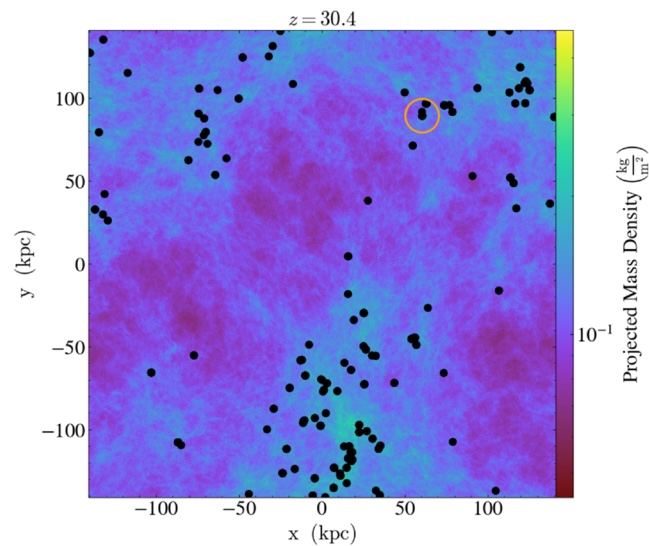
To address the likelihood of these conditions having already been met by existing JWST observations, the authors turn to cosmological simulations. Rather than simulating an “average” patch of the universe, they focus on an extremely overdense region (Fig. 1). This creates a rare but important environment where structures collapse earlier than usual. These regions are exactly where large numbers of Population III stars are expected to form at the highest redshifts.
projection of the gas density in the simulated overdense region at z = 30.4

Figure 1: A projection of the gas density in the simulated overdense region at z = 30.4. The densest structures stand out clearly, tracing the locations where the first stars are able to form. Black dots mark newly formed groups of stars, while the most massive dark matter halo in the region is highlighted with an orange circle. The figure illustrates that in such an unusually dense patch of the early universe, star formation can already be underway just 100 million years after the Big Bang, creating the conditions needed for early Population III stars and their explosive deaths. [Adapted from Jeon et al. 2026]

In their simulations, star formation begins as early as z ~ 30–40 (within the first hundred million years after the Big Bang), producing Population III stars and, by extension, potential PISNe very shortly afterwards. While such overdense regions are rare, the authors show that the total area already surveyed by JWST (including large surveys such as CEERS, JADES, PRIMER, and COSMOS-Web) is large enough that it is plausible JWST has already observed at least one such region.

Catching a Cosmic Explosion in the Act

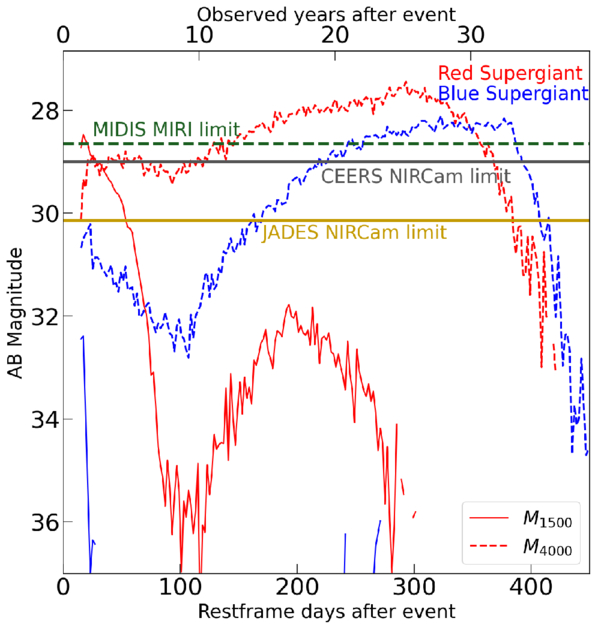
So, we can tick off condition #1: it’s possible that a sufficiently overdense region has already been observed by JWST. Next up, how lucky do we have to be to catch an explosion in the act (condition #2), so to speak? For this condition, cosmic time dilation actually works in our favour. A PISN explosion at z > 20 that lasts only months in its own rest frame can last for decades in the observed frame. (This whole time-being-relative thing sounds wacky because it is — please join me, Neil deGrasse Tyson, and countless others in struggling to imagine this.)

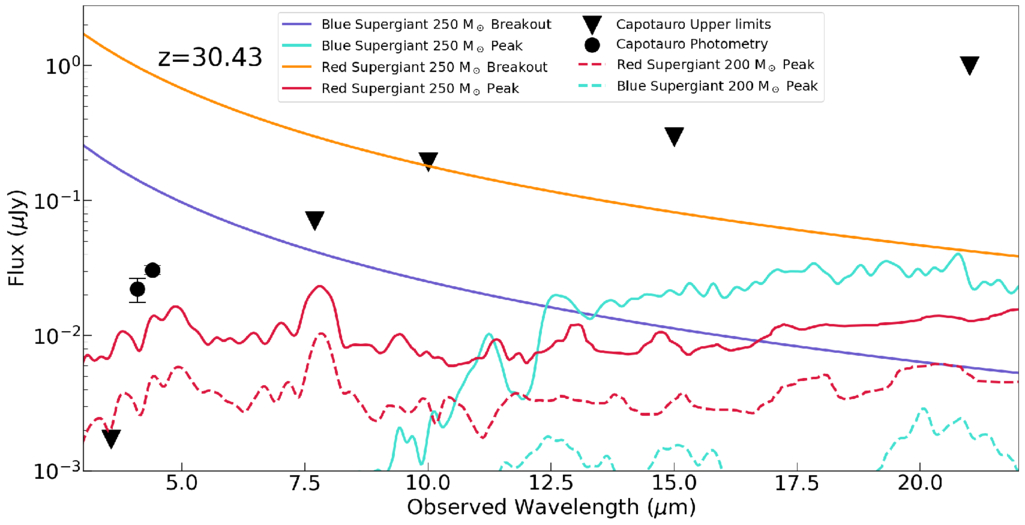
But would any such explosion be bright enough (condition #3)? Using theoretical PISN spectra, the authors show that these explosions could reach observed magnitudes of ~28–29 at z ~ 30 — right at the depth of current JWST deep surveys (Fig. 2). In fact, the predicted brightness and colours are somewhat comparable to those of some proposed z ~ 30 candidates (Fig. 3), raising the possibility that these objects could be PISNe rather than galaxies.
plot of predicted PISN brightness

Figure 2: This plot compares the predicted brightness of PISNe originating from different types of extremely massive stars to the depth reached by existing JWST surveys, showing that these explosions could remain detectable for ~20 years at peak brightness in the observed frame. [Jeon et al. 2026]
Theoretical PISNe spectra compared to a proposed z = 32 source

Figure 3: A comparison of theoretical PISNe spectra with the observed photometry of one proposed z ≈ 32 source (Capotauro). The coloured curves show model spectra for PISNe originating from extremely massive stars, at different stages of the explosion, while the data points represent the observed brightness of the high-redshift candidate across multiple JWST filters. [Jeon et al. 2026]

So… Are We Seeing the First Stars Die?

It’s not time to throw a party just yet. The authors note there are several caveats and uncertainties. The nature of Population III stars is still highly uncertain, JWST does not continuously monitor the same patch of sky, and identifying a PISN at such high redshift would be extremely challenging. Thanks to time dilation, these explosions would fade very slowly, making them hard to distinguish from steady sources using photometry alone. Alternatively, there are other plausible explanations for these ultra-high-redshift candidates: lower-redshift interlopers (a rather infamous example is CEERS-93316), local brown dwarfs, or even nearby exoplanets.

Still, the idea is exciting. If JWST were to detect a genuine PISN at z > 20, it would represent a direct glimpse of the very first stars, pushing observational astronomy into truly uncharted territory. For now, the most distant explosions in the universe may already be hiding in JWST images; we just have to learn how to recognise them.

Original astrobite edited by Nathalie Korhonen Cuestas.

About the author, Lucie Rowland:

I’m a fourth (and final!) year PhD student at Leiden Observatory in the Netherlands, studying massive, star forming galaxies in the early universe with ALMA and JWST. It’s a really exciting time to be interested in astronomy, so I hope to make groundbreaking new research more accessible!

The post The Oldest Starlight appeared first on AAS Nova.

  •  

Too Much Nitrogen Pops Open the Search for the Universe’s First Stars

Star formation in the early universe.

Astronomers have long sought evidence of the universe’s first generation of stars, and as more distant galaxies come into view, it seems these stars may finally be within reach.

JWST deep field

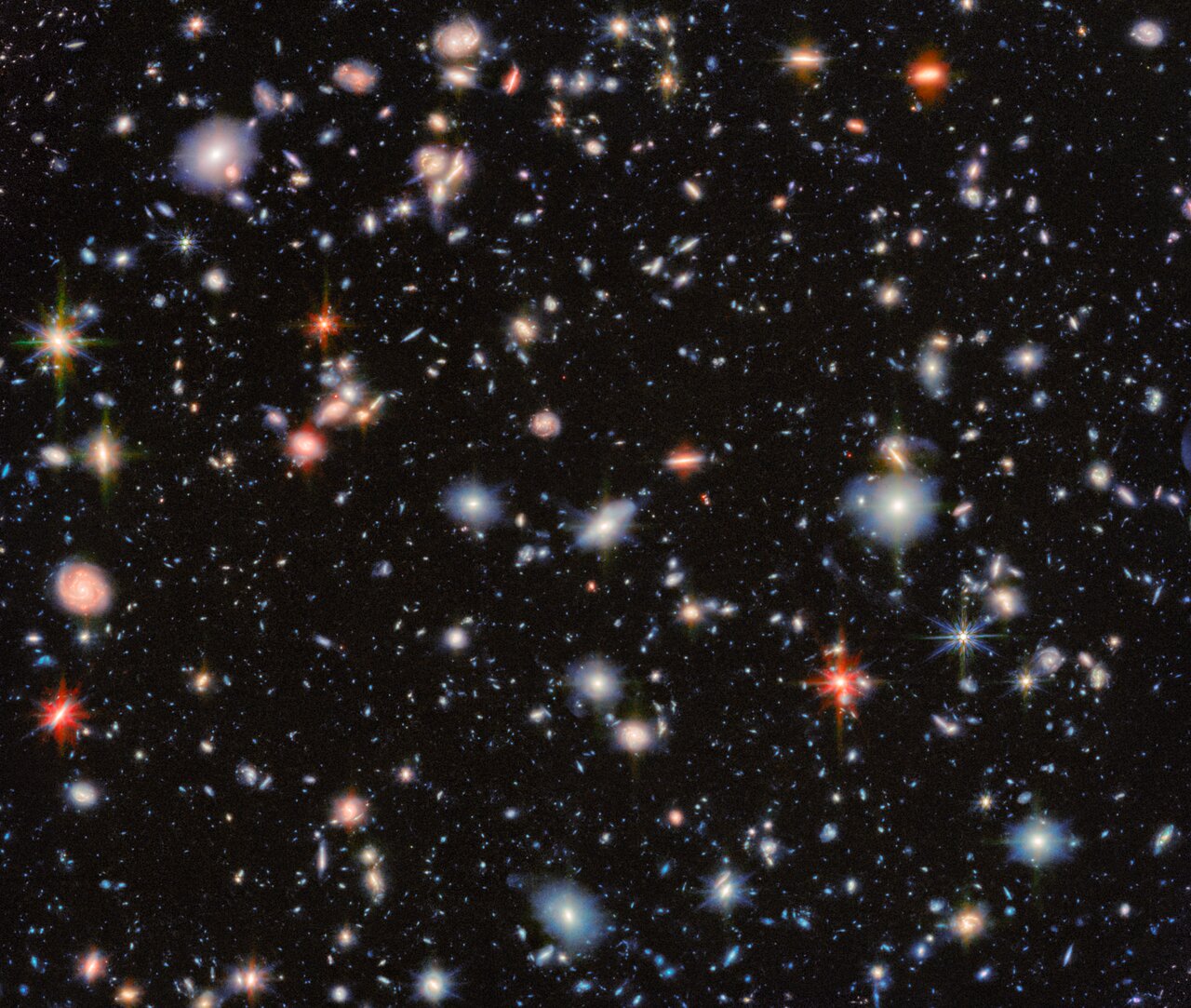
JWST spies thousands of distant galaxies in the classic Hubble Deep Field — many galaxies being uncovered for the first time with the space telescope’s powerful instruments. [ESA/Webb, NASA & CSA, G. Östlin, P. G. Perez-Gonzalez, J. Melinder, the JADES Collaboration, the MIDIS collaboration, M. Zamani (ESA/Webb); CC BY 4.0]

Excess Metals Popping Up

Since its 2021 launch, JWST has given astronomers eyes to peer into the distant past, discovering many galaxies whose light reveals the universe’s early stages of star and galaxy formation. Within the population of newly discovered galaxies are a few with bizarre chemical properties that, upon first pass, seem to be too enriched to exist so early in the universe. These hard-to-reconcile abundances may be a sign of the universe’s first stars. 

Known as Population III (Pop III) stars, the first stars in the universe were born out of giant clouds of pristine gas (hydrogen, helium, and a little lithium) and were able to form at masses hundreds to thousands of times the mass of our Sun. Though they burned bright, they did not burn for very long, ending their lives in violent supernovae and chucking their newly enriched guts back into their surroundings. While these stars are long dead, the chemical imprints they left on their host galaxies can persist  — and understanding how Pop III stars create and distribute metals could clue us in to the odd chemical signatures recently found with JWST.

Too Much Nitrogen in GS 3073

Researchers have identified a few galaxies exhibiting high nitrogen-to-oxygen (N/O) ratios that cannot be explained by stars similar to those in the universe today. A couple of these galaxies could be explained through multiple stellar populations, rapidly rotating stars, massive explosions, or the early stages of globular cluster formation. However, GS 3073, a galaxy with a redshift of z = 5.55 (about one billion years after the Big Bang), has an N/O excess so high that is has, so far, defied explanation.

Aiming to make sense of this bizarre phenomenon, Devesh Nandal (University of Virginia; Center for Astrophysics | Harvard & Smithsonian) and collaborators used stellar evolution models to see if Pop III stars could be the culprit. Modeling stars with masses 1,000–10,000 times the mass of our Sun, the authors traced the elemental yields of these supermassive stars as they go through the various stages of nuclear burning. The analysis takes into account mixing within the stars, mass loss throughout their lifetimes, and how the eventual supernova ejecta mixes within the interstellar medium.

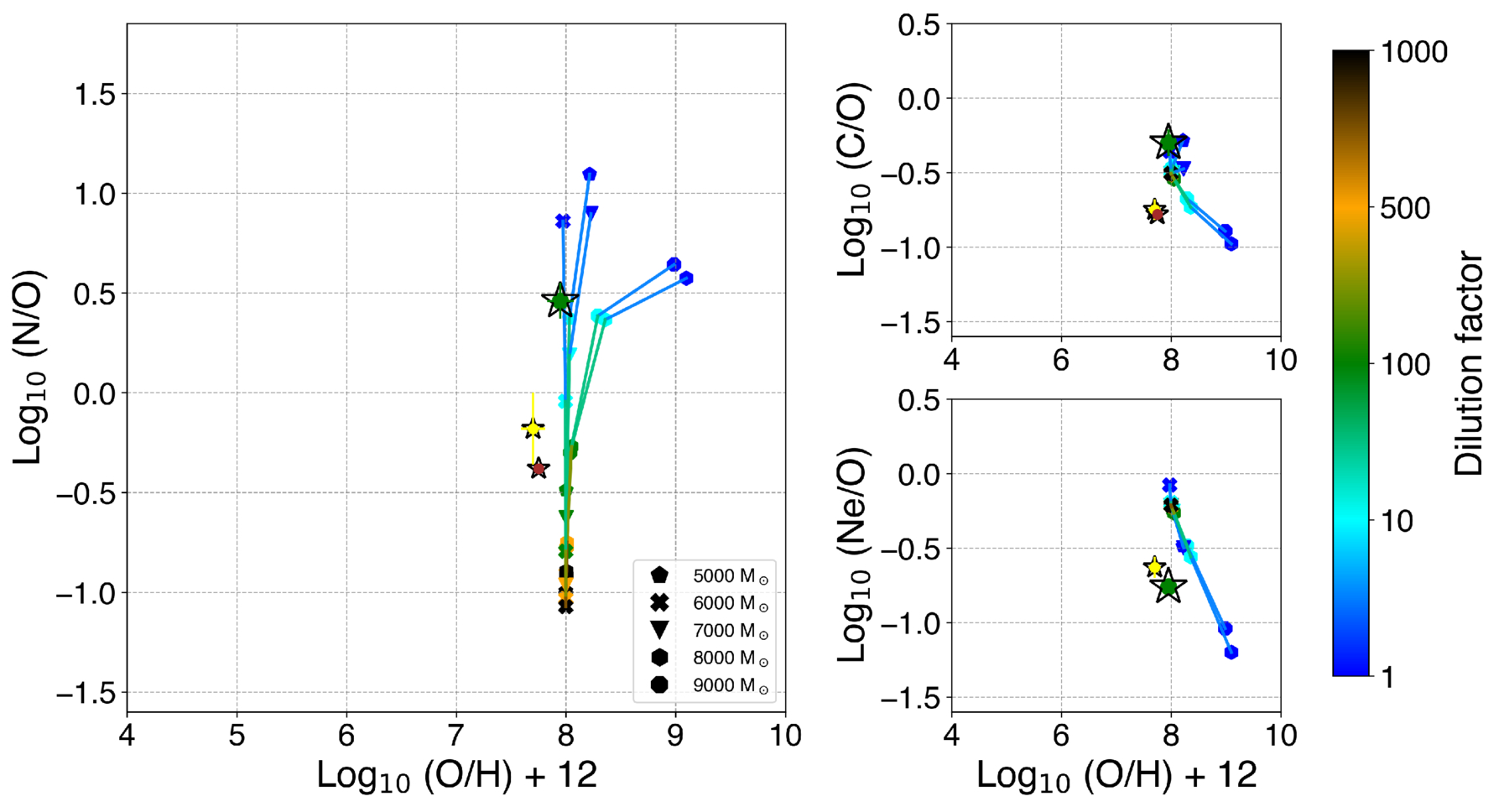
N/O, C/O, and Ne/O abundance ratios of five modeled supermassive Pop III stars taking into account the contribution from other stars in the galaxy and the Pop III star losing 10% of its mass over its lifetime. The green star indicates the observed ratios of GS 3073. Click to enlarge. [Nandal et al 2025]

From this modeling, the authors found that massive Pop III stars between 1,000 and 10,000 solar masses can produce the observed elemental abundances measured for GS 3073. Stars less massive do not produce high enough N/O ratios, and stars more massive have much lower oxygen-to-hydrogen ratios — strongly suggesting upper and lower mass limits to the possible supermassive stars that could have produced GS 3073’s chemical composition.

Finally Evidence of Pop III Stars?

This study of GS 3073 is the first of its kind to confirm the chemical imprints of Pop III stars on their host galaxy at this redshift. The unique nitrogen abundance can only be produced through the evolutionary phases of Pop III stars that burn quickly enough to produce and release an excess amount of nitrogen while other elements stay consistent. From their modeling, the authors suggest that galaxies with even higher nitrogen excess could exist, and further observations with JWST may just find them. 

The search for Pop III stars is booming — another recent study (Visbal et al 2025) examines the galaxy LAP1-B. While GS 3073 shows evidence of Pop III stars through chemical abundances, the study of LAP1-B finds that the galaxy matches theoretical predictions for the formation environments and mass distributions of Pop III stars. Both of these recent research works are laying the groundwork for the wealth of discovery possible with JWST, and the universe’s first stars are no longer out of reach.

Citation

“1000–10,000 M⊙ Primordial Stars Created the Nitrogen Excess in GS 3073 at z = 5.55,” Devesh Nandal et al 2025 ApJL 994 L11. doi:10.3847/2041-8213/ae1a63

The post Too Much Nitrogen Pops Open the Search for the Universe’s First Stars appeared first on AAS Nova.

  •  

Do X-Rays Help or Hurt Massive Black Hole Formation?

Illustration of a supermassive black hole enveloped in gas

Editor’s Note: Astrobites is a graduate-student-run organization that digests astrophysical literature for undergraduate students. As part of the partnership between the AAS and astrobites, we occasionally repost astrobites content here at AAS Nova. We hope you enjoy this post from astrobites; the original can be viewed at astrobites.org.

Title: Massive Black Hole Seed Formation in Strong X-Ray Environments at High Redshift
Authors: Kazutaka Kimura, Kohei Inayoshi, and Kazuyuki Omukai
First Author’s Institution: Tohoku University
Status: Published in ApJ

Environments of Massive Black Holes

Astronomers have found that nearly every observable galaxy hosts a central supermassive black hole (SMBH) — a black hole more than a million times more massive than the Sun. Using JWST, they have peered back into the early universe to observe some of the earliest galaxies, and these early galaxies also contain SMBHs. In fact, many of these galaxies seem to contain SMBHs that are more massive than we expected them to be this early in the universe.

We believe that most black holes form at the ends of the lives of massive stars, which collapse under their own gravity when they run out of fuel. We expect that this happened to the first stars too, forming “light” (as in “lightweight”) seeds of SMBHs with masses up to about 100 solar masses. Astronomers also think that the right conditions in the early universe could lead to the formation of a “heavy” seed with a mass on the order of 104 solar masses or more; this kind of black hole is called a direct-collapse black hole (DCBH).

In order to form a DCBH, a gas cloud needs to collapse without fragmenting to form star clusters and stars — if stars form, there won’t be enough mass funneled to the center of the cloud to form the DCBH. One important criterion for this to happen is the absence of coolants, like metals and molecular hydrogen (H2), which cause fragmentation. One way to eliminate H2 is with a particular type of ultraviolet light called Lyman-Werner radiation, which can destroy H2 molecules. However, recent results from the Hydrogen Epoch of Reionization Array (HERA) suggest that early galaxies emitted more X-rays than expected, which would increase the amount of H2 and make it less likely for DCBHs to occur. Today’s authors investigate the feasibility of forming DCBHs in these X-ray-bright environments.

Modeling Black Hole Formation

Today’s authors model the collapse of gas in dark-matter halos that have a nearby neighboring halo. This neighboring halo emits radiation like ultraviolet light and X-rays that impact the formation of molecules like H2, which affects the gas chemistry. This radiation is typically emitted by hot gas in star-forming regions. The authors also track quantities like the gas density and temperature as the gas collapses. Once the gas collapses enough, a star forms at the center and continues to accrete surrounding material. Once this star evolves and reaches the end of its life, it becomes a black hole.

The authors considered different intensities of X-ray radiation relative to a critical value of Lyman-Werner radiation believed to destroy enough H2 to form a DCBH, which is called J21. They explore values of the X-ray intensity Jx relative to J21, considering ratios of 0, 10-6, 10-5, and 10-4.

Another important consideration was the baryonic streaming velocity. This is the relative bulk velocity between baryonic (i.e., “normal”) matter and dark matter in the early universe. Higher streaming velocities can delay the collapse of gas in dark-matter halos, which affect gas properties like density, temperature, and chemistry. The streaming velocity depends on the redshift, z, which is given by σbsm = 30 km/s (1+z)/(1+z0), where z0 = 1,100. This “standard” relationship has been calibrated with measurements from observations. The authors consider two cases for the streaming velocity: vbsm = 0 and vbsm = 1σbsm, which are denoted in the figures below.

X-Rays and Seed Suppression

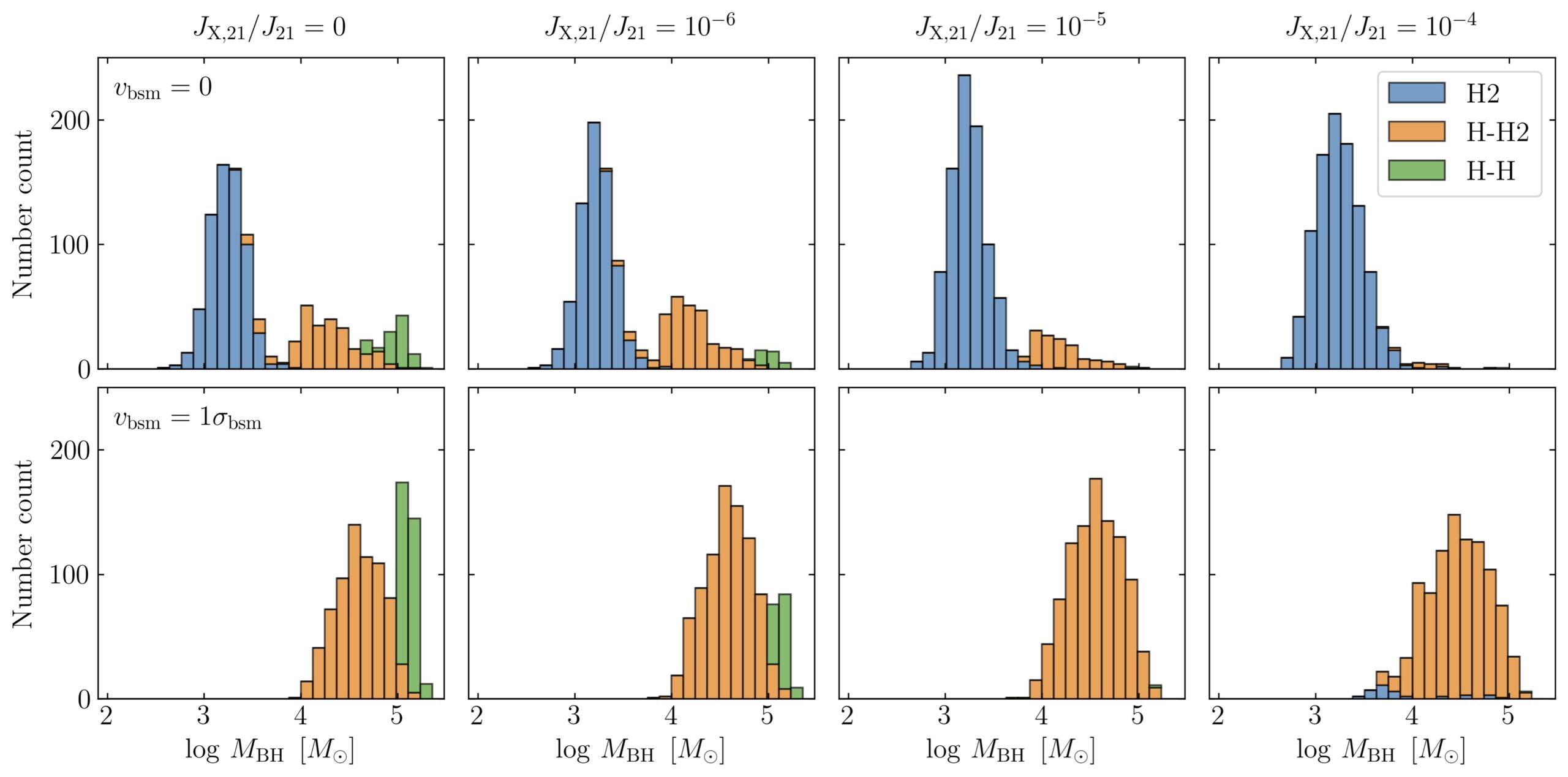
The first main results are shown in Figure 1. The authors find that a large number of intermediate-mass seeds form from H2 cooling, shown in blue, regardless of the X-ray intensity. A smaller number of higher-mass seeds form from H–H2 and H–H cooling, but these cooling processes become suppressed as the X-ray intensity increases. This is because the increased X-ray intensity converts more H to H2. Interestingly, accounting for the streaming velocity all but wipes out black hole formation via H2 cooling except at very high X-ray intensities.

histograms of seed black hole mass

Figure 1: Mass distributions of seed black holes. The top row uses a baryonic streaming velocity of 0 and the bottom row uses the standard streaming velocity. Columns represent increasing X-ray intensities (left to right). Colors represent the dominant cooling mechanisms: H2 (blue), atomic hydrogen H transitioning to H2 (orange), and solely H (green). [Kimura et al. 2025]

Another main set of results are the black hole mass functions (that is, the number density of black holes for a given black hole mass), shown in Figure 2. Note that this differs from Figure 1 because we are now accounting for the number density of black holes, not just the number, and we are no longer categorizing black holes based on their cooling mechanism. As before, we see that most massive black holes are eliminated with a high X-ray intensity and no streaming velocity, but a higher streaming velocity tends to produce more massive black holes regardless of the X-ray intensity. These black hole mass functions provide a useful comparison to observational results from telescopes like JWST.
histograms of seed black hole number density

Figure 2: Seed black hole mass functions for low and high X-ray intensities (left and right columns, respectively). Rows are the same as in Figure 1. [Kimura et al. 2025]

In summary, today’s authors find that a high X-ray intensity leads to less-massive black holes due to the increased amount of H2, but accounting for the baryonic streaming velocity can produce massive black holes even with a large amount of X-rays. The number densities of these black holes appear to agree with observations from JWST, meaning that this could be a promising formation mechanism for the observed SMBHs in the early universe.

Original astrobite edited by Sparrow Roch.

About the author, Brandon Pries:

I am a graduate student in physics at Georgia Institute of Technology (Georgia Tech). I do research in computational astrophysics with John Wise, using machine learning to study the formation and evolution of supermassive black holes in the early universe. I’ve also done extensive research with the IceCube Collaboration as an undergraduate at Michigan State University, studying applications of neural networks to event reconstructions and searching for signals of neutrinos from dark matter annihilation.

The post Do X-Rays Help or Hurt Massive Black Hole Formation? appeared first on AAS Nova.

  •  

A GLIMPSE of the First Galaxies?

Abell S1063

Editor’s Note: Astrobites is a graduate-student-run organization that digests astrophysical literature for undergraduate students. As part of the partnership between the AAS and astrobites, we occasionally repost astrobites content here at AAS Nova. We hope you enjoy this post from astrobites; the original can be viewed at astrobites.org.

Title: A Glimpse of the New Redshift Frontier Through Abell S1063
Authors: Vasily Kokorev et al.
First Author’s Institution: The University of Texas at Austin
Status: Published in ApJL

JWST has opened up a new era of early universe astronomy. Of particular interest is the hunt for the first galaxies, which are thought to have formed just a couple hundred million years after the Big Bang. But finding these early galaxies has proved to be somewhat of a challenge. While there have been many bright galaxies discovered by JWST at a redshift (z) greater than 10, no galaxies at z > 15 have been confirmed to date. Today’s article goes hunting for these very high-redshift galaxies in the GLIMPSE field, which is home to the strong lensing cluster Abell S1063, shown in Figure 1.

JWST image of Abell S1063

Figure 1: JWST image of the field used for this study. [Kokorev et al. 2025]

The process of identifying galaxies at high redshifts is not exactly a simple one. In this article, all the sources in the field are slowly winnowed down through a series of steps with the ultimate goal of finding extremely high-redshift galaxies.

Step 1: Cut Galaxies by Color

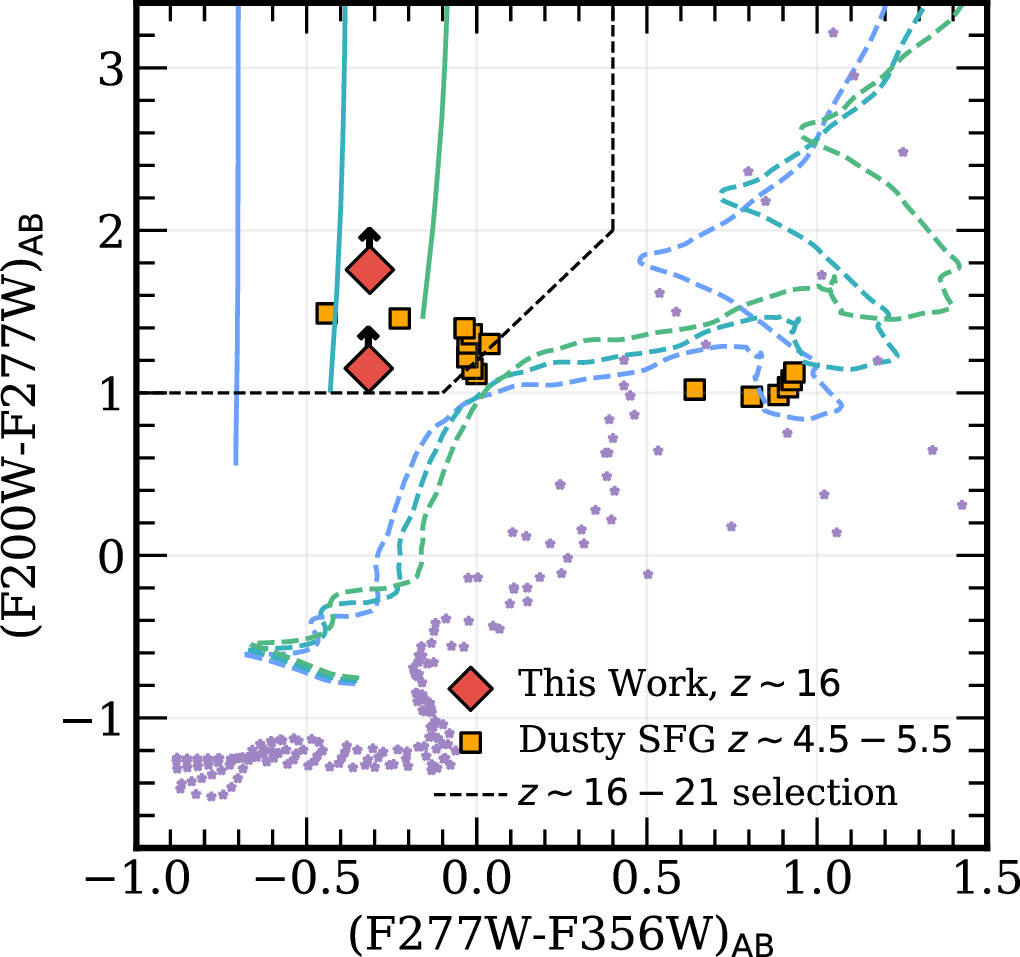
Cutting galaxies by color involves finding the Lyman break. High-energy light is absorbed by neutral hydrogen in the galaxy and in the space between the galaxy and us. Thus, when you look at a galaxy’s spectral energy distribution, there is a drop-off at short wavelengths called a “break.” For distant galaxies, the location of this drop-off gets redshifted, allowing for an estimation of a galaxy’s distance. By comparing how bright sources are between two filters that are adjacent in wavelength, we can look for steep drop-offs that are caused by the Lyman break. Figure 2 shows a color–color plot (showing the difference in brightness between different filters), where the dashed line shows the region galaxies must be in to be considered Lyman-break galaxies at these high redshifts. In the whole field, the authors detect 38 objects in this region.

Color-color plot showing the selection criteria for high redshift galaxies due to Lyman break

Figure 2: Color–color plot showing the selection criteria for high-redshift galaxies due to Lyman break. The upper-left region enclosed by the black dashed line represents the region that satisfies the high-redshift criteria. The various lines show properties of different populations. Solid are potential tracks for starburst galaxies at z = 16, dashed are lower-redshift quiescent galaxies, and dotted are cool stars and brown dwarfs, which can look like high-redshift galaxies in some situations. The two red diamonds show the final two high-redshift candidates in this work. [Kokorev et al. 2025]

Step 2: Calculate Redshift

However, this isn’t the end of the story. Color isn’t the only way to estimate distances to galaxies, as we can also use photometric fitting codes. These codes compare observations to templates of what we would expect galaxies to look like at different redshifts and see which templates fit best. This allows for an estimation of the redshift of each source identified in the field. All sources that the photometric fitting codes thought were at z > 16 were cross-referenced against the 38 color-identified objects, which narrowed the list to eight high-redshift candidates.

Step 3: Hunt for Imposters

But wait, there’s more! Both of these methods (looking at colors and calculating redshift photometrically) are susceptible to false positives. Lower-redshift galaxies, particularly star-forming dusty galaxies, can look just like high-redshift sources. This is apparent in Figure 2, where z ~ 4.5–5.5 dusty galaxies can also be found in the color-selected Lyman-break region. Thus, we need to explore the possibility that the sources might not be at high redshift at all. In this article, the authors do this by fitting their eight sources with a lower-redshift dusty starburst template, finding only five galaxies that match the high-redshift template better than the starburst template.

Step 4: Keep Significant Detections

The authors make one final cut to the last five sources, only keeping those that aren’t at the edges of the observation and thus have strong signals, where they can be confident we’re actually detecting something and it’s not just a hot pixel or noise. So, after all of that, they are left with only two z > 16 candidates in this field.

Figure 3 shows the images and spectral energy distributions of each of these candidates, given the wonderfully poetic names of 70467 and 72839. While there is still a lot to learn about these candidates, with the JWST data presented in this article we can uncover some things about the galaxy properties. Both sources appear to be compact, but still resolved, with effective radii of roughly 650 light-years. These observations can also tell us about the ultraviolet brightness of the two candidates, finding that they are most likely dominated by extended stellar emission, as opposed to active galactic nucleus activity. In general, these galaxy candidates are not very ultraviolet-bright, which is somewhat surprising, as JWST has found many bright galaxies at z ~ 12–14. However, it is not out of the question that galaxies at this slightly earlier epoch are just fainter than we expected, and then formed stars and increased in brightness relatively quickly.

Cutouts and spectral energy distributions for two high-redshift galaxy candidates

Figure 3: Cutouts and spectral energy distributions for the two high-redshift candidates in this work. Squares show images in nine JWST filters, as well as an image of several filters combined, with a cutout width of 1.5″. Spectral energy distribution plots show different template galaxies for high-redshift (orange and red) and low-redshift dusty star-forming galaxy interlopers (blue and green). You can see how these sources are only strongly detected in a few filters, with many detections being just upper limits. [Kokorev et al. 2025]

Overall, these results mark the finding of potentially some of the first galaxies in the universe. But for now, they remain candidates. The photometric data have served their purpose, allowing us to find these candidates and get some information about their properties, but now we need targeted spectroscopic observations to get a more accurate determination of their redshift.

Original astrobite edited by Bill Smith.

About the author, Skylar Grayson:

Skylar Grayson is an Astrophysics PhD Candidate and NSF Graduate Research Fellow at Arizona State University. Her primary research focuses on AGN feedback processes in cosmological simulations. She also works in astronomy education research, studying online learners in both undergraduate and free-choice environments. In her free time, Skylar keeps herself busy doing science communication on social media, playing drums and guitar, and crocheting!

The post A GLIMPSE of the First Galaxies? appeared first on AAS Nova.

  •  

From Gas to Cluster: Simulating Star Formation in the Early Universe

globular cluster

JWST observations have begun uncovering some of the oldest star clusters in the universe, but their formation mechanisms are still uncertain. A recent study uses high-resolution simulations to understand early star formation and how local globular clusters may have originated. 

Supersonically Induced Gas Objects

Our leading cosmological model of the universe suggests that stars and galaxies coalesce within dark matter halos, eventually forming the larger structures we see today. However, some of the oldest astronomical objects in the universe — massive collections of stars called globular clusters — contain little to no dark matter, making their formation mechanisms somewhat mysterious. How do large clusters with thousands of stars form outside of dark matter halos?

supersonically induced gas objects

Visualizations of the gas density in the simulated star-forming regions in this study. Click to enlarge. [Lake et al 2025]

Recent studies have suggested that as the dark matter and baryons (i.e., normal matter) in the early universe began to clump together and form slightly denser areas, the pristine gas and dark matter began to move relative to one another. Baryons, still tightly coupled to photons, did not have the same freedom to collect in dense regions that the dark matter did, creating supersonic (about five times the speed of sound) relative motions that separated gas clumps and early dark matter halos. These separate, dark-matter-free gas clumps formed baryon-enriched structures known as supersonically induced gas objects.

Over the past decade, simulations and theory have shown that supersonically induced gas objects can form star clusters, which may be the origin story of many of the local globular clusters seen today. However, these simulations have been limited by their resolution. Unable to resolve individual star formation and not including key aspects like feedback, these simulations have left open questions about these dark-matter-free objects.  

High-Resolution Simulations

Seeking to more deeply understand supersonically induced gas objects, William Lake (University of California, Los Angeles; Dartmouth College) and collaborators perform high-resolution simulations that include detailed physics and can track the formation of individual stars. The simulations varied the metallicity and presence of protostellar jets, properties that are both known to impact the star formation process in gas clouds.

imf

Mass distribution for the stars formed in the simulated supersonically induced gas objects. The simulated clusters form more high-mass stars than what is seen in local star-forming regions. Click to enlarge. [Lake et al 2025]

From the simulations, the authors find that star formation occurs naturally in these early systems. Both feedback from jets and the metallicity of the gas affect star-formation outcomes — jets tend to have a minor impact on the star formation efficiency in low-metallicity clouds, but disruption from the jets can cause low-mass stars to form in metal-enriched systems. However, in general, the authors conclude that supersonically induced gas clouds tend to form higher-mass stars than local star clusters, which agrees with what is expected for the universe’s first stellar population. 

Given that these objects likely form very high-mass stars, these primordial star clusters will have extremely high stellar mass surface densities and brightnesses compared to what is observed locally. With such enhanced brightness, these objects may be bright enough for JWST to observe them. Further high-redshift observations of star clusters will allow for further constraints on the formation of the universe’s first stars and will yield more information about the possible origins of the globular clusters we see in the local universe.

Citation

“The Stellar Initial Mass Function of Early Dark Matter–Free Gas Objects,” William Lake et al 2025 ApJL 985 L6. doi:10.3847/2041-8213/add347

The post From Gas to Cluster: Simulating Star Formation in the Early Universe appeared first on AAS Nova.

  •  

Webb Weighs Most Distant Inactive Black Hole Ever Found

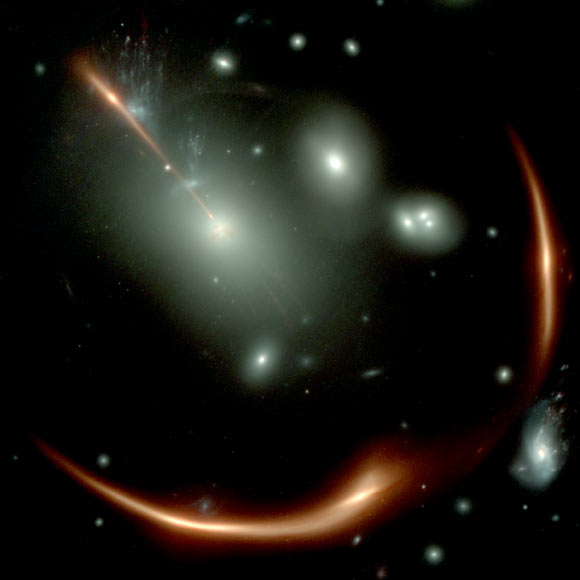
This Webb image shows the highly distorted red galaxy MRG-M0138 seen through a foreground cluster of galaxies (white sources). Image credit: NASA / ESA / CSA / Webb.

A supermassive black hole 6 billion times the mass of the Sun lurks in MRG-M0138, a gravitationally lensed quiescent galaxy seen when the Universe was just 3 billion years old, according to an analysis of data collected by the NIRSpec Integral Field Spectrograph onboard the NASA/ESA/CSA James Webb Space Telescope.

The post Webb Weighs Most Distant Inactive Black Hole Ever Found appeared first on Sci.News: Breaking Science News.

  •  

Why are Astronomers Stunned by Abundant Oxygen in Earliest Known Galaxy?

Astronomers have discovered a galaxy, allegedly dating from just 300 million years after the big bang, with unexpectedly high oxygen levels. This is in contradiction to existing cosmological models with galaxy formation taking much longer. The findings refute the validity of the big bang story itself.

  •  

Webb Spots Supermassive Black Hole Older Than Its Home Galaxy

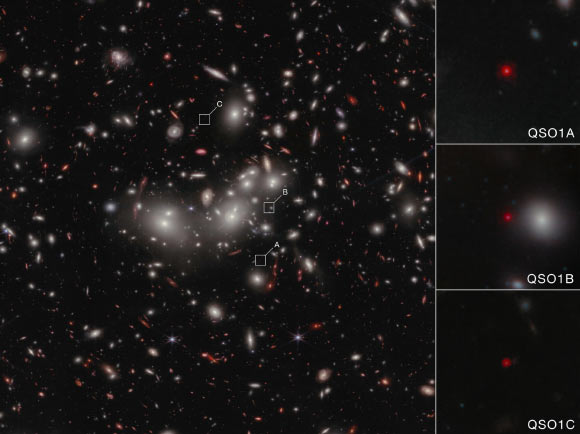
This Webb/NIRCam image shows the little red dot Abell2744-QSO1, magnified and triply imaged by galaxy cluster Abell 2744. Image credit: NASA / ESA / CSA / Lukas Furtak, Ben-Gurion University / Alyssa Pagan, STScI.

Astronomers using the NASA/ESA/CSA James Webb Space Telescope have found an enormous black hole in the early Universe that appears to predate its own host galaxy, raising fresh questions about how the cosmos’ first supermassive monsters were born.

The post Webb Spots Supermassive Black Hole Older Than Its Home Galaxy appeared first on Sci.News: Breaking Science News.

  •  
❌