
❌

Reading view

Indie Podcast Apps Not Growing

Dustin Bluck:

Independent podcast apps are not growing as a category. This is not a particular secret, but perhaps you haven’t seen it stated explicitly. It’s the sort of thing that has to be inferred, but there’s plenty of available data if you look for it. While the podcasting sector has seen growth, this has occurred almost entirely on platforms like YouTube, and the independent podcast app userbase has mostly just stood still.

[…]

I’m sure somewhere out there a 21-year-old just downloaded Castro or Pocket Casts for the first time and thinks RSS feeds are awesome (if you are this person, please email me). But every number I can see indicates the userbase is both static and aging. Every new customer I talk to has used some combination of Apple Podcasts, Overcast, Pocket Casts, or Castro for at least the last 5 years if not the last 10.

[…]

Perhaps there are healthy businesses that get very few new users but instead gracefully age with the ones they have. Ferrari maybe? Buddy, smartphone apps are not one of those businesses.

[…]

I would rather work on flashy features to capture new users, but, reality being what it is, I have to think about things in terms of both the health of the ecosystem and what will actually help retain existing podcast app users.

Nick Heer:

Anil Dash wrote, in 2014, that the simple phrase wherever you get your podcasts is a “radical statement”:

[…] Because what it represents is the triumph of exactly the kind of technology that’s supposed to be impossible: open, empowering tech that’s not owned by any one company, that can’t be controlled by any one company, and that allows people to have ownership over their work and their relationship with their audience.

Video podcasting changes that. In its simplest form, it is just a YouTube channel, which means it is siloed and controlled by Google. Spotify also supports video but only in its app.

Ilya Birman:

So Marco described a problem. What if someone manually asks to download an episode when they already have three downloaded? You can’t just immediately delete it to keep things tidy. So what do you do? Marco added a special hidden “episode downloaded manually” flag to the database, so those episodes would not count towards the limit.

This is one more example of how even the most seemingly trivial features require thinking through and accounting for different cases that may not be obvious at first glance. Every user interface designer and product designer should collect and absorb examples like this.

[…]

Finally, Marco’s wife Tiff suggests a solution to all the problems: just don’t let users download more episodes, she said, and show them a message, roughly: “Your episode limit is three, but this would be the fourth, denied”.

Marco liked the solution. I didn’t. Sure, it solves Marco’s problems, but not the user’s.

Marcin Wichary:

Birman presents this as “Let me click,” but I wanted to offer two alternative/​complementary principles that helped me before:

  • Let me do things in any order. Here’s Google Home app, where I can change the temperature and the time for holding – but if I change the time first, it frustratingly resets when I subsequently change the temperature. It forces one specific order in an interface that suggests any order is okay[…]
  • The current action has the most momentum. The user is right there, active, tapping on things, wanting to get stuff done. If Overcast indeed throws a “your episode limit is three” message, then it forces the user to remember how to get to the settings and change it. The momentum is lost. The decisions of past me should not be as important as the decisions of present me.

Marco Arment:

FWIW, the entire strict-limit feature is gone in the pending update (awaiting App Store review). EVERYONE hated it.

Now I’m just displaying the added-manually status in the UI and allowing it to be toggled manually in the “…” menu.

Marco Arment:

I’ve needed to evolve my expectations for what my role in Overcast is.

After building up a large, passionate userbase over a very long time, it’s not really entirely mine anymore. I can’t just do whatever I want with it.

And the growth era of open/RSS/indie/whatever podcast apps is over. The business is now about serving and retaining my existing customers for as long as possible.

So I can add things here and there, very carefully, but I can’t really change anything significant.

Previously:
  •  

Unforgetful 1.0

Marco Arment:

Unforgetful isn’t a new productivity system to learn.

[…]

This is designed for a small number of short-term tasks. What do you need to do today, tomorrow, this week, or this month?

[…]

If you want tagging, folders, archives, or other ways to organize or file away tasks, this isn’t the app you’re looking for.

Unforgetful is for people who know that if they file away a task, it never gets done.

I’m an OmniFocus person. I love tagging, folders, and archives; I never want to see a notification for a to-do item. I prefer pull to push. So this is absolutely not the right tool for me. But I like the fresh thinking behind this app and how the various design choices interact to make it an opinionated tool for the right type of person.

Marco Arment:

Calendar alarms changed my life. Events without alarms don’t happen.

[…]

Most of my Reminders interaction has always been via Siri and notifications. And that fits me very well, with three major exceptions:

  1. If I say “Remind me to buy milk,” but I forget to specify a time (or Siri misses it), Reminders will never notify me, and I’ll never check the app, so it’ll be lost.
  2. If I inadvertently dismiss a Reminders notification without snoozing it, Reminders will never notify me about it again, so it’ll be lost.
  3. When I do snooze a Reminders notification, which I do a lot, the snooze options suck.

He has good solutions to these and other problems. I’m tempted to try out Unforgetful just for the purported quick capture of dictated reminders, however there’s no watch app.

Listen to Accidental Tech Podcast to hear about unfortunate limitations of EventKit. Reminders itself is interesting to me in that the (private) data model is now so rich, but I’m put off by the UI, the lack of export, and the limited support for driving it from the keyboard.

Previously:

  •  

Zoom Screen Sharing Attack

Lily Hay Newman (via Ben Lovejoy):

As AI models gain advanced capabilities to find vulnerabilities in software, develop ways to exploit them, and even carry out autonomous hacking sprees, researchers offered a sobering new example on Tuesday, disclosing vulnerabilities in the video conferencing platform Zoom that could have been exploited to take over targets’ devices. Anyone on a call that involved screen sharing, whether participants or the host, would have been vulnerable to a silent attack that could be carried out with no indication and no interaction from the victim.

Researchers from the digital defense firm A Security say the bug was discovered in early June using publicly available AI models, and that it took fewer than 20 prompts to uncover the vulnerabilities and create a working attack. Zoom issued a security advisory on Tuesday, including details about fixes the company has already begun rolling out to address the flaws, which affected devices running all operating systems that Zoom supports—Windows, macOS, Linux, iOS, and Android.

[…]

The vulnerabilities were specifically in the protocol used to facilitate real-time annotation during screen sharing.

I don’t understand how it could take over an iOS device when Zoom’s iOS screen sharing feature only allows observation, not control.

Previously:

  •  

TabControl Scam and the App Review Queue

Jeff Johnson:

Despite my history of uncovering App Store frauds, I rarely go looking for these things intentionally! They’re just so pervasive and obvious, they jump out at me. In this case, I was looking at the list of top paid Safari extensions in the Mac App Store, because two of my own extensions are currently on the list, when I noticed the TabControl Extension.

[…]

The Mac App Store “screenshot” for the app is not actually a screenshot at all. If you look closely, that’s not the real Safari: the toolbar elements are wrong. I suspect that the image was AI-generated.

[…]

Another thing you should note in the fake screenshot is the “4.9 out of 5” stars, giving the impression that this is the App Store user rating of the app.

[…]

These purported reviews, all but one of which is 5 stars, are all in English. Yet none of them is in the US App Store. […] If you’ve ever looked through App Store user reviews, it’s unusual to find this naming format. […] the dates on the reviews, such as “Mar 12,” predate the release of TabControl Extension in the App Store!

John Gruber:

God only knows what this obvious AI slop scam is doing with the data from users’ Safari tabs. It’s currently the 12th or 13th most popular Safari extension in the App Store.

Jeff Johnson:

Coincidentally, on the same day well-known developer Marco Arment complained on social media that his new, unreleased Mac App Store app had been waiting 12 days for review by Apple.

Arment ended up waiting on hold—listening to an odd choice of music—to talk to App Review, which I didn’t realize was an option. His Unforgetful app is now approved.

Johnson continued browsing Safari extensions in the store:

The apps’s privacy policy is again on Google Drive, but the developer website link goes to https://aee5e5015.app-ads-txt.com, a suspicious URL. This website is barren and simply redirects back to the App Store[…] Did App Store review ever bother to click the developer website link?

[…]

In addition to the 41 apps, each of which required at least one submission to App Store review, I count across those 41 apps at least 327 updates, almost all of which have the same generic description for what’s new in the update: "Bug fixes and performance improvements." So that’s at least 368 submissions to App Store review, most within the past 12 months, from a single developer. In other words, the developer is averaging almost one submission per day. We can count only approved submissions; we have no idea how many submissions by the developer were privately rejected by App Store review.

I get the impression that Apple is asleep at the wheel. Is anyone at Apple counting submissions per developer? How many is too many? How many resources is one developer allowed to consume?

[…]

You may view it as a noble, democratic ideal to treat every app developer the same, but in reality this is the path to the crApp Store, full of scams and slop.

John Voorhees:

There’s no doubt that there is spam on the App Store, but the way to remove it is to target the spammers, not new developers, students, and hobbyists looking to build their ideas. I know that being an indie developer isn’t an easy way to make a living, but erecting barriers to submitting apps is the surest way to starve Apple platforms of fresh, innovative ideas.

John Voorhees:

I’d like to see App Store spam cleaned up as much as anyone, but the way to do it isn’t preferring well-known developers and those who can afford to pay more for special treatment.

Marc Palmer:

I don’t agree with paid tiers either. However it feels like there should be a natural brake applied to new developers and new apps. It’s no big deal if your first app takes a week or two to review (often did 10y ago), and as it matures & receives meaningful updates in the store, turnaround increases as trust and “value” (active users?) builds up. Like “tarpitting” new accounts. I think limiting the # of new apps you can add per month to say 1 or 2 would also help…

Jeff Johnson:

I was a new App Store developer myself ten years ago. My previous article didn’t propose any new barriers for those groups. To be clear, I did imply that no developer, whether new or not, should have more than 40 apps and average a new App Store submission every day of the year. I’m not aware of any prominent developer who has that many. Apparently, checking just now, Microsoft by my count has 38 App Store apps between iOS and Mac, which is a lot but still less than the 41 apps of the developer I discussed in my previous article who is definitely not one of the largest software developers in the world along with Microsoft. I do think it’s reasonable for Microsoft to pay a significantly higher developer fee to have those 38 apps reviewed than a smaller developer pays to have one app reviewed by Apple.

[…]

My contention is that Apple is actually wasting its own resources treating every developer like a potential spammer or scammer, even the developers who are known to be trustworthy, and this wasting of resources makes it harder on everyone, including new developers, students, and hobbyists. App review is grossly inefficient, and it’s clearly failing to scale to the increase in App Store submissions. What I propose is not raising the gates but rather lowering the gates for developers who have already proven trustworthy, so that Apple can focus its review efforts where they’re most needed.

I’m not sure that paying more would help anything. If scams are profitable, surely it would be worth them paying more, and then we’re back to square one. And I don’t want to create another situation like App Store Search Ads where providing poor service makes the revenue numbers go up. But I like the general idea of considering the account’s history, e.g. the way the Discourse forum gradually increases trust over time. It should count for something if you have a long history of following the rules and submitting updates to a small number of apps on a reasonable schedule vs. frequent spamming of submissions that don’t even have real release notes. It would not be fair for Microsoft to be able to cut in line, but giving spammers equal access to the review queue means they’ll use more than their share of Apple’s resources. That also seems unfair. The current system encourages frequent submissions, which also increases the overall load on the reviewers. I think the incentives need to be changed somehow. Maybe each account should get a certain number of “fast” submissions per month or year, after which you can still submit but it goes into a lower priority queue.

William Gallagher:

Even among more legitimate-seeming apps, though, Apple is ignoring clear problems. In AppleInsider research, for instance, we found that many price tiers listed for the “Simply Piano” app bore no relation to what the developer actually charges.

[…]

You shouldn’t have to be the one to investigate apps you want to try. That is the future of third-party App Stores, and that is a future to be fought.

But that future is here with the first-party App Store we already have. And this inability to trust an App Store is here, right now, because Apple will not do what it keeps saying it is doing and what it is charging developers to do.

Previously:

Update (2026-08-20): Eric deRuiter:

I wonder if there is already a separate queue, not for Marco or other established indies, but for the huge companies: Facebook, Spotify, Google, etc.

Jeff Johnson:

Apparently the App Store developer in question saw my article in the news, because the fake App Store reviews posted on the developer’s website were quickly removed, as reported by AppleInsider and confirmed by me. Until yesterday, the misleading “4.9 out of 5 stars” claim remained in the App Store. However, the developer released an update only hours ago with new screenshots that no longer include the misleading claim, thereby erasing all evidence of the previous fraud. Apple approved the developer’s update and, needless to say, did not remove the app from the App Store.

[…]

There are 59 reviews [of Authenticator ℠], 54 of which are 1 star, and 3 of which are 2 stars. Two of the reviews are 5 stars; of those, one is titled “space jam” and goes on to say, “i believe i can fly and touch the sky.” Anyway, the question is, how did the app manage ratings of 4.1 out of 5 when the reviews average 1.2 out of 5? (That’s a rhetorical question. I think we all know the answer.)

  •  

Dark Hours Rejected From the App Store

[Update: See the retraction below.]

Terry Godier:

On the web, if I build something that works within the standards, it works. Whether people use it is up to them. On iOS, there is another question entirely: whether Apple decides it should exist.

[…]

In the past couple of years I’ve built three apps that were rejected from the App Store on various grounds.

[…]

A while ago I tried to submit an iOS app for Dark Hours, my astronomy website for normal people. It was rejected on the grounds that it was astrology.

[…]

I see countless ChatGPT wrappers with nearly identical icons and eye-watering subscriptions. I see astronomy apps requesting permissions that have nothing to do with looking at the night sky. My kids download games that interrupt play every few minutes to advertise the developer’s other subscription apps, each with their own $20–50 yearly plans.

Via John Gruber (Mastodon, Hacker News):

But if you actually look at Godier’s Dark Hours, for even just a few seconds, it is instantly obvious that it pertains to the science of astronomy and has absolutely nothing — zero, zilch, nada — to do with astrology.

[…]

Godier proceeded through a series of escalations up to the App Review Board and the Review Board responded that they determined the original rejection was valid because, I shit you not, “We understand that the app includes a live tarot reading feature.” Which isn’t even about astrology. It’s straight out of Kafka.

[…]

This isn’t just contrary to the benefit of developers, like Godier. It’s obviously contrary to the benefit of Apple itself, which should not just accept an app like Dark Hours, but celebrate it as an exemplar of the platform.

Mistakes happen. But in a functioning system mistakes get corrected, and mistakes as obvious as this one get corrected almost instantly and include a quick apology for the conflation. The App Store is not a functioning system.

Previously:

Update (2026-08-10): John Gruber:

To the best of my recollection, this is the first post I’ve retracted in the 24 years I’ve been writing Daring Fireball. I hope it’s the last. I was misled, both overtly and through omissions[…]

[…]

The truth is, the app, as originally submitted by Godier to the App Store (under the name “Asterly”, not “Dark Hours”), was entirely dedicated to astrology, not astronomy, and did in fact include a “Tarot card of the day” feature amongst other occultist horseshit.

[…]

I wrongly took Godier at his word, both in his public blog post and in private iMessage correspondence yesterday, that the rejection wasn’t just merely debatable, but completely and rather preposterously ungrounded. Whether Godier ever submitted a build of “Asterly” to the App Store that contained no occult horseshit and only the hard-science astronomy features that were present in his “Dark Hours” website that was available for the last week, I don’t know. But I have no reason to believe that he did.

[…]

In an uncomfortable exchange between Beher and Godier on Bluesky, Beher pointed out that Godier’s Dark Hours had the same bug as Beher’s that routed people to “random fields in Mexico”. Earlier today, Godier took his web app down and redirected his darkhours.io domain to Beher’s darkhours.app.

I’m really unhappy about this, both for my role in spreading a false story and because I think it will hurt the cause of reforming App Review. I know there are many crazy rejections and have experienced some first-hand. This story was believable because of that well-known history and because Godier didn’t seem like a nobody trying to get attention—he was the developer of another highly regarded app. But now people are going to point to true developer stories and accuse them of being fakes, too.

Jeff Johnson:

Terry Godier has just published a so-called “Mea Culpa” blaming Claude for cloning an open source app and denying foreknowledge.

There’s no mention of or apology for how Godier deceived Gruber and the world about the astronomy/astrology App Store submission/rejection.

The blog post essentially confirms that this person cannot be trusted.

Update (2026-08-11): Colin Cornaby:

BOTH projects were generated using Claude. So you have two people - both generating the same app from the same training data - having a public throw down over who copied who.

[…]

The “original” developer does claim to know how to code - which wasn’t clear from my research. That still doesn’t necessarily mean the original app was the source of the training data. They both may be a result of the same training data.

Nick Lockwood:

Holy shit, so the “Claude plagiarised an app” story is actually “Claude produced the same app twice when prompted to do so by two separate developers” 😅

It’s not clear to me exactly how much each developer relied on Claude or which training data was used, but I wanted to note this angle of the story.

Update (2026-08-14): Rosyna Keller:

With all this talk of an astrology app being rejected by App Store review I’m reminded there’s still a flat Earth/astrology app on the App Store that actively leaks the location of all of its users.

  •  

Fitbit Now Syncs With Apple Health

Juli Clover:

Google Health (previously the Fitbit app) collects fitness, sleep, and wellness data from a connected wearable device. Steps, distance traveled, heart rate, sleep, and more can now be added to Apple Health. As noted on Reddit, some data such as HRV doesn't transfer over.

[…]

Syncing can be enabled after downloading the update by selecting Connections, choosing Apps and services, and then adding Apple Health.

My wife is a longtime Fitbit user. A few weeks ago, some family and friends started a friendly competition to see who could get the most steps. They’re all Fitbit users, too. Then she wanted to start comparing step counts with me, but I have an Apple Watch. I thought this would be no problem because the Health app has a sharing feature, and Fitbit and HealthKit have both been around forever. I was shocked to learn that there has never been any syncing. I don’t really understand the reason for this, as it seems like it would make the Fitbit more valuable.

It looks like the syncing part is now solved, but we still can’t automatically compare our steps. We’ve both tried inviting each other to share step counts and some other metrics multiple times over the last several weeks, and it has never worked. Either the invitation doesn’t arrive or the app just spins forever when trying to accept it.

Previously:

  •  

Telegram Temporarily Removed for CSAM

Hartley Charlton (The Verge):

Apple briefly removed Telegram from the App Store on Monday night after a review found content that violated its guidelines against child sexual abuse material (CSAM), but restored the app a short while later, according to Reuters.

It seems like this was a symbolic gesture. Removing the app didn’t affect any of the customers who had already downloaded it. Probably none of them saw the image. And restoring the app doesn’t mean that it’s completely free from CSAM—probably none of the major platforms is. It just means that Telegram did the obvious thing after the violation was reported, which presumably they would have done, anyway.

Jeff Johnson:

They removed an entire app for ONE app user???

And before even contacting the developer? Telegram banning the account is what actually prevented users from potentially seeing the CSAM. Apple’s action seems like either a mistake or trying to send them a message.

I would note, by the way, that the Telegram app was apparently never removed from the Mac App Store. Which goes to show how little Apple cares about the Mac App Store.

Telegram:

I’m sure this stance will be applied equally to all other apps in the store, in the future right? @Apple

Pavel Durov (Telegram, MacRumors):

Because Telegram quickly removes illegal content from public groups using all kinds of moderation tools, the attacker had to resort to a technical trick. He inserted AI-modified illegal content by editing an old message in an active group chat. As a result the content was effectively hidden from the group’s members, preventing them from seeing/reporting it.

The attacker was a takedown extortionist: someone who demands ransom from group owners in exchange for not targeting their communities. These extortionists use automated accounts to plant illegal content in public groups and then report it directly to Apple, attempting to trigger the removal of legitimate communities whose owners refused to pay them.

[…]

Extortionists have found a way to manipulate Apple into overreacting. Apple removed Telegram from the App Store before contacting us. This creates a potential systemic risk for every mobile app that hosts user-generated content. If an app used by more than a billion people can be removed from the App Store without prior warning, any app can be.

Marcus Mendes:

During the time the app was unavailable, many speculated that the move was politically motivated, or perhaps in response to the recent discovery that Telegram has allegedly been using an obfuscated private UIKit API to animate its emoji picker.

It’s sad but kind of hilarious that both of these so disparate theories were considered possible. Durov really does have political enemies, and Apple really does seem to have it out for Telegram. But, also, using private API to animate emojis totally seems like something that Telegram would do and that Apple would overreact to.

Previously:

Update (2026-08-06): Matt Burgess (Hacker News):

Over the last nine months, Mark Zuckerberg’s Meta has run dozens of paid ads that include explicit AI-generated child sexual abuse material (CSAM) and images of minors alongside sexually suggestive statements, according to details of the ads shared with WIRED. The ads, which in some cases reached several thousand accounts, were targeted at people living in the United States, United Kingdom, and more than a dozen European countries.

This is much worse than what happened with Telegram, yet Apple didn’t overreact.

There’s also the Twitter/Grok case.

Previously:

  •  

Sparrow Wallet Lawsuit

Joe Rossignol (PDF):

The complaint alleges that Apple violated California’s Consumers Legal Remedies Act and other laws by failing to adequately review and monitor apps distributed through the App Store, despite marketing it as “a safe and trusted place to discover and download apps.” Due to these assurances in Apple’s marketing, the complaint said the plaintiffs trusted that a Sparrow Wallet app they downloaded from the App Store on iOS was legitimate, when in reality it was a fraudulent spoof designed to steal Bitcoin from users.

Sparrow Wallet is only available on Windows, macOS, and Linux. The popular Bitcoin wallet is not available on iOS, but scammers have released fake lookalike apps in the App Store that can trick users into giving up control of their funds.

[…]

Even when victims reported fraud, the lawsuit alleges that Apple often took little to no action, and it says other fake Sparrow apps remain in the App Store.

Sparrow Wallet developer Craig Raw has publicly addressed Apple’s slow response to multiple fake versions of his app appearing in the App Store. In a January 2024 social media post, for example, he said “there is still a scam ‘Sparrow Wallet’ app on the @Apple App Store, despite myself and others having reported it weeks ago.”

Craig Raw:

My attempt to protect users from scam apps on the @AppStore has gotten my Apple Developer account flagged for termination - ironically, for “dishonest activity”.

[…]

I’m the developer of the real Sparrow Wallet, a desktop app, and I hold the registered US trademarks for the name and logo. I have publicly warned @Apple and the community about these fake apps from early 2024, but they keep appearing.

The app @Apple flagged was a placeholder that was never published. Its only purpose was to warn users that Sparrow is desktop-only and that other “Sparrow” apps aren’t mine. This approach may have been misguided, but there was nothing dishonest about it.

Joe Rossignol:

In response to our request for comment, Apple said it has taken swift action to remove any apps impersonating Sparrow Wallet[…] Apple says it takes immediate action against apps that do not comply with its guidelines.

Previously:

Update (2026-07-28): Sarah Perez:

The complaint targets one of Apple’s longtime competitive arguments: that its tight control over its App Store makes its platform safer than those offered by its rivals. The company has used this claim to push back against deregulation of the app ecosystem, including third-party app stores and sideloading.

“As part of a sustained marketing campaign, Apple has positioned itself, its products and services, as offering a level of security and trustworthiness superior to any competing technology company,” the new filing states. “This includes assurances about the safety of applications distributed through its App Store. By retaining exclusive control over which apps are permitted on Apple devices, Apple has structured its platform to ensure that consumers depend entirely on its promise of safety and reliability,” it reads.

With third-party app stores, there would be an incentive to do better vetting than Apple, and with sideloading it would be clear that the app was not being downloaded from sparrowwallet.com.

Update (2026-07-29): Jeff Johnson:

What struck me about Apple’s response is that it places the burden of curating the App Store on developers and users rather than taking responsibility for it. After all, Apple reviews every version of every app before it can be published to the App Store. If Apple is curating the App Store, then why do scams have to be reported and removed? One wonders how the scams get past Apple review in the first place, and even if Apple review “is not perfect” (a gross euphemism), how the second line of defense, Apple employees patrolling the App Store for scams that the review team missed, also fails. The burden of App Store curation should not fall to me, a lone indie developer.

Apple’s response also ignores that the indie developer did report the scams, multiple times.

Previously:

  •  

The EnshAIttification of Day One

Aleem Shaun:

I’ve used Day One for more than a decade. It was an excellent journalling app. Private, minimal, easy to use, with excellent features such as geolocation, weather, ‘On this Day’, and book printing. Features that got out of the way and either worked quietly in the background or appeared only when you summoned them. That’s changed.

Now there are new subscription tiers. Previously, the tiers were Free and Premium. Simple. Premium included sync and a few other things that I can’t remember, but it was compelling enough that I’ve been a Premium subscriber from the beginning. Now, without consultation, I’m Silver (not Premium), and there’s a new, more expensive AI-driven tier, Gold. I don’t object solely on that basis. You would think I could just choose to remain on ‘Silver’ and all would be well. But no. Even with these features turned off in settings, I’m visually prompted in the app to upgrade to Gold and use the Daily Chat (with AI), which I’ve turned off and can only use if I upgrade. And yet, there it is, taunting me.

Via Eric Schwarz:

Even Apple is guilty of doing this in the Settings app and the former iWork apps.

Previously:

  •  

San Francisco Demands Removal of Nudify Apps

Matt Burgess (MacRumors, ArsTechnica):

On Thursday, San Francisco city attorney David Chiu sent legal notices to Apple and Google demanding that they remove from their app stores 13 face-swapping apps, which allow users to create AI-generated nonconsensual nude images. The letters say the Silicon Valley giants should stop “aiding and abetting” the sale of explicit deepfake images and “sever” business relationships with the app developers.

[…]

Researchers have repeatedly found and reported apps in Apple’s App Store and Google’s Play Store that allow people to generate sexual images using AI—including some apps being rated as suitable for use by children. While new laws and bans aim to tackle the scourge of explicit deepfakes online, technology and social media companies consistently direct millions of people toward the harmful tech.

Both Apple and Google have developer policies that prohibit pornography, abuse, and harassment on their platforms.

Burgess gives the impression, which is my base assumption, that these 13 apps were clear about what they do, so App Review has no excuse for missing them. But I’m sure it’s keeping us all safe in other regards.

Meanwhile, in a preprint research paper published in May, researchers from Cornell University and Georgetown University identified 420 apps offering general face-swapping capabilities on Google’s and Apple’s app stores. They tested 155 to see if they could be used to create face swaps with nude images; in 70 percent of cases, it was possible, with the apps not including safety measures to prevent this.

Previously:

Update (2026-07-21): Danny Bradbury:

Chiu isn’t arguing that hosting an app automatically makes a platform liable for what it does. Platform operators already won that battle with Section 230 of the Communications Decency Act. That 30-year-old law says websites generally aren’t responsible for content posted by users, allowing platforms to host user-generated content without getting sued every time someone defames someone in a comment thread.

Courts have often extended those protections to cover app stores too. Apple and Google are treated as distributors of whatever a third-party developer uploads, rather than publishers.

Chiu is attempting to sidestep that argument by focusing on the companies’ payment systems, noting that Apple and Google collect a cut of every in-app purchase. According to the Tech Transparency Project (TTP), that means they profit from apps that generate revenue by creating non-consensual intimate imagery.

  •  

Flickr 5.0

Phil Gyford:

Flickr recently updated their iOS/iPadOS app to version 5 (App Store link) and, while it’s not radically new, for a service whose changes have been incremental over recent years it contains a lot of differences. However I’ve yet to find any official changelog or update information.

[…]

When displaying multiple grouped photos from a person you’re following, it is no longer possible to view all the subsequent ones, other than the three or four initially displayed.

In the list of your Followers’ photos, their name now appears under their photos, so you must scroll down beyond the photos to see who took them.

[…]

When zooming into a photo the app no longer loads a higher resolution version, so now the zoomed-in version will be very pixellated.

He has a long list of missing features that may or may not be coming back. And there’s what seems like a major change: tags can no longer use capital letters.

The main changes I noticed were:

  • In the Home/Discover view, when there’s a large group of new photos, you can only go into the group and view them individually, swiping to see each one. There’s no longer a way to see the whole group at once and scroll through it. (And tapping on the group icon or number of photos doesn’t do anything.)

  • Double-tapping to favorite doesn’t work in some situations.

  • The interface is more busy, showing more interaction chrome like other social media sites, rather than focusing on the photos.

  • Swiping/navigation seems more clear than before, though without the old app side-by-side I can’t be exactly sure what’s changed.

Update (2026-07-16): Wesley Moore:

The Android version has been updated too:

“Flickr is back and better than ever — rebuilt from the ground up with a fresh new look and feel.”

I would guess it’s been built with cross-platform technology as it looks the same and came out the same time as iOS. The performance is terrible on Android. Scrolling my Photostream is juddery on my Pixel 9a (120 Hz display). It’s worse on my Android tablet.

Scrolling between photos swipes the whole UI (not just the photo), there’s also a flash of white loading the new photo. Needs some serious iteration.

See also: Reddit.

Update (2026-07-27): A. Lee Bennett Jr.:

Hooray! #Flickr restored a thumbnail view of all items from a specific post.

It turns out that Flickr 5.0.3 reverts back to the 4.x codebase.

Flickr (Reddit):

We know the new app hasn’t met the bar you expect from Flickr. Since launch, we’ve heard your feedback about bugs, missing features, and rough edges, and we want to acknowledge that directly. Here is where we currently stand:

iOS: We’re in the process of rolling back the iOS app to the previous version while we address these issues. You should see this reflected in the App Store shortly.

Android: The Android app will remain on the updated version. Due to technical limitations and the risks involved in reverting, a rollback isn’t possible on this platform. Instead, expect frequent updates as we fix bugs and restore preexisting features.

Across both platforms, this app refresh represents a significant, long-term investment in the Flickr app. The app was long overdue for an update and getting it right matters to us. Thank you for your patience, and for continuing to share what’s missing and not working. It’s shaping exactly what we address next.

  •  

Weathergraph 1.0.358

Tomas Kafka:

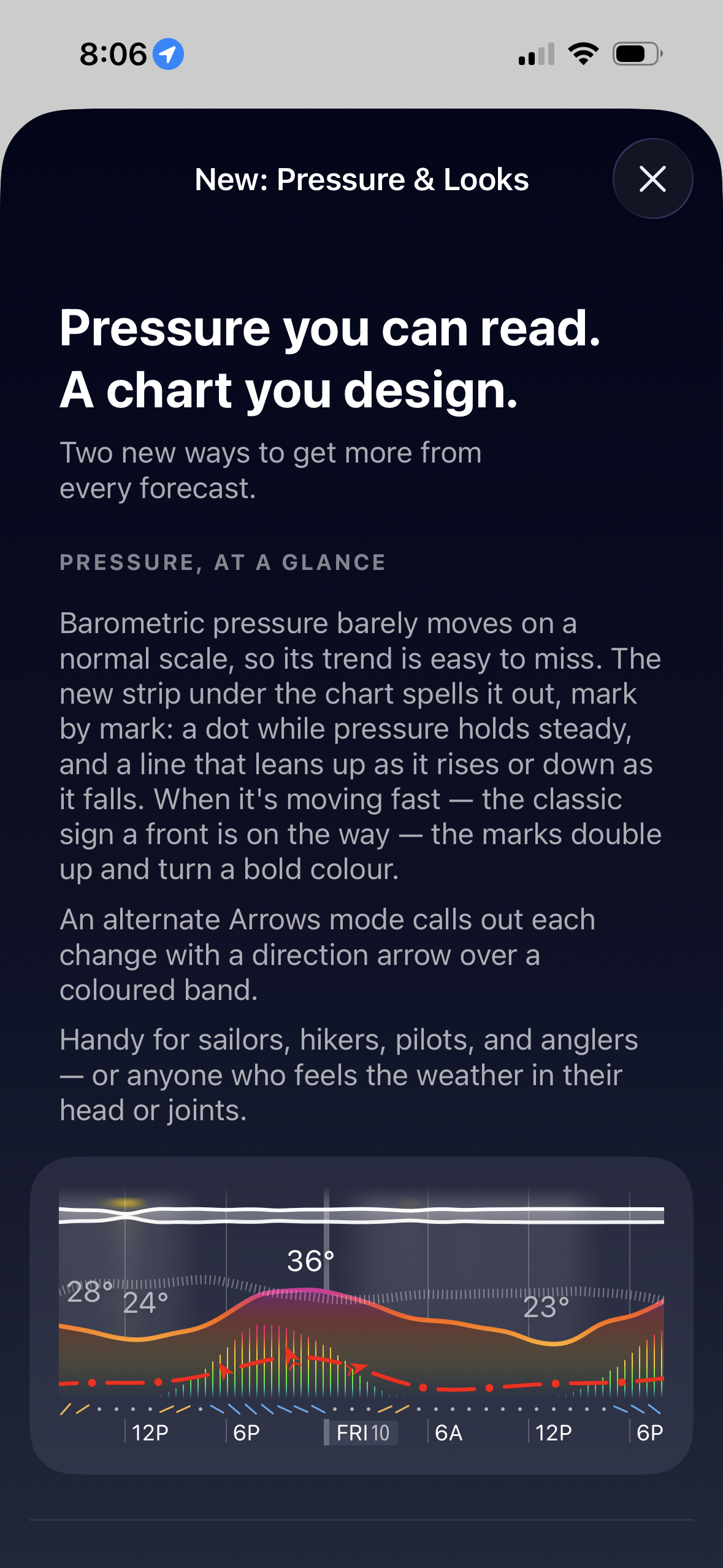
Pressure is now much easier to read. A new Pro trend strip under the chart shows whether pressure is holding steady, rising, or falling. Fast changes stand out with stronger marks and colour, so you can spot a front moving in sooner - useful for hiking, sailing, flying, fishing, or weather-sensitive heads and joints.

You can now also design the chart more freely with the new theme editor. Mix palette, style, sky detail, and accent colour, or start from a preset, to make Weathergraph fit your style.

This is an example of what it looks like:

Weathergraph: Pressure

Previously:

  •  

Castro’s Customer Support Lessons

Dustin Bluck (archive link, Hacker News):

I had an idea when I bought Castro that human support based around actual user experience was an easy differentiator. I’ve rarely gotten useful answers from support from services I use. I thought if I used my own product every day, read every email and answered it thoughtfully, people would appreciate this, and it would build some degree of loyalty and appreciation.

[…]

However, what I found is this whole thing didn’t work as I thought it would. Sure sometimes we were able to wow customers, particularly when we responded right away with an exact fix for them. But the vast majority of our honest, thoughtful answers were deeply unsatisfactory to users, and it often annoyed them more than anything else.

[…]

Customers email us with confusion about how podcasts work, how the App Store works, how their Mac works, and any number of tangential issues. What tends to happen is the same users do this over and over, and once they find out we answer, the requests get more frequent and more burdensome.

[…]

To the user, any response aside from “Okay, we’re going to build that right now” is meh-to-negative. Various honest responses, such as “I thought about this or tried it in the past and it unfortunately didn’t work very well” are not going to knock their socks off. These just don’t do much in terms of loyalty and rapport.

[…]

Avoiding explanations and specifics tends to get a neutral response and doesn’t suck anyone in or waste too much time. In other words, the best approach for us is what most companies do. Because building loyalty or rapport at the moment something isn’t working and the user is frustrated hasn’t worked. The real positive experience comes when you actually improve the product, so that’s where we’re spending our time.

I have definitely seen all these categories of customer interactions, but I don’t agree with the conclusion. Yes, in the end you want to be improving the product, but I don’t think that’s fully separable from interacting with customers as humans. I’ve found spending time on customer support incredibly valuable for making my products better. Even a lone report of an issue can often lead to a fix and learning something important that has wider implications. It’s also enjoyable and motivational to hear about real people making use of what I’ve built or to turn around someone who started with a negative view. And it seems to help with marketing, too.

I also see a correlation with the apps that I use—the better ones tend to also have good support. That said, I use a podcast app that famously doesn’t offer support. There are different situations, and there’s more than one way to a good product and a successful business.

I do think there’s an art to all this. Not everything can be measured, and there’s more to it than just committing to answering e-mails thoughtfully. You need to set boundaries and steer the interactions to make them productive, efficient, and satisfying for both sides. I’m still learning.

Previously:

Update (2026-07-07): Jeff Johnson:

This is what you get from the free with IAP business model: most of your support emails are from freeloaders!

My apps are upfront paid, thus most of my support emails are from customers. I don’t get overloaded with emails, and paid customers are more incentivized to solve issues with you, because they’ve invested money into the app.

Vitor:

I find myself agreeing with you that customer support is valuable and we should do it. But over the years I have also realised that, in a way, being good at support is punishing. I’ll explain[…]

  •  
❌