The MacVoices Live! panel shares first impressions of iOS 27 and Apple’s latest operating system updates, covering stability, performance, interface changes, Apple Pay, Weather, Vision Pro, and upgrade strategies. The discussion then turns to the new Apple Watch Live Rewind feature that will be coming later this year. How the assistive feature will work, its privacy safeguards, and accessibility benefits spark a debate that touches on, recording concerns, social implications, and whether controversy could threaten the feature’s future.
Apple Watch Ultra 4, the ultimate sports and adventure watch, now includes new, advanced health and fitness features, and longer battery life.
Apple’s newest Apple Watch features are designed to remember conversations so users don’t have to. Legal experts say they may also test wiretap statutes that were written long before a wristwatch could quietly turn speech into text.
The tools arrived with the Apple Watch Series 12 and Ultra 4. Siri Recap produces summaries of conversations a wearer had during the day. Live Rewind, triggered by a double-press of the Digital Crown, shows a transcript of the previous 15 seconds. Apple markets both as memory aids, not as recording devices.
That distinction is the heart of the dispute. According to reporting by Bloomberg News’ Natalie Lung, attorneys in all-party-consent states — including California, Massachusetts, Pennsylvania, and Washington — are not convinced that on-device processing and the absence of a saved audio file will keep users clear of eavesdropping and wiretap laws. Those statutes generally require everyone in a private conversation to agree before it is intercepted.
Apple has built in several safeguards. Live Rewind plays an audible alert, shows a full-screen animation and microphone indicator, and processes audio on secure hardware that Apple says is inaccessible to the operating system, apps, the user or the company. The company says no audio recording is created or stored. Transcripts vanish about 30 seconds after the display dims unless saved in the Siri app. Recap summaries are deleted after seven days unless a user keeps them. Users can turn the features off or restrict them by time or place. Apple also says summaries do not attach comments to named people and may omit financial details, personal identifiers and authentication data.
Experts quoted in Lung’s reporting still see legal risk. Subodh Chandra of Chandra Law Firm said the feature set “raises serious concerns under California law and the laws of other states that require all-party consent.” Boston criminal defense attorney Joe Simons called it a likely “case of first impression” in Massachusetts. Pennsylvania defense lawyer Phil Lauer said the technology is “very close to being legal” because a person is not sitting on the other end of the feed — but that courts could still treat the watch’s capture and interpretation of speech as unlawful interception. Seattle attorney Mark Blair argued that fleeting processing may not matter: if consent is missing, the wearer could face criminal exposure even after the text disappears.
Colin Zick of Foley Hoag advised users to treat the tools as they would a wiretap and ask permission first. Adam Schwartz of the Electronic Frontier Foundation said bystanders have little practical way to consent or refuse, and called always-on monitoring of conversations “an unacceptable burden on our conversational privacy.” Former Apple employee Todd Dailey wrote that lawyers “will have some long nights ahead,” arguing Recap-style capability existed before but is now harder to detect.
Apple rejected the idea that the features record conversations. It noted that people already take notes with phones and wearables, said the 15-second Live Rewind window encourages responsible use near a speaker, and pointed out there is no audio file to share or produce. Company guidance still tells users to “consider” people around them when conversations might be private or sensitive. Unlike Live Rewind, Siri Recap has no continuous on-wrist indicator while it listens through the day.
The debate sits in a broader push toward ambient AI — smart glasses, always-available assistants, gadgets that sit in the room rather than wait for a button press. Dedicated recorders from companies such as Plaud and Pocket typically start only when activated. Apple’s watches, by design, must be listening first if they are going to rewind or recap later. Whether courts treat that as note-taking or interception is unsettled. Until it is, the legal risk may fall less on Cupertino than on the person wearing the watch.
MacDailyNews Take: Surely Apple’s legal team has vetted these features before release, but we’ll see what happens with the perpetually aggrieved their overly litigious ambulance chasers.
Please help support MacDailyNews — and enjoy subscriber-only articles, comments, chat, and more — by subscribing to our Substack: macdailynews.substack.com. Thank you!
Apple says Live Rewind on Apple Watch cannot be used secretly because activation requires a deliberate double press of the Digital Crown, plays a chime, and shows a full-screen animation with a microphone indicator. The chime plays even when the watch is muted or headphones are connected. After activation, Live Rewind shows only a text […]
At my gym, all the signs are handwritten and friendly. In one section, a sign asks members not to drop their weights because there are downstairs neighbors.1 In the bathrooms, reminders to flush and wash hands. But throughout the gym, signs say—more directly—no live streaming. Other signs ask people to exercise consideration when recording their routines for themselves or their coaches to ensure nobody else is in their sight lines. Privacy in the gym is paramount to ensure everyone is not self-conscious and is comfortable.
Siri Recap requires continuous audio capture, relying on Apple’s privacy protections and with no obvious disclosure to others in the vicinity.
I was thinking of my gym when I heard about Live Rewind and Siri Recap in the just-announced Apple Watch Series 12 and Apple Watch Ultra 4. These are two of the four flagship Audio Intelligence features launching in beta later this year. Both of these tools record audio continuously. Live Rewind lets you double-press the Digital Crown to receive a transcription of the last 15 seconds of conversation. Siri Recap takes notes on what it hears throughout the day and provides Apple Intelligence-generated summaries.
Both features have, understandably, freaked people out, made them angry, or caused them to shrug in resignation. Surely Apple is exaggerating the privacy protections it explains on the same page it describes the features! And if Apple is all in on recording us all the time without our consent or knowledge whenever one of its devices is nearby, the privacy game is over, isn’t it!? Everything becomes fodder for the machine; private conversations are immutable; the future is surveillance!
I’m not one for extremes, and I’ve studied Apple’s privacy and security provisions and mistakes for nearly 30 years. But I have concerns about these features from social, political, safety, and legal standpoints. Let me tackle the privacy and security first.
Hush, now
When Apple announced Private Cloud Compute in 2024, it was interesting, but it felt academic because it didn’t then release a Siri worth worrying about. In 2026, the PCC expansion with Siri AI is much more important, as Siri may send huge amounts of our personal information to the cloud to provide better answers derived from our data.2
After studying Apple’s details on PCC, I felt reassured. This is partly because one of Apple’s five pillars of PCC integrity is transparency. This is unlike many previous claims by Apple that it would be transparent. Here, they’ve stated exactly what will be available to researchers, and one researcher already found a flaw and was awarded the highest Apple bounty—$150,000. The other pillars include end-to-end encryption, barring access by Apple or other parties through cryptographic design, and no way for an external (or internal!) party to determine which PCC server is processing an individual’s data.
Apple’s promises with Audio Intelligence are somewhat different, though I find them a valid approach to minimizing invasions of one’s privacy and an attempt to reduce violations of other people’s personal sphere. Here are the fundamentals for Live Rewind and Siri Recap:
The features are opt-in and can be entirely disabled (with a big asterisk, which I discuss in the next section). Live Rewind has to be triggered before it can access a 15-second recording window. Siri Recap must be enabled. This contrasts with Apple Intelligence in the version 27 releases, where, unlike earlier iterations, you cannot disable Apple Intelligence.3
Audio isn’t recorded, nor is it stored, nor is a transcript made. As it is captured, the audio is not accessible to you, watchOS or iOS, apps, or Apple. Apple achieves this by using the Secure Exclave to process audio; after processing, the audio is immediately discarded.4
All of the audio processing happens on your Apple Watch and iPhone. That prevents leakage. If you engage Siri, however, some portion of the Live Rewind text could be sent to PCC under the same security protections. (Apple says “will.”)
Siri Recap uses PCC. The process is complicated, exposing as little information as possible within the already secured PCC environment.
iCloud syncing is end-to-end encrypted. You don’t need to enable Advanced Data Protection (ADP).
Siri Recap deletes summaries after seven days; Live Rewind’s 15-second text snippets are deleted within 30 seconds after the Apple Watch display dims. You can save Siri Recaps or export them. With Live Rewind, they are retained within the Siri app if you choose to save them or ask Siri about the text.
From a design standpoint, these measures all feel well thought out to prevent all of the egregious use cases one might imagine: Unwanted recordings! Apple analyzing our conversations to sell us stuff (or sell to third parties)! Leakage that would allow friends or strangers to access summaries, snippets, or conversations, including via internet cloud storage!
And yet. I find the above fits into the meme of “My ‘An explanation of how the Apple Watch recording what you are saying is kept private and anonymous’ T-shirt has people asking a lot of questions already answered by my shirt.”
The right to be unheard
When I’m out in public in the United States, courts have found that in most situations, I have little right to privacy. But then you can shave that down. If a neighbor points a camera from their house at my unfenced front lawn, visible from the street?Generally legal, with some exceptions related to harassment or intimidation. But if a camera points into my house through a window or into a fenced area of my property, most jurisdictions find that “not cool” (a legal term).
The audio side of this is very different. My state of Washington, for instance, is an “all-party consent” state; some states are “one-party consent” or have different rules. “One party” means anyone in the conversation (on a phone, in person, via videoconferencing, etc.) can consent, so they can record audio or have a device or system do it for them. In Washington and other all-party states, every person being recorded must consent, or it is illegal and actionable. (Recording across state lines or internationally becomes complicated.)
Even in Apple’s promotional video, they show a food worker getting their audio recorded without their knowledge, and then replayed as text once they have left tableside.
The company says it’s not “recording” or “storing” audio. But it is capturing it. Shockingly, I’m not a lawyer, so I can’t provide a legal analysis. (Presumably many privacy-focused organizations are doing deep reads of state-level statutes.) But the gut check is what I’m really going for, anyway: do these two features have the feeling of being recorded without one’s permission, even if Apple is trying to mitigate both the technical reality and the sense of it?
On the technical side, it appears that you have to enable each feature in the Watch app on the paired iPhone. Live Rewind requires enabling Siri: Live Rewind: Double Click Digital Crown. You can schedule Siri Recap by time, trigger it or turn it off using a location, or enable or disable it manually, such as through Control Center.
So let’s do the vibe check.
Live Rewind appears to be buffering audio at all times in anticipation of needing to transcribe the last 15 seconds. Apple says Live Rewind is designed to alert those around you that you’re replaying audio: when you double-click the Digital Crown, a chime sounds (ignoring any of your settings) as the Apple Watch’s entire screen is taken over with an animation that includes a microphone indicator.
However, unless Live Rewind is also a literal Time Machine, this doesn’t feel right. People are being warned 15 seconds after their audio is captured. (If Apple doesn’t mean that, it needs to clarify.) Further, it assumes that people will be keyed in to someone’s smartwatch making sounds and flashing images they should be paying attention to.
Siri Rewind effectively replays the last 15 seconds in transcription form without obtaining consent through time travel.
There’s also no “stop recording” option: if you’re being recorded by Live Rewind, you as an unrelated party—a waiter, a friend, a stranger, someone nearby, a celebrity—have no way to say “no.”
Siri Recap ostensibly is capturing audio whenever it’s active in any of the circumstances above. There’s no indication to other people that it’s running at all, and no one except the user can opt out.
Apple’s mitigations here include that no speaker is attributed, though Siri Recap identifies and anonymously labels different voices.
With Siri Recap, an Apple Watch automatically discards “potentially harmful content.” Apple defines this as content that “promotes self-harm or hateful speech, and sensitive information, such as financial data, government-assigned identifiers, authentication data, and certain personal identifiers.” I’m not sure this list is a strong argument for Siri Recap.
When using a public or private space, there should be a compelling case, even with the protections enumerated. There are already many kinds of assistive technology used by people with many kinds of disabilities to let them function better in a world often hostile to people with no or low vision or hearing.
However, the assistive case isn’t what defines Live Rewind, a useful feature of convenience that has massive privacy implications despite the way data is captured and stored. And it doesn’t help with Siri Recap at all. Siri Recap is just “life recording” without the label attached, since no audio or video is retained, and only 0.01% of a day’s conversation will likely be summarized.
These features feel like they were designed in a lab and passed through to production without enough people wondering, “Will this provoke a tremendous backlash because of the gaps in privacy that are relatively obvious?”
It’s a jungle, Jim
The best way I can conclude my analysis is by quoting Apple:
Be mindful of those around you. While audio is not recorded and stored, and no speakers are attributed, consider those around you where conversations might be private or sensitive.
Given that Apple has to warn of this, it’s the surest sign the features shouldn’t be released in this form. Apple repeats the form of the warning I see regularly at my gym… but apparently it isn’t heeding it.
Improbably, there is a 24-hour recording studio downstairs. This is not a Simpsons bit. ↩
Siri AI uses a combination of local, on-device AI models and cloud-based models. Starting with Siri AI, this can include Apple models trained using Google Gemini running on Google’s private cloud servers. However, as a user, you can’t opt out of using cloud AI, and you don’t know which queries or parts of queries are sent to PCC (let alone which flavor of PCC). (This is distinct from ChatGPT support, from which you can opt out, use quasi-anonymously, or use logged in to your own OpenAI account.) ↩
You can only disable Siri, which also turns off Siri AI, but Apple Intelligence will continue to function in supported apps as far as I can determine. ↩
This is also where Apple Pay data is stored. The Secure Exclave differs from the Secure Enclave, which is a one-way secrets holder for biometric data and device-based encryption keys, among other things. ↩
Hoje, com a revelação dos Apple Watches Series 12 e Ultra 4, a Maçã também anunciou um novo conjunto de recursos chamado Inteligência de Áudio (Audio Intelligence), composto pelas funções Reconhecimento de Som (Sound Recognition), Reconhecimento de Música (Music Recognition), Live Rewind e Siri Recap.
Parte da Apple Intelligence e exclusivas desses novos relógios, essas ferramentas analisam o som ambiente — que, em alguns casos, é captado constantemente — para alertar o usuário sobre sons importantes, ajudá-lo a descobrir o título de músicas, recobrar algo que foi falado nos últimos instantes e revisar anotações sobre as suas principais conversas ao longo do dia, respectivamente.
Por mais bem intencionados que esses recursos possam ser, no entanto, é natural que alguns usuários torçam o nariz para eles — afinal, a ideia de ter um dispositivo monitorando tudo o que você fala (e que falam para você) sem interrupções pode ser um tanto… preocupante, principalmente do ponto de vista da privacidade — um assunto tão abordado pela Apple.
E foi muito provavelmente pensando nessas pessoas que a Apple colocou no ar uma extensa página de suporte que detalha o funcionamento dessas ferramentas, além de explicar quais medidas de segurança foram tomadas para proteger usuários que decidirem ativar essas ferramentas. A empresa também publicou um documento [PDF] que mergulha ainda mais nas minúcias dessas novidades, as quais dependem não só do poder de fogo do novo SiP 1System in a package, ou sistema em um pacote.S11, como também dos seus recursos de segurança embutidos.
Para início de conversa, a Apple deixa claro que todos esses recursos são completamente opcionais; o Reconhecimento de Som, por exemplo, precisa ser configurado nos Ajustes (Settings) do iPhone, de modo que ele só vem ativado por padrão no Apple Watch caso o recurso equivalente do iOS já tenha sido ativado anteriormente pelo usuário no iPhone. Outras ferramentas, como o Reconhecimento de Música, podem ser ativadas diretamente nos Ajustes do Apple Watch (caso já não tenham sido ativadas anteriormente).
Divulgação/Apple
O Live Rewind, por sua vez, entra em cena apenas quando o usuário dá um clique duplo na Digital Crown, mostrando em seguida uma transcrição dos últimos 15 segundos de conversa. Ainda segundo a Apple, o relógio para de gerar essa transcrição assim que o último trecho de conversa é exibido, além de não salvar qualquer texto — a menos que o usuário faça uma pergunta sobre o seu conteúdo para a Siri ou escolha salvá-lo no app da assistente, que é onde estão os ajustes dessa ferramenta.
Divulgação/Apple
Disponível na Central de Controle, o Siri Recap pode ser ativado e desativado manualmente a qualquer momento, mas também permite que o usuário defina uma programação com base na hora e/ou localização. A Siri também pode ser barrada de realizar qualquer registro em momentos/lugares específicos.
Trechos de texto do Live Rewind e anotações do Siri Recap podem ser visualizados, editados e apagados a qualquer momento no app da Siri, bem como exportados para apps como o Notas (Notes) e o Diário (Journal). Além disso, apagá-los faz com que eles sumam de todos os seus dispositivos sincronizados — lembrando que a Apple os protege com criptografia de ponta a ponta antes de enviá-los ao iCloud.
Proteções adicionais
Segundo a Apple, em todos esses casos, nenhuma gravação de áudio é gerada ou armazenada no Apple Watch. Em vez disso, o áudio captado pelos microfones passa pelo Secure Exclave do SiP S11 — compartimento isolado por hardware que processa dados de maneira separada do resto do sistema, impedindo que aplicativos, o watchOS, a Apple ou até mesmo o próprio usuário possam acessá-lo.
Os resumos da Siri Recap são gerados pelos chamados Apple Foundation Models no Private Cloud Compute, que não salva nenhuma das informações. As anotações também são apagadas automaticamente pelo app da Siri depois de sete dias, caso o usuário escolha não salvá-las ou exportá-las.
A Apple também garante que esses recursos não identificam ou atribuem locutores nos áudios captados — protegendo, assim, a identidade de pessoas no entorno do usuário. A única particularidade aqui é a Siri Recap, que pode registrar nomes citados no conteúdo da conversa, mesmo sem identificar quem é o locutor ou interlocutor; ele também reconhece e censura “conteúdo potencialmente prejudicial, como linguagem que promove automutilação ou discurso de ódio, e informações confidenciais, como dados financeiros, identificadores governamentais, dados de autenticação e certos identificadores pessoais”.
Divulgação/Apple
No caso do Live Rewind, um alerta sonoro é reproduzido sempre que o usuário ativa o recurso, não importa se o Apple Watch está com o modo silencioso ligado ou não. Uma animação em tela cheia também é exibida junto com um indicador de uso do microfone; “Isso serve para alertar as pessoas próximas de que o recurso foi ativado”, explica a empresa.
Dependente do Shazam, o Reconhecimento de Música compartilha apenas uma assinatura acústica, e não o áudio bruto, na hora de processar o áudio captado — algo que acontece nos servidores do serviço. A assinatura acústica, ainda segundo a Apple, é gerada em um buffer seguro no Secure Exclave.
Disponibilidade
Todos esses recursos, como dito, requerem um Apple Watch Series 12 ou um Apple Watch Ultra 4 para funcionar.
Indisponíveis para usuários menores de 13 anos, o Live Rewind e a Siri Recap serão liberados como recursos beta ainda neste ano (inicialmente apenas em inglês). O Reconhecimento de Som e o Reconhecimento de Música serão liberados junto com os novos smartwatches.
Matt has some pretty good but not perfect Switch 2 controllers. Niléane has a new set of headphones and assures us she doesn’t have a problem. And everyone tries to make the best gaming recommendations for their co-hosts.
On Cozy Zone, the gang has a lively discussion about the new The Mandalorian and Grogu movie.
This week, Federico returns from the beach, he and John discuss the explosion of classic videogames being ported to the iPhone, iPad, and Android, and they share a couple of Apple TV picks.
AppStories, Episode 497, ‘Folding the iPhone into the Creator Economy’ Show Notes
This episode is sponsored by:
Inoreader – Build Your Own Newsfeed and Cut Through the Noise
NPC XL is a weekly members-only version of NPC with extra content, available exclusively through our new Patreon for $5/month. Each week on NPC XL, Federico, Brendon, and John record a special segment or deep dive about a particular topic that is released alongside the “regular” NPC episodes. You can subscribe here.
Comfort Zone, Episode 113, ‘I Respect Wood’ Show Notes
For even more from the Comfort Zone crew, you can subscribe to Cozy Zone. Cozy Zone is a weekly bonus episode of Comfort Zone where Matt, Niléane, and Chris invite listeners to join them in the Cozy Zone where they’ll cover extra topics, invent wilder challenges and games, and share all their great (and not so great) takes on tech. You can subscribe to Cozy Zone for $5 per month here or $50 per year here.
MacStories Unwind, ‘Coding Agents Revive Classic Games’ Show Notes
MacStories launched its first podcast in 2017 with AppStories. Since then, the lineup has expanded to include a family of weekly shows that also includes MacStories Unwind, Magic Rays of Light, Comfort Zone, NPC: Next Portable Console, and First, Last, Everything that collectively, cover a broad range of the modern media world from Apple’s streaming service and videogame hardware to apps for a growing audience that appreciates our thoughtful, in-depth approach to media.
If you’re interested in advertising on our shows, you can learn more here or by contacting our Managing Editor, John Voorhees.
This week, John and Federico discuss the changing face of the AI-fueled App Store and questionable changes made to TestFlight before going into the nerdiest details of Open Minis, an iOS app that brings desktop-class agents onto the iPhone and iPad.
Then on AppStories+, Federico and John explore Cmux, a Mac terminal app with an iPhone and iPad beta that makes it easier than ever to sync coding projects across devices.
This week, the refreshingly complete announcement by Anbernic of the RG SP, Ticci buys a handheld, and people are tired of months-long hardware reveals.
We have a guest! D. Griffin Jones is here to show the gang technology they could only dream of: the MessagePad. After that, we look at the brand new Pastebot 3 and the surprisingly useful Clop, and we close it out by trying to sell Niléane on a 3D printer.
This week’s Cozy Zone is all about the games we’ve been enjoying lately.
This week, John realizes that too much Wi-Fi is never enough, Federico wonders what he’s going to do with a Linux PC, and John recommends Apple TV’s Lucky.
AppStories, Episode 495, ‘Open Minis Turns iOS into an Agent Playground’ Show Notes
This episode is sponsored by:
Inoreader – Build Your Own Newsfeed and Cut Through the Noise
Claude – For problems worth solving — get started with Claude today.
Scribe – AI-powered workflow documentation. Get your first month free.
NPC XL is a weekly members-only version of NPC with extra content, available exclusively through our new Patreon for $5/month. Each week on NPC XL, Federico, Brendon, and John record a special segment or deep dive about a particular topic that is released alongside the “regular” NPC episodes. You can subscribe here.
Comfort Zone, Episode 111, ‘I’m the Guest, I Have No Consequences’ Show Notes
For even more from the Comfort Zone crew, you can subscribe to Cozy Zone. Cozy Zone is a weekly bonus episode of Comfort Zone where Matt, Niléane, and Chris invite listeners to join them in the Cozy Zone where they’ll cover extra topics, invent wilder challenges and games, and share all their great (and not so great) takes on tech. You can subscribe to Cozy Zone for $5 per month here or $50 per year here.
MacStories Unwind, ‘Flooding the Wi-Fi Zone’ Show Notes
MacStories launched its first podcast in 2017 with AppStories. Since then, the lineup has expanded to include a family of weekly shows that also includes MacStories Unwind, Magic Rays of Light, Comfort Zone, NPC: Next Portable Console, and First, Last, Everything that collectively, cover a broad range of the modern media world from Apple’s streaming service and videogame hardware to apps for a growing audience that appreciates our thoughtful, in-depth approach to media.
If you’re interested in advertising on our shows, you can learn more here or by contacting our Managing Editor, John Voorhees.
This week, AYANEO is chasing the classics again, teasing a Game Boy Advance clone, while Magmi is getting vertical – plus, a Mechanism desk stand for your handheld, 8BitDo’s FlipPad, and the GPD Win Max 3 blurs the lines between laptop and console.
On NPC XL, Brendon and John try Armada and report to listeners about whether it’s ready for prime time.
Niléane brings her newest fan (literally), Chris just assumed his co-hosts have installed the betas (they have), and they all tell each other how their respective apps could start earning millions.
This week’s Cozy Zone is a complete, and authoritative, tier listing of every Men’s World Cup logo ever.
NPC XL is a weekly members-only version of NPC with extra content, available exclusively through our new Patreon for $5/month. Each week on NPC XL, Federico, Brendon, and John record a special segment or deep dive about a particular topic that is released alongside the “regular” NPC episodes. You can subscribe here.
Comfort Zone, Episode 110, ‘Only One Person Being Strangled’ Show Notes
For even more from the Comfort Zone crew, you can subscribe to Cozy Zone. Cozy Zone is a weekly bonus episode of Comfort Zone where Matt, Niléane, and Chris invite listeners to join them in the Cozy Zone where they’ll cover extra topics, invent wilder challenges and games, and share all their great (and not so great) takes on tech. You can subscribe to Cozy Zone for $5 per month here or $50 per year here.
MacStories Unwind, ‘A Long Journey Home’ Show Notes
MacStories launched its first podcast in 2017 with AppStories. Since then, the lineup has expanded to include a family of weekly shows that also includes MacStories Unwind, Magic Rays of Light, Comfort Zone, NPC: Next Portable Console, and First, Last, Everything that collectively, cover a broad range of the modern media world from Apple’s streaming service and videogame hardware to apps for a growing audience that appreciates our thoughtful, in-depth approach to media.
If you’re interested in advertising on our shows, you can learn more here or by contacting our Managing Editor, John Voorhees.
This week, Federico and John look at their experiences with Claude Fable 5 and how it differs from other models and break down the controversial changes made by OpenAI to its ChatGPT Mac app.
Then on AppStories+, John and Federico contrast their experiences with Fable 5 and OpenAI’s new family of GPT 5.6 models.
This week, Brendon and John go it alone with more bizarre news from AYANEO, a new tease and OS update from Anbernic, Valve’s e-ink Steam Machine faceplate, Armada bringing SteamOS to Android handhelds, and more.
On NPC XL, John and Brendon check on handheld gaming halfway through the year and look forward to what the rest of 2026 may have in store for the hobby.
On a special Saturday edition of MacStories Unwind, Federico and John talk live music, blockbuster movies, and their ongoing experiments with Markdown text editors.
AppStories, Episode 493, ‘Fable 5 and OpenAI’s Curious ChatGPT Update’ Show Notes
This episode is sponsored by:
Daylite: The only made-for-mac CRM solution. Start your free trial today.
NPC XL is a weekly members-only version of NPC with extra content, available exclusively through our new Patreon for $5/month. Each week on NPC XL, Federico, Brendon, and John record a special segment or deep dive about a particular topic that is released alongside the “regular” NPC episodes. You can subscribe here.
Comfort Zone, Episode 109, ‘You Can’t Kill Chrome’ Show Notes
For even more from the Comfort Zone crew, you can subscribe to Cozy Zone. Cozy Zone is a weekly bonus episode of Comfort Zone where Matt, Niléane, and Chris invite listeners to join them in the Cozy Zone where they’ll cover extra topics, invent wilder challenges and games, and share all their great (and not so great) takes on tech. You can subscribe to Cozy Zone for $5 per month here or $50 per year here.
MacStories Unwind, ‘Text Editor Experiments’ Show Notes
MacStories launched its first podcast in 2017 with AppStories. Since then, the lineup has expanded to include a family of weekly shows that also includes MacStories Unwind, Magic Rays of Light, Comfort Zone, NPC: Next Portable Console, and First, Last, Everything that collectively, cover a broad range of the modern media world from Apple’s streaming service and videogame hardware to apps for a growing audience that appreciates our thoughtful, in-depth approach to media.
If you’re interested in advertising on our shows, you can learn more here or by contacting our Managing Editor, John Voorhees.
This week, Federico and John talk about the 10+ email apps they’ve used over the years and how recent spikes in email volume have caused them to change their approaches.
On AppStories+, Federico and John update listeners on their summertime agentic coding projects.
This week, Steam Machine ordering follow-up and Sony’s many controversial announcements.
On NPC XL, what’s going on with AYANEO and the Pocket MICRO 2? Plus, the RG Rotate gets clock faces, and Apple brings PC gaming on the Mac closer to reality.
Chris explains how he’s using Parchment, Matt gets all in your face about calendars, and everyone competes to see who can handle using Snick for the longest.
On Cozy Zone, the gang shares their development tips and setups.
This week, John heads to the mountains while Federico cooks on a beach, the origin of “the boonies,” and narrow mountain roads, plus a TV and movie pick.
AppStories, Episode 492, ‘Email Survival Guide’ Show Notes
This episode is sponsored by:
Decagon: The AI concierge for every customer. Get a personalized demo.
NPC XL is a weekly members-only version of NPC with extra content, available exclusively through our new Patreon for $5/month. Each week on NPC XL, Federico, Brendon, and John record a special segment or deep dive about a particular topic that is released alongside the “regular” NPC episodes. You can subscribe here.
Comfort Zone, Episode 108, ‘My Magic Mouse Is Pregnant’ Show Notes
For even more from the Comfort Zone crew, you can subscribe to Cozy Zone. Cozy Zone is a weekly bonus episode of Comfort Zone where Matt, Niléane, and Chris invite listeners to join them in the Cozy Zone where they’ll cover extra topics, invent wilder challenges and games, and share all their great (and not so great) takes on tech. You can subscribe to Cozy Zone for $5 per month here or $50 per year here.
MacStories Unwind, ‘Out in the Boonies’ Show Notes
MacStories launched its first podcast in 2017 with AppStories. Since then, the lineup has expanded to include a family of weekly shows that also includes MacStories Unwind, Magic Rays of Light, Comfort Zone, NPC: Next Portable Console, and First, Last, Everything that collectively, cover a broad range of the modern media world from Apple’s streaming service and videogame hardware to apps for a growing audience that appreciates our thoughtful, in-depth approach to media.
If you’re interested in advertising on our shows, you can learn more here or by contacting our Managing Editor, John Voorhees.
This week, Federico and John talk about the state of AI aggregator apps and their future prospects before checking in on their current AI app setups for the AppStories+ post-show.
Niléane invested in a fast-appreciating asset (air conditioner), CHRIS MADE AN APP, and everyone surprises everyone else with their favorite challenges.
On Cozy Zone, we tier list the biggest iPhone features over the year.
This week on MacStories Unwind, Federico and John are burning up Claude Fable 5 tokens as fast as they can, while Federico finds the time to try a brand new Switch 2 game.
AppStories, Episode 491, ‘Are AI Aggregators Worth It?’ Show Notes
This episode is sponsored by:
Mercury Weather: Forecasts, beautifully done. Download now for free.
Claude: For problems worth solving — get started with Claude today.
NPC XL is a weekly members-only version of NPC with extra content, available exclusively through our new Patreon for $5/month. Each week on NPC XL, Federico, Brendon, and John record a special segment or deep dive about a particular topic that is released alongside the “regular” NPC episodes. You can subscribe here.
Comfort Zone, Episode 107, ‘The Year of Our Lord, Zork’ Show Notes
For even more from the Comfort Zone crew, you can subscribe to Cozy Zone. Cozy Zone is a weekly bonus episode of Comfort Zone where Matt, Niléane, and Chris invite listeners to join them in the Cozy Zone where they’ll cover extra topics, invent wilder challenges and games, and share all their great (and not so great) takes on tech. You can subscribe to Cozy Zone for $5 per month here or $50 per year here.
MacStories Unwind, ‘Burning Tokens Before the Clock Runs Out’ Show Notes
Fable 5
Anthropic’s Fable 5 is only available on Claude subscription plans for one week, so Federico and John are making the most of the time by tuning up ongoing projects.
MacStories launched its first podcast in 2017 with AppStories. Since then, the lineup has expanded to include a family of weekly shows that also includes MacStories Unwind, Magic Rays of Light, Comfort Zone, NPC: Next Portable Console, and First, Last, Everything that collectively, cover a broad range of the modern media world from Apple’s streaming service and videogame hardware to apps for a growing audience that appreciates our thoughtful, in-depth approach to media.
If you’re interested in advertising on our shows, you can learn more here or by contacting our Managing Editor, John Voorhees.
This week, John and Federico are back home and reflect on all the WWDC announcements, including Siri AI, Apple Intelligence, design changes, developer tools, and more.
On AppStories+, we check in on our research setups and how they fared at WWDC.
The gang’s back together! Niléane has a new window management system, Matt wonders if Thunderbolt is too fast, and everyone recovers from letting AI take the wheel for the week.
On Cozy Zone, Niléane has a new place, and it only seemed proper to roast her new setup.
NPC XL is a weekly members-only version of NPC with extra content, available exclusively through our new Patreon for $5/month. Each week on NPC XL, Federico, Brendon, and John record a special segment or deep dive about a particular topic that is released alongside the “regular” NPC episodes. You can subscribe here.
Comfort Zone, Episode 106, ‘Matt’s Big Chonker’ Show Notes
For even more from the Comfort Zone crew, you can subscribe to Cozy Zone. Cozy Zone is a weekly bonus episode of Comfort Zone where Matt, Niléane, and Chris invite listeners to join them in the Cozy Zone where they’ll cover extra topics, invent wilder challenges and games, and share all their great (and not so great) takes on tech. You can subscribe to Cozy Zone for $5 per month here or $50 per year here.
MacStories Unwind, ‘Prime Day Deal Hunters’ Show Notes
MacStories launched its first podcast in 2017 with AppStories. Since then, the lineup has expanded to include a family of weekly shows that also includes MacStories Unwind, Magic Rays of Light, Comfort Zone, NPC: Next Portable Console, and First, Last, Everything that collectively, cover a broad range of the modern media world from Apple’s streaming service and videogame hardware to apps for a growing audience that appreciates our thoughtful, in-depth approach to media.
If you’re interested in advertising on our shows, you can learn more here or by contacting our Managing Editor, John Voorhees.
It’s another duo week as Matt is out there… destroying lives??? Despite that, Chris and Niléane talk about the DMA and cool stuff in the OS 27 betas, and Chris has some stories from WWDC.
On Cozy Zone, the gang goes through their next three apps they would install on their Macs, and it leads to some hard (and surprising) decisions.
This week, Federico learns about Philadelphia and college mascots before making a sitcom plea. Meanwhile, John’s been listening to Olivia Rodrigo’s new album and buying concert tickets.
Comfort Zone, Episode 105, ‘My Dinner with Ternus’ Show Notes
For even more from the Comfort Zone crew, you can subscribe to Cozy Zone. Cozy Zone is a weekly bonus episode of Comfort Zone where Matt, Niléane, and Chris invite listeners to join them in the Cozy Zone where they’ll cover extra topics, invent wilder challenges and games, and share all their great (and not so great) takes on tech. You can subscribe to Cozy Zone for $5 per month here or $50 per year here.
MacStories Unwind, ‘Please Help, We Need Sitcoms’ Show Notes
MacStories launched its first podcast in 2017 with AppStories. Since then, the lineup has expanded to include a family of weekly shows that also includes MacStories Unwind, Magic Rays of Light, Comfort Zone, NPC: Next Portable Console, and First, Last, Everything that collectively, cover a broad range of the modern media world from Apple’s streaming service and videogame hardware to apps for a growing audience that appreciates our thoughtful, in-depth approach to media.
If you’re interested in advertising on our shows, you can learn more here or by contacting our Managing Editor, John Voorhees.
Astronomers have discovered a powerful “galaxy-killing wind” in the early universe that may help solve one of the biggest mysteries in modern astronomy: why so many massive galaxies stopped forming stars much earlier than scientists expected. The discovery suggests that some young galaxies grew rapidly and then died just as quickly, not because of exotic […]
The James Webb Space Telescope (JWST) has revealed a cosmic catastrophe, as winds extinguished a star-forming galaxy in the early universe, offering new insight into earlier strange observations.
Cosmic winds may destroy entire galaxies, according to new JWST research exploring the lingering mystery of why certain parts of the universe are unexpectedly devoid of growth.
The findings were published in a recent paper in the Monthly Notices of the Royal Astronomical Society, revealing galactic-scale death in a universe just one billion years old, and potentially answering questions about previous troubling JWST observations.
James Webb Space Telescope Observation
Observations made by the JWST revealed cold gas, an essential star-forming material, blowing out of the CRISTAL-2 galaxy in a massive plume, severely degrading its ability to produce new stars. According to the researchers, it would take less than 50 million years for the galaxy to be completely dead if this activity keeps up, a mere blink in the scheme of a 13.8 billion-year-old universe.
Astronomers consider galaxies to be “dead” if they are no longer capable of producing fresh stars. Traditionally, astronomers expected that it would take billions of years for an old galaxy to slowly run out of fuel and burn out. However, JWST observations have continually captured events in the early universe that were not expected to occur until much later.
One of these was finding a host of dead galaxies in the early universe shortly after it first became operational in 2022. How galaxies could die so close to the beginning of the universe, without sufficient time to burn through their cold gas supplies, has long perplexed scientists.
Explaining Galaxy Death
As researchers began considering various explanations for the phenomenon, they initially settled on dark energy, essentially explaining one unknown with another. Dark energy is a theoretical substance that scientists believe drives the expansion of the universe and was once a stronger force than it is now. While the Dark Energy Spectroscopic Instrument survey revealed last year that dark energy appears to be weakening over time, an exotic galaxy-killer is not required, according to this latest research.
Instead, researchers offer a much simpler explanation of powerful cosmic winds in the remote past. Conventional thinking has it that such powerful winds could only be generated by a supermassive black hole, yet these new observations challenge that assumption.
JWST Reveals the Culprit
CRISTAL-02 is a galaxy still in the making, composed of several smaller galaxies in the final stages of merging into a single system. Because the early universe was far denser than it is today, such collisions were much more common. During these mergers, gravitational forces funnel vast amounts of gas toward the galactic centers, triggering intense bursts of star formation.
Observations of CRISTAL-02 by the James Webb Space Telescope and the Atacama Large Millimeter/submillimeter Array (ALMA) revealed a star formation rate roughly twice that of similar galaxies. Ironically, this extraordinary burst of stellar activity is also generating a powerful cosmic wind that is stripping away the very gas needed to form new stars.
Compounding the effect, many of the newly formed stars rapidly exhaust their fuel and end their lives as supernovae, producing additional outflows that further deplete the galaxy’s star-forming material.
Together, these processes appear capable of shutting down star formation far more quickly than astronomers previously believed possible. Going forward, ongoing JWST observations are likely to continue challenging astronomers’ assumptions, as more evidence indicates that nearly half of the early universe’s massive galaxies were interacting—a finding which also suggests early “galactic deaths” like these may not be all that rare, after all.
Ryan Whalen covers science and technology for The Debrief. He holds an MA in History and a Master of Library and Information Science with a certificate in Data Science. He can be contacted at ryan@thedebrief.org, and follow him on Twitter @mdntwvlf.
After a 50-year search, astronomers have uncovered evidence that Sagittarius A* -- the 4.3-million-solar-mass black hole that resides at the center of our Milky Way Galaxy -- is blowing a hot cosmic wind into its surroundings, carving out a giant cavity near the Galaxy’s heart.
The winds on seven hellish alien worlds are moving in the wrong direction. That strange anomaly just cracked open one of exoplanet science's biggest mysteries.
What happens when pileups of solar wind plasma collide with Earth’s protective magnetosphere? New work uses machine learning to examine how strongly these events affect our planet’s magnetic field.
Plasma Pileups
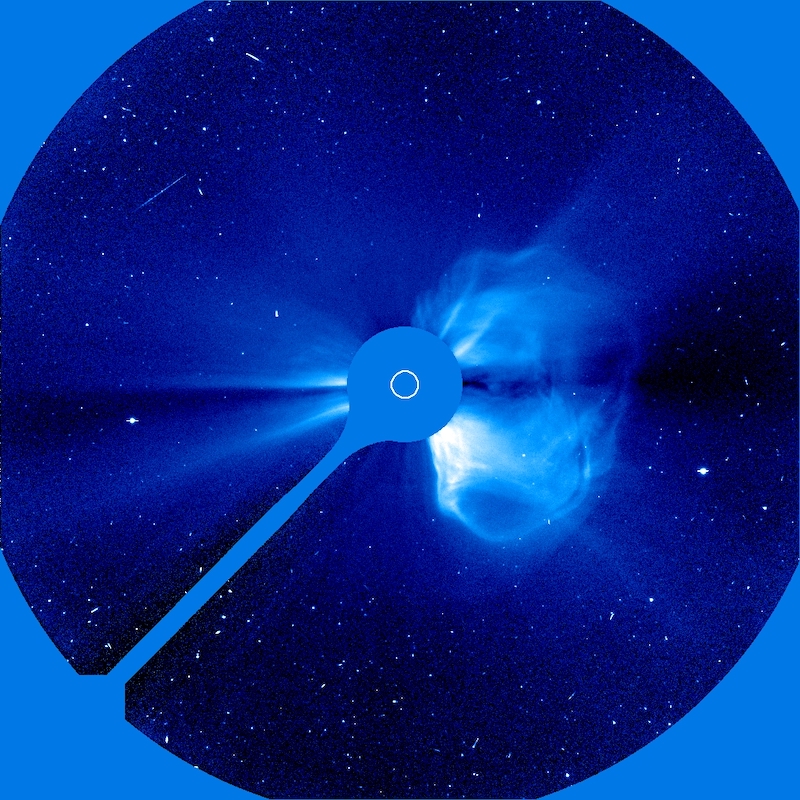
The Solar & Heliospheric Observatory (SOHO) took this coronagraphic image of a coronal mass ejection on 20 April 1998. [SOHO (ESA & NASA)]
Geomagnetic storms driven by solar activity paint night skies with glowing aurorae, but they also threaten spacecraft electronics with showers of high-energy particles. While immense eruptions of solar plasma and magnetic fields called coronal mass ejections are the most infamous example of solar activity, a team led by Yudong Ye (Sun Yat-Sen University) recently focused on another, less destructive form of activity: stream interaction regions.
Stream interaction regions arise when slow-moving solar wind is struck from behind by faster-moving solar wind emitted later. The collision of the two solar wind streams creates a tangle of compressed plasma and strong magnetic fields capable of peeling back Earth’s protective magnetosphere and dumping in high-energy charged particles, with beautiful yet harmful results.
Machine Learning Method
Though stream interaction regions are less disruptive than coronal mass ejections, they’re far more common; they frequently needle Earth’s magnetosphere, especially during the calmer years of the Sun’s activity cycle. Predicting how strongly a stream interaction region will influence Earth’s magnetosphere — in other words, how geoeffective it is — is challenging, however. When two streams of solar wind collide, their properties combine in complex and nonlinear ways that traditional statistical investigations have struggled to pin down.
Now, Ye and collaborators have used machine learning to study the properties and impact of stream interaction regions in a physically meaningful way. They performed their study on a sample of 879 stream interaction events for which there is abundant information, such as temperature, magnetic field strength and direction, and solar wind conditions before and after the event.
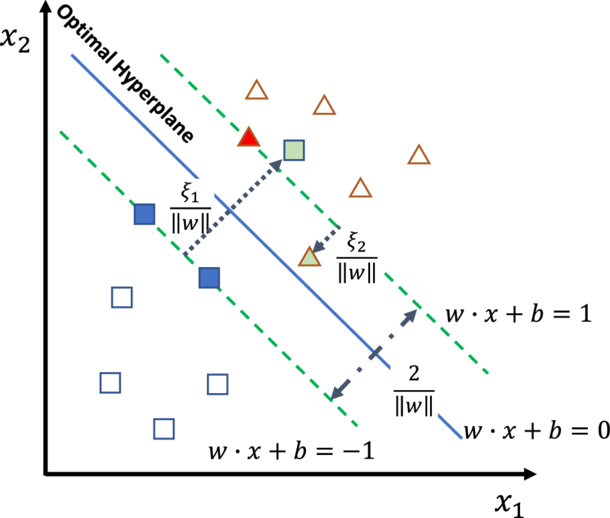
Illustration of the authors’ support vector machine framework. The optimal hyperplane is the boundary that best divides the data by maximizing the distance between the boundary and the data points nearest to it; these points are called support vectors. Square and triangle symbols represent two classes of data. Click to enlarge. [Ye et al. 2025]
Ye’s team based their framework on a support vector machine classifier: a classical machine learning algorithm that draws a mathematical boundary between groups of data while maximizing the distance between the boundary and the data points nearest to the dividing line. The support vector machine algorithm is well-suited to the task of modeling the geoeffectiveness of stream interaction regions because it doesn’t require a particularly vast dataset, can tolerate misclassified events, and allows for a physical interpretation of the results.
A Physical Interpretation
The team first reined in the model’s complexity by identifying the most important features in the dataset. They then determined which features or combination of features had the largest contribution to the output — in other words, which physical parameters most strongly determined the geoeffectiveness of the event.
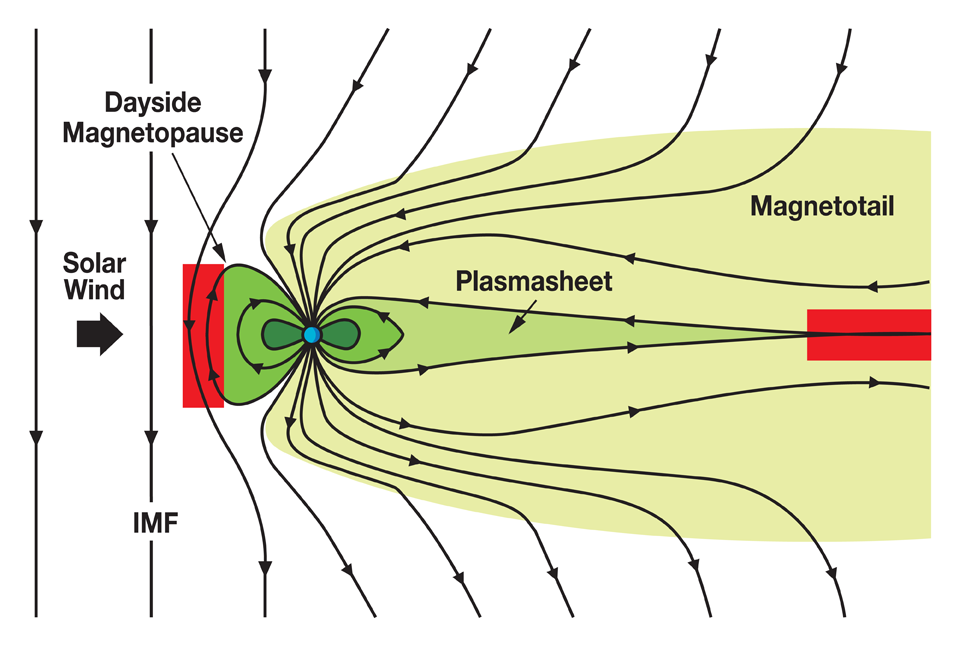
Illustration of how the interplanetary magnetic field (IMF) interacts with Earth’s magnetosphere. When the IMF points southward, as it does in this diagram, the impact on Earth’s magnetosphere is increased, with magnetic reconnection occurring in the red areas. Click to enlarge. [NASA]
Ye and collaborators found that the strongest determinants of an event’s geoeffectiveness were how long the solar wind was directed southward, the strength of the solar wind electric field, and the average and minimum strengths of the southward-pointing solar wind magnetic field. These results align with the current understanding of how energy is transferred from the solar wind to Earth’s magnetosphere through magnetic reconnection, a release of magnetic energy driven by rearrangement of magnetic fields. This shows how classical machine learning methods can enhance our ability to predict the outcome of oncoming space weather while simultaneously examining the physical drivers of the event.
Citation
“Assessing the Geoeffectiveness of Stream Interaction Regions Through Physically Interpretable Machine Learning,” Yudong Ye et al 2025 ApJ993 10. doi:10.3847/1538-4357/ae0454
Spacecraft scattered throughout the solar system keep tabs on the solar wind, but the measurements are dotted with data gaps. How can scientists prevent these gaps from biasing their studies of the solar wind?
The solar wind is a tenuous, fast-moving, turbulent plasma that constantly streams out from the Sun. Studying the solar wind is important for understanding how potentially damaging space weather events like coronal mass ejections travel through the solar system. Solar wind studies also have far-reaching implications, since solar-wind-like plasmas exist throughout the universe, such as in the sparse medium between galaxies in a cluster.
Luckily, there are many spacecraft that sample the solar wind from various locations within our solar system. Unluckily, many of these spacecraft do not continuously monitor the solar wind. For example, when a spacecraft orbiting a planet dips into the planet’s atmosphere, this detour creates an hours-long gap in solar wind monitoring.
The Impact of Data Gaps
How do these data gaps affect studies of the solar wind? In a recent research article, Daniel Wrench and Tulasi Parashar (Victoria University of Wellington) approached this question in terms of how gaps affect the structure function: a mathematical description of how the solar wind fluctuates over different length or time scales.
Wrench and Parashar introduced random artificial gaps into data from the Parker Solar Probe, which monitors the solar wind continuously, and compared the structure functions calculated from the continuous and interrupted data sets. They used the difference between the true structure function — calculated from the continuous data set — and the structure functions from the artificially gapped data sets to develop a correction factor.
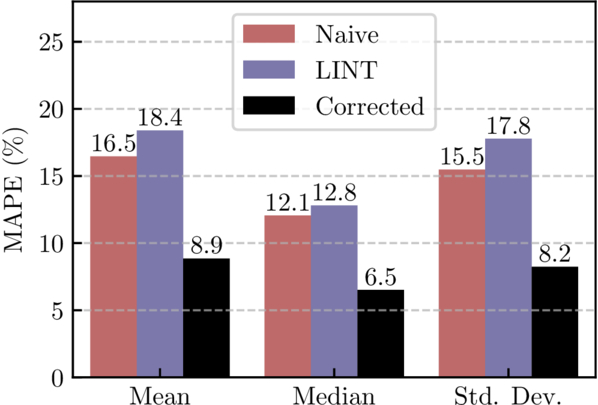
Performance of the correction factor method (black) compared to the uncorrected, gapped data (red) or gaps filled using linear interpolation (blue). MAPE is the mean absolute percentage error. [Wrench & Parashar 2025]
The team then tested their correction factor using data from the Wind spacecraft, which continuously monitors the solar wind from the L1 Lagrange point. The team calculated the structure function from 1) the continuous data set, 2) the artificially gapped data, 3) the gapped data with linear interpolation used to fill the gaps, and 4) the gapped data with the correction factor applied. This test showed that the correction factor performs better than other commonly used gap-handling methods, such as linear interpolation, which can systematically underestimate the structure function. Using the correction factor, the error in the structure function remained below 50% even when 95% of the data were missing.
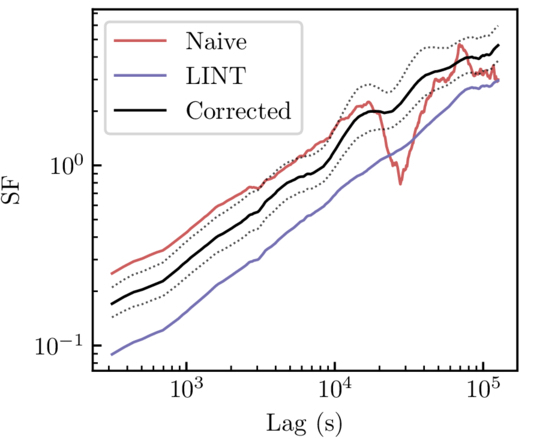
Structure function calculated from uncorrected Voyager 1 data (red), linearly interpolated data (blue), and corrected data (black). Both the linear interpolation method and the correction factor method remove the artifact around a lag of 3×10⁴ seconds, but the correction factor method does not suppress the signal like the linear interpolation method does. [Adapted from Wrench & Parashar 2025]
Correcting Voyager 1
Finally, the authors applied their validated method to data from Voyager 1. Data from the two Voyager spacecraft are extremely scientifically valuable — no other spacecraft have ventured as far from the Sun and can measure the solar wind at such large distances. The data are also extremely sparse; one segment used in this work was missing 85% of the data. This means that an effective method of correcting these data has potentially huge scientific significance.
Wrench and Parashar applied their correction factor to the Voyager 1 data, showing that this method handily removes artifacts while avoiding the underestimation introduced by linear interpolation. While the authors saved the interpretation of the newly corrected Voyager 1 data for future research, this study makes it clear that even large data gaps needn’t hinder studies of the solar wind.
Citation
“Debiasing Structure Function Estimates from Sparse Time Series of the Solar Wind: A Data-Driven Approach,” Daniel Wrench and Tulasi N. Parashar 2025 ApJ987 28. doi:10.3847/1538-4357/addc6a

 Login