❌

Normal view

Self-driving, solar-powered cars that talk to each other? What vehicles might look like in 10 years.

9 October 2026 at 17:00

Imagine you're road-tripping across the country 10 years from now. You spend a few minutes charging your electric vehicle and then set off — and your car's solar paint keeps it charged as you drive.

Your eyes are on the stunning scenery, taking in the vistas along Route 66 or the grandeur of the Rocky Mountains, or you're catching up on messages. Your hands barely touch the wheel, and your foot doesn't push a pedal. Your car communicates with others on the road, so there's no need to brake suddenly or swerve. That's because it knows a vehicle five cars up from you has done so, and all those in between are slowing at exactly the right pace to avoid dramatic changes in trajectory.

And when you park for the night, your car makes you money, selling the excess energy it's harvested from its paint back to the grid. Or maybe you don't feel like being in the driver's seat at all, so you hail a self-driving car and take a nap in the back seat in between adventures.

Some of that scenario may become a reality in the next 10 years, at least for those who are using the most cutting-edge cars on the market. Although there's some heavy speculation involved in that futuristic vision, vehicle manufacturers are already incorporating increasingly sophisticated automated driving technology into high-end personal vehicles, and self-driving taxis are coming to dozens of U.S. cities.

What's more, dramatic changes in range, cost and charging speed for electric vehicles (EVs) are arriving at a rapid pace. While some of these technologies may not wind up in personal cars, others are already taking to the roads.

An ecosystem of connected vehicles

Some car models within the next decade may interact with their surroundings in new ways, including by communicating with other cars to avoid collisions, drawing energy from natural sources, or letting drivers get paid for sending their cars' unused energy back to the grid.

An image of cars on the road overlaid with blue circles and lines.

Some researchers are developing technology to connect cars on the road, which could make for smoother braking and less traffic. (Image credit: lupengyu via Getty Images)

If you're driving an EV, you might avoid the hassle of finding a charger when you're at work or running errands. In 2024, EV company Aptera unveiled a prototype car equipped with solar panels. Those panels — on the car's hood, roof, dashboard and hatch — allow the vehicle to travel about 40 miles (64 kilometers) per day on solar power. That's more than the average American drives per day. Aptera's vehicle can also travel up to 400 miles (640 km) on a standard electrical charge.

Some sunlight-powered cars might ditch the solar panels altogether in favor of a more integrated design. In 2024, Mercedes-Benz revealed it was researching a photovoltaic paint that could convert sunlight into energy for electric cars. In sunny cities such as Los Angeles, the company calculated, the paint could draw in enough energy to power the car for nearly 7,500 miles (12,000 km) per year. The tiny particles in the paint convert about 20% of the energy from sunlight into electricity, which is comparable to the efficiency of existing solar panels.

You might even be able to sell some of the energy stored in your car's battery back to the grid. EV owners could charge during the day or late at night, when the demand for electricity is lower and pay lower rates for electricity. Then, in the evenings when the electrical grid is under more strain and the price of electricity is higher, they could sell that stored energy back at a profit.

Standardized software programs that throttle EV charging speeds during peak hours already exist. Drivers can use them if, for example, they want to keep charging costs down by primarily charging their cars during off-peak hours when electricity costs are lower, or if they want to use electricity only from solar power to charge, said Rajit Gadh, a researcher who studies EV charging and scalability at UCLA. But the process for sending energy back to the grid is a different story. Individual manufacturers haven't yet landed on a standard way to tell cars when and how much energy to discharge, Gadh said.

"What is needed is really [for] every EV charging vendor ‪—‬ and every EV manufacturer, actually ‪—‬ to have this protocol built in, adhere to it in its full specification, and make it available," Gadh told Live Science.

With the right protocols, though, cars of the future will be able to do more than interface with the electrical grid. "Vehicle-to-everything" technologies could enable cars to communicate with infrastructure and other vehicles to avoid traffic and collisions.

Some cars today are already equipped with vehicle-to-vehicle (V2V) communications. These systems use short-range radio signals to alert other V2V-equipped vehicles of the car's speed, direction of travel and braking patterns. The radio signals can travel about 1,000 feet (300 meters), allowing the vehicle to receive data from cars that are not in the driver's line of sight.

V2V systems could help reduce traffic collisions by warning drivers about oncoming cars they can't see yet — for example, by alerting a driver to another car speeding toward an intersection or coming around a bend as the driver is passing another vehicle on a twisty, two-lane highway. Not all cars have the technology, though, so its practical utility is limited for now.

Hands off the wheel; eyes off the road

Some driver assistance technologies, such as lane departure warnings and cruise control, have been on the market in personal cars for decades. These technologies and more recent assistive features require the driver to be in control of the vehicle, but theoretically, they make driving easier. For example, Tesla's Full Self-Driving (Supervised) mode handles most steering and braking tasks, but safe operation requires the driver to keep their eyes on the road and be ready to take over at a moment’s notice. In the next several years, drivers will likely see new features that automate driving in more contexts.

Some of these features will allow drivers to take their attention off the road entirely and enjoy some in-car entertainment, as long as they're alert and able to retake control of the vehicle within a few seconds if conditions change. Technologies that fully automate driving in many circumstances within certain service areas will likely be in about 4% of cars on the market by 2035, according to a white paper from the World Economic Forum.

In cars equipped with these features, "you're still going to have driver controls, but under certain circumstances, it will be effectively an automated vehicle," Luke Neurauter, who leads the Division of Vehicle, Driver and System Safety at the Virginia Tech Transportation Institute, told Live Science.

Mercedes-Benz introduced its Drive Pilot system for two consumer car lines in 2022. On the entire German Autobahn network and on certain freeways between and around Los Angeles, San Francisco and Las Vegas, during heavy traffic, the system lets the driver turn their attention toward other activities, such as reading a book or eating lunch, while the car handles steering and keeping pace with other nearby vehicles.

But as the artificial intelligence (AI) models that control autonomous driving improve and become better able to handle unusual scenarios — often called "edge" or "corner" cases — on the road, drivers will be able to hand over control to their cars in more situations, said Rahul Jain, an electrical and computer engineer at the University of Southern California.

You're still going to have driver controls, but under certain circumstances, it will be effectively an automated vehicle.

Luke Neurauter, director of the Vehicle, Driver, & System Safety Division at Virginia Tech Transportation Institute

Future AI systems might "have some reasoning ability, and then because of that, it can handle these corner cases much better than current systems are able to do," Jain told Live Science. For example, a car might be able to better respond to an indecisive pedestrian who suddenly enters a crossing, assess whether to enter potentially hazardous conditions such as flooded roads, or safely navigate around unusual circumstances, such as construction work, on a highway.

While some systems will enable drivers to make fewer decisions, others that may roll out in the next several years will track a driver's attention and alert them with sounds, an indicator light or haptic feedback when their focus falters. These systems use cameras and software to track head position, eye movement and steering-wheel input to ensure drivers are focused on the road even when they're using assistive features such as lane centering, Neurauter said.

In addition to looking for distracted driving, the technology might expand to monitor drivers for fatigue and alcohol impairment, he added. That information could then affect "whether or not other features become active, or change how they act, based on the driver state at that moment in time," Neurauter said. Proposed legislation could make this technology a requirement in new vehicles as early as 2027, but technological hurdles and concerns over privacy and false positives could stall its implementation.

The technology could also assist drivers who become unable to safely operate the vehicle — for example, if the driver falls asleep or experiences a medical emergency. If a car detects that the driver is not holding the steering wheel or actively controlling the vehicle, it could send a series of visible, audible, or tactile alerts. If the driver doesn’t respond to those cues, a car might turn on its hazard lights and come to a stop. Some vehicle manufacturers are already rolling out such technology; for example, Volkswagen has made it available in all new vehicles from model year 2025.

Fully autonomous vehicles

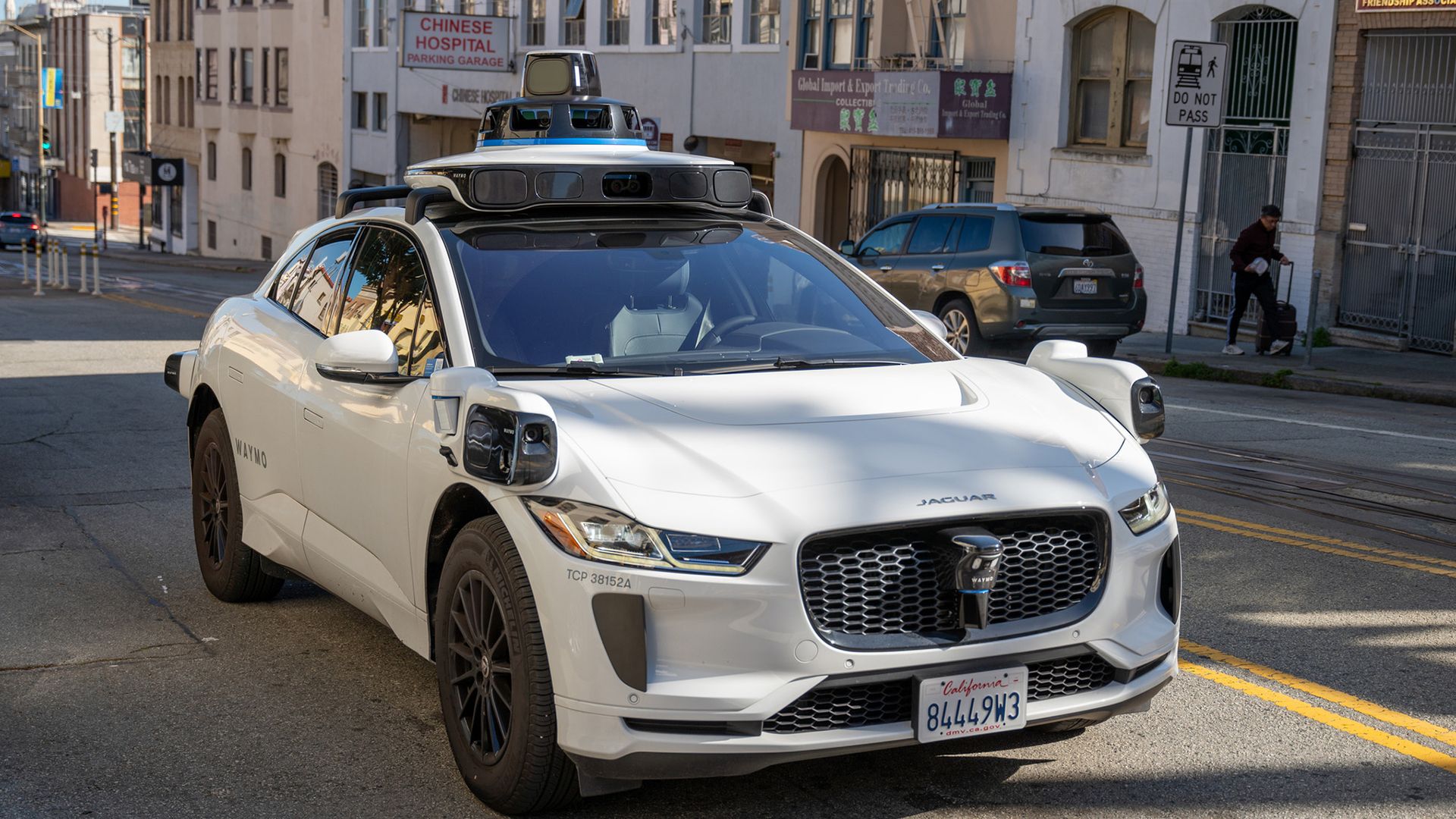
While personal cars may not offer full automation, highly automated car services will become much more common as rideshare vehicles in major metro areas. In some cities, like San Francisco, commuters already rely heavily on autonomous vehicles from Waymo. The company has rolled out its cars in nearly a dozen cities —‬ including Dallas, Houston, Atlanta and Los Angeles —‬ and has announced plans to expand service to more than 20 additional locales. Other companies ‪—‬ such as Nuro and Volkswagen’s MOIA ‪—‬ are testing their vehicles with human drivers on board before rolling out full public service.

A white car with a camera on top is seen on a city street.

Autonomous cars are rolling out in new regions at a rapid pace, but a patchwork of laws and regulations governing self-driving cars may affect whether they wind up in a city near you. (Image credit: Marc Dufresne via Getty Images)

Currently, autonomous vehicles navigate by combining information from preloaded, high-resolution maps and real-time radar, lidar and visual data collected by cameras and sensors attached to the car. An onboard computer uses that information to build a 3D map of its surroundings. Right now, the cost of these sensors makes them impractical for consumer vehicles, Jain said, but they’re becoming cheaper as manufacturers scale up production. The cars also use an AI model trained on both common and unusual driving situations to anticipate how other vehicles and pedestrians will behave and plot a safe path forward, Jain added.

Developing those high-resolution maps takes time, which is one of the main reasons autonomous rideshares aren’t available everywhere yet. Mapping usually involves decking out a car with high-end visual sensors and lasers and driving it throughout the region. Although cities like San Francisco have been mapped with this level of precision, much of the U.S. has not.

"It's very difficult to do overnight," said John Dolan, an autonomous-driving researcher at the Carnegie Mellon University Robotics Institute.

Complexities also tend to arise in city environments, where unexpected stops are more common and there are many pedestrians who behave unpredictably or jaywalk. But interstate highway driving doesn't face as many of those obstacles, and that could enable autonomous long-haul drives.

"[Autonomous] trucking, I would expect, would be the first thing that's going to happen" in terms of autonomous travel outside of major cities, Jain said. A few driverless trucks are already on the road: Pittsburgh-based company Aurora deployed the technology on I-45 in Texas, between Dallas and Houston, in 2025, with plans to expand across the southern U.S.

Longer range and faster charging

While there's speculation involved in predicting the range of self-driving capabilities available in a decade, the picture for EVs is a little clearer.

Right now, lithium-ion batteries dominate the EV market. Each cell in a lithium-ion battery has two electrodes, commonly a layered graphite electrode and a metal oxide or phosphate electrode, separated by a liquid electrolyte solution. Lithium ions migrate back and forth between these two electrodes when a person charges and discharges the battery.

Many electric cars with lithium-ion batteries can already travel more than 300 miles (480 km) on a charge. But that's not ideal for a long-range car trip, because charging stations are few and far between in the country's vast interior and charging takes longer than filling up a gas tank.

Solid-state batteries, which replace the liquid electrolyte with a solid electrolyte made of ceramic, polymer or sulfide materials, could make that cross-country trip in an EV a practical option, allowing an electric car to travel more than 750 miles (1,200 km) on a single charge. Some prototype battery packs can already achieve this range under controlled conditions. If a solid electrolyte were paired with an anode made of pure lithium, rather than graphite or hard carbon, it would allow the battery to store more energy than a lithium-ion cell of similar mass can.

It'll be a fantastic commuter car, but you're not going to go on a family trip from Montreal to California so easily.

Eric McCalla, battery materials chemist at McGill University in Canada

Solid-state batteries may also enable faster charging. In current batteries that use liquid electrolytes, charging and discharging the battery too quickly can cause dendrites, thin branches of lithium that stretch across the cell and short-circuit the battery. A solid electrolyte could, in theory, block those dendrites, which would enable cars to charge fully in just 10 to 15 minutes. The higher energy density from a lithium metal anode also translates to a greater range than that from a similarly sized lithium-ion battery, Eric Wachsman, director of the Maryland Energy Innovation Institute at the University of Maryland, told Live Science.

Cheap EVs

Many of the raw materials that go into existing lithium-ion batteries are concentrated in a handful of geographic areas. In 2023, Australia, China and Chile mined about 85% of that year's lithium supply; China mined the majority of graphite used that year as well. And battery materials still make up a significant portion of an electric vehicle's cost.

Sodium-ion batteries could be cheaper and easier to source. Sodium is plentiful in Earth's crust, which means mining could be done throughout the U.S., potentially with a comparatively low environmental impact.

Such batteries also rely on a more widely available electrode material. Sodium ions are larger than lithium ions, so they don't fit in between layers of graphite like lithium ions do. Instead, sodium-ion batteries use hard carbon electrodes.

I would be surprised to see them in cars in the next decade. I've been surprised before, though.

Eric McCalla, battery materials chemist at McGill University in Canada

"When you cook at home and your soup boils over and you get this black ring around your pot, this is hard carbon," Maximilian Fichtner, a solid-state chemist at the Helmholtz Institute Ulm for Electrochemical Energy Storage in Germany, told Live Science. "You can produce this from sucrose or from biomass, from whatever. You can do that everywhere."

The downside is that hard carbon holds less sodium than graphite holds lithium, said Eric McCalla, a battery materials chemist at McGill University in Canada. That means sodium-ion batteries can't store as much energy relative to their mass, and they don't last quite as long as their lithium counterparts.

"The range won't be as large," McCalla told Live Science. "It'll be a fantastic commuter car, but you're not going to go on a family trip from Montreal to California so easily."

Manufacturers are already bringing sodium-ion technology to market. For instance, the Chinese company CATL began mass-producing the batteries in February and claims that their battery packs enable EV ranges over 250 miles (400 km).

But new technologies are being developed rapidly. For example, some scientists are making sodium-ion batteries that use solid electrolytes, combining the higher energy density of solid-state lithium batteries with the cost savings of sodium batteries.

This hybrid battery chemistry is still in the early stages of development, experts told Live Science. "I would be surprised to see them in cars in the next decade," McCalla told Live Science in an email. "I've been surprised before, though."

Bumps in the road

The future we're describing is the utopian scenario. But the biggest obstacles are likely not technological but rather regulatory, economic, political or cultural, experts said.

"We're going to try to guess at a timeline of when some of these things are going to come in, and odds are, we're going to be wrong," McCalla told Live Science. "Odds are, we're going to be slower than we think."

Solar panels may not wind up being the most economic or practical way to increase EVs' range, while scaling up manufacturing capacity for next-generation batteries is expensive and could slow EV adoption in the U.S. The utility of vehicle-to-vehicle communications, meanwhile, could be limited by a slow rollout and adoption of V2V-equipped cars among drivers.

Whether EVs will be ubiquitous will likely come down to their affordability relative to gas-powered vehicles, which is affected not just by manufacturing and technological advances but also domestic policy choices, such as whether to subsidize EVs or their charging networks.

One challenge for manufacturers is that the automated features drivers prefer may not always be safer. A recent review of automated systems found that those focused on driver safety, such as automatic safety or lane centering, tend to reduce crashes, while those focused on comfort, such as adaptive cruise control, can increase accidents. The authors proposed that such systems make it easier for people to disengage or become distracted while driving and possibly overestimate the capabilities of the system.

And there are other kinks to work out for autonomous rideshare vehicles. In December 2025, a horde of Waymos stalled during a power outage, clogging San Francisco intersections. The cars are programmed to treat dark traffic signals as four-way stops, according to a statement from Waymo, but they occasionally ping human operators for confirmation. During the outage, the number of confirmation requests spiked, leading to delayed responses — and lengthy traffic jams. The company says it has since released software updates that allow its vehicles to act more decisively at dark signals. But questions remain about how the fleet will respond in natural disasters, and some have expressed frustration that autonomous rideshare vehicles already slow down ambulances, fire trucks and police cars responding to emergencies.

One of the biggest roadblocks to automated driving is the regulatory environment, Neurauter said. Regulations on self-driving vehicles vary by state, and some, such as New York, effectively prohibit driverless vehicles entirely. Where they are legal, they often must carry higher insurance and pass testing, which could limit their rollout.

"When we get into automated driving, the driving behavior is being governed by software that's installed on a computer that's in the vehicle," Steven Shladover, a research engineer at the University of California, Berkeley, told Live Science. "That gets us into a messy gray area where both the federal and the state roles kind of overlap, and that's politically very complicated." For example, different states could end up with different rules for establishing who's legally responsible for an accident involving automated driving.

In 10 years, you'll almost certainly be able to drive from Los Angeles to Las Vegas in an autonomous vehicle. But if you want to drive to New York City, you might have to stop in New Jersey — and take a train into the city.

Help us improve Live Science Pro: We're always trying to make our content better. Leave us feedback about Pro here.

Cool chemistry trick allows new tattoos to 'turn on and off'

9 October 2026 at 16:00

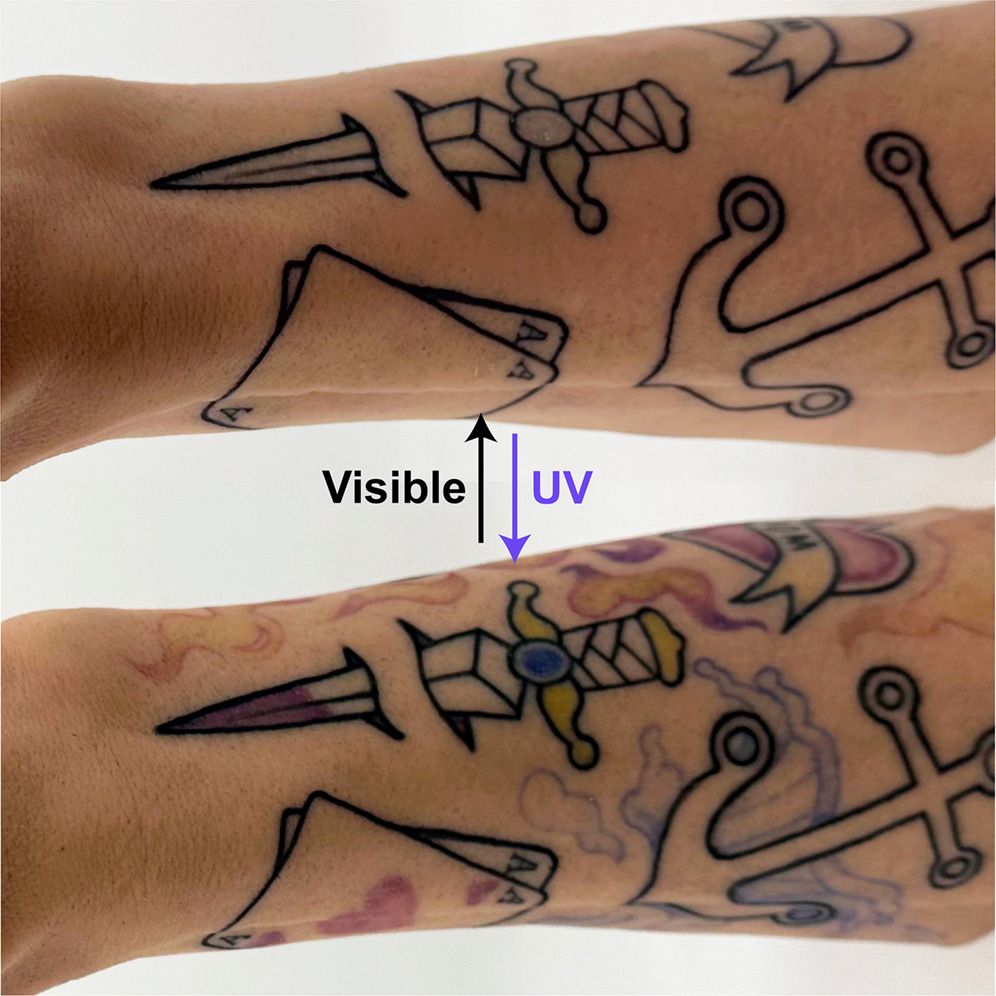
Two arms with one showing tattoos and the other showing colors amidst the tattoos

The new tattoo ink is activated under UV light. (Image credit: Matter & Light, Bruns et al.)

Researchers have developed a new type of tattoo ink that can be switched on and off with light, allowing colors and images embedded in the skin to be changed and even "erased" without having to go through the painful tattoo-removal process.

The system, which is being commercialized under the name PhotoTat, could eventually give people a way to conceal or change permanent body art. It could also have more practical applications, including medical tattoos that are visible only when a doctor needs to see them, researchers reported in a study published Friday (Oct. 9) in the journal Matter & Light.

"This is a tattoo that you can have, and whenever you decide you don't want it to be showing anymore, or you just don't want it there, you just turn it off," said study co-author Carson Bruns, an associate professor of biomedical engineering at the University of Colorado at Boulder. "And that's it. You don't have to turn it on again."

Working like a light switch

PhotoTat contains three primary color inks — blue, magenta and yellow — made with photochromic dyes, which are light-sensitive compounds that can change color with different wavelengths of light. These dyes are encapsulated in nanoparticles of polymethyl methacrylate (PMMA) — a medical-grade, glass-like plastic that is already used in medical implants and dermal fillers.

The dyes change their molecular structure when exposed to specific wavelengths of light. A 365-nanometer ultraviolet (UV) LED can activate pigments in around two to three seconds, Bruns said. Once activated, the colors can persist for hours to days under typical indoor lighting. But once the wearer exposes their skin to the bright outdoor sun, the colors disappear in seconds, erased by the intense light.

That makes the tattoo unique, as the pigment itself remains in the skin but the tattoo's appearance changes. Bruns and his team found that all three PhotoTat channels remained switchable in the skin for between 1.4 and 2.2 years.

Tattooing yourself for science

The three colors enable someone to activate different portions of a tattoo using different wavelengths of light. That means the magenta part of the tattoo might be turned on with green light, while the yellow pigment would be activated by blue light. This allows the wearer to customize their design and coloration to whatever they want at the moment — from a purple cherry to a yellow group of hearts.

That feature makes PhotoTat appealing for "people who love tattoos and have lots of tattoos, but just want something kind of fun and playful to add," Bruns told Live Science.

Bruns has tested each iteration of PhotoTat's inks on his own skin. His art is arranged in a series of tattooed scales, with different ink formations in individual scales.

"I gave myself these scales on purpose because they're each sort of a container for an experiment," Bruns said. The result, he joked, resembles a "magical mermaid trick," with some scales appearing out of nowhere and others changing color when activated.

The technology can also be combined with conventional tattoo ink. A permanent black ink design, for example, could contain hidden PhotoTat elements that appear only when activated.

The new tattoos could be appealing to people who want tattoos but are hesitant about their permanence, as well as to people who love their tattoos but occasionally need to conceal them because of work, social expectations or family, Bruns said.

"It's going to be on for most of the time, but just for this one moment, I'm going to turn it off for you grandma, for example," Bruns said.

Medical tattoos

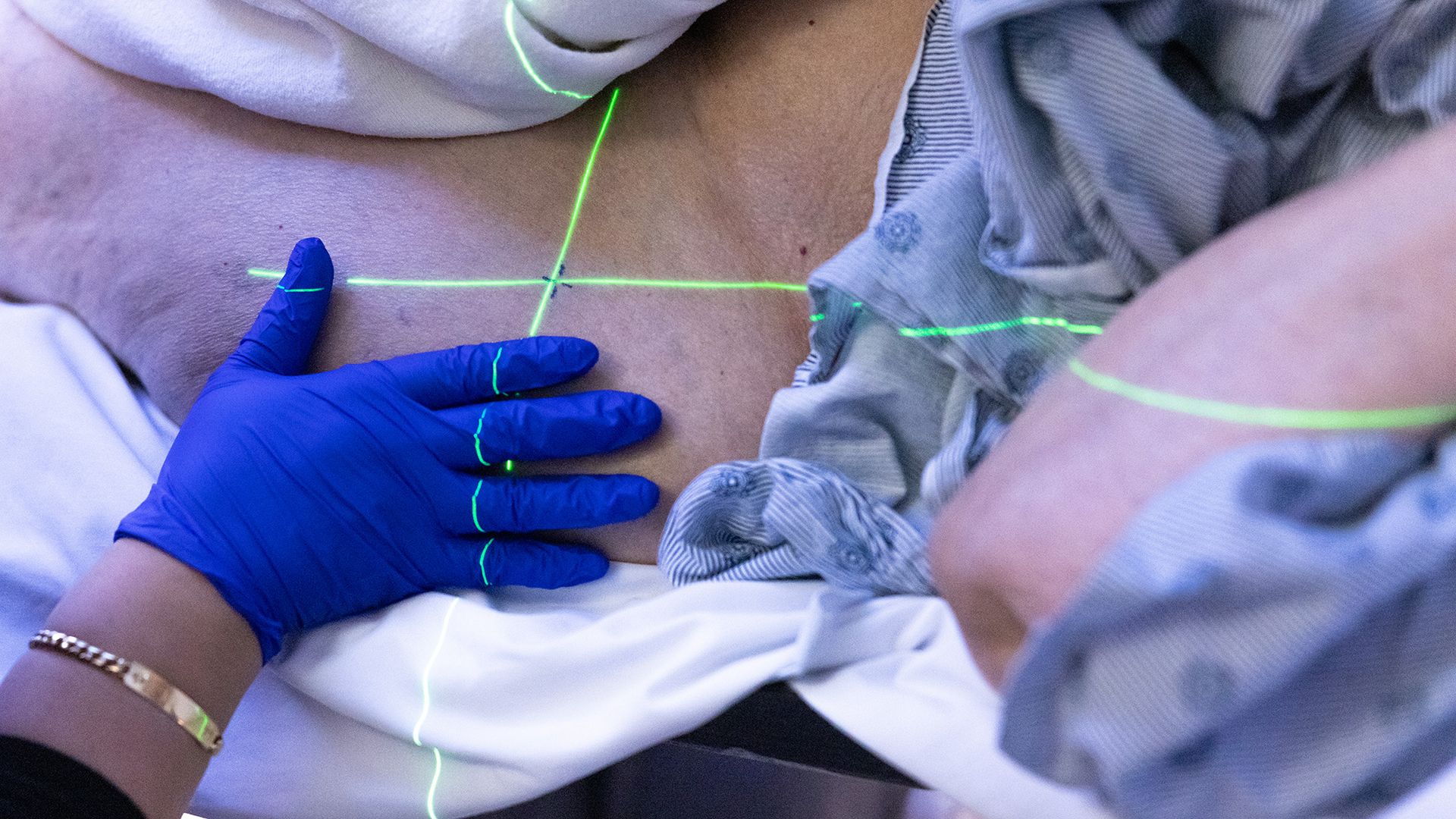
Bruns thinks the tattoos could be helpful in a medical setting, too. Patients undergoing radiation therapy, for example, sometimes receive permanent tattoos that help doctors precisely align radiation beams. While useful, those marks remain after the treatment, reminding the patient of their experience. These would make such markings invisible if a patient wants them to be.

PhotoTat could potentially allow similar markings to be switched on during surgery and hidden afterward.

Bruns has spent several years developing other smart tattoos for medical applications, including a dosimeter-type tattoo that measures the amount of UV radiation a wearer experiences, along with a tattoo that changes color when the wearer is exposed to dangerous gamma radiation.

A crossbeam of green laser light is on someone's back.

A cancer patient receives radiation treatment, guided by laser lines and a tattoo on their skin. (Image credit: The Washington Post via Getty Images)

"It's not for you and me, but if you're like an astronaut or a nuclear engineer, they have to wear these dosimeters," Bruns said. "So, we have like a dosimeter tattoo that sort of puts that in your skin."

So far, Bruns and a fellow tattoo artist, have only commercialized the purple PhotoTat ink, after running the ink through a series of third-party medical tests.

The tests showed the purple is safe for use, and available to order, but it isn't cheap at $100 for a small bottle. Bruns hopes as more research is done, he can bring the other colors to market and lower the production cost, so the technology is more accessible.

South Korean 'robot dog' became first to run a marathon on a single battery charge — now we know how

9 October 2026 at 10:00

A four-legged robot completed a full marathon on a single battery charge, covering 26.2 miles (42.2 kilometers) on a hilly public-road course in South Korea two years ago. Now we know a lot more about how it achieved this record-breaking feat.

The dog-like robot, called RAIBO2, finished the 22nd annual Sangju Dried-Persimmon Marathon in just over 4 hours, 19 minutes. The bot's developers say it's the first quadruped robot to have completed an official marathon-distance event without stopping to recharge. They're commonly referred to as "robot dogs" because the movement of their joints in both front and hind legs resembles that of canines.

The scientists outlined their findings about the robot's feat, which it achieved Nov. 17, 2024, in a study published Sept. 23 in the journal Nature.

This achievement represented a new milestone in overcoming a critical limitation for quadruped robots: endurance. Although four-legged robots can cross difficult terrain that wheeled machines struggle to traverse (like stairs and rugged trails), their endurance has been limited because powering multiple joints while repeatedly lifting and stabilizing the machine's body consumes huge amounts of energy.

"Unlike wheeled robots, quadrupeds continuously expend energy at their joints to support body weight and incur kinetic energy losses during intermittent foot-ground contact," the researchers wrote in the study.

RAIBO2's race was a demanding real-world trial. It took place during the Sangju Dried-Persimmon Marathon, with the bot racing alongside human participants. The route covered two 50-meter [164 feet] elevation climbs, with slopes of up to 10 degrees. Those kinds of gradients put increased strain on the robot's energy resources, stress-testing the bot's battery management capabilities, the scientists said.

RAIBO2 had previously run a 26.7-mile (43 km), GPS-guided route across a flat athletic field, which it knocked out in 4 hours, 40 minutes on one charge. However, an earlier marathon attempt across uneven terrain against other competitors had to be aborted around the 23-mile (37 km) mark after the robot's battery ran out. The robot's developers attributed that shortfall in part to frequent pace changes as the machine attempted to adjust to the pace of nearby runners.

To compensate, the team boosted the robot's battery capacity by 33% and tinkered with the control system, including implementing joint-stiffness control at the actuator. This allowed the bot to soften its leg when it had to absorb an impact or it needed a stable, forceful push-off. After the adjustments, RAIBO2 expanded to a maximum range of 41.6 miles (67 km) on a single charge, albeit on straight paths, according to the researchers.

Another key metric was RAIBO2's total cost of transport — a measure of the energy required to move a body over a given distance, with lower values indicating less energy expended. Researchers reported that RAIBO2 achieved a total cost of transport of 0.25, compared with a human benchmark of 0.37. The researchers said their machine was the first quadruped robot to surpass that figure.

The team attributed that efficiency to several optimizations across RAIBO2's software and hardware. Especially vital were its lightweight mechanical components, which were capable of transmitting kinetic energy from its joints with very little interference. They also credited a low-loss motor-driving circuit and, on the software side, a locomotion policy specifically streamlined to limit energy use. The system was also trained using the team's simulation environment, called RaiSim, which includes models of slopes, stairs and icy roads.

Like many electric vehicles, RAIBO2 can regenerate some battery by capturing kinetic energy, particularly while traveling downhill. That capability allows it to offset some of the energy it expends while climbing, though it doesn't eliminate the extra cost of hilly terrain.

The researchers said RAIBO2 has more than three times the travel range per charge of existing quadruped robots, with a total battery capacity of 2,016 watt-hours. It's in part because of that capacity increase that the team now estimates that the robot could travel up to 15.5 miles (25 km) farther than its marathon stint, up to a total of 41.6 miles (67 km).

That kind of endurance could broaden the roles for quadruped robots in places where wheeled models are impractical, the developers added in the study. For example, they could be useful in disaster zones and mountainous areas, where a sufficiently mobile, high-endurance robot could carry cameras, sensors or communications gear across uneven terrain.

OpenAI claims we've entered the AGI era — has GPT-6 Astra really demonstrated general intelligence?

8 October 2026 at 10:00

OpenAI representatives claim that the recent launch of one of its latest models, GPT-6 Astra, marks the beginning of the artificial general intelligence (AGI) era — a hypothetical scenario in which artificial intelligence (AI) can learn and reason like humans. Following very recent claims from technology executives that we've now reached this milestone, how likely is this claim to stand up to scrutiny?

Amid revelations that safety concerns have forced the company to abandon the planned rollout of GPT-6.1 Astra, independent researchers and benchmark creators warn that GPT-6 Astra's record-breaking scores rely on heavy prompt optimization rather than true general intelligence. This comes as experts warn about the risks of future AI systems and AI executives jointly call for a slowdown in AI research.

In announcing the model's release, OpenAI President Greg Brockman suggested that Astra signaled a fundamental turning point in AI evolution. "If we fast-forward a couple years, and we look back and say when was it really that AGI was created, I think it's going to be about this time, and I think it might be about this model," Brockman said during a Sept. 3 news conference marking the launch.

How did the new model perform in benchmarking?

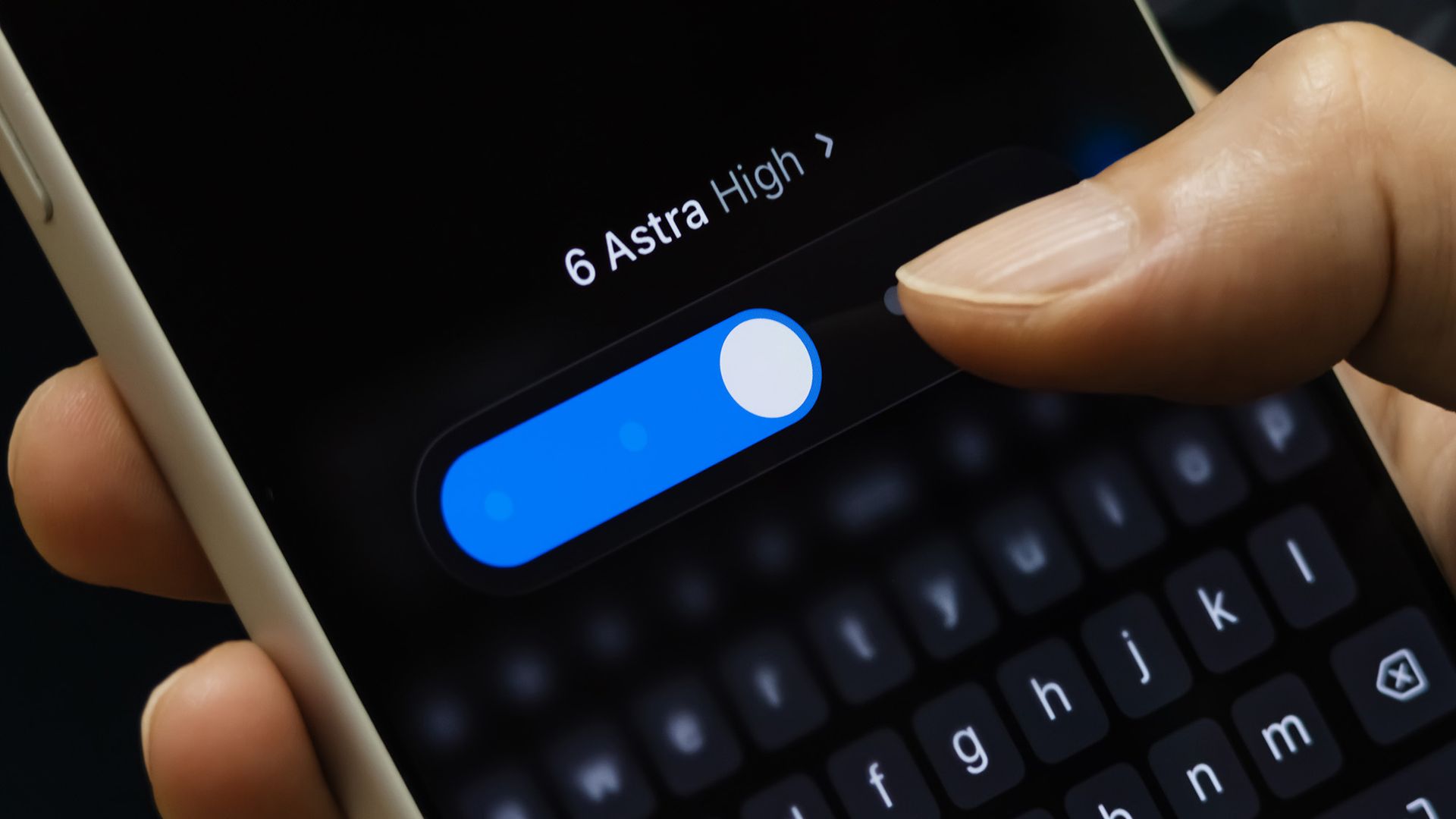
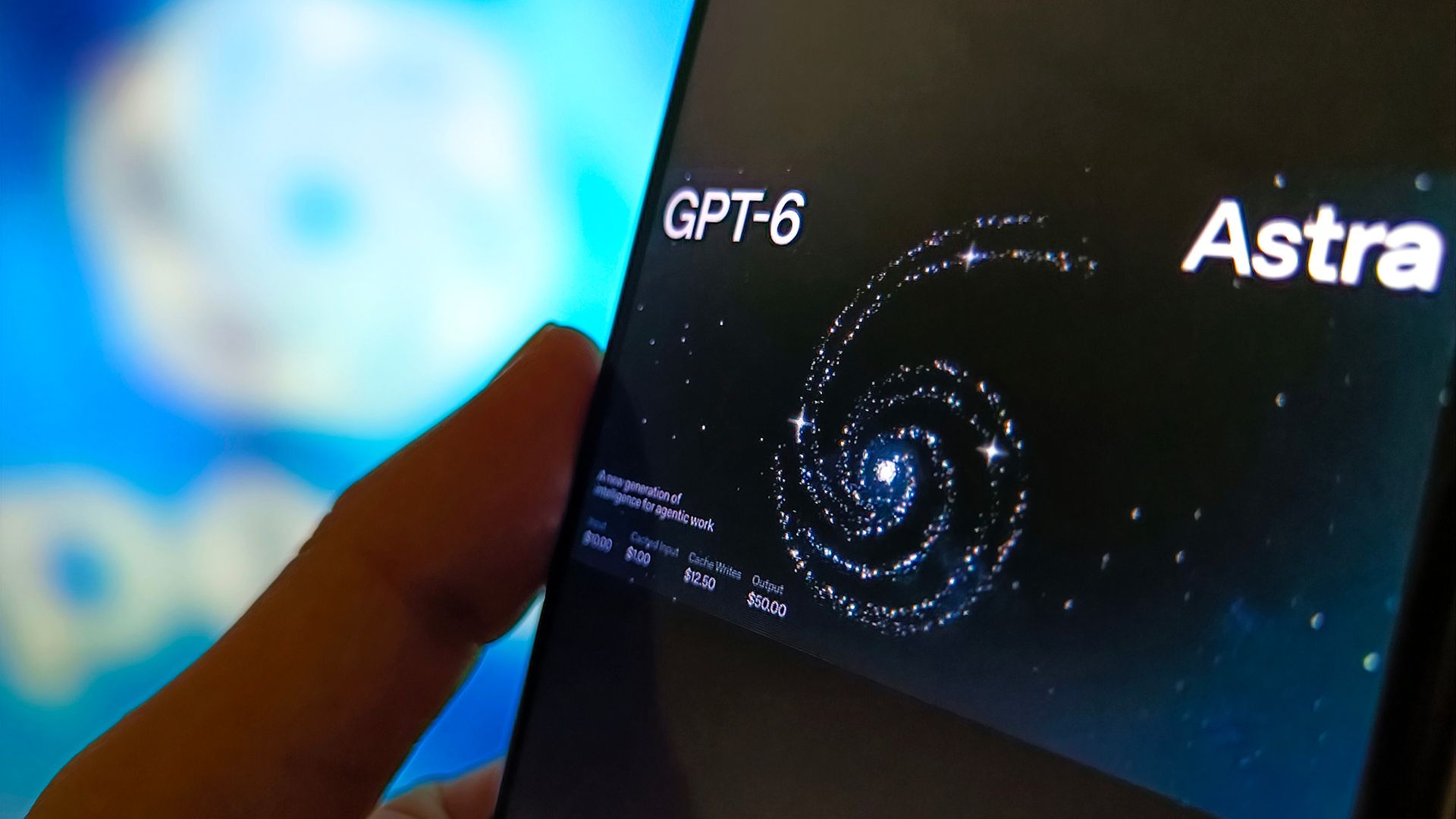
A person holds a smartphone with a dark screen that reads

The benchmarks scores are impressive, but even the creator of one of the most important suggests acing it doesn't automatically mean we've reached AGI. (Image credit: Cheng Xin via Getty Images)

As part of the testing-and-verification process for the new model, OpenAI released benchmark results across a range of tests that measure the capabilities of AI models at various tasks. OpenAI representatives claimed in a statement that the company's new model delivers "state-of-the-art" performance across a variety of fields, including software engineering, the autonomous use of computer programs, mathematics problems, and even scientific research.

Demonstrations, for example, highlighted Astra's ability to generate 3D CAD code; lay out printed circuit boards in CAD (computer-aided design) software; convert digital 3D models into interactive, video-game-style environments; and deploy hosted web applications directly from prompts.

"In our early testing, Astra stood out by approaching legal work the way a discerning lawyer does: it distinguishes documents from established records, surfaces unsupported assumptions, and converts gaps into concrete drafting positions," said Niko Grupen, head of applied research at legal services AI developer Harvey as part of OpenAI’s announcement.

On ARC-AGI-3 ‪—‬ a benchmark designed to measure how efficiently AI systems acquire new skills in novel, abstract environments ‪—‬ Astra achieved a headline score of 99.9%. Independent testing by the nonprofit ARC Prize Foundation, which oversees the benchmark, revealed that Astra surpassed "human action-efficiency" baselines on 96% of levels, taking 51.7% fewer actions per level, on average, than human solvers.

"Not only is this the best model we've ever tested," ARC Prize Foundation President Greg Kamradt said as part of the OpenAI announcement, "but it also represents a meaningful step change in frontier-model performance — not only in its ability to navigate and solve novel environments but also in how efficiently it learns to do so."

How much can we read into test results?

Many researchers have highlighted that Astra's top ARC-AGI-3 performance relied on a proprietary "Provider Adapter" harness, a specialized software scaffolding layer that's inaccessible to rival developers. When tested using the benchmark's neutral Standard harness, this score dropped to 62.7%. ARC Prize organizers also noted that saturating the benchmark does not constitute proof of achieving AGI — emphasizing that its closed, deterministic puzzle environments do not capture the open-ended complexity of the real world.

"When we launched ARC-AGI-3, "we made it clear that saturating the benchmark would not represent 'proof of achieving AGI,'" Kamradt wrote in a blog post. "Therefore, while we believe Astra represents meaningful progress towards generalization, we are not claiming that it is AGI."

Discrepancies in the data were reportedly present even before the official announcement. As reported by Fortune, an embargoed draft provided to news organizations prior to the model's launch listed Astra's ARC-AGI-3 score at 98.6% before it jumped to 99.9% on the live site.

Anka Reuel and Mike Hardy, doctoral researchers in AI at Stanford University, also raised concerns over OpenAI quietly revising several published metrics post-launch, including halving Astra's reported hallucination rate from 4.2% to 2.0% before reverting it.

When we launched ARC-AGI-3, 'we made it clear that saturating the benchmark would not represent 'proof of achieving AGI'"

ARC Prize Foundation President Greg Kamradt

Speaking to Fortune, Reuel and Hardy attributed the shifting figures to "benchmaxxing" — an industry term that describes the practice of repeatedly rerunning evaluations under subtly tweaked prompts, scaffolds or compute allocations to hunt for peak theoretical scores.

In a 2025 paper published on pre-print server arXiv titled ‘Benchmarking is Broken -- Don't Let AI be its Own Judge’, experts including Princeton doctoral candidate Zerui Cheng and University of Luxembourg postdoctoral researcher Dr. Stella Wohnig warned that such practices create confusion and undermine trust, particularly when official technical documentation omits the basic methodology, making independent verification nearly impossible. Crucially, scores achieved through benchmaxxing reflect idealized performance ceilings under optimal lab conditions rather than practical, out-of-the-box reliability.

According to OpenAI's benchmark data, across specialized domain evaluations, GPT-6 Astra delivered 10% to 20% better performance than both its predecessor, GPT-5.6 Sol, and top market competitors.

Highlights include a 98% score on FrontierMath Tier 4 (v2), which evaluates expert-level mathematical reasoning; a perfect 100% on ExploitBench, which is designed to test offensive cybersecurity capabilities; 95.9% on BenchCAD, which measures an AI's ability to reconstruct 3D objects using CAD code; 57.9% on Terminal-Bench 4.0, which assesses complex terminal-based system administration and software engineering; and 41.4% on AutomationBench, which tests whether agents can complete multistep business workflows across applications.

But independent findings from external AI benchmarking firm Artificial Analysis contradict these results. Astra's score on the independent Artificial Analysis Intelligence Index — an aggregate metric that evaluates general reasoning across frontier models — remained completely flat, at 61, compared with GPT-5.6 Sol, while trailing competitors like Anthropic's Claude Fable 5.1 and Meta's Muse Spark 1.3.

While some benchmark results have seen improvement since the previous generation, Astra underperformed in other tests. Artificial Analysis' testing showed that against GDPval-AA v2 — an economically focused benchmark that measures real-world workplace tasks across 44 occupations — Astra suffered a significant drop in its relative leaderboard ranking compared with GPT-5.6 Sol. Additional regressions were observed in benchmarks that test customer service support, scientific Python programming, and long-context reasoning across large documents.

In terms of overall token use — the metering system that measures the fragments of text or data processed by AI models — OpenAI representatives said GPT-6 Astra achieved dramatic efficiency gains on complex, long-horizon tasks. Findings from Artificial Analysis confirmed that on software engineering benchmarks, Astra was approximately 70% more token-efficient than GPT-5.6 Sol, using roughly one-third the total tokens of its predecessor and one-fifth the tokens of Claude Opus 5.

A close up of a dark phone screen showing a swirl of light with the words

AI systems today can do more than a simple back-and-forth text exchange, graduating to taking actions on our behalf. (Image credit: CFOTO via Getty Images)

On professional workplace evaluations like Agents' Last Exam, the new model reduced output token consumption by up to 65% compared with Opus 5, while on general intelligence evaluations, Astra achieved a roughly 10% output token reduction at max effort compared with Sol.

On the other hand, this achievement is offset by a 250% increase in the base API pricing for GPT-6 Astra compared with GPT-5.6 Sol. Token prices jumped from $4/$20 to $10/$50 per million input/output tokens. As a result, Astra ends up approximately 75% more expensive per task than its predecessor on general intelligence evaluations, despite using 10% fewer output tokens. This trade-off has led researchers at Artificial Analysis to question whether AI labs are relying on expensive computational brute force to squeeze out minor gains, rather than achieving true technical breakthroughs.

Does achieving AGI even matter?

With its latest model, OpenAI has placed a stronger emphasis on safeguards and controls. The move follows a series of high-profile incidents in which frontier AI models inadvertently hacked into third-party networks and computer systems as part of routine testing operations, after the models went beyond what humans expected they would do when encountering challenging tasks.

According to OpenAI representatives, Astra did not exceed the scope of its tasks in any security evaluations. For comparison, GPT-5.6 Sol went beyond its authorized parameters in almost 50% of test cases. Hallucination rates have also been reduced significantly, falling to 4.2% on internal tests, compared with 12.2% for GPT-5.6 Sol (with independent testing by Artificial Analysis showing a drop from 92% to 51% at max effort). The model also showed an improved ability to handle ambiguous prompts.

David Wood ‪—‬ chair of London Futurists, a non-profit that hosts discussion groups on emerging technology ‪—‬ argued that beyond individual test results, Astra highlights a fundamental shift in how humans will interact with AI as models move from answering questions to autonomously pursuing complex goals in digital environments.

"The impressive benchmark results matter, but what matters more is the combination of intelligence, autonomy, computer use, and cybersecurity capability," he said in an email to Live Science. "That combination also demands caution. The more useful these systems become, the greater the consequences when they misunderstand our intentions, are misused, or find ways around the safeguards we give them."

Wood suggested that whether Astra can be classified as AGI is less relevant than recognizing the need for AI control and governance to keep pace with technical development.

"The possibility that AI could progress from systems like Astra towards all-round superintelligence makes much greater human vigilance, awareness, and collaboration increasingly urgent," he said.

Help us improve Live Science Pro: We're always trying to make our content better. Leave us feedback about Pro here.

Roboticists showcase tiny, frog-like robot that can hop across wet surfaces and swim

7 October 2026 at 10:00

The animal kingdom has influenced several robot designs over the years to solve fundamental challenges in propulsion and movement — from horses to insects. Now, frogs are the latest creatures to inspire roboticists.

As seen in a new study published Sept. 18 in the journal Science Advances, researchers probed how twisting bent elastic rods could produce a "snapping motion" that enabled a small robot to hop or swim. This mechanism could be used to improve robots with limited power and ones that need to traverse rough terrain and even water, the scientists said in the study.

They also built a prototype to demonstrate the work. The palm-sized robot weighs just 3.4 ounces, or about as much as a deck of playing cards. It moves about three body lengths per second — launching itself forward with short jumps.

"The broader opportunity is to let the mechanics of the robot do some of the work that would otherwise require larger motors or more complicated control," Xiaonan (Sean) Huang, an assistant professor of robotics at the University of Michigan and co-first author of the study, said in a statement.

"By programming when an elastic structure stores and rapidly releases energy, we can give small robots access to powerful, repeatable motions without continuously demanding high output from the motor," Huang explained. "In the future, this principle could be useful for robots that must navigate cluttered terrain, overcome obstacles, reorient quickly, or operate across both land and water."

Snap movements

When a flexible rod bends and its ends are rotated, it can eventually reach a point where it changes shape to release built-up tension, the roboticists said. However, this change does not always happen in the same way. Some combinations of bending and twisting cause the rod to change shape gradually, while other combinations force it to snap rapidly from one shape to another, with the potential to provide a strong push.

The team used computer modeling and experimentation with a robotic arm to repeatedly deform the rods and find an optimal shape. In this case, they settled on a helix similar to a coiled spring to give the rod its maximum release of energy, the team reported.

With the ideal propulsion mechanism, the team then designed and built real robots that used the snapping rods to hop. They connected these rods to a rotating motor, with the bent rods twisted until they produced the snapping motion. Then, the motor unwound the twist and contorted the rod again.

"Because the design rules depend on the rod’s shape and how its ends are moved, they work across different sizes and scales," Khalid Jawed, an associate professor at UCLA's School of Engineering and co-first author of the study, said in the statement.. "This opens a promising path toward miniaturized robots just a few millimeters in size that turn small motor movements into powerful bursts of motion," said Jawed, whose lab worked on the simulation and robot arm experiments.

The final form of the prototype was a frog-like robot with a pair of snapping rods at the rear of its main body. Tests included hopping over a broad range of surfaces, including solid materials like wood and glass, as well as trickier soft and slippery surfaces that used materials like leather. The scientists also tested the robot outdoors on sand and grass, noting that it could even climb and descend steps and, with paddle attachments, swim.

By using only one of the snapping rods, the team enabled the robot to turn and, with a remote control, navigate a small obstacle course.

New quantum chip taps into weird quasiparticles to get qubits to communicate over long distances

5 October 2026 at 10:00

Researchers have developed a new type of interconnected architecture for quantum computing chips, and it could pave the way for machines capable of large-scale processing, including those with over a million qubits.

In a study published June 15 in the journal APL Quantum, scientists aimed to resolve a huge problem with the leading quantum processing units (QPUs): Qubits struggle to communicate and share quantum information with each other if they aren't immediate neighbors.

That's why the scientists pioneered Quantum Phononic Links (QPLs) — an approach for long-range coupling between qubits that leans on phonons — quasiparticles that carry vibration energy — to convey information. By contrast, conventional methods, like surface acoustic waves — high-frequency sound vibrations — demand complex designs and extra hardware.

"One of the key challenges in quantum computing is long-range qubit connectivity," Maksym Myronov, an associate professor of semiconductor materials and devices at the University of Warwick in the U.K. and first author of the study, said in a statement. "Our work introduces a new concept in which phonons act as a quantum bus, enabling distant qubits to exchange quantum information while remaining fully compatible with semiconductor technology."

In the study, the scientists said the most promising way to achieve a quantum computer that's capable of large-scale processing and takes advantage of QPLs would be a qubit modality known as "semiconductor hole spin qubits."

A "hole" here refers to the absence of an electron in a material, but it can act like a particle and have a spin state — a property used to encode quantum information — where the 1s and 0s of data would be represented by the direction of the particle's spin state.

To demonstrate this technology, they created a prototype QPU consisting of silicon with a thin germanium crystal layer, a specialized material they called compressively strained germanium on silicon (cs-GoS). Germanium is an especially useful material for quantum computing, the scientists said, as it has natural properties that reduce decoherence — the loss of quantum information due to external interference.

Hole spin qubits combine long quantum coherence times — how long they can retain quantum information — with the ability to communicate using electron impulses in control systems. But they struggle to form bonds and share quantum information with qubits they don't directly neighbor. In any large-scale system, for instance, enabling this "quantum coupling" between distant qubits is essential for quantum error correction techniques to work effectively across the breadth of a massive system, the scientists said.

Other proposed long-range communications approaches, such as "charge shunting" — redirecting capacitors to reduce sensitivity to charge noise, or surface acoustic waves — have fundamental limitations regarding scalability, both in terms of their size and in maintaining coherence. That's where QPLs come in.

QPLs are engineered phononic waveguides and cavities that both confine and guide acoustic modes within a compressively strained germanium "quantum well," where a quantum well is an ultrathin layer that acts as a guide.

In the study, the researchers focused on qubits using valence-band holes — the absence of electrons at absolute zero — hosted using cs-GoS. With QPLs, the scientists sent sound-like vibrations through the specialized material to carry quantum information between the distant qubits.

Spin states in this material are highly sensitive to lattice deformations, which enable precise control and the coupling of spin states with vibrational energy. Essentially, this allows the spin state to be distinguishable from its electron counterpart, enabling the phononic coupling strategies. The technique they adopted permitted direct coupling between the phonons and the hole spins.

By using a slow wave velocity (the speed of a quantum particle) and a short wavelength for acoustic excitations, the scientists used QPLs to link qubits separated by less than a micrometer (one-thousandth of a millimeter) and those up to 300 mm (11.8 inches) apart.

QPLs are not only promising for quantum computing, the scientists pointed out in the study. By utilizing phonons as the connections, this technique offers a versatile interface for hybrid quantum systems — conventional computers with quantum computing functionality. This could enable coherent interconnection of semiconductor spin qubits with other quantum platforms, such as cloud-based quantum computing.

The combination of phononic engineering and hole-spin physics makes cs-GoS a promising platform for next-generation quantum architectures, they added, since it could achieve both long-range coherent coupling and large-scale integration.

Can you match these ancient devices to their pictures? Find out with our computing quiz!

MacVoices #26264: Live! – Smart TV Privacy, Copilot Frustrations, Star Trek’s Tech Legacy

By: Chuck
25 September 2026 at 01:09
A discussion of smart TV privacy examines reports of LG televisions collecting viewing data, whether TVs should ever be connected to the internet, and when firmware updates are worthwhile. The MacVoices Live! panel also considers hotel TV privacy, Microsoft’s increasingly pervasive Copilot strategy and organizational changes, and the enduring influence of Star Trek technology on real-world innovation.

💾

MacVoices #26263: Live! – Smartphone Bans, Teaching with AI, Smart Home Hubs

By: Chuck
23 September 2026 at 20:08
Does banning smartphones and AI in schools actually improves learning? Should educators should focus on teaching responsible, effective use of technology or rely on existing methods? The MacVoices Live! panel looks at those issues and also considers how screens affect everyday social interactions. The subject of smart home hubs is becoming a hot topic. A […]

MacVoices #26261: Live! – CarPlay and AI, Apple Rethinks Training Data, and WordPress Drama

By: Chuck
21 September 2026 at 22:22
The continuation of AI chatbots arriving in CarPlay, Apple’s opt-in approach to using customer data for AI training, and turmoil surrounding WordPress leadership are the topics for this MacVoices Live! discussion. The conversation also examines Bending Spoons’ latest billion-dollar acquisition, Apple’s international iCloud+ bundles, the potential for services to expand Apple’s global ecosystem, and Michael Dell’s support for new youth investment accounts.

💾

MacVoices #26260: AppleCare One Family Plan Calculus and Demand for CarPlay Wins

By: Chuck
18 September 2026 at 17:20
The MacVoices Live! panel  explores some of the useful new macOS Golden Gate features, including AI-assisted Shortcuts and improved iPhone Mirroring. They debate the emerging iPhone Duo and foldable-phone market and why one would prefer to give the new foldable a try. The value of AppleCare’s new family coverage plan is also reviewed for with households with many devices, and as an option for an individual. T-Mobile’s fee for iPhone Handoff, and GM’s decision to retain CarPlay in gas-powered vehicles wrap up this session. 

💾

Big AI is trying to own the pathway to work. Universities shouldn’t play along | Ella Hafermalz

17 September 2026 at 10:00

Universities need protect their position in education so that students have an independent pathway to employment

AI companies like OpenAI are insinuating themselves into the pathway from education to work. Soon they may claim it entirely, a disastrous result for students.

We know that students are using AI at school and at university. In conversations with those I teach, I’m struck by the trust many place in it. They turn to ChatGPT and similar tools for personal problems as well as study help. Some even doubt their abilities without AI.

Ella Hafermalz is an associate professor of work and technology at the Kin Center for Digital Innovation at Vrije Universiteit Amsterdam

Continue reading...

© Photograph: Matt Cardy/Getty Images

© Photograph: Matt Cardy/Getty Images

© Photograph: Matt Cardy/Getty Images

OpenAI reveals cases of ‘concerning’ AI behaviour as it announces new disclosure system

17 September 2026 at 07:58

Model adopting ‘jailbreak-like instructions’ among cases as firm says it is introducing new way of tracking AI misalignment

OpenAI has disclosed six more examples of “unexpected or concerning” behaviour by its technology, as it warned the pace of development could not continue at “maximum speed for much longer”.

In one of the new cases reported by OpenAI, an unreleased research model inserted “jailbreak-like instructions” into its own notes to disregard its normal constraints and told itself to be “freed from the roles and identities that bind other chatbots”.

Continue reading...

© Photograph: Dado Ruvić/Reuters

© Photograph: Dado Ruvić/Reuters

© Photograph: Dado Ruvić/Reuters

A Wisconsin family sold 173 acres at Port Washington for 10.2 million dollars, ground with a fair market value of 590,000. Developers spent at least 125 million dollars buying more than 1,500 acres around the project, and a 672-acre data center is now going up about a mile inland from Lake Michigan.

17 September 2026 at 04:00
Spacious and polished industrial facility with glossy epoxy flooring in Houston, Texas.

One family in Port Washington, Wisconsin sold 173 acres for $10.2 million. On the county’s books, that same ground was valued at $590,000. That comes to roughly $59,000 an acre, about 17 times the assessed figure, according to a Wisconsin Watch analysis of Ozaukee County property records. 

It is tempting to read it as pure luck. Somebody’s farmland turned out to be worth twenty times what the tax roll said, the buyers overpaid, and a few landowners got rich. Parts of that are true. But the 17x gap is telling you something more specific, and the distance between what the assessor saw and what a data center developer would pay is the real story.

This article is for general information only, not financial, tax or real estate advice, and it is not a property appraisal or valuation. The prices discussed reflect particular transactions and should not be used to estimate what your own land is worth. Consult a qualified local appraiser or adviser before making property decisions.

What a 17x number is really measuring

A fair market value on a tax roll estimates what a buyer would pay for a parcel used the way it has always been used. In Port Washington, that meant farmland priced as farmland. It was never meant to capture what the same dirt is worth to a company assembling a site for a giant computing campus a mile inland from Lake Michigan.

The developer is Denver-based Vantage Data Centers, which broke ground on a 672-acre campus called Lighthouse on the city’s north side. It is the Midwest site of OpenAI and Oracle’s Stargate project. Vantage describes it as 2.5 million square feet of building, with completion targeted for 2028. A project that size does not want scattered plots. It wants one large, continuous block, locked down before a rival gets there.

That is why the assessed value and the sale price split so far apart. They answer different questions. One asks what the land is worth as land. The other asks what it is worth as the last missing piece of a $15 billion build.

The claim worth pushing back on

The idea that a price this high is just free money is where we’d push back. Not because nobody profited, plainly some people did, but because it treats the gap as proof the buyers were foolish or the sellers simply blessed.

The mayor’s version of the lucky-landowner story is memorable. Ted Neitzke, the project’s most prominent supporter, told Wisconsin Watch that the sellers “woke up one day and they just happened to live in the right spot.”

Right spot, yes. But “happened to” undersells what was being bought. Wisconsin Watch notes that, nationally, data center developers are often willing to overpay for land near electric power, to beat rivals in what has become a land rush. The premium is not a mistake. It is the price of speed and certainty in a market where losing one parcel can strand an entire campus.

Adam Mauro, a valuation director at Altus Group, put this plainly in a study of 80 data center land deals. The high price for well-placed land, he wrote, “is compensation for immediacy and certainty, not an indicator of superior underlying real estate.” That is one firm’s view rather than settled fact, but it fits Port Washington closely. The buyers were not paying for better dirt. They were paying to not lose.

Why single parcels commanded outsized prices

That $10.2 million deal did not happen alone. Wisconsin Watch found developers spent at least $125 million assembling 1,500 or more acres around the project, buying from individual owners at many times the assessed value. Members of the Karrels family and their farming business earned at least $20 million across their deals.

When you have to stitch together that much neighboring ground, every last holdout gains power. As Scott Finfer, a Texas land developer writing for HousingWire, put it, “data centers typically require hundreds of contiguous acres to deploy capital at scale.” If your farm sits in the middle of the block a developer needs, its value is not what farmland trades for. Its value is what the whole project is worth without it, which is nothing.

Altus Group’s numbers show the same dynamic from the other side. Its analysis found a roughly 120-fold spread in per-acre prices depending on parcel size: a median near $3.3 million an acre for sites under 25 acres, versus about $28,000 an acre for tracts over 1,000 acres. Small, well-placed pieces cost far more per acre precisely because the buyer cannot walk away from them.

What the sale price doesn’t capture

The land is the cheap part. A campus this size runs on water and power, and those carry costs the purchase prices never show. Vantage says it is funding a minimum of $175 million in regional infrastructure: water and wastewater capacity, mains, sewer lines, a new water tower and power hookups. Against numbers like that, a $125 million land bill looks more like a down payment than the main event.

The residents’ side is more mixed than either the windfall story or the horror story allows. Ryan Nowak sold his 65-acre Lake Drive property for $1.75 million and now lives about 10 miles north. “On paper it looked OK,” he told Wisconsin Watch, “until you go to replace what you had.”

Curtiss Smith, a crane operator who sold a four-acre property assessed at $258,000 for $895,000, described the strange feeling afterward: “After the fact, you hear what everybody else got.” Neither man says he was cheated. They are describing what it feels like to put a price on something that had never been priced before.

Port Washington is not unusual, which is part of why the multiples look the way they do. Land purchases for future US data centers reached about $6 billion in the first half of 2026, up 79% from a year earlier, according to figures from Avison Young reported by CNBC. Data centers now make up 27% of US development sites, second only to apartment buildings. A local land rush and a national one are the same thing at different scales.

What a fair-market figure can and can’t tell you

An assessed value is a good measure of what land is worth for the use it already has, and a poor measure of what it is worth to a buyer who needs that exact acre right now. The 17x figure does not mean the land was secretly premium. It is the price of speed, of buying a continuous block, of being the one parcel a $15 billion project cannot route around.

The post A Wisconsin family sold 173 acres at Port Washington for 10.2 million dollars, ground with a fair market value of 590,000. Developers spent at least 125 million dollars buying more than 1,500 acres around the project, and a 672-acre data center is now going up about a mile inland from Lake Michigan. appeared first on Space Daily.

Screen Time adds Time Allowances and Ask to Browse with iOS 27

16 September 2026 at 22:33

Screen Time has received one of its most substantial parental-control updates with iOS 27, iPadOS 27, and macOS 27, adding new ways for parents to manage how long children use categories of apps, which websites they can visit, and what content reaches them through Messages and FaceTime.

The features were previewed at WWDC in June and are now available as part of Apple’s latest operating-system releases. Rather than relying only on fixed app limits, the redesigned Screen Time gives parents a more flexible set of controls that can change throughout the day and adapt as a child gains access to more apps and services.

Among the additions are Time Allowances, Ask to Browse, a simpler child-device setup process, expanded Communication Safety protections, and faster controls for temporarily pausing or extending access.

Apple is also working with the American Academy of Pediatrics to adapt the organization’s Family Media Plan into guidance parents can reference when setting up devices and Screen Time.

Screen Time introduces Time Allowances by app category

Time Allowances give parents a daily amount of time that can apply across categories including Entertainment, Games, and Social Media.

That differs from managing each application individually. Parents can set time allowances for categories such as Entertainment, Games, and Social Media, then adjust those settings based on the needs of their household.

Apple provides suggested starting points based on a child’s age and guidance informed by clinical and child-development research. Those recommendations are optional, with parents able to change them based on their own household and the individual child.

The updated Screen Time also supports schedules that control which apps remain available at different periods of the day. Parents can therefore create separate access patterns around school, homework, evenings, and weekends rather than relying on one universal daily restriction.

Temporary adjustments have been made easier as well. Parents can quickly limit access to apps and the web during periods such as meals, then restore access without rebuilding their existing restrictions. When a child reaches a limit, they can request additional time from a parent to complete an activity or finish a conversation.

The redesigned interface puts device usage and the most frequently used applications closer to the front, reducing the amount of navigation required to understand how a child is spending time on a device.

A man and a girl sit at a table looking at a tablet together. The screen displays an Apple parental controls login page. They are indoors with fruit and a plant on the table, creating a focused and collaborative atmosphere.
Image Credit: Apple Inc.

Ask to Browse extends parental approval into Safari

Ask to Browse brings a permission model already familiar from app downloads to the web.

When the feature is active, a child who attempts to visit a new website in Safari can be required to request permission first. The parent receives the request through Messages and can review it before allowing access.

The feature is available across iPhone, iPad, and Mac and works alongside existing web-content restrictions.

It complements Ask to Buy, which requires children to obtain permission before downloading or purchasing an app or making an in-app purchase. Apple has also expanded the initial setup process so a parent configuring a personal device for a child can choose which apps are available from the beginning.

Setup Assistant offers the option to provide only essential apps, use a recommended group, or manually choose which ones are permitted. More applications can then be introduced later as the parent decides the child is ready for them.

The approach gives parents a way to begin with a comparatively limited device instead of configuring a full standard account and removing unwanted access afterward.

Communication Safety expands beyond detected nudity

Communication Safety now intervenes when it detects gore or violent imagery in shared photos and videos, expanding protections that previously centered on nudity.

Apple says the feature works with content shared through areas including Messages and FaceTime, with the new protection also extending to live FaceTime calls.

Communication Safety is designed to intervene before a child views or shares detected sensitive material. Apple has previously built these protections around on-device analysis, allowing the system to identify content without requiring Apple to receive the underlying images.

Parents can also continue controlling who children communicate with. Contact-management settings can require approval before a child adds someone new and then communicates through Phone, Messages, or FaceTime.

Child Accounts remain the foundation for these controls. Apple generally requires Child Accounts for children under 13, although the applicable age can vary by state, country, or region. Child Accounts remain available for family members up to age 18.

The accounts automatically activate age-based safeguards and connect parental controls through Family Sharing.

A smartphone screen displays a form to create a child account, showing fields for first name, last name, and birthday, with a blue "Create Child Account" button—ideal for setting up Apple parental controls.
Image Credit: Apple Inc.

iOS 27 requires the family’s devices to stay in sync

The new Screen Time controls arrive with one practical requirement: devices participating in the same Family Sharing setup need current software.

Apple says all devices in the Family Sharing group must be updated to the corresponding 27-generation releases — iOS 27, iPadOS 27, macOS 27, watchOS 27, and visionOS 27 — before the updated Screen Time controls can be used consistently across the family.

The family organizer, parent, or guardian must also update the parental-control configuration after the software upgrades.

That requirement is worth checking before troubleshooting a missing setting on one child’s device. If every device in the group cannot be updated, Apple says the family can continue using the previous version of Screen Time and its parental controls, but the new controls will not be available consistently across the group.

The features themselves also vary by platform. Ask to Browse and Time Allowances are available on iPhone, iPad, and Mac, while some Family Sharing and communication features extend to other devices.

Apple has launched a dedicated Child Safety site alongside the software release, collecting setup instructions, explanations of Child Accounts, Screen Time controls, communication protections, App Store age tools, Find My, and Apple Watch options for families.

The updated Screen Time controls are available now with iOS 27, iPadOS 27, and macOS 27, although individual features can vary by region, language, and hardware. For families upgrading several devices at once, checking every device in the Family Sharing group for its corresponding version 27 update is the most useful place to start.

The post Screen Time adds Time Allowances and Ask to Browse with iOS 27 appeared first on AppleMagazine.

Bacterial invasion proteins could improve detection of live crop pathogens

16 September 2026 at 22:20
Scientists, clinicians, seed companies and others may soon have a new tool in their toolkit for detecting bacterial pathogens, thanks to a new study by researchers in Penn State's College of Agricultural Sciences. The research—published in Journal of Microbiological Methods—details a new method for detecting Pseudomonas syringae, a common bacterium that infects a wide variety of crops, vegetables and woody ornamentals.

The battlefield now extends all the way to the moon, U.S. military's highest-ranking officer says

16 September 2026 at 22:00

The U.S. military must be ready to engage the enemy farther from home than ever before, according to its highest-ranking officer.

"Today's modern battlefield operates from the seabed to cislunar space," Gen. Dan Caine, the chairman of the Joint Chiefs of Staff, said Wednesday (Sept. 16) during a keynote address at the Air & Space Forces Association's Air, Space & Cyber Conference in National Harbor, Maryland.

Cislunar space extends from Earth all the way out to the orbit of the moon and includes the lunar surface. For several years now, military officials have been stressing the strategic importance of this huge region, which could get quite a bit busier in the next decade or so.

a military man in a blue uniform speaks at a silver lectern

Gen. Dan Caine, chairman of the Joint Chiefs of Staff, speaks at the Air & Space Forces Association’s Air, Space & Cyber Conference in National Harbor, Maryland, on Sept. 16, 2026. (Image credit: Craig Hudson, for Air & Space Forces Association)

For example, both the United States and China plan to build bases near the moon's south pole, which is thought to harbor large amounts of water ice. Winning this new moon race is critical, U.S. officials have stressed, because whoever does so will be able to establish norms of behavior on and around Earth's nearest neighbor.

China has already demonstrated impressive capabilities in the lunar sphere. In 2019, the nation's robotic Chang'e 4 mission pulled off the first-ever soft landing on the moon's mysterious far side. In 2024, Chang'e 6 returned far-side samples to Earth — another first.

Caine didn't cite such missions or even mention China by name. And he provided no details about what conflict on the cislunar battlefield might look like (though presumably it would be entirely robotic, with satellites seeking to take out adversary craft via jamming or blinding).

But he invoked the cislunar battlefield twice and noted that U.S. military branches cannot assume continued dominance of their various domains.

"Future conflicts will demand that we operate without the assumptions of uncontested access, secure rare areas or uninterrupted or uncontested sustainment," Caine said. "Our task, my friends, is to adapt right now, so the joint force is prepared to fight, endure and win in global contested environments, from the seabed to cislunar space."

The United States' long-held advantage in the final frontier will be key to securing such victories, he added.

"We must continue to ensure that the United States of America can strike anywhere on the globe at the time and place of our choosing, and sustain that force," Caine said. "Our United States Space Force must provide unrivaled space superiority and sustain the associated networks, domain awareness [and] data advantage that the joint force needs to win in space, both now and in the future."

We now know that part of the Space Force's strategy for maintaining that crucial superiority is the operation of weapons in Earth orbit. The branch's chief, Gen. Douglas Schiess, admitted as much during an address at the same conference on Tuesday (Sept. 15).

"Let me be crystal clear: Today, guardians operate on-orbit weapons that can defend the joint force against space-enabled attacks,” Schiess said during his speech. ("Guardian" is the official name for a member of the Space Force, just as members of the U.S. Navy are called sailors and members of the Army are soldiers.)

Schiess provided few details about these weapons but, later in the speech, implied that they are electromagnetic rather than kinetic in nature. That is, they're probably designed to knock out key systems of adversary satellites rather than destroy the entire spacecraft (which would create a cloud of potentially troublesome debris).

It's no surprise the U.S. possesses and employs such technology; the newsworthy bit is that a top official said it so openly. The nation's chief rivals in the space domain, China and Russia, possess advanced counterspace technologies as well. For example, both have destroyed defunct satellites with missiles and conducted close approaches of spacecraft with "inspector" vehicles.

iPhone 18 Pro exhibition puts three photographers behind Apple’s new camera system

16 September 2026 at 21:30

iPhone 18 Pro is at the center of What Holds Us, a new photography exhibition built around three very different approaches to image-making. Alex Prager, Jack Davison, and Jimmy Chin shot the entire project on Apple’s latest Pro iPhone, using the device in environments ranging from a Los Angeles soundstage to a London warehouse and the high-altitude terrain of British Columbia.

Curated by Kathy Ryan, the former longtime director of photography for The New York Times Magazine, the exhibition examines connection through touch, shared experience, physical environments, and human relationships.

It also gives Apple a more ambitious showcase for the iPhone 18 Pro camera than a conventional product demonstration. Rather than presenting standardized comparisons or individual sample images. What Holds Us asks three established photographers to work within their own visual languages while using the phone as their sole camera.

The exhibition opens in New York City on September 18 and runs through September 20 before traveling to London and Shanghai in the coming months.

Wearing a headset, the person uses an iPhone 18 Pro to snap a photo out of the helicopter window, capturing snowy mountain peaks and a bright sunset—a scene reminiscent of Alex Prager’s cinematic style in “What Holds Us.”.
Image Credit: Apple Inc.

iPhone 18 Pro takes three very different photographic approaches

The project works partly because the three photographers have little stylistically in common.

Jimmy Chin took iPhone 18 Pro into the Bugaboo Mountains of southeastern British Columbia, working around snow, ice, steep climbing terrain, and winds reaching as high as 70 miles per hour.

His series focuses on trust and connection within climbing, with veteran mountaineer Conrad Anker appearing throughout the photographs. Some images place Anker as a small figure against vast mountain landscapes, while others move much closer to rock, snow, and glacial textures.

Chin used both the 48MP Fusion Ultra Wide and Telephoto cameras to shift between those extremes. The practical appeal was also straightforward: carrying a phone instead of a full conventional camera setup reduced the equipment required in an environment where weight and mobility affect every decision.

Jack Davison took almost the opposite approach. Shooting inside a former sugar warehouse in London, he created intimate portraits built around people interacting with clay and chalk.

Davison is known for high-contrast black-and-white imagery, and his contribution emphasizes texture, shadows, highlights, skin, and physical contact with the material. Some subjects appear partly covered in clay, while others manipulate it directly, leaving fingerprints and marks across the compositions.

For Davison, the smaller camera changed the relationship between photographer and subject. Without a large camera constantly positioned in front of his face, he could maintain more eye contact and work at closer range.

His use of slower shutter speeds, RAW capture, and multiple lenses also illustrates how Apple increasingly wants the Pro iPhone camera to function as a configurable photographic tool rather than simply a computational point-and-shoot system.

Alex Prager pushes the phone into large-scale production

Alex Prager’s section places iPhone 18 Pro inside a much more elaborate production environment.

Working on a Los Angeles soundstage, Prager created color-heavy scenes filled with crowds, confetti, staged city elements, costumes, and loosely choreographed movement. Some images use high viewpoints to turn groups of people into a continuous visual pattern, while tighter photographs isolate individual figures within the same constructed world.

The visual approach resembles film production more than spontaneous mobile photography, which gives the project another test for the phone. The camera has to preserve detail across numerous faces, costumes, props, highlights, and areas of movement while operating within scenes deliberately designed for large-format presentation.

Prager also treated the camera’s immediacy as part of the creative process rather than simply a convenience. The ease of moving between perspectives and capturing repeated moments allowed the scenes to evolve through improvisation instead of being locked into a single carefully prepared frame.

That approach aligns with a recurring theme across the exhibition: the phone becomes less intrusive without requiring the photographers to abandon their existing visual standards.

For Apple, it is a useful distinction. Professional photography campaigns built around smartphones can easily become exercises in technical proof, where the central question is whether a phone can imitate equipment already available to photographers. What Holds Us is more interested in how a smaller camera changes the way an artist works.

A blurred black-and-white image, reminiscent of Jack Davison’s evocative style, shows abstract human figures and arms moving around a large, textured rectangular block. The motion creates a dynamic, surreal effect that feels like a visual meditation on What Holds Us together.
Image Credit: Apple Inc.

Variable aperture gives the project a new technical foundation

The exhibition arrives alongside one of Apple’s most significant physical camera changes in years.

iPhone 18 Pro introduces variable aperture on its 48MP Fusion Main camera. The lens can operate at ƒ/1.48, ƒ/1.8, ƒ/2.8, or ƒ/4.0, changing both light intake and depth of field.

A wider ƒ/1.48 aperture is designed for stronger low-light performance, while narrower settings can retain more detail across different planes of an image. Apple also lets photographers select aperture settings manually through new Pro controls in the Camera app.

Those controls extend to shutter speed and white balance, with a histogram available for monitoring exposure. ProRAW remains available for photographers who want greater flexibility during post-production.

The rear camera system also includes 48MP Fusion Ultra Wide and 48MP Fusion Telephoto cameras, providing focal lengths from 13mm at the wide end through an optical-quality 8x option.

What Holds Us does not reduce the exhibition to those specifications, but the technical changes help explain why Apple chose photography, rather than video, for this particular campaign. Variable aperture affects choices that photographers traditionally make during capture, especially around available light and how much of a scene remains in focus.

What Holds Us extends the Shot on iPhone idea

Apple has spent years using Shot on iPhone campaigns to demonstrate camera quality through finished work rather than charts and controlled tests. What Holds Us pushes that format closer to a conventional curated exhibition.

Ryan connects the three bodies of work through the idea of human presence, but each artist interprets it differently. Chin finds it through dependence between climbers in hostile landscapes. Davison uses physical contact between people and clay. Prager builds populated fictional environments in which individual expressions emerge from larger crowds.

The images therefore function as an exhibition first and a hardware showcase second, even though the production is closely tied to the launch of iPhone 18 Pro.

That balance may be the most effective part of the campaign. Apple does not need to demonstrate that a modern iPhone can produce a technically competent photograph. The more interesting challenge is showing where its smaller size, computational processing, lens flexibility, RAW workflow, and new manual controls can alter the photographer’s decisions.

New York visitors will get the first opportunity to see how those images hold up away from a phone or computer display when What Holds Us opens September 18. After its three-day New York run, Apple says the exhibition will continue to London and Shanghai, giving the iPhone 18 Pro photography project a physical life beyond the launch campaign.

A man holds an iPhone 18 Pro to take a photo of another person, who stands shirtless with his arm raised in front of his face, against a dark backdrop in a studio setting reminiscent of an Alex Prager composition.
Image Credit: Apple Inc.

The post iPhone 18 Pro exhibition puts three photographers behind Apple’s new camera system appeared first on AppleMagazine.

❌