A new NYT Connections puzzle appears at midnight each day for your time zone – which means that some people are always playing 'today's game' while others are playing 'yesterday's'. If you're looking for Wednesday's puzzle instead then click here: NYT Connections hints and answers for Wednesday, September 16 (game #1193).
Good morning! Let's play Connections, the NYT's clever word game that challenges you to group answers in various categories. It can be tough, so read on if you need Connections hints.
What should you do once you've finished? Why, play some more word games of course. I've also got daily Strands hints and answers and Quordle hints and answers articles if you need help for those too, while Marc's Wordle today page covers the original viral word game.
SPOILER WARNING: Information about NYT Connections today is below, so don't read on if you don't want to know the answers.
NYT Connections today (game #1194) - today's words
(Image credit: New York Times)
Today's NYT Connections words are…
SPRING
SUBWAY STATION
PRESTIGE
TRIANGLE
TAP
GIVE
LANGUAGE
FOUNTAIN
WELL
BOUNCE
SEWER LINE
HANDLES
SHEEP
DETECTIVES
MINE SHAFT
FLEXIBILITY
WOLVERINE
NYT Connections today (game #1194) - hint #1 - group hints
What are some clues for today's NYT Connections groups?
YELLOW: Stretchy
GREEN: Found down below
BLUE: Films starring a well jacked man
PURPLE: Compound words with added romance
Need more clues?
We're firmly in spoiler territory now, but read on if you want to know what the four theme answers are for today's NYT Connections puzzles…
NYT Connections today (game #1194) - hint #2 - group answers
What are the answers for today's NYT Connections groups?
YELLOW: ELASTICITY
GREEN: THINGS THAT ARE UNDERGROUND
BLUE: HUGH JACKMAN MOVIES, WITH "THE"
PURPLE: LOVE ____
Right, the answers are below, so DO NOT SCROLL ANY FURTHER IF YOU DON'T WANT TO SEE THEM.
NYT Connections today (game #1194) - the answers
(Image credit: New York Times)
The answers to today's Connections, game #1194, are…
YELLOW: ELASTICITY: BOUNCE, FLEXIBILITY, GIVE, SPRING
GREEN: THINGS THAT ARE UNDERGROUND: MINE SHAFT, SEWER LINE, SUBWAY STATION, WELL
PURPLE: LOVE ____: HANDLES, LANGUAGE, TAP, TRIANGLE
My rating: Hard
My score: 2 mistakes
My first mistake could have been a group of ways to access water — SPRING, TAP, WELL and FOUNTAIN — but drew a complete blank.
Thinking of a different meaning for SPRING helped me find the other words describing ELASTICITY, but I flopped again, adding TAP instead of WELL to the group that became THINGS THAT ARE UNDERGROUND.
Finally, I did not know that I was collecting HUGH JACKMAN MOVIES, WITH “THE” but I knew that PRESTIGE, SHEEP DETECTIVES and WOLVERINE were all films and took a gamble that FOUNTAIN was too.
Yesterday's NYT Connections answers (Wednesday, September 16, 2026, game #1193)
YELLOW: ENDING IN METAL ELEMENTS: LATIN, LONG JOHN SILVER, MARIGOLD, STEAM IRON
GREEN: STARTING WITH U.S. COINS: DIMENSION, NICKELODEON, PENNYWISE, QUARTERBACK
BLUE: POETS' MIDDLE NAMES: BARRETT, CARLOS, ST. VINCENT, WADSWORTH
PURPLE: SAUSAGES PLUS A LETTER: BORAT, CLINK, FRANK-N-FURTER, WIDENER
What is NYT Connections?
NYT Connections is one of several increasingly popular word games made by the New York Times. It challenges you to find groups of four items that share something in common, and each group has a different difficulty level: green is easy, yellow a little harder, blue often quite tough and purple usually very difficult.
On the plus side, you don't technically need to solve the final one, as you'll be able to answer that one by a process of elimination. What's more, you can make up to four mistakes, which gives you a little bit of breathing room.
It's a little more involved than something like Wordle, however, and there are plenty of opportunities for the game to trip you up with tricks. For instance, watch out for homophones and other word games that could disguise the answers.
It's playable for free via the NYT Games site on desktop or mobile.
Fable will have a 60fps performance mode on Xbox Series X
Playground Games associate game director Craig Littler says it didn't want to compare the PC and Xbox versions
However, he adds that "It will look great wherever you go"
Playground Games is being a bit cagey about Fable's graphics settings across PC and console, but has confirmed the Xbox Series X version will have a 60fps performance mode.
Fable has been in development for a very long time, but fans can finally expect the fantasy role-playing game (RPG) to launch on February 23, 2027, for PlayStation 5, Xbox Series X, Series S, and PC.
While there have been plenty of trailers and, most recently, new gameplay footage showcasing the game, Playground has yet to share the PC specs and how Fable will run on console.
However, during a Q&A session at Gamescom attended by TechRadar Gaming, associate game directors Will Kennedy and Craig Littler did reveal that the game will look "great" on all platforms.
"What we will say is that our approach to all platforms is really the same, in that we want the game to look great wherever you're playing it, and for it to be appropriate for the platform later on," Littler replied when asked to elaborate about the console edition graphics settings.
Without giving away too much, the developer then confirmed that the Xbox Series X version will offer a 60fps performance mode, but said, "I don't really want to get into the like in terms of what PC versus Xbox will be like."
"It will look great wherever you go," he added.
In the same interview, Playground also confirmed that Fable will take up to 20 hours to beat, but promises the game's life systems offer "limitless" replayability.
Diablo 5 will tell stories of the past, present, and future, the latter of which Blizzard calls "terror forming"
Players can visit biomes that are taken over by Diablo's Dread Commanders
Narrative director Jennifer Hepler says these biomes can change depending on who's in charge, and "it's a whole new experience" every time you revisit them
Blizzard has confirmed that Diablo 5 will tell stories involving the past, present, and future of Diablo's takeover of Sanctuary, which will visually affect explorable biomes.
The next installment in the isometric dungeon crawler series has been announced and will find players back in the mortal realm of Sanctuary. However, humanity has fallen into an apocalypse and the land has been conquered and reshaped by Diablo and his army.
Speaking to TechRadar Gaming at BlizzCon after the game's reveal, senior game director Joe Shely shared how different Sanctuary will look to players and said they will travel across the Western continent, seeing all different biomes that have been overrun.
Shely said Diablo 5 has "three stories that we're telling" within this changed world: the stories of the past, the time when Diablo took over and when he and his Dread Commanders emerged into Sanctuary, and the "desolation" of the present.
"There are no people around," he said. "There are very few survivors. Occasionally, you may find a human to add to your caravan, and they can bring something to support you."
There's also the future, which is being actively turned into an outpost of hell by Dread Commanders, something that the team has dubbed "terror forming."
"We call it terror forming because these Dread Commanders will actually transform the environment, transform the biome into a version of hell that relates to personal powers and powers at station," Shely explained.
Players will be able to revisit these occupied areas, and if a different Dread Commander is stationed there, "it's going to look totally different."
"The procedural world gives us a lot of levers to pull for that," added narrative director Jennifer Hepler. "You can go to a place, and it is under the control of the Dread Commander of Undeath, and it's going to be full of zombies and things like that. And then later in the game, you could return there, and it's either been reclaimed by humanity or taken over by a different Dread Commander, and the environment will be totally different as a result of that.
"So each time you go somewhere, it's a whole new experience and just constant new discoveries."
Diablo 5 is in development and is slated to launch in Spring 2029.
With its multi-functional side table, TV stand, and decorative controller box, this is some smartly made furniture with some genuinely helpful uses. Then, with a thumbstick stool and a D-pad cushion, it's also one of the silliest things I've seen.
Taken as a whole, you can see it's a mix of the playful and the practical. After I spoke to designers at both IKEA and Xbox at the show, it turns out that was the point all along.
"That was present throughout the journey because it's important," explained Philip Dilé, product developer for IKEA of Sweden. "Playing games is playful; it is fun. Solving people's needs connected to that can be very functional and practical. We tried to balance that, for sure.
"We wanted to make things that are relevant for people who play games. Something that reflects you, or that you feel allows you to express yourself...but the object itself is a beautiful piece of home furnishing."
It's a philosophy echoed by Carl Ledbetter, partner head of design at Xbox: "Just like when we design a console, it can be as quiet as people want it. They can put it back and let it recede into their environment. Or they can pull it forward and have it be very expressive. And I think some of those same qualities are in these products in the YXSTABY collection."
(Image credit: Future / IKEA / Xbox)
Ledbetter used the controller display box and the TV stand as examples of this. With the former, it's ideal for enthusiast gamers who like to collect controllers and show off their favorite designs in a dedicated gaming space. Meanwhile, with the latter, it serves a "dual life" — whether it's sitting in the corner while you're watching shows and movies, or wheeled front and centre for an intense gaming session.
"That was a big part of our philosophy: how do we make products that can adapt to how people want to use them? Either be as expressive as possible, or just be part of your world," summarised Ledbetter.
You can see that approach clearly in all of the more practical products from the collection.
Take the side table. Closed up and next to your sofa, it could be mistaken for another piece of clean and minimalist furniture you'd find in IKEA. Open up the sliding doors on the front, though, and inside there's space specifically designed to store controllers, headsets, and battery packs — plus the all-important cable management and power connectivity options you need to keep your tech charged between sessions.
(Image credit: Future / IKEA / Xbox)
"This came up time and time again: cable management, charging stuff — where do you put it when you're done? People don't want it all over the place," said Ledbetter.
And Dilé agreed: "We looked at it from the perspective of: what does gaming throughout the home look like? Because, of course, people play at their desks, in the living room, on the couch. In so many different ways. For us, it was important to cater for a lot of these different needs.
"And there's one never-ending challenge working for IKEA: cable management. It always comes up over and over again. I think it's a very real frustration for people.
"Take the TV stand, for example. Yeah, you need to have the console there; you need to have somewhere to charge the controllers, somewhere to put a headset. That was one of the benefits of working together with someone like Xbox that knows gaming, and the hardware, and the players. That made the brief really, really clear."
(Image credit: Future / IKEA / Xbox)
And even though designing for gamers was a big part of their brief, both teams were also well aware that they wanted products that a non-gamer would be happy to live in their home. This meant offering something that wasn't bedazzled with RGB lighting and garish colors.
"You need to cater for gamers, but also for non-gamers or people who are living with gamers, or people who want to have the functionality but still want to have a nice home," said Dilé.
"[We wanted to create] things that maybe your spouse or the people you live with also want to put in your home. These aren't just things that you accept because of your hobby. That was an important balance for us.
"There are so many people who play games, so it’s incredibly diverse. We really wanted to showcase that you can have that [gaming] experience and still have beautiful products that blend into your home to create a nice environment that you want to live in."
(Image credit: IKEA)
That led Ledbetter to reminisce about the first meeting between both parties, where they both discovered they shared very similar design philosophies and were keen to get both of their respective design teams together to bounce around ideas.
The result is this YXSTABY collection — nine products encompassing everything from stools, seats and cushions, to TV stands, storage and display cases — set to launch in October later this year. A weird and wonderful mix of items that speak to both the fun side of gaming and the practical needs in the home.
Ledbetter summed up his hopes for the collection as follows: "Think about it: we create these controllers, and we sell millions of controllers, but we're not in charge of the controller’s home. We make the controller, and then where does it go? We don’t know. So, now, there's this opportunity between IKEA and Xbox to build that home. It felt like a completion of that journey."
The first, FEX, is Valve's port of fex-emu, an open source project that emulates x86 processor instructions on an Arm chipset. Since 2018, what started as a small cross-platform emulation project has grown to include "an advanced binary recompiler that supports all modern extensions of the x86(-64) instruction set," according to the Fex website. The emulator can also make calls to graphics libraries like OpenGL and Vulkan to reduce overhead and uses "code caching to minimize stuttering as much as possible," according to Steam's own developer documentation.
While Proton was based on the pre-existing Wine conversion tool, Valve engineer Pierre-Loup Griffais told The Verge last year that the company has been funding Fex lead developer Ryan Houdek since the project was just a prototype. Back then, Valve was already anticipating that "close to a decade of work [would be] needed before [Fex-emu] would be robust enough people could rely on it for their libraries."
When Paul W.S. Anderson's Resident Evil hit theaters in 2002, video game movies were largely seen as a niche. Films like Mortal Kombat and Tomb Raider had proven that big-screen game adaptations could be successful, but the commercial and critical failure of projects like the 1993 Super Mario Bros. still cast a long shadow. And while Anderson's vision of Raccoon City might have captivated audiences on the whole, many hardcore fans of Capcom's games were left disappointed by the way the original movies wildly deviated from the source material.
Weaponsdirector Zach Cregger's new take on Resident Evil is a return to the franchise's fundamenta …
Samus is geared up for another adventure. | Image: Nintendo
The Metroid series is going back to its 2D roots again with Metroid Ravenous for the Nintendo Switch 2, the first side-scrolling game in the series since 2021’s Metroid Dread for the Nintendo Switch. If you’re already excitedenough to consider preordering, you can save $10 on the physical version of the game when you buy it from Walmart. It’s $59.88 instead of $69.99, about the same as buying it digitally. The game launches on January 28th, 2027, but it’s not clear how long the preorder discount will last. If it’s anything like other Walmart preorders, it may occasionally disappear.
Nintendo first showed off the side-scrolling adventure game at its September 2026 Direct, with a frantic trailer cutting between cinematic sequences, Samus dashing and rolling across a variety of environments, and engaging a number of enemies and bosses in battle. Samus absorbs some powerful abilities at the conclusion of Dread, and Ravenous seem to be all about plowing through anyone stopping her from escaping the planet. Other details of the story, including unique new mechanics, are being kept under wraps for the time being.
If you haven’t played Metroid Dread, I recommend it, especially at its $41.99 discounted price at Amazon. It’s part of Nintendo’s “Customer Appreciation” sale happening through September 26th, and several other games and accessories are cheaper, too.
Microsoft has been on the defensive somewhat with the service, removing Call of Duty earlier this year on rumors that it's simply "too generous" and potentially unsustainable.
Furthermore, even more rumors have been circulating online that Xbox Game Pass may be undergoing a massive restructuring in 2027, with changes that purportedly include:
The inclusion of "ads" in Xbox Game Pass with different versions. One version of Xbox Game Pass with ads will cost $12.99 per month, and one without ads will cost $19.99 per month or $239.99 annually.
New Xbox games will no longer release day one" for Xbox Game Pass "starting somewhere between February and April 2027," in exchange for reducing the cost of Xbox Game Pass by $3.
The claim "cloud streaming will no longer be a part of Xbox Game Pass."
Cloud Streaming will be "an add-on bundle" that costs $5.99 for 25 hours.
Here's one I would actually like: "Xbox Game Pass' Family plan will be included, as a $5.99 addon."
"We regularly test different Game Pass offerings and look at what works best for players in different markets. We don’t have any changes to announce today or plans that have been finalized. There are no changes to previously announced games coming to Game Pass Ultimate on day one.”
Statement I got from an Xbox spokesperson about this:"We regularly test different Game Pass offerings and look at what works best for players in different markets. We don’t have any changes to announce today or plans that have been finalized. There are no changes to previously… https://t.co/CLLSEppdBPSeptember 15, 2026
Additionally, we've been doing some digging of our own and can confirm that the list of "changes" outlined by the above forum aren't based on any current plans within Microsoft and amount to "speculation or guesswork," trusted sources suggest.
However, it's no secret that Microsoft is actively exploring "changes" to Xbox Game Pass, which could include some of the guessed ideas outlined in the forum post.
Our sources say that there's no current plan to remove "day one" games as a feature of Xbox Game Pass Ultimate in totality, but like the statement to Paul Tassi says, changes are coming. But, 100% speculatively and analytically: I think it's probably worth expecting that more franchises like Call of Duty may be pulled from day one access even on Xbox Game Pass Ultimate.
Perhaps bigger franchises might be moved onto an even more expensive tier, or come with some kind of "addon" bundle like a cable TV package.
In short, Xbox is effectively denying these specific rumors, while acknowledging that changes are coming. Like Paul Tassi spotted, the mention of "previously announced games" in Xbox's quote is interesting, as the wording increases the likelihood that future Xbox Game Pass game additions could be altered or paired back.
Anonymous forum rumors should be always be taken with a huge grain of salt. However, with the recent changes to Xbox Cloud Gaming getting monthly restrictions, I have a feeling some of the suggestions in the thread could materialize in a worst case scenario.
Xbox Game Pass is a huge revenue stream for Microsoft today, but balancing that against retail sales and cash flow back to studios (particularly first-party studios) has been a subject of debate for some time.
However, we will have to wait until 2027 to find out if these rumors of Xbox Game Pass changing are true or false.
Join us on Reddit at r/WindowsCentral to share your insights and discuss our latest news, reviews, and more.
Indie games have arguably become a cornerstone of PC gaming, even more so with modern-day entries becoming huge hits such as Hollow Knight: Silksong, Hades 2, and a superhero surprise from developer Adhoc, Dispatch.
In comes Blackwood, a cinematic third-person action indie, set in New York in 2012. You play as Anton Blackwood, an ordinary DVD store owner by day and an assassin by night, taking on contracts and dealing with the challenge of balancing two lives at once.
After playing two hours of Act 1 (the only one available so far) during my short preview at Gamescom 2026, I can see Blackwood'spromise. It's quite evident what developer AttritoM7 Productions is aiming for with its gun-fu style gameplay, heavily focused on explosive, cinematic enemy takedowns, intense gun fights, and stylish maneuvers.
Blackwood is very clearly inspired by classic martial arts and gun-fu movies, notably John Wick, and even borrows elements from classic games like Dead to Rights and Max Payne. Players can either choose to challenge enemies in a gung-ho play style, rushing out and executing different takedowns you can pick before setting out on a mission.
A more tactical approach is also possible, staying in cover and strictly going for headshots only (fitting for a John Wick-styled game), which would perfectly suit the hardest game difficulty.
Blackwood nails enemy takedowns, which is easily the one aspect that will keep me coming back to replay missions I can once Act 1 is complete. (Video Credit: AttritoM7 Productions)
The takedowns swiftly shifting straight back into gunplay are where Blackwood absolutely shines, and I can't go without stressing how impressed I am with what AttritoM7 developers were able to pull off there. In so many sequences, I was instantly taken back to those iconic moments in John Wick movies, where Keanu Reeves pulls no punches.
Ultimately, what holds Blackwood back is jankiness in combat, especially during hand-to-hand encounters. During multiple scenarios, there are bugs and stiffness in certain animations from Anton and enemies that I couldn't ignore.
Controlling Anton can be a struggle sometimes, as certain button prompts are unresponsive while in cover, and since enemies can flank the player, that unresponsiveness can lead to some pretty frustrating deaths.
The weapon recoil feels great, and I can see that AttritoM7 designed Blackwood's gunplay to have players make every shot count — which is especially important, since preparing for missions requires you to purchase ammunition with dirty money earned from fulfilling contracts.
However, I set aim assist to its lowest level (minimal), and it felt like the reticle was fighting against my control of the joystick — and it also doesn't help that the ultrawide field of view resolution desperately needs adjusting.
The opening street shootout was a great way to kick the game off, and I very quickly learned that enemies are unforgiving, requiring the player to be wary of a gung-ho playstyle. (Video Credit: AttritoM7 Productions)
Some of the audio in both combat and some NPC dialogue feels a bit out of place too, particularly during one of the early contract missions in a subway station. There are many elements like this, especially involving animations (notably Anton's run and other NPCs' movements), that end up impacting immersion.
Fortunately, while Blackwood isn't launching in early access, its remaining Acts will be released later for free (for existing owners), with Act 2 planned for March 2027 and Act 3 in September 2027 on Steam. Hopefully, with the release of the following content, patches can be made to significantly tweak and adjust those pain points.
Blackwood is a very promising game and has plenty of opportunity to shine among some of the best indie games available. However, it's a little rough around the edges at the moment, and a few steps away from realizing its potential.
You can use the YouTube link below to set a reminder — as well as bookmark it for later, of course.
In terms of what we can expect to see in the show, we already know that we'll see more than 35 games from the likes of Devolver Digital, Firefly Studios, The Game Bakers, Total Mayhem Games, Veewo Games, and WuselFaktory, and many more.
There's also going to be more than 10 world premieres, a new trailer for Firefly Studios' real-time strategy game Stronghold 4, a release date reveal of Virtue and a Sledgehammer from Devolver Digital, and a deep dive into New Blood Interactive's retro survival horror game Tenebris Somnia.
You can watch the trailer below if you want a visual teaser for the show, too!
It's time for TechRadar's annual tech awards, and this year we're doing it differently. For the first time, we have a complete set of categories where the winners are chosen 100% by you, the TechRadar readers.
The TechRadar Readers' Choice Awards 2026 comprises nearly 100 categories, but we know that not everyone is interested in voting in every one, so on this page you can vote in just our Computing and Gaming categories.
These include laptops, PC gaming peripherals, console accessories, monitors, gaming services and more. You can vote in the survey just below — or follow the links to see other specific categories, or to vote on the full list instead.
The shortlists were chosen by TechRadar's editors based on the best products we've tested or the most popular products of the year. You'll need to vote before 00:01am PST / 03:01am EST / 08:01am BST on Wednesday October 7th 2026 for it to be counted.
Once the deadline has passed at 00:01am PST / 03:01am EST / 08:01am BST on Wednesday October 7th 2026, we'll tally your votes to find the winners in each category.
We'll announce the winners in our big TechRadar Awards 2026 Week, starting Monday October 19th. We'll reveal the winners of the Reader's Choice Awards, as well as the winners of our TechRadar Product of the Year Awards, which are chosen solely by our expert judges.
How many products will do the double? We'll be curious to see — but right now, all you can do is vote for what you think should win, so vote away!
Already synonymous with flight simulation hardware, Thrustmaster is expanding its sim gaming range again with the HOTAS Warthog Mk. II, an "enhanced" variant of its popular, military-themed stick and throttle bundle for PC. Previously announced at Flight Sim Expo, it's releasing today, September 16, 2026, at an MSRP of $599.99, it's available from the official eStore and Amazon.
Indeed, the Warthog Mk. II features the same official U.S. Air Force licensing as its predecessor, with a design that seems almost indistinguishable from the Mk. I at a glance. In reality, Thrustmaster has focused mostly on the internals, redesigning its "H.E.A.R.T." Hall-Effect sensor mechanism "to offer enhanced smoothness and durability".
On the outside, it's still a 1:1-scale recreation of a Viper stick grip and the Warthog A-10C throttle with separate controls for both simulated engines (plus a locking system). Despite a few visual tweaks, the Mk. II supports full compatibility "with all Thrustmaster grips", which is great news for any sim enthusiasts who already adopted the brand's ecosystem on Windows PCs.
Thrustmaster's VIPER flight stick.ThrustmasterAnd its companion, the WARTHOG throttle unit.ThrustmasterThe refined MK II flight stick base.ThrustmasterAnd Thrustmaster's Hall-Effect sensors visualized.Thrustmaster
I've tested a huge number of flight sticks for games like Microsoft Flight Simulator, but I haven't strayed too far into military sims, or even further out to space-faring dogfights in titles like Elite Dangerous. However, I've always seen the Thrustmaster Warthog Mk. I appearing among some of the top-rated HOTAS sets in my adventures, so I definitely knew about it.
This release came with a chance to test the Warthog Mk. II for myself, so of course I said yes to a sample. Imagine my surprise when Thrustmaster's shipping confirmation included the 6.56 kg heft of this dense, 100% metal monster listed in its specs, with some extra weight on top for packaging. My word, what am I getting myself into?
The Viper flight stick grip provides a flight experience that's as close as possible to a real fighter pilot's.
Thrustmaster
Don't get me wrong, it's not like I've never, ever tried a flight stick in a combat game, but a HOTAS set of this intensity needs to be paired with something that fits better than a Cessna in Microsoft Flight Simulator. I'm looking forward to seeing how the first Warthog version built such a reputation, and whether its accolades carry over to the "sturdier" Mk. II.
That, and I need to figure out bindings for the stick's 19 buttons and the 8-way hat switch, even if the latter is usually quite obvious, before moving on to the Warthog control panel and its wealth of chunky levers, switches, and dials. That's up to 128 total buttons — should be fun! Stay tuned for my HOTAS Warthog Mk. II review going live before the end of the month.
Join us on Reddit at r/WindowsCentral to share your insights and discuss our latest news, reviews, and more.
Console de jeu hydride récente et adaptée aux jeunes joueurs comme aux adultes, la Nintendo Switch 2 séduit de nombreux joueurs depuis son lancement en juin 2025. En ce moment, et alors que son prix officiel vient de passer à 499,99 €, vous pouvez vous l'offrir pour moins de 420 € sur Amazon.
Additionally, Koei Tecmo has released a free playable Alpha demo available to download on all the aforementioned platforms (except Nintendo Switch 2) and has opened pre-orders for the game.
Wo Long 2: Wings of Ember is a sequel to Wo Long: Fallen Dynasty. It will take the player on a bloody and brutal journey across a dark fantasy version of China's Three Kingdoms period and battle many challenging foes, including iconic warriors from that era along with towering demons.
The game aims to top its predecessor with new weapons, magic, and techniques to master, more epic combat scenarios to survive in, and more challenging bosses to overcome.
You can get a taste of the early portions of Wo Long 2: Wings of Ember through its public Alpha Demo. It's free to download and play until September 30, 2026, and if you complete it, you will unlock a special Fledging Phoenix Helmet that can be used in the full game.
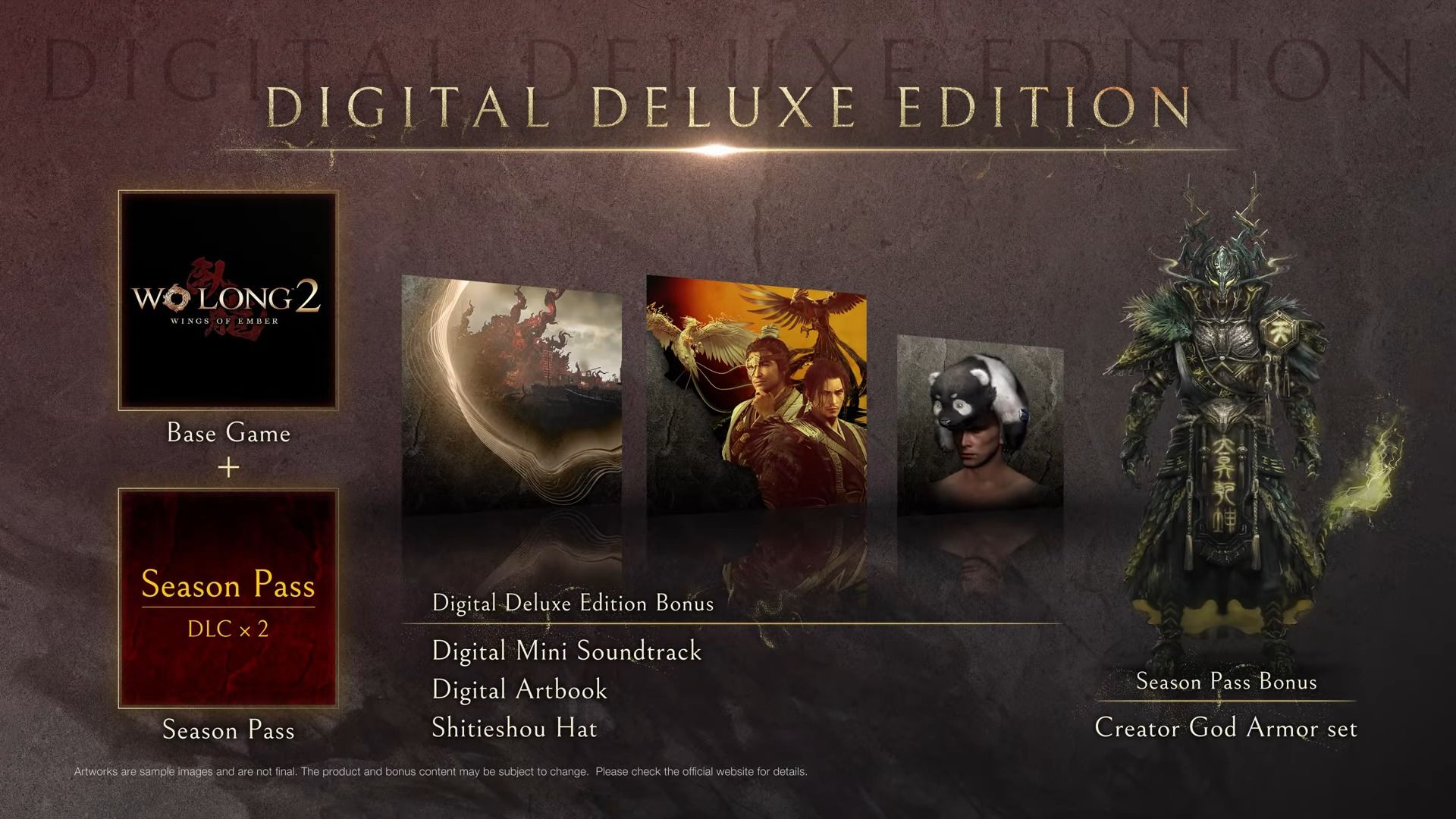
Wo Long 2: Wings of Ember Digital Deluxe Edition. (Image credit: Koei Tecmo)
If you pre-order Wo Long 2: Wings of Ruin, you can get exclusive access to the Creator Goddess Garb armor set and early purchase access to the Harvest God Armor set.
The game will come in a standard edition (which only contains the base game) or a Digital Deluxe Edition, the latter of which features:
Season pass that grants access to two future DLC expansions (the first will release on August 31, 2027, and the second on October 31, 2027), plus the Creator God Armor set as a Season Pass Bonus.
Digital Mini Soundtrack
Digital Artbook
Shietieshou Hat.
Can't wait to dive back into this grim dark Soulslike take on the Three Kingdoms era
The original Wo Long: Fallen Dynasty was an immensely fun, underrated Soulslike that we gave a 4.5/5 star review for its in-depth combat system and nail-bitingly tough bosses that were so satisfying to beat.
So I can't wait to see if its sequel has what it takes to top the first game when Wo Long 2: Wings of Ember launches next year on March 4, 2027.
In the meantime, I'll be playing the Alpha demo, as it's been a long while since I played a Soulslike, so I'll need to shake off the rust before the full game arrives.
Embody the power of a fiery Phoenix and descend upon the battlefield to purge horrifying demons and duel legendary heroes of the Three Kingdoms in Wo Long 2: Wings of Ember.
They're intended to supersede the previous PlayStation Pulse models
There's no word on pricing yet
Sony has just unveiled the "next line of PS5 audio products" with two new PlayStation Pulse wireless gaming headsets.
Both models are intended to supersede the old PlayStation Pulse Elite, which was released in 2024. The new PlayStation Pulse Edge boasts custom planar magnetic drivers that deliver "studio-inspired" sound and has eight magnets under the hood.
It comes with a detachable boom mic offering AI noise rejection alongside a USB Type-C adapter and premium carrying case.
Major features include built-in volume controls that integrate with the console's operating system, a game audio and chat balance slider, and active noise cancellation.
The upcoming PlayStation Pulse, in contrast, is positioned as a more entry-level model. It cuts the number of driver magnets down to four, which likely means less bass and reduced clarity. There's no boom mic either, so you need to rely on an integrated microphone instead.
It also loses the game audio and chat balance feature, lacks active noise cancellation, and isn't bundled with any kind of case.
Sony has been quite cagey about pricing, with no word on how much either model will cost on the official PlayStation Blog. This makes it hard to determine whether this refreshed line will offer good value, especially given the abundance of excellent headsets currently offered by third-party brands like SteelSeries and Corsair.
We do know that both models will be available in both white and black, however, and will hit shelves early next year.
Every now and then, a game comes along that doesn’t just entertain and engage me — it totally enraptures me. It stands as a pure work of art that reminds me of exactly why I love this medium and captures the essence of a book you just can’t put down. For me, that’s exactly what Fire Emblem: Fortune’s Weave is — an engrossing experience that I simply can’t get enough of.
Review info
Platform reviewed: Nintendo Switch 2 Available on: Nintendo Switch 2 Release date: September 17, 2026
This Nintendo Switch 2-exclusive tactical JRPG offers a combination of excellent turn-based combat and rewarding exploration, alongside captivating storytelling and a great cast of characters. And its sheer scale cannot be understated — I’ve spent north of 200 hours in Fortune’s Weave, and there’s still so much more I have to see.
I’ve played through each of the four Flame Lords’ paths and taken the battle to the demonic god Balor, and I’ve got a number of thoughts about gameplay, visuals, and narrative to share. So, without further ado, let’s take a look at why Fire Emblem: Fortune’s Weave is one of the best Nintendo Switch 2 games you can play right now.
Four paths converge
(Image credit: Nintendo)
I won’t get into the weeds of the premise in Fortune’s Weave, but to sum up, you’re able to play as four heroes, known as the Flame Lords, as they compete in a grand arena event known as the Heroic Games. The champion of the Games will be granted a wish of their choosing by Divine Sovereign, Solel, who rules over the land of Dagda and its capital, Dagsion.
After completing the brief prologue — which acts as a solid tutorial for newcomers — you can select any of the Flame Lords’ paths and play through them in any order you like from a central hub area. This approach works nicely, as you don’t have to replay the prologue each time you start a new journey, and you’re able to dip in and out of each story as you please.
This makes up Part I of the game, which was probably my favorite overall. Although some cutscenes and quests are the same across the four stories, they still feel distinct and gripping in their own right. Each pathway has a distinct tone and feeling to it, with each Flame Lord having a deeply personal ambition and a unique set of close allies. For instance, the vengeful and skilful Leda is joined by the womanizing bard Sirocco and protective warrior Buccar, whereas Dietrich is partnered with the excitable Esmeralda and bizarre and eccentric missionary, Fabio.
The core cast of characters is truly excellent, but you’ll also be able to recruit more allies as you progress the story, including foes you face in the Heroic Games and parties of interest across Dagsion. Many of these units can be recruited across all four stories, though their recruitment requirements often vary, which encouraged me to experiment with different characters across different stories.
Best bit
(Image credit: Nintendo)
Anything with Dietrich and Fabio. They're an unlikely yet incredible duo, with Dietrich's bloodlust and Fabio's eccentricity somehow combining to create some of the most hilarious — and sometimes emotive — dialogue in the series.
What makes the multi-path system click is that you’ll uncover revelations in one story that answer questions — or even pose new ones — about events in one of the other paths. There are plenty of twists and turns — some perhaps more obvious than others — which change the way you perceive certain characters and add substantial depth to units that may seem less significant on some paths than others.
This cross-path storytelling is done really well, and the narrative is strong, more generally. I won’t spoil anything, but it’s got its fair share of shock instances, touching moments, and character development that help it to hit — and if not, exceed — the standards that the series has set thus far.
Gameplay-wise, things are kept pretty fresh too. Each Flame Lord has specific abilities that they can make use of on the world map and beyond, with Deitrich able to battle warriors and learn their combat arts, Leda capable of holding performances to unlock unique materials, Theodora able to recruit warriors to assign battalions, and Cai skilled enough to wrangle mounts for himself and his allies.
And luckily, all of this comes together nicely in the latter parts of the game. While Part I is more individually tailored to each Flame Lord and their journey through the Heroic Games, paths begin to converge in Part II, known as the War Arc. Again, I won’t spoil anything here, but Part II offers far less variation across each pathway, but there are still some interesting differences in dialogue, and the way you approach battles will likely change considerably.
I loved how the enormity of Fortune’s Weave came together in Part III, though. Here, you’ll be able to unite all of the Flame Lords beside the game’s true protagonist, you. It’s awesome that you’re able to make use of all of the heroes’ unique abilities and even re-recruit old units for the final battle against the demonic lord, Balor.
Being able to bring all of your units, inventory, and abilities into a singular, epic finale is incredibly rewarding and makes building the ultimate army even more enjoyable.
I see grids in my sleep
(Image credit: Nintendo)
Let’s delve a bit more deeply into gameplay, which, as you’d expect, is outstanding in Fortune’s Weave.
For the most part, you’ll be battling on classic grid-based battlefields. Honestly, I’ve fought on these so many times I’m starting to see them in my dreams. It's that classic turn-based Fire Emblem that you know and love, with some returning features, like Combat Arts (which provide benefits in exchange for weapon durability) and gambits (in Theodora’s path), for instance.
But there are new mechanics too, like Blaze Arts, which are unique to specific units. By sacrificing HP, Blaze Arts enable you to deal more damage, move further, buff allies, and more. The health trade-off means they don’t feel like a cheat code, and they also fill a blaze gauge, which will burst at a certain point, forcing you to work with reduced HP for the rest of the map.
(Image credit: Nintendo)
Standard battles feel brilliantly balanced, and I never felt that difficulty spikes were too severe or that I had to grind much to push past my opponent. When you do want to grind, though, you can enter into a skirmish against foes on the world map, or try your luck in a dungeon.
Dungeons work a bit differently, and you’ll move around a 3D area to face foes in Clash Battles. These are a bit different and combine light action segments with more traditional turn-based JRPG combat rather than tactical grid-based battles. I think that they’re a great option if you want a break from the usual maps and want a faster-paced method for gaining experience or class proficiency for your units.
That’s not to say that the standard maps aren’t engaging though; quite the opposite. There’s some excellent map variety, and some battles will ask more of you than just routing the enemy. In some cases, I had to defeat more giants than my opponents, rescue defenseless citizens from a huge serpent, or even collect missing cargo before thieves made off with it. Battlefields are also delightfully diverse throughout the heroic games, and become even grander as the stakes rise towards the back end of the game.
If at any point you’re struggling, you can make use of Blessings, enabling you to rewind to a previous turn, increase your strength, or reduce the cost of Combat Arts, for example. I kept usage of these to a minimum, as I was playing on the slightly more gracious Normal/Casual difficulty. But there’s also a Hard mode, and you can play Classic (where units are permanently lost when they fall in battle), where Blessings will likely feel a bit more necessary.
All in all, combat is incredibly addictive, varied, and offers impressive depth. Building a squad with the right balance in terms of classes and weapons is massively satisfying, and breaking things up with a bit of dungeon crawling keeps the experience feeling fluid and fun for the game’s full runtime. And given that we’re talking about a title that will take you well over 100, if not 200, hours to finish, that’s an impressive feat in itself.
Beyond the battlefield
(Image credit: Nintendo)
Before I wrap up, I want to touch on my experience with Fortune’s Weave outside of battle. There’s quite a bit to do, both within the capital, Dagsion, and in the land of Dagda more broadly.
Dagsion has all of the stuff you’d expect. A training ground to boost your aptitude with specific weapons, a shopping district, an inn for viewing support conversations and restoring motivation (which is used for training and increasing your Blessings level), and an area where you can take an exam for whatever class you want to be.
A lot of your time in Fortune’s Weave will be spent using these facilities to increase your weapon levels, boost support with your allies, and acquire better equipment.
If I were to nitpick, I’d argue that the support grind can become a little tiresome for some units. If you want to recruit a new ally who requires a high support level, it can take quite some time to fill the gauge and add them to your team, though some are easier to add to your roster than others.
There are more things to do, though, like going to the Theater, taking a bath at the Thermae spa, and accepting subquests from distressed townsfolk. Perhaps the most unusual option, however, is Bird Time.
Here, you can feed the Pale Raven (the main protagonist in bird form) to increase your support level for later in the game. Is it a bit goofy? Yeah. Does it get a bit repetitive? Sure. But I kinda love the feeling of getting that sweet ‘perfect bird time’ message when you have a successful interaction with your ally.
Outside of Dagsion, you can enter the aforementioned dungeons, search for materials, enter into some smaller hub areas, and speak with wandering merchants. The world map is easy to navigate, but you’ll only have a set amount of time to explore before the day of the Main Quest arrives. This helps the game to maintain good pacing throughout, and while there’s a ton to explore, it’s broken up with main story goodness in healthy intervals, in my view.
(Image credit: Nintendo)
On a technical level, Fire Emblem: Fortune’s Weave is pretty solid too. It keeps a lot of the enticing visual style seen in Fire Emblem: Three Houses, but being a Nintendo Switch 2 exclusive, there’s a clear step-up in terms of resolution, and character models look excellent too. Be it Fortuna, whose vibrant hair pops with eye-catching yellow, or the striking, rich reds of Bertrand, the White-Maned Demon’s clothing, I found myself impressed by the visuals pretty consistently.
Some background textures do look a bit basic, however, and while the game runs smoothly, it’s not targeting a silky 60fps (but this never bothered me, personally).
I also want to shout out the game’s excellent soundtrack, which is more eclectic than you may think. There’s the classic orchestral-style stuff, which creates a real sense of grandeur and high stakes, but there are also spacey, synth-led tunes in the temples, which create ambience and intrigue, as well as electronic music with pumping bass in some mysterious hidden areas.
On the topic of sound, the voice acting is exceptional in Fortune’s Weave. You feel each character’s unmistakable personality through just about every performance, and this only makes you feel more attached to your units. The perfect example is Fabio, whose voice acting is just as outlandish and unusual as you’d hope for the character, though he also has some authentic, impassioned emotional scenes that stole the show. Great stuff all round.
To conclude, then, Fire Emblem: Fortune’s Weave is a masterful tactical JRPG that has it all. Addictive, depth-filled combat, fresh mechanics, a well-paced, multi-layered story, and a likeable cast of characters. It hypnotized me from minute one, all the way to the end, and its careful balance of tight turn-based gameplay and exploration really worked for me. As things stand, I consider Fortune’s Weave to not only be among the best Fire Emblemgames in recent memory, but also the best game on the Nintendo Switch 2 thus far.
Whatever you do, don’t skip this one.
Should you play Fire Emblem Fortune’s Weave?
(Image credit: Nintendo)
Play it if…
You want to sink your teeth into an epic RPG Fire Emblem: Fortune’s Weave is a huge game that will easily take you north of 100 hours to finish if you want to complete each Flame Lord’s path and clear every subquest. If you’re looking for a true epic to get your money’s worth out of, this is the game for you.
You’re a fan of character-driven narratives Yes, Fortune’s Weave features a very high-stakes story, but the narrative is largely centered around the four Flame Lords, and their personal ambitions in the Heroic Games. Watching each story unfurl, and seeing how each hero develops is a joy, so if you’re into more character-driven stories, then you’ll likely enjoy this.
Don’t play it if…
You’re not a big fan of tactical combat There are some light action segments and swifter turn-based dungeon battles in Fortune’s Weave, but a lot of the time will be spent commanding your units on a grid. If you’re not into the more strategic style of other Fire Emblem games, then you may not have the best time with this one either.
You need top-tier performance from your games While Fortune’s Weave looks pretty solid, it’s by no means pushing boundaries as far as visuals go. It’s very stable, in terms of performance, but it’s also not going to give you the buttery smoothness of other Switch 2 games, like Metroid Prime 4: Beyond, say, which can even run at 120fps in handheld mode.
Accessibility features
There are a handful of ways to customize your experience in Fire Emblem: Fortune’s Weave. You can make UI adjustments, like altering the size of the battle minimap, toggling the grid display on and off, you can personalize camera controls and sensitivity, and choose from a number of different subtitle languages.
There’s even an Enemy Masking mode that changes the appearances of insectile enemies if you have arachnophobia or entomophobia. There is no colorblind mode, or similar.
(Image credit: Nintendo)
How I reviewed Fire Emblem: Fortune's Weave
I spent just over 200 hours with Fire Emblem: Fortune’s Weave, during which time I played through the main story (including each of the Flame Lords’ individual paths), completed just about every subquest, and recruited countless allies.
For the most part, I played in docked mode, with my Nintendo Switch 2 connected to my Sky Glass Gen 2 TV and Marshall Heston 120 soundbar. However, I did dip into handheld mode now and then, and usually had my Sennheiser CX 80U wired earbuds connected when playing on the go.
Nintendo has gotten quite good at making open-ended games. The Legend of Zelda: Breath of the Wild upended the idea of what a Zelda game could be by giving the player free rein to tackle any part of the map, a philosophy iterated upon with Tears of the Kingdom. On the Switch 2 this idea expanded to Mario Kart World and Donkey Kong Bananza. Now, Nintendo has brought this philosophy to Fire Emblem with Fortune's Weave. It works really well; with its many ways to progress through the game and tailor teams to your liking, Fortune's Weave has become my favorite game on the Switch 2 so far.
Fortune's Weave's structure is a big reason why it feels …
The ‘magic security chip’ inside the original PlayStation 2 has been successfully reverse-engineered and dumped. Canadian retro hardware and software enthusiast DiscoStarslayer was the manic mind behind the cracking open of the CXP102064 MechaCon chip, which arrived inside the ‘PS2 Fat’ from 1999. It took “four years of effort” to reach this stage, but this milestone should be a boon to hardware preservation, repair, and emulation projects.
After 4 years of effort, I'm happy to announce that one of the final secrets of the PS2 has been broken wide open!It's been a long process of decapping, optical dumping, and now at last a software solution.Thank you Libby for finding the exploit from our dirty optical dumps! pic.twitter.com/VrsCH8I35CSeptember 13, 2026
The Mechacon got its name from its primary duty of controlling the PS2’s optical and flash drive mechanics. It also played a significant part in Sony’s game optical disc security, supporting “Magic Gate [memory card] and KELF file [executable] decryption among other things,” notes the PSDev Wiki. Unlocking the secret workings of such chips can be important to those involved in video game preservation. So, many people will appreciate DiscoStarslayer’s work in reverse engineering and dumping one of the PS2’s last remaining secrets.
As per the social media post, the arduous task of breaking the MechaCon’s security took four years. Some of the reverse engineering tricks utilized by DiscoStarslayer include chemically decapping the CXP102064 to expose the die, then using microscopes and optical dumping skills to analyze the silicon chip circuitry. In this case, a lucky break during the hacking apparently uncovered an exploit that provided a method whereby the chip’s data could be extracted through software.
With this achievement unlocked, the game/hardware preservation and programming communities can look forward to improved emulation and homebrew developments. It should also open up possibilities for replacing the aging optical drives in PS2 consoles.
Beyond the confines of PS2 Fat consoles, some social media commenters noted that the MechaCon was also used in a handful of arcade machines from the era. Specifically, the Namco System 246 and System 256, as well as the Konami Python 1, which used modified PS2 hardware, used the MechaCon firmware to authenticate security and allow the execution of encrypted game data.

 Login