 Login
A Million-Person Moon City Could Run Out of Water in Just Over a Century
16 September 2026 at 13:46
 A lunar city sounds possible until you calculate how fast it would use its water
 A lunar city sounds possible until you calculate how fast it would use its water
NASA will host an International Observe the Moon Night celebration from 5:30 to 8 p.m. CST on Saturday, Sept. 19, at the U.S. Space & Rocket Center, the official visitor center for NASA’s Marshall Space Flight Center in Huntsville, Alabama.
International Observe the Moon Night celebrates the Moon, the science behind it, and its connection to space exploration and human culture. NASA’s free public event will include agency experts delivering talks on lunar science and exploration and highlighting lunar observations made by the Artemis II crew in April.
Media interested in covering the event should confirm their attendance with Joel Wallace, joel.w.wallace@nasa.gov, in the NASA Marshall newsroom by 3 p.m., Friday, Sept. 18. Media must report to the Davidson Center to participate in the event. Visitor parking is available at the U.S. Space & Rocket Center.
NASA will have opportunities for media to capture visuals and interview agency experts. Activities available for coverage include hands-on STEM activities, a science stage show, an event photo booth, and face-painting.
The event also features Janet Ivey, the host of the television children’s series, “Janet’s Planet.” The Von Braun Astronomical Society will be on-site with telescopes, providing attendees with guided tours of the Moon, planets, and other celestial objects.
The evening is presented by the Planetary Missions Program Office at NASA Marshall.
For more information about International Observe the Moon Night, visit:
https://science.nasa.gov/moon/observe-the-moon-night/overview
Joel Wallace
Marshall Space Flight Center, Huntsville, Ala
256-786-0117
Dr. Stephen Kane from the University of California, Riverside and colleagues offer a tidy explanation for one of the Solar System’s enduring puzzles: why Venus, so similar to Earth in size and mass, has no moon at all.
The post New Study Explains Why Venus Has No Moon appeared first on Sci.News: Breaking Science News.
In April, the world watched as four humans circled the Moon for the first time in over 50 years with NASA’s Artemis II mission. On Saturday, Sept. 19, the public is invited to look up again with NASA events across the country, including the International Observe the Moon Night celebration held at NASA’s Goddard Space Flight Center Visitor Center in Greenbelt, Maryland.
International Observe the Moon Night is an annual celebration that brings people together to learn about the Moon and explore our connection to Earth’s nearest celestial neighbor. Since the program began in 2010, people around the world have participated through lunar observations, hands-on activities, artwork, music, and more.
At NASA Goddard, this year’s celebration will highlight the agency’s ongoing exploration of the Moon, including the historic Artemis II mission. Visitors can peer behind the scenes to learn more about what it took to make Artemis II’s journey around the Moon a success and discover how Goddard scientists and engineers are helping advance our understanding of the Moon, solar system, and beyond.
The event will run from 6 p.m. to 9 p.m. EDT.
Throughout the event at NASA Goddard, visitors can take part in interactive hands-on activities, create artwork and crafts, and capture selfies at a photo kiosk. Telescopes will also be set up outside (depending on weather), giving attendees an opportunity to observe the Moon and other astronomical objects up close. Inside the Visitor Center, guests can even see a real Apollo 14 Moon rock on display.
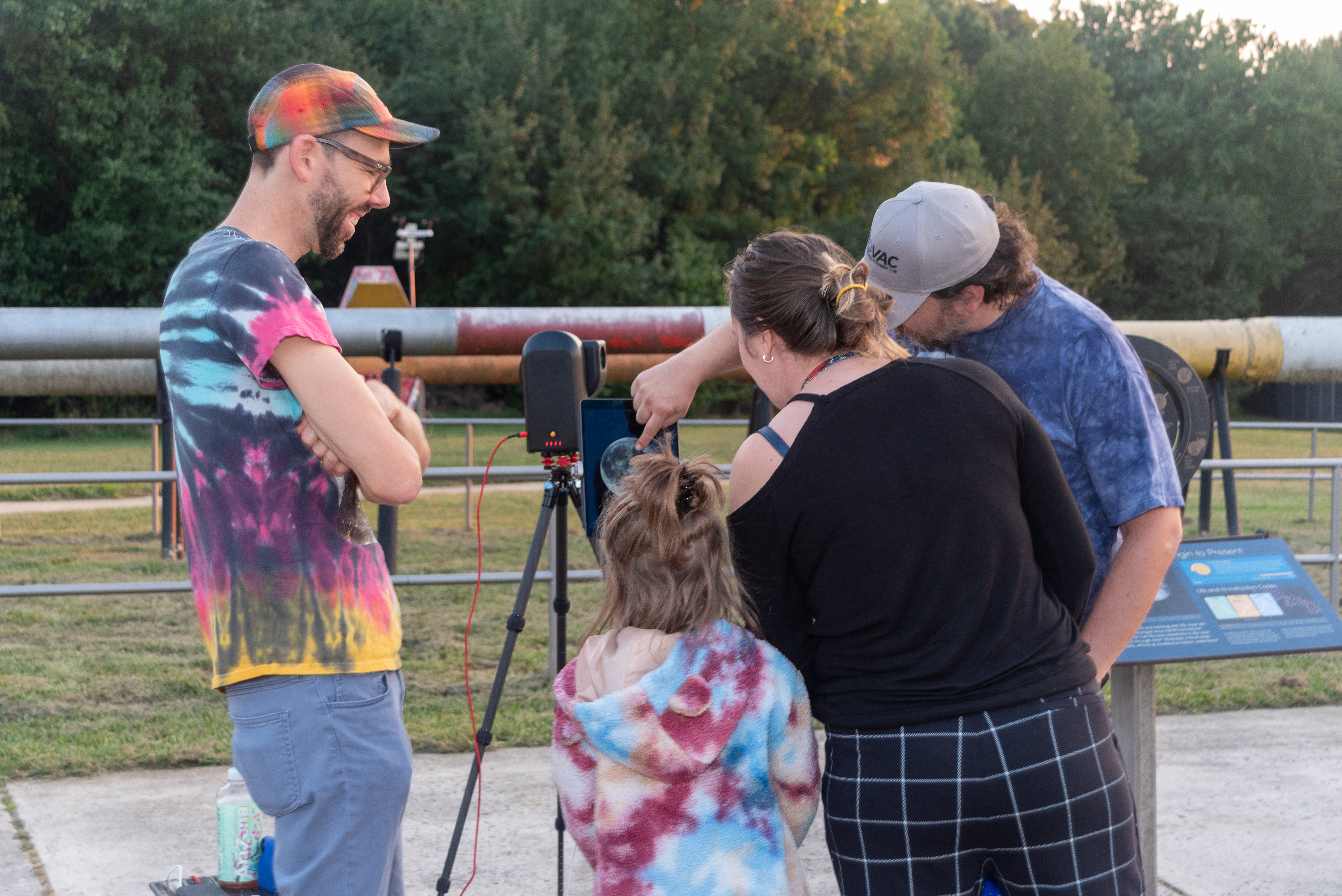
The event will also offer a chance to learn more about the groundbreaking research happening at NASA Goddard as scientists work to unlock the secrets of the Moon with missions like the Lunar Reconnaissance Orbiter (LRO) and explore our solar system and the universe beyond.
International Observe the Moon Night at Goddard is free and family friendly. Registration is not required, although registering in advance will help the Visitor Center team plan for the event. The event will take place rain or shine, and free parking is available at the Visitor Center.
Additional event details, including registration, accessibility and other logistics: https://www.nasa.gov/goddard/visitor-center/events-and-programs/.
For people who cannot travel to Greenbelt, there are opportunities to participate in International Observe the Moon Night from all around the planet. Join lunar observers around the world by observing the Moon with friends and family, attending a virtual event or finding an event in your area. Learn more and register your participation at go.nasa.gov/ObserveTheMoon.
International Observe the Moon Night is sponsored by NASA’s LRO mission and the Solar System Exploration Division of NASA’s Goddard Space Flight Center, with support from many partners. The celebration is a way for people to pause and look up at our future destination, as NASA prepares for deep space missions to the Moon and beyond.
To learn about NASA’s Artemis program, visit:
https://www.nasa.gov/artemis
To learn about LRO, visit:
https://www.nasa.gov/lro
The Moon may have emerged largely intact within hours of the colossal impact that shaped its birth. Earth has an unusually large moon for a planet of its size and position in the solar system, yet scientists still do not fully understand how that companion came to exist. Now, researchers from the Southwest Research Institute [...]The discovery of water at the poles of the moon has inspired speculation about whether we can build there – cities, industrial neighborhoods, places where people work and live. But is there enough water, and can we use it efficiently enough? In their new article in Frontiers in Space Technologies, Dr. Martin Elvis and Dr. Jonathan McDowell do the math. Even at the most generous estimates of the available water and recycling efficiency, a city of one million people would only last 100 years before all the water runs out. In this guest editorial, which Frontiers in Space Technologies provided, Elvis breaks down what we can and can't do with the technology available.
The discovery of water in dark craters at the moon's poles has sparked a "moon rush" to establish bases there, and then villages, cities and heavy industry. How sustainable is this rush?
Soon after the moon was formed, asteroids bombarded it, creating its pockmarked topography. Near the moon's poles, there are dozens of crater floors that have not seen direct sunlight in about four billion years. Many of these cryogenically cold "pits of eternal darkness" are below a temperature of 110 Kelvin (minus 262 degrees Fahrenheit), forming "cold traps" in which water ice won't sublimate away by more than a millimeter in a billion years, even in the vacuum at the moon's surface. And there is water to freeze: some of those asteroids brought it along with them. Since 2013 we have known that that water is still there, possibly as much as a billion tons of it, thanks to a succession of moon-orbiting missions that have mapped out likely locations in increasing detail.
The presence of water at the lunar poles changes everything about human visits to the moon. Suddenly it is practical to envisage a "moon village" where people could survive without importing every last bit from Earth. They could grow their own food and have showers and functional toilets, unlike the astronauts on the International Space Station (ISS). This possibility has sparked ambitions from the likes of Jeff Bezos to move heavy industry to the moon and Elon Musk's aims to have "self-growing cities" there. These are enticing visions, but are they attainable?
The good news
We realized that we could make a first feasibility estimate simply by looking at how much power and water a large population would use on the moon, and how long a city of 100,000 or one million people could survive there. How sustainable is a city on the moon?
The good news is that power, even without nuclear reactors, is not a problem. That's because the rims of the craters containing the pits of eternal darkness are in almost permanent sunlight. (That's why they are sometimes, slightly incorrectly, referred to as the "peaks of eternal light.") Up on those highly illuminated rims it would be possible to generate three gigawatts of electricity using kilometer-tall towers covered with photovoltaic arrays. It should be possible to manufacture solar panels on the moon. There's certainly plenty of silicon. This could even make AI data centers on the moon possible, by placing them near these sunny peaks. That would be the start of a true lunar economy.
The bad news is that, even assuming a generous one billion tons of water to start with, without recycling the answer to our question of sustainability is that the city would last only a few years. Even in the best-case scenario, with 98% efficient recycling of water — the same as achieved on the ISS — a one-million-person city will run out of water in just over a century. That is a problem for sustainable moon settlement. And today's best estimates of the amount of water on the moon are about 30 times less than a billion tons, shortening the time to water exhaustion by the same factor. This means that even a small city would run dry after just a decade or so. A moon village with a thousand people, or even a town with 10,000 people, would instead be sustainable for several centuries or more.
There are potential solutions. We could improve the efficiency of water recycling by a factor of five or more; lower water usage from new techniques such as vertical farming; import water, probably from accessible asteroids; or, simply, find more water. Of these it may be this last hope that is most promising. Current water surveying techniques do not reach below the surface more than a few meters, while the rubble-like rocks of the surface regolith typically extend tens of meters down and may contain water in the cold traps. If the ambitious plans of the space billionaires are to be realized, then finding more water will be the first step.

Mercury has been slowly shrinking for billions of years. But scientists studying the smallest planet in the solar system may have overlooked just how dramatic that transformation has been because some of the evidence has literally been buried.
A new study suggests Mercury’s battered, crater-covered surface has concealed a significant fraction of the faults created as the planet cooled and contracted. After accounting for those hidden geological structures, researchers estimate Mercury may have shrunk by as much as 7.2 miles (11.6 kilometers) in radius—up to 30% more than previous estimates based on the same tectonic record.
The findings could alter models of how Mercury’s interior evolved and raise an interesting possibility beyond the planet itself. For instance, scientists may also be underestimating how much other rocky worlds, particularly the Moon, have contracted.
“Combined with the contractional strain map from Broquet and Andrews-Hanna (2026a), we show that radial contraction may have been underestimated by 10%–30%,” researchers write. “Our radial contraction correction should be considered as a lower bound.”
In the study published in Geophysical Research Letters, researchers led by Dr. Gaku Nishiyama of the German Aerospace Center (DLR) examined a longstanding mystery in Mercury’s geology.
As a rocky planet loses heat, its interior contracts. Much like the skin of a drying fruit, the planet’s rigid exterior must accommodate a shrinking interior, producing faults and enormous cliff-like features known as lobate scarps, along with wrinkle ridges and other shortening structures.
Scientists therefore use the crustal shortening recorded by these structures as a geological ruler to determine how much Mercury has contracted.
The problem is that those structures aren’t distributed across Mercury the way scientists might expect.
If cooling caused the entire planet to contract, the resulting deformation should be comparatively widespread. Instead, previous mapping has revealed regions filled with large scarps alongside enormous areas where surprisingly few contractional structures have been identified.
Dr. Nishiyama and his colleagues investigated whether at least part of that discrepancy could be an illusion created by Mercury’s extraordinarily battered surface.
The researchers constructed a global map of Mercury’s surface roughness using topographic measurements acquired from NASA’s MESSENGER mission and a global digital terrain model produced from spacecraft imagery.
They then compared that roughness with previously cataloged tectonic structures.
Findings showed that fault scarps and other shortening structures were preferentially identified in smoother terrain, while rougher regions contained substantially fewer detectable structures. The relationship remained apparent across geographic scales extending to roughly 93 miles or about 150 kilometers.
That is counterintuitive because tectonic ridges themselves create topographic roughness. If roughness and plate movements were unrelated, areas with scarps might be expected to be slightly rougher than the surrounding terrain.
Instead, the researchers found the opposite.
One explanation is evident around relatively young impact craters such as Rachmaninoff. Large impacts blasted enormous quantities of debris across the surrounding landscape, producing thick blankets of material and secondary craters. In some locations, long tectonic structures appear to lose relief as they approach these deposits—consistent with the older structures being progressively hidden under impact material.
Other faults may still exist but become difficult to recognize against heavily cratered terrain. Once the surrounding topography becomes rough enough, a weathered ridge only a little higher than the background landscape can effectively disappear into the geological noise.
There is also a third possibility.
Heavily cratered regions may contain thick, porous layers of broken rock called regolith. During planetary contraction, some deformation could be absorbed as pores collapse rather than producing large faults visible from orbit. Alternatively, deformation could create faults too small for current observations to resolve. The researchers say available evidence cannot yet rule out that possibility.
Whatever mechanism is responsible, Dr. Nishiyama and his colleagues argue the relationship creates a systematic bias, where scientists see more evidence of contraction where Mercury’s surface makes that evidence easier to preserve and identify.
The team developed a correction using comparatively smooth regions, where tectonic structures appear less affected by this bias.
Applied to an earlier global estimate of 5.2 miles (8.3 kilometers) of radial contraction, the correction increased Mercury’s estimated shrinkage to roughly 7.2 miles or about 11.6 kilometers.
Depending on which tectonic structures are included, the researchers estimate surface roughness could have caused previous calculations to underestimate Mercury’s contraction by roughly 10% to 30%. They also caution that their corrected figure may itself represent a lower limit.
Ultimately, Mercury’s shrinking surface effectively records what has happened deep inside the planet.
The amount of contraction constrains how quickly Mercury lost heat, the thickness of its insulating regolith, the abundance of heat-producing elements, and even the composition and freezing history of its enormous metallic core. The revised estimate, for example, favors models involving a thinner regolith and lower sulfur content in Mercury’s core than some previous estimates.
Scientists may soon get a much sharper look.
The ESA-JAXA BepiColombo mission’s laser altimeter will eventually measure Mercury’s topography at scales as small as about 330 feet or 100 meters, possibly revealing geological relationships that MESSENGER could not resolve.
And Mercury may not be the only world whose geological record has been hiding in plain sight.
The Moon’s highlands are even rougher than Mercury’s cratered plains—by roughly 40% at the little-over 6-mile (10-kilometer) scale examined by the researchers. Yet evidence suggests the Moon contracted less than some thermal models estimate. If rough terrain similarly hides lunar faults, part of that difference might reflect structures scientists haven’t been able to see.
In other words, Mercury’s missing wrinkles may expose a wider problem in planetary geoscience. The more battered an ancient world becomes, the more effectively its later surface can erase the visible record of what happened before it.
“Investigating roughness alongside tectonic landforms may therefore refine our understanding of the lunar thermal evolution as well,” researchers conclude. “Mars could also be subject to this roughness effect, while topographic smoothing due to fluvial and aeolian processes may introduce more complex correlation between surface roughness and shortening structures.”
Study: Nishiyama, G., Broquet, A., Tosi, N., Preusker, F., Stark, A., Hussmann, H., & Hauber, E. “Underestimation of Planetary Contraction Due to Obscuration by Surface Roughness: The Case of Mercury.” Geophysical Research Letters 53, (2026).
Tim McMillan is a retired law enforcement executive, investigative reporter and co-founder of The Debrief. His writing typically focuses on defense, national security, the Intelligence Community and topics related to psychology. You can follow Tim on Twitter: @LtTimMcMillan. Tim can be reached by email: tim@thedebrief.org or through encrypted email: LtTimMcMillan@protonmail.com
Harvard-Smithsonian Center for Astrophysics scientists studying water ice believed to be stored in the Moon’s ‘pits of eternal darkness’ have concluded that there likely isn’t enough of this critical resource to support long-term future human colonies, meaning visions of large-scale cities on Earth’s largest natural satellite may be more science fiction than science fact.
Conversely, the researchers calculated that smaller settlements with fewer than 10,000 human colonists could have enough accessible water to survive for centuries. They also suggested that other technological advances in water harvesting or advances in scanning techniques that explore below the top few meters of surface regolith may reveal significant amounts of hidden lunar water.
The Moon’s surface is covered with visible evidence of asteroid collisions. Along with its textured appearance, some of these massive impact craters contain areas that are permanently shaded from direct sunlight.
The Harvard-Smithsonian research team behind the new study said some of the earliest “pits of eternal darkness” could be over one million years old. More critically, they can maintain a temperature of 110K, or just above absolute zero. At this low temperature, frozen water ice trapped in the sunless craters won’t lose more than a millimeter of thickness to space every billion years.
When announcing the new study, the researchers noted that “a succession of Moon-orbiting missions” has mapped out possible locations of stored water ice since 2013. The results suggested that the Moon’s pits of eternal darkness may contain as much as a billion tons, with the largest concentrated around the Moon’s northern and southern poles.
Since those missions, scientists and industrialists have begun to speculate about the viability of long-term human lunar habitation. Unlike astronauts trapped in capsules or space stations, lunar colonists could theoretically possess enough on-site water to support farming, full-service bathroom facilities, and production of hydrogen-based fuels.
Still, researchers wondered if one billion tons of stored water ice is enough to support the types of cities that billionaire industrialists and science fiction authors have proposed.
To start, the team modeled how long large human settlements ranging from 100,000 to one million people could survive on the water stored in lunar pits of eternal darkness. This included water-recycling rates up to 98%, as achieved on the International Space Station (ISS).
After running the numbers, the team found mixed results.
First, even colonies up to one million humans wouldn’t run out of power. The team said that number is based on solar power generation and excludes nuclear reactors.
Instead, the Harvard-Smithsonian team proposed constructing one-kilometer-tall solar energy towers near the rims of the craters. Their models suggest that an array of towers covered in photovoltaic arrays could generate three gigawatts of usable electricity.
The team noted that the materials needed to build solar panels, including the primary ingredient, silicon, are plentiful on the Moon, meaning future lunar colonists could manufacture new solar power-generating towers on-site. Such lunar colonists could theoretically maintain enormous AI data centers near these towers capable of servicing paying customers back on Earth.
“That would be the start of a true lunar economy,” the research team explained.
When the researchers crunched the water numbers, long-term lunar habitability became significantly more dubious. In fact, most estimates had future lunar colonists exhausting the most generous one-billion-ton projected supply of water ice within “a few years.”
When researchers modeled an ISS-level water recycling efficiency level using those same water estimates, a colony of one million humans would run out of water “in just over a century.”
“And today’s best estimates of the amount of water on the Moon are about 30 times less than a billion tons, shortening the time to water exhaustion by the same factor,” they add.
For example, if more conservative ‘pits of eternal darkness’ water ice estimates are closer to reality, the researchers said that “even a small city” likely wouldn’t make it past a decade before they had tapped the Moon dry.
Fortunately, the news was not all bad. When the team assumed a smaller “Moon village” of over one thousand people, up to a larger settlement of 10,000, the researchers found that the water ice stored in the Moon’s pits of eternal darkness “would instead be sustainable for several centuries or more.”
The team also suggested alternate solutions for supporting a larger, long-term lunar settlement. These included potential improvements in water recycling, improved farming efficiency, or mining nearby asteroids for water.
The team also noted that additional pockets of stored lunar water ice may be awaiting discovery, suggesting that finding such lunar water may be easier than achieving sufficient farming and recycling efficiency improvements.
“Current water surveying techniques do not reach below the surface more than a few meters, while the rubble-like rocks of the surface regolith typically extend tens of meters down and may contain water in the cold traps,” they explained.
The study “No Cities on the Moon: a Billion Tons of Water is not enough for Sustainability” was published in Frontiers in Space Technology.
Christopher Plain has spent the last six years as Associate News Editor and Head Science Reporter at The Debrief. Follow and connect with him on X, learn about his novels at plainfiction.com, or email him at christopher@thedebrief.org.
Read more of this story at Slashdot.
We've been studying the moon for a long time. NASA has gathered mountains of data over decades of lunar missions and studies. The data collected by the Lunar Reconnaissance Orbiter (LRO) alone, for example, exceeds that of all NASA's other planetary missions combined.
Analyzing all this information takes lots of time and effort from researchers. So, NASA and IBM have developed an AI model to help sift through the moon data — an advance the agency announced on Thursday (Sept. 10). The open-source model, called the NASA-IBM Lunar Foundation Model, is currently available for free at Hugging Face.
"NASA has spent decades building an extraordinary scientific record of the moon, but collecting data is only part of the job," NASA's Kevin Murphy, chief science data officer and acting chief data and AI officer, said in the announcement.
The new AI model can help researchers with tasks like mapping craters, finding young volcanic features, and modeling possible locations of water ice near the lunar poles, according to NASA.
In the announcement, Murphy said that NASA needs to make scientific data easier to explore and use. To this end, NASA has been developing and releasing science-focused AI models with IBM. Previous models include one focused on Earth observation and another for heliophysics.
This is part of a larger trend of AI use in planetary science. Space agencies and private space companies around the world have been looking into how AI models can help with analysis to increase scientific productivity, reduce costs and streamline workflows.
"The NASA-IBM Lunar Foundation Model shows what's possible when we bring AI to NASA's petabytes of scientific data," Murphy said in the announcement. "That's a real opportunity we see with AI: turning large-scale data into new discoveries."
The AI model was mostly trained on data from the LRO mission. Over 17 years, NASA's lunar orbiter has compiled a nearly complete mosaic of images that detail the moon's surface in high definition.
Chang’e-6 samples suggest the Moon’s two very different sides may have formed when uneven heating drove magma from one hemisphere to the other. The Moon presents two dramatically different faces. Its Earth-facing hemisphere is rich in dark volcanic plains, while the farside is dominated by older highlands and a much thicker crust. New analyses of [...]The moon may have formed in as few as five hours after the cataclysmic collision between Earth and a long-lost protoplanet, new simulations suggest. The surprising findings could help shed light on other historic impacts throughout our cosmic neighborhood and beyond.
Experts strongly suspect that the moon was created when a Mars-size space rock called Theia smashed into an early version of our planet, back when the solar system was young and extremely unstable. This colossal impact likely would have turned the once-neighboring worlds into spinning clumps of molten rock that eventually coalesced and cooled into the versions of Earth and the moon we see today. Without this collision, which also may have left chunks of Theia buried deep within our planet, many scientists think that life may have never existed on Earth.
Lunar rocks collected during NASA's Apollo missions have provided evidence to support this theory, dubbed the giant impact hypothesis. These samples also tell us that the moon is around 4.5 billion years old, meaning the collision occurred roughly 100 million years after the sun was born. But although scientists have previously simulated the impact event, it has been tricky to ascertain exactly how the moon formed and how long it took to emerge after the Earth-Theia collision.
In the new study, published Sept. 1 in The Astrophysical Journal Letters, researchers conducted a series of simulations focusing on the varying potential geological properties of both Earth and Theia prior to their collision. This factor has been relatively understudied until now.
"When you simulate the Earth and the moon as colliding bodies with [different] geologic properties, it changes how the moon forms out of that impact — that's something we considered unnecessary before," study first author Adeene Denton, a geologist and planetary scientist at the Southwest Research Institute in Boulder, Colorado, said in a statement.
Until now, simulations of the Earth-Theia impact have focused mainly on the masses of the colliding neighbors. But in the new study, the researchers were most interested in the material strength of the two bodies, particularly the hardness of their exteriors.
"Models have evolved to include material strength, something that's really important when you're studying collisions between smaller bodies like asteroids," Denton said. "We weren't sure if it would matter for the moon or not. When we did the simulations, we found it actually matters quite a bit."
The main factor in the strength of colliding bodies is temperature. Both Earth and Theia were very young when they smashed together, so they were still hot and had soft or molten surfaces. These properties would have cushioned the collision, allowing the debris to stay largely intact and enabling the moon to form more quickly. But when the giant impact hypothesis was first proposed (in 2001), researchers initially thought the collision occurred much later, meaning that the bodies would have cooled and become more brittle. In this case, their collision would have created a larger field of rocky debris that would have taken longer to coalesce.
Researchers simulated the collision using a range of potential temperatures and found that under the most extreme scenario — where the pair were at their hottest — the moon could have formed in just five hours. However, this is just one potential outcome, and there is no way of knowing exactly how hot — and, therefore, how strong — Earth and Theia really were when they smashed together.
When the moon took shape, it was initially covered with a magma ocean that took hundreds of millions of years to solidify. Even then, its increased proximity to Earth meant that it was likely a volcanic hellscape. However, over time, it moved away from our planet, cooling further, and it is now assumed to be geologically dead. (The moon is continuing to slowly move away from us and could eventually escape our planet's gravity entirely, if the dying sun doesn’t destroy it and us first in around 5 billion years.)
The new simulations highlight the importance of material strength in planetary impact modeling, which could change what we know about other ancient collisions, like the one that knocked Jupiter's moon Ganymede off its axis or the one that birthed Saturn's moon Titan.
Additionally, the findings could have implications in the search for exomoons — the hypothetical moons of distant exoplanets, which have so far remained elusive, according to Live Science's sister site Space.com. Until now, one of the main ways astronomers have been hunting for these alien satellites is by looking for debris fields around exoplanets. However, if the moon is anything to go by, these debris fields could be very short-lived and difficult to identify.
A cubic meter of lunar soil might be one of our best bets for finding physical proof that another advanced civilization once existed somewhere in the Milky Way, according to a new paper to be published in the International Journal of Astrobiology.
The post Could Scoop of Moon Dust Reveal Alien Technology? appeared first on Sci.News: Breaking Science News.
RoboBall is built to tumble where ordinary lunar rovers may not survive.The moon could have formed in a matter of hours following the giant impact between Earth and a Mars-size protoplanet early in the history of the solar system. The theory comes from new simulations that take into account how the internal temperature of young protoplanets affected their geologic properties and therefore the collisions they experienced.
This giant impact scenario has become the leading theory of how the moon formed, thanks in particular to work done by planetary scientist Robin Canup. Since 2001, she has conducted and refined numerous computer simulations that describe how a Mars-size body called Theia collided at an angle just right to throw debris into orbit around the proto-Earth.
Now other researchers are getting in on the act. Adeene Denton of the South-west Research Institute led a team who performed some of the most detailed simulations of the collision yet, taking into account more of the geologic properties of the colliding worlds.
"Models have evolved to include material strength, something that's really important when you're studying collisions between smaller bodies like asteroids or for my previous paper about the formation of the Pluto–Charon system," said Denton in a statement. "We weren't sure it would matter for the moon or not. When we did the simulations, we found it actually matters quite a bit."
It turns out that warmer bodies are weaker than colder ones. After the planets formed, they were still hot inside from their formation, which would have affected their material strength. Given that the moon-forming impact occurred not long after the solar system's formation, this would have affected the collision with Theia — but to what degree depends on exactly when the collision occurred and how much Theia had cooled.
As Theia smashed into Earth, it was utterly destroyed. While much of what was left of Theia's shattered iron core sank into the Earth, a large ring of debris wrapped around Earth to form the moon.
The main effect of the temperature being warmer in the outer few hundred miles of Theia was that it would have affected its ability to deform upon impact and absorb the momentum of the collision. This, in turn, would have affected how debris was strewn around Earth to form the moon. Therefore, by including varying temperatures and material strengths in the simulations, Denton's team was able to get a better look at how the collision and the resulting formation of our moon played out.
Previous simulations have shown two possible scenarios. One is that the ring of debris hung around for a substantial amount of time, allowing the moon to accrete from it gradually. The other scenario, first depicted in NASA-led simulations in 2022, implies that the moon came together from this debris in a matter of hours.
Now, Denton's models potentially bolster this startling possibility.
If Theia was colder, meaning that the impact occurred a little later in the history of the solar system, perhaps 100 to 150 million years after the birth of the planets, then the ring of debris would have formed in such a way as to allow the moon to accrete gradually. And because it was stronger, more of Theia would have survived intact to merge with Earth.
On the other hand, a warmer Theia that impacted Earth less than 60 million years after the planets' formation, would create a scenario where the moon could form very quickly while Theia itself would be obliterated.
"Depending on how hot the Earth and Theia are prior to the collision, the impact can destroy Theia and produce this massive disk of debris that eventually forms the moon," said Denton. "But when I used the same parameters as original impact modeling – down to the equal temperature structures inside both bodies — within around five hours, an intact moon emerged."
That would have been quite a day in the history of our planet, acquiring a new moon and an almighty headache all at once.
"These surprising and exciting new results imply a potential connection between the physical properties of the moon today, including perhaps its volatile content, and the thermal state of the Earth and Theia at the time of the giant impact," said the Southwest Research Institute's Robin Canup, who was not involved in this study. "This in turn might help scientists better constrain when the moon-forming event occurred."
In both scenarios, the moon appears to be made mostly from Theia's mantle material, with just a little bit of Earth's mantle mixed in. This latter finding is surprising, given the similarities between the moon's composition and Earth's mantle. However, research has shown that there's clearly more to the story because despite the similarities there are also some puzzling differences in the levels of isotopes that cannot be easily explained by current simulations, including Denton's.
The simulations could have repercussions in the search for exomoons. If the moon did form in a matter of hours, then searching for exomoon-forming disks around terrestrial exoplanets might be a fruitless endeavor because such disks would be so short-lived. Moon-forming disks around gas giant exoplanets would be a different matter, however, because those disks do not form from impacts, but rather from material leftover from assembling those planets.
The results were published on Sept. 1 in The Astrophysical Journal Letters.
A University of West Bohemia (UWB)- led team of archaeologists has unearthed an ancient Czech ritual center linked to the movement of the Sun and Moon, predating Stonehenge by over 1,000 years.
The UWB-led team behind the discovery said the site’s 6,500-year-old age makes it one of the oldest monuments of Central Europe. Moving forward, the researchers plan to take soil samples from the enclosure and its surroundings to examine chemical traces left by the site’s ancient inhabitants.
According to a UWB statement, the newly discovered almost circular enclosure was found at present-day Chelby. Initial measurements set its diameter at 230 meters. The ritual center also featured a 2.5-meter-plus ditch and twelve entrances placed at irregular intervals.
Research team leader Petr Krištuf of UWB’s Department of Archaeology at the Faculty of Arts said circular enclosures like the Chelby structure are completely unknown in this region, making the site “exceptional.” However, Krištuf explained, when researchers began analyzing the positions of the asymmetrical entrances, “it became clear that their arrangement was not random.”
“Their geometry creates a system that made it possible to observe the most significant moments of the solar and lunar cycles,” the UWB researcher explained.
A more detailed survey of the newly discovered ritual center revealed two main observation points designed for specially timed observations of the Sun and Moon. The researchers said the first appears to be “associated with the Moon’s extreme positions on the horizon during its approximately 18-year cycle.”
The team said the second observation point identified during the survey connects the sunrise at the summer solstice, the longest day of the year, with sunset on the winter solstice, the shortest day.
Although the site is not the only ancient monumental structure in the region, the team used organic material to date the newly discovered enclosure to 6,500 years before present. For comparison, the relatively nearby Stonehenge monument, which also contains astronomical alignments connected to the Sun and Moon, was built over 1,000 years later.
Krištuf said the astronomical alignments found at the Chelby site are not unusual for prehistoric people. The researchers specifically highlighted the symbolic nature of sunrise and the summer solstice marking a beginning for prehistoric farming communities known to inhabit the region. They also noted the winter solstice “represented an ending” for these same ancient farmers.
“The same principle can be seen along Stonehenge’s main axis,” the researcher explained. “We can now see that the sanctuary at Chleby was designed similarly. Still, more than a thousand years earlier, as we have established from the dating of organic material.”
Additional evidence found at the site also suggests the newly discovered enclosure was a ritual center where people performed ceremonies celebrating astronomical events. For example, the team unearthed bull skulls and horns in the ditches near the entrances.
Archaeologist Jan Turek, who is involved in the research on behalf of Charles University, said the artifacts, which are similar to objects excavated near Stonehenge, suggest the ritual center’s ancient builders may have decorated the monumental gateways leading into the enclosure.
“The cult of the bull was an important religious symbol among the first farming communities and is known from many parts of prehistoric Europe,” Turek explained.
Krištuf said their research also unearthed several iterations of the ritual center. The team leader said this feature sets it apart from its nearby, more well-known successor.
“While Stonehenge experienced repeated periods of renewed use and is still associated, for example, with Celtic druids, the first results from Chleby suggest the opposite development,” he explained. “By the Iron Age, the monument appears to have definitively lost its original significance. The ditch was gradually filled in, and an ordinary settlement was established on the site of the former sanctuary.”
The next step in the ancient ritual center’s excavation will include a detailed soil analysis. Jan Fišer of the University of Hradec Králové, who is analyzing soil samples from the enclosure and the immediate surrounding area, noted that chemical traces in the soil can complement artifacts and human remains.
“These can help us understand how this exceptional site was used during different periods of prehistory,” Fišer explained.
The new excavations and upcoming soil analysis are part of a greater international effort, Long-term Land Use Dynamics within the Areas of Prehistoric Ritual Places. That project focuses on changes in prehistoric ritual landscapes like Stonehenge and the new Chelby site.
Christopher Plain is a Science Fiction and Fantasy novelist and has spent the last six years as Associate News Editor and Head Science Writer at The Debrief. Follow and connect with him on X, learn about his books at plainfiction.com, or email him at christopher@thedebrief.org.

NASA has declared “wrenches down” on the first completed payload designed for Artemis astronauts to deploy on the Moon’s surface. Engineers working on NASA’s Lunar Environment Monitoring Station, or LEMS, have completed hardware development and testing and the payload is ready for its permanent home near the lunar South Pole. With the hardware complete, LEMS is ready to support one of the Artemis program’s core goals: enabling sustained lunar science and exploration.
The LEMS instrument package contains two highly sensitive seismometers that will monitor ground vibrations from moonquakes and meteorite impacts, providing scientists with insights into the Moon’s interior and the seismic hazards astronauts might encounter at the surface. Its modular design allows the system to be adapted or expanded to host new instruments in the future, creating a reusable platform that can evolve as scientific priorities grow.
The payload will remain in a clean room at NASA’s Goddard Space Flight Center in Greenbelt, Maryland, where it was built, until it is assigned to an Artemis mission for deployment to the lunar surface.
“The completion of the LEMS scientific instrument is a major step in a new era of lunar surface science. Innovative science experiments will uncover, measure, and reveal the Moon’s secrets while astronauts open new frontiers for discovery,” said Joel Kearns, deputy associate administrator for exploration, Science Mission Directorate, NASA Headquarters in Washington. “And, behind the scenes, countless teams across NASA and our partners are pushing the boundaries of what surface instruments can do, building the tools that will make future exploration possible and safer.”
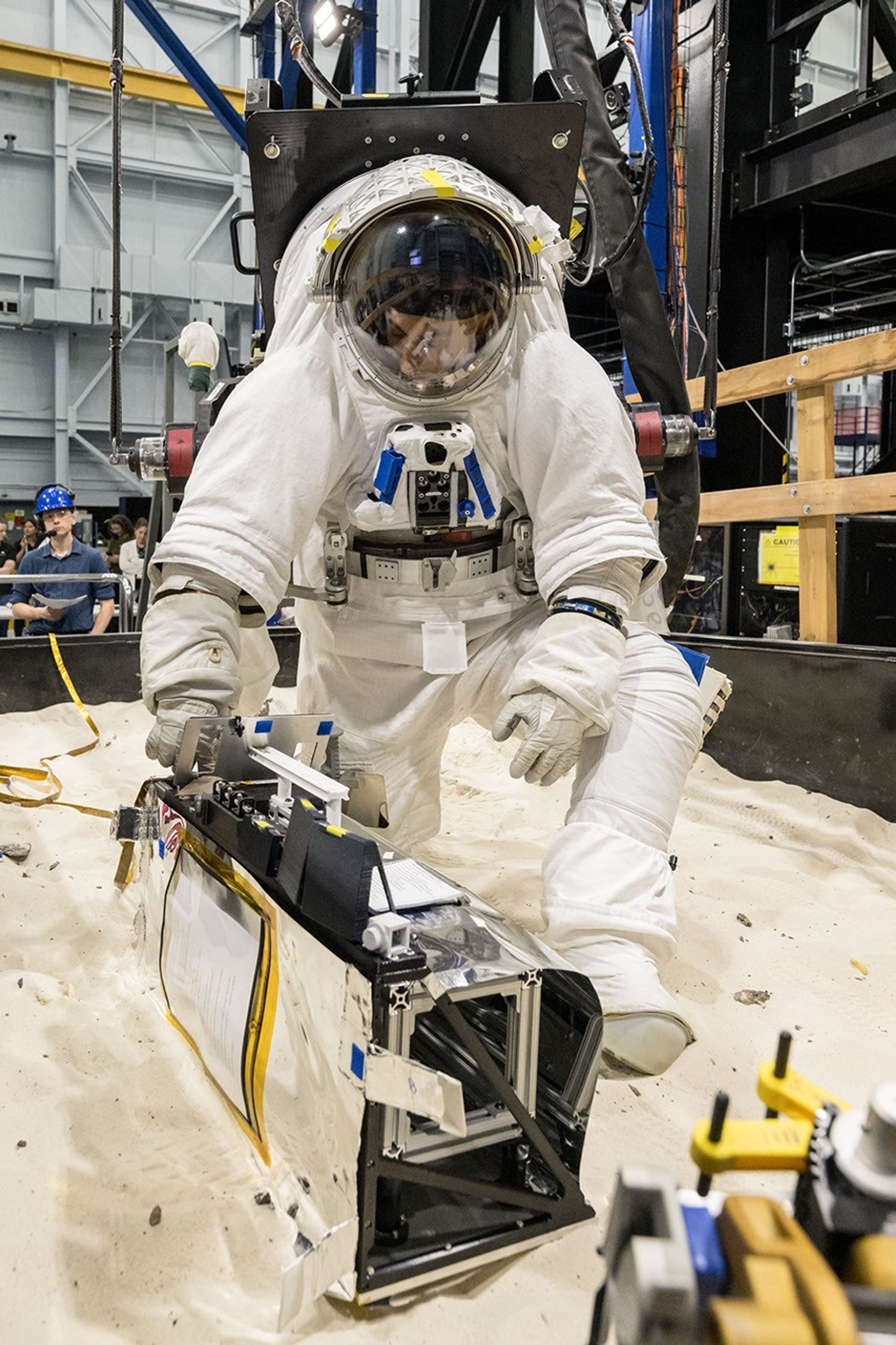
The LEMS payload builds on a legacy of lunar seismic tracking. Apollo astronauts deployed a network of seismometers on the Moon’s nearside equatorial region between 1969 and 1972. Those instruments operated until 1977, recording about 13,000 moonquakes and other ground vibrations that helped scientists begin to understand the composition of the Moon’s interior. For decades, researchers have hoped to spread more seismometers, updated with new technologies, across the lunar surface.
Now, LEMS will carry the first seismometers to be deployed by future astronauts to listen for faint ground vibrations, collecting new clues to the Moon’s internal structure and ongoing seismic activity. The sensors will be the most compact, sensitive, and energy-efficient seismometers ever built for planetary exploration.
LEMS itself is about the size of a small suitcase, weighing 11 pounds in the Moon’s low-gravity environment. It will carry not just these seismic sensors, but everything it needs to function independently of humans after deployment. LEMS is built to manage its own power production via a lightweight, flexible solar array that conforms to the shape of the LEMS unit. It also will manage its operational activities to ensure continuous data collection based on a preset plan, and monthly data transmission to Earth. The payload will do all this while maintaining a stable internal temperature throughout the massive day-to-night temperature swings of the South Pole region.
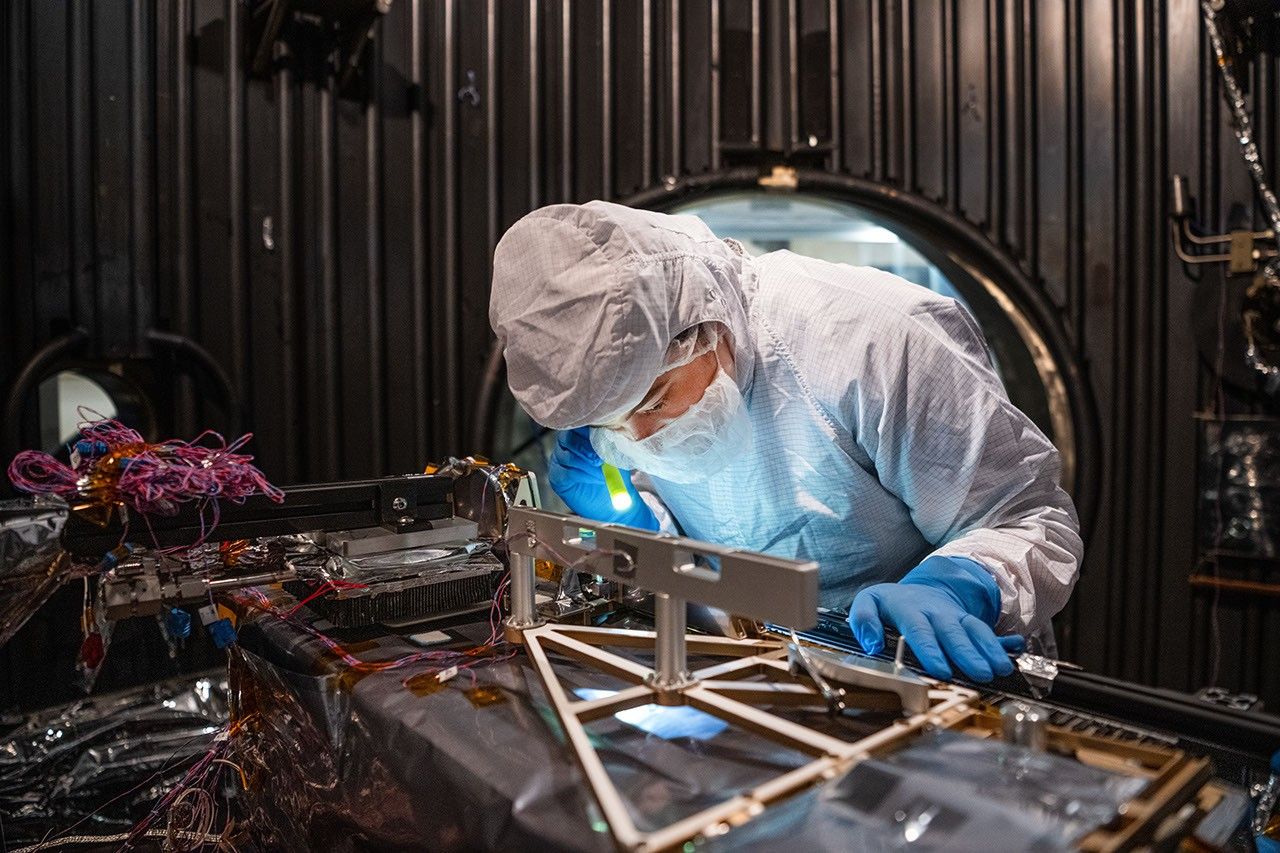
“When we conceived of LEMS, we weren’t just thinking about the next mission, we were thinking about the next generation of lunar exploration,” said Mehdi Benna, a University of Maryland Baltimore County scientist who leads LEMS from NASA Goddard. “Our vision was to create a scientific buoy for the Moon. Like an ocean buoy on Earth, LEMS is designed to be easy to build, adaptable to different scientific objectives, and capable of operating independently for years.”
Before any surface science could happen, Benna and his team had to ensure that LEMS could survive the trip to the Moon and the harsh environment of its surface. Over the past five months, LEMS and its components have been subjected to a demanding series of environmental and operational tests. Engineers verified LEMS can endure the violent shaking of launch, the journey to the lunar surface, and the Moon’s temperature and radiation environment. The team also showed that the instrument package’s mechanical and electrical design is safe for astronaut handling.
The LEMS payload was built to operate through the lunar night, which lasts two Earth weeks, without external power assistance or a heat source. Past lunar surface instruments relied on radioisotope heaters for warmth and power. But LEMS instead will withstand temperatures that dip to minus 400 degrees Fahrenheit in some areas by using advanced insulation materials, low-thermal-conductivity cables that minimize heat loss, and a thermal regulator that conducts heat away during the day to prevent overheating and helps retain heat at night.
These innovations reduce mass and power needs, setting the stage for lighter, energy-efficient instruments that can operate continuously at future Artemis landing sites and the NASA-led Moon Base.
The LEMS payload is led by University of Maryland Baltimore County and University of Maryland College Park. Technical implementation is led by NASA Goddard. The University of Arizona, in partnership with Silicon Audio, Inc., supplied LEMS’ two state-of-the-art seismometers. Morehead State University in Kentucky provided LEMS’ telecommunication system and will operate the instrument on the surface. Washington University in St. Louis will manage the instrument’s data processing and dissemination to the larger scientific community.
