Console de jeu hydride récente et adaptée aux jeunes joueurs comme aux adultes, la Nintendo Switch 2 séduit de nombreux joueurs depuis son lancement en juin 2025. En ce moment, et alors que son prix officiel vient de passer à 499,99 €, vous pouvez vous l'offrir pour moins de 420 € sur Amazon.
Additionally, Koei Tecmo has released a free playable Alpha demo available to download on all the aforementioned platforms (except Nintendo Switch 2) and has opened pre-orders for the game.
Wo Long 2: Wings of Ember is a sequel to Wo Long: Fallen Dynasty. It will take the player on a bloody and brutal journey across a dark fantasy version of China's Three Kingdoms period and battle many challenging foes, including iconic warriors from that era along with towering demons.
The game aims to top its predecessor with new weapons, magic, and techniques to master, more epic combat scenarios to survive in, and more challenging bosses to overcome.
You can get a taste of the early portions of Wo Long 2: Wings of Ember through its public Alpha Demo. It's free to download and play until September 30, 2026, and if you complete it, you will unlock a special Fledging Phoenix Helmet that can be used in the full game.
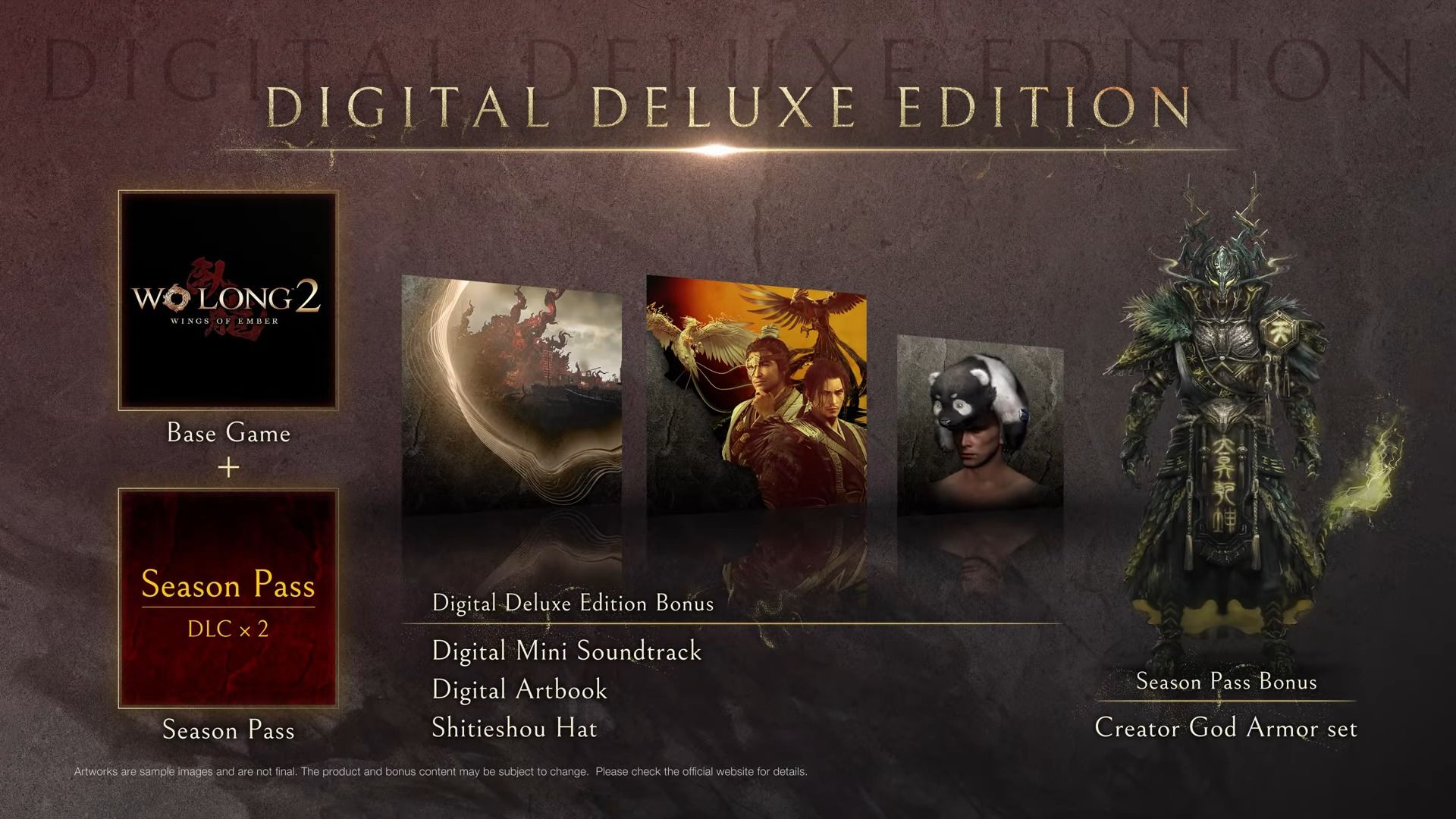
Wo Long 2: Wings of Ember Digital Deluxe Edition. (Image credit: Koei Tecmo)
If you pre-order Wo Long 2: Wings of Ruin, you can get exclusive access to the Creator Goddess Garb armor set and early purchase access to the Harvest God Armor set.
The game will come in a standard edition (which only contains the base game) or a Digital Deluxe Edition, the latter of which features:
Season pass that grants access to two future DLC expansions (the first will release on August 31, 2027, and the second on October 31, 2027), plus the Creator God Armor set as a Season Pass Bonus.
Digital Mini Soundtrack
Digital Artbook
Shietieshou Hat.
Can't wait to dive back into this grim dark Soulslike take on the Three Kingdoms era
The original Wo Long: Fallen Dynasty was an immensely fun, underrated Soulslike that we gave a 4.5/5 star review for its in-depth combat system and nail-bitingly tough bosses that were so satisfying to beat.
So I can't wait to see if its sequel has what it takes to top the first game when Wo Long 2: Wings of Ember launches next year on March 4, 2027.
In the meantime, I'll be playing the Alpha demo, as it's been a long while since I played a Soulslike, so I'll need to shake off the rust before the full game arrives.
Embody the power of a fiery Phoenix and descend upon the battlefield to purge horrifying demons and duel legendary heroes of the Three Kingdoms in Wo Long 2: Wings of Ember.
They're intended to supersede the previous PlayStation Pulse models
There's no word on pricing yet
Sony has just unveiled the "next line of PS5 audio products" with two new PlayStation Pulse wireless gaming headsets.
Both models are intended to supersede the old PlayStation Pulse Elite, which was released in 2024. The new PlayStation Pulse Edge boasts custom planar magnetic drivers that deliver "studio-inspired" sound and has eight magnets under the hood.
It comes with a detachable boom mic offering AI noise rejection alongside a USB Type-C adapter and premium carrying case.
Major features include built-in volume controls that integrate with the console's operating system, a game audio and chat balance slider, and active noise cancellation.
The upcoming PlayStation Pulse, in contrast, is positioned as a more entry-level model. It cuts the number of driver magnets down to four, which likely means less bass and reduced clarity. There's no boom mic either, so you need to rely on an integrated microphone instead.
It also loses the game audio and chat balance feature, lacks active noise cancellation, and isn't bundled with any kind of case.
Sony has been quite cagey about pricing, with no word on how much either model will cost on the official PlayStation Blog. This makes it hard to determine whether this refreshed line will offer good value, especially given the abundance of excellent headsets currently offered by third-party brands like SteelSeries and Corsair.
We do know that both models will be available in both white and black, however, and will hit shelves early next year.
Every now and then, a game comes along that doesn’t just entertain and engage me — it totally enraptures me. It stands as a pure work of art that reminds me of exactly why I love this medium and captures the essence of a book you just can’t put down. For me, that’s exactly what Fire Emblem: Fortune’s Weave is — an engrossing experience that I simply can’t get enough of.
Review info
Platform reviewed: Nintendo Switch 2 Available on: Nintendo Switch 2 Release date: September 17, 2026
This Nintendo Switch 2-exclusive tactical JRPG offers a combination of excellent turn-based combat and rewarding exploration, alongside captivating storytelling and a great cast of characters. And its sheer scale cannot be understated — I’ve spent north of 200 hours in Fortune’s Weave, and there’s still so much more I have to see.
I’ve played through each of the four Flame Lords’ paths and taken the battle to the demonic god Balor, and I’ve got a number of thoughts about gameplay, visuals, and narrative to share. So, without further ado, let’s take a look at why Fire Emblem: Fortune’s Weave is one of the best Nintendo Switch 2 games you can play right now.
Four paths converge
(Image credit: Nintendo)
I won’t get into the weeds of the premise in Fortune’s Weave, but to sum up, you’re able to play as four heroes, known as the Flame Lords, as they compete in a grand arena event known as the Heroic Games. The champion of the Games will be granted a wish of their choosing by Divine Sovereign, Solel, who rules over the land of Dagda and its capital, Dagsion.
After completing the brief prologue — which acts as a solid tutorial for newcomers — you can select any of the Flame Lords’ paths and play through them in any order you like from a central hub area. This approach works nicely, as you don’t have to replay the prologue each time you start a new journey, and you’re able to dip in and out of each story as you please.
This makes up Part I of the game, which was probably my favorite overall. Although some cutscenes and quests are the same across the four stories, they still feel distinct and gripping in their own right. Each pathway has a distinct tone and feeling to it, with each Flame Lord having a deeply personal ambition and a unique set of close allies. For instance, the vengeful and skilful Leda is joined by the womanizing bard Sirocco and protective warrior Buccar, whereas Dietrich is partnered with the excitable Esmeralda and bizarre and eccentric missionary, Fabio.
The core cast of characters is truly excellent, but you’ll also be able to recruit more allies as you progress the story, including foes you face in the Heroic Games and parties of interest across Dagsion. Many of these units can be recruited across all four stories, though their recruitment requirements often vary, which encouraged me to experiment with different characters across different stories.
Best bit
(Image credit: Nintendo)
Anything with Dietrich and Fabio. They're an unlikely yet incredible duo, with Dietrich's bloodlust and Fabio's eccentricity somehow combining to create some of the most hilarious — and sometimes emotive — dialogue in the series.
What makes the multi-path system click is that you’ll uncover revelations in one story that answer questions — or even pose new ones — about events in one of the other paths. There are plenty of twists and turns — some perhaps more obvious than others — which change the way you perceive certain characters and add substantial depth to units that may seem less significant on some paths than others.
This cross-path storytelling is done really well, and the narrative is strong, more generally. I won’t spoil anything, but it’s got its fair share of shock instances, touching moments, and character development that help it to hit — and if not, exceed — the standards that the series has set thus far.
Gameplay-wise, things are kept pretty fresh too. Each Flame Lord has specific abilities that they can make use of on the world map and beyond, with Deitrich able to battle warriors and learn their combat arts, Leda capable of holding performances to unlock unique materials, Theodora able to recruit warriors to assign battalions, and Cai skilled enough to wrangle mounts for himself and his allies.
And luckily, all of this comes together nicely in the latter parts of the game. While Part I is more individually tailored to each Flame Lord and their journey through the Heroic Games, paths begin to converge in Part II, known as the War Arc. Again, I won’t spoil anything here, but Part II offers far less variation across each pathway, but there are still some interesting differences in dialogue, and the way you approach battles will likely change considerably.
I loved how the enormity of Fortune’s Weave came together in Part III, though. Here, you’ll be able to unite all of the Flame Lords beside the game’s true protagonist, you. It’s awesome that you’re able to make use of all of the heroes’ unique abilities and even re-recruit old units for the final battle against the demonic lord, Balor.
Being able to bring all of your units, inventory, and abilities into a singular, epic finale is incredibly rewarding and makes building the ultimate army even more enjoyable.
I see grids in my sleep
(Image credit: Nintendo)
Let’s delve a bit more deeply into gameplay, which, as you’d expect, is outstanding in Fortune’s Weave.
For the most part, you’ll be battling on classic grid-based battlefields. Honestly, I’ve fought on these so many times I’m starting to see them in my dreams. It's that classic turn-based Fire Emblem that you know and love, with some returning features, like Combat Arts (which provide benefits in exchange for weapon durability) and gambits (in Theodora’s path), for instance.
But there are new mechanics too, like Blaze Arts, which are unique to specific units. By sacrificing HP, Blaze Arts enable you to deal more damage, move further, buff allies, and more. The health trade-off means they don’t feel like a cheat code, and they also fill a blaze gauge, which will burst at a certain point, forcing you to work with reduced HP for the rest of the map.
(Image credit: Nintendo)
Standard battles feel brilliantly balanced, and I never felt that difficulty spikes were too severe or that I had to grind much to push past my opponent. When you do want to grind, though, you can enter into a skirmish against foes on the world map, or try your luck in a dungeon.
Dungeons work a bit differently, and you’ll move around a 3D area to face foes in Clash Battles. These are a bit different and combine light action segments with more traditional turn-based JRPG combat rather than tactical grid-based battles. I think that they’re a great option if you want a break from the usual maps and want a faster-paced method for gaining experience or class proficiency for your units.
That’s not to say that the standard maps aren’t engaging though; quite the opposite. There’s some excellent map variety, and some battles will ask more of you than just routing the enemy. In some cases, I had to defeat more giants than my opponents, rescue defenseless citizens from a huge serpent, or even collect missing cargo before thieves made off with it. Battlefields are also delightfully diverse throughout the heroic games, and become even grander as the stakes rise towards the back end of the game.
If at any point you’re struggling, you can make use of Blessings, enabling you to rewind to a previous turn, increase your strength, or reduce the cost of Combat Arts, for example. I kept usage of these to a minimum, as I was playing on the slightly more gracious Normal/Casual difficulty. But there’s also a Hard mode, and you can play Classic (where units are permanently lost when they fall in battle), where Blessings will likely feel a bit more necessary.
All in all, combat is incredibly addictive, varied, and offers impressive depth. Building a squad with the right balance in terms of classes and weapons is massively satisfying, and breaking things up with a bit of dungeon crawling keeps the experience feeling fluid and fun for the game’s full runtime. And given that we’re talking about a title that will take you well over 100, if not 200, hours to finish, that’s an impressive feat in itself.
Beyond the battlefield
(Image credit: Nintendo)
Before I wrap up, I want to touch on my experience with Fortune’s Weave outside of battle. There’s quite a bit to do, both within the capital, Dagsion, and in the land of Dagda more broadly.
Dagsion has all of the stuff you’d expect. A training ground to boost your aptitude with specific weapons, a shopping district, an inn for viewing support conversations and restoring motivation (which is used for training and increasing your Blessings level), and an area where you can take an exam for whatever class you want to be.
A lot of your time in Fortune’s Weave will be spent using these facilities to increase your weapon levels, boost support with your allies, and acquire better equipment.
If I were to nitpick, I’d argue that the support grind can become a little tiresome for some units. If you want to recruit a new ally who requires a high support level, it can take quite some time to fill the gauge and add them to your team, though some are easier to add to your roster than others.
There are more things to do, though, like going to the Theater, taking a bath at the Thermae spa, and accepting subquests from distressed townsfolk. Perhaps the most unusual option, however, is Bird Time.
Here, you can feed the Pale Raven (the main protagonist in bird form) to increase your support level for later in the game. Is it a bit goofy? Yeah. Does it get a bit repetitive? Sure. But I kinda love the feeling of getting that sweet ‘perfect bird time’ message when you have a successful interaction with your ally.
Outside of Dagsion, you can enter the aforementioned dungeons, search for materials, enter into some smaller hub areas, and speak with wandering merchants. The world map is easy to navigate, but you’ll only have a set amount of time to explore before the day of the Main Quest arrives. This helps the game to maintain good pacing throughout, and while there’s a ton to explore, it’s broken up with main story goodness in healthy intervals, in my view.
(Image credit: Nintendo)
On a technical level, Fire Emblem: Fortune’s Weave is pretty solid too. It keeps a lot of the enticing visual style seen in Fire Emblem: Three Houses, but being a Nintendo Switch 2 exclusive, there’s a clear step-up in terms of resolution, and character models look excellent too. Be it Fortuna, whose vibrant hair pops with eye-catching yellow, or the striking, rich reds of Bertrand, the White-Maned Demon’s clothing, I found myself impressed by the visuals pretty consistently.
Some background textures do look a bit basic, however, and while the game runs smoothly, it’s not targeting a silky 60fps (but this never bothered me, personally).
I also want to shout out the game’s excellent soundtrack, which is more eclectic than you may think. There’s the classic orchestral-style stuff, which creates a real sense of grandeur and high stakes, but there are also spacey, synth-led tunes in the temples, which create ambience and intrigue, as well as electronic music with pumping bass in some mysterious hidden areas.
On the topic of sound, the voice acting is exceptional in Fortune’s Weave. You feel each character’s unmistakable personality through just about every performance, and this only makes you feel more attached to your units. The perfect example is Fabio, whose voice acting is just as outlandish and unusual as you’d hope for the character, though he also has some authentic, impassioned emotional scenes that stole the show. Great stuff all round.
To conclude, then, Fire Emblem: Fortune’s Weave is a masterful tactical JRPG that has it all. Addictive, depth-filled combat, fresh mechanics, a well-paced, multi-layered story, and a likeable cast of characters. It hypnotized me from minute one, all the way to the end, and its careful balance of tight turn-based gameplay and exploration really worked for me. As things stand, I consider Fortune’s Weave to not only be among the best Fire Emblemgames in recent memory, but also the best game on the Nintendo Switch 2 thus far.
Whatever you do, don’t skip this one.
Should you play Fire Emblem Fortune’s Weave?
(Image credit: Nintendo)
Play it if…
You want to sink your teeth into an epic RPG Fire Emblem: Fortune’s Weave is a huge game that will easily take you north of 100 hours to finish if you want to complete each Flame Lord’s path and clear every subquest. If you’re looking for a true epic to get your money’s worth out of, this is the game for you.
You’re a fan of character-driven narratives Yes, Fortune’s Weave features a very high-stakes story, but the narrative is largely centered around the four Flame Lords, and their personal ambitions in the Heroic Games. Watching each story unfurl, and seeing how each hero develops is a joy, so if you’re into more character-driven stories, then you’ll likely enjoy this.
Don’t play it if…
You’re not a big fan of tactical combat There are some light action segments and swifter turn-based dungeon battles in Fortune’s Weave, but a lot of the time will be spent commanding your units on a grid. If you’re not into the more strategic style of other Fire Emblem games, then you may not have the best time with this one either.
You need top-tier performance from your games While Fortune’s Weave looks pretty solid, it’s by no means pushing boundaries as far as visuals go. It’s very stable, in terms of performance, but it’s also not going to give you the buttery smoothness of other Switch 2 games, like Metroid Prime 4: Beyond, say, which can even run at 120fps in handheld mode.
Accessibility features
There are a handful of ways to customize your experience in Fire Emblem: Fortune’s Weave. You can make UI adjustments, like altering the size of the battle minimap, toggling the grid display on and off, you can personalize camera controls and sensitivity, and choose from a number of different subtitle languages.
There’s even an Enemy Masking mode that changes the appearances of insectile enemies if you have arachnophobia or entomophobia. There is no colorblind mode, or similar.
(Image credit: Nintendo)
How I reviewed Fire Emblem: Fortune's Weave
I spent just over 200 hours with Fire Emblem: Fortune’s Weave, during which time I played through the main story (including each of the Flame Lords’ individual paths), completed just about every subquest, and recruited countless allies.
For the most part, I played in docked mode, with my Nintendo Switch 2 connected to my Sky Glass Gen 2 TV and Marshall Heston 120 soundbar. However, I did dip into handheld mode now and then, and usually had my Sennheiser CX 80U wired earbuds connected when playing on the go.
Nintendo has gotten quite good at making open-ended games. The Legend of Zelda: Breath of the Wild upended the idea of what a Zelda game could be by giving the player free rein to tackle any part of the map, a philosophy iterated upon with Tears of the Kingdom. On the Switch 2 this idea expanded to Mario Kart World and Donkey Kong Bananza. Now, Nintendo has brought this philosophy to Fire Emblem with Fortune's Weave. It works really well; with its many ways to progress through the game and tailor teams to your liking, Fortune's Weave has become my favorite game on the Switch 2 so far.
Fortune's Weave's structure is a big reason why it feels …
The ‘magic security chip’ inside the original PlayStation 2 has been successfully reverse-engineered and dumped. Canadian retro hardware and software enthusiast DiscoStarslayer was the manic mind behind the cracking open of the CXP102064 MechaCon chip, which arrived inside the ‘PS2 Fat’ from 1999. It took “four years of effort” to reach this stage, but this milestone should be a boon to hardware preservation, repair, and emulation projects.
After 4 years of effort, I'm happy to announce that one of the final secrets of the PS2 has been broken wide open!It's been a long process of decapping, optical dumping, and now at last a software solution.Thank you Libby for finding the exploit from our dirty optical dumps! pic.twitter.com/VrsCH8I35CSeptember 13, 2026
The Mechacon got its name from its primary duty of controlling the PS2’s optical and flash drive mechanics. It also played a significant part in Sony’s game optical disc security, supporting “Magic Gate [memory card] and KELF file [executable] decryption among other things,” notes the PSDev Wiki. Unlocking the secret workings of such chips can be important to those involved in video game preservation. So, many people will appreciate DiscoStarslayer’s work in reverse engineering and dumping one of the PS2’s last remaining secrets.
As per the social media post, the arduous task of breaking the MechaCon’s security took four years. Some of the reverse engineering tricks utilized by DiscoStarslayer include chemically decapping the CXP102064 to expose the die, then using microscopes and optical dumping skills to analyze the silicon chip circuitry. In this case, a lucky break during the hacking apparently uncovered an exploit that provided a method whereby the chip’s data could be extracted through software.
With this achievement unlocked, the game/hardware preservation and programming communities can look forward to improved emulation and homebrew developments. It should also open up possibilities for replacing the aging optical drives in PS2 consoles.
Beyond the confines of PS2 Fat consoles, some social media commenters noted that the MechaCon was also used in a handful of arcade machines from the era. Specifically, the Namco System 246 and System 256, as well as the Konami Python 1, which used modified PS2 hardware, used the MechaCon firmware to authenticate security and allow the execution of encrypted game data.
StarCraft general manager and creative director Dan Hay says the series' stories and characters are "remarkably topical" today
Hay says StarCraft and the real world are both like a "frontier"
He adds that while StarCraft is science fiction, its "themes and characters" are very similar to "the headlines in our world"
StarCraft general manager and creative director Dan Hay has compared real-world events to the series' stories and characters, calling them "remarkably topical."
In a sit-down interview with TechRadar Gaming following the reveal of StarCraft, a first-person, open-world shooter slated to arrive in 2030, Hay discussed the CGI trailer that debuted at BlizzCon and explained that the team wanted to portray the "tension" that will come with this new story-driven adventure.
The developer also said that building the "stakes" was just as important; he couldn't dive too much into the narrative details, but Hay touched on the series as a whole and its storylines that explore "imperfect" characters, suggesting the new StarCraft will examine similar topics.
"The way in which you are a hero is that you are going to learn how to become one," Hay said. "The way in which you are a hero is that you are going to learn how to become one. So it's not perfect, right? And that's the thing about StarCraft: a lot of the characters are not perfect; they're imperfect, and even the villains are.
"They have an idea of what you think they are at the beginning of the game, and then by the end of the game, you realize, oh, they were something completely different. And I think what's powerful about StarCraft."
Hay continued, saying that when you look at StarCraft's stories and the characters you meet, they're "remarkably topical" to the events unfolding in the real world.
"When you think about our world today, and you think about what is StarCraft? It's a bit of a frontier," he said. "It's obviously a frontier. There's asymmetry in terms of factions that don't agree with each other. There's brinkmanship going on where one faction is being used against another. [In] a lot of cases, it's just over resources.
"A lot of the cases there's politics, and there's intrigue, and there are people being left behind and betrayed, and when you look at that, and then you look at the headlines in our world, it's not super far [apart] in terms of how it feels sometimes. So you feel that tension, and you felt that tension in the teaser [trailer]."
Hay concluded: "I think what's remarkable about StarCraft is that it feels real, and it feels like it translates quite easily into today. And even though it's science fiction, and even though it has this sense of being in this other universe, it feels very close in terms of themes and characters and moments that you could experience today."
Vor einigen Wochen deuteten Hinweise im Code des Release Candidate von macOS 26.7 auf die bevorstehende Markteinführung von zwei Spielecontrollern hin. (Darin fanden sich auch Hinweise auf eine Reihe von Airpods mit Kamera, doch das ist eine andere Geschichte.) Ein neuer Bericht liefert nun weitere Details zu den Markteinführungsplänen für diese Produkte.
In der neuesten Ausgabe seines „Power On“-Newsletters bestätigt der Bloomberg-Reporter Mark Gurman, dass Apple tatsächlich „seit etwas mehr als einem Jahr“ an diesem iPhone-Gaming-Zubehör arbeitet und bestrebt ist, in einen Markt einzusteigen, den das Unternehmen als lukrativ ansieht. Er nennt hierfür keine Quellen, sondern sagt lediglich: „Das ist, was ich weiß.“ Doch Gurmans Quellen sind in der Regel zuverlässig, wie man an der Genauigkeit seiner kurz vor dem Launch-Event in der vergangenen Woche veröffentlichten Informationen zum „iPhone Duo“ erkennen kann.
Der „interessante Teil“ von Gurmans neuem Bericht (seine Worte, nicht unsere) ist, dass die Spielecontroller derzeit entwickelt werden und – sofern sie auf den Markt kommen – wahrscheinlich unter der Marke „Beats“ statt unter der von Apple erscheinen werden.
„Das Unternehmen nutzt Beats zunehmend als Möglichkeit, mit neuen Produktkategorien zu experimentieren und vom Markt für Zubehör von Drittanbietern zu profitieren, ohne bestimmte Produkttypen unter der eher im Premiumsegment angesiedelten Marke Apple zu führen“, erklärt er.
Das, so argumentiert er, sei ein kluger Schachzug bei der Entwicklung von Gaming-Produkten. Ein Game-Controller für das iPhone müsste relativ erschwinglich sein, um ein breites Publikum zu erreichen. Doch wie wir beim „Staunen und Strahlen“-Event letzte Woche gesehen haben, platziert Apple Geräte unter seiner eigenen Marke eher im Premiumsegment.
Ein Blick auf den Beats-Bereich der Apple-Website verdeutlicht diesen Ansatz. Die günstigsten kabellosen Ohrhörer der Marke Apple, die Sie kaufen können, sind die Airpods 5 für 149 Euro, während das günstigste Beats-Pendant die Beats Solo Buds für 90 Euro sind. Ebenso kosten die Airpods Max 2 579 Euro, während die in ihren Funktionen vergleichbaren Beats Studio Pro für 400 Euro erhältlich sind.
Die Entscheidung für die Marke „Beats“ sei auch aus kultureller und Lifestyle-Perspektive sinnvoll, behauptet Gurman. „Beats“ sei eine jüngere und insgesamt angesagtere Marke. Apple hingegen „versteht Gaming anscheinend nicht wirklich“. Beats hat außerdem eine lange Geschichte der Android-Unterstützung und würde so den „Apple-Muff“ vermeiden, der Apple-Geräten außerhalb der Apple-Fanbase häufig nachgesagt wird.
Wir möchten betonen, dass Gurman lediglich behauptet, Apple arbeite derzeit und habe bereits in der Vergangenheit an Controllern für das iPhone gearbeitet, und es gibt keine Garantie dafür, dass diese Produkte jemals auf den Markt kommen werden. Sollte dies jedoch der Fall sein, ist er zuversichtlich, dass sie ein „b“ statt eines angebissenen Apfels tragen werden.
AYN Thor is not trying to win attention simply by putting a faster processor inside a conventional handheld. Its defining feature is the clamshell design: a large 6-inch AMOLED screen sits above a second display, giving the device a layout that is much closer to a portable dual-screen gaming system than a traditional Android game console.
The Banggood configuration covered here pairs the Snapdragon 8 Gen 2 platform with 8GB of RAM and 128GB of storage, while the wider Thor lineup also includes higher-memory versions. AYN’s own current product information lists the standard Snapdragon 8 Gen 2 configurations alongside a 6-inch AMOLED main display, a 3.92-inch secondary AMOLED screen, Android 13 and a 6000mAh battery.
That makes the Thor interesting for a very specific reason: the second screen can change how certain games and emulators are played, rather than merely adding another display to the specification sheet.
The Second Screen Is the Real Story
Most Android gaming handhelds use a single display and place all controls around it. The Thor takes a different route.
Its upper panel is a 6-inch AMOLED display with a 120Hz refresh rate, while the lower section provides a smaller 3.92-inch AMOLED touchscreen. The primary display runs at 1920 × 1080, while the secondary panel uses a 1080 × 1240 resolution and a 60Hz refresh rate.
The difference in refresh rate is actually useful to understand. The top screen is optimized for the main gaming experience, while the lower screen is better thought of as a companion interface.
That opens up several possibilities. In dual-screen emulation, one display can show the main game while the second handles maps, menus, touch controls or other information. For games designed around two screens, the physical arrangement can also feel considerably more natural than trying to reproduce the same layout on a single panel.
This is where the Thor has a clearer identity than another Android handheld with similar processing hardware.
Snapdragon 8 Gen 2 Gives the Thor Plenty of Headroom
The 8GB/128GB configuration uses Qualcomm’s Snapdragon 8 Gen 2, the same platform used by several other high-performance Android handhelds. AYN’s specifications identify the Snapdragon 8 Gen 2 versions as the Base, Pro and Max models, with RAM and storage increasing depending on configuration.
For the Thor, the processor is less interesting as a headline number than what it enables.
Android gaming, retro emulation and game streaming can all benefit from additional processing headroom, but the dual-screen design is where the hardware becomes more purposeful. The system has to manage two displays and the associated touch input while still maintaining a responsive gaming interface.
The 8GB configuration therefore makes sense as the entry point for users who want the Thor’s unusual hardware without necessarily moving to one of the larger storage variants.
Android 13 Keeps the Platform Flexible
The Thor runs Android 13, which gives it access to the broader Android gaming and emulation ecosystem rather than locking it into a proprietary game library. AYN’s product information also confirms that games are not preinstalled, meaning buyers should think of the device as an Android gaming platform rather than a ready-made retro library.
That distinction matters.
The real value of an Android handheld is often determined by how well its software environment fits the user’s preferred games and emulators. With the Thor, there is an additional consideration: configuring software to take advantage of two physical screens.
For example, a dual-screen setup can be particularly useful for systems and games that were originally designed around separate gameplay and information displays. Retro Game Corps’ setup guide specifically covers the additional considerations involved in configuring dual-screen Android handhelds such as the Thor.
Hall-Effect Sticks Are a Practical Hardware Choice
The Thor also uses Hall-effect joysticks, which detect stick movement magnetically rather than relying on traditional mechanical contact for position sensing. AYN lists Hall sticks among the device’s hardware features.
For an Android gaming handheld, this is more relevant than it might initially appear.
The controls are likely to see much more use than many of the device’s headline specifications. Precise analog input matters for action games, racing titles and 3D emulation, while the absence of conventional contact-based sensing can help reduce one common source of stick-position problems over long-term use.
It also reinforces the idea that the Thor is designed as a serious gaming device rather than simply an Android tablet folded into a portable shell.
A 6,000mAh Battery Balances the Dual-Screen Hardware
A 6,000mAh battery sits inside the Thor, according to AYN’s current specifications. The device also supports 27W charging.
Battery capacity alone does not tell the whole story, especially on a dual-screen handheld.
The actual runtime will depend heavily on brightness, refresh rate, emulator workload, wireless connectivity and how frequently the secondary display is active. More demanding games will naturally place a greater load on the Snapdragon platform than lightweight retro titles.
For this reason, the Thor’s battery should be viewed as part of a larger power-management equation rather than judged only by the 6000mAh figure.
The Flip Design Solves a Portability Problem
There is another advantage to the clamshell construction that has little to do with gaming performance: screen protection.
When the Thor is closed, the two displays face inward. That gives the handheld a natural protective position when it is placed inside a bag or carried between locations.
The closed form also makes the Thor visually distinct from the large number of slab-style Android gaming handhelds now available.
However, the hinge introduces its own design considerations. Users who want the device primarily for traditional single-screen Android gaming may not need a second display or a clamshell mechanism. The dual-screen architecture becomes much more valuable when the software can actually make use of it.
8GB + 128GB Is the More Straightforward Configuration
The Banggood listing specifically covers the 8GB RAM and 128GB storage version.
That capacity should be enough for a focused Android gaming setup, but storage requirements can grow quickly once users begin adding large game files, emulator libraries and multiple applications.
AYN’s wider lineup includes a 12GB/256GB model and higher-end 16GB configurations with substantially more storage.
This makes the 8GB/128GB model easier to understand as an entry configuration rather than the only version of the Thor. Buyers who plan to maintain a large local game library should pay particular attention to storage before choosing between variants.
Who Actually Benefits From Two Screens?
The Thor makes the most sense for users whose gaming habits can take advantage of its unusual layout.
Dual-screen emulation is an obvious example. Systems that originally used two displays can be represented more naturally when the handheld itself physically provides two panels.
The secondary display can also be useful for touch-based controls, menus or supplementary information while the main display remains dedicated to gameplay.
For ordinary Android games that only need one screen, however, the second panel becomes less important. In that situation, the Thor’s main advantage is its unusual form factor rather than a fundamental change in gameplay.
That distinction is worth keeping in mind when comparing it with conventional single-screen Android handhelds.
A Different Kind of Android Gaming Handheld
The AYN Thor gaming handheld ‘s most interesting feature is not the Snapdragon 8 Gen 2 by itself, nor is it simply the 120Hz AMOLED display.
It is the combination of a 6-inch 120Hz AMOLED main screen, a secondary AMOLED touchscreen, Hall-effect controls, Android 13 and a 6000mAh battery inside a foldable chassis.
That combination gives the Thor a specific purpose.
For users who mainly want a standard Android gaming handheld, its dual-screen construction may be more hardware than they need. But for players interested in DS/3DS-style emulation, dual-screen interfaces or experimenting with different Android gaming layouts, the second display provides a capability that conventional handhelds simply cannot reproduce in the same physical way.
The result is a device that stands apart not because it has the longest specification sheet, but because its hardware is built around a different idea of what a portable gaming console can be.
AULA F75 MAX keyboard is designed for users who want more than a basic compact mechanical gaming keyboard. Instead of focusing on a single headline feature, it combines a space-saving 75% layout with a dedicated TFT screen, rotary knob, hot-swappable switches, gasket mounting and three connection modes.
That combination makes the F75 MAX interesting for both gaming and everyday desktop use. Its design also reflects a broader trend in mechanical keyboards: smaller layouts are becoming more feature-rich without completely sacrificing the controls that PC users rely on.
Why the 75% Layout Makes Sense
The F75 MAX uses an 80-key 75% layout, keeping the function row and arrow-key cluster while removing the large gaps and dedicated number pad found on full-size keyboards.
For a gaming setup, this layout can free up more desk space for mouse movement. At the same time, it remains practical for productivity because users do not have to give up the dedicated arrow keys and function row.
The trade-off is the missing number pad. Anyone who regularly enters large amounts of numerical data may still prefer a full-size keyboard, but for gaming, general typing and compact workstations, the 75% format is a useful middle ground.
The TFT Screen Is More Than Decoration
One of the F75 MAX’s most noticeable design elements is its built-in TFT screen. Instead of relying entirely on RGB lighting for visual customization, the keyboard adds a small display that gives the top section a more personalized appearance. Banggood specifically lists a GIF-capable TFT screen interface.
This feature does not fundamentally change typing performance, but it gives the keyboard a distinct identity. For users who enjoy customizing their desktop setup, the screen can make the F75 MAX feel more like a configurable gadget than a conventional mechanical keyboard.
The separate metal knob also adds a practical control point, giving users a physical way to interact with supported functions instead of relying entirely on keyboard shortcuts.
Gasket Mounting Targets a Softer Typing Feel
The keyboard uses a gasket-mounted structure with multiple layers of sound-dampening material. AULA lists five layers of dampening, while the product listing describes a six-layer sound-absorbing structure, so the exact terminology varies between listings.
The important part is what this construction is intended to achieve. A gasket-mounted keyboard isolates the plate from parts of the case, allowing slightly more flex while reducing some of the direct vibration transferred through the chassis.
Combined with the F75 MAX’s foam and silicone layers, the design is aimed at producing a deeper and less harsh typing sound than a basic rigid keyboard.
That makes the keyboard potentially more appealing to people who care about typing acoustics as well as gaming performance.
Hot-Swappable Switches Make Future Upgrades Easier
Another useful feature is the hot-swappable PCB, which supports 3-pin and 5-pin mechanical switches according to AULA’s specifications.
This means owners are not necessarily locked into the factory switch configuration. Users who prefer a lighter linear feel, a different actuation characteristic or another sound profile can experiment with compatible switches without replacing the entire keyboard.
The F75 MAX comes with LEOBOG Reaper linear switches. AULA lists them as factory-lubed, while EPOMAKER’s specifications give the switch a 45±3gf trigger force and 3.6±0.3mm total travel.
For someone buying a mechanical keyboard as a long-term platform, this upgradeability may be more meaningful than RGB effects alone.
Tri-Mode Connectivity Covers Different Setups
The F75 MAX supports USB-C wired, 2.4GHz wireless and Bluetooth 5.0 connections.
That gives the keyboard three distinct use cases. Wired mode is suitable for a desktop gaming setup, 2.4GHz wireless keeps the desk cleaner while maintaining a low-latency connection, and Bluetooth is convenient when switching between compatible computers or mobile devices.
AULA rates the keyboard at up to 1000Hz polling through USB and 2.4GHz, while Bluetooth is listed at 125Hz. The manufacturer also lists latency of around 3ms over USB, 7ms via 2.4GHz and 18ms through Bluetooth.
For competitive gaming, the wired and 2.4GHz modes are therefore the more relevant choices.
4000mAh Battery Gives Wireless Mode Some Flexibility
The built-in 4000mAh battery is another reason the F75 MAX works well as a wireless desktop keyboard. AULA rates battery life at approximately 30.5 hours with the RGB backlight enabled and up to 80 hours with the lighting switched off.
Actual endurance will depend on lighting brightness, connection mode and usage patterns, so these figures should be treated as manufacturer ratings rather than guaranteed real-world results.
Still, the option to turn off RGB lighting when maximum battery life matters gives users more control over how they use the keyboard.
PBT Keycaps and South-Facing RGB
The F75 MAX uses double-shot PBT keycaps and south-facing per-key RGB lighting.
PBT is commonly chosen for mechanical keyboards because it generally resists the glossy wear that can develop on frequently used ABS keycaps. The south-facing RGB arrangement also works well with the keyboard’s overall enthusiast-oriented design.
AULA lists support for more than 16 million RGB colors and multiple lighting effects, although the visual customization is ultimately secondary to the keyboard’s typing and connectivity features.
A Compact Keyboard With Room to Experiment
AULA F75 MAX is best understood as a feature-rich 75% mechanical keyboard rather than simply another RGB gaming board.
Its strongest combination is the compact layout, gasket construction, hot-swappable PCB and tri-mode connectivity. The TFT display and rotary knob then add a layer of customization that separates it from more conventional 75% keyboards.
For gamers, the 2.4GHz connection and 1000Hz polling rate give the keyboard a performance-oriented side. For enthusiasts, the hot-swap PCB and gasket structure leave room for future customization. And for everyday users, the 75% layout provides a useful balance between desk space and functionality.
The main compromise is straightforward: users who need a dedicated number pad will need a larger keyboard. But for anyone comfortable with the 75% format, the AULA F75 MAX offers a combination of customization, wireless flexibility and enthusiast-style construction that makes it worth considering.
For the latest specifications and software information, buyers should also check the official AULA product page before ordering, since configurations and regional listings can vary.
TRIMUI Brick Pro TG4040 is aimed at players who want a dedicated retro gaming handheld without carrying a bulky modern console.Its appeal comes from the combination of a compact vertical design, a high-resolution IPS display, physical controls designed for longer sessions, and a Linux-based gaming environment.
The 256GB configuration also targets users who want a large game library available locally. Banggood lists this version with more than 17,000 games, although the actual titles and availability can depend on the included software and storage configuration.
A Small Handheld With a Surprisingly Detailed Display
The Brick Pro uses a 3.95-inch IPS panel with a 1024 × 768 resolution, giving it a 4:3 aspect ratio that suits many classic games particularly well. The official TRIMUI specifications also list a 60Hz refresh rate and full lamination.
That resolution is more important than simply looking at the screen size. Retro games were generally designed around lower-resolution displays and 4:3 layouts, so the Brick Pro’s screen can preserve that traditional presentation without requiring an oversized handheld.
The relatively compact display also keeps the device portable, making it easier to use during travel, commuting or short gaming sessions.
Dual Hall Joysticks Focus on Long-Term Control
One of the more practical hardware choices is the inclusion of dual Hall-effect joysticks. Unlike conventional analog sticks that rely on physical contact for position sensing, Hall-effect controls use magnetic sensing technology.
For a retro handheld, the benefit is less about chasing headline specifications and more about control consistency. Players who frequently switch between arcade titles, platformers and games that require analog input can benefit from having two proper sticks instead of relying entirely on a directional pad.
The official TRIMUI specification lists the Brick Pro with JF15 dual Hall-effect joysticks, along with L3 and R3 click functions.
The 256GB Version Is Built Around a Large Game Library
Storage is another major reason to consider this particular configuration.
The 256GB TRIMUI Brick Pro is advertised with more than 17,000 games, while other Brick Pro configurations are sold with different storage capacities and game counts. Banggood’s product listings show 64GB, 128GB and 256GB versions, giving buyers several ways to configure the handheld around their preferred library size.
For users who mainly want a ready-to-play retro machine, the larger storage option reduces the need to constantly manage space. At the same time, buyers should check exactly what game content is included with their chosen package rather than assuming that every version contains the same library.
The official hardware also supports a TF card, with storage expansion listed up to 1TB.
CNC Metal Construction Gives the Handheld a Different Character
The Banggood 256GB listing highlights a CNC metal body, which gives this configuration a more substantial positioning than lightweight plastic retro consoles.
This matters particularly for a device intended to be used frequently. A metal exterior can provide a more rigid feel in the hands, although it may also add weight compared with an all-plastic design.
It is worth noting that TRIMUI’s official Brick Pro specification describes the standard product body as ABS+PC plastic, so buyers should pay attention to the exact TG4040 variant and listing configuration when comparing materials.
5,000mAh Battery Makes It Better Suited to Portable Play
The Brick Pro carries a 5,000mAh battery, which is substantial for a compact retro handheld. TRIMUI rates battery life at around 5 to 10 hours depending on workload, while charging is handled through USB-C at up to 10W.
Actual endurance will naturally vary according to the emulator, screen brightness, wireless connectivity and other usage conditions. Still, the battery capacity makes the Brick Pro better suited to longer sessions away from a charger than many smaller retro handhelds.
Linux Keeps the Experience Focused on Gaming
The Brick Pro runs TrimUI’s Linux-based software environment rather than Android. The official specifications list Trim-UI Linux and Trimui OSD, along with support for a broad range of classic gaming systems and arcade platforms.
That approach keeps the device closer to the traditional retro-handheld experience. Instead of functioning as a general-purpose Android tablet, the Brick Pro is primarily designed around emulation, physical controls and quick access to games.
Connectivity includes 802.11 b/g/n wireless networking, Bluetooth 4.2 and USB-C, while the system also provides a 3.5mm headphone jack and stereo speakers.
Who Is the TRIMUI Brick Pro TG4040 For?
The Brick Pro makes the most sense for players who want a dedicated retro handheld rather than a general-purpose gaming device.
Its strongest combination is the 3.95-inch 4:3 display, dual Hall-effect controls, 5,000mAh battery and large-storage option. The 256GB model is particularly interesting for users who prefer having a substantial library available without frequently swapping storage.
However, its Linux-based design also tells you what the device is not trying to be. This is primarily an emulation-focused handheld rather than a replacement for a modern Windows gaming PC or high-end console.
For retro enthusiasts, that focused approach can actually be the main attraction: the Brick Pro puts the screen, controls and game library at the center of the experience while keeping the overall device compact enough to take almost anywhere.
Note: Game counts, included software, storage contents and package configurations can vary by seller and version. Buyers should verify the exact 256GB configuration before ordering.
StarCraft's first-person perspective will offer a new sort of "tension"
General manager and creative director Dan Hay says the tension is "subtly different" from the original RTS game
Since the game is in first-person, "You have to protect yourself"
StarCraft general manager and creative director Dan Hay has explained the process of designing a new game in first-person, revealing that "tension" was crucial.
Blizzard's next StarCraft game won't be a real-time strategy (RTS) title, but a story-driven, open-world first-person shooter, which will be a fresh direction for the beloved series.
Hay, who discussed the game's inspirations with TechRadar Gaming at BlizzCon, explained that because of the new perspective, this meant the team had to think carefully about how to manage a combat system, the world, and enemies of StarCraft in a new way, while still being faithful and familiar to the original RTS game.
"The combat has to feel very, very clean and dangerous and mean and dark," Hay said. "I think StarCraft does that well. The mood is dark, but also, in a strange way, hopeful."
Without giving away too many details, the developer said that the team has to make the enemies the player is fighting "feel real" while also balancing the challenge of what it's like being inside 10-foot armour that weighs 1000 pounds.
"It's because the thing that's out there is going to try and shuck me like an oyster," he continued. "The thing that's out there is going to try and just flay me open, and eat my insides. And so we have to build it in such a way that it all makes sense, which means when you move, when you attack, when you shoot, it has to feel real, and then whatever it is that's attacking you — which we all know what's probably going to be attacking you — it has to feel like it's an onslaught where you have to stem the tide, you have to figure out a way to stop that biomass from attacking you, and it has to feel real."
Hay said the "key" to designing this experience was "tension," which players got a glimpse of in the CGI trailer, adding that it's the same tension from the RTS "but it's subtly different."
In the RTS game, players would be confronted with a wall of Zerg enemies, and that would be the tension, but in StarCraft, a first-person experience, the top-down perspective is gone.
"Now your boots on the ground," Hay said. "We have to give you the tension of deployment, and you saw us actually do that in the teaser, and then we have to give you the tension of there not being a whole bunch of marines around that you can just go through. It's you. You have to protect yourself. You have to figure out how to fix your armor. You have to figure out how to push back against it.
"Every shot matters. Everything you do matters. So the tension feels even greater."
StarCraft is currently in development and is set to arrive in 2030.
HS Hyosung Information Systems, an AI and data infrastructure solutions provider, held its Data Center Modernization Conference 2026 at Lotte Hotel Busan on Sept. 15. The conference is an annual event that HS Hyosung Information Systems has held for IT professionals in the Busan and South Gyeongsang region for more than a decade.
HS Hyosung Information Systems said it shared strategies and insights for data center modernization in the AI era, including data and infrastructure strategies for enterprise AI, more efficient private cloud operations and ways to strengthen cyber resilience.
According to HS Hyosung Information Systems, data center infrastructure is increasingly required to reliably process and operate large-scale AI workloads and vast amounts of data, driving a shift toward redesigning overall infrastructure to integrate AI infrastructure, cloud operations and data protection.
In response to these changes, the conference broadly covered key infrastructure strategies required for data centers, including data and infrastructure development for enterprise AI, modernization of AI training and inference environments, greater efficiency in private cloud and data center operations, and security and data protection.
Dong-soo Kwon, a senior expert at HS Hyosung Information Systems, delivered a keynote presentation titled "Data and Infrastructure Strategies for Enterprise AI in the Agentic AI Era of 2026." Go-hoon Jung, a project manager at HS Hyosung Information Systems, then outlined the company's capabilities and strategies for building private clouds through a smart city development project case study. Dong-hyuk Kim, a team leader at HS Hyosung Information Systems, also presented data protection and recovery strategies designed to support uninterrupted business operations amid disasters and cyber threats.
Major technology partners also participated. FuriosaAI showcased its RNGD neural processing unit (NPU), which supports high power efficiency and high-performance inference, while Lablup presented modernization tools for efficient AI training and inference.
VMware by Broadcom shared ways to reduce data center costs using VMware Cloud Foundation (VCF), while Veeam Software presented next-generation service recovery strategies for zero-trust environments. Palo Alto Networks Korea presented a data center modernization strategy using its Precision AI-based security platform.
The venue also featured exhibition booths where attendees could explore technologies and solutions from major partners including C Platform, Ocean Technology, Gensys and Union Biometrics.
From left, Microsoft Korea Technical Sales Manager Lee Jong-hee, Gaming Customer Business Sales Representative Ma Seung-jae, CEO Cho Won-woo, Microsoft Executive Vice President and Chief Revenue Officer for Global Enterprise Deb Cupp, NC CBO Baek Seung-wook, AION 2 Global Publishing Head So In-seop, IP Alliance Director Choi Won-jong and AION 2 Technical Director Pung Hyun-seop. (Photo: NC)
From left, Microsoft Korea Technical Sales Manager Lee Jong-hee, Gaming Customer Business Sales Representative Ma Seung-jae, CEO Cho Won-woo, Microsoft Executive Vice President and Chief Revenue Officer for Global Enterprise Deb Cupp, NC CBO Baek Seung-wook, AION 2 Global Publishing Head So In-seop, IP Alliance Director Choi Won-jong and AION 2 Technical Director Pung Hyun-seop. (Photo: NC)
NC is working with Microsoft to prepare for the global launch of its new game “AION 2,” with Microsoft Korea setting up a dedicated team for the title. The companies will build global service infrastructure based on Microsoft Azure and pursue joint marketing with Microsoft’s global gaming organization.
NC said on Sept. 15 that it is strengthening its strategic partnership with Microsoft Korea to support the global service of AION 2.
Executives from the two companies met at NC’s R&D Center in Pangyo, Seongnam, on Sept. 14 to discuss cooperation for the global launch and operation of AION 2. Participants included NC Chief Business Officer (CBO) Baek Seung-wook and Microsoft Korea Chief Executive Officer Cho Won-woo.
Ahead of AION 2’s global launch on Oct. 5, NC will use Microsoft Azure’s global infrastructure. The aim is to handle large numbers of simultaneous users and regional traffic fluctuations during the global launch.
Microsoft plans to deploy its global technical organization and a dedicated Korea team to support AION 2, from performance verification before launch to incident response after the service goes live.
The companies will also expand their marketing partnership. They plan to conduct joint marketing with Microsoft’s global gaming organization to broaden AION 2’s reach among global users. Specific marketing methods and channels were not disclosed.
The partnership between NC and Microsoft also extends beyond game services. NC has deployed Microsoft 365 E5 companywide to establish its security and collaboration environment and is considering using Microsoft 365 Copilot to improve employee productivity.
“Microsoft, with its global operational capabilities and technical expertise, is a key partner joining NC in our most important global challenge,” Baek said.
“Microsoft will support NC’s service operations with its cloud capabilities and engineering expertise and work together to provide a stable gaming experience for users worldwide,” Cho said.
A GSMA RCS standardization meeting at SKT Tower. (Photo: SK Telecom)
A GSMA RCS standardization meeting at SKT Tower. (Photo: SK Telecom)
SK Telecom (SKT) said it is hosting an in-person standardization meeting of the GSMA Rich Communication Services (RCS) group at SKT Tower in Seoul from Sept. 15 to 18, where participants will discuss ways to combine artificial intelligence (AI) with messaging services.
As AI's capabilities expand into real-world actions such as reservations and payments, SKT is seeking to redefine the role of messaging. The company envisions using messages as a channel through which AI agents obtain users' final approval before carrying out actions.
The GSMA RCS group is a body under the GSMA where global telecommunications carriers, device and platform companies, and business messaging providers discuss RCS technical standards and service specifications. The SKT-hosted meeting is attended by 33 representatives, including staff from 16 companies — global carriers AT&T, T-Mobile, Vodafone and Orange, as well as Apple, Google and Samsung Electronics — along with GSMA officials. RCS is a next-generation messaging standard that supports features such as photo and video transmission through smartphones' native messaging apps.
An AI special session has been added to the meeting alongside regular standardization topics. SKT proposed the AI agenda to the GSMA and agreed to hold a special session titled "AI and the Evolution of Messaging" on Sept. 17. SKT also led the organization of the session and recruitment of participating companies.
The session will cover the integration of RCS and AI agents, trust in AI and user control, improvements to brand registration using AI, and AI-based spam prevention for business messaging. Participants will share their technologies and service experience and discuss the functions and roles messaging will require in the AI era.
User control is at the heart of discussions about connecting AI with RCS. As AI agents increasingly execute actual transactions, users need to directly review and approve key information such as order details and payment amounts before a transaction is finalized. If that confirmation takes place within the AI service itself, however, it could be affected by malfunctions or external manipulation. Different approval methods among AI agents could also make it difficult for users to determine whether a request is legitimate.
To address the issue, SKT has proposed "AI Agent Approval over RCS" as a standardization agenda, using RCS as a separate channel outside the AI service where users can make the final decision. RCS can verify that the company requesting approval is legitimate because only pre-registered and verified businesses can display their names and logos.
Messages can also include product images and an "Approve" button, allowing users to respond without opening another app. Approval requests and results remain in the conversation history of the smartphone's native messaging app for later review.
Example of an RCS-based AI agent approval process. (Source: SK Telecom)
For example, when an AI agent requests a product payment, the user can review the order details and payment amount in an RCS message and approve the transaction. This preserves the convenience of having AI perform tasks while leaving the final transaction decision to the user.
SKT said the role of telecommunications in the AI era will expand to connecting people with AI agents and that it plans to use its connectivity and authentication capabilities to build "AI trust infrastructure."
SKT said it has operated its own RCS network and services while working to incorporate features needed in Korea into global standards. Rich Text Formatting, which SKT proposed at a Seoul meeting in May last year, was incorporated into RCS Universal Profile 4.0 earlier this year. The company said the latest meeting will expand discussions to the convergence of RCS and AI while seeking opportunities for technical exchanges and cooperation with global carriers, device makers and messaging providers.
Kakao Games will acquire game company Me2on for 98 billion won.
The deal marks the first merger and acquisition (M&A) since co-CEOs Kim Tae-hwan and Lee Si-woo took office. It comes about a month after management said it would initially pursue M&A deals worth hundreds of billions of won.
Kakao Games said on Sept. 15 that its board approved the acquisition of 16,828,508 Me2on shares for a total of 98.01 billion won. Upon completion, Kakao Games will become Me2on's largest shareholder with a 39.56% stake. The transaction is scheduled to close on Nov. 16.
The entire 98 billion won, however, is not being paid to existing shareholders for management control. Kakao Games will acquire 7,011,390 existing shares held by Chief Executive Son Chang-wook, the current largest shareholder, and related parties for 70.11 billion won. Separately, it will participate in a third-party allotment capital increase by Me2on, acquiring 9,817,118 new shares for 27.9 billion won.
The existing shares will be acquired at 10,000 won each, about 3.2 times Me2on's Sept. 14 closing price of 3,110 won. Based on that closing price and 32,723,726 shares outstanding at the time, Me2on's market capitalization was about 101.8 billion won. Me2on shares closed Sept. 14 at 3,110 won, up 13.5% from the previous session.
By contrast, the new shares will be acquired at 2,842 won each, about 8.6% below the Sept. 14 closing price. The capital increase will raise Me2on's outstanding shares to 42,540,844 from 32,723,726. Kakao Games will hold a combined 16,828,508 existing and new shares, giving it a 39.56% stake after the capital increase. The roughly 27.9 billion won paid for the new shares will go directly to Me2on rather than existing shareholders.
The acquisition is the first implementation of the new Kakao Games management team's M&A strategy. Co-CEO Kim said during the company's second-quarter earnings announcement last month that Kakao Games was reviewing more than 10 investment and M&A opportunities in Korea and overseas. He said the company would start with deals worth hundreds of billions of won and gradually increase their scale rather than aggressively pursuing acquisitions worth trillions of won.
Me2on posted consolidated revenue of 120.9 billion won last year. According to regulatory filings, the company had assets of 264.9 billion won, liabilities of 22.7 billion won and equity of 242.2 billion won at the end of last year, with net income of 3.7 billion won. Second-quarter revenue rose 11.2% from a year earlier to 24.9 billion won, while operating profit jumped 61.6% to 4.8 billion won. First-half revenue totaled 47.9 billion won and operating profit 8.7 billion won.
Founded in 2010 and listed on Kosdaq in 2016, Me2on is a game company focused primarily on the social casino genre, with overseas markets accounting for more than 80% of its revenue.
Its major titles include "Full House Casino" and "Full Pot Hold'em." Full House Casino has built a user base primarily in Asian markets including Hong Kong and Japan. Me2on's businesses also include webtoon and web novel production and publishing, as well as drama production and entertainment management. More recently, it launched "ACE Casino," a global casino platform that supports the USDT stablecoin as a payment method.
Choi Ok-jin, head of kt cloud’s DC division, presents the company’s AIDC supply roadmap. (Photo: KT)
Choi Ok-jin, head of kt cloud’s DC division, presents the company’s AIDC supply roadmap. (Photo: KT)
kt cloud plans to supply more than 1 gigawatt (GW) of artificial intelligence data center (AIDC) infrastructure across more than 20 sites in the Seoul metropolitan area and other regions by 2031. The company will vary the scale and development model of its data centers depending on location.
kt cloud unveiled its AIDC development roadmap and cloud business strategy at the “KT Cloud Summit 2026” held at the Grand InterContinental Seoul Parnas on Sept. 15.
KT announced its “AX Platform Company” strategy in July, saying it would invest 5 trillion won in AIDCs over the next five years to secure an additional 1GW of data center capacity.
The latest announcement sets out kt cloud’s execution plan, targeting completion by 2031. The company plans to provide more than 1GW of AIDC infrastructure across more than 20 locations. A simple calculation would put the average capacity at about 50 megawatts (MW) per site, although actual capacity is expected to vary depending on demand, power availability and site conditions.
The company will pursue different strategies in the Seoul metropolitan area and other regions. In the capital region, kt cloud will provide customized AIDCs based on sites where power and infrastructure have been secured. Outside the capital region, it will seek to attract global customers to areas where securing large-scale power supplies is relatively easier.
The strategy is aimed at attracting not only Korean companies but also global Big Tech companies and neocloud providers that supply large-scale AI computing resources.
kt cloud also plans to upgrade the technical specifications of its AI data centers. To address rising power consumption and heat generated by graphics processing units (GPUs) and other AI accelerators, the company will expand liquid cooling and ultra-high-density power supply technologies. It also plans to use digital twins, robots and open standards based on the Open Compute Project (OCP) to improve operational efficiency.
The company will also seek to integrate KT Group’s telecommunications infrastructure with its AIDCs. The plan is to connect geographically distributed AIDCs through KT’s ultra-low-latency backbone network, allowing multiple data centers to operate as a single infrastructure platform.
The key to kt cloud’s 1GW roadmap will be securing sufficient power, sites and demand. AI data centers consume significantly more electricity than conventional data centers, meaning the company will need to secure grid capacity, sites and regulatory approvals to bring the planned capacity into operation.
Kakao will shut down its standalone artificial intelligence (AI) service Kanana 17 months after its launch. The move marks a shift from its initial strategy of developing KakaoTalk and Kanana as services with separate roles, signaling a greater focus on AI services within KakaoTalk.
Kakao said on Sept. 15 that the Kanana AI mate app and PC service will end on Oct. 15, about 17 months after the beta service began in May last year.
Kanana is a standalone AI service that allows users to interact with AI mates named Kana and Nana. Kakao introduced various features through Kanana, including voice-based conversations, the “AI Studio” image-generation service and “Special Mate,” which supports services such as vehicle maintenance reservations.
Kakao initially planned to develop Kanana as an independent AI service separate from KakaoTalk.
Kakao Chief Executive Officer Chung Shin-a drew a distinction between KakaoTalk and Kanana during the company’s third-quarter earnings call in November 2024, dismissing concerns that the two services could cannibalize each other. Chung said the two had “different starting points,” with KakaoTalk focused on communication between users and Kanana on interactions between users and AI mates. The plan was to use Kanana to create new types of interactions between users and AI mates that would be difficult to implement within KakaoTalk. A subscription model was also discussed at the time as a potential way to monetize Kanana.
Kakao’s AI strategy, however, began shifting rapidly toward KakaoTalk last year. During the company’s second-quarter earnings call last year, Chung said Kakao would “no longer define Kanana as a name referring only to an independent app, but expand it into a brand encompassing Kakao’s entire AI business.” She also outlined a strategy to make AI part of everyday life through KakaoTalk.
Kakao has further strengthened its KakaoTalk-centered AI strategy this year. During its second-quarter earnings call last month, the company set a target of increasing monthly active users (MAUs) of AI services within KakaoTalk to more than 10 million by the end of this year. The plan is to integrate services including Kanana in KakaoTalk and “ChatGPT for Kakao” naturally into the KakaoTalk user experience.
Kakao has recently positioned “agentic AI,” which identifies user intent within KakaoTalk, recommends products and services, and handles orders, reservations and payments, as a new growth driver. The company plans to connect commerce, reservation, travel and payment service providers with AI agents, increasing AI usage within KakaoTalk and linking it to its existing businesses.
Kakao said all user data will be deleted upon termination of the service in accordance with applicable laws and its privacy policy.
Com2uS Holdings has launched “ARES: The Iron Vanguard,” a stylish action role-playing game (RPG) developed by Second Dive, in global markets.
The company is targeting major markets including North America, Europe and Southeast Asia. To improve accessibility, the game supports cross-play across PC and mobile platforms, including Apple’s App Store and Google Play.
The global version moves away from the traditional massively multiplayer online role-playing game (MMORPG) structure and has been revamped as a single-player-focused action RPG tailored to global players. The early stages center on single-player content, allowing players to experience the story and combat on their own. As they progress, the game expands into cooperative content including raids and seasonal endgame content. Competitive content is offered separately as an optional mode based on player preference.
The game also retains the original title’s science-fiction setting and action-oriented gameplay. Players can use “Suit Change” to configure two suits and switch between them in real time depending on the situation, along with dodging and combo attacks. Combat also includes battles aboard the giant Goliath mech and aerial combat using Valkyries.
Com2uS Holdings conducted a soft launch in six countries — Indonesia, Malaysia, Brazil, Canada, Australia and New Zealand — starting in August. Feedback collected from global players during the period was incorporated into content improvements and operational optimization for the global service.
OpenAI has acquired smartphone camera artificial intelligence (AI) and imaging startup Glass Imaging Inc. for more than $300 million, The Wall Street Journal reported on Sept. 14. Neither OpenAI nor Glass Imaging has officially confirmed the deal, while foreign media have viewed the acquisition as a further expansion of OpenAI’s push into consumer hardware.
Glass Imaging develops AI-based image processing technology designed to overcome the physical limitations of smartphones’ small image sensors and lenses. The acquisition is drawing attention because OpenAI is developing consumer devices with renowned former Apple designer Jony Ive.
Ive led the design of Apple products including the iPhone, iPad and iPod. OpenAI has been developing new AI devices with Ive and his design firm LoveFrom since the fall of 2023.
Ive founded io Products Inc. in 2024 with Scott Cannon, Evans Hankey and Tang Tan, and OpenAI entered the consumer hardware market by acquiring io Products in May last year. OpenAI announced an all-stock transaction valuing io Products at $6.5 billion and completed the acquisition in July of the same year.
Following the acquisition, 55 hardware, software and product development employees, including former Apple staff at io Products, joined OpenAI. No new AI device has been officially announced, but Bloomberg reported last month that the first device under development by OpenAI and Ive is a donut-shaped, screenless smart speaker, with a price of $300 to $400 under discussion.
The industry is paying attention to OpenAI’s move to acquire AI camera technology.
If AI agents are embedded in smartphones, glasses, earbuds or other personal devices, cameras can serve as key sensors that allow AI to perceive the physical world. Current smart glasses allow users to show AI particular objects or places through a camera, enabling the AI to recognize, explain or analyze them.
Glass Imaging Uses AI Trained on Optical Characteristics to Overcome Smartphone Camera Limits
Founded in 2019, Glass Imaging is headquartered in Los Altos, California, and has raised $30 million in external funding. The company was valued at $100 million in a funding round last year. The latest acquisition represents a threefold increase in valuation.
Its co-founders, Ziv Attar and Tom Bishop, are also former Apple engineers. Attar founded Israeli camera startup LinX Imaging, which Apple acquired in 2015 for $20 million, bringing Attar to Apple.
Glass Imaging's website. (Photo: Glass Imaging)
Foreign media have reported that the two co-founders led the team that developed Apple’s Portrait Mode. Apple’s Portrait Mode brought the so-called bokeh effect to smartphones by distinguishing a subject from the background and blurring the latter.
Bokeh is a photography term referring to blurred areas, points of light or out-of-focus regions in the background of a photo or video. The term derives from the Japanese word “boke,” meaning blur or haze. Computational photography is a digital imaging technology that uses software calculations, algorithms and AI to overcome the physical limitations of optical lenses and sensors and to synthesize and improve images. It enables thin devices with small lens apertures and sensors, such as smartphones, to produce images approaching the quality of large DSLR cameras.
Glass Imaging’s technology takes original RAW data captured by a camera sensor and processes the entire post-capture imaging pipeline through a neural network.
A key feature is that the neural network is trained in advance on the specific camera system used in each smartphone model. It learns the characteristics of the camera types, sensors, lenses and other components of a particular camera system.
GlassAI Trains Neural Networks on Individual Camera Modules
At the core of Glass Imaging’s technology is GlassAI, a neural network-based image signal processor (ISP) software. Unlike conventional ISPs, which process RAW data through multiple stages including demosaicing, noise reduction, sharpening and frame fusion, GlassAI uses an end-to-end neural network to process RAW data into red, green and blue (RGB) images.
GlassAI performs those processes at once while also modeling the optical characteristics of individual lenses. The neural network is trained to reflect the optical and sensor characteristics of each smartphone camera module, allowing it to produce images tailored to that particular camera system during capture.
An Honor 600 smartphone equipped with Glass Imaging technology. The device uses a 200-megapixel camera and GlassAI for zoom photography without a telephoto lens. (Source: Honor)
While conventional AI photography technologies focus on improving the quality of images after they are captured, GlassAI learns the physical characteristics of camera lenses and sensors and uses a neural network for the entire process of converting RAW data into images.
According to SiliconANGLE, GlassAI measures the point spread function (PSF) for each lens-and-sensor combination, along with sensor response and noise profiles, and trains the neural network to address the shortcomings of that specific combination. A PSF mathematically describes how a perfect point of light spreads after passing through an optical system such as a camera, telescope or microscope. As a result, a change in smartphone model requires training and tuning for the specific camera module.
Glass Imaging says the resulting detail is not newly generated by AI but information captured by the sensor that would otherwise be lost during conventional ISP processing. The company also says the technology becomes more effective as pixel sizes decrease.
According to an interview Glass Imaging machine-learning engineer Shivansh Rao gave to photography publication PetaPixel, submicron pixels contain fine details that conventional approaches cannot properly decode. Tests showed that as pixel size decreased from 0.75 micrometers (μm) to 0.35μm, the neural-network approach improved MTF50, a resolution metric, by more than 50%.
A comparison of zoomed images of the same subject taken with the Honor 600 and iPhone 17. Left, the Honor 600 processed with the GlassAI neural network; right, Apple’s iPhone 17. (Source: PetaPixel)
The technology is being used for zoom functionality in the 600 series from Chinese smartphone maker Honor Device Co. The Honor 600 uses a 200-megapixel main camera to provide zoom without a dedicated telephoto camera. It uses a 16-in-1 Hexa Bayer configuration that combines 16 0.56μm pixels into the equivalent of a 2.24μm superpixel for regular photography.
The challenge arises when zoom is used. Cropping part of the sensor rather than using its entire area to magnify an image requires information from the small native 0.56μm pixels. As pixels become smaller, they capture less light and become relatively more susceptible to optical limitations, noise and blur. The structure is inherently disadvantaged compared with using a dedicated telephoto lens.
Glass Imaging uses neural networks to compensate for those limitations. GlassAI, trained in advance on the lens and sensor characteristics of a camera module, analyzes RAW data from the sensor and restores details lost in conventional image processing. Glass Imaging says this allows high-resolution main-camera pixels to deliver higher-quality zoom images without adding a separate telephoto camera.
Zoom remains an area where smartphone cameras face physical limitations. Smartphones, constrained by thickness and size, cannot accommodate long optical systems like those used in DSLRs. Even with multiple cameras, each has a limited focal length, while digital zoom results in image-quality degradation.
The Honor 600 uses GlassAI to correct the effects of optical aberrations and sensor noise during smartphone zoom photography and restore image detail. Glass Imaging’s technology uses AI to compensate for the physical limitations of small sensors and lenses, enabling higher-quality zoom images in compact devices.

 Login