The state is considering extending the life of its last nuclear power plant, Diablo Canyon, and allowing construction of new reactors to help meet its clean energy goals.
Established nuclear plants like Diablo Canyon in California tend to produce relatively affordable power.
The state is considering extending the life of its last nuclear power plant, Diablo Canyon, and allowing construction of new reactors to help meet its clean energy goals.
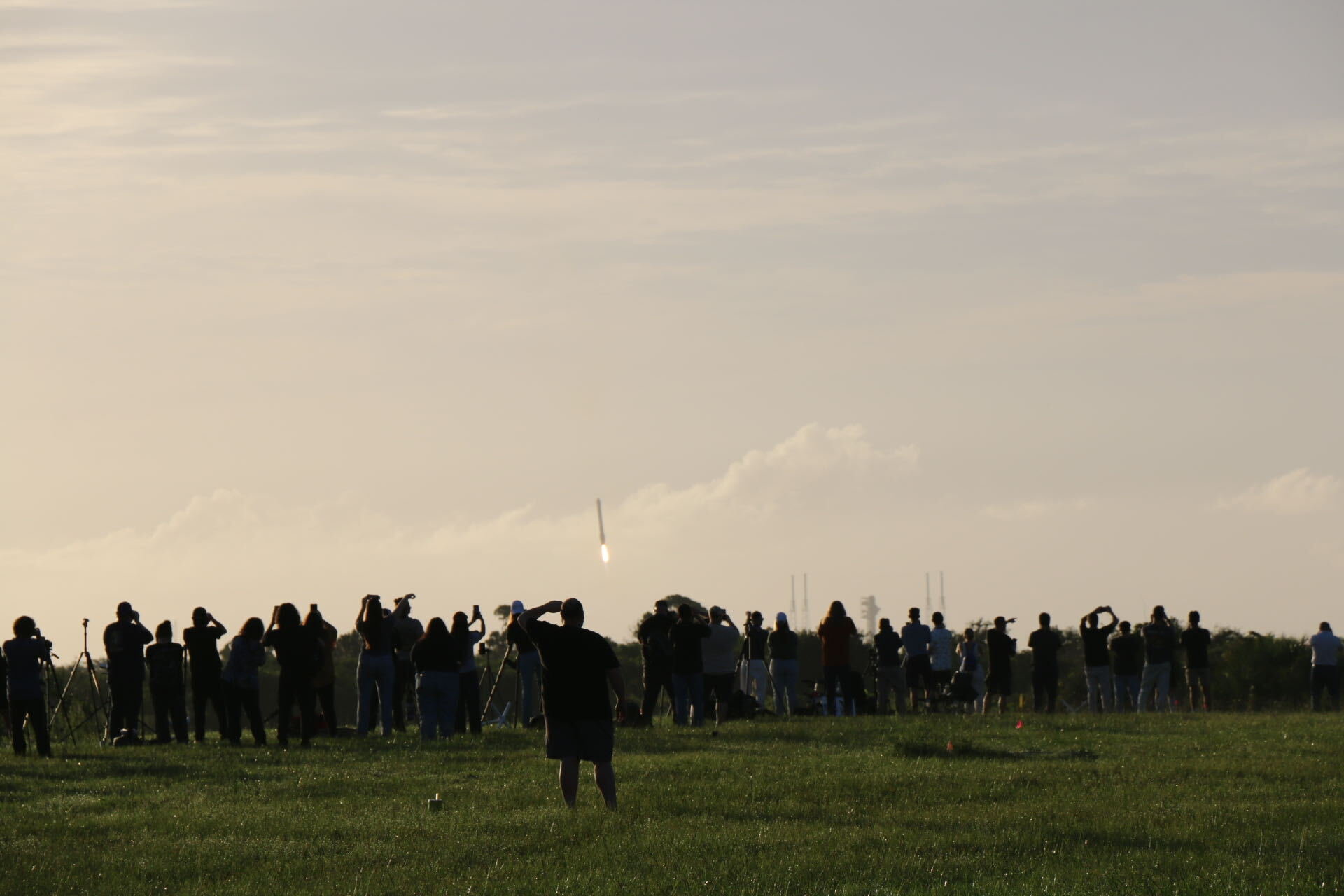
This might look like a rocket launching off Earth, but it's actually a rocket booster perfectly landing on our planet after fulfilling its duty. (Image credit: Chelsea Gohd)
On Aug. 30, the Nancy Grace Roman Space Telescope launched into space aboard a SpaceX Falcon Heavy rocket — then, after completing their job, the rocket's boosters safely landed back on Earth. Watching the events unfold, Space.com's Chelsea Gohd caught one of these beautiful landings on camera as onlookers at NASA's Kennedy Space Center watched in awe.
What is it?
The Roman Space Telescope is NASA's next great observatory, meant to revolutionize how we view the cosmos. Equipped with instruments like a coronagraph that can directly image exoplanets and a Wide-Field Instrument (WFI) that has a massively wide field of view, it's designed to work with big names like the Hubble Space Telescope and James Webb Space Telescope and reveal our universe's intricacies on a grand scale.
But to get to space, like any other space telescope, it needed a rocket to ferry it there. In this case, that was SpaceX's Falcon Heavy rocket. Falcon Heavy is about 230 feet (70 meters) tall and can lift nearly 141,000 pounds (64 metric tons) of payload to low Earth orbit. And importantly, Falcon Heavy's two boosters are reusable.
After launching a payload to space, the boosters split and each lands back on Earth in an upright position. In the image above, Gohd captured one of those boosters landing in the distance.
Why is it incredible?
Though we hear about it so often, there is something undeniably dreamlike about living in a time when a rocket can land its parts back on Earth so precisely. I was also there for the launch of the Roman Space Telescope in Florida, and it was breathtaking to watch such a huge piece of equipment navigate mid-air and straighten itself before landing. The crowd in the picture was equally astonished while the event unfolded.
My mother texted me just after she watched the Roman Space Telescope launch live online, exclaiming that the booster's landing looked just like a taxi returning to its station, getting ready for the next task. I hadn't thought about it that way before, but she was correct.
One of the boosters that participated in Roman's launch landed at Landing Zone 2 and the other hit the ground at Landing Zone 40. As NASA explained in a statement, one of these boosters carried out its very first mission while the other was on its third.
Now, the next spectacle to take our breath away will be Roman's very first images of the universe. Those are expected to drop next year.
However, the three Russian cosmonauts living on the ISS will have to clock in as usual.
NASA astronaut Jessica Meir (left) and the European Space Agency's Sophie Adenot work together inside the International Space Station’s Quest airlock during spacesuit fit and leak checks. (Image credit: NASA)
The trio — Pyotr Dubrov, Andrey Fedyaev and Anna Kikina — "will be busy monitoring the Progress 94 resupply spacecraft when it undocks on Monday, packed with trash and obsolete gear, from the Poisk module," NASA officials said in an update on Friday.
"It will be replaced by the Progress 96 resupply spacecraft after it launches from Kazakhstan's Baikonur Cosmodrome on Sept. 9 for an automated docking two days later to Poisk’s vacated port," they added.
Adenot, Feyaev, Hathaway and Meir arrived at the ISS in mid-February on SpaceX's Crew-12 mission. Dubrov, Kikina and Menon are relative newcomers, reaching the station aboard a Russian Soyuz spacecraft on July 14.
NASA astronauts on long-duration missions to the ISS generally work a relatively normal schedule, getting weekends and major holidays off. Such downtime is crucial to mission success, as it helps the spaceflyers stay happy, healthy and productive.
They may not be able to mark the holidays in exactly the same ways we do here on Earth, however. For example, the astronauts won't be grilling any hamburgers or hot dogs today, as open flames are verboten on the ISS.
As today's schedule shows, international crewmates do not always have the same days off in orbit. But they try to celebrate major holidays like Christmas together, both to cement the bonds that exist between them and to take the sting out of being so far away from family and friends.
App Tracking Transparency is at the center of a new UK lawsuit seeking approximately $2.7 billion (£2 billion), putting one of the most recognizable iPhone privacy features under fresh legal pressure. The claim follows earlier challenges to the tracking system in France, but this action seeks compensation for developers who say Apple imposed unfair restrictions on their businesses while favoring its own advertising services.
Filed on September 3 at London’s Competition Appeal Tribunal, the case represents another dispute over the rules behind the familiar permission prompt. Apple rejects the allegations and maintains that it follows the same App Tracking Transparency requirements as other developers.
The amount being sought is not a fine or an awarded payment. It is the claimants’ estimate of losses, which Apple disputes.
What the App Tracking Transparency Lawsuit Alleges
The action was brought by ATT Collective Action Limited, whose director, Ann Pope, previously led antitrust enforcement at the UK Competition and Markets Authority. Law firm Hausfeld is representing the proposed class.
According to Hausfeld’s announcement of the claim, developers argue that Apple introduced the framework unfairly, without adequate consultation, and applied more burdensome requirements to outside businesses than to its own services.
The complaint focuses partly on consent. It alleges that third-party developers must obtain permission under data-protection law and then secure an additional approval through the iOS tracking prompt. Apple’s advertising services, the claimants argue, operate under a less demanding process.
Developers also contend that the introduction left them insufficient time to adapt business models dependent on advertising.
These are allegations about how the system was designed and introduced—not established findings in this UK case. The claimants’ stated position is that privacy protections should remain compatible with fair treatment of businesses.
Image Credit: AppleMagazine
What the Tracking Prompt Actually Protects
For someone using an iPhone, App Tracking Transparency offers a direct choice about a practice that previously could be difficult to see.
An app may want to connect information about your activity with information gathered through other companies’ apps or websites. That connection can help advertisers build a profile, target advertisements, or measure whether an advertising campaign led to a purchase.
Under Apple’s explanation of the tracking rules, apps must request permission before carrying out the tracking covered by the framework. Choosing “Ask App Not to Track” blocks access to the system advertising identifier and prohibits using other identifying information to perform that tracking instead.
The feature arrived with iOS 14.5 in 2021. It does not remove advertisements, make an app anonymous, or serve as a universal switch for every kind of data collection.
That boundary matters. A retailer remembering purchases made within its own service is not automatically doing the same thing as an advertising company linking activity across unrelated businesses.
The disagreement concerns whether those distinctions, and the consent processes built around them, give Apple an unfair commercial advantage.
Apple Says the Same Rules Apply to Everyone
Apple has responded directly to the lawsuit, defending the feature as a way to give people control over tracking across other companies’ services.
In a statement reported by AFP, a spokesperson said: “Apple is bound by the exact same requirements as all developers under ATT.”
The company also pointed to support for the feature from customers and privacy advocates.
That response challenges the foundation of the developers’ case. Apple presents App Tracking Transparency as a rule based on the type of data activity involved. The claimants argue that its practical operation places competing advertising businesses at a disadvantage.
Resolving that disagreement requires more than comparing the appearance of two permission screens. The underlying data uses, consent requirements, and commercial effects all matter.
Why Free Apps Are Part of the Dispute
Advertising can support both sides of an app business. A developer may sell advertising space inside a free app while also buying advertisements elsewhere to attract new users.
A change to tracking can therefore affect how much an app earns and how confidently its developer can measure spending on promotion.
Consider a small game studio. It needs to know whether an advertising campaign brings in players who keep using the game. If measurement becomes less precise, deciding where to spend the next marketing dollar becomes harder. Separately, advertisers may value the game’s available ad space differently when less information is available for targeting.
That explains the commercial concern without proving the legal claim. Losing revenue after a privacy change does not, by itself, establish that the change was unlawful.
There is also a consumer interest that cannot be reduced to advertising performance. Someone choosing not to be tracked is expressing a preference about personal information, not making a promise to preserve a developer’s previous income.
The difficult question is whether that preference can be protected through a system that treats competing businesses fairly.
France Has Already Examined the Consent Process
The UK action arrives after a separate French competition investigation found problems with the implementation of App Tracking Transparency.
In its March 2025 decision, France’s Autorité de la concurrence distinguished between the legitimate objective of protecting privacy and the way Apple pursued it.
The authority criticized multiple consent requests and differences in treatment between Apple and outside publishers. It also highlighted the position of smaller businesses that lack the extensive first-party data available to large platforms.
Importantly, the French authority did not argue that people should lose the ability to refuse tracking. It said adjustments to the framework could address competition concerns while retaining privacy protections.
That distinction leaves room for changes to wording, consent flows, or implementation without automatically requiring the removal of the feature. The French decision, however, does not determine liability or compensation in the separate UK proceedings.
The Claim Is for Developers, Not iPhone Owners
The official claim website describes a proposed action for UK-based app developers affected since April 2021. It estimates losses across the group rather than offering a fixed payment to everyone who owns an iPhone.
The proposed scope includes developers earning advertising revenue from third-party iOS apps and developers spending money to attract users to those apps. Whether compensation becomes available depends on the proceedings and their outcome.
For U.S. readers, the filing does not announce a change to domestic iPhone settings or create a consumer refund program. There is no reason to grant an app tracking permission simply because its developer objects to the framework.
Businesses following the case should also distinguish registering interest from receiving compensation. The claim website currently invites affected organizations to provide their details; it is not distributing a settlement.
A planned flagship spacecraft to Uranus was aiming to use Jupiter for a gravitational boost to shorten its journey to the outer solar system. Now that the mission’s launch date has been pushed back, it’ll need to find another way to its target.
Redesigning the Route
Uranus and Neptune, the ice giants of our solar system, have been comparatively neglected by humanity’s fleet of interplanetary probes. While all of the other major bodies have been visited by at least an orbiter or even a lander, the most detailed exploration we’ve done of these two planets happened when the Voyager 2 spacecraft went screaming past on its way toward interstellar space.
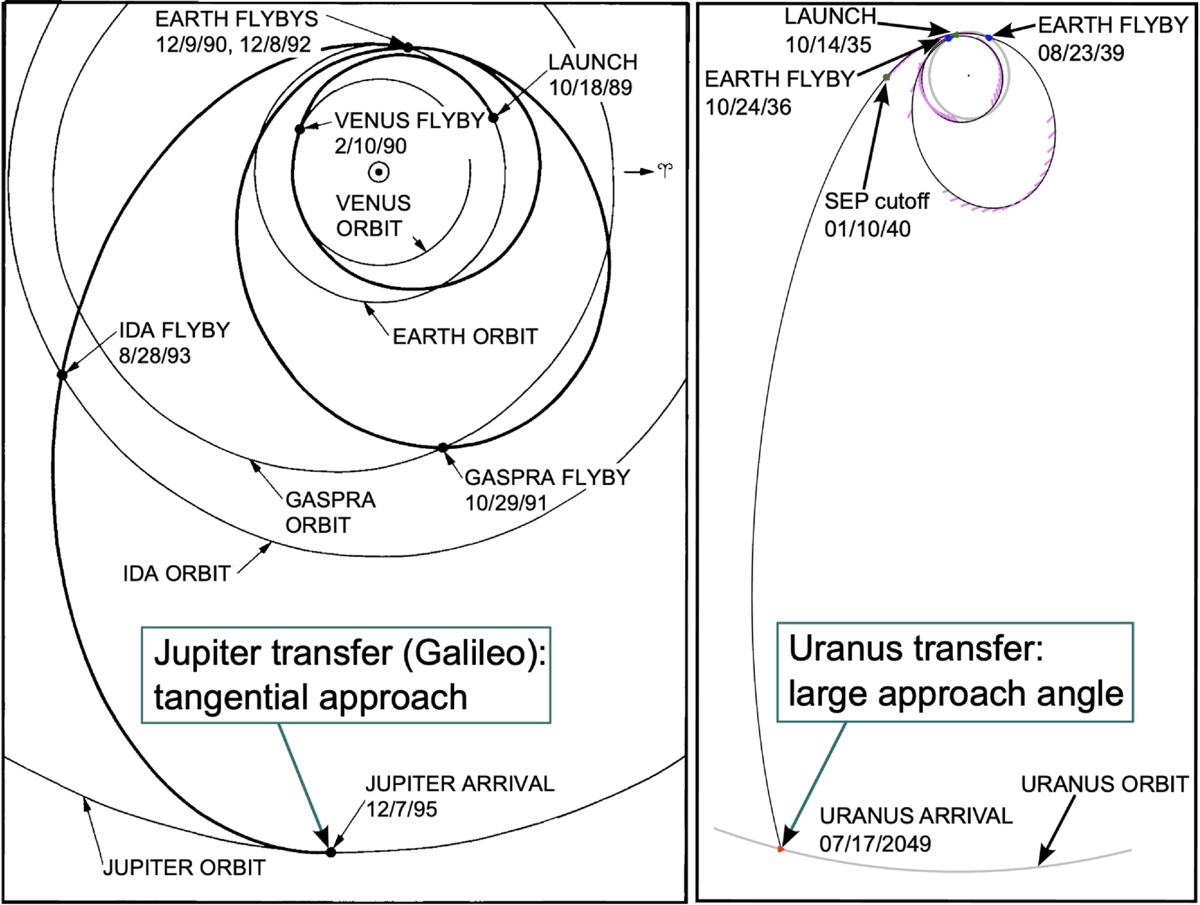
Schematics of different trajectories within the solar system. Left: The path the Galileo spacecraft took to Jupiter. This path arrived nearly parallel to the planet’s motion. Right: One of the proposed paths to Uranus. This path will intersect the planet’s orbit at a much steeper angle to shorten the flight time. Click to enlarge. [Simon et al. 2026]
So it was no surprise when a panel of scientists and engineers charged with setting scientific exploration priorities between 2023 and 2032 recommended finally sending a spacecraft to Uranus, depositing it into orbit around the planet, and keeping it there for a while to collect data. The study itself suggested a basic design for the mission: a pair of spacecraft, one orbiter and one sacrificial atmospheric probe, collectively weighing about 4,000 kg.
Getting these spacecraft to their destination will be a challenge The thriftiest path to get to Uranus, a trajectory called a Hohmann transfer that’s been used for other missions aimed elsewhere in the solar system, would take 16–17 years. Rather than accept the long wait, the original authors suggested that the mission instead fly toward Jupiter, using the giant planet’s massive gravitational tug to slingshot the spacecraft toward Uranus.
However, this plan relied on Jupiter being in just the right place when the spacecraft approached. This in turn relied on the mission launching sometime in 2031 or 2032: any earlier or later, the slingshot would be aimed in the wrong direction. Now that timelines and budgets have slipped for this flagship mission, hitting this launch window seems unlikely. And, without the boost from Jupiter, the mission will have to cross 20 au of open interplanetary space on its own.
Solar Electric Propulsion to the Rescue
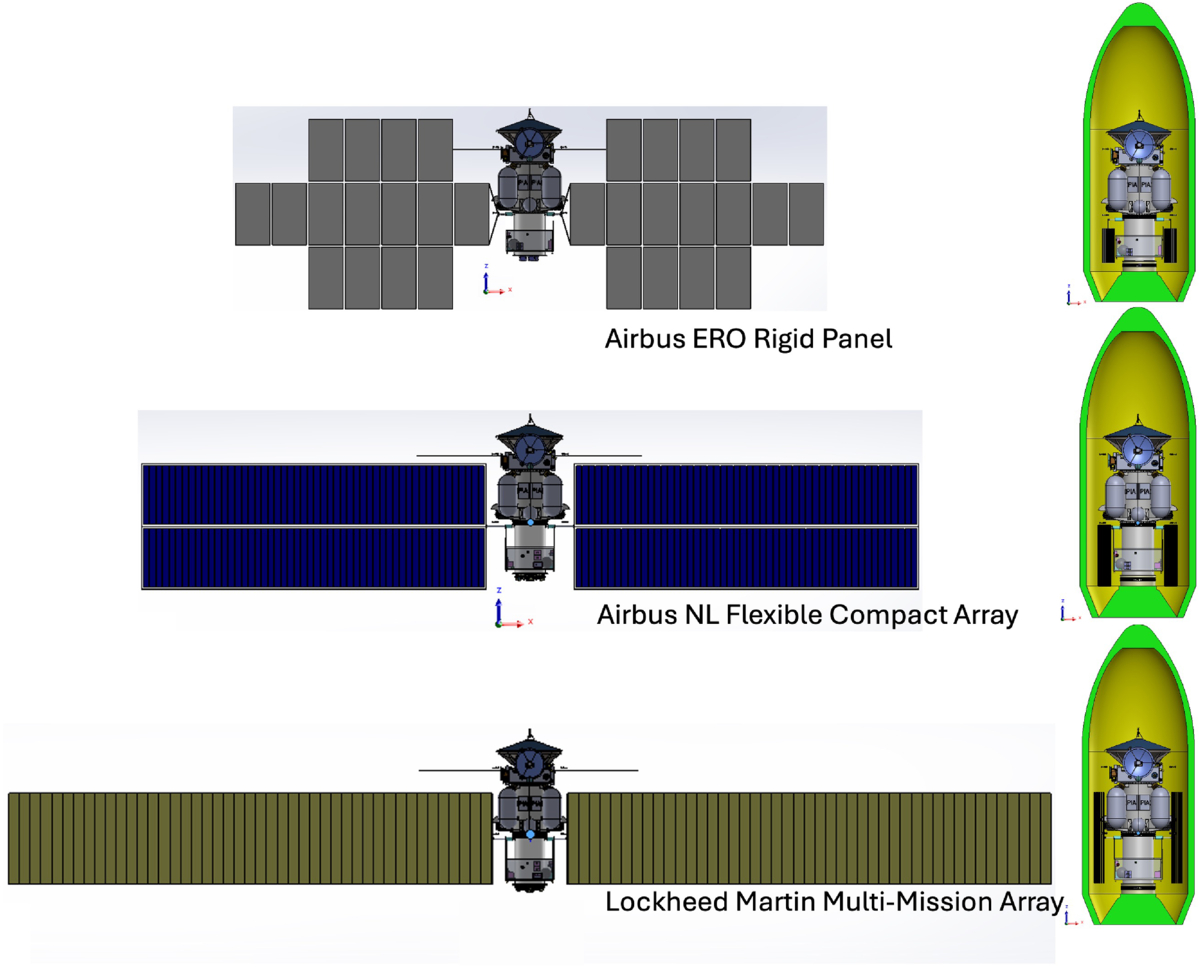
Several proof-of-concept designs for the mission’s SEP components. How these designs would be packaged into a rocket fairing for launch is shown at right. Click to enlarge. [Simon et al. 2026]
Recently, a team led by Amy Simon, NASA Goddard Space Flight Center, took on this challenge and tried to chart a new path through the solar system. The team realized that solar electric propulsion (SEP), a technique that relies on using solar panels to create electricity and accelerate ions to create thrust, might offer a path forward. By using SEP, the mission could leave Earth, unfurl wings of solar panels, then gradually accelerate for as long as there was enough sunlight to power the engine.
The power levels would likely get too low just a few astronomical units into their journey, but that would be enough: after discarding the SEP stage, the mission could coast to Uranus on a journey that would take only 13 years. Even better, this technology has a proven flight history and would require little maturation or development. The BepiColombo mission to Mercury is currently using SEP, and similar techniques are used on satellites in Earth orbit today.
Simon and collaborators also took on a number of other challenges that have cropped up since the mission was proposed, including fewer available plutonium power sources and a re-assessment of Uranus’s rings that revealed hazards in the original flight path. Their work brings the mission closer to the launch pad and illustrates how much iteration goes into the spacecraft that finally takes to the stars.
Citation
“Uranus Orbiter and Probe: Mission Challenges and Concept Updates Since the Origins, Worlds, and Life Decadal Survey,” Amy A. Simon et al 2026 Planet Sci. J.7 143. doi:10.3847/PSJ/ae680c
After nearly eight years traveling through the inner solar system, the trailblazing BepiColombo spacecraft has finally begun its arrival at Mercury.
The joint European Space Agency (ESA)-Japanese Aerospace Exploration Agency (JAXA) mission reached a major milestone today (Sep. 3), entering its arrival phase at one of our sun's least-studied planets. BepiColombo's Mercury Transfer Module (MTM), the main power and propulsion system that has ferried a dual stack of planetary probes through space for nearly eight years, released its payload to kick off a sequence of operations that will ultimately place the two spacecraft in Mercury's orbit.
The separation left ESA's Mercury Planetary Orbiter (MPO) and JAXA's Mercury Magnetospheric Orbiter, known as Mio, together for their final approach, which will take about six more months. "It will basically be a new mission starting today," said Bruno Sousa, ESA's head of operations definition and engineering, during today's mission livestream.
BepiColombo launched aboard an Ariane 5 rocket from Europe's Spaceport at the Guiana Space Center in Kourou, French Guiana, on Oct. 19, 2018, beginning a journey that was expected to take about seven years. To assist its plunge sunward, the spacecraft's trajectory has included one flyby of Earth, two of Venus and six of Mercury, as it has shed more and more gravitational energy during to slow its approach to the system's innermost planet.
"It's one of the most complicated missions we have ever flown," Sousa said. The mission was made even more complicated in April 2024, when a solar panel issue reduced the available power for MTM's electric thrusters. Engineers devised a lower-thrust trajectory that saved BepiColombo's mission but delayed its Mercury arrival from December 2025 to November 2026.
Today's maneuver doesn't place BepiColombo in orbit around Mercury quite yet. MPO and Mio will spend the next several weeks navigating toward the planet ahead of orbital insertion on Nov. 21. "Arriving to Mercury is not as simple as other missions that do a big maneuver and they are there," said Elsa Montagnon, BepiColombo's operations manager. "In our case, it's going to be six months of continuous activities."
The Nov. 21 arrival will begin a sequence of 16 maneuvers to progressively lower and reshape BepiColombo's orbit. Mio is scheduled to separate from MPO around Dec. 9 and settle into a highly elliptical polar orbit. MPO will jettison Mio's MOSIF sunshield (Magnetospheric Orbiter Sunshield and Interface Structure) on Dec. 16, then continue lowering its own altitude before reaching its own polar orbit on March 10, 2027.
BepiColombo's arrival at Mercury will take about six months. (Image credit: European Space Agency)
BepiColombo is scheduled to begin science operations on April 6, 2027, with MPO and Mio studying Mercury simultaneously from complementary orbits. MPO will focus on Mercury's surface composition, geology and planetary interior, while Mio will investigate the planet's magnetic field and its interaction with the solar wind.
Today's separation took place at 8:00 a.m. EDT (1200 GMT), but confirmation of that event didn't come for more than an hour following its scheduled execution. Acquisition of signal from BepiColombo came just before 10 a.m. EDT (1400 GMT), followed by a positive telemetry reading indicating the spacecraft was where it was supposed to be.
"I'm again extremely relieved," Montagnon said. "That the telemetry comes exactly at the moment we expect it, and that we see in the telemetry that the configuration of the spacecraft is the correct one," she said, "this is the best case scenario."
Recent versions of xOS (that is, macOS, iOS, iPadOS, etc) have Data Protection Classes from A to D that get assigned to files and folders.
[…]
The thing is, though, is that these files and folders are inaccessible unless the user is logged in, and the screen is unlocked. A few seconds after the screen locks (or you log out), the keys are purged, and they cannot be read.
[…]
That means the files any application considers to be worth protection cannot be accessed when a backup usually happens.
[…]
You may have noticed that if you had an overnight backup, when you unlock your screen, a copy starts to run. It’s typically quite brief, thanks to ⚡️Turbo Smart Update, but it might surprise you anyway. […] During your overnight copy, SuperDuper kept track of the files that it couldn’t access due to their protection class. And now that it can access them, it’s making sure they get backed up.
This seems like the right thing to do. Time Machine also does it. A backup app should try to make as faithful a backup as possible. I kind of find it annoying, though. Sometimes it can’t do a Turbo Smart Update, and so the backup that should already be done may end up taking another 30 minutes or more. The best thing to do is schedule backups while you’re using your Mac to avoid SuperDuper needing to do such “follow-ups.”
I wrote some code to try to figure out which files I have that are using data protection. Interestingly, the URLFileProtection API seems to not work on macOS. I used the lower level getattrlist() instead. Nanian recommends fcntl(). I didn’t find any protected files that I actually care about, just caches and derived data from Apple’s own apps. But, in theory, Apple or a third-party app could be saving actual user data using data protection.
Datacentres should generate their own power and control their emissions, writes Richard Lamming, while Michael McClelland says we should reduce our digital communication. Plus a letter from Malcolm Fraser
One solution would be to make each datacentre responsible for generating all its own electricity and for reducing its CO2 emissions to zero. These installations will have vast areas of roofing and car parks that could be covered in solar panels, space for wind generation and battery storage, and for emissions scrubbers.
Secretive state begins repairs on ageing facilities after being revealed as worst country for leaks of potent greenhouse gas
Turkmenistan has started plugging the mega-leaks of methane that spew from its ageing oil and gas facilities, the latest UN data shows, in a move hailed as a breakthrough.
Methane, also called natural or fossil gas, is a potent greenhouse gas. It traps 80 times more heat than carbon dioxide and causes 25% of global heating today. Stopping leaks can be quick and cheap and, because methane breaks down in the atmosphere far quicker than CO2, this has a rapid impact, with some experts calling it the climate “emergency brake”.
The UK’s Science and Technology Facilities Council (STFC) recently announced funding cuts to a range of physics and astronomy projects as it seeks to reduce costs. One of the most high-profile casualties is e-MERLIN, a network of seven radio telescopes spread across the UK, including the iconic Lovell Telescope at Jodrell Bank.
To discover what the cuts could mean for UK science and the livelihoods of those affected, podcast host Andrew Glester caught up with two astronomers at Jodrell Bank: Simon Garrington, e-MERLIN director, and David Williams-Baldwin, an e-MERLIN research support scientist.
They discuss why the cuts have caused such alarm among scientists, how the UK astronomy community is mobilizing in opposition, and why the consequences could extend far beyond Jodrell Bank.
e-MERLIN combines signals from its telescopes to produce sharp radio images of the Universe – with a resolution comparable to that of the Hubble Space Telescope. As things stand, funding for the telescope array will run out in March 2028, putting the future of the network and scientific operations at Jodrell Bank in doubt.
It’s an uncertain time for an observatory that was granted UNESCO World Heritage status in July 2019 for its historical contributions and its technical and scientific ingenuity since the 1940s.
An STFC spokesperson emphasises that Jodrell Bank is “not closing” and “will continue to play an important role in UK science”. This includes the Square Kilometre Array Observatory that has its headquarters at Jodrell Bank as well as other radio astronomy research projects in the UK and elsewhere.
“We recognise the strength of feeling about Jodrell Bank and the e-MERLIN network, and the contribution they have made to UK science. The achievements of the scientists, engineers and staff who have supported e-MERLIN over many years are widely respected across the research community,” they add. “We are focusing on the next generation of radio astronomy to ensure UK researchers continue to be at the forefront of the field. Rising cost pressures mean that we have had to make difficult choices about STFC funding to make sure we are able to fund world class research sustainably into the future.”
A radiation shielding vest tested during the uncrewed Artemis I flight in 2022 has been shown to significantly reduce the radiation dose that future astronauts or deep-space tourists might receive.
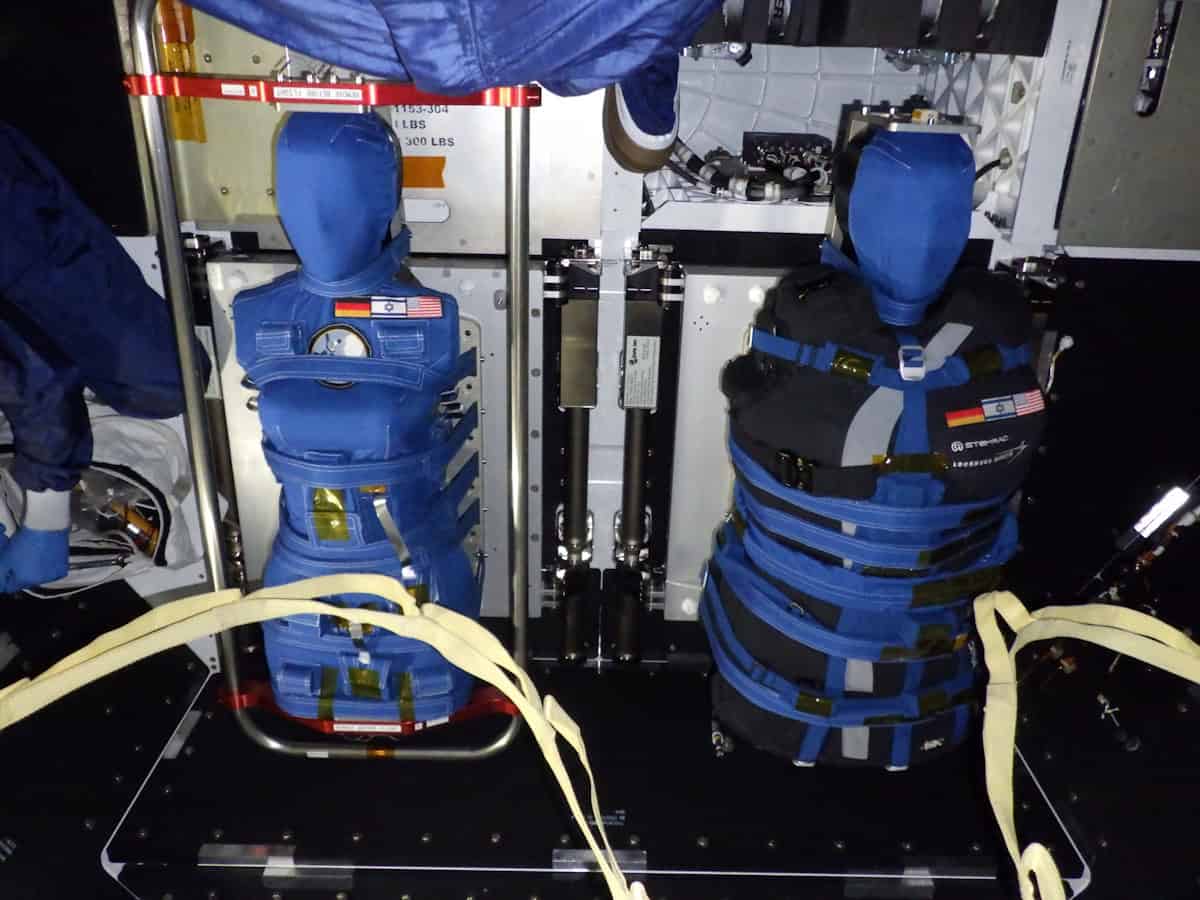
The data for this analysis were obtained via seating two human-tissue-equivalent female torso phantoms in the Orion crew capsule. While the “Zohar” phantom wore the new AstroRad vest, its travel companion “Helga” did not. Numerous radiation dosimeters placed in and on the phantoms allowed the received radiation dose to be compared.
“Exposure to radiation in space is unavoidable, and a single major solar particle event (SPE) can deliver more than one-third of NASA’s 600 millisievert career effective-dose limit. A three-year round trip to Mars would equal or exceed the career limit, which corresponds to a 3% mortality risk from radiation-induced cancer. So we developed the AstroRad vest to significantly reduce this hazard,” explains immunologist Oren Milstein, CEO of StemRad Radiation Protection, which began developing the vest with Lockheed Martin in 2015.
Dosimetry phantoms The Helga and Zohar (wearing the AstroRad vest) phantoms inside the Orion spacecraft at the NASA Vehicle Assembly Building prior to the launch of Artemis I. (Courtesy: NASA/Lockheed Martin/DLR)
The shielding thickness varies throughout the garment according to the radiation sensitivity of the underlying organs, with breasts, colon, lungs, ovaries, stomach and red bone marrow having concentrated shielding in the test vest. Milstein was inspired to develop this targeted architecture based on the experiences of his PhD supervisor, who treated the first responders to the 1986 Chernobyl nuclear power plant disaster.
With damage to bone marrow the accepted cause of death for all those emergency workers who lost their lives within months of the accident, “that heritage instilled in me a desire to protect people from radiation by selective shielding of the bone marrow,” Milstein explains, adding that the female focus of this experiment is because women have a higher predicted risk of radiation-induced cancer than men.
Astronauts currently shield from SPEs in “storm shelters” consisting of barricades of supplies, or by moving into areas containing more hardware against the walls. AstroRad provides a similar level of protection to the most robust shelter configuration while also “allowing the astronaut wearing it to move around the cabin and continue mission-critical tasks,” radiation physicist Jordan Houri, lead scientist for space exploration at StemRad, tells Physics World.
To maintain flexibility, the vest is constructed from thousands of hexagonal tessellated rods of high-density polyethylene (HDPE) sandwiched between two layers of elastic fabric. The shielding components can also slide past one another and stretch. HDPE was chosen for its high proportion of hydrogen – which is extremely effective at shielding against charged particle space radiation.
While Artemis I did not encounter a solar storm, Orion traversed the inner Van Allen belt, whose protons cover a similar energy range to those in SPEs. This enabled the team to construct a Monte Carlo model of the experiment for testing different radiation environments.
“We created digital twins of Helga and Zohar, the AstroRad vest, radiation detectors and spacecraft shielding,” explains Houri. “Using this model, we generated hundreds of billions of virtual protons and electrons representing the radiation environment of the inner Van Allen belt, before comparing the predicted detector responses directly with the measurements recorded during Artemis I.”
With close agreement found, the researchers then simulated measured SPEs from August 1972 and October 1989. As detailed in their recent Science Advancespaper, this revealed that wearing AstroRad would reduce effective dose by around 60% in an August 1972-type scenario, and by almost 40% for a 1989-type SPE – sparing astronauts the dose equivalent from up to 193 and 131 days of deep space travel, respectively.
Combining these results with those from previous experiments, which tested the vests’ ergonomics on the International Space Station, is allowing the researchers to improve comfort and ease of motion, and reduce mass. They are also exploring whether lighter, empty vests could be filled with recycled polyethylene after launch.
Alongside the health benefits, reducing radiation exposure makes economic sense as it extends astronauts’ careers, concludes Milstein, who hopes that the AstroRad vests can help “make lunar habitation and Mars travel truly sustainable and not just a dream”.
The fully-integrated LEMS (Lunar Environment Monitoring Station) ready for environmental testing. A small suitcase-size instrument suite built at NASA Goddard, LEMS is designed to carry out continuous, long-term monitoring of the seismic environment at the Moon, including surface motion caused by moonquakes and meteorite impacts in the lunar south polar region.
NASA Goddard/Mike Guinto
NASA has declared “wrenches down” on the first completed payload designed for Artemis astronauts to deploy on the Moon’s surface. Engineers working on NASA’s Lunar Environment Monitoring Station, or LEMS, have completed hardware development and testing and the payload is ready for its permanent home near the lunar South Pole. With the hardware complete, LEMS is ready to support one of the Artemis program’s core goals: enabling sustained lunar science and exploration.
The LEMS instrument package contains two highly sensitive seismometers that will monitor ground vibrations from moonquakes and meteorite impacts, providing scientists with insights into the Moon’s interior and the seismic hazards astronauts might encounter at the surface. Its modular design allows the system to be adapted or expanded to host new instruments in the future, creating a reusable platform that can evolve as scientific priorities grow.
The payload will remain in a clean room at NASA’s Goddard Space Flight Center in Greenbelt, Maryland, where it was built, until it is assigned to an Artemis mission for deployment to the lunar surface.
“The completion of the LEMS scientific instrument is a major step in a new era of lunar surface science. Innovative science experiments will uncover, measure, and reveal the Moon’s secrets while astronauts open new frontiers for discovery,” said Joel Kearns, deputy associate administrator for exploration, Science Mission Directorate, NASA Headquarters in Washington. “And, behind the scenes, countless teams across NASA and our partners are pushing the boundaries of what surface instruments can do, building the tools that will make future exploration possible and safer.”
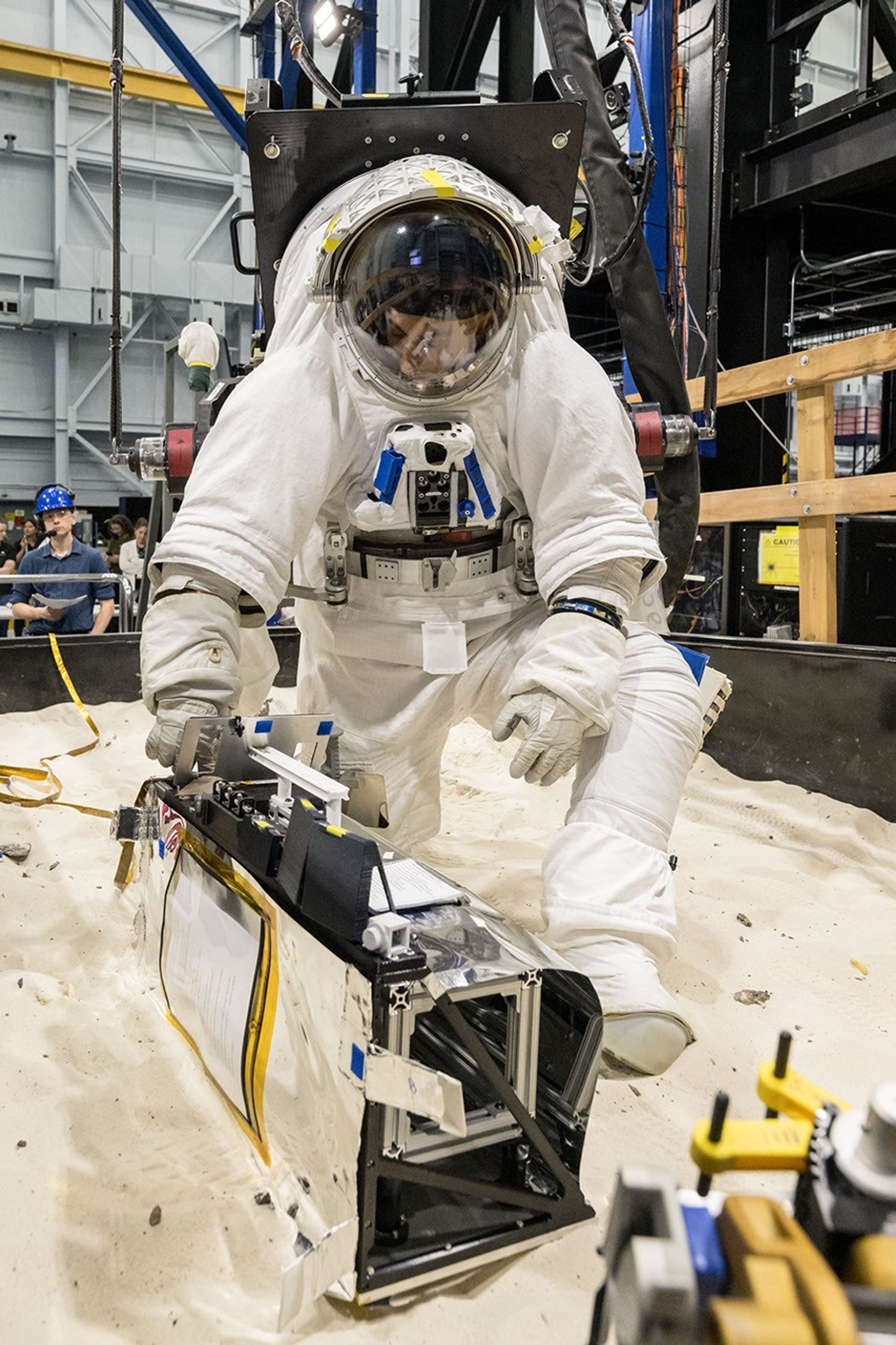
A scientist wearing NASA’s xEMU prototype space suit is testing the handling of a mockup version of NASA’s Lunar Environment Monitoring Station, or LEMS. The testing took place at the Active Response Gravity Offload System, a simulated reduced gravity environment at NASA’s Johnson Space Center in Houston.
NASA Johnson
The LEMS payload builds on a legacy of lunar seismic tracking. Apollo astronauts deployed a network of seismometers on the Moon’s nearside equatorial region between 1969 and 1972. Those instruments operated until 1977, recording about 13,000 moonquakes and other ground vibrations that helped scientists begin to understand the composition of the Moon’s interior. For decades, researchers have hoped to spread more seismometers, updated with new technologies, across the lunar surface.
Now, LEMS will carry the first seismometers to be deployed by future astronauts to listen for faint ground vibrations, collecting new clues to the Moon’s internal structure and ongoing seismic activity. The sensors will be the most compact, sensitive, and energy-efficient seismometers ever built for planetary exploration.
LEMS itself is about the size of a small suitcase, weighing 11 pounds in the Moon’s low-gravity environment. It will carry not just these seismic sensors, but everything it needs to function independently of humans after deployment. LEMS is built to manage its own power production via a lightweight, flexible solar array that conforms to the shape of the LEMS unit. It also will manage its operational activities to ensure continuous data collection based on a preset plan, and monthly data transmission to Earth. The payload will do all this while maintaining a stable internal temperature throughout the massive day-to-night temperature swings of the South Pole region.
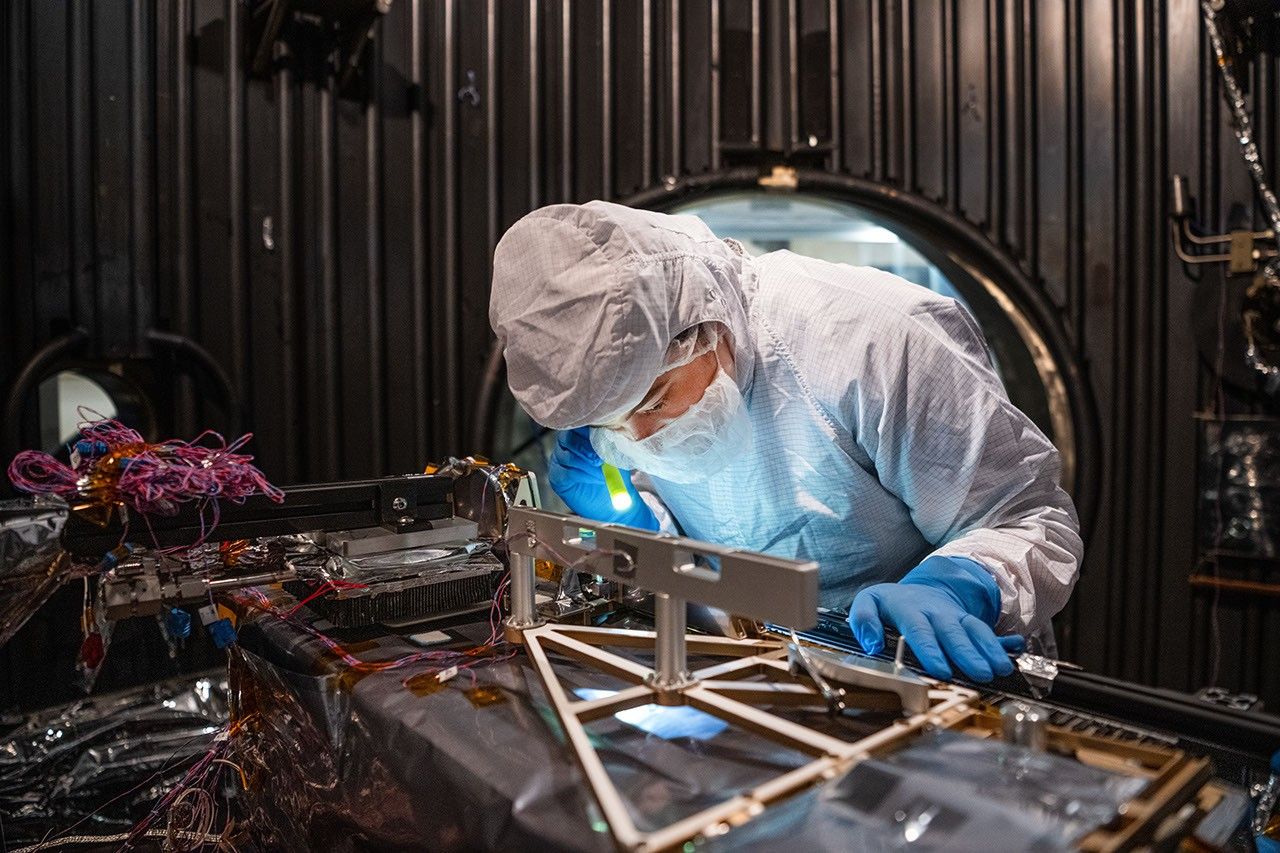
Mechanical Engineer Brie Ludwig inspects the Lunar Environment Monitoring Station (LEMS) in preparation for testing in a thermal vacuum chamber at Goddard Space Flight Center in Greenbelt, Maryland, on March 31, 2026. LEMS is a compact, autonomous, and self-sustaining seismometer suite designed to carry out continuous, long-term monitoring of the lunar seismic environment at the South Polar region.
NASA/Denny Henry
“When we conceived of LEMS, we weren’t just thinking about the next mission, we were thinking about the next generation of lunar exploration,” said Mehdi Benna, a University of Maryland Baltimore County scientist who leads LEMS from NASA Goddard. “Our vision was to create a scientific buoy for the Moon. Like an ocean buoy on Earth, LEMS is designed to be easy to build, adaptable to different scientific objectives, and capable of operating independently for years.”
Before any surface science could happen, Benna and his team had to ensure that LEMS could survive the trip to the Moon and the harsh environment of its surface. Over the past five months, LEMS and its components have been subjected to a demanding series of environmental and operational tests. Engineers verified LEMS can endure the violent shaking of launch, the journey to the lunar surface, and the Moon’s temperature and radiation environment. The team also showed that the instrument package’s mechanical and electrical design is safe for astronaut handling.
The LEMS payload was built to operate through the lunar night, which lasts two Earth weeks, without external power assistance or a heat source. Past lunar surface instruments relied on radioisotope heaters for warmth and power. But LEMS instead will withstand temperatures that dip to minus 400 degrees Fahrenheit in some areas by using advanced insulation materials, low-thermal-conductivity cables that minimize heat loss, and a thermal regulator that conducts heat away during the day to prevent overheating and helps retain heat at night.
These innovations reduce mass and power needs, setting the stage for lighter, energy-efficient instruments that can operate continuously at future Artemis landing sites and the NASA-led Moon Base.
The LEMS payload is led by University of Maryland Baltimore County and University of Maryland College Park. Technical implementation is led by NASA Goddard. The University of Arizona, in partnership with Silicon Audio, Inc., supplied LEMS’ two state-of-the-art seismometers. Morehead State University in Kentucky provided LEMS’ telecommunication system and will operate the instrument on the surface. Washington University in St. Louis will manage the instrument’s data processing and dissemination to the larger scientific community.
A climate shock that unfolded about 304 million years ago is offering scientists a dramatic warning about how quickly Earth’s climate system can amplify an initial temperature rise. During the Late Paleozoic Ice Age, a relatively modest increase in global temperatures appears to have triggered a much larger episode of warming, as methane released from thawing permafrost intensified the greenhouse effect. Researchers say the ancient event provides a powerful geological parallel for the climate changes occurring today.
The study, led by Le Yao of the Nanjing Institute of Geology and Paleontology with contributions from University of Cincinnati geosciences professor Thomas Algeo and international colleagues, examined a short-lived warming episode during Earth’s penultimate ice age. Their findings suggest that global sea surface temperatures eventually increased by more than 7 degrees Celsius, or approximately 12 degrees Fahrenheit. The rise was not necessarily caused by one enormous initial pulse of carbon. Instead, it may have developed through a chain reaction in which warming activated additional natural sources of greenhouse gases.
The Late Paleozoic Ice Age extended across a vast span of geological time, when large ice sheets covered parts of the supercontinent Gondwana. Although the planet was in an “icehouse” state, atmospheric carbon dioxide and methane still had the power to destabilize the climate. The newly analyzed warming event is particularly significant because it occurred under ice-age conditions rather than during an already warm greenhouse world. That makes it a valuable analog for the modern Earth, which still contains continent-scale ice masses in Greenland and Antarctica.
According to the researchers, the initial climate disturbance may have been linked to volcanic activity. Volcanic emissions can inject carbon dioxide and other gases into the atmosphere, where they absorb outgoing infrared radiation and prevent some heat from escaping into space. The warming may also have been assisted by changes in Earth’s orbit. Over long cycles, variations in orbital shape alter the distribution of sunlight across the planet, influencing the growth and retreat of ice sheets and changing the seasonal balance of solar energy.
At first, the additional carbon may have produced only a limited temperature increase. But once warming crossed a critical threshold, frozen ground in high-latitude regions began to thaw. Permafrost contains large quantities of organic carbon preserved in frozen soils. When that material becomes available to microbes, decomposition can release carbon dioxide and methane. Methane is especially powerful over shorter atmospheric timescales because, molecule for molecule, it absorbs considerably more infrared radiation than carbon dioxide, even though it remains in the atmosphere for less time.
This process can create a positive climate feedback. An initial warming causes permafrost to thaw, thawing releases greenhouse gases, and the additional gases produce further warming. That extra heat can accelerate more thawing, allowing the cycle to reinforce itself. The researchers describe the ancient event as a transient global warming episode in which a comparatively modest carbon release appears to have crossed a climatic tipping point and initiated much more extensive carbon emissions from natural reservoirs.
The geological timescale of the ancient warming is also central to the study’s relevance. Algeo said the temperature change unfolded over tens of thousands of years, with warming occurring at an average rate of roughly one-tenth of a degree Celsius per 1,000 years. Modern warming is progressing far more rapidly. Researchers have observed an increase of nearly 1 degree Celsius in global sea surface temperature over approximately the past century, a rate many times faster than the average change reconstructed for the ancient event.
The comparison does not mean that Earth is destined to repeat the precise conditions of 304 million years ago. Continents, ecosystems, atmospheric composition and ice-sheet geometry were all different in the Late Paleozoic. However, the physics of greenhouse warming and the existence of carbon feedbacks remain relevant. Ancient climate records reveal how a system that appears stable can respond nonlinearly when warming activates processes capable of releasing additional greenhouse gases.
The findings also place human history in a broader planetary context. All recorded human civilization has developed during the most recent ice age, despite the fact that the term can sound incompatible with today’s climate. In scientific usage, Earth remains in an ice age because substantial permanent ice sheets still exist in Greenland and Antarctica. The ancient warming episode matters precisely because it demonstrates that an ice age does not guarantee a permanently cold or stable climate. Even within an icehouse world, a small disturbance can trigger rapid and substantial changes when reinforcing feedbacks are engaged.
The research, published in the Proceedings of the National Academy of Sciences, underscores why scientists closely monitor permafrost, polar ice and other climate-sensitive carbon stores. The ancient record cannot provide an exact forecast of future warming, but it shows that Earth’s climate has repeatedly responded to carbon disturbances with amplifying feedbacks. As modern emissions continue to raise temperatures at an exceptional rate, the geological evidence offers a clear message: the danger lies not only in the carbon released directly by human activity, but also in the natural carbon sources that warming can unlock.
Subject of Research: Ancient global warming, permafrost methane feedbacks, and climate tipping points during the Late Paleozoic Ice Age
Article Title: A transient global warming event during Earth’s penultimate icehouse
NASA’s Transiting Exoplanet Survey Satellite (TESS) mission has notched up its first discovery of an exoplanet via a method known as microlensing. The planet is a “super Jupiter” known as Gaia23bra b, and TESS observed it when the planet and its host star acted as a gravitational lens, magnifying the light from a second, more distant background star.
Astronomers have several ways of finding planets beyond our solar system. The most successful of these by far – and the one that TESS was designed for – is the transit method, which is responsible for roughly 75% of all exoplanet detections to date. This approach relies on observing the periodic dimming of a star’s light as a planet passes between the star and an observer here on Earth.
The transit method does have limitations, however. The main limitation is that we can see transits for only a small number of planets, namely those with orbital planes that are almost exactly edge-on to Earth. An alternative approach known as photometric microlensing is somewhat more flexible in this respect, as it relies on the star-planet system magnifying the light from a background star, which is known as the source. This magnification occurs because the gravitational pull of the planet-star system warps space, bending and magnifying the source’s light (as Albert Einstein predicted as part of his general theory of relativity) like a lens and producing characteristic spikes in its brightness.
A second bite at the exoplanetary cherry
Astronomers initially identified a planet in the Gaia23bra system using observations made in 2023 by the European Space Agency’s now-retired Gaia space telescope. However, while Gaia picked up the unexpected brightening of a background star, it did not identify this event as coming from a binary-star system, and it could not pick out the planet itself because its observations were too sparse, explains Mallory Harris, an astronomer at the University of New Mexico, US who led the TESS study.
In the new work, Harris and colleagues scoured TESS data from the same period. Because TESS’ observations were much denser – it observed the region every 200 seconds for nearly 60 days – they were able to identify extra features in the brightness of the light curve that indicated the presence of a planet in the system. Subsequent analyses revealed that this planet is about 1.63 times the size of Jupiter, and it orbits its host – an orange dwarf star 20% smaller than our Sun – at a distance similar to that of Jupiter from our Sun.
Complementary techniques
The transit technique is particularly sensitive to planets that orbit close to their star because these planets are the most likely to transit and block out most of their host stars’ light as they pass in front of them. In contrast, Harris explains that microlensing is most sensitive to planets orbiting at Earth-like distances or further from their stars, making it better for studying planetary systems more like our own solar system. “With microlensing, we can find smaller planets with greater orbital distances, including worlds in the habitable zone of their star and even farther away,” she says.
The transit technique and microlensing are therefore complementary because each reveals a category of planet that the other may not be able to detect, adds team member Diana Dragomir. The only problem, Harris notes, is that microlensing observations are limited-time opportunities. “Microlensing events happen once and they’re gone – they don’t repeat,” Harris says. “I like to joke that we’ll probably find the first Earth analogue with microlensing and then wave at it as it goes by because we’ll never see it again.”
That said, Harris says that Gaia23bra will be an important observing target for the Nancy Grace Roman Space Telescope. “Microlensing is currently the only method capable of detecting Earth‑mass planets at Earth‑like orbital distances,” she explains. “We already knew that this technique could find planets, because it has done so in the past using ground-based observatories.
“What we demonstrated in this work is that high-cadence observations (even with low spatial precision) and high-precision long-baseline observations can work together to find a microlensing planet. And that it is possible to specifically do this by pairing TESS observations with those from another instrument.”
This synergy between long-time-scale surveys and high cadence observations could be therefore applied towards future searches for potentially habitable worlds, she tells Physics World. Although Gaia was retired last January, making it unlikely that astronomers will find many additional events via a Gaia–TESS combination, Harris adds that there could nevertheless be other microlensing planets in the past eight years of archived TESS observations. “I’m excited to see whether there are other events like this already hiding in the TESS data and whether future surveys can work together with TESS to find more microlensing planets in different parts of the galaxy,” she says.
Modelling finds AI-driven productivity gains in coal, oil and gas enable more emissions than applications in renewables avoid
AI-driven productivity gains enable more planet-heating pollution from fossil fuels than they avoid from renewables, a study has found.
Researchers modelled the technical potential for AI to boost clean power generation along with projections for how it can help produce coal, oil and gas. Across 64 scenarios, they found net yearly carbon pollution rose by 0.47-1.8 gigatonnes, or about 1-5% of the energy sector’s annual emissions.
The tech giant is investing in the natural-gas-burning power plant as part of a huge data center in Texas, even as it pledges to honor climate commitments.

 Login