For the first time, astronomers combined Hubble and Webb space telescopes to hunt down some of the smallest, faintest objects ever spotted in the outer Solar System.
Saturne n’a décidément pas fini de surprendre. Alors que son pôle Nord est ceinturé depuis plus de 40 ans par un mystérieux hexagone, le télescope spatial Hubble vient de révéler une autre structure géométrique autour du pôle Sud. Mais cette fois, ce n’est pas un hexagone : les puissants...
A new images from the NASA/ESA Hubble Space Telescope reveals LHA 120-N44, a striking nebula located roughly 160,000 light-years away in the Large Magellanic Cloud, a satellite galaxy of the Milky Way.
NASA’s Hubble Space Telescope has glimpsed a strange ten-sided atmospheric wave at Saturn’s south pole, the first regular-sided jet pattern ever observed there.
In a recent paper published in Science Advances, researchers examined Saturn’s peculiar decahedron, detecting signs of an entirely new atmospheric phenomenon for the gas giant. A similar hexagon-shaped wave resides at Saturn’s north pole but differs in noticeable ways.
Years of Hubble observations from 2023 to 2025 allowed the team to trace subtle hints that they eventually resolved into the decagonal wave at Saturn’s south pole.
Observing the Solar System
“We’ve never seen anything quite like this in Saturn’s southern hemisphere,” said co-author Amy Simon, OPAL principal investigator, at NASA’s Goddard Space Flight Center in Greenbelt, Maryland. “The northern hexagon has been there every time we’ve looked for more than 40 years. This feature is different — it appears to be strengthening, giving us the rare opportunity to watch a giant atmospheric pattern develop.”
Since its 1990 launch into low Earth orbit, the Hubble Space Telescope has been observing our solar system, uncovering new details about our planetary neighbors. One such project is the Outer Planet Atmospheres Legacy (OPAL) program, which began collecting data with observations of Uranus in 2014 and now provides the crucial evidence for this discovery, with high-resolution images that resolve murky hints from ground-based observations.
As Saturn’s seasons changed, its south pole came into alignment with ground-based observatories. In images from those telescopes submitted to the Planetary Virtual Observatory Laboratory, amateur astronomers Trevor Barry and Jean-Paul Oger, along with Agustín Sánchez-Lavega of the University of the Basque Country in Spain, noticed something interesting happening on the gas giant.
Since 2023, the decagon has continued to develop in what scientists believe may be a new atmospheric pattern on Saturn. Credit: NASA, ESA, STScI, Agustin Sánchez-Lavega (UPV), Amy Simon (NASA-GSFC), Michael Wong (UC Berkeley); Image Processing: Alyssa Pagan
A Strange Band on Saturn
The researchers spotted an undulating band along Saturn’s south pole, which, in further 2025 ground-based telescope images, began to suggest a decagonal (ten-sided) structure. With its incredible image clarity and spatial resolution, Hubble’s imagery finally allowed researchers to resolve the decagonal shape with certainty.
“Given Saturn’s symmetry in its north-south jet stream system, we have been searching for a counterpart to Saturn’s northern hexagon on the south pole in Hubble images since 1990,” said lead author Agustín Sánchez-Lavega of the University of the Basque Country in Spain. “Images from NASA’s Cassini spacecraft, which orbited Saturn between 2004 and 2017, showed no inkling of a long-lived formation, either. The Hubble data confirmed the feature’s presence back to 2023.”
The wave is an interesting three-dimensional feature that extends through multiple layers of the atmosphere within one of the planet’s jet streams. Because Hubble can image the planet in multiple wavelengths, the decagon’s location appears to shift between observations, as each wavelength penetrates the atmosphere to a different degree.
Questions About Saturn
“The most intriguing part to me is that this seems to have just formed recently,” said Simon. “The question is, why did it suddenly form now when we haven’t seen one before?”
Recognizing Saturn’s decagonal wave is only a first step. Follow-up observations to collect more data and computer models to piece together what is occurring on the planet will be required to firmly grasp the phenomenon. Questions remain about how it formed, how long it may last, and how similar it is compared to the northern hexagonal wave.
One thing the team will be sure to watch for in their continued observations is whether the shape evolves or maintains its decagonal structure. Their continued work could provide important new insights into how atmospheric dynamics operate on gas giants and what they can reveal about our own planet’s atmospheric phenomena.
Ryan Whalen covers science and technology for The Debrief. He holds an MA in History and a Master of Library and Information Science with a certificate in Data Science. He can be contacted at ryan@thedebrief.org, and follow him on Twitter @mdntwvlf.
For almost five decades, Saturn’s north pole has been famous for hosting a bizarre, six-sided jet stream known as the hexagon, a feature first spotted by NASA’s Voyager spacecraft in the 1980s and still churning today.
A stunning new image captured by the NASA/ESA Hubble Space Telescope shows the lopsided intermediate spiral galaxy NGC 4654, whose unusual shape was sculpted by both a close encounter with another galaxy and a headlong plunge through the hot gas of the Virgo Cluster.
After decades of searching, astronomers have pinpointed the first of an estimated 10,000 stellar-mass black holes thought to lurk in Omega Centauri, the most massive stellar system in the Milky Way found so far, with a stellar mass of 3.6 million solar masses.
Using near-UV spectroscopic data from the Space Telescope Imaging Spectrograph (STIS) on the NASA/ESA Hubble Space Telescope, astronomers discovered four white dwarfs orbiting nearby red dwarf stars.
Un team internazionale guidato da Mairi O'Brien della University of Warwick ha individuato quattro nane bianche precedentemente invisibili entro un raggio di 65 anni luce dalla Terra. I densi nuclei stellari caldi erano nascosti dalla luce visibile delle nane rosse compagne nei rispettivi sistemi binari. Gli astronomi hanno superato l'ostacolo analizzando le oscillazioni gravitazionali delle nane rosse e confermando la firma ultravioletta delle nane bianche tramite il telescopio spaziale Hubble. Tra i sistemi scoperti spicca G 203-47 (a 25 anni luce), che ospita la nona nana bianca più vicina al Sole e presenta un'insolita asincronia orbitale. La scoperta convalida i modelli teorici sulla densità della popolazione stellare locale, in attesa di nuove mappature globali fornite dal satellite Gaia dell'ESA.
The only three measurables in galactic astronomy are the position, luminosity and spectrum of the source light received in our telescopes. There is no distance information without unprovable assumptions, hence no direct measurement of size or age of the universe. Thus we may conclude it is young in agreement with the Bible.
New Webb and Hubble data not only confirm the existence of two distinct populations of stars in the ancient stellar system Terzan 5, once classified as a globular cluster, but also provides evidence for two more recent rounds of star formation.
O telescópio espacial Nancy Grace Roman está prestes a partir para investigar os maiores mistérios do Universo profundo. Vai à procura do “invisível”, entre os mil milhões de galáxias que promete observar.
As NASA prepares an attempt to reboost an astronomy spacecraft in a decaying orbit, it is open to doing something similar for Hubble, if its operating costs can be reduced.
Notice anything unusual about these galaxies? Each of the scenes above is crafted from observations from the Hubble Arp Galaxy Survey, which turned the talents of the Hubble Space Telescope toward 216 targets in the Arp and Arp–Madore catalogs. These catalogs contain galaxies that are visibly out of equilibrium, either caught in the middle of an interaction with another galaxy, sporting strange structures, or illuminated by brilliant starbursts. Julianne Dalcanton (Flatiron Institute; University of Washington), Meredith Durbin (University of Washington; University of California, Berkeley), and Benjamin Williams (University of Washington) designed the survey to create an archive of previously unobserved sources in these catalogs of peculiar galaxies. In addition to providing a new high-resolution view of these sources, the team hopes that the survey will serve as a launchpad for new investigations and complementary observations from facilities like JWST and the Atacama Large Millimeter/submillimeter Array. To learn more about the Hubble Arp Galaxy Survey and see more of the new images, be sure to check out the full article linked below.
The seemingly warped and stretched galaxies in the image above show the work of gravitational lensing, in which the powerful gravitational pull of galaxies or galaxy clusters bends the light from background objects. Xiaosheng Huang (University of San Francisco and Lawrence Berkeley National Laboratory) and coauthors have used a neural network to amass a sample of 3,500 gravitational lensing candidates in data from the Dark Energy Spectroscopic Instrument (DESI) Legacy Surveys. Now, the team has used the Hubble Space Telescope to confirm some of the most promising candidates. Four of the newly confirmed systems are presented in the image above, with the DESI data shown in color and the higher-resolution Hubble data in black and white. Huang and collaborators also demonstrated the ability of their forward-modeling pipeline, GIGA-Lens, to constrain lens properties rapidly, even for large images like those from Hubble. Ultimately, Huang and coauthors hope to identify lensing systems that can be used to search for low-mass dark matter halos and test our theories of cosmology, as well as those that can be monitored for signs of lensed supernovae — providing a way to measure the expansion rate of the universe. To learn more about this sample of gravitational lenses and what the team plans to do next, be sure to check out the full research article linked below.
Citation
“DESI Strong Lens Foundry. I. HST Observations and Modeling with GIGA-Lens,” Xiaosheng Huang et al 2026 ApJ998 69. doi:10.3847/1538-4357/ae22d2
In 1999–2000, the Hubble Space Telescope captured what was then the most detailed image ever taken of the Crab Nebula. In the quarter-century since the release of that image, the nebula — the remnant of a star observed to explode as a supernova in July 1054 — has been slowly unfurling and changing as the ejected stellar material expands into space. Now, as reported in a research article by William Blair (Johns Hopkins University) and collaborators, astronomers have turned Hubble’s inquisitive eye toward the Crab Nebula once again. One of the new images is shown above (click for the full view!). By comparing the new and old Hubble images, Blair’s team uncovered dramatic changes in the nebula’s intricate filamentary structure. These changes are due to the nebula’s three-dimensional expansion as well as evolution in the density of its knots and filaments. To learn more about the new Hubble portrait of the Crab Nebula, be sure to check out the full article linked below.
Hubble Space Telescope image of Dracula’s Chivito. [Monsch et al 2026]
The disks of gas and dust that collect around young stars — protoplanetary disks — hold the secrets to how planets form. When a protoplanetary disk is tilted edge-on from our perspective, the disk’s dense, dusty midplane blocks the light from the star at the center, revealing structures like winds and jets wafting off of the disk. Pictured above and to the right is the spectacular edge-on protoplanetary disk IRAS23077+6707, which is also known as Dracula’s Chivito. (Delightfully, the name combines references to the backgrounds of two of the astronomers who identified the object as a protoplanetary disk: one hailing from Transylvania and another from Uruguay, where a sandwich called a chivito is the national dish.) Though the distance to this disk is not known, estimates place it around 1,000 light-years away, which would make the disk about 4,200 au across — larger than any other known protoplanetary disk. Recently, a team led by Kristina Monsch (Center for Astrophysics ∣ Harvard & Smithsonian) published their Hubble Space Telescope observations of Dracula’s Chivito. These observations show in great detail the structure within the disk, including large-scale asymmetries, wispy tendrils, and potential signs of dust grains settling toward the midplane. To learn more about this exceptional protoplanetary disk, be sure to check out the full research article linked below.
Citation
“Hubble Reveals Complex Multiscale Structure in the Edge-On Protoplanetary Disk IRAS23077+6707,” Kristina Monsch et al 2026 ApJ996 45. doi:10.3847/1538-4357/ae247f
Editor’s Note: For the remainder of 2025, we’ll be looking at a few selections that we haven’t yet discussed on AAS Nova from among the most-downloaded articles published in AAS journals this year. The usual posting schedule will resume January 2nd.
The Bullseye: HST, Keck/KCWI, and Dragonfly Characterization of a Giant Nine-ringed Galaxy
Published February 2025
Main takeaway:
Red ellipses overplotted on the first eight rings identified with Hubble in the Bullseye galaxy. Click to enlarge. [Pasha et al 2025]
Using a combination of the Hubble Space Telescope, the Dragonfly Telephoto Array, and the Keck Cosmic Web Imager, Imad Pasha (Yale University) and collaborators discovered and performed deep follow-up observations of a giant collisional ring galaxy aptly nicknamed the “Bullseye” galaxy (LEDA 1313424). The team identified a staggering nine rings in the Bullseye with a likely tenth that has since faded — the most rings found in any collisional ring galaxy to date. The rings are a result of a small blue dwarf galaxy shooting through the Bullseye’s core about 50 million years ago, sending ripples through the galaxy.
Why it’s interesting:
Galaxy mergers and interactions are commonplace in the universe, but it is very rare for a dwarf galaxy to strike right through a large galaxy’s core. When this does happen, the collision sends shock waves through the impaled galaxy, sweeping gas and dust outward and forming rings where star formation can occur (hence the name, collisional ring galaxy). These galaxies are valuable sites to explore galactic structure and evolution as well as provide a unique case to study galaxy mergers and interactions. Previously discovered collisional ring galaxies have at most two or three rings, so when Pasha and collaborators found the stunning nine in the Bullseye, it was clear they caught something significant.
Catching the Bullseye at a lucky time in its evolution:
Why does the Bullseye have so many rings? Theoretical studies of these head-on collisions predict that many rings will form and travel outward after the initial crash; however, the rings tend to dissolve after only a few hundred million years. Catching this collision only 50 million years after it happened means we are witnessing the earlier stages of the Bullseye’s evolution. This lucky discovery not only confirms theoretical predictions for collisional ring galaxies, it also may be a clue to how another unique galaxy type, giant low-surface brightness galaxies, originate. Given the wispy ring material found at very large radii from the Bullseye, the authors suggested that collisional ring galaxies may evolve into giant low-surface brightness galaxies as they expand outward and fade. Further investigation and a larger sample of collisional ring galaxies are necessary to confirm this hypothesis, but the Bullseye provides interesting and critical observational evidence of these predictions for the first time.
Editor’s Note: For the remainder of 2025, we’ll be looking at a few selections that we haven’t yet discussed on AAS Nova from among the most-downloaded articles published in AAS journals this year. The usual posting schedule will resume January 2nd.
Hubble Space Telescope Observations of the Interstellar Interloper 3I/ATLAS
Published August 2025
Main takeaway:
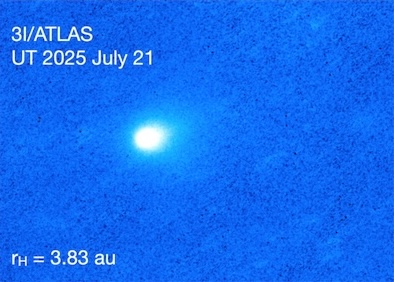
3I/ATLAS as seen by Hubble on 21 July 2025, when the comet was 3.83 au from the Sun. [Adapted from Jewitt et al. 2025]
David Jewitt (University of California, Los Angeles) and collaborators used the Hubble Space Telescope to observe the interstellar object 3I/ATLAS just a few weeks after it was discovered. These observations allowed the team to constrain the object’s mass-loss rate and the size of its nucleus, placing its radius between 0.22 and 2.8 kilometers.
Why it’s interesting:
3I/ATLAS is just the third known object to visit our solar system from another planetary system. With such a small sample size, every interstellar object discovered is a source of fascination. Are these objects more like comets or asteroids? How many of them roam the space between the stars? What, exactly, launches them into interstellar space? Using all available tools, including powerful observatories like Hubble, researchers can extract as much information as possible when interstellar objects make their brief journeys through our solar system, and get us closer to answering these key questions.
How these observations were planned, and what happened afterward:
After interstellar objects 1I/ʻOumuamua and 2I/Borisov zipped through the solar system in 2017 and 2019, respectively, researchers knew it was only a matter of time before the next interstellar interloper paid a visit. In preparation for the next arrival, Jewitt’s team proposed a target-of-opportunity observation with Hubble. This allowed them to disrupt the telescope’s planned observing schedule once 3I/ATLAS was discovered, getting an early high-resolution look that could guide further observations. Since then, researchers have published more than 30 articles in the AAS journals alone about 3I/ATLAS. In these articles, researchers have sought to understand where 3I/ATLAS came from, investigated its polarization properties, collected JWST data of the object, found it in pre-discovery data, and much more, crafting a comprehensive view of a rare visitor to our neighborhood.
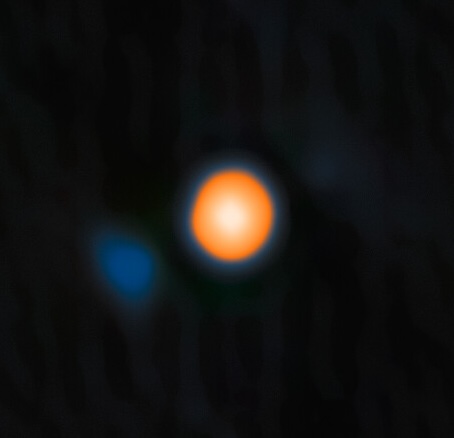
Multiple research teams have turned to the famous red supergiant Betelgeuse in search of a possible companion star hiding in its glare. A carefully designed spectroscopic search has placed new constraints on the identity of Betelgeuse’s stellar buddy.
Betelgeuse, a nearby red supergiant, is a variable star with a 400-day primary pulsation period and a 2,100-day secondary variation period. Recent studies have speculated that this secondary period is due to the presence of an 0.5–2.0-solar-mass companion star (often nicknamed “Betelbuddy”), and researchers using a speckle imaging technique likely spotted this companion earlier this year.
As is often the case when there’s an intriguing astronomical possibility, multiple research teams have sought out Betelgeuse’s purported stellar companion in different ways. One avenue recently described in a published paper was spectroscopic, searching for signs of ultraviolet emission lines from a growing young star.
Spectroscopic Search
In just 10 million years, Betelgeuse has sped through its main-sequence lifetime and taken on a new starring role as a red supergiant. In contrast, a 0.5–2.0-solar-mass companion star would not have even reached the main sequence in the same span of time. How is it possible to spot a tiny young stellar object next to a much brighter supergiant?
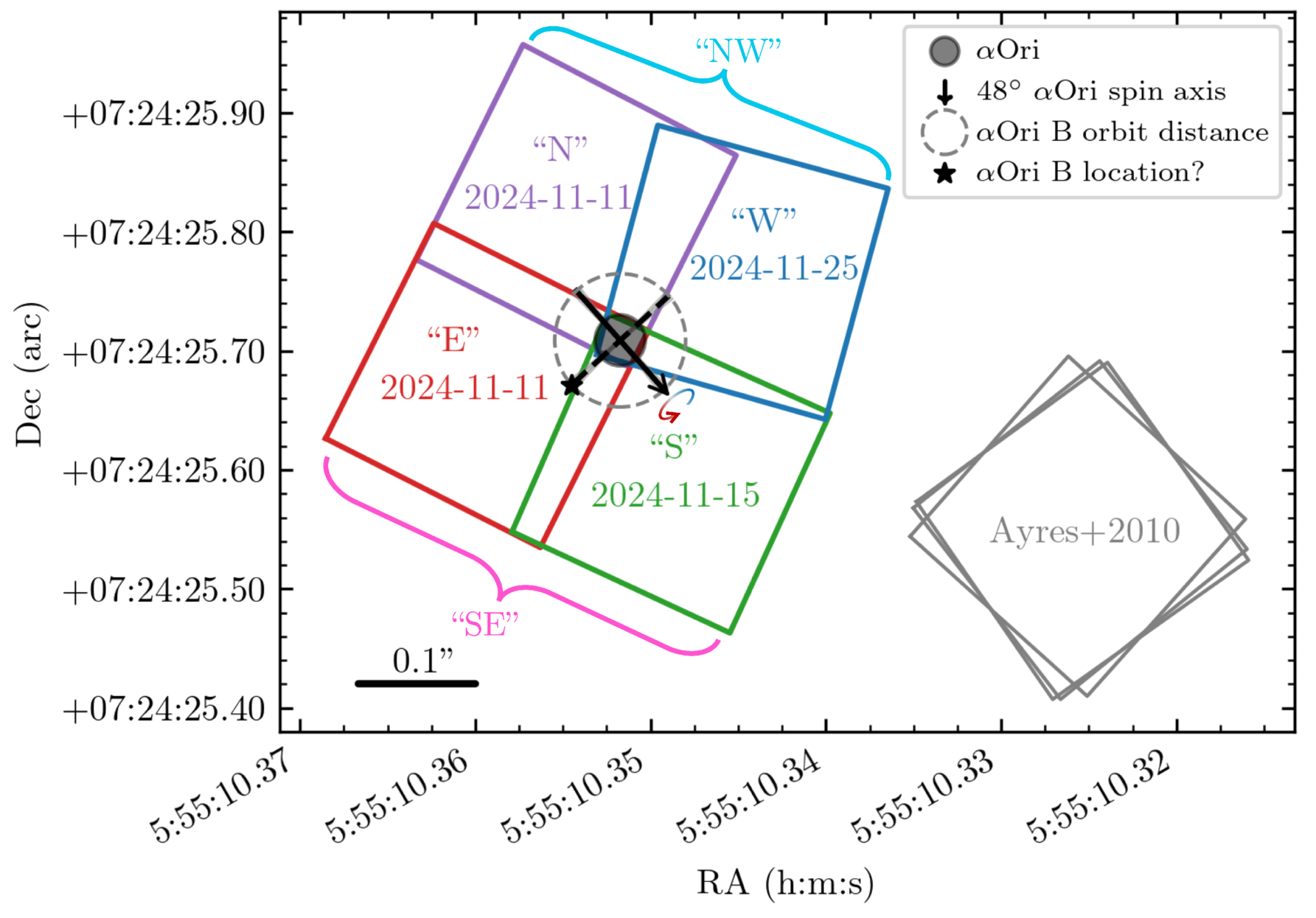
Hubble observing pattern, showing how the quadrants are arrayed around Betelgeuse. Click to enlarge. [Goldberg et al. 2025]
A team led by Jared Goldberg (Flatiron Institute) found a possible way forward in the far-ultraviolet, where young stellar objects and red supergiants both display prominent emission lines. Though Betelgeuse would greatly outshine its stellar buddy, the companion’s orbital motion should shift its emission lines relative to those of Betelgeuse, bringing them into view. To guide their search, the team consulted spectra of known young stellar objects, finding a dozen ultraviolet spectral lines that either rival the strength of those from Betelgeuse or aren’t present in Betelgeuse’s spectrum at all.
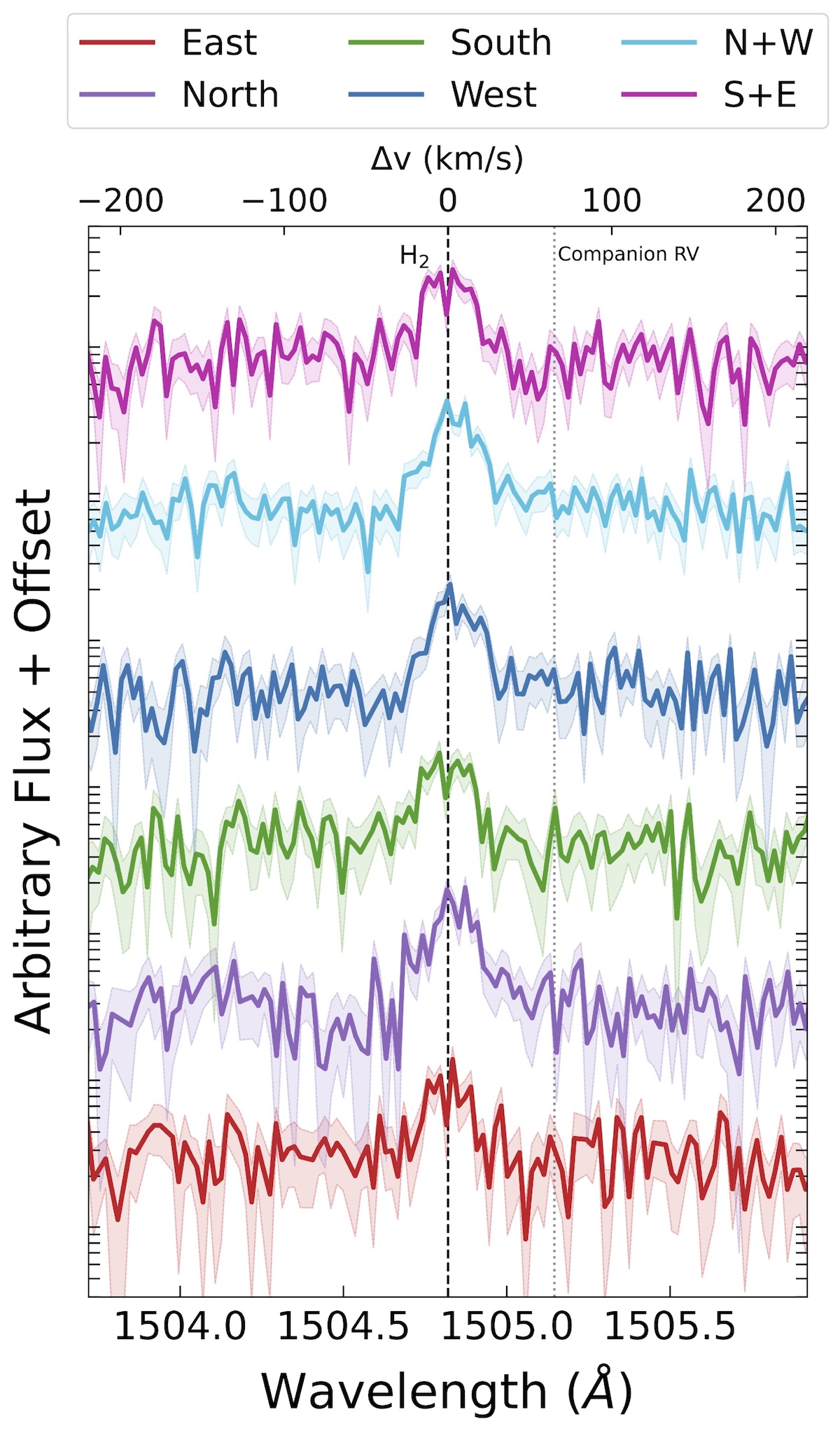
The search is on: Goldberg and collaborators observed Betelgeuse with the Hubble Space Telescope in November 2024, timed to when the companion star’s emission lines would be shifted relative to Betelgeuse. The observations split Betelgeuse’s disk into quadrants, only one or two of which should contain the companion, helping the team tease out the signal from the smaller star, if present. Ultimately, though, no statistically significant signals were found.
Emission around Betelgeuse’s 1504.82 Angstrom H2 line from each of the four observed quadrants as well as combinations of two quadrants. No significant signals were detected at the expected radial velocity of the companion star. [Goldberg et al. 2025]
When Finding Nothing Tells You Something
A lack of a significant detection doesn’t mean that the companion isn’t there, but it does place constraints on its identity. The data confidently rule out a companion star twice as massive as the Sun, marginally permit a star in the 1.1–1.5-solar-mass range, and favor a star lower than 1.1 solar masses.
Researchers assigned a likely mass of about 1.5 solar masses to the probable companion star imaged earlier this year. Though this is at the limit of what’s permitted by the ultraviolet observations, Goldberg and coauthors note that the companion star’s ultraviolet output could be suppressed due to tidal coupling with Betelgeuse or other processes. If the star’s ultraviolet emission is lower than expected, a 1.5-solar-mass companion remains consistent with Hubble’s non-detection of the star.
This is a fantastic example of how multiple lines of inquiry can converge on similar solutions. With the companion star expected to swing around to a favorable observing position again in 2027, this is certainly not the last chapter in the tale of Betelgeuse and Betelbuddy.
Citation
“Betelgeuse, Betelgeuse, Betelgeuse, Betel-buddy? Constraints on the Dynamical Companion to α Orionis from HST,” Jared A. Goldberg et al 2025 ApJ994 101. doi:10.3847/1538-4357/ae0c0c

 Login