Login
Evolution of Biological Information: Lizards and a “New” Organ
5 August 2026 at 23:35
The first experiment that Christoph Adami discusses is one where scientists transported lizards from one island to another.

Visible in Scotland, the total solar eclipse of Aug. 2, 1133, featured nearly 4½ minutes of totality. This eclipse provides just one of many historical examples of people wrongly associating a celestial spectacle with an earthly event: In his Historia Novella, written between 1140 and 1143, English historian William of Malmesbury linked the eclipse withContinue reading "Aug. 2, 1133: A total eclipse is misremembered"
The post Aug. 2, 1133: A total eclipse is misremembered appeared first on Astronomy Magazine.
The longest total solar eclipse visible from land until 2114 will sweep across Spain and North Africa on August 2, 2027. Here’s how to choose where to watch it.
The post Plan for Next Year's Total Solar Eclipse: August 2, 2027 appeared first on Sky & Telescope.
Smart wearables continue to evolve, and DT NO.1 E08 Smart Cycling Glasses are a perfect example of how artificial intelligence, photography, and audio technology can be integrated into a lightweight pair of sports glasses. Designed for cyclists, outdoor enthusiasts, and tech lovers, the E08 combines AI recognition, hands-free photography, video recording, music playback, and voice interaction into a single wearable device.
The DT NO.1 E08 features a sporty cycling-glasses design that prioritizes comfort and stability during outdoor activities. Whether you’re riding a bike, hiking, running, or traveling, the lightweight frame provides a secure fit while offering protection from sunlight and wind.
Its modern aerodynamic appearance makes it suitable for both athletic and casual use, allowing users to capture experiences without carrying additional devices.

One of the biggest highlights of the E08 is its built-in AI functionality. The glasses support OpenAI-powered recognition technology, enabling users to interact with intelligent voice features while on the move.
AI capabilities include:
These features transform the glasses from a simple recording device into a wearable AI companion.
The integrated 13MP camera allows users to capture moments directly from their point of view. Unlike traditional action cameras, the E08 records exactly what the wearer sees, making it ideal for cycling adventures, scenic rides, and outdoor exploration.
Photo resolution reaches up to 32MP, delivering detailed images suitable for sharing on social media or preserving memorable experiences. The hands-free design means users can focus on the activity rather than holding a smartphone.
For video creators and outdoor sports enthusiasts, the E08 supports 1080P HD video recording. Electronic Image Stabilization (EIS) helps reduce vibrations and shaking, producing smoother footage during movement.
Whether cycling through city streets or mountain trails, the stabilization technology improves recording quality and makes videos more enjoyable to watch.
The inclusion of Wi-Fi 6 technology enables faster wireless transfers and improved connectivity. Users can quickly synchronize photos and videos with their smartphone, reducing the need for cables and simplifying content sharing.
Wi-Fi 6 also enhances communication between the glasses and companion applications, ensuring responsive performance for AI features and media management.
The E08 functions as more than just smart glasses. Built-in speakers provide an open-ear listening experience, allowing users to enjoy music, navigation prompts, and voice responses while remaining aware of their surroundings.
This design is especially beneficial for cyclists and runners who need to hear traffic, pedestrians, and environmental sounds for safety. The device supports up to 10 hours of music playback, making it suitable for long rides and outdoor adventures.
Beyond photography and audio, the DT NO.1 E08 offers a range of intelligent functions:
These features make the glasses useful not only for sports but also for travel, commuting, sightseeing, and daily activities.
For cyclists and outdoor enthusiasts, the E08 provides a practical combination of safety and convenience. Users can listen to music, receive AI assistance, capture photos, and record videos without reaching for a smartphone.
The first-person perspective recording capability makes the glasses particularly appealing for adventure content creators, while the open-ear audio design helps maintain environmental awareness during activities. Smart-glasses users often view camera, audio, AI assistance, and battery life as the most important features in everyday wearable devices.
DT NO.1 E08 Smart Cycling Glasses successfully blend AI technology, hands-free photography, HD video recording, and open-ear audio into a versatile wearable device. With its 13MP camera, 32MP photo capability, Wi-Fi 6 connectivity, OpenAI recognition features, and 10-hour battery life, the E08 offers an impressive package for cyclists, travelers, and outdoor adventurers.
For users seeking a smart wearable that can capture experiences, provide AI assistance, and deliver entertainment without sacrificing comfort or awareness, the DT NO.1 E08 stands out as a compelling option in the growing smart glasses market.
The post DT NO.1 E08 Smart Cycling Glasses Review: AI-Powered Vision for Outdoor Adventures appeared first on IGeeKphone China Phone, Tablet PC, VR, RC Drone News, Reviews.
OpenAI family of devices plans are no longer limited to an experimental gadget hidden inside a design studio. OpenAI President Greg Brockman has confirmed that the company’s first consumer device will begin a broader series intended to reconsider how people interact with artificial intelligence.
The confirmation gives OpenAI’s hardware strategy a clearer shape without revealing the first product itself. Brockman said the company is not ready to discuss the device in detail, but described it as the first in a series that will rethink what devices should be when AI can understand language, observe context and complete tasks.
That ambition extends well beyond placing the ChatGPT app on another piece of hardware. OpenAI wants to reduce the menus, buttons, model selectors and separate applications that currently stand between a person and an AI assistant.
For Apple, Google and other established platform owners, the implication is significant. ChatGPT currently reaches consumers through devices and operating systems controlled by other companies. An OpenAI-designed product would give the company direct control over the microphones, cameras, sensors, interface and account experience through which its models interact with people. 56000
OpenAI’s move into consumer hardware accelerated in 2025 when it acquired io Products in a transaction valued at approximately $6.5 billion.
The startup had been founded by former Apple design chief Jony Ive alongside Scott Cannon, Evans Hankey and Tang Tan. Its team included hardware engineers, designers, manufacturing specialists and product developers, many of whom had spent years working together at Apple.
OpenAI and Ive had already been collaborating before the acquisition. Their early ideas developed into physical designs, convincing the partners that they needed a dedicated company capable of engineering and manufacturing complete products rather than another software prototype.
The io team officially merged with OpenAI in July 2025. Ive and his design collective LoveFrom remained independent while assuming extensive design and creative responsibilities across OpenAI.
The structure combines OpenAI’s models and software research with a group experienced in turning new interface concepts into mass-produced consumer products. Ive’s previous work helped shape the iMac, iPod, iPhone, iPad, Apple Watch and other devices that established Apple’s modern design identity.
OpenAI has continued recruiting hardware expertise from Apple. Paul Meade, who led hardware development for Apple Vision Pro and worked on the company’s smart-glasses efforts, reportedly joined OpenAI’s hardware organization in 2026.
OpenAI also placed product-development veteran Peter Welinder in a leadership role connected to the io division. The resulting organization is not structured like a small accessory project. It is being assembled to develop products, create manufacturing relationships and support more than one form factor.
OpenAI has not publicly confirmed the name, appearance, price or specifications of its first device. It has also not presented the product as a smartphone, pair of glasses, wearable pin or conventional smart speaker.
Recent reporting describes a portable, screen-free device designed primarily for use inside the home. The reported product resembles a compact speaker but includes a rechargeable battery, allowing it to move between rooms rather than remain attached to one location.
A camera and additional sensors would help the device understand its surroundings. Mechanical elements could allow parts of it to move, creating a more expressive physical presence than a stationary speaker waiting for a wake word.
The reported design would rely heavily on OpenAI’s latest voice technology. Instead of requiring a person to wait for the assistant to finish speaking, the system could listen and respond more naturally during overlapping conversation. Access to personal information, including messages or email when authorized, could give it enough context to handle requests rather than merely answer questions.
These details remain reported plans rather than announced specifications. OpenAI could change the hardware, features or release schedule before introducing the product.
The company is reportedly targeting a presentation during 2026 and a commercial release in 2027. Fortune separately reported that the initial design has been finalized, although development of the larger product family continues.
ChatGPT already operates across iPhone, iPad, Mac, Android and Windows devices. That wide distribution gives OpenAI access to an enormous audience without requiring it to manufacture screens, batteries or processors.
It also leaves crucial parts of the experience under the control of Apple, Google and Microsoft.
An operating system determines when ChatGPT can use a microphone, whether it can run continuously, how notifications appear and which applications it can control. Platform owners can limit background access, change default-assistant rules or promote their own AI systems more prominently.
Those restrictions matter more as ChatGPT develops from a chatbot into an agent. Answering a question inside an app requires relatively little control over the device. Completing a task across messages, calendars, files, cameras and connected appliances requires deeper access.
OpenAI hardware could be designed around those capabilities from the beginning. The assistant would not need to behave like one application among dozens because it could become the primary interface.
Brockman has described the current ChatGPT interface as too complicated, particularly as new models and tools add more controls. OpenAI’s objective is to make much of that interface disappear.
A successful device could allow someone to describe an outcome instead of opening several applications and completing each step manually. The user might ask the assistant to reorganize a day after a delayed flight, contact the relevant people and adjust reservations. The interface would be the request and the resulting confirmation rather than a sequence of taps.
Calling the project a family of devices changes the strategy. One experimental product would need to prove its value independently. A coordinated group could distribute different sensors and functions across the places where people already live and work.
A home device could provide shared access in kitchens and living spaces. A personal wearable could preserve private conversations while moving outside. A future mobile product could handle visual information, navigation and communication without reproducing the application grid of a smartphone.
OpenAI is reportedly developing approximately five hardware concepts, with the screen-free home companion receiving priority. The company has also explored wearables and home robotics, although none of those later products has been announced.
The devices would become more useful if they shared the same ChatGPT identity, memory controls and task history. A request started at home could continue through another product without requiring the user to repeat the people involved, the desired result or the decisions already made.
That continuity is one of the strongest advantages Apple currently receives from controlling a complete ecosystem. An iPhone, Mac, Apple Watch, AirPods and HomePod can exchange information because Apple designs the devices, operating systems and cloud services together.
OpenAI appears to be pursuing a different center of gravity. Instead of making the operating system coordinate applications, it could make the AI assistant coordinate specialized devices.
OpenAI’s hardware work does not mean the company intends to reserve ChatGPT for its own products.
Brockman has said OpenAI is interested in deeper integrations with smart glasses, wearables and other devices through its application programming interfaces. The company wants ChatGPT to become an interface available across hardware categories, including products manufactured by third parties.
That creates a two-track strategy. OpenAI can use its own devices to demonstrate the experience it considers ideal while allowing other manufacturers to connect their cameras, microphones and sensors to ChatGPT.
Third-party distribution would help OpenAI reach consumers who do not want another dedicated device. It would also reduce the risk of depending entirely on the success of one hardware launch.
The difficult part will be keeping those experiences consistent. A wearable may have limited battery capacity, a camera may require visible privacy controls, and a speaker may depend on cloud processing when a connection is available. OpenAI will need to define what its assistant can do reliably across products with very different technical limits.
The first generation of dedicated AI gadgets established a warning for every company entering this market.
Humane’s AI Pin and the Rabbit R1 attracted attention by promising an alternative to application-based computing. Their launches also exposed problems involving response delays, battery life, incomplete features and tasks that remained easier on a smartphone.
Those products demonstrated that access to a language model does not automatically justify a new object. Consumers need to understand why they should carry, charge and maintain another device when ChatGPT, Gemini and other assistants already operate on phones.
OpenAI has several advantages those earlier companies lacked. It controls one of the most widely used AI services, operates the models behind the interface and has the resources to improve the software after launch. The io acquisition gives it experienced design and manufacturing leadership rather than requiring it to assemble a hardware organization gradually.
The standard will consequently be higher. A well-designed enclosure and natural voice will not be enough if the device cannot complete dependable tasks more efficiently than an iPhone or Android phone.
OpenAI’s expansion beyond Apple devices has also produced a direct legal confrontation with Apple.
Apple filed a federal lawsuit in July 2026 accusing OpenAI, io and former Apple employees of misappropriating confidential hardware information. The complaint alleges that trade secrets connected to unreleased products, engineering processes and suppliers were taken for the benefit of OpenAI’s hardware business.
OpenAI has denied having any interest in Apple’s trade secrets and said it was unaware of evidence giving the complaint merit. The allegations have not been decided by a court.
Apple is seeking restrictions on the use of its confidential information, along with the return of materials and financial damages. The case could require OpenAI to separate employees from parts of the project, replace suppliers or repeat engineering work if disputed information is found inside the development process.
It does not automatically establish that OpenAI’s reported product copies an Apple device. The first OpenAI design is described as substantially different from Apple’s current hardware, but the legal dispute could still affect when it can be manufactured or sold.
The most important details at OpenAI’s eventual hardware presentation may have little to do with the object’s shape.
A camera-equipped device that learns from activity inside a home will need unmistakable recording indicators, understandable data-retention controls and a simple method for temporarily disabling its sensors. Owners will need to know which information remains on the device, what reaches OpenAI’s servers and which memories can be reviewed or deleted.
OpenAI will also have to explain whether the product requires a paid ChatGPT subscription, how much it can do without an internet connection and whether multiple members of a household receive separate identities. Those choices will determine whether it behaves like a personal assistant, a shared appliance or a new subscription terminal.
Support for messages, calendars, music and connected appliances will require cooperation from outside companies. A device cannot replace frequent phone interactions if it remains unable to enter the services where those interactions occur.
The first model will therefore establish more than OpenAI’s industrial-design language. It will set the privacy, account, subscription and developer rules that every later member of the OpenAI family of devices inherits.
The post OpenAI Family of Devices Takes ChatGPT Beyond Apple appeared first on AppleMagazine.
LONDON — In the packed halls of the recent Alzheimer's Association International Conference in mid-July, over 10,000 experts in brain research discussed strategies to beat dementia. But in one room, attendees gathered to watch a video from a nonscientist named Isabel Beltre, whose life was transformed by a recent trial.
Beltre was one of 1,200 participants ages 60 to 77 who took part in the Latin American Initiative for Lifestyle Intervention to Prevent Cognitive Decline (LatAm-FINGERS), the first trial to test a culturally adapted lifestyle intervention to prevent cognitive decline in Latin America. Rather than attempting to treat dementia after it has developed, the trial tackled risk factors that raise the likelihood of the condition, like smoking and a sedentary lifestyle.
In her native Spanish, Beltre thanked both God and the project for its impact on her life. There was a celebratory air in the conference room as the trial's results were released. The lifestyle interventions, which included exercise programs and brain training, had statistically improved participants' thinking skills, compared with a control group who received only bare-bones support, like general health advice.
Trials like LatAm-FINGERS — including a related U.S.-based trial called the POINTER study — ultimately aim to cut rates of dementia around the world. The LatAm trial is the most successful of these trials to date, raising hopes that this approach could help to prevent dementia en masse.
Whether that promise pans out remains to be seen, though, experts told Live Science.
When it comes to dementia prevention, few guidelines are as influential as those written by the Lancet Commission, an expert-led review of the available evidence on dementia. Three editions of this review have provided comprehensive overviews of risk factors; the most recent, published in 2024, identified 14 factors, including smoking, infrequent social contact, and a lack of physical activity.
The commission estimated that, together, the identified risk factors contribute to 45% of dementia cases at a population level.
Long before the 2024 report, Dr. Miia Kivipelto, a professor of clinical geriatrics at the Karolinska Institute in Sweden, wanted to tackle these risk factors at the individual and population level in her work as a medical doctor and epidemiologist.
"I felt that I wanted to move on to interventions to really show that if you do something, you can change the risk," Kivipelto told Live Science.
The many contributing factors that lead to cognitive decline, and ultimately dementia, couldn't be tackled in isolation, Kivipelto realized. She designed a trial in her native Finland, called the Finnish Geriatric Intervention Study to Prevent Cognitive Impairment and Disability (FINGER) study, that would aim to tackle many risks simultaneously.
The two-year project recruited 1,260 participants ages 60 to 77 and divided them into two groups. The first group received general health advice, such as tips on healthy eating and exercise, at the start of the study and then again after six and 12 months.
The other group additionally received a multipart intervention consisting of meetings with nutritionists to discuss personalized meal plans, brain training, exercise programs, social activities, and metabolic and vascular tests. These programs lasted throughout the study period, with the brain training alone including 144 sessions over 12 months of the study.
At the end, the two groups' cognitive skills, such as thinking speed and memory, were tested; the trial did not track dementia rates, only overall cognition. In both groups, these skills improved by the end of the study. But the headline finding was that in the group given the comprehensive intervention, overall brain function was judged to be 25% stronger than in the control group.
What did that difference mean in concrete terms? It turns out, the improvement was relatively small.
I felt that I wanted to move on to interventions to really show that if you do something, you can change the risk.
Miia Kivipelto, professor of clinical geriatrics at the Karolinska Institute
It was calculated in terms of a statistical measure called a z-score, which represented the extent of the improvement in brain-function test scores in each group. In the end, the difference in z-scores between the two groups was just 0.04 points, which a 2021 review defined as "small."
However, Kivipelto maintained that the improvement is significant. "It's as big as anti-amyloid treatments," she said.
Several drugs approved by the U.S Food and Drug Administration for the treatment of Alzheimer's disease target amyloid, a protein that forms unruly tangles in the brain. These drugs have been reported to marginally slow the disease's progression, but statistically, their overall effect is small.
Despite criticism of the trial's moderate effects, Kivipelto's FINGER intervention has since been repeated all over the world, including by the U.S.-based POINTER study, and, most recently, LatAm-FINGERS.
Dr. Gill Livingston, a psychiatrist at University College London who led the 2024 Lancet Commission report, told Live Science that the data from these trials shows that dementia interventions need to be tailored to the risks the participants actually face.
In the POINTER study, 70% of the participants had a college degree, compared with roughly 43% of the wider U.S. population. "People who are usually in randomized controlled trials are usually highly educated people who are very interested in health," Livingston noted. "And that means they're at less risk of developing dementia, and therefore, less can be done to help them" through lifestyle interventions.
The difference between the test group and the control group in the POINTER study was even smaller than in the original FINGER trial — just 0.029 points.
LatAm-FINGERS tried to maximize flexibility in its approach by better tailoring its interventions to its study participants, said study first author Dr. Lucía Crivelli, a neuropsychologist at the neurology center FLENI in Argentina. Dietary advice reflected the produce available in each region. Exercise programs considered local environmental factors; for example, sessions were held outside, avoiding hot gyms during the sweltering summers in Ecuador and Mexico.
The trial recruited volunteers across Argentina, Brazil, Bolivia, Chile, Colombia, Costa Rica, Ecuador, Mexico, Peru, Puerto Rico, the Dominican Republic and Uruguay. The participants were less highly educated than the POINTER cohort had been; 37% had no education beyond a high school diploma, compared to just 5% in the POINTER study. That likely made the study participants more representative of people who might benefit from the trial's interventions.
When Crivelli announced the results of the trial at the conference, a large cheer filled the room. The intervention had achieved a difference of 0.11 points between the test and control groups' z-scores — more than twice the difference seen in the FINGER trial.
That difference corresponded to a relative 55% improvement in overall brain function in the test group compared to the control group at the end of the study.
Crivelli, Kivipelto and Livingston all pointed to one key factor in explaining the project's relative success. "In Latin America, there are more modifiable risk factors," Kivipelto summarized.
The study participants had lower academic attainment and higher cardiometabolic risk factors, such as high BMI, than the participants in previous studies. The trial had reaped the rewards of delivering the intervention to people who needed it most, experts concluded.
But the approach wasn't perfect. said Dr. Claudia Suemoto, a neuroscientist at the University of São Paulo who presented a detailed breakdown of the trial's results. They found that the intervention didn't improve men's overall cognitive ability, compared with the control group. Only women benefited.
The difference may be that men simply didn't engage in the trial as much as women did, Suemoto's data suggested. Livingston pointed to the trials' exercise classes as an example of an activity that men may not be as likely to participate in, although that's an assumption rather than being based on the trial data.
The LatAm-FINGERS results show that addressing the dementia risk factors that people face is the most effective way to prevent dementia, Livingston said.
And Livingston is leaning into the idea. She's planning a dementia prevention trial in the U.K. that will ask participants about their risk factors and then give them tailored interventions based on the risks they can realistically avoid.
"We ask them to choose which ones they want," Livingston said. "If somebody doesn't want to stop drinking or smoking, then they're not going to."
While LatAm-FINGERS has been the most successful of the FINGER trials to date, it's still unclear whether such projects actually reduce dementia rates.
Only two previous prevention trials have attempted to measure dementia incidence, and neither saw a notable change in their test group. That said, neither trial included cognitive training interventions like FINGER did; they instead focused on cardiovascular risk factors, such as low exercise rates and high body weight.
Measuring changes in dementia rates requires trials much longer than two years, and they also need massive recruitment. Implementing an intensive study like LatAM-FINGERS in the wider community "is not practical," Crivelli said. Instead, she said the study's interventions would need to be distilled into their essential parts so that they could be implemented at scale.
Kivipelto is optimistic that advances in Alzheimer's screening, including new blood-based tests, could provide an early biological measure to show that FINGERS-style interventions can help stave off dementia. This would be an indirect measure but wouldn't require as long a trial as tracking dementia rates.
Some of the risk factors the Lancet Commission identified, like air pollution, can't be modified at an individual level, Livingston noted. A combination of personal and governmental change could address this, she said, as it has in the realm of infectious-disease prevention.
While the scientific field still has uncertainty about the scale of change that trials like FINGERS can bring about, Beltre has little doubt about the trial's impact.
While she previously relied on help from family members like her grandson to complete everyday activities, she said, "I do everything myself now."
This article is for informational purposes only and is not meant to offer medical advice.
See how much you know about the most complex organ in the human body with our brain quiz!
A solar eclipse, the Perseids, bright Venus after sunset, and a deep partial lunar eclipse highlight August’s skywatching.
A solar eclipse, one of the year’s best meteor showers, Venus at its brightest in the evening sky, and a lunar eclipse to close out the month.
That’s “What’s Up” for August.
On Aug. 12, a total solar eclipse crosses northern Russia, Greenland, Iceland, and northern Spain, with a small corner of Portugal inside the path of totality.
In parts of the United States, from Alaska to North Carolina, the eclipse is partial. The Moon will take only a small bite out of the Sun, and the amount of coverage will vary with location.

Remember to watch safely. Use certified eclipse glasses or a safe solar viewer any time any part of the Sun is visible. Regular sunglasses are not safe. And never use binoculars, a telescope, or a camera without a solar filter made for the front of the optics.
Later that same night, the Perseid meteor shower will light up the sky, peaking the evening of Aug. 12 into the early morning hours of the 13th. And with a New Moon arriving on the 12th, the skies will be ideally dark.
The Perseids happen every year when Earth passes through a debris stream left behind by Comet Swift-Tuttle. As those tiny bits of comet dust hit our atmosphere at high speed, they burn up as bright streaks of light.
To view this meteor shower, look toward the northeast once it’s fully dark and watch for the constellation Perseus to clear the horizon. This is where the meteors originate, but let your eyes wander, because they can flash across any part of the sky.
For the best view, stay out late as the stars climb higher, find a dark open spot, and give your eyes 30 minutes to adjust.

Aug. 14-16, Venus reaches its greatest eastern elongation, which is its widest apparent separation from the Sun during this evening appearance.
Look low in the western sky shortly after sunset for the bright object that will outshine every star around it. Through a telescope after sunset, Venus will look close to half lit, like a tiny lunar phase.

On the night of Aug. 27, continuing into Aug. 28 for some time zones, the Full Moon slips through Earth’s shadow, resulting in a partial lunar eclipse. It will be visible from much of North and South America and parts of Europe and Africa.

At maximum eclipse, about 93% of the Moon’s diameter will be inside Earth’s dark central shadow, called the umbra. The Moon will not be completely covered, but it can look dramatically darkened, with a rusty, coppery tint along the covered edge.
Unlike a solar eclipse, a lunar eclipse is safe to watch with just your eyes. Binoculars or a small telescope can give you a closer view of Earth’s curved shadow moving across the Moon.
Here are the phases of the Moon for August.
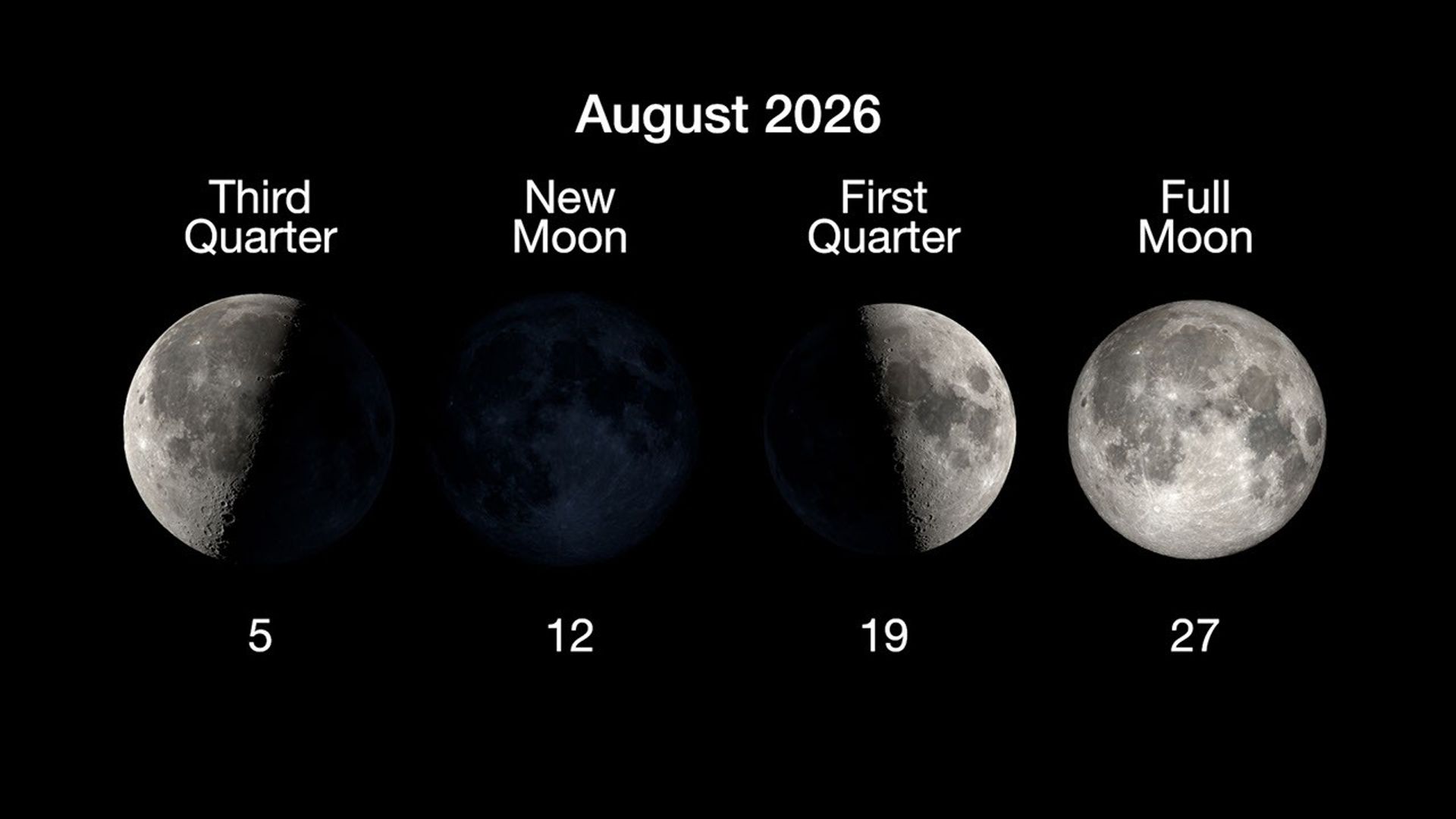
You can stay up to date on all of NASA’s missions exploring the solar system and beyond at science.nasa.gov. I’m Raquel Villanueva from NASA’s Jet Propulsion Laboratory, and that’s What’s Up for this month.
The post What’s Up: August 2026 Skywatching Tips from NASA appeared first on NASA Science.
A solar eclipse, the Perseids, bright Venus after sunset, and a deep partial lunar eclipse highlight August’s skywatching.
A solar eclipse, one of the year’s best meteor showers, Venus at its brightest in the evening sky, and a lunar eclipse to close out the month.
That’s “What’s Up” for August.
On Aug. 12, a total solar eclipse crosses northern Russia, Greenland, Iceland, and northern Spain, with a small corner of Portugal inside the path of totality.
In parts of the United States, from Alaska to North Carolina, the eclipse is partial. The Moon will take only a small bite out of the Sun, and the amount of coverage will vary with location.
Remember to watch safely. Use certified eclipse glasses or a safe solar viewer any time any part of the Sun is visible. Regular sunglasses are not safe. And never use binoculars, a telescope, or a camera without a solar filter made for the front of the optics.
Later that same night, the Perseid meteor shower will light up the sky, peaking the evening of Aug. 12 into the early morning hours of the 13th. And with a New Moon arriving on the 12th, the skies will be ideally dark.
The Perseids happen every year when Earth passes through a debris stream left behind by Comet Swift-Tuttle. As those tiny bits of comet dust hit our atmosphere at high speed, they burn up as bright streaks of light.
To view this meteor shower, look toward the northeast once it’s fully dark and watch for the constellation Perseus to clear the horizon. This is where the meteors originate, but let your eyes wander, because they can flash across any part of the sky.
For the best view, stay out late as the stars climb higher, find a dark open spot, and give your eyes 30 minutes to adjust.
Aug. 14-16, Venus reaches its greatest eastern elongation, which is its widest apparent separation from the Sun during this evening appearance.
Look low in the western sky shortly after sunset for the bright object that will outshine every star around it. Through a telescope after sunset, Venus will look close to half lit, like a tiny lunar phase.
On the night of Aug. 27, continuing into Aug. 28 for some time zones, the Full Moon slips through Earth’s shadow, resulting in a partial lunar eclipse. It will be visible from much of North and South America and parts of Europe and Africa.
At maximum eclipse, about 93% of the Moon’s diameter will be inside Earth’s dark central shadow, called the umbra. The Moon will not be completely covered, but it can look dramatically darkened, with a rusty, coppery tint along the covered edge.
Unlike a solar eclipse, a lunar eclipse is safe to watch with just your eyes. Binoculars or a small telescope can give you a closer view of Earth’s curved shadow moving across the Moon.
Here are the phases of the Moon for August.
You can stay up to date on all of NASA’s missions exploring the solar system and beyond at science.nasa.gov. I’m Raquel Villanueva from NASA’s Jet Propulsion Laboratory, and that’s What’s Up for this month.
App Store regulatory changes are beginning to affect Apple Services growth as developers gain more ways to avoid Apple’s payment system or pay lower commissions in major markets.
Apple finance chief Kevan Parekh told investors that changes to the App Store business model in some countries had affected its performance during the June quarter. Softer spending on mobile games created additional pressure.
The acknowledgement is significant because regulatory risk has appeared in Apple filings for years without producing a clearly identified effect on Services performance. Apple is now confirming that rule changes have advanced far enough to influence reported results.
The impact does not mean the App Store has stopped growing. Apple described the store as reaching another June-quarter revenue record, while Services expanded by approximately 12% from the previous year.
The emerging issue is the rate of growth. A purchase can still occur inside an iPhone app while generating less revenue for Apple when the customer pays through a developer’s website or uses terms carrying a reduced fee.
Apple did not identify one country or policy as solely responsible for the effect.
The company is adapting to a collection of court orders, competition laws and regulatory agreements that differ substantially among the United States, European Union, China, Brazil, Japan, South Korea and other markets.
Some rules concentrate on payment choice. They allow developers to place links or buttons inside apps leading customers to external checkout pages.
Other changes permit alternative app marketplaces or direct distribution outside the App Store. Several regulators are also examining whether Apple can charge developers for transactions completed through another payment provider.
The financial result depends on the model adopted in each country. Apple may receive no commission, a reduced commission or another fee connected with platform technology and distribution.
This creates a more fragmented App Store business. A subscription sold through the same application can produce different revenue for Apple according to the customer’s country, payment route and the developer terms governing that version of the app.
The most direct change in the United States came from the long-running legal dispute between Apple and Epic Games.
A federal court previously ordered Apple to stop preventing developers from directing customers toward outside purchasing options. Apple responded by allowing certain external links while seeking commissions of between 12% and 27% on purchases completed through them.
The company also introduced design restrictions, an approval process and a warning screen displayed when customers left the App Store environment.
In April 2025, the district court found Apple in civil contempt for failing to comply fully with the anti-steering injunction. The ruling prohibited the company from collecting a commission on purchases made through external links and removed several restrictions governing their appearance.
Apple updated its App Review Guidelines in May 2025. Apps distributed through the United States storefront can include buttons, external links and other calls to action leading customers toward another payment method.
The rules no longer require a special external-link entitlement for the U.S. storefront.
That change gives developers a straightforward financial reason to move some transactions to the web. A company can process a payment through another provider instead of giving Apple a percentage of the digital sale.
The customer can return to the iPhone app and use the purchased subscription or content. The app remains distributed through Apple, but the associated transaction no longer produces the same App Store commission.
Enough developers adopting that route can slow Apple Services growth even if total spending on iPhone applications continues increasing.
The European Union’s Digital Markets Act requires Apple to permit alternative app marketplaces, outside payment systems and other changes intended to reduce its control over iOS distribution.
Developers can remain under Apple’s conventional App Store terms or adopt business terms designed for the European market.
The alternative structure separates several services that were previously combined inside one commission. Developers can choose different levels of App Store support, use Apple’s payment system, provide another payment option or distribute software through a competing marketplace.
Apple introduced reduced commissions and technology-related fees to preserve compensation for the tools, security systems, distribution infrastructure and platform access it provides.
Those terms have changed several times following regulatory objections. Beginning in 2026, Apple started moving from its earlier Core Technology Fee toward a Core Technology Commission applied to eligible digital transactions under particular conditions.
The structure means outside payments do not always eliminate Apple fees in Europe. They can still reduce the amount Apple collects or shift revenue among different fee categories.
Regulators continue examining whether the terms provide meaningful choice or discourage developers from leaving the standard model.
Apple argues that alternative stores and payment systems create additional privacy, security and fraud risks. The European Commission has focused on whether Apple’s warnings, technical requirements and fees make those options unnecessarily difficult to use.
European developers must calculate more than one commission. They need to consider payment-processing costs, marketplace charges, customer acquisition, reporting obligations and the Apple terms attached to each distribution method.
The result may be lower App Store revenue without an equally large shift toward independent marketplaces. External website payments can change Apple’s economics more quickly because they do not require customers to install another store.
App Store regulatory changes are not limited to alternative stores and external payments.
Apple lowered several commission rates in the China mainland storefront beginning March 15, 2026.
Qualifying transactions under the App Store Small Business Program and Mini Apps Partner Program now carry a 12% commission. The same rate applies to eligible auto-renewing subscriptions after the subscriber’s first year.
These transactions previously qualified for a higher 15% rate.
A three-percentage-point reduction may appear small beside demands for completely independent payments. At the scale of China’s app economy, it can remove a meaningful amount of revenue while improving the share retained by developers.
The Mini Apps Partner Program is particularly important in China because large platforms can contain many smaller services inside one host application.
Reducing the commission can encourage those ecosystems to continue using Apple In-App Purchase. It also demonstrates how Apple may respond to pressure by offering more favorable terms before regulators require a more disruptive change.
Lower commissions can support transaction growth over time, but the immediate calculation is straightforward: Apple receives less from each qualifying purchase.
Apple introduced alternative app distribution and payment options in Brazil through an agreement with the country’s competition regulator, CADE.
Beginning with iOS 26.5, developers can distribute apps through alternative marketplaces, operate those marketplaces and process digital payments outside Apple In-App Purchase.
Apps can also present links leading users to an external website where the transaction is completed.
Apple continues applying notarization and other technical requirements to software distributed outside the App Store.
The company maintains that these protections reduce risks but cannot provide the complete safeguards associated with App Review.
Brazil is a major smartphone and digital-services market. Its effect on Apple Services will depend on whether large developers adopt the new options and whether customers are willing to leave the familiar App Store purchasing flow.
An external option existing in software does not guarantee that people will use it. The developer must usually offer a meaningful advantage, such as a lower price, a different subscription package or payment methods better suited to local customers.
Adoption can increase gradually as existing apps release updates. The financial impact may therefore become more visible over several quarters rather than appearing immediately after the regulatory agreement takes effect.
Apple receives a commission when an eligible digital purchase uses its in-app payment system.
The fee compensates Apple for distribution, payment processing, fraud management, developer tools, customer support and access to the iOS platform, according to the company.
The standard percentage varies. Small developers and long-running subscriptions can qualify for reduced rates, while other eligible digital transactions may carry higher commissions.
When payment moves to a developer’s website, an independent processor handles the financial transaction. The developer pays that provider, manages more of the customer relationship and retains the amount that would otherwise become an App Store fee.
Apple may still provide the operating system, APIs, development tools and App Store distribution without receiving the conventional payment commission.
This separation explains why App Store activity and App Store revenue can move differently. People may download more applications and spend more on digital services while Apple captures a smaller percentage of the commerce.
The same customer could maintain several subscriptions used exclusively on an iPhone without any of their monthly payments passing through Apple.
Apple can collect other revenue from that user through hardware, advertising, iCloud or its own subscriptions. The external transaction nevertheless removes one part of the Services model.
The size of the App Store economy should not be confused with Apple’s commissionable revenue.
Apple says the global App Store ecosystem facilitated more than $1.4 trillion in developer billings and sales during 2025. More than 90% of that commerce did not produce a commission for the company.
The largest categories involve physical goods and services such as retail purchases, travel, grocery delivery, restaurant orders and transportation.
Apple does not collect a percentage when someone uses an Amazon app to order furniture, books a hotel or pays for a meal delivered through an iPhone.
App Store commissions generally concentrate on digital goods, application features, virtual items and subscriptions sold through Apple In-App Purchase.
Regulatory changes target this smaller but financially important part of the ecosystem.
Digital transactions require no physical inventory or delivery network, allowing payment commissions to carry attractive margins. Losing part of that revenue can therefore affect profitability more than the dollar amount alone suggests.
Apple does not disclose App Store revenue or profit separately. The category remains combined with cloud services, advertising, media subscriptions, AppleCare, payments and other operations inside Services.
Regulation was not the only factor Apple identified.
Parekh said softer mobile gaming activity also affected the App Store. Games represent an important source of digital transactions because players purchase virtual currency, characters, cosmetic items, subscriptions and access to additional content.
A decline in game spending directly affects the commission Apple receives through In-App Purchase.
Gaming is also one category where developers have pushed aggressively for alternative stores and payments. Epic Games began its legal confrontation with Apple after introducing another payment method inside Fortnite and attempting to bypass App Store commissions.
The simultaneous effects are difficult to separate. A game can generate lower revenue because players are spending less, because payments moved outside Apple’s system or because both changes occurred together.
Apple does not provide enough category detail to calculate the contribution from each factor.
The distinction matters for the outlook. Gaming demand can recover with successful releases and stronger consumer spending. A permanent regulatory change does not reverse when one popular game reaches the top of the charts.
Outside payments can improve the amount a developer retains from each purchase.
A company moving from a conventional App Store commission to a lower-cost web payment processor may use the difference to reduce prices, fund development or improve profitability.
The developer also assumes responsibilities previously handled through Apple.
Independent billing requires payment processing, tax management, fraud protection, refunds, account recovery and customer support. Subscription status must synchronize correctly between the website and the iPhone app.
Customers changing devices or reinstalling an app expect their purchases to remain available. The developer needs its own account system capable of verifying ownership without relying entirely on Apple’s purchase history.
Small developers may decide that Apple In-App Purchase remains worth its fee because it removes operational complexity and gives customers a familiar checkout experience.
Large subscription businesses have stronger incentives to build their own systems. They already maintain accounts and payments across websites, televisions, Android devices and other platforms.
The regulatory effect will therefore vary by developer size and business model. One company may remove Apple billing completely, while another continues using it because external infrastructure would cost more than the commission saved.
External payments create the possibility of lower subscription prices because developers no longer need to incorporate the complete App Store fee into the amount charged.
Some services already cost more when purchased through an iPhone app than through their websites. The higher price allows the developer to preserve similar revenue after Apple receives its share.
A visible external link makes comparing those prices easier. Customers can leave the app, complete the transaction on the web and return with an active account.
Savings are not guaranteed. A developer can retain the entire difference rather than passing it to subscribers.
Independent billing can also make subscription management less consistent.
Settings > Apple Account > Subscriptions
A subscription purchased directly must be canceled through the developer’s website or account system. Customers using many external services may need to remember several billing portals and renewal policies.
Refunds and purchase disputes also move away from Apple. The developer or its payment processor becomes responsible for resolving the transaction.
Choice can reduce prices while increasing complexity. The practical outcome depends on whether developers make external checkout clearly cheaper and easy to manage.
Apple is responding to the changing environment by adding business models and marketing systems that can keep developers using its commerce platform.
Monthly subscriptions with a 12-month commitment allow participating apps to offer lower recurring payments while securing a complete year of revenue.
The Advanced Commerce API supports more complex content catalogs, optional add-ons and subscription structures that were previously difficult to manage through standard In-App Purchase products.
Apple has also expanded tools for custom product pages, promotional offers, application analytics and international distribution.
These additions increase the value attached to App Store billing. A developer may tolerate a commission when Apple provides conversion tools, subscription management and access to promotional placement that would be expensive to reproduce independently.
The company can also adjust rates for particular categories. The Small Business Program, Mini Apps Partner Program and reduced commission for longer-running subscriptions already demonstrate differentiated pricing.
A more competitive payment market may push Apple toward additional service tiers rather than one universal commission.
The United Kingdom’s Competition and Markets Authority is consulting on rules that would allow developers to direct customers outside Apple and Google’s payment systems.
The regulator expects any fee charged for steering to be fair, reasonable and lower than current app-store commissions. It wants the resulting savings passed to customers or reinvested in developer businesses.
The UK proposal is not yet a final requirement. Its eventual structure could determine whether developers receive the broad freedom available in the United States or a fee-based model closer to some European arrangements.
Regulators are also considering app-review fairness, interoperability and access to mobile-platform capabilities.
The outcome will matter beyond British customers. Each major jurisdiction creates another model that regulators elsewhere can examine when designing their own rules.
Apple must decide whether to continue maintaining different commercial systems by country or move toward broader global terms that reduce operational complexity.
Developers face the same choice. Supporting a separate payment route, marketplace package and reporting process for every region can become expensive enough to cancel some of the benefits regulation intended to create.
The next evidence will come from behavior rather than another policy announcement: how many major apps add external payment links, whether they offer lower prices and how quickly customers move away from Apple’s checkout.
The post App Store Regulatory Changes Begin Slowing Services Growth appeared first on AppleMagazine.
Os óculos inteligentes da Meta podem parecer relativamente distantes da realidade brasileira no momento, mas já são um fenômeno (e tanto) lá fora, a tal ponto que o atual terceiro aplicativo pago mais baixado na App Store americana tem como proposta detectá-los; refiro-me ao Antizuck Smart Glasses Scanner.
O interessante é que nem mesmo a procedência desconhecida do utilitário foi capaz de conter a curiosidade dos usuários, interessados em descobrir se ele realmente funciona como anunciado.
A promessa do desenvolvedor Albert Pariente Cohen é de que a detecção ocorre por meio de sinais Bluetooth emitidos pelos óculos, sendo compatível com os Meta Glasses, Ray-Ban Meta, Snap Spectacles, Amazon Echo Frames e o RayNeo. Supostamente, o app também é capaz de estimar a proximidade dos óculos em relação ao iPhone/iPad.


Teoricamente, óculos inteligentes como os da Meta contam com um LED 1Light emitting diode, ou diodo emissor de luz. não removível na lateral, que permitiria às pessoas ao redor alguma ciência de que estão sendo gravadas. Já existem no mercado, no entanto, alternativas para coibir o funcionamento desse mecanismo, como tampas de plástico ou adesivos que inibem a visibilidade da luz de gravação. Varejistas como a Amazon ou a própria Meta trabalham para tirar esse tipo de produto de circulação, mas ainda é possível encontrá-los à venda.
A categoria de produtos levanta constantes debates sobre ética, visto que os casos de gravações não consentidas se tornam cada vez mais frequentes. Na semana passada, o diretor do Instagram, Adam Mosseri, declarou que vídeos contendo gravações de assédio com estranhos em lugares públicos — frequentemente gravados com o hardware da Meta — terão como consequência o banimento na rede social:
Se você está postando conteúdo que tira vantagem de pessoas e assedia elas, como muitos desse tipo de vídeo de cantadas que costumamos ver e ouvir falar, então nós vamos derrubar o conteúdo. […] Nós não queremos que pessoas sorrateiramente gravem vídeos de outras pessoas e as assediem e então postem na nossa plataforma. Então nós estamos tentando lutar de todo o jeito que conseguimos.
O Antizuck Smart Glasses Scanner está disponível por R$20 na App Store.
via 9to5Mac, Business Insider
With 100-plus lectures, practical projects, automation training and more, this Claude AI training bundle helps you get the results you want.
(via Cult of Mac - Your source for the latest Apple news, rumors, analysis, reviews, how-tos and deals.)

Com uma aposta reforçada na criatividade, acompanhada por novidades com IA, o Oppo Reno16 Pro quer conquistar quem valoriza a fotografia e a conveniência de ter todas as ferramentas de edição reunidas num único lugar. Mas a redução da capacidade da bateria deixa a desejar e a subida no preço é difícil de ignorar.
The post Oppo Reno16 Pro acelera na criatividade e inteligência artificial para as fotos, mas perde fôlego na bateria appeared first on Tek Notícias.
Microsoft has had a narrow escape from total embarrassment: A security company uncovered a critical vulnerability that could have compromised all Azure Cosmos DB databases — both those of customers and Microsoft’s own.
Google subsidiary Wiz found a flaw in the database’s Gremlin API, usually used for storing and managing property graph data.
If bad actors had discovered it first, they could have exploited it to acquire what Wiz called the Cosmos Master Key, which would have enabled them to use the primary key of any Cosmos database, resulting in read and write access to any account. They would also have had access to a list of every database on the service, with identifiers such as subscription and tenant IDs.
Azure Cosmos DB is a NoSQL database that underpins Microsoft’s cloud services. It can be accessed through SDKs for framework such as Python, Node.js, Java, and .NET.
Wiz described how it discovered the vulnerability in a blog post. It disclosed details of the flaw to Microsoft in November 2025.
Microsoft deployed a hot fix within two days, but it took another eight months to re-engineer the infrastructure, removing the Cosmos Master Key and introducing new guardrails to Cosmos DB to prevent similar attacks.
It is not the first time Cosmos DB customers’ primary keys have been under threat: In 2021, Wiz found a flaw in data exploration tool Jupyter Notebook that could be exploited to access the database keys and other secrets.
This article first appeared on CSO.
LONDON — New blood tests for Alzheimer's disease aim to catch the condition in its earliest stages. Scientists hope that, someday, by spotting very early signs of dementia and enabling earlier treatments, these tests could significantly improve patients' prognoses.
But how well do current blood tests work for that purpose?
At the Alzheimer's Association International Conference in London on July 12-15, Live Science spoke with researchers and clinicians who study and use blood tests for Alzheimer's disease. Here's their take on the current state of these tests and their practicality for real-world use
People diagnosed with Alzheimer's disease face an incurable condition, but their outlook is marginally more hopeful than it was 10 years ago. That's because the first "disease-modifying" drugs for Alzheimer's, which target the disease's causes rather than its symptoms, have been approved in recent years.
These drugs, which include the lab-made antibodies lecanemab and donanemab, only slow, rather than stop, the progression of the disease. However, researchers hope these medicines could be the precursors to more effective treatments.
Alzheimer's disease researchers hotly debate the exact causes of the condition, but they are united on the idea that early intervention is likely to produce the best possible outcome for patients. The aim is to remove disease-linked proteins before they can damage the brain.
That's why new blood tests for Alzheimer's disease, some of which have been approved in the past year, are exciting so many scientists. These tests, which measure chemical signals of the disease circulating through the bloodstream, are currently paired with other clinical exams to provide an accurate Alzheimer's diagnosis for patients with early symptoms, such as subtle changes to memory or personality.
The hope is that if these patients could be identified at this stage, they could access clinical trials and treatments when they might be the most helpful.
The U.S. Food and Drug Administration (FDA) has approved two blood tests for Alzheimer's disease: Roche's Elecsys pTau181 assay and Fujirebio's Lumipulse G pTau217/ß-Amyloid 1-42 Plasma Ratio test.
An additional test from Roche (the Elecsys pTau217 test) has received a basic safety certification in the European Union and U.K., which allows it to be sold but is not equivalent to FDA approval. This test is not approved in the U.S. yet. A second test from Fujirebio (the Lumipulse G pTau 217 Plasma assay) is in the same boat.
Plus, there are a host of other tests made in specific clinical laboratories; these are not FDA-approved but they are available in certain specialist clinics.
All of these tests in varying stages of approval measure "a core part of the pathology of Alzheimer's disease in the brain," said Dr. Sebastian Palmqvist, a clinical neurologist at Lund University in Sweden. These include two proteins that build up in the brains of Alzheimer's patients: tau and amyloid.
The Elecsys tests and the FDA-approved Lumipulse test measure levels of tau in the blood, while the other Lumipulse test measures the ratio of tau to amyloid. Both measurements can be used to indirectly assess the presence of amyloid plaques, sticky deposits in the brain that are associated with the disease's progression.
It's important to note that the blood tests alone aren't diagnostics for Alzheimer's disease, said Dr. Jemma Hazan, an old-age psychiatrist at University College London. Instead, "the test is telling you whether you have certain abnormal proteins in your brain." This, she said, makes it important to use the test in a setting where patients can be properly directed to the next steps of diagnosis and treatment.
Currently in the U.S., Alzheimer's blood tests are approved for use only for adults ages 55 and older who have signs of cognitive impairment, like memory problems. Palmqvist said these tests are best used by specialists with knowledge of dementia, such as doctors in memory clinics. They aren't approved for use by primary care doctors in the U.S.
"The clinicians working there [at memory clinics] have many, many years of experience of interpreting these types of biomarkers," he explained.
Before the advent of these blood tests, memory clinics had to rely solely on expensive brain scanning technology or invasive lumbar punctures to identify physical signs of Alzheimer's disease. The new tests greatly simplify diagnosis, Palmqvist said, but they still need to be used in combination with other tests.
So currently, if a patient receives a positive blood test, they must undergo further cognitive testing, brain scans or invasive biomarker analyses to confirm the diagnosis.
While for now the blood tests are best used by specialists, data that Palmqvist presented at the conference suggested that access to a blood test result may improve a primary care physician’s diagnostic accuracy to levels closer to a memory clinic specialist's. That hints that the test may eventually be usable in primary care, without more invasive diagnostics.
In clinical trials, the approved Lumipulse test had a sensitivity of 97.6% and a specificity of 90.8%. Sensitivity refers to the percentage of people who do have amyloid in their brains that test positive — so it's the rate of true positives. Specificity refers to the percentage of healthy people who test negative, meaning true negatives.
However, the test was recalled in February because it returned an unusually high percentage of false-positive results when it was used in the real world, compared to clinical trials. Palmqvist said there's now a newer version of the same test that avoids this problem.
Analyses comparing pTau217 and pTau181, the two tau biomarkers that Roche uses in its tests, have concluded that pTau217 is a more accurate indicator of Alzheimer's disease. That means it more closely matches results from gold-standard amyloid brain scans.
Dr. Ashton Harper, global medical affairs lead for neurosciences at Roche Diagnostics, said the Roche pTau217 test correctly spotted Alzheimer's-linked proteins 96.1% of the time and accurately ruled out that pathology 94.7% of the time in trials. By comparison, pTau181 — the Roche test approved in the U.S. — correctly identified Alzheimer's pathology 83.6% of the time and ruled out pathology in healthy brains 72.2% of the time.
Patients who take this more-accurate test are given one of three possible results based on two cutoff points, Harper said. If their tau level comes back above the upper cutoff — giving a positive result — clinicians can be "highly certain" that the patient has disease-linked amyloid in their brain, he said.
Below the lower of the two cutoffs, clinicians can be confident that their patient doesn't have any disease-linked amyloid in their brain. If the reading comes back in between the two cutoffs, though, the result is uncertain.
Current guidelines set by the Alzheimer’s Association require that patients end up in that gray area no more than 20% of the time, and the pTau217 test meets that requirement, Harper said. As with patients who get a positive test result, patients who receive these uncertain results are also advised to undergo further testing, such as scans or cognitive tests.
There are other reasons a person without Alzheimer's disease might get a positive test result; rare cases of severe kidney disease, for example, can artificially inflate the test's readings.
Harper said early data suggests that Roche's pTau217 test is roughly as accurate at detecting Alzheimer's disease proteins in cognitively unimpaired people as it is in those with symptoms. This may someday open the door to prevent Alzheimer's in patients who have not yet developed symptoms, he suggested, clarifying that Roche's test is not intended for that use yet.
In the U.S., these tests can help patients get a diagnosis more quickly, but treatment options for the condition remain limited.
The approved antibody drugs are available through both private and government insurers, but they still cost the patient thousands of dollars each month. And again, these drugs only slow, rather than stop, the progression of the disease.
Researchers hope that early treatment with the drugs will enhance their effectiveness, but as of yet, there's no published data to back this idea up.
Diagnostic accuracy is important in its own right so that people feel more certain about the diagnosis and also there are management implications.
Dr. Jemma Hazan, an old-age psychiatrist at University College London
In the U.K., disease-modifying drugs like the antibodies have not been approved by the U.K.'s National Health Service (NHS) yet. Because the drugs only modestly slow Alzheimer's progression, ultimately, the NHS determined that they were too costly to cover without clearer signs of efficacy. That means British patients cannot access the drug for free.
Still, Hazan said a positive test could be beneficial for patients.
"Diagnostic accuracy is important in its own right so that people feel more certain about the diagnosis and also there are management implications," Hazan said. While they can't access antibody drugs, patients do have access to drugs that help ease the condition's cognitive and behavioral symptoms, as well as non-pharmacological treatments like behavior management.
Diagnosed patients can also access one of the many clinical trials for the condition. It's estimated that 50,000 patients are needed to populate these ongoing trials worldwide.
Hazan and Palmqvist agreed that, despite the blood tests' accuracy, they should not be used to preventively screen for Alzheimer's in people with no symptoms. That's because testing in a wider population, where fewer people will have Alzheimer's disease, naturally increases the number of false-positive results, even while the assay itself retains the same level of accuracy. This could lead many healthy people to be incorrectly diagnosed with Alzheimer's disease, which would cause stress for patients and have significant financial implications for healthcare systems.
Newer tests that are still in development may help reduce the likelihood of false positives by measuring only a subset of tau protein that comes directly from the brain rather than from the rest of the body, Palmqvist said. But for now, mass screening remains a goal, rather than a reality, for these blood-based Alzheimer's diagnostics.
"I think that's the next frontier," Palmqvist said.
This article is for informational purposes only and is not meant to offer medical advice.
See how much you know about the most complex organ in the human body with our brain quiz!
Bats have long posed an immunological mystery: They can harbor viruses that cause severe diseases in other animals, including humans, yet they rarely show signs of illness. Now, scientists have discovered a big clue as to why that is.
Researchers uncovered an unusual feature of bat immunity that could help to explain how these mammals evade infections. Vesper bats, the world's largest family of bats, may possess two separate genetic systems for producing the building blocks of antibodies, the immune proteins that latch onto germs. This configuration has never been found before in mammals.
"It was really surprising," study co-author Hannah Frank, an associate professor of ecology and evolutionary biology at Tulane University, told Live Science. "The only other vertebrates we see something similar in are fish."
The findings, published Wednesday (July 29) in the journal Science Advances, could open new avenues for studying viral infections and the evolution of immunity.
"The study provides a novel view into the evolution and diversity of adaptive immunity in bats," said Daniel Becker, an associate professor of biology at the University of Oklahoma who was not involved in the study. "The duplication seen in vesper bats is really intriguing and suggests that we need more immunological study of this globally distributed family of bats," Becker told Live Science in an email.
Antibodies are Y-shaped proteins that help the immune system recognize and neutralize foreign invaders, including viruses, as well as other threats, like toxins. Each antibody contains two "heavy chains" and two "light chains," structures that work together to recognize and bind to specific features of viruses, bacteria or other targets.
The tips of the Y shape are responsible for recognizing the targets, while other parts of the antibody help determine how the immune system responds — by blocking pathogens from infecting cells or flagging them for destruction by other immune cells, for instance.
In humans and most other mammals, the genes that build antibody heavy chains are organized into a single region of the genome, called a locus. Cells create a wide range of antibodies by mixing and matching the proteins encoded in different segments of that locus.
But when Frank and her team examined 26 bat species, they found two complete heavy-chain loci located on different chromosomes. The team then showed that both sets of genes were functional and actively used by immune cells to build antibodies. The finding was initially surprising enough that the researchers considered whether it could be an error in how they'd assembled the bats' genomes after sequencing them.
However, Frank's collaborator and former graduate student Dr. Taylor Pursell thought the finding might be genuine, rather than an experimental fluke.
"She said, 'No, Hannah; this is really weird — like, this doesn't happen,'" Frank recalled. "And I said, 'Oh my God; you're right. This is not just an experimental annoyance. This is actually super cool.'"
Using genetic analysis, the team found that one of the two loci contained a larger and more varied collection of gene segments that could be used to create a broad, ready-made repertoire of antibodies. The other had fewer of these building blocks but appeared to rely more heavily on a process called somatic hypermutation, in which antibody-producing cells make small genetic changes after encountering a pathogen.
Those changes can help antibodies become more "customizable" to whatever threatens the immune system, Frank said.
She compared this system to the different layers of defense seen in the 1998 Disney movie "Mulan." Upon seeing invaders at the Great Wall of China, guards raised an alarm to alert others without yet knowing the specific threat; this is like the innate immune system, the body's first, broad line of defense. The adaptive immune system is more like the heroine Mulan: highly targeted and capable of responding to a specific enemy, but slower to develop.
This study suggests bats have more diversity to start with, which may allow for faster and more effective responses from the start of an infection.
Michael Letko, molecular virologist at Washington State University
These two layers of immune defense are not unique to bats, but bats' two antibody systems may provide an additional layer of protection.
From each loci, bats can create a "cache of trainable, customizable cells," Frank said. This degree of customization could help the bats immune system ward off a wider range of threats than other mammals can.
"This extra set of genes gives the animals more diversity in their antibodies," said Michael Letko, a molecular virologist at Washington State University who was not involved in the study. "This study suggests bats have more diversity to start with, which may allow for faster and more effective responses from the start of an infection," Letko told Live Science in an email.
Letko added that the genetic analysis in the study was impressive and lends credibility to the results. "It is hard to dispute the validity of information solidly founded on the genetic organization of these bats," he said.
That interpretation remains a hypothesis, though; Frank and her team will need to study how these two systems behave when bats are exposed to viruses before they can determine exactly what advantages they provide.
"We think this discovery is an important piece of the puzzle," Frank said in a statement. "It doesn't fully explain why bats are such effective viral reservoirs, but it reveals a level of immune variety we didn't know existed and gives us an entirely new direction to explore."
Past studies of bat immunity have found that hotter body temperatures and a larger number of virus-filled packages in stem cells could also help bats' tolerate viruses better.
Understanding how bats tolerate viruses could help scientists predict which kinds of bats are most likely to affect human health and how we can mitigate those risks, Becker noted. Separately, bats have a notably low incidence of tumors and cancer, Letko said, and he wonders if their unique immune systems might hold clues as to why.
While bats are often viewed through the lens of the infectious diseases they carry, their story is far more complex, Frank said.
"Let's learn from the guys who've been evolving with them [viruses] for millions and millions of years," Frank said. "But let's try not to villainize them for surviving for millions and millions of years."
Oracle on Tuesday described new EBCDIC character set compatibility features in Oracle AI Database for customers transitioning from legacy databases on IBM mainframes.
In its post, Oracle noted that EBCDIC compatibility has historically been one of the top technical challenges for enterprises re-platforming to use newer, ASCII-based databases while continuing to use proven legacy applications.
“Achieving this goal requires more than simply moving data. It requires preserving the EBCDIC compatibility on which existing applications depend,” wrote Michael Yau, VP for Oracle Database Globalization Engineering. The feature rollout “addresses two fundamental challenges of preserving EBCDIC compatibility: accurate character encoding conversion and preservation of EBCDIC binary ordering.”
He added: “These client character sets implement IBM Character Data Representation Architecture (CDRA) code page definitions, providing source-to-target character mappings that are compatible with IBM’s published standards. This enables accurate and predictable character encoding conversion during data migration and subsequent database client/server communication.”
Yao observed that this is important because these mainframe migrations can be very complex.
“Many legacy EBCDIC applications, such as those written in COBOL, implicitly rely on the EBCDIC binary ordering defined by IBM EBCDIC code pages. SQL predicates that compare character values, perform range searches, or sort query results often assume this ordering,” he wrote. “After migration to an ASCII-based Oracle AI Database character set, these same SQL statements can produce different results, not because the data changed, but because the database’s default binary ordering follows that of the ASCII-based database character set rather than the source EBCDIC code page.”
While consultants generally applauded the new features, some questioned whether this will simply shift enterprise dependency on IBM to dependency on Oracle.
Sanchit Vir Gogia, chief analyst at Greyhound Research, is one of the fans.
“Oracle has repaired one of the oldest silent faults in mainframe migration: EBCDIC ordering, the muscle memory of the legacy estate. Preserve the data and lose the ordering, and a query returns the wrong record while every dashboard stays green,” he said. “The application runs and the query completes. The answer is simply wrong.”
Gogia noted that the new feature is “not a modernization suite. It is a compatibility repair, narrow and genuinely useful, which CIOs who have bled on past migrations will read with equal parts relief and suspicion.”
AJ Thompson, CCO at UK IT consulting firm Northdoor, agreed that the Oracle announcement addresses a genuine technical barrier rather than just being a marketing gimmick, so it is worth taking seriously as a re-platforming enabler. “The two problems it solves, EBCDIC to ASCII character conversion and preserving EBCDIC binary sort ordering, have historically been real blockers for allowing COBOL to move away,” he said.
But, he cautioned, CIOs must also take resiliency challenges seriously. “Mainframes are not chosen primarily for character encoding, they are chosen for benefits like decades of proven uptime, IBM Z’s redundancy architecture, and workload isolation,” he pointed out.
“Oracle’s announcement solves a data compatibility problem, not a resilience or availability one. A client with genuinely mission-critical, zero-downtime workloads will still need convincing on the availability and disaster recovery side before moving [to the cloud], and Oracle’s own resilience claims would need scrutiny on their own merits, quite separate from this EBCDIC work.”
Mike Wilkes, enterprise CISO at Aikido Security, added that Oracle is leveraging IT desperation to squeeze long-term value from legacy systems.
“I have always believed that Oracle will own the very last white-knuckle-grip workloads that migrate from on-premises data centers into the cloud,” he said. “This announcement certainly demonstrates that they understand their position in the world of cloud service providers. They are not the biggest, they are not the oldest, and they are not the most technically advanced. But they do own the market share for the trailing edge of cloud adoption.”
He pointed out that the greatest barrier to cloud migration is not containerizing modern applications, it is the decades of business logic buried inside COBOL applications and EBCDIC-encoded data.
“Oracle’s EBCDIC compatibility features acknowledge a practical reality: organizations are not rewriting these systems from scratch,” he said. “If Oracle can reduce the cost, risk, and operational disruption associated with moving those workloads, the announcement represents meaningful value for IT teams that have been delaying modernization because the migration path was simply too complex or too expensive.”
Then again, Wilkes noted, there is the potential for increasing vendor lock-in.
“Compatibility layers almost always increase long-term dependence on the platform providing them,” he said. “Rather than eliminating legacy technology, they abstract it behind Oracle’s database and cloud ecosystem, making future migrations potentially more difficult. Enterprises should view these tools as transition accelerators rather than permanent architecture.”
Thus, he said, if they use the opportunity to gradually modernize applications and data models, there is substantial value, but if they simply relocate technical debt into Oracle Cloud, they may find that they have exchanged one form of legacy lock-in for another.
Matt Kimball, VP and principal analyst with Moor Insights & Strategy, also saw the Oracle move as a good one, but stressed that while it should make things easier for organizations, re-platforming still won’t be easy because EBCDIC migration isn’t just a character-conversion exercise. However, “Oracle’s built-in character-set support and EBCDIC collations move part of that compatibility burden into the database, making it easier to preserve existing application behavior,” he said.
Ishraq Khan, CEO of coding productivity tool vendor Kodezi, agreed.
“One of the biggest obstacles to leaving mainframes is decades of applications built around EBCDIC encoding and legacy data formats. If these compatibility features reduce the amount of code that needs to be rewritten, they can lower migration risk, cost, and implementation time,” Khan said. But, he added, organizations should also consider whether these features simply make migration easier, or make future moves more difficult.
This article originally appeared on CIO.com.
The only total solar eclipse of the year coincides with the Perseid meteor shower. Here's what you need to know to watch the eclipse.
The post Rare Total Solar Eclipse-Perseid Meteor Shower Double-Header August 12th appeared first on Sky & Telescope.

Apple’s long-rumored smart glasses face a steep uphill battle that has little to do with hardware specs or AI capabilities. The real obstacle is the privacy stigma attached to the entire category — one largely created by Meta’s Ray-Ban smart glasses, which critics have derisively labeled “pervert glasses.”
According to Bloomberg News’ Mark Gurman in the Power On newsletter, Apple is now targeting a public debut for its first smart glasses at WWDC in June 2027, with a consumer launch expected later that year. Internally codenamed N50, the device had previously been eyed for a late-2026 introduction and early-2027 release. The delay stems in significant part from Apple’s deliberate effort to refine both the product and its privacy messaging.
Meta’s Ray-Ban Meta glasses have sold millions of pairs and demonstrated commercial viability for camera-equipped eyewear that can capture photos and video, play music, handle calls, and leverage AI. But that success has come with heavy baggage. Reports of users discreetly recording people without consent, online hacks that disable or hide the recording indicator light, and investigations revealing that contractors reviewed intimate footage (including bathroom visits and sexual activity) for AI training have fueled public distrust. Protests have occurred, some jurisdictions have restricted the devices, and the “pervert glasses” nickname has stuck in online discourse.
Apple, which has spent more than a decade positioning privacy as a core brand pillar, is acutely aware of the risk. Simply entering the same product category threatens to undermine that carefully cultivated reputation, regardless of how differently the company approaches the technology. Teams in Apple’s Vision hardware group and elsewhere treat privacy as “priority No. 1,” Gurman reports.
The company has explored multiple approaches to cameras. One option under debate would include full camera hardware, but disable photo and video recording entirely, limiting the sensors to feeding visual data into on-device AI for object recognition, navigation, or environmental awareness. Another prototype eliminates cameras altogether while retaining audio features, Siri access, music playback, and calls. The most likely path, however, appears to retain conventional cameras paired with substantially stronger privacy protections than those offered by Meta.
Expected safeguards include heavy reliance on on-device processing, avoidance of facial recognition, rejection of continuous “super-sensing” modes that analyze surroundings without clear indicators, and a firm policy against using customer recordings to train AI models or sending footage to third-party contractors for review. Hardware indicators are also expected to be more prominent and harder to defeat than Meta’s small LED. Price is anticipated in the $200–$500 range, with multiple frame styles, oval-shaped cameras, and no in-lens AR display in the first generation. The glasses would primarily serve as an iPhone companion for hands-free Siri, Visual Intelligence features, and media.
Apple’s strategy is clear: lean hard into privacy differentiation. Whether that will be enough to overcome bystander discomfort remains an open question. Even users who trust Apple more than Meta may still feel uneasy around anyone wearing outward-facing cameras. Success will depend not only on technical features but on convincing the public that these glasses respect the privacy of everyone in view—not just the wearer.
MacDailyNews Take: Disabling photo and video recording entirely would be a deal-breaker. No sale.
However, if Apple gets this right, privacy could become the product’s strongest selling point. If not, the company may discover that even its brand equity cannot fully erase the cultural resistance Meta’s glasses helped create. The delayed timeline gives Apple time to get the balance right before the world puts its smart glasses to the ultimate test.
Please help support MacDailyNews — and enjoy subscriber-only articles, comments, chat, and more — by subscribing to our Substack: macdailynews.substack.com. Thank you!
Support MacDailyNews at no extra cost to you by using this link to shop at Amazon.
The post After Meta Ray-Bans ‘Pervert Glasses,’ Apple’s smart glasses must focus on privacy appeared first on MacDailyNews.