Teams at Katalyst Space are making progress slowing the spin of their LINK spacecraft, which is designed to boost the orbit of NASA’s Neil Gehrels Swift Observatory. A series of thruster burns this week reduced the rate of spin from approximately 9 degrees per second to less than 4 degrees per second. Katalyst is continuing with this approach to restabilize the spacecraft in the coming days.
Teams also further evaluated LINK’s functionality and determined there are still potential paths forward for a boost. NASA is working closely with Katalyst to consider revised, innovative approaches. The agency will continue to provide updates about stabilization of LINK and next steps for the mission. LINK is now expected to approach Swift around the end of August.
Learn more from Katalyst, and monitor NASA’s Swift blog for continued updates:
Scientists from the Paul Scherrer Institute (PSI), conducting a new series of experiments with millions of ultracold neutrons, have determined that the neutral particles do not switch between our universe and a theoretical “mirror universe” containing oppositely charged, identical counterparts of all elementary particles previously proposed by theoretical physicists.
Although the new experiments do not completely disprove the concept of a mirror universe, the experiments do cast doubt on one of the idea’s fundamental principles, making its existence less likely. The team behind the new study said their findings also aid future experiments by eliminating one potential area of inquiry.
Neutrons Are the Perfect Candidate to Test for a Mirror Universe
Although theoretical physicists sometimes propose radical concepts, one such idea proposes a mirror universe where every elemental particle has a “twin.” For example, the authors of the new study explain, there would be mirror protons, mirror electrons, and mirror neutrons. Still, they note, interaction between the particles in our universe and their mirror universe companions is likely to be minimal.
Geza Zsigmond, a researcher at the PSI Center for Neutron and Muon Sciences, said the theory suggests that the two mirror particles “sense each other’s presence” through gravity. Some physicists have even suggested that gravitational interaction with mirror-universe particles could explain dark matter. Unfortunately, experiments designed to hunt for the mirror universe have returned zero positive results.
Bernhard Lauss, leader of the research group for ultracold neutron physics at the PSI Center for Neutron and Muon Sciences, said, “There is no way of proving the existence of mirror particles using gravitational interaction alone.” Fortunately, the theory also offers a second testing possibility.
According to Zsigmond and colleagues, mirror universe particles would interact with our universe either through gravitation or through what they described as a “rare” oscillation of neutrons. This means that neutral particles like a neutron could occasionally disappear from our universe and reappear in the mirror universe. Even more surprisingly, the same theory says that these particles could magically return to our universe as well.
“Based on this hypothesis, neutral particles might oscillate to and fro between our normal matter world and the mirror world,” Lauss said.
The team said that this possibility, combined with new experiments at the Institut Laue-Langevin in France that “rekindled” speculation about the mirror universe, focused their new efforts on this “other” property of mirror universe particles.
Study Finds No Evidence for Neutral Particle Oscillations
After joining up with researchers from ETH Zurich and the Jagiellonian University in Kraków, the PSI team designed a series of experiments that should show if neutrons are zipping back and forth between universes. Zsigmond said that neutrons are ideal to test the concept for two reasons. First, they are neutral particles, and second, the researcher said they have a “strange property” the team hoped to exploit.
“Neutrons appear to have different lifetimes, depending on how this is measured,” Zsigmond explained.
Although several theories have been proposed to explain this discrepancy, the team acknowledged that the varying neutron lifetimes could be caused by some of these neutral particles disappearing from our universe and entering the mirror universe.
First, the team used the high-intensity proton accelerator at PSI to generate the millions of neutrons needed for their experiments. Next, the team slowed the neutrons down, creating what scientists call “ultracold” neutrons.
Next, the researchers trapped the ultracold neutrons in a specially designed non-magnetic stainless steel vacuum chamber. Because the theory suggests that the probability of neutrons jumping between universes is extremely sensitive to magnetic fields, the vacuum chamber was surrounded by magnetic field coils that the researchers could control with the required precision.
Throughout the experimentation phase, the researchers stored 1.5 million ultracold neutrons in the chamber every five minutes. After about 200 seconds, the team would empty the chamber and count how many neutrons remained. The team repeated this process over several months, resulting in the creation, storage, and measurement of approximately 25 billion neutrons.
Lauss said the researchers gradually varied the strength and direction of the magnetic field throughout the process to “scan all the relevant regions in which one might expect oscillations between neutrons and mirror neutrons to occur.” However, Lauss said, “we saw no evidence at all of such oscillations.”
Experiments “Set the Standard” For the Foreseeable Future
When discussing the significance of their findings, the PSI-led team said the lack of evidence of mirror universe oscillation by ultracold neutrons suggests a very high probability that such mirror universe neutral particle roundtrips “can be ruled out.” They also note that failing to find evidence of a mirror universe still resulted in benefits for particle physics by eliminating an area of inquiry.
“By restricting the scope for certain speculations, we are showing researchers in theoretical physics that they need to explore new avenues,” Zsigmond explained. “Physics needs that kind of impetus if it is to continue to evolve.”
Moving forward, the team said that “substantial improvements” to their experiments would require a much more elaborate setup. Until then, they said their experiment and its results are “the best of its kind in the world and will set the standard for the foreseeable future.”
Christopher Plain is a Science Fiction and Fantasy novelist and has spent the last six years as Associate News Editor and Head Science Writer at The Debrief. Follow and connect with him on X, learn about his books at plainfiction.com, or email him at christopher@thedebrief.org
An unusual clump of gas 450 million years after the Big Bang may contain stars hailing from the universe’s elusive first generation of stars. New research examines an alternative explanation involving an accreting black hole.
Meet Hebe
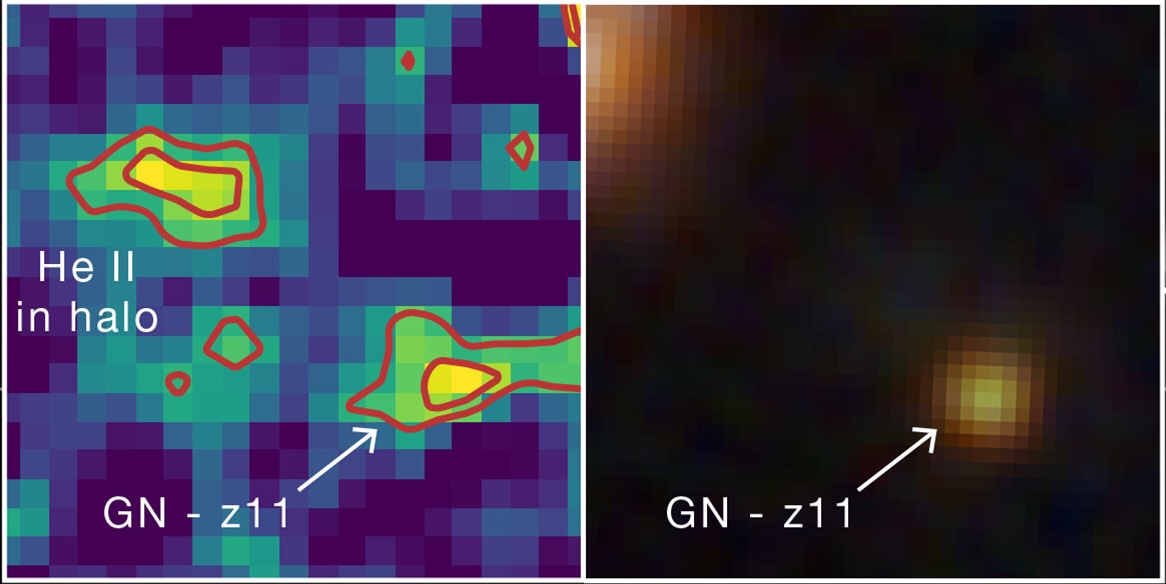
Hebe is visible in the image on the left as a prominent blob of helium emission up and to the left from GN-z11, a luminous galaxy hosting an accreting supermassive black hole. On the right is an infrared image of the same region, in which Hebe is not visible. Click to enlarge. [Adapted from NASA, ESA, CSA, Ralf Crawford (STScI)]
Initially spotted in 2024, an early-universe gas clump nicknamed Hebe has now been identified as a possible hiding place of Population III (Pop III) stars — the universe’s first generation of stars. Pop III stars are thought to be massive and chemically pristine, containing only hydrogen, helium, and a whisper of lithium. This exciting hypothesis was prompted by the detection of recombination lines from helium, which could be ionized by the high-energy radiation of the first stars.
Before the community settles on this exciting explanation, however, the hypothesis must withstand all the tests astronomers can throw at it. In a recent research article, Junehyoung Jeon, Tae Bong Jeong, and Saiyang Zhang (The University of Texas at Austin) along with Volker Bromm (The University of Texas at Austin) attempted to explain Hebe’s properties in another way.
Considering Alternatives
Hebe glows with distinctive helium emission that requires a source of high-energy radiation. This radiation could be provided by a cluster of Pop III stars, but it could also, in theory, arise from an accreting supermassive black hole embedded within the gas clump.
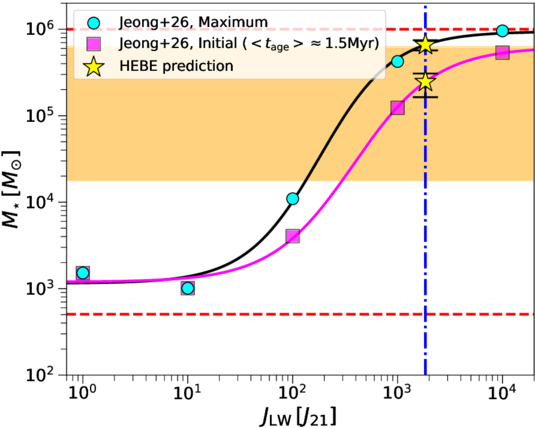
Predicted total mass of Hebe’s Pop III stars as a function of the Lyman–Werner flux from the nearby galaxy GN-z11. Click to enlarge. [Jeon et al. 2026]
The authors used models to explore both possibilities. For the first scenario, in which the telltale helium emission is driven by a cluster of Pop III stars, the team calculated the maximum possible mass of the cluster, which sets how much high-energy radiation is produced. The cluster mass is moderated by high-energy radiation from another source: GN-z11, a starburst galaxy situated about 10,000 light-years from Hebe. For the second scenario, the team modeled the spectral energy distribution arising from a supermassive black hole — either a direct-collapse black hole or a primordial black hole — accreting pristine gas from the surrounding cloud.
Still a Leading Explanation
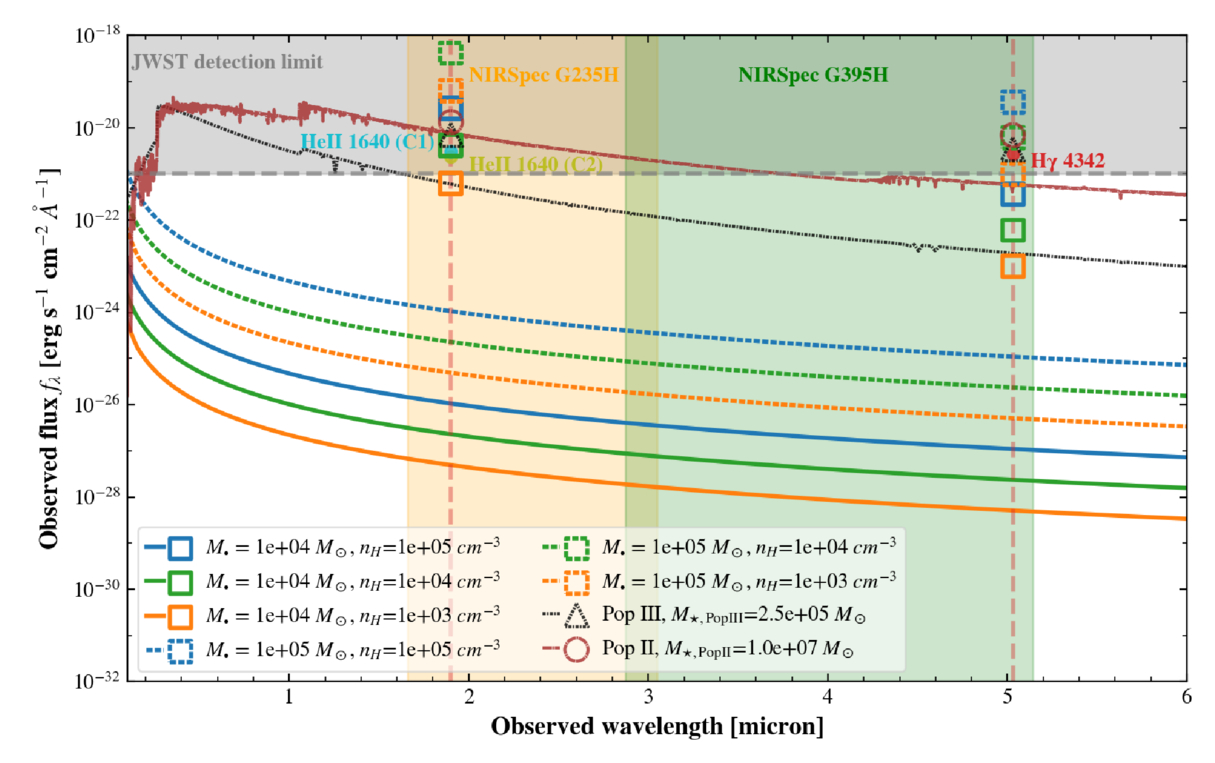
While the black hole scenario could, with reasonable black hole masses, gas densities, and accretion rates, reproduce individual flux measurements drawn from JWST observations, this hypothesis struggled to simultaneously match multiple measurements. The Pop III star cluster scenario, with a cluster mass of a few hundred thousand solar masses, provided the best fit to the JWST data.
Modeled spectral energy distributions (lines) and predicted line flux densities (open symbols) for the accreting black hole, Pop III star, and Pop II (second-generation) star hypotheses. The observed JWST line fluxes are shown as filled circles. Click to enlarge. [Jeon et al. 2026]
As a final test, the team introduced a third possibility involving a population of second-generation stars, which are more chemically enriched than Pop III stars. While this model fit well, the number of stars necessary to match the data — roughly 10 million — would produce a stellar continuum detectable (but so far not seen) by JWST.
While a cluster of Pop III stars is still the leading explanation for Hebe’s properties, the team noted that the Pop III star and black hole hypotheses aren’t mutually exclusive; Hebe could very well harbor a primordial black hole and a smattering of Pop III stars. Regardless of what powers its characteristic helium emission, Hebe offers an enticing glimpse into the early universe, and more work is needed to understand this intriguing object.
Citation
“What Is Powering the Enigmatic He II Emitter Hebe: The First Stars or Black Holes?” Junehyoung Jeon et al 2026 ApJ1006 27. doi:10.3847/1538-4357/ae7bea
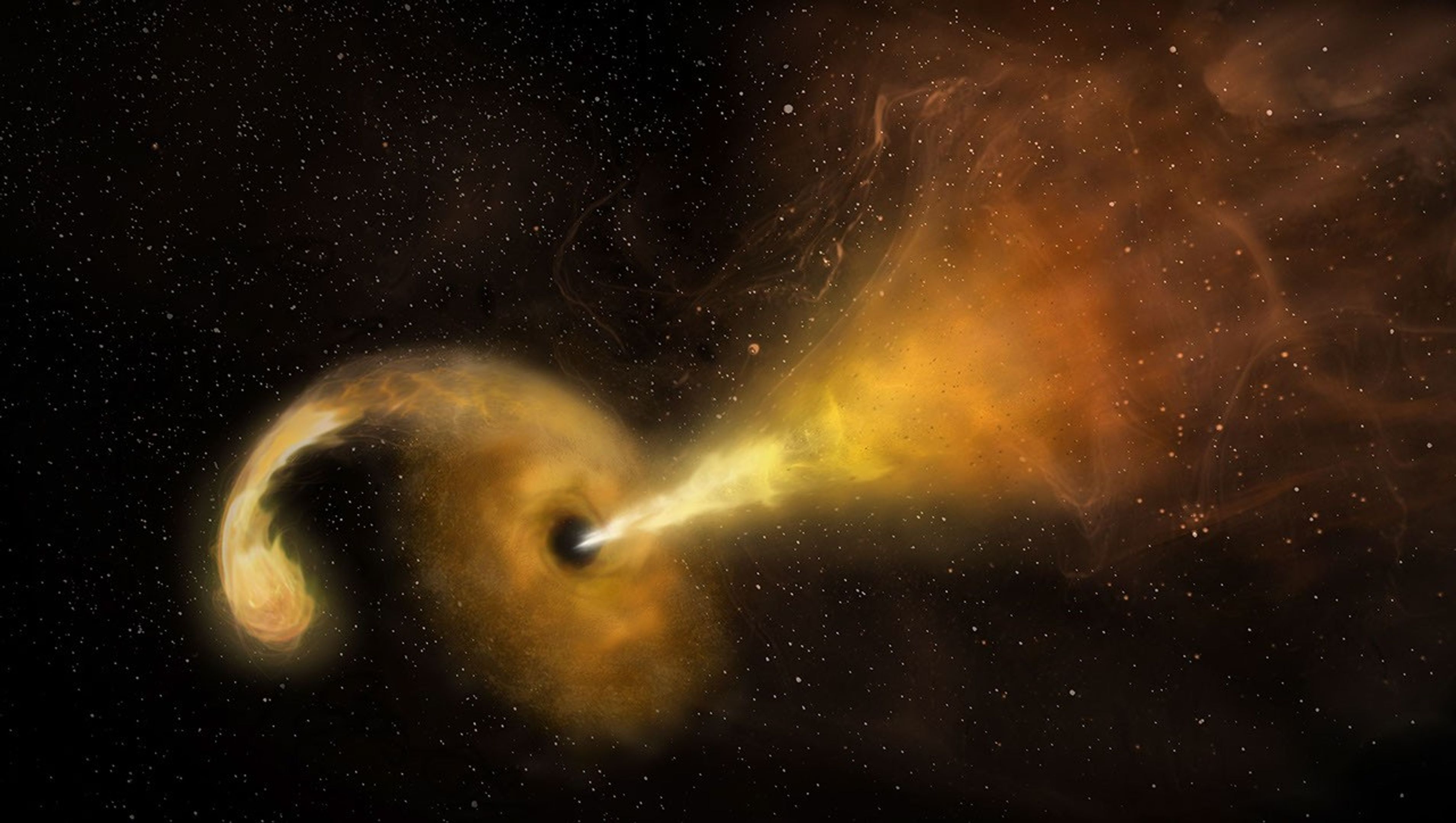
This artist’s concept depicts a tidal disruption event, which occurs when a star passes fatally close to a supermassive black hole. Crumbs of the splintering star heat up as they swirl around the black hole, creating a glow astronomers can see from far across the cosmos, and the black hole launches a relativistic jet into space.
NRAO/AUI/NSF/NASA
NASA’s Neil Gehrels Swift Observatory captured an “orphan” black hole lighting up as it devoured a star on the outskirts of a faraway galaxy. These phenomena are rare to begin with, and none had ever before been seen so far outside of a galaxy’s core.
“We were looking for these star-shredding events as a way to find otherwise invisible supermassive black holes wandering away from the galactic cores where they usually reside,” said Robert Stein, a research fellow at The University of Maryland, College Park and NASA’s Goddard Space Flight Center in Greenbelt, Maryland. “With this discovery, which is one of just a couple that have been confirmed so far, we’ve validated a new technique and can use it to hunt for more.”
A paper describing the results, led by Stein, was published Monday in The Astrophysical Journal Letters.
Researchers saw an ultrabright flare unleashed by a star being torn apart by extreme gravitational forces after drifting too close to a monster black hole — a phenomenon called a tidal disruption event. The black hole behind the blast weighs in at about a million times the Sun’s mass. Its existence was first flagged in November 2025 as an unusual brightening in a galaxy about 750 million light-years away by ZTF (Zwicky Transient Facility), a survey conducted by the Palomar Observatory in Southern California.
“Out of the half million flashes ZTF detects each night, our new artificial intelligence algorithm automatically recognized a flare that looked a lot like a tidal disruption event, despite its unusual location in the outskirts of a galaxy,” Stein said. For a few months, the tidal disruption event outshone its entire host galaxy in ultraviolet wavelengths, temporarily radiating with the light of about 10 billion suns.
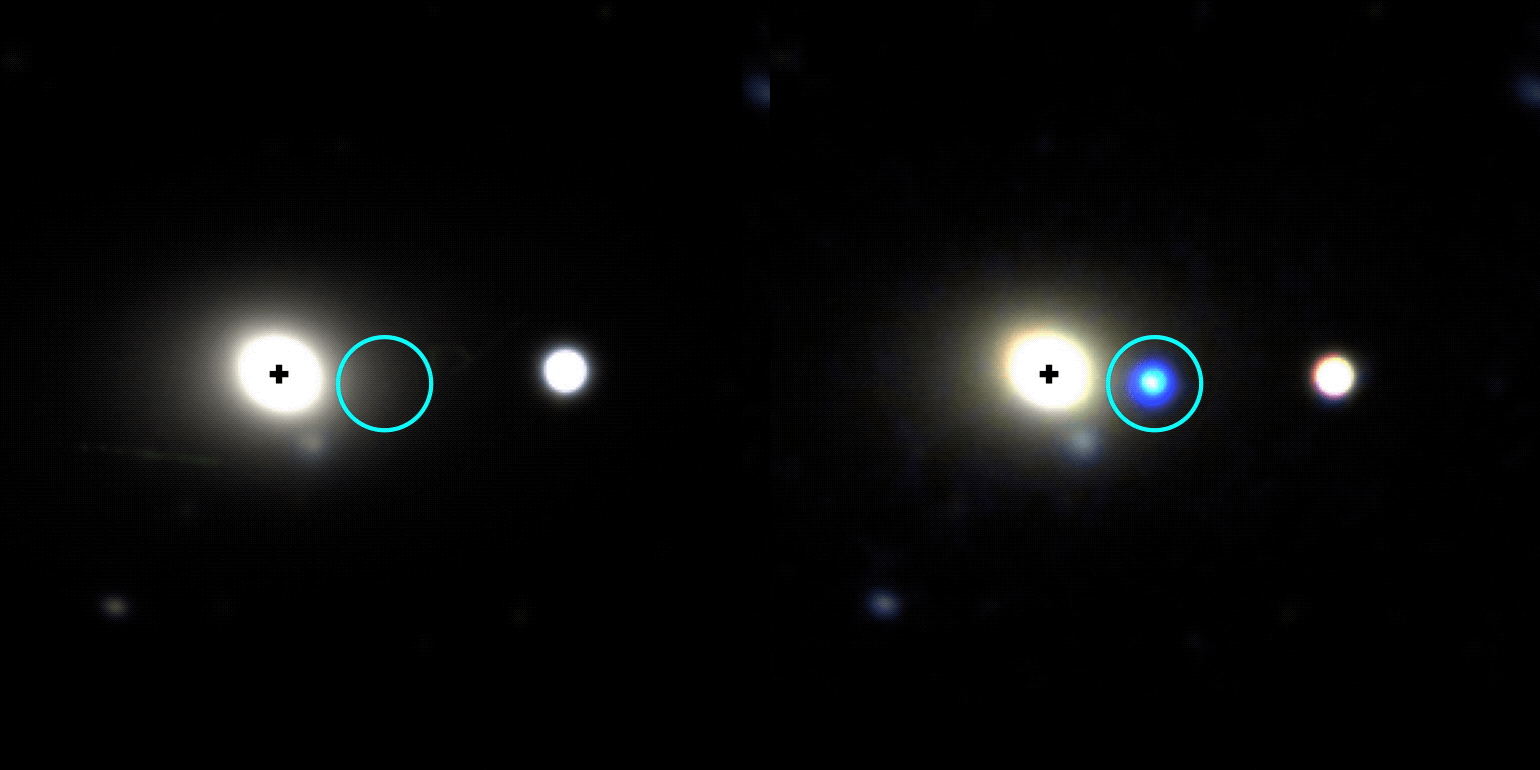
This gif shows the galaxy WISEA J014656.04-152214.7, located about 750 million light-years away in the constellation Cetus, before and after a tidal disruption event was spotted on its outer edge in November 2025. The image at left was taken by the DESI (Dark Energy Spectroscopic Instrument) Legacy Survey and the one at right is from the Lowell Discovery Telescope.
Other telescopes, including the SOAR (Southern Astrophysical Research) telescope in Chile, followed up on the ZTF source to look at the event’s spectrum, which revealed features supporting that it was likely a tidal disruption event. Astronomers then used NASA’s Swift to look at wavelengths they can’t detect with ground-based telescopes to uncover new information. For example, Swift’s UVOT (Ultraviolet/Optical Telescope) took the blip’s temperature and found that it had quite a fever at about 54,000 degrees Fahrenheit (30,000 degrees Celsius).
“The combination of all this data helped us rule out other explanations and confidently say it’s a tidal disruption event, despite its strange location,” said Jonathan Carney, a doctoral student at the University of North Carolina at Chapel Hill, who took the first spectra that supported the flare’s interpretation as a tidal disruption event.
Hidden heavyweights
Nearly every galaxy in the universe is anchored by a supermassive black hole sitting right in the center. About once every 100,000 years, a star will drift too close to this invisible heavyweight and trigger a tidal disruption event.
While they’re rather rare in any given galaxy, scientists scour millions of galaxies for them. Each year, astronomical surveys typically spot about 30 tidal disruption events occurring somewhere in the universe.
Prior to 2024, they’d only been seen in galaxy cores. That’s partly because astronomers mainly looked for them there; after all, it’s where all the known supermassive black holes were, and you can’t get a tidal disruption event without one (the gravitational pull of lighter black holes isn’t strong enough).
Then scientists saw the telltale signs of a star being shredded 2,600 light-years from the center of its host galaxy. That inspired more astronomers to look beyond galaxy cores for similar events, and now a team has identified one more than 30,000 light-years away from a galaxy’s center.
This video visualizes a star approaching a supermassive black hole so closely that it’s stretched to a breaking point by the black hole’s strong gravity. Intense tidal forces crack the star open and hurl its gaseous guts outward. Stellar debris forms a spinning accretion disk as it continues to spiral into the black hole.
NASA, ESA, STScI, Ralf Crawford (STScI)
Oddball origin story
So how did the newfound black hole become so off-kilter?
“It must have originated in a galaxy’s center, but not the one it’s in the outskirts of now,” Stein said. “We think the host galaxy’s supermassive black hole is still at its core, but the one eating the star could have started off in a small galaxy that merged with the big one we see today.”
The researchers have outlined two possibilities. Three or more galaxies may have merged together, and the gravitational tug-of-war between their central supermassive black holes may have flung the lightest black hole out to the galaxy’s edge.
Or a dwarf galaxy could be midway through a merger. As the dwarf’s stars fell into the larger galaxy, one may have passed too close to the dwarf’s supermassive black hole.
“Further discoveries could reveal the origin of this apparent ‘orphan’ black hole,” Stein said. “The key science question we want to answer is: How common are wandering black holes?”
The answer may soon be within reach. “Pointed science observations with Swift’s UVOT and XRT (X-Ray Telescope) instruments are temporarily suspended as the mission awaits an orbit boost, which is planned for this summer,” said co-author S. Bradley Cenko, Swift’s principal investigator at NASA Goddard. The spacecraft, whose primary mission ran from 2004 to 2006, is slowly sinking toward Earth due to atmospheric drag after more than 20 years of observations of the changing universe. Nudging it to a higher orbit could extend its lifetime even longer. “Once it resumes normal operations, Swift could continue searching for more examples of out-of-place black holes.”
In the coming years, scientists will use the new technique to search for disintegrating stars in observations from the newly operational Vera C. Rubin Observatory, jointly funded by the U.S. Department of Energy and National Science Foundation, in Chile and NASA’s upcoming Nancy Grace Roman Space Telescope.
“Rubin’s wide, deep surveys will reveal a much larger sample of tidal disruption events than current observatories are capable of collecting, including ones that are off-center,” Carney said. “And Roman’s space-based surveys will extend the current search zone by seeing ones that are farther away, looking back through 9 billion years of cosmic history.” Adding their observations to Swift’s and those from ground-based observatories will bring astronomers closer than ever before to completing a census of the universe’s behemoth black holes.
Using the largest sample yet of particles called beauty mesons, physicists with the CMS Collaboration at CERN’s Large Hadron Collider (LHC) refined a decades-old test of the subtle imbalance that let our Universe exist at all.
Two major mysteries in science, the nature of dark matter and the possible existence of higher dimensions, could be linked, new research suggests. The team behind a new study proposes that dark matter may be so strange and ghost-like because it is in tune with a fifth dimension.
When scientists discuss "extra dimensions," they aren't talking about other universes in which another evil version of you exists (and with a beard). Instead, they refer to dimensions that could be "curled up" with reality alongside the standard four-dimensional spacetime, consisting of the three dimensions of space and one dimension of time.
While these extra dimensions remain highly speculative, they have become a hot topic, especially as string theory, the most popular extension to standard physics, relies upon the existence of at least 11 dimensions. Scientists are more sure that dark matterexists, but proving its existence still remains troubling because, despite its gravity literally holding galaxies together and outweighing ordinary matter by around five to one, it remains effectively invisible because it doesn't interact with light and it simply ghosts through ordinary matter.
"Understanding dark matter would represent a profound advance in humanity's knowledge of the cosmos and what it is made of," team member Yu-Dai Tsai of the University of Sheffield said in a statement.
"Our research gives physicists clear new targets in the search for dark matter, while connecting two of the biggest ideas in fundamental physics: the mystery of dark matter and the existence of hidden dimensions."
Dark photons play dark matter like a violin
Though the main idea is that dark matter may operate in the fifth dimension, this new research expands upon that concept with another theory. It suggests that dark matter exists with another inhabitant of the fifth dimension, a force-carrying particle called a "dark photon."
Standard photons are the constituent particles of electromagnetic radiation, or light; dark photons would be similar but for a hypothetical "dark force."
The team's new proposal would see the unique geometry of the fifth dimension causing the masses of dark matter particles to form an arrangement that gives rise to a "dark matter resonance." This is akin to the intense vibration of a musical instrument at certain notes.
"Dark matter resonance is already known to be a powerful idea, with the potential to change our understanding of how dark matter was produced in the early universe and how we search for it today," team member Yu-Dai Tsai of the University of Sheffield said in a statement. "But many previous resonant dark matter models have treated the resonance as an assumption. This work gives a possible deeper origin for it: the resonance may come directly from the geometry of hidden dimensions."
An illustration shows a cloud of dark matter slipping past a distant star (Image credit: Robert Lea (created with Canva))
Tsai explained that while dark matter resonance is a phenomenon that has been explored before, the research conducted by this team differs because it suggests dark matter resonance is not a coincidence. Instead, the possible deeper origin for the resonance sees it emerge directly from the geometry of hidden dimensions. This would allow dark matter to interact strongly shortly afterthe Big Bang while allowing it to settle into its ghost-like inert existence today.
"This resonance can make dark matter interactions much stronger at crucial epochs in cosmic history, such as in the early universe," Tsai added. "Crucially, the model allows for these strong interactions in the past while still explaining why dark matter appears so inert and hard to detect today."
Of course, it is very early days for the team's theory, but it excitingly offers a way toward solving two of the universe's greatest mysteries.
The only three measurables in galactic astronomy are the position, luminosity and spectrum of the source light received in our telescopes. There is no distance information without unprovable assumptions, hence no direct measurement of size or age of the universe. Thus we may conclude it is young in agreement with the Bible.
Astronomers using ESA’s Euclid space telescope have discovered 31 ancient quasars from a time when the Universe was just 670 to 800 million years old. One of these objects, dubbed EUCL J172902.75+641018.1, sets the new record for the most distant quasar ever reported.
The European Space Agency’s (ESA) Euclid Space Telescope has just revealed new evidence for the existence of more than two-and-a-half dozen objects that are among the oldest and most remote in the universe.
These 31 massive objects, known as quasars, rank among the oldest objects astronomers have ever seen, including two that are believed to originate from a period in the universe when our cosmos was only 5% of its current age.
The discoveries, revealed in a new study appearing in the journal Astronomy & Astrophysics, provide a remarkable look at the earliest generations of galaxies, as well as a rare look at the dynamics of the ancient black holes that once powered them.
Quasar Questions
As some of the brightest objects anywhere in our universe, quasars are remote objects resembling stars in appearance that emit unprecedented amounts of energy. They are the result of creation processes that involve enormous quantities of gas and dust, which spiral into supermassive black holes.
During the gravity-driven inward acceleration process, immense friction causes temperatures that can reach millions of degrees, which generates large amounts of energy. The resulting celestial features produce enough light to outshine entire galaxies.
Despite their brightness, the 31 newest additions to our growing collection of known quasars were difficult for astronomers to spot, given their extreme distances from Earth. The light that documents their ancient presence in the universe has traveled more than 13 billion years to make its way here, causing it to be extremely faint, and thereby very difficult to distinguish from surrounding stars whose light normally outshines them with ease.
Rotating Quasars from the Early Universe
A dozen of the newly discovered collection of quasars date to within the first 770 million years our universe existed. Add to that the fact that two of the ancient objects are believed to have formed just 670 million years after the Big Bang—at such ages, these quasars are among the oldest astronomers have ever observed.
The weight of the discoveries goes beyond just record-breaking astronomical observations, since the data they provide could help astrophysicists unravel some of the most enduring mysteries of cosmology. For instance, these quasars could help to reveal answers to questions about how supermassive black holes grew so quickly while the universe was still in its infancy.
Additionally, studying these energetic ancient giants could help to provide new insights into the formation of the earliest galaxies and the evolution of the universe while it was still in its relative infancy.
Answering Questions About the Cosmos
The recent research, led by the ESA and with contributions from its partners at NASA, has helped to place the Euclid mission in an ideal place to carry out its mission of mapping billions of galaxies. Doing so may help scientists uncover clues about the questions surrounding mysterious dark energy, which is widely believed to be the force behind the accelerating expansion of the cosmos.
Additionally, the Euclid mission’s findings could be pivotal in helping shape the future work of NASA’s Nancy Grace Roman Space Telescope, which will continue the quest to unravel the nature of dark energy and help astronomers understand the nature of the universe at large scales. Additional details about the recent quasar discoveries by Euclid can be found at the ESA’s website and on NASA’s FAQ page.
The new findings were detailed in a recent study, “Euclid: Discovery of 31 new quasars at 6.6 < z < 7.8” published in Astronomy and Astrophysics.
Micah Hanks is the Editor-in-Chief and Co-Founder of The Debrief. A longtime reporter on science, defense, and technology with a focus on space and astronomy, he can be reached atmicah@thedebrief.org. Follow him on X @MicahHanks, and at micahhanks.com.
The interstellar comet 3I/ATLAS carries a chemical fingerprint unlike anything in our Solar System, and it may have formed 10 to 12 billion years ago, before our Sun even existed, according to two papers published in the journal Nature.
The expansion of the universe is still accelerating under the influence of dark energy, despite recent claims to the contrary, according to new research. This means that dark energy, the mysterious force that dominates the universe, is not weakening but continues to get stronger, considered something of a "cosmological crisis" as it was so against expectations.
In 1998, via the study of cosmic explosions called Type Ia supernovas, astronomers discovered that not only is the universe expanding, but that the speed of that expansion is increasing. "Dark energy" was the name given to the mysterious force driving this accelerating expansion. Since then, scientists have discovered that dark energy accounts for around 70% of the universe's matter and energy.
In November 2025, research was published that suggested the expansion of the universe was slowing, meaning dark energy would be weakening. But this new research suggests that these findings from last year might not be a cosmic hand grenade thrown into the cosmological apple cart, but instead may have actually emerged from a scientific misunderstanding.
"Thankfully, we have averted this crisis, but the mystery about why the rate of expansion of the universe is still accelerating remains," lead author of the new refuting research, Phil Wiseman, from the University of Southampton in the UK, said in a statement. "The previous and well-accepted measurements were, in fact, fine, and our current understanding of the fate of the universe remains robust. By proving our measurements are correct, we can get back to trying to understand what this dark energy actually is, rather than wondering if it exists at all."
The research from 2025 that suggested dark energy was weakening was based upon a reassessment of the brightness of Type Ia supernovas, which occur when a dead star called a white dwarf overfeeds on a companion star. This causes a runaway nuclear explosion of such uniform brightness that it can be used to measure cosmic distances. In fact, these explosions are so uniform that astronomers refer to them as "standard candles."
This prior research determined, incorrectly it now seems, that as the universe has aged, the brightness of Type Ia supernovas had changed, leading to incorrect measurements of distances based on them as well as incorrect estimates of the speed of the universe's expansion. Both of these led to the suggestion that dark energy is weakening.
An illustration of a white dwarf star feeding on a stellar companion prior to a type Ia supernova (Image credit: Robert Lea (created with Canva))
But Wiseman and colleagues found this previous team had made an error in how they calculated the ages of exploding white dwarfs, finding they had assumed the ages of these stars would be the same as the ages of the galaxies in which they exploded.
They also found the 2025 research hadn't accounted for a common correction used in cosmology that factors in the masses of galaxies in which Type Ia supernovas occur.
"Extraordinary claims require especially careful testing," team member Adam Riess, who in 2011 shared the Nobel Prize for the discovery of dark energy, said. "What we find is that when we calibrate these supernovae, accounting for different host environments and populations, the evidence for cosmic acceleration remains remarkably consistent."
While the challenge to dark energy's growing dominance over the universe seems now to have been refuted, the back and forth on this topic shows how ideas in science aren't dogma and remain open for revision.
"This is how progress is made," team member Mark Sullivan, also from the University of Southampton, said. "Although this idea did not turn out to be correct, it has opened up new ways of thinking about how supernovae explode and how we can measure dark energy more accurately."
One of the most hotly debated mysteries in astronomy is set to continue, as new research fails to rule out self-annihilating dark matter as the source of gamma-ray emissions from the heart of the Milky Way. Known as the Galactic Center Excess, a spherical gamma-ray glow extending out for thousands of light-years from the core of our galaxy, this high-energy light has baffled researchers for over a decade.
While several possible explanations for the Galactic Center Excess have been put forward, including a population of rapidly spinning neutron stars called pulsars, one of the most prevalent has been a specific type of dark matter particle. Dark matter is the mysterious stuff that accounts for 85% of the universe's matter. It is effectively invisible because it doesn't interact with light or with "ordinary" matter composed of atoms. That fact has led to many possible dark matter candidate particles being proposed, including some that self-annihilate. This is akin to what happens when an electron meets its antimatter counterpart, or positron. The two annihilate each other, releasing energy into the cosmos.
For self-annihilating dark matter, these particles would be their own antiparticles, meaning when they interact, they would annihilate and release energy as gamma rays. With dark matter outweighing ordinary matter by a ratio of five to one, one might expect this annihilation to be occurring constantly, flooding the cosmos with gamma rays, but dark matter rarely interacts with itself in this model. Thus, dark matter annihilation is only a factor when this mysterious stuff is densely clustered in a region like the heart of a galaxy.
Unfortunately, investigating the heart of the Milky Way is challenging indeed.
"Interpreting the signal is particularly difficult because the Galactic Center is an exceptionally bright and crowded region of the gamma-ray sky," team member and University of Vienna researcher Florian List said in a statement.
Getting to the point
To investigate if annihilating dark matter could indeed account for the Galactic Center Excess, List and colleagues turned to machine learning trained on more than a million simulated gamma-ray observations. Previous similar approaches had pointed to comparatively bright, unresolved light sources as a potential source of the Galactic Center Excess. However, this new research showed that these point sources, including pulsars, would be extremely faint, and that is good news for scientists who favor annihilating dark matter as the cause of these gamma rays.
That is because, whereas previous research has suggested just a few hundred pulsars could be enough to account for the Galactic Center Excess, these findings indicate that the pulsar population at the heart of the Milky Way would have to be greater than 35,000.
"Our new analysis shows that the sources would have to be so faint that they would be almost indistinguishable from the emission expected from annihilating dark matter," team member Nick Rodd, a scientist at the Lawrence Berkeley National Laboratory, said.
While this research may keep dark matter in the game as a plausible explanation, it far from confirms the annihilation of this mysterious stuff as the source of the Galactic Center Excess. "The origin of the Galactic Center Excess is one of the longest-running debates in astrophysics," List said. "Our work does not show that dark matter is responsible for the signal. However, it suggests that it is still too early to rule out this possibility."
Astronomers have used a technique called echo mapping to detect hints that supermassive black holes, such as the cosmic titan at the heart of the Milky Way, known as Sagittarius A* (Sgr A*), are surrounded by dense clouds and clusters of dark matter. The research could teach us more about this mysterious substance and the environments around supermassive black holes.
Dark matter is the universe's most mysterious stuff, outweighing ordinary matter in the cosmos by a ratio of five to one — but remaining effectively invisible because it doesn't interact with electromagnetic radiation, including the light we use to see. The only way scientists can even infer the presence of dark matter is via its interaction with gravity, and the impact that this interaction has on objects made of traditional matter like stars. For instance, the gravitational effect of dark matter allows stars at the edges of galaxies to whip around at much greater speeds while not flying loose than the visible matter of those galaxies would allow.
This team decided to test the gravitational influence of dark matter at the hearts of galaxies, environments dominated by supermassive black holes which can have masses millions or even billions of times that of the sun. Ordinary matter around these supermassive black holes is often very visible, especially when spiraling into the maw of one of these cosmic titans from a flattened cloud called an accretion disk. This is because the gravitational influence of those black holes generates immense amounts of friction, causing them to grow brightly. That wouldn't work for dark matter; it can't feel friction because it doesn't interact with itself or with ordinary matter, and it can't glow because it doesn't absorb or emit light.
Clearly, dark matter can't be spotted around supermassive black holes even using the most advanced telescopes such as the Event Horizon Telescope (EHT), which has captured glowing rings of material around Sgr A* and around a more distant supermassive black hole that rules the heart of the galaxy Messier 87 (M87).
While discussing the problem of detecting dark matter around supermassive black holes, Mayank Sharma, a physics graduate student at Virginia Polytechnic Institute and State University (Virginia Tech), hit on an interesting solution.
"We could actually test this prediction using a technique in astronomy, which allows you to measure the distance to the surrounding gas by looking for echoes of light," Sharma said in a statement. The technique Sharma refers to is "reverberation mapping," and it has become a trusted method of determining the mass of black holes.
Echoes of dark matter
Reverberation mapping is based upon the fact that as matter falls into a black hole, it releases a burst of energy that causes the accretion disk it comes from to pulse. This pulse of light travels from the accretion disk to gas in the wider environment of the black hole. This gas absorbs that light and also pulses, with this secondary pulse serving as an echo of the first.
Because we know the speed of light, when astronomers see the first pulse of light and then its echo, they can use the time between pulses to estimate the distance between the black hole and the gas on the outskirts of its environment. The size of a black hole and the distance between it and outer gas clouds can be used to determine its mass, and could also be used to determine the mass of dark matter clustered around it.
The team applied their method to 14 different galaxies, finding in five cases that mass increases moving away from the central black hole in a way that couldn't be accounted for by visible matter alone. Despite the early success of this research, it far from proves that supermassive black holes are indeed gathering places for dark matter. The team's findings do point an interesting way forward for the investigation into the universe's most mysterious substance and its most mysterious regions.
"These galaxies are definitely showing a hint that there is extra material that cannot be explained by just the supermassive black hole," Sharma said. "The prospects are exciting."
Northrop Grumman’s Stargazer took off Thursday, June 18, 2026, from NASA’s Wallops Flight Facility in Virginia. The modified L-1011 aircraft carried the company’s Pegasus XL rocket hosting LINK, a robotic servicing spacecraft from Katalyst Space. LINK will launch from the air-deployed Pegasus XL later this month on a mission to boost the orbit of NASA’s Neil Gehrels Swift Observatory.
NASA/Jeanette Kazmierczak
An airplane carrying a rocket loaded with a robotic spacecraft designed to raise NASA’s Neil Gehrels Swift Observatory departed the agency’s Wallops Flight Facility in Virginia on Thursday, June 18.
Stargazer, a modified L-1011 operated by Northrop Grumman, took off for Kwajalein Atoll, part of the Republic of the Marshall Islands in the South Pacific Ocean. Attached to the belly of the aircraft was one of the company’s Pegasus XL rockets with LINK inside.
NASA contracted Katalyst Space to design and build LINK to rendezvous and dock with Swift and lift it back to a higher altitude.
Spacecraft in low Earth orbit experience drag caused by our planet’s atmosphere, which gradually reduces their altitude if they do not have propulsion systems to counteract the effect.
Recent solar activity magnified this effect on Swift, which began to sink faster than anticipated.
Katalyst selected Northrop Grumman’s Pegasus XL launch vehicle as the best means of reaching Swift on a short timeline based on orbital and programmatic needs.
Stargazer will carry Pegasus and LINK to Kwajalein Atoll, part of the Republic of the Marshall Islands in the South Pacific Ocean with stopovers in California and Hawai’i.
NASA/Jamie Adkins
Later this month, Stargazer will carry the rocket to an altitude of around 40,000 feet before releasing it.
After several seconds in free-fall, Pegasus XL will fire the first of its three-stage rocket motors, delivering LINK into orbit in about 10 minutes.
A new cosmic bounce model suggests that remnants from a pre-Big Bang Universe may still exist today. What if some of the Universe’s oldest objects are actually older than the Big Bang itself? A new study from the University of Portsmouth suggests that ancient black holes may have survived from a time before the Universe [...]
This NASA Hubble Space Telescope image features a swarm of galaxies in the galaxy cluster called CL0016+1609 or MACS J0018.5+1626.
NASA, ESA, H. Ebeling (University of Hawaii), D. Coe (STScI, ESA, JWST); Image Processing: G. Kober (NASA/Catholic University of America)
This NASA Hubble Space Telescope image features a galaxy cluster, called CL0016+1609 or MACS J0018.5+1626, that is very bright at X-ray wavelengths and is one of the most extensively studied clusters at X-ray and radio wavelengths. The X-ray observations of this cluster revealed that it is two clusters merging along our line of sight.
Researchers requested time to observe CL0016+1609 with Hubble’s Advanced Camera for Surveys because that data would help them accurately measure the cluster’s dark-matter distribution, which helps them study the merger and the role of CL0016+1609 in the large-scale structure of the universe. Hubble can’t directly see dark matter, but its infrared and visible light observations can detect dark matter’s gravitational lensing effects on the normal matter Hubble observes.
The data in this image also includes observations with Hubble’s Wide Field Camera 3 taken as part of an observing program that obtained the first Hubble infrared images of 46 massive galaxy clusters and looked for distant galaxies gravitationally lensed by these clusters. Called RELICS (Reionization Lensing Cluster Survey), this survey found some 300 high-redshift candidate galaxies lensed by these clusters.
You can see the faint vertical arc of one of these distant galaxies in the image above. Look for it just to the left of the large elliptical galaxies in the center of the image. Another brighter, though shorter arc is visible just above and to the right of the large elliptical galaxies in the center of the image.
NASA’s Fermi Mission Uncovers Possible Sibling Supernova Remnants
A new study of two supernova remnants, the debris left behind after stars explode, suggests the explosions came from stellar siblings that once orbited each other. The first star’s detonation sent its binary companion hurtling through space, and then, after traveling for thousands of years, the surviving star blew up too.
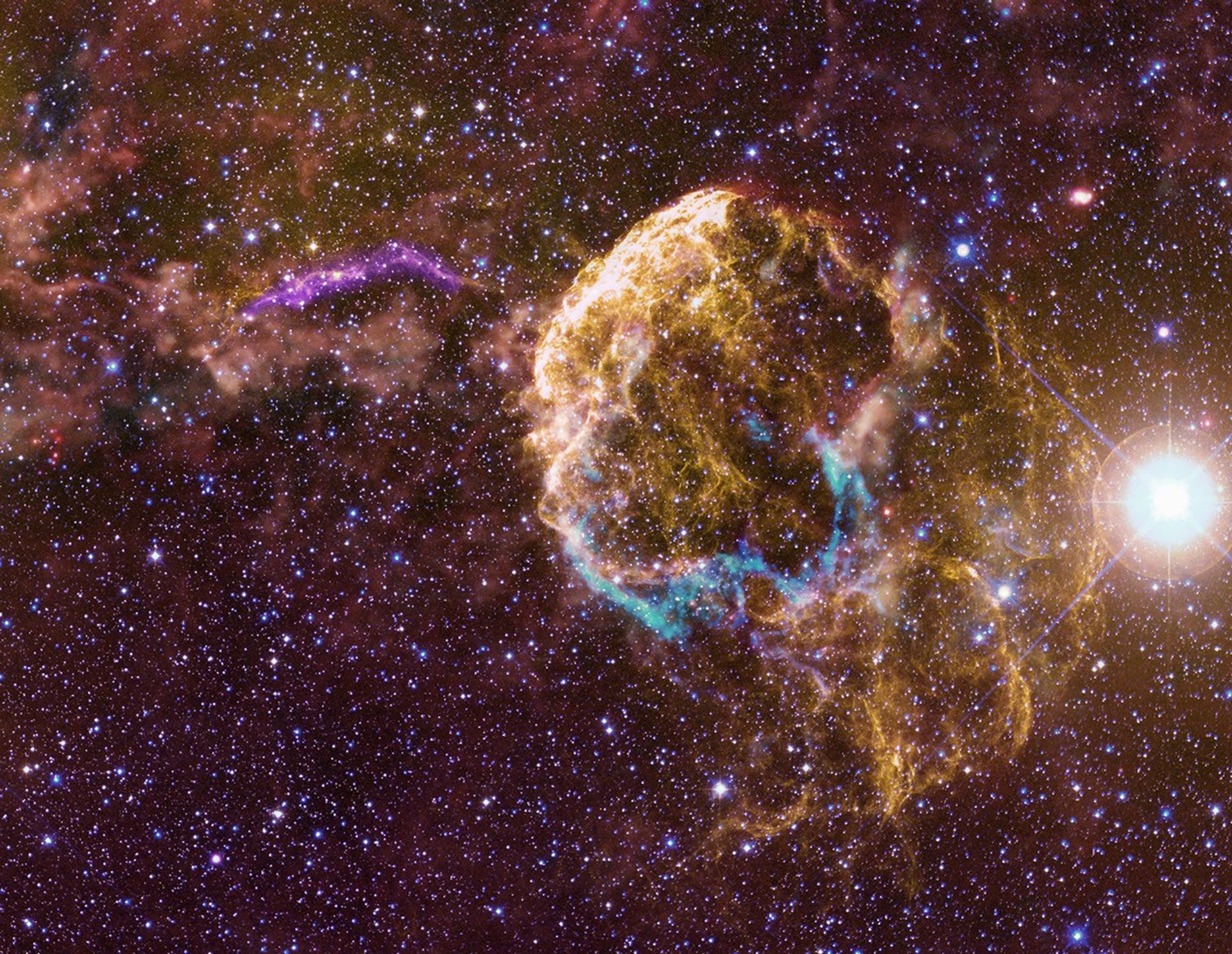
This multiwavelength scene shows the Jellyfish Nebula supernova remnant (right), the interstellar cloud it’s interacting with, and a distinctive curving filament to its upper left. The filament, which is shown here both in optical and ultraviolet (UV) light, is the visible part of an overlapping supernova remnant, G189.6+3.3, that is more prominent in radio and X-rays. Visible light is shown in yellow, UV from NASA’s Neil Gehrels Swift Observatory is shown in violet, and infrared light from NASA’s retired WISE (Wide-field Infrared Survey Explorer) mission appears in cyan, red, and orange. Both remnants are located about 6,000 light-years away in the constellation Gemini. The brilliant star at far right is Propus, also known as Eta Geminorum.
NASA Goddard Space Flight Center and M. Michailidis et al. 2026; optical: DSS; infrared: NASA/WISE/JPL-Caltech/UCLA; ultraviolet: NASA/Swift
“Using 16 years of data from NASA’s Fermi Gamma-ray Space Telescope, our analysis uncovered gamma rays associated with a supernova remnant that was hidden in the glare of its neighbor, the Jellyfish Nebula, one of the brightest gamma-ray-emitting supernova remnants known,” said Miltiadis Michailidis, a postdoctoral fellow in the physics department at Stanford University in California. “There are so many striking connections between the two remnants that we conclude they’re likely related, giving us the first known example of a binary system where both stars have undergone supernova explosions.”
Michailidis presented the findings Wednesday at the 248th meeting of the American Astronomical Society in Pasadena, California. A paper describing the results will appear in a future edition of Nature Communications.
The study focused on a faint supernova remnant called G189.6+3.3, which is mainly visible in X-rays. It is upstaged by its brighter and better-known neighbor, the Jellyfish Nebula (IC 443). The two star wrecks, both located in the constellation Gemini, appear to partially overlap as seen in X-rays. Recent X-ray evidence suggests that hot plasma likely associated with G189.6+3.3 may extend across the entire region, a hint that the overlap may be nearly total.
A massive star explodes when its energy-producing core runs out of fuel and collapses under its own weight, triggering an explosion that blows the star apart. The explosion’s shock wave encloses a hot cloud of debris that rapidly expands into space. So far, astronomers have cataloged about 300 supernova remnants in our galaxy.
The Fermi mission is part of NASA’s fleet of observatories monitoring the changing cosmos to help humanity better understand how the universe works. More than a decade ago, observations from Fermi’s LAT (Large Area Telescope) showed that the shock waves of supernova remnants accelerated particles to within a fraction of the speed of light, a process first proposed by physicist Enrico Fermi — the mission’s namesake — in 1949.
These high-speed particles, called cosmic rays, interact with interstellar gas to produce gamma rays, the highest-energy form of light. Protons make up 99% of cosmic ray particles. To prove that accelerated protons are responsible for the glow, astronomers search for a specific gamma-ray feature. When cosmic-ray protons smash into interstellar gas, they produce a short-lived particle called a neutral pion, which almost immediately decays into a pair of gamma rays. This emission occurs within a specific band of energies associated with the neutral pion’s mass and lies within the range detected by Fermi’s LAT instrument.
In 2013, Fermi observations proved that the Jellyfish Nebula, which is interacting with part of a glowing cloud of hydrogen gas known as Sharpless 249, produced gamma rays through this mechanism. Its neighbor, G189.6+3.3, was discovered in 1994 as part of an X-ray survey by the German-led ROSAT (Roentgen Satellite) mission.
A bright filament of gas lies between the overlapping remnants. New observations of this feature reveal that the shock wave from G189.6+3.3 slammed into dense interstellar gas there and dramatically slowed, key evidence that both remnants are interacting with the same cloud system.
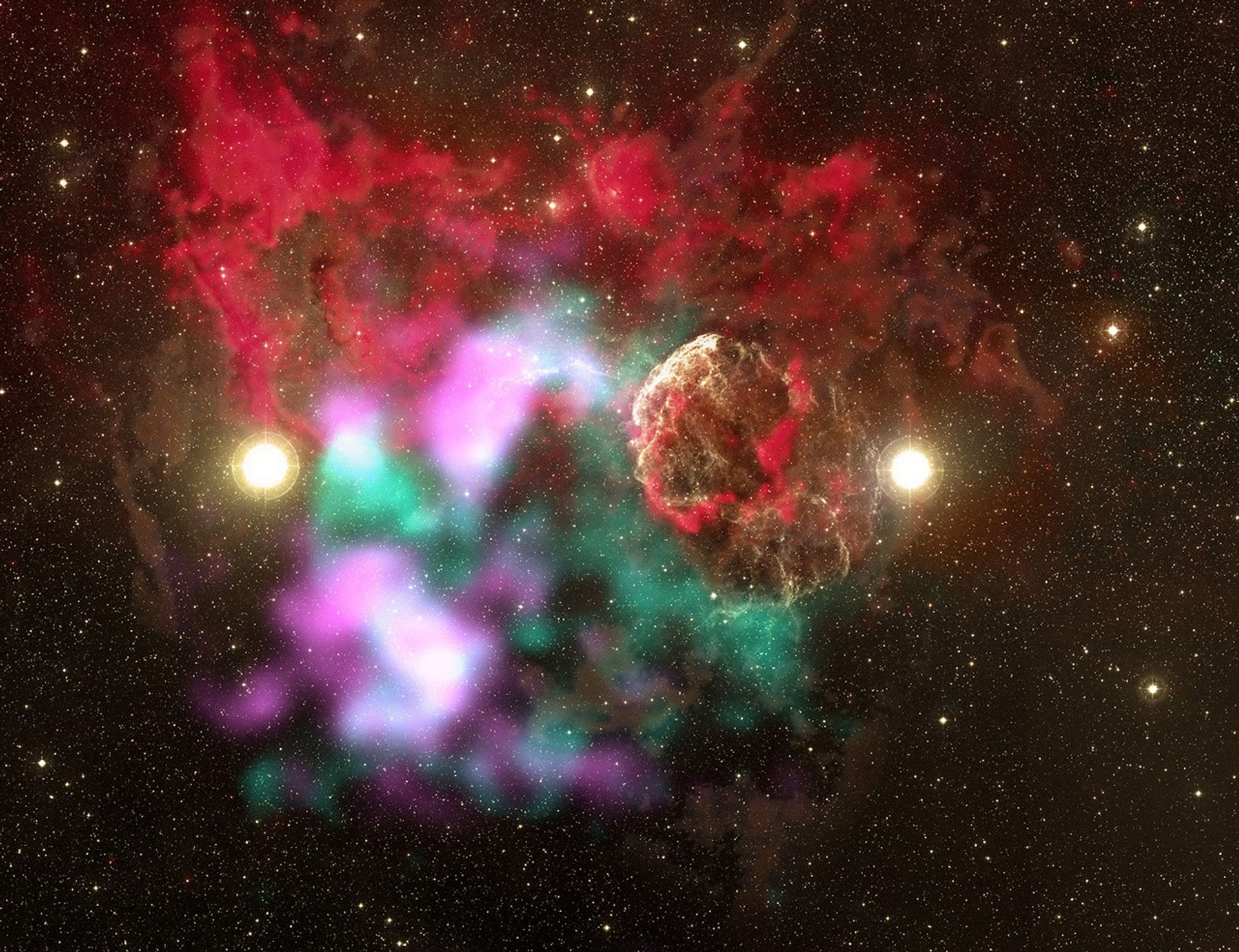
The well-known supernova remnant IC 443 (right) has an older, fainter neighbor (shown here in blue-green and magenta) called G189.6+3.3. A filament of gas between them, glowing in visible and ultraviolet light (violet arc at center), traces the neighbor’s shock wave and shows that both remnants are interacting with the same molecular cloud, shown in red, orange, brown for infrared and radio data and yellow for visible light. Blue-green shows X-rays from the fainter remnant, while magenta shows gamma rays with energies greater than 10 billion electron volts; for comparison, visible light has energies between about 2 and 3 electron volts. In this view, high-energy light from the much brighter IC 443 has been removed for clarity. Gamma-ray emission near the filament stems from protons accelerated in the supernova’s shock wave as it expands into the cloud.
NASA Goddard Space Flight Center and M. Michailidis et al. 2026; radio, MWISP and ESA/Planck; infrared: NASA/WISE/JPL-Caltech/UCLA; optical: DSS; ultraviolet: NASA/Swift; X-ray: SRG/eROSITA; gamma ray: NASA/DOE/Fermi LAT Collaboration
Astronomers think the Jellyfish Nebula is also a candidate PeVatron, a cosmic particle accelerator capable of boosting protons to energies so high they could nearly escape our galaxy. Such particles can produce gamma rays with trillions of times more energy than visible light. Finding a second particle accelerator near the Jellyfish Nebula could offer scientists new clues for how supernova remnants develop into PeVatrons.
“The overlapping remnants, a connecting gas filament, and the availability of data from Fermi and other facilities motivated us to delve into this complex but little-studied region,” said co-author Marianne Lemoine-Goumard, an astrophysicist at the French National Centre for Scientific Research (CNRS) based at the University of Bordeaux. “With Fermi’s LAT instrument, we found gamma-ray emission associated with accelerated protons in the northern part of the fainter remnant. If both remnants are interacting with the same structure, then they must share a common distance from us.”
The team concludes the remnants lie about 6,000 light-years away, their explosion centers are separated by roughly 40 light-years projected onto the plane of the sky, and the original stars may have been 20 or more times the Sun’s mass.
Estimates of the remnants’ ages vary widely, but the team concludes that the age of the Jellyfish Nebula is 8,000 to 9,000 years, while G189.6+3.3 is between 20,000 to 110,000 years old. This means the delay between the explosions could have extended for up to 100,000 years.
In addition, the team conducted computer simulations of a million massive binary systems. They show that systems where the stars orbit close enough to exchange matter and interact during their lives can readily produce dual supernova explosions with similar separations and time delays as those found for the remnants. The team also estimated that the chance of randomly encountering this combination of observed spatial alignment and compatible distances to be less than 1%, strongly supporting a physical association.
“The evidence we’ve compiled — including observations across the spectrum, the chemical and physical properties of the remnants, simulations, and more — paints a compelling picture of a dual supernova event,” said Michailidis.
This study identifies a unique possible example of a binary system where both stars exploded as supernovae and left behind separate, detectable supernova remnants. Astronomers think that most massive stars form in binary or multiple-star systems. The Jellyfish Nebula/G189.6+3.3 complex offers astronomers a rare opportunity to study how massive binary stars evolve, exchange matter, explode, and experience velocity changes — called kicks — induced by the supernova blast. It also provides a powerful new laboratory for understanding how coupled supernova remnants behave, including how they accelerate particles, generate gamma rays, and shape their surrounding environments.
“Fermi’s gamma-ray observations of supernova remnants continue to reveal the dynamic lives of stars,” said Elizabeth Hays, the Fermi project scientist at NASA’s Goddard Space Flight Center in Greenbelt, Maryland. “We can now connect the glowing remains of two massive stars to a powerful pair that evolved together over thousands of years.”
This NASA Hubble Space Telescope image features a swarm of galaxies in the galaxy cluster called CL0016+1609 or MACS J0018.5+1626.
NASA, ESA, H. Ebeling (University of Hawaii), D. Coe (STScI, ESA, JWST); Image Processing: G. Kober (NASA/Catholic University of America)
This NASA Hubble Space Telescope image features a galaxy cluster, called CL0016+1609 or MACS J0018.5+1626, that is very bright at X-ray wavelengths and is one of the most extensively studied clusters at X-ray and radio wavelengths. The X-ray observations of this cluster revealed that it is two clusters merging along our line of sight.
Researchers requested time to observe CL0016+1609 with Hubble’s Advanced Camera for Surveys because that data would help them accurately measure the cluster’s dark-matter distribution, which helps them study the merger and the role of CL0016+1609 in the large-scale structure of the universe. Hubble can’t directly see dark matter, but its infrared and visible light observations can detect dark matter’s gravitational lensing effects on the normal matter Hubble observes.
The data in this image also includes observations with Hubble’s Wide Field Camera 3 taken as part of an observing program that obtained the first Hubble infrared images of 46 massive galaxy clusters and looked for distant galaxies gravitationally lensed by these clusters. Called RELICS (Reionization Lensing Cluster Survey), this survey found some 300 high-redshift candidate galaxies lensed by these clusters.
You can see the faint vertical arc of one of these distant galaxies in the image above. Look for it just to the left of the large elliptical galaxies in the center of the image. Another brighter, though shorter arc is visible just above and to the right of the large elliptical galaxies in the center of the image.
Scientists are exploring a fascinating idea: some of the brilliant stellar explosions seen across the universe may have been triggered by tiny black holes formed shortly after the Big Bang. A new study led by researchers at the State University of New York Polytechnic Institute (SUNY Poly) suggests that these mysterious objects, called primordial black […]
JCMT0402-0424, a dusty starburst galaxy around 11 billion light-years away, is the strongest candidate yet for the source of the high-energy neutrino event IC 210922A, according to a team of astronomer led by Yuji Urata of MITOS Science Co.

 Login