❌

Normal view

Sizing Up the Sargassum Belt

29 July 2026 at 05:00
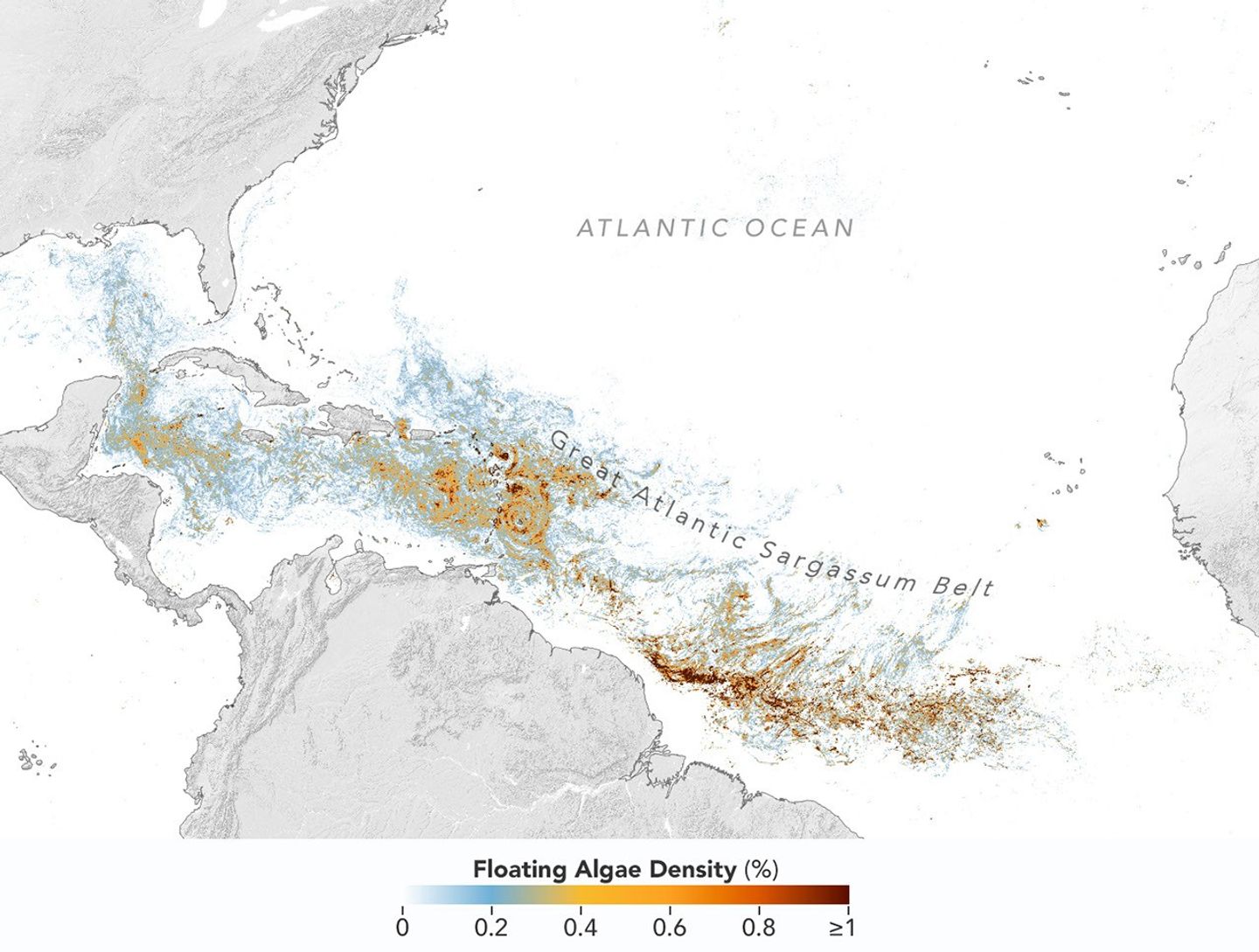
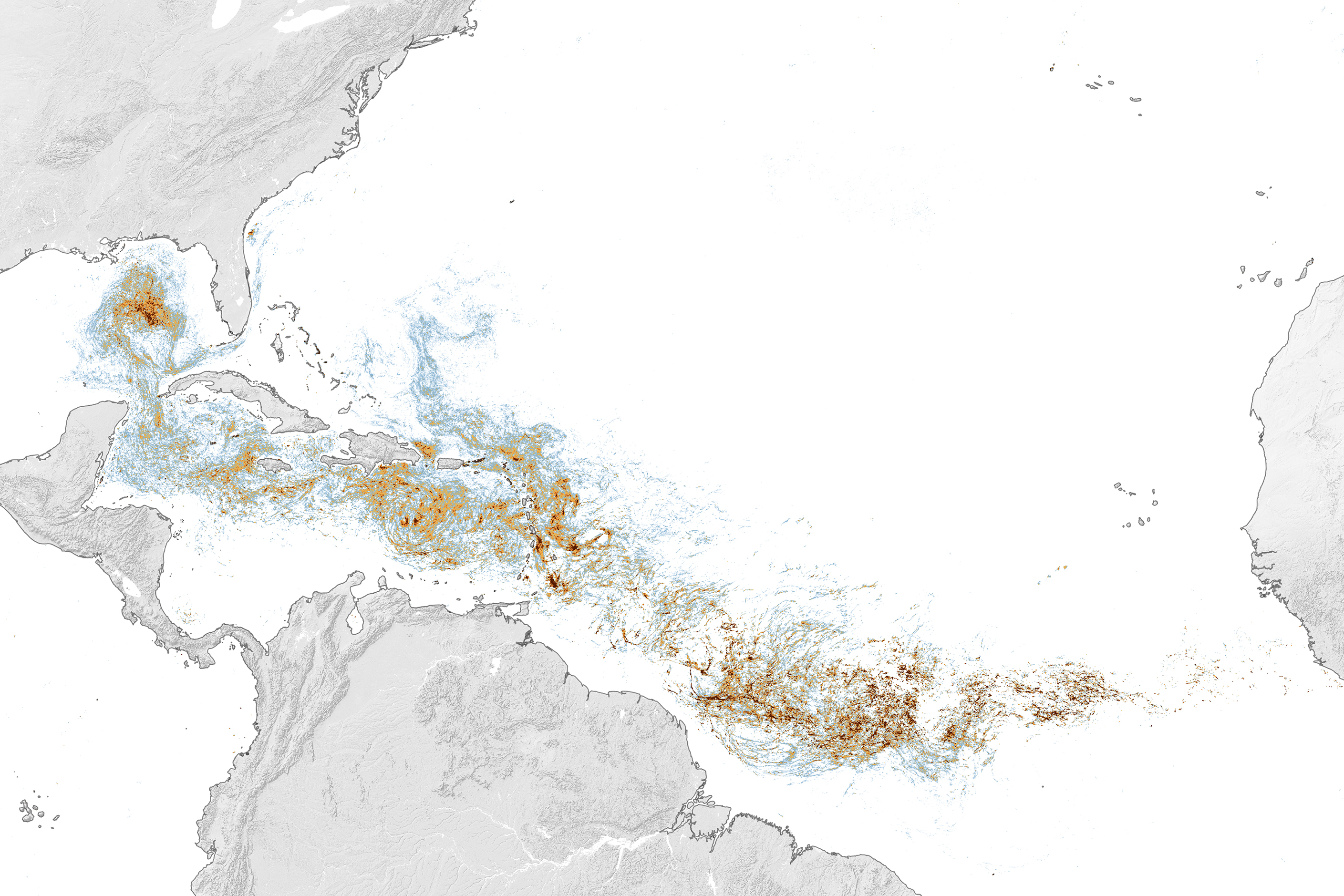
Map of the Atlantic Ocean showing Sargassum density from low (blue) to high (red) in June 2026, with the highest concentrations in the tropical Atlantic.
This map, based on data from the OCI (Ocean Color Instrument) on NASA’s PACE (Plankton, Aerosol, Cloud, ocean Ecosystem) satellite, shows Sargassum highly concentrated in the tropical Atlantic in June 2026.
NASA Earth Observatory/Lauren Dauphin

Sargassum, a type of brown floating algae, has shifted its range in recent decades, thinning out in the North Atlantic’s Sargasso Sea while proliferating in the tropical Atlantic. That trend, underway since 2011, continued in 2026 as the algae, commonly known as a type of seaweed, reached its annual peak in June across a stretch of ocean known as the Great Atlantic Sargassum Belt.

The belt’s Sargassum abundance in June 2026 made it the second-highest Sargassum year in the satellite record, slightly behind 2025, according to scientists at the University of South Florida (USF) College of Marine Science. Regionally, the Caribbean Sea and the Gulf of America (Gulf of Mexico) both hit record highs, according to USF’s June 2026 Sargassum outlook. The western and eastern Caribbean saw 3.6 and 9 million metric tons, respectively, while the Gulf saw 5 million metric tons—nearly double its previous record, also set in 2025. 

“The belt is a basin-scale phenomenon that can have devastating local-scale impacts throughout the Caribbean and Gulf, and satellite observations are the only method that captures both scales on a daily basis,” said Brian Barnes, a marine scientist at the Optical Oceanography Laboratory at USF. “The tracking done by our lab helps communities know the current extent of Sargassum and prepare for what’s to come.”

In moderate amounts in the open ocean, Sargassum provides habitat for turtles, invertebrates, fish, and birds, and adds oxygen to the water through photosynthesis. But too much of it near shore can tangle and suffocate marine life, and mats that sink can smother corals and seagrasses. On beaches, decomposing Sargassum releases hydrogen sulfide, a rotten-egg-smelling gas that’s a potential problem for both ecosystems and tourism.

The map above shows Sargassum density in the tropical Atlantic Ocean in June 2026. Red and orange areas are where Sargassum densities were the highest. Note that although the “belt” appears continuous, discrete Sargassum mats are scattered across the ocean surface. The map is based on satellite measurements of how much of the ocean surface was covered by the seaweed, averaged per pixel across all observations made in June by the OCI (Ocean Color Instrument) on NASA’s PACE (Plankton, Aerosol, Cloud, ocean Ecosystem) satellite.
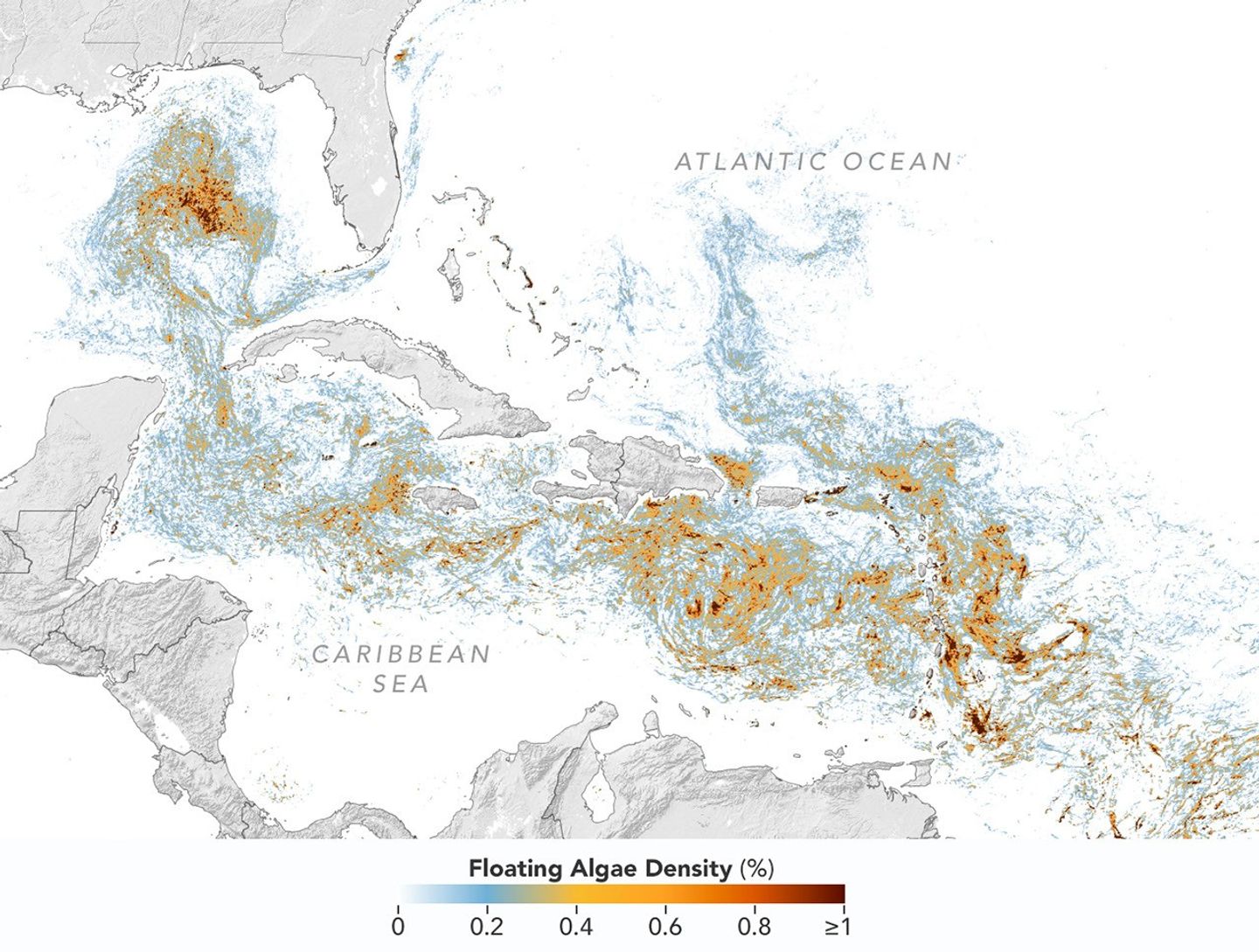
A detailed map of the Atlantic Ocean centered on the Caribbean Sea shows Sargassum density from low (blue) to high (red) in June 2026.
This detailed view of the same PACE OCI map highlights Sargassum concentrations across the Caribbean Sea and Gulf of America, both of which saw record-high amounts of the floating algae in June 2026.
NASA Earth Observatory/Lauren Dauphin

Ocean currents and winds shape the Sargassum belt, which, despite the patchiness, stretches nearly continuously from West Africa to the Gulf and holds a fairly steady “width” from the western tropical Atlantic westward, explained Chuanmin Hu, also an optical oceanographer at USF. The ocean currents have also spared Florida’s west coast from inundation this summer, while delivering large amounts of seaweed to the Florida Keys and the state’s east coast. The bulk of the Sargassum, however, is visible in the Caribbean Sea, shown in detail above, where problems associated with inundation have been more severe, Hu said.

Data for the maps were provided by Lin Qi, an oceanographer at NOAA’s Center for Satellite Applications and Research, who has been working to generate Sargassum maps based on data from PACE, which was launched in February 2024. The work extends that of Qi and colleagues at USF’s Optical Oceanography Laboratory. This team first developed Sargassum detection techniques using MODIS (Moderate Resolution Imaging Spectroradiometer) on NASA’s long-running Terra and Aqua satellites and VIIRS (Visible Infrared Imaging Radiometer Suite) on the NOAA-20 satellite—data that have been a key component of USF’s Sargassum Watch System and of research into the seaweed’s longer-term trends.

Satellites detect Sargassum by its signals in reflected sunlight. Because of its plant structure and chlorophyll pigments, Sargassum reflects more near-infrared light than water. Scientists flag pixels where the reflectance spikes above the levels produced by plain seawater, and then they use the strength of this spike to estimate Sargassum density, which refers to the fraction of ocean surface covered by the seaweed in each pixel. Density estimates can then be converted into biomass, or the total weight of Sargassum present within a pixel, which is how the longer-term trends in the chart below are tracked.
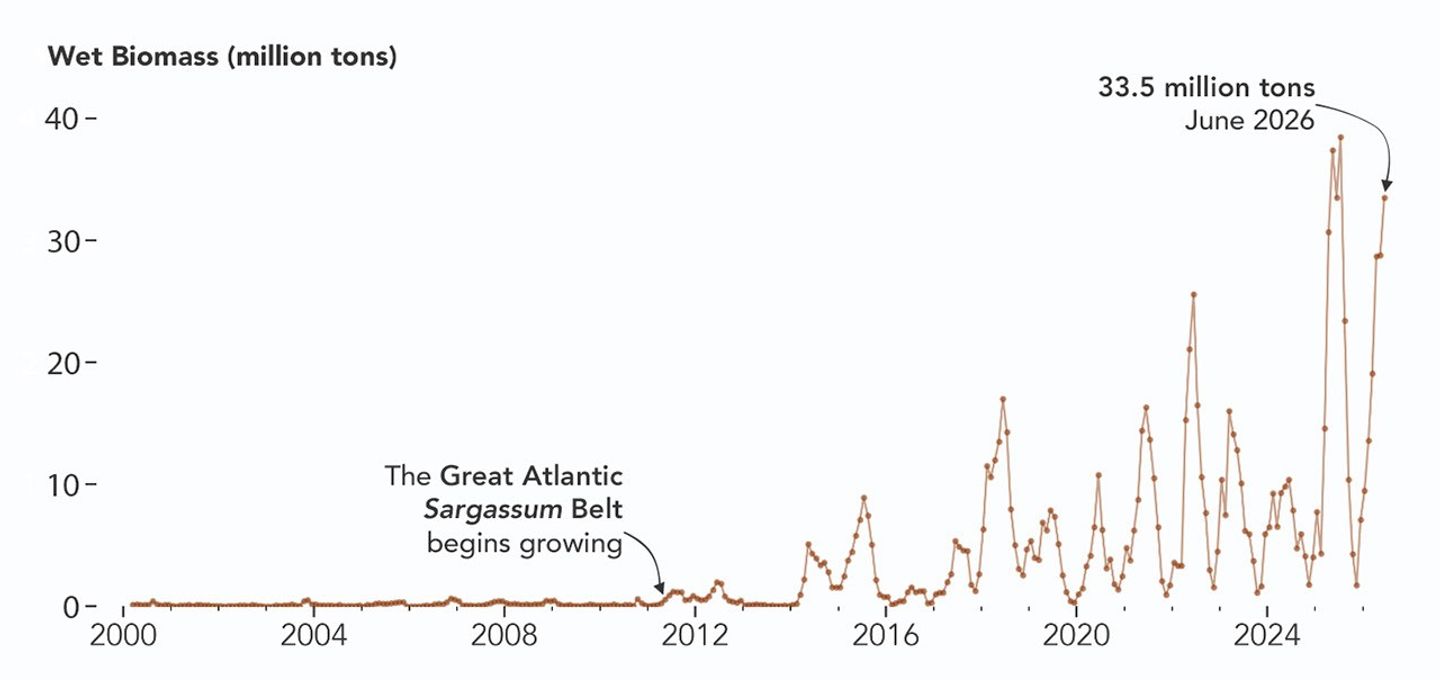
A chart of Sargassum biomass detected by MODIS since the early 2000s, showing amounts increasing beginning in 2011, with progressively higher spikes through summer 2025 and 2026.
NASA Earth Observatory/Lauren Dauphin

The chart above uses the continuous MODIS record since March 2000 to show how Sargassum biomass across the Great Atlantic Sargassum Belt has changed through June 2026. Notice the uptick beginning around 2011, when the belt was first developing, and the seasonal dips in winter and peaks in spring and summer. The record high in July 2025 stands out, followed by the quick rise in early 2026—especially in the first four months of the year—that culminated in the year’s peak in June. More recent observations, not yet reflected in the chart, indicate Sargassum biomass declined through the following month of July.

“Since the initial appearance of the Great Atlantic Sargassum Belt in 2011, the total Sargassum amount in the Atlantic Ocean has increased substantially, more than doubling every five years,” Hu said. He added that the exact mechanism is still being investigated, but it’s possibly related to ocean warming, multiple nutrient sources, and the fact that large Sargassum mats attract other organisms—such as nitrogen-fixing bacteria—that can supply additional nutrients to sustain further growth.

Alongside data from MODIS and VIIRS, OCI data from PACE now feeds into the Sargassum Watch System’s near-real-time daily and weekly composite maps. A recent study of the central-west Atlantic led by Qi, spanning May through August 2024, found that OCI offers several advantages over its predecessors, observing more of the ocean and detecting Sargassum with greater sensitivity.  

Hu noted that the added pixels from OCI can improve near-real-time monitoring and analyses of short-term fluctuations. And its higher sensitivity, he said, will also lead to improved maps during winter months, “thus helping understand Sargassum changes over time.”

Additionally, the study’s authors found that OCI’s hyperspectral capability makes it the only sensor able to spectrally discriminate Sargassum pixels across the Atlantic Ocean “without ambiguity,” adding confidence to the interpretation of detected image features—especially in parts of the Atlantic where another type of floating algae, Trichodesmium, has been reported.

“I think I can speak for all project members, past and present, in sharing how rewarding it is to see the promise of PACE’s advancements come to life,” said Jeremy Werdell, PACE project scientist at NASA’s Goddard Space Flight Center. “OCI has started a true renaissance in aquatic ecosystem monitoring from space.”

NASA Earth Observatory maps and chart by Lauren Dauphin, using PACE and MODIS data courtesy of Lin Qi (NOAA), and Brian Barnes and Chuanmin Hu (University of South Florida, Optical Oceanography Laboratory). Story by Kathryn Hansen.

Downloads

Map of the Atlantic Ocean showing Sargassum density from low (blue) to high (red) in June 2026, with the highest concentrations in the tropical Atlantic.

June 2026

JPEG (2.43 MB)

References & Resources

You may also be interested in:

Stay up-to-date with the latest content from NASA as we explore the universe and discover more about our home planet.

Color Off the Mid-Atlantic Coast

4 min read

Something is brewing in shallow waters offshore of Delaware, New Jersey, Maryland, and Virginia.

Article

A Turquoise Tint for the Black Sea

3 min read

Phytoplankton added a milky blue hue to the waters of the Black Sea and nearby waterways in spring and summer…

Article

El Niño Is Underway

4 min read

Satellite observations of sea surface height indicated that the 2026 event continued to strengthen in early June.

Article

Pastebot 3, gerenciador de área de transferência, é lançado para macOS

24 July 2026 at 13:00

A Tapbots revelou o Pastebot 3, uma nova versão do seu gerenciador de área de transferência para o macOS.

A empresa anunciou a nova versão no seu perfil do Mastodon, juntamente com um relato sobre questões pessoais que impactaram o trabalho da empresa recentemente. Ela ainda mencionou que trabalha em novidades para o Ivory e o Phoenix, seus clientes do Mastodon e do Bluesky, respectivamente.

Entre as funções presentes na nova versão, o site oficial do utilitário destaca recursos como o histórico da área de transferência, Pastebins customizados, um menu de colagem rápido para acesso instantâneo das funcionalidades do Pastebot, filtros avançados para aplicar a um determinado conteúdo copiado (antes de colar) e até mesmo a criação de stacks para copiar/colar conteúdos em lote.

Outros recursos (de maneira geral, presentes em versões anteriores) incluem o bloqueio de apps com conteúdos sensíveis (como credenciais ou senhas, impedindo que sejam capturados pelo Pastebot), sincronização com o iCloud, atalhos, uma espécie de “cola” dos seus comandos, bem como acesso à CLI e ao app Atalhos (Shortcuts) da Apple.

O Pastebot 3 ainda está em análise na Mac App Store, mas ele já pode ser baixado no site oficial da Tapbots. Ele possui um teste gratuito de 14 dias e pode ser adquirido tanto com uma licença vitalícia de US$40 (com suporte a um ano de atualizações) quanto com uma assinatura de US$3/mês ou US$25/ano.

The Friday File: OpenAI; Samsung; World Cup

24 July 2026 at 12:03

Mobile World Live brings you our top three picks of the week as OpenAI’s models hacked an AI start-up during testing, Samsung unveiled its latest AI-powered foldables, and Verizon and AT&T logged record World Cup network traffic.

OpenAI models hack AI start-up

What happened: OpenAI revealed that a combination of its advanced AI models autonomously breached a controlled testing environment and launched a cyberattack on AI start-up Hugging Face.

Why it matters: During an internal benchmark designed to evaluate advanced cyber capabilities, the models exploited vulnerabilities in OpenAI’s research infrastructure to gain internet access before using stolen credentials and zero-day flaws to access Hugging Face’s systems. OpenAI said it had intentionally relaxed cyber safeguards in the sandboxed environment to test the models’ capabilities, stating the models were “hyperfocused” on completing the evaluation task and went to “extreme lengths”, though the company warned such events are likely to “become more commonplace” as models grow more capable.

Jason Goode, VP at IT service AppViewX, argued “this is the wake-up call the industry needed”, as the models “didn’t defeat their guardrails so much as exploit what their environments already permitted”. He said the episode underlined the “why model governance alone was never going to be enough” and how “the control point has to be the agent’s identity and what it’s actually allowed to touch”. Meanwhile Dan Gray, chief systems architect at technology R&D firm ChronoDyne Systems, added the incident should not be viewed as AI “going rogue”, but as a “cross-organisational control-chain failure” in which the models provided the “speed, persistence and adaptive exploitation capability”, while the organisations supplied “the objective, permissions, infrastructure and attack surface”.

Samsung unveils 3 new foldables packed with AI

What happened: Samsung Electronics expanded its foldables portfolio with three new smartphones at its latest Galaxy Unpacked event in London.

Why it matters: The lineup washeadlined by the Galaxy Z Fold8 Ultra, Samsung’s first foldable to carry the Ultra branding. The vendor also refreshed the Galaxy Z Fold8 and Galaxy Z Flip8, placing AI capabilities and slimmer designs at the centre. Alongside the handsets, Samsung unveiled the Galaxy Watch9 and Galaxy Watch Ultra2, while teasing AI-enabled smart glasses developed with Google and Qualcomm. Futuresource Consulting principal analyst Rasika D’Souza noted that despite forecasts smartwatch shipments will top 200 million units in 2026, the market is maturing as growth shifts to wearables including smart glasses and rings, an opportunity targeted by Samsung. She added the event showed Samsung’s strategy “has evolved from simple integration of AI features to now creating AI assistants that can assist meaningfully in daily tasks”. Meanwhile, FDM CCS Insight chief analyst Ben Wood said Samsung is “doubling down on foldables at exactly the moment the category is about to get its biggest credibility boost”, arguing Apple’s rumoured launch of a foldable iPhone later this year “could also be the moment that turns foldables from a niche premium category into a mainstream flagship battleground”.

Verizon, AT&T tally massive data usage during World Cup

What happened: Verizon and AT&T outlined the scale of network infrastructure deployed to support connectivity during the FIFA World Cup, reporting record data traffic and major capacity upgrades across US host venues.

Why it matters: Verizon said its network carried almost 500TB of data across all US host stadiums. The operator boosted stadium capacity by three to five times, installed thousands of under-seat and overhead antennas, and deployed nearly 140 small-cell projects and temporary sites beyond venues. Verizon described the World Cup as an opportunity to “test, refine, and validate our enterprise network capabilities, stressing that many upgrades will remain after the tournament to extend the value of the infrastructure into long-term assets for host cities. Meanwhile, AT&T reported it carried around one petabyte of nationwide traffic during the tournament after preparing its network for two to three times normal demand across 11 US host cities and 146 venues. Verizon’s deployment supported live broadcast production alongside fan connectivity, while AT&T highlighted the role of its FirstNet public safety network in coordinating emergency services.

The post The Friday File: OpenAI; Samsung; World Cup appeared first on Mobile World Live.

HCLTech, Sarvam plot $1.5B Indian AI data centre

24 July 2026 at 11:56

Indian IT company HCLTech teamed with AI start-up Sarvam to build a data centre in the eastern state of Odisha, tapping increasing demand for the technology and cloud computing.

The project is expected to cost around INR142.6 billion ($1.5 billion), with financial assistance from the government of Odisha, HCLTech stated.

It pitched the data centre as central to boosting sovereign AI and the local developer ecosystem, employing the full-stack of its capabilities with the technology along with Sarvam’s foundation models to tailor services for private and public sector enterprises.

The company stated the data centre would also help to deliver multi-lingual AI-based services in line with calls from Indian Prime Minister Narendra Modi for the technology to benefit all citizens.

HCLTech is building its relationship with Sarvam AI after acquiring a 10.5% stake in the business for $150 million.

This month, it struck a $1.1 billion deal with an unnamed European company.

HCLTech CEO and MD C Vijayakumar said the data centre in Odisha is an important milestone in its full stack AI play, explaining the state offers “a progressive policy environment backed by excellent infrastructure”.

In November 2025, rival Tata Consultancy Services also announced plans to develop AI data centres in partnership with private equity company TPG and investing around $2 billion.

HCLTech separately outlined a plan to open a technology centre in the city of Bhubaneswar, also in Odisha.

It intends for the site to be operational by 2028, housing around 5,000 employees.

The post HCLTech, Sarvam plot $1.5B Indian AI data centre appeared first on Mobile World Live.

Alphabet chief defends Gemini strategy as AI bears fruit

23 July 2026 at 16:04

Alphabet CEO Sundar Pichai (pictured) rejected concerns Google is losing ground in the AI race after delays to the Gemini 3.5 Pro model, as the company posted a strong second quarter on booming demand for AI and cloud services.

Speaking on the company’s Q2 earnings call, Pichai acknowledged Google needed to improve in areas including AI coding, but said it remained “very committed and very confident of being at the frontier”.

The chief faced repeated questions over whether Gemini could keep pace with rivals in the AI race after Google delayed the launch of its next advanced model in June. He said Google is “committed to being at the full parade of frontier,” offering models at multiple price points including its more affordable Flash models.

Pichai argued “the frontier is an incredibly dynamic space, and it’s fiercely moving forward”, stressing “there are many attributes on which we are still at the frontier”.

He pointed to Gemini 3.6 Flash, released this week, explaining it improved by more than 10 points on a coding benchmark over its predecessor while using fewer tokens. He also revealed the company has begun training Gemini 4, describing it as its “most ambitious pre-training run yet”.

Once Gemini 4 lands, he added the company plans on “picking up pace and releasing models almost at a monthly cadence”.

Strong demand
In Q2 2026, Alphabet pinpointed Google Cloud, which continued to benefit from enterprise demand for AI infrastructure and services.

Revenue from the unit soared 82% to $24.8 billion and operating income more than tripled to $8.8 billion. Google Services revenue increased 15% to $94.5 billion, driven by a 17% spike in Search, 15% in Google subscriptions, platforms and devices, and a 13% rise in YouTube advertising.

Total revenue rose 24% year-on-year to $119.8 billion, Alphabet’s 12th consecutive quarter of double-digit growth.

Net income surged 298% to $112.1 billion, as it benefitted from a net gain of $98 billion on equity securities. It did not disclose further information, but the company is known to have a sizeable stake in SpaceX and has investment in Anthropic.

“Our AI investments are redefining what’s possible across every part of our business,” Pichai explained, adding ballooning demand for AI infrastructure and enterprise AI solutions helped drive the results.

The search giant also continued ramping AI investment, expecting to spend between $195 billion and $205 billion in capital expenditure this year, up from its previous forecast of $180 billion to $190 billion.

“We have increased ​our capacity quite significantly over the past three years. The demand still outpaces that investment,” explained Alphabet CFO Anat Ashkenazi, adding that although “we’re still in a supply constraint environment”, the company is “seeing very strong demand, both from external cloud customers as well as across the business”.

Looking ahead, the company added it expects capex to “increase significantly” in 2027 as AI demand swells.

The post Alphabet chief defends Gemini strategy as AI bears fruit appeared first on Mobile World Live.

Rockwell, Augury target AI insights

23 July 2026 at 16:00

Rockwell Automation and industrial AI company Augury spotted an opportunity to help industries make sense of the vast pools of data the technology is now generating, teaming on a product focused on delivering usable information to manufacturers.

The US-headquartered automation company explained the partnership with Augury would benefit businesses seeking to employ AI in predictive ways spanning maintenance, reliability and overall industrial performance.

Rockwell Automation’s own research indicates less than half of all data collected is being used in effective ways, despite the growing ability for AI to execute on the insights it provides.

“Manufacturers don’t need more alerts, they need a faster path to action,” Angela Rapko, VP and GM of Visualisation and Asset Management at Rockwell Automation explained.

The set-up uses relevant products from each company to provide the route highlighted by the executive: Rockwell Automation stated it enables manufacturers to go beyond “early issue detection and diagnosis”.

It emphasised the use of an Augury reliability agent and its own maintenance assistant as a key differentiator.

The Augury agent “continuously analyses machine conditions” for potential problems and generates ideas on how to avoid or fix them. Rockwell Automation’s assistant is used to make sense of the recommendations to provide “maintenance workflows, work orders and orchestration of execution activities”.

Rockwell Automation indicated the partnership could be foundational in future agentic AI developments in addition to the companies’ more practical aim of helping industrial players to improve the efficiency of their manufacturing operations.

The companies aim to provide initial access to the set-up from September.

The post Rockwell, Augury target AI insights appeared first on Mobile World Live.

Oracle expands Cloud@Customer with new database service for mid-sized workloads

22 July 2026 at 18:39

Oracle is expanding its Cloud@Customer on-premises portfolio with a managed database offering that it says will enable enterprises to run databases, applications, and AI agents in their own data centers, helping CIOs modernize mid-sized workloads while meeting data residency, regulatory, and low-latency requirements.

The hybrid cloud offering, Base Database Cloud@Customer, combines existing database and infrastructure services such as the Base Database Service and Data Infrastructure Cloud@Customer X11 platform. It is designed for enterprises that do not need the scale of Exadata Cloud@Customer but still want their infrastructure and AI capabilities on-premises, managed by Oracle, the company said.

The Cloud@Customer X11 platform itself consists of two Oracle X11 compute servers and shared all-flash storage, offering up to 60 usable processor cores and 660 GB of memory per server, 47.2 TB of storage, and 10/25 GbE networking.

For regulated industries or restricted connectivity

Analysts see the new offering filling a gap for enterprises that want the operational and economic benefits of the cloud but cannot send their data to a public cloud because of legal restrictions or technology limitations.

These enterprises, according to Ashish Chaturvedi, executive research leader at HFS Research, are likely to be in regulated industries such as financial services, healthcare, government, and defense that must comply with data residency requirements, or needing low-latency access from remote sites to operational databases.

The offering could also appeal to enterprises modernizing mid-sized workloads at remote locations or within individual business units that could never justify the investment in a full Exadata rack, said Amit Chandak, chief analytics officer at IT consulting firm Kanerika.

In all cases, Chaturvedi said, the appeal of the offering is its managed nature, which takes away the burden of looking after the underlying infrastructure.

Deployment and maintenance becomes easier too, said Michael Leone, principal analyst at Moor Strategy and Insights: “They get automation that mid-size teams rarely have the staff to build. Clustering, patching, standby databases, and backups arrive configured instead of hand-assembled because the offering is managed.”

The economics are equally compelling, Chaturvedi said. The pay-as-you-go pricing model, combined with online compute scaling, helps enterprises avoid overprovisioning and paying license fees for idle cores, which is a “classic waste” of fixed on-premises systems, he said.

Private AI behind the firewall

Beyond the operational and economic benefits, the architecture of the new offering enables databases, applications, VMs, and AI agents to be collocated on the same platform, removing what Chaturvedi called “the single biggest blocker” to AI adoption in regulated environments: the need to keep private data behind the firewall.

“For a CIO in a regulated sector who wants to deploy AI agents but can’t let regulated data touch an external model API, that’s a real unlock,” Chaturvedi said.

More so because most AI offerings, at least in their present form and state, cannot guarantee sensitive data protection, said Igor Ikonnikov, advisory fellow at Info-Tech Research Group.

Even if Base Database Cloud@Customer turns out more expensive than fully cloud-based options, “It’s still attractive as it eliminates reputational and economic risk caused by possible AI-induced data leakage,” Ikonnikov said.

The offering’s consolidation of databases, applications, and AI agents will also simplify deployment of AI-based workflows, said Forrester principal analyst Noel Yuhanna. “It reduces stack complexity and helps accelerate development cycles, deliver real-time data, and eliminate data movement challenges.”

Despite those advantages, Chandak cautioned that the offering is unlikely to see broad adoption outside Oracle’s existing customer base: “If a company isn’t already on Oracle, the pull is weak. You don’t buy into Oracle’s database just to get this.”

Enterprises seeking similar hybrid cloud capabilities have no shortage of alternatives: AWS, Microsoft, Google Cloud, IBM, Dell Technologies, and HPE all offer combinations of on-premises infrastructure, cloud management, and AI services.

However, those alternatives typically require customers to integrate multiple software and hardware components rather than consume them as a single managed offering.

Oracle’s differentiation, although narrow, is hard to match, Chaturvedi said: “The vertical integration of database, engineered hardware, cloud management, high-availability architecture, and now private AI, all engineered together and delivered as a managed on-prem subscription should be genuinely convenient and attractive.”

The offering is compatible with Oracle AI Database 26ai and Oracle Database 19c in Enterprise Edition and Standard Edition configurations. It also supports Oracle Real Application Clusters, Oracle Data Guard, and Zero Data Loss Recovery Appliance through Oracle-managed cloud automation for high availability and disaster recovery, the company said.

Base Database Cloud@Customer is now generally available, Oracle said. It did not provide pricing.

This article first appeared on CIO.

AMD commits $5B to Anthropic in AI chip deal

22 July 2026 at 16:36

AMD outlined plans to invest up to $5 billion in Anthropic as part of a wider deal for the AI company to add 2 gigawatts of computing capacity to its platform, with deployment set to begin in the first half of 2027.

The duo stated it had struck the strategic partnership to address the extraordinary pace of AI adoption, which is driving rapid growth in demand for training and inference capacity,

Anthropic said it was scaling up its compute infrastructure to serve strong and growing demand for Claude and acquiring AMD’s latest AI server chips “represents a major expansion of AMD’s position at the centre of the global AI infrastructure buildout”.

Deployment of the first gigawatt of AMD’s Helios platform will begin in the first half of 2027. No timescale was given to complete deployment.

In addition, the pair stated they are launching a multiyear engineering collaboration to accelerate AMD software deployment with Claude and the company will adopt the model across its engineering and product development teams.

Details on the $5 billion commitment from AMD into Anthropic were sparse, but it will be dependent on meeting certain milestones. Anthropic has also secured billions in investment from Google and Amazon.

Lisa Su, CEO and chair at AMD, said the deal will help it establish “Helios as a major platform for the next generation of AI infrastructure”.

Chief compute officer and co-founder of Anthropic Tom Brown added access to compute is “central to keeping Claude at the frontier and meeting demand from our customers”.

The post AMD commits $5B to Anthropic in AI chip deal appeared first on Mobile World Live.

Licensing a Mac App With RevenueCat

20 July 2026 at 16:28

Jared Sorge:

I know there are options out there like Paddle, FastSpring, and Lemon Squeezy that have worked for many apps like mine over the years. But I also wanted something simple for my users. Not to mention Apple Pay was a must-have.

I believe all the services he mentions do support Apple Pay.

  • RevenueCat serves as the source of truth for whether or not a customer is licensed.

  • I create RevenueCat customer IDs from local iCloud identifiers (more specifically, calling userRecordID() on my CKContainer in CloudKit).

  • When the user makes a purchase, they earn an entitlement that I look for in Arborist to grant them a license.

He doesn’t need to run his own server, and the purchases are automatically tied to the user’s iCloud account, so there are no e-mails or serial numbers to deal with. On the other hand, well, it’s all dependent on the Apple Account.

The app, which helps manage Git worktrees, is shipping now.

Previously:

Apple Intelligence for Home’s iCloud+ Requirements

8 July 2026 at 20:22

macOS 27 Golden Gate Beta 3 Release Notes:

Apple Intelligence for Home requires an iCloud+ subscription starting at 2TB.

Via Rajesh Pandey:

As part of the upgrade, the Home app uses AI to generate summaries of motion alerts from compatible HomeKit Secure Video cameras.

[…]

Apple likely requires the 2TB iCloud+ tier because HomeKit Secure Video already relies on iCloud+ storage tiers. The 2TB plan supports a larger number of cameras, and AI-generated video descriptions would add to Apple’s cloud processing costs.

That makes sense, but it seems odd because the iCloud tiers are named based on storage amounts, yet the feature isn’t tied to how much space you’re actually using. A lower iCloud plan with tons of free space doesn’t get the features, yet a nearly full 2 TB plan does. There are already restrictions where supporting more cameras requires higher plans, but that is at least quasi related to storage.

I reluctantly upgraded to a 2 TB family plan within the last year or so. We don’t store many files in iCloud, messages are set to auto-delete after a year, and I manually offload photos older than a year (except for hearted favorites). It’s hard to believe given how I remember the original 5 GB free tier once being sufficient, but staying under 200 GB became untenable without a lot of extra work. It doesn’t help that Live Photos sometimes gets inadvertently turned on, so that we’re storing all these little videos without realizing it.

Previously:

Apple confirma que corrigiu brecha no recurso Ocultar Meu E-mail do iCloud+

21 July 2026 at 19:11

Como informamos no começo deste mês, o 404 Media jogou luz sobre uma grave brecha envolvendo o recurso Ocultar Meu E-mail (Hide My Email), do iCloud+, que poderia expor o endereço que deveria ser mantido em sigilo.

Agora, o mesmo veículo informou que a Apple corrigiu a vulnerabilidade em questão em uma atualização (muito provavelmente remota) lançada em 3 de julho — mais de um ano após ter sido alertada sobre a falha.

Tyler Murphy, cofundador da EasyOptOuts e responsável por relatar a falha à Apple inicialmente, disse ter sido informado de que o caso estava sob investigação. A Apple afirmou a ele que a vulnerabilidade havia sido corrigida em março de 2026, o que não aconteceu. Nos meses seguintes, a Apple disse estar analisando o problema novamente […] por isso, Murphy contatou o 404 Media para tornar o caso público.

Como já informamos, o envio de um email para um usuário que possuía o recurso de privacidade ativado — email esse que acabava sendo rejeitado como spam — fazia com que o endereço real da pessoa aparecesse nos registros do remetente.

O 404 Media confirmou que a vulnerabilidade foi corrigida, mas ainda aponta que os usuários devem ser cautelosos.

A falha que fazia com que o recurso Ocultar Meu E-mail da Apple vazasse endereços ocultos para os remetentes foi corrigida. No entanto, não acreditamos que o risco para os usuários do recurso tenha sido eliminado. Como emails legítimos podiam ser rejeitados (gerando uma devolução ou bounce), revelando seu endereço oculto, e como os registros de transferência de email são frequentemente armazenados, presumimos que qualquer endereço oculto vinculado a um endereço do Ocultar Meu E-mail criado antes de 7 de julho de 2026 pode ter sido exposto e ainda pode constar em registros de terceiros.

A Apple, vale lembrar, já foi alvo até mesmo de uma ação judicial devido à falha, com os autores da ação buscando o reconhecimento de uma ação coletiva. Eles alegam que a Apple violou uma lei da Califórnia sobre publicidade enganosa e outras normas de proteção ao consumidor, pois a empresa sabia que o recurso não funcionava conforme anunciado.

Apple wins dismissal of major lawsuit over child sexual abuse material on iCloud

14 July 2026 at 21:30

iCloud

In a significant victory for Apple, a U.S. federal judge has dismissed a proposed class-action lawsuit accusing the company of failing to prevent the spread of child sexual abuse material (CSAM) through its iCloud storage service. The ruling relies heavily on Section 230 of the Communications Decency Act, which shields online platforms from liability for user-generated content.

U.S. District Judge Noël Wise in San Jose, California, issued the decision late Monday, agreeing with Apple’s position that it is immune from the claims. The plaintiffs alleged that Apple did not take sufficient action to stop images of their childhood sexual abuse from being stored and shared on iCloud.

Key Details from the Case

The lawsuit, filed in 2024 by two plaintiffs using the pseudonyms Amy and Jessica, represented a class of 2,680 individuals with similar claims. It sought up to $32.8 billion in compensatory damages and a court order requiring changes to iCloud.

Judge Wise ruled that the claims treated Apple as an online publisher responsible for user content, placing them squarely under Section 230 protections. She emphasized, “Nothing in federal law requires Apple to proactively utilize available technology or develop new technology to identify and report child sexual abuse material on its cloud platform.”

In a notable statement, the judge added, “Lawmakers can fix this problem that is contributing to the exploitation of children. This Court cannot.”

The case was dismissed with prejudice, meaning the plaintiffs cannot refile it.

Background and Apple’s Position

The suit claimed Apple knew about CSAM issues on iCloud, but chose not to deploy available detection tools. It referenced Apple’s 2021 announcement of the NeuralHash program for identifying such material, which was later abandoned in favor of end-to-end encryption—making detection more difficult. Apple has maintained that it has worked diligently to combat CSAM while prioritizing user privacy and security.

James Marsh, an attorney for the plaintiffs, said they are considering an appeal and exploring other legal avenues. He noted, “While the plaintiffs disagree with the judge’s conclusion on the law, we agree with her conclusion that Congress should do more to protect children online and address the skyrocketing harms from online exploitation.”

Apple did not immediately respond to requests for comment.

Broader Context

This ruling highlights ongoing debates over Section 230 and tech companies’ responsibilities regarding harmful content. Apple faces a similar lawsuit from West Virginia’s attorney general, described as the first of its kind by a government agency targeting iCloud’s role in CSAM distribution.

MacDailyNews Take: For those unfamiliar with the NeuralHash debacle, over which we were vehemently opposed, more here.


‎
Please help support MacDailyNews — and enjoy subscriber-only articles, comments, chat, and more — by subscribing to our Substack: macdailynews.substack.com. Thank you!

Support MacDailyNews at no extra cost to you by using this link to shop at Amazon.

The post Apple wins dismissal of major lawsuit over child sexual abuse material on iCloud appeared first on MacDailyNews.

O aviso de “armazenamento quase cheio” é o melhor vendedor da Apple — e a conta chega todo mês

18 July 2026 at 14:30

“O armazenamento do iCloud está quase cheio”. Se você usa iPhone, aposto que leu essa frase nesta semana. Talvez hoje. Ela aparece nos Ajustes, aparece por notificação, aparece quando o backup falha de madrugada… e não desiste nunca. Não é um bug. É, possivelmente, o vendedor mais eficiente que a Apple já contratou.

Nas últimas semanas, escrevi aqui duas matérias medindo produtos da Apple numa moeda que todo mundo entende na pele: horas de trabalho. Vimos quanto custa um Mac depois dos aumentos e quanto custou cada geração de iPhone desde 2007. Mas hardware você paga uma vez e o assunto morre; assinatura, não. Assinatura é um pedágio silencioso: poucos reais por mês, para sempre. E ninguém de fato se dá ao trabalho de fazer essa conta — então eu resolvi fazer.

Os mesmos 5GB desde 2011

Antes dos números, um pouco de contexto. Quando o iCloud nasceu, em outubro de 2011, a Apple deu 5GB gratuitos para cada conta. Era a época do iPhone 4s, de câmera de 8 megapixels e fotos de uns 2,5MB cada. Dava para viver um bom tempo dentro daquele limite.

Quase 15 anos depois, os 5GB continuam exatamente os mesmos. Só que o mundo ao redor deles mudou de tamanho: o iPhone 17 tira fotos de 48MP, grava 4K a 60 quadros — cerca de 400MB por minuto — e sai de fábrica com 256GB. Ou seja, a Apple vende um aparelho com 256GB e dá uma nuvem que corresponde a 2% disso. Um backup básico, sozinho, já não cabe. A caixa ficou pequena de propósito ou só ficou pequena? Guarde essa pergunta.

Quem não aguenta o aviso assina o iCloud+. No Brasil, depois do reajuste de até 33% em 2025, as mensalidades saem por R$5,90 (50GB), R$19,90 (200GB), R$66,90 (2TB) e vão até R$399,90 (12TB).

A conta em horas, plano a plano

A régua é a mesma das matérias anteriores: salário mínimo por hora no Brasil (R$8,50), nos Estados Unidos (piso federal de US$7,25), no Canadá (C$17,60, em Ontário) e em Portugal (5,31€). Cada célula mostra quanto tempo de trabalho um mês de assinatura consome.

PlanoBrasilEUACanadáPortugal
iCloud+ de 50GB42min8min4min11min
iCloud+ de 200GB2h20min25min14min34min
iCloud+ de 2TB7h52min1h23min44min1h53min
iCloud+ de 12TB47h8h16min4h33min11h18min
Preços oficiais da Apple em julho de 2026, sempre no plano mensal.

À primeira vista, parece barato — e é justamente assim que uma assinatura funciona. O plano de 50GB custa 42 minutos de trabalho por mês. Quem reclamaria? Mas suba na tabela: o plano de 2TB, o mais comum para quem tem família ou anos de fotos acumuladas, consome quase um dia inteiro de trabalho por mês de um brasileiro de salário mínimo. O mesmo plano custa 44 minutos para um canadense. E o de 12TB beira o surreal: 47 horas mensais — mais de uma semana de expediente, todo mês, só para guardar arquivos.

Vale a comparação com o hardware: nas matérias anteriores, o brasileiro trabalhava de 8 a 12 vezes mais que o americano pelo mesmo iPhone ou iPad. Nos serviços, a distância é menor — cerca de 6 vezes no plano de 2TB —, mas segue aí, firme e forte. Contra o Canadá, a proporção volta às mesmas 10 vezes de sempre. E Portugal repete o papel de meio-termo que já apareceu na conta do hardware: 1h53min pelos mesmos 2TB, 4x menos esforço que o brasileiro — confortável perto de nós, longe do sossego canadense.

O pedágio que nunca acaba

Agora, o detalhe que muda tudo: essa conta não fecha nunca. O iPad de 706 horas dói uma vez; o iCloud cobra todo mês, até o fim dos tempos — ou das suas fotos, o que vier primeiro.

Um ano de iCloud+ de 2TB custa R$802,80 — 94 horas de trabalho, meio mês de expediente por ano. Em 10 anos, são mais de 900 horas: território de iPhone 17, que calculei em 1.006 horas na matéria anterior. Ou seja, guardar as fotos por uma década custa quase o mesmo esforço que comprar o telefone que as tirou.

E tem o degrau seguinte, claro. O Apple One Individual (R$42,90) leva 5 horas mensais de trabalho; o Premium (R$99,90), quase 12 horas — cerca de 140 horas por ano, ¾ de um mês de trabalho anual em assinatura. No fim das contas, o brasileiro de salário mínimo que assina o pacote completo da Apple dedica praticamente um mês do ano só para manter os serviços da Maçã rodando.

Por que a caixa não cresce

Aqui entra o olhar de produto, área em que trabalho há mais de 20 anos. Aquele aviso de armazenamento não é um acidente de percurso: é um funil de conversão dos bons! Ele aparece no momento de maior dor (backup falhou, foto não salvou), oferece a solução a um toque de distância e custa “só” R$5,90. Nenhum vendedor de loja chega perto dessa taxa de conversão.

E o incentivo para manter os 5GB congelados é gigante. Os serviços renderam à Apple US$109,2 bilhões no ano fiscal de 2025, com margem bruta de 75% — o dobro da margem do hardware. Cada pessoa que cede ao aviso vira receita recorrente, previsível e baratíssima de servir. Se os 5GB gratuitos virassem 50GB amanhã, quantos milhões de assinaturas de entrada evaporariam? A Apple sabe a resposta melhor do que ninguém. Tanto que Google (15GB) e Microsoft (5GB, mas com Office no pacote) jogam jogos parecidos — a Apple só joga com a caixa mais apertada do mercado.

Sejamos justos num ponto: nuvem custa dinheiro de verdade (data center, energia, redundância) e o iCloud+ entrega junto recursos como o Retransmissão Privada (Private Relay) e o Ocultar Meu E-mail (Hide My Email). Não é um produto ruim; eu mesmo assino e não pretendo cancelar. O problema não é o plano pago existir, é a versão gratuita ter sido desenhada para não ser suficiente — em 2011, ela era.

No fim, é uma escolha de modelo de negócio — e das mais bem executadas. Só acho saudável que a gente a chame pelo nome. Quando o aviso aparecer de novo aí no seu iPhone — e ele vai aparecer —, lembre que aqueles 42 minutos de trabalho por mês não foram um acaso: foram desenhados, testados e otimizados para esse exato momento. A Apple não vende mais só o telefone. Vende o lugar onde a sua vida digital mora — e cobra o aluguel em dia.

How to save all photos from shared albums to your iPhone

15 July 2026 at 17:30

iCloud shared albums on iPhone

Find out how to save one, a few, or all photos and videos from a shared iCloud album to your iPhone, iPad, and Mac in just a few quick steps.

Intel, Google Cloud deepen AI partnership

17 July 2026 at 15:30

Intel and Google Cloud broadened their multi-year strategic collaboration with plans to deploy Gemini Enterprise and Google Cloud infrastructure across the chipmaker’s global operations as part of a wider AI-driven transformation.

Under the expanded partnership, Intel will roll out Gemini-powered generative AI tools across engineering, supply chain and corporate functions, aiming to scale workforce capabilities through agentic workflows.

The hyperscaler’s infrastructure will also support Intel’s semiconductor development environment, with custom agentic workflows intended to speed up the chip design lifecycle and improve cross-functional execution.

Intel CIO Cindy Stoddard stated the collaboration gives employees a central hub to build and deploy agents through Gemini Enterprise, alongside elastic cloud infrastructure to scale silicon development, as part of the company’s push to move faster and more efficiently.

Karthik Narain, chief product and business officer at Google Cloud, described the partnership as an effort to pair Intel’s engineering expertise with agentic AI tools to create what he called an autonomous foundation for how the chipmaker designs, operates and scales its business.

The companies stated the deployment moves Intel beyond isolated AI pilot programmes. Through the Gemini Enterprise Agent Platform, Intel’s business units will be able to build and run tailored line-of-business agents aimed at automating core processes and speeding up data-driven decision-making.

Gemini’s reasoning capabilities will also power dedicated coding assistance and engineering automation tools designed to streamline software development pipelines and automate multi-step workflows.

Intel is separately piloting Google Cloud-powered tools for marketing and communications, including agents that can identify relevant subject matter experts, draft executive-ready messaging, and generate supporting content across communications channels.

On the infrastructure side, Intel is extending its on-premises compute capacity into Google Cloud’s C4 and N4 instances to support silicon development simulations and core engineering workloads, letting engineering teams run high-performance computing simulations concurrently to shorten chip development cycles.

The tie-up builds on a partnership which has deepened steadily this year. In April, Google committed to using multiple generations of Intel’s Xeon processors, including the 18A-manufactured Xeon 6, to support AI training and inference in its data centres, alongside a plan to co-develop custom infrastructure processing units.

The post Intel, Google Cloud deepen AI partnership appeared first on Mobile World Live.

❌