O iPhone 16 segue sendo uma excelente opção para quem quer um smartphone recente da Apple, mas não quer investir tanto em um modelo da linha 17.
Entre as suas especificações, podemos destacar a tela de 6,1 polegadas, o conjunto de duas câmeras (com um sistema Fusion de 48 megapixels e uma câmera ultra-angular de 12MP) e o processador A18, além da presença do Controle da Câmera (Camera Control) e do botão de Ação (Action Button).
Se levarmos em conta que o preço tabelado desse modelo aqui no Brasil é de R$6.799 nessa mesma modalidade de pagamento, estamos diante de um desconto de 23%!
Já para quem preferir pagar à vista no Pix, a oferta também é muito boa: ele sai a R$4.739,00, representando um desconto de 23% se comparado com o valor da Apple nessa mesma condição, que é de R$6.119,10.
Para chegar a esses valores, não esqueça de resgatar/aplicar o cupom IPHONE400.
Todos os descontos de promoções divulgadas pelo MacMagazine são calculados com base nos preços sugeridos pela Apple ou por outras fabricantes. Pode ser que um determinado produto seja comumente encontrado por valores inferiores em redes varejistas, mas a nossa base de comparação é sempre em cima das tabelas oficiais.
Se você não é louco, é claro que gosta de economizar. E, para isso, o MacMagazine tem diversas opções para ajudar você a conseguir comprar o seu produto Apple pagando menos!
NOTA DE TRANSPARÊNCIA: O MacMagazine recebe uma pequena comissão sobre vendas concluídas por meio de links deste post, mas você, como consumidor, não paga nada mais pelos produtos/serviços usando os nossos links de afiliado.
O iPhone 17 recebeu várias melhorias em relação ao seu antecessor, o que fez dele o smartphone perfeito para a grande maioria dos usuários que procuram um telefone da Apple.
Entre as suas especificações técnicas, podemos destacar a tela Super Retina XDR de 6,3 polegadas com ProMotion (até 120Hz), o conjunto de duas câmeras (com um sistema Fusion de 48 megapixels nas duas lentes) e o processador A19, além da presença do Controle da Câmera (Camera Control) e do botão de Ação (Action Button).
Se levarmos em conta que o preço tabelado desse modelo aqui no Brasil é de R$7.999 nessa mesma modalidade de pagamento, estamos diante de um desconto de 26%.
Todos os descontos de promoções divulgadas pelo MacMagazine são calculados com base nos preços sugeridos pela Apple ou por outras fabricantes. Pode ser que um determinado produto seja comumente encontrado por valores inferiores em redes varejistas, mas a nossa base de comparação é sempre em cima das tabelas oficiais.
Se você não é louco, é claro que gosta de economizar. E, para isso, o MacMagazine tem diversas opções para ajudar você a conseguir comprar o seu produto Apple pagando menos!
NOTA DE TRANSPARÊNCIA: O MacMagazine recebe uma pequena comissão sobre vendas concluídas por meio de links deste post, mas você, como consumidor, não paga nada mais pelos produtos/serviços usando os nossos links de afiliado.
Citando pessoas familiarizadas com o cronograma de lançamentos da Maçã, ele explicou que a set-top box e o alto-falante inteligente deverão ser lançados durante o outono do hemisfério norte (nossa primavera, entre setembro e dezembro), enquanto o smart hub é previsto atualmente para algum momento entre outubro próximo e o início do ano que vem.
Rumorado há algum tempo, o smart hub deverá contar com uma tela de 7 polegadas e servir como peça central dessa nova investida da Apple no mercado de casa inteligente. Seu sistema operacional, por sua vez, será baseado no tvOS e apostará em uma interface que misturará elementos do iOS com características do watchOS, incluindo grades de ícones, widgets e apps.
Compatível com “chamadas de vídeo via FaceTime, monitoramento residencial e um sistema de interfone para residências que possuem vários dispositivos domésticos da Apple”, ele também será capaz de reproduzir mídia e contará com mostradores personalizáveis que lembram as watchfaces do watchOS. Além disso, é esperado que ele conte com um recurso de reconhecimento facial, permitindo-lhe distinguir os moradores de uma casa — algo que proporcionará experiências personalizadas.
Ainda segundo Gurman, há duas versões desse smart hub “no forno”. A primeira delas, de codinome J490, “posiciona a tela sobre uma base em formato de meia cúpula, semelhante a um HomePod mini cortado ao meio”; já a segunda, de codinome J491, foi projetada para ser afixada a uma parede com a ajuda de um sistema magnético. A ideia da Apple, que também está projetando uma interface “companheira” para o dispositivo no iPhone, é que o usuário tenha mais de um hub desse em sua casa.
A nova Apple TV (J265) e a próxima geração do HomePod mini (B525), por sua vez, não deverão introduzir mudanças significativas de design, mas contarão com chips mais velozes e suporte à Siri AI.
O jornalista, vale lembrar, também já apostou em uma câmera de segurança interna feita para competir com os dispositivos da linha Amazon Ring. Com o codinome J450, ela também chegou a ter seu lançamento especulado para este ano, mas não chegou a ganhar uma nova previsão nessa reportagem.
O Apple TV divulgou hoje o aguardado trailer da quarta temporada de “Ted Lasso”, cujo primeiro episódio estreará no dia 5 de agosto (quarta-feira da semana que vem).
Com um total de dez episódios, os nove capítulos remanescentes chegarão ao catálogo do streaming da Maçã às quartas-feiras, até o dia 7 de outubro.
Eis o trailer:
E também a versão dublada em português do Brasil:
Tim Cook, CEO 1Chief executive officer, ou diretor executivo. da Apple, também compartilhou o trailer no X:
Welcome home, Ted! Can’t wait to cheer on the Lady Greyhounds in the new season! https://t.co/g3w8xk0tFF
Bem-vindo de volta, Ted! Mal posso esperar para torcer pelas Lady Greyhounds na nova temporada! – É bom estar de volta. #TedLasso retorna em 5 de agosto.
Estrelada por Jason Sudeikis, a nova temporada segue com o foco em Ted, que retorna a Richmond para enfrentar o seu maior desafio até aqui: comandar um time feminino da segunda divisão do futebol inglês. Com o desenrolar da história, ele e a equipe aprendem a arriscar antes de terem todas as respostas, encarando desafios que até então pareciam inimagináveis.
O roteiro é assinado por Sarah Walker e Phoebe Walsh (que também são creditadas como produtoras), ao lado de Goldstein (que também é produtor), Julia Lindon e Dylan Marron (que exerce também a função de editor de roteiro). Além de Walker, Goldstein, Hunt e Walsh, a produção executiva é assinada por Joe Kelly, Jane Becker, Jamie Lee e Bill Wrubel. O vencedor do Emmy Jack Burditt também chega para a nova temporada.
O Apple TV está disponível no aplicativo Apple TV em mais de 100 países e regiões, seja em iPhones, iPads, Apple TVs, Macs, dispositivos Android, smart TVs ou online — além de também estar em aparelhos como Roku, Amazon Fire TV, Chromecast com Google TV, consoles PlayStation e Xbox. O serviço custa R$29,90 por mês, com um período de teste gratuito de 7 dias. Por tempo limitado, quem comprar e ativar um novo iPhone, iPad, Apple TV ou Mac ganha 3 meses do Apple TV. Ele também faz parte do pacote de assinaturas da empresa, o Apple One.
NOTA DE TRANSPARÊNCIA: O MacMagazine recebe uma pequena comissão sobre vendas concluídas por meio de links deste post, mas você, como consumidor, não paga nada mais pelos produtos/serviços usando os nossos links de afiliado.
Para a estreia das telas OLED1Organic light-emitting diode, ou diodo emissor de luz orgânico. e do suporte ao toque em computadores com o suposto “MacBook Ultra”, a Apple poderá recorrer exclusivamente à Samsung Display como fornecedora dos painéis.
A informação partiu do site sul-coreano The Elec, o qual afirmou que, segundo as suas fontes relacionadas à cadeia de suprimentos, cerca de 250 mil unidades de painéis OLED de 14 e 16 polegadas (8,6ª geração) da Samsung foram encomendadas, com previsão de produção em massa para o mês de agosto.
A Apple não teria cogitado a LG Display e tampouco a BOE para o desenvolvimento dessas telas, devido a questões de rendimento, tornando a Samsung a única fornecedora viável.
De acordo com uma série de leakers, analistas e jornalistas, especulava-se que o “MacBook Ultra” tivesse o seu lançamento entre o final deste ano e o início do ano que vem, mas devido à crise de memória é possível que ele de fato chegue às lojas somente em 2027.
Segundo o jornalista Mark Gurman (da Bloomberg), tal Mac deverá ser equipado com os chips M5 Pro e M5 Max, com o conjunto (design, construção e tela) posicionando-o acima dos MacBooks Pro.
MacBook Pro de 16″
Cores: preto-espacial ou prateado Tela: padrão ou nano-texture Chips: M5 Pro ou M5 Max Memória: 24GB, 36GB, 48GB, 64GB ou 128GB Armazenamento: 1TB, 2TB, 4TB ou 8TB
Cores: preto-espacial ou prateado Tela: padrão ou nano-texture Chips: M5, M5 Pro ou M5 Max Memória: 24GB, 36GB, 48GB, 64GB ou 128GB Armazenamento: 1TB, 2TB, 4TB ou 8TB Adaptador de energia: USB-C de 70W ou 96W
NOTA DE TRANSPARÊNCIA: O MacMagazine recebe uma pequena comissão sobre vendas concluídas por meio de links deste post, mas você, como consumidor, não paga nada mais pelos produtos/serviços usando os nossos links de afiliado.
Confirmando rumores, a Appleanunciou hoje, nos Estados Unidos, a chegada do Apple Upgrade, seu programa de leasing de iPhones, iPads, Macs e Apple Watches feito em parceria com a Klarna.
Exclusivo das Apple Stores (inclusive a Online), ele permite alugar iPhones e Apple Watches por 12 ou 24 meses. iPads e Macs, por sua vez, podem ser utilizados por 24 ou 36 meses.
Na Apple, colocamos o cliente no centro de tudo o que fazemos e estamos muito satisfeitos que o Apple Upgrade ofereça aos nossos clientes — tanto online quanto nas lojas — uma maneira mais flexível de pagar pelos produtos que eles adoram.
—Karen Rasmussen, vice-presidente da Apple Store online
Antes de completar o seu pedido, o usuário passa por uma rápida avaliação de crédito conduzida pela Klarna, que também mantém um app com todas as informações do Apple Upgrade. Caso aprovado, ele está liberado para escolher o dispositivo desejado.
Segundo a Maçã, o programa avisará o usuário quando ele estiver apto a fazer um upgrade sem pagar qualquer tipo de taxa. A Apple também permite acelerar a troca mediante um pagamento adicional e oferece instruções sobre como devolver o aparelho antigo.
Divulgação/Apple
Também é possível continuar com o dispositivo que o usuário já está utilizando ao final do período de leasing ou simplesmente devolvê-lo para a Apple. Caso ele escolha a primeira opção, no entanto, será necessário realizar um pagamento único para mantê-lo.
A Apple alerta que, caso o contrato de leasing seja encerrado antes do fim do prazo estipulado, “taxas substanciais” poderão ser cobradas. Além disso, se o usuário não tomar nenhuma ação após o fim do contrato, sua assinatura será convertida em um contrato de leasing mensal que durará até seis meses. Se o usuário continuar sem tomar uma decisão após o fim desse período extra, ele terá que pagar a taxa de compra integral.
O Apple Upgrade também permite adicionar as coberturas do AppleCare aos dispositivos no momento da assinatura do serviço, dando aos usuários um pouco mais de tranquilidade na hora de investir em um novo iPhone/iPad/Mac/Apple Watch.
Eis os dispositivos oferecidos pelo Apple Upgrade, começando pelos iPhones:
iPhone 17e: a partir de US$25/mês por 12 meses ou US$18/mês por 24 meses;
iPhone 17: a partir de US$33/mês por 12 meses ou US$23/mês por 24 meses;
iPhone Air: a partir de US$42/mês por 12 meses ou US$29/mês por 24 meses;
iPhone 17 Pro: a partir de US$46/mês por 12 meses ou US$32/mês por 24 meses;
iPhone 17 Pro Max: a partir de US$49/mês por 12 meses ou US$35/mês por 24 meses.
Vale notar que, embora o iPhone venha desbloqueado, é preciso selecionar uma das operadoras cobertas pelo Apple Upgrade (AT&T, T-Mobile ou Verizon). Também não é possível utilizar um plano pré-pago.
Agora, os iPads:
iPad mini (A17 Pro): a partir de US$16/mês por 24 meses ou US$12/mês por 36 meses;
iPad Air (M4) de 11 polegadas: a partir de US$20/mês por 24 meses ou US$16/mês por 36 meses;
iPad Air (M4) de 13″: a partir de US$26/mês por 24 meses ou US$20/mês por 36 meses;
iPad Pro (M5) de 11″: a partir de US$32/mês por 24 meses ou US$25/mês por 36 meses;
iPad Pro (M5) de 13″: a partir de US$41/mês por 24 meses ou US$31/mês por 36 meses.
Os Macs:
MacBook Air (M5) de 13″: a partir de US$35/mês por 24 meses ou US$25/mês por 36 meses;
MacBook Air (M5) de 15″: a partir de US$41/mês por 24 meses ou US$29/mês por 36 meses;
MacBook Pro de 14″ (linha M5): a partir de US$54/mês por 24 meses ou US$39/mês por 36 meses;
MacBook Pro de 16″ (linha M5): a partir de US$81/mês por 24 meses ou US$58/mês por 36 meses;
iMac (M4): a partir de US$41/mês por 24 meses ou US$29/mês por 36 meses;
Mac Studio (M4 Max /M3 Ultra): a partir de US$68/mês por 24 meses ou US$49/mês por 36 meses.
Por fim, os Apple Watches:
Apple Watch Series 11: a partir de US$22/mês por 12 meses ou US$12/mês por 24 meses;
Apple Watch Hermès Series 11: a partir de US$76,04/mês por 12 meses ou US$40,78/mês por 24 meses;
Apple Watch Ultra 3: a partir de US$45/mês por 12 meses ou US$25/mês por 24 meses;
Apple Watch Hermès Ultra 3: a partir de US$87,28/mês por 12 meses ou US$47,03/mês por 24 meses.
Clientes têm ainda a opção de entregar o seu dispositivo antigo para receber um desconto no pagamento do novo, assim como já acontecia em compras tradicionais.
Além disso, como era esperado, a Apple aproveitou o lançamento do seu novo serviço para descontinuar o antigo iPhone Upgrade Program, que estava no ar há mais de uma década.
Com o recurso de mensagens diretas no YouTube, é possível compartilhar facilmente um vídeo que tenha curtido com quem você quiser.
Porém, como todo mensageiro, pode ser que você se depare com algum contato indesejado ou com quem não queira mais conversar. Pensando nisso, o aplicativo do Google permite bloquear uma pessoa.
Abra o app do YouTube no seu dispositivo (iPhone ou iPad) e toque no ícone de mensagens, localizado na parte superior direita.
Selecione a conversa com a pessoa que quer bloquear, vá até o botão com três pontinhos (no canto superior direito) e escolha “Bloquear as mensagens desta pessoa”.
O destinatário não receberá uma notificação sobre o bloqueio; depois de bloquear alguém, a conversa com ela vai permanecer na sua caixa de entrada, mas não será possível enviar novas mensagens.
Ao fazer esse bloqueio, você também não verá mais os chats ao vivo e os comentários dessa pessoa, nem receberá menções dela. O canal bloqueado também não vai mais receber as suas mensagens no chat ao vivo, comentários ou menções.
Comece abrindo o app do YouTube no seu dispositivo. Selecione o botão de mensagens (na parte superior direita) e entre na conversa onde a mensagem está localizada.
Mantenha o dedo pressionado por alguns segundos em cima da mensagem, toque em “Cancelar envio” e novamente em “Cancelar envio” para confirmar a ação.
O YouTube informa que, ao cancelar o envio de uma mensagem, ela não aparecerá mais para as pessoas na conversa.
Além disso, é importante lembrar que a pessoa para quem você enviou a mensagem já pode tê-la visualizado e saber que foi apagada.
Em seu perfil oficial no X, ele publicou uma imagem que remete ao final da segunda temporada, com a legenda “Voltar ao trabalho é voltar para casa”. O perfil do Apple TV repercutiu a publicação, com a legenda “Por favor, brinquem com moderação” — o que corrobora a tese de que se trata mesmo de um retorno oficial das gravações.
A segunda temporada de “Ruptura” chegou ao Apple TV no início do ano passado, e a expectativa é de que a terceira estreie “já” no ano que vem. Embora ainda seja um intervalo de dois anos entre uma temporada e outra, trata-se de uma espera bem menor que os três anos entre a primeira e a segunda.
O Apple TV está disponível no aplicativo Apple TV em mais de 100 países e regiões, seja em iPhones, iPads, Apple TVs, Macs, dispositivos Android, smart TVs ou online — além de também estar em aparelhos como Roku, Amazon Fire TV, Chromecast com Google TV, consoles PlayStation e Xbox. O serviço custa R$29,90 por mês, com um período de teste gratuito de 7 dias. Por tempo limitado, quem comprar e ativar um novo iPhone, iPad, Apple TV ou Mac ganha 3 meses do Apple TV. Ele também faz parte do pacote de assinaturas da empresa, o Apple One.
NOTA DE TRANSPARÊNCIA: O MacMagazine recebe uma pequena comissão sobre vendas concluídas por meio de links deste post, mas você, como consumidor, não paga nada mais pelos produtos/serviços usando os nossos links de afiliado.
Pela quinta vez só neste mês, as ações da Apple [$AAPL] voltaram a alcançar uma nova máxima histórica após abrirem esta semana com uma alta de 1,17%. Agora, elas valem US$336,91 — o penúltimo recorde, vale lembrar, foi de US$333,74 e havia sido registrado no último dia 17/7.
Durante o pregão, os papéis da Maçã chegaram a atingir a marca dos US$339,57, o que também representa um recorde em relação ao último pico registrado (US$334,98).
Além disso, a empresa voltou a assumir a liderança do ranking das mais valiosas do mundo, após atingir um market cap de US$4,948 trilhões — se aproximando, portanto, da marca dos US$5 trilhões pela primeira vez.
Agora segunda colocada dessa lista, a NVIDIA [$NVDA] apresentou uma queda forte durante o pregão (-4,99%, mais especificamente), o que fez com que suas ações fechassem o dia valendo US$196,51. Em termos de valor de mercado, a empresa está agora avaliada em US$4,76 trilhões (US$188 bilhões a menos do que a Apple).
Na terceira posição, temos a Alphabet [$GOOG], com um market cap de US$3,994 trilhões. Durante o dia de hoje, os papéis da empresa-mãe do Google cresceram 2,34%, fechando o dia valendo US$326,57.
A Amazon solicitou à Comissão Federal de Comunicações (Federal Communications Commission, ou FCC) dos Estados Unidos uma licença para operar uma nova rede de 5.105 satélites destinada a fornecer serviços para dispositivos celulares, com planos de iniciar os lançamentos em 2028.
À época da notícia, inclusive, a Apple e a Amazon firmaram um acordo pelo qual a Globalstar operará em conjunto com a rede de satélites Leo 1Low Earth orbit, ou órbita terrestre baixa. da Amazon; de modo que ambas as redes sustentarão futuros serviços via satélite para a Maçã.
A Amazon Leo já anunciou um acordo com a Apple para viabilizar serviços via satélite para modelos compatíveis de iPhone e Apple Watch — incluindo SOS de Emergência via satélite, Mensagens, Buscar e Assistência Rodoviária via satélite — e para colaborar com a Apple em futuros serviços via satélite utilizando a rede expandida.
A Amazon planeja implantar cinco camadas orbitais projetadas para cobrir diferentes regiões do planeta. Três delas atenderão áreas densamente povoadas, enquanto as outras estenderão o serviço às regiões polares.
A Apple disponibilizou oficialmente hoje o iOS 26.6 (compilação 23G71), iPadOS 26.6 (idem), macOS Tahoe 26.6 (25G72), watchOS 26.6 (23U67), tvOS 26.6 (23L773), Software do HomePod 26.6 (idem) e visionOS 26.6 (23O770) para todos os usuários.
Também foram liberados o macOS Sonoma 14.8.8 (compilação 23J620) e o macOS Sequoia 15.7.8 (24G824) para as máquinas que estão rodando essas versões mais antigas.
I am writing from Argentina as a researcher working within the country’s national scientific system. While discussions about science funding are often framed in terms of budgets and economic indicators, the reality is experienced in laboratories, offices and research facilities where scientific knowledge is produced.
Today, many of us in Argentina are witnessing a progressive deterioration of Argentine science, both in terms of infrastructure and human capital.
The impact became tangible when my colleague Paula Alderete, an experienced electron microscope specialist, lost her position. Alderete, who has published two papers with me, was responsible not only for operating a highly specialized instrument, but also for maintaining it and supporting dozens of research projects.
Without Paula Alderete’s expertise, our lab’s electron microscope has become largely unusable. It is a quiet reminder that scientific infrastructure depends as much on people as on expensive equipment.
Faramarz S Gard
Without her expertise, the microscope has become largely unusable. Every morning I pass her empty desk on my way to the laboratory. It has become a quiet reminder that scientific infrastructure depends as much on people as on expensive equipment.
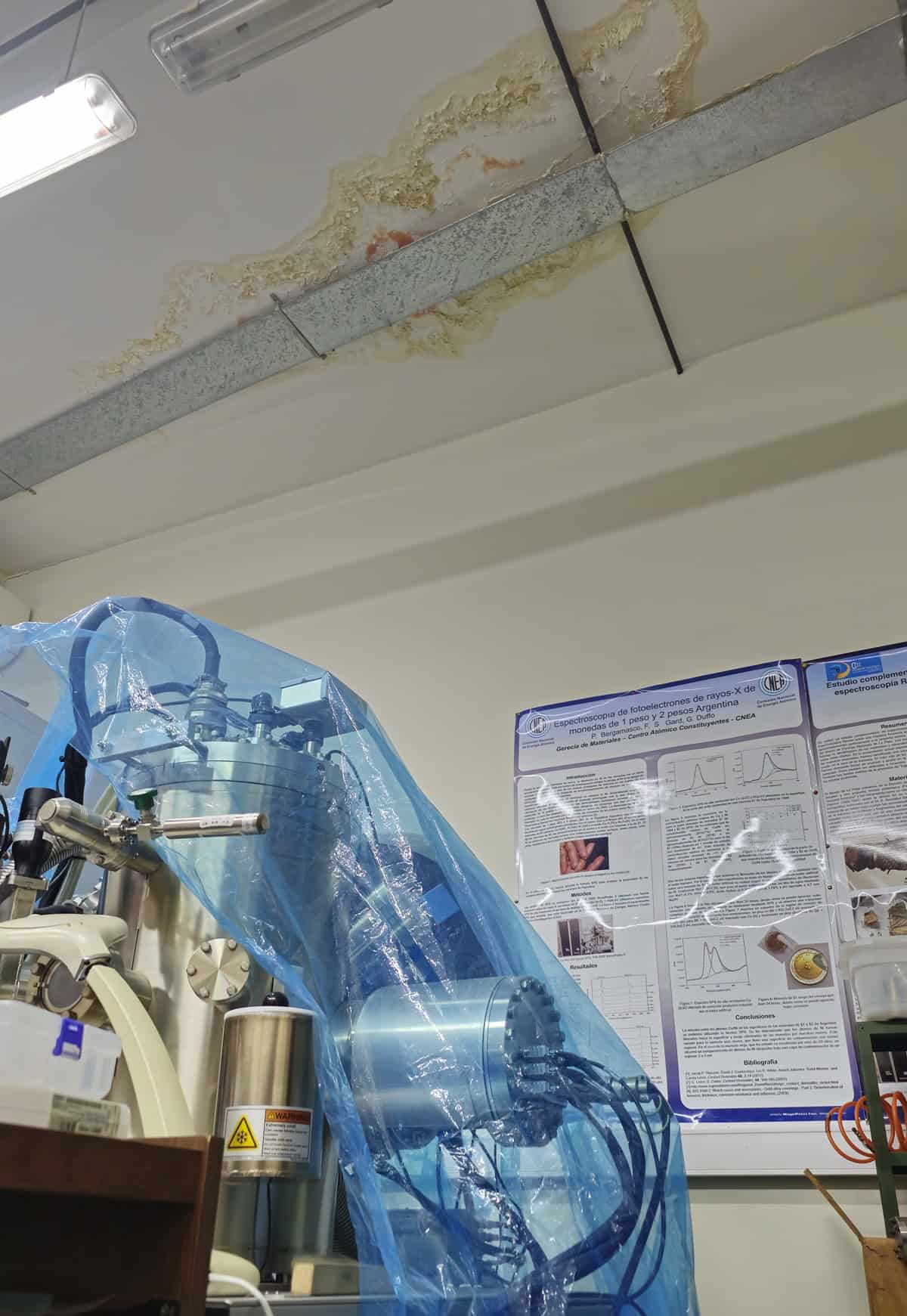
The deterioration extends beyond personnel. In my laboratory, an X-ray photoelectron spectroscopy (XPS) instrument worth more than $1m must sometimes be protected with plastic sheets because rainwater leaks through the roof.
Equipment designed to operate under tightly controlled environmental conditions is now exposed to circumstances that threaten its long-term reliability. Similar situations are becoming increasingly common across Argentina’s universities and research institutes as maintenance budgets shrink and infrastructure ages.
Argentina has a scientific tradition that reaches far beyond its borders. The country has produced five Nobel laureates, including three in the sciences, and has made internationally recognized contributions to nuclear technology, medicine, agriculture, astronomy and materials science. Institutions such as CNEA, CONICET (Argentina’s national research council) and the national universities have trained generations of researchers whose work has strengthened international collaborations and advanced scientific knowledge worldwide.
Scientific systems rarely collapse through a single dramatic event. They decline incrementally: one technician dismissed, one laboratory left unrepaired, one instrument taken out of service, one young scientist deciding to build a career elsewhere. These individual losses accumulate into a weakening of scientific capacity that may take decades to rebuild.
When a country loses the expertise required to operate advanced laboratories or maintain unique scientific infrastructure, the consequences extend beyond national borders.
Faramarz S Gard
This should concern more than Argentina. Modern science depends on international networks of researchers, shared facilities and long-term collaboration. When a country loses the expertise required to operate advanced laboratories or maintain unique scientific infrastructure, the consequences extend beyond national borders.
Damaged goods This X-ray photoelectron spectrometer at the author’s lab has to be protected from water leaking through the ceiling. (Courtesy: Faramarz S Gard)
Knowledge is lost, collaborations weaken, and opportunities for discovery diminish.scientific infrastructure is more than buildings and instruments; it is the people whose expertise gives those resources value. Once that expertise disappears, replacing it is far more difficult than preserving it.
The empty desk of a single scientist may seem insignificant, but multiplied across laboratories and institutions, it becomes a warning of how a research system is quietly dismantled. Argentina’s experience is therefore not only a national concern but also a reminder that scientific capacity, wherever it exists, is a global resource that is remarkably difficult to rebuild once lost.
I write this letter not only to describe a difficult situation but also to call attention to the broader consequences of sustained disinvestment in science. The international scientific community should recognize that the erosion of research systems in countries such as Argentina represents a loss not only for those nations but for global science itself.
Science is built by people, sustained by institutions, and enabled by infrastructure. Today, all three are under increasing strain in Argentina.
How do we make good, well-informed decisions? This is the central question of author Helen Pearson’s new book Beyond Belief: How Evidence Shows What Really Works. It examines evidence-based decision-making and compares it with “conventional wisdom and questionable opinion”. Pearson is interested in how we can use scientific reasoning to empower decision-making using empirical evidence, rather than choices based on opinion or public sentiment.
Pearson uses human stories and historical narratives to outline “the evidence revolution”, in which academics, policy-makers and civilians have tried to embed evidence into decision-making. She tackles disciplines where evidence is seldom used, such as people management, or where its absence is surprising, like environmental conservation. Throughout Beyond Belief, Pearson asks us to understand what makes for good evidence, and how evidence can be better used in daily life.
An award-winning science journalist and editor at the journal Nature, Pearson is particularly good at establishing clear narratives based on a host of different scientific studies. She begins with the field of medicine, focusing on Iain Chalmers, one of the founders of the Cochrane Collaboration. Formed in 1993, it is considered to be a trailblazer in evaluating evidence-based healthcare. Indeed, the institution has influenced important changes to treatment, including the use of corticosteroids to save the lives of premature babies.
It seems obvious, Pearson suggests, that doctors would choose treatments based on rigorous evidence. Instead, she shows us that evidence-based medicine is a young field that only emerged in the 1970s. One particularly personal example she gives is the standard practice of shaving knee cartilage in meniscal tears – a procedure I nearly underwent in 2015 – which was shown to be no better than exercise therapy after a landmark trial in 2016. Beyond Belief offers a glimpse into how recent, and as-yet fragile, our reliance on evidence-based treatment is; as well as how much opposition it has faced from institutional inertia and scepticism.
The book is not just about medicine. It includes examples ranging from the roll-out of the pioneering Mexican social welfare scheme, PROGRESA, which helped to decrease poverty and improve health and education in the country; to the ineffective use of bat bridges over the UK’s A11 dual-carriageway. She also discusses using evidence to make management decisions, as opposed to relying on corporate wisdom or management consultancy. The examples are often surprising, underscoring Pearson’s central argument that evidence allows for better decisions, but getting people to use good evidence consistently is challenging.
Throughout the book, Pearson is engaging and often witty, while still discussing the complexities of implementing evidence-based best practice. Beyond Belief is highly readable too – even when navigating difficult concepts in meta-analyses. Pearson outlines the difficulties of teaching people how to use evidence, how to design studies well, and how studies can easily be misleading. She presents the enormous challenge of encouraging institutions to use evidence correctly, while remaining hopeful about our direction of travel.
There are places where tensions arise, one being in the chapter on policing. Pearson describes how evidence can be used in effective policing, for example, to support increasing patrols or stop-and-search in crime hot-spots. This reveals an interesting question about what the role of successful policing is – crime reduction, retributive justice or rehabilitation – and whose definition of justice that evidence is being used to support.
In these cases, the author’s arguments would have been strengthened if she had engaged more with the central premise of the book: that evidence always makes for better decisions. There are nuances that arise between evidence-based policy and harm reduction, and broader questions of trust that cause people to rebuke evidence entirely. A more serious conversation about these reservations might have deepened the argument in favour of empirical evidence, particularly in questions of social policy.
This discussion is not entirely absent. One particular strength of Beyond Belief is Pearson’s examination of COVID, drawn from her experience as a Nature editor during the pandemic. In this chapter, close to the book’s end, Pearson presents the difficulties of using evidence-based trials in acutely developing crises, in which scientists and public-health bodies have to adapt quickly to minimize harm. At a time when discussions about public health responses to COVID are so polarized, Beyond Belief provides a nuanced analysis of how we can arrive at a scientific conclusion under immense pressure.
At the heart of this book is Pearson’s passion and advocacy for a scientific approach to decision-making. She includes a call to action, empowering readers to be champions of evidence in their lives. Although only present in the short chapters towards the book’s end, her anecdotes about childcare, artificial intelligence and using your vote to support evidence through democracy, are useful reference tools. She also succeeds in her goal of starting a conversation about how we can best use evidence.
Ultimately, Beyond Belief sets out to demonstrate the ways in which evidence enters our lives and improves them. Pearson asks us to advocate for science in a world of increasing misinformation, and to challenge conventional wisdom while equipping us with the tools to do so. For that alone, her book is well worth reading.
“Human beings have a remarkable ability to accept the abnormal and make it normal,” observes Ryland Grace, the main protagonist of Project Hail Mary, as he floats alone in interstellar space, millions of miles from Earth. And yet there is nothing ordinary about the spectacular film released earlier this year, based on Andy Weir’s bestselling 2021 novel of the same name.
With its sweeping plot that spans civilizations and light-years, at its heart, Project Hail Mary is a humorous and uplifting story routed in friendship, survival and what it means to be “human”. It also shines a bright light on international co-operation and scientific problem-solving under great pressure, as the human race is forced to come together in a time of dire need.
Starring Ryan Gosling (who also produced the film), the tale follows Grace, a middle-school science teacher turned extremely unwilling astronaut – “I put the ‘not’ in astronaut! I’ve never done a space walk, I can’t even moonwalk!” Strongarmed into becoming our interstellar saviour, Grace has the self-deprecating charm coupled with enough scientific acumen to make him a lead character that audiences can happily root for.
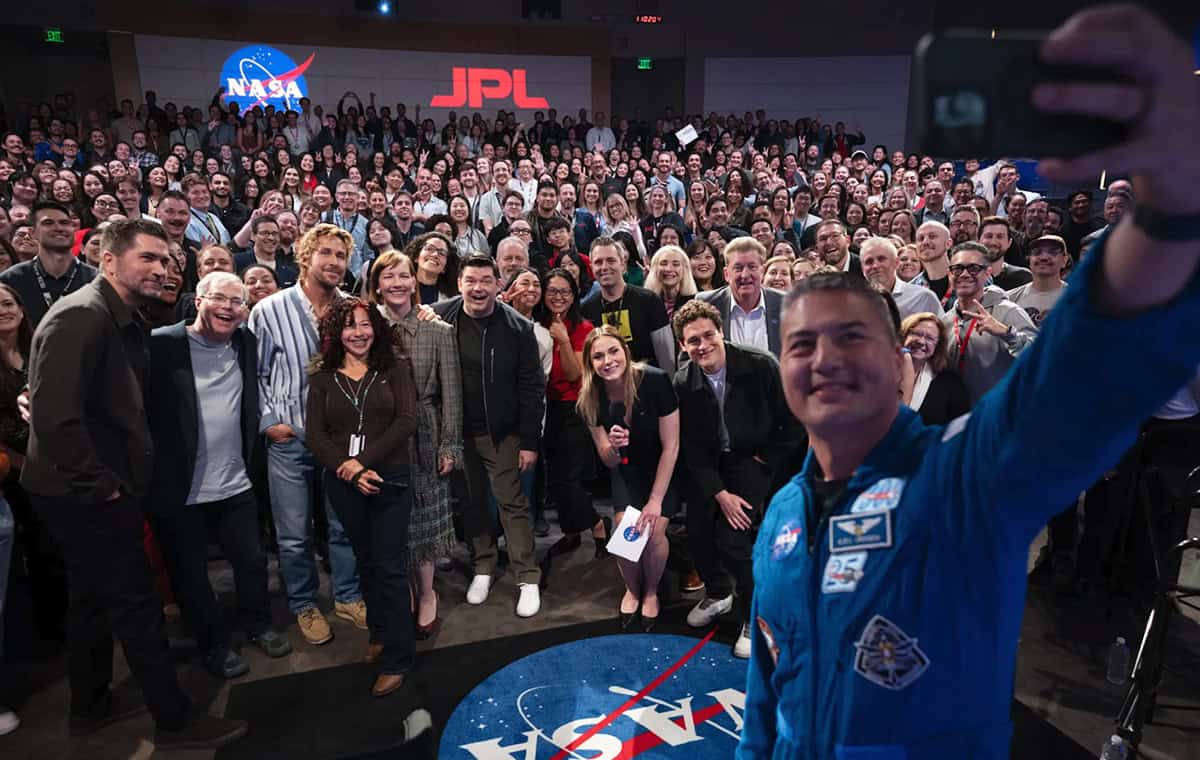
Art meets reality NASA astronaut Kjell Lindgren takes a selfie with the people behind Project Hail Mary, including Ryan Gosling and Andy Weir, and the audience during a panel about the movie at NASA’s Jet Propulsion Laboratory. (Courtesy: NASA)
The film is a visual masterpiece, with sequences that visualize the beauty and terror of space, often viewed from Grace’s disorienting and lonely perspective; alongside scenes on an increasingly more frantic Earth in a bid for survival and sunshine. It is directed and produced by Phil Lord and Christopher Miller (The Lego Movie and Spider-Man: Into the Spider-Verse), who are both well known for their funny and fast-paced movie style. If you expected a certain level of inventive energy in their adaption of this story you will not be disappointed, as Project Hail Mary is expansive in every aspect. New cinematic techniques were combined with the centuries old artform of puppetry to simulate the disorienting reality of long-term zero gravity and the unique physiology of alien life for gigantic IMAX screens.
A dual timeline narrative
Project Hail Mary opens with a familiar Weir set-up – a lone scientist in crisis, who must use all his ingenuity and scientific know-how to save the day. Indeed, Grace wakes up aboard a spacecraft, light-years from Earth with no memory of his identity or how he got there. He soon realizes that he is the sole surviving member of the crew on the ship, and as he slowly recovers his memories, he recalls their desperate, one-way mission to save humanity.
Interspersed in flashbacks, we learn that scientists have discovered a so-called “Petrova line” of infrared light between the Sun and Venus. They have worked out that this line is made up of a mysterious micro-organism, which seems to be consuming the Sun’s energy and threatens to plunge our planet into icy doom. Dubbed “astrophage” (Latin for “star eater”), the algae-like microbe has already noticeably dimmed the light that Earth receives from the Sun, and extrapolating, it will cause catastrophic global cooling within 30 years.
A “Petrova Taskforce” is created, made up of scientists and military personnel from across the globe. It is led by the formidable Eva Stratt – perfectly played by German actor Sandra Hüller – who brings a reticent Grace into the fold, who uses his skills as a one-time top molecular biologist to study the unicellular organism. It is Grace who, after some comedic and somewhat DIY experimentation, figures out that the astrophage are capable of absorbing and storing solar radiation; and later expelling it, which serves as a source of propulsion, allowing them to travel at near-light speeds.
Further research shows that all but one of the stars in our galactic neighbourhood are similarly infected by the astrophage. The exception is Tau Ceti, which is 11.9 light-years away from Earth (see box “Around the Sun”) and hosts a few planets of its own. The taskforce decides to send a one-way crewed mission to this special star, to determine what makes it immune to these interstellar interlopers.
Around the Sun
(Courtesy: Nsae Comp by CC-BY-SA-4.0)
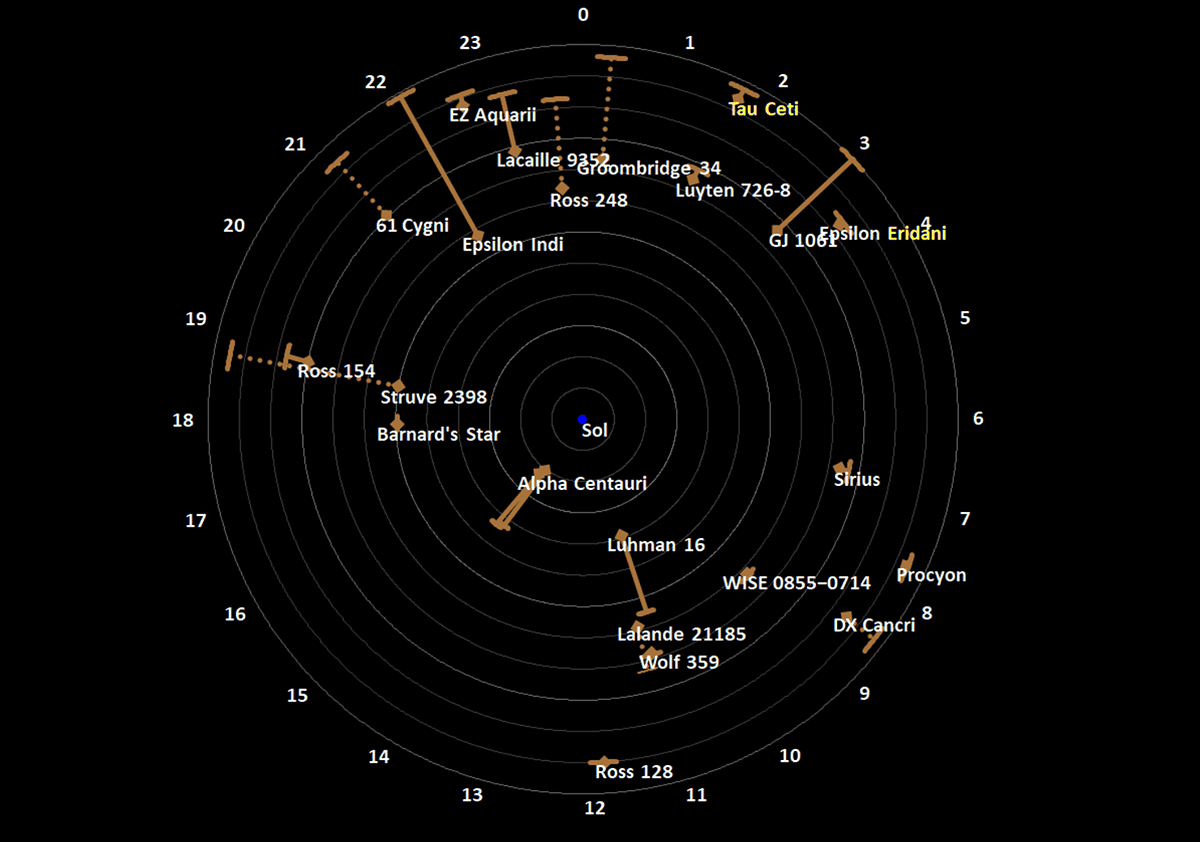
This stellar map is a graphical representation of nearby stars to our own star – Sol – all within 12 light-years of Earth. Each stellar object is jointly marked by two points, a diamond marked point (which shows the location of the stellar objects according to its declination) and a line marked point (which represents the distance in light-years from the centre). The circular lines indicate the distance from the centre by being set apart in one light-year steps.
The map accurately depicts these stars’ distance from Sol and their location in 3D space; to help visualize the distances to nearby stars in our galactic neighbourhood. Both Taue Ceti (2) and Eridani (4) can be seen on the map in the top right-hand quadrant.
In an interesting twist, it is the astrophage themselves that ultimately fuel the Hail Mary ship, after Grace discovers how to breed them on Earth. With only enough time to breed the required amount of astrophage for a one-way trip – they decide that any findings will be sent back to Earth via a series of much smaller and lighter probes. Despite Tau Ceti being almost 12 light-years away from Earth, it takes the spacecraft only about four years to get there, thanks to the fact that the ship travels at 92% the speed of light. This allows relativistic effects such as time dilation and length contraction come into play.
With this complex set-up, the real story picks up once Grace arrives at Tau Ceti, only to find that he is second in line, with another spaceship already there. Grace soon meets its sole occupant – the alien creature that he refers to as Rocky thanks to its stone-like morphology. Grace learns that Rocky is on the exact same mission as him, and that the alien hails from another nearby astrophage-infested star system called 40 Eridani. The pair soon realize that the only way to save both their planets is to work together.
Alongside Grace and Rocky’s adventures in space, the film does well in bringing in the more sober aspects of the story back on Earth – highlighting the trials and triumphs of the taskforce. These range from the global mobilization of scientists and engineers, working together to build and fuel a light-speed ship in record time; to Stratt’s character bypassing international law to ensure humanity’s survival. Lord and Miller use a distinct visual language to illustrate the two timelines. The Earth sequences look more bleak; while the scenes aboard the Hail Mary use visualizations of waveforms and light-absorption to show how Grace perceives the microscopic threat that is astrophage.
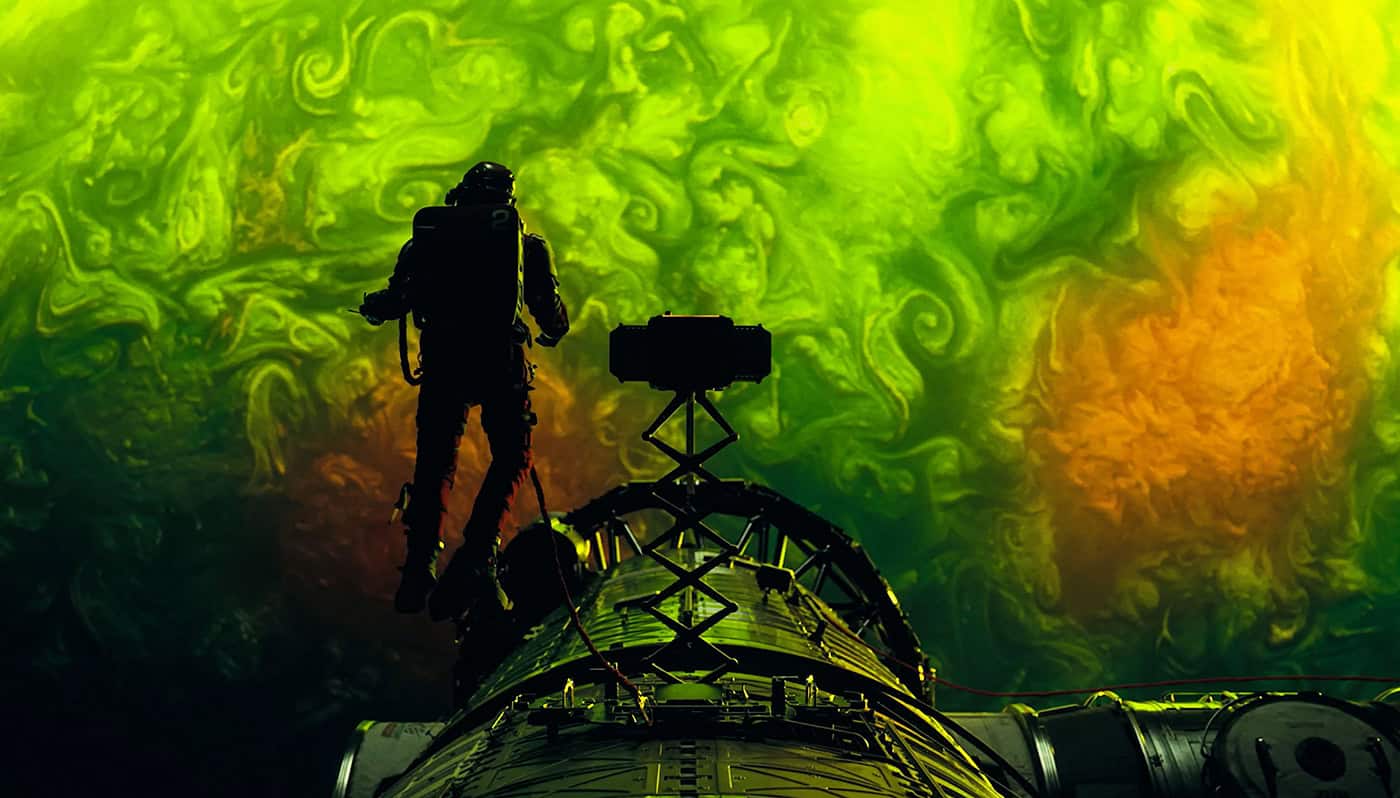
Natural predators Grace floats in space above the planet Adrian in the Tau Ceti system, to observe the native home of “Taumoeba”. (Courtesy: Landmark Media Studios / Amazon MGM / Alamy)
Rocky is one of the most lovable alien creatures to have graced our cinema screens in recent years, brought to life by the clever use of puppetry. The astrophage, by contrast, are meant to evoke fear and intrigue. We are treated to visualizations of how these “black matter” organisms absorb radiation, giving the audience a sense of how matter and energy can be manipulated on a grand scale. Visually, this metaphor continues throughout the film and, ultimately, to the survival of the planet.
Science and fiction, on screen and the page
It is clear that both Weir and the film’s producers and director were keen to highlight science and scientists throughout the book and film. For example, 40 Eridani is a real star system and Weir used astronomical data to build Rocky’s world.
In fact, when the book Project Hail Mary was written, the planet 40 Eridani-B was believed to be real. More recent data has revealed the dimming of the star that inferred the planet’s existence is in fact more likely a result of the composition of the star itself, and the planet most likely does not exist (see box “Exoplanetary exploits”).
In Project Hail Mary, Weir used the real-world observations of stars sometimes dimming for unknown reasons to come up with the idea of the astrophage and its effects on stars. The book also has much more detailed (if scientifically dubious) explanations, using neutrinos and quantum physics, for how astrophage devours starlight and manages to survive on the surface of stars.
Exoplanetary exploits: the science and speculation behind Rocky’s home world
(Courtesy: Gemini Observatory, NSF’s NOIRLab, NSF, AURA, Julien Rameau (University of Montreal), Christian Marois (NRC Herzberg))
Andy Weir based Rocky’s home planet in a star system that is beloved in science fiction, while existing in reality. 40 Eridani is a triple star system that is about 16.3 light-years from the Sun. Fans of Star Trek might also recognize 40 Eridani as the solar system that is home to planet Vulcan. The system comprises the larger star 40 Eridani A and a binary pair of stars, consisting of a red dwarf (40 Eridani C), and a white dwarf star (40 Eridani B).
The system has been well known and observed for a number of years, so much so that as of 1991, Star Trek creator Gene Roddenberry described how the binary stars would “gleam brilliantly in the Vulcan sky” in a letter to Sky & Telescope magazine.
In Project Hail Mary, Erid (or “40 Eridani A b”) is the closest planet to the main star in the system, with some extreme conditions compared with those found on Earth. For example, the planet’s gravity is more than twice Earth’s, and it has a very dense (28 Earth atmospheres) ammonia-based atmosphere at extremely high pressure. The planet has an average surface temperature of 210 °C – despite this, it is able to have liquid water on its surface, as the high surface pressure raises water’s boiling point above that temperature.
According to Weir, Erid’s dense atmosphere blocks almost all incoming light, meaning that Eridians are “blind” to visible light and use echolocation to “see” and communicate. Erid also has a strong magnetic field that blocks the large amount of radiation a planet so close to a star would be bathed in. The high-pressure environment, meanwhile, meant that Weir had to base Eridian biology on a high-mineral content, stone-like exoskeleton, with a circulatory system using liquid mercury, making it an especially unique alien life form.
In reality, astronomers at one point believed that 40 Eridani A was host to a planet or two, thanks to periodic variations in its radial velocity – a common signature of exoplanets. However, the observed variation was on the scale of 42 days, which is similar to the star’s rotation period, meaning that it was next to impossible to confirm the existence of a planet. After a series of observations over a number of years, as of 2024 astronomers sadly concluded that the radial velocity signal very likely does originate from stellar activity, and not from a planet.
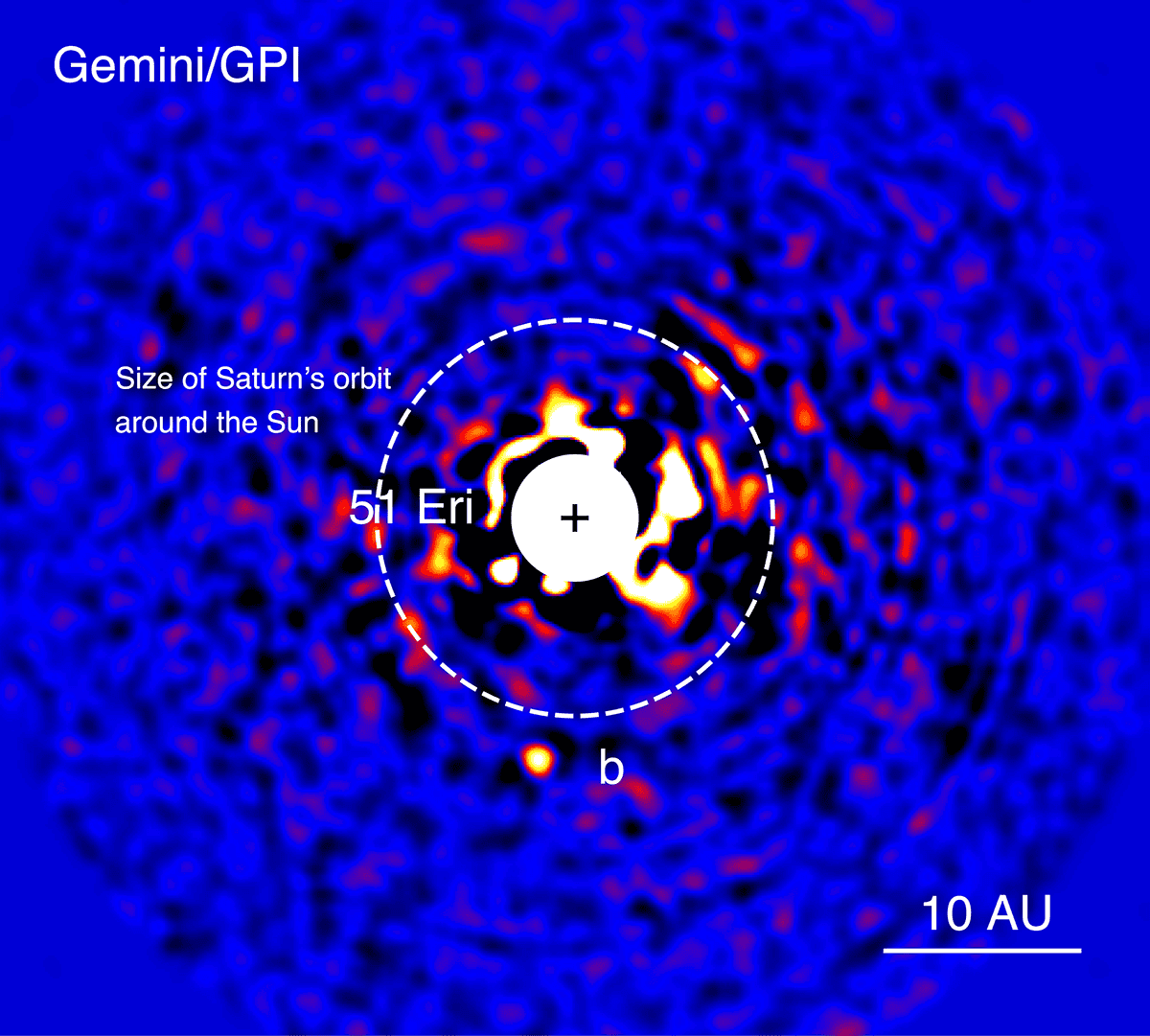
But all is not lost in the Eridian stellar neighbourhood – the not too far away system of 51 Eridani b (roughly 96 light-years from Earth) has a confirmed and directly imaged exoplanet (see image above). Dubbed 51 Eridani b, the Jupiter-sized planet orbits 11 billion miles from its star, a little farther out than Saturn’s orbit in our solar system. As of 2021, NASA announced that its James Webb telescope plans to probe the planet’s atmosphere at infrared wavelengths to learn more about this distant world – and the secrets it currently keeps.
Weir wrote the book before the global COVID-19 pandemic, but it was released in the very midst of it. Indeed, there are many parallels in the way humanity deals with global problems. As we see in Project Hail Mary, the fictional version of our world has this immediate burning issue and while not everybody quite agrees on a plan, there is a global realization and agreement that something must be done, no matter what it takes. Weir is not so convinced that it always works like this though, as he told us that “I do think that the world works together when there’s a common problem, but only if it’s a direct and immediate problem like COVID. We’re not so great at it when it’s a slow burn, like environmental damage.”
Filmmaker and scriptwriter Drew Goddard – who wrote the screenplay for Project Hail Mary as well as Weir’s previous bestselling-book-turned-movie The Martian – reportedly drew up a list of 10 things that he would like to bring from the pages to the film. He achieved nine of them – the missing one was the nuking of the polar ice-caps by Stratt to purposefully trigger global warming. It is a shocking and thought-provoking moment in the book, stripped from the film due to the necessary time it would take to explore and depict such a drastic decision (though one can imagine an entire story based on just that one issue). The film also could have included some more details from the book of the political machinations on Earth, though there are already a lot of ideas to take in, especially for those viewers who have not read the book.
Building a common language
When it comes to depicting an alien, the filmmakers did a great job, not only of realizing Rocky on screen, but also showing the growing friendship between two creatures from distant worlds. Despite their many differences, both Grace and Rocky have been displaced from their homes and tasked with the burden of saving them. To do so, they must overcome their fear of the unknown, and find ways to converse and connect.
On Earth, we are able to communicate in a number of ways – even sometimes between species. In science fiction, science and maths often become a common language. Rocky’s language is decidedly otherworldly. The script, which includes not just the spoken lines but also the complex “musical” language of the Eridian, was developed with linguists and xenobiologists. Via Grace, the audience is able to experience the genuine difficulty of two distinct life-forms learning to communicate for the first time (see box “Words of great encouragement”).
Despite the challenges the pair face in dealing with a culture alien to their own, the two of them go from being fearful and intrigued to amused and friendly; eventually making great sacrifices to help one another.
“Words of great encouragement”
Hannah Little, a linguist and lecturer in communication and media at the University of Liverpool, on the language and communication between Grace and Rocky:
I love Rocky and Grace’s first contact scene – they initially don’t know how the other communicates, but Rocky must find a way to tell Grace to leave the airlock. To do this, he creates a 3D model of Grace and the Hail Mary, to act out that he wants Grace to return to his ship. Grace understands this communication attempt immediately. Without a shared language at the start, the pair must use other strategies to converse, such as using something called “iconicity”. Iconicity is when we use sounds or gestures that depict what we are trying to communicate in some way. Humans often do this using gesture (imagine playing charades) or with drawings (like in Pictionary), but we don’t usually have a 3D printer to hand like Rocky does. This is an excellent opening concept as a 3D model can be a more accurate representation of a human or a ship than a 2D drawing, and it also tells us something about how Rocky perceives the world – he doesn’t have vision that uses light as we do, but instead something more similar to echolocation that can only detect 3D objects.
As they continue to interact, we see Rocky mimicking Grace in raising his index finger: a gesture Grace uses to communicate “can you wait a minute”. Through imitating him, Rocky is able to see what Grace does in response to this gesture and gather data about what the gesture means and the effect it has. This is exactly how humans learn language. When we speak to babies, we are constantly trying to get them to imitate us.
After these initial exchanges, Grace starts to build a translation programme where he logs different sounds Rocky makes and his best guess for what they mean in English. This is where the realism of the movie gets lost: to build reliable translation systems between different human languages, we need an enormous amount of data, even with everything we know about how human languages are produced and structured. It would be a mammoth task to work out what aspects of Rocky’s sounds are meaningful and how those meanings map to human concepts and grammar, but the film depicts this as relatively straightforward. We then suddenly jump forward in time to a point where they have a working translation model without much clue of how long this took. Of course, this has to happen for the sake of the story, and I prefer this as an explanation than some magical universal translator or a fish you put in your ear.
I also love how Rocky’s biology is such that he looks like a strange rocky spider with no discernible face. This makes Project Hail Mary a more exciting exploration of potential alien biology than other films and TV shows where the aliens all look and speak a lot like humans do. But Rocky still communicates with sound, as humans do, and presumably using structures that are very easy to translate. I’m always after depictions of alien communication that get away from a human-centric view of what language can be. It would have been entertaining if Rocky communicated via smell or vibrations or electricity.
“I’m going to have to science the **** out of this.”
Alongside the intriguing linguistics, a side-effect of the interwoven timelines is that viewers are confronted with the reality of scientific progress: it is often messy, desperate and driven by people who are deeply flawed. For the most part, the characters are shown as tenacious individuals, who refuse to give up in the face of a dying sun.
Grace is the embodiment of a reluctant hero. He is also painted as something of a lone voice in academia, having presented a paper at a conference about non-carbon-based life, and being ridiculed for the idea. He is then ostracized by the scientific community, and so turns to being a school-teacher instead, making him a rather unlikely candidate for a space mission.
Despite Grace’s reticence, it turns out he is perfect for the role of saviour of the planet, mainly thanks to his relentless resolve to find the answer, even when armed with minimal resources. Gosling’s face, initially confused, then increasingly determined, fills the screen as we see him try to come to terms with his mission.
It is, however, impossible to know for sure how a person in such total isolation may truly feel or react. This uncertainty is core to the script. The big questions of the film about the value of sacrifice and the necessity of co-operation are left for the audience to decide. The directors are not didactic storytellers, and Weir himself is adamant that his main aim is to entertain. It will be a great bonus if readers and viewers come away with a new understanding of science and the scientific process.
Indeed, this story features many physics concepts, from exoplanetary science to the special theory of relativity; as well as space travel, artificial gravity and a healthy dose of quantum and materials science. Weir contends that the science of Project Hail Mary is sound until you get deep into the quantum level. It is there where he used a literary plot device often referred to as a “MacGuffin” that enabled interstellar travel, using a biological organism.
Becky Smethurst, an astrophysicist at the University of Oxford, recently joined the Physics World Stories podcast, and was delighted that Weir went to such lengths for the science in his narratives. “I think it really surprised me in terms of energy storage,” says Smethurst. “It’s mass-energy equivalence at the crux of the story, if the astrophage can take in the Sun’s energy and store it and then release it later. It’s just e = mc2.”
She goes on to explain that this fundamental physics concept is what allowed for interstellar travel, by harnessing huge amounts of energy to accelerate the spacecraft up to nearly the speed of light. In reality, the issue lies in terms of what kind of single-cell can store that much energy and with that much energy efficiency, which she estimates to be “a billion times more efficient” than any we know on Earth.
But Smethurst goes on to highlight that this is what makes Weir a creative writer, especially when it came to developing the biological and physical mechanisms that allow astrophage to interact with neutrinos. “He invented this whole term in the book called ‘super cross-sectionality’,” she says, “which is fun because it’s sort of a borrowed word from particle physics, when you talk about cross sections of particles and whether they’re likely to intersect. So I like that the idea is obviously sci-fi, but the fact that it’s rooted in some elements of physics and he made that effort to do that, I think was incredible.”
At the heart
Project Hail Mary succeeds as an entertaining space adventure because it trusts its audience to be as smart as its protagonist. It treats astrophysics and molecular biology not as hurdles to the plot, but as the plot itself. Without giving it all away, the story does not end with a straightforward “victory” and much of the lessons learned come from the realization that science is a universal language. In 2026, where global challenges often feel intractable, the film offers a fundamentally sunny outlook. It suggests that when people – or even different species from distant planets – come together to overcome impossible odds, survival is possible.
Using the immense format of IMAX, Project Hail Mary leads us into a total immersion of Grace’s lonely, pressurized world; only to show us that we are never truly alone – as long as we have the tools of discovery, and the ability to overcome our fear of the unknown.
The Nobel-prize-winning Belgian theoretical physicist François Englert, whose work led to the discovery of the Higgs boson, died on 18 June at the age of 93.
Englert’s studies, which he carried out in the early 1960s with his colleague Robert Brout, demonstrated that fundamental particles can acquire mass by interacting with a field that permeates the universe. The work set in motion a decades-long hunt for the Higgs boson, which was finally discovered at the CERN particle-physics lab near Geneva in 2012.
Born in Brussels, Belgium, on 6 November 1932, Englert studied electrical engineering at the Free University of Brussels (ULB) before switching to physics and completing a PhD at the university in 1959.
For two years he then worked at Cornell University before returning to ULB in 1961, where he remained for the rest of his career.
New particle
“Spontaneous symmetry breaking” is a well-known concept in condensed-matter physics where it had been used to explain how, for example, unordered regions of a magnetic material could suddenly align themselves in a specific direction.
In the early 1960s, the Japanese–American particle physicist Yoichiro Nambu adapted the phenomenon into quantum field theory.
Working at the ULB, Englert and Brout took inspiration from Nambu’s work and in 1964 the pair proposed that the weak and electromagnetic interactions could be united by spontaneous symmetry breaking.
Higgs, who independently came to the same conclusion as Brout and Englert, showed that the particles that carried the weak force acquired their mass through interactions with an all-pervasive field, now known as the Higgs field with the interactions occurring via the Higgs boson.
In 2012 at CERN’s Large Hadron Collider, physicists working on the LHC’s giant ATLAS and CMS detectors discovered the Higgs boson with a mass of about 125 GeV.
The following year, Englert shared half of the 2013 Nobel Prize in Physics with Higgs “for the theoretical discovery of a mechanism that contributes to our understanding of the origin of mass of subatomic particles, and which recently was confirmed through the discovery of the predicted fundamental particle, by the ATLAS and CMS experiments”.
Brout died in 2011 so was not given the Nobel prize as it is not awarded posthumously.
As well as the Nobel prize, Englert won many other awards including the Francqui Prize, awarded by the Francqui Foundation in 1982, the Wolf Prize in Physics (2004) and the American Physical Society J J Sakurai Prize (2010). In 2013, he was ennobled a baron by King Albert II of Belgium.
Particle physicist John Ellis from King’s College London, who has spent most of his career at CERN, told Physics World that he will remember Englert for his “his modest and polite demeanour, despite his evident and justified pride in his ground-breaking work”.
“His memory lives on as one of the founders of the Standard Model and an originator of one of its greatest puzzles, the Brout-Englert-Higgs mechanism for breaking symmetries and generating particle masses,” adds Ellis. “How long will it be before we understand this remarkable, yet crucial, aspect of Nature?”
Toutes les vitamines D ne se valent pas. Une vaste analyse révèle même que l'une des deux formes pourrait faire baisser les niveaux de l'autre, celle qui protège le mieux notre immunité. De quoi interroger le choix des compléments alimentaires, très prisés à la saison sombre.

 Login