Desativada por padrão, ela lembra, de certa forma, a interface de ajuste dos estilos fotográficos do iOS, com o usuário tendo que segurar e arrastar o dedo — ou, no caso do Siri no macOS 27, o cursor do mouse — por uma malha de pontos brancos.
Como explicado por mactracker, conforme o cursor do mouse navega por essa malha, a voz da Siri é modulada para reproduzir certas características. Quanto mais o cursor do mouse se aproxima de um ponto, mais clara a voz da Siri fica.
Esse “voice pad”, como a interface está sendo popularmente chamada, também conta com animações elaboradas e bastante coloridas, além de vir acompanhado de um áudio de referência — com direito a Áudio Espacial (Spatial Audio) — que fica tocando sem parar no fundo.
Ainda segundo as informações, essa malha comporta 13 pontos diferentes, sugerindo que o novo sistema operacional do Mac ganhará novas opções de vozes para a assistente virtual. Como a quarta beta do macOS 27 não conta com todos os modelos de voz necessários, no entanto, apenas 2 opções personalizadas podem ser definidas pelo usuário por enquanto.
A nova versão do sistema também inclui um arquivo com descrições (algumas mais completas do que outras) para todas essas 13 vozes:
Gênero
Idade
Características
Estilo
Feminino
Jovem
Fala mansa
—
Feminino
Jovem
Sussurrante, brilhante, suave
—
Feminino
Adulto na faixa dos 20 anos
—
—
Feminino
Adulto na faixa dos 30 anos
—
Amigável
Feminino
Adulto na faixa dos 30 anos
—
Entusiasmada, relaxada, aconchegante
Feminino
Adulto na faixa dos 40 anos
—
—
Feminino
Velho
—
—
Masculino
Jovem
—
—
Masculino
Adulto na faixa dos 30 anos
Profunda
—
Masculino
Adulto na faixa dos 30 anos
Suave
—
Masculino
Adulto na faixa dos 30 anos
Rica
Amigável
Masculino
Velho
—
—
Masculino
Desconhecido
—
—
Ativar essa interface, porém, não é exatamente fácil, com usuários tendo que desativar o recurso System Integrity Protection (SIP) e sobrepor o código interno usando um depurador. Caso contrário, o sistema continuará exibindo o menu tradicional da voz da Siri no app Ajustes do Sistema (System Settings).
Por fim, embora essa interface tenha sido encontrada apenas no macOS 27, ela utiliza o mesmo framework de configuração da Siri que o iOS 27 e o iPadOS 27, o que sugere que ela também poderá dar as caras em iPhones e iPads. Ademais, também foi confirmado que ela será localizada para 44 outros idiomas.
Nesta quarta-feira, economize com a nossa seleção de promoções na App Store!
Space Menace, desenvolvido por Md Umar, é um jogo de estratégia direto e surpreendentemente divertido, escolhido como nosso destaque do dia.
Como jogador, você controla uma pequena nave, coletando sucata, desenvolvendo seus módulos e construindo gradualmente uma frota capaz de enfrentar facções hostis em batalhas táticas. Cada melhoria realmente muda o seu desempenho em combate.
De acordo com o seu avanço na campanha, o jogo revela tanto seus méritos quanto suas limitações. A dificuldade é crescente e passa a exigir cada vez mais decisões estratégicas reais e complexas, evitando que o jogador se torne indestrutível. Mas nem tudo são flores — algumas facções inimigas retomam territórios rápido demais, o balanceamento favorece excessivamente os mísseis no início e o sistema de energia pode parecer irregular mesmo com evoluções conquistadas.
Confira um vídeo:
Divertido. Aproveite a oferta e baixe agora! 🛸
Abaixo outros jogos/apps que, juntos, somam cerca de R$110 em descontos:
Jogos
Jogo de estratégia.
Jogo de ação.
Puzzles.
Aplicativos
Tabela periódica.
Sons de teclado.
Aproveite as ofertas e até amanhã! Vale lembrar que as ofertas são sempre por tempo limitado, então é bom correr. 🏎️
Om Malik (@Om), the journalist, GigaOm founder, photographer and True Ventures partner whose work tracked the commercial internet from dial-up optimism to AI saturation, died on June 24 at Stanford Hospital after what his family described as a long health journey with his heart, according to a post on On my Om. He was 59.
[…]
That exchange was small. It was also the whole system in miniature. A founder could reach the editor directly. The editor was awake. The story was not filtered through a communications department, a conference stage or a banked embargo calendar. Malik helped build that operating system for Silicon Valley media: fast, conversational, porous, technically literate and dangerously close to the companies it covered.
Malik was not just one of the people who covered Silicon Valley. He became one of the people Silicon Valley used to understand itself. That was the gift and the complication of his career. He was a reporter, then a founder, then a venture investor, and he never entirely gave up any of those identities. He could spot a network shift early because he had spent decades watching pipes, protocols, business models and human ego interact at close range. He could also be too close to the machine he covered, a tension that defined the blog era he helped build.
[…]
On my Om, became less about scoops and more about judgment. He wrote about technology, photography, business cycles, health, memory and the human cost of living inside the network. He preferred the long arc to the launch post.
We were mutual readers for many years, and I respected him as a thoughtful writer, but I didn’t know him well. He always seemed like a kind soul, and reading the many comments about his passing that really comes across. When he announced the break recently, I hoped he was off to take some more wonderfulphotos.
Through it all, Om Malik was just a kind, warm, funny (af), true, and honest friend who helped me get to the good times and ride out the bad. He’d been through a lot and wasn’t afraid to tell you all about it. He was a rare breed indeed in many ways, but having the confidence to show kindness and vulnerability in the world of venture capital is something that should be studied.
Given that I have been writing three decades, including eighteen-plus years a blogger, I am hardly surprised that I am repeatedly asked: how should I write? And my answer is always the same — write like a human.
Tony Krueger is remembered in Wikipedia as the person who ported the game Chip’s Challenge to Windows for the Windows Entertainment Pack. But that’s probably not the code he wrote that touched the most people.
Tony worked on Word 1.0, 1.1, 2.0, then on Word for OS/2 and Word for Mac, then returned to Word 6.0 and several versions beyond that. He probably holds the record for “most versions of Word shipped.”
[…]
Tony made the spell checker much more unobtrusive so that it didn’t interfere with your foreground work. And when it found a problem, instead of waiting for you to trigger a spell check, it immediately drew red squiggles under potentially-misspelled words (and later green squiggles under potential grammatical errors).
A Apple atualizou a página oficial do Apple Park Visitor Center para alertar visitantes sobre uma reforma que está sendo conduzida no estabelecimento.
Ao contrário do que costuma acontecer durante as reformas em Apple Stores, o espaço não será totalmente fechado para a realização dessas manutenções. O horário de funcionamento tradicional (das 10h às 19h do horário local), inclusive, foi mantido.
Melhorias estão sendo feitas no #Apple Park Visitor Center
De acordo com o alerta, no entanto, o Exhibition Space será, sim, interditado temporariamente. A empresa não forneceu uma previsão de quando tudo voltará ao normal.
Atualização em andamento. Pedimos desculpas pelo aspecto do local enquanto aprimoramos nossa loja. Durante esse período, o Exhibition Space permanecerá temporariamente fechado.
Aberto em 2017, o Apple Park Visitor Center é um dos grandes “pontos turísticos” da sede da Apple em Cupertino, servindo tanto como loja quanto como um lugar para tomar café, comprar souvenirs e apreciar os arredores.
Assim como os iPhones e iPads, os Apple Watches também possuem um ajuste que pode minimizar os efeitos de destaque e de luz intermitente nas interações com os elementos presentes na tela.
Batizado de Redução dos efeitos de brilho, o recurso veio para minimizar os efeitos do Liquid Glass, já que muita gente não curtiu os elementos introduzidos com as versões 26 dos sistemas operacionais da Maçã.
Material: alumínio ou titânio Cores: cinza-espacial, prateado, ouro rosa, preto brilhante, natural, dourado ou ardósia Tamanho: 42mm ou 46mm Conectividade: GPS ou GPS + Cellular Pulseiras: esportiva ou estilo milanês
NOTA DE TRANSPARÊNCIA: O MacMagazine recebe uma pequena comissão sobre vendas concluídas por meio de links deste post, mas você, como consumidor, não paga nada mais pelos produtos/serviços usando os nossos links de afiliado.
After using the James Webb Space Telescope (JWST) to peer back toward the beginning of time, astronomers have proposed a radical new explanation for one of the universe's most flummoxing phenomena.
Little red dots (LRDs) are mysteriously compact, brilliant celestial objects found predominantly when the universe was less than 10% of its current age.
As revealed by JWST's unmatched infrared sensitivity, LRDs emerged incredibly early, only around 600 million years after the Big Bang, and then began disappearing about a billion years later.
Now, in a paper published in The Astrophysical Journal Letters, astronomers have proposed a novel formation mechanism for LRDs: They may be birthed by previously undiscovered celestial companions, whose intense ultraviolet (UV) radiation causes gas clouds to collapse into incredibly dense and exotic objects, like "black hole stars."
An illustration of a black hole star, or quasi-star, powered by a black hole surrounded by a cocoon of gas. (Image credit: (MPIA/HdA/T. Müller/A. de Graaff) via Wikimedia Commons)
"The most surprising aspect… is that these little red dots are not just 'red dots,' but there is a more complex emission nearby and around them," Josephine Baggen, an astronomer at Yale University and first author of the study, told Live Science in an email. "We think those what we call 'companions' are starlight."
Connecting the dots
In the study, the researchers compiled a sample of 83 LRDs, imaged with JWST, from ultradeep surveys. They found that 36 of the 83 LRDs, including over 80% of the brightest ones, hosted at least one companion that shined bright in blue-ish ultraviolet light; little red dots with little blue companions.
The LRDs sampled in this study. (Image credit: (Baggen et al., ApJL, 2026) )
These companions had masses ranging from hundreds of millions to billions that of the sun, suggesting that they may be star clusters or relatively small early galaxies, Baggen told Live Science.
These UV-spewing companions spurred the formation of LRDs from immense gas clouds, the team's new proposal states. Normally, cold molecular gas clouds fragment and condense into stars. But the intense UV irradiation from the companions halted the fragmentation process, potentially squeezing the gas clouds into supermassive stars that directly collapsed into black holes while skipping the explosive supernova stage that normally marks these stars' deaths.
This proposal helps to explain why LRDs appear bright in red optical light and UV wavelengths, with a dip between the two caused by the wavelengths of light absorbed by hydrogen gas. Rather than originating from a single object, the optical red light derives from the LRD, the UV light comes from its nearby companion, and the dip is thought to be caused by the dense cocoon of gas around the LRD.
As a result, the researchers suggested that all LRDs may have such partners but they may be too close together to be distinguished. Conversely, some companions may be separated by greater distances than the researchers accounted for in this study, requiring future observations to zoom out.
Intriguingly, this work may illuminate a couple of early-universe enigmas. First, the black holes manifesting from these interactions may be between 100,000 and 1 million solar masses, forming the "seeds" necessary to explain how ancient supermassive black holes grew so surprisingly massive so early in cosmic history.
Additionally, because LRDs may merge with the relatively small, UV-spewing galaxies that birthed them, this process may have created the impressively immense galaxies all around us today.
"We do think that this might be the birth of the supermassive black holes around these UV companions, born 'outside the galaxy,' [which] will eventually merge," Baggen told Live Science. "Whether this is what happened to the Milky Way in its earliest phases, we cannot really say, but it is plausible! There is still a lot of debate about how LRDs evolve and what they turn into at later times."
What it means: The heliosphere is the region around the sun that's affected by the solar wind, a flow of charged particles emanating from the sun. Think of the heliosphere like a giant bubble encompassing the sun and planets, reaching out into space at three times the distance of Pluto. This bubble protects the solar system from radiation emanating from outer space, but the solar wind can also erode planetary atmospheres. Luckily, Earth is protected by its own bubble, the magnetosphere, which helps deflect the solar wind.
How to use it in a sentence: Because the entire solar system is traveling through space, scientists have long pictured the heliosphere as comet-shaped, but recent research suggests the bubble of solar wind looks more like a sad, deflated croissant.
Can you crack our science word of the day puzzle, Chain Word?
Astronomers have found the strongest evidence yet that a rocky planet beyond our solar system has managed to hold onto an atmosphere — a crucial ingredient for life as we know it.
The discovery marks the first time scientists have detected an atmosphere surrounding a rocky planet orbiting in the habitable zone of another star, the region around a star where temperatures could enable liquid water to exist on a planet's surface. The findings, published July 16 in the journal Science, could help astronomers narrow the search for potentially habitable worlds beyond our cosmic backyard.
"It's absolutely exciting," Edward Schwieterman, associate professor of astrobiology at the University of California, Riverside, who was not involved in the study, told Live Science in an email. "We are getting closer to studying the atmospheres of worlds that could plausibly harbor life, with evidence of that life embedded in their observable spectra."
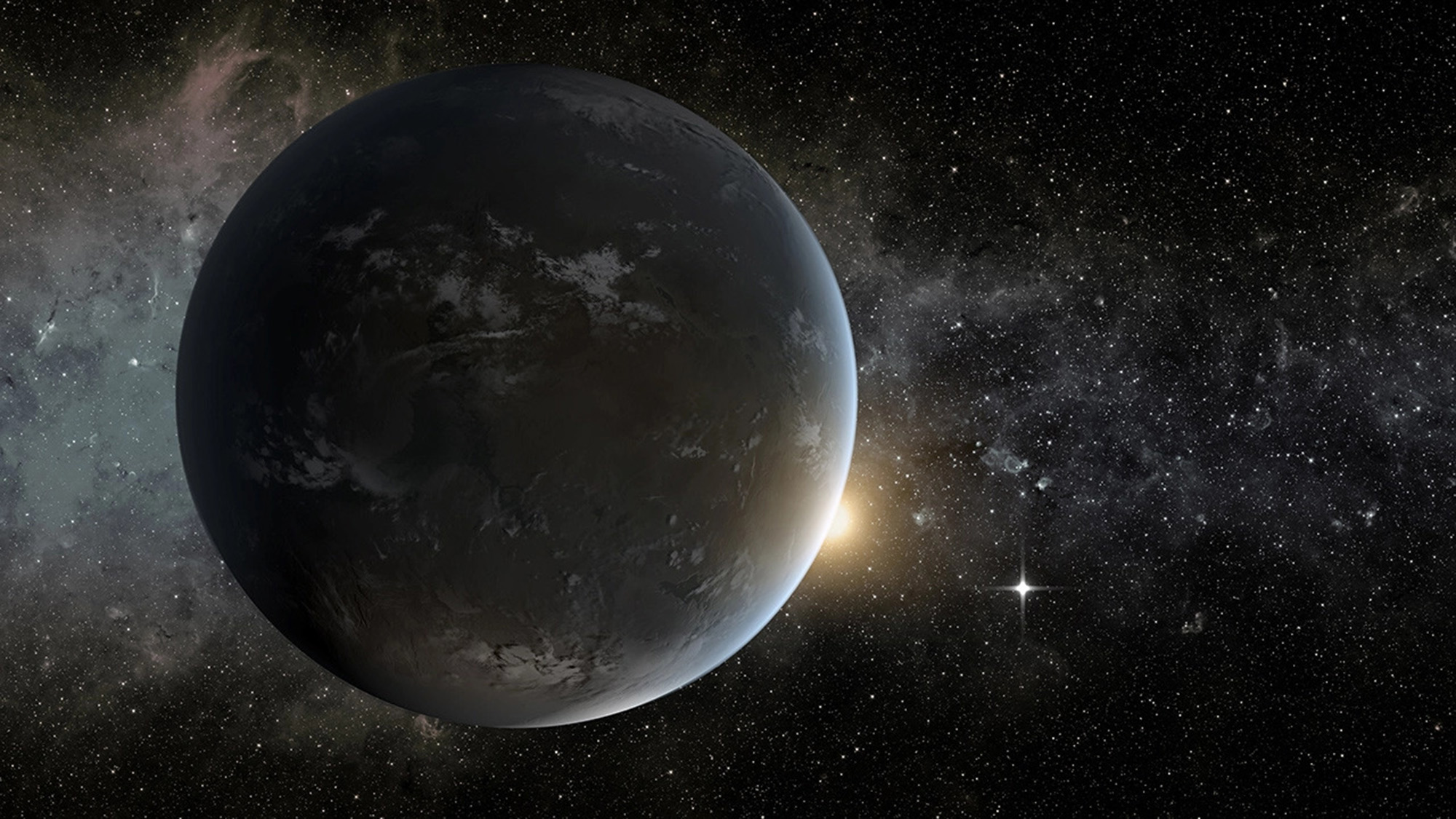
The planet, known as LHS 1140 b, lies about 48 light-years away from Earth and orbits a small, cool red dwarf star. At roughly 5.6 times Earth's mass, the exoplanet is classified as a super-Earth: a rocky planet larger than our own but much smaller than gas giants like Neptune.
It receives less than half the sunlight Earth gets, giving it an estimated surface temperature of around minus 53 degrees Fahrenheit (minus 47 degrees Celsius), according to previous estimates not accounting for an atmosphere. That makes the planet cold, but in the range astronomers consider potentially habitable.
Cosmic gas leak
Scientists have discovered thousands of exoplanets over the past few decades, including many rocky worlds. But determining whether those planets have atmospheres has proven far more difficult, because atmospheres around rocky planets are incredibly thin compared with those of giant planets, making them much harder to detect across vast cosmic distances.
Instead of looking for the atmosphere directly, the researchers behind the new study searched for a subtle clue that one existed: helium gas leaking into space. Using the WINERED spectrograph on the Magellan Clay Telescope in Chile, the team watched LHS 1140 b cross in front of its star and let a sliver of starlight filter through the planet's atmosphere on its way to Earth. As it did, the team looked for a tiny dip in the star’s light at the exact wavelength of infrared light that helium blocks — a telltale sign that gas was streaming off the planet and into space.
The prediction rested entirely on a mathematical model that had never been confirmed for a rocky planet. However, in September 2024, the team caught LHS 1140 b and a smaller, hotter neighboring planet, LHS 1140 c, transiting their star on the same night, less than 40 minutes apart. The researchers detected a clear helium signal from LHS 1140 b, while LHS 1140 c showed nothing.
NASA concept art depicting LHS 1140 b as a rocky super-Earth — a type of potentially habitable planet most similar to our own. (Image credit: NASA)
The contrast matters: LHS 1140 c orbits much closer to its star than LHS 1140 b does and receives roughly five times the radiation, yet it's also smaller and less gravitationally bound — conditions that should make any escaping gas easier, not harder, to spot. Finding nothing there suggests LHS 1140 c's atmosphere was stripped away long ago, while LHS 1140 b, sitting farther out in cooler, calmer conditions, has managed to hold onto its own.
The discovery addresses a question astronomers have been working to answer for decades.
"Twenty years ago we wondered whether other terrestrial-type planets even existed," study co-author Robin Wordsworth, a professor of Earth and planetary sciences at Harvard, said in a statement. "Then we learned they're common, and found some in the habitable zone. The next question was whether any of them had managed to keep an atmosphere. Now we know at least one has."
A step forward in the hunt for life
The find is especially notable because red dwarf stars like LHS 1140 can bombard nearby planets with high-energy radiation capable of stripping atmospheres away over time. Based on the star's estimated age of at least 3.1 billion years, the researchers say LHS 1140 b's atmosphere has likely persisted despite that bombardment, suggesting some rocky planets around these common stars can hang onto their atmospheres for far longer than once assumed.
But the researchers caution that detecting helium does not mean the planet is inhabited — or even that it is habitable. The observations reveal only the planet's thin upper atmosphere, not its full composition. Scientists still don't know whether LHS 1140 b has oxygen, carbon dioxide, water vapor or other gases that could make its surface more Earth-like and hospitable to life.
Instead, the discovery opens a new way to study distant rocky worlds.
"The study demonstrates that, at least in some cases, we will be able to begin characterizing the atmospheres of potentially habitable planets," Schwieterman said. "If only rocky planets orbiting Sun-like stars retained atmospheres, we might have to wait one to two decades for the launch of the Habitable Worlds Observatory to search for biosignatures on rocky planets. I'm certainly excited about what comes next!"
Future observations will aim to determine what the rest of LHS 1140 b's atmosphere is made of and investigate whether it may harbor oceans or other features associated with habitability.
What it is: The collision-prone galaxy cluster MACS J0553.4-3342
Where it is: In the constellation Columba
When it was shared: July 2026
Around 100 years ago, Albert Einstein made an audacious prediction about space. The frequently right (but occasionally wrong) physicist theorized that, just as the curved lens of a magnifying glass bends light to increase an object's apparent size, massive celestial objects can curve the very fabric of the universe with their gravity — causing distant sources of light to bend, warp, and appear magnified as their rays pass through the region on their way to Earth.
Today, this phenomenon — called gravitational lensing — has been confirmed through dozens of telescope observations, and is a crucial tool that observatories like the James Webb Space Telescope (JWST) use to probe the light of the oldest, faintest galaxies in the universe. And in this newly released JWST image of a tumultuous young galaxy cluster, Einstein’s gravitational funhouse effect is on full display.
In the foreground, two bright white points of light ringed with white halos signify the gravitational center of MACS J0553.4-3342, a gargantuan collection of bound galaxies located in the constellation Columba (the dove). These two white beacons are massive elliptical galaxies, each wreathed in their own sub-cluster of smaller galaxies, according to a statement from the European Space Agency (ESA). And the two clusters are not getting along.
Studying the galaxies’ light as it appeared roughly 4.4 billion years ago, astronomers can tell the clusters are in the messy process of merging together. The two principal elliptical galaxies have already slammed through each other once, and now sit at a distance of around 1 million light-years apart (that’s about 10 Milky Ways lined up in a row). Eventually, that gap will close as the massive galaxies swoop back toward each other, finally combining into one.
A full-size view of JWST's observations (Image credit: ESA/Webb, NASA & CSA, S. Fujimoto)
But the real jewels in this galactic trove are hidden in the contorted, orange arcs of light that bookend the cluster on either side. Here, the magnifying effect of gravitational lensing is acting in full force — allowing JWST to detect the light of several faint galaxies from less than a billion years after the Big Bang.
Three bright dots in the arc on the left are actually three repeated images of a single galaxy, according to ESA. The trippy effect appears several times throughout the image, with each elongated orange streak cracking open a warped window onto an ancient corner of the universe that would otherwise be impossible to see.
Through observations like these, scientists using JWST have discovered that the oldest stars and galaxies in the universe have grown larger and faster than our leading theories of cosmology predict should be possible. Using one cosmic oddity to uncover another, this gravitational lens could keep astronomers busy for decades to come.
Scientists have discovered the building blocks of life inside a meteorite that smashed through a New Jersey home two years ago. The space rock contains amino acids, carbon compounds and other "prebiotic" molecules similar to what may have helped kick-start life on our planet, a new study shows.
Scientists on the study team — led by Peter Jenniskens, a meteor astronomer with affiliations at the SETI Institute and NASA's Ames Research Center — praised the homeowner in Hillsborough, N.J., for quickly preserving the meteorite after it fell through the roof on July 16, 2024, despite the adverse circumstances. His actions included using disposable gloves and aluminum foil to place pieces of the meteorite fragments into glass jars.
"I was at home at the time, heard a loud crash and found a hole in the ceiling of the master bedroom," the homeowner, who was not named, said in a statement from the SETI Institute. "I smelled a strong, sulfur-like odor and saw many black fragments, along with debris and black dust that covered my bed, carpet and surrounding areas."
A close-up of the Hillsborough meteorite’s surface. (Image credit: SETI Institute)
Those meteorite pieces were precious, the scientists said, and likely came from an ancient solar system planet that wasn't fully formed. "A forensic study of the fragments revealed that they contained preserved bits from near the surface of a small primitive asteroid where it experienced concentrated salty fluids — a process not previously known from this type of protoplanet world," Jenniskens said in the statement.
The rock broke apart in midair, with observer reports stopping when the meteor reached 22 miles (35 kilometers) in altitude, although Newark Liberty International Airport briefly tracked pebbles falling from the sky with Doppler weather radar after that. Fragments from only one meteorite — called Hillsborough, after the town where it crashed through the New Jersey home — were recovered.
The American Meteor Society used its cameras in Northford, Connecticut, and Douglassville, Pennsylvania — along with a doorbell camera in Wayne, New Jersey — to figure out the meteor's origin, Mike Hankey, an operations manager at the American Meteor Society and co-author of the study, said in the statement. "The path traced back to low in the asteroid belt."
Hillsborough is the second stony meteorite of its type ever spotted in a fall. Later analysis showed that the meteorite is full of ancient brines or salt. Scientists classified the meteorite as a type of stony space rock called a carbonaceous chondrite.
Scientists will compare the salt minerals to samples of asteroids Ryugu and Bennu, both of which contain ingredients of life and are samples of another carbonaceous chondrite type that formed earlier than Hillsborough. This analysis could help scientists further trace the origins of life-friendly chemistry in the early solar system.
Up to 90% of Earth's population may be able to see the enormous "God of Chaos" asteroid Apophis zoom past our planet in less than three years, scientists say. The skyscraper-size space rock will come closer to us than some satellites, making it clearly visible to the naked eye during the "once-in-a-millennium" skywatching event.
This will be the first time humans have ever been able to predict a flyby of an asteroid visible to the naked eye, and it could be a once-in-a-lifetime experience for the up to 7.6 billion people who manage to see it, scientists said at the Apophis T-3 Years workshop, held June 18-19 at the University of Padua in Italy.
"Sighting Apophis as it passes by is a way of feeling a shared cosmic experience, realizing the smallness of Earth in the vastness of space," Richard Binzel, a planetary scientist and asteroid expert at MIT who helped organize the recent workshop and create new maps of the flyby, told Live Science in an email.
The asteroid, dubbed 99942 Apophis (or simply Apophis), is a peanut-shaped object that spans about 1,500 feet (450 meters) across at its widest point, or around as wide as the Empire State Building is tall, making it large enough to wipe out a city if it ever impacted our planet. Apophis likely originated from the solar system's main asteroid belt between Mars and Jupiter, but it now resides between the orbits of Venus and Earth, circling our home star roughly every 10.5 months. The name Apophis comes from Apep, the Egyptian serpent god of darkness and disorder, which has earned the space rock the nickname "God of Chaos."
On April 13, 2029, Apophis will make a superclose flyby of Earth, reaching a minimum distance of around 19,000 miles (30,600 kilometers) from our planet, according to The Planetary Society. That's much farther away than the International Space Station and the thousands of other spacecraft in low Earth orbit, but it's closer than several hundred satellites stationed in an elevated geosynchronous orbit. (Apophis poses no threat to these high-altitude satellites because they can easily be maneuvered away from its projected path.)
At the recent Apophis T-3 Years workshop, scientists shared new maps showing how many people will be within viewing range of the asteroid at each point of its seven-hour flyby of Earth. (Image credit: eclipseatlas.com)
Therefore, scientists are keen to monitor the flyby in great detail and will coordinate observations from telescopes around the world to understand the potentially hazardous asteroid better. Several spacecraft, including NASA's OSIRIS-APEX, will also attempt to fly past Apophis to study its structure and trajectory. The event is so significant that the United Nations has declared 2029 the International Year of Asteroid Awareness and Planetary Defence.
Researchers also hope the flyby will provide a unique opportunity to inspire the next generation of space scientists. "I hope people will find the Apophis flyby intriguing, as it is not anything fearful or frightening at all," Binzel said. "Who knows how many young people might find a spark of curiosity that leads them on a path to a career in space studies."
Who will see Apophis?
The new maps help break down who might be able to see Apophis throughout the roughly seven-hour period it passes by our planet. The asteroid will be visible only to people who are positioned within its path at twilight or night amid clear skies and limited light pollution.
Apophis will slowly move across the night sky through a set of well-known constellations, although its exact position will depend on where in the world you are. (Image credit: eclipseatlas.com)
At the start of the flyby, when Apophis is farthest from Earth, the asteroid could be visible to around 4.5 billion people across Australia and most of Asia. By the end of the flyby, when the space rock reaches its closest point to us, it might be visible to around 1.9 billion people in eastern South America, northern Africa and parts of Europe, according to the new maps.
Peak visibility will occur around halfway through the flyby, when Apophis might be seen by as many as 5.7 billion people across eastern Africa, Southern Europe, Australia, and all of Asia and the Middle East. At this point, astronomical observatories situated on Spain's Canary Islands will likely snap the best photos of the asteroid's flyby, according to Live Science's sister site Space.com.
North America is the only continent that will not get a clear view of Apophis.
For those who are lucky enough to see the passing space rock, the asteroid will appear as a "modest star passing slowly across the sky, much like a slow-moving satellite," Binzel said, and it will shine as brightly as the stars in the Big Dipper.
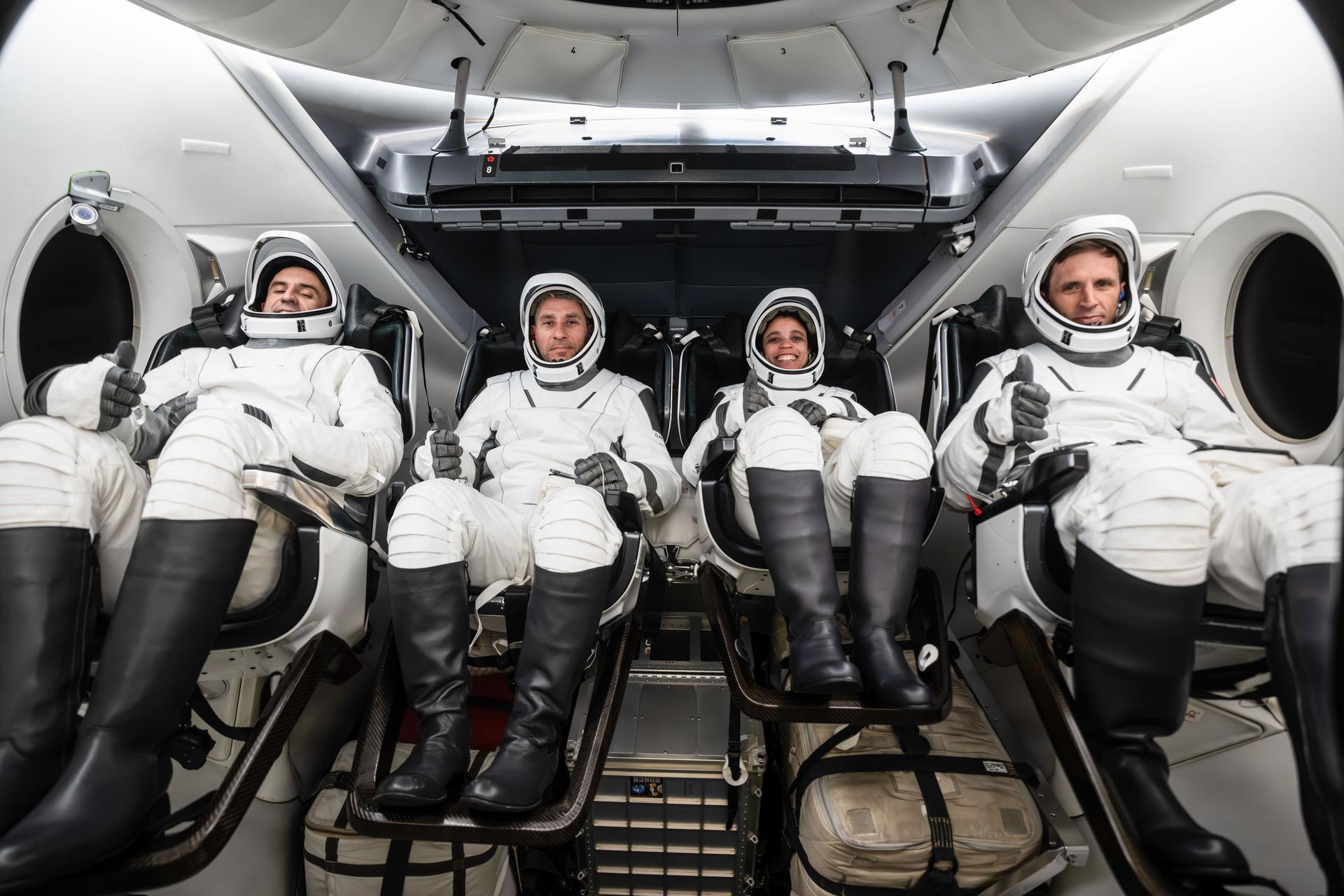
NASA’s SpaceX Crew-13 members are pictured in their pressure suits seated inside a mockup Dragon spacecraft during a preflight training session at the company’s headquarters in Hawthorne, California. From left are Roscosmos Sergey Teteryatnikov, NASA astronauts Luke Delaney and Jessica Watkins, and CSA (Canadian Space Agency) astronaut Joshua Kutryk.
Credit: SpaceX
NASA and its partners will discuss the upcoming crew rotation mission to the International Space Station during a pair of news conferences on Monday, Aug. 3, from the agency’s Johnson Space Center in Houston.
Mission leadership will provide an overview of NASA’s SpaceX Crew‑13 mission at 12 p.m. EDT. Next, crew members will discuss their training and mission preparations at 2 p.m. This is Crew-13’s final media availability prior to traveling to the agency’s Kennedy Space Center in Florida for launch.
NASA will stream these events live. Learn where to watch online:
The Crew-13 mission will carry NASA astronauts Jessica Watkins and Luke Delaney, CSA (Canadian Space Agency) astronaut Joshua Kutryk, and Roscosmos cosmonaut Sergey Teteryatnikov to the orbiting laboratory. The crew will launch aboard a SpaceX Dragon spacecraft on the company’s Falcon 9 rocket from Space Launch Complex 40 at Cape Canaveral Space Force Station in Florida no earlier than mid-September.
International media attending in person must email the NASA Johnson newsroom at jsccommu@mail.nasa.gov by 5 p.m., Tuesday, July 21. United States-based media attending in person must respond by 5 p.m., Thursday, July 30. Media joining virtually must respond by 10 a.m. the day of the event. NASA’s media accreditation policy is available online.
Briefing participants are as follows (all times Eastern and subject to change based on real-time operations):
12 p.m.: Mission Overview News Conference
Joel Montalbano, deputy associate administrator, Human Spaceflight Mission Directorate, NASA Headquarters
Dana Weigel, manager, Low Earth Orbit Program, NASA Johnson
Mathieu Caron, director, Astronauts, Life Sciences, and Space Medicine, CSA
Julianna Scheiman, director, NASA Science and Dragon Programs, SpaceX
Following the news conference, crew members will be available for limited media interviews. All interview requests must be submitted by 5 p.m. on July 30, to the NASA Johnson newsroom at: jsccommu@mail.nasa.gov.
This will be the second flight to the space station for Watkins, who was selected as a NASA astronaut in 2017. Watkins grew up in Lafayette, Colorado, and earned an undergraduate degree in geological and environmental sciences from Stanford University, as well as a doctorate in geology from the University of California, Los Angeles. As a geologist, she studied the Martian surface and was a member of the Curiosity rover science team at NASA’s Jet Propulsion Laboratory in Southern California. Watkins first launched to the space station as a crew member aboard NASA’s SpaceX Crew-4 mission, spending a total of 170 days in space across space station Expeditions 67/68 in 2022. She will be the first NASA astronaut to launch aboard a SpaceX Dragon spacecraft twice.
Selected as a NASA astronaut in 2021, Delaney earned a bachelor’s degree in mechanical engineering at the University of North Florida and a master’s degree in aerospace engineering at the Naval Postgraduate School. The Florida native is a distinguished naval aviator who participated in exercises throughout the Asia Pacific region and conducted missions in support of Operation Enduring Freedom. As a test pilot, Delaney evaluated developmental aircraft systems and served as a test pilot instructor. He also worked as a research pilot at NASA’s Langley Research Center in Hampton, Virginia, where he supported airborne science missions. This is the first spaceflight for Delaney.
The Crew-13 mission also is the first spaceflight for Kutryk. Prior to his selection as a CSA astronaut in 2017, he served as a CF-18 fighter pilot, flying missions in support of Canada’s NATO, U.N., and North American Aerospace Defense Command commitments. A native of Fort Saskatchewan, Alberta, Kutryk also worked as an experimental and operational test pilot at the Aerospace Engineering Test Establishment in Cold Lake, Alberta. Kutryk received a bachelor’s degree in mechanical engineering from the Royal Military College of Canada in Kingston, Ontario, and he is a distinguished graduate of the United States Air Force Test Pilot school in Edwards, California. He has master’s degrees in space studies, flight test engineering, and defense studies.
This mission will be Teteryatnikov’s first trip to the orbiting laboratory. He graduated from the Naval Academy, St. Petersburg, Russia, in 2011 as an engineer specializing in ship power plant operations. Before his selection as a test cosmonaut, Teteryatnikov served in various naval engineering roles, including undersea vessels and specialized engine room operations. He was selected for the Gagarin Research and Test Cosmonaut Training Center Cosmonaut Corps in 2021 and has served as a test cosmonaut since 2023.
In April 2026, NASA’s Office of the Chief Health and Medical Officer (OCHMO) initiated a working group to review updated VTE case information, additional data gathered revealing altered blood flow status within a cohort of astronauts, and discuss progress of research and clinical activities intended to mitigate the risk of VTE during spaceflight with new evidence-based clinical practice recommendations.
Recommendations
The following is a summary of the working group’s recommendations:
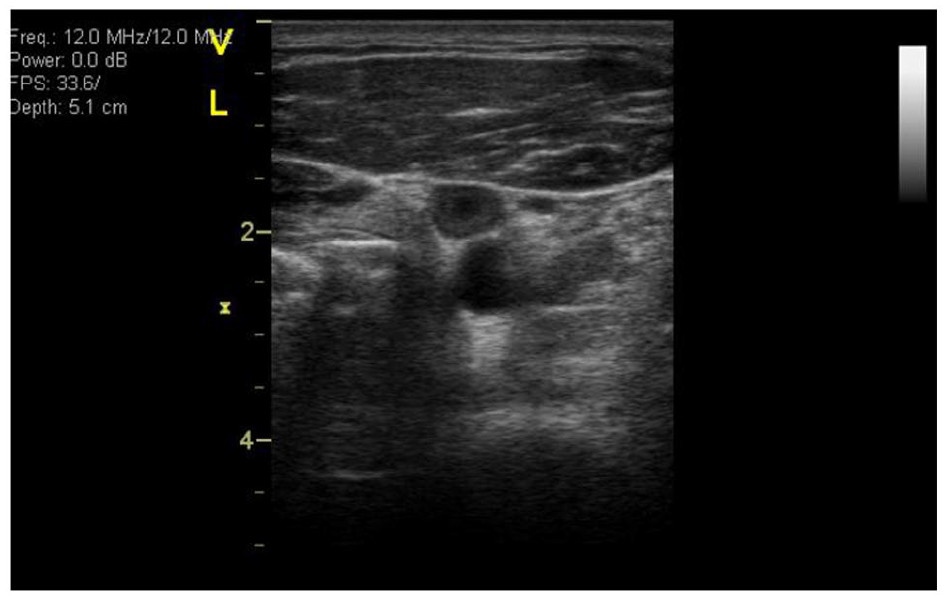
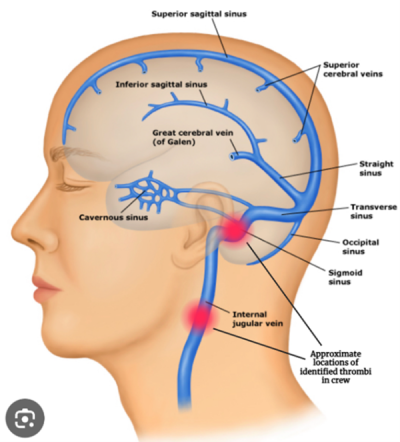
The working group’s conclusions emphasized that stasis in the left internal jugular vein (IJV) is consistently viewed as a dominant risk factor for VTE in microgravity, though there is active debate regarding the relative contributions of slow qualitative flow, endothelial factors and/or retrograde flow.
Limitations of current in-flight ultrasound capabilities to accurately measure stasis/slow flow was cited as a concern, especially if using only stasis as a factor for indicating the need for prophylaxis.
Additional review of assessing stasis with ultrasound in-flight was recommended.
After reviewing the risk factors, additional discussions following the working group led to the majority of the panel agreeing that stasis and retrograde flow warranted use of prophylaxis.
The working group also recommended assessing all other risk factors other than stasis to also determine when prophylaxis is warranted.
Based on a literature review and summary of the panel contributions, a VTE Risk Score for Astronauts Algorithm was developed, which includes providing anticoagulation prophylaxis for stasis alone, or a combination of other thrombosis risk factors that are weighted by terrestrial literature.
Risk of Venous Thromboembolism During Spaceflight
NASA initially formed a working group in October 2024 after diagnosing venous thromboembolisms (VTEs) in astronauts during ISS missions. Experts reviewed case data, updated Clinical Practice Guidelines, and examined possible causes.
A Apple está testando uma nova interface na beta do macOS Golden Gate 27 que exibe uma série de atalhos da Siri AI sempre que o usuário seleciona texto em um app qualquer.
Descoberta pelo usuário identificado como “pdfu” em uma comunidade do Reddit, a novidade está claramente inacabada, o que explica o fato de ela vir desativada por padrão nas versões mais recentes do sistema operacional.
Como é possível notar abaixo, a interface assume a forma de um popover que aparece no canto superior esquerdo da seleção feita pelo usuário. Além disso, os atalhos são contextuais, o que significa que ações diferentes poderão ser sugeridas dependendo do conteúdo em destaque.
Caso o usuário esteja trabalhando em um texto, o recurso exibirá atalhos relacionados às Ferramentas de Escrita (Writing Tools), só para citar um exemplo. Ainda de acordo com as informações, o recurso também pode sugerir ações como enviar um email, adicionar um número aos contatos, exibir um endereço no app Mapas (Maps) ou rastrear um voo.
Para desativar a novidade (o que talvez se prove necessário, já que, como dito, ela ainda está inacabada e apresenta inconsistências), basta abrir o Terminal novamente, rodar o comando a seguir e reiniciar o Mac:
Como essa nova interface já está disponível (mesmo que escondida) nas betas do macOS 27, é bem possível que ela dê as caras em uma futura versão de teste do sistema — provavelmente em um estado bem mais polido.
Our poll results are in: virtually no TidBITS readers use clear or tinted icons on the Mac or the iPhone. But the real issue isn’t color—it’s that Apple’s mandatory squircle shape strips icons of their distinctive personalities, making them harder to differentiate.
If there’s extraterrestrial life anywhere in the galaxy, chances are, it could be on LHS 1140b.
Astronomers have found that the exoplanet 48 light years away is spewing helium into space, a strong sign that it harbors a robust atmosphere, they reported in a new study published in the journal Science.
And that’s not all: it’s also a rocky world like our own, and orbits within its star’s habitable zone, the region around a star where a planet can maintain liquid — and possibly life-harboring — water on its surface.
If their findings are borne out, then it’s the first ever Earth-like exoplanet we’ve seen with an atmosphere stable enough to support life — and could vindicate the belief that there’s a whole host of similar planets out there, rather than our own being a rare anomaly in the cosmos.
“When there’s one, there’s more in exoplanets,” Sara Seager, an astrophysicist at MIT who was not involved in the study, told the New York Times. “Hopefully this is the start of something new.”
“At this point, we have absolutely no evidence for life on the planet,” lead author Collin Cherubim, a planetary scientist at Harvard University, added to the newspaper. “But we think all of the really important, essential ingredients are there.”
Spotting exoplanets is rare. While we have catalogued millions of stars, we have only confirmed around 6,000 worlds outside our solar system. Finding ones with an atmosphere is even rarer, since their signals are faint compared to the light of the planet’s star. In many cases, the planets with atmospheres are gas giants, which are unlikely to support life.
A key detail is that LHS 1140b orbits a red dwarf. Planets around red dwarfs are easier to spot because the diminutive stars are fainter, meaning it’s more noticeable when a planet passes in front of them. But since they emit less heat, a potentially habitable planet needs to orbit much closer to to them than we do our Sun. That could be a problem because red dwarfs are believed to be highly volatile. A closely orbiting planet would be in danger of being battered by solar flares and other powerful outbursts, which could strip it of its atmosphere and sterilize developing lifeforms.
The astronomers, however, found that LHS 1140b has a helium-rich atmosphere despite being — or because it’s in — the star’s habitable zone, demonstrating that the volatility of red dwarfs may not be as much as a problem as once thought (though this one appears to be less active than its cousins). They used a theoretical computer model of exoplanet atmosphere evolution that tracked how lighter elements like hydrogen and helium would be ejected by the outbursts of its host star, Science explained. When they applied it to LHS 1140b, which was first discovered in 2017, it predicted that its upper atmosphere would be dominated by helium, a promising sign that it’s capable of supporting life.
“Twenty years ago we wondered whether other terrestrial-type planets even existed,” Robin Wordsworth, a professor of earth and planetary sciences at Harvard, said in a statement about the work. “Then we learned they’re common, and found some in the habitable zone.”
“The next question was whether any of them had managed to keep an atmosphere,” he added. “Now we know at least one has.”
Apple Intelligence on-device processing remains Apple’s most convincing argument in artificial intelligence. Rivals may lead in public model rankings, chatbot adoption and the speed of releasing experimental features, but Apple is building AI inside devices people already use for their most personal work.
That distinction changes the definition of winning.
Apple does not need every iPhone owner to open a separate chatbot app. It can place intelligence inside Messages, Mail, Photos, Notes, Shortcuts, Siri and third-party apps. Local models can operate on private information without automatically transferring that information to an external server.
The strategy appeared slow while the AI market measured progress through chatbot launches and model size. It looks more competitive as the industry confronts cloud costs, privacy concerns, unreliable connectivity and the difficulty of turning general-purpose AI into useful daily actions.
In his video “Apple Lost the AI Race,” Marques Brownlee captures the contradiction in one concise line:
“Apple lost the AI race. Actually, Apple won the AI race.”
The apparent reversal describes Apple’s current position well. Apple may have lost the first race for public perception. It is increasingly prepared for the longer contest over where AI runs, how it reaches users and who controls the personal data required to make it useful.
Apple Intelligence On-Device Changes the AI Relationship
Most popular generative AI products began as cloud services. A user sends a request to a remote model, the provider processes it in a data center and the answer returns through an app or browser.
That structure supports enormous models but creates dependence on internet access, server capacity and continuing infrastructure expense. It also means personal prompts leave the device, even when the provider uses strong security and privacy policies.
Apple Intelligence on-device begins from the opposite direction. The iPhone, iPad or Mac first attempts to handle the request locally using Apple Foundation Models optimized for Apple silicon.
That local model does not need to know everything available on the internet. It needs to understand the user’s request, work with relevant personal context and complete common tasks efficiently.
The difference is similar to owning a capable computer rather than renting every calculation from a distant server. Cloud systems remain useful for difficult workloads, but they no longer need to participate in every interaction.
For Apple, local processing is also a product advantage. The company controls the chip, operating system, model architecture, memory system and apps. Each layer can be designed around the others rather than assembled from unrelated services.
Image Credit: Apple Inc.
Privacy Becomes a Technical Feature
Technology companies frequently describe privacy as a policy. Apple is trying to make it part of the AI architecture.
When a request runs entirely on an iPhone, the associated data does not need to leave the device. A model can work with messages, appointments, photos or app content without uploading that personal context to a conventional cloud account.
That structure is especially relevant to Siri AI. A truly personal assistant needs access to information that users may never place willingly inside an ordinary chatbot: private conversations, travel plans, health-related details, work documents and relationships between people.
An assistant becomes more useful as it gains context. It also becomes more invasive when the same context is stored, analyzed or used for model training outside the device.
Apple Intelligence on-device allows Apple to expand personal context while maintaining a stronger boundary around it. The assistant can understand information locally, perform an action and discard temporary processing data without building a permanent advertising or training profile.
This is difficult for competitors whose businesses depend on cloud services, large-scale data collection or engagement inside separate AI products. Apple’s hardware business gives it different incentives.
Private Cloud Compute Extends the Model
Not every AI task can fit within the power and memory limits of an iPhone. Apple uses Private Cloud Compute when a request requires a larger model.
Private Cloud Compute is designed to extend the privacy architecture of Apple devices into the cloud. User information is processed only for the request, is not stored and is not made available to Apple for unrelated purposes.
Independent researchers can inspect software images used by the system, creating an unusual level of outside visibility into the cloud environment. Apple has also expanded the architecture while maintaining control over the software and privacy protections used for processing.
This creates a layered system rather than a simple choice between local and cloud AI.
Apple Intelligence first determines whether the device can handle the request. More complex work can move to Private Cloud Compute. External models may be offered separately when the user chooses to involve them.
The user does not need to understand the technical path behind every answer. The system chooses the smallest and most private environment capable of completing the task.
Apple Silicon Was an AI Investment
Apple’s control of its processors has become one of its largest advantages in the AI era.
The Neural Engine first appeared years before generative AI became a consumer obsession. It supported Face ID, photography, speech recognition and other machine-learning tasks. Apple continued expanding that hardware across the iPhone, iPad and Mac.
Those investments now provide a large installed base of devices designed to run machine-learning workloads locally. Recent Apple chips combine CPU, GPU, Neural Engine and unified memory in one architecture that can move information efficiently between different types of processing.
The same design helps foundation models run without requiring the power consumption or separate memory systems associated with conventional data-center hardware.
Apple also controls the operating systems that schedule those workloads. A model can be optimized for the exact processors, memory limits and energy behavior of supported devices.
Competitors can build excellent models, but they often need to support hardware from several manufacturers with inconsistent capabilities. Apple can decide that an AI feature requires a specific generation of silicon and design the complete experience around it.
Developers Gain a Local Model
The Foundation Models framework extends Apple Intelligence on-device beyond Apple’s own apps. Developers can use the system model through native Swift tools rather than shipping a separate large model or paying for every cloud request.
An app can generate structured content, interpret natural language or use tool calling while keeping supported processing on the device. Apple handles model delivery and system integration.
This can reduce operating costs for developers. A cloud-based AI feature creates an ongoing expense each time a user submits a request. Local inference uses hardware the customer already owns.
It can also improve reliability. Features may remain available without an internet connection and respond without waiting for a remote service.
The framework encourages a quieter form of AI adoption. Apps do not need to add a prominent chatbot tab or redesign themselves around a conversational interface. Intelligence can appear inside existing workflows as a useful capability.
That is where Apple’s strategy may reach scale. Millions of apps can incorporate small AI functions that users experience as normal software behavior rather than as visits to an AI destination.
Image Credit: Apple Inc.
The Installed Base Is Apple’s Distribution Advantage
The AI race is often discussed as a contest between models. Consumer adoption also depends on distribution.
Apple can deliver new intelligence features through operating-system updates across the iPhone, iPad, Mac and Vision Pro. Users do not need to create another account, choose a provider or transfer their personal information into a new service.
Siri already occupies the system interface. Apple Intelligence can work across first-party apps. Developers can connect their own features through Apple frameworks.
The scale is difficult to reproduce. A model provider may have stronger benchmark scores but still need users to download an app and consciously open it. Apple can introduce AI during actions people already perform: replying to a message, locating a photo, organizing a note or completing a shortcut.
This does not guarantee success. Apple must make Siri AI reliable, keep feature availability consistent and prove that local models can deliver enough capability to satisfy users accustomed to powerful cloud assistants.
The distribution advantage only becomes meaningful when the experience works.
Winning Without Building the Loudest Chatbot
Apple has made mistakes during its AI transition. Siri improvements arrived later than promised, regional regulations delayed features and competitors established powerful consumer brands before Apple completed its new system.
Those setbacks explain why the claim that Apple lost the AI race became persuasive.
They do not settle the outcome.
The first stage rewarded companies that released chatbots quickly and demonstrated increasingly large models. The next stage may reward systems that can integrate AI into ordinary life without demanding constant cloud access, high subscription costs or broad collection of personal information.
Apple Intelligence on-device is built for that stage. It uses hardware already in the user’s hand, protects more personal context locally and gives developers access to intelligence without requiring every interaction to become a server transaction.
Apple does not need to win every benchmark or release the most talkative assistant. It needs AI to become a reliable part of the devices people already trust.
Brownlee’s title works because both statements can be true. Apple lost the visible sprint that defined the early generative AI market. By concentrating on local processing, silicon, privacy and operating-system integration, it may already be positioning itself to win the race that follows.
The researchers behind the historic discovery, which they are calling “a major milestone in the search for life on other planets,” said the detection of an atmosphere on an Earth-like rocky exoplanet offers the strongest evidence to date that worlds with similar compositions and temperatures to Earth that are also capable of supporting life could exist beyond our solar system.
Models Predicted First Earth-like Rocky Habitable Zone Exoplanet Atmosphere
In a statement announcing the detection of an atmosphere around a habitable-zone rocky exoplanet, the discovery was motivated by theoretical predictions suggesting that LHS 1140 b may contain an atmosphere. The planet was even more tantalizing because its orbit around its host red dwarf star allows for liquid water on its surface, a key ingredient for life as we know it.
Although thousands of exoplanets have been confirmed since 1995, including habitable-zone rocky worlds similar in size and composition to Earth, the team notes that determining whether any of these potential Earth analogs maintain an atmosphere. Like water, an atmosphere is considered a likely necessity for life to emerge.
“An atmosphere is essential for a planet to support life as we know it,” explained Collin Cherubim, the lead author of a study detailing the findings, who recently earned his Ph.D. in Earth and Planetary Sciences from Harvard University.
Robin Wordsworth, the Gordon McKay Professor of Environmental Science and Engineering and Professor of Earth and Planetary Sciences at Harvard, said that as recently as twenty years ago, astronomers still didn’t know if other, terrestrial-type planets “even existed.” However, he explained, they quickly found that this type of planet was common, including some orbiting within their star’s habitable zone.
“The next question was whether any of them had managed to keep an atmosphere,” the professor added.
Infrared Observations Confirm Historic First
Before performing any direct observations, the team used computer models to predict what they might find on LHS 1140 b. As noted, those models predicted an upper atmosphere rich in helium. The models also suggested that the atmospheric helium was slowly escaping into space.
To test the model’s predictions, Cherubim and colleagues gained access to the Warm Infrared Echelle (WINERED) Spectrograph on the Magellan Observatory in Chile. The team noted that this powerful telescope allowed them to observe an alignment of LHS 1140 b and another planet transiting its star “on the same night.”
When analyzing the data, the team found that one of the planets appeared to lack any measurable atmosphere. However, as their models had predicted, helium was actively escaping from LHS 1140 b. The finding confirmed that this rocky exoplanet orbiting within its star’s habitable zone was actively maintaining an atmosphere.
David Charbonneau, the head of the Harvard Department of Astronomy and an astronomer at the Center for Astrophysics | Harvard & Smithsonian, and Cherubim’s co-advisor with Wordsworth, was initially skeptical because the entire concept was based on a mathematical prediction of a phenomenon astronomers had never witnessed directly. However, Professor Charbonneau ended up praising the student’s determination and follow-through, which led to the historic detection.
“Collin analyzed the planets we knew about and predicted that this one would have a helium atmosphere,” Charbonneau said. “Then he organized telescope time, got the data, and the detection was statistically rock solid.”
“Hopefully it’s just the First of Many More Observations to Come”
When discussing the implications of the findings, Cherubim noted that “this is the first time anyone has found an atmosphere on a rocky planet in the habitable zone of another star.” Professor Wordsworth agreed, once again noting that until now, planets in these categories with atmospheres had been purely theoretical.
“Now we know at least one has,” the professor said.
The data also suggest that LHS 1140 b’s atmosphere has likely survived for more than three billion years, roughly three-quarters of Earth’s existence. This durability makes LHS 1140 b an excellent candidate for future exoplanet atmosphere studies.
More broadly, the team said that using ground-based observatories to search for escaping gases, such as the helium detected leaving LHS 1140 b, “may become an important tool for studying atmospheres on rocky exoplanets.” They also note the potential value of atmospheric detection for astrobiologists searching for signs of life in the cosmos.
As for Cherubim, he plans on following up his historic discovery with a more detailed analysis of the planet’s atmospheric composition. He also said he would like to investigate the possible presence of surface oceans or other planetary characteristics typically associated with habitability and life. The entire team also said they would like to use Cherubim’s model to search for similar Earth-like, habitable-zone rocky exoplanets.
“This has been a model validation, and hopefully it’s just the first of many more observations to come,” Cherubim said.
Christopher Plain is a Science Fiction and Fantasy novelist and Head Science Writer at The Debrief. Follow and connect with him on X, learn about his books at plainfiction.com, or email him directly at christopher@thedebrief.org.
Our modern society depends heavily on communications and power networks that are highly susceptible to interference from solar storms, making these volatile space weather events a paramount concern for scientists.
Now, it turns out there may be more to fear than previously realized. Scientists are discovering that there may be no ceiling to the devastating effects solar storms may have on Earth, overturning what little sense of security may exist as a mere mathematical anomaly.
In a recent paper published in Nature, a NASA-led team discovered that the potential impact of solar storms on our technological infrastructure could be substantially more severe than currently recognized.
Solar Storms Reconsidered
According to new research, any past limitations perceived regarding the impact of solar storms on our planet are purely an illusion, which arises from imprecise data collection.
Previous observations of electric currents in the Earth’s upper atmosphere during solar storm events suggested a ceiling to how far they could increase. Yet the new paper claims that uncertainties in solar wind data are falsely giving rise to this idea.
The researchers say that the distance of the spacecraft taking solar wind measurements is the issue. Those spacecraft are millions of miles closer to the Sun than the Earth is, meaning that by the time those winds reach Earth, they have weakened considerably. Additionally, instrument error and the effects of the local plasma and field conditions all come into play.
All this, the researchers say, creates a mismatch between the measured strength of the wind and its effects on our planet’s electrical currents.
Correcting For Distance
The new findings contain one significant difference from existing research: they relied on observation platforms much closer to Earth to collect data, which included spacecraft such as NASA’s MMS and THEMIS.
Launched in 2007, THEMIS consists of five satellites that target the Earth, rather than the Sun, to study our planet’s magnetosphere and auroras. MMS consists of four spacecraft that also study the Earth’s magnetosphere.
Existing charts show the impact of solar winds on Earth leveling off at a certain threshold, which scientists had believed was the maximum saturation possible. However, in new solar wind strength data collected much closer to Earth, more accurately reflecting power at the time of impact, this saturation point disappeared. Instead, this data revealed that there is no ceiling on how heavily solar storms can charge the Earth’s electrical currents.
Solar Storm Impacts
Another crucial element in the NASA-led research is the statistical concept of regression to the mean, which holds that extreme measurements often change as more data come in. In this case, as more data on solar storm impacts on Earth recorded from various distances were collected, the plating effect disappeared. The authors note that similar effects occur in other areas of research, such as climate studies and chronic medical pain.
These new findings present a major challenge to our understanding of space weather. Scientists will now need to conduct many further observations to determine if any such ceiling exists. The threat to our infrastructure may be severe, as satellite communication underpins our modern society, not to mention the power grid, which keeps our world running.
For now, NASA continues to monitor solar storms to prepare for their potentially dangerous effects on our infrastructure, and in light of the new research, the potential for future challenges ahead may be greater than previously realized.
Ryan Whalen covers science and technology for The Debrief. He holds an MA in History and a Master of Library and Information Science with a certificate in Data Science. He can be contacted at ryan@thedebrief.org, and follow him on Twitter @mdntwvlf.

 Login