Doctorow doesn't actually enjoy talking about AI, but he's constantly being asked to comment on it. "I made the tactical error of being sick of talking about AI," Doctorow told Ars. "So I wrote a book about why I think it's a dumb thing to keep asking people to talk about, and now I have to talk about it." Reverse Centaur is Doctorow's attempt to "sort out the bullshit from the material reality."
In automation theory, per Doctorow, a "centaur" describes a human augmented with a technology, like machine learning, or even just driving a car or using autocomplete. A reverse centaur "is a machine head on a human body, a person who is serving as a squishy meat appendage for an uncaring machine," Doctorow said in a speech last December. He gave the example of an Amazon delivery driver, surrounded by AI cameras monitoring their driving, who essentially serves as a peripheral to the delivery van.
On my way to Tash Rabat from Son-Kul, both in Kyrgyzstan, sitting on the comfortable seats of a minibus, I had to pinch myself just to realize that it wasn’t a dream. I could see green valleys on one side of the road and the rugged brown Pamir Plateau on the other. As someone whoContinue reading "Capturing the night sky in Kyrgyzstan"
BLUEMONT, Va.—From an overlook in the foothills of the Blue Ridge Mountains, Dan Roelker gazed across the green splendor of the Shenandoah Valley. With the pleasant spring afternoon drawing toward evening, the Sun lazily crossed the sky, casting light all around.
The pleasing environs had put Roelker, who was drinking rye whiskey procured from a local distillery called Catoctin Creek, in an expansive mood to talk about one of his favorite subjects: light.
"If you can control light, you can control space," he said. "So it’s basically a race for who is collecting the most light."
New research reveals how an unusual celestial object resembling a cosmic “bullseye” could offer clues to one of the most perplexing phenomena in our universe.
The research, undertaken by physicists Pierre Sikivie and Yuxin Zhao at the University of Florida, focuses on an astronomical feature quite unlike any other—the galaxy LEDA 1313424, whose concentric rings have garnered it the apt nickname of the “Bullseye galaxy.”
Based on Sikivie and Zhao’s recent research, detailed in a new paper that appeared in The Astrophysical Journal, quantum behavior related to long-mysterious dark matter may hold the key to the galaxy’s unusual appearance.
Unraveling a Bullseye Galaxy’s Circular Secrets
In the past, astronomers have attempted to explain LEDA 1313424’s unusual concentric appearance as the likely result of an ancient collision between two galaxies.
Not so, according to Sikivie and Zhao, who now take a vastly different approach by arguing that a better explanation may involve a Bose-Einstein condensate of axions, a variety of extremely light hypothetical particles.
A stunning Hubble Telescope view of the Bullseye galaxy (Image Credit: NASA, ESA, I. Pasha (Yale), P. van Dokkum (Yale)).
This concept has much deeper roots that go back close to a century ago, when the first galaxy featuring an unusual concentric ring was discovered. This example, dubbed the Cartwheel galaxy, was only the first in a succession of similar astronomical discoveries involving galaxies with “ringed” appearances that incorporate as many as three annular features.
Unraveling an Annular Enigma
Explaining why these galaxies look this way has remained elusive. One theory proposed by astronomers, as noted earlier, involves impacts between two galaxies, which could create waves of density whose ripples become evident in ring-like structures surrounding the resulting galaxies.
However, a discovery in 2025 by Imad Pasha, a Yale University astronomer, and his colleagues presented an even stranger development in this ongoing concentric saga: the discovery of a galaxy that possesses not three rings, but nine of them. With its discovery, this remarkable celestial object’s unusual appearance garnered the nickname now familiar to us: “The Bullseye galaxy.”
Artist’s concept detailing the annular features encircling LEDA 1313424 (Image Credit: NASA, ESA, Ralf Crawford (STScI))
One theory that astronomers believed may account for the galaxy’s nine concentric structures had been a hypothetical impact—and a very energetic one—that occurred about 56 million years ago. However, while investigating this possibility, Sikivie and Zhao say a problem emerged: this would mean that the outermost ring in the galaxy would have had to travel at a speed of 758 miles per second as it blasted outward from the galaxy’s center.
This speed, they say, is impossible to reconcile with what astronomers can already discern about the nature of the supposed collusion, as well as the well-characterized behavior of galactic material observed in other regions of the cosmos.
An Alternative Approach
In an effort to get to the bottom of the mystery behind this unique galaxy, Sikivie and Zhao have put forward an alternative idea: that the rings in the Bullseye galaxy might instead be a byproduct of dark matter’s mysterious properties.
According to astronomers, dark matter is believed to be a nonluminous material that populates our universe, contributing around 85% of its total mass. Despite its ubiquity, direct detections that could confirm its existence have remained elusive.
However, there are some intriguing cosmic phenomena that astronomers are aware of that are very good candidates for being indirect evidence of this mysterious material. These observations include gravitational motion that occurs in galaxies, whereby the accumulation of dark matter is believed to manifest in the appearance of spherical halos encircling them.
In the past, Sikivie has explored this possibility, and whether current prevailing theories about dark matter, such as the idea that hypothetical particles known as axions, may offer the best interpretation of the physical reality behind dark matter.
If dark matter is indeed related to axions, it would also be required to obey what astrophysicists call conservation of angular momentum. According to Sikivie, when axions and galaxies interact, a phenomenon should emerge where portions of dark matter halos closest to the center would become oriented in structural forms known as “caustic rings.”
“We had earlier proposed that disk galaxies have caustic rings of dark matter with a pattern of ring radii, very similar to the pattern of ring radii observed in LEDA 1313424,” Sikivie recently said.
With this idea in mind, Sikivie and Lhao then turned their attention to the mysterious bullseye of LEDA 1313424 and “fitted the observed ring radii to the pattern of ring radii in the caustic ring interpretation,” from which they discerned that “LEDA’s rings are the imprint of caustic rings of dark matter on the baryonic matter in LEDA’s disk.”
Strange Quantum Behaviors
A further aspect of the researchers’ theory involves the quantum behavior that axions are expected to engage in.
Under extremely cold conditions, these hypothetical dark matter particles could collectively occupy the same quantum state, forming what is known as a Bose-Einstein condensate—a strange state of matter in which quantum effects become visible on macroscopic scales.
According to the team, such a condensate could interact with ordinary matter in ways that match astronomical observations. If the duo is correct, this could imply that ring-shaped galaxies such as LEDA may not result from galactic collisions at all—instead, these unique cosmic structures might be evidence of dark matter axions that have undergone Bose-Einstein condensation.
Presently, much like dark matter, axions have remained hypothetical and frustratingly difficult to detect. Of course, given their elusiveness, this also makes them a very good candidate in terms of helping scientists close in on the dark matter mystery, and new models are helping to provide potentially compelling new resolutions for such problems.
For now, mysterious ringed galaxies remain mysterious. However, as the work of researchers like Sikivie and Lhao progresses, one of astronomy’s more unusual recent discoveries is gradually coming into focus, while providing fresh insight into the intriguing quantum nature of dark matter.
Micah Hanks is the Editor-in-Chief and Co-Founder of The Debrief. A longtime reporter on science, defense, and technology with a focus on space and astronomy, he can be reached atmicah@thedebrief.org. Follow him on X @MicahHanks, and at micahhanks.com.
MAJURO, Marshall Islands—Perched on the bow of an aluminum landing craft, Anne Cohen gazed a few yards ahead of the vessel toward a yellow robot gliding across the emerald Majuro lagoon.
The unmanned surface vehicle, called Yellowfin, was quickly becoming one of the coral researcher’s most dependable guides in these Central Pacific waters.
“She’s the best dive buddy,” said Cohen, a tenured scientist at the Woods Hole Oceanographic Institution in Cape Cod. Programmed to navigate to a precise set of coordinates, the robot cut through small swells like a tiny sailboat without a mast, directing Cohen toward a destination she had traveled thousands of miles to revisit.
Plague swept through groups of hunter-gatherers in southeastern Siberia 5,500 years ago, leaving dozens dead in its wake—with DNA from Yersinia pestis bacteria still trapped inside their teeth.
University of Oxford ancient DNA researcher Ruairidh Macleod and his colleagues recently sequenced the telltale bacterial DNA in teeth from plague victims at four ancient cemeteries in the area around Russia’s Lake Baikal. The tragedy that befell these communities is now the earliest known plague outbreak, courtesy of the oldest strain of Y. pestis ever sequenced.
Unearthing a new backstory for the plague
Until recently, scientists who study the evolution of diseases have held two fairly solid ideas about the origins of plague, the disease caused by Yersinia pestis bacteria. It's a scourge so awful that it has gone down in history as not just a plague but the plague. The first idea is that the earliest strains didn't have the right genetic traits to be really lethal. And the second is that the plague first began menacing humans when the first farmers settled in densely packed towns alongside rats and domestic animals.
Greetings, Arsians, and welcome to the great Ars Technica 2026 reader survey! It has been almost four years since we last ran a big site-wide survey like this, where we ask our readers—you!—what you like about the work we do and what we could perhaps improve on. This kind of check-in is absolutely vital to ensuring we're steering the ship properly, and we take the results very seriously. (The last time we did this, we got several thousand responses, and that's incredibly valuable data for us!)
You don't have to have been a reader since 1998 to weigh in, either. Whether you're a first-time reader, an old grizzled forum veteran, a front page comment maven, a newbie sysadmin, or a CEO, we want to hear what you have to say, no matter who you are. The only requirement is that you're a human! (Aliens are welcome as well, though we didn't really define any demographic categories for extraterrestrial beings. We'll tackle this issue if it comes up, I suppose.) There are a few text fields. Yes, we will read what you write there!
To assay, perchance to sing
Fortunately, this isn't a long survey—just a handful of targeted questions. We're not collecting any personally identifying information, and responses will only be viewed in aggregate. None of the data will be analyzed by anyone except us, and none of it will be sold or otherwise distributed outside of Ars. (We're using SurveyMonkey for our survey platform, the same as we have many times in the past.)
The release of macOS 27 later this fall won't quite close the book on the Intel Mac. The last handful of models that could run macOS 26 Tahoe will be eligible for security and Safari updates for two more years, and elements of the Rosetta compatibility layer for running Intel code on Apple Silicon Macs will be with us in some form for some indeterminate amount of time after that.
But macOS 26 is definitely the last chapter of the Intel Mac story. Anything that happens after this is a coda or an epilogue.
Most of our WWDC coverage has been forward-looking, so indulge us if you will in a look backward at the full history of the Intel Mac, a partnership between two companies that made Macs dramatically better, until it started making them worse.
Apple Intelligence and Siri AI have sucked most of the oxygen out of the room at Apple's Worldwide Developers Conference this year—understandable, maybe, given that the AI-powered Siri delays are all anyone has wanted to ask any Apple executive about for the last two years.
But Apple Intelligence is just one of the three big focus areas Apple outlined during its keynote this week. The second is new parental controls—overdue, but promising-looking, as the parent of a 6-year-old with an iPad that I only begrudgingly connect to the Internet. And the third is "platform improvements," a catch-all for a wide range of fit-and-finish changes aimed at boosting responsiveness and addressing common user complaints.
I have the first beta of macOS 27 Golden Gate running on an M1 MacBook Air—the oldest, slowest hardware Apple supports now that Intel compatibility is out the window. With some help from Apple's densely packed wall-of-features slide, here are a few things from the "platform improvements" column I like the most, plus one item I'd still like to see.
There is a pattern found in nature. It is indeed the largest pattern there is. It is so vast that it spans the universe, filling up its observable volume. The pattern is made of individual units in the same way your body is made of cells — if each of your cells were a galaxyContinue reading "Untangling the cosmic web"
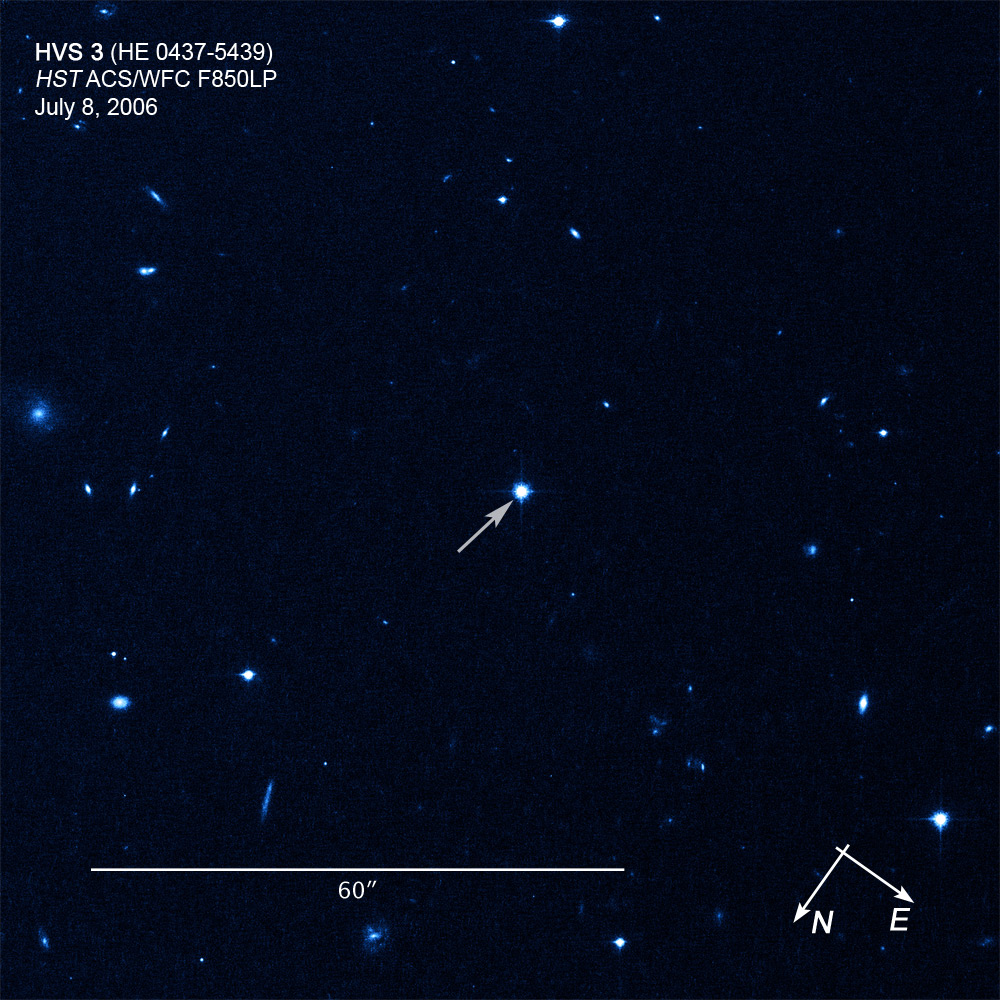
Zooming through the galaxy faster than they should, hypervelocity stars are a curious population of stars whose origins are often difficult to determine. A recent study presents the first evidence of an old, low-mass hypervelocity star launched from the Milky Way’s center, providing clues into this elusive set of fast-moving stars.
Astronomers have caught a number of hypervelocity stars zipping through the Milky Way since their first discovery in 2005. With speeds fast enough to escape the galaxy, hypervelocity stars were launched off course by some strong dynamical interaction. One such method, known as the Hills mechanism, predicts that when a binary star system approaches the Milky Way’s central supermassive black hole, one binary member is captured by the black hole and the other is flung away with high velocity.
However, constraining a hypervelocity star’s origin to the galactic center is limited by uncertainties in distances and proper motions, muddling how well researchers have been able to trace their orbits backward. Among a number of candidate galactic center–origin hypervelocity stars, only one has been confidently identified as having been kicked from the galaxy’s center. Intriguingly, this hypervelocity star and most galactic center–origin candidates are young, massive stars — old, low-mass hypervelocity stars from the galactic center have yet to be identified.
What does this dearth of old, low-mass zooming stars mean? Either stars in the galactic center are preferentially young and massive, with fewer than expected old and small stars, or low-mass hypervelocity stars are missed by selection effects, challenging to detect in current surveys. Searching for hypervelocity stars with higher precision and sensitivity may allow astronomers to tease out this missing population and trace back more zooming stars to a Hills mechanism origin.
Discovering An Old Hypervelocity Star
Leveraging high-quality spectra from the Dark Energy Spectroscopic Instrument (DESI) survey and precise astrometry from Gaia, Shunhong Deng (University of Chinese Academy of Sciences; China West Normal University) and collaborators reported the discovery of the hypervelocity star DESI-HVS1. From the spectroscopic and astrometric analyses, the authors determined that DESI-HSV1 is a ~14-billion-year-old low-metallicity star with a mass about 80% that of the Sun’s, moving through the galaxy at 523 km/s.
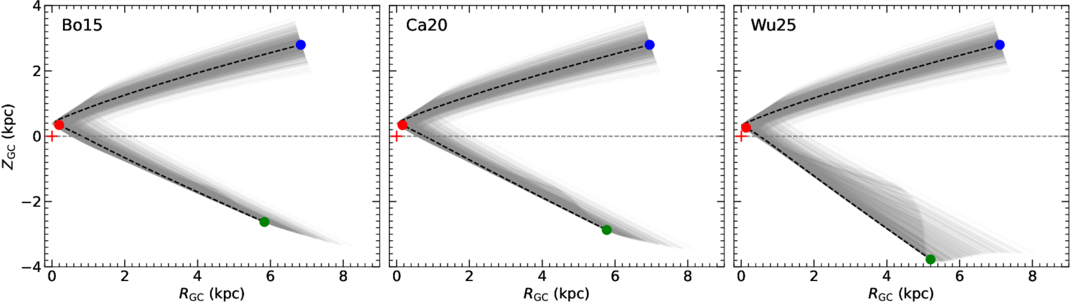
Backward-integrated orbits of DESI-HVS1 for three different galactic potential models. The blue, red, and green points show the star’s current position, closest approach to the galactic center, and position 50 million years ago, respectively. Click to enlarge. [Deng et al 2026]
Exploring the possible origins of this hypervelocity star, the authors integrated the star’s orbit backward in time for one billion years. The backward orbit integrations show the star approaching the galactic center where it then turns around, traveling away faster than the local escape velocity of the galaxy. Even when varying the galactic potential and constants, all orbit integrations suggest DESI-HVS1’s motion through the galaxy is most naturally explained by the Hills mechanism.
While more refined galaxy models and comparison to other candidate galactic center–origin hypervelocity stars are necessary to fully confirm its origins, DESI-HVS1 provides the first compelling evidence for an old, low-mass hypervelocity star candidate consistent with a galactic center launch. This suggests that the observed lack of such stars is likely not a reflection of the Milky Way’s central stellar population, but rather a consequence of observational constraints making such small hypervelocity stars particularly difficult to detect. As large spectroscopic and astrometric surveys continue to advance, the sample of galactic-center hypervelocity star candidates will grow, enabling further exploration of the stellar environment and dynamical processes at the Milky Way’s core.
Citation
“An Old, Low-mass, Metal-poor Hypervelocity Star Candidate Consistent with Galactic Center Origin,” Shunhong Deng et al 2026 ApJL 1003 L9. doi:10.3847/2041-8213/ae6505
What’s the story behind the longest gamma-ray burst ever observed? Researchers explore how repeated interactions between a white dwarf and an intermediate-mass black hole could explain GRB 250702B’s unusual properties.
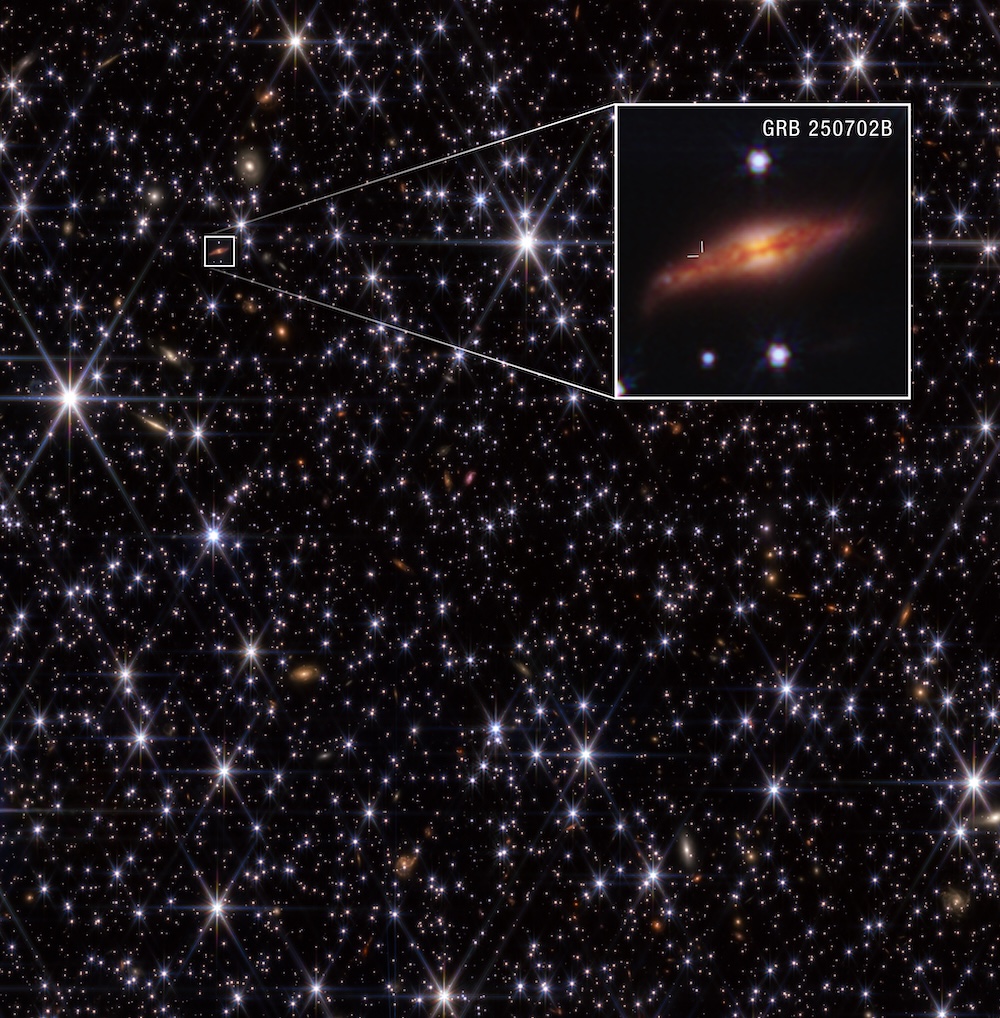
In 2025, the Fermi Gamma-ray Space Telescope spotted an intense flash of gamma rays from a distant, dusty galaxy, and a fleet of spacefaring and earthbound telescopes soon revealed the remarkable characteristics of the event. GRB 250702B featured multiple bursts spanning several hours, individual flares lasting roughly 100 seconds, and X-ray emission in the 24 hours leading up to the gamma-ray activity — something never seen before in a gamma-ray burst.
These characteristics have been challenging to explain with typical models of long gamma-ray burst formation, such as collapsing massive stars, but researchers have developed numerous promising alternatives. In a new research article, astronomers have shown how GRB 250702B’s behavior might be explained by repeated close encounters between a white dwarf and an intermediate-mass black hole.
Eccentric Close Encounters
Yuri Sato (Tohoku University) and collaborators modeled the source of GRB 250702B as a white dwarf that has been captured into orbit around an intermediate-mass black hole. In their model, the white dwarf travels on an extremely eccentric orbit, drawing close to the black hole roughly once an hour. Each time the white dwarf ventures close, the black hole’s tidal forces strip away part of the star until, after about 40 such encounters, the white dwarf is completely destroyed.
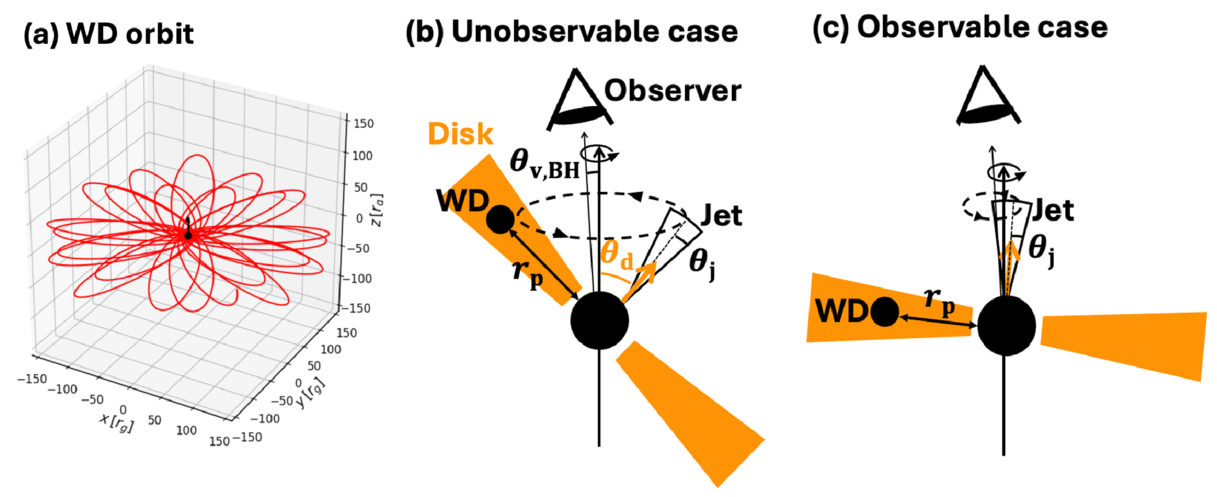
Schematics showing the orbit of the white dwarf (WD; left) and the geometries that produce observable and unobservable jets. Click to enlarge. [Sato et al. 2026]
When the black hole peels material away from the white dwarf, some material swirls into an accretion disk, and some is cast off into space. Accretion from the disk powers a narrow relativistic jet: the source of the event’s powerful gamma-ray flares. This should mean that there is one jet produced each time the white dwarf is partially disrupted — 40 times — yet astronomers detected only a handful of flares from GRB 250702B.
Jet Precession and Model Predictions
The discrepancy can be resolved if the angle between the jet and the black hole’s spin axis precesses over time so that only some of the jets are pointed toward us. This can occur if the accretion disk is misaligned relative to the black hole’s spin. As an alternative, disk instabilities or other processes could keep all but a few of the expected jets from being launched.
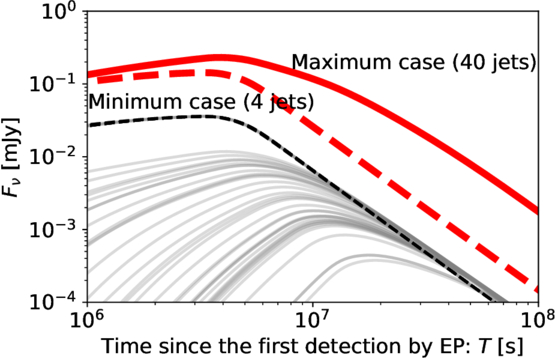
Predicted strength of the radio afterglow for the jet precession case (maximum case) and the case in which only four jets were launched due to disk instabilities or jet choking (minimum case). The x-axis shows the time since the burst was detected in X-rays by the Einstein Probe (EP). [Sato et al. 2026]
Sato and coauthors found that these two scenarios have different long-term outcomes, providing a potential way to ascertain what’s going on at the source; in the jet precession scenario, the jets that are launched away from our line of sight produce an order of magnitude more radio emission at late times.
This work by Sato and collaborators demonstrates how the repeated partial tidal disruption of a white dwarf by an intermediate-mass black hole can match the properties of one of the most remarkable recent transient sources — one that has pushed astronomers to consider new ways of producing gamma-ray bursts.
Citation
“Successive Partial Disruptions with Orbital Precession in a White Dwarf–Black Hole System for Repeating GRB 250702B,” Yuri Sato et al 2026 ApJL1003 L44. doi:10.3847/2041-8213/ae6a8f
It feels like there's no escaping AI right now, whether you’re trying to type a sentence without being interrupted by a digital “assistant” or struggling to find a new refrigerator that doesn’t require a Wi-Fi connection for some reason. You’d be forgiven for wondering if we’re in the midst of a quantum leap in tech or whether people are just hyping up a heap of slop.
So what should we make of the growing use of AI in weather and climate modeling?
The conversation didn't get off to a great start earlier this year when a National Weather Service office posted a forecast map featuring nonexistent cities in Idaho with names like “Whata Bod” and “Orangeotild.” Thankfully, that was just an AI-generated image produced for social media, not the actual forecast model. Meteorologists and climate scientists are not yet being replaced by large language model prompt engineers.
When the third known object from the galactic space beyond our Sun barreled through the solar system last year, Earth was in a terrible spot to view its flyby. Thankfully, however, a spacecraft that was previously busy mapping Mars took advantage of much better positioning for a closer look.
Cheap Seats
Astronomers have now observed three interstellar objects as they’ve flown through the solar system: 1I/ʻOumuamua, which shocked astronomers in 2017; 2I/Borisov, which followed in 2019 and behaved almost identically to a solar system comet; and now 3I/ATLAS, which was found buzzing toward the Sun in July 2025. As soon as 3I/ATLAS was spotted, pretty much every telescope on the planet took a look. The data swiftly revealed much that intrigued astronomers: while 3I/ATLAS was behaving essentially like a standard comet, its chemistry was nothing like its solar system counterparts, and its coma and dust outflow were strangely shaped. Among other oddities, it seemed to counterintuitively have a dust tail that pointed toward the Sun.
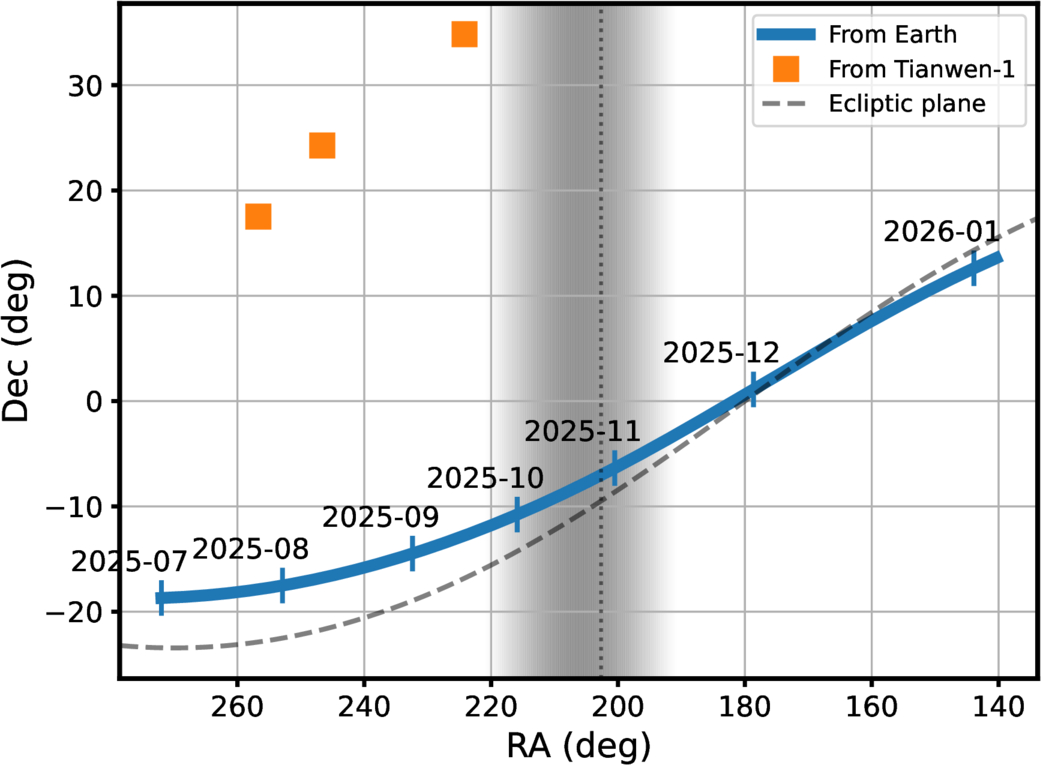
3I/ATLAS’s path across the sky as seen from Earth versus the clearer line of sight from Mars. The shaded region represents the times where the comet was too close to the Sun for viewing. [Xin Ren et al. 2026]
Unfortunately for astronomers, 3I/ATLAS didn’t make it easy for them to study the shape of its coma. Thanks to a cosmic coincidence, the interstellar visitor was traveling almost perfectly within the plane of our solar system, and Earthbound observers were often limited to an edge-on view of its tail. Even worse, 3I/ATLAS looped around the back of the Sun from our perspective, meaning no one on the planet could observe the comet for a few weeks in the fall. This led a group of astronomers to consider their assets that are farther from home.
Better View from Mars
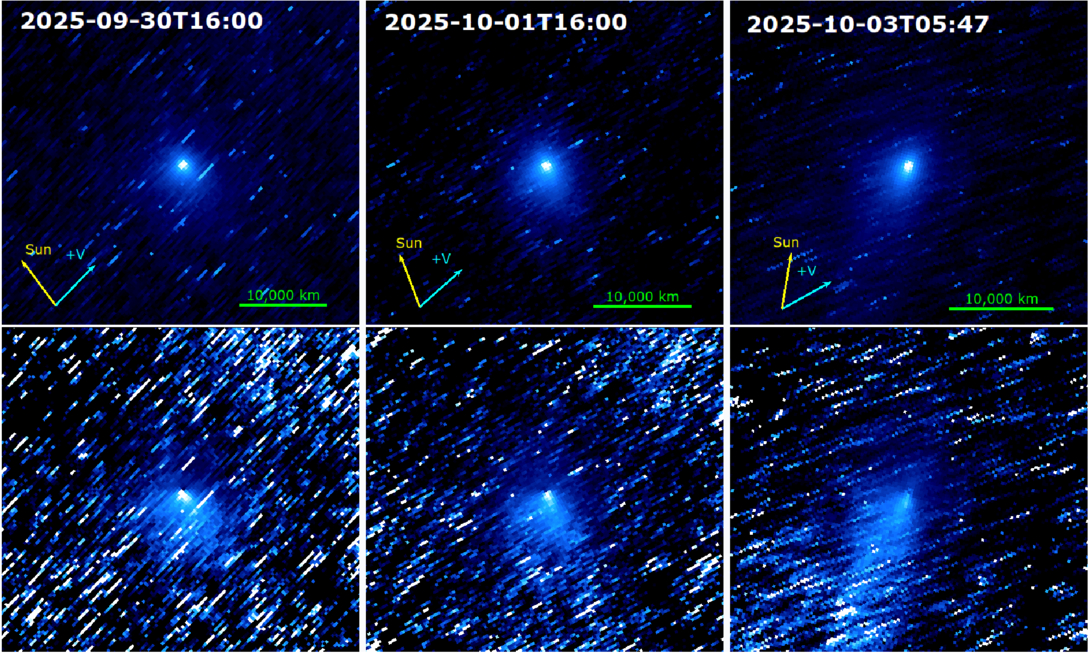
The Tianwen-1 spacecraft, which entered Martian orbit in early 2021 and has been diligently mapping the Red Planet ever since, has a high-resolution camera that’s normally pointed at the planet’s surface. By spinning the spacecraft around, a team of researchers led by Xin Ren (National Astronomical Observatories, Chinese Academy of Sciences) repurposed the camera to act as a small telescope when 3I/ATLAS flew by. In another cosmic coincidence, 3I/ATLAS happened to pass very near Mars last fall, and this close approach gave Tianwen-1 a great out-of-plane view of the coma. The orbiter managed to capture 57 images of 3I/ATLAS over three days last fall, representing China’s first-ever observations of an object from an asset in deep space.
Stacked images of 3I/ATLAS from the Tianwen-1 orbiter across three epochs; the tail’s apparent shape shifts as the viewing geometry changes. Click to enlarge. [Xin Ren et al. 2026]
The team took full advantage of the great view and leveraged the spacecraft’s unique perspective to extract some intriguing results. By tracking how the gentle pressure of sunlight nudged the escaping grains, the researchers found that the coma is dominated by surprisingly large dust. With an average size of hundreds of microns across, the dust is more like coarse sand than smoke, and they found that it ambles away from the comet at just 3–10 meters per second. All told, 3I/ATLAS was shedding dust at roughly 1,000 kilograms every second. The big grains may be a fingerprint of a cold, distant birthplace: models suggest such grains collect in the frigid outer reaches of planet-forming disks, hinting that 3I/ATLAS was forged far from its parent star before being flung into the dark.
As new surveys begin to turn up interstellar interlopers more often, this improvised observation makes a tidy point: the spacecraft already scattered across the solar system can double as a fleet of opportunistic comet-watchers, each offering a view we simply can’t get from home.
Citation
“Interstellar Object 3I/ATLAS Observed from Mars by China’s Tianwen-1 Spacecraft,” Xin Ren et al 2026 ApJL 1003 L10. doi:10.3847/2041-8213/ae61b3
Planets that get too close to their host stars are liable to be engulfed and consumed. New research explores how to identify stars that have had a planetary snack.
It’s Snack Time
Being a planet that closely orbits its star is dangerous, and various dynamical processes can draw a planet inward past the point of no return. When a planet vanishes beneath the surface of its host, it eventually disintegrates within the star, its atoms mixing into the blazing stellar soup.
This outcome is likely extremely common across the universe, and researchers have begun to see evidence for it: stars that appear to have absorbed angular momentum from their planets, white dwarfs with uncanny metals in their spectra, and stars with chemical abundances that don’t match those of their siblings. Now, in a recent publication led by Kaitlyn Lane (Vanderbilt University), researchers seek to find observational signatures of planetary engulfment of rocky exoplanets by main-sequence stars.
Modeling Engulfment
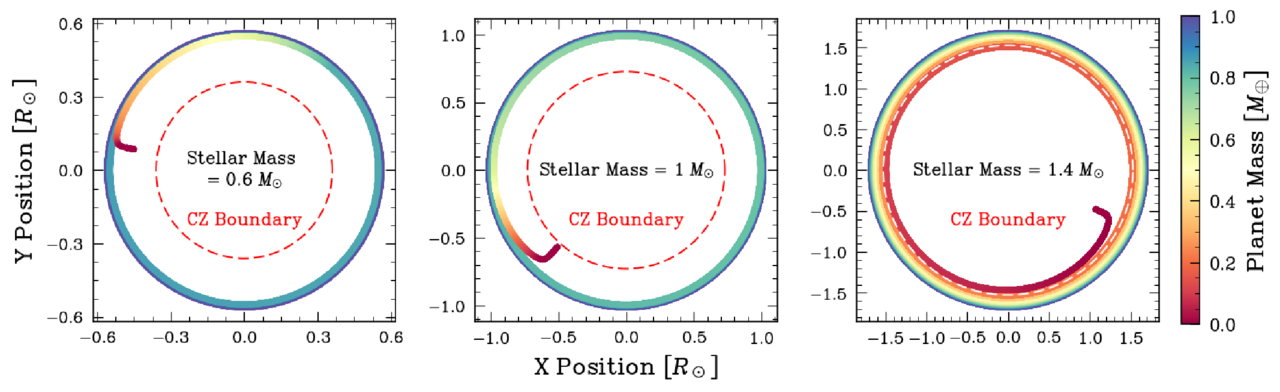
Lane’s team focused on main-sequence stars in the range of 0.5 to 1.4 solar masses, using one-dimensional analytical models to determine which of these stars will most readily display signs of having engulfed a planet. They simulated the stars as they consumed either an Earth-like planet or a super-Earth with the same composition as Earth but 15 times its mass.
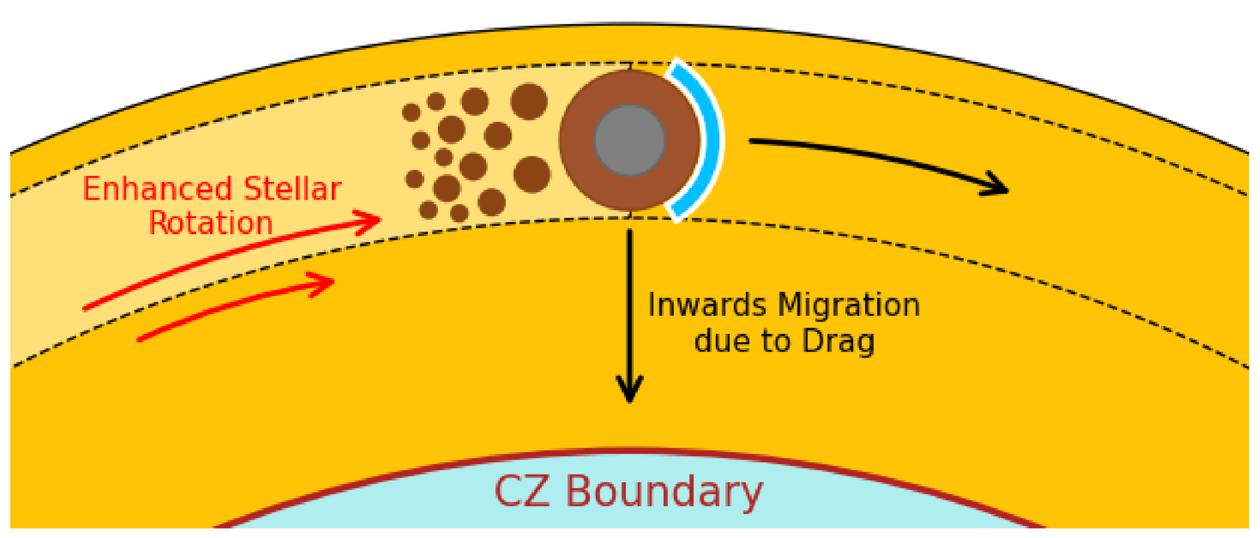
Diagram showing a planet being engulfed by its star and beginning to disintegrate before migrating inward. The boundary between the star’s outer convective zone (CZ) and inner radiative zone is shown. Click to enlarge. [Lane et al. 2026]
At the onset of the model, the engulfment is set to begin, the planet placed tangent to the star’s surface. The planets sink down and orbit just barely within their stars for 1–10 years, their solid surfaces slowly beginning to evaporate.
After that relatively lengthy phase, the process proceeds rapidly: as the planet inches deeper into its star, the drag forces grow stronger and the planet’s demise accelerates, with the planet disintegrating over the course of hours. In the last phase, the planet makes its final plunge and is destroyed in a half hour.
Signs of Planets Past
Lane’s team found that the planets tended to be destroyed fully within the outer convective layer of their stars, except in the case of the most massive stars studied here. For more massive stars, the outer convective zone is shallower than it is for the less massive stars, allowing a chunk of each planet to survive the passage through the convective zone to reach the radiative zone below.
The trajectories of three example cases, showing how the planet loses mass as it spirals inward. In the 1.4-solar-mass case, part of the planet survives to reach the radiative zone, but the shallowness of the star’s convective zone means that the disintegrated planetary material is easier to observe. Click to enlarge. [Lane et al. 2026]
What this translates to, for the purposes of identifying planet-eating stars from afar, is that stars near the top of the mass range studied — from 1.0 to 1.4 solar masses — make the best targets. This is because the tell-tale planetary metals are not overly diluted within the stars’ relatively small convective zones, making these elements easier to detect. In terms of specific metals, the authors found that aluminum, calcium, and vanadium are the best signposts of planetary engulfment, with lithium also making the list.
While the authors acknowledge that there’s more work to be done — they plan to investigate the impacts of planetary engulfment on stellar structure more closely, for example — this work represents an important foray into identifying targets for future studies of stars that have eaten their planets.
Citation
“Observable Metal Pollution in Main-Sequence Stars: Simulations of Rocky Planets Engulfed by Stars in the 0.5 to 1.4 M⊙ Range,” Kaitlyn T. Lane et al 2026 ApJ1003 67. doi:10.3847/1538-4357/ae5b9a
The fastest spinning pulsars in the universe are often quite difficult to detect. Leveraging multiple observations from the largest single-dish telescope in the world, researchers have discovered six previously undetected pulsars.
Millisecond Pulsars in Globular Clusters
Globular clusters, compact collections of tens of thousands to millions of stars, are highly dense and rife with dynamical interactions. These active environments are ideal factories for the formation of millisecond pulsars — the extremely fast-spinning cores of once-massive stars, shining beams of radio emission from their poles. One way millisecond pulsars are thought to form is when a pulsar in a binary system steals mass from its companion star, transferring angular momentum and causing the pulsar to spin up. The densely packed environment in a globular cluster provides ample opportunity for a pulsar to acquire a companion to siphon.
However, millisecond pulsars in distant globular clusters are notoriously difficult to detect. Traditional pulsar searches that rely on a single observation tend to miss millisecond pulsars, many of which have signals too faint to be distinguished from noise or radio interference. Instead, researchers must rely on a different method to find these fast-spinning pulsars.
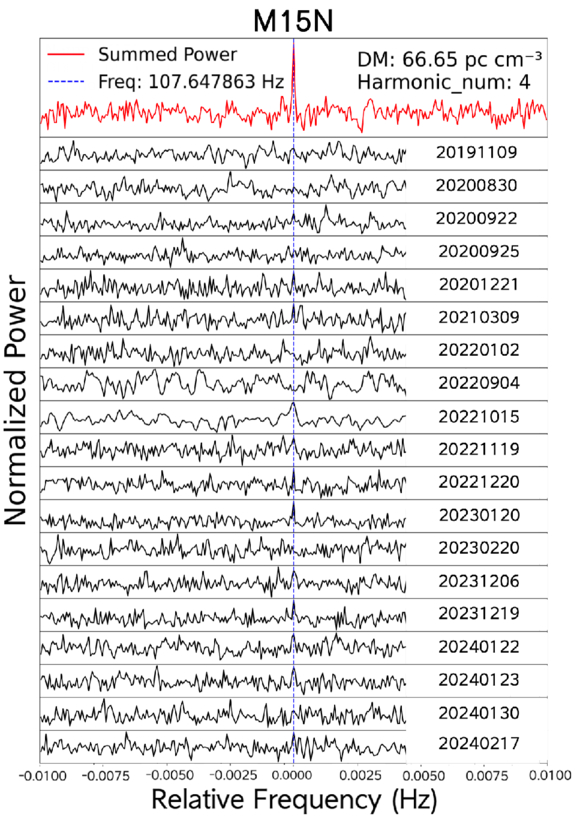
To find faint millisecond pulsars, researchers have developed the stack search method, in which multiple radio observations are combined to tease out faint signals and decrease noise. Reliably stacking observations across epochs requires stability; isolated millisecond pulsars, now no longer spinning up after losing their companion, have very stable rotation periods, making them ideal targets for the stack search method. To date, the stack search method has successfully identified nine isolated globular cluster millisecond pulsars using data from the Arecibo, Parkes, and Green Bank radio telescopes.
Power spectra from a discovered millisecond pulsar M15N. The black solid lines show the 19 individual observations of the pulsar, and the red solid line in the top panel shows the stacked spectrum. The stack search method pulls out a clear pulsar signal. [Dai et al. 2026]
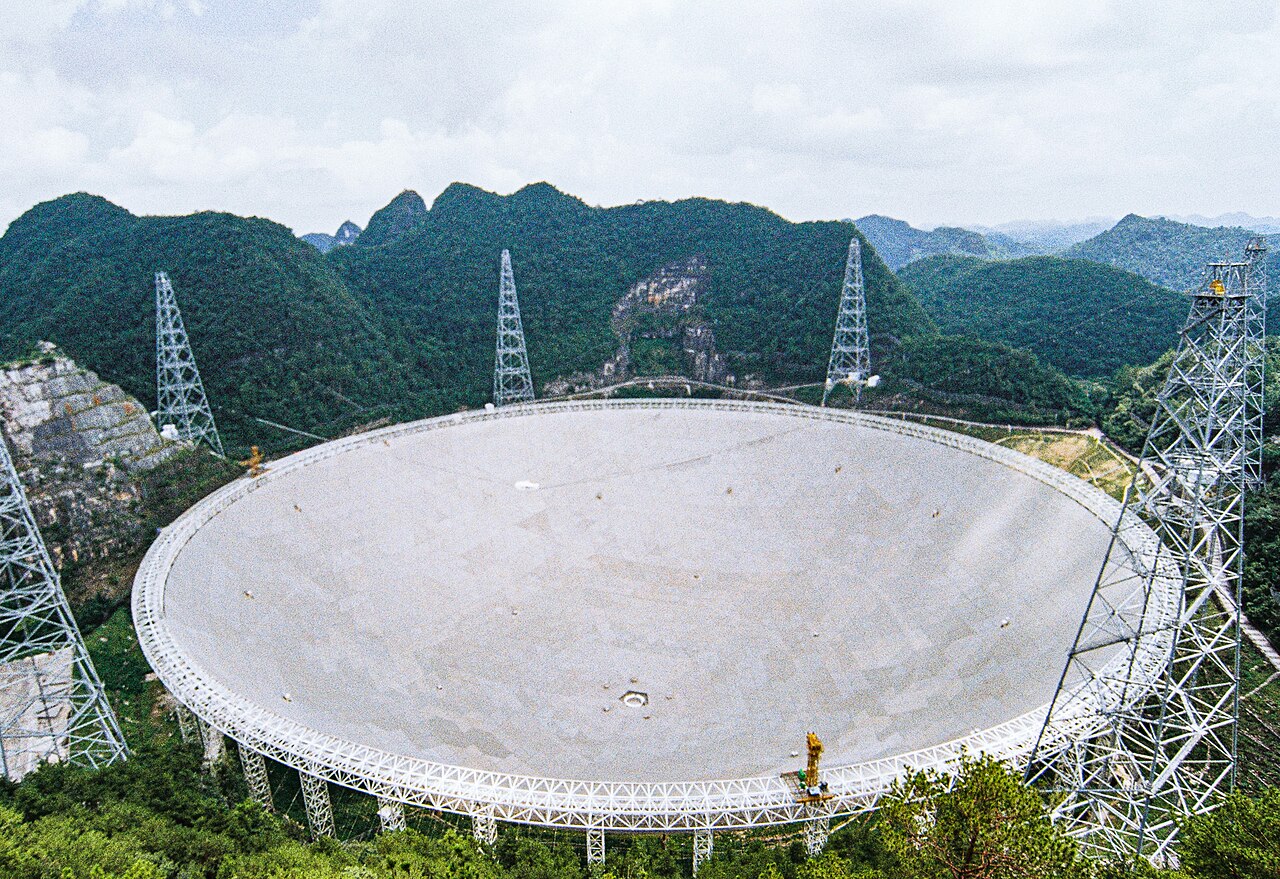
In hopes of recovering more of these faint fast-spinning pulsars, Yinfeng Dai (Beijing Normal University) and collaborators used archival data obtained with the Five-hundred-meter Aperture Spherical radio Telescope (FAST), the world’s largest single-dish telescope. Targeting two specific globular clusters, NGC 6517 and M15, the team applied the stack search method to 23 and 19 observations of the globular clusters, respectively. From their search, the authors discovered six previously unidentified isolated millisecond pulsars: four in NGC 6517 and two in M15.
While previous studies identified brighter pulsars in the targeted globular clusters, the authors confirmed that all six newly discovered pulsars are too weak to be reliably recovered from single-epoch searches, underscoring the importance of the stack search method. In particular, this search increased the known pulsar populations of NGC 6517 and M15 by 27% and 18%, respectively, suggesting that a meaningful fraction of globular cluster pulsars are easily missed in traditional pulsar searches. Future studies employing this stack search method will continue to detect faint millisecond pulsars, unlocking this elusive population for further exploration.
Citation
“The Stack Search Tests on FAST Data: Discovery of Six Faint Isolated Millisecond Pulsars in NGC 6517 and NGC 7078 (M15),” Yinfeng Dai et al 2026 ApJL 1002 L31. doi:10.3847/2041-8213/ae5dbb
Where do black hole mergers happen? Recent research finds evidence that most black hole mergers occur in triple systems containing a close inner binary and a more distant third party.
Assembling Merging Black Holes
Thanks to the combined efforts of the LIGO, Virgo, and KAGRA gravitational wave detectors, we’ve now collected the subtle signals from several hundred pairs of merging stellar-mass black holes. As this collection of spacetime ripples continues to grow, researchers are seeking to understand how these merging black hole pairs were assembled.
In the simplest scenario, pairs of high-mass stars independently evolve into black holes, lose momentum by emitting gravitational waves, and meld into one another. But the population of merging black holes likely contains contributions from multiple sources, including multiple-star systems, the disks surrounding accreting supermassive black holes, and black holes that have already experienced a merger. Which of these merging populations is reflected in our catalog of gravitational wave events?
Modeling Challenges
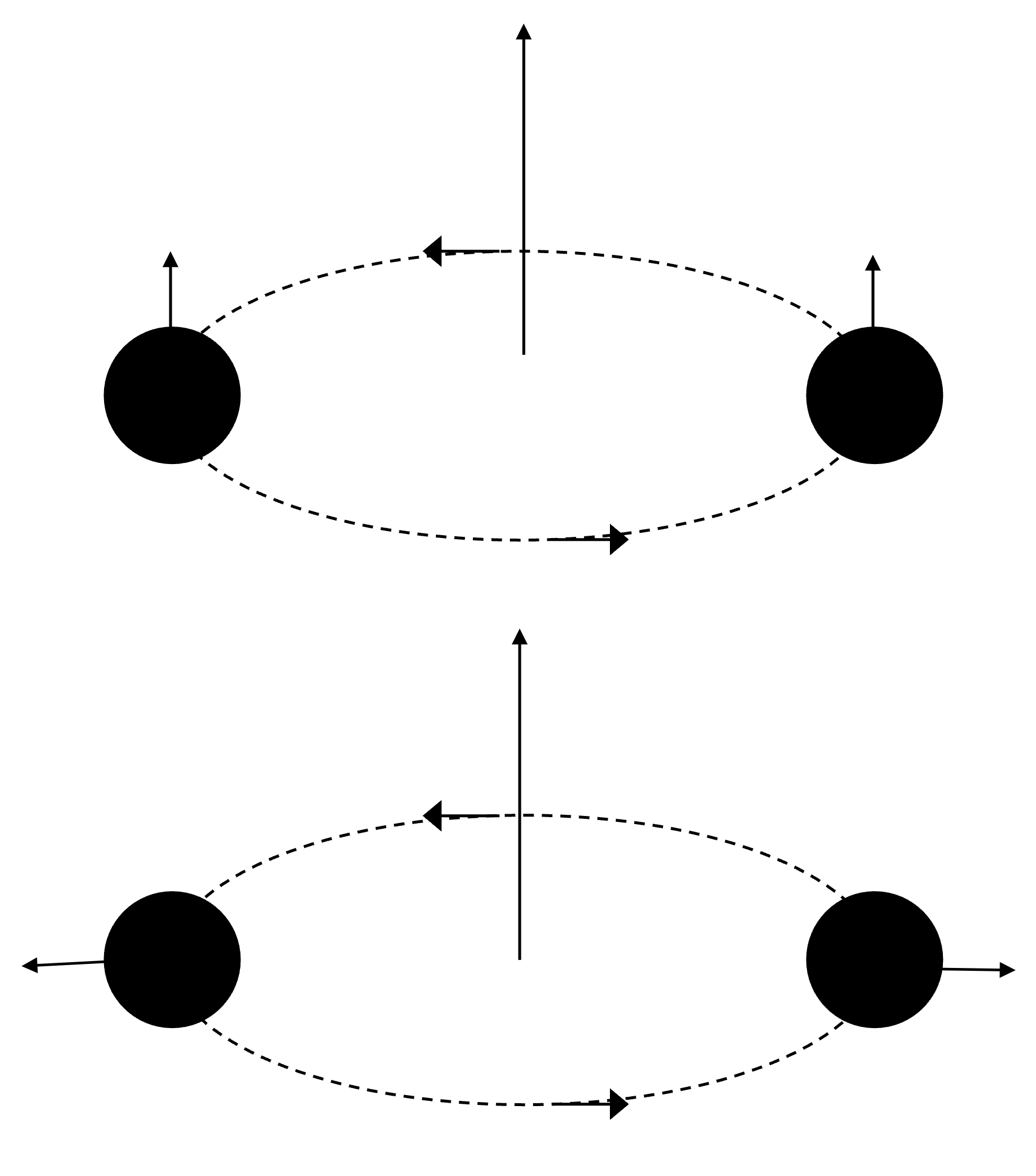
A black hole binary system with aligned spins and orbit (top) and a binary with spins tilted by 90 degrees (bottom). [AAS Nova/Kerry Hensley]
In theory, this question can be answered by extracting the properties of merging black holes — mass, spin, and the like — from gravitational wave observations and comparing these properties against model predictions from different formation pathways. In reality, this is exceedingly difficult, as certain merger pathways can produce a wide variety of results, depending on assumptions or fine tuning.
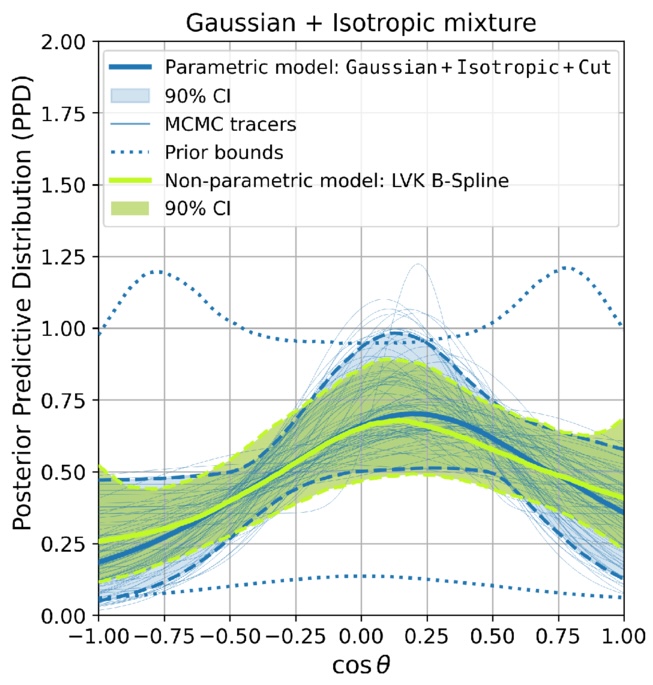
So far, the increasingly large pool of gravitational wave detections tentatively points to a feature that could illuminate the sites of black hole mergers: a peak in the spin–orbit tilt distribution around 90 degrees. This feature has been most confidently extracted from nonparametric analyses, which do not make assumptions about the population of merging black holes, but it has also been hinted at in parametric analyses, which do make population-level assumptions.
Triple-System Feature
To investigate this feature further, a team led by Jakob Stegmann (Max Planck Institute for Astrophysics) performed a new, astrophysically motivated parametric analysis of the most recent catalog of gravitational wave detections from LIGO, Virgo, and KAGRA.
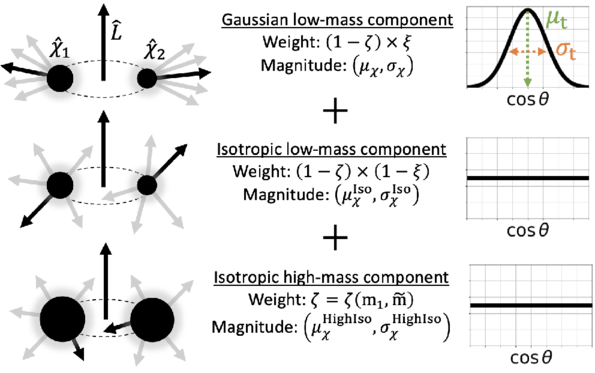
The three populations in the team’s modeling. [Stegmann et al. 2026]
Their modeling tests combinations of multiple populations, including mergers in isolated binary systems, triple-star systems, and dense environments like star clusters. They also include a potential contribution from higher-mass mergers involving black holes that have merged previously. Using this framework, Stegmann’s team found that the observed spin–orbit tilt distribution is best matched by a model dominated by mergers in triple-star systems, with some contribution from other sources.
Posterior predictive distribution of black hole spin–orbit tilts. Both the authors’ modeling (solid blue line) and the nonparametric modeling performed by the LIGO–Virgo–KAGRA collaboration (solid green line) find evidence for a peak in the spin–orbit tilt distribution near cosθ = 0. [Adapted from Stegmann et al. 2026]
Specifically, this finding suggests that most mergers occur in hierarchical triple systems, which naturally predict an excess of 90-degree spin–orbit tilts without any fine tuning. Hierarchical triples contain an inner close binary with a distant outer companion; in these systems, relativistic spin precession, gravitational wave emission, and oscillations in eccentricity and inclination work to tilt the black holes in the inner binary by 90 degrees.
Stegmann and collaborators pointed out that the triple-system scenario aligns well with other properties of the observed population of black hole mergers, such as the mass and effective spin distributions. This scenario may also be necessary to explain certain merging pairs that might have had slightly eccentric orbits at the moment of merging. If future gravitational wave observations strengthen the evidence for a peak in the spin–orbit tilt distribution near 90 degrees, it will have profound implications for how and where black holes merge in our universe.
Citation
“Gravitational-Wave Observations Suggest Most Black Hole Mergers Form in Triples,” Jakob Stegmann et al 2026 ApJL1000 L59. doi:10.3847/2041-8213/ae52ec

 Login