❌

Normal view

PLOS Issues Expression of Concern for Yangtze River Delta Study

21 October 2026 at 23:17

The PLOS One editors have issued an expression of concern for a 2024 case study concerning the digital economy, innovation factor allocation and industrial structure transformation in China’s Yangtze River Delta city cluster. The notice, published on October 21, 2026, states that the article was identified as one of a series of submissions for which the journal has concerns about the integrity or reliability of the peer-review process. Readers are advised to interpret the original study with this issue in mind.

The notice does not report a new scientific finding, identify an error in the paper or evaluate the study’s scientific validity. According to the editors, PLOS did not assess the article’s integrity or scientific validity when following up on the matter. The expression of concern therefore records a concern about the circumstances surrounding peer review rather than announcing that the study’s data, methods or conclusions have been disproved. The editors also state that they have no concerns regarding the authors’ conduct during the peer-review process.

The affected article was published in PLOS One in 2024 under the title β€œDigital economy, innovation factor allocation and industrial structure transformationβ€”A case study of the Yangtze River Delta city cluster in China.” The supplied notice does not provide the study’s findings, population details, analytical methods, model estimates, uncertainty measures or specific mechanisms linking the subjects named in the title. As a result, the notice does not support conclusions about the relationship between digital-economy development, innovation factors and industrial structure in the region, nor does it establish whether any reported association or causal effect is reliable.

For the wider research record, the immediate effect is that the 2024 article is accompanied by an editorial notice questioning the integrity or reliability of its peer-review process. The notice does not provide details about the submissions or explain the specific basis for the journal’s concerns. It also does not announce a correction, replacement analysis or revised conclusion. The central status of the paper’s scientific validity remains unevaluated in the supplied material, while the issue is sufficiently significant for PLOS One to advise readers to consider it when interpreting the study.

Subject of Research: A PLOS One expression of concern concerning peer-review reliability in a Yangtze River Delta regional-economy case study.

Article Title: Expression of Concern: Digital economy, innovation factor allocation and industrial structure transformationβ€”A case study of the Yangtze River Delta city cluster in China

Article References: The PLOS One Editors (2026). Expression of Concern: Digital economy, innovation factor allocation and industrial structure transformationβ€”A case study of the Yangtze River Delta city cluster in China. PLOS One, 21(10), e0360867. https://doi.org/10.1371/journal.pone.0360867

Image Credits: AI Generated

DOI: 10.1371/journal.pone.0360867

Keywords: PLOS One, expression of concern, peer review, research integrity, digital economy, innovation factors, industrial structure, Yangtze River Delta, China, Expression, Concern, Digital

Researchers See Gas Swirling Around a Growing Baby Planet

28 September 2026 at 17:00

WISPIT 2b

Astronomers seem to find something new every time they point a telescope at WISPIT 2, a 5-million-year-old solar-mass star located 430 light-years away. New high-resolution radio observations provide the best view yet of how the young planets of this system interact with the disk that feeds them.

Detecting Distant Planets

In 2025, astronomers carrying out the WIde Separation Planets In Time (WISPIT) survey β€” a targeted search for widely separated giant planets around young Sun-like stars β€” revealed a dusty disk surrounding the star WISPIT 2. Orbiting within this disk is a 4.9-Jupiter-mass planet, WISPIT 2b, at 57 au from the star. This makes WISPIT 2 just the second star to host a confirmed, directly imaged planet within its protoplanetary disk. Even more remarkable, WISPIT 2b was detected in HΞ±, showing that the planet is still growing by accreting gas from the disk.

Later observations confirmed the presence of a second planet, WISPIT 2c, which has an estimated mass of 8–12 Jupiter masses and orbits the star at 15 au. On top of these planetary discoveries, researchers have also found that WISPIT 2 is two stars rather than one!

Best View Yet of the WISPIT 2 System

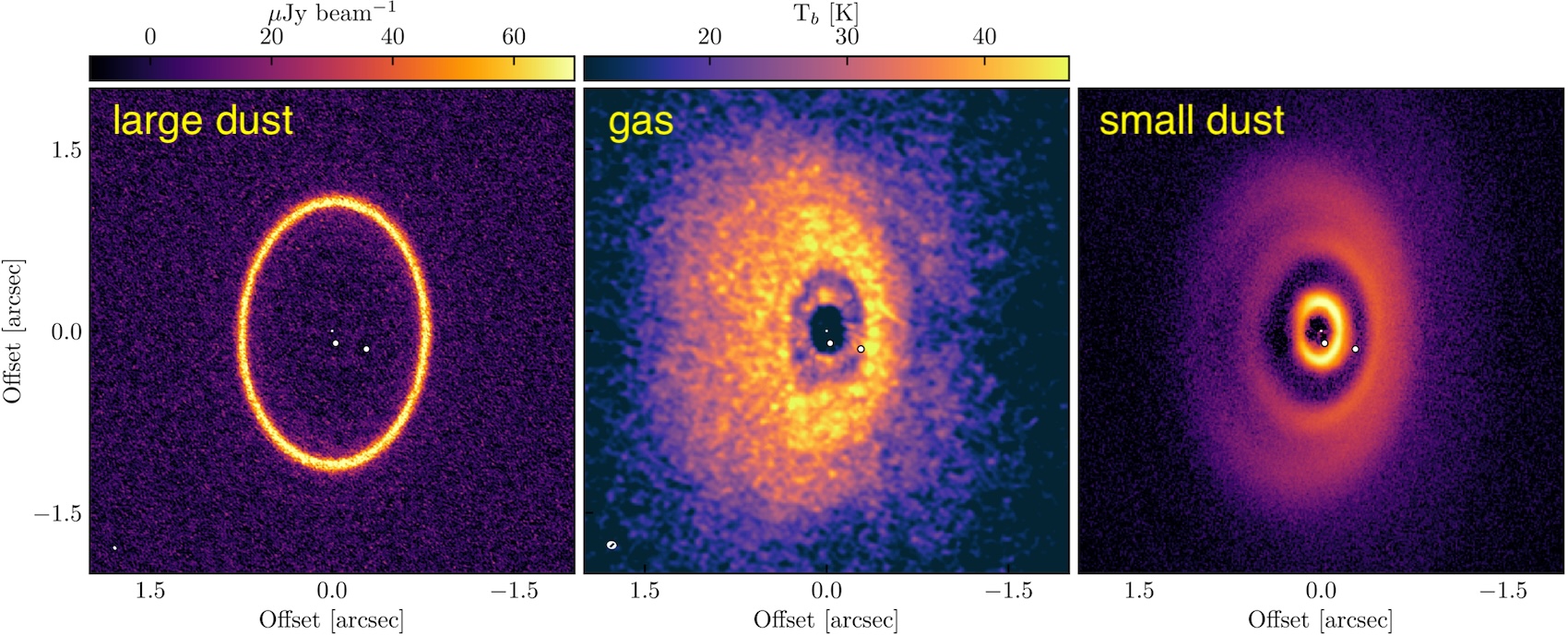
observations of WISPIT 2 showing the disk in three different ways

New observations of WISPIT 2 from ALMA (left and center panels) and previous observations from the Very Large Telescope (right panel). The star is shown by the small dot at the very center, and the planets are indicated by the two white circles. Click to enlarge. [Adapted from Benisty et al. 2026]

Now, a team led by Myriam Benisty (Max Planck Institute for Astronomy) has presented new high-resolution observations of the WISPIT 2 system from the Atacama Large Millimeter/submillimeter Array (ALMA). These observations show the distribution of gas and large dust particles within the disk. When combined with existing observations of small dust grains, the new data demonstrate how these components of the disk interact with each other and with the system’s planets.

The distribution of gas within the disk, traced by emission from carbon monoxide, roughly follows the pattern seen in previous observations of small dust grains: the orbits of WISPIT 2b and 2c are depleted of gas and dust, demonstrating how the young planets have carved their own berths within the disk, creating a gap at WISPIT 2b’s orbit and a cavity around the star.

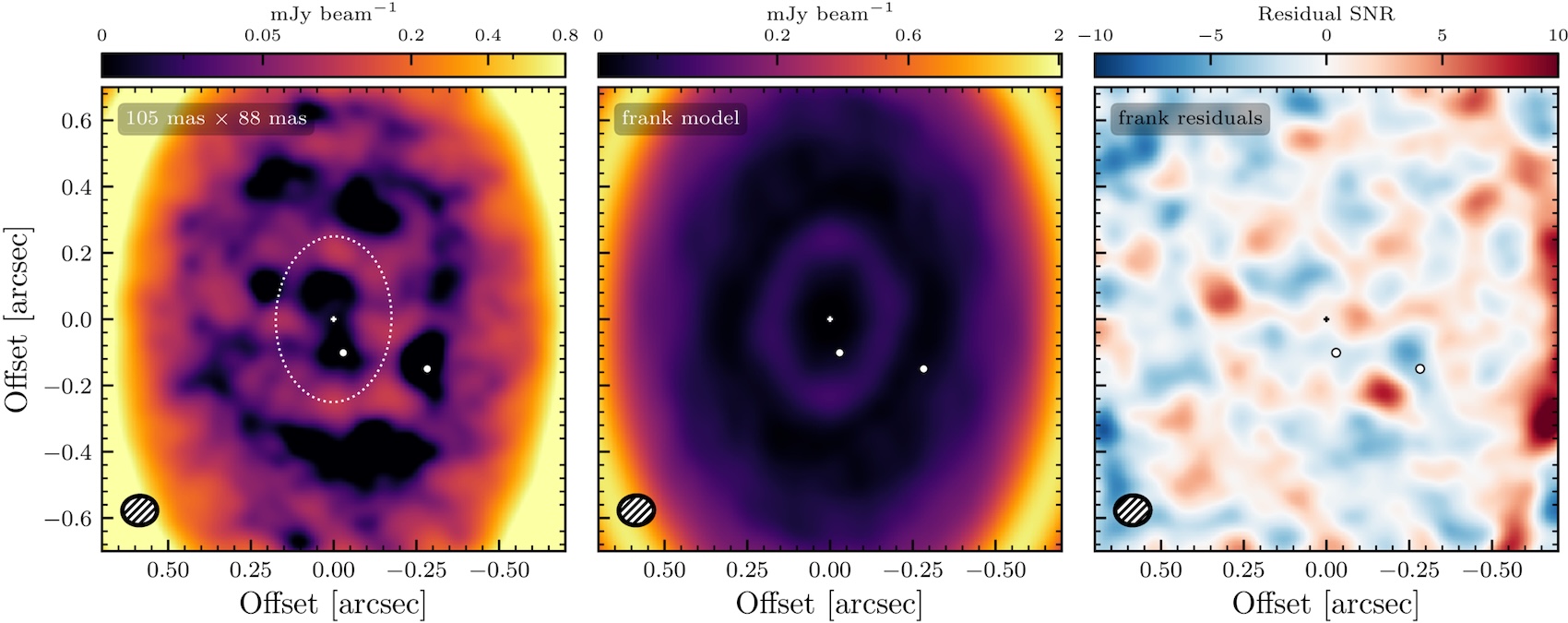
dust continuum emission around WISPIT 2 showing the location of a faint dust ring

The left panel shows the dust continuum emission zoomed in on the star (plus sign) and planets (circles). The dotted line shows the location of a faint ring, which is modeled in the center panel. The right panel shows the residuals. Click to enlarge. [Benisty et al. 2026]

The new observations of larger dust particles show a bright ring of emission well outside the orbits of both planets, plus a faint ring in between the two planets that is newly detected in dust continuum emission. This faint ring lines up with a ring in both the gas and small dust grain data, showing that dust and gas are able to journey inward from the outer disk, past the orbit of WISPIT 2b. However, there is no gas or dust detected interior to WISPIT 2c’s orbit, and WISPIT 2c does not appear to be accreting, suggesting that this material is unable to move inward to WISPIT 2c’s orbit and beyond.

Spiral Wakes Making a Splash

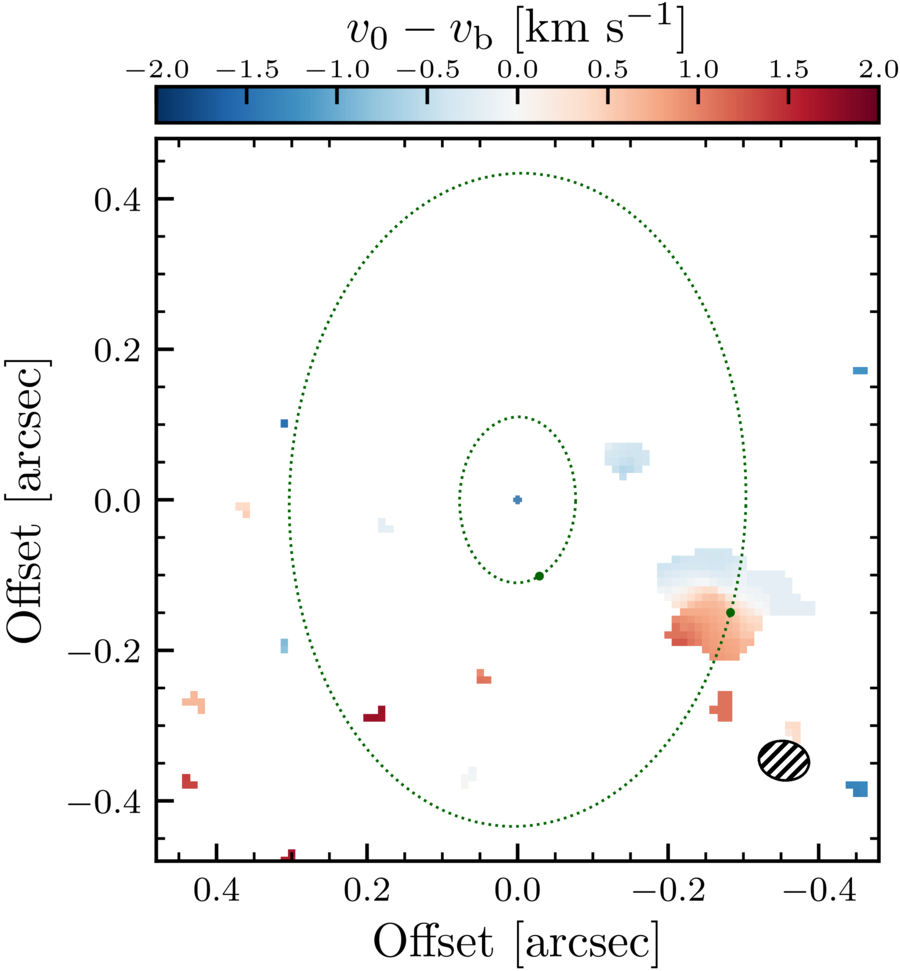
velocity field showing gas swirling around WISPIT 2b

Velocity field showing the gas swirling around WISPIT 2b, which is indicated by the green circle farther from the star. [Benisty et al. 2026]

The new ALMA observations allowed Benisty and coauthors to analyze how WISPIT 2b is interacting with the disk. Kinematic maps of the disk showed that the typical emission pattern of a rotating disk is interrupted near WISPIT 2b. The team determined that this feature is due in part to spiral wakes driven by the planet as it orbits within the disk, with potential contributions from local heating or a circumplanetary disk.

Spiral wakes have been spotted in other protoplanetary disks, but this is the first time researchers have been able to definitively associate this feature with a planet rather than other causes, such as gravitational instabilities. Looking ahead, future high-resolution spectroscopic observations of WISPIT 2b and its surroundings will offer researchers an unprecedented opportunity to compare the properties of the planet and its spiral wake against the predictions of simulations β€” advancing toward a powerful new way to study exoplanets embedded in protoplanetary disks.

Citation

β€œMapping the WISPIT 2 Planet-Hosting Cavity at Sub-Hill-Radius Scales,” Myriam Benisty et al 2026 ApJL 1009 L32. doi:10.3847/2041-8213/aea214

The post Researchers See Gas Swirling Around a Growing Baby Planet appeared first on AAS Nova.

A Sneak Peek into Early-Universe Star Formation with BoΓΆtes I

22 September 2026 at 17:00

star-forming region N44

Editor’s Note: Astrobites is a graduate-student-run organization that digests astrophysical literature for undergraduate students. As part of the partnership between the AAS and astrobites, we occasionally repost astrobites content here at AAS Nova. We hope you enjoy this post from astrobites; the original can be viewed at astrobites.org.

Title: Probing the IMF in the Early Universe β€” Direct Measurements in the BoΓΆtes I UFD with JWST/NIRCam
Authors: Keyi Ding et al.
First Author’s Institution: University of Maryland
Status: Published in ApJ

The Stellar Initial Mass Function

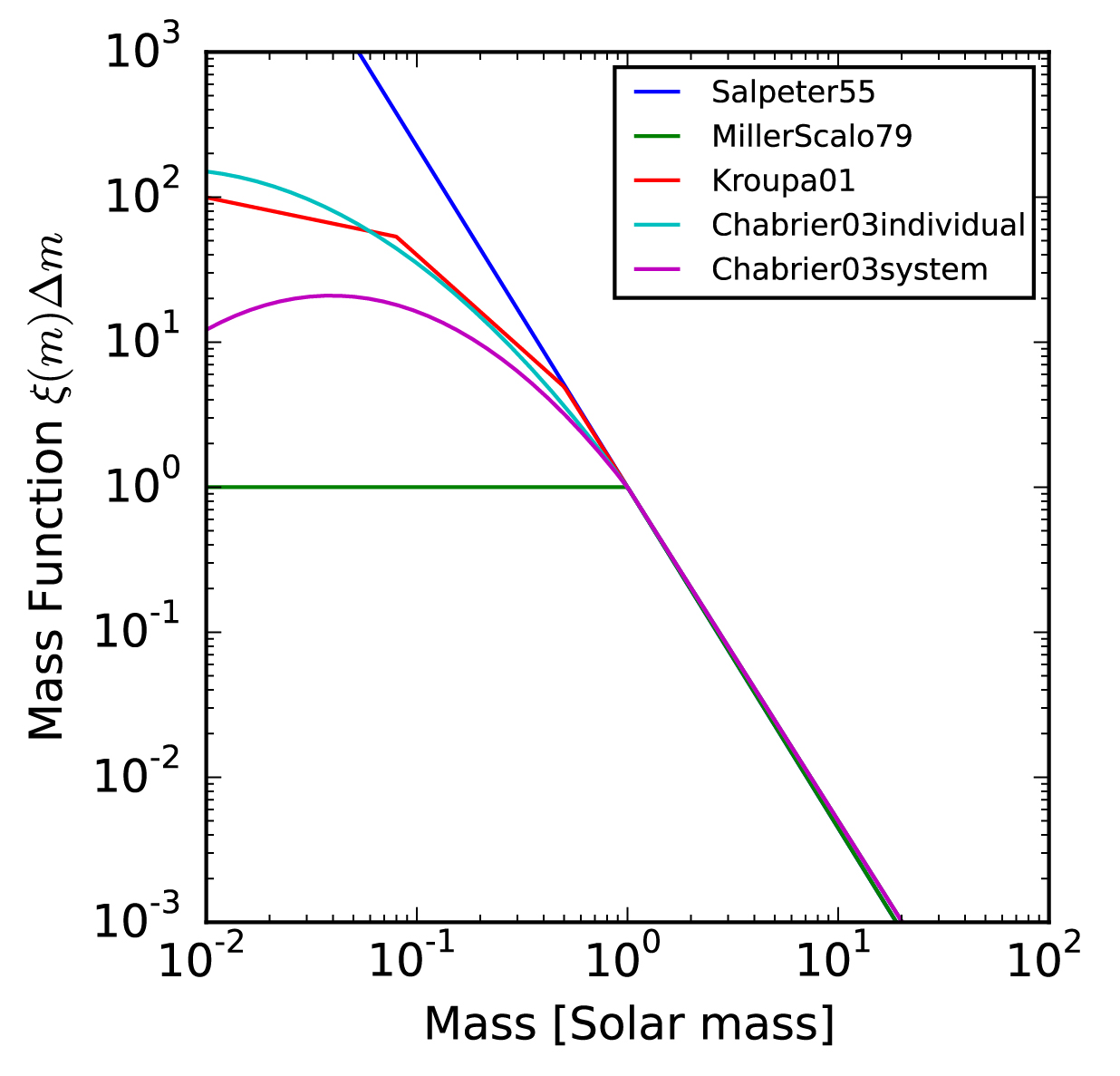
plot of different formulations of the initial mass function

Figure 1: Several different formulations for the IMF. Astronomers have found that the Milky Way IMF seems to follow either a broken power law (Kroupa), or a log-normal (Chabrier) distribution. [JohannesBuchner; CC BY-SA 4.0]

A fundamental concept in astronomy is the stellar initial mass function (IMF). The IMF describes the number of stars of each mass that form from a single birth cloud. If the IMF has a negative slope, it means most stars are low in mass; if it has a positive slope, it means most stars are high in mass. Figure 1 shows some examples of commonly used IMFs, all of which have a negative slope, since we see far more low-mass stars than high-mass stars in the Milky Way. You may notice that several models deviate from a straight line at about 0.5 solar mass. This point, known as the turnover or critical mass, is crucial in determining the exact shape of the IMF.

For a relatively simple concept, the IMF is shaped by incredibly complicated underlying physical mechanisms. Things like turbulence, magnetic fields, and chemical enrichment all play a role in shaping the observed IMF. Additionally, the IMF is a pretty fundamental quantity. An enormous amount of astronomy research relies on assumptions made about the IMF. For example, since most stars are low in mass, and low-mass stars are dimmer, astronomers use the IMF to convert the amount of light in a galaxy to the number of stars; if there are more or fewer low-mass stars than we expect, our measurements will be wrong.

A big question surrounding the IMF is whether or not it’s universal. In the Milky Way, astronomers have been able to measure the IMF accurately, and they have found that it seems to be the same regardless of which bunch of stars we use to measure it.1 However, we know that galaxies in the early universe were very different compared to today. Things get tricky when you acknowledge that most measurements made of early-universe galaxies rely on modeling tools that are entirely reliant on assuming an IMF. This gnarly little detail makes measuring the IMF in the early universe especially valuable to astronomers.

What Makes Ultra-Faint Dwarfs So Special?

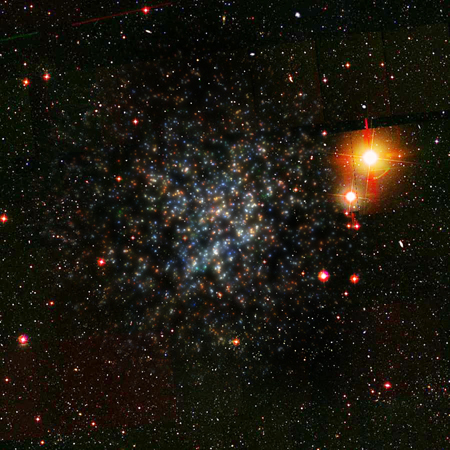
Today’s authors attempt to measure the early-universe IMF using a local relic, an ultra-faint dwarf galaxy (UFD). You might describe UFDs as β€œincredibly funky little galaxies.” They’re much less massive than the Milky Way, with about 10,000 times less stellar mass. What stars they do have tend to be very old and metal poor. The nature of UFDs has led many astronomers to think of them as fossils: relatively untouched galaxies formed in the early universe. Since we think UFDs are fossils of earlier galaxies, measuring the IMF in a UFD tells us whether the IMF was the same in the early universe as it is today. The authors focus on BoΓΆtes I, a relatively luminous UFD orbiting the Milky Way. Figure 2 shows BoΓΆtes I as seen by the Sloan Digital Sky Survey.

BoΓΆtes I

Figure 2: BoΓΆtes I as seen by the Sloan Digital Sky Survey. Because they’re so diffuse, UFDs look less like galaxies and more like groups of stars. [Vasily Belokurov – SDSS-II Collaboration]

The IMF in BoΓΆtes I

Measuring the IMF can get tricky β€” it’s typically pretty difficult to measure the mass of each individual star in a galaxy. Thankfully, BoΓΆtes I is close enough that we can do exactly that! Using JWST’s NIRCam instrument, today’s authors obtain imaging of BoΓΆtes I that is sensitive enough to extract roughly 10,000 stars belonging to the galaxy.

To measure the IMF from the observed population of stars, the authors use a modified version of Starwave, a Bayesian inference tool. In short, the tool takes in some assumptions about the population of stars in the galaxy, then generates many potential color–magnitude diagrams for various parameter selections. You can then assess how well each simulated color–magnitude diagram fits the observed data, thus determining likely parameters for the stellar population. The authors apply their tool for three different IMF models, testing how close the IMF in BoΓΆtes I is to that of the Milky Way. This allows them to determine how well the IMF compares to that of the Milky Way, which is typically thought of as a broken power law or log-normal distribution. If the IMF in BoΓΆtes I aligns with the Milky Way’s IMF, we’ll have a solid piece of evidence for a truly invariant IMF across cosmic time, allowing astronomers to rest easy knowing our modeling efforts haven’t been bunk this whole time.

So… What Did We Learn?

The authors find that a single power law can be ruled out to a good degree of confidence. This is good, as Milky Way studies show undeniable evidence of a turnover in the distribution. The broken power law and log-normal models both fit the observed data relatively well, aligning well with Milky Way–derived IMFs. All in all, they find solid evidence for an invariant IMF in the early universe.

However, they are unable to say with absolute certainty that the IMF is invariant. Given that their data are nearly perfect (that is, it’s pretty much impossible to get better data for BoΓΆtes I), the authors emphasize that a larger sample of UFD IMFs is needed to truly rule out an invariant IMF, but we’re certainly taking steps in the right direction! As the age-old saying goes, β€œmore data are needed!”

Original astrobite edited by Maggie Verrico.

  1. Editor’s Note: The Milky Way IMF may vary from star cluster to star cluster; as described in this AAS Nova highlight from 8 July 2026, recent research using data from the Gaia spacecraft has found evidence for IMF variation in our galaxy. β†©οΈŽ

About the author, Drew Lapeer:

Drew is a first-year PhD student at the University of Massachusetts Amherst. They are broadly interested in the evolution of galaxies, with a focus on the impact of cosmic feedback on the galactic ecosystem. In their free time, they enjoy reading, rock climbing, hiking, and baking!

The post A Sneak Peek into Early-Universe Star Formation with BoΓΆtes I appeared first on AAS Nova.

Fast Radio Bursts Are Starting to Map the Universe’s Missing Gas

15 September 2026 at 16:00

A new Nature Astronomy study uses 114 fast radio bursts to trace cosmic gas and test how stellar and black-hole feedback reshapes matter around galaxies.

The post Fast Radio Bursts Are Starting to Map the Universe’s Missing Gas appeared first on Curiosmos.

Giant-nucleus cells emerge as early cancer markers in new study

11 September 2026 at 11:21

For more than four decades, pathologists have glimpsed something unsettling under the microscope in the earliest stages of certain cancers: cells with nuclei far larger than they should be, swollen and distorted, lurking in tissue that otherwise appears on the verge of catastrophe. These so-called giant-nucleus cells, or karyomegalic cells, were first spotted in the 1980s in animal experiments involving iron-induced oxidative stress, yet their biological identity and their role in the genesis of cancer remained stubbornly obscure. Now, a team of researchers in Japan has provided the most detailed portrait of these cells to date, and their findings suggest that the enormous nuclei may be far more than a curiosityβ€”they could be the founding population of early cancer, visible before any tumor exists, and potentially useful as a predictor of patient outcomes.

The study, led by Shinya Toyokuni, professor emeritus at Nagoya University Graduate School of Medicine, together with assistant professor Yingyi Kong and colleagues, was published in Redox Biology. The work addresses a deceptively simple question: when iron overload kills most cells in a tissue through oxidative damage, who survives, and what do the survivors become? Iron is an essential micronutrient, but in excess it is a potent carcinogen. Its chemistry is both the reason we need it and the reason it can harm us. Iron catalyzes the formation of hydroxyl radicals from hydrogen peroxide through the Fenton reaction, and these radicals shred DNA, oxidize lipids, and damage proteins. When the damage is severe enough, a form of programmed cell death called ferroptosis is triggeredβ€”an iron-dependent demise characterized by lipid peroxidation cascades that rupture the cell membrane. Ferroptosis has become one of the hottest topics in cancer biology precisely because it links iron metabolism, oxidative stress, and cell fate in a single mechanism.

Toyokuni’s team reasoned that if ferroptosis sweeps through iron-damaged tissue, the cells that escape it must be exceptional in some way, and those exceptions might be the seed of malignancy. To find out, they turned to a well-established animal model in which ferric nitrilotriacetate, a carcinogenic iron compound, is injected into rats, delivering a bolus of iron to the kidneys. The compound accumulates in the proximal tubules, where it catalyzes oxidative damage and, over months, produces renal cell carcinoma. In the experiments, the researchers collected kidney tissue before the injection and again one and three weeks afterward. Crucially, they also included a second experimental group: rats carrying a single mutated copy of the BRCA1 gene, the same gene that, when mutated in humans, dramatically raises the risk of breast and ovarian cancers and is associated with renal carcinoma in certain contexts.

The methodological heart of the study lies in its marriage of two technologies. The first is spatial transcriptomics, a technique that maps gene activity across individual cells within a tissue section while preserving the tissue’s original architectureβ€”so researchers can see not only which genes are active but where in the tissue those transcriptional programs are operating. The second is computational nuclear morphometry, which quantifies the size, shape, and density of cell nuclei in the same samples. By overlaying the two datasets, the team could link the physical appearance of each cellβ€”above all, the size of its nucleusβ€”to its underlying transcriptional state. This integration is important because morphological atypia has long been the currency of diagnostic pathology, but connecting that atypia to molecular signatures at single-cell resolution is a recent capability.

What emerged within a week of iron administration was striking. Giant-nucleus cells appeared in the damaged kidneys, and these cells were not simply wounded cells awaiting death. They showed elevated expression of potent oncogenes, including Myc and Met, and they had acquired resistance to ferroptosisβ€”the very cell death pathway that was eliminating their neighbors. In other words, the extreme oxidative environment had functioned as a brutal selective pressure, and the cells best adapted to survive it had activated a program that resembles, in miniature, the hallmark machinery of cancer. The enrichment of Myc, a transcription factor that drives cell growth and proliferation, and Met, a receptor tyrosine kinase involved in invasive growth, paints a picture of cells that are not merely enduring damage but reorganizing themselves around it.

The BRCA1 connection proved equally consequential. BRCA1 is best known as a guardian of the genome, a scaffold for the homologous recombination machinery that repairs double-strand DNA breaks. In the BRCA1-mutant rats, giant-nucleus cells emerged with distinctly different biological profiles from those in wild-type animals. The interpretation the researchers offer is that BRCA1 deficiency cripples DNA repair, so more of the damaged cells that would otherwise die or be repaired instead survive in their injured, genome-compromised stateβ€”becoming precancerous giant-nucleus cells. Electron microscopy and cellular respiration measurements reinforced this idea at the subcellular level: cells from BRCA1-mutant rats showed mitochondrial remodeling, with impaired iron handling and compromised respiratory function. Mitochondria, long appreciated as power plants, are also central regulators of ferroptosis and iron metabolism, and their disarray in the mutant animals may be both a consequence of BRCA1 loss and a driver of the abnormal iron biology that feeds karyomegaly.

Using their combined gene-expression and nuclear-shape data, the researchers went further and classified the giant-nucleus cells into six distinct types. One type possessed extremely large nuclei and gene signatures of stress-induced growth arrestβ€”cells that appear to have locked themselves into a senescent-like state, consistent with profiles reported in earlier studies. Another type, found more frequently in BRCA1-mutant kidneys, showed heightened activity of cancer-related genes alongside elongated nuclei, a combination the authors interpret as a potential precancerous state. The taxonomy matters because it reframes giant-nucleus cells from a single enigmatic category into a spectrum, some members of which may be harmless or even protective while others carry genuine malignant potential.

One of the most provocative findings concerns the cells surrounding the giants. Even morphologically normal cells near giant-nucleus cells exhibited gene expression changes that appear to promote survival, suggesting that the karyomegalic cells remodel their local microenvironment in ways that extend beyond their own borders. In BRCA1-mutant kidneys, the team also documented a substantial increase in stromal cellsβ€”non-cancerous supportive cells including immune and connective tissue elementsβ€”around the damaged regions. The local tissue environment, the tumor niche in the language of modern oncology, was being reshaped long before any tumor could be called a tumor. This raises the possibility that a single conspicuous cell, easily identified by its nucleus under a conventional microscope, could serve as a sentinel for a whole neighborhood of incipient malignancy.

The leap from rat kidneys to human medicine came through two complementary analyses. First, the researchers mined TCGA-KIRC, a large public database of kidney cancer patients, asking whether tumors carrying gene-expression patterns resembling the cancer-prone giant-nucleus cells were associated with different clinical trajectories. They were: patients whose tumors shared the gene patterns of the cancer-prone giant-nucleus cells had shorter survival times, while those with patterns resembling the healthier giant-nucleus cell types had better outcomes. Not all giant-nucleus cells, in other words, are created equal, and the transcriptional fingerprints defined in the rat model appear to carry prognostic weight in human disease. Second, in a small pilot study, the team examined breast tissue from seven individuals with inherited BRCA1 mutations and fifteen without, observing abnormal nuclear features similar to those in the animal model in the mutation carriers. While the sample size is modest, the parallel hints that karyomegaly may be a cross-tissue marker of BRCA1-linked precancerous change.

The broader implications run in two directions. Clinically, the promise is that giant-nucleus cells, being easy to spot under the microscope, could function as early indicators of cancerβ€”visible warnings in tissue that would otherwise be classified as merely damaged or inflamed. The TCGA survival data suggest that their gene-expression signatures might even stratify patients by risk once a tumor has formed. Scientifically, the study offers a concrete mechanism connecting an environmental exposome factorβ€”iron-catalyzed oxidative stressβ€”to a defined, transcriptionally characterized precancerous population, with ferroptosis resistance as the pivot. It also implies testable therapeutic hypotheses: if blocking mitochondrial remodeling or reversing ferroptosis resistance could prevent the persistence of the precancerous cells, early intervention might stop cancer before it starts. Toyokuni and his colleagues are careful to note that long-term studies will be needed to determine how giant-nucleus cells actually progress into tumor cells, whether such interventions can work, and whether nuclear shape combined with gene patterns can be validated as a diagnostic in larger patient cohorts. But the central message is already legible: some of the earliest chapters of cancer may be written in cells that have grown too large to be ignored.

Subject of Research: Animals

Article Title: Iron-catalyzed oxidative stress reveals an exposome-related ferroptosis-resistant karyomegalic niche in BRCA1-linked renal carcinogenesis.

Article References: Kong, Y., Shiraki, Y., Furuhashi, K., Maruyama, S., Imaoka, T., Enomoto, A., & Toyokuni, S. (2026). Iron-catalyzed oxidative stress reveals an exposome-related ferroptosis-resistant karyomegalic niche in BRCA1-linked renal carcinogenesis. Redox Biology, 95, Article 104293. https://doi.org/10.1016/j.redox.2026.104293

Image Credits: AI Generated

DOI: 10.1016/j.redox.2026.104293

Keywords: giant-nucleus cells, karyomegaly, ferroptosis, BRCA1, iron-catalyzed oxidative stress, spatial transcriptomics, renal carcinogenesis, mitochondrial remodeling, nuclear morphometry, precancerous cells, TCGA-KIRC, Nagoya University

Unique zipper reaction converts perfluoroalkyl chains via defluorination and borylation

9 September 2026 at 17:22

In a development that could reshape how chemists recycle one of the most persistent classes of synthetic molecules ever made, researchers have reported a new catalytic strategy that strips fluorine atoms from perfluoroalkyl chains in a controlled, sequential fashion while installing a single boron group at the chain’s terminus. The work, published in Nature Communications, introduces what the authors call zipper polydefluorination-monoborylation, a transformation that walks down a perfluoroalkyl skeleton and removes multiple fluorine atoms in a stepwise cascade before capping the partially defluorinated product with a boron substituent. The achievement addresses a longstanding challenge in fluorine chemistry: while carbon-fluorine bonds are prized in materials and pharmaceuticals for their extraordinary stability, that same stability makes them notoriously difficult to break selectively, leaving chemists with few tools for converting perfluorinated waste streams into useful building blocks.

Perfluoroalkyl substances, often grouped under the umbrella of PFAS chemistry, owe their remarkable properties to the strength of the carbon-fluorine bond, which at roughly 485 kilojoules per mole in fully fluorinated chains ranks among the strongest single bonds that carbon forms. This bond strength, combined with the sheer electronegativity of fluorine, means that perfluoroalkyl groups resist oxidation, hydrolysis, and thermal degradation under nearly all conventional conditions. As a consequence, perfluorinated chains accumulate in the environment and resist standard degradation pathways, prompting intensive research into defluorination methods ranging from photocatalytic single-electron transfer to reductive hydrodefluorination with metal hydrides. Yet most existing approaches suffer from a common limitation: they either remove fluorine indiscriminately, collapsing the entire chain to a mixture of products, or they remove only a single fluorine atom, offering little control over the degree of defluorination. The new study demonstrates a way to achieve the best of both worlds, delivering multi-fluorine removal in a predictable pattern while simultaneously introducing a versatile functional handle.

The conceptual heart of the method lies in what the authors describe as a zipper mechanism. Rather than removing fluorine atoms at random positions along the chain, the reaction initiates at a defined site and then propagates along the perfluoroalkyl backbone one carbon at a time, much as a zipper opens tooth by tooth. At each step along the chain, a fluorine atom is expelled and replaced in sequence, with the reaction front advancing until a thermodynamic or kinetic stopping point is reached. The monoborylation component of the process ensures that once the zipper has run its course, the resulting olefinic or anionic intermediate is intercepted by a boron reagent, furnishing a product in which the boron group occupies a predictable position derived from the original perfluoroalkyl terminus. Organoboron compounds are among the most valuable intermediates in modern synthetic chemistry, serving as partners in Suzuki-Miyaura cross-coupling and as precursors to alcohols, amines, and halides, so their installation at a defluorination site effectively converts a chemical dead end into a synthetic launching pad.

Mechanistically, the transformation draws on the characteristic reactivity of organoboron reagents toward geminal difluoroalkenes, the partially defluorinated intermediates that arise when consecutive fluorine atoms are eliminated from a perfluoroalkyl chain. Perfluoroalkyl chains, when subjected to strong bases or reductive conditions, can undergo sequential beta-fluoride elimination events, each generating a more highly unsaturated species. The boron reagent in the reported system engages these unsaturated intermediates through addition pathways that install boron at the terminal carbon while generating a carbanionic center adjacent to the remaining difluoromethylene unit. That newly formed carbanion is perfectly positioned to expel another fluoride ion, regenerating an unsaturated handle one carbon further down the chain and setting up the next iteration of the cycle. This intimate coupling of borylation and defluorination is what gives the reaction its chain-walking character: each borylation event creates the conditions for the next defluorination event, and the process ripples along the chain until the fluorine reservoir is exhausted or the reagents are consumed.

The practical significance of the work becomes apparent when one considers the fate of the fluorine atoms themselves. In the zipper process, fluorine is released as fluoride ion, which under the reaction conditions is sequestered by silicon-containing trapping agents to form robust silicon-fluorine bonds. Fluorosilicates of this kind are stable, isolable, and, importantly, compatible with industrial processes for recycling fluorine back into hydrofluoric acid, the feedstock from which essentially all synthetic organofluorine compounds are made. In this sense, the method does more than transform perfluoroalkyl chains into borylated products; it also lays the groundwork for closing the fluorine cycle, recovering the fluorine content of persistent molecules in a form that can be fed back into the chemical economy. With global concern over PFAS contamination intensifying and regulatory pressure on fluorinated chemicals mounting, technologies that enable fluorine recovery rather than dilution into the environment carry considerable weight.

From a synthetic chemistry standpoint, the products of the reaction open multiple downstream avenues. Because the boron substituent is installed at a defined position on a partially fluorinated alkyl or alkenyl framework, the resulting molecules retain a programmable mixture of carbon-fluorine bonds and carbon-boron functionality. The remaining fluorine atoms can tune the lipophilicity, metabolic stability, and dipole moment of the scaffold, properties that are actively exploited in medicinal chemistry when designing fluorinated drug candidates. Meanwhile, the boron group serves as a convertible handle, allowing the defluorinated carbon center to be joined to aromatic rings through cross-coupling, oxidized to alcohols, or aminated in homologation reactions. In effect, the method converts a chemically inert perfluoroalkyl group, useful mainly as a passive coating or tail, into a functionalized partial-fluoro skeleton that can participate in the full toolkit of carbon-carbon and carbon-heteroatom bond formation.

The reported study also sheds light on the factors governing how far the zipper travels along a given chain. Chain length, the nature of the substituent anchoring the perfluoroalkyl group, and the stoichiometry of the base and boron reagent all influence the number of fluorine atoms removed and the distribution of products obtained. Through systematic variation of these parameters and careful analysis of the reaction mixtures by nuclear magnetic resonance spectroscopy and mass spectrometry, the authors map out the scope of the transformation across a range of perfluoroalkyl substrates, from short perfluoroethyl groups to longer chains approaching those found in commercial fluorosurfactants. Control experiments interrogating individual elementary steps support the proposed sequential elimination-addition mechanism and rule out alternative pathways involving radical fragmentation or random beta-scission, underscoring the unusually high degree of positional control the method achieves.

Beyond its immediate synthetic utility, the work contributes to a growing body of research aimed at taming the carbon-fluorine bond through the strategy of defluorinative functionalization. Over the past decade, chemists have developed an impressive repertoire of reactions that replace fluorine in perfluoroalkyl and fluoroarene substrates with groups ranging from hydrogen to sulfur, nitrogen, and carbon substituents. What distinguishes the zipper approach is its multiplicity and its directionality: instead of a single substitution event at a single site, the reaction performs many substitutions in a choreographed sequence along a chain, effectively treating the perfluoroalkyl group as a one-dimensional lattice to be patterned at will. This conceptual reframing, from defluorination as bond-breaking to defluorination as programmable editing, may inspire analogous strategies for other polyfluorinated motifs, including perfluoroarenes and perfluoropolyethers, two additional classes of highly persistent fluorinated materials.

Challenges remain before such chemistry can move from the laboratory bench to environmental remediation at scale. The reaction conditions reported rely on strong bases and moisture-sensitive boron reagents handled under inert atmosphere, and the substrates studied are discrete, soluble perfluoroalkyl compounds rather than the polymeric or adsorbed PFAS species that dominate environmental contamination. Scaling the chemistry will require sourcing boron reagents economically, managing the large quantities of fluoride generated, and integrating the transformation with upstream methods for extracting perfluoroalkyl pollutants from water and soil. Nevertheless, the demonstration that a perfluoroalkyl chain can be unzipped in a controlled manner, with fluorine captured in recyclable form and a valuable boron handle installed, establishes a credible chemical pathway toward defluorination that is both productive and selective, a combination that has eluded the field for decades.

As policymakers and scientists grapple with the legacy of fluorine chemistry, work of this kind illustrates a middle path between the wholesale abandonment of fluorinated molecules and their indefinite persistence in the biosphere. The fluorine atom confers properties that industry and medicine continue to depend upon, and the ability to disassemble fluorinated architectures on demand, recovering both the carbon skeleton as a functionalized building block and the fluorine content as a recyclable salt, points toward a more circular future for organofluorine chemistry. The zipper polydefluorination-monoborylation strategy reported in Nature Communications is an early but striking example of that vision made concrete at the molecular level, and it is likely to prompt rapid efforts to extend the concept across the breadth of persistent fluorinated chemicals.

Subject of Research: Controlled sequential defluorination of perfluoroalkyl chains coupled with terminal borylation (zipper polydefluorination-monoborylation)

Article Title: Zipper polydefluorination-monoborylation of perfluoroalkyl chains

Article References: Albers, S. L., Harzendorf, J. K., Deliaval, M., KΓΆllmann, J., & Streuff, J. (2026). Zipper polydefluorination-monoborylation of perfluoroalkyl chains. Nature Communications, 17(1), Article 9502. https://doi.org/10.1038/s41467-026-77437-9

Image Credits: AI Generated

DOI: 10.1038/s41467-026-77437-9

Keywords: perfluoroalkyl chains, defluorination, polydefluorinative borylation, organoboron compounds, carbon-fluorine bond activation, PFAS degradation, fluorine recycling, geminal difluoroalkenes, cross-coupling, sustainable chemistry

Earth May Not Be a Cosmic Fluke, New Simulations Suggest

9 September 2026 at 16:03
Exoplanet Ross 128 b Is Not Like EarthSolar system simulations starting from varied initial conditions suggest that Earth-like planets can emerge naturally from planet formation. Computer simulations of planetary systems can now begin from thousands of different starting conditions, allowing researchers to explore how worlds might emerge without assuming the final outcome. Over the past three decades, these models have advanced from [...]
❌