 Login

Elon Musk Says SpaceX and Tesla Are Exploring a Merger
21 October 2026 at 21:57
A deal would consolidate Elon Musk’s holdings in rockets, cars and artificial intelligence into a company worth well over $3 trillion.


Growing plants in space? Yes indeed! NASA astronauts are conducting botany experiments aboard the International Space Station (ISS).
In this snapshot — captured by NASA astronaut Jessica Watkins, commander of SpaceX's Crew-13 mission to the ISS — we can see fellow NASA spaceflyer Luke Delaney hard at work aboard the ISS. And while he's orbiting around our planet aboard a laboratory in the vacuum of space, he's also growing plants.
In the photo, Delaney is working petri dishes and experiment modules that support our growing understanding of how plants grow in the microgravity environment aboard the station. Specifically, the experiments Delaney is working on will investigate the genetic responses of plants in this environment.
This is not the first time that researchers have studied plants in space. In fact, ISS astronauts have conducted a wide variety of plant experiments and investigations over the years. They've grown peppers and other edible produce and even proved that moss can survive outside the station, in the harsh environment of space.
When you picture the inside of an orbiting space station, you might imagine the white and gray walls with computers, buttons, switches and other such tech speckling the scene. But the space station is also full of (non-astronaut) life, thanks to the incredible variety of biological experiments onboard.
While space is "the final frontier," and we look outward to study everything from black holes to exploding stars, outer space can also help teach us about own planet. Satellites look back at Earth, studying its changing landforms, migrating wildlife, diminishing glaciers and natural disasters. Onboard the ISS, astronauts conduct experiments with plants, animals, microscopic organisms and an incredible amount of studies supporting human health and medical care. While space might be the final frontier, so much of the work done in space is designed to benefit us back here on Earth.
Daniel Biedermann is a partner at NewSpace Capital. He contributed this article to Space.com's Expert Voices: Op-Ed & Insights.
Jeff Bezos, the founder and former CEO of Amazon, recently said that Blue Origin, his space technology company, is likely to go public in the coming years. The announcement has (unsurprisingly) attracted considerable attention, not least because Bezos has spent more than two decades financing the company largely from his personal wealth. He has invested billions of dollars in developing rockets, spacecraft and other forms of technology, often with very little prospect of an immediate return. But although Bezos has now raised the possibility of an initial public offering, he has given no firm indication of when one might happen. He may be right to keep his options open.
Bezos founded Blue Origin in 2000. Because he has financed so much of its development by himself, the company has been able to pursue ambitious engineering projects without the financial pressures that publicly listed businesses typically face. But developing reusable rockets, manufacturing spacecraft and building the infrastructure needed for future lunar missions requires extraordinary amounts of capital: These projects can take decades to complete, and even the wealthiest investors must think hard about how best to finance them over the long term. Bezos, then, has good reasons to seek additional sources of investment — particularly as Blue Origin prepares to expand its commercial operations.
An IPO would give Blue Origin the means to raise substantial capital from public investors and reduce its dependence on Bezos's personal wealth. The company could then use that money to expand manufacturing, develop new technology and compete for a greater share of the growing space market. Public ownership would also give existing investors the power to sell some of their holdings and could make it easier for Blue Origin to finance acquisitions. But the company would also have to meet the expectations of shareholders, who would expect to see regular evidence of commercial progress. This, I suspect, is why Bezos wants to establish a stronger business before committing to a listing.
It might have much to prove commercially, but Blue Origin’s technical progress has been remarkable. In January 2025, its New Glenn rocket reached orbit for the first time — a significant achievement for a vehicle built to compete in the heavy-lift launch market. The company has also secured government and commercial contracts and continued developing its lunar capabilities. But it will eventually have to demonstrate that it can launch New Glenn frequently, reliably and at a commercially competitive cost, and it is still some way away from that point.
Some will be asking whether Bezos wants to raise money to accelerate growth or simply to reduce the amount he himself must invest. Such doubts could affect the company's valuation and make it harder to attract investors who share its long-term ambitions. But again, this suggests Bezos is playing the long game. And given the enthusiasm that has surrounded some billionaire-led space ventures, this is sensible. Investors have sometimes attached extraordinary valuations to companies with ambitious plans but limited commercial experience. Space businesses certainly require ambition: engineers will often spend years developing technology before they can sell it. But investors have to distinguish between technical achievement and commercial performance. At the end of the day, they are seeking a strong rate of return.
What’s also worth considering is how Blue Origin's progress could benefit the wider space industry, particularly the specialist companies that supply technology to larger manufacturers and operators. SpaceX has achieved remarkable success in part by developing and manufacturing much of its technology internally. This includes its rockets, spacecraft and satellites. Blue Origin also does something similar, undertaking substantial engineering and manufacturing work itself, but it is not quite so vertically integrated, and thus may have greater scope to work with external suppliers as it expands. It already buys parts, equipment and services from hundreds of businesses. If it can successfully increase its production and launch activity, these suppliers could receive more orders and gain opportunities to develop new technologies. That’s to the good of the sector as a whole.
Why? Because a successful space industry needs more than a handful of large launch providers. It needs companies specializing in satellite communications, propulsion, electronics, software and other areas. Such businesses may have developed highly sophisticated products, but they need bigger customers and predictable demand to expand and produce more. Blue Origin could become an important customer for some of these, particularly if it chooses to buy specialist technology rather than make everything internally. Greater competition between the bigger space companies could translate to more potential customers for suppliers and fewer dependent commercial relationships.
Investors would benefit. There’s real potential in businesses that provide the technology and services on which larger space companies depend — the ‘picks and shovels.’ These can sometimes serve several customers and markets, making them less dependent on the success of a single program. A growing Blue Origin would create more opportunities for companies like these — although, of course, much will depend on how Bezos chooses to organize its supply chain. We shouldn’t assume that Blue Origin will become more open to external suppliers than its competitors, but the possibility is at least worth entertaining.
As it is, Bezos still faces substantial challenges. Blue Origin is not yet a commercially mature business. The company must increase its launch activity; it must demonstrate its reliability; and it must compete for customers in the public and private sectors. It must also decide how much technology to manufacture internally and whether and where third parties can provide better products or products at a lower cost. Bezos has the resources to give the company time to answer these questions, and he appears to be willing to use them. If he continues to prioritize commercial performance before pursuing an IPO, then Blue Origin could eventually enter the public markets in a much stronger position.
BepiColombo, a joint mission of the European Space Agency and the Japan Aerospace Exploration Agency, launched Oct. 20, 2018. The spacecraft is actually two satellites in one, the Mercury Planetary Orbiter (MPO) and the Mercury Magnetospheric Orbiter (MMO), commissioned with investigating one of the least-visited planets in our solar system. To reach its final position,Continue reading "Oct. 20, 2018: BepiColombo launches"
The post Oct. 20, 2018: BepiColombo launches appeared first on Astronomy Magazine.
Rocket launches this week On Monday, Oct. 19, the Japan Aerospace Exploration Agency (JAXA) successfully launched its Martian Moons eXploration (MMX) mission aboard an H3-24L rocket from Tanegashima Space Center in southern Japan at 3:41 p.m. EDT. MMX will study the martian moons Phobos and Deimos and is designed to return a sample from PhobosContinue reading "Japan sends MMX toward the martian moons"
The post Japan sends MMX toward the martian moons appeared first on Astronomy Magazine.
Paleontologists have described a new genus and species of early bird from the Late Jurassic Zhenghe Fauna of southeastern China.
The post Jurassic Fossil Hints that Some Early Birds Were Flightless appeared first on Sci.News: Breaking Science News.
Milt Windler, one of the four leaders of Mission Control who in 1970 directed the round-the-clock efforts to bring the Apollo 13 astronauts back to Earth safely, has died at the age of 94.
Windler died on Thursday, surrounded by his loving family, according to a brief notice posted online.
Named a NASA flight director in 1968 after working on recovery operations during the Mercury and Gemini programs, Windler also led a shift of flight controllers for the Apollo 8 first circumlunar flight and Apollo 10 lunar landing dress rehearsal, as well as the second, third and fourth moon landings — Apollo 12, Apollo 14 and Apollo 15. He then served as a flight director for all three crewed missions to the United States' first space station, Skylab.
© NASA
A 12-ton rocket loaded with a 1-ton warhead, the V-2’s successful launch would prove to be exceptionally significant to both the military and to space exploration. On Oct. 3, 1942, the V-2 was fired from Peenemunde, Germany – its fourth test, and the first to succeed. The rocket rose to an altitude of 60 milesContinue reading "Oct. 3, 1942: The V-2 successfully launches"
The post Oct. 3, 1942: The V-2 successfully launches appeared first on Astronomy Magazine.
When the Artemis 2 crew splashed down in the Pacific Ocean on April 10, the excitement was palpable — Reid Wiseman, Victor Glover, Christina Koch, and Jeremy Hansen had swung around the Moon, broken a human spaceflight distance record, and come home safely. But for the Artemis program, it was just the beginning. Between April’sContinue reading "Why we need in-orbit refueling to return to the Moon"
The post Why we need in-orbit refueling to return to the Moon appeared first on Astronomy Magazine.
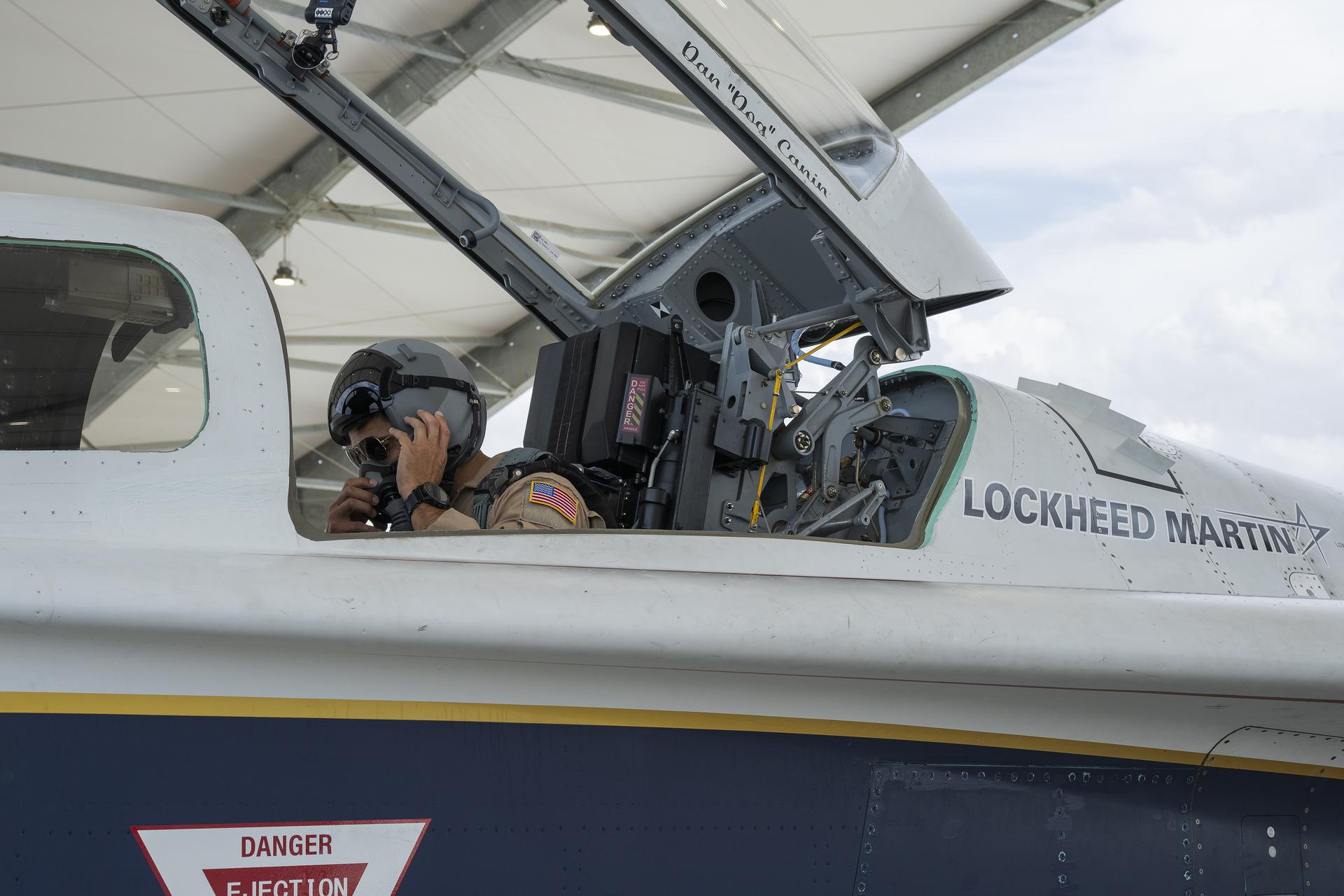
This summer, NASA test pilot Mike Lippert powered up the X‑59 cockpit for the first time, running the aircraft’s engines on the ground during a key step in his months of preparation and training to fly the experimental aircraft.
“Getting into the cockpit of the X‑59 felt very comfortable,” said Lippert, the newest X-59 test pilot for NASA’s Quesst mission. “The whole team has done a tremendous job of making sure I am trained and prepared.”
Lippert’s first powered interaction with the aircraft demonstrated how mentorship works in NASA’s test pilot community. The X‑59’s two established pilots, Nils Larson and Jim “Clue” Less, guided him throughout the test. Larson monitored Lippert’s coordination with the control room, while Less answered questions and provided coaching.
Their feedback, along with insights from experienced engineers, turned the startup sequence into a detailed training exercise to strengthen Lippert’s understanding of the X‑59’s systems and the pace of test operations.
The X-59 is a revolutionary design, shaped to create a quiet thump instead of a sonic boom when flying faster than the speed of sound. The test pilots’ experience and skill will allow NASA to safely test the aircraft, then eventually fly it over U.S. communities to gather data on how the public perceives the sounds it makes.
The engine run also introduced Lippert to the X‑59’s maintenance crew. As the test progressed, Lippert saw how the cockpit and control room work together during critical operations. Watching the real-time rhythm, he said, provided a better understanding of how NASA’s flight test teams align to ensure safety and precision.
Lippert credited the test team’s operating practices and leadership for helping him prepare for flight. He spent extensive time in the X-59’s high-fidelity simulator — designed to match the aircraft’s cockpit — for training, aircraft familiarization, and mission rehearsal. The simulation team’s members are absolute experts on the aircraft and have been key contributors to his training and the program as a whole, Lippert said.
Lippert said he felt energized after powering on the aircraft’s systems for the first time, adding the milestone left him feeling ready for upcoming test flights. The X-59 will continue to progress through envelope expansion and test its performance under various flight conditions. In the coming months, it will advance toward acoustic validation flight tests to study the sonic thumps it is designed to make.
Learn more about the Quesst mission on NASA’s site.
The post NASA’s New X-59 Test Pilot Gets Behind Controls for Ground Test appeared first on NASA Science.
In a groundbreaking announcement, the U.S. Space Force stated publicly on Monday, Sept. 14, that it currently has on-orbit weapons in space. Department of the Air Force Secretary Troy Meink’s keynote address at the 2026 Air and Space Cyber Conference focused on plans to modernize the Air Force against AI-powered weapons and capabilities wielded byContinue reading "U.S. confirms it has weapons in orbit"
The post U.S. confirms it has weapons in orbit appeared first on Astronomy Magazine.
Pending regulatory approval, SpaceX said today it intends to launch its 14th Starship mission as early as September 22. This flight is notable, as it will be the first time that SpaceX attempts to launch the experimental vehicle into orbit.
The company set a target liftoff time of 7:15 am local in Texas (12:15 UTC), with a 75-minute launch window. Sunrise in Brownsville, Texas, is 7:17 am CT, so the launch could make for some striking imagery.
The super heavy lift rocket will be carrying 26 of the larger V3 Starlink satellites into an orbit 275 km above the Earth. In an update on its website, SpaceX said the Starship upper stage will seek to complete six orbits around the Earth before completing its mission after about 10 hours.
© SpaceX
Just as I was heading into the final stretch of review season, TestFlight was updated to reverse an update I wrote about in July. That update added search, which was one of my longstanding wishes for TestFlight. However, for some users, the update also changed the sorting of betas from reverse chronological order to alphabetical, including active betas alongside expired ones. As someone who reviews a lot of apps, that made TestFlight barely usable.
With the latest update, I’m happy to report that the sorting order has been restored to reverse chronological order. The most recently updated betas appear at the top of the list, and when you want to find something older, search is a great option. Returning to reverse chronological order may seem like a small thing, but it’s made a world of difference in keeping up with the apps I test.
Search was near the top of my list of TestFlight wishes for years, and its addition made a meaningful difference to the app’s usability. But I’ve had a lot of TestFlight wishes over the years that are scattered across multiple articles, so I thought I’d share what else I’d like Apple to tackle with TestFlight:
The bottom line is that while TestFlight is once again usable, it could be much better. I recognize that TestFlight isn’t an app used by most people, but like Apple’s own OS beta testing program, TestFlight betas are an important part of developers’ workflow. They provide QA feedback and a promotional channel that the friction encountered by TestFlight users undermines.
I’m glad TestFlight continues to get meaningful updates. I just hope it gets more attention going forward.
After over 7,000 days in space, the Cassini mission ended on Sept. 15, 2017. Since its Oct. 15, 1997 launch, the spacecraft had returned a wealth of new knowledge and images of Saturn and its moons. Thanks to Cassini’s observations, researchers discovered liquid methane lakes on Titan, the potential habitability of Enceladus and the geysersContinue reading "Sept. 15, 2017, Cassini’s Grand Finale"
The post Sept. 15, 2017, Cassini’s Grand Finale appeared first on Astronomy Magazine.
Rocket launches this week On Monday, Sept. 14 at 9:21 p.m. EST, Avio — a publicly traded Italian aerospace company headquartered near Rome — is set to launch a Vega C rocket from the Guiana Space Centre in French Guiana, carrying two Earth-observation satellites for the European Space Agency (ESA). The first, Sentinel-3C, is theContinue reading "Europe launches two Earth-observation satellites amidst a busy week for China"
The post Europe launches two Earth-observation satellites amidst a busy week for China appeared first on Astronomy Magazine.
