❌

Normal view

Cling film helps stamp two-dimensional materials onto patterned surfaces

9 September 2026 at 09:00

Since the discovery of graphene over two decades ago now, two-dimensional (2D) materials have revolutionized almost all areas of science and technology thanks to their unique properties compared with bulk materials. These include high electronic conductivity, high mechanical strength, transparency and flexibility, to name just a few. The problem since the beginning, however, has been to produce sheets of these materials large enough for real-world applications and, importantly, to be able to transfer them onto other substrates without cracking the sheets. A team of researchers in Amsterdam, the Netherlands, has now succeeded in doing just this, with the help of an unexpected material – kitchen cling film. Their work could help in the continuing development of next-generation electronic and optoelectronic devices.

“The method we developed allows us to, for the first time, pick up, transfer and place large (roughly 1-mm-sized) 2D layers on almost arbitrarily patterned surfaces,” explains Jorik van de Groep of the 2D Nanophotonics group at the UvA-Institute of Physics, who led this research study. “Being able to do this is crucial since it enables the integration of 2D materials with structures like larger electronic devices and photonic coatings. Most importantly, the transfer is no longer probabilistic (as were most other methods) but has a near-unity yield.”

In the early days of 2D materials, researchers obtained micron-sized mono- or multi-layers of these structures by mechanically shaving off, or exfoliating, flakes from the bulk material using sticky tape. This was first famously done for graphene, a sheet of carbon just one atom thick. More recently, a technique known as gold-assisted exfoliation has allowed them to produce high-quality centimetre-sized layers of technologically important materials like transition-metal dichalcogenides (TMDCs) and transfer these onto flat glass surfaces.

For the field of nanophotonics in particular, explains van de Groep, we need to be able to transfer large-area 2D materials onto both flat and patterned substrates – such as those with electrical contacts and optical coatings on them, for example – if we are to fabricate functional devices. The problem is that existing transfer techniques are limited in this respect.

Kitchen cling film to the rescue

The Amsterdam team – which also includes researchers from UvA’s Van ‘t Hoff Institute for Molecular Sciences, ARCNL and AMOLF – has now developed a simple method that allows them to reliably transfer both large-area monolayers of TMDCs and hexagonal boron nitride/monolayer heterostructures onto patterned or non-patterned substrates, ranging from flat surfaces to high-aspect ratio and low adhesion patterned interfaces. In their process, which is detailed in ACS Nano, they used low-density polyethylene (LDPE), or kitchen cling film, an inexpensive and widely available polymer that has a low melting temperature.

In their work, the researchers transferred a gold-assisted-exfoliated large-area monolayer of the TMDC tungsten disulphide (WS2) from a silica (SiO2) substrate to another target SiO2 substrate. They began by fabricating a stamp made of a heat-resistant half-sphere covered by LDPE cling film. They then mounted the stamp on an xyz-micron precision stage and moved it slowly towards the WS2 monolayer, which was heated to 70 °C, at a speed of 0.5 µm/s until it contacted with the LPDE.

“We used force sensors in the stage to measure the forces involved during the stamping procedure, both in the plane of the 2D material (Fx and Fy) and perpendicular to it (Fz),” explains van de Groep. “This not only offers better control and repeatability of the transfer, it also provides crucial information on the contact and friction dynamics throughout the process.”

During initial contact with the substrate, the normal force (Fz) increases to 120 mN, at which point the researchers stop moving the stamp. Once it has contacted the monolayer, they heat the system to 140 °C. This induces a phase transition at which the LDPE melts, so allowing it to strongly adhere to the monolayer. They then cool the ensemble back down to 70 °C to solidify the LDPE. Finally, they pull off the monolayer from the LPDE with the stage moving at 0.5 µm/s and clean it to remove any polymer residue.

Material retains its good photoluminescence properties

To assess how the transfer process affects the monolayer, the researchers imaged it before and after the procedure. Before transfer, cracks covered 8% of the material. This figure increased to 14% after, with the cracks mainly generated at the edge of the stamp contact area. “As such, the procedure only modestly increases the cracked area fraction and largely preserves the monolayer topography,” says van de Groep. “More importantly, the material retains its good photoluminescence properties.”

The new work could help 2D materials scientists working in a variety of different fields to build larger and more complex devices. “Already, we are using it to develop atomically thin optical elements, optical modulators, single-photon emitters and other optoelectronic devices,” van de Groep tells Physics World. “Also, and more fundamentally, the method we have developed could allow for the fabrication of complex heterostructures of interest for quantum materials.”

The Amsterdam team is now busy optimizing its method further by, for example, building a humidity-controlled environmental enclosure around the stamping setup. “2D materials and the (van-der-Waals) adhesion between them strongly depends on the surface chemistry and, as such, on the relative humidity during the stamping procedure,” explains van de Groep. “We’re also working on additional methods to characterize the thickness of the materials in situ, that is, during the stamping process.”

The post Cling film helps stamp two-dimensional materials onto patterned surfaces appeared first on Physics World.

Antineutrino detector could monitor spent nuclear fuel for clandestine activity

3 September 2026 at 12:00

Scientists have measured antineutrino emissions from spent nuclear fuel for the first time, demonstrating that monitoring efforts need not stop when the reactors do. This is important because although independent nuclear safeguarding agencies have long used antineutrino emissions to glean information on reactor operations, previous detection schemes only worked when the reactors were running. Now, however, members of the Double Chooz collaboration have shown that it is possible to detect residual antineutrino emissions during a complete reactor shutdown – including from spent fuel stored in cooling pools.

Like neutrinos, antineutrinos are tiny, nearly massless fundamental particles that come in three flavours: electron, muon and tau. The largest human-made sources of electron antineutrinos are the reactor cores of nuclear power plants, which produce them via beta decay of neutron-rich fragments that are primarily generated during the fission of heavy elements such as uranium and plutonium.

Because antineutrinos interact so rarely with other particles, their emissions cannot be shielded and their signatures cannot be altered. They can also be detected some distance from the power plant itself. All these features make them valuable for nonintrusive nuclear reactor monitoring. Indeed, the idea of using antineutrinos to provide real-time information about the fissile content of a reactor core – and thereby detect illicit production of material that could be used in nuclear weapons manufacturing – dates back to the 1970s.

When a reactor is shut down, long-lived fission products (found in burnt fuel assemblies that remain in the reactor core, as well as assemblies that were previously removed and stored in nearby cooling pools) continue to decay, producing a residual neutrino flux. However, this residual signal is only around 1% as strong as the signal from an operating reactor. It also lies in a region of the energy spectrum that is strongly affected by background activities.

Measuring the residual neutrino flux and its energy spectrum

In the new work, which is detailed in Physical Review Letters, a team led by Thierry Lasserre and Anthony Onillon from the Max-Planck-Institut für Kernphysik (MPIK) in Heidelberg, Germany, succeeded in measuring the residual neutrino flux and its energy spectrum despite these difficulties. They obtained their data from the Double Chooz neutrino detection experiment, which is located near the two 4.25 GWth cores of the Chooz B nuclear power plant in the French Ardennes. This experiment uses a pair of detectors – labelled “near” and “far” and located around 400 m and 1.05 km from the cores – to study a fundamental parameter called the 𝜃13 neutrino mixing angle that describes how neutrinos transform between different types as they travel.

The Chooz plant uses a pair of pressurized water reactors, each of which contains 205 fuel assemblies consisting of roughly 600 kg of enriched uranium dioxide (mainly 238U with a few percent of 235U). During operation, these reactors also produce additional fissile isotopes, 239Pu and 241Pu, through neutron capture and subsequent decay processes involving 238U. In a typical cycle, they operate at full power for over a year and are then shut down for six to eight weeks for refuelling. During this time, some of the spent fuel assemblies are removed and transferred to storage pools in a nearby building.

The Double Chooz neutrino detector consists of more than 30 m3 of liquid scintillator, which is a material that emits short, double flashes of light when an antineutrino hits it. The outer part of the detector is shielded from the background radiation of the surrounding mountain rocks by 15 cm of demagnetized steel for the far detector and 1 m of water for the near detector. The inner part of the detector is shielded by a thick layer of mineral oil. Finally, an outer “muon veto” consisting of segmented scintillator modules positioned above the detector eliminates contributions from cosmic muons that can mask the signal from the antineutrinos.

Over 100 events observed

The researchers collected their data in 2017 when both of Chooz’s reactors were simultaneously shut down for 24.4 days for refuelling and maintenance. This unusual double shutdown was long enough for the team to obtain the statistics and low background signals needed to extract, for the first time, a quantitative residual reactor antineutrino spectrum.

After accounting for muon veto-induced dead time, the researchers clocked up 17.2 days of measurements for the near detector and 22.2 days for the far detector. While they analysed data from both, they mainly focused on the near detector because it is closer to the reactor cores and spent fuel pools and is therefore more sensitive to the residual antineutrino flux.

In the 1–3 MeV range, where the residual neutrino signal is strongest, the researchers observed 106 ±18 events, which represents a 5.9 σ excess over the background. This value, they say, is in very good agreement with the 88 ±7 events predicted by detailed simulations of the remaining nuclear fuel inventory and the decay of long-lived fission products.

According to the researchers, this result had a long gestation period: “In 2003, the IAEA safeguards met with the neutrino community and raised a question: could antineutrinos also provide information on spent nuclear fuel?

“The main difficulty has been detecting the faint residual antineutrino signal. This meant obtaining data during periods when both Chooz reactors were simultaneously off, very low and well-controlled detector backgrounds, and a detailed simulation of the irradiation and cooling history of relevant fuel assemblies.”

The researchers hope that their result will become a robust benchmark for agencies and experimenters designing detectors for specific spent-fuel monitoring applications. “Such monitoring is feasible and could provide an independent, non-intrusive complement to reactor-status and spent fuel inventory,” they tell Physics World, though they add that “it will not necessarily be easy, compact or inexpensive to implement.”

The post Antineutrino detector could monitor spent nuclear fuel for clandestine activity appeared first on Physics World.

Plasmonic metamaterial makes a photonic time crystal

3 September 2026 at 09:00

Researchers in France and Germany have created the first all-optical photonic time crystal. The nanostructure could be used to make ultrafast optical computers and amplifiers, frequency converters and perhaps even new types of lasers that work in the terahertz range.

Photonic crystals are nanostructured materials with a refractive index that varies on a length scale comparable to the wavelength of light, producing a phenomenon known as a photonic bandgap. This gap affects how photons propagate through the material in a way that resembles how a periodic potential in semiconductors affects the flow of electrons by defining allowed and forbidden energy bands. In the case of photonic crystals, light in certain wavelength ranges can pass through the material, but other wavelengths cannot.

Photonic time crystals (PhTCs) are similar to this, except their properties vary periodically in time, not space. Among other adjustments, this means that instead of photonic bandgaps, they host momentum bandgaps. These gaps are special in that light waves whose momenta fall within them grow exponentially in time.

Optical modulation at THz frequencies

PhTCs show much promise for applications like new types of tuneable lasers and ultrafast frequency converters, but controlling their photonic properties has proven very difficult. This is because these properties need to be modulated very strongly and on ultrashort timescales – on the order of the temporal period of the light itself.

Producing such extremely fast modulations is a key goal for scientists working in a branch of highly nonlinear optics known as time-domain photonics. Previously, their efforts have paid off in the microwave frequency range using PhTCs containing electrical circuits, but all-optical systems have proven elusive.

A team of physicists led by Yannis Laplace of the Ecole Polytechnique in France has now made a PhTC with properties that can be optically modulated at terahertz (THz, 1012 Hz) frequencies. The new PhTC is made from a type of photonic crystal known as a plasmonic metamaterial: an artificially engineered nanostructure consisting of micron-sized cavities made of gold atop an insulating layer and a semiconductor material based on indium and antimony. The cavities trap photons between the gold and semiconductor layers, and surface plasmons – collective, coherent oscillations of conduction electrons that interact very strongly with light – then keep them on the surface of the semiconductor.

Working with scientists from the Collège de France and the Helmholtz-Zentrum Dresden-Rossendorf (HZDR) in Germany, the researchers applied pulses of THz light from the TELBE light source at the HZDR’s ELBE accelerator to their structure. They found that they could use this intense multi-cycle THz light field to modulate the material’s optical properties over timescales of just picoseconds.

Towards new types of lasers in the THz range

“This study builds on previous work in my group related to the development and study of tuneable plasmonic metamaterials in the THz range as a means to create functional devices to control light-matter interactions in this range,” Laplace says. “One of the central questions in our work was to determine if the temporal modulation of the metamaterial would be strong and fast enough.

“By developing a theoretical model in collaboration with our colleague Marco Schiró and his team at the Collège de France that reproduced the experimental observations remarkably well, we showed that the system presented the characteristic spectroscopic signatures expected for a PhTC and provided an explanation for the behaviour of the photons therein.”

The researchers, who detail their work in Nature, also found that the ultrafast temporal modulation reduced the dissipation of photons within the metamaterial by half and they are now looking to reduce these optical losses even further.

“The THz frequency range lies at the junction between electronic and photonic technologies and is historically less developed than these two,” Laplace explains. “With the THz PhTCs that are now achievable, we hope we can soon develop devices like THz amplifiers, frequency converters and maybe new types of THz lasers in this range, hence contributing to the closing of the so-called ‘THz gap,’” he tells Physics World.

The post Plasmonic metamaterial makes a photonic time crystal appeared first on Physics World.

No show again for mirror neutrons

31 August 2026 at 09:40

Could a mirror world – in which every type of elementary particle has a corresponding mirror particle – exist in parallel to our ordinary world? For now, the answer is probably no, but in exploring this question, physicists at the Ultracold Neutron (UCN) Physics Group at the Paul Scherrer Institute (PSI) in Switzerland, say they have refuted this hypothesis with the best precision yet. Their work, which involved looking for so-called neutron-to-mirror-neutron transitions, also excludes mirror neutrons as potential components of dark matter, the mysterious substance thought to make up over 25% of the universe’s mass. Dark matter has never been detected directly, but its existence is inferred through observed gravitational interactions.

Theoretical physicists put forward the idea of a mirror world as long ago as the 1950s to address problems related to parity symmetry conservation in particle physics. Here, a set of mirror particles would exist as exact duplicates of their ordinary particle counterparts except that their so-called handedness would be reversed. In this picture, particles like the electron e, proton p and neutron n have mirror partners denoted by e′, p′ and n′. These mirror particles would have almost the same mass as the ordinary particles.

Not easy to detect

Finding proof for the existence of this mirror matter is important as it could account for dark matter – provided that during the evolution of the universe mirror matter was cooler than ordinary matter. Mirror matter is not easy to detect, however, because mirror particles are predicted to interact with ordinary matter in only two ways. The first is via the force of gravity and the second is through the rare oscillation of neutral particles such as neutrons that “mix” with their mass-degenerate mirror partners. This, explains Bernhard Lauss, one of the physicists at the PSI’s Center for Neutron and Muon Sciences who led this new study, means that ordinary neutrons might, on very rare occasions, turn into their mirror particles and simply “vanish” from our world. The time period up to this event is known as the n−n′ oscillation time, and afterwards a neutron could even reappear as if out of nowhere.

Neutron-to-mirror-neutron mixing has been predicted to have an n−n′ oscillation time as small as few tens of seconds, but it is not easily detectable because it is suppressed by environmental factors such as the presence of ordinary and/or mirror matter or of ordinary and/or mirror magnetic fields.

In recent years, researchers have been trying to reduce these environmental effects by studying neutrons cooled to extremely low temperatures. There are only a few laboratories around the world that can produce such ultracold neutrons at high regular flux. One is the Institut Laue–Langevin (ILL) in Grenoble, France, and another is the PSI.

Unexplored regions

The results from a series of experiments at the ILL in the past 20 years conducted at various magnetic fields were interpreted as being anomalous signals in the range of magnetic fields at which n−n′ oscillations could take place, thereby rekindling interest in the existence of mirror neutrons. More recently, the nEDM collaboration at PSI excluded a big part of this magnetic field range, but some magnetic field regions remain unexplored.

In the latest work, Lauss together with his colleague Géza Zsigmond and co-workers from PSI, the ETH Zurich and the Jagiellonian University in Krakow used ultracold neutrons from the PSI UCN source produced via a technique called superthermal moderation in a deuterium crystal cooled down to a temperature of 5 K. The researchers trapped these neutrons in a non-magnetic vessel made of stainless steel under vacuum. They were able to trap an unprecedented number of neutrons – on the order of 25 billion in all – something that allowed them to significantly improve the sensitivity of such experiments. A set of eight rectangular coils surrounding the storage vessel was used to generate a magnetic field that could be precisely controlled and scanned over two orders of magnitude, from 5–109 µT.

The team released around 1.5 million neutrons from the storage vessel into a gas-electron-multiplier based UCN-detector every six minutes to count how many neutrons remained in the tank after being stored there for 200 s. The researchers repeated the process over a period of several months, gradually varying the strength and flipping the direction of the magnetic field to scan all the relevant fields over which oscillations between neutrons and mirror neutrons are expected to occur. Finally, they performed complex computational simulations on the EULER cluster at the ETH Zurich to predict theoretical probabilities of n-n’ transitions that they then compared with the neutron losses they measured.

New limits set

The result? The researchers say they saw no evidence for such oscillations under the tested conditions. This finding, explains Lauss, means that there is a “very high probability” that previous speculations about the transformation of neutron particles into their mirror counterparts can be ruled out and that new limits for the n−n′ oscillation time constant have now been set. “Indeed, we have excluded the parameter space previously claimed for potential signals to 99.98 %,” he explains.

“The result therefore also excludes mirror neutrons as relevant dark matter particles,” Lauss tells Physics World.

Despite the existing limits already being very tight, Lauss, Zsigmond and their colleagues say they now plan to study the n−n′ transitions theoretically expected at zero mirror-magnetic fields to establish even more stringent limits. “Improving sensitivity further will be very challenging though, and perhaps even impossible,” admits Zsigmond. “A twofold increase, for example, will require 16 times more neutrons because the sensitivity of the experiment scales with the fourth root of the neutron counts.”

The post No show again for mirror neutrons appeared first on Physics World.

Betelgeuse is not alone

21 August 2026 at 12:00

Astronomers have found the best evidence yet for a companion star to Betelgeuse, the brightest star in the constellation Orion. Based on data obtained by the SPHERE instrument on the European Southern Observatory’s Very Large Telescope (VLT) in Chile, they say this companion may be responsible for the red supergiant star’s periodic changes in brightness, which have puzzled scientists for decades.

Betelgeuse is a red supergiant star located about 548 light-years away. As the 10th brightest star in the night sky, it is generally visible even in locations with substantial light pollution. However, its brightness varies over a period of roughly 420 days, superimposed on a longer 2200-day modulation.

For decades, astronomers have suspected that some of these variations could be caused by a companion star that modifies the distribution of cosmic dust that Betelgeuse produces and expels. These changes in cosmic dust would, in turn, change the amount of its light that reaches us here on Earth.

A few years ago, two studies (published in The Astrophysical Journal in 2024 and 2025, but available as preprints beforehand) predicted that in December 2024, this companion star would be at its greatest distance (maximum elongation) from Betelgeuse, making it easier to detect. To take advantage of this opportunity, researchers led by Miguel Montargès of the Observatoire de Paris – PSL, France, requested observing time on the VLT. Although the same studies predicted that the companion would not be massive enough to be detectable with current instrumentation, Montargès and colleagues nevertheless hoped to place upper limits on its stellar parameters.

A difficult analysis

The astronomers used the SPHERE instrument on the VLT to image light from the region where the companion was expected to be, followed by advanced post-processing techniques originally developed to search for exoplanets. Betelgeuse’s brightness and large angular size made this analysis difficult, explains Montargès, but he and his colleagues were nevertheless able to gather enough data to identify a “Betelbuddy” with a confidence of 6σ. As Montargès points out, this is better than the previous upper limit of 1.5σ reported by astronomers at NOIRlab in 2025, and above the usual 5σ threshold that constitutes an “observation” or “discovery”.

Despite this, the astronomers say that before they can be certain that they have really detected a companion that it is indeed gravitationally bound to Betelgeuse, they will need to perform additional observations next year. At that point, they will attempt to confirm the companion’s presence by observing it half a period after the initial detection, on the other side of the red supergiant. “We will then continue observing it to get a precise characterization of its orbit (semi-major axis, eccentricity and inclination, among other parameters),” Montargès says. “These will be required to understand the past and future evolution of the system.”

What happens next

As a mature supergiant star, Betelgeuse is expected to undergo a supernova explosion at some point. The presence of a companion star could affect how this process plays out, and even dictate when the eventual explosion occurs. “It is clear to me that this companion detection will now trigger a wave of new studies on the evolutionary status of Betelgeuse,” Montargès says. “Depending on past, present and future interactions between the two stars, the supernova could possibly be advanced or delayed.

“Betelgeuse is a star that has been observed throughout history,” Montargès continues. “It was even depicted in prehistoric paintings, yet we are discovering one of its fundamental characteristics only now.”

And that is not all: “30% of red supergiants in our galaxy show the type of light variations that led to the discovery of Betelgeuse’s companion,” he tells Physics World. “We may have opened a new avenue to find such binary systems, when the primary star is an evolved star like Betelgeuse.”

The new study is detailed in Astronomy and Astrophysics.

The post Betelgeuse is not alone appeared first on Physics World.

Colliding molecules reveal their ‘cone of reaction’

21 August 2026 at 09:00

For a chemical reaction to occur, atoms and molecules need to collide. However, not every collision produces a reaction. If the atoms and molecules are not favourably aligned with each other, nothing will happen. The “point of impact” of the colliding entities is also important, and it is hard to control because it requires confining the reactants along precise paths.

A team at the University of Graz, Austria, has now shed fresh light on this question by observing molecular coupling reactions on a single-crystal surface. “For the first time, we have been able to directly observe in real space and with single molecules which collision geometry must be met for a successful reaction,” explains Leonhard Grill, a physicist at Graz who co-led the study with post-doctoral researcher Matthew Timm. “Importantly, our experiment covers all geometric aspects of a reaction, namely, the precise location at which the reactants ‘touch’ each other upon collision, the ‘impact parameter’ (that is, how far the collision is from the reactants’ centre of mass) and the orientation of the reactants.”

Based on these observations, the researchers concluded that reactions only occur within a so-called “cone of reaction” that is defined by the colliding particles contacting at a specific point and a certain angle. This finding could lead to a better understanding of chemical reactions at the atomic scale and, ultimately, to ways of controlling and optimizing them.

Control of impact parameters

Grill and Timm used a scanning tunnelling microscope (STM) to project a molecule of difluorocarbene (CF2) onto a target radical (BTFyl) anchored to a copper surface. This set-up enabled them to control the impact parameter by launching the CF2 molecules directly and in a straight line along different atomic rows on the surface. They were also able to control the orientation of the BTFyl target by rotating it around its anchor point.

The researchers observed that reactions mainly occur when the CF2 approaches the BTFyl target on the same copper row to which the target is bound. This didn’t happen often. In fact, only six of the 79 collisions they observed – corresponding to a narrow range of impact parameters – resulted in a chemical reaction, and reactions did not happen at all when the orientation of the CF2 and the BTFyl deviated by more than 15 °.

“Controlling the impact parameter was for a long time considered to be the ‘forbidden fruit’ of reaction dynamics because of the technical difficulties to control it,” explains Grill. “The main challenge for us was how to do such experiments with relatively large molecules, which can have many adsorption orientations on the surface.”

A new view of collisions

Grill believes that the study’s findings could change the way we view collisions between reactants. “The new picture we have gleaned concerns not only the impact parameter, so where one reactant has to collide with another, but also the orientation of the involved compounds,” he tells Physics World. “If the reactants become larger and also have various side groups, understanding the cone of reaction might become even more important to understand, control and predict reaction rates.”

The researchers, who detail their work in Science, say they are already studying similar systems to assess whether the behaviour they observed can be generalized. In a related article, Jonas Björk of Linköping University, Sweden, suggests that further measurements could reveal how molecular structure, reactive sites and environment shape reaction pathways, enabling more predictive control of surface chemical transformations. “They could also enable single-molecule studies of how chirality influences chemical reactivity by directly controlling the handedness and orientation of reactants,” he adds.

The post Colliding molecules reveal their ‘cone of reaction’ appeared first on Physics World.

Upconverting colloidal quantum dots bring ‘colour vision’ to the infrared

20 August 2026 at 12:06
Infrared visualization Wearable eyeglasses. (Courtesy: Fu et al., Sci. Adv. 12, eaed0245 (2026))

Most people can perceive different colours in the visible range of the electromagnetic spectrum – at wavelengths between about 400 and 700 nm. However, our eyes cannot see infrared radiation, let alone perceive infrared “colours”. But now a team at China’s Beijing Institute of Technology has created colloidal quantum dot-based light upconverters that convert the infrared to the visible while preserving the spectral notion of colour. These nanostructures can be incorporated into wearable eyeglasses and, more ambitiously, could someday be implanted directly into the retina.

Photoreceptors in mammalian eyes contain light-absorbing pigments consisting of opsins and their covalently linked retinals. Infrared light at wavelengths greater than 700 nm cannot be absorbed by these photoreceptors, so when such light reaches the retina no corresponding electric signal is sent to the brain. Seeing infrared radiation could reveal otherwise invisible features and improve night vision, which relies on infrared light.

In recent years, researchers have made great strides in developing materials that capture photons with lower energies (in the infrared, for example) and re-emit them as photons with higher energies (typically visible or ultraviolet light). This process is known as upconversion, and the emitted light is said to be anti-Stokes shifted. This has led to the development of photoreceptor-binding upconversion nanoparticles that convert infrared light into visible emissions. These have been injected into mouse eyes and have been used to create wearable lenses for humans – with nonlinear upconversion projecting infrared-transformed visible light onto the cornea. While effective, these applications are limited to the narrow near-infrared (NIR) spectral range.

Confined electrons

Now, a team led by Ge Mu and Xin Tang studied a structure made up of semiconducting mercury telluride (HgTe) colloidal quantum dots (CQDs) atop an organic light-emitting diode (OLED). The OLED contains two light-emitting layers, one red-light-emitting and one cyan-light-emitting. Because of the small size of the CQDs, the electrons in them are confined in all three directions. This means that the electrons are restricted to discrete and separate atomic-like energy subbands rather than having access to a continuous band of allowed energies as they would in a bulk material.

When the CQDs absorb photons with infrared wavelengths, spanning the NIR to short-wave infrared regions, they produce excited carriers (electrons and holes) that then travel from their different energy levels into the OLED. This is a seamless process because the OLED is designed so that its electronic bands align with the sub-bands of the HgTe. When either the light intensity or the wavelength of the incident infrared light changes, explains Tang, the excited photocarriers are transported and recombined in the different emissive layers of the OLED thanks to the hole-trapping barriers that were engineered in these layers. The result is infrared-to-visible-light (red and cyan) upconversion.

Semi-transparent wearable eyeglasses

As a proof-of-concept, the researchers integrated their upconverter into lightweight, semi-transparent wearable eyeglasses and found that they can project multispectral infrared light onto the retina without affecting normal vision, so allowing the wearer to see infrared light as well as visible light. Indeed, a wearer can detect infrared light at wavelengths greater than 2 μm with a luminance of over 700 cd m−2.

Looking ahead, Tang says that the upconverter could be bound to light-sensitive proteins in the retina and so serve as an implantable next-generation retinal bionic photoreceptor. This structure would transform infrared light into visible light emissions that stimulate light-sensitive proteins on retinal neurons to bypass damaged photoreceptor cells and potentially restore visual function across both the visible and infrared.

This full colour upconverter has been a long-term project in my group, Tang tells Physics World. “Starting from an efficient single-colour upconverter, we then successfully demonstrated colour-tuneable OLEDs and Si-/Ge-/CMOS-integrated upconverters. And with our recent progress on the understanding of interfacial carrier transport between quantum dots and colour-tuneable OLEDs, we have now demonstrated this new full-colour upconverter.”

The latest work is detailed in Science Advances.

The post Upconverting colloidal quantum dots bring ‘colour vision’ to the infrared appeared first on Physics World.

Fast radio bursts reveal that the universe’s ‘missing matter’ is found far from galaxies

19 August 2026 at 09:30

By analysing the signals from extragalactic fast radio bursts, astronomers at the Massachusetts Institute of Technology (MIT) say that the “missing matter” in the universe is distributed further away from galaxies than most theoretical simulations predict. Their finding – which is counterintuitive since the gravity from galaxies tends to pull everything closer to them – could help us better understand how highly energetic galactic activities, such as jets from supermassive black holes and explosions from old dying stars, impact the formation of cosmological structures.

“Ordinary” matter, which is built from atoms and their protons and neutrons (collectively known as baryons), makes up stars and galaxies and everything we see around us. However, the best models of the universe we have today suggest that close to 90% of this baryonic matter is “missing”.

The radio signals of FRBs are stretched

As their name implies, fast radio bursts (FRBs) are brief, intense bursts of radio waves spanning multiple wavelengths. They were first detected in 2007 and since then, astronomers have spotted thousands of others, including some within our own galaxy. They are thought to originate from cataclysmic processes involving compact celestial objects such as neutron stars and typically last a few milliseconds or even less. And these FRBs can be used to probe the missing baryonic matter.

As they pass through the missing matter, the radio signals of FRBs are stretched (or “dispersed”) over time – that is, their overall duration becomes longer. The more missing matter they pass through, the more the signals are dispersed. The missing matter has an extremely low density – of just a single proton per cubic metre – so it is extremely difficult to identify, but researchers recently found that they could use the dispersion effect to detect it. In that previous study, they confirmed that intergalactic space, which contains most of the universe’s baryons, is home to tenuous clouds or filaments of diffuse plasma that make up the missing matter.

Data from CHIME and DESI

In the new work, a team led by astrophysicists Haochen Wang and Kiyoshi Masui has now gone a step further and mapped the extent to which this plasma extends. They did this by cross correlating the locations of millions of galaxies with the dispersion of nearly 3000 background FRBs on length scales of 0.1 to 50 Mpc.

The researchers used data from the Canadian Hydrogen Intensity Mapping Experiment (CHIME) catalogue and the Dark Energy Spectroscopic Instrument (DESI) survey. CHIME, a large radio telescope located in British Columbia, scans the entire northern sky for incoming radio waves and it can detect ultrashort, ultrabright radio signals. Indeed, it has detected about 4000 FRBs since it became operational. DESI, for its part, is an instrument mounted on the Mayall Telescope at Kitt Peak National Observatory, near Tucson, Arizona. It makes detailed measurements of the light coming from over 30 million galaxies – originally to provide estimates of dark energy, the mysterious force that is driving our universe’s expansion.

In all, the researchers detected 2870 FRB signals with CHIME and correlated these with the locations of around six million galaxies with DESI.

Missing baryonic matter scattered across a large radius

Their analyses revealed that on scales smaller than about 1 Mpc, the missing baryonic matter was indeed found around galaxies and galaxy clusters, but rather than being close to galaxies in a dense ball as expected, it was scattered across a large radius. “A galaxy is maybe a few 100,000 light years across, and we found missing matter out to about four million light years,” Masui says. “That’s further than the simulations predict.”

The new result backs up the idea that missing matter is projected out from a galaxy through highly energetic events, such as jets from supermassive black holes and explosions from old dying stars. These processes could be much more energetic than we think, note Wang and Masui, and they are stronger and much more violent.

The work, which is detailed in Physical Review Letters, proves that FRBs are a good way to study large-scale structures in the universe – in a similar way to how cosmologists have been using galaxies and the cosmic microwave background for decades, says Wang. “It has helped to establish FRBs as a new cosmological probe, especially for detecting the missing matter.”

FRBs will only become a more popular tool in this context, he adds, especially given that several new radio telescopes, with upcoming surveys such as CHORD, DSA-2000 and the SKA, are being constructed around the world to offer much better FRB data in the coming years. “Indeed, we have already received more FRB data from our telescopes and are working on expanding our study,” Wang tells Physics World.

And that is not all: the researchers say they are also busy improving their analysis technique. “Until now, we have mostly examined the dispersion of FRBs but we are now working on extracting information from FRBs’ spatial positions relative to galaxies. This will reveal more details on how the missing matter is distributed in the universe.”

The post Fast radio bursts reveal that the universe’s ‘missing matter’ is found far from galaxies appeared first on Physics World.

Semiconducting nanorods help laser-powered drones keep cool

18 August 2026 at 16:43

Remote uncrewed aerial vehicles (UAVs), or drones, equipped with solar cells could be wirelessly charged using laser beams directed at them from the ground, rather than relying on traditional onboard batteries. The problem until now, however, has been keeping the drones cool – since laser light heats them up, so reducing the efficiency of the photovoltaic cells they carry on their wings. A team of researchers at the Civil Aviation University of China has now overcome this problem by incorporating a heat blocking technology based on antimony selenide (Sb2Se3) nanorods into these solar cells.

As drones take on longer missions, battery life has become one of the biggest barriers, explains Jianhua Han, who led this new research study. “Our team has been looking into laser wireless power transmission, which is a leading approach for long-distance wireless energy transfer, to replace these batteries.”

Laser wireless power transmission is particularly suited to aerospace applications such as UAVs equipped with photovoltaic cells. Perovskite solar cells show much promise in this context because they are cheap to manufacture, absorb light strongly in the visible part of the electromagnetic spectrum and have long charge-carrier diffusion lengths.

A perovskite laser cell-thermoelectric tandem device

In the new work, detailed in Matter & Light, Han and colleagues studied a type of solar cell known as a perovskite laser cell-thermoelectric (PLC-TE) tandem device, which consists of a carbon-based CsPbBr3 perovskite as the PLC and bismuth telluride (Bi2Te3) as the TE material. The TE module is directly fixed beneath the laser cell and a carbon electrode is attached to its negative terminal  to create a series connection. When laser light is shone onto the device, the carbon electrode converts a portion of the incident laser energy into heat. The TE then harvests this heat, converting it into electricity through the thermoelectric effect.

And that’s not all: since one side of the device ends up being warmer than the other, this temperature gradient also helps convert the thermal energy into electricity. The larger the temperature gradient, the more electricity the TE layer can generate.

There is a problem though: while the carbon in the hybrid structure dissipates some of the heat produced by the laser, the structure can still heat up – reaching temperatures of up to 90°C, says Han. “That was much higher than we expected and made us realize that heat buildup was a far more serious problem than we had imagined.”

Sb2Se3 behaves like a thermal barrier

To overcome this problem, the researchers turned to Sb2Se3, which is a promising photovoltaic material. As well as its good optoelectronic properties, this semiconductor also has a low thermal conductivity, which allows it to behave like a thermal barrier when embedded in a device.

Han’s team synthesized nanorods from the Sb2Se3 and incorporated them into the upper portion of the CsPbBr3 layer. The Sb2Se3 reduces heat dissipation in the carbon electrode and so helps maintain a significant temperature gradient in the TE device, thereby improving its overall energy conversion efficiency. Its thermal barrier properties also help decrease the PLC’s overall operating temperature during prolonged laser exposure.

The team then inserted the tandem device containing the Sb2Se3 nanorods beneath the wing of a stationary drone and carved out air channels through the wing to simulate real-world airflow conditions. When illuminated with high-power green laser light with a wavelength of 520 nm, they found that the device converted 38.49% of the incoming laser energy into electricity and successfully powered the drone’s propellor blade. This power conversion efficiency, says Han, is among the highest reported for this class of technology operating under similar conditions.

Device could help UAVs stay airborne for longer

“In terms of concept, this is the first time that a system-level scheme of the devices has been applied to a UAV power supply, expanding the work from pure materials research to application-oriented system design,” Han tells Physics World. “It demonstrates that powering UAVs with light is not just a theoretical concept, but an engineering pathway that can be practically implemented.”

The device could help UAVs stay airborne for longer, something that will be useful for applications like forest patrol, disaster monitoring and delivering packages, he says. But there is still much work to do before such applications become a reality. For one, the researchers will need to integrate the PLC-TE device into a lightweight drone for flight testing outdoors and to assess the safety of their technology. They will also need to find a way of accurately tracking moving drones with laser beams.

“Going from the ground-based proof stage to the real flight validation stage will require solving many engineering challenges,” says Han, “but our technology is a good starting point and verifying its viability is the core objective for the next phase in our study”.

The post Semiconducting nanorods help laser-powered drones keep cool appeared first on Physics World.

Frame-dragging measurement around the Earth sets new precision record

17 August 2026 at 09:00

A laser-ranging technique has allowed physicists to measure the frame dragging of the Earth with an uncertainty approaching one part in a thousand, representing the highest precision yet for this parameter. The new result not only provides one of the most stringent confirmations of Einstein’s theory of general relativity in the near-Earth environment to date, it also sets stronger constraints on some alternative theories that have been put forward to explain the unsolved mystery of the universe’s accelerated expansion.

Frame dragging, also known as the dragging of inertial frames, is one of the predictions in Einstein’s theory of general relativity. Here, a massive, rotating object not only curves spacetime, it also drags it around as it rotates. The effect is very large around huge objects like black holes but is much smaller around Earth. It can be detected, however, by monitoring the motion of certain satellites in orbit around our planet.

There is a problem though in measuring the very tiny shift of the orbital plane around the Earth predicted by general relativity because the Earth is not a spherically symmetrical body, explains Ignazio Ciufolini of the Chinese Academy of Sciences, who led this new study. He and his colleagues overcame this difficulty by analysing motion data from the recently launched Laser Relativity Satellite 2 (LARES-2), developed by the Italian Space Agency, and its predecessor LAGEOS.

The combined orbits of these satellites act like a huge gyroscope and their position can be measured via laser ranging: a laser pulse is emitted towards the satellite and reflected back from the retroreflectors covering its surface. “By measuring the time it takes the laser light to come back, we can very precisely determine the position of the satellite,” says Ciufolini.

LARES-2 is a small, spherical satellite with a radius of 0.212 m and it is extremely heavy, weighing in at nearly 295 kg. Its orbit, he notes, is therefore perturbed only by the Earth’s gravitation and to a much lesser extent by non-gravitational effects, such as the push of the photons from the Sun and the Earth.

Removing the influence of Earth’s lunisolar tides

One of the difficult steps in the measurements, Ciufolini explains, was removing the influence of Earth’s lunisolar tides. These are the subtle distortions in the Earth’s gravity field caused by the tides raised by the Moon and Sun, which would otherwise hide the signal the researchers were looking for. “The most challenging part was to get rid of the orbital influence of Earth’s ‘K1 tide’, which biases the precision of the frame-dragging measurement,” he says.

“Thanks to this precise measurement, which is an order of magnitude better than previous Solar System measurements, we have been able to set stronger limits of validity to some theories alternative to general relativity proposed to possibly explain the great mystery of the accelerated expansion of the universe,” he tells Physics World. “Some of these theories predict something that may be related to quintessence (a mysterious time-dependent scalar field).”

While these theories predict the same so-called post-Newtonian weak-field effects as general relativity, they predict a different frame-dragging effect, he adds. Increasing the accuracy of frame-dragging (and indeed other tests of general relativity) can therefore place further limits on these other theories. It could also shed more light on phenomena like the flow of time around rotating black holes, where frame-dragging is extremely pronounced.

Laser-ranged satellites remain in orbit for many decades (LAGEOS was launched by NASA in 1976) and will carry on providing data for a very long time. “The more time we have, the more observational data we can obtain and therefore tests of general relativity (not only frame-dragging but also other tests) can be carried out with much increased precision,” says Ciufolini. “This data could also improve our knowledge of the Earth and allow, for example, improved determinations of the Earth tides and its centre of mass, which is useful for the Global Positioning System.”

The study is detailed in Nature.

The post Frame-dragging measurement around the Earth sets new precision record appeared first on Physics World.

‘Kinetic electronics’ make self-connecting circuits

14 August 2026 at 09:00
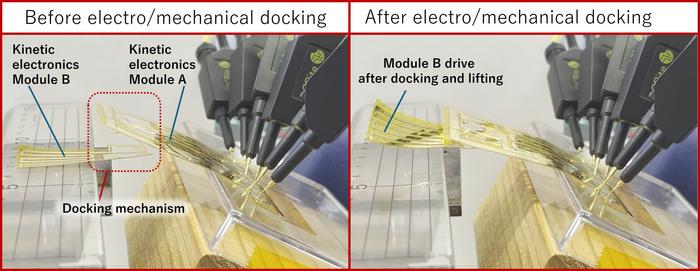
Side-by-side photos showing a pair of circuits before and after they connect
Come together: Kinetic electronics module A, which integrates an electrical circuit and an actuator, deforms in response to an electrical input and connects mechanically and electrically to thin-film circuit module B via the docking mechanism. Before connection (left image), the two modules are separate; after connection (right image), module A holds and lifts module B, and by supplying power through the connection point, it can independently drive module B to deform. (Courtesy: Fumihiro Sassa/Kyushu University)

Researchers at Kyushu University in Japan have developed a flexible electronic circuit that can connect itself to another electronic circuit and then disconnect from it. The prototype structure is an important step towards electronic devices that can reconfigure and even repair themselves, and it could have applications in wearable sensors, soft robotics and medical devices.

Most of today’s electronic devices are fixed, or “non-modular”, explains study leader Fumihiro Sassa of Kyushu University’s Department of Electrical and Electronic Engineering. Typically designed for specific tasks or environments, they are not readily adaptable to new ones, and they often cease to function if even a single component in their electronic circuitry fails. This leaves them dependent on human operators or external robotic systems if it becomes necessary to expand their functionality or repair damage.

“This can be a serious limitation inside very small machines, in space equipment, in devices requiring specialized handling, such as wearable chemical sensors, or in systems containing very large numbers of wires and electronic elements,” Sassa explains. “In such cases, in-situ repair can be difficult. The whole system may need to be replaced.”

Connection and disconnection

To overcome this problem, the Kyushu University researchers have been developing what they term “kinetic electronics” modules. These consist of electronic circuits and actuators that deform when an electrical current is applied to them so that they can mechanically and electrically connect to other modules. Before this connection takes place, different modules are separate, but after connection or “docking” takes place, one module can independently deform another when power is supplied through the point that connects them.

In this way, explains Sassa, the circuits can rearrange their own hardware structure. “Such functions have traditionally been used in mechanical systems, such as spacecraft, trains and modular robots, but we have now applied them to an electronic device.”

Sassa and colleagues fabricated their electrothermal bimorph actuators from polypropylene and polyimide films with heater electrodes and electrical circuits formed on them through a two-dimensional top-down process. Because the two polymers expand differently, Sassa explains that Joule heating causes selected actuator sections to bend. “Prescribed sequences of these motions produce docking and undocking and once docked, passive mechanical engagement maintains the connection without continuous power being supplied,” he says. “Undocking requires a separate actuation sequence.”

Towards miniaturization and more intelligent control

The researchers say they are working on miniaturizing their system and looking how to control it more intelligently. In the present study, which is detailed in npj Flexible Electronics, they demonstrated the docking mechanism using a small number of millimetre-scale independent sensors and actuators formed together on the circuit, with motion being controlled in sequence by an external microcontroller. They are now developing photolithographic processes to further decrease the size of these components and have already fabricated actuators smaller than 100 μm using these techniques.

“In a similar way to large-scale integration in conventional electronics, doing this will allow us to integrate very large numbers of these sensing and actuation elements, allowing the electronic circuit to form and change much more complex mechanical structures and functions,” says Sassa.

“We are also interested in so-called distributed control, in which the central controller does not need to specify every movement,” he adds. “Instead, many elements would follow relatively simple local control rules, from which advanced self-reconfiguration and self-organization could emerge.”

The post ‘Kinetic electronics’ make self-connecting circuits appeared first on Physics World.

Crystal symmetry controls hydrogen’s quantum tunnelling

13 August 2026 at 09:00

The quantum tunnelling of hydrogen atoms plays a central role in many physical, chemical and biological process, but a practical means of controlling it has proved elusive. Researchers from the University of Tokyo, Japan have now demonstrated that the way hydrogen permeates through a material depends on the degree of symmetry in the material’s crystal structure. By controlling this symmetry, scientists could therefore gain control over hydrogen’s ability to tunnel, potentially leading to safer and more efficient media for storing this industrially important clean-burning fuel.

“We found that hydrogen undergoes pronounced quantum tunnelling in a highly symmetric crystal environment, whereas the tunnelling is strongly suppressed when the symmetry is lowered,” explains Katsuyuki Fukutani, who led the research together with colleagues Takahiro Ozawa and Sudhansu Sekhar Das. “This is particularly exciting because it identifies crystal symmetry as a fundamental principle for controlling the quantum behaviour of hydrogen in materials, opening new possibilities for tailoring hydrogen transport.”

A model hydrogen-storage material

The researchers, who work at Tokyo’s Institute of Industrial Science, obtained their results by studying how hydrogen atoms move through a model hydrogen-storage material, vanadium, at low temperatures. To do this, they combined two complementary techniques. The first is called nuclear reaction analysis and it measures the hydrogen’s depth distribution directly with high resolution. The second involves measuring electrical resistance, which sensitively monitors how the hydrogen redistributes itself over time.

These measurements revealed that at temperatures of around 70 K, hydrogen atoms begin to migrate through vanadium’s crystal lattice, hopping between its interstitial spaces. At low hydrogen concentrations, this hopping occurs within a highly symmetric structure known as α-phase vanadium, and the hydrogen atoms easily tunnel between neighbouring lattice sites. At higher hydrogen concentrations, however, vanadium’s crystal lattice distorts, forming a β-phase. Under these conditions, the hydrogen atoms must overcome an energy barrier (of 148 meV in this case) before they can tunnel to neighbouring sites.

Quantum tunnelling or classical thermal activation?

Based on changes to vanadium’s electrical resistance, the researchers were able to calculate the diffusion coefficient of hydrogen over a wide range of temperatures, including those for which quantum tunnelling is important. They then interpreted these results using quantum-mechanical calculations of hydrogen motion, which revealed that the crystal symmetry determines whether hydrogen moves by quantum tunnelling or by classical thermal activation. They found that in the α-phase, hydrogen’s ground states are delocalized over tetrahedral sites thanks to tunnelling. In the β-phase, in contrast, the uniaxial strain produced by the distortion of the crystal lattice leads the quantum states of the hydrogen atoms to localize around certain (Oz) sites in the material.

Hydrogen is the lightest element, so Fukutani says it’s not surprising that it exhibits pronounced quantum behaviour. However, while quantum tunnelling had long been assumed to play an important role in hydrogen diffusion, it was difficult to obtain direct experimental evidence for it because we cannot easily observe hydrogen inside materials using conventional techniques. “We wanted to clarify how hydrogen actually behaves in the quantum regime and identify the factors that control its tunnelling,” he explains.

New possibilities for controlling hydrogen permeation and storage

“Our findings suggest that hydrogen transport can be controlled by tuning quantum tunnelling through crystal symmetry — for example by applying external strain,” he adds. “This capability opens up new possibilities for controlling hydrogen permeation, storage and even catalytic reactions.”

More broadly, Fukutani says the team’s work establishes crystal symmetry as a new design principle for tailoring quantum hydrogen behaviour in functional materials. The Tokyo researchers now plan to extend their work to a wider range of hydrogen storage media, including metal alloys and oxide materials. “Ultimately, we hope to establish a universal framework describing how local atomic structure and crystal symmetry govern the quantum behaviour of hydrogen,” Fukutani tells Physics World.

They report their present work in Nature Communications.

The post Crystal symmetry controls hydrogen’s quantum tunnelling appeared first on Physics World.

Physicists extend Hawking’s black hole laws to dynamical objects

12 August 2026 at 12:00

The event horizons of black holes that are far from equilibrium can now be described by the first and second laws of thermodynamics thanks to new work by theoretical physicists at Pennsylvania State University in the US. The result augments the work of the late Stephen Hawking and others who showed in the 1970s that these classical concepts have applications in idealized, static black holes.

Black holes are objects so dense that their gravitational pull prevents anything – even light – from escaping them. The “point of no return” of any object falling into a black hole is called the event horizon, and it represents the black hole’s mathematically defined “edge”.

Although black holes can be described using concepts from quantum mechanics and Einstein’s general theory of relativity, some 50 years ago physicists like Hawking and Jacob Bekenstein showed that the equations governing them are also astonishingly similar to the fundamental laws of thermodynamics. “This seminal observation sparked a rethinking of black holes in thermodynamics terms,” explains Abhay Ashtekar, a physicist at Penn State’s Eberly College who led the new study. In particular, Ashtekar says it meant that black holes could be assigned an entropy that is equal to the area of their event horizon.

The problem, he continues, is that technically, these relationships are only valid for black holes in equilibrium – that is, those that are stable and do not change over time. In contrast, real astrophysical black holes are constantly changing: they form, merge and eventually evaporate because of quantum effects.

“In these dynamical objects, event horizons are ‘teleological’, meaning that we need to know how a black hole will behave for all of eternity to be able to define its entropy today,” Ashtekar explains. “This notion of black hole entropy is therefore physically untenable. Indeed, this limitation was already recognized in the 1990s and it has been the elephant in the room since then.”

Extending the laws of thermodynamics

In their new work, Ashtekar and colleagues sought to overcome this limitation by replacing static event horizons with an alternative concept known as dynamical horizon segments. These segments are characterized by the physical properties of a black hole at a given moment in time, and other researchers have employed them in numerical simulations of black hole mergers and gravitational collapse. Indeed, Ashtekar and various colleagues had previously shown that dynamical horizons were a physically admissible replacement for event horizons.

However, Ashtekar says that these earlier studies had not addressed two central questions. These involved defining intensive parameters – analogues of pressure and temperature in ordinary thermodynamics systems such as gases – and defining the energy of a black hole by itself in a highly curved region of space-time at a given instant.

“Our study now shows that Einstein’s equations imply that these dynamical horizons also satisfy equations very similar to the first and second laws of thermodynamics,” Ashtekar tells Physics World. “What is more, the change in thermodynamical quantities of these horizons at any given moment in time are caused directly by fluxes of energy and changes in the angular momentum of the black hole at that instant.”

The researchers’ new calculations show that even when black holes are very far from equilibrium, their evolution defines specific trajectories in the space of different equilibrium states. “This allows us to transport observables from these states to instantaneous non-equilibrium ones,” explains Ashtekar. “Such a procedure cannot be applied to conventional thermodynamics systems; black holes are very special in this regard.”

Event horizons “entirely absent” when quantum effects are included

According to team member Daniel Paraizo, the new work treats the event horizon as a dynamical horizon segment that forms in a gravitational collapse and then evaporates because of quantum effects. Intriguingly, Paraizo says that within this framework, event horizons vanish entirely when quantum effects are included – a fact which, he says, “removes a great deal of confusion currently surrounding the issue of information loss from a black hole, for example”. This same finding, he notes, also supports an idea that Hawking advocated shortly before his death in 2018: the possibility that a “true” event horizon never actually forms.

The Penn State researchers now plan to build on their present work with theories involving both classical and quantum gravity. Team member Jonathan Shu says that such theories may provide a thermodynamic explanation of several puzzling features that have been observed in numerical simulations of black hole mergers. “We have also already extended our results to theories of gravity beyond general relativity,” he reveals. “For quantum gravity, dynamical horizon segments have been successfully deployed in the so-called semi-classical phase of black hole evaporation and work is underway to address still unanswered questions about the final stages of the process using a theory known as loop quantum gravity.”

The researchers report their work in Physical Review Letters. Ashtekar will also be speaking on this subject at Penrose Fest@95, which is due to be held in Oxford, UK in September.

The post Physicists extend Hawking’s black hole laws to dynamical objects appeared first on Physics World.

Artificial blood vessels grow with the help of mechanical forces

12 August 2026 at 09:00

Tissue engineering offers a means to restore, maintain or replace biological tissues. But it is difficult to grow blood vessels using conventional fabrication techniques like 3D printing, as they are typically not precise enough to print fine capillaries and veins. A team of engineers from the Massachusetts Institute of Technology (MIT) has now developed a new approach to do just that, by using mechanical forces. Their blood-vessel-on-a-chip could be the first step in the scalable production of vascular networks that could then be implanted in the body to replace tissue that has been damaged by disease or injury.

The researchers, led by Ritu Raman, made their chip by filling a Petri dish with a gel containing nutrients and cell-growth factors. They then embedded a small magnet into the gel. Finally, they introduced a thin, hollow tube into the gel and coated the inside of the tube with live endothelial cells – the cells that naturally line blood vessels in the body.

Once anchored onto the inner walls of the tube, the endothelial cells began sprouting new, capillary-like vessels in the gel. And when the researchers moved the embedded magnet back and forth in different directions and by varying degrees, they found that the mechanical forces created by the moving magnet could stretch the vessels and increase the number of new capillaries that grew, as well as their length.

‘Steering’ blood vessel growth

“We also showed that blood vessel growth, or angiogenesis, could be directionally patterned using the mechanical forces created by the magnet and that these directions could change dynamically over time,” explains Raman. “This allows us to ‘steer’ blood vessel growth in all three spatial directions (x, y, z) and make complex geometries (like L-shaped branches) that would not be possible to fabricate using conventional methods.”

The researchers had previously demonstrated that biological cells are highly responsive to mechanical forces in the body, but they did not know how different types of forces – for example, stretching in different directions and at different degrees and frequencies – impacted the 3D structure of blood vessels. The main obstacle lay in developing a coupled magnet system to precisely stretch blood vessels in different directions. To achieve this, they designed a method for mechanically stimulating tissues, dubbed “magnetic matrix actuation”.

In their new work, which is detailed in PNAS, they went a step further and developed a method to accurately yet non-invasively stretch 3D blood vessel tissues they had built in the laboratory.

To better understand the effect of mechanical forces on angiogenesis, the MIT team decided to look into the role of a gene known as PIEZO1, which is just one of the many mechanically sensitive genes in the body. They built on the work of molecular biologist Ardem Patapoutian, who received the 2021 Nobel Prize in Physiology or Medicine for discovering that ion channels in cells open and close in response to mechanical pressure. One such ion channel is PIEZO1, which is regulated by the PIEZO1 gene.

By suppressing this PIEZO1 gene in the endothelial cells they studied, the researchers indeed observed that significantly fewer new blood vessels grew in the gel. This, they say, provides evidence that the applied mechanical forces in their experiment may have been opening the PIEZO1 ion channel in the endothelial cells, so triggering the new blood vessel growth.

“My group has always been interested in engineering artificial tissues that can be implanted in the body to repair damage caused by disease or traumatic injury, but such artificial tissues require integrated networks of blood vessels in order to function,” says Raman. “We hope that our method for precisely fabricating complex networks of blood vessels within engineered tissues will enable the development of such implants,” she tells Physics World.

The post Artificial blood vessels grow with the help of mechanical forces appeared first on Physics World.
Transit-based exoplanet survey finds its first microlensing exoplanet

11 August 2026 at 14:00

NASA’s Transiting Exoplanet Survey Satellite (TESS) mission has notched up its first discovery of an exoplanet via a method known as microlensing. The planet is a “super Jupiter” known as Gaia23bra b, and TESS observed it when the planet and its host star acted as a gravitational lens, magnifying the light from a second, more distant background star.

Astronomers have several ways of finding planets beyond our solar system. The most successful of these by far – and the one that TESS was designed for – is the transit method, which is responsible for roughly 75% of all exoplanet detections to date. This approach relies on observing the periodic dimming of a star’s light as a planet passes between the star and an observer here on Earth.

The transit method does have limitations, however. The main limitation is that we can see transits for only a small number of planets, namely those with orbital planes that are almost exactly edge-on to Earth. An alternative approach known as photometric microlensing is somewhat more flexible in this respect, as it relies on the star-planet system magnifying the light from a background star, which is known as the source. This magnification occurs because the gravitational pull of the planet-star system warps space, bending and magnifying the source’s light (as Albert Einstein predicted as part of his general theory of relativity) like a lens and producing characteristic spikes in its brightness.

A second bite at the exoplanetary cherry

Astronomers initially identified a planet in the Gaia23bra system using observations made in 2023 by the European Space Agency’s now-retired Gaia space telescope. However, while Gaia picked up the unexpected brightening of a background star, it did not identify this event as coming from a binary-star system, and it could not pick out the planet itself because its observations were too sparse, explains Mallory Harris, an astronomer at the University of New Mexico, US who led the TESS study.

In the new work, Harris and colleagues scoured TESS data from the same period. Because TESS’ observations were much denser – it observed the region every 200 seconds for nearly 60 days – they were able to identify extra features in the brightness of the light curve that indicated the presence of a planet in the system. Subsequent analyses revealed that this planet is about 1.63 times the size of Jupiter, and it orbits its host – an orange dwarf star 20% smaller than our Sun – at a distance similar to that of Jupiter from our Sun.

Complementary techniques

The transit technique is particularly sensitive to planets that orbit close to their star because these planets are the most likely to transit and block out most of their host stars’ light as they pass in front of them. In contrast, Harris explains that microlensing is most sensitive to planets orbiting at Earth-like distances or further from their stars, making it better for studying planetary systems more like our own solar system. “With microlensing, we can find smaller planets with greater orbital distances, including worlds in the habitable zone of their star and even farther away,” she says.

The transit technique and microlensing are therefore complementary because each reveals a category of planet that the other may not be able to detect, adds team member Diana Dragomir. The only problem, Harris notes, is that microlensing observations are limited-time opportunities. “Microlensing events happen once and they’re gone – they don’t repeat,” Harris says. “I like to joke that we’ll probably find the first Earth analogue with microlensing and then wave at it as it goes by because we’ll never see it again.”

That said, Harris says that Gaia23bra will be an important observing target for the Nancy Grace Roman Space Telescope. “Microlensing is currently the only method capable of detecting Earth‑mass planets at Earth‑like orbital distances,” she explains. “We already knew that this technique could find planets, because it has done so in the past using ground-based observatories.

“What we demonstrated in this work is that high-cadence observations (even with low spatial precision) and high-precision long-baseline observations can work together to find a microlensing planet. And that it is possible to specifically do this by pairing TESS observations with those from another instrument.”

This synergy between long-time-scale surveys and high cadence observations could be therefore applied towards future searches for potentially habitable worlds, she tells Physics World. Although Gaia was retired last January, making it unlikely that astronomers will find many additional events via a Gaia–TESS combination, Harris adds that there could nevertheless be other microlensing planets in the past eight years of archived TESS observations. “I’m excited to see whether there are other events like this already hiding in the TESS data and whether future surveys can work together with TESS to find more microlensing planets in different parts of the galaxy,” she says.

The post Transit-based exoplanet survey finds its first microlensing exoplanet appeared first on Physics World.

AI model helps physics Nobel laureate out of a decade-old mathematical jam

7 August 2026 at 14:19

Two theoretical physicists – including a Nobel laureate – have solved a mathematical problem that flummoxed them for 10 years with help from Claude, the large language model (LLM) developed by the US-based firm Anthropic. In addition to its importance for fundamental physics, the result is significant because it offers further evidence that artificial intelligence (AI) is reshaping the nature of research in some fields.

The problem that kept Francesco Zamponi and Giorgio Parisi awake at night originates in the field of complex systems and relates to a phenomenon known as jamming. “Jamming describes a sudden transition at which a fluid system becomes completely rigid, yet remains disordered,” explains Zamponi, a physicist at the Sapienza Università di Roma, Italy.

To visualize this, Zamponi suggests imagining a box filled with spheres (such as tennis balls) that are floating in zero gravity, free from friction or weight. When there are only a few spheres in the box, they have plenty of room to move, bouncing off each other and the box like a classical gas. However, if you add more spheres or inflate the existing ones, space becomes increasingly scarce, and a sphere that tries to move soon impinges on its neighbours. Eventually, a critical density is reached, and every sphere is securely held by those around it, causing the entire system to “lock up” into a state where no more movement is possible.

If the spheres freeze into a regular, geometric pattern, they form a crystal-like structure that resembles carefully stacked oranges at the market. If they are compressed or added quickly, though, a crystal cannot form. Instead, they freeze into a completely disordered packing state, like a traffic jam.

Generalizing the problem

Moving beyond physical spheres into more abstract territory, Zamponi notes that jamming is an example of a highly general mathematical problem known as constraint satisfaction. “In this framework, the spatial positions of the spheres act as the variables, or degrees of freedom, while the strict rule that no two spheres can overlap serves as the constraint,” he explains. As more variables are incorporated, Zamponi adds, satisfying all the rules simultaneously becomes increasingly difficult.

Because of this precise mathematical mapping, jamming concepts are widely applied in neuroscience and artificial intelligence. In a machine learning model or a biological brain, for example, the synaptic weights represent the degrees of freedom, while the data classifications or memories that must be learned serve as the constraints.

“Just like physical spheres, an artificial neural network undergoes a jamming transition,” Zamponi observes. “In the ‘liquid’ phase, the network easily configures its weights to satisfy all constraints, allowing it to classify data perfectly. But when tasked with too much data, it hits a wall, corresponding to the ‘solid’ phase. It can then no longer satisfy all the conditions, and it begins to make errors.”

A surprising relation

In 2014, Parisi, who received half of the 2021 Nobel Prize in Physics for “the discovery of the interplay of disorder and fluctuations in physical systems from atomic to planetary scales”, and Zamponi spotted a surprising relation in the theory of jamming. Working with colleagues in the US and France, they found that in numerical calculations, two mathematical parameters, denoted a and b and related to the scaling of the distribution of contact forces and inter-sphere gaps as the system reaches the jamming point, mysteriously add up to 1. These parameters are very important for characterizing the physical structure of the packing, but try as the researchers might, they could not obtain a formal mathematical proof that a + b = 1.

Asking generative AI for help was Parisi’s idea. The problem was well-suited for machine assistance because it was well-defined, with a clear conjecture and a known numerical answer but no analytical proof. He and Zamponi chose Claude because it boasts more advanced coding and mathematical reasoning capabilities than other models of its kind.

Even so, they didn’t ask it for the proof immediately. “We first prompted Claude to replicate the numerical calculations our group had developed a decade ago,” Zamponi explains. “Once it had successfully reproduced those exact results, we took the natural next step and asked it: ‛If a + b = 1, can you prove why?’”

The model produced an initial conceptual path that was essentially correct, but that contained minor mathematical errors and required several iterative refinements and verifications. Still, Zamponi says, the “core intuition” belonged to the AI: “We had spent years looking for a complicated solution – like deeply hidden structural symmetry – but Claude showed us that the solution was far simpler; it was right there in front of us, but we had just missed it.

“The new proof connects our infinite-dimensional theory, which is more abstract but mathematically rigorous, with a framework developed at the same time by our colleague Matthieu Wyart and his team at the École Polytechnique Fédérale de Lausanne (EPFL),” Zamponi continues. “Wyart’s theory is built on more concrete physical notions, but it relies nevertheless on some assumptions.” The new result, he tells Physics World, confirms that both starting points lead to the same physical laws.

“More important than the industrial revolution or the birth of the Internet”

Zamponi believes that the advent of generative AI could be on par with, or even more important than, the industrial revolution or the birth of the Internet. As a “telescope for the mind”, he says it could become indispensable for research, allowing scientists to test ideas at unprecedented speeds. It could also lower specialization barriers and facilitate interdisciplinary work by unlocking complex literatures that would otherwise take too long to master.

On the downside, though, Zamponi is concerned that LLMs also encourage the production of poor-quality, pseudo-scientific research, straining the peer-review system. “We desperately need to figure out how to filter and review this influx,” he says. “We also need to design novel pedagogical frameworks to responsibly integrate tools like Claude into undergraduate and graduate research courses.

“To use these tools responsibly, we believe transparency is key. This is why we chose to publish our full conversation with Claude alongside our paper. If an AI sparks a genuinely new idea, we believe that its ‘thought processes’ should be public record.”

Jamming and random sequential absorption

Zamponi is now applying the approach detailed in the new work, which is published in Journal of Statistical Mechanics: Theory and Experiment, to a problem involving the random sequential absorption (RSA) of hard hyperspheres. This classic protocol for generating random packings involves introducing spheres one by one at completely random positions. “It is a vital tool for understanding the geometry of void spaces and packing efficiency, which directly relates to finding optimal error-correcting codes and navigating the mathematical ‘curse of dimensionality’,” Zamponi says.

While both RSA and jamming transitions describe how systems of hard spheres lock up, they represent two fundamentally different physical processes, he explains. In traditional jamming, particles are mobile and fluid and they continuously rearrange and relax until the entire system undergoes a collective, sudden transition into a rigid, solid-like state. RSA, on the other hand, is a strictly out-of-equilibrium, irreversible process where particles never move once placed. RSA therefore reaches a “saturation” limit rather than a true collective jamming transition.

The post AI model helps physics Nobel laureate out of a decade-old mathematical jam appeared first on Physics World.

Matter-antimatter symmetry measurement sets new precision record

27 July 2026 at 16:16

A new measurement of the ground-state hyperfine splitting in antihydrogen shows that it is identical to that of normal hydrogen to within four parts per million – two orders of magnitude more precise than previous experiments. Although the measurement by CERN’s ALPHA collaboration did not reveal any asymmetries between matter and antimatter, the result is nevertheless a milestone in the search for reasons why the universe appears to be made up almost entirely of matter, with only minute amounts of antimatter.

According to the Standard Model of particle physics, all matter particles have a corresponding antimatter particle that is identical to them in every way apart from their charge and magnetic properties, which are reversed. If this model is correct, then the Big Bang that formed our universe nearly 14 billion years ago should have generated equal amounts of antimatter and matter. But in that case, neither we nor almost everything else we observe should exist, because pairs of antimatter and matter particles annihilate each other whenever they collide.

“This apparent lack of antimatter in the universe remains one of the biggest mysteries in modern physics and suggests there is something about antimatter and matter that we do not understand,” says Timothy Friesen of the University of Calgary, Canada, one of the lead authors of a Nature paper on the new measurement.

Measuring antihydrogen

To look for subtle asymmetries that might explain why matter triumphed and antimatter all but disappeared, ALPHA is performing precise measurements on the simplest antimatter atom: antihydrogen, which consists of an antiproton bound to an antielectron, or positron.

These measurements take place at the CERN Antiproton Decelerator Facility using the ALPHA-2 antihydrogen apparatus, which is designed to prevent antihydrogen from coming into contact with normal matter. It does this by confining the antimatter within a cylindrical Penning–Malmberg trap under an extremely high vacuum and surrounded by strong superconducting magnets. These magnets suspend the antimatter in the trap so that it does not touch the walls of the container it is held in, preventing it from annihilating before measurements can take place.

In the latest work, the ALPHA collaboration focused on a parameter known as hyperfine splitting. This splitting occurs because magnetic interactions between the spins of the antiproton and positron cause the positronic ground state in antihydrogen to split into four sublevels, which the researchers label |a⟩, |b⟩, |c⟩ and |d⟩.

In hydrogen, the magnitude of this hyperfine splitting has been measured extremely precisely – we know its value to within a few parts per trillion – and it is particularly sensitive to the structure of the proton. Measuring this splitting in antihydrogen with the same precision would therefore be an excellent way of searching for differences between matter and antimatter. Previously, however, the most sensitive measurements only managed a precision of 400 parts per million (ppm).

In pursuit of precision

To push beyond this level, the ALPHA researchers applied pulses of microwaves at frequencies between 28 GHz and 31 GHz to induce the positron spin flip transitions |c⟩ → |b⟩ and |d⟩ → |a⟩ between the hyperfine levels of ground-state (2S and 1S) antihydrogen atoms. By measuring the frequencies at which these transitions occurred, they could then calculate the hyperfine splitting energy.

“At a magnetic field of 1 Tesla, we measured the hyperfine splitting for antihydrogen to a precision of 4 ppm – a result that has allowed for one of the best comparisons of matter-antimatter symmetry in antihydrogen ever,” Friesen says.

While the new measurement is precise enough to push experiments into a regime that is sensitive to the structure of the antiproton, Friesen notes that it is still five orders of magnitude less precise than comparable measurements in ordinary hydrogen. “The comparisons at this level of precision with matter hydrogen are identical, and our current models of physics therefore still hold,” he says.

The team does have some ideas for further improvements. “To push the measurement to improved precisions we are aiming to induce antiproton spin flip transitions, since these can be less sensitive to magnetic field inhomogeneities, which are our biggest systematic uncertainty,” Friesen explains. “This, combined with laser cooling the antihydrogen samples to reduce the width of our spectroscopic line-shapes, could help improve the precision by at least another factor of 100.”

The post Matter-antimatter symmetry measurement sets new precision record appeared first on Physics World.

Solar tower power plants get a data boost

20 July 2026 at 09:00

“Solar towers” that convert sunlight into heat could play a useful role in the renewable energy transition, but high installation costs and complex requirements limit their attractiveness to commercial operators. A team of researchers from Germany’s Karlsruher Institut für Technologie (KIT) and the German Aerospace Center (DLR) is now taking steps to change that. By creating a freely accessible database of information about how these plants work, they aim to accelerate research on solar thermal energy and drive improvements that could allow the technology to be more widely deployed in the future.

Unlike photovoltaic panels, concentrating solar power (CSP) plants do not convert sunlight directly into electricity. Instead, they generate heat by using an array of movable mirrors called heliostats to funnel sunlight onto a receiver located at the top of a tower. This heat can be used to drive a turbine to produce electricity immediately, but it can also be stored and used to generate electricity at night or on cloudy days. Depending on the plant’s location and setup, the heat could even be used directly for industrial applications and district heating.

The problem, explains study leader Kaleb Phipps, is that operating solar power tower plants safely and efficiently is a complex and expensive task. “CSP technologies have the potential to help the transition to a renewable energy system,” says Phipps, a research fellow at KIT’s Scientific Computing Center. “However, they are still not financially viable and there are operating challenges associated with them.”

Before researchers can develop and reliably test new, improved processes, Phipps explains that they need access to real-world operational CSP data. “We believe that modern data-driven machine learning methods like ours can help solve a lot of these problems,” he says.

849 gigabytes of operational data

To construct their database, which is known as PAINT, researchers collected data from the CSP tower near Jülich, Germany. These data include the exact positions of the tower’s 2014 mirrors, their dimensions, how they are warped and the way they rotate and tilt. The team also obtained fine-grained weather data for the entire 2021-2024 period under study, plus a further 218 000 images to help determine whether the mirrors were efficiently directing sunlight precisely to the top of the tower.

All in all, the PAINT database contains 849 gigabytes of operational data organized using the SpatioTemporal Asset Catalog (STAC) standard. To make these data FAIR (findable, accessible, interoperable and reusable), the researchers developed software to simplify access to the database and then published the data in a way that is freely available to all users.

Their goal, they say, is for other researchers to use this FAIR database to develop “digital twins”, or virtual replicas, of real-world CSP plants. When combined with machine-learning models, such twins can be used to answer questions such as whether the mirrors are aligned for maximal light absorption (one of the most important parameters for efficient operation) in near real time.

Community reaction

“The fact that we are receiving many positive responses regarding the data and that people seem to appreciate it is our biggest success,” Phipps says. Such responses are especially gratifying, he adds, because constructing databases like PAINT can be an arduous task.

“The main difficulties were about collecting the data, cleaning and unifying it into standard formats and parsing and organising all the metadata, which was originally complete chaos,” Phipps recalls. “We therefore put a lot of time and effort into creating standardized and automated workflows so that the process is as transparent as possible and can be reused for future data.”

The team also faced challenges when trying to convince peers that this work counted as “research”, he adds. “The fact that the data itself didn’t directly result in a new algorithm or method meant that lots of people didn’t believe we would be able to publish the results or achieve anything with them,” says Phipps. “Luckily, we were able to prove the doubters wrong.”

While the PAINT database currently contains data from only one CSP, the KIT researchers, who report their work in Nature Energy, are hoping to expand it. “We really need contributions from other CSP power plants around the world to transform the database into a truly international and diverse source for researchers,” Phipps says. “As data from different facilities is added in the future, it will be possible to develop a common standard for open operational data in solar tower research. This would speed up the development and promote a widespread adoption of this technology.”

The post Solar tower power plants get a data boost appeared first on Physics World.

Quantum entanglement explains why strange metals are so strange

17 July 2026 at 09:00
Illustration showing a cubic lattice of electrons glowing with an eerie green light
Correlation explanation: Quantum entanglement between electrons in strange metals appears to account for some of their unusual behaviour. (Courtesy: Harald Ritsch / TU Wien)

“Strange” metals owe at least some of their peculiar properties to the quantum entanglement of their electrons. This finding comes from physicists at the Vienna University of Technology in Austria, who used a concept from quantum information science to guide their experiments. A similar approach, they say, could also yield a better understanding of certain high-temperature superconductors and other correlated quantum materials.

Electrons travel relatively unimpeded through most metals, but in the 1980s, scientists identified puzzling exceptions in certain cuprate high-temperature superconductors. Further examples of this “strange” metal behaviour subsequently turned up in other classes of materials, including heavy-fermion materials, pnictides and organic compounds. This resistive behaviour cannot be explained by theories that treat electrons as independent, non-interacting particles, nor by theories that include interactions while treating electrons as quasiparticles. And although multiple recent theoretical works suggested a possible role for entanglement, experimental evidence was lacking.

A novel statistical tool

To investigate further, a team led by solid-state physicist Silke Bühler-Paschen used facilities at the Institut Laue-Langevin (ILL) in Grenoble, France to perform inelastic neutron scattering measurements on a heavy-fermion metal with the chemical formula Ce3Pd20Si6. According to team member Federico Mazza, who conducted this part of the study, the scattered neutrons would normally each transfer their energy to individual particles.

However, when the researchers analysed their data using a concept called quantum Fisher information – roughly, a measure of how sensitively a quantum state depends on a given parameter – they found that they could not explain what they were seeing in terms of particles behaving independently. Instead, the data indicated that groups of at least nine quantum-entangled entities were acting collectively. Mazza says this provides direct evidence of highly multipartite quantum entanglement in the material – and, in turn, a new way of understanding why strange metals are so strange.

The parent state of high-temperature superconductivity

The strange metal state is of great interest because physicists consider it the “parent” state of high-temperature superconductivity, though it also occurs across other materials platforms. “We had suspected that some of the intriguing properties of this state might be related to entanglement but were not able to pin it down until now,” Bühler-Paschen explains. “The results are a great success for us. They confirm that our unusual approach of using methods from quantum information science for solid-state physics studies of novel materials can reveal fundamentally new insight.”

Photo of Federico Mazza in the lab at the ILL
Neutron scattering: Federico Mazza at the Institut Laue Langevin. (Courtesy: ILL Grenoble)

The experiments, which are detailed in Nature Physics, were not without challenges. For starters, the researchers needed to identify an ideal material to study the effect they were looking for and then grow it as a large, high-quality single crystal. Once they secured inelastic neutron scattering beamtime at the ILL’s powerful high-resolution triple-axis spectrometer – a difficult feat in itself – Bühler-Paschen notes that they had to obtain and analyse the data at the highest standards and support it with simulations. “Last but not least, [we had to] communicate with our peers that multipartite entanglement contains valuable information beyond correlation functions and scaling analyses,” Bühler-Paschen recalls.

Rather than being a “detail” of one particular material, Bühler-Paschen says the team’s result suggests that enhanced multipartite entanglement might be an integral part of the strange metal state. Verifying this, however, will require studies on other strange metals across materials classes, she says.

“Looking further ahead, we can envision that this aspect of strange metals finds application in quantum devices,” she tells Physics World. “It could also help us better understand high-temperature superconductors and other materials in which electrons are so strongly correlated that they lose their (quasi)particle nature.”

The post Quantum entanglement explains why strange metals are so strange appeared first on Physics World.

Super-loud gravitational waves offer a new way to study black hole event horizons

16 July 2026 at 09:00

An exceptionally loud gravitational wave signal has offered an unprecedented glimpse into the region of space near a black hole’s event horizon – the “surface of no return” beyond which nothing, not even light, can escape the pull of gravity. Denoted GW250114, the signal originated from the merger of two black holes, and its unusual strength and clarity meant that astrophysicists could extract information from it that was previously only accessible via theoretical modelling.

Physicists describe a black hole’s event horizon in terms of two parameters: the black hole’s rotation frequency ΩH and its surface gravity κ. When an object falls into a black hole, it appears to orbit at ΩH because of a phenomenon known as frame dragging in which the black hole literally drags nearby spacetime along with it as it rotates. This means that objects near a black hole’s edge are constantly in motion relative to observers on Earth.

Regions of space near an event horizon can be described very well theoretically, but observational data has been hard to come by – at least until recently. “Gravitational waves are changing that,” says Sizheng Ma, a postdoctoral researcher at Canada’s Perimeter Institute who led the new study alongside astrophysicist Ling Sun and PhD student Neil Lu from the ARC Centre of Excellence for Gravitational Wave Discovery (OzGrav) and the Australian National University.

Gravitational waves are ripples in spacetime produced whenever dense astronomical objects such as black holes and neutron stars collide. With facilities such as the Laser Interferometer Gravitational-Wave Observatory (LIGO), Virgo and KAGRA (Kamioka Gravitational Wave Detector) now routinely recording these ripples, Ma says, “something that once sounded almost like science fiction – learning about black-hole horizons through observations – is now becoming a real scientific programme”.

From prediction to observation

In earlier theoretical work, Ma and colleagues in Japan, China and the US predicted that if Einstein’s general theory of relativity is correct, the gravitational waves produced when two black holes merge should carry information about the near-horizon region during the final stage of the merger. This information takes the form of a gravitational-wave component known as a direct wave that oscillates around a value that is twice that of ΩH. “The big question was whether such a signal could actually be seen in real gravitational-wave data,” Ma says.

Photo of Ling Sun and Neil Lu standing in front of a glowing pixelated backdrop depicting a black hole surrounded by a swirl of blue and purple
Observing an event horizon: Team members Ling Sun and Neil Lu from the ARC Centre of Excellence for Gravitational Wave Discovery (OzGrav) and the Australian National University. (Courtesy: OzGrav/Swinburne University)

The main challenge, he explains, is that gravitational-wave data are hard to interpret. “Interesting features can appear for many reasons, so we had to be very cautious,” he says. “We needed to separate this possible direct-wave signature from the much stronger and better-known ‘ringdown’ signal of the final black hole, and then check whether the remaining pattern behaved as the theory predicted.”

When the LIGO-Virgo-KAGRA network detected GW250114 last year, the astrophysicists realized they were in luck. With a network signal-to-noise ratio of approximately 80, this event was around three times louder than LIGO’s first gravitational-wave signal in 2016, and it gave the team a rare opportunity to test their prediction against data. “Our new analyses have allowed us to decrypt the signal and measure ΩH and κ for the first time,” Ma says.

“A new way of studying black holes”

Even with an unusually clear signal, Ma acknowledges that the work required “careful modelling and many double-checks to make sure we were not overinterpreting a feature in the noise”. But if the team’s interpretation holds up, Ma tells Physics World that their method could become a new way of studying black holes. Gravitational-wave observations have already enabled scientists to study how black holes orbit, merge and settle down, Ma notes. The present work extends this by offering access to the near-event-horizon region during the merger’s final stage.

“That gives us a new observational handle on some of the most extreme predictions of Einstein’s theory, allowing us to perform sharper tests of this theory and better understand how black holes form and relax after a merger,” he says. “It also allows us to explore whether the near-horizon region behaves exactly as Einstein predicted.”

The researchers’ next step will be to improve their direct-wave model so that it describes realistic black hole mergers in greater detail. “On the observational side, we want to apply the analysis to more gravitational-wave events,” Ma says. “The result detailed in this study comes from one exceptionally loud and clean event, so the most convincing confirmation would be to see the same kind of near-horizon signature in other black-hole mergers.”

The good news is that as gravitational-wave detectors continue to improve, the researchers hope to collect more such high-quality events. “These will allow us to test whether this pattern appears consistently in the way general relativity predicts and eventually turn this first result into a more systematic way of studying the regions near black hole horizons,” Ma says.

The research is published in Nature.

The post Super-loud gravitational waves offer a new way to study black hole event horizons appeared first on Physics World.

❌