❌

Normal view

Stacking Up the Discovery of Six Millisecond Pulsars

29 May 2026 at 17:00

Millisecond pulsar and companion artist's impression

The fastest spinning pulsars in the universe are often quite difficult to detect. Leveraging multiple observations from the largest single-dish telescope in the world, researchers have discovered six previously undetected pulsars.

Millisecond Pulsars in Globular Clusters

Globular clusters, compact collections of tens of thousands to millions of stars, are highly dense and rife with dynamical interactions. These active environments are ideal factories for the formation of millisecond pulsars — the extremely fast-spinning cores of once-massive stars, shining beams of radio emission from their poles. One way millisecond pulsars are thought to form is when a pulsar in a binary system steals mass from its companion star, transferring angular momentum and causing the pulsar to spin up. The densely packed environment in a globular cluster provides ample opportunity for a pulsar to acquire a companion to siphon.

However, millisecond pulsars in distant globular clusters are notoriously difficult to detect. Traditional pulsar searches that rely on a single observation tend to miss millisecond pulsars, many of which have signals too faint to be distinguished from noise or radio interference. Instead, researchers must rely on a different method to find these fast-spinning pulsars.
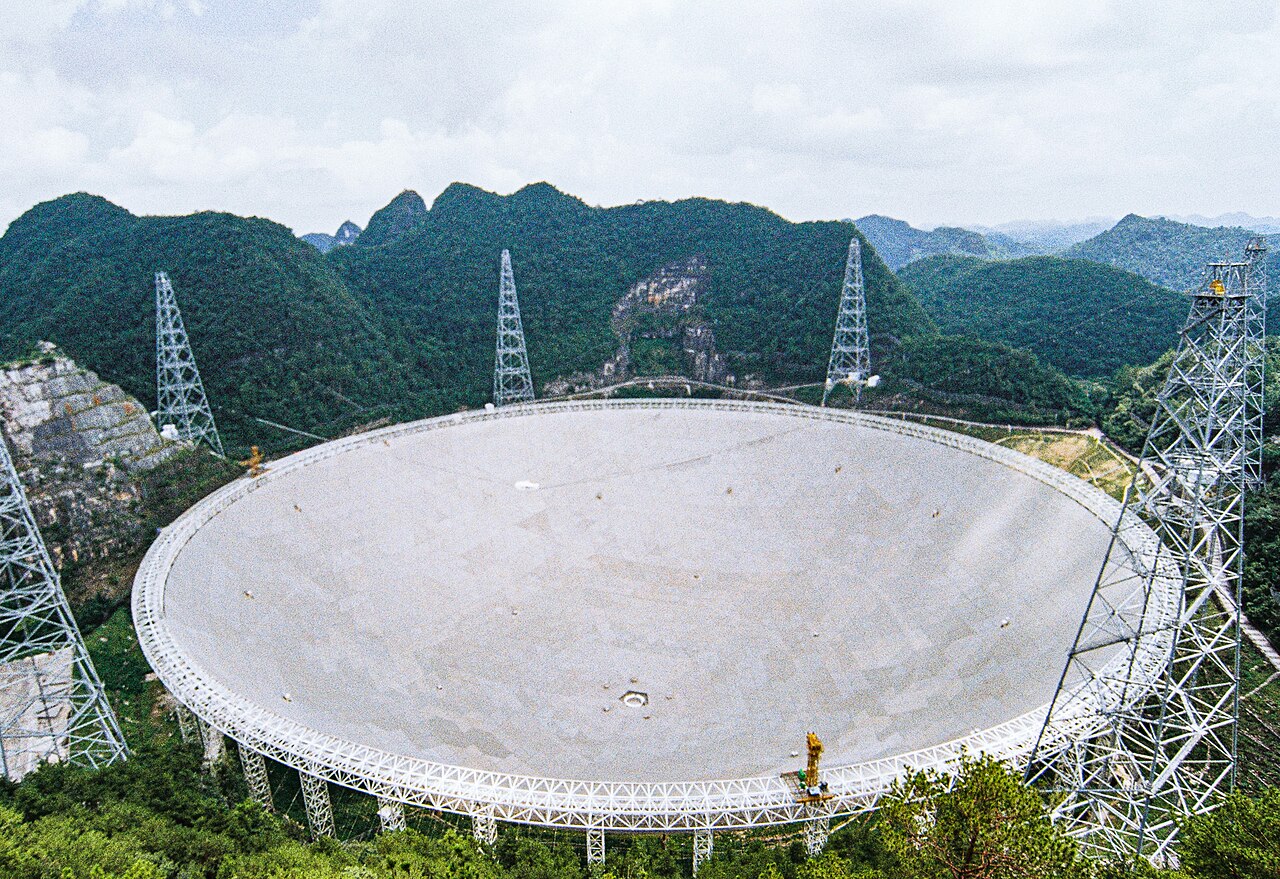
FAST

FAST, the 500-meter single-dish radio telescope located in southwestern China. [Wikipedia user SCJiang; CC BY 4.0]

Stack Search Success

To find faint millisecond pulsars, researchers have developed the stack search method, in which multiple radio observations are combined to tease out faint signals and decrease noise. Reliably stacking observations across epochs requires stability; isolated millisecond pulsars, now no longer spinning up after losing their companion, have very stable rotation periods, making them ideal targets for the stack search method. To date, the stack search method has successfully identified nine isolated globular cluster millisecond pulsars using data from the Arecibo, Parkes, and Green Bank radio telescopes.
Stack Spectra

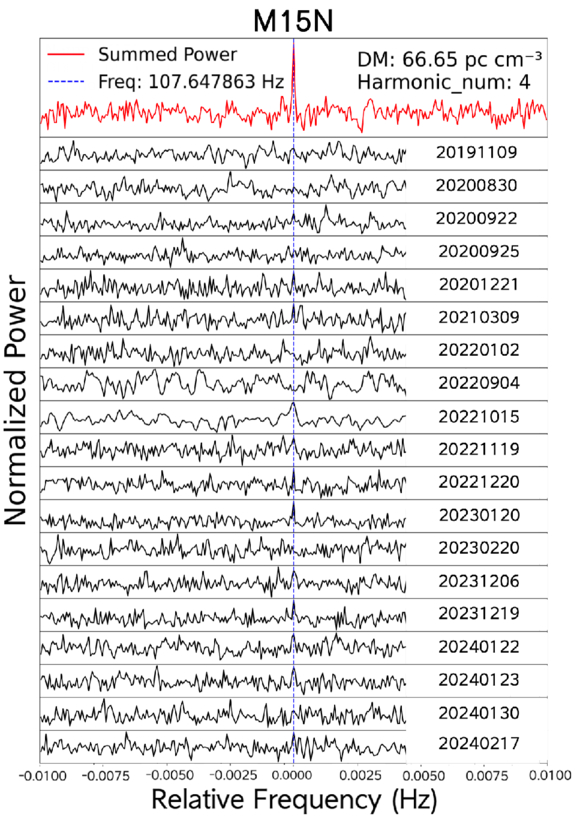
Power spectra from a discovered millisecond pulsar M15N. The black solid lines show the 19 individual observations of the pulsar, and the red solid line in the top panel shows the stacked spectrum. The stack search method pulls out a clear pulsar signal. [Dai et al. 2026]

In hopes of recovering more of these faint fast-spinning pulsars, Yinfeng Dai (Beijing Normal University) and collaborators used archival data obtained with the Five-hundred-meter Aperture Spherical radio Telescope (FAST), the world’s largest single-dish telescope. Targeting two specific globular clusters, NGC 6517 and M15, the team applied the stack search method to 23 and 19 observations of the globular clusters, respectively. From their search, the authors discovered six previously unidentified isolated millisecond pulsars: four in NGC 6517 and two in M15.

While previous studies identified brighter pulsars in the targeted globular clusters, the authors confirmed that all six newly discovered pulsars are too weak to be reliably recovered from single-epoch searches, underscoring the importance of the stack search method. In particular, this search increased the known pulsar populations of NGC 6517 and M15 by 27% and 18%, respectively, suggesting that a meaningful fraction of globular cluster pulsars are easily missed in traditional pulsar searches. Future studies employing this stack search method will continue to detect faint millisecond pulsars, unlocking this elusive population for further exploration.

Citation

“The Stack Search Tests on FAST Data: Discovery of Six Faint Isolated Millisecond Pulsars in NGC 6517 and NGC 7078 (M15),” Yinfeng Dai et al 2026 ApJL 1002 L31. doi:10.3847/2041-8213/ae5dbb

The post Stacking Up the Discovery of Six Millisecond Pulsars appeared first on AAS Nova.
Hints for Massive Galaxy Evolution from Dusty Star-Forming Galaxies

15 May 2026 at 17:00

NGC 972

How do massive galaxies form and evolve? A recent study traces the stellar and dust distributions across evolutionary phases of massive galaxies to better understand how massive dusty star-forming galaxies fit into the picture.

Dusty Massive Galaxies

Massive galaxies, like the Milky Way or even larger, undergo phases of active star formation and quiescent phases of inactivity, but exactly how these galaxies evolve through these stages is not yet fully understood. Dusty star-forming galaxies, which are undergoing a period of intense star formation and shrouded in dust, might be the missing evolutionary step between star-forming and quiescent phases of massive galaxy evolution. 

Currently, the leading explanation for massive galaxy formation and evolution is inside-out growth — star formation and quenching start in the inner regions of a galaxy and progress outward. However, it’s not clear whether dusty star-forming galaxies also follow the favored inside-out pathway, or if they instead proceed outside-in, first growing their disks and then assembling a central bulge.

JWST NIRCam images

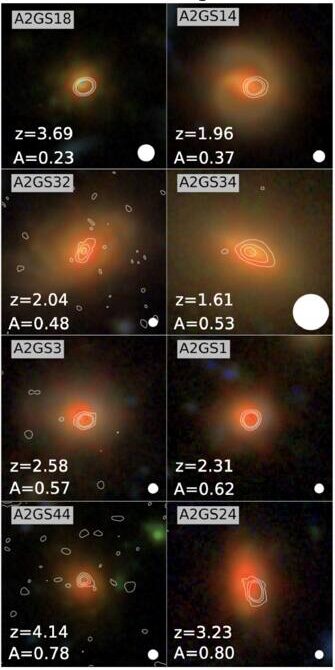
Example of JWST NIRCam images with ALMA contour lines overlaid for select dusty star-forming galaxies in the sample. [Modified from Bodansky et al 2026]

The spatial distribution (or morphology) of the stars and dust within dusty massive galaxies can help us trace their evolution. Thanks to high-resolution observations from JWST and the Atacama Large Millimeter/submillimeter Array (ALMA), researchers can now directly compare the morphologies of distant star-forming, quiescent, and dusty galaxies during the height of our universe’s star formation. Filling this gap will reveal how dusty star-forming galaxies may connect star-forming and quiescent galaxies in massive galaxy evolution.

Multiwavelength Morphological Comparisons

To directly compare the star and dust morphologies across massive galaxies, Sarah Bodansky (University of Massachusetts, Amherst) and collaborators selected a sample of 33 dusty star-forming galaxies from the GOODS-ALMA 2.0 survey that searched the sky for 1.1-mm dust emission as well as star-forming and quiescent comparison samples drawn from JWST observations. Combining the ALMA survey data with JWST imaging, the authors studied the rest-frame optical (stars) and rest-frame near-infrared (dust) morphologies of dusty, star-forming, and quiescent galaxies at redshifts around cosmic noon (a few billion years after the Big Bang).

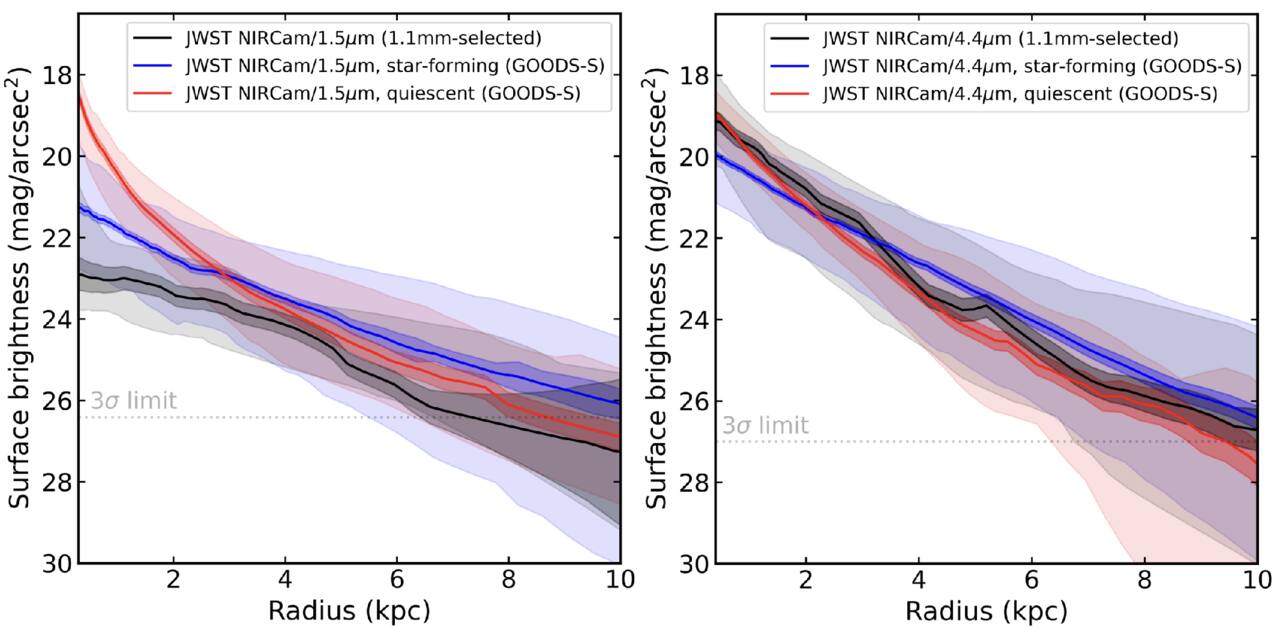
When comparing optical morphologies, the authors found that dusty star-forming galaxies and typical star-forming galaxies had similar distributions, but their near-infrared morphologies showed clear differences. Dusty galaxies tended to show more compact near-infrared emission, with dust tracing their stellar populations and more concentrated in the galaxies’ central regions. Though clearly different from star-forming galaxies, the authors noted striking similarities between the near-infrared morphologies of the dusty star-forming and quiescent galaxies, especially within their centers.

Surface brightness profiles

Average surface brightness profiles for the rest-optical (left) and rest-near-infrared (right) for the dusty (black), star-forming (blue), and quiescent (red) galaxies. In the near-infrared, the dusty star-forming galaxy profile appears very similar to the quiescent galaxy profile. [Bodansky et al 2026]

All of these properties suggest that dusty star-forming galaxies have built up stellar mass and dust in their cores, potentially forming a central bulge first and supporting an inside-out model of massive galaxy growth. This points to dusty star-forming galaxies as possible direct progenitors of early massive quiescent galaxies, hanging onto their last bit of star formation before becoming quiet as well. While this study morphologically distinguishes dusty galaxies from their star-forming and quiescent counterparts, future spectroscopic studies comparing the kinematics of these populations and investigations of molecular gas distributions are necessary to better pin down the evolutionary connection between star-forming, dusty, and quiescent massive galaxies.

Citation

“JWST+ALMA Reveal the Buildup of Stellar Mass in the Cores of Dusty Star-forming Galaxies at Cosmic Noon,” Sarah Bodansky et al 2026 ApJ 1001 235. doi:10.3847/1538-4357/ae4f64

The post Hints for Massive Galaxy Evolution from Dusty Star-Forming Galaxies appeared first on AAS Nova.

In or Out? Using Balmer Emission to Distinguish Inflows from Outflows

1 May 2026 at 17:00

M33

Galaxies pull in and pump out gas as they form and evolve, but distinguishing between the two directions is tricky. A recent study used emission lines and dust absorption to try to pin it down.

Inflow or Outflow?

Throughout their lives, galaxies churn gas into stars, stars fuse new metals, supernovae blow enriched material back out, and the cycle repeats. To maintain this process and sustain star formation, a galaxy must fuel up by accreting gas from its surroundings. However, catching galactic gas accretion has proven difficult — both emission from gas falling into the galaxy (inflows) and gas blown out by supernovae (outflows) can appear blueshifted or redshifted along an observer’s sight line, depending on if the flowing material is in front of or behind the galaxy.

While direct evidence of inflows has been identified in the Milky Way, only a few direct detections of inflowing gas in other galaxies exist due to the degeneracy of inflow and outflow emission-line features. Relying on additional absorption measurements, some studies have teased out inflows in other galaxies, but these star formation fuel pumps remain overwhelmingly evasive. The angle at which we observe a galaxy also limits our ability to detect both inflows and outflows, with face-on galaxies best oriented to detect these shifted spectral features. How then do we uncover this critical component of a galaxy’s evolution?

Breaking Through with the Balmer Decrement

Balmer decrement diagram

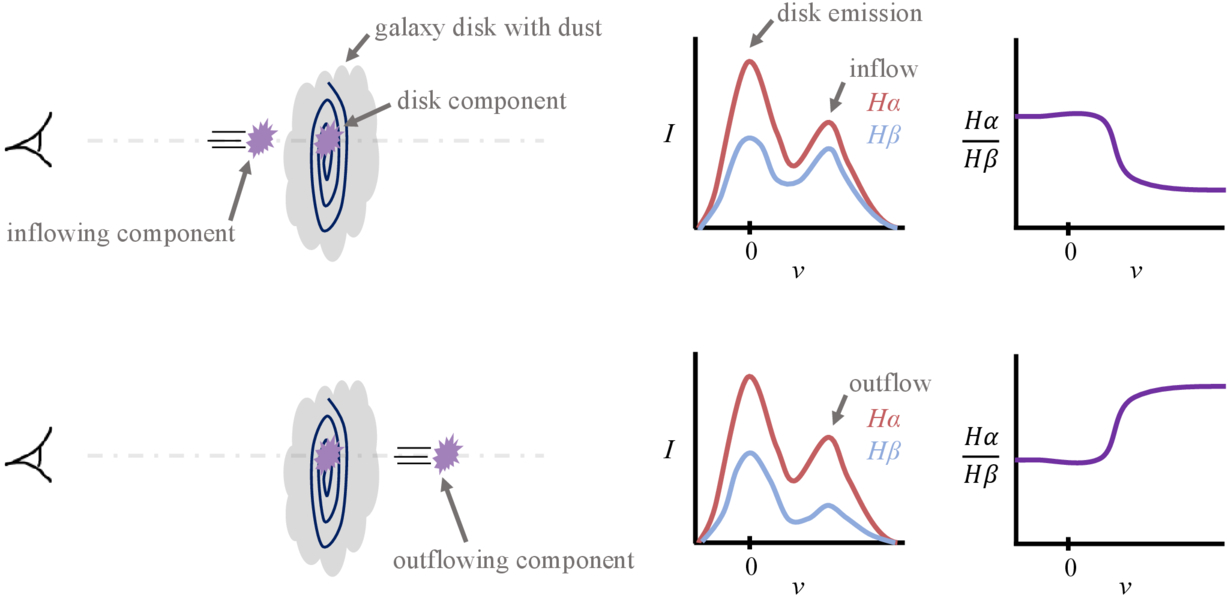
A diagram illustrating the degeneracy in emission spectra of galaxies, with the top panel showing an inflowing component and the bottom panel showing an outflowing component. While the Hα emission is similar, the Hβ emission is more affected by extinction due to dust in the galaxy’s disk, making it possible to identify inflow versus outflow based on the Balmer decrement. Click to enlarge. [Sitaram et al 2026]

To try to break through the confusion between inflows and outflows, Meghna Sitaram (Columbia University) and collaborators explored how the strengths of hydrogen emission lines vary depending on the location of the emitting gas. Referred to as the Balmer decrement, the ratio between the Hα (redder) and Hꞵ (bluer) emission lines is sensitive to dust between the emitting gas and the observer. Because dust preferentially absorbs bluer photons, an inflow or outflow behind a galaxy is expected to have a higher Hα/Hꞵ ratio due to the intervening dust in the galaxy’s disk absorbing some of the Hꞵ emission.

Testing this idea, the authors performed a hydrodynamic simulation of an isolated, face-on Milky Way–like galaxy and tracked inflows and outflows over a billion years. From the simulation, they extracted mock spectral observations to measure the ionized gas motions and Hα and Hꞵ emission lines along different sight lines throughout the galaxy. Separating gas components into three categories — inflow, outflow, and in the disk — the authors found that dust extinction does cause noticeable differences in the Balmer decrement depending on a component’s location with respect to the disk.

histograms

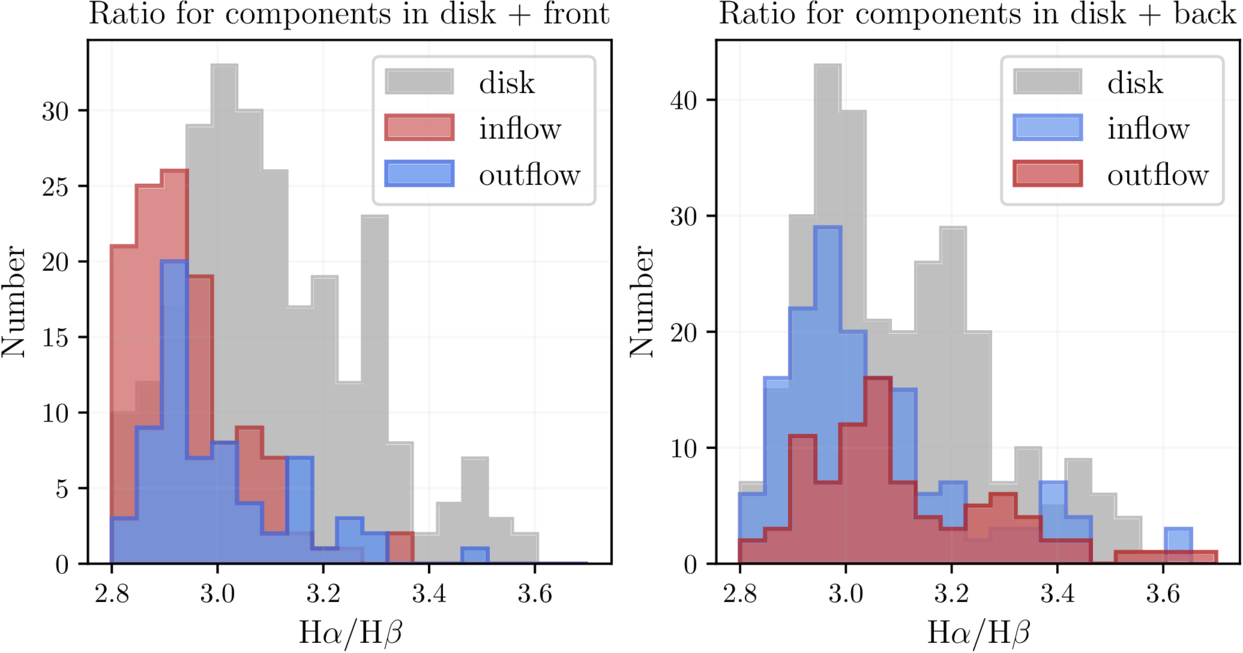
The distribution of Balmer ratios between different components in the interstellar medium and in front of the galaxy (left) and behind the galaxy (right). Material in front of the galaxy shows lower Hα/Hβ ratios. Click to enlarge. [Sitaram et al 2026]

Front Inflow Finds

What does this mean for identifying the inflows that provide galaxies with star-forming fuel? The authors reported that components in front of the galaxy — redshifted inflows and blueshifted outflows — tend to exhibit lower Hα/Hꞵ ratios compared to components behind the disk, aligning with the expectation that dust in the disk absorbs Hꞵ. In particular, these front inflows appear to be the most readily distinguished from gas in and behind the galaxy’s disk.

However, things get more complicated for gas behind the galaxy. Because the dust in the simulation is distributed nonuniformly in small clumps throughout the galaxy, it is difficult to distinguish between disk gas and gas behind the galaxy. While future simulations with improved dust modeling are necessary to resolve this issue, this study offers a useful method to distinguish inflow and outflow in dusty face-on galaxies.

Citation

“Identifying Signatures of Inflow onto Face-On Galaxies Using Balmer Decrement,” Meghna Sitaram et al 2026 ApJ 1001 87. doi:10.3847/1538-4357/ae5222

The post In or Out? Using Balmer Emission to Distinguish Inflows from Outflows appeared first on AAS Nova.

Water Vapor Around a Sizzling Supergiant: High-Resolution Spectroscopy of B[e] Supergiant LHA 115-S 18

17 April 2026 at 17:00

blue supergiant

Prior to exploding, massive stars advance through action-packed evolutionary stages that are exciting but often difficult to fully decipher. A recent study focuses on a unique late-stage star to better understand its properties and evolution.

To B[e] a Supergiant

HD 62623 disk image

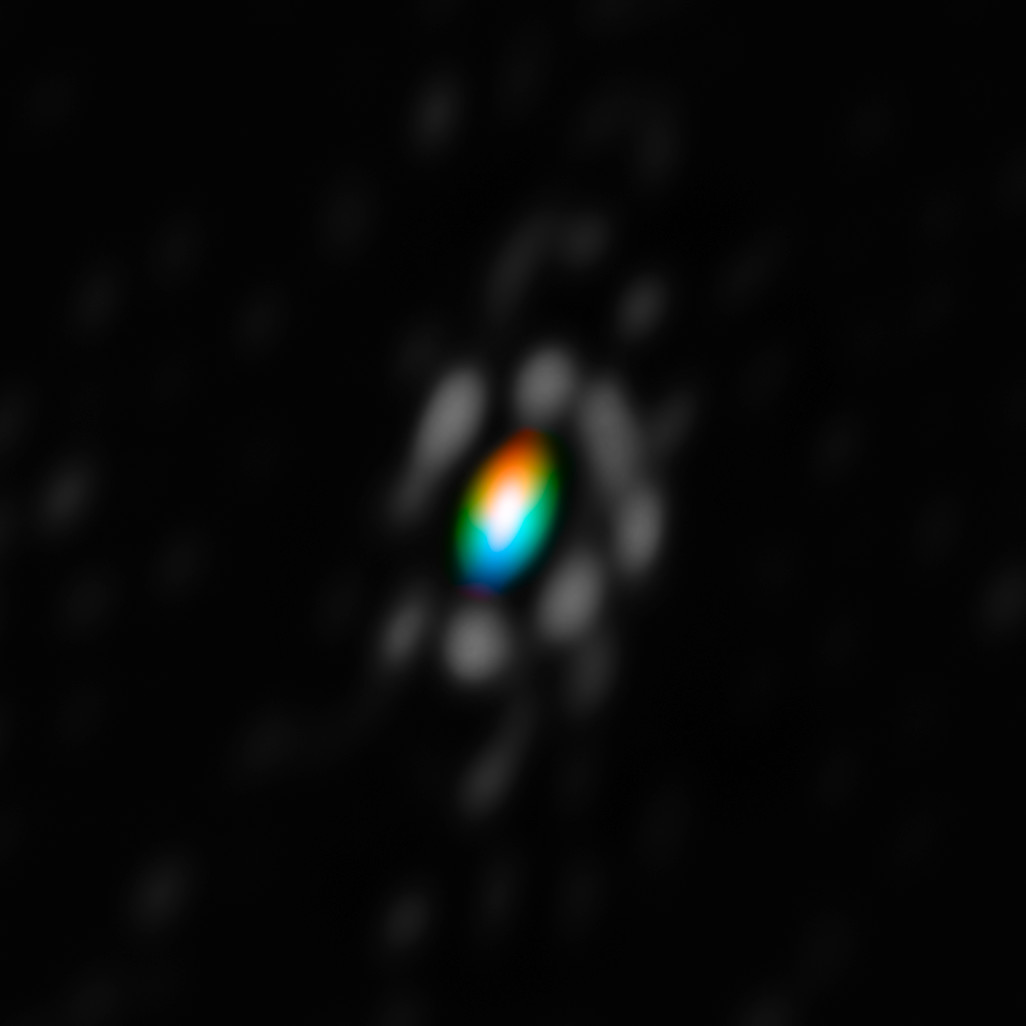
Very Large Telescope Interferometer image of the circumstellar disk around the B[e] supergiant star HD 62623. The colors indicate the rotation of the disk with blue coming toward us and red going away. [ESO/F. Millour; CC BY 4.0]

After depleting their cores of hydrogen, massive stars journey off the main sequence through a series of evolutionary phases before ending in dramatic supernova explosions. A massive star’s post-main-sequence evolution is intense, often sloughing off layers of material that can settle into a circumstellar disk. The B[e] supergiant phase describes a blue supergiant star surrounded by a cool, dense circumstellar disk where oxygen is more abundant than carbon. These environments often lock up carbon atoms in carbon monoxide molecules, leaving excess oxygen available to form other molecules including SiO, TiO, and water vapor. These molecules can survive under different physical conditions, making them key tracers of the environments around B[e] supergiants.

One particularly interesting B[e] supergiant, LHA 115-S 18, has been the subject of numerous studies but remains poorly constrained. The star exhibits significant variability both in brightness and emission features on timescales of days to years, and previous works have suggested that the star may have an as-yet unconfirmed binary companion. Molecular line emission from CO and TiO have been identified in LHA 115-S 18, indicating a circumstellar disk, but to date, water vapor emission has not been identified in any B[e] supergiant. Identifying more complex oxygen-bearing molecules like water will further reveal the physical properties and possible binary companion of LHA 115-S 18.

Identifying Emission in LHA 115-S 18

To characterize the emission around LHA 115-S 18, María Laura Arias (Institute of Astrophysics La Plata; National University of La Plata) and collaborators obtained high-resolution near-infrared spectroscopy of the star using the Immersion Grating Infrared Spectrometer on the Gemini South telescope. From the high-resolution spectra, the team identified several atomic emission lines indicative of the star’s gaseous envelope, revealing the structure of material around the star: an inner hot disk of ionized material and an outer cool disk of neutral material. Looking at molecular emission from carbon monoxide — a tracer of both gas motions and stellar age — the authors confirmed the presence of a rotating ring of gas around LHA 115-S 18 and determined that the star is an evolved, post–red supergiant object.

LHA 115-S 18 spectrum

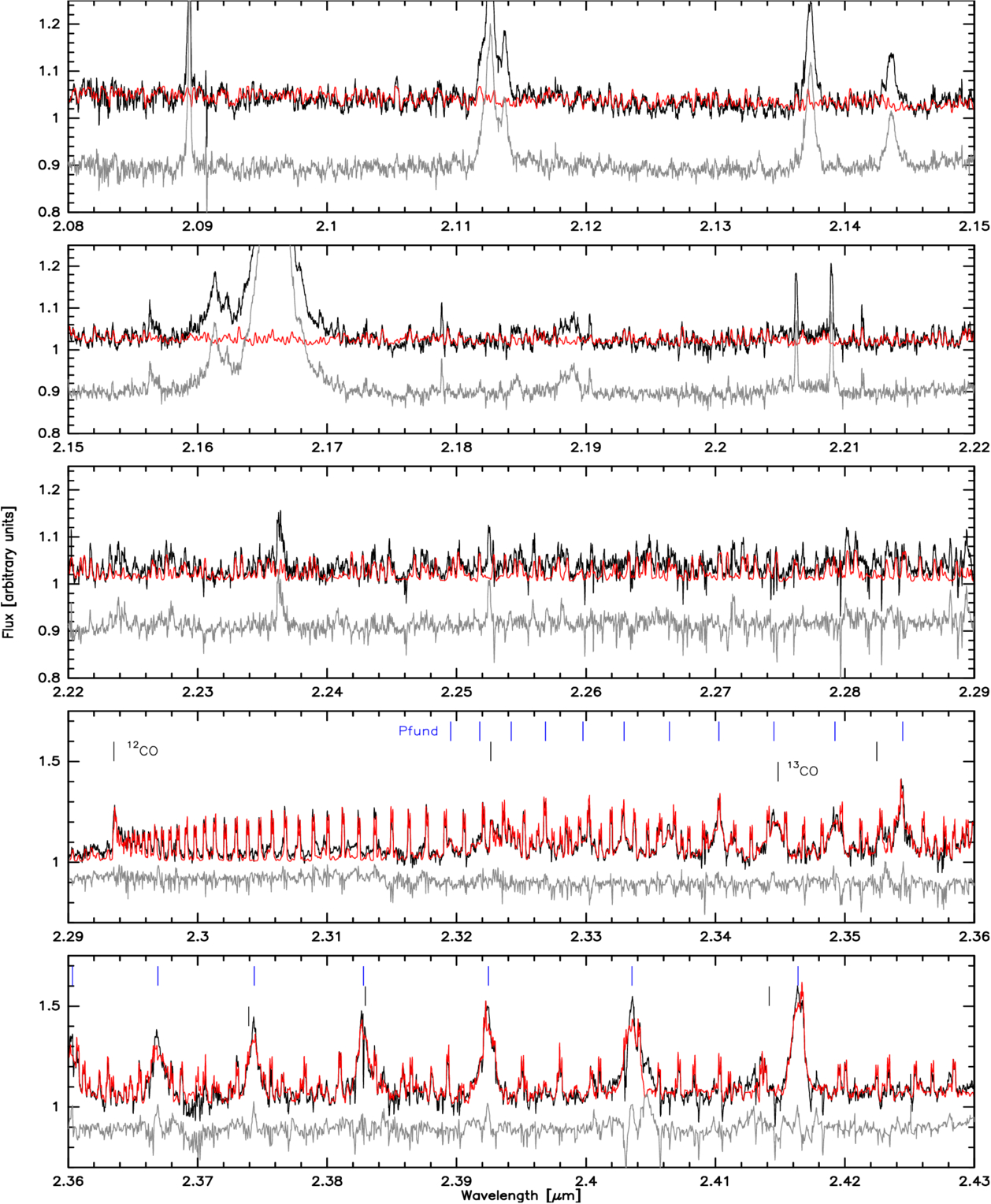
Spectrum of LHA 115-S 18 (black) with the model spectrum composed of water vapor (red, top three panels) and water vapor, CO, and hydrogen emission (red, bottom two panels) overplotted as well as residuals (gray). [Arias et al 2026]

Through computing a synthetic spectrum to compare to the observed spectrum, the authors identified many water vapor emission lines in the circumstellar environment around LHA 115-S 18. While water vapor has been detected in other evolved late-type stars, this is the first detection of water vapor from a B[e] supergiant star. For water vapor to survive the star’s intense radiation, it must exist in a dense, cool, heavily shielded disk around the B[e] supergiant.

Sustaining a cool disk around such a hot star indicates that the circumstellar environment around LHA 115-S 18 is complex and likely shaped by binary interaction. With emission features characteristic of both cool and hot evolved stars, this particular B[e] supergiant presents itself as a unique object holding critical insights into the late-stage evolution of massive stars. Further multiwavelength observations of LHA 115-S 18 will constrain its potential binarity and reveal a possible evolutionary link between B[e] supergiants and other late-stage evolutionary phases of massive stars.

Citation

“High-resolution Near-Infrared Spectroscopy of the B[e] Supergiant LHA 115-S 18: Discovery of Hot Water Vapor Emission,” María Laura Arias et al 2026 ApJL 1000 L49. doi:10.3847/2041-8213/ae524a

The post Water Vapor Around a Sizzling Supergiant: High-Resolution Spectroscopy of B[e] Supergiant LHA 115-S 18 appeared first on AAS Nova.

Characterizing the Atmosphere of Exoplanet WD 0806b with JWST

3 April 2026 at 17:00

gas giant orbiting white dwarf

Orbiting a white dwarf, the exoplanet WD 0806b is the subject of a recent study using JWST to measure the atmospheric conditions governing the planet.

Directly Imaged Exoplanet WD 0806b

Most of the 6,000 and counting exoplanets discovered thus far have been detected due to their impacts on their host star — passing in front of the star and causing it to dim, or gravitationally tugging on the star and causing it to wobble. On rare occasions, though, astronomers have been able to catch the exoplanet itself through direct imaging. Directly imaged exoplanets offer key insights that cannot be obtained through indirect detection methods. Luminosity measurements and spectral emission features allow astronomers to more directly measure planet mass, radius, and composition otherwise inferred from the host star.

WD 0806b system

NIRCam image showing host star WD 0806 circled in orange and the location of exoplanet WD 0806b marked by the orange arrow. [Lew et al 2026]

Included in the about 90 distant planets that have posed for a picture is WD 0806b, a rare exoplanet companion trotting around a white dwarf at an orbital distance of 2,500 au (50 times the distance from the Sun to the Kuiper belt!). Originally discovered with the Spitzer Infrared Array Camera in 2011, WD 0806b is the second-coldest directly imaged exoplanet to date. With JWST’s high-precision photometric and spectroscopic capabilities, WD 0806b provides a unique opportunity to probe the atmospheric chemistry of cold giant planets and take steps toward understanding the co-evolution of white dwarfs and their surviving exoplanets.

WD 0806b’s Atmospheric Abundances from JWST

Aiming to characterize the physical properties and atmospheric composition of WD 0806b, Ben W.P. Lew (Bay Area Environmental Research Institute; NASA Ames Research Center) and collaborators used JWST’s Near-Infrared Camera (NIRCam) and Near-Infrared Spectrograph (NIRSpec) to obtain high-resolution imaging and spectroscopy of the exoplanet. Combining these observations, prior lower-resolution observations, and evolutionary planet models, the authors estimated the physical properties of WD 0806b including mass, radius, surface gravity, and effective temperature.

WD 0806b spectrum

NIRSpec spectrum of WD 0806b with best-fit model spectra overlaid. [Lew et al 2026]

From the derived physical properties, the authors modeled the NIRSpec spectrum to estimate molecular abundances and elemental abundance ratios in the atmosphere of WD 0806b. They obtained measurements of multiple molecules including carbon dioxide, carbon monoxide, and ammonia; these molecular abundances offer the opportunity to test chemical equilibrium and disequilibrium as well as eddy diffusion, or bulk mixing, in the planet’s atmosphere. The authors developed a novel chemical analysis framework to determine how bulk mixing varies with altitude in WD 0806b and reported the first observational evidence that mixing becomes weaker at higher altitudes in exoplanet atmospheres. This result points to the need for future studies exploring the impact of these chemical processes on spectra and photometry, which are essential to characterizing cold giant planets.

This study highlights how high-precision JWST data can reveal a rich collection of atmospheric conditions, chemical composition, and physical processes occurring in cold giant planets. With such a wide orbit from its host white dwarf, WD 0806b serves as an interesting case study for how giant planet composition may reflect the formation and evolutionary history of the overall system. Future observations of and comparisons to similarly cold giant planets will further uncover how atmospheric characterization may fit into our understanding of exoplanets and their histories.

Citation

“JWST Spectral Retrieval of Cold Directly Imaged Planet WD 0806b and the First Measurement of Altitude-dependent Kzz in Exoplanet Atmospheres,” Ben W.P. Lew et al 2026 AJ 171 227. doi:10.3847/1538-3881/ae4747

The post Characterizing the Atmosphere of Exoplanet WD 0806b with JWST appeared first on AAS Nova.

Starring in the Early Universe: Black Hole Stars and Little Red Dots

25 March 2026 at 16:10

NIRCam JADES image

JWST has uncovered a peculiar population of very distant objects known as “little red dots.” The mechanisms powering these objects’ peculiar properties — high luminosities, compact radii, and “V”-shaped spectra — remain uncertain. Could little red dots be the result of supermassive stars, galaxy mergers, or, as a recent study explores, black hole stars?

Direct-Collapse Black Holes and Little Red Dots

Since their discovery, little red dots have been the subject of many studies, but a complete explanation for their unique combination of properties remains elusive. Multiple studies have explored the growing population of peculiar dots, with some postulating that they are the result of stars thousands of times the mass of the Sun, supermassive stars entrenched in gas from a galaxy merger, or black holes embedded in dense accretion disks. 

Even more recently, studies have proposed that little red dots may be the remnants of direct-collapse black holes. In this scenario, a large cloud of gas in the early universe directly collapses into a stellar-mass black hole, and the remaining gas envelops the black hole, forming what is known as a quasi-star (or black hole star). Researchers have suggested that little red dots may be the late stage of this process when the black hole has accreted at least 10% of the total mass of the system. Direct comparisons between quasi-star evolutionary models and JWST observations of little red dots have yet to be explored but are necessary to confirm the potential of quasi-star origins.

Evolutionary Models of Quasi-Stars

Quasi-star HR diagram

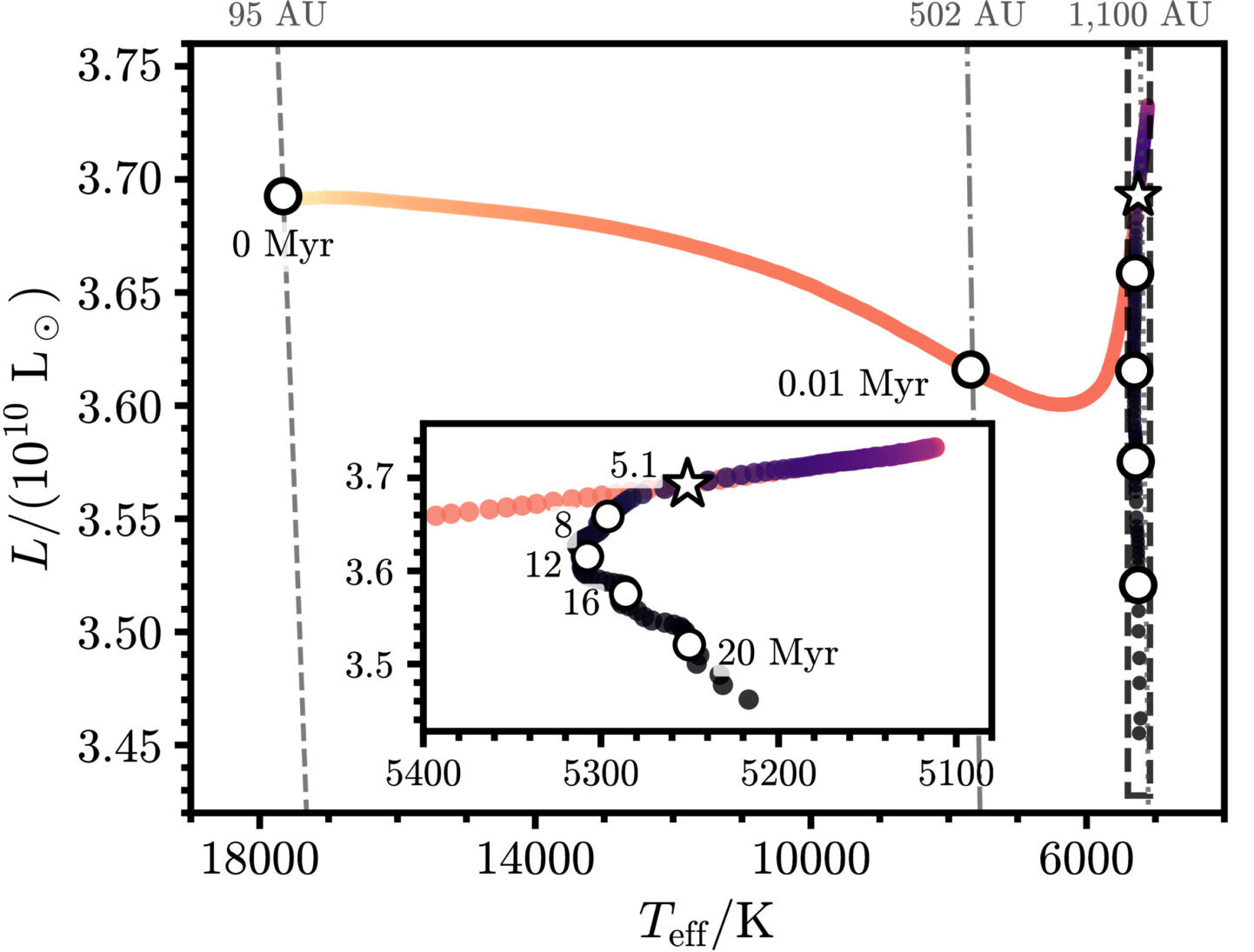
Evolution of a theoretical quasi-star model on a Hertzsprung–Russell diagram. [Modified from Santarelli et al 2026]

Seeking to compare quasi-star evolutionary models to JWST observations of little red dots, Andrew D. Santarelli (Yale University) and collaborators developed a modeling framework to simulate quasi-star evolution. In this framework, a quasi-star is modeled as a black hole at the core of a massive star that accretes material from the stellar envelope over its lifetime. The authors computed models for a range of initial masses and tracked the evolution of the quasi-stars, predicting luminosities, temperatures, surface gravities, and lifetimes of these objects.

After a short initial phase of contraction lasting around 10,000 years, the quasi-star spends the rest of its approximately 20–40-million-year lifetime in the “late stage” as the central black hole continues to eat up the surrounding envelope. In the end, the quasi-star becomes a supermassive black hole a million times the mass of the Sun.

SED comparison of quasi-star + LRDs

Predicted spectral energy distributions of 1 million solar mass, late-stage quasi-stars both alone (black dashed line) and embedded in a host galaxy (solid blue line). Each panel compares the quasi-star to a little red dot observed by JWST. [Modified from Santarelli 2026]

From these models, the authors extracted synthetic spectral energy distributions for late-stage quasi-stars. In comparing the simulated quasi-star spectra to those of three observed little red dots, the authors found that the synthetic quasi-star spectra generally reproduce the main continuum features seen in all three of the little red dots. While the models do not account for specific emission lines, the continuum slopes of the ultraviolet and near-infrared parts of the spectral energy distributions that form the signature “V” shape generally agree with those seen in the three comparison little red dots.
Plausible Progenitors

The results of this study indicate that late-stage quasi-stars can naturally produce the defining continuum features of little red dot spectra. While further modeling is required to trace specific emission line features, the initial modeling presented in this study establishes quasi-stars as plausible progenitors of not only little red dots but also the universe’s first supermassive black holes. 

As the authors noted, the short lifetimes of quasi-stars shown in their models in conjunction with the observed number density of little red dots implies that a significant fraction of supermassive black holes formed through this mechanism. Continued observations of little red dots and advanced modeling of direct-collapse black holes will aid in determining if these peculiar dots are showing off the birth of supermassive black holes in the universe.

Citation

“Evolutionary Tracks and Spectral Properties of Quasi-stars and Their Correlation with Little Red Dots,” Andrew D. Santarelli et al 2026 ApJL 998 L4. doi:10.3847/2041-8213/ae3713

The post Starring in the Early Universe: Black Hole Stars and Little Red Dots appeared first on AAS Nova.

Pulling Back the Curtain on DART Ejecta

6 March 2026 at 17:00

In September 2022, the Double Asteroid Redirection Test (DART) mission served as the first attempt at redirecting a near-Earth asteroid — an experiment testing humanity’s ability to fend off any threatening Earth-bound asteroids. A recent study presents the first 3D reconstruction of the impact ejecta, suggesting that the blown-out material is more complex than previous models considered.

DART-ing into Dimorphos 

The DART spacecraft intentionally smashed into Dimorphos, the small and unassuming moon of the larger asteroid Didymos. This space-based crash test aimed to determine if kinetic impactors like DART could successfully change an asteroid’s course through the solar system. Dimorphos’s orbit was indeed shortened by roughly 30 minutes, confirming that ramming an asteroid with a spacecraft could be a viable method of planetary defense. However, determining exactly how much an asteroid’s path will be altered is not necessarily straightforward. When a spacecraft collides with an asteroid, the impactor imparts momentum to the target, and any material excavated from the impact site can also alter the asteroid’s course.

DART’s impact launched a significant spray of rubble, or what researchers call an ejecta curtain. The ejecta curtain is typically modeled as a cone, using a simple geometry to determine its contribution to momentum transfer. However, when looking closely at imaging taken soon after the collision, the real physical structure of the ejecta appears to be more complex. Untangling the true 3D distribution of the ejecta is necessary to understand how momentum was actually distributed among escaping ejecta, better estimate the total mass ejected from Dimorphos, and improve modeling of the Didymos system’s orbit after impact.

DART ejecta

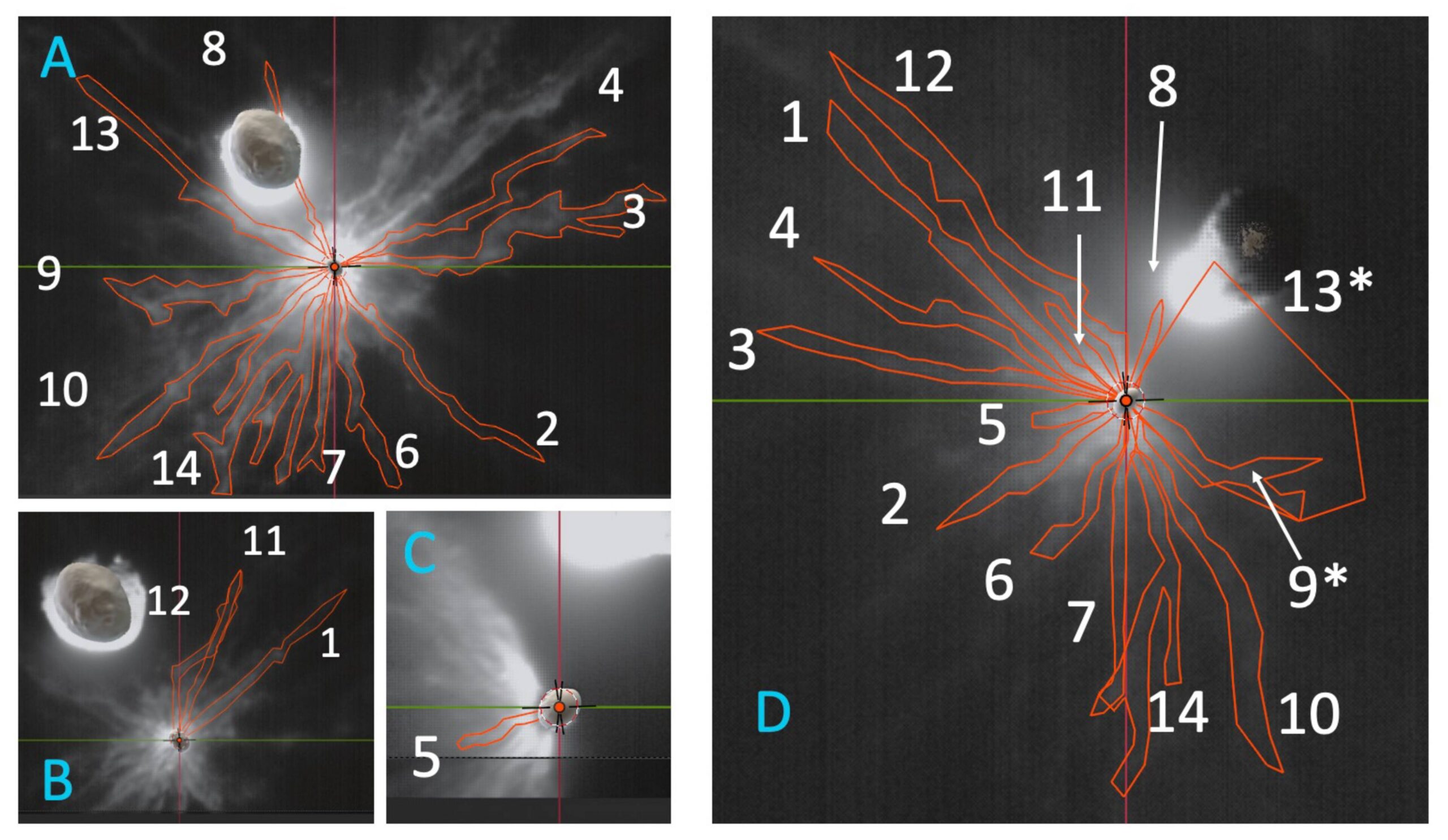
LICIACube images of the DART ejecta curtain with the 14 distinct features identified in this study outlined in red. Click to enlarge. [Deshapriya et al 2026]

Determining Debris Distribution

Seeking to better characterize the ejecta curtain, a team led by J. D. P. Deshapriya from Italy’s National Institute for Astrophysics used data from the Light Italian CubeSat for Imaging of Asteroids (LICIACube) that flew behind the DART spacecraft to capture images of the system shortly after the impact. After careful image handling to bring out diffuse and faint material, the researchers identified 14 distinct ejecta features across the flyby imaging. LICIACube viewed the aftermath both side on and face on, providing valuable 3D information about the distribution and motion of the ejecta. 

DART ejecta animation

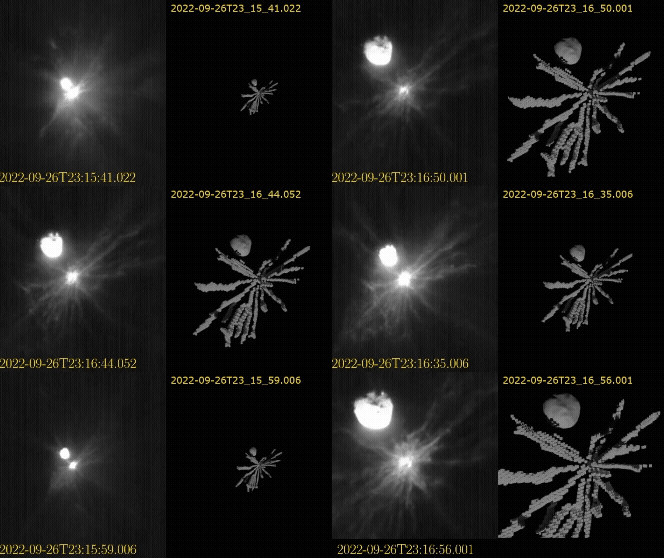
Animation of the DART ejecta as the LICIACube spacecraft approached the impact. The left shows the images taken by the spacecraft, and the right shows the 3D model produced for the ejecta. Click to play animation. [Deshapriya et al 2026]

Using 3D modeling software, the researchers traced each of the 14 distinct features across the images and reconstructed a 3D representation of the ejecta morphology. While earlier models assumed symmetric cone-like geometries, this 3D modeling revealed clear asymmetric and non-uniform structures within the ejecta curtain. These variations point to underlying heterogeneities in the impact site on Dimorphos — surface and subsurface composition naturally link to the resulting ejecta distribution according to previous laboratory experiments. The spatial and directional features uncovered in this study highlight the limitations of models that attempt to characterize ejecta curtains with symmetric and uniform distributions. Refining these model parameters will better match observations and better predict momentum transfer in future missions. 

Planetary Defense

What does this mean for planetary defense? While simplified symmetric cone models provide helpful approximations for kinetic impactor missions, they do not fully capture the true complexity of the impact. This study shows that local variations in an asteroid’s surface and interior properties can directly influence the resulting ejecta distribution and motion. The true momentum imparted to the target asteroid depends heavily on the specific ejecta material, and these details inform how effective planetary defense missions can be in redirecting asteroids. Incorporating realistic, observation-driven ejecta distributions into modeling frameworks is essential to achieve reliable predictions for future planetary defense missions.

Citation

“3D Reconstruction of DART Ejecta at Dimorphos Reveals an Anisotropic, Filamentary Structure,” J. D. P Deshapriya et al 2026 Planet. Sci. J. 7 4. doi:10.3847/PSJ/ae2c64

The post Pulling Back the Curtain on DART Ejecta appeared first on AAS Nova.

Satellite Surplus Around Dwarf Galaxy DDO 161

20 February 2026 at 17:00

LMC

Small galaxies are expected to have even smaller companion galaxies, according to current cosmological models. A recent study takes a look at one dwarf galaxy and finds more tiny companions than anticipated. 

Cosmology Predicts Satellite Galaxies

Critical to our understanding of dark matter and galaxy formation, satellite galaxies are small, faint galaxies surrounding a larger host galaxy. The leading cosmological model, known as lambda cold dark matter (ΛCDM), predicts dark matter halos of all masses to host smaller dark matter subhalos whose luminous counterparts make up satellite galaxies. 

While the satellite systems of Milky Way-like galaxies are well characterized, the companions of dwarf galaxies are less well studied. Despite being significantly smaller, dwarf galaxies should also host even smaller satellites galaxies around them. These satellites push the limits of observations — extremely faint and hard to distinguish from background sources, dwarf galaxy satellites require innovative imaging techniques to discover. 

In recent years, new surveys have identified a number of satellites around dwarf galaxies that appear broadly consistent with ΛCDM predictions, though the sample size is still small. Continuing the search for little galaxies’ little galaxies is critical to testing the ΛCDM framework and will further our understanding of galaxy formation on the smallest scales. 

DDO 161 satellite map

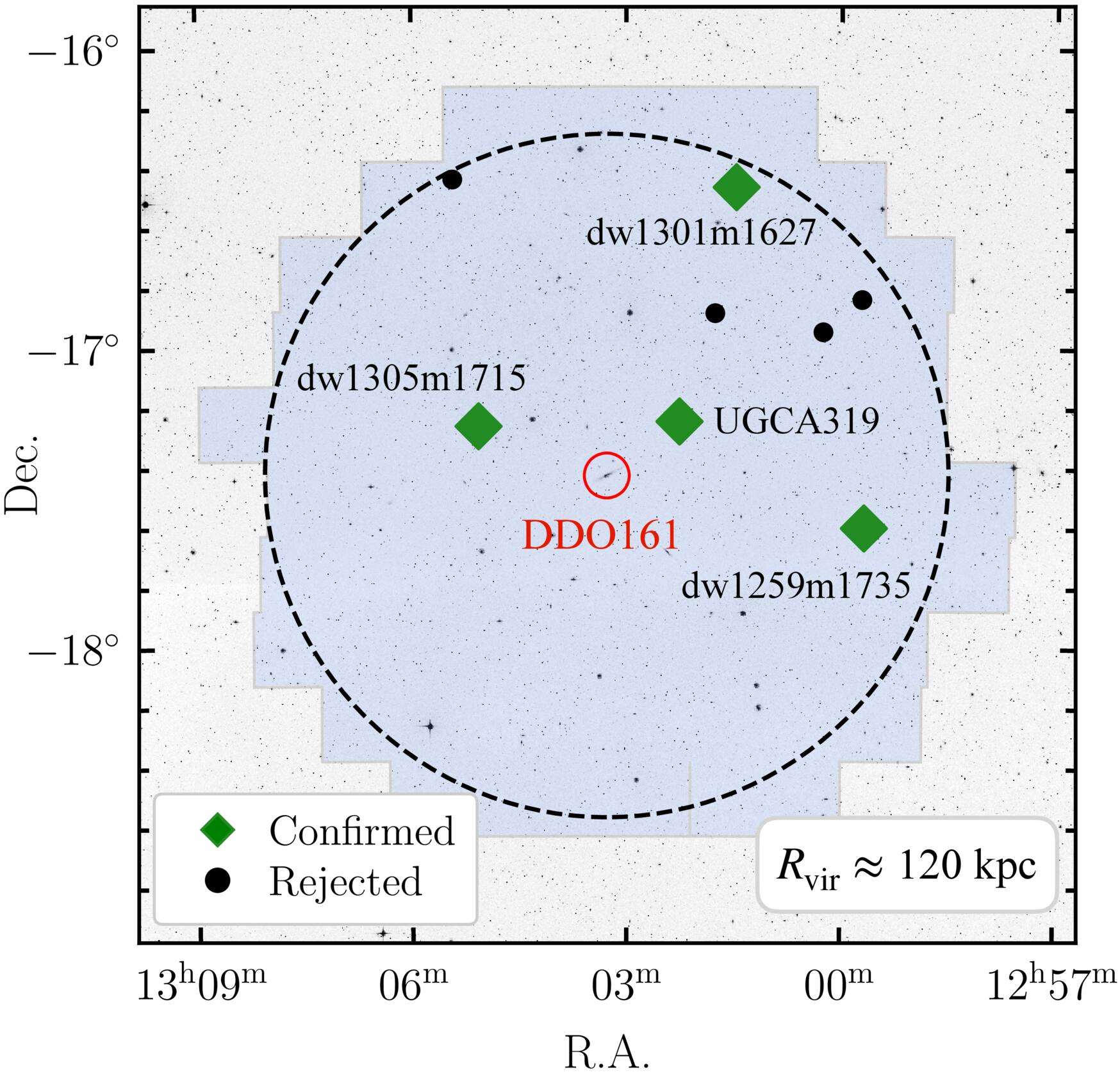
Satellite candidates around DDO 161 as they appear on the sky. Click to enlarge. [Li et al 2026]

Searching for Satellites Around DDO 161

Diving into a specific system, a team led by Jiaxuan Li (李嘉轩) from Princeton University began an in-depth search for satellites around the dwarf galaxy DDO 161. Prior to this study, DDO 161 was known to have one companion, UGCA 319, that is about 10 times smaller than its host. 

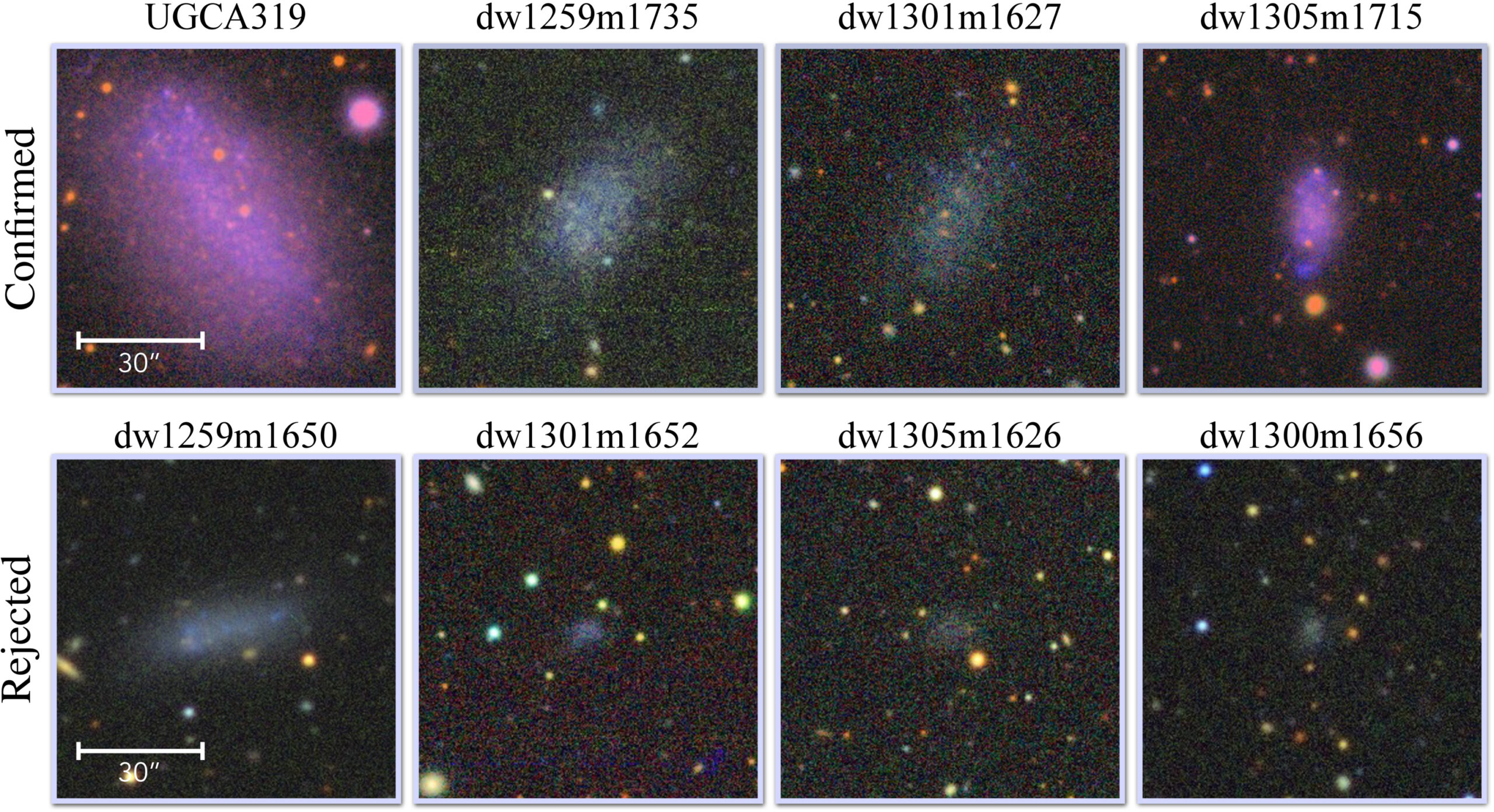
The authors used data from the Legacy Surveys to search for satellites within about 400,000 light-years of DDO 161 — the expected reach of DDO 161’s gravitational influence. After removing bright sources and smoothing the image to bring out very faint objects, they found eight satellite galaxy candidates including UGCA 319.

Images of the satellite candidates of DDO 161 from the Legacy Surveys. The top row shows the confirmed satellites, and the bottom row shows the rejected satellites. Click to enlarge. [Li et al 2026]

To confirm if these candidates were actual satellites of DDO 161, the team performed follow-up observations of the seven unconfirmed sources with the Magellan 6.2-meter telescope. Using the surface brightness fluctuation technique — measuring how a galaxy’s light fluctuates from pixel to pixel to determine its distance — the authors confirmed that three of the candidates are located at a similar distance to DDO 161 and are likely satellites. With the previously confirmed companion UGCA 319, DDO 161 has four satellite galaxies with stellar masses above 250,000 solar masses, making it the most satellite-rich dwarf galaxy known to date. 

Too Many Satellites

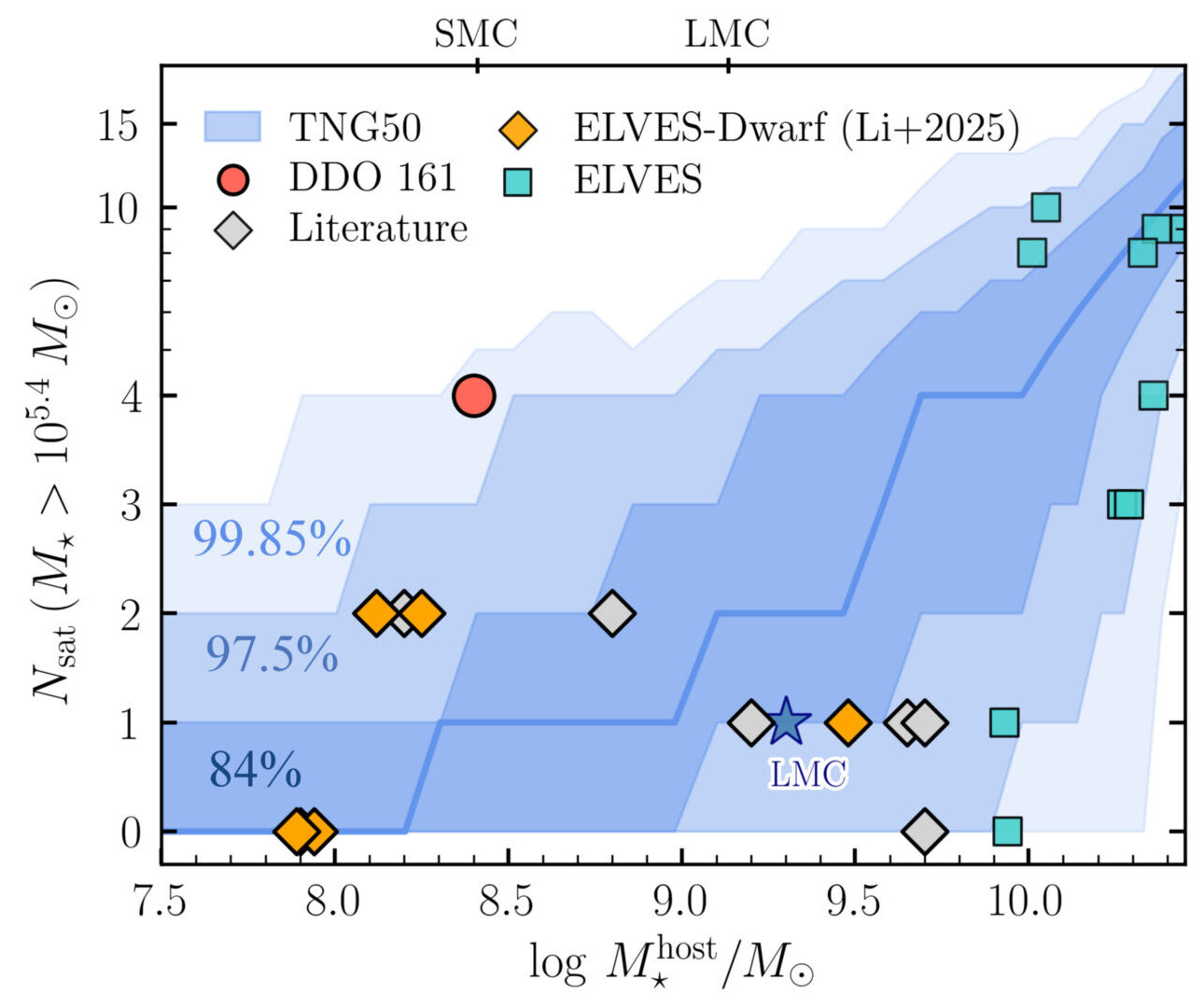
How does DDO 161 compare to theoretical predictions for galaxies of its size? The authors ran cosmological simulations to quantify the expected satellite populations around galaxies of similar size to DDO 161. Just as it is an outlier observationally, DDO 161 is also an outlier when compared to the simulation results that predicted fewer satellite galaxies in similarly massive host systems. 

DDO 161 Satellite Population Comparison

Number of satellites versus host galaxy stellar mass for DDO 161 (red circle) compared to other observed low-mass galaxy satellite systems (data points) and predicted ranges from simulations (blue regions). DDO 161 is a clear outlier, having a high number of satellites for the host galaxy’s stellar mass. Click to enlarge. [Modified from Li et al 2026]

Making sure to cover all bases, the authors considered their observational uncertainties, limitations of the simulations, different relationships between stellar and dark matter halo mass, and possible environmental effects. None of these checks could, at this point, sufficiently explain the satellite overabundance in DDO 161, introducing a possible “too-many-satellites” problem for this galaxy. A larger sample of satellites around dwarf galaxies is necessary to better understand this discrepancy, test our current cosmological framework, and give new insight into galaxy formation on small scales. 

Citation

“A Possible ‘Too-many-satellites’ Problem in the Isolated Dwarf Galaxy DDO 161,” Jiaxuan Li et al 2026 ApJL 998 L24. doi:10.3847/2041-8213/ae3ddd

The post Satellite Surplus Around Dwarf Galaxy DDO 161 appeared first on AAS Nova.

We Have Visitors: Interstellar Material from Nearby Debris Disks

6 February 2026 at 17:00

'Oumuamua

Traversing the galaxy from places yet known, a few interstellar objects have taken a quick dip into our solar system. These objects have inspired a frenzy of questions regarding their origins and paths that led them here. A recent study took to nearby planet-forming stellar systems as possible launching posts.

Interstellar Object Origins

As 3I/ATLAS was first spotted entering the solar system in July 2025, all eyes turned to the curious interstellar visitor. Just the third interstellar object astronomers have observed, 3I/ATLAS joins 1I/ʻOumuamua (2017) and 2I/Borisov (2019) in capturing our attention and igniting many questions regarding their origins and journeys to our corner of the Milky Way. While astronomers have characterized these objects’ compositions, sizes, and paths through the solar system, the mechanisms by which these objects leave their origin systems and travel the galaxy before arriving here are not well constrained. 

These three large bodies are just part of the interstellar material visiting the solar system — spacecraft have detected an influx of small interstellar dust particles, and while not yet directly confirmed, interstellar meteoroids burning up in Earth’s atmosphere are possible. This loose material likely originates in dusty, planet-forming disks (debris disks) around stars — rubble kicked out into interstellar space, sending chemicals, organic compounds, and perhaps even the precursors of life to other nearby systems. Understanding the origins and trajectories of such material will allow us to investigate planet formation and how developing systems may impact their environments.

Deliveries from Debris Disks

Debris disks offer ideal testbeds for tracing small bodies and dusty material through the galaxy. Interactions with large planets in debris disks can launch loose material like planetesimals and dust into interstellar space. To explore how debris disks may drive interstellar visitors to our solar system, Cole R. Gregg and Paul A. Wiegert (The University of Western Ontario) simulated how much material the 20 nearest debris disks would contribute to the interstellar object population of our solar system.

sky projection for particle arrival directions

Arrival direction on the sky for particles that reach the solar system from the 20 debris disks studied here. The arrival locations for 1I/ʻOumuamua, 2I/Borisov, and 3I/ATLAS are shown for comparison. Click to enlarge. [Gregg and Wiegert 2025]

The authors modeled the trajectories of ejected material from each debris disk within a simulated Milky Way, running the simulations backward and forward in time to trace the ejecta over 100 million years. These simulations show that material from each of the 20 systems is currently expected to be within our solar system. For interstellar objects (≥100 meters), the simulations predict that about two objects from these debris disks are currently within the inner solar system.

Trickier to spot, smaller meteoroids (≥200 microns) that would appear as meteors in Earth’s atmosphere are also expected. The only way to observationally confirm interstellar origins for meteors is based on how fast they are moving relative to the material in our solar system, or their excess velocities. Based on the simulations, many of these smaller particles have low excess velocities, making them observationally difficult to distinguish from bound solar system objects.

Observational Connections and Expectations

'oumuamua zoom in plot

Zoomed-in view focusing on the direction where 1I/ʻOumuamua entered the solar system. The interstellar object falls near the arrival directions of particles from HD 38858 and HD 166. Click to enlarge. [Gregg and Wiegert 2025]

How do these simulations compare to observations? From their analysis, the authors identified where the interstellar material from each debris disk would first enter the solar system. Comparing these to the entry locations of 1I/ʻOumuamua, 2I/Borisov, and 3I/ATLAS, ʻOumuamua appears near the entry locations for debris from HD 166 and HD 38858. (2I/Borisov and 3I/ATLAS had no such match up in this sample of debris disks.) However, tracing ʻOumuamua’s travel backward, its closest approaches to these systems are about 32 and 18 light-years away, respectively — likely too far to have originated from either system but still a clear proof of concept that we can place interstellar objects near potential systems of origin. 

Where are the expected interstellar meteoroids? Current meteor detectors including the Canadian Meteor Orbit Radar (CMOR) and the Global Meteor Network (GMN) search the sky for incoming material. While the simulations predict hundreds of meteoroid-sized particles from each debris disk currently in the inner solar system, the small collecting area of CMOR and the limiting size of grains detectable by GMN statistically require decades of observations to detect even a single interstellar meteoroid. Thus, the lack of detections thus far is not surprising, but with advanced instrumentation, discoveries of more interstellar particles and objects are imminent.

Citation

“A Catalogue of Interstellar Material Delivery from Nearby Debris Disks,” Cole R. Gregg and Paul A. Wiegert 2025 PSJ 6 309. doi:10.3847/PSJ/ae284f

The post We Have Visitors: Interstellar Material from Nearby Debris Disks appeared first on AAS Nova.

Getting a Peek of Kitt Peak National Observatory

23 January 2026 at 17:00

KPNO

After AAS 247 in Phoenix, Arizona, AAS Nova Editor Kerry Hensley and I had the chance to travel about 150 miles south for a tour of Kitt Peak National Observatory.

A Window into Kitt Peak

Located 60 miles southwest of Tucson, Kitt Peak National Observatory (KPNO) resides on a mountain top within the Tohono O’odham Nation reservation. Founded in 1958, Kitt Peak is home to nearly two dozen active telescopes ranging in wavelength coverage and scientific objectives. Ronald Proctor, Lori Allen, and Jacelle Ramon-Sauberan, all serving in crucial roles for the observatory, led our tour around the mountain.

Windows Center Lobby

The Windows On the Universe Center’s lobby exhibit displaying the Tohono O’odham language with words describing the land and astronomy. Jacelle Ramon-Sauberan, the Tohono O’odham Nation Education Liaison, is seen to the left. [KPNO/NOIRLab/NSF/AURA/R. Proctor; CC BY 4.0]

Our visit began in the new Windows on the Universe Center — the first science center inside of a telescope. Situated inside the retired McMath-Pierce Solar Telescope, the Windows Center takes visitors through exhibits exploring the universe, the telescope’s original control room, and the observatory’s connection to the Tohono O’odham Nation.

The center’s lobby introduced visitors to the beautiful land KPNO calls home. Working with Tohono O’odham linguists, Jacelle, the observatory’s Tohono O’odham Nation Education Liaison, curated the lobby exhibit that features the native language and the Nation’s connection to astronomy and the observatory. The science center serves as an educational resource and place of cultural exchange, expanding the relationship between the observatory and the Tohono O’odham Nation. 

Astronauts

Apollo astronauts in the control room of the McMath-Pierce Solar Telescope in 1964. [United States Geological Survey; CC BY 4.0]

After walking through an introduction to the universe exhibit, visitors enter the original control room of the telescope. Mirrors across the room’s ceiling focus the Sun’s light onto table screens where visitors can observe the Sun in real time without burning their eyeballs. In addition to observing the Sun, the solar telescope allowed astronauts in the 1960s to view a projection of the Moon’s surface and plan their landing site for the Apollo 11 mission. Visitors can stand in the same place and witness the instruments that made the moon landing possible.

At the end of the Windows Center is a Science On a Sphere Theater — a spherical display system that allows visitors to see planets, stars, moons, and even large-scale structures of the universe in 3D. Featuring multiple programs, the theater takes visitors through the universe and displays data collected right there on the mountain!

WIYN

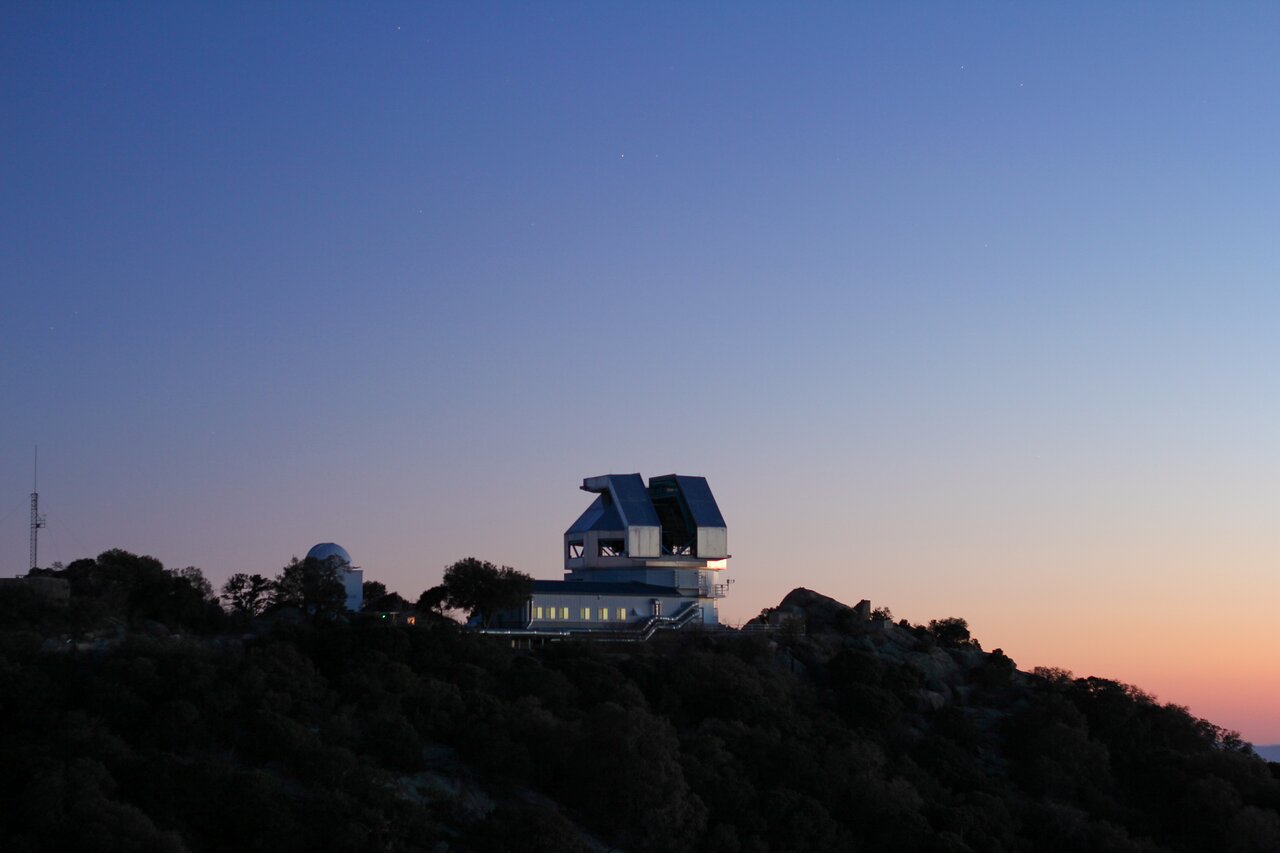
The WIYN 3.5-meter telescope at sunset. [KPNO/NOIRLab/NSF/AURA/P. Marenfeld; CC BY 4.0]

A WIYN for Exoplanetary Science

Though not typically open to the public for tours, our next stop took us to the WIYN 3.5-meter telescope. This telescope is operated and owned by the WIYN Consortium, a partnership between the University of Wisconsin, Indiana University, NSF’s NOIRLab (National Optical-Infrared Astronomy Research Laboratory; formerly NOAO), Pennsylvania State University, and Princeton University. Operating since 1994 with a strong collection of instruments, WIYN has observed galaxies near and far, stars across their lifetimes, and exoplanets tugging on their host stars.

Lexi at WIYN

Me, Lexi Gault (AAS Media Fellow), in front of the WIYN 3.5-meter telescope. I have used WIYN’s SparsePak spectrograph to collect data for my dissertation research! [AAS Nova/Kerry Hensley]

WIYN’s newest instrument, NEID (pronounced “NOO-id”), has been advancing exoplanetary science since its first light in early 2020. Derived from the word meaning “to see” in the Tohono O’odham language, NEID is a high-resolution spectrograph that uses the radial velocity method to detect exoplanets. As a planet orbits its host star, its gravitational pull induces a wobble in the star, and NEID can detect these wobbles with unprecedented precision. This instrument allows astronomers to find exoplanets that were previously undetectable.

The partnership between public and private universities and a government institution was the first of its kind. Through this consortium, hundreds of undergraduate and graduate students have conducted research with WIYN, and the telescope’s suite of instruments have enabled early career astronomers to explore the universe both near and far.

Mysteries of Dark Energy at Mayall

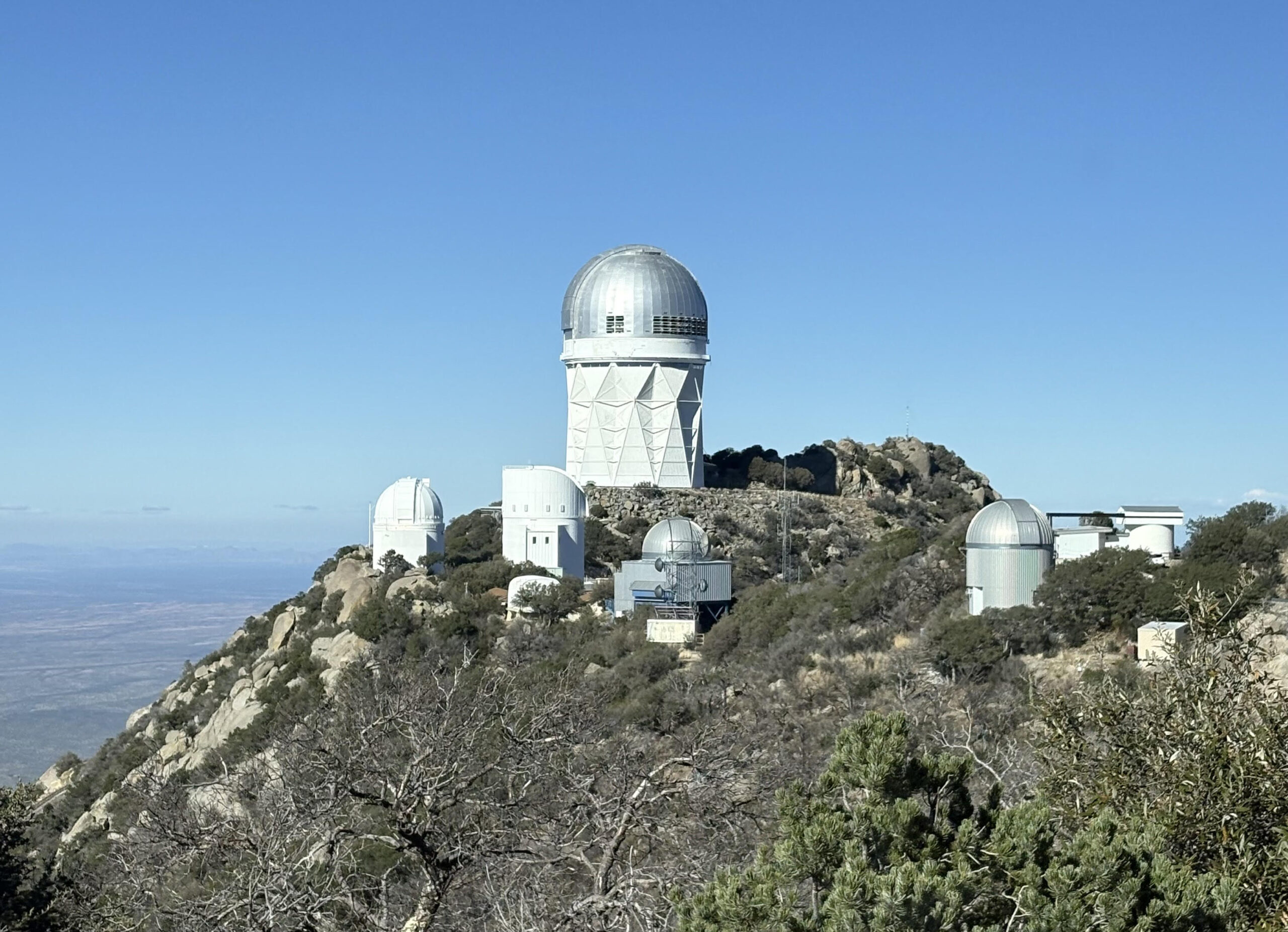
We concluded our tour at the Mayall 4-meter Telescope, the tallest telescope dome on the mountain at a staggering 18 stories high. This iconic telescope saw first light in 1973, and at the time, was the second-largest (in diameter) telescope in the world. Originally built for wide-field optical and infrared studies of the universe, the Mayall has enabled decades of critical scientific research.

Mayall dome

The Mayall dome across the mountain as seen from inside the WIYN dome. [AAS Nova/Lexi Gault]

Mayall is now home to the Dark Energy Spectroscopic Instrument (DESI), the most powerful multi-object survey spectrograph in the world. The DESI survey measures the impact of dark energy on the expansion of the universe through creating the largest ever 3D map of the universe. Mapping the distances to hundreds of millions of galaxies, DESI has revolutionized cosmology and enabled groundbreaking research into the origins of the universe. 

From the telescope’s massive dome, to the busy DESI control room, to the gallery floor with a nearly 360 degree view of the surrounding desert, the Mayall offers visitors a unique glimpse into Kitt Peak’s history and its future. While WIYN is a hidden gem, the Mayall 4-meter Telescope is open to the public for tours daily, so you can experience the exciting era of research and discovery at KPNO. 

Visit Kitt Peak

Interested in getting a peek yourself? KPNO is open to the public daily with multiple tour types to choose from, including both daytime and nighttime visits! Plan your visit to Kitt Peak here.

The post Getting a Peek of Kitt Peak National Observatory appeared first on AAS Nova.

Selections from 2025: Could Earth Detect Earth?

30 December 2025 at 17:00

Earth

Editor’s Note: For the remainder of 2025, we’ll be looking at a few selections that we haven’t yet discussed on AAS Nova from among the most-downloaded articles published in AAS journals this year. The usual posting schedule will resume January 2nd.

Earth Detecting Earth: At What Distance Could Earth’s Constellation of Technosignatures Be Detected with Present-day Technology?

Published February 2025

Main takeaway:

In a collaborative effort between the Search for Extraterrestrial Intelligence (SETI) Institute and the Penn State Extraterrestrial Intelligence Center, Sofia Sheikh (SETI Institute) and team turned inward to expand the search for intelligent life in the universe. Right here on Earth, humans have created a laboratory of technological signatures that can be detected from space — if another Earth-like civilization is out there, could they detect us? Using theoretical modeling, the authors determined the reaches of various human technosignatures such as radio transmissions, optical and infrared emission, satellites, and other probes sent into space. They found humanity’s strongest signals, radio transmissions, could be detected as far as 12,000 light-years away.

Why it’s interesting:

Scientists search for intelligent civilizations by hunting for signs of technology — signals or patterns that natural phenomena cannot explain. While we cannot expect other intelligent life to look exactly like Earth’s, many SETI projects have surveyed the skies for hypothetical signals far exceeding humanity’s own technological advancements. Taking a step back, Sheikh and collaborators considered where human technology is currently and what present-day instrumentation could pick up on if we were to search for ourselves. This “Earth detecting Earth” paradigm recenters the search for intelligent life and provides a multiwavelength framework for understanding the detectability of technology on far-away worlds.

Maximum detectability of Earth's technosignatures.

Maximum distances that Earth’s technosignatures could be detected by current technology. Click to enlarge. [Sheikh et al 2025]

Earth’s constellation of technosignatures:

What exactly are Earth’s many technosignatures, and how far could our current technology detect them? The most prominent and farthest detectable signal comes from radio transmissions. As the authors noted, these signals come from multiple sources: targeted radar transmissions used to characterize planets and asteroids, radio transmissions used to communicate between space probes and ground stations (e.g., space telescopes, Mars rovers, etc.), and radio leakage from Earth’s communication systems like cell towers and broadcasting stations. Additionally, there are atmospheric technosignatures from air-polluting compounds, optical and infrared emission from cities, targeted lasers from telescopes, and interplanetary and interstellar probes sent into space. All of these combined create a constellation of technosignatures detectable across a range of distances from Earth. This study underscores the importance of assessing Earth’s technology and detection capabilities, and repeating this type of study as technological advancements continue will enhance the search for intelligent life.

Citation

Sofia Z. Sheikh et al 2025 AJ 169 118. doi:10.3847/1538-3881/ada3c7

The post Selections from 2025: Could Earth Detect Earth? appeared first on AAS Nova.

Selections from 2025: The Nine-Ringed Bullseye Galaxy

23 December 2025 at 17:00

Bullseye galaxy

Editor’s Note: For the remainder of 2025, we’ll be looking at a few selections that we haven’t yet discussed on AAS Nova from among the most-downloaded articles published in AAS journals this year. The usual posting schedule will resume January 2nd.

The Bullseye: HST, Keck/KCWI, and Dragonfly Characterization of a Giant Nine-ringed Galaxy

Published February 2025

Main takeaway:

Bullseye galaxy rings

Red ellipses overplotted on the first eight rings identified with Hubble in the Bullseye galaxy. Click to enlarge. [Pasha et al 2025]

Using a combination of the Hubble Space Telescope, the Dragonfly Telephoto Array, and the Keck Cosmic Web Imager, Imad Pasha (Yale University) and collaborators discovered and performed deep follow-up observations of a giant collisional ring galaxy aptly nicknamed the “Bullseye” galaxy (LEDA 1313424). The team identified a staggering nine rings in the Bullseye with a likely tenth that has since faded — the most rings found in any collisional ring galaxy to date. The rings are a result of a small blue dwarf galaxy shooting through the Bullseye’s core about 50 million years ago, sending ripples through the galaxy.

Why it’s interesting:

Galaxy mergers and interactions are commonplace in the universe, but it is very rare for a dwarf galaxy to strike right through a large galaxy’s core. When this does happen, the collision sends shock waves through the impaled galaxy, sweeping gas and dust outward and forming rings where star formation can occur (hence the name, collisional ring galaxy). These galaxies are valuable sites to explore galactic structure and evolution as well as provide a unique case to study galaxy mergers and interactions. Previously discovered collisional ring galaxies have at most two or three rings, so when Pasha and collaborators found the stunning nine in the Bullseye, it was clear they caught something significant.

Catching the Bullseye at a lucky time in its evolution:

Why does the Bullseye have so many rings? Theoretical studies of these head-on collisions predict that many rings will form and travel outward after the initial crash; however, the rings tend to dissolve after only a few hundred million years. Catching this collision only 50 million years after it happened means we are witnessing the earlier stages of the Bullseye’s evolution. This lucky discovery not only confirms theoretical predictions for collisional ring galaxies, it also may be a clue to how another unique galaxy type, giant low-surface brightness galaxies, originate. Given the wispy ring material found at very large radii from the Bullseye, the authors suggested that collisional ring galaxies may evolve into giant low-surface brightness galaxies as they expand outward and fade. Further investigation and a larger sample of collisional ring galaxies are necessary to confirm this hypothesis, but the Bullseye provides interesting and critical observational evidence of these predictions for the first time.

Citation

Imad Pasha et al 2025 ApJL 980 L3. doi:10.3847/2041-8213/ad9f5c

The post Selections from 2025: The Nine-Ringed Bullseye Galaxy appeared first on AAS Nova.

Intergalactic Impacts of Quasars During the Epoch of Reionization

12 December 2025 at 17:00

quasar artist's concept

Emitting powerful radiation into their surroundings, quasars had the ability to significantly influence their local environments. A recent study using JWST observations focuses in on one of the most powerful known quasars to determine its intergalactic impact.

Quasar Questions

Beacons of light from the very distant universe, quasars are incredibly luminous galactic cores powered by active supermassive black holes. During the first few billion years after the Big Bang, quasars pumped radiation not only into their host galaxies but also out into intergalactic space and subsequently into nearby galaxies. This radiation was strong enough to ionize any intervening material and even break up (or photodissociate) molecular hydrogen gas. With their star formation fuel evaporated, a quasar’s unsuspecting galactic neighbors were stymied from growth.

Sky map

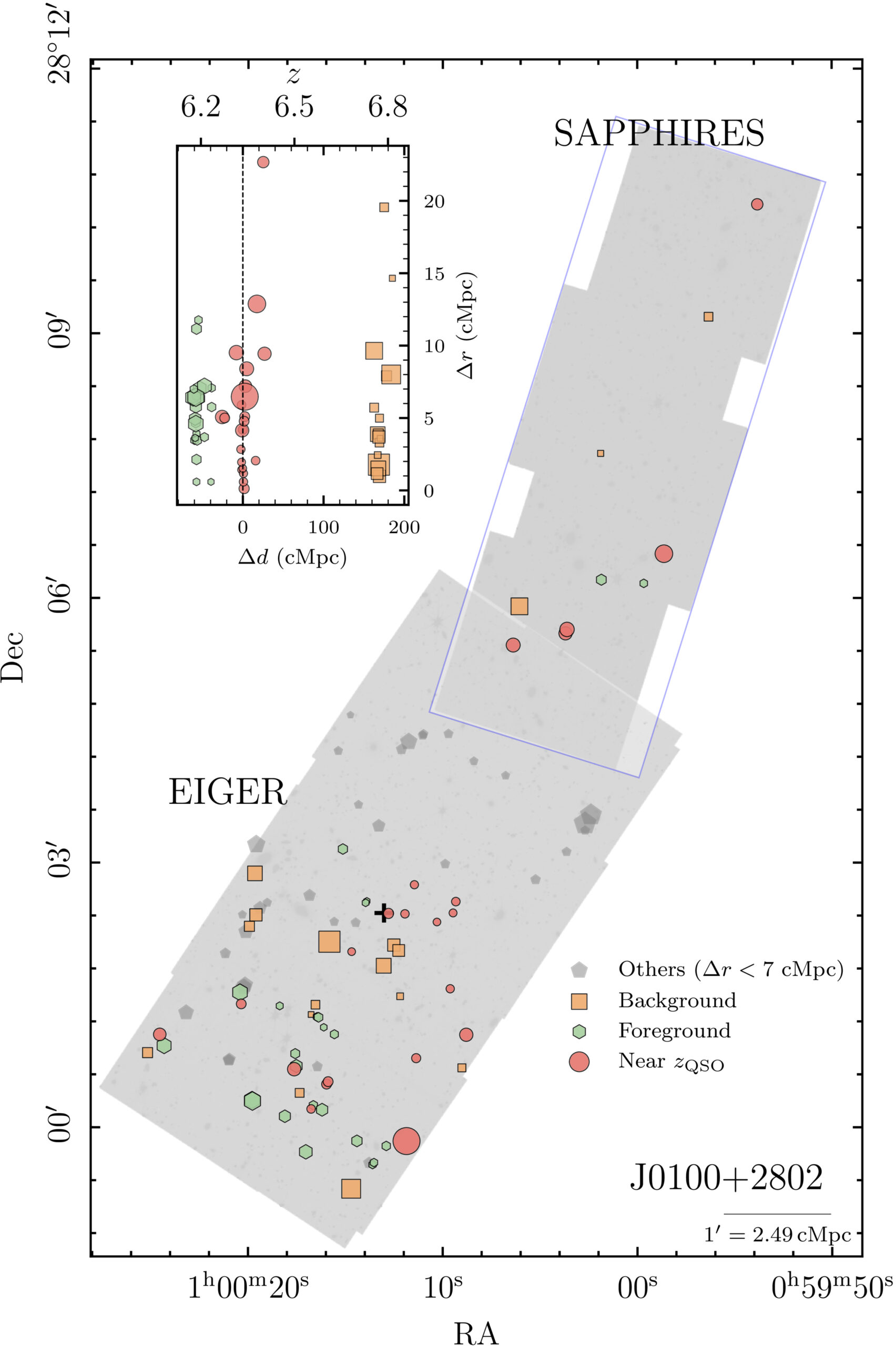
Sky map showing the location of quasar J0100+2802 (marked with black cross) and the [OIII]-emitting galaxies detected in the field. The red points are within the same redshift window as J0100+2802, and the green and orange points show foreground and background galaxies respectively. Click to enlarge. [Zhu et al 2025]

When the universe went from neutral to ionized during the epoch of reionization, quasars are thought to have occupied dense regions, tracing out the beginnings of galaxy clusters. However, studies thus far have been unable to decipher the environmental influence of quasar radiation from other mechanisms impacting the evolution of nearby galaxies. With the advent of JWST, direct measurements of rest-frame star formation tracers during the epoch of reionization are now possible, allowing astronomers to explore high-redshift quasar environments in new ways.

Searching for Suppressed Star Formation

To investigate how quasars may impact their environments, Yongda Zhu (University of Arizona) and collaborators set their gazes on J0100+2802 — the most ultraviolet-luminous quasar known at redshift z > 6. This powerful quasar lies in an overdensity, surrounded by galaxies filled with hot, young stars, making it an ideal candidate to test the impacts of luminous quasars on their neighbors. The authors used spectroscopy and photometry obtained from JWST to explore the space around J0100+2802.

Searching within the expected reach of the quasar’s radiation field, the authors identified galaxies with doubly ionized oxygen emission ([OIII] λ5008), which traces a galaxy’s recent star formation activity. After carefully separating background and foreground galaxies from galaxies at the same redshift as J0100+2802, the authors measured the total [OIII] emission and compared it to the overall ultraviolet stellar emission. From their sample, galaxies closer to J0100+2802 tend to exhibit lower [OIII]/UV ratios than those farther away, indicating that the powerful quasar may be suppressing star formation activity in nearby galaxies. 

[OIII]/UV versus distance from quasar

[OIII]/UV ratio versus distance from quasar J0100+2802. There is a clear positive correlation indicating that closer to the powerful quasar, [OIII] emission declines. The dashed line shows the expected radiation field of J0100+2802. Click to enlarge. [Modified from Zhu et al 2025]

Confirming the Culprit

To verify that the quasar is truly responsible for this declining trend, other environmental factors and intrinsic galaxy properties must be ruled out. Could the galaxies nearby J0100+2802 just happen to have elevated ultraviolet stellar continuum? Or could the overdense environment itself drive this trend? The authors performed additional analysis to control for these variables and found no strong global factors that could explain the decline in [OIII] emission — radiation from the quasar is likely the driver.

To further bolster their results and determine whether this behavior is more widespread, the authors investigated the environments around three other quasars at the same redshift as J0100+2802. Though these quasars are not as powerful as J0100+2802, a similar trend is uncovered for galaxies within the radiation field of these quasars. From this study, radiative feedback from quasars appears to disrupt the star formation activity in nearby galaxies, suppressing their growth and changing the way early galaxy formation progresses. 

Further wide-field studies are necessary to understand the full extent to which reionization-era quasars can impact their environments, but this study provides a clear path forward with JWST.

Citation

“Quasar Radiative Feedback May Suppress Growth on Intergalactic Scales at z = 6.3,” Yongda Zhu et al 2025 ApJL 995 L5. doi:10.3847/2041-8213/ae1f8e

The post Intergalactic Impacts of Quasars During the Epoch of Reionization appeared first on AAS Nova.

Too Much Nitrogen Pops Open the Search for the Universe’s First Stars

21 November 2025 at 17:00

Star formation in the early universe.

Astronomers have long sought evidence of the universe’s first generation of stars, and as more distant galaxies come into view, it seems these stars may finally be within reach.

JWST deep field

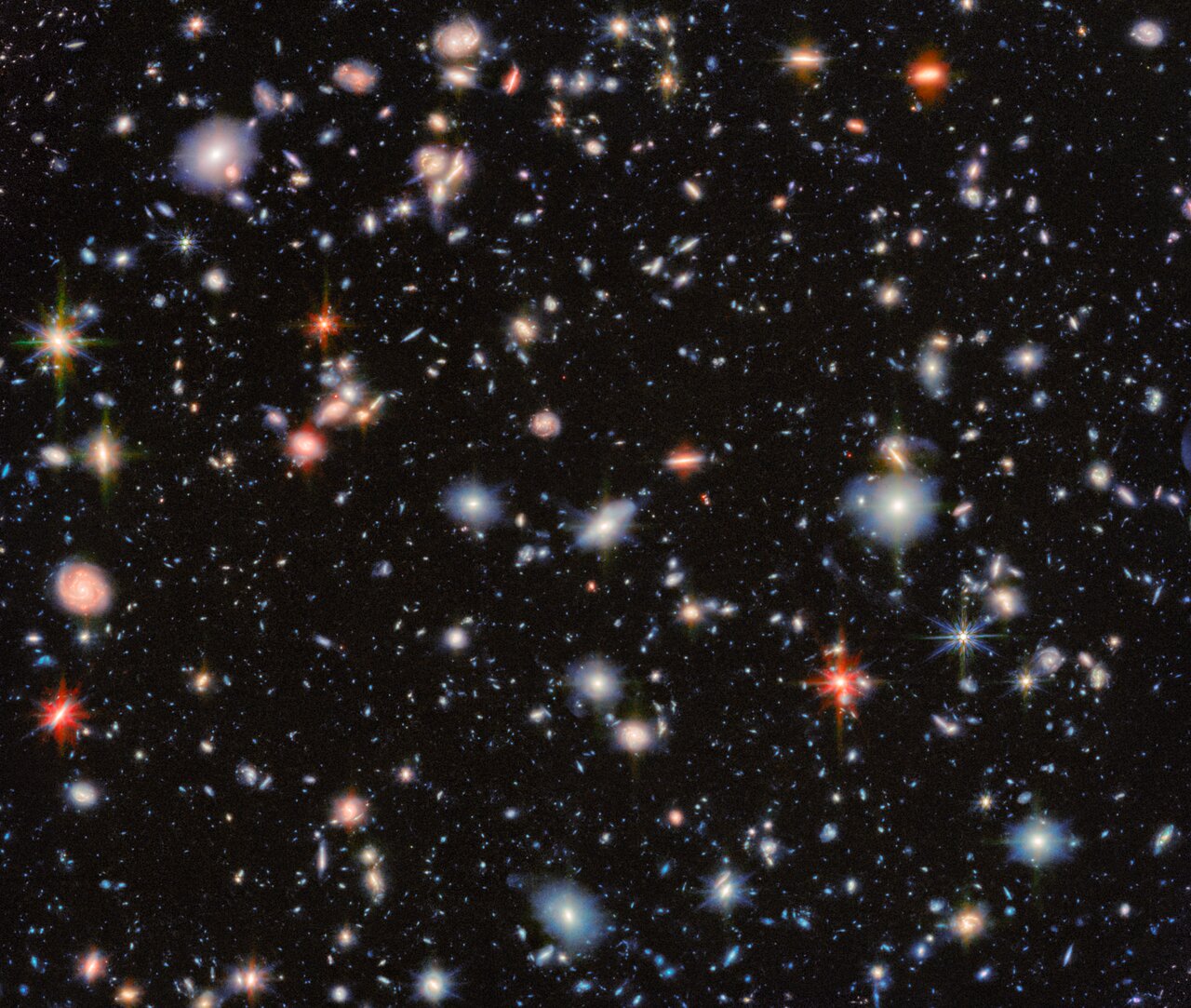
JWST spies thousands of distant galaxies in the classic Hubble Deep Field — many galaxies being uncovered for the first time with the space telescope’s powerful instruments. [ESA/Webb, NASA & CSA, G. Östlin, P. G. Perez-Gonzalez, J. Melinder, the JADES Collaboration, the MIDIS collaboration, M. Zamani (ESA/Webb); CC BY 4.0]

Excess Metals Popping Up

Since its 2021 launch, JWST has given astronomers eyes to peer into the distant past, discovering many galaxies whose light reveals the universe’s early stages of star and galaxy formation. Within the population of newly discovered galaxies are a few with bizarre chemical properties that, upon first pass, seem to be too enriched to exist so early in the universe. These hard-to-reconcile abundances may be a sign of the universe’s first stars. 

Known as Population III (Pop III) stars, the first stars in the universe were born out of giant clouds of pristine gas (hydrogen, helium, and a little lithium) and were able to form at masses hundreds to thousands of times the mass of our Sun. Though they burned bright, they did not burn for very long, ending their lives in violent supernovae and chucking their newly enriched guts back into their surroundings. While these stars are long dead, the chemical imprints they left on their host galaxies can persist  — and understanding how Pop III stars create and distribute metals could clue us in to the odd chemical signatures recently found with JWST.

Too Much Nitrogen in GS 3073

Researchers have identified a few galaxies exhibiting high nitrogen-to-oxygen (N/O) ratios that cannot be explained by stars similar to those in the universe today. A couple of these galaxies could be explained through multiple stellar populations, rapidly rotating stars, massive explosions, or the early stages of globular cluster formation. However, GS 3073, a galaxy with a redshift of z = 5.55 (about one billion years after the Big Bang), has an N/O excess so high that is has, so far, defied explanation.

Aiming to make sense of this bizarre phenomenon, Devesh Nandal (University of Virginia; Center for Astrophysics | Harvard & Smithsonian) and collaborators used stellar evolution models to see if Pop III stars could be the culprit. Modeling stars with masses 1,000–10,000 times the mass of our Sun, the authors traced the elemental yields of these supermassive stars as they go through the various stages of nuclear burning. The analysis takes into account mixing within the stars, mass loss throughout their lifetimes, and how the eventual supernova ejecta mixes within the interstellar medium.

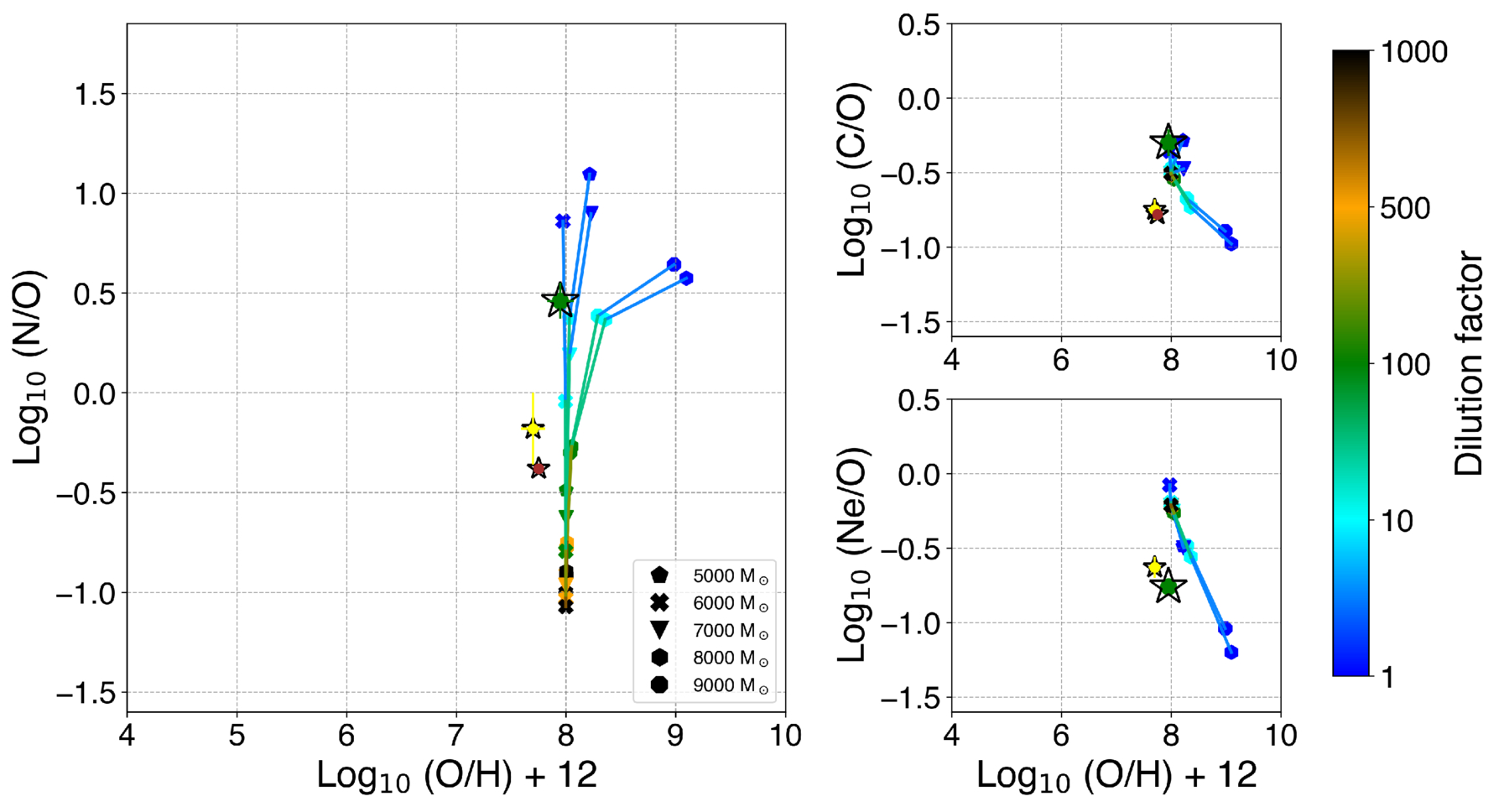
N/O, C/O, and Ne/O abundance ratios of five modeled supermassive Pop III stars taking into account the contribution from other stars in the galaxy and the Pop III star losing 10% of its mass over its lifetime. The green star indicates the observed ratios of GS 3073. Click to enlarge. [Nandal et al 2025]

From this modeling, the authors found that massive Pop III stars between 1,000 and 10,000 solar masses can produce the observed elemental abundances measured for GS 3073. Stars less massive do not produce high enough N/O ratios, and stars more massive have much lower oxygen-to-hydrogen ratios — strongly suggesting upper and lower mass limits to the possible supermassive stars that could have produced GS 3073’s chemical composition.

Finally Evidence of Pop III Stars?

This study of GS 3073 is the first of its kind to confirm the chemical imprints of Pop III stars on their host galaxy at this redshift. The unique nitrogen abundance can only be produced through the evolutionary phases of Pop III stars that burn quickly enough to produce and release an excess amount of nitrogen while other elements stay consistent. From their modeling, the authors suggest that galaxies with even higher nitrogen excess could exist, and further observations with JWST may just find them. 

The search for Pop III stars is booming — another recent study (Visbal et al 2025) examines the galaxy LAP1-B. While GS 3073 shows evidence of Pop III stars through chemical abundances, the study of LAP1-B finds that the galaxy matches theoretical predictions for the formation environments and mass distributions of Pop III stars. Both of these recent research works are laying the groundwork for the wealth of discovery possible with JWST, and the universe’s first stars are no longer out of reach.

Citation

“1000–10,000 M⊙ Primordial Stars Created the Nitrogen Excess in GS 3073 at z = 5.55,” Devesh Nandal et al 2025 ApJL 994 L11. doi:10.3847/2041-8213/ae1a63

The post Too Much Nitrogen Pops Open the Search for the Universe’s First Stars appeared first on AAS Nova.
Chandra Spies a Supernova Shock Front Speeding Along

7 November 2025 at 17:00

Supernova remnant N132D

Beautiful bubbles of hot ionized gas, supernova remnants trace the dying days of massive stars. A recent study uses the Chandra X-ray Observatory to detail the motion and understand the origins of one supernova remnant.

Retracing Supernova Remnants

Massive stars, about 8 solar masses or larger, will end their short lives in violent core-collapse supernovae. These explosions barrel into any surrounding interstellar medium, carving out low-density cavities and blowing material outward. Appearing as a bubble or shell of hot gas, a supernova remnant carries the signatures of the type of star that produced it and the ways that star shaped its environment throughout its life. 

Nearby, in the Large Magellanic Cloud, is the 2,500-year-old supernova remnant N132D — the most X-ray luminous supernova remnant within the Local Group. Though N132D’s size, likely progenitor mass, and chemical composition are well constrained, astronomers have yet to nail down the velocity of the X-ray shock front — the outer edge of the supernova remnant that rams into the interstellar medium. This measurement is critical to understanding the local conditions the supernova first encountered and how its expansion will continue to impact the interstellar medium over time.

Chandra Observations of N132D

Determining the shock front velocity requires astronomers to focus on the thin outer edge of the soaring supernova remnant — how do we measure the motion of such a narrow strip of gas? X-ray spectroscopy of N132D yields a measurement from a single epoch of observations, but it cannot isolate the narrow shock front, making a reliable velocity measurement difficult to attain.

supernova remnant velocity

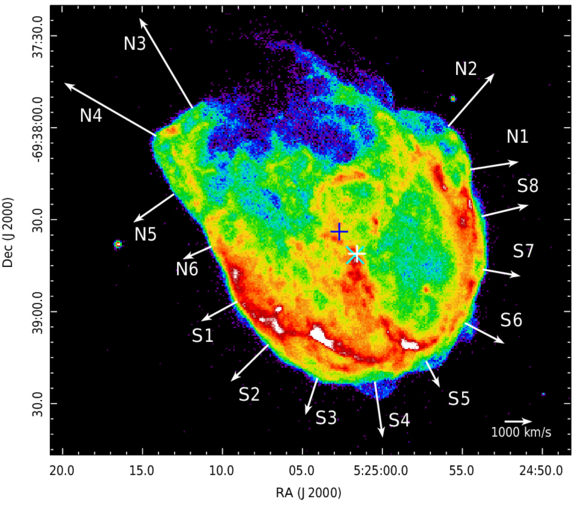
The expansion of supernova remnant N132D around the rim for each of the regions analyzed in this study. The arrow lengths are proportional to their estimated expansion velocities. Click to enlarge. [Long et al 2025]

Circumventing the challenges of spectral analyses, Xi Long (University of Hong Kong) and collaborators used two sets of X-ray observations of N132D from the Chandra X-ray Observatory taken about 14.5 years apart to measure the motion of the shock front across the sky over time. This measurement, known as proper motion, compares the location of the foreground supernova remnant to stationary background stars to estimate its angular speed. 

The authors focus on small regions on the very edge of the supernova shock front, six northern and eight southern, to carefully measure the motion of the shock between the two sets of observations. In separating the shock front into smaller regions, the authors can determine any variations in speed along the shock front. The southern edge of N132D moves with the same expansion rate of 1,620 km/s. The northern edge has an average expansion rate of 3,820 km/s, but its speed is more varied, which isn’t unexpected given its blown-out appearance.

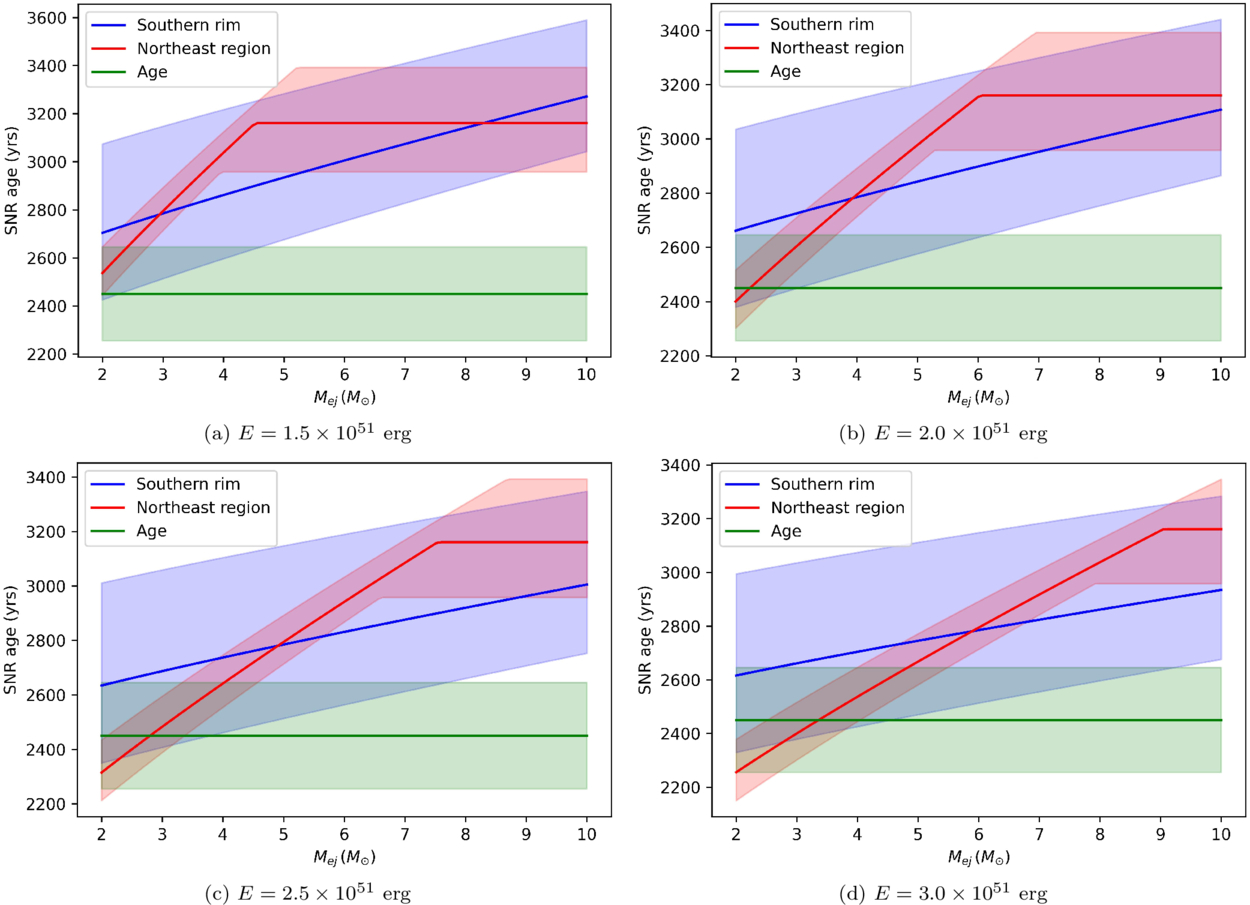
Modeling results showing the supernova age versus ejecta mass for the northern (red) and southern (blue) regions compared to the age estimate from an optical study of N132D. For the explosion energies and estimated ejecta masses between 2 and 6 solar masses, the models are consistent for all three. Click to enlarge. [Long et al 2025]

Comparing to Prior Studies

In addition to determining the velocity of the forward shock, the authors model the evolution of the supernova remnant to estimate the initial conditions of N132D including progenitor star mass, explosion energy, and ejecta mass. Their results agree with other studies that suggested N132D originated from a roughly 15-solar-mass star that exploded 2,500 years ago into a low-density cavity. 

This study showcases the unique ability of Chandra’s high-resolution instruments to carefully measure the evolution of supernova remnants, and further studies will continue to determine the detailed characteristics of supernova remnants across the Local Group.

Citation

“Chandra Large Project Observations of the Supernova Remnant N132D: Measuring the Expansion of the Forward Shock,” Xi Long et al 2025 ApJ 993 136. doi:10.3847/1538-4357/ae07c7

The post Chandra Spies a Supernova Shock Front Speeding Along appeared first on AAS Nova.

Rapid Recurrent Nova May Be Challenging Perceptions

10 October 2025 at 17:00

nova

Flashing on and fading quickly, recurrent novae are captivating astronomical phenomena. A recent study identifies one system that challenges our current understanding.

Rapid Recurrent Novae

When a white dwarf — the white-hot remnant of a dead star — has a close binary companion, the white dwarf can pull material from the companion star onto its boiling surface. Ignited in a bright flash, the accreted material is blown out from the white dwarf in a nova explosion that gradually expands and fades over time. Some novae, known as recurrent novae, repeat on observable timescales, creating a “new” star in the sky on periods ranging from one to one hundred years.

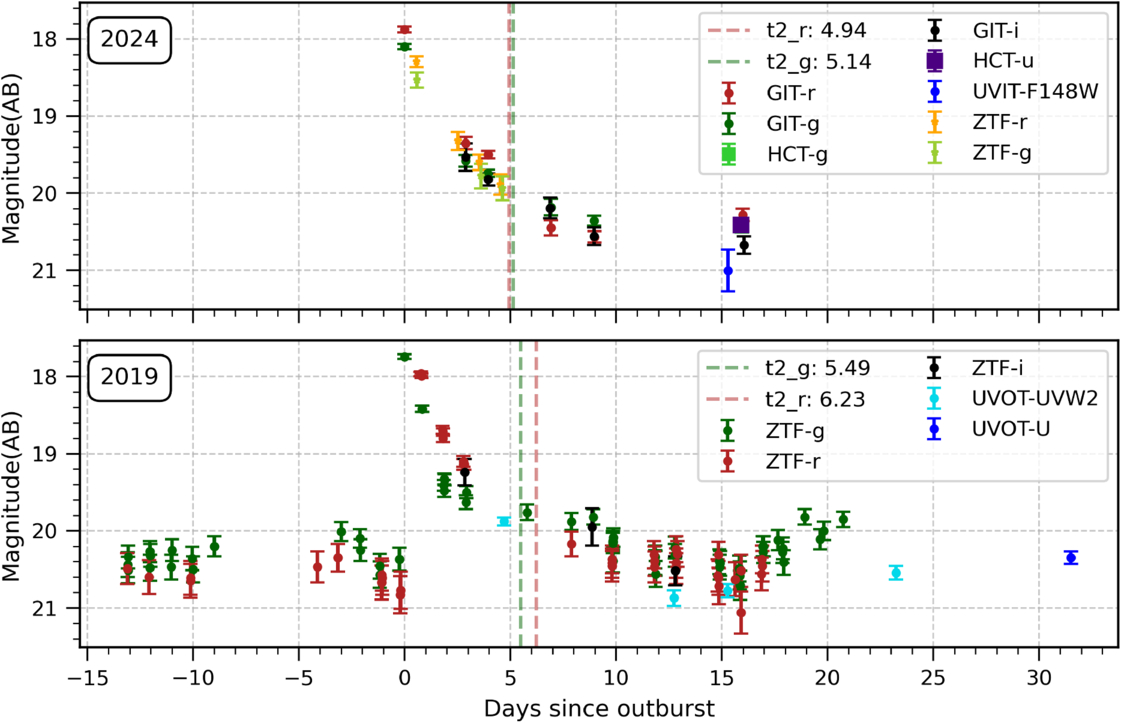
M31N 2017-01e light curves

Two light curves of M31N 2017-01e outbursts from 2024 (top) and 2019 (bottom) showing how the light evolves over time. Click to enlarge. [Chamoli et al 2025]

Our nearest galactic neighbor, Andromeda, hosts the most rapid recurrent novae observed to date, including the shortest-period known recurrent nova, M31N 2008-12a. M31N 2008-12a has erupted once a year for millions of years and will eventually meet its fate in a supernova explosion. 

Discovered in 2017, the second-shortest-period nova M31N 2017-01e has an outburst about every 2.5 years. This nova has sparked intrigue among researchers due to its low-amplitude outbursts and rapid evolution compared to other recurrent novae. While M31N 2017-01e exhibits some emission features typical for recurrent novae, recent studies have suggested that the system’s companion star may be a moderately young, blue B-type star. Most novae occur in systems where the white dwarf’s companion is a late-type main-sequence, subgiant, or giant star, making M31N 2017-01e an unusual case requiring further investigation. 

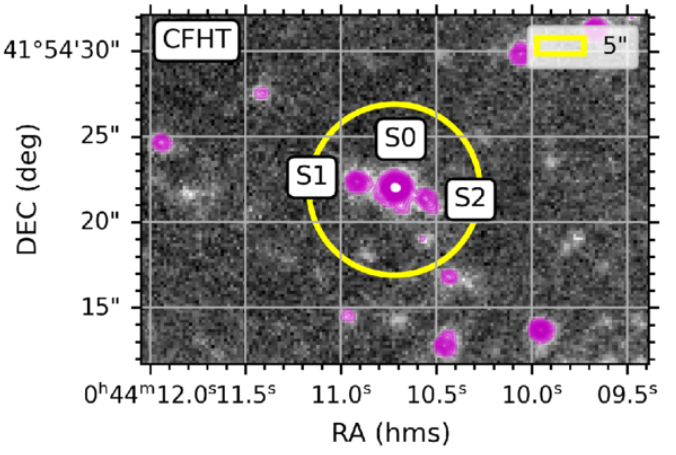
M31N 2017-01e Progenitor search

Optical image showing the location of sources near the location of M31N 2017-01e. The yellow circle corresponds to a radius of 5 arcseconds and is centered on the nova. Labeled S0, the source coincides with the location of the nova with sub-arcsecond resolution. Click to enlarge. [Modified from Chamoli et al 2025]

Dialing In on M31N 2017-01e

Aiming to constrain the nature and companion star of the nova, Shatakshi Chamoli (Indian Institute of Astrophysics and Pondicherry University) and collaborators performed a multiwavelength analysis using ultraviolet and optical observations of M31N 2017-01e.

In monitoring the nova during and in between outbursts, the authors identified a source at the reported location of M31N 2017-01e that exhibited variability and color consistent with previous observations of the system. Through a detailed photometric analysis, the authors found that the color and emission properties of the source are consistent with a hot, early-type star as was previously suggested. Though all the observational signs point toward a B-type companion, there’s one glaring obstacle to that scenario: such a massive star would typically be unable to transfer the amount of mass necessary to fuel the nova’s frequent eruptions without the accretion becoming unstable.

Be a Companion

What else, then, could the companion be? The authors considered another stellar companion known as a Be star — a rapidly rotating, early-type star that occasionally hosts a disk of loose stellar material. With a blue color and spectral features similar to B-type stars, a Be star could match the observational properties of the nova’s companion while solving the problem of its accretion. Outbursts of M31N 2017-01e likely arise due to the white dwarf lying very near or within the Be star’s circumstellar disk, siphoning material and adequately fueling the system’s recurring eruptions. To confirm this hypothesis, researchers will need to perform follow-up infrared observations to search for the tell-tale signs of a dusty disk around the companion star. 

This system is rare and challenges the assumed properties of recurrent novae. From this study, it is clear that nova progenitors are potentially quite diverse and require further multiwavelength observational programs to identify more systems like M31N 2017-01e.

Citation

“Challenging Classical Paradigms: Recurrent Nova M31N 2017-01e, a BeWD System in M31?” Shatakshi Chamoli et al 2025 ApJ 991 174. doi:10.3847/1538-4357/adf843

The post Rapid Recurrent Nova May Be Challenging Perceptions appeared first on AAS Nova.

Supermassive Black Hole in a Super Tiny Galaxy Found with JWST

26 September 2025 at 17:00

ultracompact dwarf galaxy

With very small stellar masses and tiny radii, ultracompact dwarf galaxies raise questions about the dividing line between the highest-mass star clusters and the lowest-mass galaxies. A recently published article leverages JWST’s high resolution to target one tiny galaxy and investigate its origins.

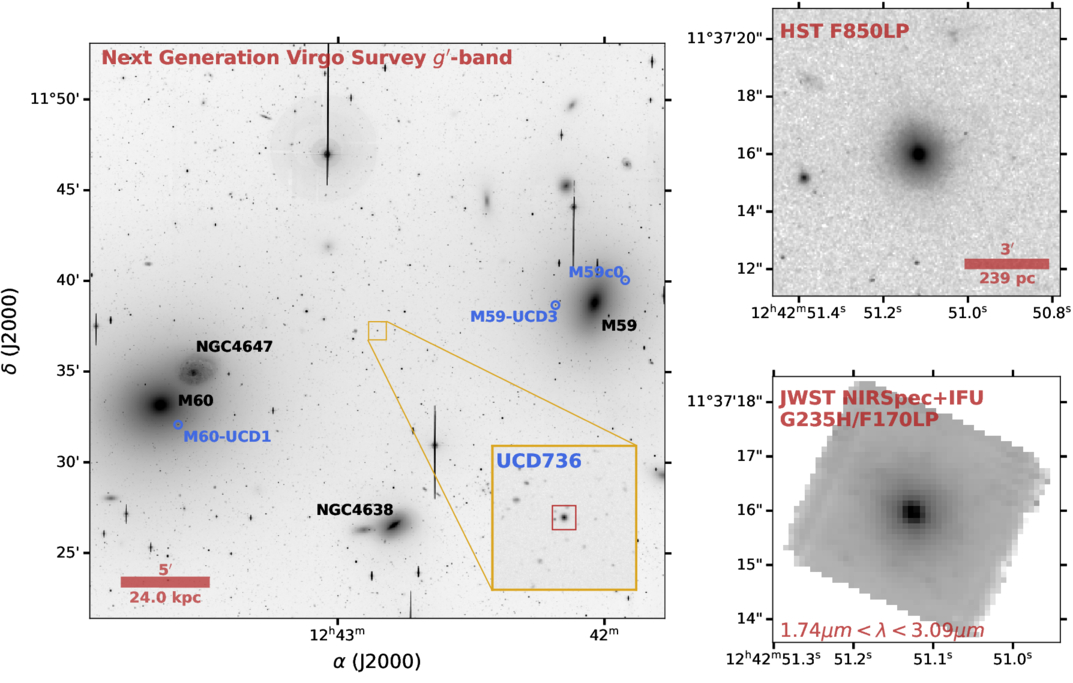
UCD 736

Location of UCD 736 in the Virgo Cluster with the other ultracompact dwarf galaxies with supermassive black hole detections labeled. Click to enlarge. [Taylor et al 2025]

Origins of Ultracompact Dwarf Galaxies

How tiny can a galaxy get? Discovered 20 years ago among the dense environments of the Virgo and Fornax clusters, ultracompact dwarf galaxies walk the line between the largest globular clusters and the smallest galaxies. Determining if these dwarfs are stellar in nature or actually of galactic origin is complex, but one sure way to get at this question is to determine if an ultracompact dwarf galaxy houses a supermassive central black hole. 

While astronomers have identified hundreds of these tiny dense galaxies, supermassive black holes have been detected in only five. Hoping to extend this sample, Matthew Taylor (University of Calgary) and collaborators targeted UCD 736, an ultracompact dwarf galaxy located in the Virgo galaxy cluster. If a massive black hole is found in this galaxy, it will be the smallest and least luminous ultracompact dwarf to have such a detection. Exploring galaxies at such small sizes will allow researchers to determine what fraction of ultracompact dwarfs have galactic or star cluster origins, which can provide insights into massive black hole seeding mechanisms in the early universe.

Modeling Black Hole Mass

Model results

Summary of results for the three black hole modeling methods for UCD 736, indicating the quality of the models and how the observed velocity dispersion and spatial distribution of the galaxy fit with the models. Click to enlarge. [Taylor et al 2025]

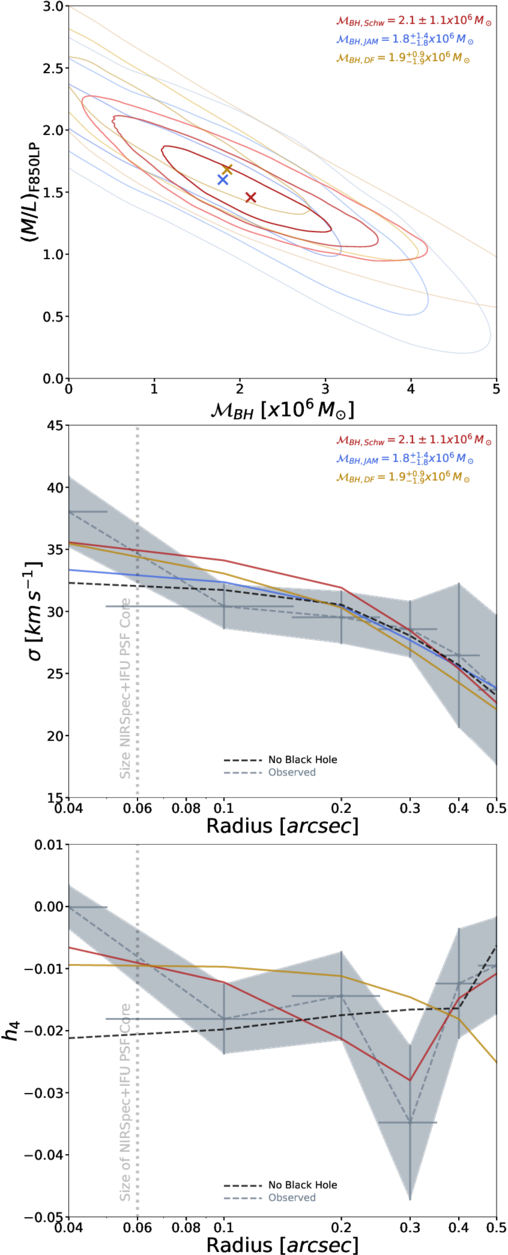
In order to search for a central black hole in UCD 736, Taylor and team obtained high-resolution spectroscopy from JWST and supplemental imaging from the Hubble Space Telescope. The authors used the stellar kinematics and light profile of the galaxy to estimate the mass of its central black hole with three independent modeling methods. Based on the expected impacts of a massive black hole on galaxy dynamics and the estimated stellar population of the galaxy, the authors found that UCD 736 likely hosts a central supermassive black hole with mass ~2.1 million times the mass of the Sun. 

However, the authors noted that the three models do not provide equivalent confidence levels in this estimate — while one model confidently rules out the possibility of no central black hole at 3σ significance, the other two models were less constraining, ruling out the possibility of there not being a black hole to only 1σ. Despite these differences, all three models agree on the central black hole mass within the first confidence interval, indicating a positive detection of a black hole in UCD 736.

Progenitor of UCD 736

From their observations and modeling, the authors presented the fifth positive detection of an ultracompact dwarf galaxy with a central supermassive black hole within the Virgo Cluster. Given the presence of this black hole, UCD 736 likely originated as a more massive galaxy that was tidally stripped as it interacted with other nearby cluster galaxies. Interestingly, though, other ultracompact dwarf galaxies with black hole detections in the Virgo Cluster are much closer to the massive galaxy that likely stripped them. UCD 736 sits about 160,000 light-years outside of the nearest giant galaxy Messier 59’s tidal radius, which does not rule out interactions but could indicate that Messier 59 is particularly good at stripping material from smaller galaxies. 

Continued searches for black holes in ultracompact dwarfs will further probe the differences between the highest-mass globular clusters and the lowest-mass galaxies. Revealing more within this parameter space will allow astronomers to test black hole seeding and galaxy formation theories.

Citation

“A Supermassive Black Hole in a Diminutive Ultracompact Dwarf Galaxy Discovered with JWST/NIRSpec+IFU,” Matthew A. Taylor et al 2025 ApJ 991 L24. doi:10.3847/2041-8213/ae028e

The post Supermassive Black Hole in a Super Tiny Galaxy Found with JWST appeared first on AAS Nova.

Chiming In on the Pulsar Search: Searching for Pulsars with CHIME

12 September 2025 at 17:00

Pulsar diagram

Pulsars, the best timekeepers in the universe, are key to many fields within astronomy. A new survey searching for pulsars has come online and is already making discoveries.

Searching for Pulsars

Pulsars, the extremely dense cores left over from some massive stars’ deaths, act as astronomical lighthouses — spinning fast and emitting jets of light from their magnetic poles, they send steady pulses of light to observers on Earth. Pulsars are particularly intriguing sources, providing insights into multiple areas of astrophysics like gravitational waves, general relativity, and high-density matter properties. While more than 3,700 pulsars have been discovered to date, increasing this number will enable further exciting science. 

Multiple pulsar surveys have utilized single-dish radio telescopes to cover portions of the sky, and to date, these surveys have primarily focused on finding pulsars near the dense stellar population in the Milky Way’s galactic plane. While these surveys have detected many pulsars, they are limited by their small fields of view, taking longer to cover large portions of the sky, and they miss the population of pulsars that must lie within globular clusters orbiting in the galactic halo. Some low-frequency detectors address these limitations but require intense computational resources to sift through the raw data to find pulsars. How can we search for pulsars efficiently across the sky?

Introducing CHAMPSS

CHAMPSS pointing map

CHAMPSS pointing map showing the survey’s planned sky coverage. The orange stars correspond to the newly discovered pulsar, and the pink points denote known pulsars within the commissioning surveys. Click to enlarge. [Andrade et al 2025]

Hoping to cover the gaps in pulsar surveys thus far, researchers turned to the Canadian Hydrogen Intensity Mapping Experiment (CHIME). CHIME is a unique instrument that utilizes a set of cylindrical antennas to monitor large portions of the sky for radio sources from 400 to 800 MHz. This instrument has already made great strides in detecting transient radio events and has discovered more than 80 pulsars since its first light in 2017. 

With a clear opportunity to advance the pulsar search, a group of scientists developed the CHIME All-sky Multiday Pulsar Stacking Search (CHAMPSS) — a radio pulsar survey that covers the full northern sky daily and uses long-term data stacking to detect irregular and faint sources. Through stacking observations across multiple days, CHAMPSS builds up signals to find faint sources that would otherwise go undetected. The data processing pipeline searches in real time for strong peaks that signify a transient radio event, and follow-up analysis determines if the event is a pulsar candidate. A strong candidate then moves through further stages to confirm it as a pulsar and determine its properties. 

Pulsar discoveries

The 11 pulsars discovered with CHAMPSS. Click to enlarge. [Andrade et al 2025]

First Discoveries and Looking Forward

What has CHAMPSS uncovered thus far? In testing the system through multiple commissioning surveys on a small subset of the sky, the CHAMPSS collaboration has discovered 11 new pulsars with periods ranging from 0.2 to 1.5 seconds. Additionally, the collaboration tested the sensitivity of their survey by searching for known pulsars within the observed area, and they found that their predicted and detected signal-to-noise ratios for known pulsars agree well. This confirmation allows the team to advance to the next phase of the survey, and it will soon be in full swing.

CHAMPSS complements and expands upon other radio pulsar searches, discovering faint and irregular sources that are missed without repeated observations. The future of pulsar astronomy is promising, and with the advent of this survey, a new collection of pulsars will be discovered. 

Citation

“CHIME All-sky Multiday Pulsar Stacking Search (CHAMPSS): System Overview and First Discoveries,” Christopher Andrade et al 2025 ApJ 990 50. doi:10.3847/1538-4357/adeb51

The post Chiming In on the Pulsar Search: Searching for Pulsars with CHIME appeared first on AAS Nova.

All Alone With No AGN to Call Home? New Results for Little Red Dots

29 August 2025 at 17:00

little red dots

Among the discoveries JWST has made since its 2021 launch, “little red dots” are one of the most perplexing. Named for their compact size and red color, the origins of these distant galaxies remain unknown. A recent article explores some little red dots’ spectral energy distributions and local environments to better understand what may be lighting up these tiny torches.

Little Red Dot Dilemma

Along with their size and color, little red dots exhibit “V”-shaped spectral energy distributions (how they emit light across wavelengths), broad hydrogen emission lines, and no observed X-ray emission. These properties land them in an untapped parameter space with some similarities to both active galactic nuclei (AGNs) and stellar populations. Some previous investigations have suggested that little red dots contain AGNs, reddened by a dusty accretion disk scattering or blocking AGN light. Other studies have found that models for stellar populations can also fit certain little red dot spectra well. 

Adding to the ambiguity, observations and theory predict AGNs to show broad spectral lines, which are present in little red dots — but if little red dots are AGNs, this implies a much higher density of AGNs in the early universe than previously predicted by ground-based surveys. Furthermore, AGNs are expected to emit in the X-ray and show photometric variability, but neither property has been detected definitively thus far for a little red dot. With a clear dilemma arising for the origins of little red dots, astronomers are still prodding at these curious sources.  

AGN or Not?

AGN vs non-AGN fits

Comparison of AGN versus non-AGN fits using the Bayesian information criterion (BIC). Positive values of ΔBIC favor a non-AGN fit, and ~70% of little red dots have positive ΔBIC. Click to enlarge. [Carranza-Escudero et al 2025]

Leveraging the wealth of data available from recent JWST surveys, María Carranza-Escudero (University of Manchester) and collaborators built a sample of 124 little red dots spanning redshifts of z ~ 3–10. The authors used both AGN and non-AGN models to fit the spectral energy distribution for each galaxy. 

Using a robust statistical analysis, the authors found that AGN models tend to “overfit” the data — with more free parameters, an AGN model can be tweaked in a way that may not actually be physical (e.g., fitting for extremely high dust extinction that would not be possible). Instead, models without AGN components appear to be more appropriate for about 70% of the little red dots in their sample, suggesting that these peculiar objects may have a significant star-forming component powering their emission. 

environments histograms

Histograms for two redshift windows showing that little red dots (red) tend to be found in less dense environments than other galaxies (blue) in the same redshift window. Click to enlarge. [Carranza-Escudero et al 2025]

Lonely Neighborhoods

In addition to characterizing little red dots’ emission, the authors analyzed the local environments to compare to other galaxies at similar redshifts. From their analysis, they found that little red dots tend to be found in sparser environments, generally isolated from other galaxies. One explanation for this could be that little red dots in higher-density environments evolve past this peculiar stage faster, which is supported by observations of high-density environments accelerating the evolution of other galaxy types at similar redshifts. However, further investigation is required to better understand the connection between the local environment and little red dot properties. 

More little red dots are yet to be discovered, and continued analysis of their emission and environments will uncover more intriguing characteristics. For now, it seems as though little red dots are still a mystery.

Citation

“Lonely Little Red Dots: Challenges to the Active Galactic Nucleus Nature of Little Red Dots through Their Clustering and Spectral Energy Distributions,” María Carranza-Escudero et al 2025 ApJL 989 L50. doi:10.3847/2041-8213/adf73d

The post All Alone With No AGN to Call Home? New Results for Little Red Dots appeared first on AAS Nova.

Supermassive Black Holes and Stripped Subgiants: Significant Signals for Future Gravitational Wave Detectors

8 August 2025 at 17:00

Current gravitational wave detectors are primarily sensitive to powerful sources like black hole–black hole mergers — what types of events may next-generation gravitational wave detectors reveal? A recent study explores stripped subgiant stars around supermassive black holes and how their gravitational waves may be detected in next-generation missions. 

Inspiraling Stars and Gravitational Waves

The immense gravity of supermassive black holes at the centers of galaxies drives complicated dynamics that could generate so far undetected gravitational wave signals. One predicted source of gravitational waves is a rare event known as an extreme-mass-ratio inspiral (EMRI) — a prolonged inspiraling of a stellar-mass object around a supermassive black hole, driven inward by gravitational waves. EMRIs are thought to arise when a stellar-mass object is captured into a close-in nearly circular orbit around a supermassive black hole, emitting gravitational waves due to the object’s proximity to the black hole. 

To date, most studies have explored EMRIs involving compact objects like black holes, but an EMRI with an inspiraling star is possible, though not yet well explored nor understood. In addition to generating gravitational waves, a stellar EMRI will also emit light as the supermassive black hole rips up siphoned material from the star. These events may explain recent observations of peculiar X-ray transients, but their gravitational wave counterparts remain undetected as EMRIs’ predicted signals fall outside the sensitivity range of current ground-based gravitational wave detectors. However, the Laser Interferometer Space Antenna (LISA), a space-based gravitational wave detector expected to launch in the mid-2030s, will be sensitive to the gravitational waves of EMRIs. In order to properly identify them, we must better understand what to expect.

Diagram showing the evolutionary steps of a supermassive black hole capturing a subgiant star that subsequently undergoes mass transfer and gravitational wave-driven inspiral. Click to enlarge. [Olejak et al 2025]

Modeling a Subgiant Inspiral

Seeking to better predict what the gravitational waves of stellar EMRIs may look like and what LISA may detect, Aleksandra Olejak (Max Planck Institute for Astrophysics) and collaborators used stellar evolution code to simulate the evolution of a subgiant star as it transfers mass to a supermassive black hole and gravitational waves draw in its orbit. In their models, the supermassive black hole captures the star through scattering between stars or tidal interactions with a stellar binary in which the black hole catches one star and ejects the other.

Once the star is captured, its orbit becomes circularized around the black hole, pulled in closer over time until mass transfer of the star’s outer envelope begins. During this stage, the gravitational wave signal remains too weak to be detected. However, as the star is stripped down to just a helium core, it contracts and experiences an extended gravitational wave–driven orbital decay.

Possible Detections with LISA

The strain spectral density as a function of the detected frequency of the gravitational wave. The colorful line indicates the signal from a stripped subgiant at the Milky Way’s center, and the gray lines are what would be observed at greater distances. LISA’s sensitivity to gravitational wave signals is shown with the black and red lines with detectable sources falling to the right of or above the line. Click to enlarge. [Olejak et al 2025]

With a better understanding of this process, the authors explored how such a signal compares to LISA’s sensitivity at various distances away from Earth. They found that as a star spirals inward, the gravitational wave signal grows stronger and enters LISA’s detectable frequency range. Stellar EMRIs occurring closer to Earth will result in higher signal-to-noise detections, and the gravitational waves from those occurring within the Milky Way would remain detectable for hundreds of thousands of years. The authors’ analysis revealed that, given their simulations, LISA could detect such an event out to ~3 billion light-years away. They estimate that a few systems involving similarly stripped subgiant stars could be detectable by LISA during a four-year mission, with a 1% chance of our galactic center hosting one.    

This study provides exciting potential for what is possible with LISA, and future detections of gravitational waves will shine further light onto the complicated dynamics of galactic centers and the evolution of stars around supermassive black holes.

Citation

“Supermassive Black Holes Stripping a Subgiant Star Down to Its Helium Core: A New Type of Multimessenger Source for LISA,” Aleksandra Olejak et al 2025 ApJL 987 L11. doi:10.3847/2041-8213/ade432

The post Supermassive Black Holes and Stripped Subgiants: Significant Signals for Future Gravitational Wave Detectors appeared first on AAS Nova.
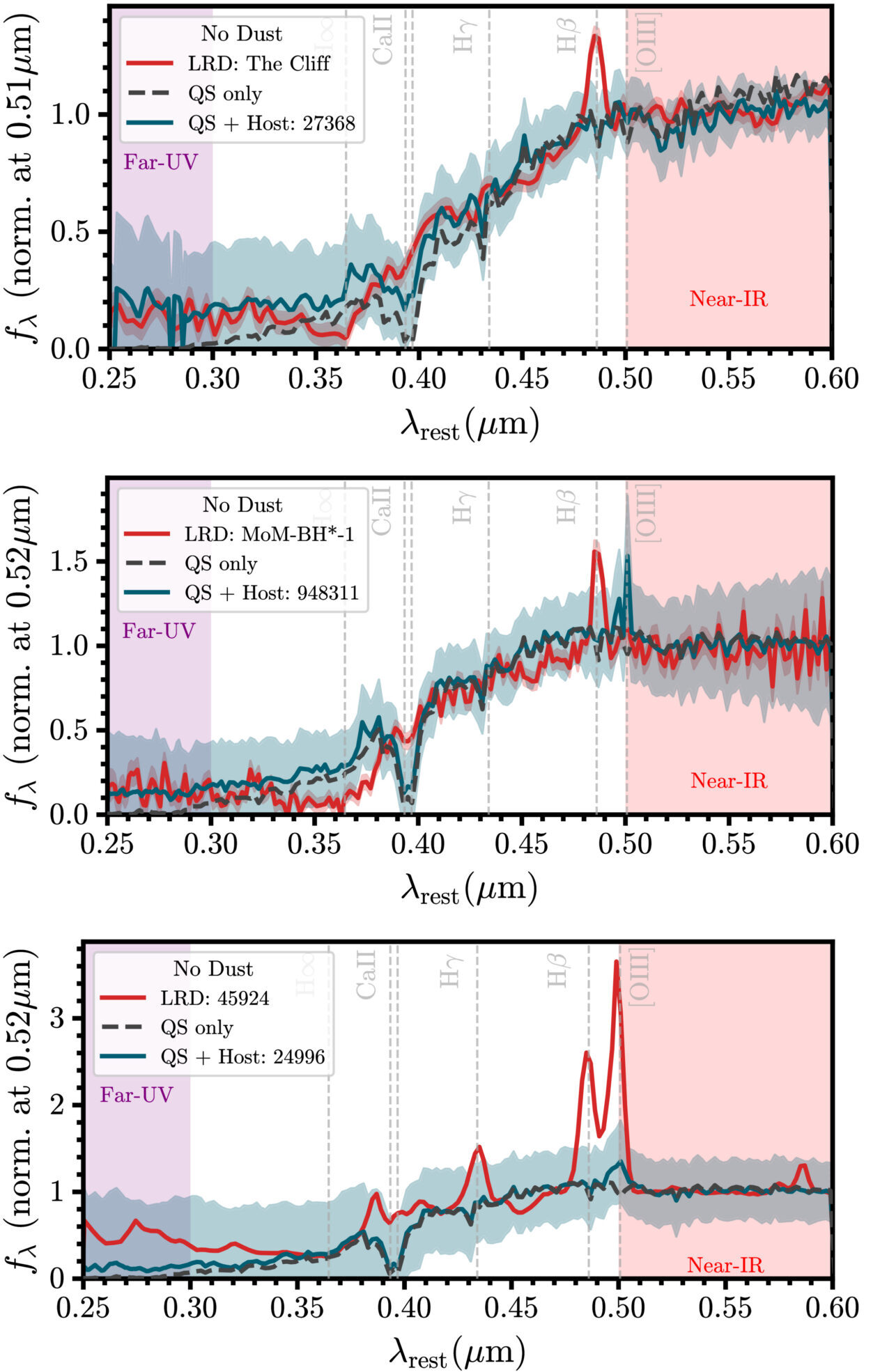
❌