Some stars have planets. Others are orbited by brown dwarfs, balls of gas too massive to be planets, but too low-mass to be stars. Astronomers love these brown dwarf-star pairs because being paired with a star helps reveal a brown dwarf’s age. Ages of astronomical objects are often hard to measure, but essential for understanding how they form.
Now, you can join NASA’s new Backyard Worlds: Binaries project and help astronomers discover these rare and interesting pairs. As a volunteer, you’ll inspect images from NASA’s Wide-field Infrared Survey Explorer (WISE) space telescope. Brown dwarfs may appear as small dots moving across a field of otherwise static stars.
“We need your help to gain critical insights into these enigmatic cosmic objects,” said project lead Aaron Meisner.
Brown dwarfs are common but mysterious because they are so faint. There’s one for every three or four stars in our corner of the Milky Way galaxy. They are important laboratories for understanding giant planets like Jupiter.
Join the Backyard Worlds: Binaries project today and help astronomers understand where and when brown dwarfs form! You can also try one of our other brown dwarf-related projects: Backyard Worlds: Cool Neighbors! Anyone with a laptop or cell phone can participate. Participation does not require citizenship in any particular country.
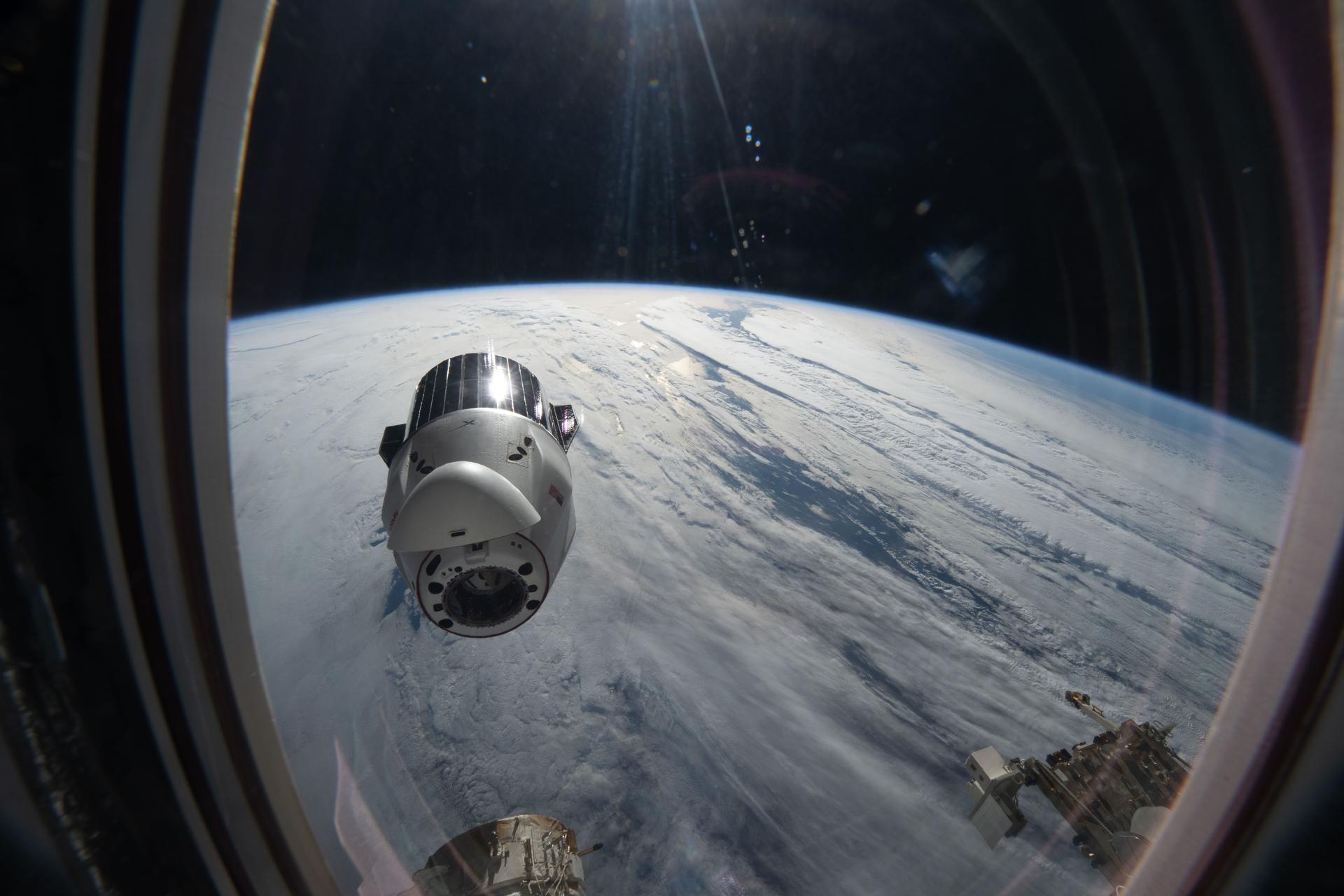
A SpaceX Dragon cargo spacecraft backs away from the International Space Station moments after undocking from the Harmony module’s forward port on June 16, 2026. Dragon, packed with completed science experiments and cargo for retrieval and analysis on Earth, parachuted to a splashdown off the coast of southern California the following day.
Credit: NASA/Jessica Meir
Biomedical tests using augmented and virtual reality tools to advance space health dominated the research schedule aboard the International Space Station on Wednesday. The Expedition 74 crew is also turning its attention to a spacewalk at the end of the month following the departure of a U.S. cargo spacecraft.
NASA flight engineers Jessica Meir and Jack Hathaway began their shift in the Columbus laboratory module conducting vein scans with guidance from doctors on the ground. The duo took turns scanning each other with the EchoFinder-2 ultrasound device that collects health data using augmented reality and artificial intelligence tools. The medical hardware provided by ESA (European Space Agency) provides a screen using augmented reality to guide the operator’s probe motion and artificial intelligence software to detect the subject’s organs. The lightweight, easy-to-use gear may enable independent crew health monitoring on spacecraft travelling to the Moon, Mars, and beyond.
Afterward, Hathaway moved to the Harmony module and loaded bacteria samples into a portable DNA sequencer to read their genetic code. Scientists will use the knowledge to understand bacterial resistance to antibiotics in the space environment potentially affecting an astronaut’s ability to fight an infection.
Meir assisted NASA flight engineer Chris Williams who wore virtual reality goggles for a test measuring his ability to detect balance, movement, orientation in microgravity. The goggles recorded Williams’s eye movements as he responded to visual stimuli generated by computer software operated by Meir. The vestibular system investigation, just one part of the CIPHER suite of 14 human research experiments, is studying how astronauts neurologically adapt to weightlessness to improve crew training and safety.
ESA flight engineer Sophie Adenot helped her crewmates with the digital health science on Wednesday first setting up the EchoFinder-2 hardware, connecting it to a computer tablet, and installing a camera to track the vein study. Next, Adenot configured Harmony’s maintenance work area and retrieved a mini-cold bag to house the bacteria samples for the antibiotics study. Finally, she took pictures of the Moon to observe Earth’s light reflecting off the lunar surface.
All four astronauts gathered together at the end of their shift for a conference call with spacewalk experts on the ground. The quartet and the engineers discussed the tools and procedures necessary to repair a wrist joint on the Canadarm2 robotic arm during a spacewalk planned for June 30. NASA will soon announce the spacewalkers and provide a live televised briefing for more details before the end of the month.
Roscosmos flight engineer Andrey Fedyaev conducted another neurological study while wearing a virtual reality headset and responded to computerized stimuli as electrodes measured brain activity and tracked eye movement, testing his sense of direction, movement, and position. Station commander Sergey Kud-Sverchkov and flight engineer Sergei Mikaev, both from Roscosmos, started their shift in the Nauka science module checking the operation of components supporting the Elektron oxygen generator. Kud-Sverchkov then tested communications gear inside the Soyuz MS-28 crew spacecraft. Mikaev took a computer quiz documenting his mental state before terminating a 24-hour heart and blood pressure monitoring session.
A SpaceX Dragon cargo spacecraft is back on Earth following its undocking from the orbital outpost on Tuesday and splashdown in the Pacific Ocean at 5:11 a.m. PDT/8:11 a.m. EDT on Wednesday. Dragon returned sensitive scientific samples from investigations studying stem cell manufacturing, cartilage tissue printing, and more to treat a range of conditions from blood diseases, cancers, and cartilage injuries.
Dr. John Wisniewski serves as the Program Scientist for the SPHEREx mission, the UVOIR Discipline Lead for APRA, the Program Officer for the Exoplanet Research Program, executive secretary of the ExoPAG, and the Deputy Program Scientist for ExEP.
He obtained his BS in Astronomy-Physics from the University of Wisconsin-Madison in 1999, where he gained his first research experience working with the HPOL spectropolarimeter at UW’s Pine Bluff Observatory, in support of the Wisconsin Ultraviolet Photo-Polarimeter Experiment (WUPPE) that flew as part of the ASTRO-1 and ASTRO-2 shuttle missions. He obtained his PhD from the University of Toledo in 2005. Following terms as a NPP Postdoc at NASA/GSFC and a NSF-AAPF at the University of Washington, he served as an assistant professor and tenured associate professor at the University of Oklahoma (OU) for a decade. Wisniewski received the distinctions of Presidential Professor twice at OU, the James and JoAnn Holden Faculty award, and was a Scialog Fellow of the Research Corporation. He has authored over 215 refereed papers in his career in topics spanning circumstellar disks, exoplanets, high contrast imaging, hot stars, cool stars, stellar activity, and polarimetry. He has been at NASA Headquarters since 2023.
Air pollution is a significant threat to human health and our environment. Instruments on NASA satellites, along with airborne and ground-based sensors, are constantly collecting data on major pollutants in our atmosphere.
Explore Air Quality with NASA
Where Does NASA Fit?
NASA instruments — on satellites, planes, and the ground — constantly collect data on air quality. NASA-funded scientists track the sources and concentrations of major pollutants and their movement through the atmosphere. They provide managers and policymakers with Earth observations that can inform decisions around air quality for economic and human benefit.
Satellites observed striking upper-atmosphere phenomena generated by an intensifying tropical cyclone.
Jun 1, 2026
NASA MISSIONS HELP
How NASA Sees the Air We Breathe
NASA and NOAA, among other agencies, worked together this summer through the STAQS and AEROMMA missions to calibrate and validate NASA’s new TEMPO satellite. The satellite and missions combined aim to not only better measure air quality, and the major pollutants that impact it, but also to improve air quality, from street to stratosphere. This effort was documented during the August 2023 campaign leg, which took place over the Chicago region.
NASA’s Fermi Mission Uncovers Possible Sibling Supernova Remnants
A new study of two supernova remnants, the debris left behind after stars explode, suggests the explosions came from stellar siblings that once orbited each other. The first star’s detonation sent its binary companion hurtling through space, and then, after traveling for thousands of years, the surviving star blew up too.
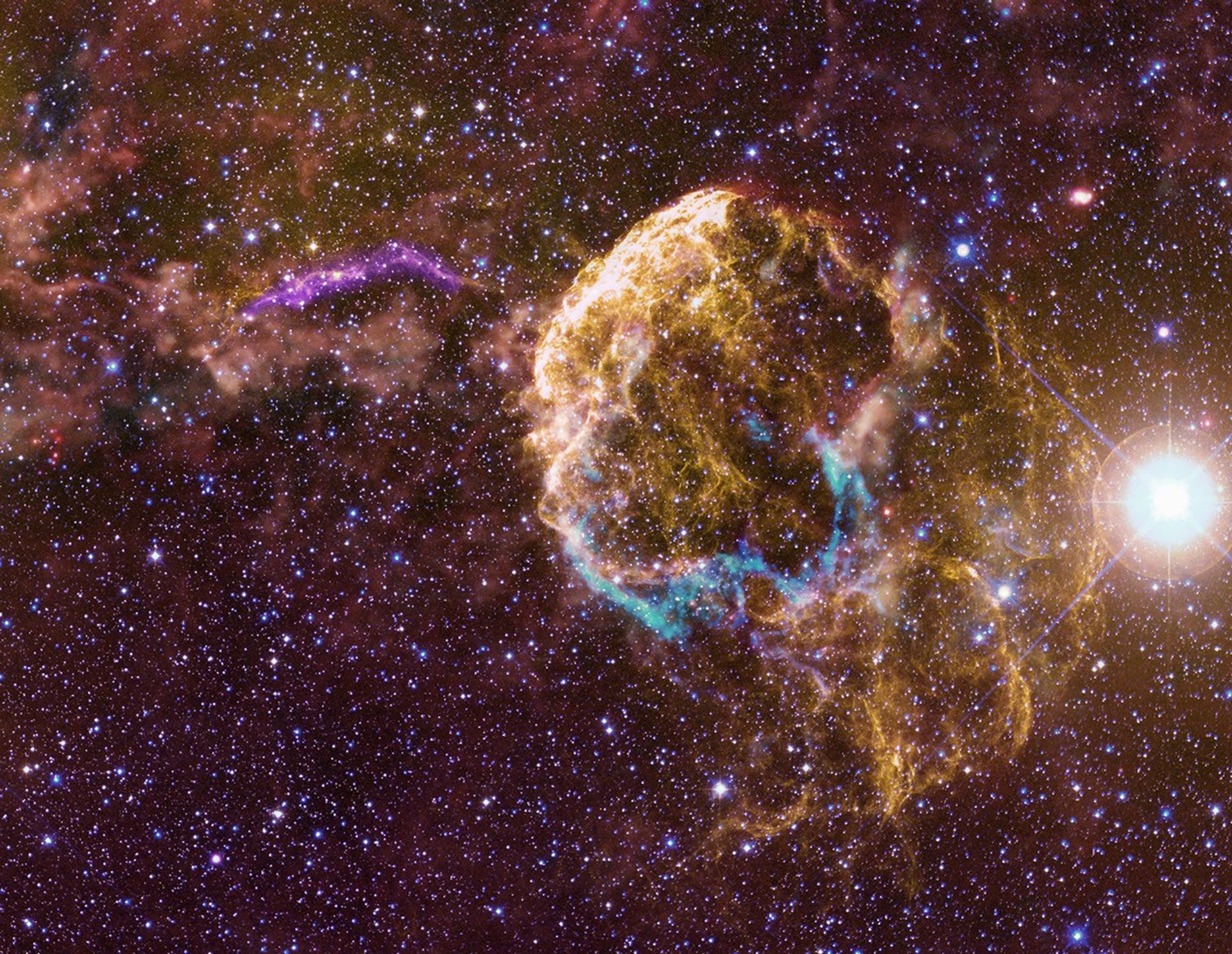
This multiwavelength scene shows the Jellyfish Nebula supernova remnant (right), the interstellar cloud it’s interacting with, and a distinctive curving filament to its upper left. The filament, which is shown here both in optical and ultraviolet (UV) light, is the visible part of an overlapping supernova remnant, G189.6+3.3, that is more prominent in radio and X-rays. Visible light is shown in yellow, UV from NASA’s Neil Gehrels Swift Observatory is shown in violet, and infrared light from NASA’s retired WISE (Wide-field Infrared Survey Explorer) mission appears in cyan, red, and orange. Both remnants are located about 6,000 light-years away in the constellation Gemini. The brilliant star at far right is Propus, also known as Eta Geminorum.
NASA Goddard Space Flight Center and M. Michailidis et al. 2026; optical: DSS; infrared: NASA/WISE/JPL-Caltech/UCLA; ultraviolet: NASA/Swift
“Using 16 years of data from NASA’s Fermi Gamma-ray Space Telescope, our analysis uncovered gamma rays associated with a supernova remnant that was hidden in the glare of its neighbor, the Jellyfish Nebula, one of the brightest gamma-ray-emitting supernova remnants known,” said Miltiadis Michailidis, a postdoctoral fellow in the physics department at Stanford University in California. “There are so many striking connections between the two remnants that we conclude they’re likely related, giving us the first known example of a binary system where both stars have undergone supernova explosions.”
Michailidis presented the findings Wednesday at the 248th meeting of the American Astronomical Society in Pasadena, California. A paper describing the results will appear in a future edition of Nature Communications.
The study focused on a faint supernova remnant called G189.6+3.3, which is mainly visible in X-rays. It is upstaged by its brighter and better-known neighbor, the Jellyfish Nebula (IC 443). The two star wrecks, both located in the constellation Gemini, appear to partially overlap as seen in X-rays. Recent X-ray evidence suggests that hot plasma likely associated with G189.6+3.3 may extend across the entire region, a hint that the overlap may be nearly total.
A massive star explodes when its energy-producing core runs out of fuel and collapses under its own weight, triggering an explosion that blows the star apart. The explosion’s shock wave encloses a hot cloud of debris that rapidly expands into space. So far, astronomers have cataloged about 300 supernova remnants in our galaxy.
The Fermi mission is part of NASA’s fleet of observatories monitoring the changing cosmos to help humanity better understand how the universe works. More than a decade ago, observations from Fermi’s LAT (Large Area Telescope) showed that the shock waves of supernova remnants accelerated particles to within a fraction of the speed of light, a process first proposed by physicist Enrico Fermi — the mission’s namesake — in 1949.
These high-speed particles, called cosmic rays, interact with interstellar gas to produce gamma rays, the highest-energy form of light. Protons make up 99% of cosmic ray particles. To prove that accelerated protons are responsible for the glow, astronomers search for a specific gamma-ray feature. When cosmic-ray protons smash into interstellar gas, they produce a short-lived particle called a neutral pion, which almost immediately decays into a pair of gamma rays. This emission occurs within a specific band of energies associated with the neutral pion’s mass and lies within the range detected by Fermi’s LAT instrument.
In 2013, Fermi observations proved that the Jellyfish Nebula, which is interacting with part of a glowing cloud of hydrogen gas known as Sharpless 249, produced gamma rays through this mechanism. Its neighbor, G189.6+3.3, was discovered in 1994 as part of an X-ray survey by the German-led ROSAT (Roentgen Satellite) mission.
A bright filament of gas lies between the overlapping remnants. New observations of this feature reveal that the shock wave from G189.6+3.3 slammed into dense interstellar gas there and dramatically slowed, key evidence that both remnants are interacting with the same cloud system.
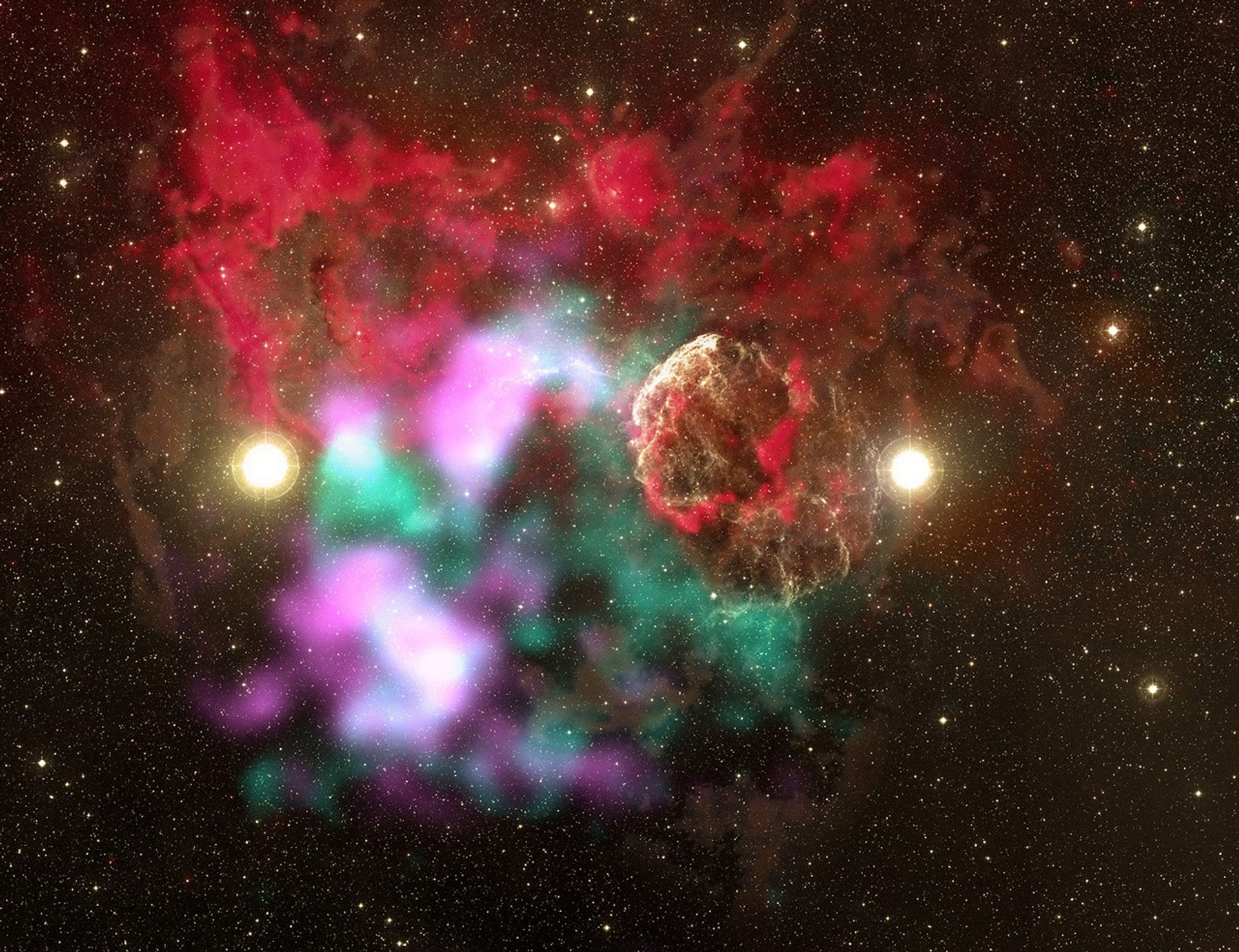
The well-known supernova remnant IC 443 (right) has an older, fainter neighbor (shown here in blue-green and magenta) called G189.6+3.3. A filament of gas between them, glowing in visible and ultraviolet light (violet arc at center), traces the neighbor’s shock wave and shows that both remnants are interacting with the same molecular cloud, shown in red, orange, brown for infrared and radio data and yellow for visible light. Blue-green shows X-rays from the fainter remnant, while magenta shows gamma rays with energies greater than 10 billion electron volts; for comparison, visible light has energies between about 2 and 3 electron volts. In this view, high-energy light from the much brighter IC 443 has been removed for clarity. Gamma-ray emission near the filament stems from protons accelerated in the supernova’s shock wave as it expands into the cloud.
NASA Goddard Space Flight Center and M. Michailidis et al. 2026; radio, MWISP and ESA/Planck; infrared: NASA/WISE/JPL-Caltech/UCLA; optical: DSS; ultraviolet: NASA/Swift; X-ray: SRG/eROSITA; gamma ray: NASA/DOE/Fermi LAT Collaboration
Astronomers think the Jellyfish Nebula is also a candidate PeVatron, a cosmic particle accelerator capable of boosting protons to energies so high they could nearly escape our galaxy. Such particles can produce gamma rays with trillions of times more energy than visible light. Finding a second particle accelerator near the Jellyfish Nebula could offer scientists new clues for how supernova remnants develop into PeVatrons.
“The overlapping remnants, a connecting gas filament, and the availability of data from Fermi and other facilities motivated us to delve into this complex but little-studied region,” said co-author Marianne Lemoine-Goumard, an astrophysicist at the French National Centre for Scientific Research (CNRS) based at the University of Bordeaux. “With Fermi’s LAT instrument, we found gamma-ray emission associated with accelerated protons in the northern part of the fainter remnant. If both remnants are interacting with the same structure, then they must share a common distance from us.”
The team concludes the remnants lie about 6,000 light-years away, their explosion centers are separated by roughly 40 light-years projected onto the plane of the sky, and the original stars may have been 20 or more times the Sun’s mass.
Estimates of the remnants’ ages vary widely, but the team concludes that the age of the Jellyfish Nebula is 8,000 to 9,000 years, while G189.6+3.3 is between 20,000 to 110,000 years old. This means the delay between the explosions could have extended for up to 100,000 years.
In addition, the team conducted computer simulations of a million massive binary systems. They show that systems where the stars orbit close enough to exchange matter and interact during their lives can readily produce dual supernova explosions with similar separations and time delays as those found for the remnants. The team also estimated that the chance of randomly encountering this combination of observed spatial alignment and compatible distances to be less than 1%, strongly supporting a physical association.
“The evidence we’ve compiled — including observations across the spectrum, the chemical and physical properties of the remnants, simulations, and more — paints a compelling picture of a dual supernova event,” said Michailidis.
This study identifies a unique possible example of a binary system where both stars exploded as supernovae and left behind separate, detectable supernova remnants. Astronomers think that most massive stars form in binary or multiple-star systems. The Jellyfish Nebula/G189.6+3.3 complex offers astronomers a rare opportunity to study how massive binary stars evolve, exchange matter, explode, and experience velocity changes — called kicks — induced by the supernova blast. It also provides a powerful new laboratory for understanding how coupled supernova remnants behave, including how they accelerate particles, generate gamma rays, and shape their surrounding environments.
“Fermi’s gamma-ray observations of supernova remnants continue to reveal the dynamic lives of stars,” said Elizabeth Hays, the Fermi project scientist at NASA’s Goddard Space Flight Center in Greenbelt, Maryland. “We can now connect the glowing remains of two massive stars to a powerful pair that evolved together over thousands of years.”
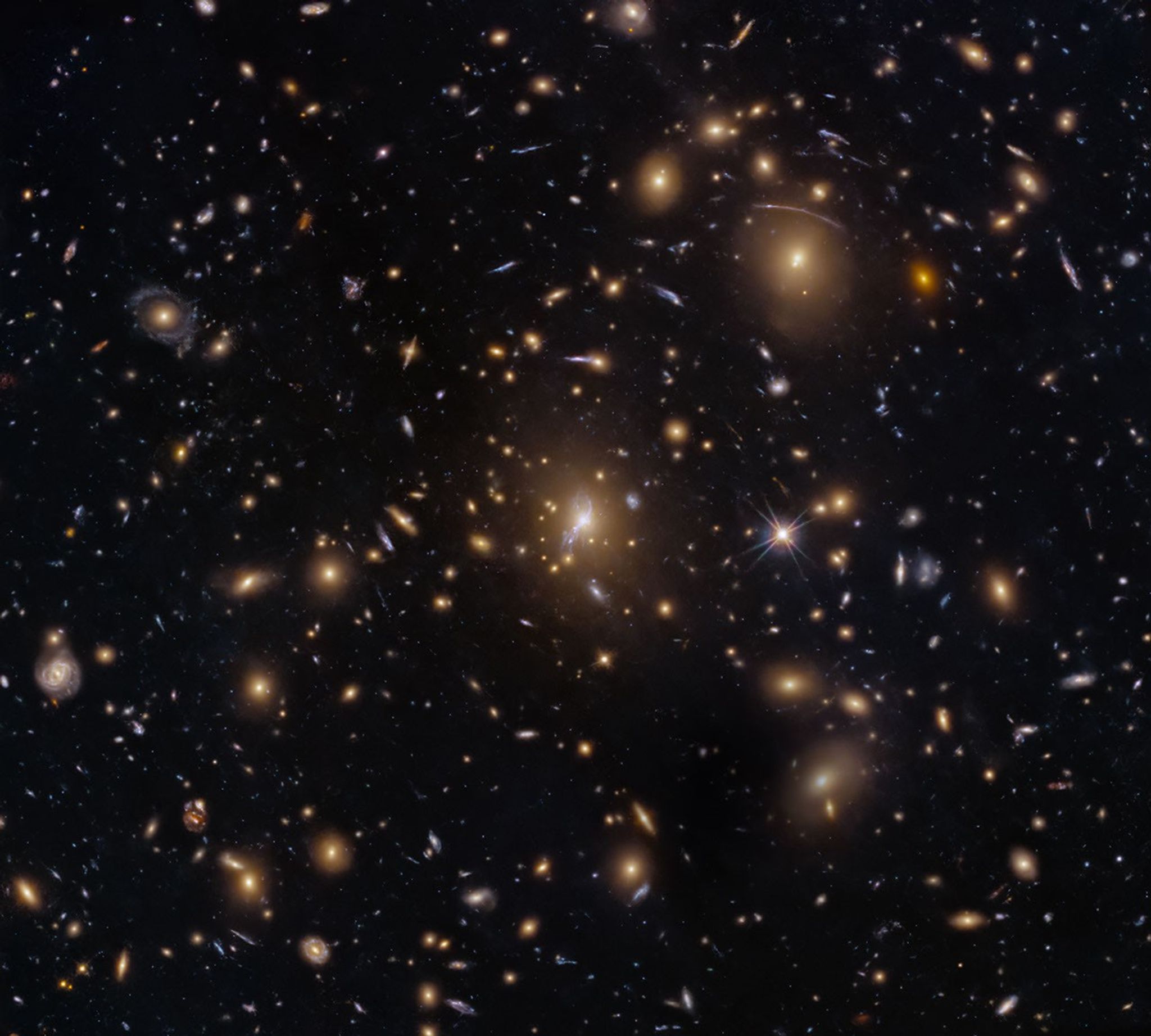
This NASA Hubble Space Telescope image features the galaxy cluster MACS0329-0211.
NASA, ESA, M. Postman (STScI); Image Processing: G. Kober (NASA/Catholic University of America)
Looking somewhat like a swarm of bees returning to their hive, this NASA Hubble Space Telescope image released on June 12, 2026, features the galaxy cluster MACS0329-0211. Galaxy clusters like MACS0329-0211 are important signposts in the story of how the structure of the universe evolved, and are the ultimate telescopic lenses, placing gravitationally lensed galaxies from the earliest stages of the universe into our view.
Zoom into this galaxy swarm and you will find large, oval-shaped elliptical galaxies, and thin spiral and lenticular galaxies viewed from the edge. We can also see the full, face-on view of spiral galaxies and their curving spiral arms. The image’s upper-right quadrant holds faint arcs of distant galaxies gravitationally lensed by the cluster’s massive gravity. The largest of these arcs appears above the bright oval shape of a giant elliptical galaxy. Closer inspection of the image’s center reveals several bright-white intersecting curves that appear as a distorted figure eight. This may be another distant galaxy whose light was magnified and distorted by this massive cluster’s gravity.
Hubble looked at MACS0329-0211 as part of an observing program of X-ray bright galaxy clusters. Researchers used Hubble’s two main cameras, the Advanced Camera for Surveys and its Wide Field Camera 3, to gather data visible and infrared light from the cluster. Hubble’s ability to see such a broad spectrum of light makes it a valuable tool in understanding the very nature of these galaxy clusters.
Image credit: NASA, ESA, M. Postman (STScI); Image Processing: G. Kober (NASA/Catholic University of America)
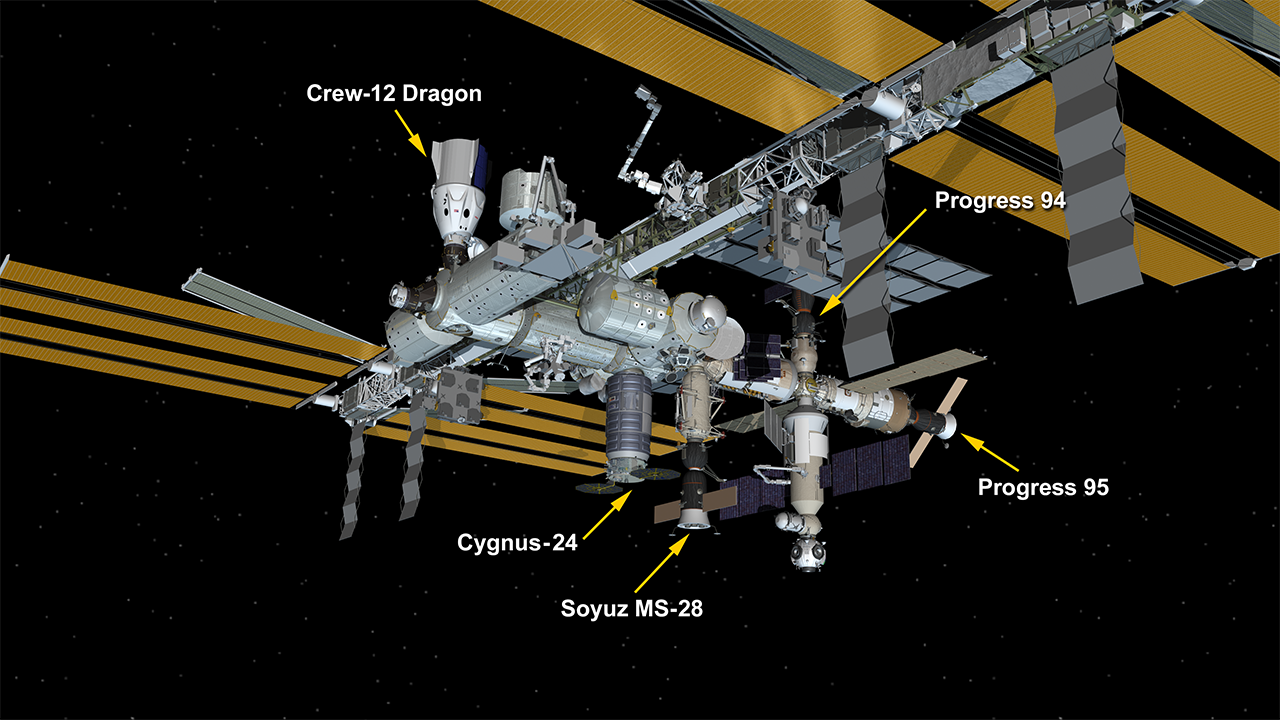
June 16, 2026: International Space Station Configuration. Five spaceships are parked at the space station including the SpaceX Crew-12 Dragon, Northrop Grumman’s Cygnus XL, the Soyuz MS-28 crew ship, and the Progress 94 and 95 resupply ships.
NASA
At 5:11 a.m. PDT (8:11 a.m. EDT), the unpiloted SpaceX Dragon spacecraft splashed down off the coast of California near Oceanside, marking the return of the 34th SpaceX commercial resupply services mission to the International Space Station for NASA.
Dragon undocked at 12:25 p.m. EDT on June 16, carrying samples that could shape future space exploration and life on Earth. Research returning includes bioprinted organ and cartilage tissue, data on improving cryogenic fuel storage for future space missions, and DNA‑inspired materials to develop new cancer treatments. The returning hardware includes an ocular imaging device used to monitor crew members’ eye health, an absorbent bed that filters trace contaminants from cabin air, and a separator pump from the waste and hygiene compartment.
The spacecraft arrived at the space station on May 17 after launching two days earlier on a Falcon 9 rocket from Space Launch Complex 40 at Cape Canaveral Space Force Station in Florida.
PhysCOS Activities at AAS 248 – Wednesday, 17 June 2026
16 June 2026
Dear Physics of the Cosmos (PhysCOS) community members-
If you’re attending the American Astronomical Society’s 2026 Summer Meeting (AAS 248) in Pasadena CA, please join us for the following PhysCOS-organized activities (all times Pacific):
Wednesday 17 June
11:40a ‑ 1:10p, Conference Center 212: (XR SIG Special Session)
HEAD: Toward the 2030 Decadal: Science Cases for Potential Future X-ray Mission Concepts
Additionally, the following activities may be of special interest to the PhysCOS community:
Wednesday 17 June
10a ‑ 11:30a, Conference Center 211: Time Domain and Multi-messenger Astrophysics
11a ‑ 12n, Conference Center 204: The NASA Astrophysics ROSES Program
2p ‑ 3:30p, Conference Center 211: Stellar/Compact Objects 2: HMXBs and Pulsar Phenomena
3:40p ‑ 5:10p, Conference Center 212: HEAD: Chandra: Today and Tomorrow
And please drop by the PhysCOS table in the Exhibit Hall!ll!
For more information on PhysCOS throughout the meeting, check out our meeting webpage.
Wishing you the best,
Dr Francesca Civano & Dr Brian Humensky PhysCOS Chief Scientists, NASA GSFC
Dr Bernard Kelly PhysCOS Support Scientist, NASA GSFC
American Astronomical Society
The 248th Meeting of the AAS
The 248th AAS meeting (joint with the High Energy Astrophysics and the Laboratory Astrophysics Divisions) will be held 14-18 June 2026 in Pasadena, California.
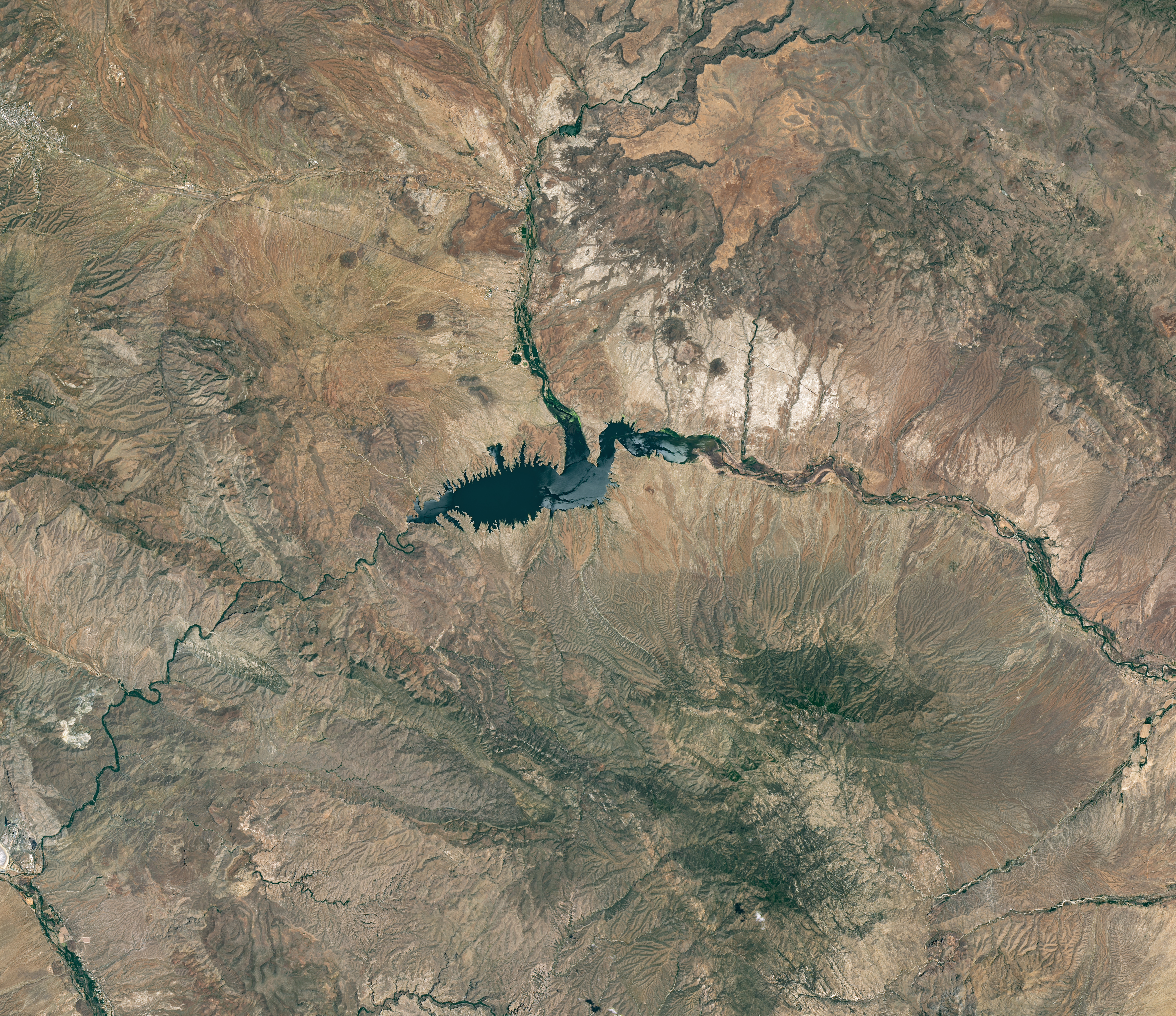
The reservoir appears lake-like and expansive in an image acquired in June 2023.
NASA Earth Observatory/Michala Garrison
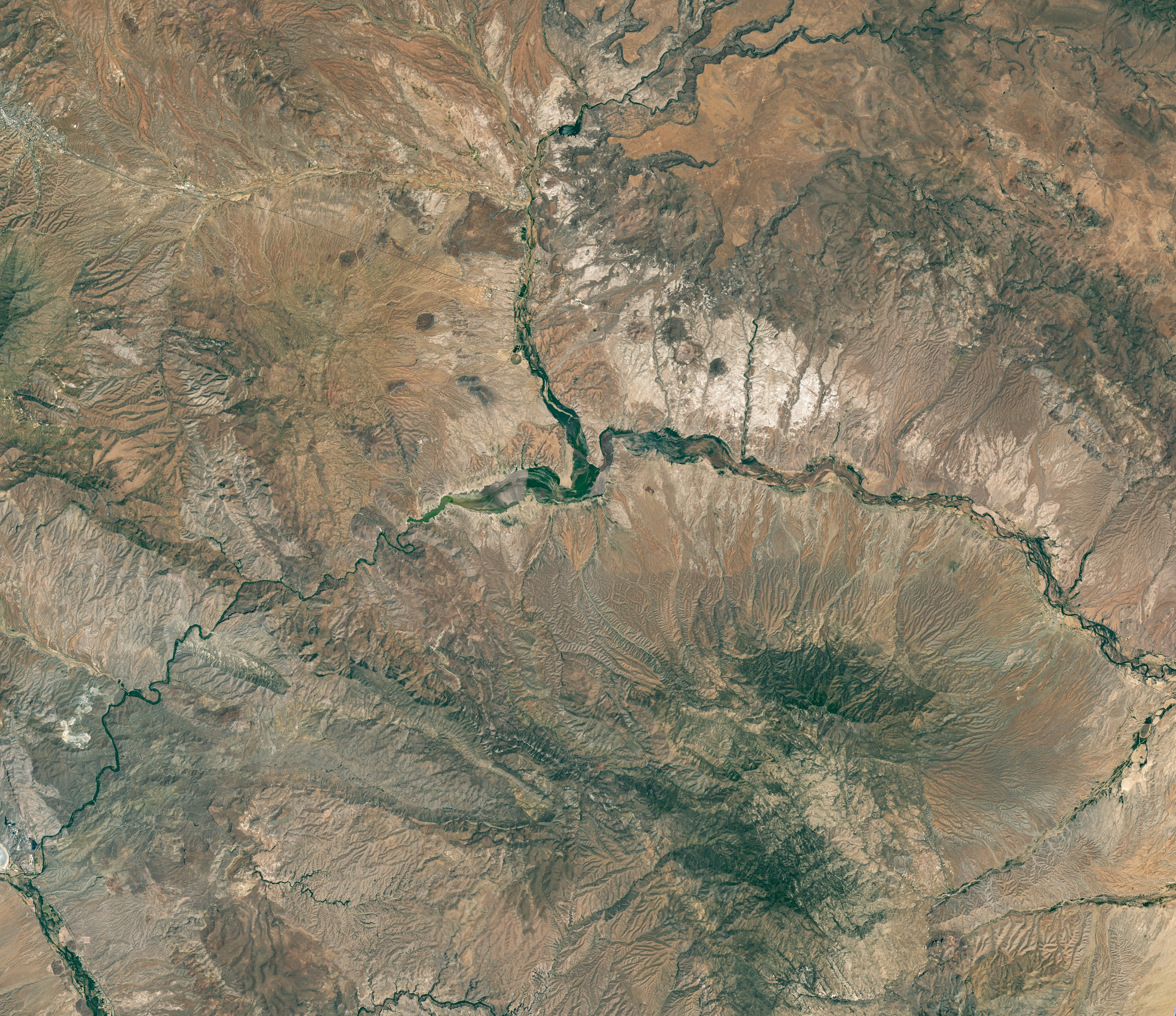
The reservoir is nearly empty by May 2026. The Gila River’s natural channel is now visible and flanked with green vegetation in what had been the bottom of the reservoir.
NASA Earth Observatory/Michala Garrison
June 7, 2023
May 22, 2026
Little water remains in the San Carlos Reservoir in May 2026 (right) compared to fuller conditions in June 2023 (left). Images were captured by the OLI (Operational Land Imager) on the Landsat 9 and 8 satellites, respectively. NASA Earth Observatory images by Michala Garrison.
The Gila River is among the Southwest’s most important rivers, delivering water for people, farms, and wildlife while linking the snow-fed mountains of southwestern New Mexico to the desert lowlands of southwestern Arizona.
In wetter years, seasonal snowfall on the Mogollon Mountains and Black Range provides much of the river’s spring flow and helps refill San Carlos Reservoir, which is formed by the Coolidge Dam. When filled to capacity, the reservoir is one of Arizona’s largest bodies of water.
However, in 2026, lackluster snowfall left the mountain snowpack in the Gila River watershed at 2 percent of the 1991-2020 March median. The limited snowpack pushed April streamflow to 39 percent of normal. By June, after mandatory water releases for downstream agriculture, the reservoir held less than 400 acre-feet of water.
The Landsat image above (right) shows the near-empty reservoir on May 22, 2026, when it stored 389 acre-feet of water—less than 1 percent full; the other image (left) shows the same area in June 2023, when it was about 60 percent full. The green vegetation growing along the river channel and reservoir edge includes a mixture of tamarisk, willow, cottonwood, sedges, and grasses.
Officials closed the reservoir indefinitely on June 5, 2026, after the declining water levels contributed to low oxygen levels—hypoxia—that killed virtually all of its fish. Species living in the reservoir included largemouth bass, black crappie, bluegill, channel catfish, flathead catfish, and several stocked species, including brown trout and rainbow trout. The decomposing fish may pose health risks to people attempting to boat or fish, the San Carlos Recreation and Wildlife Department warned.
The reservoir has hit similarly low water levels in the past, running out of water at least 20 times since it was filled in 1930, according to news reports. Even when the dam and reservoir were first dedicated, there was enough grass growing on the dried reservoir bottom that humorist Will Rogers famously quipped to President Calvin Coolidge: “If that was my lake, I’d mow it.”
Other years with major fish kills include 1976 and 2018. After more than 5 million fish died during a similar event in 1976, the Gila Heraldreported that it took five years for the lake’s ecosystem to rebound.
The region is currently in the midst of a multi-year dry period that has left much of the Gila River’s headwaters in New Mexico in a state of severe drought, according to data from the U.S. Drought Monitor.
However, the river’s flow is highly variable, and heavy rains during the coming wet season could help the reservoir recover. A seasonal monsoon outlook released by NOAA in May 2026 projected a 33 to 50 percent chance that an above-average amount of rain would fall in the region that summer. El Niño in the central and eastern equatorial Pacific, which was strengthening in late spring 2026, can make heavy rains in the U.S. Southwest more likely.
NASA Earth Observatory images by Michala Garrison, using Landsat data from the U.S. Geological Survey.Story by Adam Voiland.
Become an Earth scientist and explore the planet we call home! You’ll use tools like maps, colors, and careful observations to discover Earth’s surface and atmosphere. Pick a digital patch, a physical patch, or complete activities on your own.
LiDAR (Light Detection and Ranging) is a technology that uses laser light to measure distances and create detailed maps of surfaces. By calculating how long it takes for light to bounce back, scientists can determine the height and shape of objects, helping them map landscapes on Earth and even explore other planets.
Satellite images are built from thousands (or millions!) of tiny squares called pixels, and each one adds a small piece of information to the overall picture. The more pixels an image has, the higher its resolution — allowing scientists to see finer details and better understand Earth’s surface.
Ozone Where We Live (OWWL) is a NASA project that helps scientists understand air quality in California’s San Joaquin Valley. Volunteers collect ozone and other air pollution data using simple sensors, which NASA researchers use to improve satellite measurements and air quality predictions.
NeMO-Net is a single player iPad game where you help classify coral reefs by painting 2D and 3D images of coral. The data you collect in the game trains NASA’s neural network to study coral reef health around the world.
LiDAR (Light Detection and Ranging) is a technology that uses laser light to measure distances and create detailed maps of surfaces. By calculating how long it takes for light to bounce back, scientists can determine the height and shape of objects, helping them map landscapes on Earth and even explore other planets.
Discover how scientists map the invisible world beneath clouds, ice, and forest canopies to undestand the shape of our planet.
1. LiDAR Patch
Resources
LiDAR Patch Activity
Click here for the LiDAR Patch activity sheet in PDF form.
Purchase the Patch
LiDAR Patch Activity
Use “laser-like” tools to map a hidden landscape just like a NASA scientist.
Create a color-coded “laser” stick
Measure the hidden landscape
Record your data and create your topographical map
Share your discoveries
What is LiDAR?
Scientists use LiDAR to create topographical maps, meaning a type of map that shows the elevation of different areas. They use this to map different parts of the Earth’s surface, like forests or cities. Some types of LiDAR can see through water, which allows scientists to map the ocean floor!
How do scientists use LiDAR?
Scientists use LiDAR to create topographical maps, meaning a type of map that shows the elevation of different areas. They use this to map different parts of the Earth’s surface, like forests or cities. Some types of LiDAR can see through water, which allows scientists to map the ocean floor!
Scientists also use LiDAR in outer space, to create maps of other planets and moons.
NeMO‑Net is a NASA game and citizen science project where you help classify coral reef images by painting 2D and 3D pictures of coral. The classifications you make train a NASA neural network to better assess the health and makeup of coral reefs around the world.
Discover how everyday people can help protect one of Earth’s most vital ecosystems.
NeMO-Net
Resources
NeMO-Net Patch Activity
Click here for the NeMO-Net Patch activity sheet in PDF form.
Purchase the Patch
NeMO-Net Patch Activity
Dive into real coral reef data and help NASA scientists map the ocean floor.
Meet the coral reefs inside the NeMO-Net game
Explore ocean reefs
Paint and classify coral
Make your mark on NASA ocean science
What is NeMO-Net?
NeMO-Net is a single player iPad game where you help classify coral reefs by painting 2D and 3D images of coral. The data you collect in the game trains NASA’s neural network to study coral reef health around the world.
How does it work?
NeMO‑Net turns the classifications you make in the game into real science! NASA uses your coral drawings to train a smart computer program, called a neural network, that studies coral reefs around the world.
The program compares your work with super-detailed 3D images of reefs taken by NASA’s FluidCam, then uses that information to improve satellite and airborne images. This helps scientists understand coral reef health and changes in oceans at a scale and detail that was never possible before.
Ozone Where We Live (OWWL) is a NASA project that helps scientists understand air quality in California’s San Joaquin Valley. Volunteers collect ozone and other air pollution data using simple sensors, which NASA researchers use to improve satellite measurements and air quality predictions.
Discover how the air around you connects to a global mission and why measuring what we can’t see matters for every living thing on Earth.
OWWL (Ozone Where We Live)
Resources
OWWL Patch Activity
Click here for the OWWL Patch activity sheet in PDF form.
Purchase the Patch
Learn More about the OWWL Project
OWWL Patch Activity
Help NASA measure the air we breathe in our own communities.
Deploy your sensor
Explore and measure the air quality
Help track pollution levels in your community
What is OWWL?
Ozone Where We Live (OWWL) is a NASA project that studies air quality in California’s San Joaquin Valley. Kids and families can help by placing simple sensors at homes, schools, or other locations—or even by flying sensors on planes—to collect data that helps scientists track and predict pollution.
How does it work?
NASA scientists team up with community volunteers to explore and measure air quality in the San Joaquin Valley, giving you a chance to be a real-life Earth scientist!
Airborne component: Volunteer pilots carry small ozone sensors on their regular flights to collect important data near the ground, helping NASA check and improve satellite measurements.
Ground-based component: You, your family, or your school can host sensors to track ozone and other gases in your neighborhood. The data you collect helps scientists understand pollution, make better predictions, and share real-time air quality information to keep your community safe and informed.
Satellite images are built from thousands (or millions!) of tiny squares called pixels, and each one adds a small piece of information to the overall picture. The more pixels an image has, the higher its resolution — allowing scientists to see finer details and better understand Earth’s surface.
Uncover how a single pixel can tell a powerful story and discover how scientists use images from space to understand our changing planet.
Color-a-Pixel Patch
Resources
Color-a-Pixel Patch Activity
Click here for the Color-a-Pixel Patch activity sheet in PDF form.
Purchase the Patch
Color-a-Pixel Patch Activity
Discover how scientists see the Earth from space, one pixel at a time.
Explore your pixel grid
Color your image
Discover the power of resolution
What is the significance of pixels in satellite data?
Lots of satellites take pictures of Earth. Often, each satellite is programmed to travel in a specific orbit – meaning a circular path – around the plant, photographing specific areas. As technology has gotten better, we get better and better pictures. The quality of a picture is called its resolution, which is determined by how many individual dots of color (pixels) make up the image.
In this activity, we are going to understand how pixels are important to pictures by coloring in each pixel on our own satellite image. As you color each square, the image will start to appear!
How do scientists use pixels in their research?
Satellite image resolution is important for scientists, because it determines how much detail they have to be able to accurately observe, measure, and analyze the Earth’s surface. For example, a high-resolution image would be needed for a researcher to count how many individual trees are in a particular area.

 Login