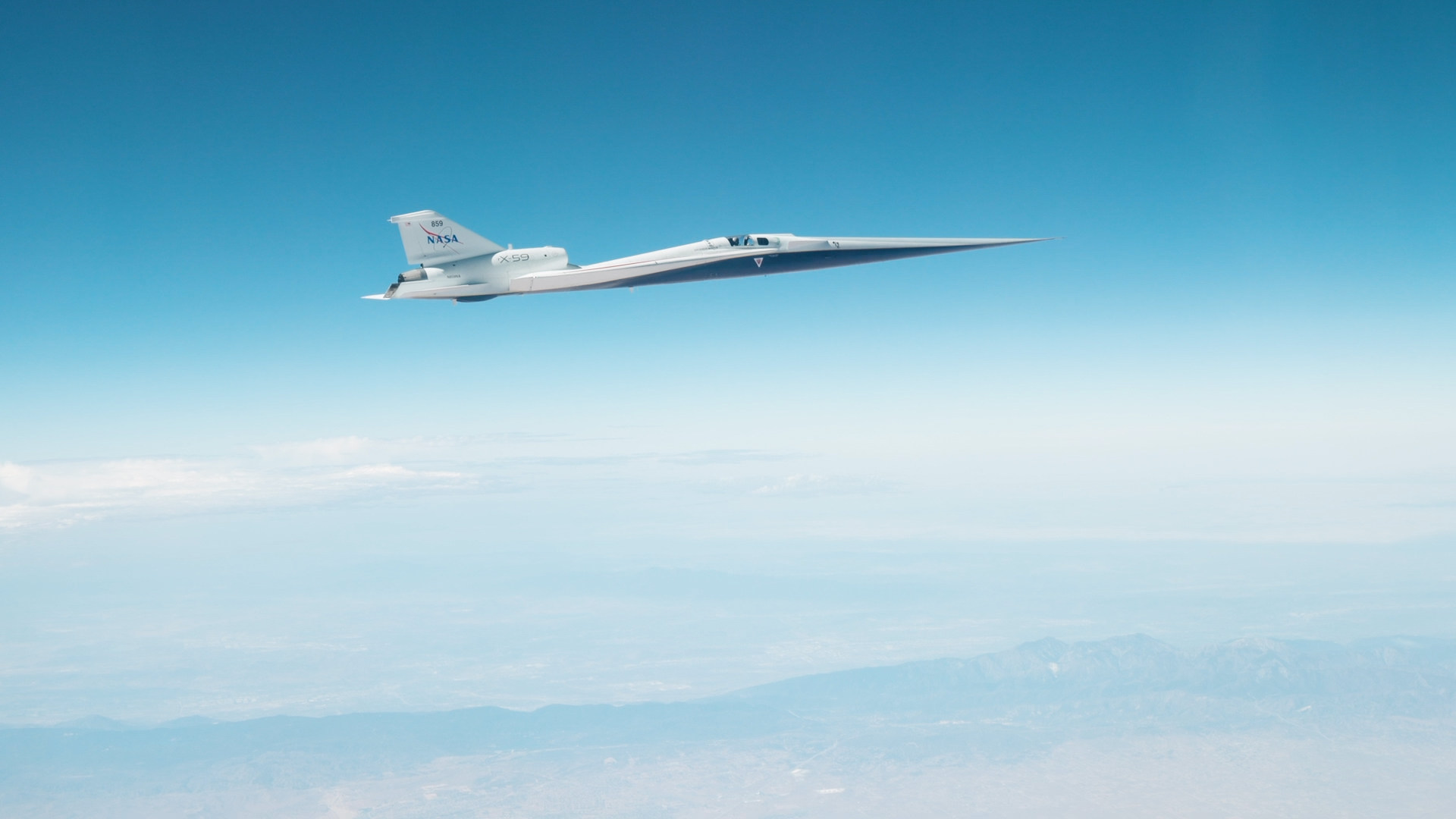
NASA’s X-59 quiet supersonic research aircraft reached its target speed and altitude for future community overflights for the first time during a flight on Friday, June 12, 2026. The milestone marked the first time the aircraft flew at Mach 1.4 and 55,000 feet — conditions it will fly when gathering community response data to its quiet sonic thump.
NASA/Lori Losey
NASA’s X-59 experimental aircraft reached a major milestone Friday, June 12, flying Mach 1.4 (about 924 mph) and an altitude of 55,000 feet, the conditions required for the aircraft to make future flights critical to its mission.
The X-59 still has months of performance testing ahead, but after those are complete, NASA’s Quesst mission will fly the aircraft over several U.S. communities to collect data on public perception of the quiet sonic thump it will make at supersonic speeds. Those community overflights will include flights at Mach 1.4 and 55,000 feet.
The milestone comes just days after the X-59’s first supersonic flight. That flight showed the aircraft performed as expected at Mach 1.1, but Friday’s mission conditions flight was an even more critical step for NASA.
NASA’s X‑59 eXternal Vision System (XVS) shows Mach 1.4 at 55,030 feet on Friday, June 12, 2026 during the aircraft’s first mission conditions flight, the approximate conditions it will fly when gathering community response data to its quiet “sonic thump.” The milestone marks the first time the aircraft flew at its designed speed and altitude.
NASA/Lori Losey
The X-59 was designed to fly supersonic without causing a loud sonic boom. However, for these early supersonic flights it has been accompanied by a NASA F-15 research aircraft, a traditional supersonic jet that causes booms obscuring any noise the X-59 makes. During upcoming flights, a shock-sensing probe mounted to the F-15 will gather measurements of the X-59’s shock wave signature, an early measure of its supersonic performance.
After the team conducts more tests at a variety of altitudes and conditions to complete envelope expansion, the X-59 will enter the acoustic validation phase of Quesst. During this phase, researchers will thoroughly measure the aircraft’s supersonic acoustic signature — the quiet thump it’s designed to make — to confirm it is performing as intended.
Each flight brings NASA one step closer to flying the X-59 over communities and gathering feedback that could help shape the future of commercial supersonic flight over land.
Lead researcher Federico De Pascalis of the Italian Institute for Environmental Protection and Research (ISPRA) holds a Mediterranean storm petrel.
A. Benvenuti
You might think birds skimming over the ocean wouldn’t seek wind unless it was pushing them in the right direction, but NASA-funded researchers have learned that storm petrels find stiff crosswinds worth the slowdown, in return for the clues and cues the gusts carry.
In a paper published by the Royal Society’s Biology Letters May 13, researchers from Woods Hole Oceanographic Institution (WHOI) and the Italian Institute for Environmental Protection and Research (ISPRA) found that Mediterranean storm petrels actively sought out crosswinds, which carried odors the birds used to navigate toward prey. The birds were effectively trading the extra energy needed to fly in a crosswind for the information it blows toward them.
These sparrow-sized birds routinely undertake foraging trips hundreds of miles over the sea, returning to the breeding colony to relieve their partners from incubation duties. Until recently, their small size has precluded researchers’ ability to tag them, keeping their journeys a mystery. In 2020 and 2021, working on the Italian island Sardinia, the team, led by ISPRA and WHOI, attached lightweight GPS sensors to the birds, adding just 3.3% of the birds’ weight as they set out over the Mediterranean Sea.
This finding could help reveal how changing winds might impact seabirds’ feeding, breeding, energy levels, and survival, adding insights about patterns of nutrients in the sea — and the forces that create them.
Special Session: Everything but Exoplanets: The Transformative General Astrophysics of the Habitable Worlds Observatory
Monday, June 15th, 1:00pm – 2:30pm ET, 10:00am -11:30am PT
Highlights from Cosmic Origins Science Interest Groups (SIGs) and Science Analysis Groups (SAGs).
Time
Topic
Speaker
10:20am ‑ 10:30am
Spatially Resolved UV Spectroscopy Science Analysis Group in Support of HWO
Emily Witt (JHU)
10:30am ‑ 10:40am
Investigating the NIR Discovery Space of the Habitable Worlds Observatory: Updates from the Red Limit Science Analysis Group
Kyle Cooke (University of Louisville)
10:40am ‑ 10:50am
Opening the OVI Window to Reveal the Diffuse Cosmic Ecosystem with HWO
Sanchayeeta Borthakur (Arizona State University)
11:00am ‑ 11:10am
HWO Science Interest Group: Keeping the Community Connected to HWO
Jessie Christiansen (Caltech/IPAC)
Splinter Session: NASA’s Big Science, Small Missions
Tuesday, June 16th, 1:00pm – 2:30pm ET, 10:00am -11:30am PT (Hybrid Session)
For remote participation, please look for the “Join the Session” link above the agenda on the Cosmic Origins at AAS website.
High-impact science. Smarter, faster, together.
Agenda
Organizers: Swara Ravindranath (NASA/GSFC), Emily Witt (JHU)
Time
Topic
Speaker
10:00am ‑ 10:05am
Welcome
Swara Ravindranath (NASA/GSFC)
10:05am ‑ 10:15am
FORTIS Sounding Rocket
Emily Witt (JHU)
10:15am ‑ 10:25am
BlackCAT CubeSat
Abe Falcone (Pennsylvania State University)
10:25am ‑ 10:35am
SunRISE CubeSat Constellation
Joseph Lazio (University of Michigan)
10:35am ‑ 10:45am
SPHEREx Medium Explorer Mission
Roberta Paladini (IPAC/Caltech)
10:45am ‑ 10:55am
Landolt Pioneer Mission
Peter Kurczynski (NASA/GSFC)
10:55am ‑ 11:05am
Non-Traditional Path to Missions
Sanchayeeta Borthakur (Arizona State University)
11:05am ‑ 11:10am
BREAK
11:10am ‑ 11:30am
Panel Discussion
Swara Ravindranath (NASA/GSFC, moderator) Panelists: Drew Miles (Caltech), Pablo Saz Parkinson (NASA HQ), Joseph Lazio (University of Michigan), Abe Falcone (Pennsylvania State University), David Ardila (JPL)
Special Session: Planning for the Future of Astrophysics and the ASTRA Initiative
Thursday, June 18th, 1:00pm – 2:30pm ET, 10:00am -11:30am PT
No remote participation is available for this special session.
Agenda
Time
Topic
Speaker
10:00am ‑ 10:10am
Introduction from the NASA Astrophysics Division Director
Shawn Domagal‑Goldman (NASA HQ)
10:10am ‑ 10:25am
The ASTRA Initiative: Overview& Path Forward
Jessica Gaskin (NASA HQ)
10:25am ‑ 10:40am
Innovation for Astrophysics Workshop: Initial Findings
Kendra Short (JPL)
10:40am ‑ 10:55am
Ad ASTRA Community Science Workshop
Peter Kurczynski (NASA/GSFC)
10:55am ‑ 11:30am
Panel Discussion
Francesca Civano (NASA/GSFC)
ASTRA Office Hours at Cosmic Origins Exhibit Booth
(June 15 – 17, 2026) at 9am PT
Stop by the AAS / Cosmic Origins Exhibit booth during these times to ask questions about the ASTRA initiative, the September Ad ASTRA workshop, and developing new strategic mission concepts for astrophysics. Monday, Tuesday, Wednesday 9 am PT (Peter Kurczynski)
Best regards, Swara Ravindranath
American Astronomical Society
The 248th Meeting of the AAS
The 248th AAS meeting (joint with the High Energy Astrophysics and the Laboratory Astrophysics Divisions) will be held 14-18 June 2026 in Pasadena, California.
Enabling landers to autonomously identify the safest sites to touch down
Moon craters and their surrounding areas are high-value destinations for lunar missions since they may contain important resources and valuable science targets. However, these sites are also home to dangers such as steep slopes that are difficult to see in the challenging lighting conditions. As a result, selecting landing sites on lunar surfaces is a critical component for NASA’s CLPS (Commercial Lunar Payload Services) missions. A new technology tested through NASA’s Flight Opportunities program is set to go to the Moon and help provide a safe and precise landing.
Astrobotic Technology’s Hazard Detection (HD) Lidar system scans and analyzes the terrain in real-time, enabling landers to autonomously map and select the safest landing sites. Lidar stands for light detection and ranging. The Pittsburgh-headquartered company will use its HD Lidar system when its Griffin lunar lander delivers science and technology payloads to the Moon during its CLPS delivery to the lunar south pole.
With Flight Opportunities support, Astrobotic first tested an engineering model of its advanced HD Lidar sensor in November 2024, confirming its ability to select a safe landing site by detecting and avoiding slopes, rough areas, and potential hazards. This flight test provided the Astrobotic team valuable data on the system’s performance, which was later leveraged by a second flight test in March 2026 with an integrated hazard detection and guidance, navigation, and control (GNC) system to further validate the system ahead of its first lunar mission scheduled for later this year. These flight tests helped the company advance the technology for use on its CLPS mission.
The Astrobotic Griffin Mission One will launch aboard a SpaceX Falcon Heavy rocket from Launch Complex 39A at NASA’s Kennedy Space Center in Florida to deliver NASA payloads to the lunar south pole.
Astrobotic’s HD Lidar system is designed to detect hazards as small as 5.9 inches (15 cm) and slopes greater than 10° to identify potential hazards, such as craters or large rocks. During the lander’s final descent phase, the spacecraft performs a stationary hover at an altitude of 100 meters — about the height of a 30-story building — while pointing its lidar toward the intended landing site. During the hover, the lidar scans the terrain, applies motion correction to account for changes in the spacecraft’s position and attitude, and processes the results into a hazard map used to identify the safest available landing location. The spacecraft then maneuvers to the selected landing site and proceeds with touchdown.
Astrobotic’s HD Lidar system works in tandem with its terrain relative navigation (TRN) sensor system, which takes live photos of the surface and compares them to an onboard map derived from orbital images to determine the spacecraft’s location above the lunar surface. In preparation for the CLPS mission, Astrobotic fully integrated its HD Lidar and TRN camera into its Griffin lander and demonstrated a successful soft landing simulation using Astrobotic’s Griffin Mission One production flatsat — a platform built with engineering models of the actual flight avionics.
Astrobotic’s Griffin lunar lander inside the company’s integration facility. The lander uses Hazard Detection Lidar technology tested with support of NASA’s Flight Opportunities program.
Astrobotic
Advancing Hazard Detection Lidar Through Flight Testing
NASA’s Flight Opportunities program supported testing of Astrobotic’s HD Lidar as part of its mission to demonstrate promising technologies for space exploration, scientific discovery, and the expansion of space commerce. During the flight test on Nov. 11, 2024, an engineering model of the HD Lidar sensor successfully collected data over Astrobotic’s Lunar Surface Proving Ground while mounted on the company’s Xodiac reusable vertical takeoff vertical landing rocket. During the flight, the HD Lidar system processed the 3D lidar point cloud data into a terrain hazard map and helped verify lidar communications, settings, and controls under relevant conditions.
This flight test enabled Astrobotic to make a significant advancement in demonstrating space exploration technology capabilities, and the company applied lessons from this test directly to its lunar lander missions.
Flight test planning using simulated scans from Xodiac historical flight data and Lidar Hazard Detection scan settings in simulation.
Astrobotic
The Hazard Detection Lidar payload, as integrated on the top of Xodiac. The lidar is the box on the left pointed down towards the ground; This pointing angle enables it to view the surface of the Lunar Surface Proving Ground during the flight test.
Astrobotic
Astrobotic’s Griffin lunar lander is seen inside the company’s integration facility.
Astrobotic
Learn More About Flight Opportunities
More Technology Transitions
Learn about other technologies that have advanced their readiness through testing with Flight Opportunities.
Access Flight Testing
Learn more about how to flight test your technology, instrument, or experiment with the Flight Opportunities program.
Flight Providers
Learn about the commercial flight providers that engage with the Flight Opportunities program.
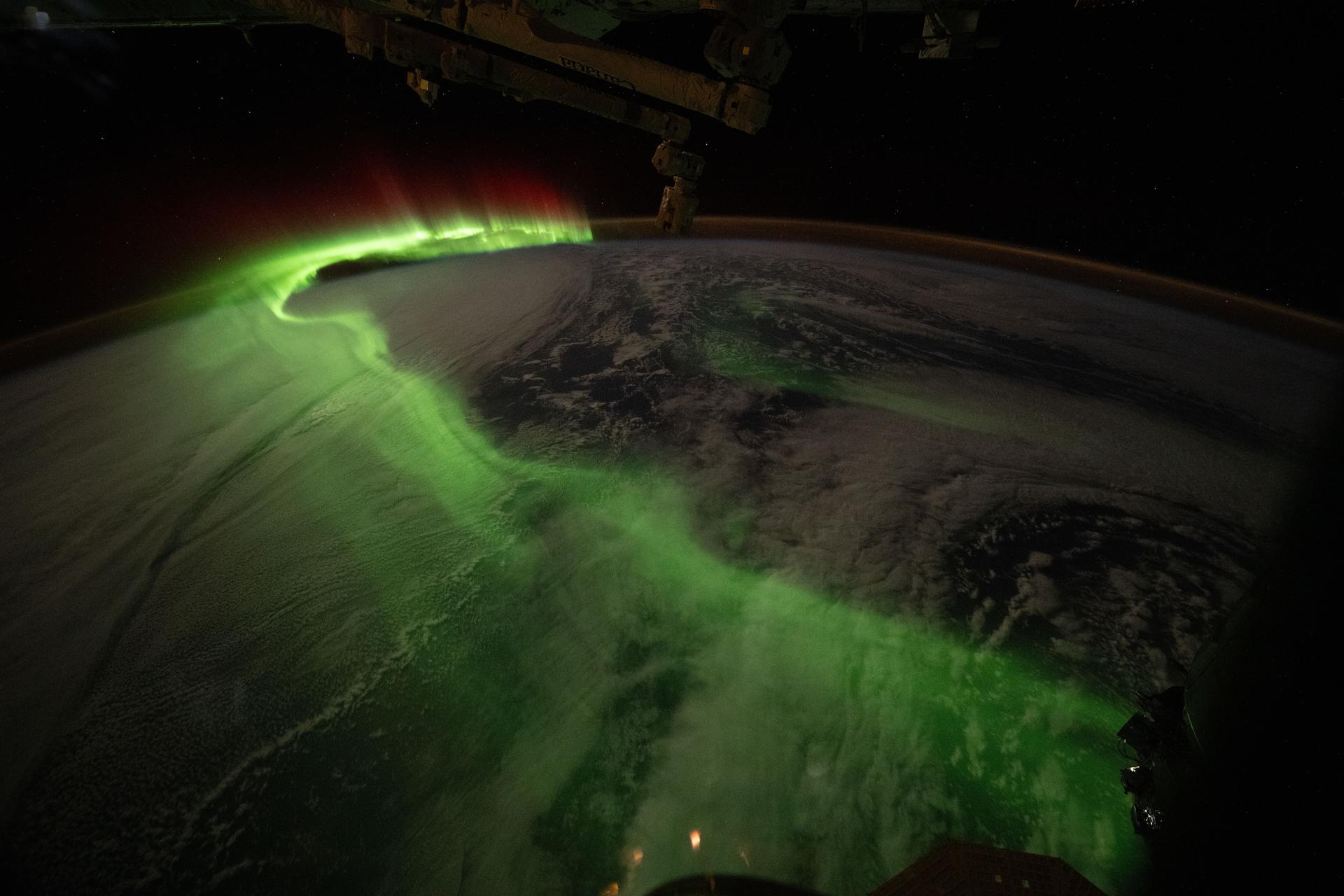
The aurora australis arcs over Earth during an active solar event in this photograph taken at approximately 11:32 p.m. local time from the International Space Station as it orbited 271 miles above the Indian Ocean southwest of Perth, Australia.
NASA/Jessica Meir
Space agriculture, stem cells, and cargo operations wrapped up the week aboard the International Space Station. The Expedition 74 crew also conducted blood tests and installed a new food processor as a U.S. cargo spacecraft nears the end of its mission.
Launching a spacecraft on Earth packed with enough food for a yearslong crew mission or sending resupply ships to replenish a crew beyond low Earth orbit is prohibitive. Therefore, growing plants aboard a spacecraft is key to sustaining crews on long-duration missions to the Moon, Mars, and beyond. As a result, NASA and its international partners have been exploring growing crops in space to enable crews to feed themselves without support from Earth. NASA flight engineer Chris Williams contributed to the ongoing space agriculture research at the end of the week and configured a microscope to observe plant cell division in microgravity. Insights may lead to improved methods of growing food in space as well as on lunar and planetary surfaces.
Low Earth orbit may also be the next frontier for biomedical manufacturing as doctors seek to overcome the limitations of gravity on the ground. NASA flight engineer Jessica Meir harvested blood stem cells inside the Kibo laboratory module’s Life Science Glovebox (LSG) that have been growing aboard the orbital outpost since the arrival of a SpaceX Dragon cargo craft on May 17. Next, she looked at the density and viability of the live cells using the KERMIT fluorescent microscope. Researchers are exploring space-designed cell therapies to treat serious medical conditions such as blood cancers and immune diseases.
Dragon is due to depart the International Space Station at 12:05 p.m. EDT on Tuesday, June 16, to return the stem cell samples, including several tons of completed science experiments and lab hardware, for analysis on Earth. Live coverage of Dragon’s undocking and departure begins at 11:45 a.m. on NASA+.
Williams and Meir also partnered with flight engineers Jack Hathaway of NASA and Sophie Adenot of ESA (European Space Agency) packing Dragon with return cargo together throughout Friday. The quartet will intensify their cargo transfers early next week when they begin loading Dragon with sensitive research samples packed inside portable science freezers for preservation, retrieval, and analysis on Earth.
Williams and Meir began their Friday shift collecting blood samples for spinning in a centrifuge then stowing in a science freezer for future analysis. Hathaway removed a research freezer from inside Kibo’s Life Science Glovebox used the day before to preserve bacteria samples for genetic and chemical analysis. Adenot also spent some time assisting Meir during the stem cell operations then tested a new food processor in the Columbus laboratory module by cooking a Mediterranean dish.
The station’s three cosmonauts, station commander Sergey Kud-Sverchkov and flight engineers Sergei Mikaev and Andrey Fedyaev enjoyed an off-duty day on Friday.
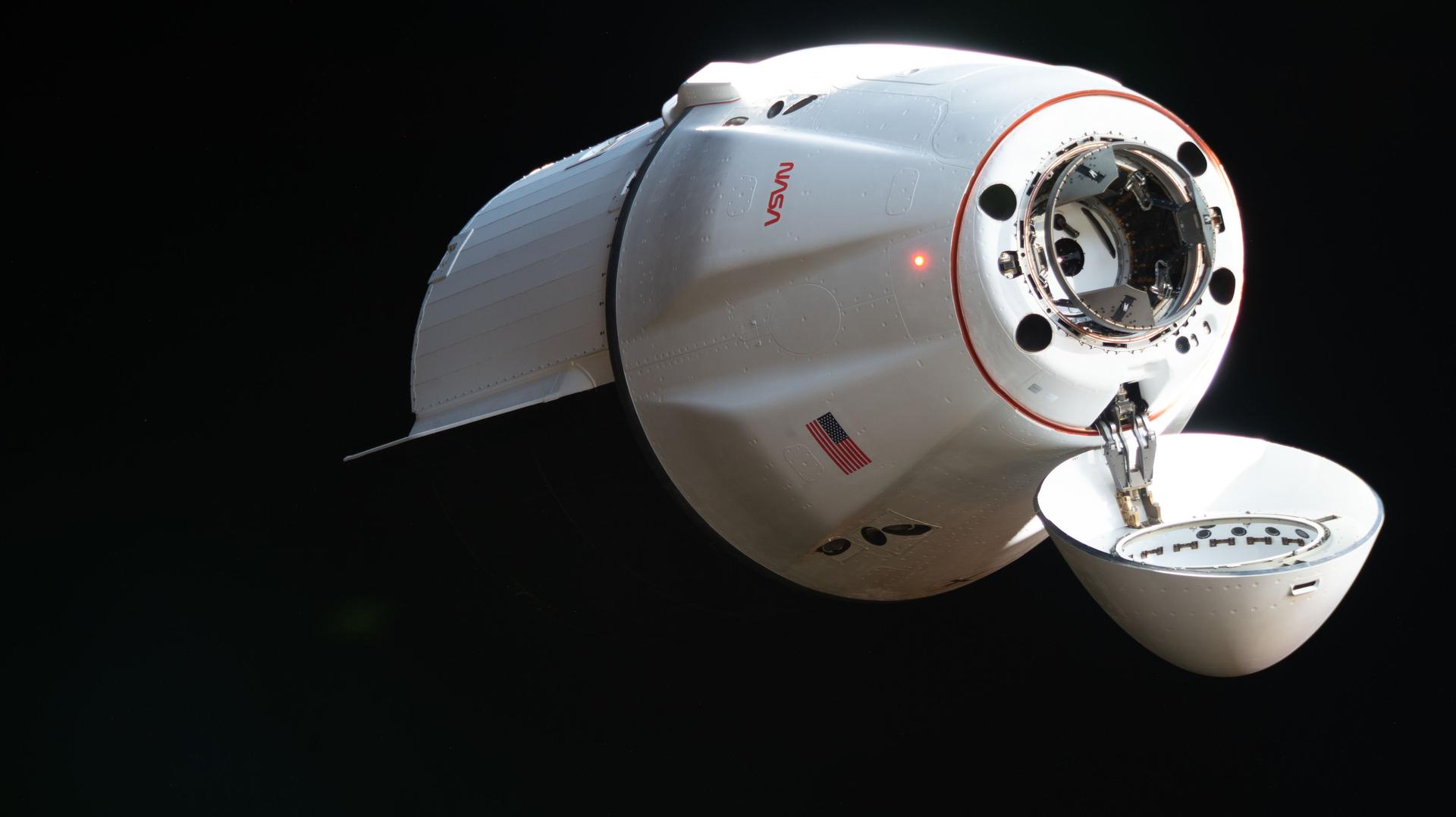
The SpaceX Dragon cargo spacecraft supporting the company’s 34th commercial resupply services mission for NASA approaches the International Space Station on May 17, 2026, carrying nearly 6,500 pounds of food, supplies, and equipment for the Expedition 74 crew.
Credit: NASA
NASA and its international partners are set to receive scientific research samples and hardware as a SpaceX Dragon spacecraft is scheduled to depart the International Space Station on Tuesday, June 16, for its return to Earth.
Watch NASA’s live undocking coverage beginning at 11:45 a.m. EDT on NASA+, Amazon Prime, and the agency’s YouTube channel. Learn how to watch NASA content through a variety of online platforms, including social media.
The Dragon spacecraft will undock from the forward port of the station’s Harmony module at about 12:05 p.m., after receiving a command from SpaceX ground controllers. The spacecraft then will fire its thrusters to move safely away from the orbiting complex.
Following a June 16 departure, the spacecraft will reenter Earth’s atmosphere on Wednesday, June 17, before splashing down off the coast of California at approximately 5:08 a.m. PDT. NASA will not stream the splashdown but will post updates on its space station blog.
Dragon will return to Earth with thousands of pounds of cargo, carrying samples that could shape future space exploration and life on Earth. Research returning includes bioprinted organ and cartilage tissue, data on improving cryogenic fuel storage for future space missions, and DNA‑inspired materials to develop new cancer treatments. The returning hardware includes an ocular imaging device used to monitor crew members’ eye health, an absorbent bed that filters trace contaminants from cabin air, and a separator pump from the waste and hygiene compartment.
Loaded with nearly 6,500 pounds of crew cargo and science experiments, Dragon arrived at the station on May 17 after launching two days earlier on a Falcon 9 rocket from Space Launch Complex 40 at Cape Canaveral Space Force Station in Florida.
For more than 25 years, people have lived and worked continuously aboard the International Space Station, advancing scientific knowledge and making research breakthroughs not possible on Earth. The space station helps NASA understand and overcome the challenges of human spaceflight, expand commercial opportunities in low Earth orbit, and build on the foundation for long-duration missions to the Moon, as part of the Artemis program, and to Mars.
Get breaking news, images, and features from the space station on Instagram, Facebook, and X.
Learn more about International Space Station research and operations at:
Habitable Worlds Observatory Detector System Development Study Request for Proposals
12 June 2026
Due by July 7th, 2026
Dear Colleagues,
The Habitable Worlds Observatory Technology Maturation Project Office and Columbus Technologies are excited to invite you to participate in a Detector System Development Study focused on developing critical detector technologies for the Habitable Worlds Observatory. This request for proposals seeks information from qualified organizations capable of supporting detector technology maturation studies to advance candidate technologies toward Technology Readiness Level 5. Specifically, we are seeking responses to address one or more of the following detectors categories: photon-counting detectors for visible and near-infrared coronagraph applications, far-ultraviolet detectors, and large-format detectors for near-ultraviolet and visible applications. Details regarding the call for proposals, eligibility, required deliverables, and study phases are available at the Columbus Technologies website here: https://columbususa.com/opportunities/hwo-detector-rfp/
Respondents located at Government agencies including the Jet Propulsion Laboratory or NASA Centers (e.g., Goddard Space Flight Center, Ames Research Center, etc.) should submit their responses directly to Daniel Kelly (daniel.p.kelly@nasa.gov).
Dear Astrophysics Strategic Technology & Research Accelerator (ASTRA) community members-
As we prepare for our Ad ASTRA Community Science workshop, we are writing to share important updates regarding the agenda structure and instructions for abstract submissions.
The Community Science (Ad ASTRA) Workshop is organized by the NASA Astrophysics Division to engage the community in identifying future large, strategic astrophysics missions. Structured over three thematic days—Science, Capabilities and Implementation, and Community Discussion—the workshop provides a comprehensive framework to connect scientific priorities with technological readiness and mission implementation. Across all three days, plenaries, panels, breakout sessions, and poster contributions are designed to maximize community interactions and discussion. The outcomes of the workshop will help NASA prioritize mission concepts and shape a balanced, forward-looking astrophysics portfolio that is consistent with the Astro2020 recommendations and existing and future science gaps.
To best serve the community and facilitate meaningful collaboration, we are splitting the mission concept presentations into two distinct focuses: Science on Day 1, and Capabilities and Implementation on Day 2. We are relying on you—the concept teams and the broader community—to submit abstracts for both days. We are also offering the option to present mission concepts as posters, and will offer the opportunity to present as posters any abstracts for which there is insufficient room in the parallel sessions.
Please review the detailed agenda structure and submission guidelines below:
Day 1: Science Focus
Science Questions: Day 1 will focus on open science priorities and questions from strategic documents (Astro 2020 Decadal Survey, Enduring Quests – Daring Visions from 2014) and more recent science questions that the mission concepts submitted to ASTRA will address.
Abstract Submission: Presentations for Day 1 are not restricted to mission concept team members. We strongly encourage other scientists in the community to submit abstracts presenting important science questions and to use this opportunity to connect with concept teams.
Breakout Sessions: These sessions will be organized by science themes (Compact Objects and Energetic Phenomena, Cosmology, Galaxies, Exoplanets & Astrobiology, Stars and Stellar Populations). Moderators will present a summary of the panel discussions at the end of Day 1.
Day 2: Mission Concepts – Capabilities and Implementation
Focus: Day 2 is focused on implementation, capabilities, and technologies (software and hardware) relevant to the ASTRA submitted mission concepts. A summary of the Innovation for Astrophysics Missions Workshop (May 2026) will inform discussions regarding industry and other capabilities and opportunities that may be leveraged.
Breakout Sessions: These sessions will be organized by capability groups, which will be determined once the submitted mission concept documents are reviewed.
Format & Goals: Breakout sessions will feature a mix of presentations and flexible discussion. The goal is for teams with concepts at varying maturity levels to collaborate, find commonalities, and strengthen their respective capability groups.
Abstract Submission Note: Teams may submit multiple abstracts for these sessions if their concept spans different capabilities (e.g., requiring both UV and X-ray technologies).
Day 3 & Workshop Outcome
A primary goal of this workshop is to refine a draft “science-to-capabilities” matrix, which will be built using inputs from your submitted ASTRA mission concept documents. During the Day 1 and 2 breakout sessions, moderators will capture key discussion points to present during end-of-day summary panels. On Day 3 of the workshop, we will hold a plenary discussion to recap the week and collaboratively revise the “science-to-capabilities” matrix. Together as a community, we will add, refine, and prioritize science questions, mapping them to mission concepts.
Key Upcoming Dates:
24 June 2026: Abstract submission deadline (link). If you have already submitted an abstract and would like to modify it based on the guidelines above, please delete your previous contribution and send another submission.
Announcement of Opportunity Astrophysics Explorers Program 2026 Small Explorer (SMEX) Final Text Released
12 June 2026
The National Aeronautics and Space Administration (NASA) Science Mission Directorate (SMD) announces the release of an Announcement of Opportunity (AO) to solicit Principal Investigator (PI)-led space science investigations for the Small Explorer (SMEX) opportunity under the Astrophysics Explorers Program. The SMD strategic goal of expanding human knowledge through new scientific discoveries in astrophysics includes the broad objective: “to understand the Sun, Earth, Solar System, and Universe.” SMD addresses this objective through astrophysics investigations that address one or more of these science goals:
How does the Universe work? Probe the origin and destiny of our universe, including the nature of black holes, dark energy, dark matter and gravity.
How did we get here? Explore the origin and evolution of the galaxies, stars, and planets that make up our universe.
Are we alone? Discover and study planets around other stars and explore whether they could harbor life.
The 2026 Astrophysics SMEX (APSMEX26) Schedule:
AO Release Date: June 9, 2026
Preproposal Conference Date: June 30, 2026
Mandatory Notice of Intent Due Date: July 21, 2026
Proposal Due Date: September 9, 2026
The NASA Solicitation and Proposal Integrated Review and Evaluation System (NSPIRES) is the official source for the full text of the Astrophysics Explorers Program 2026 SMEX AO. To find the full, final text visit https://go.nasa.gov/APSMEX26. Alternatively, visit: http://nspires.nasaprs.com/, select ‘Solicitations’ at the top of the page, and on the next page enter solicitation number NNH26ZDA011O in the search field.
Prospective investigators from any category of organizations or institutions, U.S. or non-U.S. with some restrictions as specified in Section 4.2.1 of the AO, are welcome. Specific categories of organizations and institutions include, but are not limited to, educational, industrial, and not-for-profit organizations, Federally Funded Research and Development Centers (FFRDCs), University Affiliated Research Centers (UARCs), NASA Centers, and other Government agencies. Both U.S. and non-U.S. participation is subject to China restrictions described in Sections 4.2.2 and 5.8.1 of the AO.
All interested parties must read the final APSMEX26 AO carefully for significant changes from the draft AO (NNH25ZDA008J) and prior years’ SMD Explorers Program AOs. Of particular importance is the change in evaluation and selection to a single-step competitive process. NASA intends to select one investigation proposal from the APSMEX26 responses to proceed into a combined Phase A&B. All proposals must comply with the requirements, constraints, and guidelines contained within the AO.
The Science Office for Mission Assessments (SOMA) will post the virtual Preproposal Conference agenda, connection information, and related information at: https://explorers.larc.nasa.gov/APSMEX26/SMEX. SOMA hosts the official “2026 Astrophysics Small Explorer (SMEX)” website that provides further information, including the SMEX Program Library and SMEX Question & Answer (Q&A) page. Anonymity of persons/institutions who submit questions will be preserved. Proposers are encouraged to send comments and questions early so that they may be fully addressed. Questions posed at least one week before the Pre-Proposal Conference may be addressed in the Pre-Proposal Conference presentation or on the SMEXQ&A page. The deadline for other questions is two (2) weeks before the proposal due date.
All questions or comments about the Astrophysics SMEX 2026 AO shall be addressed via email to Daniel Moses, APSMEX26 Lead Program Scientist, dan.moses@nasa.gov; Hannah JangCondell, APSMEX26 Deputy Program Scientist, hannah.jang-condell@nasa.gov; and Omar Torres, Lead Acquisition Manager for the 2026 Astrophysics SMEX AO, SOMA omar.torres@nasa.gov using subject line “APSMEX26” to be properly routed.
Any costs incurred in preparing a submission in response to this notice or the full APSMEX26 AO are solely the responsibility of the submitter.
Dear Physics of the Cosmos (PhysCOS) community members-
As we prepare for our Ad ASTRA Community Science Workshop, we are writing to share important updates regarding the agenda structure and instructions for abstract submissions.
The Community Science (Ad ASTRA) Workshop is organized by the NASA Astrophysics Division to engage the community in identifying future large, strategic astrophysics missions. Structured over three thematic days—Science, Capabilities and Implementation, and Community Discussion—the workshop provides a comprehensive framework to connect scientific priorities with technological readiness and mission implementation. Across all three days, plenaries, panels, breakout sessions, and poster contributions are designed to maximize community interactions and discussion. The outcomes of the workshop will help NASA prioritize mission concepts and shape a balanced, forward-looking astrophysics portfolio that is consistent with the Astro2020 recommendations and existing and future science gaps.
To best serve the community and facilitate meaningful collaboration, we are splitting the mission concept presentations into two distinct focuses: Science on Day 1, and Capabilities and Implementation on Day 2. We are relying on you—the concept teams and the broader community—to submit abstracts for both days. We are also offering the option to present mission concepts as posters, and will offer the opportunity to present as posters any abstracts for which there is insufficient room in the parallel sessions.
Please review the detailed agenda structure and submission guidelines below:
Day 1: Science Focus
Science Questions: Day 1 will focus on open science priorities and questions from strategic documents (Astro 2020 Decadal Survey, Enduring Quests – Daring Visions from 2014) and more recent science questions that the mission concepts submitted to ASTRA will address.
Abstract Submission: Presentations for Day 1 are not restricted to mission concept team members. We strongly encourage other scientists in the community to submit abstracts presenting important science questions and to use this opportunity to connect with concept teams.
Breakout Sessions: These sessions will be organized by science themes (Compact Objects and Energetic Phenomena, Cosmology, Galaxies, Exoplanets & Astrobiology, Stars and Stellar Populations). Moderators will present a summary of the panel discussions at the end of Day 1.
Day 2: Mission Concepts – Capabilities and Implementation
Focus: Day 2 is focused on implementation, capabilities, and technologies (software and hardware) relevant to the ASTRA submitted mission concepts. A summary of the Innovation for Astrophysics Missions Workshop (May 2026) will inform discussions regarding industry and other capabilities and opportunities that may be leveraged.
Breakout Sessions: These sessions will be organized by capability groups, which will be determined once the submitted mission concept documents are reviewed.
Format & Goals: Breakout sessions will feature a mix of presentations and flexible discussion. The goal is for teams with concepts at varying maturity levels to collaborate, find commonalities, and strengthen their respective capability groups.
Abstract Submission Note: Teams may submit multiple abstracts for these sessions if their concept spans different capabilities (e.g., requiring both UV and X-ray technologies).
Day 3 & Workshop Outcome
A primary goal of this workshop is to refine a draft “science-to-capabilities” matrix, which will be built using inputs from your submitted ASTRA mission concept documents. During the Day 1 and 2 breakout sessions, moderators will capture key discussion points to present during end-of-day summary panels. On Day 3 of the workshop, we will hold a plenary discussion to recap the week and collaboratively revise the “science-to-capabilities” matrix. Together as a community, we will add, refine, and prioritize science questions, mapping them to mission concepts.
Key Upcoming Dates:
24 June 2026: Abstract submission deadline (link). If you have already submitted an abstract and would like to modify it based on the guidelines above, please delete your previous contribution and send another submission.
Easily identified by the spectacular band of dark dust that partially obscures its bright core, Messier 64, or the Black Eye Galaxy, is characterized by its bizarre internal motion.
NASA, CSA, ESA, F. Belfiore (European Southern Observatory – Germany), J. Lee (Space Telescope Science Institute), A. Leroy (The Ohio State University), and D. Thilker (The Johns Hopkins University); Processing: Gladys Kober (NASA/Catholic University of America)
This March 20, 2026, image of Messier 64, or the Black Eye Galaxy, is a composite view from NASA’s Hubble Space Telescope and James Webb Space Telescope. It shows Messier 64 captured at near- and mid-infrared wavelengths by Webb, while Hubble’s image shows the galaxy in ultraviolet, visible, and near-infrared light.
Messier 64 is characterized by its bizarre internal motion. The gas in the outer regions of this spiral galaxy is rotating in the opposite direction from the gas and stars in its inner regions. This strange behavior may be the result of a merger between M64 and a satellite galaxy over a billion years ago.
Image credit: NASA, CSA, ESA, F. Belfiore (European Southern Observatory – Germany), J. Lee (Space Telescope Science Institute), A. Leroy (The Ohio State University), and D. Thilker (The Johns Hopkins University); Processing: Gladys Kober (NASA/Catholic University of America)
Meet the astronauts who will fly on Artemis III: Commander Randy Bresnik, Pilot Luca Parmitano, and Mission Specialists Frank Rubio and Andre Douglas. In this special presentation of Houston We Have a Podcast, the Artemis III astronauts discuss their backgrounds and training ahead of them to prepare for one of the most complex human spaceflight missions in history.
The Artemis III crew: from left: Andre Douglas, Luca Parmitano, Randy Bresnik, and Frank Rubio.
[Music: Curiosity by SYSTEM Sounds]
HOST JACOB PINTER: Hey. NASA dropped some big news. Big, big, big news. We now know which astronauts will fly on the next Artemis mission. Following the Artemis II test flight around the Moon, the crew of Artemis III will perform a series of tests in low-Earth orbit. This is a super challenging mission, and it will demonstrate critical systems to put astronauts back on the Moon’s surface.
So we’re doing something special. We’re sharing an episode from another NASA podcast. It’s called Houston We Have a Podcast, and if you don’t already, you should follow that show too. Houston We Have a Podcast has one of the very first interviews with this crew. So I’m just getting out of the way. Here’s Houston We Have a Podcast introducing the people who will fly on Artemis III.
Nilufar Ramji Houston We Have a Podcast. Welcome to the official podcast of the NASA Johnson Space Center, episode 426: Meet Artemis III. I’m Nilufar Ramji, and I’ll be your host today. On this podcast, we bring in the experts: scientists, engineers, and astronauts, all to let you know what’s going on in the world of human space flight and more.
On the heels of NASA’s historic Artemis II mission, the agency is preparing to return Americans to the lunar surface and build the capabilities needed to stay there. While NASA continues to advance the systems needed to support a sustained human presence beyond Earth, we here at NASA Johnson are supporting the astronauts and mission teams who are training for the future of space flight.
The Artemis III mission will demonstrate the capabilities of lunar spacecraft in low Earth orbit. A crew of four astronauts will launch in the Orion spacecraft on top of the Space Launch System rocket to test rendezvous and docking capabilities between Orion and commercial human landing systems.
In this episode, we meet the crew of Artemis III, four explorers who will test the spacecraft, demonstrate capabilities, and eventually train crews who will go on to perform these maneuvers at the Moon.
The astronauts of Artemis III. Photo Credit: (NASA/John Kraus)
Let’s go, for all humanity.
First up, we’ll be talking to the Commander of the mission and the Pilot.
The Commander of Artemis III is Randy “Komrade” Bresnik, a Marine Corps test pilot turned NASA astronaut. He’s logged 149 days in space across two missions, flown in both the space shuttle and Russian Soyuz, done five spacewalks totaling over 32 hours, and commanded the International Space Station on Expedition 53. With over 7000 flight hours in nearly 100 aircraft, including combat missions, as an F/A-18 pilot, he blends raw experience with exceptional leadership. A Citadel Military College math grad and University of Tennessee Aviation Systems masters, he’s now shaping Artemis missions at NASA. Before being selected as commander, he was serving as Assistant to the Chief of the Astronaut Office.
Astronaut Randy Bresnik seen inside Space Shuttle Atlantis during his first spaceflight in 2009.
Next our Pilot, European Space Agency’s Luca Parmitano, an Italian Air Force test pilot who has spent 367 days in space over two long duration space station missions. He’s flown twice on the Russian Soyuz, conducted six spacewalks totaling 33 hours, and made history as the first Italian and third European to command at the International Space Station during Expedition 61. With over 2000 flight hours across more than 40 aircraft, he blends technical skill with leadership. A political science grad from the University of Naples, he also holds a master’s in experimental flight test engineering.
Let’s meet your Artemis III Commander and Pilot.
(to Randy and Luca) Well, first off, congratulations on your assignments. This is incredibly exciting, but you have lots of work and training ahead. So, tell us a little bit, how you were told you were assigned to the mission, and what was it like when you found out?
Randy Bresnik: I had the fortunate opportunity this flight to have the chief of the astronaut office call a meeting where all the crew members were present, and that was really special for me, because my previous flights, it was me and the chief, and that was it, and my crew wasn’t, you know, who I was gonna be flying with was not there, and so that was just afterwards. I sat and was just really thankful for that, for everybody to find out about each other at the same time.
Luca Parmitano: So for me was slightly different, because I believe that my boss couldn’t quite, the way we say Italian, hold the nut in his mouth.
Nilufar Ramji: He had no poker face.
Luca Parmitano: And so he called me, and I was on a train, so a public space, and at the time I was responsible for the crew on orbit on the on the International Space Station with Expedition on 74 the role, so-called the increment lead, so when I saw the call, I immediately thought that it was going to be something concerning the crew on orbit. And so I answered the phone, and the boss told me, “Hey, Luca, I want you to know that we want you to be the pilot on the Artemis III mission.” And I was very much unprepared for that answer, and so it went through one ear, it didn’t register in my brain, came out the other ear, and I literally said, “Can you say that again?” and it told me the same words, and then it did register, but I was in a public environment, so I knew that I couldn’t say anything out loud, so I was literally speechless, which doesn’t happen very often, and then I was very, very honored when I, when I met the crew for the first time a couple of days later.
European Space Agency astronaut Luca Parmitano—pictured before his selection for Artemis III—participates in a test of Artemis recovery procedures callde Underway Recovery Test-12 in 2025. Photo Credit: (NASA/Joel Kowsky)
Nilufar Ramji: So you all knew each other, but in this configuration as the Artemis III crew you had met, and how are you feeling right now?
Luca Parmitano: Well, Komrade has known me since I’ve been an astronaut, because I came into the core in 2010 So he has known me for my entire professional life as an astronaut. And for me, I can only hope to learn as much as I can from, from the crew, from the team, from my commander.
Randy Bresnik: And certainly you know we started off and have very little time together so far, but the majority of the time we’ve been together we’ve been laughing, and so that is a very good sign to me that you know with the stresses of the limited time or the you know complexity or the weight of the mission that being able to have that levity and comfort with each other will make the mission go very smooth.
Nilufar Ramji: That’s phenomenal. And I want to switch gears here and talk a little bit about before NASA. So you came to the agency, both of you came into space flight, came in as astronauts with several hundred, if not thousands of flight hours under your belt. So do you recall a moment in your early years, maybe when you were growing up, or as you were going through your education, where that interest in flight was sparked?
Randy Bresnik: Well, I certainly was always interested in flight, because our house was under the traffic pattern of the Santa Monica airport, where I grew up, and I looked at the window and just watched planes go around and listen to them. It’s just, it’s just fascinating to me. And so my father was a pilot, but it wasn’t, you know, because of what he did, it was just, it was innately fascinating to me. So I was super fortunate to be able to get a scholarship from the Marine Corps to be attend college, and that then took me to flight school, where you get the opportunity to fly a trainer aircraft, and then they decide what you go to fly, you know, whether it’s jets or helicopters, and so certainly a lot of people have your druthers, but it’s always the needs of the service. So I happened to be at the fortunate time where I did well enough in flight school, where I got selected to fly jets, and then when I finished up my jet training, I was fortunate enough to be able to get selected to be able to fly F-18s. And so you know doing that and being able to master that airplane, become a training officer, attend, you know, Top Gun in our weapons schools was awesome, because you’re the pinnacle of that tactical aviation, and then what next? And so you know, was able to apply for test pilot school, and go to test pilot school, and be able to do that cutting-edge development of stuff that hasn’t been done before, and that to me was just fascinating. Be able to bridge engineering and operations, knowing that I was bringing something to the fleet operators of that aircraft that was going to make things better, more survivable, you know, and be able to employ the weapon system better. And so, you know, doing that, the next, you know, thing that you know is an option is, you know, wow, can I really, you know, do that, have an opportunity to do that thing, and go to space? And in 2000 Doug Hurley got selected as an astronaut, and I’d known him well from our fleet days, and while we were at the Patuxent River Naval Air Station as Marine test pilots, and at that point it was like “if they like Chunky, maybe I’ve got a shot too,” you know. So and then the rest is history. The old school way to become at NASA is a test pilot.
Nilufar Ramji: Right. What about you, Luca?
Luca Parmitano: Incredibly enough, my story is actually also connected to California in one way. I will get there in a second. I was, I was, and to the Marines, so this is serendipitous, but I was always interested in flight and space flight, as a kid. I watched airplanes, and I was curious about how they flew helicopters. Anything that flew really captured my attention, but like many things, it disappeared in my teenager years, where I thought about being a rock star, a professional athlete. There were so many things that I wanted to do. I had hair at the time, so being a rock star was an option nowadays, not so much. But in 1993 I got a scholarship to be an exchange student in the US, and I came to the US to California in Orange County, where my host starter was the schedule commander for a Marine squadron of F-18s.
Randy Bresnik: Which one?
Luca Parmitano: I don’t remember the number of the squadron, but it was El Toro.
Randy Bresnik: 1993 I was flying F-18s out of El Toro.
Nilufar Ramji: What?! We’re finding this out right now.
Luca Parmitano: Serendipity is magic. So he reintroduced me to the idea of flying and a military flight, specifically. At the time, you know, as a teenager, I was like every teenager looking at myself and what my future was going to be, and I just felt enamored with the world of military aviation. So, I went back to Italy at the end of the year. I finished high school, and I applied for the Italian Air Force, which is a selection process.
I went in as a pilot, I started flying, and there is a second moment where Lieutenant Colonel Maurizio Cheli, an Italian astronaut, came to talk to us about this space flight on STS-100 and that was the moment when I thought that’s who I want to be. I was looking at the stage at this super humble pilot and astronaut, and I thought there is a path, and, and I just want to know what that is. And I learned that you had to be a fighter pilot, a test pilot, so I put every effort I could into becoming a fighter pilot. And after seven years as a fighter pilot, I went into, into that, I was selected to become a test pilot. I went to a test pilot school, and there, there was a call for astronauts from the European Space Agency. At the time, I was the youngest astronaut, the youngest test pilot in my squadron, and so I thought that that would be fantastic to apply, but probably not, not my chance, because all these other colleagues are more experienced, they’re older, the more experienced they have, more capabilities. So I probably should wait for the next time. And that was my, that was my idea that I was going to have another chance when I had more capabilities and more experience. Except that one morning my schedule commander asked me if, if I had applied for the selection, because he knew that I wanted to be an astronaut, that I was dreaming about that. And I told him, I don’t think that’s, I don’t think that’s my chance, I don’t think it’s the right time, I’m too young, I’m too inexperienced, and he told me, Well, if you don’t apply, you have 100% chance of not being selected.
Nilufar Ramji: Exactly.
Luca Parmitano: Yeah, and at least you have the experience, you’ll see what it’s about. So I felt authorized to do it. And so that night I brought my, my letter of intention. I applied for the selection, and a year later I was being called to Paris to be introduced as a, as a young astronaut.
Nilufar Ramji: What a story. And now you are standing here on the heels of Artemis III. You talk about Randy, you had mentioned, you know, test pilots is the old school way to get in to be an astronaut. So let’s just to contextualize for our audience, you used to manually pilot the space shuttle. Now we have vehicles that are more autonomous. We’re going to Artemis III. It’s going to be manual piloting, because we have to demonstrate the docking capabilities of these human landing systems. So, it’s actually very serendipitous that we have test pilots that are going to be supporting Artemis III. You’ve flown your respective missions to the International Space Station, and those those skills will apply to your upcoming assignment. So, what are you most looking forward to with Artemis III?
Luca Parmitano: Honestly. I’m looking forward to whatever contribution I can give as a test pilot, as an experienced astronaut with a year of space time on the International Space Station, six space walks. That’s one part of it. The other part is that I’m really looking forward to learn and improve my capabilities, improve my experience and just get better at what I do, and hopefully keep giving my contribution to this incredible program.
Randy Bresnik: And so I’ve been in this Assistant to Chief Astronaut job for Exploration for almost eight years now, and so I’ve been working everything Exploration from Artemis I and its first flight to Artemis II and getting the crew on board and now being taking this role for Artemis III, just awesome to see how we are making those incremental steps and testing out our flight envelope and determining the system’s capabilities and testing as much as we can, so that when we have our next mission after this one, it has as much risk bought down and as much stuff proven for its capability that we can, and so I look forward to most is whatever we are able to put into this mission, getting it tested out and, and, and proven, flight proven operations figured out timelines, all that type of stuff, so that we can then go on to Artemis IV, which would hopefully be our moon landing with confidence, because of all the stuff we were able to prove out on our flight.
NASA astronaut Randy Bresnik is seen inside the Vehicle Assemby Building, Tuesday, June 25, 2019 at NASA’s Kennedy Space Center in Florida. Photo Credit: (NASA/Joel Kowsky)
Nilufar Ramji: Yeah, and so many things that you can learn and train future crew for as well. So, lots of documentation and lots of heavily choreographed and dynamic events.
Randy Bresnik: And certainly you know the amount of training, Artemis II crew had three years to train. They were doing the, they were the first one, so we were figuring out training along the way, they came back and said, hey, we can, you know, make this training more efficient, and so there’s a massive reduction in the amount of hours, because they said we, if we train this way on these particular subjects, we’re gonna be able to train the crew to much less time. Which is exactly what we need, because our mission right now is on the books for in a year from now.
Nilufar Ramji: Yeah, so increasing efficiencies, but also this is exactly what test missions, test flights do for us, right? So, between the spacewalks both of y’all have conducted and the support that you’ve done from the ground, you are seasoned astronauts, and your upcoming assignments, as I mentioned, will involve a series of highly choreographed and dynamic events. So, how do you both prepare mentally and physically?
Randy Bresnik: Well, we are fortunate to have some flight test experience with crew in Orion, so that is massive for that foundation. We’ll be able to get those basics here pretty quick. It’s just in applying how that vehicle, you know, and the experience we gained on Artemis II with the prox operations demo, and that close flying we had with the ICPS, doing that to actual landers, you know, doing that to a Blue lander and a SpaceX Starship during that proximity, doing actual, you know, rendezvous and docking, being able to undock, fly around, that is going to be amazing. For instead of a, a spent second stage, like the ICPS was on the with Artemis II, they see actual lander spacecraft in that view and test these things out here in Earth orbit, so that we can make sure that when we get to lunar orbit, it’s not the first time we’re doing it.
Luca Parmitano: I’m sorry, I was salivating while you were talking. The fascination that I have for test flying comes from being able to go into an environment where we have an idea what’s going to happen, but then you have to be part of making it happen. And specifically for a mission like this one, it really is creating a stepping stone for the future. And it is such an honor to be able to make it better for the next guy, for the next mission to be able to contribute to any to a program so vast, but being at the early stages and doing something for the first time, it’s I would say that is the true nature of test flying, and so as a test pilot, I could not be more excited at the prospect of being part of it.
Luca Parmitano during a spacewalk in 2013.
Nilufar Ramji: Now, let’s go into the preparation. Let’s talk about game day. What do you do on your game day? Do you have any rituals or routines that help your mindset to do something that’s literally out of this world? Is there, is there a song you listen to? Do you hug your kids a certain way? What do you do?
Luca Parmitano: So, since I’ve been a pilot, I have a, not a routine, but there are simple gestures that for me represent the beginning of the mission. If you’re a pilot, the mission is flying an airplane. For me, the moment in which I separated the rest of the world from what was going to happen was locking a canopy. When I locked the canopy on my aircraft, this is 25 years ago now, but it would lock everything else outside, and it was almost an immediate transformation for me. It was the moment that I became one with my aircraft, and now everything outside of this of the aircraft doesn’t exist any longer. It’s me, the mission, the guy on the other airplane, and what we’re going to do. It was that the physical click was almost a switch, and you can replicate that in any environment you are. You go out on a spacewalk, locking the helmet for me was that moment. You know, the click of the helmet, now everything is out, is outside, everything that’s outside of this, on the spacesuit is not important. It’s for later. I could have problems at work, I could have problems with with my family, I could have anything going on, but it stays outside of the head and outside of the spacesuit, outside of the spacecraft, outside of the airplane. And I’m sure that during the 100 of hours that we will spend training together, we will we will find what is that that switch that puts everything leaves everything outside and makes me focus on the on what’s happening in the moment.
Nilufar Ramji: I love that. Top that, Randy.
Randy Bresnik: Well, and it’s called compartmentalization. Okay, and you have to be able to do it so that things that when you’re in a high stress, high stakes, time sensitive environment, that you’re not distracted, and you’re totally focused with all your capabilities, physical and mental, in that one spot. And on launch day, you know, we’ll be getting up, having seen our spouses and kids for the last time, you know, in an intimate environment the day before, and that day you’ll get up, you might have a phone call with them, but then it’s into the routine of the breakfast, the suit up, and all of that. And you’re in your suit doing leak checks, it’s you’re, like it’s game day, but you walk out and you get that one little snippet back to reality, because you walk out and your family’s standing there as you get ready to go in the van and hit the launch pad, you don’t get to touch them, you don’t get to hug them. All you can do is stand across because you’re in quarantine and wave at them, blow them a kiss, you know, give them a give him a heart sign. And then you step on that bus and it’s all business, you know.
Luca mentioned going on a spacewalk in the helmet. I totally resonate with Brother Luca, because on my first flight, on my first spacewalk, my wife was in labor here in Houston with our daughter in the hospital, and once that helmet clicked down, there was going to be no more updates, no more anything. It had to be focused completely on that spacewalk. And on my first spacewalk, I haven’t experienced this. I don’t have any frame of reference. All I have is the training I had here on the ground, but I had to rely on that training and be at peace that me and my spacewalking teammate Mike Foreman were ready to go execute, and they, he needed to build the whole team needed to rely on me to be able to compartmentalize and turn that switch off until I got back inside. I thought, you know, during when I got back inside, we’re repressurizing the airlock, that when that helmet came off and the switch could be turned back on, they’d be saying, “Hey, Komrade, you’re a father, and unfortunately for my wife, she was still in labor. That’s a different story.
Nilufar Ramji: Poor thing!
Randy Bresnik: She did say “top that.”
Nilufar Ramji: I’m sorry, I know. I’m just like, I want to talk about mental preparation, and-
Luca Parmitano: I’m so happy that you said that!
Randy Bresnik: That was really good. I was- there’s only one story that could have topped that, that was my wife’s in labor on the ground…
Nilufar Ramji: Okay, Artemis I tested the Space Launch System, and Orion Artemis II certified the vehicles as human rated. These test flights help support the foundational building blocks for humans to get closer to the moon. Now you have the task of testing another part of the mission, the commercially developed human landing systems. How does it feel to take us closer to being on the Moon again?
Randy Bresnik: The most important Artemis mission is the next one. Everything has to proceed, you know, with these steps. You can’t just go straight to the lunar surface without having done Artemis II, without having done Artemis III. And so, as Luca has said, what a privilege to be a part of that. And Orion, we’ve got one flight with crew on board, you know, are we able to do a longer mission and prove that out? Are we able to do things that we didn’t have time to do on our own? Start, we’ll expand the flight envelope or testing the heat shield, the new heat shield for the first time. And so there’s all these things that are still expanding the envelope of Orion, so that we can feel comfortable that that part risk has been brought down, and when we go to lunar surface, the new part is actually taking that human landing system and actually touching down on the surface.
Luca Parmitano: For anybody who hasn’t seen the HBO series, From the Earth to the Moon. Is one on one of the episodes, it’s about Apollo 9, one of my favorite episodes, because in that, in that event, what was happening is that there was a crew that was going to perform testing of the lunar lander, and they were going to be, they were not going to land on the moon, and then they told them there is, we’re going to anticipate another mission, and we’re going to send Apollo 8 around the moon and back, but because you, you were assigned first, we want to, we want to give it to you the opportunity to step into Apollo 8 instead of performing Apollo 9, and the crew gets together, and they ask them what you want to do, and they look at each other and they’re like, well, they might be going to the moon and back, but our mission is fun. Because they’re all test pilots and they were testing systems, and that’s what we will be doing. But that the Orion spacecraft that we’re going to fly is very different from the one that’s already flown, there’s there’s testing systems that that we’re going to have to do, and then we’ll be testing lunar landers and maneuvers, and at that mission is is so much fun.
And so I, the way I feel about it, I feel that it’s an incredible contribution, I feel that it’s important, and if you, if you think about grappling up a mountain, there is always somebody that needs to plant that nail, so that somebody can go and use that nail to be safe and go on, but exploration is a mountain without a summit, so our only hope is that we can just plant the nail well enough, so then the next person can go above and beyond, and then they can plant another nail, and the next crew can go up and and go higher and higher. So when Komrade said the next mission is the most important, I think I like to think that it’s always the next mission, not the one that’s coming after Artemis III, but the one that’s coming and coming and coming is always going to be the most important, and so the idea of contributing that way for me is the essence of what we do.
Nilufar Ramji: I love that. So, what I’ve heard from you two today is: one, you love the thrill, you have a great game day plan, and I couldn’t think of a better commander and pilot to be assigned for Artemis III, so congratulations again. We’ve gotten to, we’ve gotten to know you a little bit, so that’s been good, but I want our listeners to get to know you a little bit more. So are you ready for a rapid fire?
Randy Bresnik: Yes.
Nilufar Ramji: Okay, let’s go. Morning person or night owl?
Randy Bresnik: Morning.
Luca Parmitano: Morning person.
Nilufar Ramji: Me too. Not that I’m playing. You walk into your coffee shop. What’s your go-to order?
Luca Parmitano: Caffe macchiato.
Randy Bresnik: I don’t drink coffee.
Nilufar Ramji: No caffeine at all. Tea, anything?
Randy Bresnik: No tea, no coffee.
Nilufar Ramji: Oh, okay. That’s good. Sweet or salty?
Luca Parmitano: Salty.
Randy Bresnik: Salty at night, sweet in the morning.
Nilufar Ramji: Ah, nice. Phone call or text?
Luca Parmitano: Nowadays, text.
Randy Bresnik: Phone call
Nilufar Ramji: What kind of pet? If you, any of you, have one.
Luca Parmitano: I love dogs. I was adopted by a cat.
Nilufar Ramji: Oh, you did mention before we began recording. that’s your boss.
Luca Parmitano: My boss, yes. Tati.
Randy Bresnik: I have become a dog person.
Nilufar Ramji: Become a dog. Okay. Book or movie?
Luca Parmitano: Book.
Randy Bresnik: Movie.
Nilufar Ramji: Thank you for joining us.
Luca Parmitano: Thank you for having us.
Nilufar Ramji: Next up, our two Mission Specialists.
Francisco “Frank” Rubio is a U.S. Army Colonel, physician, and NASA astronaut. Rubio holds the American record for the longest single spaceflight: 371 days aboard the Space Station, having flown on Soyuz MS‑22 and 23 during Expeditions 67–69. A veteran UH‑60 Black Hawk pilot with over 1,100 flight hours and over 600 combat hours in Bosnia, Afghanistan, and Iraq, Rubio later earned his MD and served as a flight surgeon before joining NASA’s 2017 astronaut class. On his mission he performed three spacewalks totaling 21 hours 24 minutes, and contributed to critical long-duration space medicine and station maintenance experiments.
NASA astronaut Frank Rubio at work on the International Space Station.
Last but certainly not least, our fourth crew member, Andre Douglas. He’s a U.S. Coast Guard Reserve Commander and versatile systems engineer from the Johns Hopkins University Applied Physics lab. His Coast Guard time included search and rescue operations, ship salvage response, and drug interdiction missions. While with Hopkins, he worked space exploration design and test missions, nuclear ballistic missile defense, and multidomain autonomous systems development. This is his first flight assignment, but he’s no stranger to Artemis. Douglas was key to Artemis II serving as a backup crew member, fully trained and ready to step in if it was needed. He was also the astronaut support person on the closeout crew handling astronaut ingress and strap in before the Space Launch System and Orion launched earlier this year.
NASA astronaut Andre Douglas. Credit: NASA/ Josh Valcarcel
Let’s meet your Artemis III Mission Specialists.
Frank, Andre, welcome to the fun, and congratulations to both of you. You’re about to go into an intense training flow, but before we get there, tell us a little bit about how you were told you were assigned to the mission, and what was it like when you found out? How did you feel?
Andre Douglas: Well, I think it was amazing, but we were all called into Maker’s office, that’s our chief, and he said, “Hey, come on in.” There was a few of us in person, and then there was a few online, and basically said, “Hey, you guys are assigned as a crew,” and it was nice to have people there and talk about it, and kind of give some hugs and some handshakes, and it was.. it was really nice, I would say, just very nice.
Nilufar Ramji: Were you shocked, or did you anticipate that it was coming? Maybe Andre?
Andre Douglas: I kind of anticipated that it might come, so I wasn’t too shocked, but I was still kind of like, oh, this is nice to have with the crew to get it all at once. So that was really, really nice.
Frank Rubio: Yeah, it was awesome to find out with the crew that day. I had had a conversation with Scott a couple of weeks prior as some final pieces were being decided for several missions, and so to come together with these guys and see the crew eye to eye was pretty exciting, and knowing what we were going to participate in for the next year, year and a half is just a, it’s, it’s exciting, but really it’s humbling, right? Just to know that you’re lucky enough to be selected, it’s a huge honor. So, yeah, happy to be here.
Andre Douglas: Yeah.
Nilufar Ramji: And like your crew mates, you are both members of the military, so thank you so much for your service. Frank, as a pilot, was this always the dream for you? And Andre, you’re with, you were with the Coast Guard. What is it that drew you to serve with them? So, let’s start with you, Frank.
Frank Rubio: Yeah, honestly, my dream was always to be a physician, working with a special operation. So, I was actually living my dream when I decided to apply for this job. And the reason was, you know, the more I looked into the mission, the team, it was something that I thought would fit me perfectly, and just so appealing to, you know, think that I could possibly be a person that could help explore space, right? I never once in a million years thought I’d be selected, but when you find something that you think might fit so perfectly, you got to give it a try, and so, yeah, so you know, ultimately, even though it wasn’t my dream, it has actually worked out to fit exactly the way I imagined.
Nilufar Ramji: I love that.
Andre Douglas: Yeah, and I think for me, for the Coast Guard, my parents served in the Coast Guard, so my dad was in the Coast Guard, and then my mom, she was in the Marine Corps, the Army, and the Air Force at different points. Yeah, at one point she was Air Force Cadet, and then she did the reserves for the army and taught nursing, and then she was in the Marine Corps, she got her scholarship with Penn State and went enlisted and everything, so she did all of that, and I remember as a kid she used to take me to all of her nursing courses across the country. And then you know growing up with my dad and having him go off to duty and just serve and not be there, like this concept of service was just kind of permeating throughout my, my life. And so for me, you know, when it comes to serving the Coast Guard, I thought, man, being in service, but for humanity, right, humanitarian service, the Coast Guard was what I chose. I thought about Air Force, thought about. All the other services, and they’re great too, but the Coast Guard was like, “Hey, let’s go save some lives. So that’s been kind of my calling to serve with them, and currently in the reserve, and did active duty before, but it blends well into NASA, right? It’s we’re serving humanity, we’re serving the public, and it makes it that much easier to do as we’re doing that job day to day, and it’s an honor to be here, just like Frank said, but the service makes a big part of it, you know, come easier, and just honored to be here. So-
Nilufar Ramji: Both of you are so humble. And Frank, you are a space station veteran, and Andre, you trained alongside the Artemis II crew. So, how have these experiences informed what you’re about to get into, and tell me a little bit more of what you’re looking forward to?
Andre Douglas: Yeah, so I think you know being with Artemis II was very, very special, because you know, before I got assigned, I was actually getting very involved with the architecture, understanding the rovers, the suits, understanding the, you know, potential habitat, either orbiting or on the surface of the Moon, and understanding that this is a massive organization with a lot of different players. You know, as I was going through the astronaut candidate training program, I just focused on my T-38 you know, my flying, my diving, the little tactical things that would make me a good operator, but like having context of this is a big machine, and it’s going to take a lot of people to do hard things, and to see Artemis II go off and it to go well was awesome. But knowing behind the scenes all of that stuff that comes together, it’s impressive. So having that perspective coming into this crew and this mission, it helps to just have that context, so I can know where to focus, and you know, contribute the best that I can. Seeing how things at the end of the previous flow went, where I could have made changes and additions early, like I can do that now, and I can help the crew and everybody see certain things, and so I’m just happy to bring that to the table, and it’s just a nice vantage point to have in the past.
Frank Rubio: Yeah, and I think Dre captured it perfectly. The number one thing is that we are part of an awesome team, right, and one of the coolest parts about our team is that we do help to inspire humanity. Both from outreach to engineering to exploring, right, and getting on the rocket and going to space, and ultimately space is awesome, right? And so we’re going to work our butts off for the next year and a half, and it’s going to be challenging, and then you get to get on a rocket and go to space, and it’s absolutely worth every little bit of work that you’re going to put into it. So a lot of work, a lot of sacrifice, but ultimately the payoff is both incredibly fun and amazing, and then a few minutes after that, it hits you that how privileged you are to be able to do it, and that we are helping to inspire future generations, and it’s pretty cool that you know, really, regardless of what mission you’re doing, it’s all of those things, but being part of a mission now that’s going to help set the foundation for a program that’s going to take our nation and humanity back to the Moon and then onto Mars, that feels, I think, a little bit extra special, just being part of that foundation for something, right, and something that’s bigger than ourselves. So, so, yeah, super excited about it.
Frank Rubio during a spacewalk. Behind Rubio, the last rays of an orbital sunset penetrate Earth’s thin atmosphere as the space station flew 258 miles above the African nation of Algeria.
Nilufar Ramji: And the four of you as this this team making something happen that involves a series of dynamic events, but lots of lots of coordination and choreography you’re going to have to do as you prepare for Artemis III. How do you, how do you do this? How do you prepare both mentally and physically for a mission like this?
Andre Douglas: Yeah, I think that’s a really good question, and sometimes I think that’s different than what you’ve done in the past. I know for me it helps to do a lot of mental prep with respect to procedures, and you know, all the tasks that you’re going to do on the mission. So, some of the things that we do, which is translatable from what we did early in the astronaut candidate training program is something called Chair Fly, right? So I’m sitting in a chair right now, and I’m envisioning where am I going to be. I’m going to be either on Station, I’m going to be in Orion, and I’m going to think about, okay, I have to get my suit off. I have to work my cuffs on my gloves, and then I have to work my helmet. I have to figure out how to get my head out of the neck ring, and I’m going to talk through those motions. I’m going to actually physically move in that manner without the stuff, but I’m going to mentally and physically connect those actions in my mind, right? I’m going to chair fly. I’m going to do all on the chair. That goes with space walks out the door, that goes with other procedures on the display units. These are our DUs that we, we do in commanding Orion. I’m going to go to all these different menus in my mind, so that when I’m there in the moment, I’ve already done that mental prep, and it becomes more automatic as I’m executing, and it helps a lot. I think from an operational standpoint, that’s very helpful.
NASA astronaut Andre Douglas takes a picture of the lunar-like landscape during a simulated moonwalk in Northern Arizona. Credit: NASA/Josh Valcarcel
So that’s the mental prep, and the physical prep to me is about it’s not just. Working out, so you can get stronger and faster. It’s actually working out, so you understand your response, your physiological response. How can you control your breathing when you get super tired? How can you know, you know, how to control your heat load and things like that? Because it can get hot in Orion, it could get cold in Orion, all these different environments we might encounter based on our mission, which we’re still learning about, right? So, if you can control your body in terrestrial like conditions and understand and test bed a little bit, I think it’s a great way to know, like, no matter what happens, I know kind of where my limits and I can make decisions based on those. So, I think it’s important to definitely train the brain and the body as much as possible. But those are some methods that I would employ.
Nilufar Ramji: What about you, Frank?
Frank Rubio: Yeah, I think ultimately it comes down to trust and confidence, right? Trust in the team that’s going to train us, and knowing that they have put in way more work than we ever will into developing all the possible scenarios that we could encounter, and training us over and over for those things, and that repetition builds confidence, right? And so when you do strap into that rocket, you think of all those people who’ve trained you, and it just gives you confidence that, like, we- you know, hopefully the mission will go perfectly, but when it does not, because it just never does go perfectly, we are ready and trained to deal with almost any contingency you can imagine.
Nilufar Ramji: So this segues perfectly into my next question. Now, what happens if things don’t go as planned? So, Frank, you had a bit of an extended work trip to the space station, to put it lightly, and Andre, you were training alongside Artemis II, as I mentioned, just in case. So, now, how have these experiences informed how you approached an unplanned or anomalous situation? Now, Frank, let’s start with you.
Frank Rubio: Yeah, so I think again, there’s a confidence in knowing that you are ready for everything you’ve trained for, right? You just put in a lot of time and effort, as Dre said, but then also part of our job is just to be ready to improvise and make things happen, right? And you do that in communication with the ground team, right? There’s an incredible team led by a flight director and all the flight control teams, and they’re ready to support and provide you as much information and data as you need, but ultimately, sometimes you just need to improvise and make something happen. I think that’s one thing that all of our backgrounds contribute to, is you just learn and are comfortable making the best out of a situation that you may not have ever thought of, or you know, couldn’t have imagined. But then you assess, you take store of what’s available, and then you make the most of it, and usually it turns out pretty well.
NASA astronaut Frank Rubio after returning to Earth in September 2023. Rubio’s 371 days in space is the longest single spaceflight by a U.S. astronaut in history. Photo Credit: (NASA/Bill Ingalls)
Andre Douglas: Yeah, I think those are really good words, Frank. I mean, it’s, it’s crazy, too. When we train, a lot of the public does not see all of the plan B’s and C’s and D’s and E’s, and so, in addition to the confidence in the reps that we get, we get reps in all of those scenarios, and it’s, it’s pretty awesome to have that, that breadth of experience. And one of the things I think that also helps, that we can do, as well as, you know, all of our trainers train us, like Frank said, they can also give us these guiding principles that can try to fit all the impossible scenarios that gives you that 80% solution, because we can’t get every scenario when we’re doing our sims right, but you know, if you know that a box on a system has data power cooling right, and you may not know the specifics, but you know that you have basic functions, and we have to reset it in Orion. We need to troubleshoot through those basic functions. Those are ways to kind of help bound the scenario, and I think that’s a decent method to help with preparing for the unknown.
But at the end of the day, like, the more that we practice and more that we trust the team, then the better off we’re going to be, but there are some little techniques that may help from like a first principle standpoint, and so especially like as we’re doing these things, we can easily talk in this room about how to solve the problems when we’re comfortable, we got oxygen, we’re hydrated, but when things start to degrade and it helps to fall back to the first principles, so we’re not overthinking and just completely off kilter there. But yeah, those are some things I think about when trying to make sure we prepare for that off nominal.
Nilufar Ramji: You two are exceptional humans, and given me lots of tips for myself here on the ground with the oxygen and the hydration. So, speaking of hydration, I wanted to switch gears and talk a little bit about meals, they bring us together, and food just is something that everyone loves. So, let’s talk about some of your favorite meals that you had, Frank, while you were in space, or that you, Andre, tried in the food lab. Is like, what are you guys going to eat?
Frank Rubio: You know what I learned is you’re going to eat whatever they give you.
Nilufar Ramji: That sounds like what I tell my kids now! That’s dinner.
Frank Rubio: You know, actually, it was a lesson that was reinforced, and something I already knew from the army, right? Like, unfortunately, the environment that you usually placed in doesn’t allow for gourmet meals, and ultimately, you just have to have the energy you need to conduct a mission. But what, what being in space for that long reinforced is it’s not really the meal, it’s the people you’re sharing it with, right, and just ultimately you can be sharing some pretty untasty food, and it’s still an awesome experience, right, and you’re sharing stuff with each other, and you’re fellowshipping, and smiling and laughing, and ultimately that’s what the part that matters, and I’m pretty confident we’re going to do exactly that. So, not to minimize, you know, our Food Lab’s awesome, so they do provide us with some great food, but ultimately, again, it’s not going to be, you know, foodie gourmet food, right? But we’ll make the most of it, it’ll be awesome, and it’ll be good memories from, I think, those times around the table.
Nilufar Ramji: That’s true. The camaraderie.
Andre Douglas: Really good words, Frank. I mean, somebody told me in our office that food is better shared. It just tastes better shared. There’s a psychological thing, you know, that that goes to it. So, I think that’s all there is to it. It’s gonna taste good when we’re together, you know, going through whatever we’re going through, the ups and the downs, and so I completely agree. As far as Food Lab goes, I think the one thing I tasted that I thought was pretty decent was the brisket. I think there was some brisket there, and I was like, “Oh, I’m in Texas, maybe I’m a true Texan now.” I don’t know, I wouldn’t have said that maybe like eight years ago, but I was like, “Oh, I’ll do the brisket.” But other than that, yeah, I think it’s all gonna taste pretty good.
Frank Rubio: Now I’m just gonna imagine Randy as our Commander, being like, “Here’s your food!”
Nilufar Ramji: This is dinner.
Andre Douglas: Good Luck!
Nilufar Ramji: The first meal you had when you came back from space, your gourmet meal, what was that, Frank?
Frank Rubio: You know, we have some awesome support personnel. One of those teams is the people who pick us up from when you land on a Soyuz from Baikonur, and so you have about a 24 hour travel back to Houston, and they had reached out and said, “Hey, what do you want your first meal to be?” And I was a little aggressive, thinking, “Oh, I feel great, and I want steak and salad.” And you know, the first leg of that flight from Kazakhstan to Scotland, I did not feel great. So I had to wait for the second leg from Scotland back to Houston, and actually felt great. I enjoyed a steak in the salad, and it was fantastic.
Andre Douglas: That’s a good idea. Yeah, that’s …
Frank Rubio: I wouldn’t recommend it right away, but eventually.
Andre Douglas: Yeah, see, we learned from our peers. This is good.
NASA astronaut Andre Douglas (left) and Canadian Space Agency astronaut Jenni Gibbons seen during a visit at NASA’s Kennedy Space Center on Thursday, Jan. 16, 2025. In the background is the Orion Environmental Test Article spacecraft which was flown around the Moon and back during Artemis I on Nov. 16, 2022. Douglas and Gibbons were backup crew members for Artemis II.
Nilufar Ramji: Okay, now I did this with Luca and Randy, but I want everyone to get to know you, so I’m going to do some rapid fire questions. Are you ready?
Frank Rubio: Ready.
Nilufar Ramji: Okay, let’s go. Morning person or night owl?
Andre Douglas: Morning person.
Frank Rubio: Also a morning person.
Nilufar Ramji: All four of you are morning people. This is gonna be great. Good team!
You’re going for a run. Are you listening to music, podcast, or alone with your thoughts?
Andre Douglas: Definitely music for me, and running.
Frank Rubio: Alone with my thoughts.
Nilufar Ramji: You know what the right answer would have been? You’re listening to Houston We Have a Podcast!
Frank Rubio: Of course.
Nilufar Ramji: Phone call or text?
Andre Douglas: Phone call.
Frank Rubio: Yeah, 1,000 percent phone call. I think texts are easy to misunderstand.
Nilufar Ramji: Agree. You don’t get tone.
Frank Rubio: And yeah, and as someone who is occasionally sarcastic… doesn’t come across.
Nilufar Ramji: I respect that. What kind of pet, if any, do you have?
Andre Douglas: I don’t really have any true pets. The kids have a fish or two.
Nilufar Ramji: A fish or two. Okay.
Frank Rubio: Yeah, you might have asked the wrong person on this one. So, I, we have a small little farm, and-
Nilufar Ramji: I love that! Tell us about that!
Frank Rubio: So I have two dogs, three cats, five ducks, and 17 chickens. Yeah, so we got rid of the goats and turkeys, but yeah, we had a little bit more before that.
Nilufar Ramji: So egg prices didn’t affect you,
Frank Rubio: But that’s for another podcast. No, egg prices definitely do not affect us.
Nilufar Ramji: Do you have a comfort movie or show?
Andre Douglas: So, man, my just favorite movie is Interstellar, and that sounds cliche, but I just really enjoyed it. Show-wise. I actually recently finished a series, it’s an anime series called Dr. Stone. I don’t know if you’ve ever heard of it, but it’s about this – it’s about the earth, and apparently everybody on earth turns to stone, and they don’t know why. But then there was this one character who, like, drank an energy drink right before it happened, and he counted for like 30,000 years or something, and then he broke out of the stone, and then he took his time breaking everybody else out of the stone using like bat feces fluid or something. And like it talks about, the thing that’s crazy is, it talks about all of the, all of the human-made inventions over time, and it’s like, how do you make an iPhone? How do you make a wheel, like all these things? It’s insane. So I thought that was, like, at first kind of crazy, and I started watching them, like, oh. It got me. It’s I finished it. And yeah, that was an interesting one. I did not expect, so I’ll leave it at that.
Nilufar Ramji: Top that, Frank!
Frank Rubio: Bat feces fluid is a difficult one to…
Nilufar Ramji: I can’t stop laughing- I’m crying!
Andre Douglas: I do what I can.
Frank Rubio: I was like, huh, how can I weave that into my story? And you just can’t.
Nilufar Ramji: It’s its own thing.
Frank Rubio: Yeah. So I don’t watch a ton of TV, but when I do, I love college football. And so for four months out of the year, I’ll enjoy that on a Saturday. And then I actually don’t love the show myself, per se, because of who usually wins, but my kids love Survivor, and so that’s become a regular staple, just because they enjoy watching it. So, watching it with them. So, yeah.
Nilufar Ramji: Learn by watching or learn by doing.
Andre Douglas: Oh, by doing. I’m a learn by doer.
Frank Rubio: That’s interesting, because I always associate the two things together, together, yeah. Usually, if I can watch it and then do it, that’s pretty ingrained.
Nilufar Ramji: I need someone to sit there and teach me as I’m doing it. I will perform a lot better, it’ll retain in my, my head more.
Frank Rubio: Yeah, yeah. But, like, you know, I can watch a YouTube video and pretty much feel like MacGyver, right? Like, anything in the world now, I can do. Yeah, I don’t know what people did before. I guess I probably hired a bunch of other people.
Nilufar Ramji: Well, we are limited on time. So, thank you guys so much for being here. We appreciate you being on the podcast. And once again, congratulations on Artemis III.
Frank Rubio: Thank you.
Andre Douglas: Thank you.
Nilufar Ramji: Thanks for sticking around. I hope you’re as excited for Artemis III as I am!
You can check out the latest from around the agency at NASA.gov. And you can find out more about Artemis III at NASA by visiting nasa.gov/artemis.
Our full collection of episodes, and all the other wonderful NASA podcasts, can be found at nasa.gov/podcasts.
On social media we are on the NASA Johnson Space Center pages of Facebook, X, and Instagram. If you have any questions for us or suggestions for future episodes, email us at nasa-houstonpodcast@mail.nasa.gov.
This interview was recorded on June 4, 2026.
Our producer is Dane Turner. Audio Engineers are Will Flato and Daniel Tohill. And our social media is managed by Leah Cheshier and Kelcie Howren. Houston We Have a Podcast was created and is supervised by Gary Jordan. Special thanks to Anna Schneider for helping us plan and set up this interview. And of course, thanks again to our Artemis III crew, Randy Bresnik, Luca Parmitano, Frank Rubio, and Andre Douglas, for taking the time to come on the show.
Give us a rating and feedback on whatever platform you’re listening to us on, and tell us what you think of our podcast.
From Earth orbit to the Moon and Mars, explore the world of human spaceflight with NASA each week on the official podcast of the Johnson Space Center in Houston, Texas. Listen to in-depth conversations with the astronauts, scientists and engineers who make it possible.
On episode 426, the Artemis III astronauts discuss their backgrounds and training ahead of them to prepare for one of the most complex human spaceflight missions in history. This episode was recorded in June 4, 2026.
Transcript
Nilufar Ramji
Houston We Have a Podcast. Welcome to the official podcast of the NASA Johnson Space Center, episode 426: Meet Artemis III. I’m Nilufar Ramji, and I’ll be your host today. On this podcast, we bring in the experts: scientists, engineers, and astronauts, all to let you know what’s going on in the world of human space flight and more.
On the heels of NASA’s historic Artemis II mission, the agency is preparing to return Americans to the lunar surface and build the capabilities needed to stay there. While NASA continues to advance the systems needed to support a sustained human presence beyond Earth, we here at NASA Johnson are supporting the astronauts and mission teams who are training for the future of space flight.
The Artemis III mission will demonstrate the capabilities of lunar spacecraft in low Earth orbit. A crew of four astronauts will launch in the Orion spacecraft on top of the Space Launch System rocket to test rendezvous and docking capabilities between Orion and commercial human landing systems.
In this episode, we meet the crew of Artemis III, four explorers who will test the spacecraft, demonstrate capabilities, and eventually train crews who will go on to perform these maneuvers at the Moon.
Let’s go, for all humanity.
Nilufar Ramji
First up, we’ll be talking to the Commander of the mission and the Pilot.
The Commander of Artemis III is Randy “Komrade” Bresnik, a Marine Corps test pilot turned NASA astronaut. He’s logged 149 days in space across two missions, flown in both the space shuttle and Russian Soyuz, done five spacewalks totaling over 32 hours, and commanded the International Space Station on Expedition 53. With over 7000 flight hours in nearly 100 aircraft, including combat missions, as an F/A-18 pilot, he blends raw experience with exceptional leadership. A Citadel Military College math grad and University of Tennessee Aviation Systems masters, he’s now shaping Artemis missions at NASA. Before being selected as commander, he was serving as Assistant to the Chief of the Astronaut Office.
Next our Pilot, European Space Agency’s Luca Parmitano, an Italian Air Force test pilot who has spent 367 days in space over two long duration space station missions. He’s flown twice on the Russian Soyuz, conducted six spacewalks totaling 33 hours, and made history as the first Italian and third European to command at the International Space Station during Expedition 61. With over 2000 flight hours across more than 40 aircraft, he blends technical skill with leadership. A political science grad from the University of Naples, he also holds a master’s in experimental flight test engineering.
Let’s meet your Artemis III Commander and Pilot.
Nilufar Ramji
Well, first off, congratulations on your assignments. This is incredibly exciting, but you have lots of work and training ahead. So, tell us a little bit, how you were told you were assigned to the mission, and what was it like when you found out?
Randy Bresnik
I had the fortunate opportunity this flight to have the chief of the astronaut office call a meeting where all the crew members were present, and that was really special for me, because my previous flights, it was me and the chief, and that was it, and my crew wasn’t, you know, who I was gonna be flying with was not there, and so that was just afterwards. I sat and was just really thankful for that, for everybody to find out about each other at the same time.
Luca Parmitano
So for me was slightly different, because I believe that my boss couldn’t quite, the way we say Italian, hold the nut in his mouth.
Nilufar Ramji
He had no poker face.
Luca Parmitano
And so he called me, and I was on a train, so a public space, and at the time I was responsible for the crew on orbit on the on the International Space Station with Expedition on 74 the role, so-called the increment lead, so when I saw the call, I immediately thought that it was going to be something concerning the crew on orbit. And so I answered the phone, and the boss told me, “Hey, Luca, I want you to know that we want you to be the pilot on the Artemis III mission.” And I was very much unprepared for that answer, and so it went through one ear, it didn’t register in my brain, came out the other ear, and I literally said, “Can you say that again?” and it told me the same words, and then it did register, but I was in a public environment, so I knew that I couldn’t say anything out loud, so I was literally speechless, which doesn’t happen very often, and then I was very, very honored when I, when I met the crew for the first time a couple of days later.
Nilufar Ramji
So you all knew each other, but in this configuration as the Artemis III crew you had met, and how are you feeling right now?
Luca Parmitano
Well, Komrade has known me since I’ve been an astronaut, because I came into the core in 2010 So he has known me for my entire professional life as an astronaut. And for me, I can only hope to learn as much as I can from, from the crew, from the team, from my commander.
Randy Bresnik
And certainly you know we started off and have very little time together so far, but the majority of the time we’ve been together we’ve been laughing, and so that is a very good sign to me that you know with the stresses of the limited time or the you know complexity or the weight of the mission that being able to have that levity and comfort with each other will make the mission go very smooth.
Nilufar Ramji
That’s phenomenal. And I want to switch gears here and talk a little bit about before NASA. So you came to the agency, both of you came into space flight, came in as astronauts with several hundred, if not thousands of flight hours under your belt. So do you recall a moment in your early years, maybe when you were growing up, or as you were going through your education, where that interest in flight was sparked?
Randy Bresnik
Well, I certainly was always interested in flight, because our house was under the traffic pattern of the Santa Monica airport, where I grew up, and I looked at the window and just watched planes go around and listen to them. It’s just, it’s just fascinating to me. And so my father was a pilot, but it wasn’t, you know, because of what he did, it was just, it was innately fascinating to me. So I was super fortunate to be able to get a scholarship from the Marine Corps to be attend college, and that then took me to flight school, where you get the opportunity to fly a trainer aircraft, and then they decide what you go to fly, you know, whether it’s jets or helicopters, and so certainly a lot of people have your druthers, but it’s always the needs of the service. So I happened to be at the fortunate time where I did well enough in flight school, where I got selected to fly jets, and then when I finished up my jet training, I was fortunate enough to be able to get selected to be able to fly F-18s. And so you know doing that and being able to master that airplane, become a training officer, attend, you know, Top Gun in our weapons schools was awesome, because you’re the pinnacle of that tactical aviation, and then what next? And so you know, was able to apply for test pilot school, and go to test pilot school, and be able to do that cutting-edge development of stuff that hasn’t been done before, and that to me was just fascinating. Be able to bridge engineering and operations, knowing that I was bringing something to the fleet operators of that aircraft that was going to make things better, more survivable, you know, and be able to employ the weapon system better. And so, you know, doing that, the next, you know, thing that you know is an option is, you know, wow, can I really, you know, do that, have an opportunity to do that thing, and go to space? And in 2000 Doug Hurley got selected as an astronaut, and I’d known him well from our fleet days, and while we were at the Patuxent River Naval Air Station as Marine test pilots, and at that point it was like “if they like Chunky, maybe I’ve got a shot too,” you know. So and then the rest is history. The old school way to become at NASA is a test pilot.
Nilufar Ramji
Right. What about you, Luca?
Luca Parmitano
Incredibly enough, my story is actually also connected to California in one way. I will get there in a second. I was, I was, and to the Marines, so this is serendipitous, but I was always interested in flight and space flight, as a kid. I watched airplanes, and I was curious about how they flew helicopters. Anything that flew really captured my attention, but like many things, it disappeared in my teenager years, where I thought about being a rock star, a professional athlete. There were so many things that I wanted to do. I had hair at the time, so being a rock star was an option nowadays, not so much. But in 1993 I got a scholarship to be an exchange student in the US, and I came to the US to California in Orange County, where my host starter was the schedule commander for a Marine squadron of F-18s.
Randy Bresnik
Which one?
Luca Parmitano
I don’t remember the number of the squadron, but it was El Toro.
Randy Bresnik
1993 I was flying F-18s out of El Toro.
Nilufar Ramji
What?! We’re finding this out right now.
Luca Parmitano
Serendipity is magic. So he reintroduced me to the idea of flying and a military flight, specifically. At the time, you know, as a teenager, I was like every teenager looking at myself and what my future was going to be, and I just felt enamored with the world of military aviation. So, I went back to Italy at the end of the year. I finished high school, and I applied for the Italian Air Force, which is a selection process.
I went in as a pilot, I started flying, and there is a second moment where Lieutenant Colonel Maurizio Cheli, an Italian astronaut, came to talk to us about this space flight on STS-100 and that was the moment when I thought that’s who I want to be. I was looking at the stage at this super humble pilot and astronaut, and I thought there is a path, and, and I just want to know what that is. And I learned that you had to be a fighter pilot, a test pilot, so I put every effort I could into becoming a fighter pilot. And after seven years as a fighter pilot, I went into, into that, I was selected to become a test pilot. I went to a test pilot school, and there, there was a call for astronauts from the European Space Agency. At the time, I was the youngest astronaut, the youngest test pilot in my squadron, and so I thought that that would be fantastic to apply, but probably not, not my chance, because all these other colleagues are more experienced, they’re older, the more experienced they have, more capabilities. So I probably should wait for the next time. And that was my, that was my idea that I was going to have another chance when I had more capabilities and more experience. Except that one morning my schedule commander asked me if, if I had applied for the selection, because he knew that I wanted to be an astronaut, that I was dreaming about that. And I told him, I don’t think that’s, I don’t think that’s my chance, I don’t think it’s the right time, I’m too young, I’m too inexperienced, and he told me, Well, if you don’t apply, you have 100% chance of not being selected.
Nilufar Ramji
Exactly.
Luca Parmitano
Yeah, and at least you have the experience, you’ll see what it’s about. So I felt authorized to do it. And so that night I brought my, my letter of intention. I applied for the selection, and a year later I was being called to Paris to be introduced as a, as a young astronaut.
Nilufar Ramji
What a story. And now you are standing here on the heels of Artemis III. You talk about Randy, you had mentioned, you know, test pilots is the old school way to get in to be an astronaut. So let’s just to contextualize for our audience, you used to manually pilot the space shuttle. Now we have vehicles that are more autonomous. We’re going to Artemis III. It’s going to be manual piloting, because we have to demonstrate the docking capabilities of these human landing systems. So, it’s actually very serendipitous that we have test pilots that are going to be supporting Artemis III. You’ve flown your respective missions to the International Space Station, and those those skills will apply to your upcoming assignment. So, what are you most looking forward to with Artemis III?
Luca Parmitano
Honestly. I’m looking forward to whatever contribution I can give as a test pilot, as an experienced astronaut with a year of space time on the International Space Station, six space walks. That’s one part of it. The other part is that I’m really looking forward to learn and improve my capabilities, improve my experience and just get better at what I do, and hopefully keep giving my contribution to this incredible program.
Randy Bresnik
And so I’ve been in this Assistant to Chief Astronaut job for Exploration for almost eight years now, and so I’ve been working everything Exploration from Artemis I and its first flight to Artemis II and getting the crew on board and now being taking this role for Artemis III, just awesome to see how we are making those incremental steps and testing out our flight envelope and determining the system’s capabilities and testing as much as we can, so that when we have our next mission after this one, it has as much risk bought down and as much stuff proven for its capability that we can, and so I look forward to most is whatever we are able to put into this mission, getting it tested out and, and, and proven, flight proven operations figured out timelines, all that type of stuff, so that we can then go on to Artemis IV, which would hopefully be our moon landing with confidence, because of all the stuff we were able to prove out on our flight.
Nilufar Ramji
Yeah, and so many things that you can learn and train future crew for as well. So, lots of documentation and lots of heavily choreographed and dynamic events.
Randy Bresnik
And certainly you know the amount of training, Artemis II crew had three years to train. They were doing the, they were the first one, so we were figuring out training along the way, they came back and said, hey, we can, you know, make this training more efficient, and so there’s a massive reduction in the amount of hours, because they said we, if we train this way on these particular subjects, we’re gonna be able to train the crew to much less time. Which is exactly what we need, because our mission right now is on the books for in a year from now.
Nilufar Ramji
Yeah, so increasing efficiencies, but also this is exactly what test missions, test flights do for us, right? So, between the spacewalks both of y’all have conducted and the support that you’ve done from the ground, you are seasoned astronauts, and your upcoming assignments, as I mentioned, will involve a series of highly choreographed and dynamic events. So, how do you both prepare mentally and physically?
Randy Bresnik
Well, we are fortunate to have some flight test experience with crew in Orion, so that is massive for that foundation. We’ll be able to get those basics here pretty quick. It’s just in applying how that vehicle, you know, and the experience we gained on Artemis II with the prox operations demo, and that close flying we had with the ICPS, doing that to actual landers, you know, doing that to a Blue lander and a SpaceX Starship during that proximity, doing actual, you know, rendezvous and docking, being able to undock, fly around, that is going to be amazing. For instead of a, a spent second stage, like the ICPS was on the with Artemis II, they see actual lander spacecraft in that view and test these things out here in Earth orbit, so that we can make sure that when we get to lunar orbit, it’s not the first time we’re doing it.
Luca Parmitano
I’m sorry, I was salivating while you were talking. The fascination that I have for test flying comes from being able to go into an environment where we have an idea what’s going to happen, but then you have to be part of making it happen. And specifically for a mission like this one, it really is creating a stepping stone for the future. And it is such an honor to be able to make it better for the next guy, for the next mission to be able to contribute to any to a program so vast, but being at the early stages and doing something for the first time, it’s I would say that is the true nature of test flying, and so as a test pilot, I could not be more excited at the prospect of being part of it.
Nilufar Ramji
Now, let’s go into the preparation. Let’s talk about game day. What do you do on your game day? Do you have any rituals or routines that help your mindset to do something that’s literally out of this world? Is there, is there a song you listen to? Do you hug your kids a certain way? What do you do?
Luca Parmitano
So, since I’ve been a pilot, I have a, not a routine, but there are simple gestures that for me represent the beginning of the mission. If you’re a pilot, the mission is flying an airplane. For me, the moment in which I separated the rest of the world from what was going to happen was locking a canopy. When I locked the canopy on my aircraft, this is 25 years ago now, but it would lock everything else outside, and it was almost an immediate transformation for me. It was the moment that I became one with my aircraft, and now everything outside of this of the aircraft doesn’t exist any longer. It’s me, the mission, the guy on the other airplane, and what we’re going to do. It was that the physical click was almost a switch, and you can replicate that in any environment you are. You go out on a spacewalk, locking the helmet for me was that moment. You know, the click of the helmet, now everything is out, is outside, everything that’s outside of this, on the spacesuit is not important. It’s for later. I could have problems at work, I could have problems with with my family, I could have anything going on, but it stays outside of the head and outside of the spacesuit, outside of the spacecraft, outside of the airplane. And I’m sure that during the 100 of hours that we will spend training together, we will we will find what is that that switch that puts everything leaves everything outside and makes me focus on the on what’s happening in the moment.
Nilufar Ramji
I love that. Top that, Randy.
Randy Bresnik
Well, and it’s called compartmentalization. Okay, and you have to be able to do it so that things that when you’re in a high stress, high stakes, time sensitive environment, that you’re not distracted, and you’re totally focused with all your capabilities, physical and mental, in that one spot. And on launch day, you know, we’ll be getting up, having seen our spouses and kids for the last time, you know, in an intimate environment the day before, and that day you’ll get up, you might have a phone call with them, but then it’s into the routine of the breakfast, the suit up, and all of that. And you’re in your suit doing leak checks, it’s you’re, like it’s game day, but you walk out and you get that one little snippet back to reality, because you walk out and your family’s standing there as you get ready to go in the van and hit the launch pad, you don’t get to touch them, you don’t get to hug them. All you can do is stand across because you’re in quarantine and wave at them, blow them a kiss, you know, give them a give him a heart sign. And then you step on that bus and it’s all business, you know.
Luca mentioned going on a spacewalk in the helmet. I totally resonate with Brother Luca, because on my first flight, on my first spacewalk, my wife was in labor here in Houston with our daughter in the hospital, and once that helmet clicked down, there was going to be no more updates, no more anything. It had to be focused completely on that spacewalk. And on my first spacewalk, I haven’t experienced this. I don’t have any frame of reference. All I have is the training I had here on the ground, but I had to rely on that training and be at peace that me and my spacewalking teammate Mike Foreman were ready to go execute, and they, he needed to build the whole team needed to rely on me to be able to compartmentalize and turn that switch off until I got back inside. I thought, you know, during when I got back inside, we’re repressurizing the airlock, that when that helmet came off and the switch could be turned back on, they’d be saying, “Hey, Komrade, you’re a father, and unfortunately for my wife, she was still in labor. That’s a different story.
Nilufar Ramji
Poor thing!
Randy Bresnik
She did say “top that.
Nilufar Ramji
I’m sorry, I know. I’m just like, I want to talk about mental preparation, and-
Luca Parmitano
I’m so happy that you said that!
Randy Bresnik
That was really good. I was- there’s only one story that could have topped that, that was my wife’s in labor on the ground…
Nilufar Ramji
Okay, Artemis I tested the Space Launch System, and Orion Artemis II certified the vehicles as human rated. These test flights help support the foundational building blocks for humans to get closer to the moon. Now you have the task of testing another part of the mission, the commercially developed human landing systems. How does it feel to take us closer to being on the Moon again?
Randy Bresnik
The most important Artemis mission is the next one. Everything has to proceed, you know, with these steps. You can’t just go straight to the lunar surface without having done Artemis II, without having done Artemis III. And so, as Luca has said, what a privilege to be a part of that. And Orion, we’ve got one flight with crew on board, you know, are we able to do a longer mission and prove that out? Are we able to do things that we didn’t have time to do on our own? Start, we’ll expand the flight envelope or testing the heat shield, the new heat shield for the first time. And so there’s all these things that are still expanding the envelope of Orion, so that we can feel comfortable that that part risk has been brought down, and when we go to lunar surface, the new part is actually taking that human landing system and actually touching down on the surface.
Luca Parmitano
For anybody who hasn’t seen the HBO series, From the Earth to the Moon. Is one on one of the episodes, it’s about Apollo 9, one of my favorite episodes, because in that, in that event, what was happening is that there was a crew that was going to perform testing of the lunar lander, and they were going to be, they were not going to land on the moon, and then they told them there is, we’re going to anticipate another mission, and we’re going to send Apollo 8 around the moon and back, but because you, you were assigned first, we want to, we want to give it to you the opportunity to step into Apollo 8 instead of performing Apollo 9, and the crew gets together, and they ask them what you want to do, and they look at each other and they’re like, well, they might be going to the moon and back, but our mission is fun. Because they’re all test pilots and they were testing systems, and that’s what we will be doing. But that the Orion spacecraft that we’re going to fly is very different from the one that’s already flown, there’s there’s testing systems that that we’re going to have to do, and then we’ll be testing lunar landers and maneuvers, and at that mission is is so much fun.
And so I, the way I feel about it, I feel that it’s an incredible contribution, I feel that it’s important, and if you, if you think about grappling up a mountain, there is always somebody that needs to plant that nail, so that somebody can go and use that nail to be safe and go on, but exploration is a mountain without a summit, so our only hope is that we can just plant the nail well enough, so then the next person can go above and beyond, and then they can plant another nail, and the next crew can go up and and go higher and higher. So when Komrade said the next mission is the most important, I think I like to think that it’s always the next mission, not the one that’s coming after Artemis III, but the one that’s coming and coming and coming is always going to be the most important, and so the idea of contributing that way for me is the essence of what we do.
Nilufar Ramji
I love that. So, what I’ve heard from you two today is: one, you love the thrill, you have a great game day plan, and I couldn’t think of a better commander and pilot to be assigned for Artemis III, so congratulations again. We’ve gotten to, we’ve gotten to know you a little bit, so that’s been good, but I want our listeners to get to know you a little bit more. So are you ready for a rapid fire?
Randy Bresnik
Yes.
Nilufar Ramji
Okay, let’s go. Morning person or night owl?
Randy Bresnik
Morning.
Luca Parmitano
Morning person.
Nilufar Ramji
Me too. Not that I’m playing. You walk into your coffee shop. What’s your go-to order?
Luca Parmitano
Caffe macchiato.
Randy Bresnik
I don’t drink coffee.
Nilufar Ramji
No caffeine at all. Tea, anything?
Randy Bresnik
No tea, no coffee.
Nilufar Ramji
Oh, okay. That’s good. Sweet or salty?
Luca Parmitano
Salty.
Randy Bresnik
Salty at night, sweet in the morning.
Nilufar Ramji
Ah, nice. Phone call or text?
Luca Parmitano
Nowadays, text.
Randy Bresnik
Phone call
Nilufar Ramji
What kind of pet? If you, any of you, have one.
Luca Parmitano
I love dogs. I was adopted by a cat.
Nilufar Ramji
Oh, you did mention before we began recording. that’s your boss.
Luca Parmitano
My boss, yes. Tati.
Randy Bresnik
I have become a dog person.
Nilufar Ramji
Become a dog. Okay. Book or movie?
Luca Parmitano
Book.
Randy Bresnik
Movie.
Nilufar Ramji
Thank you for joining us.
Luca Parmitano
Thank you for having us.
Nilufar Ramji
Next up, our two Mission Specialists.
Francisco “Frank” Rubio is a U.S. Army Colonel, physician, and NASA astronaut. Rubio holds the American record for the longest single spaceflight: 371 days aboard the Space Station, having flown on Soyuz MS‑22 and 23 during Expeditions 67–69. A veteran UH‑60 Black Hawk pilot with over 1,100 flight hours and over 600 combat hours in Bosnia, Afghanistan, and Iraq, Rubio later earned his MD and served as a flight surgeon before joining NASA’s 2017 astronaut class. On his mission he performed three spacewalks totaling 21 hours 24 minutes, and contributed to critical long-duration space medicine and station maintenance experiments.
Last but certainly not least, our fourth crewmember, Andre Douglas. He’s a U.S. Coast Guard Reserve Commander and versatile systems engineer from the Johns Hopkins University Applied Physics lab. His Coast Guard time included search and rescue operations, ship salvage response, and drug interdiction missions. While with Hopkins, he worked space exploration design and test missions, nuclear ballistic missile defense, and multidomain autonomous systems development. This is his first flight assignment, but he’s no stranger to Artemis. Douglas was key to Artemis II serving as a backup crew member, fully trained and ready to step in if it was needed. He was also the astronaut support person on the closeout crew handling astronaut ingress and strap in before the Space Launch System and Orion launched earlier this year.
Let’s meet your Artemis III Mission Specialists.
Frank, Andre, welcome to the fun, and congratulations to both of you. You’re about to go into an intense training flow, but before we get there, tell us a little bit about how you were told you were assigned to the mission, and what was it like when you found out? How did you feel?
Andre Douglas
Well, I think it was amazing, but we were all called into Maker’s office, that’s our chief, and he said, “Hey, come on in.” There was a few of us in person, and then there was a few online, and basically said, “Hey, you guys are assigned as a crew,” and it was nice to have people there and talk about it, and kind of give some hugs and some handshakes, and it was.. it was really nice, I would say, just very nice.
Nilufar Ramji
Were you shocked, or did you anticipate that it was coming? Maybe Andre?
Andre Douglas
I kind of anticipated that it might come, so I wasn’t too shocked, but I was still kind of like, oh, this is nice to have with the crew to get it all at once. So that was really, really nice.
Frank Rubio
Yeah, it was awesome to find out with the crew that day. I had had a conversation with Scott a couple of weeks prior as some final pieces were being decided for several missions, and so to come together with these guys and see the crew eye to eye was pretty exciting, and knowing what we were going to participate in for the next year, year and a half is just a, it’s, it’s exciting, but really it’s humbling, right? Just to know that you’re lucky enough to be selected, it’s a huge honor. So, yeah, happy to be here.
Andre Douglas
Yeah.
Nilufar Ramji
And like your crew mates, you are both members of the military, so thank you so much for your service. Frank, as a pilot, was this always the dream for you? And Andre, you’re with, you were with the Coast Guard. What is it that drew you to serve with them? So, let’s start with you, Frank.
Frank Rubio
Yeah, honestly, my dream was always to be a physician, working with a special operation. So, I was actually living my dream when I decided to apply for this job. And the reason was, you know, the more I looked into the mission, the team, it was something that I thought would fit me perfectly, and just so appealing to, you know, think that I could possibly be a person that could help explore space, right? I never once in a million years thought I’d be selected, but when you find something that you think might fit so perfectly, you got to give it a try, and so, yeah, so you know, ultimately, even though it wasn’t my dream, it has actually worked out to fit exactly the way I imagined.
Nilufar Ramji
I love that.
Andre Douglas
Yeah, and I think for me, for the Coast Guard, my parents served in the Coast Guard, so my dad was in the Coast Guard, and then my mom, she was in the Marine Corps, the Army, and the Air Force at different points. Yeah, at one point she was Air Force Cadet, and then she did the reserves for the army and taught nursing, and then she was in the Marine Corps, she got her scholarship with Penn State and went enlisted and everything, so she did all of that, and I remember as a kid she used to take me to all of her nursing courses across the country. And then you know growing up with my dad and having him go off to duty and just serve and not be there, like this concept of service was just kind of permeating throughout my, my life. And so for me, you know, when it comes to serving the Coast Guard, I thought, man, being in service, but for humanity, right, humanitarian service, the Coast Guard was what I chose. I thought about Air Force, thought about. All the other services, and they’re great too, but the Coast Guard was like, “Hey, let’s go save some lives. So that’s been kind of my calling to serve with them, and currently in the reserve, and did active duty before, but it blends well into NASA, right? It’s we’re serving humanity, we’re serving the public, and it makes it that much easier to do as we’re doing that job day to day, and it’s an honor to be here, just like Frank said, but the service makes a big part of it, you know, come easier, and just honored to be here. So-
Nilufar Ramji
Both of you are so humble. And Frank, you are a space station veteran, and Andre, you trained alongside the Artemis II crew. So, how have these experiences informed what you’re about to get into, and tell me a little bit more of what you’re looking forward to?
Andre Douglas
Yeah, so I think you know being with Artemis II was very, very special, because you know, before I got assigned, I was actually getting very involved with the architecture, understanding the rovers, the suits, understanding the, you know, potential habitat, either orbiting or on the surface of the Moon, and understanding that this is a massive organization with a lot of different players. You know, as I was going through the astronaut candidate training program, I just focused on my T-38 you know, my flying, my diving, the little tactical things that would make me a good operator, but like having context of this is a big machine, and it’s going to take a lot of people to do hard things, and to see Artemis II go off and it to go well was awesome. But knowing behind the scenes all of that stuff that comes together, it’s impressive. So having that perspective coming into this crew and this mission, it helps to just have that context, so I can know where to focus, and you know, contribute the best that I can. Seeing how things at the end of the previous flow went, where I could have made changes and additions early, like I can do that now, and I can help the crew and everybody see certain things, and so I’m just happy to bring that to the table, and it’s just a nice vantage point to have in the past.
Frank Rubio
Yeah, and I think Dre captured it perfectly. The number one thing is that we are part of an awesome team, right, and one of the coolest parts about our team is that we do help to inspire humanity. Both from outreach to engineering to exploring, right, and getting on the rocket and going to space, and ultimately space is awesome, right? And so we’re going to work our butts off for the next year and a half, and it’s going to be challenging, and then you get to get on a rocket and go to space, and it’s absolutely worth every little bit of work that you’re going to put into it. So a lot of work, a lot of sacrifice, but ultimately the payoff is both incredibly fun and amazing, and then a few minutes after that, it hits you that how privileged you are to be able to do it, and that we are helping to inspire future generations, and it’s pretty cool that you know, really, regardless of what mission you’re doing, it’s all of those things, but being part of a mission now that’s going to help set the foundation for a program that’s going to take our nation and humanity back to the Moon and then onto Mars, that feels, I think, a little bit extra special, just being part of that foundation for something, right, and something that’s bigger than ourselves. So, so, yeah, super excited about it.
Nilufar Ramji
And the four of you as this this team making something happen that involves a series of dynamic events, but lots of lots of coordination and choreography you’re going to have to do as you prepare for Artemis III. How do you, how do you do this? How do you prepare both mentally and physically for a mission like this?
Andre Douglas
Yeah, I think that’s a really good question, and sometimes I think that’s different than what you’ve done in the past. I know for me it helps to do a lot of mental prep with respect to procedures, and you know, all the tasks that you’re going to do on the mission. So, some of the things that we do, which is translatable from what we did early in the astronaut candidate training program is something called Chair Fly, right? So I’m sitting in a chair right now, and I’m envisioning where am I going to be. I’m going to be either on Station, I’m going to be in Orion, and I’m going to think about, okay, I have to get my suit off. I have to work my cuffs on my gloves, and then I have to work my helmet. I have to figure out how to get my head out of the neck ring, and I’m going to talk through those motions. I’m going to actually physically move in that manner without the stuff, but I’m going to mentally and physically connect those actions in my mind, right? I’m going to chair fly. I’m going to do all on the chair. That goes with space walks out the door, that goes with other procedures on the display units. These are our DUs that we, we do in commanding Orion. I’m going to go to all these different menus in my mind, so that when I’m there in the moment, I’ve already done that mental prep, and it becomes more automatic as I’m executing, and it helps a lot. I think from an operational standpoint, that’s very helpful.
So that’s the mental prep, and the physical prep to me is about it’s not just. Working out, so you can get stronger and faster. It’s actually working out, so you understand your response, your physiological response. How can you control your breathing when you get super tired? How can you know, you know, how to control your heat load and things like that? Because it can get hot in Orion, it could get cold in Orion, all these different environments we might encounter based on our mission, which we’re still learning about, right? So, if you can control your body in terrestrial like conditions and understand and test bed a little bit, I think it’s a great way to know, like, no matter what happens, I know kind of where my limits and I can make decisions based on those. So, I think it’s important to definitely train the brain and the body as much as possible. But those are some methods that I would employ.
Nilufar Ramji
What about you, Frank?
Frank Rubio
Yeah, I think ultimately it comes down to trust and confidence, right? Trust in the team that’s going to train us, and knowing that they have put in way more work than we ever will into developing all the possible scenarios that we could encounter, and training us over and over for those things, and that repetition builds confidence, right? And so when you do strap into that rocket, you think of all those people who’ve trained you, and it just gives you confidence that, like, we- you know, hopefully the mission will go perfectly, but when it does not, because it just never does go perfectly, we are ready and trained to deal with almost any contingency you can imagine.
Nilufar Ramji
So this segues perfectly into my next question. Now, what happens if things don’t go as planned? So, Frank, you had a bit of an extended work trip to the space station, to put it lightly, and Andre, you were training alongside Artemis II, as I mentioned, just in case. So, now, how have these experiences informed how you approached an unplanned or anomalous situation? Now, Frank, let’s start with you.
Frank Rubio
Yeah, so I think again, there’s a confidence in knowing that you are ready for everything you’ve trained for, right? You just put in a lot of time and effort, as Dre said, but then also part of our job is just to be ready to improvise and make things happen, right? And you do that in communication with the ground team, right? There’s an incredible team led by a flight director and all the flight control teams, and they’re ready to support and provide you as much information and data as you need, but ultimately, sometimes you just need to improvise and make something happen. I think that’s one thing that all of our backgrounds contribute to, is you just learn and are comfortable making the best out of a situation that you may not have ever thought of, or you know, couldn’t have imagined. But then you assess, you take store of what’s available, and then you make the most of it, and usually it turns out pretty well.
Andre Douglas
Yeah, I think those are really good words, Frank. I mean, it’s, it’s crazy, too. When we train, a lot of the public does not see all of the plan B’s and C’s and D’s and E’s, and so, in addition to the confidence in the reps that we get, we get reps in all of those scenarios, and it’s, it’s pretty awesome to have that, that breadth of experience. And one of the things I think that also helps, that we can do, as well as, you know, all of our trainers train us, like Frank said, they can also give us these guiding principles that can try to fit all the impossible scenarios that gives you that 80% solution, because we can’t get every scenario when we’re doing our sims right, but you know, if you know that a box on a system has data power cooling right, and you may not know the specifics, but you know that you have basic functions, and we have to reset it in Orion. We need to troubleshoot through those basic functions. Those are ways to kind of help bound the scenario, and I think that’s a decent method to help with preparing for the unknown.
But at the end of the day, like, the more that we practice and more that we trust the team, then the better off we’re going to be, but there are some little techniques that may help from like a first principle standpoint, and so especially like as we’re doing these things, we can easily talk in this room about how to solve the problems when we’re comfortable, we got oxygen, we’re hydrated, but when things start to degrade and it helps to fall back to the first principles, so we’re not overthinking and just completely off kilter there. But yeah, those are some things I think about when trying to make sure we prepare for that off nominal.
Nilufar Ramji
You two are exceptional humans, and given me lots of tips for myself here on the ground with the oxygen and the hydration. So, speaking of hydration, I wanted to switch gears and talk a little bit about meals, they bring us together, and food just is something that everyone loves. So, let’s talk about some of your favorite meals that you had, Frank, while you were in space, or that you, Andre, tried in the food lab. Is like, what are you guys going to eat?
Frank Rubio
You know what I learned is you’re going to eat whatever they give you.
Nilufar Ramji
That sounds like what I tell my kids now! That’s dinner.
Frank Rubio
You know, actually, it was a lesson that was reinforced, and something I already knew from the army, right? Like, unfortunately, the environment that you usually placed in doesn’t allow for gourmet meals, and ultimately, you just have to have the energy you need to conduct a mission. But what, what being in space for that long reinforced is it’s not really the meal, it’s the people you’re sharing it with, right, and just ultimately you can be sharing some pretty untasty food, and it’s still an awesome experience, right, and you’re sharing stuff with each other, and you’re fellowshipping, and smiling and laughing, and ultimately that’s what the part that matters, and I’m pretty confident we’re going to do exactly that. So, not to minimize, you know, our Food Lab’s awesome, so they do provide us with some great food, but ultimately, again, it’s not going to be, you know, foodie gourmet food, right? But we’ll make the most of it, it’ll be awesome, and it’ll be good memories from, I think, those times around the table.
Nilufar Ramji
That’s true. The camaraderie.
Andre Douglas
Really good words, Frank. I mean, somebody told me in our office that food is better shared. It just tastes better shared. There’s a psychological thing, you know, that that goes to it. So, I think that’s all there is to it. It’s gonna taste good when we’re together, you know, going through whatever we’re going through, the ups and the downs, and so I completely agree. As far as Food Lab goes, I think the one thing I tasted that I thought was pretty decent was the brisket. I think there was some brisket there, and I was like, “Oh, I’m in Texas, maybe I’m a true Texan now.” I don’t know, I wouldn’t have said that maybe like eight years ago, but I was like, “Oh, I’ll do the brisket.” But other than that, yeah, I think it’s all gonna taste pretty good.
Frank Rubio
Now I’m just gonna imagine Randy as our Commander, being like, “Here’s your food!”
Nilufar Ramji
This is dinner.
Andre Douglas
Good Luck!
Nilufar Ramji
The first meal you had when you came back from space, your gourmet meal, what was that, Frank?
Frank Rubio
You know, we have some awesome support personnel. One of those teams is the people who pick us up from when you land on a Soyuz from Baikonur, and so you have about a 24 hour travel back to Houston, and they had reached out and said, “Hey, what do you want your first meal to be?” And I was a little aggressive, thinking, “Oh, I feel great, and I want steak and salad.” And you know, the first leg of that flight from Kazakhstan to Scotland, I did not feel great. So I had to wait for the second leg from Scotland back to Houston, and actually felt great. I enjoyed a steak in the salad, and it was fantastic.
Andre Douglas
That’s a good idea. Yeah, that’s..
Frank Rubio
I wouldn’t recommend it right away, but eventually.
Andre Douglas
Yeah, see, we learned from our peers.. This is good.
Nilufar Ramji
Okay, now I did this with Luca and Randy, but I want everyone to get to know you, so I’m going to do some rapid fire questions. Are you ready?
Frank Rubio
Ready.
Nilufar Ramji
Okay, let’s go. Morning person or night owl?
Andre Douglas
Morning person.
Frank Rubio
Also a morning person.
Nilufar Ramji
All four of you are morning people. This is gonna be great. Good team!
You’re going for a run. Are you listening to music, podcast, or alone with your thoughts?
Andre Douglas
Definitely music for me, and running.
Frank Rubio
Alone with my thoughts.
Nilufar Ramji
You know what the right answer would have been? You’re listening to Houston We Have a Podcast!
Frank Rubio
Of course.
Nilufar Ramji
Phone call or text?
Andre Douglas
Phone call.
Frank Rubio
Yeah, 1,000% phone call. I think texts are easy to misunderstand.
Nilufar Ramji
Agree. You don’t get tone.
Frank Rubio
And yeah, and as someone who is occasionally sarcastic… doesn’t come across.
Nilufar Ramji
I respect that. What kind of pet, if any, do you have?
Andre Douglas
I don’t really have any true pets. The kids have a fish or two.
Nilufar Ramji
A fish or two. Okay.
Frank Rubio
Yeah, you might have asked the wrong person on this one. So, I, we have a small little farm, and-
Nilufar Ramji
I love that! Tell us about that!
Frank Rubio
So I have two dogs, three cats, five ducks, and 17 chickens. Yeah, so we got rid of the goats and turkeys, but yeah, we had a little bit more before that.
Nilufar Ramji
So egg prices didn’t affect you,
Frank Rubio
But that’s for another podcast. No, egg prices definitely do not affect us.
Nilufar Ramji
Do you have a comfort movie or show?
Andre Douglas
So, man, my just favorite movie is Interstellar, and that sounds cliche, but I just really enjoyed it. Show-wise. I actually recently finished a series, it’s an anime series called Dr. Stone. I don’t know if you’ve ever heard of it, but it’s about this – it’s about the earth, and apparently everybody on earth turns to stone, and they don’t know why. But then there was this one character who, like, drank an energy drink right before it happened, and he counted for like 30,000 years or something, and then he broke out of the stone, and then he took his time breaking everybody else out of the stone using like bat feces fluid or something. And like it talks about, the thing that’s crazy is, it talks about all of the, all of the human-made inventions over time, and it’s like, how do you make an iPhone? How do you make a wheel, like all these things? It’s insane. So I thought that was, like, at first kind of crazy, and I started watching them, like, oh. It got me. It’s I finished it. And yeah, that was an interesting one. I did not expect, so I’ll leave it at that.
Nilufar Ramji
Top that, Frank!
Frank Rubio
Bat feces fluid is a difficult one to…
Nilufar Ramji
I can’t stop laughing- I’m crying!
Andre Douglas
I do what I can.
Frank Rubio
I was like, huh, how can I weave that into my story? And you just can’t.
Nilufar Ramji
It’s its own thing.
Frank Rubio
Yeah. So I don’t watch a ton of TV, but when I do, I love college football. And so for four months out of the year, I’ll enjoy that on a Saturday. And then I actually don’t love the show myself, per se, because of who usually wins, but my kids love Survivor, and so that’s become a regular staple, just because they enjoy watching it. So, watching it with them. So, yeah,
Nilufar Ramji
Learn by watching or learn by doing.
Andre Douglas
Oh, by doing. I’m a learn by doer.
Frank Rubio
That’s interesting, because I always associate the two things together, together, yeah. Usually, if I can watch it and then do it, that’s pretty ingrained.
Nilufar Ramji
I need someone to sit there and teach me as I’m doing it. I will perform a lot better, it’ll retain in my, my head more.
Frank Rubio
Yeah, yeah. But, like, you know, I can watch a YouTube video and pretty much feel like MacGyver, right? Like, anything in the world now, I can do. Yeah, I don’t know what people did before. I guess I probably hired a bunch of other people.
Nilufar Ramji
Well, we are limited on time. So, thank you guys so much for being here. We appreciate you being on the podcast. And once again, congratulations on Artemis III.
Frank Rubio
Thank you.
Andre Douglas
Thank you.
Nilufar Ramji
Thanks for sticking around. I hope you’re as excited for Artemis III as I am!
You can check out the latest from around the agency at NASA.gov. And you can find out more about Artemis III at NASA by visiting nasa.gov/artemis.
Our full collection of episodes, and all the other wonderful NASA podcasts, can be found at nasa.gov/podcasts.
On social media we are on the NASA Johnson Space Center pages of Facebook, X, and Instagram. If you have any questions for us or suggestions for future episodes, email us at nasa-houstonpodcast@mail.nasa.gov.
This interview was recorded on June 4, 2026.
Our producer is Dane Turner. Audio Engineers are Will Flato and Daniel Tohill. And our social media is managed by Leah Cheshier and Kelcie Howren. Houston We Have a Podcast was created and is supervised by Gary Jordan. Special thanks to Anna Schneider for helping us plan and set up this interview. And of course, thanks again to our Artemis III crew, Randy Bresnik, Luca Parmitano, Frank Rubio, and Andre Douglas, for taking the time to come on the show.
Give us a rating and feedback on whatever platform you’re listening to us on, and tell us what you think of our podcast.
This NASA Hubble Space Telescope image features the galaxy cluster MACS0329-0211.
NASA, ESA, M. Postman (STScI); Image Processing: G. Kober (NASA/Catholic University of America)
Looking somewhat like a swarm of bees returning to their hive, this NASA Hubble Space Telescope image features the galaxy cluster MACS0329-0211. Galaxy clusters like MACS0329-0211 are important signposts in the story of how the structure of the universe evolved, and are the ultimate telescopic lenses, placing gravitationally lensed galaxies from the earliest stages of the universe into our view.
Zoom into this galaxy swarm and you will find large, oval-shaped elliptical galaxies, and thin spiral and lenticular galaxies viewed from the edge. We can also see the full, face-on view of spiral galaxies and their curving spiral arms. The image’s upper-right quadrant holds faint arcs of distant galaxies gravitationally lensed by the cluster’s massive gravity. The largest of these arcs appears above the bright oval shape of a giant elliptical galaxy. Closer inspection of the image’s center reveals several bright-white intersecting curves that appear as a distorted figure eight. This may be another distant galaxy whose light was magnified and distorted by this massive cluster’s gravity.
Hubble looked at MACS0329-0211 as part of an observing program of X-ray bright galaxy clusters. Researchers used Hubble’s two main cameras, the Advanced Camera for Surveys and its Wide Field Camera 3, to gather data visible and infrared light from the cluster. Hubble’s ability to see such a broad spectrum of light makes it a valuable tool in understanding the very nature of these galaxy clusters.
A pair of Landsat images shows 40 years of westward urban expansion from Guadalajara, Mexico. The Thematic Mapper on Landsat 5 captured the left image in 1986; the Operational Land Imager on Landsat 8 captured the right image in 2026.
A pair of Landsat images shows 40 years of westward urban expansion from Guadalajara, Mexico. The Thematic Mapper on Landsat 5 captured the left image in 1986; the Operational Land Imager on Landsat 8 captured the right image in 2026.
NASA Earth Observatory / Lauren Dauphin
A pair of Landsat images shows 40 years of westward urban expansion from Guadalajara, Mexico. The Thematic Mapper on Landsat 5 captured the left image in 1986; the Operational Land Imager on Landsat 8 captured the right image in 2026.
A pair of Landsat images shows 40 years of westward urban expansion from Guadalajara, Mexico. The Thematic Mapper on Landsat 5 captured the left image in 1986; the Operational Land Imager on Landsat 8 captured the right image in 2026.
NASA Earth Observatory / Lauren Dauphin
April 13, 1986
April 27, 2026
April 13, 1986 – April 27, 2026
A pair of Landsat images shows 40 years of westward urban expansion from Guadalajara, Mexico. The TM (Thematic Mapper) on Landsat 5 captured the left image in 1986; the OLI (Operational Land Imager) on Landsat 8 captured the right image in 2026.
Guadalajara, Mexico, was quite a different place when it last hosted World Cup games 40 years ago. The city welcomed matches in June 1986 and did so again in 2026, when South Korea faced Czechia at Guadalajara Stadium in the opening round of the 2026 FIFA World Cup.
In 1986, Guadalajara Stadium had not yet been built in Zapopan, the fast-growing municipality just northwest of Guadalajara. Many of that year’s World Cup matches were held instead at Jalisco Stadium in northeastern Guadalajara. It was in that stadium that France defeated Brazil in a penalty shootout in the 1986 quarterfinals, in what is widely regarded as one of the most memorable World Cup games of all time.
As seen in the Landsat images above, the land where Guadalajara Stadium (also called Estadio Akron) now sits was farmland in 1986. The new stadium, built in 2010 to host Mexico’s Club Deportivo Guadalajara, or Chivas, lies near the Sierra la Primavera volcanic complex, a rugged landscape full of lava flows, volcanic domes, steam vents, and hot springs. The architects who designed the stadium took inspiration from the nearby volcanic terrain, creating a structure that rises from a grassy earthen berm meant to resemble the flanks of a volcano, topped with a white roof reminiscent of a volcanic cloud.
About 95,000 years ago, the volcanic system underneath Sierra la Primavera produced a massive eruption that caused a caldera 11 kilometers (7 miles) in diameter to slump downward. Water filled the depression for tens of thousands of years, but tectonic uplift and the accumulation of sediment eventually led to the demise of the lake. Erosion wore away the softer surrounding rock over time, leaving harder, erosion-resistant volcanic rocks within the circular feature that now stand high above the surrounding terrain.
Starting about 60,000 years ago, several lava domes erupted along the southern edge of the caldera. The youngest of them, Cerro del Colli, formed about 30,000 years ago, leaving the dome-shaped feature just south of the stadium and contributing to a broader landscape dotted with other volcanic domes and cinder cones.
Today, much of the original caldera has been preserved as a forested area known as La Primavera Biosphere Reserve, even as development has partially encircled it during the past 40 years. The population of the Guadalajara metro area has grown from about 2.7 million in 1986 to more than 5.5 million now, with particularly rapid growth in Zapopan, a burgeoning tech hub sometimes billed as “Mexico’s Silicon Valley.” A prominent development visible in Landsat images is Guadalajara Technology Park, one of several new industrial parks in Zapopan. New greenhouses have also come to the area en masse, including south of the reserve, where they are mostly used to grow fruits and vegetables.
World Cup fever runs particularly high in Guadalajara, which is hosting World Cup matches for the third time. During Brazil’s legendary title run in 1970, when Pelé led the team, Jalisco Stadium was the venue for Brazil’s first-round, quarterfinal, and semifinal matches. To commemorate him, the city in May 2026 erected a 9.5-meter (31-foot) bronze statue of the iconic football (soccer) player.
Even the animals at Guadalajara Zoo are taking part in the festivities, with elephants, gorillas, giraffes, capybaras, pumas, and macaws “predicting” match winners by choosing between food, shirts, boxes, soccer balls, and other items. A puma named Muluk predicted South Korea would beat Czechia by sniffing and moving a ball, one newspaper reported.
Guadalajara will host four first-round matches: South Korea vs. Czechia on June 12, Mexico vs. South Korea on June 18, Colombia vs. Democratic Republic of the Congo on June 23, and Uruguay vs. Spain on June 26.
NASA Earth Observatory images by Lauren Dauphin, using Landsat data from the U.S. Geological Survey. Story by Adam Voiland.
Video tutorial showing how to use NASA’s 3D interactive tool “Eyes on Exoplanets.”
NASA/JPL-Caltech
Welcome to NASA’s Eyes on Exoplanets! Use this tutorial to start exploring worlds beyond our own. With this 3D interactive tool, you can visit all the stars beyond the Sun where we’ve found other planets, called exoplanets.
Choose a star or exoplanet and see an artist’s concept of what it might look like. Spin it around to see its sun and planetary system. Learn how long a trip there from Earth would take at light speed — or by jet plane, or family car!
Study the real versions of planets and stars cited in your favorite science fiction. See which planets reside in habitable zones, where liquid water could exist on their surfaces. Or, search “Where We Explore,” stars that future space telescopes will target when looking for Earth-like planets. You can also choose your location on Earth and see what’s in the sky above you right now.
Select any of the stars shown to see how many planets have already been found there. Examine how those star systems compare to the layout of our solar system, or check the sizes of individual planets — are they as small as Earth, or as big as Jupiter?
See all the different techniques we’ve used to confirm the 6,000+ exoplanets discovered so far — among the billions we believe exist in the galaxy — and the many observatories, on Earth and in space, that have detected them. You can also browse some of our favorite weird worlds, or destinations featured in our Exoplanet Travel Bureau.
Welcome to NASA’s Eyes on Exoplanets. With this interactive tool, you can explore all of the stars beyond the Sun where we’ve discovered planets known as exoplanets. When you enter the site, the default is this view from space. You can start your exploration here. Or if you know of a specific star or exoplanet you want to visit, enter that in the search bar at upper right.
You can also select View from Earth. Choose your location and see what’s in the sky above you right now. Click and drag to explore different parts of the sky. In the lower right corner, you can choose different display options. You can see the constellations, view only stars that are visible to the naked eye, or see the stars that are good places for future telescopes to search for planets like Earth.
These future target stars are shown as filled-in circles. If you click the gear symbol and switch from the star symbol to the circled number, you will see how many exoplanets have already been found around the star shown.
When you select a star, you have three different view options. Starting in System View, you will see the star and where planets are located around it. The shaded green area marks the habitable zone, the region around a star where a planet could have liquid water on the surface, a key to the search for life beyond Earth. You can also see how this system compares to our solar system by selecting that feature in the lower right. The star view will show a hypothetical view of what the star might look like.
Click “Learn More” to see basic information about the star, including its history and pop-culture references. You can see how it compares to our Sun and solar system and what we found so far. Under “How to Detect a Planet in the System,” you can learn about the different ways to discover an exoplanet and see how many planets have been found with each technique, as well as the prospects for discovering more. Finally, the planet view allows you to explore each planet in the system.
For each confirmed exoplanet, you’ll see an artist’s concept of what it might look like and see how it compares to other planets. Planets also have an option to learn more, where you can see how far away it is, how long it would take to get there, how it was discovered, and which observatory found it.
To see other discoveries made by that observatory, click “Browse Destinations” in the upper right menu. There you can also find curated lists of featured discoveries and truly weird worlds.
As you can see, there are so many worlds to discover. Where will you explore?
NASA Award Boosts Space Technology Research Capabilities
NASA is introducing a new funding opportunity to accelerate academic research and technology development. The Minority University Research and Education Project Space Technology Artemis Research (M‑STAR) application window opened Thursday and will remain open through 11:59 p.m. EDT on Tuesday, Aug. 11.
The research funded through this award supports the agency’s priorities for exploring the Moon, Mars, and deep space, while strengthening eligible institutions in the future of space exploration. Through M-STAR, institutions are encouraged to grow their scientific and engineering capabilities, enhance faculty and student engagement in aerospace research, and expand their ability to compete for future federal and commercial research awards.
Administered by NASA’s Office of STEM Engagement, this initiative contributes to NASA’s Space Technology Mission Directorate, and supports the agency’s broader mission to develop innovative technologies that improve space transportation, human exploration, robotic discovery, and the growing space economy.
NASA’s Office of STEM Engagement fosters an ecosystem across education, industry, and government to cultivate a well‑prepared talent pool, while the agency’s Space Technology Mission Directorate develops the transformative space technologies that enable future NASA missions and ensure U.S. leadership in aerospace. Together, they accelerate mission readiness by aligning cutting edge technological innovation with the workforce needed to carry it forward.
For complete eligibility information, help session registration, and to submit an M-STAR proposal, visit:
NASA’s Chandra Discovers Possible Supernova Remnant in Galactic Center
Astronomers may have uncovered a new supernova remnant in a star-forming region near the center of the Milky Way galaxy using data from Chandra and XMM-Newton. If confirmed, this would be one of the closest supernova remnants to the supermassive black hole in the Galactic Center. This image shows the region where the evidence was found, which contains X-rays from Chandra and XMM-Newton, radio data from the MeerKAT telescope in South Africa, and an optical image from the Pan-STARRS telescopes in Hawaii.
Using data from NASA’s Chandra X-ray Observatory, astronomers may have found a supernova remnant in an intriguing neighborhood in the middle of our galaxy. A paper describing these new findings published in The Astrophysical Journal.
Supernova remnants are the expanding remains of exploded stars and provide elements – like iron, oxygen, and silicon – that are critical for the formation of planets and for life as we know it to form and flourish.
This new supernova remnant, if confirmed, would be one of the closest ever discovered to the supermassive black hole at the central region of the Milky Way galaxy, an exotic region crammed with massive stars, long threads of magnetic fields and dense clouds of gas orbiting rapidly around the Galactic Center.
Astronomers may have uncovered a new supernova remnant in a star-forming region near the center of the Milky Way galaxy using data from Chandra and XMM-Newton. If confirmed, this would be one of the closest supernova remnants to the supermassive black hole in the Galactic Center. This image shows the region where the evidence was found, which contains X-rays from Chandra and XMM-Newton, radio data from the MeerKAT telescope in South Africa, and an optical image from the Pan-STARRS telescopes in Hawaii.
A new composite image of this region contains X-rays from Chandra and ESA’s (European Space Agency’s) XMM-Newton mission (shown in blue) as well as radio data from the MeerKAT telescope (shown in red) in South Africa. These have been combined with an optical image from the Pan-STARRS telescopes in Hawaii (red, green, and blue). The plane of the galaxy runs horizontally from left to right in the image, and the central black hole is off to the left of the image.
The evidence for the new supernova remnant, located about 26,000 light-years from Earth, comes from X-ray data from Chandra and XMM-Newton. The X-ray data reveals a “blob” of X-ray emission that may come from the remains of a massive star that self-destructed as a supernova, buried within the larger cloud of expanding gas.
The location of this suspected supernova remnant in the image is labeled with a circle.
It is in a bubble of gas that has had electrons stripped away from hydrogen – called an “H II region” – surrounding a massive, young star. This bubble is a bright source of radio emission called Sagittarius C.
If this is indeed a supernova remnant, then it is expanding at about two million miles per hour and is at least about 1,700 years old. Previously, observations with NASA’s now-retired SOFIA (Stratospheric Observatory for Infrared Astronomy) mission had shown evidence for an expanding shell of gas surrounding Sagittarius C. This gave astronomers a hint that a stellar explosion had occurred in the same spot.
The long filaments seen in the radio image are caused by energetic particles travelling along magnetic fields that are mostly directed perpendicular to the plane of the galaxy.
The nuclear fusion engines of stars create elements from hydrogen and helium that were abundant at the beginning of the universe. When stars explode at the end of their lives as supernovae, they send these newly synthesized elements into interstellar space and provide material for the next generation of stars and planets.
The team of astronomers searched the X-ray data for signs of increased amounts of key elements in the remnant, which would have been caused by the stellar explosion blasting them into space. While they did not see an enhancement, this could imply that the stellar debris has already mixed with the surrounding gas.
An alternative explanation for the X-ray blob is that the hot gas comes from a collection of massive stars in the region. The authors of the recent study don’t think this explanation is likely, because the X-ray emission from the blob is more than ten times brighter than the X-ray emission of large, known stellar clusters with bright, massive stars.
An additional image shows data from NASA’s James Webb Space Telescope added to the X-ray and radio data. The light blue color represents infrared light from gas in the H II region, and the darker blue depicts X-rays from the supernova remnant candidate, on the right side of the image. X-rays near the center of the image are associated with the H II region, possibly caused by material blown away by massive stars that has heated gas to millions of degrees, producing X-rays.
Sagittarius C, close-up image adding NASA’s James Webb Space Telescope data to the X-ray and radio data.
The study’s authors are Zhenlin Zhu and Mark Morris of the University of California, Los Angeles; Gabriele Ponti of Italy’s National Institute for Astrophysics; and Ping Zhou of Nanjing University in China.
NASA’s Marshall Space Flight Center in Huntsville, Alabama, manages the Chandra program. The Smithsonian Astrophysical Observatory’s Chandra X-ray Center controls science operations from Cambridge, Massachusetts, and flight operations from Burlington, Massachusetts.
Visual Description
This release features a composite image of colorful, overlapping clouds, which suggests to astronomers that a supernova remnant may be buried in gas near the center of our Milky Way galaxy.
Set against a backdrop packed with distant stars and other specks of light are two distinct, overlapping clouds. The larger, visually dominant cloud, is red and multifaceted. It has an irregular shape, and features patches of different textures, including pockets that resemble wispy smoke, tangles of faint red veins, and clear streaking lines. This large cloud of expanding gas represents radio data from the MeerKAT telescope in South Africa.
Overlapping with that red cloud is a cloudy blue blob representing X-ray data from NASA’s Chandra X-ray Observatory and ESA’s XMM-Newton. Astronomers suggest that this blue blob of X-ray emissions is the remains of a massive star destroyed by a supernova.
Structures and Materials, Associate Director, Research Directorate at NASA’s Langley Research Center
Martin Annett is the Associate Director of the Structures and Materials Division at NASA’s Langley Research Center, where he leads cutting-edge research in structures and materials in support of aeronautics and space missions.
He has recently served in key leadership roles as Chief Engineer and Program Manager for NASA’s Science and Space Technology Mission Directorates. From 2008 to 2021, Martin contributed to major advancements in aircraft and rotorcraft crashworthiness at Langley’s Landing and Impact Research Facility, serving as Technical Lead for Impact Dynamics and Injury Biomechanics, Head of the Structural Dynamics Branch, and Facility Manager.
Prior to joining NASA, Martin held positions at Johns Hopkins University Applied Physics Laboratory, Orbital Sciences Corporation, and the Aerospace Corporation, where he conducted structural dynamics testing and analysis in support of missile defense systems, spacecraft structures and opto-mechanical instruments, and injury biomechanics programs.
Martin holds an M.S. in Mechanical Engineering from George Washington University and a B.S. in Aerospace Engineering and Mechanics from the University of Minnesota.
He has authored or co-authored more than 40 technical papers and is an active member of the Vertical Flight Society’s Crash Safety Committee.

 Login