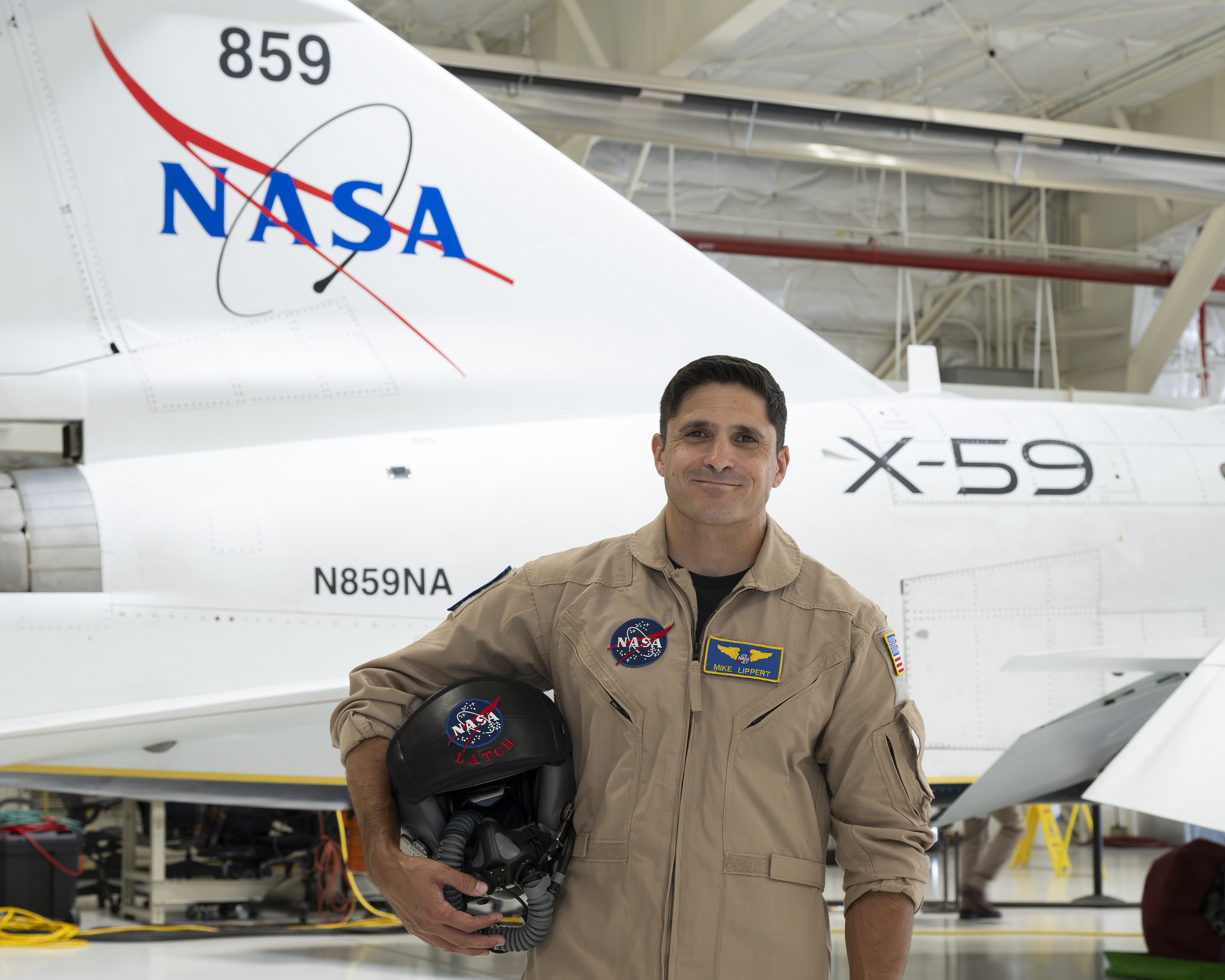
NASA’s X-59 test pilot Mike Lippert stands in front of the agency’s X-59 quiet supersonic research aircraft at NASA’s Armstrong Flight Research Center in Edwards, California, on Wednesday, June 24, 2026.
NASA/Carla Escamilla
NASA added a new X-59 test pilot to support the agency’s Quesst mission: Mike Lippert, a research test pilot based at NASA’s Armstrong Flight Research Center in Edwards, California.
“This fulfills a lifelong dream of conducting airborne research and experimental flight test for NASA in the high desert — contributing to humankind’s understanding of the science of flight and the nature of the world around us,” Lippert said.
Lippert will fly the X-59, along with the F-15 and F-18 support aircraft to monitor the quiet supersonic X-plane when it’s in the air. He joins Nils Larson and Jim “Clue” Less, who have been flying the X-59 since its first flight in October 2025.
A South Carolina native, Lippert served 20 years with the U.S. Marine Corps before retiring last year as a lieutenant colonel. Like his fellow test pilots, he boasts an impressive flight resume, including logging more than 2,600 hours of flight time in 60 different types of aircraft.
Lippert said he finds test pilot work especially rewarding.
“For me, the joy of taking part in experimental flight test and airborne research is the experience of discovery and learning something new every day,” he said. “It is incredibly rewarding to be part of a team solving complex problems and venturing into the unknown, together.”
Lippert spent the majority of his career flying the AV-8B Harrier operationally and serving as a test pilot in the F-35 program. He is also an aerospace engineer, earning a bachelor’s degree from the United States Naval Academy in Annapolis, Maryland, and a Master of Science in flight test engineering from the U.S. Air Force Test Pilot School at Edwards Air Force Base in California. Additionally, he earned a Master of Science in systems engineering from the Naval Postgraduate School in Monterey, California.
Lippert is currently pursuing a doctoral degree in aerospace engineering at the University of Alabama Graduate School in Tuscaloosa, where his research focuses on high-speed gas dynamics, including supersonic and hypersonic fluid mechanics — complementing his work on the Quesst mission.
Lippert is busy preparing for his role at NASA by flying training flights on support aircraft and spending time in the X-59 simulator. He is expected to begin flying the X-59 later this summer.
Michael T. Lippert is a research test pilot at NASA’s Armstrong Flight Research Center in Edwards, California. He is assigned to fly the agency’s X-59 quiet supersonic research aircraft, along with the F-15 and F/A-18 support aircraft, and to support NASA’s advanced air mobility research projects.
Experience
Prior to joining NASA in 2026, Lippert served 20 years in the U.S. Marine Corps before retiring as a lieutenant colonel in 2025. He was a flight instructor at Naval Air Station Kingsville in Texas, where he trained U.S. Navy and Marine Corps officers in tactical jet aircraft. He has more than 2,600 hours of flight experience in 60 types of aircraft.
The bulk of his career was spent flying the AV-8B Harrier operationally and serving as a test pilot in the F-35 program. During his last two assignments, he served as the chief test pilot of Marine Operational Test and Evaluation Squadron One at Marine Corps Air Station Yuma in Arizona, and as the government flight test director of the F-35 Integrated Test Force at Naval Air Station Patuxent River in Maryland.
Education
Lippert earned a bachelor’s degree in aerospace engineering in 2005 from the United States Naval Academy in Annapolis, Maryland, and a Master of Science in flight test engineering in 2016 from the U.S. Air Force Test Pilot School at Edwards Air Force Base, California. Lippert also earned a Master of Science in systems engineering in 2019 from the Naval Postgraduate School in Monterey, California. He is currently pursuing a doctoral degree in aerospace engineering at the University of Alabama Graduate School in Tuscaloosa, Alabama. His research focuses on high-speed gas dynamics, including supersonic and hypersonic fluid mechanics.
Awards
Lippert is an associate fellow of the Society of Experimental Test Pilots and a member of the American Institute of Aeronautics and Astronautics. He was part of the multi-agency team that received the Collier Trophy in 2018 for the Automatic Ground Collision Avoidance System. He also contributed to the team that received a Silver Medal from the Royal Aeronautical Society for F-35 testing aboard HMS Queen Elizabeth, a British Royal Navy aircraft carrier.
An F-15 aircraft flies above the world’s largest compass rose above NASA’s Armstrong Flight Research Center in Edwards, California, on Monday, April 20, 2026. NASA’s Crossflow Attenuated Natural Laminar Flow (CATNLF) test article is attached to the bottom of the F-15. The project aims to lower fuel costs for future commercial aircraft by testing a scale-model wing designed to improve laminar flow.
Credits: NASA/Jim Ross
Flight tests are a big part of how NASA turns breakthrough ideas into reality. From flying humans faster than the speed of sound to proving designs that helped shape the space shuttle, flight testing transforms bold concepts into safer, more efficient technologies that benefit the public.
“Flight tests are a way to safely and effectively prove new technology, which helps certification authorities certify equipment,” said Wayne Ringelberg, chief pilot at NASA’s Armstrong Flight Research Center in Edwards, California. “It helps industry iterate and make systems better, and it promotes research in areas where new ideas can be developed.”
For nearly 80 years, teams at NASA Armstrong have used flight testing in the Southern California desert to push the limits of aerodynamics and advance aviation. Thanks to that work, NASA-developed innovations are aboard every U.S. commercial aircraft and inside every control tower today.
“The space side of NASA uses flight test, too. Every mission, like Artemis II, is never routine,” Ringelberg said. “Everything we’re doing when flying a test mission is something new or different.”
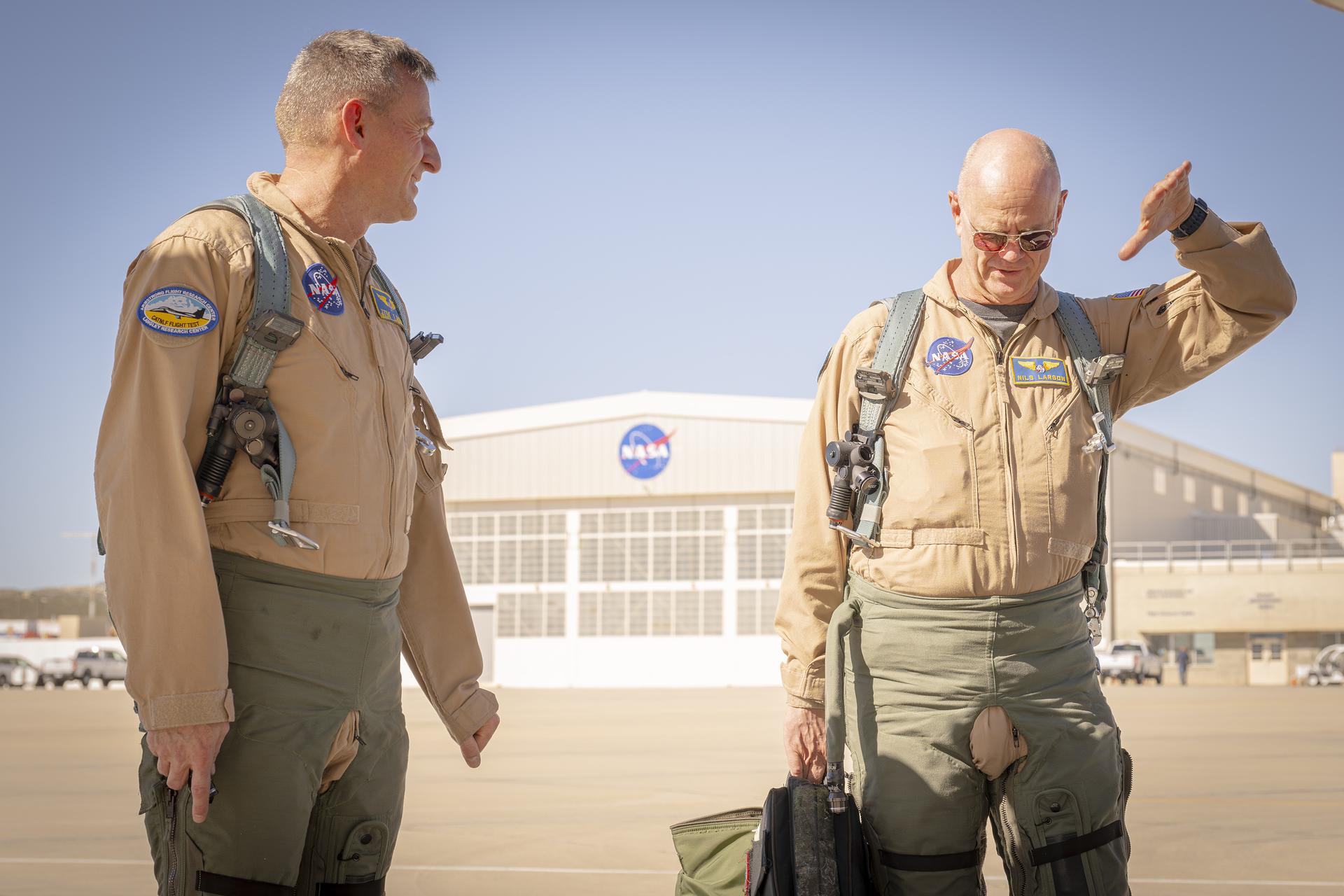
NASA test pilots Jim Less, left, and Nils Larson walk away from a hangar at NASA’s Armstrong Flight Research Center in Edwards, California, on Thursday, Feb. 4, 2026. The pilots support the agency’s Crossflow Attenuated Natural Laminar Flow (CATNLF) project, which aims to lower fuel costs for future commercial aircraft by testing a scale-model wing designed to improve laminar flow.
NASA/Christopher LC Clark
Every NASA test flight — whether it’s studying new software, hardware, or the revolutionary technology of an experimental X-plane — relies on engineers, researchers, pilots, maintenance crew, control room operators, and many others working together.
“Experienced operators and engineers evaluate how things work in flight,” Ringelberg said. “Most new technologies are designed to work in a lab or can be tested in a wind tunnel or other facility, but you never really know how they’ll perform until you fly them.”
Preflight tests often include computer analysis, simulation, wind tunnel testing, and ground tests focused on an aircraft’s ability to withstand the forces of flight and the environments through which it may fly. After hardware or software is deemed safe to fly, researchers turn the mission over to the flight test team.
To support testing, NASA Armstrong maintains an aircraft fleet modified to create space for new hardware or instruments, as well as the ability to integrate new software. These aircraft are flying laboratories, and pilots are trained to accomplish experimental missions.
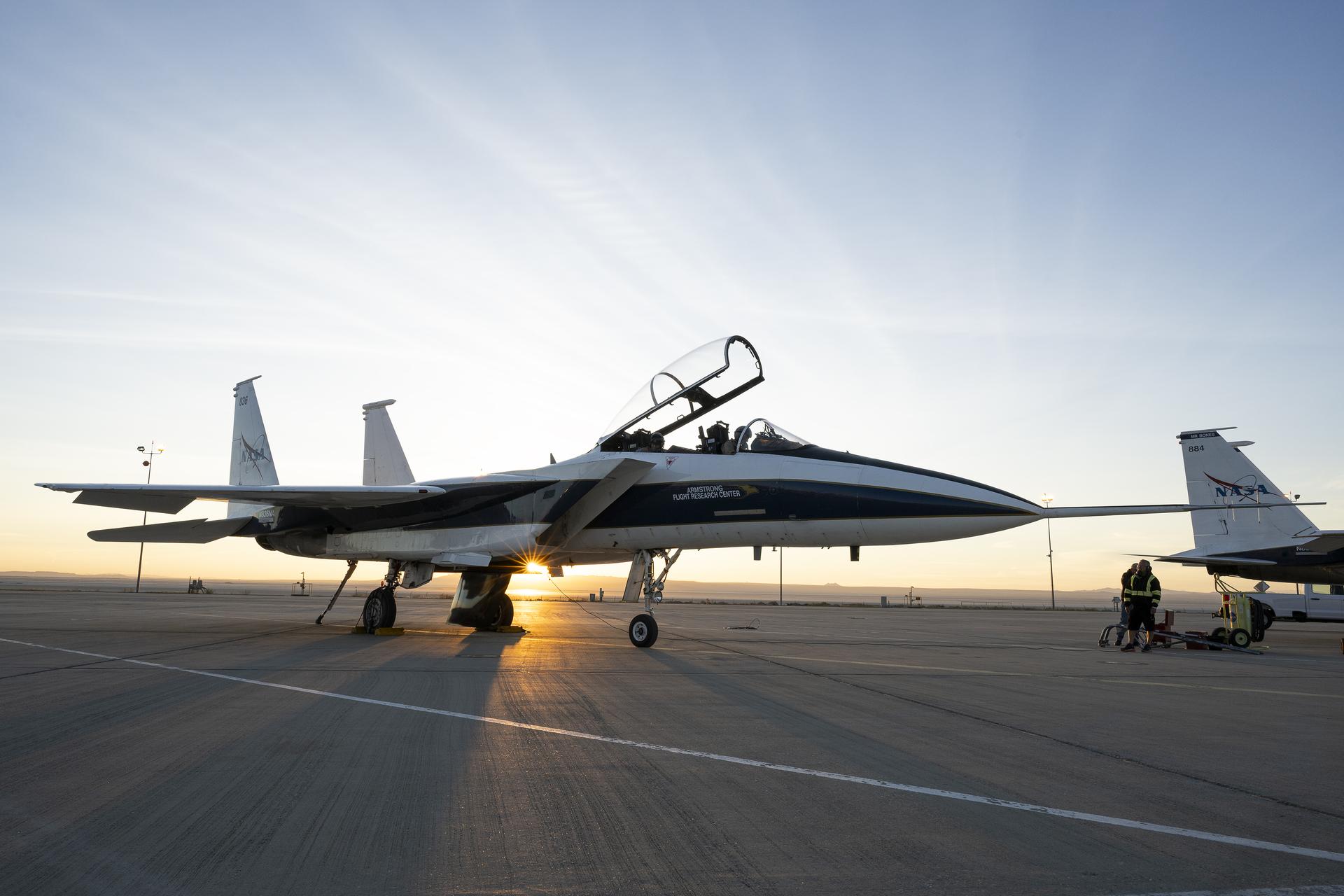
An F-15 research aircraft sits on the ramp at NASA’s Armstrong Flight Research Center in Edwards, California, on Tuesday, March 17, 2026. NASA pilots Jim Less, front seat, and Carrie Worth prepare for the flight. The agency’s Crossflow Attenuated Natural Laminar Flow (CATNLF) test article is attached to the bottom of the F-15. The project aims to lower fuel costs for future commercial aircraft by testing a scale-model wing designed to improve laminar flow.
NASA/Carla Escamilla
For example, flight testing recently helped NASA gather critical data on laminar flow, or the smooth flow of air, over a wing. The work could lower fuel costs for future airliners. Computer modeling, wind tunnel tests, and other methods helped advance the research, but to find out even more about how the wing concept could reduce drag for future airliners, NASA used a scale model in actual flight.
NASA researchers strapped the Crossflow Attenuated Natural Laminar Flow (CATNLF) model wing to the belly of one of NASA Armstrong’s F-15s. The arrangement allowed them to collect all the information they would need without doing the extensive, costly modifications required to install a full-scale wing on an aircraft.
After a flight series is complete, engineers and researchers analyze the data. Did the instrument work as designed? Did the experimental aircraft perform safely at a high altitude? Did the software operate as planned? Each test raises its own set of questions to evaluate.
NASA continues working with academia, the Department of War, and industry partners to advance U.S. aviation through flight test and bring new benefits to the flying public.
NASA’s X-59 quiet supersonic research aircraft reached its target speed and altitude for future community overflights for the first time during a flight on Friday, June 12, 2026. The milestone marked the first time the aircraft flew at Mach 1.4 and 55,000 feet — conditions it will fly when gathering community response data to its quiet sonic thump.
NASA/Lori Losey
NASA’s X-59 experimental aircraft reached a major milestone Friday, June 12, flying Mach 1.4 (about 924 mph) and an altitude of 55,000 feet, the conditions required for the aircraft to make future flights critical to its mission.
The X-59 still has months of performance testing ahead, but after those are complete, NASA’s Quesst mission will fly the aircraft over several U.S. communities to collect data on public perception of the quiet sonic thump it will make at supersonic speeds. Those community overflights will include flights at Mach 1.4 and 55,000 feet.
The milestone comes just days after the X-59’s first supersonic flight. That flight showed the aircraft performed as expected at Mach 1.1, but Friday’s mission conditions flight was an even more critical step for NASA.
NASA’s X‑59 eXternal Vision System (XVS) shows Mach 1.4 at 55,030 feet on Friday, June 12, 2026 during the aircraft’s first mission conditions flight, the approximate conditions it will fly when gathering community response data to its quiet “sonic thump.” The milestone marks the first time the aircraft flew at its designed speed and altitude.
NASA/Lori Losey
The X-59 was designed to fly supersonic without causing a loud sonic boom. However, for these early supersonic flights it has been accompanied by a NASA F-15 research aircraft, a traditional supersonic jet that causes booms obscuring any noise the X-59 makes. During upcoming flights, a shock-sensing probe mounted to the F-15 will gather measurements of the X-59’s shock wave signature, an early measure of its supersonic performance.
After the team conducts more tests at a variety of altitudes and conditions to complete envelope expansion, the X-59 will enter the acoustic validation phase of Quesst. During this phase, researchers will thoroughly measure the aircraft’s supersonic acoustic signature — the quiet thump it’s designed to make — to confirm it is performing as intended.
Each flight brings NASA one step closer to flying the X-59 over communities and gathering feedback that could help shape the future of commercial supersonic flight over land.
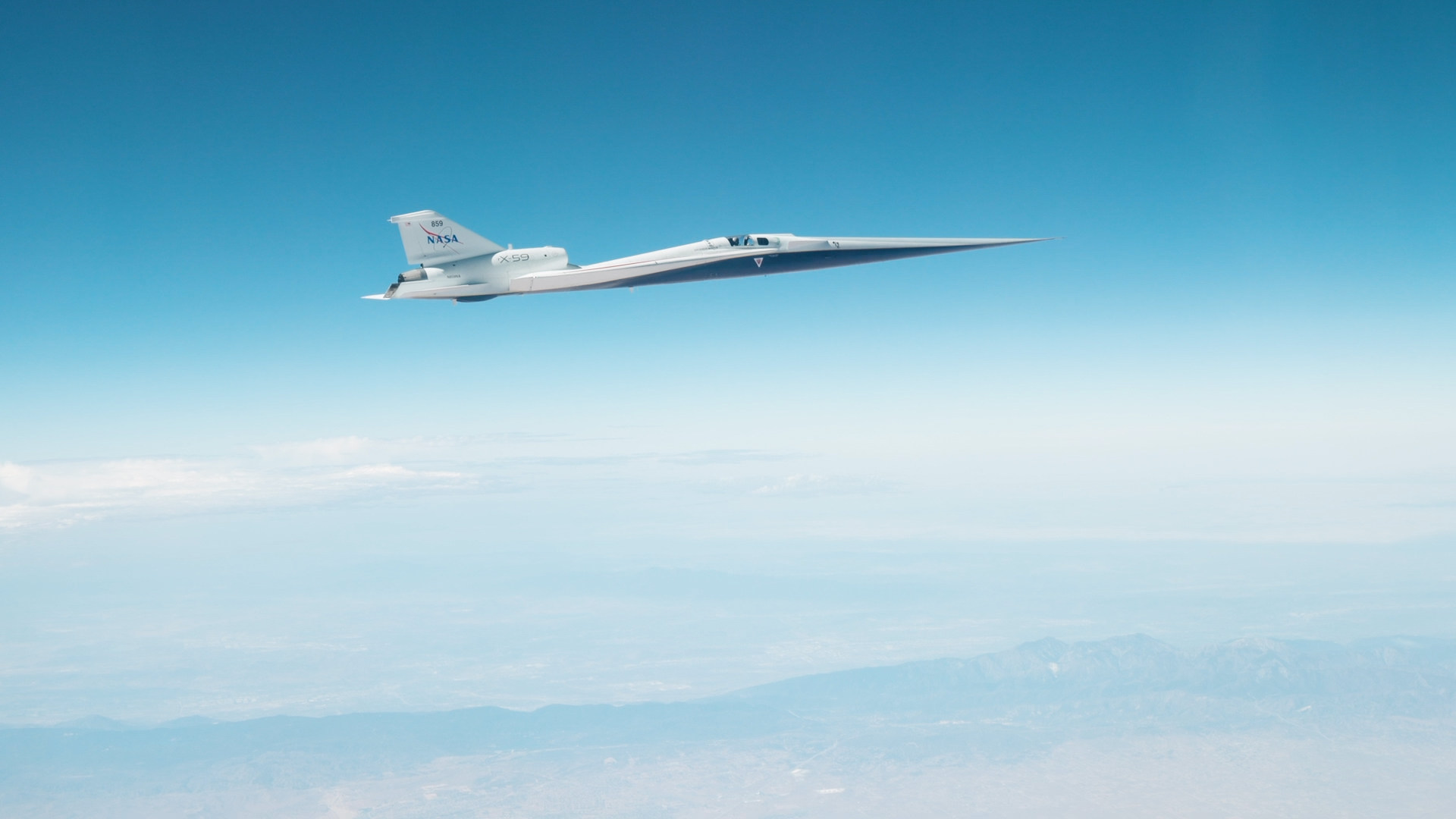
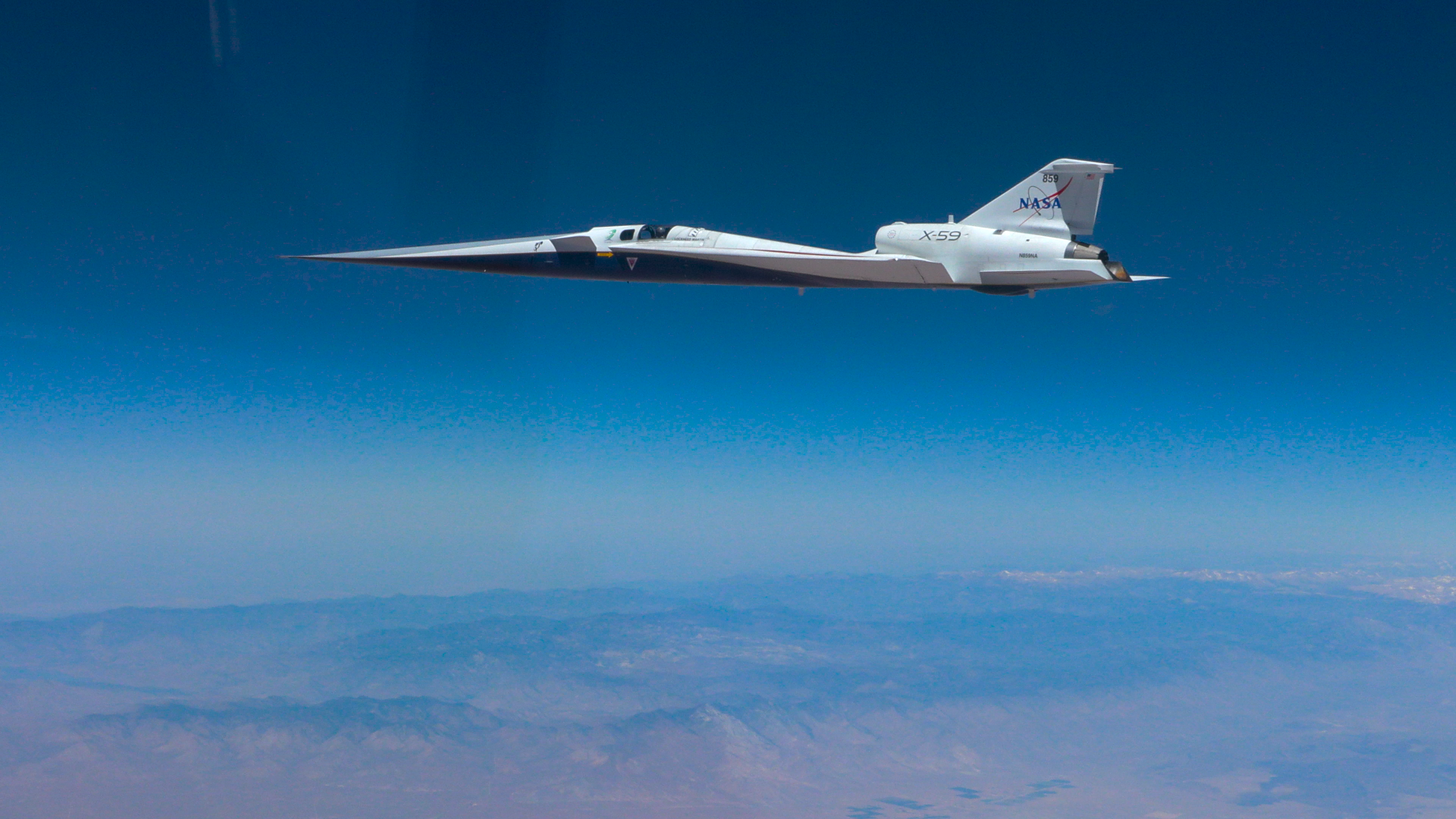
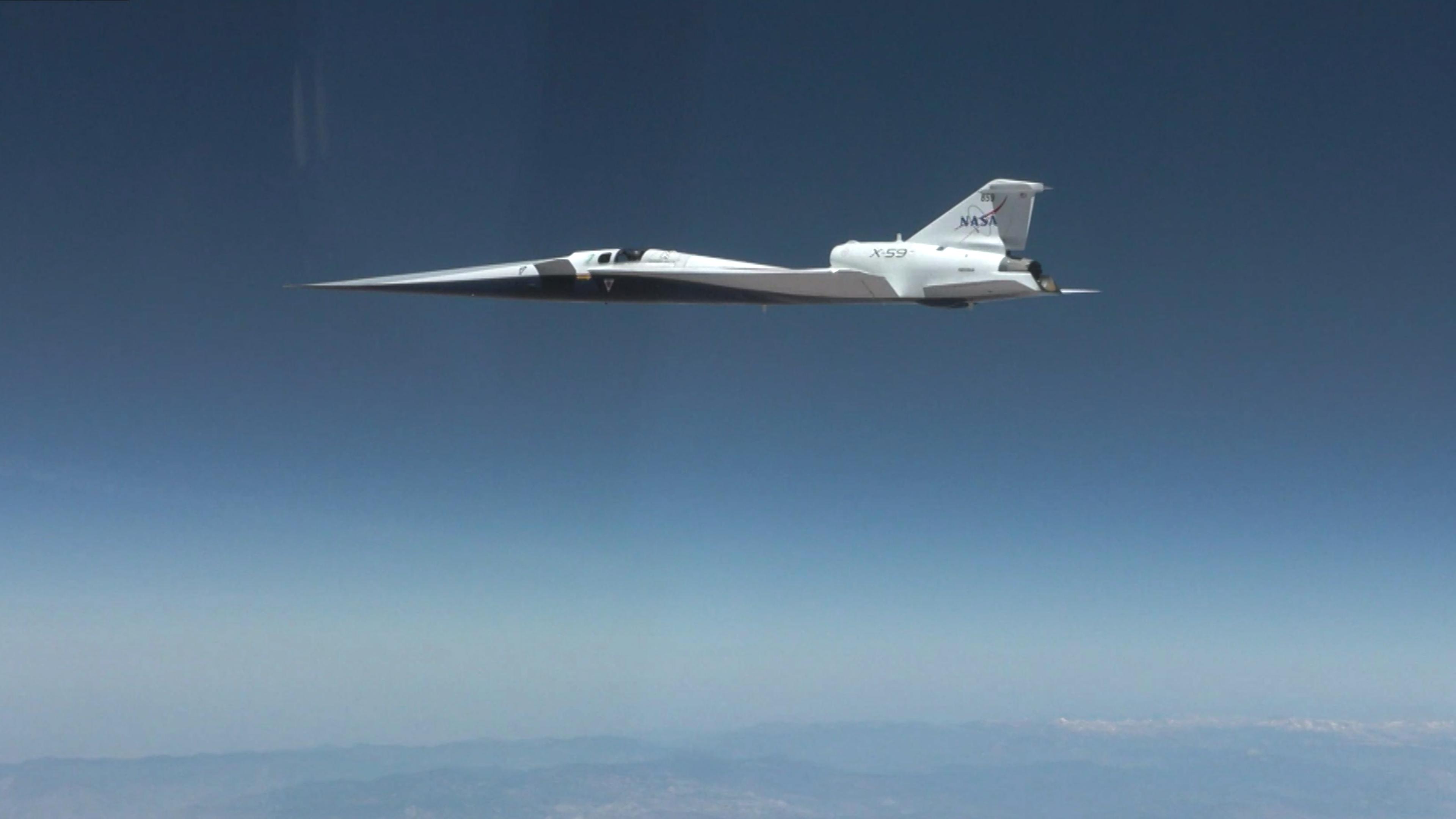
NASA’s X-59 quiet supersonic research aircraft completed its first supersonic flight Friday, June 5, 2026, marking the first time the aircraft exceeded the speed of sound in support of NASA’s Quesst mission. The milestone represents a major step in flight testing as the aircraft expands into the supersonic portion of its flight envelope.
The 81-minute flight achieved a speed of Mach 1.1 (approximately 713 mph) at an altitude of 43,400 feet, with the X-59 performing as expected. For NASA test pilot Jim “Clue” Less, the plane’s instruments were the only indication of flying supersonic — exactly what the team wanted.
“You know you are supersonic when gauges say you are supersonic. I didn’t feel anything,” Less said. “It went smoothly, and we easily got to Mach 1.1.”
The X-59 is designed to fly at supersonic speeds while creating only a quiet thump instead of a loud sonic boom. For this flight, a NASA F‑15 chase plane flew nearby to monitor the test. Its loud sonic booms obscured any sound made by the X-59. The X-59 will conduct flights focused on its sound profile during a later phase of testing.
Now that the X-59 has officially kicked off supersonic flight tests, the next big step is its first mission conditions flight. During this test, the X-59 will fly at the same speed and altitude planned for future tests, where the aircraft will fly over several U.S. communities to gather data from people on the ground about its noise levels: Mach 1.4 (925 mph) at 55,000 feet.
“The plane wants to go faster, and we are looking forward to that,” Less said.
The X-59 is the centerpiece of NASA’s Quesst mission, which aims to demonstrate quieter supersonic flight and to help enable commercial supersonic flight over land.
NASA’s X-59 Aircraft Flies Supersonic for First Time
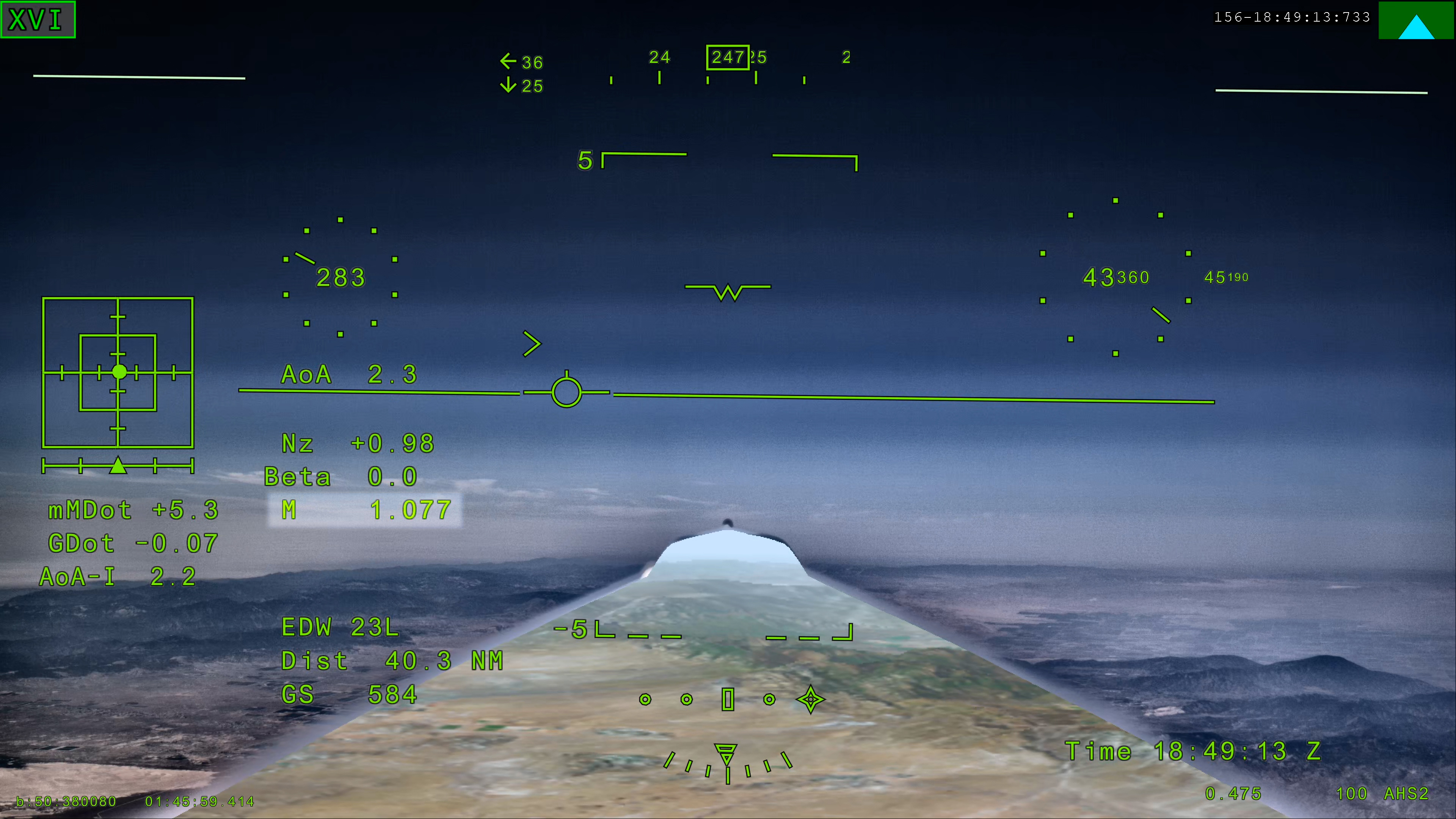
NASA’s X 59 eXternal Vision System shows Mach 1.077 on Friday, June 5, 2026, marking the aircraft’s first time reaching supersonic speed in support of NASA’s Quesst mission. The moment represents a milestone for the aircraft as it transitions to include test flights faster than the speed of sound.
NASA
NASA’s experimentalX-59 aircraft marked a major milestone Friday, June 5, when it flew faster than the speed of sound for the first time, setting the stage for demonstrating its quiet supersonic capabilities later this year.
NASA test pilot Jim “Clue” Less took off and landed at Edwards Air Force Base in California, reaching a top speed of approximately Mach 1.1 (713 mph) and altitude of 43,400 feet. The X-59’s flight began at 11:08 a.m. PDT and lasted 81 minutes, with the team focusing on flying qualities at both subsonic and then supersonic speeds.
In the coming days, we expect to take the next step and push to Mach 1.4
jared isaacman
NASA Administrator
”X-59 is getting ready for its quiet supersonic debut. Since the aircraft’s first flight on Oct. 28, 2025, the team has made tremendous progress, flying 16 times in the last 90 days and getting into a steady test rhythm. In the coming days, we expect to take the next step and push to Mach 1.4,” said NASA Administrator Jared Isaacman “I’m grateful to the NASA team and Lockheed Martin Skunk Works for their help getting us to this point, and I hope this is the first of many collaborations as we rebuild NASA’s X-plane portfolio.”
The X-59 is designed to fly at supersonic speeds while creating only a quiet thump instead of a loud sonic boom. For this flight, a NASA F‑15 chase plane flew nearby to monitor the X‑59. The loud sonic booms from the F-15 obscured any sound made by the X-59.
“The X-59’s first supersonic flight is a testament to America’s enduring leadership in science, engineering, and aerospace innovation,” said Michael Kratsios, Assistant to the President for Science and Technology and Director of the Office of Science and Technology Policy. “This achievement comes as the Trump Administration continues work to unleash supersonic flight and enable American ingenuity.”
This first supersonic flight is a significant milestone, but an event even more critical to the mission is upcoming. In just days, the aircraft is expected to make its first “mission conditions” flight, reaching a cruising speed of Mach 1.4 (925 mph) and altitude of approximately 55,000 feet. The X-59 also will be accompanied by a chase plane for this flight.
NASA’s X-59 quiet supersonic research aircraft completed its first supersonic flight Friday, June 5, 2026, marking the first time the aircraft exceeded the speed of sound in support of NASA’s Quesst mission. The milestone represents a major step in flight testing as the aircraft expands into the supersonic portion of its flight envelope.
NASA / Lori Losey
This speed and altitude are the base conditions for the X-59 when it will eventually fly over several U.S. communities enabling NASA to gather data about how people may perceive its quiet thump. NASA will share this data with U.S. and international regulators to help establish new data-driven noise standards to enable a future viable market for supersonic commercial flight over land.
For the last several months, the X-59 has been participating in an ongoing series of flights where the plane has been flying at a wide range of speeds and altitudes – a process known as envelope expansion. These tests are the first phase of the X-59’s flight testing. They are focused on performance and involve chase plane monitoring. When the aircraft completes this phase it will enter another, focused on its sound profile in order to verify its quiet thump capability.
The X-59 is the centerpiece of NASA’s Quesst mission, which aims to demonstrate quiet supersonic flight and help enable commercial supersonic flight over land worldwide. These advancements will help travelers reach their preferred destinations faster, spending less time in the air.
Through Quesst’s development of the X-59, NASA also will deliver design tools and technology for quiet supersonic airliners that will achieve the high speeds desired by commercial operators without disturbing people on the ground. NASA will validate design tools through ground and flight testing, providing U.S. aircraft manufacturers the ability to explore new quiet supersonic concepts, and provide them with confidence that their resulting designs will meet quiet flight requirements.
Preparations for Next Moonwalk Simulations Underway (and Underwater)
NASA’s X-59 eXternal Vision System shows Mach 1.077 on Friday, June 5, 2026, marking the aircraft’s first time reaching supersonic speed in support of NASA’s Quesst mission. The moment represents a milestone for the aircraft as it transitions to include test flights faster than the speed of sound.
NASA
NASA’s experimentalX-59 aircraft marked a major milestone Friday, June 5, when it flew faster than the speed of sound for the first time, setting the stage for demonstrating its quiet supersonic capabilities later this year.
NASA test pilot Jim “Clue” Less took off and landed at Edwards Air Force Base in California, reaching a top speed of approximately Mach 1.1 (713 mph) and altitude of 43,400 feet. The X-59’s flight began at 11:08 a.m. PDT and lasted 81 minutes, with the team focusing on flying qualities at both subsonic and then supersonic speeds.
In the coming days, we expect to take the next step and push to Mach 1.4
jared isaacman
NASA Administrator
”X-59 is getting ready for its quiet supersonic debut. Since the aircraft’s first flight on Oct. 28, 2025, the team has made tremendous progress, flying 16 times in the last 90 days and getting into a steady test rhythm. In the coming days, we expect to take the next step and push to Mach 1.4,” said NASA Administrator Jared Isaacman “I’m grateful to the NASA team and Lockheed Martin Skunk Works for their help getting us to this point, and I hope this is the first of many collaborations as we rebuild NASA’s X-plane portfolio.”
The X-59 is designed to fly at supersonic speeds while creating only a quiet thump instead of a loud sonic boom. For this flight, a NASA F‑15 chase plane flew nearby to monitor the X‑59. The loud sonic booms from the F-15 obscured any sound made by the X-59.
“The X-59’s first supersonic flight is a testament to America’s enduring leadership in science, engineering, and aerospace innovation,” said Michael Kratsios, Assistant to the President for Science and Technology and Director of the Office of Science and Technology Policy. “This achievement comes as the Trump Administration continues work to unleash supersonic flight and enable American ingenuity.”
This first supersonic flight is a significant milestone, but an event even more critical to the mission is upcoming. In just days, the aircraft is expected to make its first “mission conditions” flight, reaching a cruising speed of Mach 1.4 (925 mph) and altitude of approximately 55,000 feet. The X-59 also will be accompanied by a chase plane for this flight.
NASA’s X-59 quiet supersonic research aircraft completed its first supersonic flight Friday, June 5, 2026, marking the first time the aircraft exceeded the speed of sound in support of NASA’s Quesst mission. The milestone represents a major step in flight testing as the aircraft expands into the supersonic portion of its flight envelope.
NASA / Lori Losey
This speed and altitude are the base conditions for the X-59 when it will eventually fly over several U.S. communities enabling NASA to gather data about how people may perceive its quiet thump. NASA will share this data with U.S. and international regulators to help establish new data-driven noise standards to enable a future viable market for supersonic commercial flight over land.
For the last several months, the X-59 has been participating in an ongoing series of flights where the plane has been flying at a wide range of speeds and altitudes – a process known as envelope expansion. These tests are the first phase of the X-59’s flight testing. They are focused on performance and involve chase plane monitoring. When the aircraft completes this phase it will enter another, focused on its sound profile in order to verify its quiet thump capability.
The X-59 is the centerpiece of NASA’s Quesst mission, which aims to demonstrate quiet supersonic flight and help enable commercial supersonic flight over land worldwide. These advancements will help travelers reach their preferred destinations faster, spending less time in the air.
Through Quesst’s development of the X-59, NASA also will deliver design tools and technology for quiet supersonic airliners that will achieve the high speeds desired by commercial operators without disturbing people on the ground. NASA will validate design tools through ground and flight testing, providing U.S. aircraft manufacturers the ability to explore new quiet supersonic concepts, and provide them with confidence that their resulting designs will meet quiet flight requirements.
NASA’s X-59 quiet supersonic research aircraft completed its first supersonic flight Friday, June 5, 2026, marking the first time the aircraft exceeded the s...

 Login