If you were paranoid about digital tracking before, you might want to think twice about reading any further.
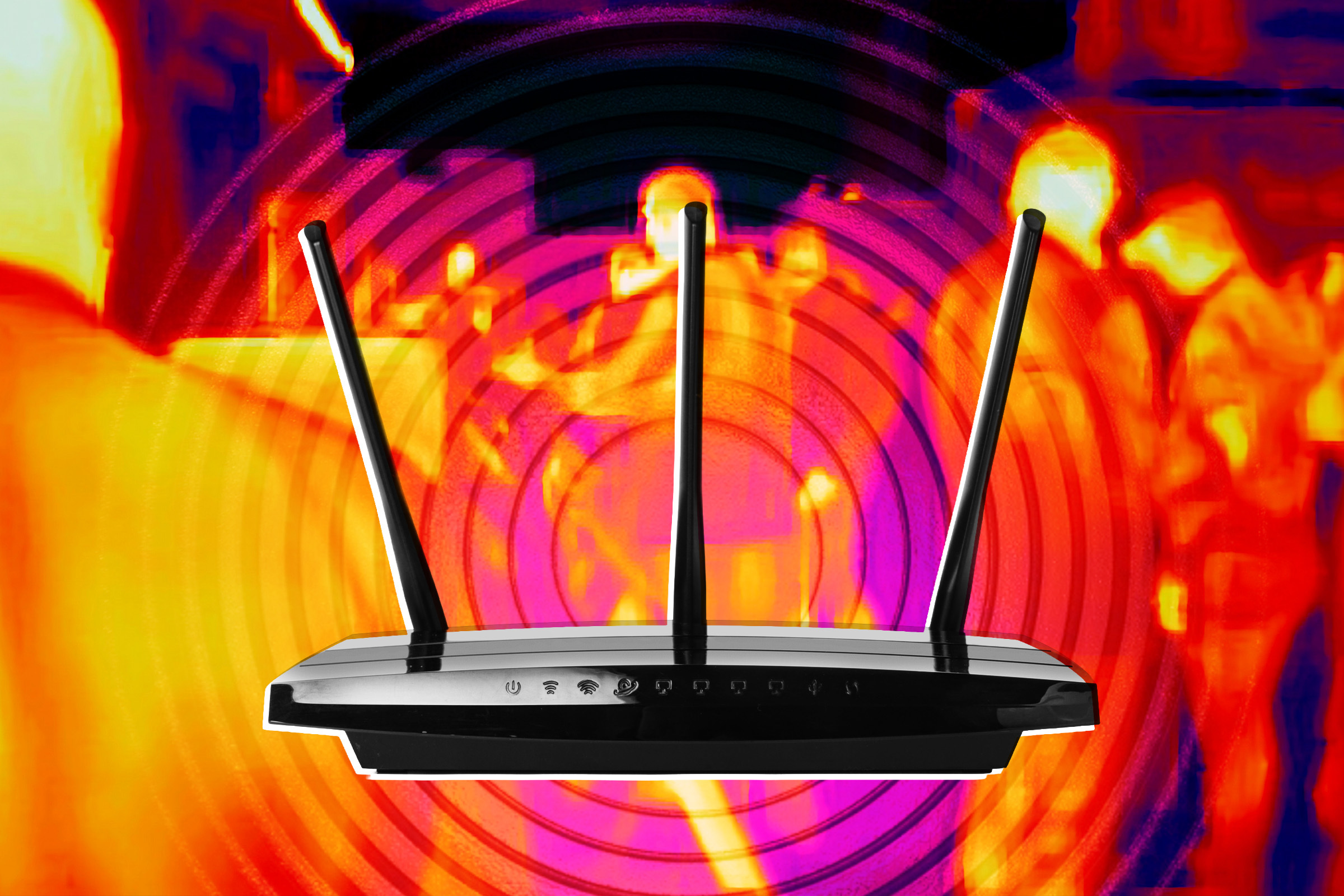
New research out of Germany’s Karlsruhe Institute of Technology found that the types of Wi-Fi routers we all have in our homes come with a major privacy vulnerability that can be used to identify any human body that comes within their range.
The study, flagged by Gizmodo, used machine learning systems to identify individuals with an accuracy rate of 99.5 percent. To do so, the researchers exploited a vulnerability in a process known as beamforming feedback information (BFI), which was introduced to allow routers to focus Wi-Fi signals on connected devices, as opposed to the older approach, which is to blanket an entire area in coverage.
While BFI is great for network connectivity, it has a major downsides for privacy. For starters, devices connected to a router using beamforming need to send constant feedback in order to be found. As routers send out and receive network feedback, the signal is inevitably impacted by real world factors like pets, walls, and people.
That gap, between the signals routers expect to receive and the distorted feedback they actually get, allowed researchers to extrapolate the identities of 161 individual participants based on BFI data which inadvertently mapped their physical characteristics. Even when individuals changed their gait or carried objects like backpacks and crates, the system registered an accuracy rate between 50 to 60 percent, the KIT team wrote.
“This works similar to a normal camera, the difference being that in our case, radio waves instead of light waves are used for the recognition,” study coauthors Thorsten Strufe said in a press release.
Making matters worse is the fact that this data is basically wide open for anyone to grab — not only is that feedback data unencrypted, it can also be accessed without ever connecting directly to the router.
“We have shown robust identity inference with common-of-the-shelf hardware which is already in widespread adoption in many homes and public areas,” the team wrote in their paper. “With this hardware making its way into millions of homes, the privacy concerns are severe.”
The KIT findings contrast to other Wi-Fi tracking systems, like one developed by researchers at the Sapienza University of Rome. That method, called “WhoFi,” uses channel state information, which is much harder to access on consumer hardware, but can still identify people through walls with an alarmingly high accuracy rate.
That WhoFi study made a point to highlight the anonymity factor: the idea that the sensing system can detect people’s presence, but not identify them. The KIT team refutes that framing outright, arguing that Wi-Fi-sensing technology poses major privacy risks regardless.
“While there maybe legitimate use-cases, we explicitly consider identity inference via Wi-Fi sensing a privacy attack,” they write. “This view reflects the serious risks associated with the ubiquity of Wi-Fi networks, their ability to sense through walls and in non-line-of-sight scenarios, and the fact that this would likely happen without explicit consent.”
While more research will be needed, the researchers don’t mince words about the implications of their initial findings. In their conclusion, the KIT team writes that regulators and companies moving to standardize Wi-Fi sensing should “strongly consider adding effective privacy protection,” or else “abandon beamforming entirely.”
Imagine this scenario: your algorithm has pulled up a background YouTube video, or maybe a podcast. Unbeknownst to you, hackers have embedded inaudible sounds in it, designed to hijack your smart speaker or phone’s AI assistant — meaning the cybercriminals can now access your private photos, bank accounts, or any other personal information you’ve hooked up to your AI system.
It sounds like an also-ran episode of “Black Mirror,” but it’s exactly what researchers have shown is possible in new research being presented this week at the IEEE Symposium on Security and Privacy.
Basically, a team of researchers in China and Singapore found that they can construct “adversarial audio,” completely undetectable to the human ear, that tricks voice AI models into doing things they shouldn’t. Then it’s a breeze to hide it in innocent-sounding audio — a song, a movie, or anything else that unsuspecting targets might play in the background — and lay in wait for users to accidentally compromise their digital lives.
“It takes just half an hour to train this signal, and then, because this signal is context-agnostic, you can use it to attack the target model whenever you want, no matter what the user says,” lead author Meng Chen, a PhD candidate at China’s Zhejiang University, told IEEESpectrum of the work. “These single-point defenses struggle to resist our attack because we found it’s very hard for these models to distinguish the normal user intent and our adversary attack.”
One catch, at least for now: the technique required the hackers to have access to the full weights of the AI model they’re targeting, meaning they were only able to attack open source models. But because many commercial AI systems are built on open source models, that meant that their exploit was effective against mainstream products by Microsoft and Mistral.
Mistral didn’t respond to IEEE‘s request for comment, but Microsoft issued a statement that should probably give anyone pause before connecting any important information whatsoever to one of the company’s voice AI models.
“We appreciate the researchers’ work to advance understanding of this type of technique,” it read. “This study evaluates model resilience through controlled, direct interactions with the model itself, which helps inform our approach to building model resiliency. In practice, AI models are often integrated into user applications, and we offer developers tools and guidance they can use to implement additional layers of protection that help safeguard users.”
Like data centers, automatic license plate readers (ALPRs) are incredibly unpopular with voters around the US. Plenty of local politicians are taking the hint, choosing to cancel controversial surveillance contracts with the granddad of ALPR companies, Flock Safety.
In the tiny town of Bandera, Texas, however, one petty tyrant on the city council took personal offense after his fellow politicians voted 3-2 to immediately end their contract with Flock earlier this month. After voting, the dissenting councilmember, identified by 404 Media as Jeff Flowers, immediately went on the offensive, threatening to outlaw virtually all forms of modern technology and take the town “back to 1880.”
“For months, I have listened to the outcry regarding [ALPR] technology,” he scathed. “I have seen the eyerolls, and I’ve even been met with ‘Nazi rhetoric,’ the dangerous claim that believing in accountability and community safety is somehow equivalent to totalitarianism. Comparing a neighbor’s desire for a safe street to a dark chapter of history is a classic case of comparing apples to oranges; it is a distraction used to avoid the reality of the threats our town faces today.”
“Since the Council has decided we are the ‘Free State of Bandera,’ a place where the ‘rights’ of a car thief or human trafficker to remain anonymous apparently outweigh the right of a resident to protect their property and the safety of their family, then we must go all the way,” Flowers continued his rant.
“To ensure our historic County Seat becomes the most ‘traditional’ sanctuary in Texas, I have requested… a total ban on all cellular and GPS-capable devices for all operations within city limits,” the councilman raged. “If we are to be truly ‘private,’ we must leave our smartphones at the city line.”
Continuing his childish crashout, Flowers also proposed a ban on all commercial and residential security cameras, as well as a “total total termination of all internet services and electronic record-keeping.”
“We are going back to 1880, paper ledgers and cash only,” he seethed.
Back in February, Flowers moderated a town hall meeting exclusively meant to discuss the Flock contract, which brought eight ALPRs into the one-horse town. During another February meeting, Flowers accused opponents of the private surveillance company of having something to hide, saying “I believe personally that guilty people act defensively.”
“If you don’t have anything to hide, then it shouldn’t be a problem,” he carried on. “I also believe when you are in a public space, your privacy kind of goes out the window because you are in essence in a public place.”
Meta has raised the possibility that it could be joining the likes of Amazon, Microsoft and Google in offering cloud services at some point in the future — although potential customers shouldn’t be adding the company to their suppliers list just yet.
He explained that different companies were approaching Meta asking for the company to offer an API service or to buy compute services at a premium price. “We haven’t done it yet, because we think we have a use for the compute, but when we feel we have overbuilt, then that is an option that we have.”
Meta has been active in developing its data centers over the past few years, so there will be a possibility of some excess capacity. It is also developing its own AI chips.
For the moment, though, the company may well need all the capacity it can build: Zuckerberg said that the launch of Muse Spark, a new AI model from Meta Superintelligence Lab, had resulted in large increases in Meta’s AI usage.
“The future of AI should be accessible, available, and open to people and builders everywhere, and it should not require an absurd amount of resources only available to a handful of cloud providers,” Paolo Ardoino, CEO, Tether.
About 700 million people use generative AIs like Gemini and ChatGPT weekly, but adoption is far from uniform. McKinsey’s 2025 State of AI survey found that nearly half of respondents from companies with more than $5 billion in revenue have reached the AI scaling phase, compared with just 29 percent of those from companies with less than $100 million in revenue, a gap that only widens further down the chain, locking out smaller businesses, developers, and everyday users.
Retail and small businesses are limited to basic AI utilities that their facilities can power, such as text-based inference and multimedia generation, using base models. That is billions of end users, and developers locked out of full utilization and development of intelligent software due to high infrastructure demands.
Tether’s edge-first LoRA fine-tuning framework for Microsoft’s Bitnet LLM is an important step towards developing an infrastructure system that supports billions of AI agents and intelligent machines. By reducing the computational overhead of machine learning and enabling consumer-grade devices to perform advanced operations, Tether’s edge-first approach ensures greater leverage for the larger population.
Imagine a 13-billion-parameter model being fine-tuned on everyday handheld devices like Samsung S25 and iPhone 16, as well as on regular personal computers. The breakthrough combines resource-efficiency and platform-agnostic techniques to develop a fine-tuning framework for the ternary-quantized LLM.
Behind Tether’s Bitnet fine-tuning framework
Bitnet LLM was born out of the vision of an intelligent AI model that doesn’t consume outrageous computing resources even at full precision. Earlier attempts at resource-efficient AI relied on trade-offs, such as running small-parameter models at higher precision or larger-parameter models at lower precision, but neither approach fully solved the problem.
Bitnet takes a more fundamental approach. The result is a model that achieves linear efficiency while consuming only a fraction of the computing resources traditionally required.
The challenge, however, is that contemporary GPUs are optimized for the very floating-point operations Bitnet eliminates, creating a hardware compatibility gap. Compounding this, Bitnet was originally confined to its own Bitnet.cpp inference engine, limiting its broader utility. Tether’s breakthrough addresses both constraints at once by integrating a Vulkan and Metal GPU backend that unlocks true cross-platform capabilities for BitNet inference and LoRA fine-tuning on heterogeneous consumer GPUs, including mobile GPUs. Bitnet can now run on more mature, widely supported inference engines without sacrificing its efficiency advantages.
Vulkan’s cross-platform nature is key here. Unlike CUDA, which ties developers to NVIDIA hardware, Vulkan runs across a broad range of GPUs and operating systems, opening Bitnet to genuinely multi-platform deployment. Tether’s Bitnet fine-tuning framework implements a dynamic tiling technique to mitigate limitations in Vulkan driver buffer allocation on mobile GPUs.
The dynamic tiling algorithm technique was first applied in the fine-tuning framework for QVAC Fabric LLM, the AI model that powers Tether’s QVAC Workbench application.
This implementation demonstrates the efficiency of this approach: fine-tuning a 13-billion-parameter model across a range of consumer devices with varying GPU configurations.
The Bitnet LLM Fine-tuning framework is Tether’s latest achievement and part of a broader expansion into open-source AI and communication technologies that challenge current, slow, fragile, and controlled systems. These developments are open-sourced and packaged as modules in the QVAC SDK for easy deployment and to help developers build edge-first AI applications without needing anyone’s permission.
Tether envisions superintelligence as a foundational element possessed by its owner and is enforcing this through:
Local-first AI
Synonymous with decentralized AI, “Local-first” AI aims to create sovereign AI solutions that do not rely on centralized infrastructure, such as data centers, to operate. They are considered cost-effective, relatively more sustainable, and unarguably more private than centralized AI. Tether is building AI applications that rely entirely on the device’s resources. These applications store data in device memory and use its processors for advanced operations, such as fine-tuning and inference.
P2P computing network for AI inference
Tether’s AI applications are built on the Pear runtime. Pear is a tooling platform for fully P2P applications that can operate without servers. Pear leverages the Holepunch tech stack. Holepunch is purpose-built for stable, direct communication between devices. Pear enables delegated inference for AI applications such as QVAC Workbench. Delegated inference enables a unified, dynamic workstation architecture where compute tasks are fluidly distributed between mobile and desktop environments, allowing either device to offload high-intensity processing to the most capable system. That is, you can start a task on your mobile device and delegate it to your desktop or laptop for completion.
AI for everyone
The only way to scale intelligence to the needs of a ten-billion-strong society is to push it to the edge. This, in turn, depends on the progress made by experiments aimed at cost-effectively localizing AI computation.
Billions of AI agents and countless AI applications deployed by developers in every region of the world, running effectively on user-owned resources, is the only way we can democratize superintelligence and avoid creating another ‘luxury’ cutting-edge technology controlled by unicorns and fully accessible only to elites.
Tether is pioneering limitless superintelligence for an ever-growing society and applications. Follow the journey to truly local and edge-first AI solutions
The US government will take equity stakes worth a total of $2 billion in a slew of quantum computing companies, including a startup backed by a firm with links to the Trump family and one taken public by a Pentagon official.
The announcement by the commerce department that it had signed letters of intent with nine companies—including GlobalFoundries and IBM—sent shares in quantum specialists soaring on Thursday.
Both IBM, which is set to get $1 billion, and GlobalFoundries, which will receive $375 million, were up more than 6 percent in pre-market trading. D-Wave Quantum, an awardee that was taken public in 2022 by Emil Michael—now a top Pentagon official—was up more than 20 percent.
Speaking at Amazon’s AI on the Lot event, the Rogue One film-maker Gareth Edwards said ‘it’ll do anything you ask’ and ‘it’s going to be better than CGI’
Jurassic World Rebirth and Rogue One director Gareth Edwards has enthusiastically endorsed the use of generative AI in film-making, saying “it is a fucking genius at helping you” and “it’s going to be better than CGI”.
Edwards was speaking at AI on the Lot, an event in Culver City, California, organised by Amazon, and in remarks reported by the Hollywood Reporter said: “I can’t see a reason why you wouldn’t become interested in this stuff as a film-maker. It’s so clearly a tool that might be up there with the camera. It’s going to be better than CGI.”
Datacentres used 22% of country’s electricity last year, pushing up household bills, study suggests
Energy demand by datacentres in Ireland has added hundreds of euros to household electricity bills in a pattern that could be replicated across Europe, according to a report.
Datacentres used 22% of country’s electricity last year, pushing up household bills, study suggests
Energy demand by datacentres in Ireland has added hundreds of euros to household electricity bills in a pattern that could be replicated across Europe, according to a report.
Crisp 27in 5K Mac monitor is packed with features and some of the best HDR performance you can get for work or play
Apple’s new 27in Studio Display XDR is its best monitor yet, with an exceptionally bright and gorgeous 5K screen that wants to be the pro display for Mac-wielding content creators everywhere, with a price tag to match.
Built to be paired with the latest or high-end Macs, the Studio Display XDR costs from £2,599 (€3,099/$2,899/A$4,799), although it is a cool £3,000 if you want it with a stand. It sits above the standard £1,499 Studio Display and is £2,000 cheaper than the 2019 Apple Pro Display XDR it replaces.
I draw the old way – with my hand. Doing it with AI would not make me more creative, it would drain the colour out of my existence
Last week I went to a gig by myself for the first time. I sat myself down in my single seat, possibly the youngest person in the room and one of thousands excited to see Split Enz. I loved it – I felt joy and heartache as the lyrics spoke of human experiences, really lived. I happily realised that I did not have to wonder whether Split Enz had used AI in their work (as I so often do nowadays) as these bangers were created long before it was even dreamed of.
As a visual artist and writer myself, when I see AI generated images, music or words presented as “art”, I see red. It’s boring, it’s theft, it’s soulless, sterile and it’s killing the planet through energy and water-guzzling datacentres. Someone suggested AI “visual art” should be called “Computer Rendered Artificial Pictures” (CRAP).
Agreement averts strike and shows latest impact of AI boom as two more chipmakers join $1tn club
Employees at Samsung Electronics’ memory chip division are to receive bonuses averaging about £310,000 each through a landmark profit-sharing agreement, as the AI boom drives up chipmakers’ profits.
Fears of a strike at Samsung were averted on Wednesday after two unions for the world’s largest memory chipmaker said 74% of the 62,616 workers who cast their votes had backed the deal.
Celebrity gossip might break the Internet, but not in the way that quantum computers could. “The advent of quantum computers poses a critical threat, as they could break widely deployed encryption schemes,” warns Lily Chen, a cryptography expert from the US National Institute of Standards and Technology (NIST). Systems at risk include banking encryption, digital signatures, secure messaging, secure shell tunnelling, cryptocurrency and more.
Today’s quantum computers are still too small and error-prone to defeat gold-standard encryption. However, new results from Google Quantum AI and start-up Oratomic suggest that could change, with two widely used cryptographic systems – elliptic curve cryptography (ECC) and the Rivest-Shamir-Adleman (RSA) algorithm – potentially coming under threat sooner than many scientists predicted.
Space–time trade-off
At present, anyone who wants to access encrypted information needs a secret digital key. To obtain this key, an attacker must first solve a difficult mathematics problem. For example, breaking the RSA algorithm boils down to factoring a large number into its prime components. Breaking ECC involves finding a secret number that connects two points on an elliptic curve.
Classical computers might take billions of years to solve these problems. But if an attacker had access to a powerful enough quantum computer, they could solve the problems in mere minutes using an algorithm devised by Peter Shor in 1994.
Several years ago, experts estimated that cracking a typical RSA scheme with 2048-bit keys (RSA-2048) would require tens of millions of physical quantum bits (qubits), which are the building blocks of quantum computers. A year ago, this value dropped to a million. By February 2026 it was down to 100,000. The latest results from California-based Oratomic push the floor even lower, to 10,000 physical qubits. The largest neutral-atom qubit array – realized last year in the lab of Oratomic co-founder Manuel Endres – stands at 6100 qubits. This makes the benchmark of 10,000 feel alarmingly close, though Endres’ array hasn’t yet been used for computation.
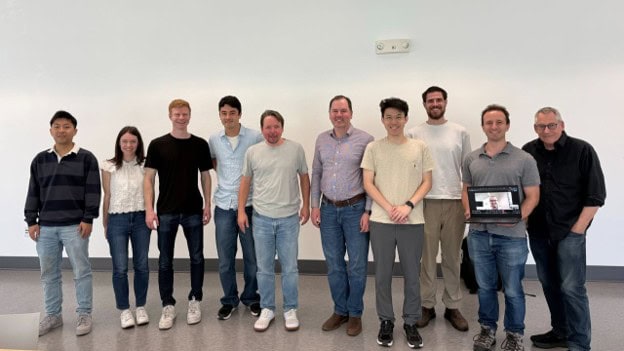
The team: Employees at Oratomic, a new neutral-atom quantum computing start-up. (Courtesy: Oratomic)
There are, however, trade-offs. Quantum computers that use fewer qubits or more space-efficient hardware generally have longer computation times. Oratomic’s proposed 10,000-qubit platform would require three years to crack ECC with 256-bit keys (ECC-256) and 120 years to crack RSA-2048. The company’s predicted time-efficient alternative could solve ECC-256 in 10 days, but that would require 26,000 qubits. Solving RSA-2048 in 97 days would take 100,000 qubits.
Oratomic’s numbers have not yet been peer-reviewed, and outside experts say they depend on different assumptions about future hardware developments. “The space-efficient [architecture] is mostly based on assuming aspects that have been demonstrated to work individually in state-of-the-art academic labs,” explains Maria Violaris, a quantum physicist at Oxford Quantum Circuits, who was not involved in the research. “Meanwhile, the time-efficient one relies on more speculative assumptions that need future innovation.”
A second perspective
On the same day as the Oratomic team posted its findings on the arXiv preprint server, researchers at Google Quantum AI released a white paper with their own updated resource estimates. They report that a computer with 500,000 physical qubits made from superconducting circuits could solve ECC-256 in 18 minutes – and potentially even less (see box). Google’s current state-of-the-art processor, Willow, has 105 physical qubits. However, the researchers warn against assuming gradual and predictable progress because quantum computing developments are driven by overcoming scaling barriers rather than by steady increases in processor size.
The quantum threat to cryptocurrencies
Elliptic curve cryptography (ECC) underpins the security of most blockchain networks, including Bitcoin and Ethereum. Bitcoin transactions take an average of 10 minutes, so if a quantum computer can crack ECC and determine the secret key during that window, the transaction could be intercepted and funds stolen in real time.
While Google Quantum AI’s results predict that it would take 18 minutes to solve ECC on a 500,000-qubit quantum computer, they argue that the run time could be effectively shortened in some circumstances. To understand how, imagine planning a heist in which you need to open a safe. Although you won’t know the exact combination until you get your hands on the safe, if you know the model number in advance, you can prepare some tools to help you crack it faster.
A quantum computer could do something similar. According to the Google Quantum AI researchers, half the ECC algorithm only depends on the elliptic curve and not on the specific transaction. A quantum computer could precompute this half, wait in a primed state until a Bitcoin transaction begins, then quickly solve the second half in only nine minutes, dropping below the 10-minute threshold.
Quantum computing platforms that use superconducting, silicon, and photonic qubits are well-positioned for real-time attacks because they tend to compute faster than neutral-atom and ion-based computers. However, the latter could still pose a serious risk through “at-rest” attacks. Such attacks involve adversaries collecting archived and publicly available data, then decrypting it later with few time constraints.
Which threat arrives first will depend on how different quantum computing architectures mature and scale, a path still marked with considerable uncertainty. “Ultimately, feasibility is difficult to say as it depends on how challenging it will be to increase scale or to take a novel approach by engineering [new] hardware,” notes Maria Violaris of Oxford Quantum Circuits.
The high number of physical qubits required for quantum computation comes from the need to detect and correct errors. Google Quantum AI’s estimate is based on a well-known error-correction method known as the surface code. In this approach, physical qubits are arranged in a rectangular grid and interact with their nearest neighbours. Quantum information is spread redundantly across this grid, allowing errors on one physical qubit to be found and fixed. The entire grid is considered one logical qubit, and the ratio of logical to physical qubits is called the encoding rate.
In the surface code, reducing error amounts to adding more physical qubits per logical qubit, and typical encoding rates range from a few hundred to a few thousand. In contrast, the Oratomic team based its estimates on a newer method of error correction called quantum Low-Density-Parity-Check (qLDPC), which reduces error more efficiently by making the physical qubits interact over large distances. Hengyun (Harry) Zhou, a physicist at the Massachusetts Institute of Technology in the US who was not involved in the research, explains that this longer-range connectivity can significantly increase the encoding rate. For qLDPC codes, a typical rate is around 1 to 10, but rates can now go as high as 1 to 2.
Because neutral atoms are highly reconfigurable, neutral atom platforms like those used by Oratomic (and other companies, including QuEra Computing, Infleqtion, Pasqal, planqc and Atom Computing) are naturally suited to the required long-range connectivity that qLDPC codes require. However, Zhou argues that it’s “not completely out of the question” that superconducting qubit platforms could use these codes too. “There is some additional cost that the lack of reconfigurability in those platforms currently leads to, but I would say if we’re thinking about a beyond-10-year timescale, it’s quite imaginable that things could also change for other platforms as well,” he says.
Responsible disclosure
Google Quantum AI’s white paper may represent a turning point in another respect. Rather than being open about their circuit designs, its authors hid them behind a “zero-knowledge proof”, which provided enough information to verify claims while hiding details that they say could provide bad actors with an “instruction manual”.
Superconducting quantum computing: Google Quantum AI’s Willow processing chip. (Courtesy: Google Quantum AI)
This is a relatively novel approach within the quantum computing community, which has thus far followed the conventional academic practice of publishing results with full transparency. A Google blog post expresses hope that “our approach to responsible disclosure can spur an important conversation among quantum computing researchers and the broader public”.
Certainly, it has already spurred a conversation among experts. “This is the first time I’ve ever seen a new mathematical result actually announced that way,” Scott Aaronson, a quantum physicist at the University of Texas at Austin, US, wrote on his blog. “I’m not sure how much it will actually help, as once other groups know that a smaller circuit exists, it might be only a short time until they’re able to find it as well.”
Zhou echoes this sentiment. “These are the kind of results that could potentially have a lot of general societal safety implications, so you want to make sure that they’re safeguarded responsibly,” he observes. “That being said, I think it is also possible that other people, now that they know what is possible, might come up with related constructions.”
What comes next?
In the long run, protecting against threats likely means migrating away from RSA and ECC and towards new mathematical problems that are difficult for both classical and quantum computers to solve. Google recently introduced 2029 as an internal deadline for migrating major system to so-called post-quantum cryptography (PQC), and many experts believe the migration ought to begin now.
“Migrating to PQC is a massive undertaking that won’t happen overnight. Starting migration today is a necessary risk management strategy,” urges Chen from NIST. She notes that NIST has been instrumental in guiding this migration, beginning with its 2016 call for cryptography experts to design and evaluate new algorithms for PQC, and culminating in its publication of the three most promising ones in 2024.
The Google Quantum AI researchers also outline recommendations to help cryptocurrency communities and policymakers prepare for the PQC era. And while urgency permeates their white paper, ongoing PQC efforts prompted them to end it on a positive note. “These trailblazing projects demonstrate that transition to post-quantum cryptography is realistic and instil hope that it will have been completed before the first [cryptographically relevant quantum computers] come online,” they write.
Last week, the US government announced $2 billion in investments in quantum computing companies, allocating $100 million each to a range of startups in exchange for equity in the companies. Those could be make-or-break investments for many companies that are likely years away from a product that could see widespread use. But a member of the US Congress is now arguing that those deals are illegal, as Congress did not allocate the money for this purpose—instead, it was meant to support public research in semiconductors.
But the biggest chunk of money would go to a company that likely wouldn't exist if it weren't for the government's backing. Anderon will be set up with a billion dollars each from IBM and the government and will inherit personnel and IP from IBM. It will serve as a foundry for fabricating quantum processing units and will contract its services out to IBM and any other company that wants access to cutting-edge hardware.
Is any of this legal?
Zoe Lofgren (D–Calif.), the ranking member of the House Science, Space, and Technology Committee, made it clear that she is not happy with how the government is using its money to support this technology.
As intelligence itself becomes privatised by big tech, allowing your intellectual faculties to wither in service of inane bots seems a dangerous move
Long before the age of multi-billion-dollar AI companies promising to disrupt the field of software development, I was learning to code the hard way.
It was the mid-2000s, and I was a child with unmonitored access to the family computer. With the help of a basic text editor program, I learned how to make websites – first basic, then increasingly complex – from scratch. The results were never as beautiful or polished as in my imagination, but I could live with that, because I was learning a craft. The painstaking hours of debugging and poring over arcane documentation for projects that I eventually abandoned never felt wasted.
Darren Aronofsky among proponents of using technology, while Guillermo del Toro says he would ‘rather die’
Under a white marquee on Cannes’ Croisette beach, with the Mediterranean glistening behind him and superyachts drifting across the horizon, the director Darren Aronofsky addressed an audience of executives and tech evangelists gathered for an “AI for Talent” summit.
“There’s so much pushback against AI,” said Aronofsky, who has faced criticism over his embrace of generative AI projects though his new studio, Primordial Soup, at a time when artificial intelligence has become one of the film industry’s most divisive fault lines.
The US president’s reversal on calling for a safety review of new AI models is a green light for tech’s unchecked power
Only hours before Donald Trump was set to sign a long-awaited executive order on Thursday that would have called for a government safety review of new artificial intelligence models before their release, the president abruptly backed out. Despite growing public backlash to the technology and experts warning new models will pose critical security risks, Trump vowed the US government would not slow down the AI race.
During a meeting with reporters on Thursday, Trump cited both American dominance and competition with China and as his reasoning behind the reversal.
The US government will take equity stakes worth a total of $2 billion in a slew of quantum computing companies, including a startup backed by a firm with links to the Trump family and one taken public by a Pentagon official.
The announcement by the commerce department that it had signed letters of intent with nine companies—including GlobalFoundries and IBM—sent shares in quantum specialists soaring on Thursday.
Both IBM, which is set to get $1 billion, and GlobalFoundries, which will receive $375 million, were up more than 6 percent in pre-market trading. D-Wave Quantum, an awardee that was taken public in 2022 by Emil Michael—now a top Pentagon official—was up more than 20 percent.

 Login
Login