A research team from the School of Biomedical Sciences at the LKS Faculty of Medicine, the University of Hong Kong (HKUMed), has achieved a significant advance in biotechnology that could revolutionize treatment strategies for neurodegenerative diseases. The team has developed a novel tool called RNA Segment Editing (RSE), which functions like a "cut-and-patch" tool for RNA. This innovative approach allows scientists to precisely remove or replace faulty segments of genetic messages within living cells without permanently changing a person's DNA.
Cell function is determined by how DNA is expressed into proteins. That process includes two main steps—transcription, when messenger RNA (mRNA) makes copies of active genes; and translation, when mRNA guides protein assembly.
NASA's X-59 jet is on the verge of finally breaking the sound barrier as the agency looks forward to the aircraft's first supersonic flight this month.
NASA's X-59 jet is on the verge of finally breaking the sound barrier as the agency looks forward to the aircraft's first supersonic flight this month.
Financial stakes of AI race rise as Elon Musk’s SpaceX, OpenAI and Anthropic are slated to go public this year
Anthropic has filed confidentially for an initial public offering on the US stock market, the company announced on Monday. The AI firm makes the Claude chatbot, popular with software engineers and other business clients, and has seen a meteoric rise this year.
The company did not disclose the valuation it will target on the stock market, nor did it make public other terms of the offering. The startup announced on Thursday that it had raised $65bn in funding to value the company at $965bn post-money. Anthropic was valued at $380bn in February.
Record-breaking box office for Backrooms and Obsession has opened the door for twentysomething YouTube creators as the industry rethinks what audiences want
At this time last year, the idea of a wide-release feature film-maker cutting their teeth on YouTube was, if not unheard of, certainly still a niche origin story. Siblings Michael and Danny Philippou had just released Bring Her Back, the follow-up to their surprise horror hit Talk to Me, to pretty-good reviews and OK box office; clearly they would continue to work, but the slightly diminished returns didn’t predict a YouTube explosion. Nor did the outright lousiness of Shelby Oaks, from longtime YouTube film critic Chris Stuckmann, when it premiered in theaters later in 2025. Generous horror-festival buzz died down as more people actually laid eyes on the movie; Stuckmann was an obvious enthusiast, and some saw promise in his first effort, but a clumsy found-footage pastiche without much emotional sense didn’t seem like the next big thing, either.
But in 2026, something has shifted. In January, YouTuber Markiplier self-released his adaptation of the video game Iron Lung to theaters, and it outgrossed any number of big-studio titles. Then Curry Barker, whose comedy sketches have been a YouTube fixture, unveiled his feature debut Obsession. The film, made for under a million dollars, has become the box office phenomenon of the summer so far, managing a virtually unheard-of feat when its second and third weekends actually outgrossed its first. Obsession is sharing multiplex space with Backrooms, directed by 20-year-old Kane Parsons, who previously brought the spooky internet meme to life in a series of YouTube shorts. Despite being set in a series of purgatorial, sparsely furnished, fluorescent-lit “liminal spaces”, it was the top movie at the North American box office this weekend, poised to become the biggest-grossing movie from distributor A24 in a matter of days. Backrooms also opened to bigger numbers than any number of starrier or bigger-brand 2026 titles like Wuthering Heights, Scream 7, The Devil Wears Prada 2 or the last Pixar movie. That makes three YouTube-trained film-makers who have presided over some of this year’s biggest and/or most surprising hits. With them have come countless social media posts about how YouTube, not film school, provides the real training tomorrow’s directors need.
From Google co-founder Brin spending $82m to fight a billionaire tax to Google and Meta funding a joint Super Pac, Silicon Valley is engaged in an existential fight for its political power at home
Tech billionaires have shelled out hundreds of millions of dollars ahead of the 2 June primary election in California, in an unrivaled attempt to influence who gets to run the state that Silicon Valley calls home.
The industry has used a cover-all-bases approach, funding candidates and ballot measures big and small, contributing to what looks to be the most expensive primary season in California history. The goal, experts say, is to gain both political and regulatory leverage that will perpetuate dominance in business.
Google co-founder Sergey Brin has spent $82m since January, more than any other donor, to fight a billionaire tax that’s up for a vote on the November ballot.
Democratic gubernatorial candidate Matt Mahan has received moredonations than any other candidate, including from top executives at Google, Amazon, Snap, LinkedIn, Reddit and Palantir.
Crypto mogul Chris Larsen has funded three Super Pacs with $26m to sway campaigns across California, including giving $1m to back a primary candidate for state insurance commissioner.
Google and Meta have collectively funded a Super Pac with $10m to back assembly and senate candidates in local district races across the state.
Silicon Valley money is flowing toward city primaries as well as state-level ones, with tech-backed Pacs sponsoring voter guides suggesting how to vote on local tax measures.
As temperatures soar across the UK, chill your space – and avoid energy-guzzling aircon – with our pick of the best fans, from tower to desk to bladeless
Our world is getting hotter. Summer heatwaves are so frequent, they’re stretching the bounds of what we think of as summer. Hot-and-bothered home working and sweaty, sleepless nights are now alarmingly common.
Get a good fan and you can dodge the temptation of air conditioning. Aircon is incredibly effective, but it uses a lot of electricity … and burning fossil fuels is how we got into this mess in the first place. Save money and carbon by opting for a great fan instead.
Best quiet fan for the bedroom and best overall: AirCraft Lume
Best fan for cooling: Dreo TurboCool misting fan 765S
The roots of AI in rightwing ideology is examined in Valerie Veatch’s enjoyable doc, including an array of colourful, often crazed, figures
Director Valerie Veatch made her name with documentaries such as Love Child (about an online gaming-addicted couple whose child died of malnutrition) and Me at the Zoo (about American vlogger Cara Cunningham), films that explore the intersection of real-world subcultures and internet communities. Her latest continues in this vein, although its self-set remit is a bit broader, more urgent and germane to everyone right now: the pursuit of artificial intelligence, its dark history in eugenics and highly debatable utility today (despite the stock-market bubble pushing the value of a half-dozen companies towards the stratosphere).
The thrust of the film is largely polemic, guiding the viewer towards AI-sceptical conclusions one persuasive soundbite at a time. Nevertheless, it also serves as a very useful, straightforward primer on AI history, touching on a dazzling array of colourful, often crazed figures, including Victorian British eugenicist Francis Galton, Silicon Valley founding father and overt racist William Shockley and current-day jillionaire jerk Elon Musk. Sadly, the film is not so up-to-date that it covers Musk and former friend-turned-foe Sam Altman’s recent courtroom brawl, but that doesn’t detract from the thrust of Veatch and her interviewees’ arguments.
A new front has opened up in the battle for dominance in AI chips, as Nvidia said its latest development could replace the mouse and keyboard in how people use computers.
The $5tn (£3.7tn) US semiconductor company has launched a “superchip” that puts AI capabilities into laptops and desktop computers, a move that will pit it against Intel, Apple, Qualcomm and AMD.
Coalition of more than 100 organisations says move could lead to more children ending up in adult detention facilities
A coalition of more than a hundred refugee children’s organisations has said controversial plans to use AI to assess the age of young asylum seekers could lead to more children wrongly ending up in adult prisons or detention centres.
The warning follows a Home Office announcement on Friday of a contract to roll out AI facial age estimation technology on young asylum seekers whose age is disputed.
Sarah Wynn-Williams did not speak during event after lawyers warned of possible sanctions from tech firm
Facebook whistleblower Sarah Wynn-Williams was forced to sit in silence on stage at an event at Hay festival, after lawyers advised her not to speak because of ongoing legal action brought by Meta.
Wynn-Williams, whose bestselling memoir, Careless People, details her years working at Facebook, was due to appear in conversation with the investigative journalist Carole Cadwalladr and academic Tim Wu.
A new belief set is uniting some of the wealthiest men in the world around a ‘transhuman’ future – actual humanity be damned
Sam Altman, the chief executive of OpenAI, took to the Internet a few years ago to propose that homo sapiens would be the first species “to design our own descendants”. In his best case scenario, the “merge” between humans and artificial intelligence occurs at some point over the next 50 years. The alternative, where we remain simply human and the machines follow their own path, is more ominous. “If two different species both want the same thing and only one can have it – in this case, to be the dominant species on the planet and beyond – they are going to have conflict,” he wrote.
More recently, Elon Musk, the world’s richest man, who at one point last year was granted the power to reconfigure the US federal government, argued on his social media platform, X, that “it increasingly appears that humanity is a biological bootloader for digital superintelligence” – our role in the history of the cosmos reduced to that of the low level code that boots up a computer before you can run sophisticated programs on it.
Scientists have developed “living plastics” that can be programmed to break themselves down when triggered. Many plastic items are made for one-time use, but the materials can remain in the environment for years. Researchers are exploring a different approach: living plastics, materials built with microbes that can be activated to break down the polymer when [...]
Workers who learn to use AI effectively may gain a significant advantage as workplaces become increasingly AI-focused, according to new research. Generative AI is rapidly changing the way people work, raising concerns about job security and whether machines could eventually replace human employees. However, new research from the University of Vaasa in Finland suggests that [...]
The average American spends nearly an hour a day behind the wheel, according to the US Department of Transportation. Some people love driving. Others tolerate it in order to get around. But either way, on average we all spend a lot of time doing it.
So it’s understandable if, over time, we all come to believe a few things about our cars that aren’t true. There’s nothing more human than believing myths, but some of these false beliefs have people wasting money or getting upset at people who are actually doing the right thing. With that in mind, here are a few widely believed driving myths—and why research suggests they’re false.
Premium fuel is pointless (unless your car is made for it).
Diesel aside, there are three kinds of fuel at most gas pumps—regular, plus, and premium. The overwhelming majority of personal vehicles are built with regular fuel in mind; it’s basically just sports cars and a few luxury vehicles that require the higher octane.
Some people believe using premium fuel offers benefits, such as higher fuel economy, increased performance, or reduced tailpipe emissions. But there’s no evidence to support this idea. Engines are designed with a specific octane in mind. Using a higher octane won’t hurt anything, but it doesn’t benefit the vehicle in any way.
Save yourself the money. Image: Shutterstock Joel A Johnson
A 2016 study by the American Automobile Association (AAA) tested different fuels in identical cars. The study found no consistent increase in horsepower or fuel economy, and there was also no change in tailpipe emissions. The only real difference was the price of the fuel.
A 2003 publication from the US Federal Trade Commission put it plainly: “In most cases, using a higher octane gasoline than your owner’s manual recommends offers absolutely no benefit.”
Generally, if your car requires a higher octane fuel, there will be a sticker saying so when you flip open the fuel door. If not, check your car’s manual—it will state which kind of gas your car needs. But basically, if you don’t own a sports car or luxury vehicle, you should just use regular fuel.
Waiting to merge is good, actually.
There’s a widespread belief that, if there’s a lane closure up ahead, people should merge into the open lane as soon as possible. The problem is that doing this slows down traffic. “When most drivers see the first ‘lane closed ahead’ sign in a work zone, they slow too quickly and move to the lane that will continue through the construction area,” reported the Minnesota Department of Transportation. “This behavior can lead to unexpected and dangerous lane switching, serious crashes, and road rage.”
There’s research backing this up. A 1999 study by researchers from the University of Nebraska showed that traffic moves faster if people stay in their lanes until the merge point, then take turns merging. A 2018 study from North Carolina State University shows that there’s a real safety benefit to this system, which is referred to as a zipper merge. According to the study, “drivers merged at much safer distances after installation of the zipper merge at these sites than before the zipper merge was in place.” The study also found that the zipper merge was safer for construction workers. A 2024 paper by researchers from Iowa State University analyzed construction sites in Michigan and Missouri, where portable lit signs instructed drivers to stay in the closing lane until the merge point. They found increased traffic throughput at those sites.
The problem is that not many people know about the benefits of the zipper merge. Some drivers get angry at drivers who don’t merge early, and in some cases will even cut them off. But research suggests everyone would get home faster if we all stayed in our lanes until the merge point.
Manual transmissions aren’t more efficient than automatic ones.
This myth was true, at some point, and still might be true for particular cars with particularly skilled drivers. Overall, though, there’s no real fuel economy advantage to driving a modern manual car. That’s according to the US Department of Energy (DoE), which stated that “advances in automatic transmissions have improved their efficiency to the point that the automatic version of a vehicle often gets the same or better fuel economy than the version with a manual transmission.”
Anyone who is interested can head to FuelEconomy.gov, a website run by the US Environmental Protection Agency (EPA) and the DoE. On this site you can see the miles per gallon (MPG) for any make and model, allowing you to directly compare the manual and automatic versions of any car. You can dig into the numbers yourself, comparing the automatic and manual version of the same car—assuming, that is, that the car is available as a manual. Such vehicles are a relative rarity in the United States, possibly making this myth largely academic (and that’s before we factor in the shift toward electric cars).
Google Maps has been helping us get from A to B since 2005. In that time, it’s amassed a huge amount of data about the world—from business opening times to national boundaries. And alongside the map itself, there’s satellite imagery and imagery at ground level, courtesy of Street View.
You may well have used Street View before, dropping a little pegman onto a road in Google Maps to see what it looks like if you’re actually stood on the sidewalk. What you might not be aware of is that you can go back in time in Street View—back to 2007 in the first places that were mapped with this technology.
It means you can check out your neighborhood (or someone else’s neighborhood) as far back as twenty years ago. You can see what’s changed and what hasn’t. It works for the most iconic streets and locations in the world too, from Times Square to the Arc de Triomphe. Here’s how to use the feature.
How to find Street View time travel
See how iconic spots have changed over time. Screenshot: Google
The feature is a little easier to use through Google Maps on the web, not least because there’s more screen real estate to work with. Scroll and pan to the part of the world that you want to take a look at, or use the search box up in the top left corner to jump to somewhere specific.
You can find the little Street View pegman icon down in the bottom left corner (yes, pegman is his official name). Click and drag the pegman over to the map, and you’ll see all the roads, paths, lanes, and freeways that support Street View highlighted in blue. Drop the pegman on the spot you want to take a look at.
You’ll go straight into the immersive Street View mode, with ground-level imagery. Use the mouse or the arrow keys on your keyboard to take a look around. You can also start moving up and down the street using the up and down arrow keys, or by clicking the arrow icons overlaid on the ground.
Here’s the time travel bit: Click the See more dates link up in the top left corner, and along the bottom of the screen you’ll see thumbnails of older imagery, together with dates—scroll to the right to see the oldest available pictures.
Bear in mind that the total number of different date options, and the years they cover, are going to vary depending on how long Google’s Street View cars have been covering a particular area, and how regularly they’ve been back. You’ll find there’s quite a substantial difference in how far you can go back, depending on where you are in the world.
Exploring neighborhoods of the past
Historical imagery can be accessed through the Google Maps mobile apps too. Screenshot: Google
As soon as you select one of the image thumbnails representing an earlier year, you’ll be taken back in time in Street View. You can still look around and explore as before—the views you see will be from the same year you’ve selected, until you choose a different month and date from the carousel at the bottom.
It lets you check out how businesses and houses have changed over time, and in some locations you’ll even be able to see roads or buildings being built (or being leveled) as the years go by. For busy areas, you get an interesting peek into the changing fashions for both people and vehicles.
It’s possible to check out famous landmarks in this way too, though if they’re iconic then they don’t tend to be modified much over time. When you’re ready to return to the present day, click the See latest date link in the top left corner.
You can time travel through Street View through the Google Maps apps for Android and iOS as well. To get to Street View, long-press on a road on the map, then tap the Street View thumbnail that pops up in the lower left corner. You can then tap the date label (top left) to find other dates.
It’s also worth noting that historical imagery is available in Google Earth too, for both Street View images and satellite maps. Either drag the pegman in from the bottom right corner and then choose See more dates, or click the historical imagery button in the top toolbar (it looks like a globe with an arrow around it).
It seems like every week there’s another example of a new robot modeled after a real creature in the animal kingdom. From dogs and bats, to roaches and desert lizards, the natural world is a constant source of inspiration for engineers. But while most robotics researchers use animals as a base for their machine’s movement, an ambitious team of Duke University engineers set out to make something entirely new: a robot whose form factor and movement aren’t derived from biology, but from the universe’s underlying physics.
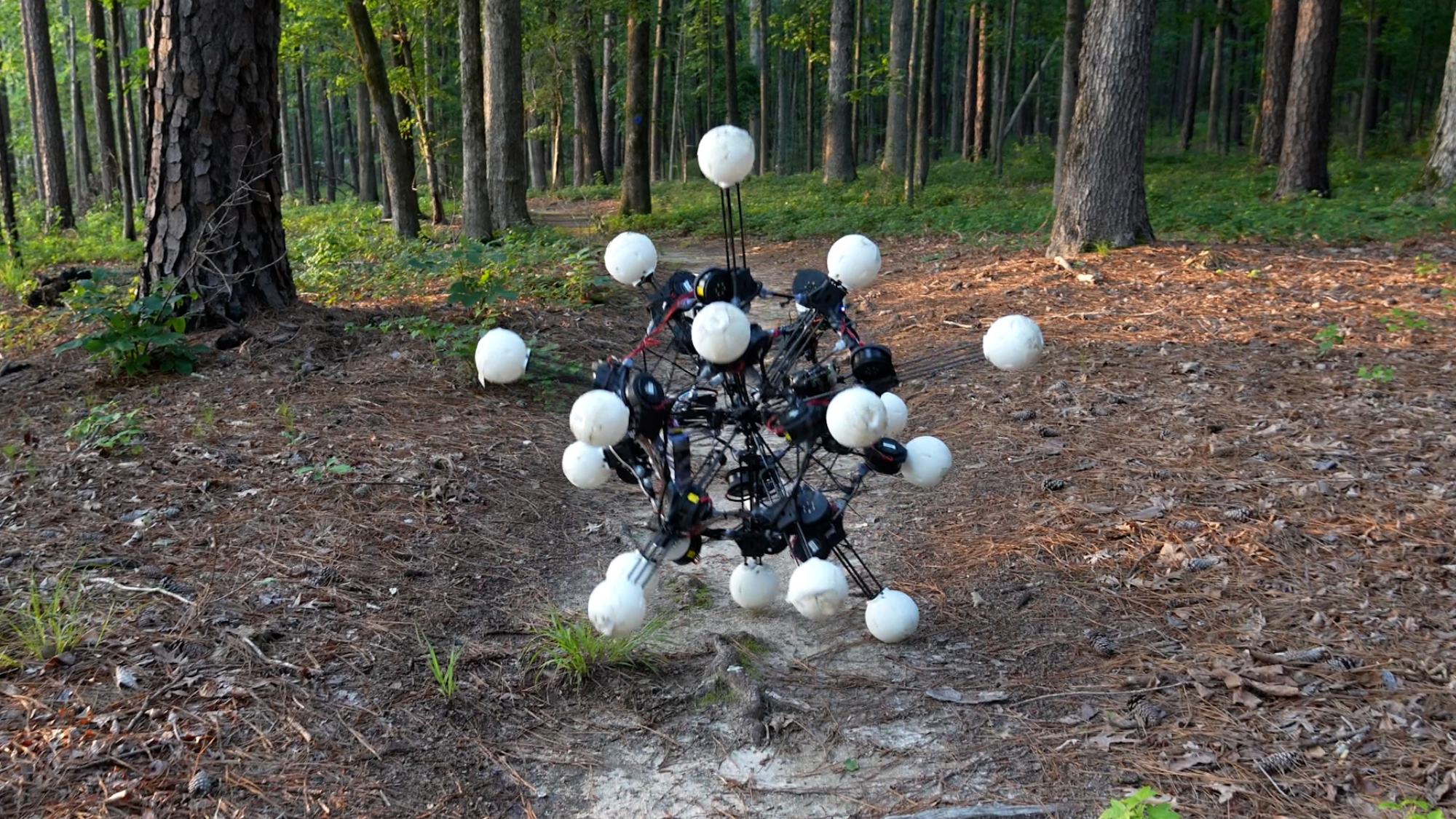
Say hello to Argus, a 20-legged, blob-looking robot capable of seeing in all directions at the same time and able to move almost instantly in any direction. The amorphous-looking sphere has no top or bottom, no left or right, and will keep trekking through sand, dirt, and gravel even when some of its legs are destroyed. It can also use its many legs to shimmy up narrow walls, a move similar to a wall jump in “Super Mario.”
The engineers behind Argus say their intriguing, if not slightly terrifying, creation isn’t just another incremental step forward in robotics. It’s the first member of a totally new category of “dynamically symmetric machines.” The findings were published this week in the journal Science Robotics.
“Watching Argus move is unlike watching any other robot we’ve worked with,” study co-author and Duke PhD student Jiaxun Liu said in a statement . “The first time we saw it navigate among trees and rough terrain, even under heavy collisions, we knew this was something different.”
Biological tradeoffs
Though somewhat human-looking, upright bipedal robots from companies like Figure and Tesla are all the rage these days, engineers have long looked to other animals to inspire their machines, because animals are simply better than Homo sapiens at certain tasks. Dogs and other quadrupeds are more agile, bats can fly, and bugs can scurry into hard-to-reach places.
However, at least in terms of movement, each of the pluses of these specific animals has also come with some minuses. Dogs and other quadrupeds are remarkably fast and nimble when moving forwards, but ask them to replicate that movement when moving backwards and you’re in for a problem.
With those inherent biological tradeoffs in mind, the team at Duke’s General Robotics Lab set out to make something completely different. Taking inspiration from underlying physics, they wanted to see if they could make a robot based around “dynamic symmetry,” which they define as the ability to generate forces and acceleration with uniform magnitude in all directions.
In other words, such a robot would take the idea of left or right and up and down and throw them out the window. Instead, it would be capable of moving in any direction, at any time, without any privilege given to one particular direction. The goal was essentially to build possibly the world’s first “omnidirectional” robot.
Argus keeps on coming—even when you break its legs
The design team eventually settled on a spherical core, or base, with a bunch of legs sticking out of it. They made multiple versions in a simulation, one with as few as eight legs and another with as many as 40. Eventually they settled on an even 20 legs for the physical build. Each of those legs is tipped with a camera that serves as one of Argus’ many eyes. Fitting, then, that it’s named after a many-eyed giant in Greek mythology. The researchers describe Argus as visually similar to a sea urchin, but even that’s selling it short. It doesn’t really look like anything in nature, which makes its uncanny movement in real-world testing all the more unsettling.
In testing, Argus could move in any direction just as quickly and comfortably as any other. The upside of that is that the blob is actually quite adaptable to different terrain despite its unusual appearance. It can easily traverse forest, wet surfaces, and sand, and could climb over certain obstacles. Argus’ ability to rapidly redistribute its weight also meant that it excelled at recovering when researchers tried to shove it off course. While Argus isn’t the first robot to right itself after getting pummeled by a researcher, what makes it unique is that it can redistribute its weight even if some of its legs get damaged or fail altogether.
In other words, you can chop off Argus’ legs and it will just keep coming.
Argus joins a family of DARPA-backed robots
The Duke researchers frame their interest in building this new category of machine as primarily motivated by pushing the boundaries of what’s possible in mechanical science. Still, it’s hard not to ignore the researchers’ most notable funder: the Pentagon’s Defense Advanced Research Projects Agency. Known for incubating some of the military’s most notorious research and development projects, DARPA is responsible for everything from Boston Dynamics’ beef Atlas humanoid to a massive, experimental manta ray inspired uncrewed underwater vehicle.
So, while it’s still not clear what exactly Argus will ever be used for, paper coauthor and postdoctoral researcher at Duke’s General Robotics Lab Boxi Xia says the experimentation and exploration was success in itself.
“Argus is an existence proof,” Xia said in a statement. “It shows that designing for dynamic symmetry isn’t just a theoretical curiosity. It produces a robot you can deploy in the wild, on uneven ground and in clutter, even in low-gravity settings. It changes what’s possible.”

 Login
Login