By tracking fierce winds racing through the atmospheres of seven ultra-hot Jupiters, astronomers have uncovered the strongest evidence yet that magnetic fields shape weather on worlds beyond our Solar System.
In this presentation I discuss the drastic reduction in human lifespans after the global flood, from 910-970 years to about 70 years. I link these changes to factors such as biological decay, genetic entropy, Earth’s altered magnetic field and loss of physiological resilience. Eternal lifespans can only be restored through Jesus Christ.
The generation and evolution of electricity is discussed, highlighting significant milestones from early static electricity experiments to modern AC power generation techniques. Dirty electricity, characterized by high-frequency electrical noise, can lead to health issues. There is a strong need for more research on this electromagnetic pollution and its health impacts.
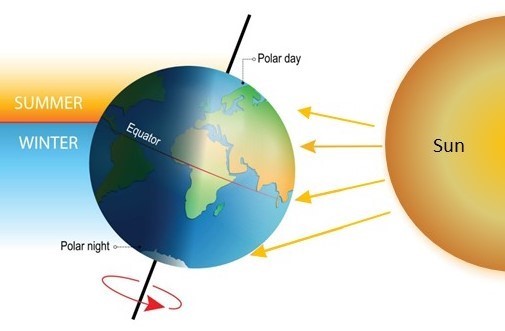
Two Part Seminar: Part 1 discusses Young Earth Creation, Earth's magnetic field, and related phenomena. Part 2 presents a new creation model addressing changes in Earth's axial tilt and magnetic field, including a dating of Noah's Flood.
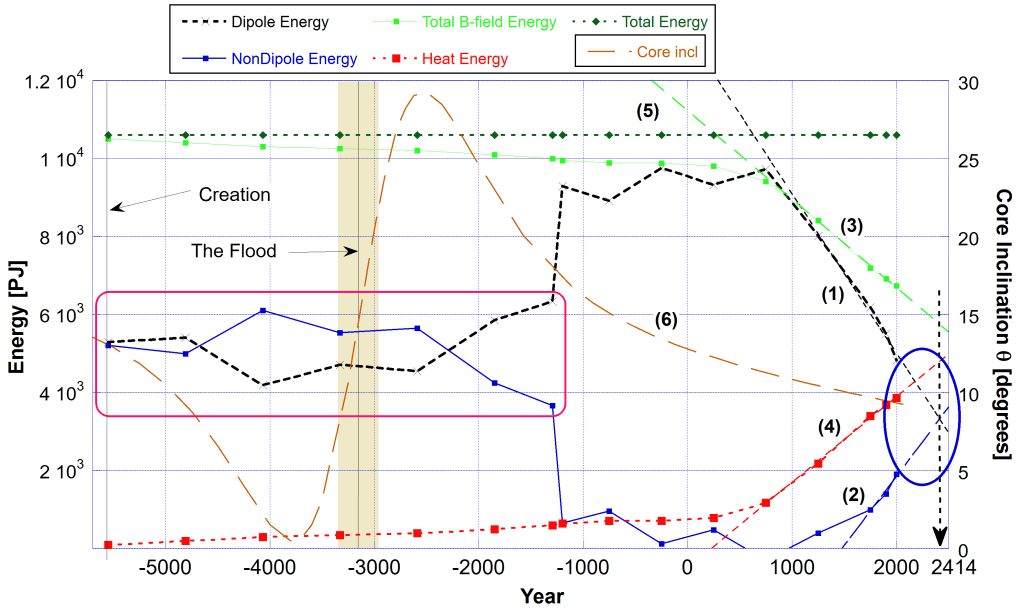
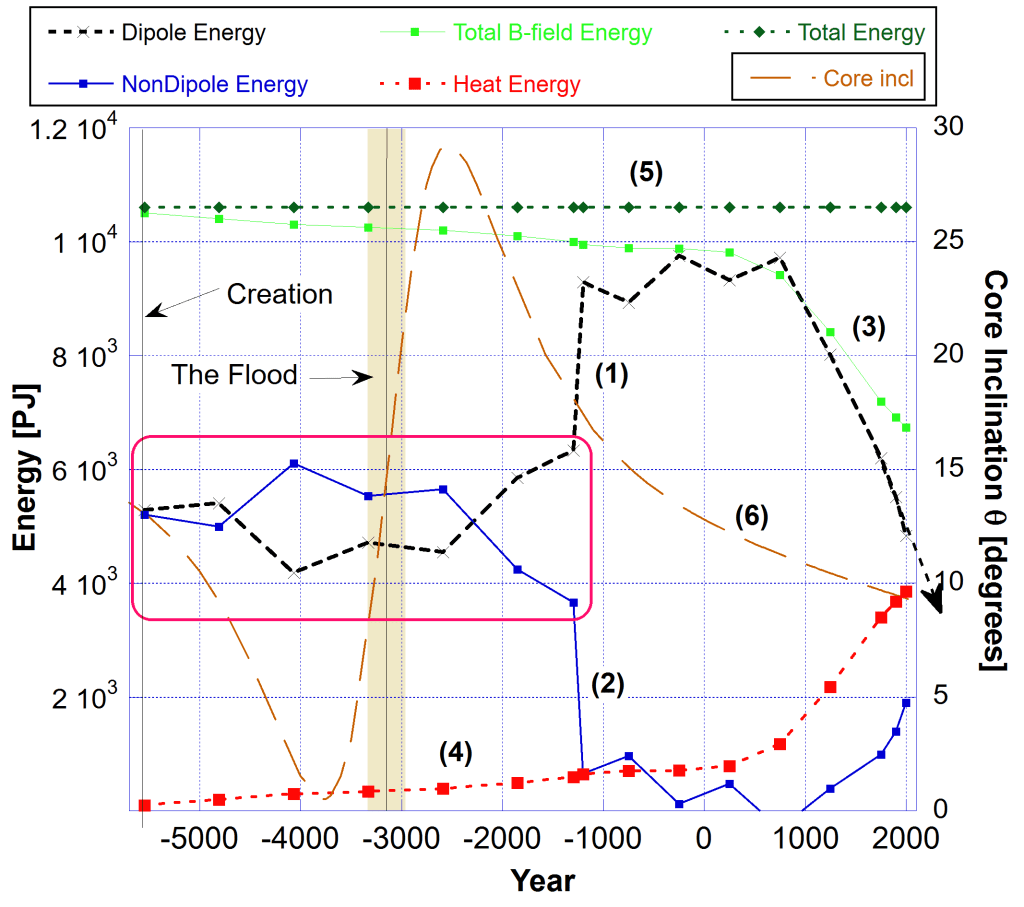
In light of discussions on the Earth's magnetic field around potential pole flips and energy changes I present my model predictions. Significant energy will be lost by 2414, suggesting chaos in Earth's liquid core. By 3227, the Dipole Energy may reach zero unless divine intervention occurs.
Carl Friedrich Gauss initiated a scientific journey into the properties of the Earth's magnetic field. I describe its history from a Young Earth creationist perspective, suggesting a history of less than 8,000 years, and exploring correlations in the data regarding axial tilt and magnetic changes since creation.
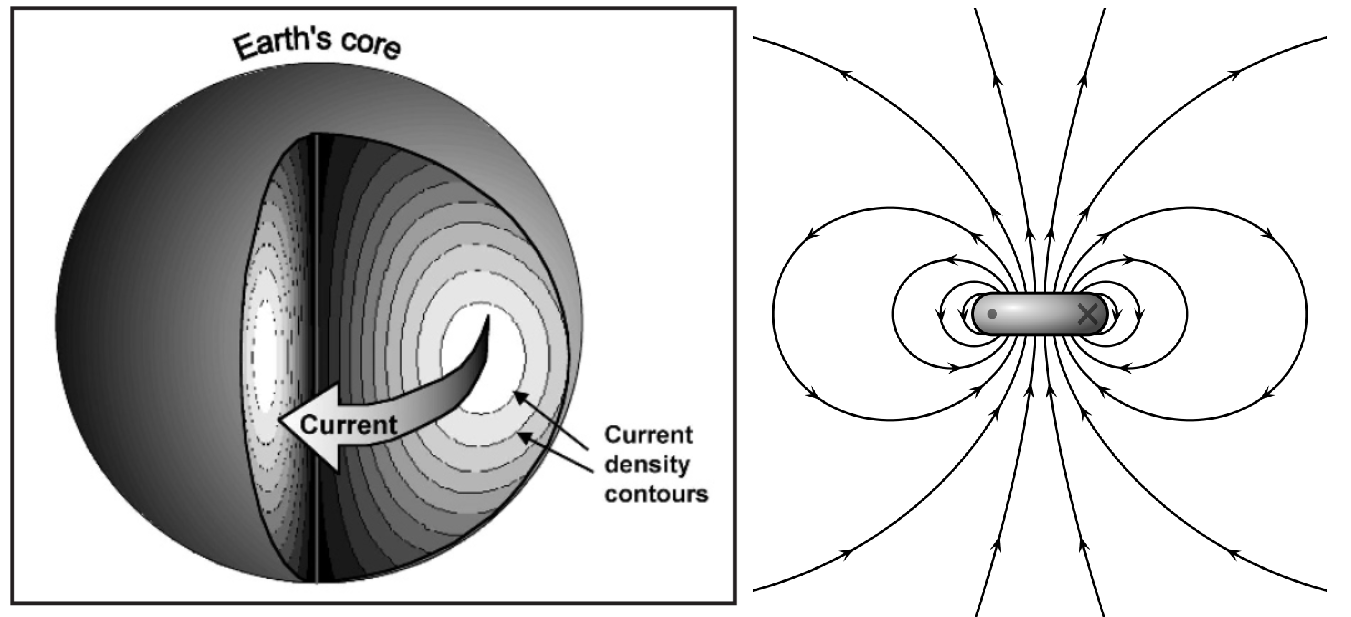
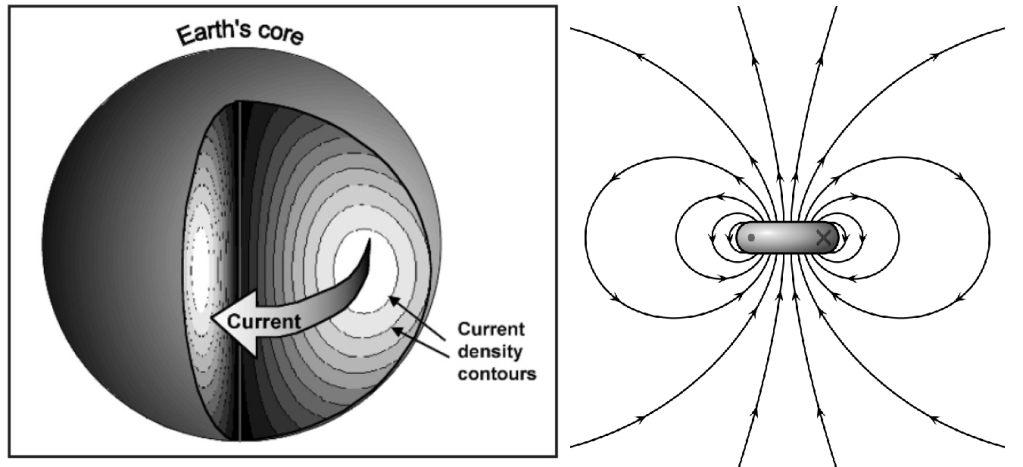
The Barnes-Humphreys model explains Earth’s geomagnetic dipole field arises from currents in the liquid outer core, experiencing decay over 200 years. Despite evolutionist arguments for regeneration, evidence shows decreasing magnetic energy, with a recent half-life of approximately 1,400 years, suggesting a young Earth, consistent with YEC views.
I discuss evidence supporting the Earth's magnetic field as a divine shield for life, highlighting its decay since Gauss's measurements. I link this decay to a young Earth, highlighting that Carbon-14 presence in minerals aligns with a creation timeline under 8,000 years.
Day 4 of creation, God made the Sun, Moon, planets, and stars, establishing them as luminaries in the heavens. The language of the Bible uses an Earth-observer perspective, meaning that light from celestial bodies was instantly visible. Additionally, I confront naturalistic explanations for celestial origins, proposing a creationist model.
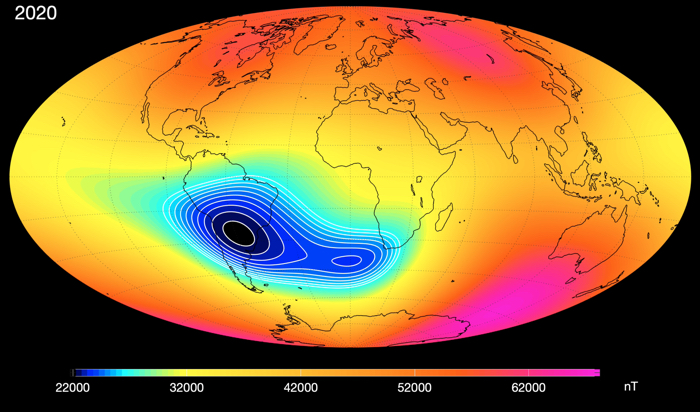
Recent satellite data indicate that the South Atlantic Anomaly in Earth's magnetic field is potentially splitting into two anomalies. This phenomenon, attributed to disturbances in the outer core, threatens the planet's magnetic shielding. This supports a young Earth perspective based on evidence of total energy decay from the magnetic field.
Day 3 of creation, God formed dry land and initiated life with green plants, establishing essential conditions for future sentient life forms. This day also included the formation of Earth's physical structures. All creations were designed perfectly, paving the way for environmental balance and the development of biodiversity.
God created all space, time, and energy over six ordinary days less than 8,000 years ago. I discuss the physics of the Day 1 of that, with the earth formed from a sphere of water and the creation of all light, including the thermal radiation called the cosmic microwave background.
The best evidence for exoplanetmagnetic fields ever discovered has emerged from new European research, which measured wind speeds on seven ultra-hot Jupiters using the European Southern Observatory’s Very Large Telescope (ESO’s VLT) and the Gemini North telescope.
In a recent paper published in Nature Astronomy, the team suggests that magnetic fields are most likely driving the winds, enabling the first measurements of exoplanet magnetism.
Ultra-hot Jupiters are a class of exoplanets similar in size and composition to Jupiter in our solar system, yet orbiting much closer to their host stars, resulting in surface temperatures above 2000°K.
“This breakthrough opens a completely new window on exoplanet research,” said lead author Julia Seidel, an astronomer at the Laboratoire Lagrange, Observatoire de la Côte d’Azur, France.
“It’s the first time we can compare the magnetic environments of other worlds,” Seidel added, calling it “a key step toward ultimately understanding which planets can stay alive, keep their water, and perhaps even, one day, host life as we know it.”
Exoplanet Magnetic Fields
On Earth, magnetism is one of the primary influences on our atmosphere and is essential to maintaining habitability. Other planets in our solar system, like Jupiter and Saturn, have strong magnetic fields, while Mars has only small, weak pockets of magnetism rather than a powerful global field.
“Radio astronomy has been trying to find the direct signals of exoplanet magnetic fields for the past 15 years, but due to technical and geometrical limitations, they have not yet been successful,” Seidel told The Debrief, noting past works by Phillip Zarka and collaborators, who she said have “led a gargantuan effort in that direction.”
“But thus far, the tentative claims could not be confirmed,” Seidel added.
“In our work, we use an indirect method, via the wind speed measurement, to infer the characteristics of the magnetic field,” Seidel continued. “So it’s not a direct method, so not as robust, but it’s the first clear indication that planets outside of the solar system have a magnetic field at all!”
Strange Exoplanet Winds
Like some of science’s most spectacular advancements, the team set out looking for something else entirely: exoplanet wind speeds. The exoplanets observed in the team’s work are all tidally locked, meaning that one side always faces toward their star, while the other faces away.
Each ultra-hot Jupiter that the team observed orbits on a different side, yet all have tremendous dayside temperatures and frigid nightsides.
Exoplanets with such extreme temperature differences between hemispheres generate weather patterns that differ greatly from those seen on Earth. When air pockets with very different temperatures meet, they produce winds. These radical differences between the two sides produce a range of wind speeds from 7200 to 25000 kilometers per hour, compared to the relatively slow 1500 kilometers per hour of our local Jupiter.
“In the beginning, we set out to check if the atmospheric winds behaved the same way for all hot planets,” Seidel said.
A strange pattern emerged from the data, as the team identified that the hottest parts of the planet had slower winds, defying expectations.
“This is totally counterintuitive because, all things being equal, hot planets have more energy to accelerate the winds! Something must happen that slows down the wind speeds for hotter objects,” said co-author Vivien Parmentier, a professor at the Laboratoire Lagrange.
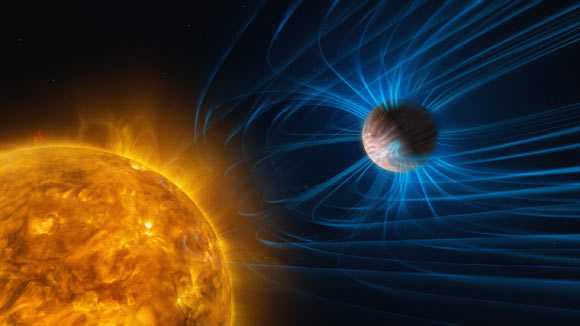
Using spectrographs, astronomers can measure the temperature and wind speed on exoplanets. A trend of decreasing wind speed with increasing temperature can betray the presence of magnetic fields on these planets. Credit: ESO/M. Kornmesser, L. Calçada
A Magnetic Explanation
To explain these anomalies, the researchers proposed that powerful global magnetic fields were serving as a brake on the charged particles that make up the winds. They were able to extrapolate each exoplanet’s magnetic field strength from the wind speed data.
Results of the work indicate these magnetic fields are relatively close to what has been found in our solar system, roughly half the strength of Jupiter’s and four times that of Saturn. An unusual added effect of these magnetic fields is that they likely produce much more dramatic auroras than those seen on Earth, moving the gases that produce such vivid lights.
“I like to imagine that some of these worlds have a sky filled not only with stars, but with vast curtains of colourful light dancing across a planet that’s half in perpetual day and half in endless night,” explained co-author Bibiana Prinoth, a former PhD student at Lund University, Sweden, now an astronomer at ESO in Garching, Germany.
The team has already identified the direction of their follow-up research.
“The next step is clear: Until what planetary temperature do magnetic fields dominate how atmospheres flow and at which temperature do these winds behave more similar than in the solar system?,” Seidel said.
“For that, we are planning an observational survey to look at less hot planets and see when the trend depending on the ionisation of the atmosphere (and therefore the magnetic field) breaks.”
Ryan Whalen covers science and technology for The Debrief. He holds an MA in History and a Master of Library and Information Science with a certificate in Data Science. He can be contacted at ryan@thedebrief.org, and follow him on Twitter @mdntwvlf.
Scientists have identified supermagnetic macrophages in the livers of homing pigeons (Columba livia domestica) that appear essential for navigation when the Sun is not visible, pointing to an entirely new mechanism for animal magnetoreception.

 Login
Login