
Normal view

The P5 Report & The Future of Particle Physics (Part 1)

3 January 2024 at 20:21

Particle physics is the epitome of ‘big science’. To answer our most fundamental questions out about physics requires world class experiments that push the limits of whats technologically possible. Such incredible sophisticated experiments, like those at the LHC, require big facilities to make them possible,  big collaborations to run them, big project planning to make dreams of new facilities a reality, and committees with big acronyms to decide what to build.

Enter the Particle Physics Project Prioritization Panel (aka P5) which is tasked with assessing the landscape of future projects and laying out a roadmap for the future of the field in the US. And because these large projects are inevitably an international endeavor, the report they released last week has a large impact on the global direction of the field. The report lays out a vision for the next decade of neutrino physics, cosmology, dark matter searches and future colliders. 

P5 follows the community-wide brainstorming effort known as the Snowmass Process in which researchers from all areas of particle physics laid out a vision for the future. The Snowmass process led to a particle physics ‘wish list’, consisting of all the projects and research particle physicists would be excited to work on. The P5 process is the hard part, when this incredibly exciting and diverse research program has to be made to fit within realistic budget scenarios. Advocates for different projects and research areas had to make a case of what science their project could achieve and a detailed estimate of the costs. The panel then takes in all this input and makes a set of recommendations of how the budget should be allocated, what should projects be realized and what hopes are dashed. Though the panel only produces a set of recommendations, they are used quite extensively by the Department of Energy which actually allocates funding. If your favorite project is not endorsed by the report, its very unlikely to be funded. 

An computer generate graphic showing two sprays of particles being injected from a single center point
The P5 report also created an awesome graphic that contains symbolism for the different aspects of the plan. The left  side depicts oscillating neutrinos and the shape of the Higgs potential. The right side depicts dark matter and the large scale structure of the universe. The central ball of light is supposed to represent discoveries of the unknown. Source

Particle physics is an incredibly diverse field, covering sub-atomic to cosmic scales, so recommendations are divided up into several different areas. In this post I’ll cover the panel’s recommendations for neutrino physics and the cosmic frontier. Future colliders, perhaps the spiciest topic, will be covered in a follow up post.

The Future of Neutrino Physics

For those in the neutrino physics community all eyes were on the panels recommendations regarding the Deep Underground Neutrino Experiment (DUNE). DUNE is the US’s flagship particle physics experiment for the coming decade and aims to be the definitive worldwide neutrino experiment in the years to come. A high powered beam of neutrinos will be produced at Fermilab and sent 800 miles through the earth’s crust towards several large detectors placed in a mine in South Dakota. Its a much bigger project than previous neutrino experiments, unifying essentially the entire US community into a single collaboration.

DUNE is setup to produce world leading measurements of neutrino oscillations, the property by which neutrinos produced in one ‘flavor state’, (eg an electron-neutrino) gradually changes its state with sinusoidal probability (eg into a muon neutrino) as it propagates through space. This oscillation is made possible by a simple quantum mechanical weirdness: neutrino’s flavor state, whether it couples to electrons muons or taus, is not the same as its mass state. Neutrinos of a definite mass are therefore a mixture of the different flavors and visa versa.

Detailed measurements of this oscillation are the best way we know to determine several key neutrino properties. DUNE aims to finally pin down two crucial neutrino properties: their ‘mass ordering’, which will solidify how the different neutrino flavors and measured mass differences all fit together, and their ‘CP-violation’ which specifies whether neutrinos and their anti-matter counterparts behave the same or not. DUNE’s main competitor is the Hyper-Kamiokande experiment in Japan, another next-generation neutrino experiment with similar goals.

A depiction of the DUNE experiment. A high intensity proton beam at Fermilab is used to create a concentrated beam of neutrinos which are then sent through 800 miles of the Earth’s crust towards detectors placed deep underground South Dakota. Source

Construction of the DUNE experiment has been ongoing for several years and unfortunately has not been going quite as well as hoped. It has faced significant schedule delays and cost overruns. DUNE is now not expected to start taking data until 2031, significantly behind Hyper-Kamiokande’s projected 2027 start. These delays may lead to Hyper-K making these definitive neutrino measurements years before DUNE, which would be a significant blow to the experiment’s impact. This left many DUNE collaborators worried about its broad support from the community.

It came as a relief then when P5 report re-affirmed the strong science case for DUNE, calling it the “ultimate long baseline” neutrino experiment. The report strongly endorsed the completion of the first phase of DUNE. However, it recommended a pared-down version of its upgrade, advocating for an earlier beam upgrade in lieu of additional detectors. This re-imagined upgrade will still achieve the core physics goals of the original proposal with a significant cost savings. With this report, and news that the beleaguered underground cavern construction in South Dakota is now 90% complete, was certainly welcome holiday news to the neutrino community. This is also sets up a decade-long race between DUNE and Hyper-K to be the first to measure these key neutrino properties.

Cosmic Implications

While we normally think of particle physics as focused on the behavior of sub-atomic particles, its really about the study of fundamental forces and laws, no matter the method. This means that telescopes to study the oldest light in the universe, the Cosmic Microwave Background (CMB), fall into the same budget category as giant accelerators studying sub-atomic particles. Though the experiments in these two areas look very different, the questions they seek to answer are cross-cutting. Understanding how particles interact at very high energies helps us understand the earliest moments of the universe, when such particles were all interacting in a hot dense plasma. Likewise, by studying the these early moments of the universe and its large-scale evolution can tell us about what kinds of particles and forces are influencing its dynamics. When asking fundamental questions about the universe, one needs both the sharpest microscopes and the grandest panoramas possible.

The most prominent example of this blending of the smallest and largest scales in particle physics is dark matter. Some of our best evidence for dark matter comes analyzing the cosmic microwave background to determine how the primordial plasma behaved. These studies showed that some type of ‘cold’, matter that doesn’t interact with light, aka dark matter, was necessary to form the first clumps that eventually seeded the formation of galaxies. Without it, the universe would be much more soup-y and structureless than what we see to today.
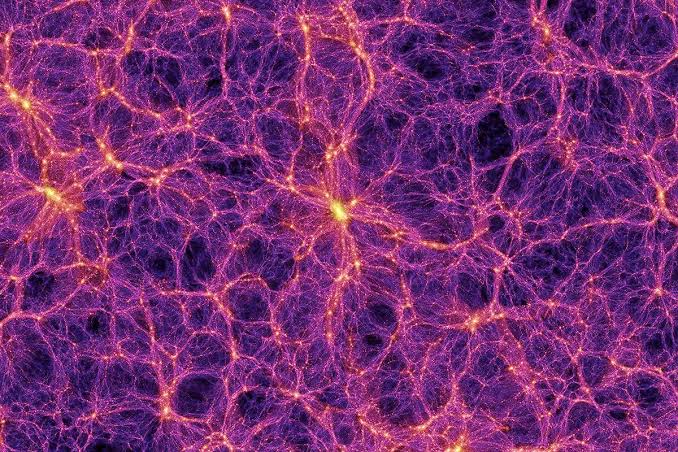
The “cosmic web” galaxy clusters from the Millenium simulation. Measuring and understanding this web can tell us a lot about the fundamental constituents of the universe. Source

To determine what dark matter is then requires an attack from two fronts: design experiments here on earth attempting directly detect it, and further study its cosmic implications to look for more clues as to its properties.

The panel recommended next generation telescopes to study the CMB as a top priority. The so called ‘Stage 4’ CMB experiment would deploy telescopes in both the south pole and Chile’s Atacama desert to better characterize sources of atmospheric noise. The CMB has been studied extensively before, but the increased precision of CMS-S4 could shed light on mysteries like dark energy, dark matter, inflation, and the recent Hubble Tension. Given the past fruitfulness of these efforts, I think few doubted the science case for such a next generation experiment.

A mockup of one of the CMS-S4 telescopes which will be based in the Chilean desert. Note the person for scale on the right (source)

The P5 report recommended a suite of new dark matter experiments in the next decade, including the ‘ultimate’ liquid Xenon based dark matter search. Such an experiment would follow in the footsteps of massive noble gas experiments like LZ and XENONnT which have been hunting for a favored type of dark matter called WIMP’s for the last few decades. These experiments essentially build giant vats of liquid Xenon, carefully shield from any sources of external radiation, and look for signs of dark matter particles bumping into any of the Xenon atoms. The larger the vat of Xenon, the higher chance a dark matter particle will bump into something. Current generation experiments have ~7 tons of Xenon, and the next generation experiment would be even larger. The next generation aims to reach the so called ‘neutrino floor’, the point as which the experiments would be sensitive enough to observe astrophysical neutrinos bumping into the Xenon. Such neutrino interactions would look extremely similar to those of dark matter, and thus represent an unavoidable background which would signal the ultimate sensitivity of this type of experiment. WIMP’s could still be hiding in a basement below this neutrino floor, but finding them would be exceedingly difficult.

A photo of the current XENONnT experiment. This pristine cavity is then filled with liquid Xenon and closely monitored for signs of dark matter particles bumping into one of the Xenon atoms. Credit: XENON Collaboration

WIMP’s are not the only dark matter candidates in town, and recent years have also seen an explosion of interest in the broad range of dark matter possibilities, with axions being a prominent example. Other kinds of dark matter could have very different properties than WIMPs and have had much fewer dedicated experiments to search for them. There is ‘low hanging fruit’ to pluck in the way of relatively cheap experiments which can achieve world-leading sensitivity. Previously, these ‘table top’ sized experiments had a notoriously difficult time obtaining funding, as they were often crowded out of the budgets by the massive flagship projects. However, small experiments can be crucial to ensuring our best chance of dark matter discovery, as they fill in the blinds pots missed by the big projects.

The panel therefore recommended creating a new pool of funding set aside for these smaller scale projects. Allowing these smaller scale projects to flourish is important for the vibrancy and scientific diversity of the field, as the centralization of ‘big science’ projects can sometimes lead to unhealthy side effects. This specific recommendation also mirrors a broader trend of the report: to attempt to rebalance the budget portfolio to be spread more evenly and less dominated by the large projects.

A pie chart comparing the budget porfolio in 2023 (left) versus the projected budget in 2033 (right). Currently most of the budget is being taken up by the accelerator upgrades and cavern construction of DUNE, with some amount for the LHC upgrades. But by 2033 the panel recommends a much more equitable balance between different research area.

What Didn’t Make It

Any report like this comes with some tough choices. Budget realities mean not all projects can be funded. Besides the pairing down of some of DUNE’s upgrades, one of the biggest areas that was recommended against were ‘accessory experiments at the LHC’. In particular, MATHUSULA and the Forward Physics Facility were two experiments that proposed to build additional detectors near already existing LHC collision points to look for particles that may be missed by the current experiments. By building new detectors hundreds of meters away from the collision point, shielded by concrete and the earth, they can obtained unique sensitivity to ‘long lived’ particles capable of traversing such distances. These experiments would follow in the footsteps of the current FASER experiment, which is already producing impressive results.

While FASER found success as a relatively ‘cheap’ experiment, reusing detector components from and situating itself in a beam tunnel, these new proposals were asking for quite a bit more. The scale of these detectors would have required new caverns to be built, significantly increasing the cost. Given the cost and specialized purpose of these detectors, the panel recommended against their construction. These collaborations may now try to find ways to pare down their proposal so they can apply to the new small project portfolio.

Another major decision by the panel was to recommend against hosting a new Higgs factor collider in the US. But that will discussed more in a future post.

Conclusions

The P5 panel was faced with a difficult task, the total cost of all projects they were presented with was three times the budget. But they were able to craft a plan that continues the work of the previous decade, addresses current shortcomings and lays out an inspiring vision for the future. So far the community seems to be strongly rallying behind it. At time of writing, over 2700 community members from undergraduates to senior researchers have signed a petition endorsing the panels recommendations. This strong show of support will be key for turning these recommendations into actual funding, and hopefully lobbying congress to even increase funding so that more of this vision can be realized.

For those interested the full report as well as executive summaries of different areas can be found on the P5 website. Members of the US particle physics community are also encouraged to sign the petition endorsing the recommendations here.

And stayed tuned for part 2 of our coverage which will discuss the implications of the report on future colliders!

Moriond 2023 Recap

17 April 2023 at 16:16

Every year since 1966,  particle physicists have gathered in the Alps to unveil and discuss their most important results of the year (and to ski). This year I had the privilege to attend the Moriond QCD session so I thought I would post a recap here. It was a packed agenda spanning 6 days of talks, and featured a lot of great results over many different areas of particle physics, so I’ll have to stick to the highlights here.

FASER Observes First Collider Neutrinos

Perhaps the most exciting result of Moriond came from the FASER experiment, a small detector recently installed in the LHC tunnel downstream from the ATLAS collision point. They announced the first ever observation of neutrinos produced in a collider. Neutrinos are produced all the time in LHC collisions, but because they very rarely interact, and current experiments were not designed to look for them, no one had ever actually observed them in a detector until now. Based on data collected during collisions from last year, FASER observed 153 candidate neutrino events, with a negligible amount of predicted backgrounds; an unmistakable observation.

Black image showing colorful tracks left by particles produced in a neutrino interaction
A neutrino candidate in the FASER emulsion detector. Source

This first observation opens the door for studying the copious high energy neutrinos produced in colliders, which sit in an energy range currently unprobed by other neutrino experiments. The FASER experiment is still very new, so expect more exciting results from them as they continue to analyze their data. A first search for dark photons was also released which should continue to improve with more luminosity. On the neutrino side, they have yet to release full results based on data from their emulsion detector which will allow them to study electron and tau neutrinos in addition to the muon neutrinos this first result is based on.

New ATLAS and CMS Results

The biggest result from the general purpose LHC experiments was ATLAS and CMS both announcing that they have observed the simultaneous production of 4 top quarks. This is one of the rarest Standard Model processes ever observed, occurring a thousand times less frequently than a Higgs being produced. Now that it has been observed the two experiments will use Run-3 data to study the process in more detail in order to look for signs of new physics.

Event displays from ATLAS and CMS showing the signature of 4 top events in their respective detectors
Candidate 4 top events from ATLAS (left) and CMS (right).

ATLAS also unveiled an updated measurement of the mass of the W boson. Since CDF announced its measurement last year, and found a value in tension with the Standard Model at ~7-sigma, further W mass measurements have become very important. This ATLAS result was actually a reanalysis of their previous measurement, with improved PDF’s and statistical methods. Though still not as precise as the CDF measurement, these improvements shrunk their errors slightly (from 19 to 16 MeV).  The ATLAS measurement reports a value of the W mass in very good agreement with the Standard Model, and approximately 4-sigma in tension with the CDF value. These measurements are very complex, and work is going to be needed to clarify the situation.

CMS had an intriguing excess (2.8-sigma global) in a search for a Higgs-like particle decaying into an electron and muon. This kind of ‘flavor violating’ decay would be a clear indication of physics beyond the Standard Model. Unfortunately it does not seem like ATLAS has any similar excess in their data.

Status of Flavor Anomalies

At the end of 2022, LHCb announced that the golden channel of the flavor anomalies, the R(K) anomaly, had gone away upon further analysis. Many of the flavor physics talks at Moriond seemed to be dealing with this aftermath.

Of the remaining flavor anomalies, R(D), a ratio describing the decay rates of B mesons in final states with D mesons and taus versus D mesons plus muons or electrons, has still been attracting interest. LHCb unveiled a new measurement that focused on hadronically taus and found a value that agreed with the Standard Model prediction. However this new measurement had larger error bars than others so it only brought down the world average slightly. The deviation currently sits at around 3-sigma.

A summary plot showing all the measurements of R(D) and R(D*). The newest LHCb measurement is shown in the red band / error bar on the left. The world average still shows a 3-sigma deviation to the SM prediction

An interesting theory talk pointed out that essentially any new physics which would produce a deviation in R(D) should also produce a deviation in another lepton flavor ratio, R(Λc), because it features the same b->clv transition. However LHCb’s recent measurement of R(Λc) actually found a small deviation in the opposite direction as R(D). The two results are only incompatible at the ~1.5-sigma level for now, but it’s something to continue to keep an eye on if you are following the flavor anomaly saga.

It was nice to see that the newish Belle II experiment is now producing some very nice physics results. The highlight of which was a world-best measurement of the mass of the tau lepton. Look out for more nice Belle II results as they ramp up their luminosity, and hopefully they can weigh in on the R(D) anomaly soon.

A fit to the invariant mass the visible decay products of the tau lepton, used to determine its intrinsic mass. An impressive show of precision from Belle II

Theory Pushes for Precision

The focus of much of the theory talks was about trying to advance our precision in predictions of standard model physics. This ‘bread and butter’ physics is sometimes overlooked in scientific press, but is an absolutely crucial part of the particle physics ecosystem. As experiments reach better and better precision, improved theory calculations are required to accurately model backgrounds, predict signals, and have precise standard model predictions to compare to so that deviations can be spotted. Nice results in this area included evidence for an intrinsic amount of charm quarks inside the proton from the NNPDF collaboration, very precise extraction of CKM matrix elements by using lattice QCD, and two different proposals for dealing with tricky aspects regarding the ‘flavor’ of QCD jets.

Final Thoughts

Those were all the results that stuck out to me. But this is of course a very biased sampling! I am not qualified enough to point out the highlights of the heavy ion sessions or much of the theory presentations. For a more comprehensive overview, I recommend checking out the slides for the excellent experimental and theoretical summary talks. Additionally there was the Moriond Electroweak conference that happened the week before the QCD one, which covers many of the same topics but includes neutrino physics results and dark matter direct detection. Overall it was a very enjoyable conference and really showcased the vibrancy of the field!

How Multiangle Simulations Reveal Neutrinos’ Role in Driving or Stalling Supernova Explosions

3 June 2026 at 13:57

In the vast cosmic arena where massive stars end their lives in spectacular explosions known as core-collapse supernovae (CCSNe), a new frontier in astrophysics is being unveiled through the study of elusive particles called neutrinos. These near-massless subatomic particles, produced in staggering quantities during a supernova event, play a crucial role in the dynamic processes that govern these cataclysmic explosions. Recent groundbreaking research led by Assistant Professor Ryuichiro Akaho from Waseda University, Japan, has shed light on the complex influence of a phenomenon known as neutrino fast flavor conversion (FFC) on the mechanisms driving CCSNe explosions, offering fresh insights that challenge prior theoretical models.

The lifecycle of massive stars concludes with an extraordinary release of energy and matter during a core-collapse supernova, marking one of the most luminous events observed in the cosmos. Neutrinos, generated in the intense core environment, transport energy and influence shock dynamics critical for the explosion’s success. However, understanding how neutrinos change their quantum states—or flavors—through collective oscillations during such events has remained an open question. Fast flavor conversion, a rapid and collective oscillation process driven by neutrino-neutrino interactions, poses significant theoretical and computational challenges. Previous studies predominantly employed simplified “truncated moment” approximations to estimate FFC effects, yet such methods fall short in accurately representing the nuanced angular distributions of neutrinos vital for pinpointing where and how FFC unfolds.

Departing from these limitations, Akaho and his collaborators implemented a sophisticated multiangle approach to neutrino transport, enabling a direct and comprehensive simulation of neutrino momentum-space angular distributions across the turbulent supernova environment. This approach captures the subtle directional dependencies essential for evaluating FFC occurrences with unprecedented fidelity. By integrating a quantum kinetic theory-based FFC framework with multidimensional Boltzmann neutrino radiation hydrodynamics simulations, the research team delivered a meticulous description of neutrino flavor evolution and its feedback on supernova dynamics, marking a pioneering step in computational astrophysics.

Their model utilizes the Bhatnagar-Gross-Krook (BGK) relaxation scheme to incorporate quantum kinetic effects and trace the complex neutrino flavor states. This physics-based subgrid approach permits seamless coupling between flavor conversion processes and neutrino radiation transport within the supernova core, a feat not previously achieved in comprehensive CCSN simulations. The research also builds on a foundation laid by earlier works, expanding the computational toolkit to realistically capture how fast flavor conversion influences neutrino heating and shock revival.

The simulation study spanned an array of progenitor star models with zero-age main sequence masses of 9, 12, 16, and 20 solar masses, alongside three nuclear equations of state (EOS), encapsulating diverse microphysical conditions: the variational method-based Furusawa-Togashi EOS, Dirac-Brückner-Hartree-Fock technique, and chiral effective field theory. This broad parameter space allowed for a thorough examination of how stellar structure and nuclear matter properties intertwine with neutrino physics to shape supernova outcomes.

One of the most compelling revelations from the simulations is the bifurcated—or dual—impact of fast flavor conversion on CCSN explosions, distinctly influenced by progenitor mass and accretion dynamics. For lower-mass progenitors (such as the 9 solar mass cases), FFC acts as a catalyst, promoting shock revival and enhancing the explosion energy by boosting neutrino-driven heating within the stalled shock region. In contrast, for higher-mass progenitors characterized by elevated mass accretion rates, FFC surprisingly exerts a suppressive effect. The reduction in neutrino luminosity due to flavor conversion outweighs any benefits from spectral hardening of electron-type neutrinos, culminating in diminished neutrino heating and significantly hampering the likelihood of successful explosions.

This nuanced dependency underscores mass accretion rate as a principal controlling factor in determining the net influence of FFC. High accretion funnels exerting intense pressure on the shock interface foster conditions where neutrino heating contributions from FFC turn negative, stalling the explosion. Conversely, under low accretion scenarios, FFC enhances energy deposition behind the shock through spectral changes and flavor transformations that favor electron neutrino interactions, facilitating revitalization of the shock wave.

Crucially, these findings expose the inherent limitations of approximative neutrino transport methods that fail to resolve angular distributions, which can either overlook the presence of fast flavor conversions or falsely signal their emergence. Through their multiangle neutrino transport approach, the authors highlight the necessity of detailed angular resolution to faithfully capture the complex interplay between neutrino flavor physics and hydrodynamic instabilities driving CCSNe.

This research not only deepens the theoretical understanding of the multifaceted role neutrinos play in the deaths of massive stars but also paves the way for refining supernova models that bridge microscopic quantum processes with macroscopic explosion phenomena. The ability to accurately predict FFC effects is critical for interpreting neutrino signals from potential future galactic supernovae, offering a direct window into the physics within collapsing stellar cores.

The study emerges at a pivotal time when giant neutrino observatories worldwide are poised to detect supernova neutrinos with unprecedented precision, potentially validating theoretical models experimentally. By aligning state-of-the-art computational astrophysics with the physics of neutrino fast flavor conversion, Akaho’s work builds a framework essential for extracting rich astrophysical information from forthcoming neutrino data, advancing the quest to unravel the enigmatic mechanisms underlying core-collapse supernovae.

Beyond its astrophysical implications, this research signifies an intersection of quantum kinetics, nuclear physics, and fluid dynamics on cosmic scales, exemplifying the interdisciplinary complexity required to tackle outstanding questions in modern physics. The utilization of multidimensional Boltzmann neutrino radiation hydrodynamics combined with quantum kinetic flavor transformation models represents a major milestone in computational modeling, empowering scientists to explore emergent phenomena that previous approximations could not resolve.

As the community moves forward, these insights will stimulate further investigation into the feedback mechanisms between neutrino physics and the turbulent, dynamic environment of collapsing stars. Comprehensive understanding of fast flavor conversion effects promises to enhance predictive models, inform detector design, and ultimately transform our comprehension of the universe’s most dramatic stellar explosions.


Subject of Research: Not applicable

Article Title: Bifurcated Impact of Neutrino Fast Flavor Conversion on Core-Collapse Supernovae Informed by Multiangle Neutrino Radiation Hydrodynamics

News Publication Date: 15-May-2026

Web References: DOI link

References: DOI 10.1103/fksy-1jtw (Physical Review Letters, Volume 136, Issue 19)

Image Credits: Assistant Professor Ryuichiro Akaho from Waseda University, Japan


Keywords

Applied sciences and engineering, Hydrodynamics, Subatomic particles, Physics, Physical sciences, Neutrinos

❌