Normal view

The light from the Andromeda Galaxy — the most distant object visible to the naked human eye — left its source about 2.5 million years ago, which means when you look at it on a clear night, you are seeing light that began its journey to Earth around the time the first members of our genus, Homo, were learning to use stone tools

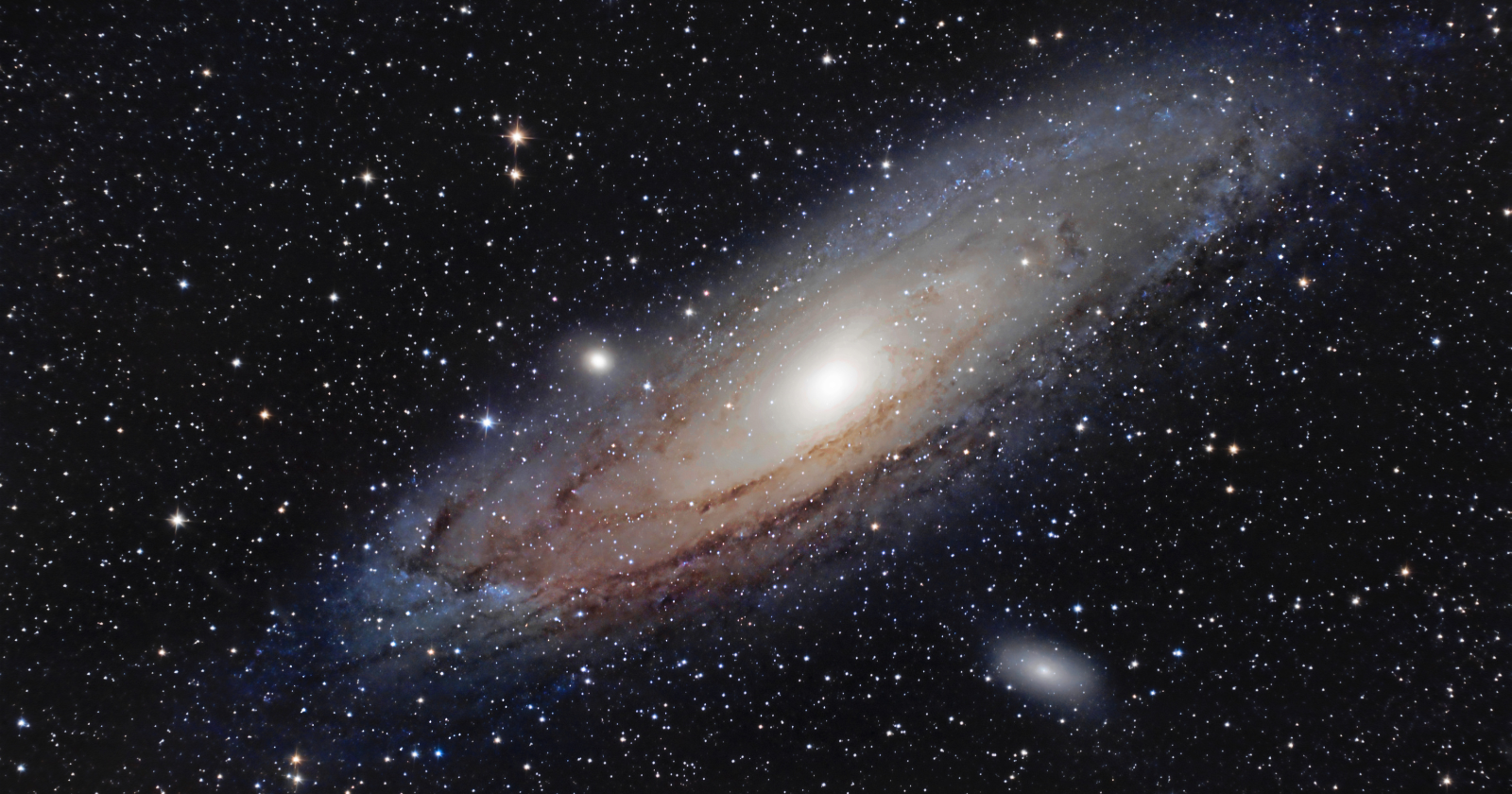
On a clear, moonless autumn night, away from city lights, the patch of sky between the constellations Andromeda and Cassiopeia contains a faint, fuzzy smudge that looks like a slightly out-of-focus star. The smudge is not a star. It is the Andromeda Galaxy, designated M31, the nearest large galaxy to our own and the most distant object that an unaided human eye can see. The light reaching your retina from Andromeda has been travelling for approximately 2.5 million years. It started its journey across intergalactic space at a moment when, on Earth, the first members of the genus Homo had recently appeared in East Africa and were beginning to chip the earliest stone tools out of pebbles. The light is older than our genus’s mastery of the rock.

According to NASA’s Hubble Messier Catalogue reference on M31, Andromeda lies at a distance of 2.5 million light-years, contains an estimated trillion stars, and spans roughly 260,000 light-years across — about twice the diameter of the Milky Way’s main disk, depending on how each galaxy’s outer halo is measured. It is the largest member of our Local Group of galaxies, a small cluster of about 80 galaxies bound together by gravity that includes the Milky Way, the Triangulum Galaxy, the Magellanic Clouds and a few dozen smaller satellite galaxies. Andromeda and the Milky Way are the two heavyweights of the group, separated by 2.5 million light-years of nearly empty space and approaching each other at roughly 110 kilometres per second. In about 4.5 billion years, the two galaxies are predicted to merge.

What “2.5 million light-years” means

A light-year is the distance light travels in one year, moving at 299,792 kilometres per second through a vacuum. It works out to roughly 9.46 trillion kilometres. The “year” in “light-year” therefore refers to the time the light takes, not to the date when the light was emitted. A galaxy “2.5 million light-years away” is 2.5 million light-years’ worth of empty space distant, meaning that the light from it requires 2.5 million years to cover the gap.

The implication is the one that makes astronomical observation a form of time travel in reverse. Any observation of a distant object is necessarily an observation of that object’s past, by the amount of time the light has taken to reach the observer. When you look at the Sun, you are seeing it as it was about eight minutes ago. When you look at Proxima Centauri, the nearest star outside the Solar System, you are seeing it as it was about four years ago. When you look at the brightest stars of the constellation Orion, you are seeing them as they were a few hundred to a few thousand years ago, depending on the specific star. When you look at Andromeda, you are seeing it as it was 2.5 million years ago. The galaxy has continued to evolve in the meantime. Whatever has happened in M31 since the light left, no observer on Earth can see yet.

The poetic version of this fact is sometimes used by NASA’s own science-communication team. NASA’s “Catch Andromeda Rising” guide for night-sky observers phrases the framing succinctly: M31 is “so far away that the light you see left M31’s stars when our earliest ancestors figured out stone tools.”

What was happening on Earth then

The corresponding moment in Earth’s history is well documented in the palaeoanthropological record. According to the Smithsonian Institution’s Human Origins Program, the genus Homo — the group containing our species and our closest extinct relatives — appears in the African fossil record from about 2.8 million years ago. The earliest known specimen, called LD 350-1, was discovered at the Ledi-Geraru site in Ethiopia’s Afar region in 2013 and dated to roughly 2.75-2.8 million years ago. According to the Becoming Human project at Arizona State University’s Institute of Human Origins, the LD 350-1 mandible is “one of the best fossil representatives from this poorly understood period of human evolution,” giving researchers their clearest single window into the emergence of our genus. By the time the light from Andromeda that is now reaching Earth was just beginning its journey, the genus Homo had been in existence for perhaps 200,000 to 300,000 years.

The same period saw the appearance of the first deliberately produced stone tools in the archaeological record. The earliest stone tools, the Oldowan industry, date to about 2.6 million years ago, with cut-marked animal bones from the same period showing that early humans were using sharp stone flakes to butcher carcasses. Homo habilis, the species whose Latin name literally translates as “handy man,” lived from about 2.4 million to 1.65 million years ago, and was given the name specifically for its association with these early stone tools.

The light that reaches your eye from Andromeda tonight began travelling toward you during the early phase of this period. While the first photons were crossing the gap between M31 and the Milky Way, a small number of early hominins in East Africa were taking the first reliably documented steps toward the technology that would, two and a half million years later, build the telescopes capable of imaging the galaxy the light came from.

Why Andromeda is the visible limit

The reason Andromeda is the most distant naked-eye object, despite being roughly the size of six full Moons in angular extent across the sky, is that it is also extremely faint. Most of the galaxy’s surface brightness is spread thinly across a large area, with only the bright core visible to the unaided eye. Under truly dark skies, observers report being able to see fainter portions of the disk extending well beyond the bright nucleus, but in practice most casual observers see only a small, slightly elongated smudge a few times brighter than the surrounding sky background.

Other galaxies are technically visible to keen observers under exceptional conditions. The Triangulum Galaxy, M33, lies at about 2.7 million light-years and is sometimes claimed as a naked-eye object by experienced amateurs at very dark sites. M81, in Ursa Major, is much further at 12 million light-years and has been reported by a small number of naked-eye observers under perfect conditions. These observations are at the absolute limit of human visual capability and require dark adaptation, perfect transparency, and skilled averted vision. For practical purposes, Andromeda is the conventional and widely-accepted “most distant naked-eye object.” Anyone who can see it without a telescope is, in the strict sense, seeing further than any other unaided human observation.

The galaxy looks unremarkable from Earth because of the distance. Up close, M31 contains roughly a trillion stars, dozens of satellite galaxies, supermassive black holes, supernovae, and the same vast structural complexity that the Milky Way contains. Hubble’s most recent high-resolution survey, released in 2025, assembled the largest photomosaic ever made by the space telescope: 2.5 billion pixels stitched together from 600 overlapping snapshots taken over a decade of observations, capturing the glow of about 200 million individual stars — roughly one fiftieth of one percent of M31’s total stellar population. From 2.5 million light-years away, the entire galaxy appears as a faint patch of haze, smaller in subjective impression than a moonbeam. The light has been on its way since before any human ancestor knew what a tool was.

The post The light from the Andromeda Galaxy — the most distant object visible to the naked human eye — left its source about 2.5 million years ago, which means when you look at it on a clear night, you are seeing light that began its journey to Earth around the time the first members of our genus, Homo, were learning to use stone tools appeared first on Space Daily.
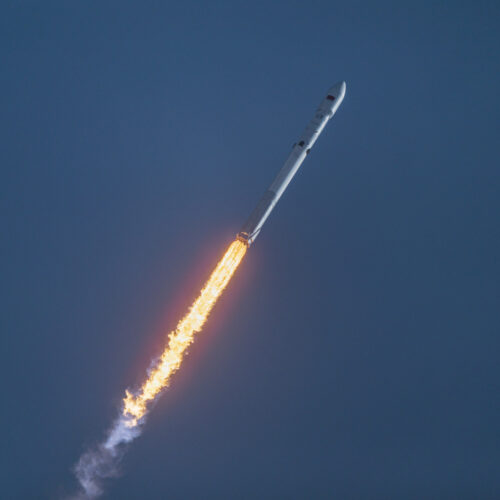

In a surprise launch, China debuts another big rocket designed for reusability

2 June 2026 at 17:05

The race to field China's first reusable launch vehicle is far less predictable than a similar competition that played out in the United States a decade ago.

There was never any real question of which company would develop and demonstrate the first reusable orbital-class rocket in the United States. SpaceX landed a Falcon 9 booster for the first time in 2015, and a little more than a year later, it launched it back into space. It took nearly 10 years for anyone else to do the same. Blue Origin celebrated its first orbital-class booster landing last November with the successful recovery of one of its New Glenn boosters, followed by a relaunch of the same rocket in April.

In China, several companies and state-owned enterprises have a realistic shot at landing an orbital-class booster stage this year. For a time, it seemed like China's new crop of privately funded launch companies might have the advantage in accomplishing the first landing of an orbital-class booster. But Monday's launch of China's Long March 12B rocket, backed by the nearly unrestricted resources of the country's vast state-owned aerospace enterprise, suggests the industry's legacy players may now have a leg up.

Read full article

Comments

© VCG/VCG via Getty Images

Non-Expanding Universe | Redshifts Explained by Stimulated Transfer Tired-Light Theory Agreeing with an Observed Hubble–Lemaître Law Up to Redshift z ≈ 16

19 August 2025 at 22:36
Stimulated Transfer redshift, a newly discovered phenomenon predicted by quantum electrodynamics, results in electron heating and a redshift of light from distant galaxies. The mechanism not only explains the extreme heating of the solar corona, but also provides an alternative explanation for astronomical redshifts without invoking an expanding universe.

Time and the Measurement of Time

15 July 2025 at 11:01
The exploration of time measurement emphasizes the Earth's rotation as a historical clock, defining the 24-hour day. The development of mechanical clocks, notably John Harrison's marine chronometers, advanced navigation. Time's definition evolved from an Earth-centric model to atomic standards, although fundamental concepts of time remain abstract and intrinsic to the universe's creation.

Have Aliens Terraformed Other Planets? New Insights

12 February 2025 at 23:13
Extraterrestrial life has been searched for without success, and now a new method is suggested. I participated in an interview on the David Rives Genesis Science Report about this new search method, which examines similarities among clustered planets, suggesting terraforming has occurred.

Is the Big Bang Pure Fiction?

1 February 2025 at 05:34
How much of cosmology is fiction? What are the fudge factors. How much is being fudged. Are there insurmountable problems with our current model of big bang cosmology?

Lessons from the Tower of Babel: AI’s New Age

24 January 2025 at 00:45
The biblical Tower of Babel, with its message of human pride and language confusion, is being built again but this time in the digital realm within a technocratic society. The global oligarchs are using AI to integrate all humans into the Internet of Bodies but do not comply.

Is Earth Unique? The Case Against Extra-Terrestrial Life

9 January 2025 at 22:05
The Search for Extra-Terrestrial Intelligence (SETI) program has yielded no evidence of intelligent life beyond Earth, raising questions about life’s uniqueness to our planet. Critics claim SETI lacks empirical support and resembles ufology. The author argues that life is a divine creation, asserting evolution cannot account for life's origin or complexity.

Have Aliens Already Terraformed Other Planets?

6 January 2025 at 22:13
A research paper proposes that advanced alien civilizations might be terraforming planets and spreading life through panspermia. It suggests that similarities among clustered planets could indicate extraterrestrial life, while acknowledging the challenges in detecting such life. This approach sidesteps the fundamental questions of life's origins.

Paper Claims the “Asteroid” Japan’s Probe Is Approaching Is Actually a Derelict Spacecraft

2 June 2026 at 17:51

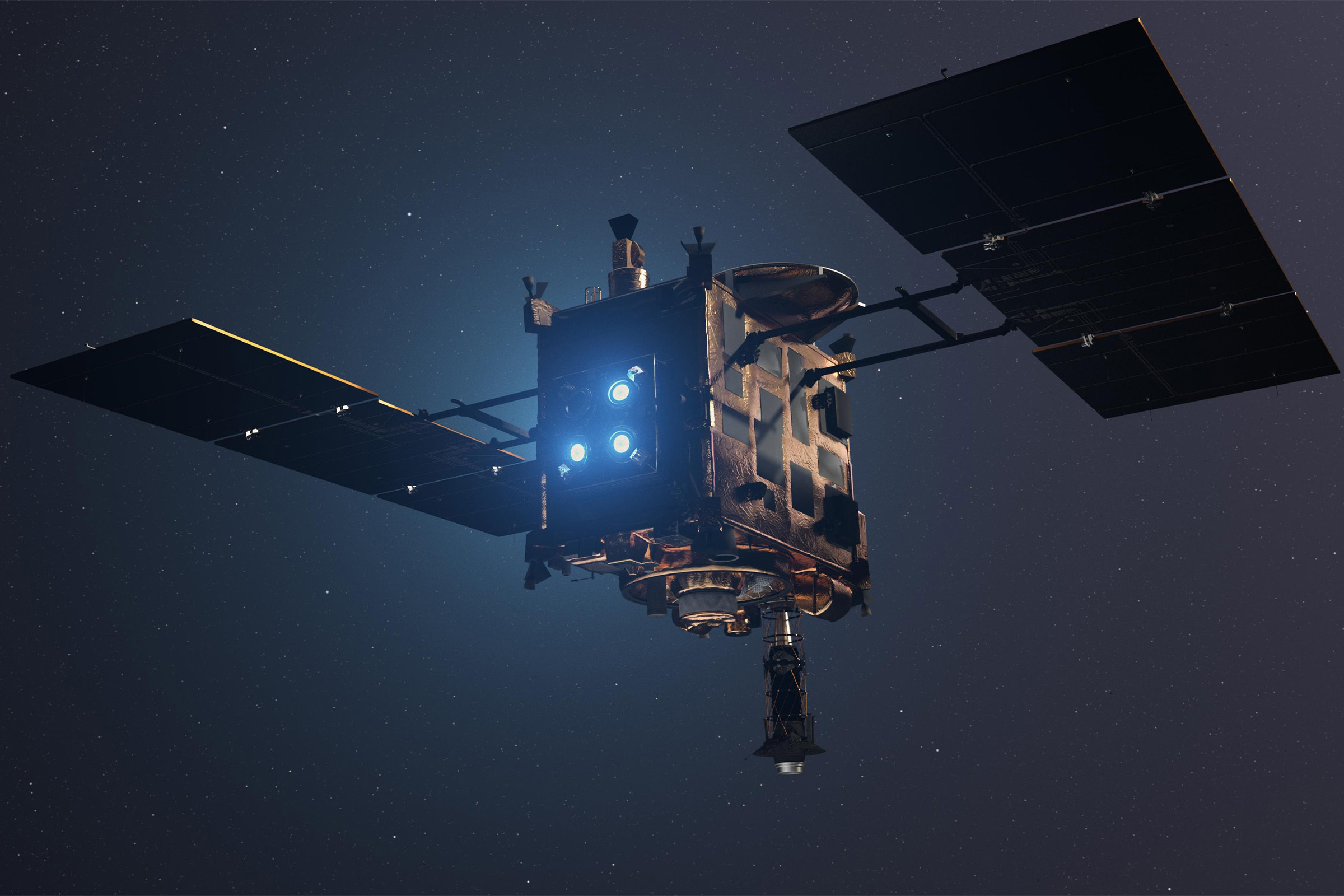
After successfully rendezvousing with near-Earth asteroid Ryugu in June 2018 and sending a sampled cache of rocks back to Earth, Japan’s Hayabusa2 spacecraft is now making its long journey to its next destination, a tiny and rapidly spinning asteroid dubbed 1998 KY26.

The spacecraft is expected to reach the mysterious space rock by July 2031, giving scientists plenty of time to come up with theories as to what it could find once it gets there.

1998 KY26 is an intriguing new candidate for an entirely new class of objects. In 2017, interstellar visitor ‘Oumuamua — the first object from beyond the solar system to have ever been observed — inspired scientists to categorize it as a “dark comet,” a class of asteroids that share some behaviors with comets. (A brief refresher: asteroids are lumps of rock, ice or dust that orbit the Sun but are too small to be classified as planets, while comets are “dirty snowballs” that release gases to form a tail behind them as they pass by the Sun.)

Scientists suggest 1998 KY26 could also be a dark comet, making Hayabusa2’s visit five years from now an intriguing opportunity to get a closer look.

But according to Harvard astronomer Avi Loeb, who has spent years pondering the nature of ‘Oumuamua and its unusual behavior, 1998 KY26 could be something else entirely. As detailed in a yet-to-be-peer-reviewed paper, Loeb and his colleagues suggest the object could instead be a long-lost relic of the Soviet space program.

“In particular, we identify it as potentially a relic of a historical Russian mission to Mars, the Phobos 1 probe, which suffered a failure 2 months after the launch in July 1988, due to upload of a faulty command,” Loeb explained in a blog post this week.

Phobos 1 failed to send back a signal in August 1988 due to what later turned out to be a typo — a missing hyphen — in a command that shut down crucial systems.

In their latest paper, Loeb and his colleagues suggest that the probe’s thruster firings may have put it in a “similar” orbit to 1998 KY26’s, and that the “two orbits converge and are statistically compatible.” The researchers also argue that the defunct spacecraft and dark comet share roughly the same size and a “quite elongated” shape.

Still, the hypothesis is quite a stretch, given the vastness of space. However, in his blog post, Loeb argued that scientists should nonetheless extend their “training data set to include not just rocks and icebergs but also the space objects launched by humans over the past 69 years” just in case.

If 1998 KY26 does turn out to be technological in nature, Loeb argued that the finding could support his controversial theory that ‘Oumuamua may have also been a piece of technology sent to us by an advanced extraterrestrial civilization.

“I wonder whether the mainstream of comet experts will acknowledge that 1I/’Oumuamua may have not been a natural ‘dark comet’ if it becomes clear that their so-called ‘dark comet’ 1998 KY26 is technological in origin, beyond any reasonable doubt,” he pondered.

Nobody knows for sure what Hayabusa2 will find. Besides, thanks to the asteroid’s extremely fast spin, it could prove extremely difficult to land on.

But Loeb and his colleagues argue we should keep an open mind, just in case it turned out to be a long-lost Soviet era spacecraft.

“In anticipation of the Hayabusa2 observations in 2031, which will be decisive in resolving the origin of this object, we encourage further observational, dynamical, and theoretical studies aimed at more tightly constraining the nature and properties of 1998 KY26,” they concluded in their paper.

More on Hayabusa2: Scientist Left “Speechless” After Opening Asteroid Samples

The post Paper Claims the “Asteroid” Japan’s Probe Is Approaching Is Actually a Derelict Spacecraft appeared first on Futurism.

In a surprise launch, China debuts another big rocket designed for reusability

2 June 2026 at 17:05

The race to field China's first reusable launch vehicle is far less predictable than a similar competition that played out in the United States a decade ago.

There was never any real question of which company would develop and demonstrate the first reusable orbital-class rocket in the United States. SpaceX landed a Falcon 9 booster for the first time in 2015, and a little more than a year later, it launched it back into space. It took nearly 10 years for anyone else to do the same. Blue Origin celebrated its first orbital-class booster landing last November with the successful recovery of one of its New Glenn boosters, followed by a relaunch of the same rocket in April.

In China, several companies and state-owned enterprises have a realistic shot at landing an orbital-class booster stage this year. For a time, it seemed like China's new crop of privately funded launch companies might have the advantage in accomplishing the first landing of an orbital-class booster. But Monday's launch of China's Long March 12B rocket, backed by the nearly unrestricted resources of the country's vast state-owned aerospace enterprise, suggests the industry's legacy players may now have a leg up.

Read full article

Comments

© VCG/VCG via Getty Images

In a surprise launch, China debuts another big rocket designed for reusability

2 June 2026 at 17:05

The race to field China's first reusable launch vehicle is far less predictable than a similar competition that played out in the United States a decade ago.

There was never any real question of which company would develop and demonstrate the first reusable orbital-class rocket in the United States. SpaceX landed a Falcon 9 booster for the first time in 2015, and a little more than a year later, it launched it back into space. It took nearly 10 years for anyone else to do the same. Blue Origin celebrated its first orbital-class booster landing last November with the successful recovery of one of its New Glenn boosters, followed by a relaunch of the same rocket in April.

In China, several companies and state-owned enterprises have a realistic shot at landing an orbital-class booster stage this year. For a time, it seemed like China's new crop of privately funded launch companies might have the advantage in accomplishing the first landing of an orbital-class booster. But Monday's launch of China's Long March 12B rocket, backed by the nearly unrestricted resources of the country's vast state-owned aerospace enterprise, suggests the industry's legacy players may now have a leg up.

Read full article

Comments

© VCG/VCG via Getty Images

In a surprise launch, China debuts another big rocket designed for reusability

2 June 2026 at 17:05

The race to field China's first reusable launch vehicle is far less predictable than a similar competition that played out in the United States a decade ago.

There was never any real question of which company would develop and demonstrate the first reusable orbital-class rocket in the United States. SpaceX landed a Falcon 9 booster for the first time in 2015, and a little more than a year later, it launched it back into space. It took nearly 10 years for anyone else to do the same. Blue Origin celebrated its first orbital-class booster landing last November with the successful recovery of one of its New Glenn boosters, followed by a relaunch of the same rocket in April.

In China, several companies and state-owned enterprises have a realistic shot at landing an orbital-class booster stage this year. For a time, it seemed like China's new crop of privately funded launch companies might have the advantage in accomplishing the first landing of an orbital-class booster. But Monday's launch of China's Long March 12B rocket, backed by the nearly unrestricted resources of the country's vast state-owned aerospace enterprise, suggests the industry's legacy players may now have a leg up.

Read full article

Comments

© VCG/VCG via Getty Images

In a surprise launch, China debuts another big rocket designed for reusability

2 June 2026 at 17:05

The race to field China's first reusable launch vehicle is far less predictable than a similar competition that played out in the United States a decade ago.

There was never any real question of which company would develop and demonstrate the first reusable orbital-class rocket in the United States. SpaceX landed a Falcon 9 booster for the first time in 2015, and a little more than a year later, it launched it back into space. It took nearly 10 years for anyone else to do the same. Blue Origin celebrated its first orbital-class booster landing last November with the successful recovery of one of its New Glenn boosters, followed by a relaunch of the same rocket in April.

In China, several companies and state-owned enterprises have a realistic shot at landing an orbital-class booster stage this year. For a time, it seemed like China's new crop of privately funded launch companies might have the advantage in accomplishing the first landing of an orbital-class booster. But Monday's launch of China's Long March 12B rocket, backed by the nearly unrestricted resources of the country's vast state-owned aerospace enterprise, suggests the industry's legacy players may now have a leg up.

Read full article

Comments

© VCG/VCG via Getty Images

Blue Origin has set a very aggressive return-to-flight timeline

2 June 2026 at 16:16

The chief executive of Blue Origin, whose large New Glenn rocket exploded spectacularly less than a week ago at the company's launch site in Florida, vowed Monday night that the company would launch again before the end of 2026.

Writing on the social media site X, Blue Origin's Dave Limp said the company had been able to complete a preliminary survey of the LC-36A launch site.

"Now that we’ve had access to the pad and integration facility, we can share a bit of good news," Limp said. "The propellant farm, oxygen, liquid hydrogen and LNG tanks are all in good shape. This is good luck because these are very long lead items. The water tower is also good."

Read full article

Comments

© Blue Origin

Blue Origin has set a very aggressive return-to-flight timeline

2 June 2026 at 16:16

The chief executive of Blue Origin, whose large New Glenn rocket exploded spectacularly less than a week ago at the company's launch site in Florida, vowed Monday night that the company would launch again before the end of 2026.

Writing on the social media site X, Blue Origin's Dave Limp said the company had been able to complete a preliminary survey of the LC-36A launch site.

"Now that we’ve had access to the pad and integration facility, we can share a bit of good news," Limp said. "The propellant farm, oxygen, liquid hydrogen and LNG tanks are all in good shape. This is good luck because these are very long lead items. The water tower is also good."

Read full article

Comments

© Blue Origin

Blue Origin has set a very aggressive return-to-flight timeline

2 June 2026 at 16:16

The chief executive of Blue Origin, whose large New Glenn rocket exploded spectacularly less than a week ago at the company's launch site in Florida, vowed Monday night that the company would launch again before the end of 2026.

Writing on the social media site X, Blue Origin's Dave Limp said the company had been able to complete a preliminary survey of the LC-36A launch site.

"Now that we’ve had access to the pad and integration facility, we can share a bit of good news," Limp said. "The propellant farm, oxygen, liquid hydrogen and LNG tanks are all in good shape. This is good luck because these are very long lead items. The water tower is also good."

Read full article

Comments

© Blue Origin

Global SSA Market to Reach $61B as Governments Prioritize Space Security, Resilience, and Orbital Safety

2 June 2026 at 16:11
Novaspace logo

Paris, France – May 2026 – The 2nd edition of Novaspace’s Space Situational Awareness (SSA) report points to a pivotal decade ahead, with cumulative global spending projected to reach $61 […]

The post Global SSA Market to Reach $61B as Governments Prioritize Space Security, Resilience, and Orbital Safety appeared first on SpaceNews.

❌