Scientists looking for dark matter have looked almost everywhere they could imagine: deep underground detectors, powerful particle colliders, precision telescopes, and maps of the universe itself. Yet, despite making up most of the matter in the cosmic realm, dark matter remained frustratingly invisible.
Now, researchers think they may have found a profoundly different way to look for it: by listening to black holes collide.
A new study published in Physical Review Letters suggests that gravitational waves—the tiny ripples in spacetime generated when black holes merge—may carry subtle fingerprints of dark matter if those black holes happen to collide within dense concentrations of the mysterious substance.
More intriguingly, when researchers applied their method to real gravitational-wave observations, one previously recorded event appeared to show a tentative preference for exactly that kind of hidden environment.
The results do not amount to a discovery of dark matter. Researchers repeatedly stress that alternative explanations are possible and that additional observations will be required. Still, the work opens a new observational front in one of modern physics’ longest-running mysteries.
“We know that dark matter is around us. It just has to be dense enough for us to see its effects,” co-author and MIT postdoc research fellow, Dr. Josu Aurrekoetxea, said in a press release. “Black holes provide a mechanism to enhance this density, which we can now search for by analyzing the gravitational waves emitted when they merge.”
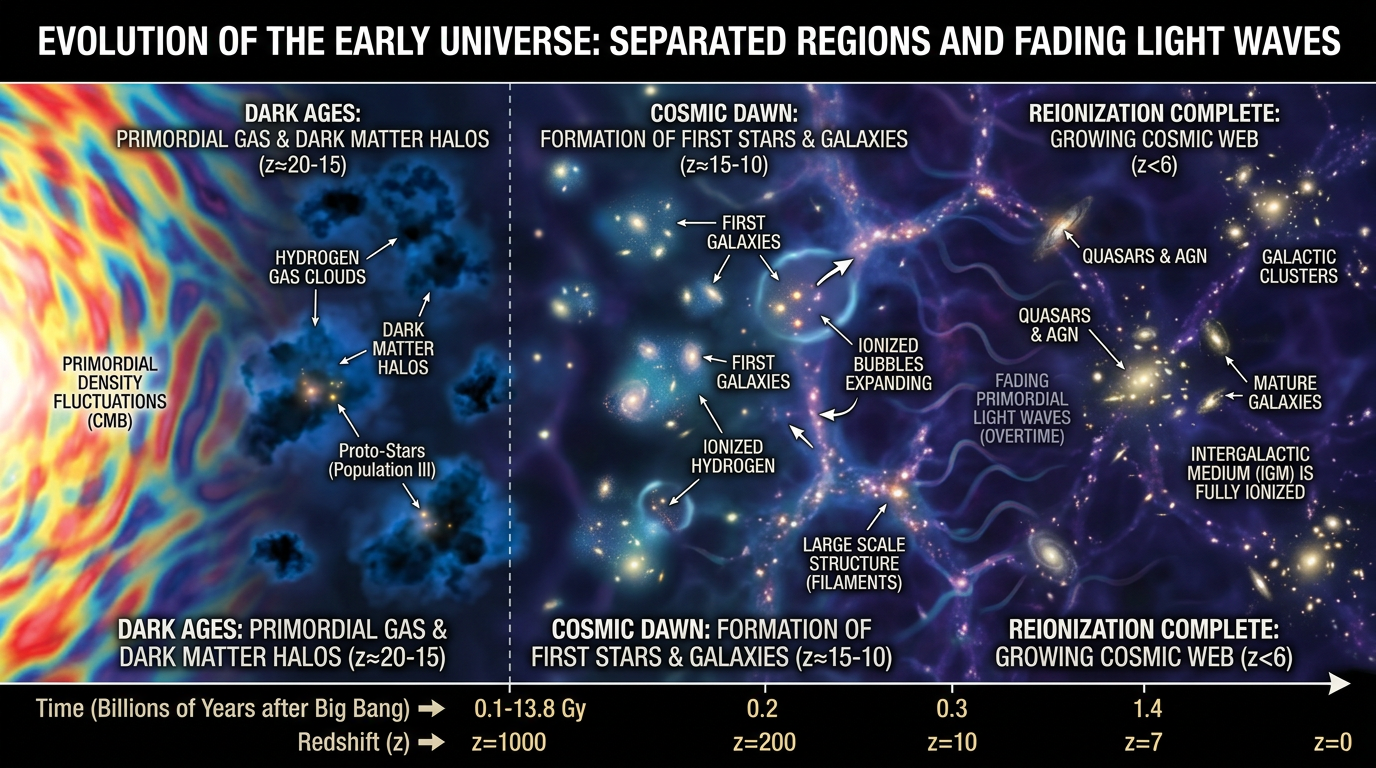
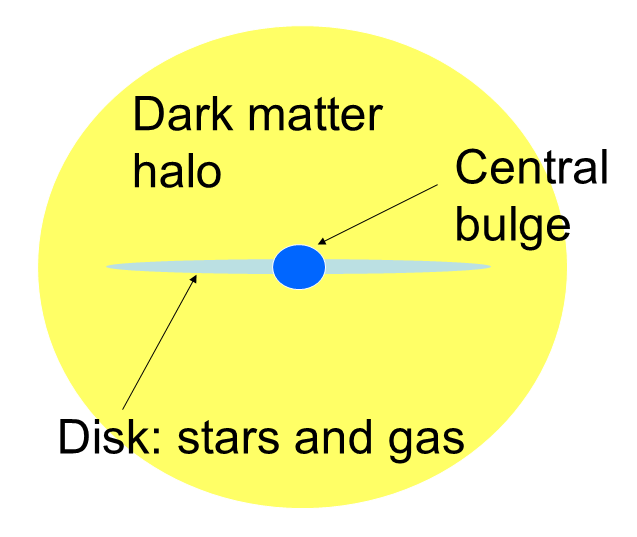
Dark matter is believed to account for roughly 85 percent of all matter in the universe, yet it has never been directly detected. Scientists infer its existence because galaxies rotate too quickly and large-scale cosmic structures behave as though far more mass exists than telescopes can see.
Unlike ordinary matter, dark matter appears to interact almost exclusively through gravity, making it extraordinarily difficult to detect using conventional techniques.
That challenge motivated researchers to pose a different question. Instead of trying to see dark matter directly, could scientists detect its influence on something else?
The researchers’ answer focused on gravitational waves. These are disturbances in spacetime first directly detected in 2015 by the Laser Interferometer Gravitational-Wave Observatory (LIGO). Since then, the international LIGO–Virgo–KAGRA collaboration has cataloged dozens of black hole mergers and transformed gravitational-wave astronomy into one of the fastest-moving areas of astrophysics.
Traditionally, those signals have been treated as extraordinarily clean probes of the black holes themselves. However, in this recent study, researchers argue that the environment around merging black holes may matter more than previously thought.
The study centers on a class of hypothetical dark matter candidates called ultralight scalar particles. These represent exotic fields that appear naturally in many extensions of the Standard Model of particle physics and have long been considered viable dark matter candidates.
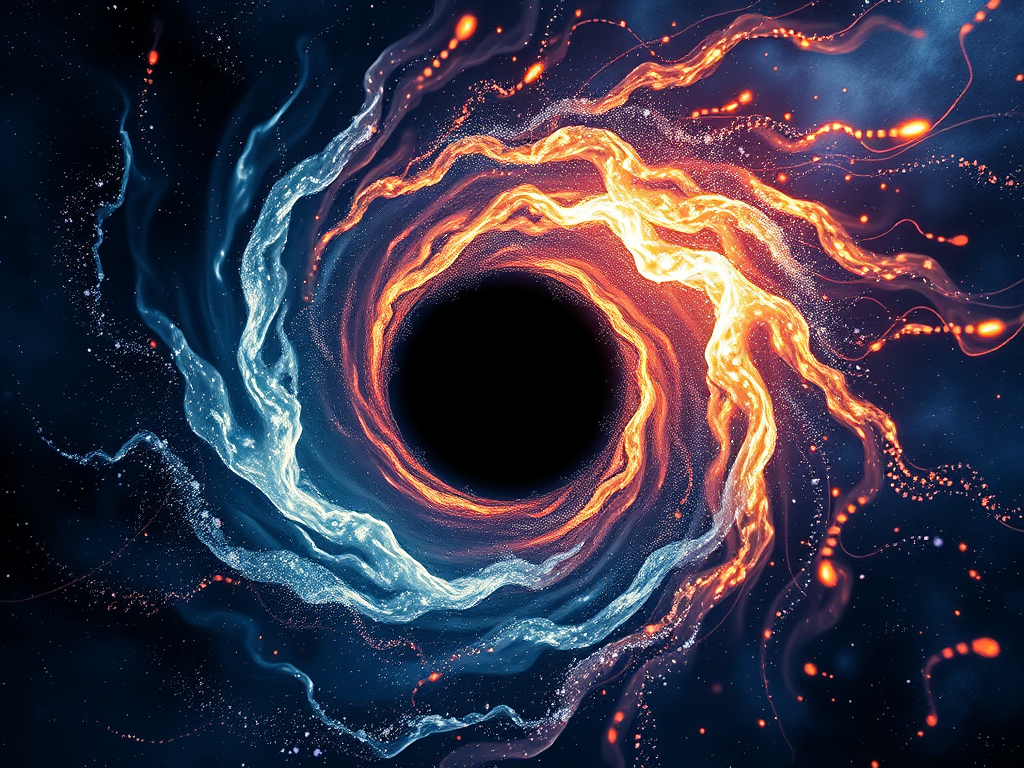
Under the right conditions, ultralight scalar particles could accumulate around spinning black holes, forming extremely dense clouds. Moreover, some of those clouds could become astonishingly concentrated.
According to researchers, a process called superradiance may allow rapidly spinning black holes to transfer rotational energy into surrounding ultralight particles, dramatically amplifying them.
In some scenarios, those dark matter structures could reach densities more than 30 orders of magnitude greater than the average dark matter density in our galaxy. If a pair of black holes then spiraled together inside one of these environments, the surrounding scalar field would slightly alter their orbital motion.
That change would be subtle but measurable.
Rather than producing the gravitational-wave “chirp” expected from two black holes merging in empty space, the waves would show tiny distortions in timing and phase evolution, essentially arriving with an altered rhythm.
To test the idea, researchers developed a new semi-analytic waveform model capable of predicting how black hole mergers should appear embedded within environments of scalar dark matter. They then validated those predictions using full numerical relativistic simulations that model black hole mergers inside dense scalar fields.
The simulations showed that dark matter-like scalar structures could survive the violent inspiral process better than many earlier models had suggested.
Previous thinking often assumed equal-mass black hole binaries would destroy surrounding dark matter structures before merger. However, the new simulations suggest the opposite may sometimes occur. Portions of those structures can persist and potentially leave observable signatures in gravitational waves.
Armed with their model, the researchers turned to reality.
The team analyzed 28 gravitational-wave events from the publicly available GWTC-3 catalog collected by LIGO, Virgo, and KAGRA. Most events behaved exactly as expected.
Twenty-seven appeared consistent with black holes merging in a vacuum. But one event—GW190728, detected in 2019—stood out.
When analyzed under assumptions tied to superradiance, the signal showed what researchers describe as tentative evidence for a scalar environment surrounding the merger. The statistical preference reached a Bayes factor of approximately ln(B) ≈ 3.5—enough to attract attention but well below the standard required for a discovery claim.
If that interpretation ultimately proves correct, the data would point toward an ultralight scalar particle with a mass around 10^-12 electron volts.
That would place it in an area already discussed in theoretical dark matter research, although the authors acknowledge existing black hole spin measurements create some tension with portions of that parameter space.
Importantly, the researchers emphasize that they cannot rule out more ordinary explanations.
Environmental effects, parameter indeterminacies, or constraints in current waveform models could potentially mimic some of the observed behavior. Researchers carefully examined possibilities, including orbital eccentricity and line-of-sight acceleration, and found no strong evidence that those effects explain the signal, but warn that confirmation will require future observations.
“The statistical significance of this is not high enough to claim a detection of dark matter, and further checks should be performed by independent groups,” Dr. Aurrekoetxea said. “What we think is important to highlight is that without waveform models like ours, we could be detecting black hole mergers in dark matter environments, but systematically classifying them as having occurred in vacuum.”
That said, further checks of the researcher’s theory may arrive sooner than expected.
Current gravitational-wave observatories continue collecting data, and next-generation instruments such as the Einstein Telescope and Cosmic Explorer are expected to detect mergers with far greater sensitivity and over longer durations. That improvement could make tiny environmental signatures easier to isolate from ordinary black hole physics.
For now, the result remains an intriguing hint, but not yet proof.
Nevertheless, after decades of dark matter remaining elusive through light, particles, and laboratory experiments, researchers are beginning to explore the possibility that the universe’s missing mass may announce itself in an entirely different way. Not by being seen. But by changing the sound of spacetime itself.
“We now have the potential to discover dark matter around black holes as the LVK detectors keep collecting data in the coming years,” co-author and physicist at the Center for Cosmology in Belgium, Dr. Soumen Roy, said. “It is an exciting time to search for new physics using gravitational waves.”
Tim McMillan is a retired law enforcement executive, investigative reporter and co-founder of The Debrief. His writing typically focuses on defense, national security, the Intelligence Community and topics related to psychology. You can follow Tim on Twitter: @LtTimMcMillan. Tim can be reached by email: tim@thedebrief.org or through encrypted email: LtTimMcMillan@protonmail.com

 Login
Login