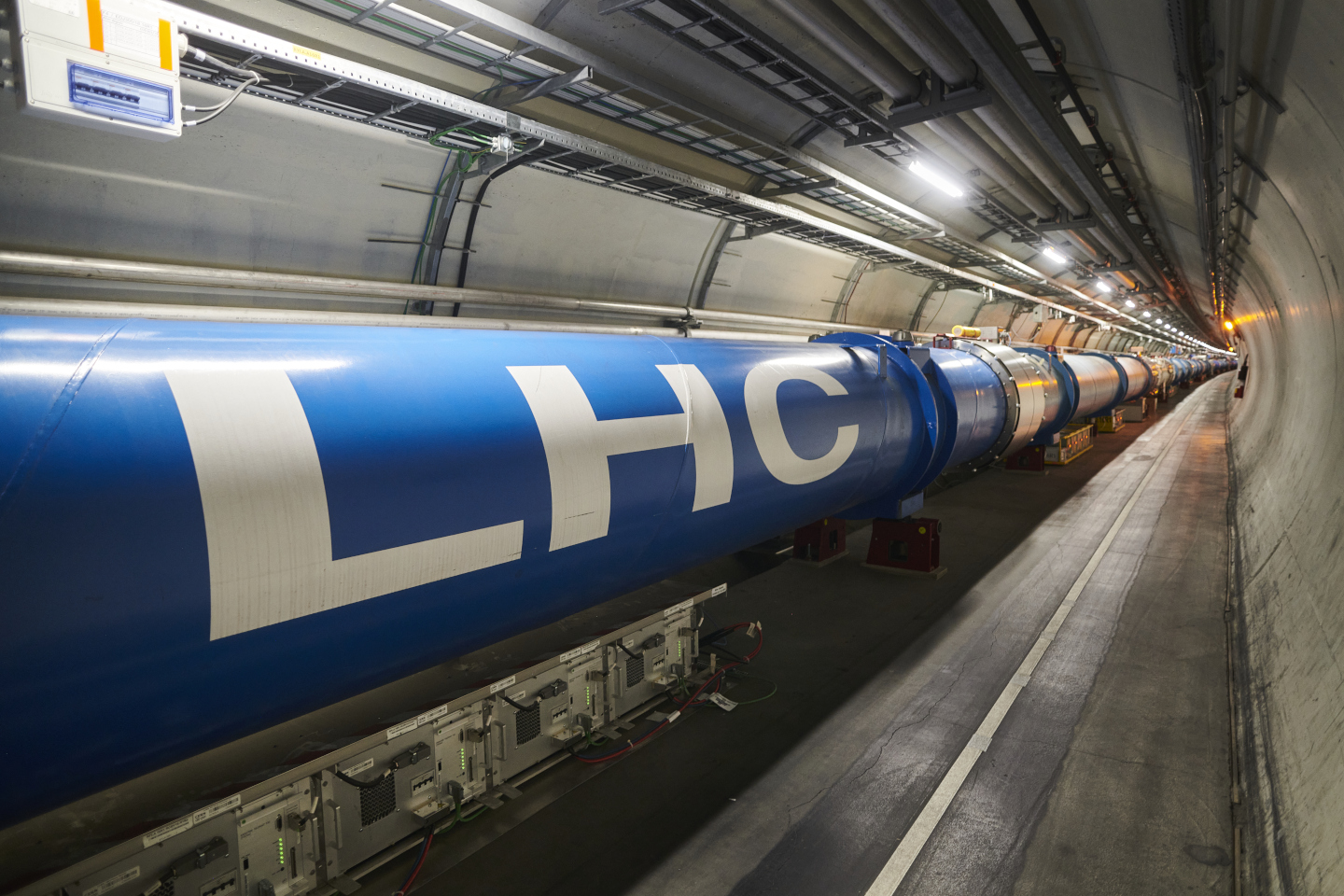
Should you be concerned about the possibility of the Large Hadron Collider (LHC) at CERN creating enough antimatter to blow up the Earth? Or the whole Universe?
The space-time oddities of modern physics may have just been taken to a new level of odd, as researchers have revealed that space and time can be used to form a variety of structures that may then be able to become tiny black holes.
The unusual discovery, reported by researchers from Vienna and Frankfurt, presents a new formula for this unusual effect, which they claim can be used to create a crystal-like structure resulting from spacetime self-organization due to a process physicists call critical collapse.
The findings, now reported in Physical Review Letters, reveal the first successful description of this bizarre phenomenon using a novel mathematical trick, which allowed researchers to derive a precise formula for the phenomenon.
Baby Black Holes
Although black holes are often envisaged as large physical structures that result from the powerful conditions involving stellar deaths, not all of them are so monstrous.
In theory, tiny black holes can also exist, emerging from very minuscule critical states where only the smallest amount of energy is introduced. These states, according to physicists, are believed to have once existed immediately after the genesis of our universe, known as the Big Bang, at which time a disorderly blend of particles persisted in the newborn cosmos—conditions that would have been ripe for the creation of what are known as primordial black holes.
These structures are already theoretically verified through computer simulations, although in their recent research, the Goethe University Frankfurt and TU Wien collaboration has now taken the study of these tiny cosmic monsters to a new level by deriving a mathematical formula to confirm longstanding theories about these tiny black holes.
Curving Spacetime at Smaller Scale
According to Professor Daniel Grumiller, a researcher at TU Wien, even the smallest events can sometimes trigger major changes.
“Take liquid water at zero degrees Celsius, for example,” Grumiller recently said in a statement. “A very small change is enough to make the water freeze. The water molecules then spontaneously arrange themselves into a regular pattern and form an ice crystal,” he says.
Why is this significant? A primary reason involves Einstein’s revolutionary ideas about gravity, in which a similar effect occurs, albeit involving space and time. Specifically, Einstein’s theory holds that particles that change locations can cause changes to the surrounding spacetime.
Christian Ecker of the Institute for Theoretical Physics at Goethe University Frankfurt observes that spacetime is warped more strongly in proportion to the size of objects (in other words, those possessing greater mass).
“Large objects such as stars curve spacetime strongly,” Ecker notes. “For example, we can observe this when light rays are deflected by massive stars.” However, massive celestial objects aren’t the only ones that can curve spacetime.
“Smaller masses also produce spacetime curvature, just to a lesser extent,” Ecker explains.
In the image above, a spacetime-crystal structure is shown on the left, while to the right, a cubic crystal structure is displayed (Image Credit: Vienna University of Technology).
Patterns in Space and Time
According to the researchers, repeating patterns emerge in space and time because of spacetime curvature, in which spacetime can self-organize into a regular, repetitive structure.
This structural form, which they liken to being a sort of “spacetime crystal,” results from a process known as critical collapse.
Grumiller calls the resulting spacetime “crystal,” a “very peculiar and fascinating object,” which he says can be thought of as “a kind of intermediate state, an unstable point that can evolve in two different directions.” Following its formation, Grumiller says that the crystal may then simply dissipate, “leaving behind ordinary spacetime filled with freely moving particles.”
That is, unless an energy input is introduced.
“If a tiny amount of energy is added, the evolution takes a completely different path,” Grumiller says, whereby “the inconspicuous spacetime crystal turns into a black hole.”
Simulating Primordial Black Holes
According to Grumiller and his colleague, Christian Ecker, deriving accurate formulas for such phenomena has proven especially difficult over the years. However, Ecker says they were able to overcome this challenge by instituting a novel trick of mathematics.
“Our universe has four dimensions—three dimensions of space and one dimension of time,” Ecker recently said. “But in principle, nothing prevents us from writing down physical equations for a larger number of dimensions—five dimensions, forty-two dimensions, or even infinitely many.”
Despite the expectation that such conditions might cause theoretical interpretations to become very complicated, the team was able to show that the opposite can be the case, with some questions physicists would normally deem to be extremely complex actually being reduced to relatively simple outcomes.
The team says they hope to explore the possibility that their mathematical formula might be reinterpreted for contexts involving fewer dimensions, which would allow the current models, which relate to the possibility of an infinite number of dimensions, to be scaled back to four-dimensional applications.
So far, doing so has allowed the team to explore four-dimensional universal qualities by taking what one might liken to being a shortcut through a sort of theoretical universe consisting of many dimensions. However, for now, the team’s findings are already proving very promising.
“Our technique turns out to be remarkably stable,” according to Florian Ecker, also with TU Wien.
“Depending on the desired precision, we can systematically improve our formulas using additional approximation methods,” Ecker added. “This gives us a new method for studying black-hole-related phenomena that could previously not be analyzed analytically.”
The team’s recent paper, “Analytic Discrete Self-Similar Solutions of Einstein-Klein-Gordon at Large 𝐷,” appeared in Physical Review Letters on May 12, 2026.
Micah Hanks is the Editor-in-Chief and Co-Founder of The Debrief. A longtime reporter on science, defense, and technology with a focus on space and astronomy, he can be reached atmicah@thedebrief.org. Follow him on X @MicahHanks, and at micahhanks.com.
The fastest-moving star, S301, was discovered recently by Stefan Gillessen’s team at the Max Planck Institute for Extraterrestrial Physics in Garching, Germany. First reported here (with the full paper accessible here), the star was discovered by near-infrared interferometry on 8-meter telescopes, using the GRAVITY instrument in operation at the European Southern Observatory’s (ESO’s) Very Large Telescope (VLT).
Recently, I sat next to Stefan at the reception dinner of the annual conference of Harvard’s Black Hole Initiative, for which I served as the founding director a decade ago. This 1.5-solar-mass star moves on a highly elliptical orbit with a period of 8.7 years and eccentricity of 0.98 around the supermassive black hole at the Milky Way center, called Sagittarius A*.
This black hole has a long history of swallowing 4.3 million solar masses of gas and stars from its environment. The peak velocity of S301 is 25,000 kilometers per second or 8.3% of the speed of light, as it comes down to a distance of 140 times the Schwarzschild radius of the black hole, which defines the scale of the black hole’s mouth from where even light cannot escape. If the star were to pass ten times closer to the black hole, it would have been ripped apart by tidal gravity into a stream of gas that shines brightly as it feeds the mouth of this spacetime beast.
The orbit of S301 can be used to test expectations from Albert Einstein’s formulation of gravity as the curvature of spacetime. Einstein’s equations predict that S301’s orbit will precess in response to the spin of the black hole, offering a precise new way to measure how fast Sagittarius A* is rotating within the coming decade.
How did this star get so close to its black hole?
A natural mechanism, proposed by Jack Hills in a 1988 paper, is the tidal break-up of a pair of stars by the black hole. About half of solar-mass stars form in binaries. When a binary star system gets close enough to the black hole, the tidal gravity becomes stronger than the gravitational binding of the two stars and breaks the binary apart, sending one star out at a speed of up to thousands of kilometers per second and launching the second star into a tighter orbit around the black hole.
Indeed, a population of hypervelocity stars had been discovered on their way out in the Milky Way halo by Warren Brown and collaborators from the Harvard-Smithsonian Center for Astrophysics, as reported here.
In a 2006 paper published here, I proposed with the student, Idan Ginsburg, that the former companions of the observed hypervelocity stars in the Milky Way halo might have produced the observed population of close-in S-stars on highly eccentric orbits around Sagittarius A*. The Galactic center star S301 is likely one of them, formed via the Hills mechanism out of an initial binary star system with an orbital period of 1-2 weeks over the past 100 million years.
In a follow-up paper, I showed with Idan that planets could survive the break-up of binary star systems by Sagittarius A*. As a result, Galactic travel agencies could sell tickets for thrilling journeys on habitable planets around hypervelocity stars. I wonder whether adventurous Galactic passengers would prefer to travel with a hypervelocity star on its way out of the Milky Way galaxy at a speed of up to 1% of the speed of light or travel with a star like S301 as it reaches 8.3% of the speed of light and gets within a distance of 140 Schwarzschild radii from the largest black hole in our Galaxy.
I would personally favor the latter possibility, since the extreme spacetime structure of a supermassive black hole is far more exhilarating than the rarefied environment of intergalactic space. The trip close to the black hole also offers health benefits, since aging slows down by a third of a percent at the closest approach of S301 to Sagittarius A*. This corresponds to a 5-minute gain in the passenger’s lifespan each day relative to distant relatives.
The black hole tour with S301 offers a view of the black hole’s mouth from a distance where it occupies roughly the same angle as the Moon or the Sun in our sky. The gas swirling into the event horizon of Sagittarius A* glows brightly, but at the center of this glow, there is a silhouette – a shadow cast by the absorption of light emanating from behind the black hole.
Over the decade between 2006 and 2016, I wrote 30 papers in collaboration with my postdoc, Avery Broderick, forecasting the expected portrait of a black hole (as detailed here and summarized for the general public here). By now, Sagittarius A* was imaged by the Event Horizon Telescope (here), whose headquarters were established at Harvard’s Black Hole Initiative during my directorship.
On a tour with S301, it would be fascinating to observe the silhouette image of Sagittarius A* from a minimum distance that is 140 million times closer than the Earth is from the black hole. I would have loved to serve as the tour guide on such a journey. Here’s hoping that Galactic travel agents would pay attention to this essay.
Avi Loeb is the head of the Galileo Project, founding director of Harvard University’s Black Hole Initiative, director of the Institute for Theory and Computation at the Harvard-Smithsonian Center for Astrophysics, and the former chair of the astronomy department at Harvard University (2011-2020). He is a former member of the President’s Council of Advisors on Science and Technology and a former chair of the Board on Physics and Astronomy of the National Academies. He is the bestselling author of “Extraterrestrial:The First Sign of Intelligent Life Beyond Earth” and a co-author of the textbook “Life in the Cosmos”, both published in 2021. The paperback edition of his new book, titled “Interstellar”, was published in August 2024.
 Login
Login