Day 3 of creation, God formed dry land and initiated life with green plants, establishing essential conditions for future sentient life forms. This day also included the formation of Earth's physical structures. All creations were designed perfectly, paving the way for environmental balance and the development of biodiversity.
The concept of Greater Israel invokes a biblical promise to Abram, raising questions about the legitimacy of current territorial claims. Discussions on military expansion and potential regional conflict highlight tensions surrounding Israel's historical and contemporary land rights.
The UN's alleged Mpox pandemic is debunked as purported symptoms are effects of COVID jabs. New Zealand's controversial legislation allows forced vaccinations with no liability for manufacturers, sparking concerns and comparisons to West Australia's similar laws. The potential for forced vaccinations in America is also highlighted.
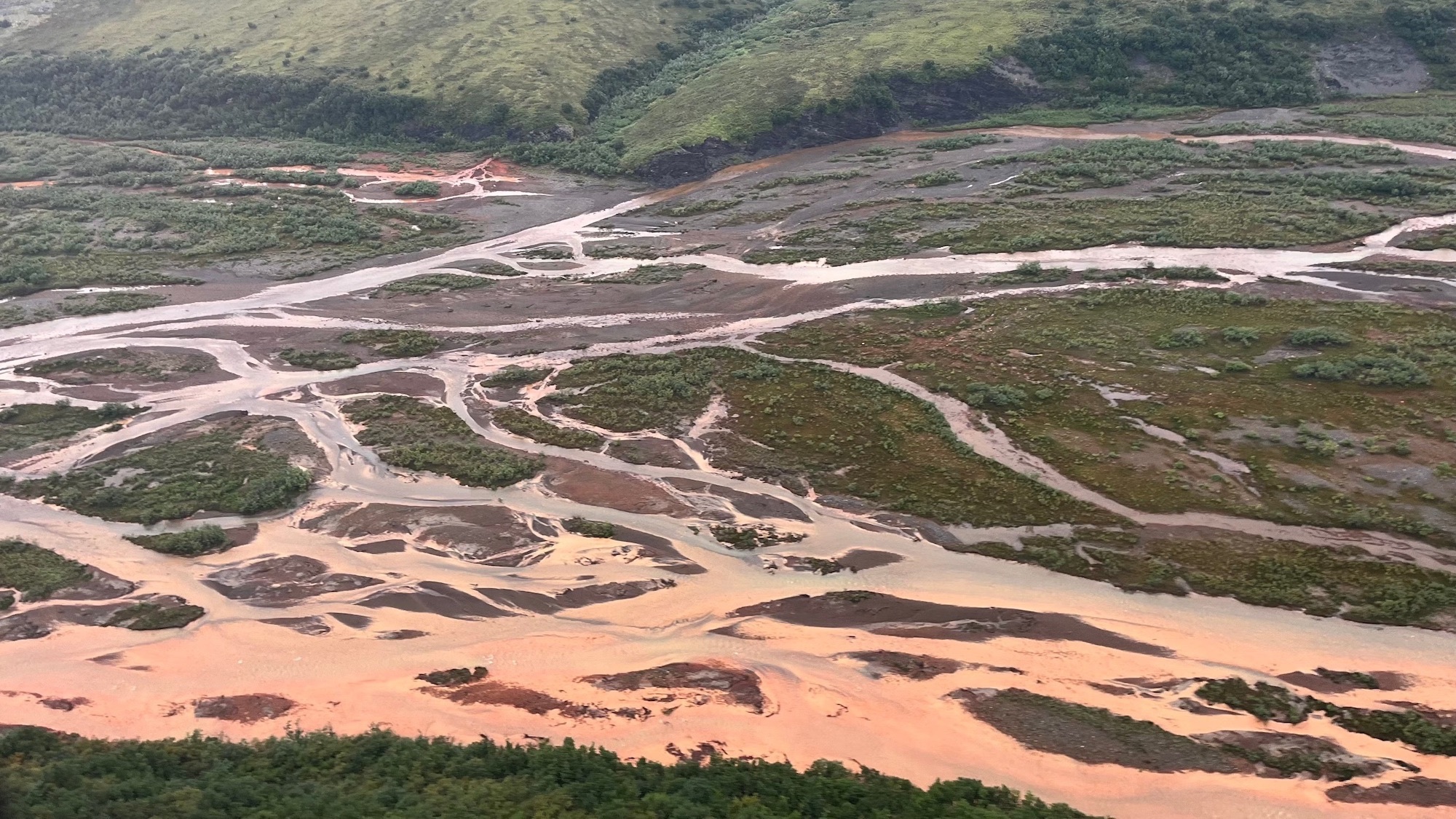
Alaska’s Arctic rivers have a big, orange problem. Previously clear rivers are turning a cloudy orange color due to iron particles, and it’s more than unsightly. The particles can suffocate fish and choke insects, threatening the food web and ecosystem as a whole.
Scientists have long pointed to previously frozen soil beginning to thaw as the potential culprit behind the contamination of rivers in northern Alaska’s remote Brooks Range, and a study recently published in the Communications Earth & Environment proves it. The research also shows two distinct ways that this thawing soil is rusting the rivers and can help scientists predict where the damage is likely to spread next.
“You’d think if any ecosystem could hide from the effects of warming and big human footprints, it’d be this one. But it’s not so,” Tim Lyons, a study co-author and biogeochemist at the University of California, Riverside, said in a statement. “There is no safe place.”
Researcher sampling rusty Alaskan river water. Image: Tim Lyons/UCR.
As the ice-filled permafrost begins to thaw due to climate change, it can turn into mud that can’t support the weight of the soil or vegetation above it. This can threaten human-built infrastructure such as homes, pipes, and roads. It can also expose iron particles from rocks that turn rivers orange, a process called rusting.
Rusting has severe ecological consequences. The fine iron particles can stay suspended in water for over 60 miles, smothering algae, disrupting insect populations, and clogging fish gills. These changes may already be affecting salmon in Alaska and Canada who rely on the gravel riverbeds for spawning and rely on algae as food during early life stages.
A top-down, fool’s gold problem
For this new study, the team looked at a wide regional view of the roughly 600-mile Brooks Range. They then zoomed in on a specific river system, followed by an even closer look at one creek. This top-down approach helped them to connect the bigger regional patterns to specific, on-the-ground processes.
“At middle, more heavily forested elevations, there isn’t much going on. But at the higher and lower elevations we could see distinctly different phenomena,” said Roman Dial, a study co-author math and biology professor emeritus at Alaska Pacific University.
At the higher elevations, the problem begins in the rocky ground containing pyrite, aka fool’s gold. Since the ground was frozen for many years, water and air didn’t affect the pyrite. Yet the rising temperatures have started to melt the ground, kicking off a process called acid rock drainage. The minerals and rocks are exposed to oxygen and water and degrade the water quality.
“When pyrite meets water, it comes apart. It breaks down into iron and sulfur, creating sulfuric acid as well as sulfate and other toxic metals,” said Lyons. “When the iron-rich water mixes with more oxygen, the iron turns into rust-like particles that color the water and stain the bottom sediments orange.”
It’s an entirely different story at the lower elevations. The landscape is covered with wetlands that are changing shape and expanding downward as the permafrost melts. In these more soggy places, the soils are low in oxygen. So instead of breathing in oxygen, the microbes in the water (mostly bacteria) are taking in iron.
“When we breathe, oxygen goes in and gets converted to the carbon dioxide that we exhale,” Dial said. “Similarly, microbes are consuming iron in the lowland soils and converting it into a water-soluble form that seeps into streams and results in rusting as it meets oxygenated surface water.”
Taken together, both acid rock drainage and microbes breathing in more iron help explain why orange waters are appearing across such large and remote regions across northern Alaska, closely tracking to areas where permafrost is thawing.
The direct link
The team also found a delayed effect that could help predict future contamination. During the summer, the active, top layer of soil thaws to its deepest point. It then refreezes before the winter. The iron released during one summer thaw can become trapped and then flushed into rivers the following year.
By studying long-term ground temperature data and stream chemistry, this lag can be used to anticipate increases in metal levels.
“That means we can use ground temperatures to help predict water quality in the future,” added study co-author and University of Alaska ecologist Paddy Sullivan. In 2019, Sullivan first noticed the dramatic river changes that looked “like sewage” during fieldwork in the region.
Since mines typically control the waters near them to minimize pollution, the team partnered with scientists at the Red Dog zinc mine in northwest Alaska. The scientists there have long-term temperature records from boreholes that are drilled deeply into the earth and from chemistry sampling in stream water. Linking the underground measurements with changes in the stream’s chemistry directly connected the thawing permafrost to the rusting rivers.
While this problem is difficult to contain and manage, predicting where the contamination may pop up next could help pinpoint and protect critical habitats. This forecasting is especially important for communities that depend on these waters and the fishing living there for food and cultural practices.
“There’s no fixing this once it starts,” Lyons said. “But we can give people downstream a heads up and work hard to protect the places that are still safe and less vulnerable to the rusting.”
Residents of New England were startled over the weekend as a loud quaking boom shook the northeast, while many observers spotted a bright fireball streaking through the skies over the U.S. and Canada.
Now, NASA has confirmed that the energy released as a meteor exploded in the northeastern skies on May 30, 2026, was roughly equivalent to 230 tons of TNT. The resulting blast was also so bright that it registered in satellite imagery normally used to detect powerful lightning bolts.
Shortly after the incident, NASA took to social media, reporting that the GOES-19 satellite had detected a bright fireball at 2:06 p.m. EDT that coincided with reports of loud booms.
“The meteor appears to have fragmented at an altitude of 40 miles over northeast MA and southeast NH,” the NASA statement read, adding that at the time, the energy released as the object tore apart while streaking through the atmosphere was approximately the “equivalent to about 300 tons of TNT, which accounts for the loud noise.”
In the video above, provided by NOAA, imagery from the GOES East (GOES-19) satellite revealed the meteor, which the satellite’s sensors registered as a lightning bolt. The meteor appears approximately one second into the looped imagery above, seen as a bluish-white flash to the right of the center of the frame.
In a subsequent update issued on Monday, NASA officials have now revealed new details about the incident, confirming the object’s size, mass, and the approximate speed as it passed above the Earth.
“The meteor was about 5 feet (1.6 meters) in diameter with a mass of 5.6 metric tons and entered Earth’s atmosphere at roughly 42,000 mph,” NASA officials wrote in Monday’s statement. “The meteor traveled through the atmosphere from northwest to southeast for 26 miles before breaking up at an altitude of 31 miles and producing a meteorite fall into Cape Cod Bay.”
The NASA update also slightly downgraded the power of the blast that the exploding object produced.
“Based on the latest data, the energy released at breakup is estimated to be equivalent to about 230 tons of TNT,” NASA’s statement on Monday noted.
Fortunately, there were no injuries or damage to property or infrastructure resulting from the May 30 incident. However, some area residents who were present at the time of the explosion reported feeling buildings shaking on Saturday afternoon.
In a statement provided by the agency from its NASA Space Alerts account on X, which periodically issues notifications on “cosmic activity in near-Earth space including solar events, asteroids, comets, and meteors,” the agency noted that objects like the one observed over the northeast, while capable of producing loud noise, are generally not viewed as being potentially dangerous.
“NASA’s planetary defense network watches the skies for objects of all sizes – and specifically is tasked with finding objects 140 meters and larger which can cause widespread damage,” the notification read.
“Meteoroids, like this one over New England, are much much smaller,” the statement added, calling them “almost impossible to track in space” and adding that “they do not survive passage through our atmosphere intact and do not pose a hazard.”
Fortunately, larger and potentially more dangerous space objects aren’t as “impossible” for NASA to track. Presently, the American space agency and its international partners are tracking more than 40,000 larger near-Earth objects (NEOs) and are frequently discovering new ones as part of their broader planetary defense objectives.
The explosion heard over the northeast on Saturday marked only the latest in a series of similar incidents that have occurred in the early part of 2026.
NASA provides additional information about meteor reentries and their effects at its Fireballs FAQ page, which can be found here.
Micah Hanks is the Editor-in-Chief and Co-Founder of The Debrief. A longtime reporter on science, defense, and technology with a focus on space and astronomy, he can be reached atmicah@thedebrief.org. Follow him on X @MicahHanks, and at micahhanks.com.
Last year, 4.8 million people ventured to Yellowstone National Park, one of the most famous of our nation’s “best ideas.” And it’s not surprising why. The park, spread across 2.2 million acres and three states, includes half of Earth’s active geysers, the Grand Canyon of the Yellowstone River, and stunning wildlife.
Yellowstone’s famed Grand Prismatic Spring. Image: NPS / Jim Peaco.
No reservations
Unlike a trendy new restaurant or theme park, Yellowstone does not require a reservation to enter. Visitors just need a park entrance pass. However, it’s important to remember that the summer is very busy, so bring your patience along with that bear spray and be ready for crowds and lines at entrances.
Check road status
Most of Yellowstone’s park roads are open to personal vehicles in mid-April and will close in early November. Still, weather may temporarily close roads, so use Yellowstone’s website and app to check the status of park roads before arriving.
Plan, plan, plan
As with any popular tourist attraction, it pays to plan. While the park does not require reservations to enter, campgrounds and lodging do. Visitors often need to book well in advance, and operating hours and service levels may change with little notice. Check before you go for the latest on fishing permits, current weather, places to go, etc.
Cow bison and calves in Lamar Valley. Image: NPS/ Neal Herbert.
Give wildlife lots of space
Yellowstone’s wildlife are one of the park’s biggest draws. But remember that wild animals are dangerous if you get too close. You must respect safety regulations and view them from a safe distance. Always maintain a minimum of 100 yards from predators like bears, wolves, and cougars and 25 yards from all other animals, including bison and elk. Also, all of Yellowstone is bear country, so carry bear spray and know how to use it before you go. You should also review how to watch wildlife safely and travel safely while in bear country.
Be a responsible driver (and parker)
Observe all of the posted speed limits and use the designated pullouts to watch wildlife, take pictures, and let other cars pass you. Also, do not stop your vehicle in the middle of the road. When pulling over, be sure to park with all four of your vehicles tires fully to the right of the white line.
Boardwalks are your friends
Please keep on the park’s boardwalks. People have been severely injured or even killed after stepping off of them into thermal areas. Here, the thin, fragile ground can suddenly give way, and visitors risk falling directly into scalding hot springs. The springs can reach temperatures of over 200 degrees Fahrenheit.
Views of Sunday Geyser from the boardwalk. Image: NPS / Jacob W. Frank.
Unplug, but remember the app
Download the free National Park Service app (and all of the offline content) before you arrive in the park. The app has interactive maps, tours of park places, on-the-ground accessibility information, and more that can help enhance your visit.
Expect limited connectivity
That said, don’t be surprised if you can’t receive calls or texts, even in the few areas of the park that may have cell reception. This is why it is important to remember to download that map before entering the park.
Sunset on the Madison River near Madison Junction. Image: NPS / Neal Herbert.
Prepare for all kinds of weather
Yellowstone’s weather is unpredictable. You can expect big temperature swings, rain, or even snow during every month of the year. Make sure you have a warm jacket, rain gear, and several layers. You should also check current weather conditions before arrival. .
Branch out
Consider attending a ranger program, exploring the Yellowstone Tribal Heritage Center, or participating in the free Junior Ranger program are extra ways to make the most out of your trip.
While Westminster’s attention is focused on Andy Burnham and Makerfield, another pivotal byelection is taking place in Scotland’s north-east
The coming byelection in Makerfield, from where Andy Burnham aspires to make rapid progress towards Downing Street, is perhaps the most consequential in British political history. But the decision by the Scottish National party’s former Westminster leader, Stephen Flynn, to relocate to Holyrood means that another pivotal contest is taking place more than 350 miles to the north. If Makerfield is a test case for Mr Burnham and Labour’s ability to see off Reform UK, Mr Flynn’s old constituency of Aberdeen South is on the frontline of the increasingly fraught politics of North Sea oil.
Labour, despite finishing second in the 2024 general election thanks largely to anti-Tory tactical voting, will not be expecting much this time round. The ramifications of Donald Trump’s reckless war in Iran have exposed Britain’s ongoing vulnerability to fossil-fuel-related energy shocks, highlighting the practical benefits of moving to a green economy. But the knock-on effects of the closure of the strait of Hormuz have also been a gift for the Scottish Conservatives and Reform, who are framing the byelection as a local referendum on reviving oil and gas production beyond Westminster-imposed limits.
Picture was created by administrator in charge of station’s Facebook account who wanted to create ‘friendlier image’
It was an arresting image and an irresistible story. A group of tough Thai police officers – five men and one woman – all wearing elaborate festival-style dresses, surrounding a drug dealer they had caught while undercover.
The image, released by local police, was so compelling that it found its way on to the front page of the UK’s Daily Star, as well as in picture stories in the Telegraph, the Sun and the New York Post.
Datacentres used 22% of country’s electricity last year, pushing up household bills, study suggests
Energy demand by datacentres in Ireland has added hundreds of euros to household electricity bills in a pattern that could be replicated across Europe, according to a report.
Datacentres used 22% of country’s electricity last year, pushing up household bills, study suggests
Energy demand by datacentres in Ireland has added hundreds of euros to household electricity bills in a pattern that could be replicated across Europe, according to a report.
Paleontologists in Canada say they have recovered a dinosaur tail vertebra from 75- to 80-million-year-old marine rocks on a small island off the coast of British Columbia, providing the clearest evidence yet that bird-like ornithomimosaurs once roamed the ancient Pacific coastline of North America.
A single female specimen, collected 1,773 m below the surface near Darwin Island, has been described as a new species of deep-sea octopus, and it doesn’t fit neatly into the Megaleledonidae family it belongs to, forcing a revision of the textbook definition.
 Login
Login