The new Australian "hate speech" legislation criminalizes criticism of Israel or Jewish identity, potentially labeling such discourse as harassment. Attorney-General Michelle Rowland confirmed that if Jewish Australians feel intimidated, related actions could be prosecuted. Critics warn this undermines democracy and enables totalitarian practices by silencing political opposition.
Australia's hate speech laws are under debate after passing the House of Representatives. Critics argue the definition of hate speech is subjective, potentially threatening free speech. Concerns arise over the bill’s ability to target legitimate political discourse while seemingly failing to address extremism comprehensively. A crucial Senate vote is pending.
Researchers say that a discovery in remote northern Australia has revealed that a species thought to have been driven to extinction more than half a century ago has been rediscovered in the wild.
The discovery was made possible by a chance photograph uploaded to the citizen science platform iNaturalist, which came to the attention of researchers.
Now, scientists have confirmed that Ptilotus senarius, a delicate shrub that grows in some of the outback’s most sparsely populated regions and possesses a distinctive purple-pink flower, has been rediscovered in rugged terrain near the Gulf of Carpentaria in Queensland.
The species hasn’t been documented by naturalists in the wild since 1967 and was long thought to have gone extinct.
An Australian Shrub Springs Back from Extinction
The remarkable discovery initially surfaced when Aaron Bean, a professional horticulturalist, noticed the plant while working as part of a bird banding operation in a rugged portion of Australia’s northern outback. Intrigued by the colorful flower, Bean took photographs, which he later uploaded to iNaturalist, a popular website and app that allows users around the world to map and share observations of biodiversity.
Sometime later, Bean’s images on the platform eventually came to the attention of Anthony Bean, a botanist at the Queensland Herbarium who, ironically, shares the last name of the horticulturalist who made the initial discovery.
Ptilotus senarius, seen growing in one of northern Australia’s most remote regions (Image Credit: Aaron Bean/inaturalist.org/observations/288434421).
Their common name was perhaps only one of the many serendipitous circumstances related to the discovery, since the original images finding their way through millions of observations shared on the platform and coming to the attention of a Queensland Herbarium botanist was remarkable enough—add to that the fact that, in another surprising twist, Anthony Bean had formally described Ptilotus senarius himself roughly a decade earlier.
“It was very serendipitous,” said Thomas Mesaglio of the UNSW School of Biological, Earth and Environmental Sciences, who penned a recent paper documenting the discovery that appeared in the Australian Journal of Botany.
“Aaron Bean is an avid iNaturalist user who opportunistically took some photos of a few plants that were interesting on the property,” Mesaglio noted. Following the imagery that Bean obtained and its coming to the attention of the broader botanical community, researchers were dispatched to the property where the photos were captured, and, with the assistance of the landowners, the collection and confirmation of a specimen proved beyond any doubt that Ptilotus senarius survives.
A Breakthrough for Citizen Science
The rediscovery of Ptilotus senarius is not only a remarkable event for conservation efforts; it also highlights the growing importance of citizen science in biodiversity research.
With the availability of platforms like iNaturalist, members of the public with little more than a keen interest in the natural world can contribute valuable observations that often help advance science in meaningful ways.
In cases like this one, it can even lead to rediscoveries of species thought extinct or, in some instances, to the identification of entirely new species.
Thanks to such discoveries, several programs, including New South Wales’ Land Libraries initiative, have begun ramping up efforts to encourage landowners to document species on their properties and contribute observations to citizen science databases.
Among the most important pieces of information that citizen scientists can contribute are multiple photographs from various angles whenever possible. With regard to plants, being able to identify bark, stems, leaves, and other key features, as well as the surrounding habitat, can greatly help with accurate species identification.
Additional information that can assist with such identifications includes photos of soil conditions, nearby vegetation, scents the vegetation may produce, and information about local pollinators.
“The more information you can provide and the more context you can provide, the more potential uses that record will have in the future,” Mesaglio said.
Micah Hanks is the Editor-in-Chief and Co-Founder of The Debrief. A longtime reporter on science, defense, and technology with a focus on space and astronomy, he can be reached atmicah@thedebrief.org. Follow him on X @MicahHanks, and at micahhanks.com.
Nour Haydar speaks with Christopher Knaus about the BHP files – the cache of internal documents leaked to the Guardian and the ABC’s Four Corners – which show that the world’s biggest miner has war-gamed ways to massively delay decarbonisation
Additional audio in this episode was sourced by Financial Times Live
Exclusive: Mining giant says technology is not yet advanced enough to run a fully electrified fleet but experts say it is hooked on federal fuel tax credits
BHP has continued to spend hundreds of millions of dollars buying diesel trucks in the Pilbara despite internal documents suggesting it would increase emissions and be “misaligned” with its decarbonisation goals.
The mining giant is Australia’s biggest consumer of diesel and trucks are its biggest single source of diesel emissions. Replacing the fleet with battery-electric trucks is considered a critical step in the multinational’s efforts to decarbonise.
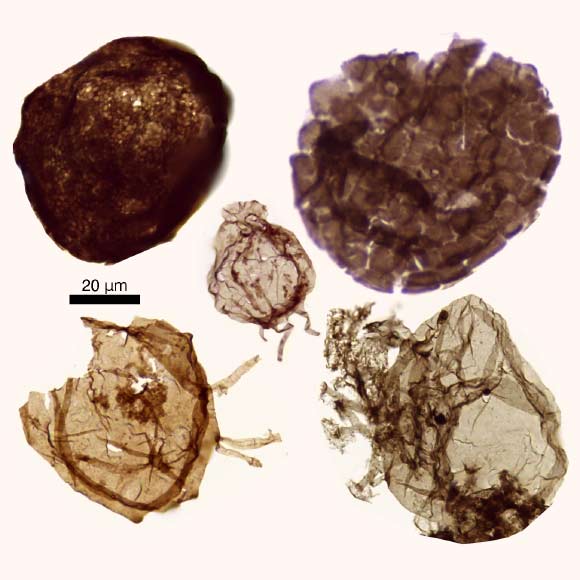
Analyzing 1.75-billion-year-old microfossils from ancient Australian seabeds, paleontologists say ancient eukaryotes -- the ancestors of every plant, animal and fungus -- huddled in oxygenated seafloor patches for over a billion years before breaking free into open water.
Exclusive: Cache of internal documents leaked to the Guardian and the ABC’s Four Corners show multinational has war-gamed ways to massively delay decarbonisation
The world’s biggest miner has halted or delayed projects to cut vast amounts of emissions and has quietly war-gamed options to push major climate investments in its Western Australian iron ore operations into the next two decades, internal documents show.
An exclusive investigation based on documents leaked to the Guardian and the ABC’s Four Corners can reveal that BHP, one of Australia’s biggest historic emitters, has dumped plans for a facility that could have significantly reduced emissions and has put on ice renewable projects designed to power its iron ore operations in the vast, resource-rich Pilbara region.
Exclusive: BHP once dubbed climate change an ‘existential’ threat. But leaked documents show it has backtracked on decarbonisation at a vast network of mines
A new Australian initiative is sending Year 9-12 students to one of the most extreme scientific environments on Earth, and asking them to contribute to real research while they’re there. For most students,...
Wake-up call, and a call to arms The spectacular feature-length documentary ‘Ocean with David Attenborough’ is his very first partnership with National Geographic, now showing on Disney+ channel in Australia. With the great...

 Login
Login