At the end of last month, Dr. Leonard G. Horowitz submitted a policy review to the CDC for publishing. In his brief review, he pointed out that previous Ebola outbreaks were linked […]
The human mind has a long history of innovative achievements. But its potential is being neglected in the age of technology, with luxury beliefs and AI being forced upon society by elites. […]
A new front has opened up in the battle for dominance in AI chips, as Nvidia said its latest development could replace the mouse and keyboard in how people use computers.
The $5tn (£3.7tn) US semiconductor company has launched a “superchip” that puts AI capabilities into laptops and desktop computers, a move that will pit it against Intel, Apple, Qualcomm and AMD.
A Dutch pro-abortion organisation has placed lockboxes containing abortion pills across Malta and Gozo, directly challenging one of Europe’s last remaining pro-life countries. The campaign is being presented as a humanitarian intervention […]
Australia is pioneering a revolution in home renewables and battery use, proving what is possible with the right policies
The timing was rich with symbolism. As intense heatwaves pummelled Europe and Asia, and oil markets around the world leapt and sputtered, the two big chimneys of one of Australia’s largest power stations were being demolished. Meanwhile, the Australian energy minister was holding a media conference to hail a fall of up to 10% in the benchmark electricity price in parts of the country.
Quietly, and with surprisingly little fanfare from the rest of the world, Australia is pioneering a revolution in home renewables and battery use, proving what is possible with the right policies. The country was already one of the global leaders in domestic solar power, with panels on one in three homes. It also remains, however, a major contributor to the climate crisis through its vast fossil fuel exports.But it is batteries that are giving Australia a new burst of speed.
Experts say AI firm’s engagement with Vatican risks creating ‘feelgood’ discourse that lacks critical examination
Why did Anthropic’s founder sit beside the pope during a warning about AI?
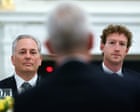
In the first major written teaching of his papacy, Pope Leo XIV took artificial intelligence to task. The pontiff delineated the technology’s most concerning threats to humanity: replacing workers, accelerating war and exploiting the environment. At a ceremony honoring the holy teaching the day of its release at the Vatican, the pope was flanked by an unusual guest speaker: Anthropic co-founder Chris Olah, one of the people behind the AI boom so worrying Leo.
Guardian investigation shows how US presidency blurs line between policy and enrichment of American ruling family and those around it
On a graffitied Sarajevo backstreet, a path leads past an overgrown patch of garden to a white door. Beyond is the registered office of a company that is on the brink of winning contracts worth more than $1bn.
AAFS Infrastructure and Energy is close to securing a concession to build and operate a pipeline across the Balkans to allow fossil gas shipped from the US to replace supplies that come from Russia. “This could be the most important infrastructure project ever in Bosnia and Herzegovina,” says one of the country’s top officials, who, like others, asks to remain anonymous to discuss sensitive negotiations.
A 72-hour break from cell phones (aka mobile phones) triggered increased cravings in study participants; brain scans showed heightened activity in reward centres when shown phone images. Cell phones stimulate your brain’s […]
Last year, the government of Burkina Faso terminated the Target Malaria project, a research initiative funded by the Gates Foundation and Open Philanthropy, due to biosafety risks, low impact and scientific sovereignty […]
Speaking at Amazon’s AI on the Lot event, the Rogue One film-maker Gareth Edwards said ‘it’ll do anything you ask’ and ‘it’s going to be better than CGI’
Jurassic World Rebirth and Rogue One director Gareth Edwards has enthusiastically endorsed the use of generative AI in film-making, saying “it is a fucking genius at helping you” and “it’s going to be better than CGI”.
Edwards was speaking at AI on the Lot, an event in Culver City, California, organised by Amazon, and in remarks reported by the Hollywood Reporter said: “I can’t see a reason why you wouldn’t become interested in this stuff as a film-maker. It’s so clearly a tool that might be up there with the camera. It’s going to be better than CGI.”
The intelligent and thoughtful encyclical is an important warning of the uses and misuses of a rapidly developing technology. Silicon Valley is wrong to dismiss it
Often I’m asked if I think that the novels of the future will all be written by AI. It’s not so much a question as a provocation. Do I worry that a machine can do what I do, only better? I usually say something like: “No algorithm is going to write Anna Karenina!” which is also not a real answer.
So I’m grateful to Pope Leo XIV, the American pope, for his recently issued letter to the world, Magnifica Humanitas: On Safeguarding the Human Person in the Time of Artificial Intelligence. It’s a long (more than 40,00 words), intelligent and thoughtful encyclical in which the pope addresses the uses and misuses of a rapidly developing technology. Now when someone asks my opinion of AI, I can refer them to the pope’s letter, or at least chapter three.
Picture was created by administrator in charge of station’s Facebook account who wanted to create ‘friendlier image’
It was an arresting image and an irresistible story. A group of tough Thai police officers – five men and one woman – all wearing elaborate festival-style dresses, surrounding a drug dealer they had caught while undercover.
The image, released by local police, was so compelling that it found its way on to the front page of the UK’s Daily Star, as well as in picture stories in the Telegraph, the Sun and the New York Post.
In 2023, Dr. David Martin presented evidence to UK Parliamentarians that the covid pandemic was a 56-year plan in development, starting in the UK in 1966 when the Wellcome Trust decided to […]
Datacentres used 22% of country’s electricity last year, pushing up household bills, study suggests
Energy demand by datacentres in Ireland has added hundreds of euros to household electricity bills in a pattern that could be replicated across Europe, according to a report.
Datacentres used 22% of country’s electricity last year, pushing up household bills, study suggests
Energy demand by datacentres in Ireland has added hundreds of euros to household electricity bills in a pattern that could be replicated across Europe, according to a report.
With early tests suggesting the presence of crude oil, the Caribbean island has begun to debate whether it could justify becoming a producer
Jamaica is closer than ever to drilling for oil. Tests on samples from the seabed off the Caribbean island’s south coast earlier this year identified hydrocarbons, which suggest the presence of crude oil below ground.
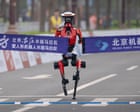
Last month at Beijing’s half marathon, a robot named Lightning beat the human world record by nearly seven minutes. It’s the latest in a string of AI-powered milestones that have got people wondering whether robots are about to enter our everyday lives, just as chatbots have. And the country leading the charge is China, where the government has pledged to invest more than £100bn in robotics over the next 20 years. To find out how robots are already entering the workforce, and what needs to happen to get them cleaning our homes and weeding our gardens, Ian Sample hears from the Guardian’s senior China correspondent, Amy Hawkins, and from Nathan Lepora, professor of robotics and AI at Bristol University, who researches how robots can achieve human-like dexterity
After 88 days of near-total blackout, first reactions to the return of partial connectivity were not celebratory
After 88 days of near-total internet blackout in Iran, long-delayed messages, images and poems flooded phones and social media feeds at about 5pm on Tuesday, when still-limited connectivity flickered back to life.
The first reactions, however, were not celebratory. Many new posts were threaded with scepticism, anxiety and anger.
Agreement averts strike and shows latest impact of AI boom as two more chipmakers join $1tn club
Employees at Samsung Electronics’ memory chip division are to receive bonuses averaging about £310,000 each through a landmark profit-sharing agreement, as the AI boom drives up chipmakers’ profits.
Fears of a strike at Samsung were averted on Wednesday after two unions for the world’s largest memory chipmaker said 74% of the 62,616 workers who cast their votes had backed the deal.
The US president’s reversal on calling for a safety review of new AI models is a green light for tech’s unchecked power
Only hours before Donald Trump was set to sign a long-awaited executive order on Thursday that would have called for a government safety review of new artificial intelligence models before their release, the president abruptly backed out. Despite growing public backlash to the technology and experts warning new models will pose critical security risks, Trump vowed the US government would not slow down the AI race.
During a meeting with reporters on Thursday, Trump cited both American dominance and competition with China and as his reasoning behind the reversal.

 Login
Login