O PRESENTIS, projeto liderado pela GMV, recorre ao sistema de navegação europeu Galileo para garantir segurança e resiliência às infraestruturas críticas europeias para possíveis ataques realizados durante aplicações críticas de sincronização do tempo.
The big bang has causality issues, particularly the "horizon problem." I critique suggested solutions like cosmic inflation and negentropy, arguing that they require unproven concepts. The Creator, as described in the Bible, provides a coherent explanation without causality violations, in contrast with those scientific storytelling fairy tales for adults.
When we look out into space, even with the most powerful telescopes, are we seeing the universe in real time? Are we observing events as they happen, that is, at the time measured on our local clocks?
Due to medical conditions, my postings on Bible Science Forum will be greatly reduced. I need to limit screen time to prevent blurry eyesight. I apologize for the fewer, and briefer posts.
The exploration of time measurement emphasizes the Earth's rotation as a historical clock, defining the 24-hour day. The development of mechanical clocks, notably John Harrison's marine chronometers, advanced navigation. Time's definition evolved from an Earth-centric model to atomic standards, although fundamental concepts of time remain abstract and intrinsic to the universe's creation.
Day 4 of creation, God made the Sun, Moon, planets, and stars, establishing them as luminaries in the heavens. The language of the Bible uses an Earth-observer perspective, meaning that light from celestial bodies was instantly visible. Additionally, I confront naturalistic explanations for celestial origins, proposing a creationist model.
While that image makes for compelling science fiction, a new study shows that it does not match the actual physics behind this concept. Recent research suggests that the original bridge theory was not a wormhole but a mathematical feature of how time is structured. This new realization could help solve a persistent problem in physics.
The study, led by Professor Enrique Gaztañaga from the University of Portsmouth, along with K. Sravan Kumar and João Marto, was published in Classical and Quantum Gravity. The researchers suggest that the bridge functions as a mathematical link between two directions of time, one going forward and the other going backward.
Einstein and Rosen’s Original Concept
Albert Einstein and Nathan Rosen never directly proposed a shortcut through space in their original 1935 theory. Instead, they were studying how quantum fields behave under conditions of extreme gravity. To keep their equations consistent, they described a link between two copies of spacetime that are mirror images of each other.
The interpretation of a wormhole came much later. The bridge in the original concept collapses too quickly for anything to travel through it, making it unusable as a passage. Despite this, the idea of a literal tunnel still became popular.
Gaztañaga and his team reexamined the original idea. They do not view the bridge as a path through space, but as a mechanism of how quantum mechanics works in curved spacetime. Their findings suggest that to fully describe what happens near black holes, we need to consider both directions of time, not just the forward-moving one that we experience.
Solving the Information Paradox
This discovery is significant for one of physics’ biggest puzzles, known as the black hole information paradox. In 1974, Stephen Hawking demonstrated that black holes slowly radiate heat and can eventually evaporate, apparently destroying all information about the matter that fell into them. This directly goes against the belief in quantum mechanics that information cannot be destroyed.
The researchers say the paradox arises only when we think of black holes in terms of a single direction of time. When we include both directions in the quantum picture, information persists at the event horizon rather than disappearing. It continues evolving in the time-reversed component of the quantum state. We cannot see this from our perspective, but the information is still there.
Before the Big Bang
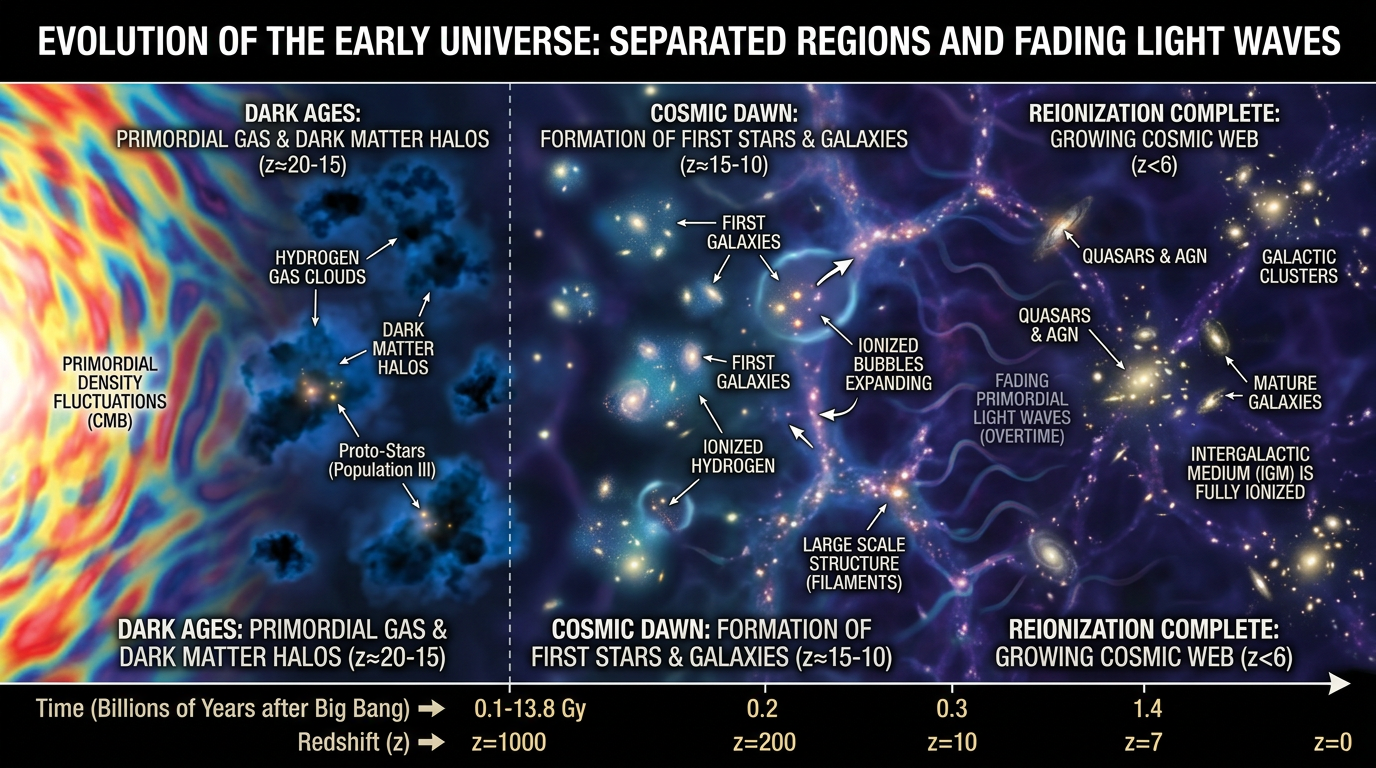
The implications for this extend beyond black holes. If time has two mirrored directions at the quantum level, the Big Bang might not be the absolute beginning. It could instead represent a quantum change from a shrinking universe to a growing one, each with its own direction of time. In this case, our universe could be inside a black hole that formed in an even larger cosmos.
The researchers point to a possible clue from observations. The cosmic microwave background displays a persistent imbalance that standard models struggle to explain. Models with mirrored quantum components fit the observational data better, but the researchers are careful to note that they still do not confirm the theory.
Gaztañaga’s team does not intend for the study to replace Einstein’s theory of relativity or standard quantum mechanics. They instead propose that both ideas gain strength when we take the full, time-balanced structure of quantum mechanics seriously. What the Einstein-Rosen bridge may really describe is not a shortcut between galaxies but a window into the hidden structure of time itself.
Austin Burgess is a writer and researcher with a background in sales, marketing, and data analytics. He holds an MBA, a Bachelor of Science in Business Administration, and a data analytics certification. His work focuses on breaking scientific developments, with an emphasis on emerging biology, cognitive neuroscience, and archaeological discoveries.
The space-time oddities of modern physics may have just been taken to a new level of odd, as researchers have revealed that space and time can be used to form a variety of structures that may then be able to become tiny black holes.
The unusual discovery, reported by researchers from Vienna and Frankfurt, presents a new formula for this unusual effect, which they claim can be used to create a crystal-like structure resulting from spacetime self-organization due to a process physicists call critical collapse.
The findings, now reported in Physical Review Letters, reveal the first successful description of this bizarre phenomenon using a novel mathematical trick, which allowed researchers to derive a precise formula for the phenomenon.
Baby Black Holes
Although black holes are often envisaged as large physical structures that result from the powerful conditions involving stellar deaths, not all of them are so monstrous.
In theory, tiny black holes can also exist, emerging from very minuscule critical states where only the smallest amount of energy is introduced. These states, according to physicists, are believed to have once existed immediately after the genesis of our universe, known as the Big Bang, at which time a disorderly blend of particles persisted in the newborn cosmos—conditions that would have been ripe for the creation of what are known as primordial black holes.
These structures are already theoretically verified through computer simulations, although in their recent research, the Goethe University Frankfurt and TU Wien collaboration has now taken the study of these tiny cosmic monsters to a new level by deriving a mathematical formula to confirm longstanding theories about these tiny black holes.
Curving Spacetime at Smaller Scale
According to Professor Daniel Grumiller, a researcher at TU Wien, even the smallest events can sometimes trigger major changes.
“Take liquid water at zero degrees Celsius, for example,” Grumiller recently said in a statement. “A very small change is enough to make the water freeze. The water molecules then spontaneously arrange themselves into a regular pattern and form an ice crystal,” he says.
Why is this significant? A primary reason involves Einstein’s revolutionary ideas about gravity, in which a similar effect occurs, albeit involving space and time. Specifically, Einstein’s theory holds that particles that change locations can cause changes to the surrounding spacetime.
Christian Ecker of the Institute for Theoretical Physics at Goethe University Frankfurt observes that spacetime is warped more strongly in proportion to the size of objects (in other words, those possessing greater mass).
“Large objects such as stars curve spacetime strongly,” Ecker notes. “For example, we can observe this when light rays are deflected by massive stars.” However, massive celestial objects aren’t the only ones that can curve spacetime.
“Smaller masses also produce spacetime curvature, just to a lesser extent,” Ecker explains.
In the image above, a spacetime-crystal structure is shown on the left, while to the right, a cubic crystal structure is displayed (Image Credit: Vienna University of Technology).
Patterns in Space and Time
According to the researchers, repeating patterns emerge in space and time because of spacetime curvature, in which spacetime can self-organize into a regular, repetitive structure.
This structural form, which they liken to being a sort of “spacetime crystal,” results from a process known as critical collapse.
Grumiller calls the resulting spacetime “crystal,” a “very peculiar and fascinating object,” which he says can be thought of as “a kind of intermediate state, an unstable point that can evolve in two different directions.” Following its formation, Grumiller says that the crystal may then simply dissipate, “leaving behind ordinary spacetime filled with freely moving particles.”
That is, unless an energy input is introduced.
“If a tiny amount of energy is added, the evolution takes a completely different path,” Grumiller says, whereby “the inconspicuous spacetime crystal turns into a black hole.”
Simulating Primordial Black Holes
According to Grumiller and his colleague, Christian Ecker, deriving accurate formulas for such phenomena has proven especially difficult over the years. However, Ecker says they were able to overcome this challenge by instituting a novel trick of mathematics.
“Our universe has four dimensions—three dimensions of space and one dimension of time,” Ecker recently said. “But in principle, nothing prevents us from writing down physical equations for a larger number of dimensions—five dimensions, forty-two dimensions, or even infinitely many.”
Despite the expectation that such conditions might cause theoretical interpretations to become very complicated, the team was able to show that the opposite can be the case, with some questions physicists would normally deem to be extremely complex actually being reduced to relatively simple outcomes.
The team says they hope to explore the possibility that their mathematical formula might be reinterpreted for contexts involving fewer dimensions, which would allow the current models, which relate to the possibility of an infinite number of dimensions, to be scaled back to four-dimensional applications.
So far, doing so has allowed the team to explore four-dimensional universal qualities by taking what one might liken to being a shortcut through a sort of theoretical universe consisting of many dimensions. However, for now, the team’s findings are already proving very promising.
“Our technique turns out to be remarkably stable,” according to Florian Ecker, also with TU Wien.
“Depending on the desired precision, we can systematically improve our formulas using additional approximation methods,” Ecker added. “This gives us a new method for studying black-hole-related phenomena that could previously not be analyzed analytically.”
The team’s recent paper, “Analytic Discrete Self-Similar Solutions of Einstein-Klein-Gordon at Large 𝐷,” appeared in Physical Review Letters on May 12, 2026.
Micah Hanks is the Editor-in-Chief and Co-Founder of The Debrief. A longtime reporter on science, defense, and technology with a focus on space and astronomy, he can be reached atmicah@thedebrief.org. Follow him on X @MicahHanks, and at micahhanks.com.
The researchers behind the framework said the next step will be to prove their concept experimentally. If successful, they suggest that trapped-ion atomic clocks could potentially help unravel physics’ other fundamental question: the elusive nature of gravity.
Quantum Superposition, Gravity, Atomic Clocks, Albert Einstein, and the Flow of Time
In the macro world, time moves in one direction. Although famed 20th-century scientist Albert Einstein showed that gravity and speed can alter the rate at which time flows, his theory of relativity conceded that time at the macro scale inexorably flows in a forward direction.
As recently reported by The Debrief, the research team behind the new theoretical framework notes that this arrow of time remains poorly understood, leading to several theories attempting to explain how it actually works. For scientists studying behavior at the quantum scale, the movement of time becomes even more complex. That’s because time can exist in superposition, a state where different flows of time all exist at the same moment. However, the team notes, this “interplay of time” between relativity and quantum physics has not yet been experimentally verified.
Curious if new, state-of-the-art trapped-ion atomic clocks were precise enough to measure the quantum superposition of time to quantify different flows of time occurring at the same moment, researchers from Kyushu University, in collaboration with the Stevens Institute of Technology, University of Waterloo, the National Institute of Standards and Technology, Colorado State University, and Stockholm University, explored a theoretical framework capable pf capturing this elusive phenomenon.
Theoretical Framework Improves Sensitivity ‘By 100 to 1000 Times’
According to a statement announcing a potential breakthrough in measuring the quantum superposition of time, atomic clocks work by monitoring the frequency of certain atoms. This fundamental design enabled unprecedented timekeeping accuracy, with applications in satellite navigation and GPS systems.
The team notes that state-of-the-art trapped-ion configurations of atomic clocks are so precise and sensitive that “they can detect the time dilation predicted by Einstein’s theory over a height difference of a few millimeters.”
Associate Professor Joshua Foo of Kyushu University’s Institute for Advanced Studies, and one of the lead authors of the paper detailing the measurement framework, said it is the precision of these cutting-edge instruments that motivated his team to design their theoretical model.
“We found that the atomic clock’s motion becomes ‘entangled’ with its internal energy,” Professor Foo explained. “The signature of this entanglement is that the clock itself loses some of its quantum properties, which can be detected using modern techniques.”
When Foo and colleagues introduced a new technique for controlling the motion of these advanced atomic clocks, the professor said their framework indicates an improvement in sensitivity to this effect “by 100 to 1000 times.”
Experimental Proof and Probing the Nature of Gravity
When discussing the possible impact of their new theoretical framework, should it ultimately be used to quantify the quantum superposition of time, the researchers noted that it established atomic clocks as a viable tool for exploring several phenomena in the quantum world that had previously proven difficult to measure accurately, including the quantum nature of time. They also note that it “opens a new experimental frontier in fundamental physics,” as well as offering a viable path to more precise, next-generation atomic clocks.
Next, Foo said that the team is developing a detailed real-world experiment “bringing our theoretical model to reality.” If successful, these upcoming efforts will provide further insights into their model that do not appear in the theoretical version. The research also said his team is interested in whether atomic clocks based on their model could be used to probe the quantum realm of gravity, which he calls “the other fundamental question in physics.”
Christopher Plain is a Science Fiction and Fantasy novelist and Head Science Writer at The Debrief. Follow and connect with him on X, learn about his books at plainfiction.com, or email him directly at christopher@thedebrief.org.
The strange quantum nature of time moves one step closer to being untangled, thanks to new research on optical ion clocks that could allow scientists to test the flow of time in a new way.
Since Albert Einstein first presented his theory of relativity, scientists have known that the flow of time is not absolute. Yet quantum theory takes this further, suggesting that time may exist in a superposition, flowing both slower and faster concurrently, not being set until it is measured.
Now, a research team from the Stevens Institute of Technology, Colorado State University, and the National Institute of Standards and Technology (NIST) has published a paper in Physical Review Letters describing how optical ion clocks could be used to evaluate whether time itself can exist in a quantum superposition.
Atomic Clocks and Quantum Time
In an atomic clock, the device is tuned to the steady vibration of an atom, which acts as a natural metronome, keeping time with extraordinary precision. Thanks to their stability and accuracy, atomic clocks underpin GPS and global communications systems, ensuring that everything is precisely synchronized. Now, researchers are exploring how that same precision might be applied at the quantum level.
These clocks rely on motion—the vibration of an atom. Yet in quantum theory, motion itself can exist in a superposition, remaining uncertain until it is measured. This makes atomic clocks a promising tool for investigating whether the same uncertainty applies to the flow of time.
“Time plays very different roles in quantum theory and in relativity,” said co-author Igor Pikovski, Assistant Professor of theoretical physics at Stevens Institute of Technology. “What we show is that bringing these two concepts together can reveal hidden quantum signatures of time-flow that can no longer be described by classical physics.”
Quantum Relativity
Relativity shows that time is not absolute or independent, but instead depends on the clock measuring it. Velocity and position are key factors that determine how quickly time passes relative to a given observer. For example, a clock moving at a different speed will experience time differently—a phenomenon confirmed by atomic clock experiments.
This idea is often illustrated by the twin paradox: if one identical twin travels at high speed while the other remains on Earth, they will age at different rates. In quantum theory, however, this concept gives rise to the so-called quantum twin paradox, in which a single system can experience multiple timelines simultaneously in a superposition. While this idea is theoretically sound, experimental tests have remained out of reach with current technology.
Atomic Clocks and Relativity
In their new research, the team demonstrated that combining advanced atomic clock technology with quantum computing techniques could enable quantum time research.
“Atomic clocks are now so sensitive, they can detect tiny differences in time caused by just the thermal vibrations at minuscule temperatures,” said co-author Gabriel Sorci, a PhD candidate at Stevens Institute of Technology. “But even at the absolute zero temperature, the ground state, the ticking rate will still be affected by just the quantum fluctuations alone.”
The researchers showed that cooling techniques used in quantum computing can produce so-called squeezed states, where quantum behavior becomes detectable within the clock. In theory, this could allow a single clock to measure time as both faster and slower simultaneously.
“Physics is still full of mysteries at the most fundamental level,” Pikovski concluded, adding that “Quantum technologies are now giving us new tools to shed light on them.”
Ryan Whalen covers science and technology for The Debrief. He holds an MA in History and a Master of Library and Information Science with a certificate in Data Science. He can be contacted at ryan@thedebrief.org, and follow him on Twitter @mdntwvlf.
In an era where digital screens have become ever-present in the lives of children and adolescents, a groundbreaking neuroscientific framework has emerged to articulate the profound impact of early experiential integration in brain development. This latest synthesis, published in the acclaimed journal Brain Health, introduces the concept of the “criticome,” a comprehensive construct describing the totality of sensory, motor, social, cultural, and environmental information integrated by the brain during critical periods of synaptic plasticity. Spanning prenatal phases through approximately the mid-twenties, this framework offers a powerful lens to understand how experience—or its absence—shapes neural architecture with lasting implications.
The importance of these critical windows lies in their load-bearing nature: experiences absorbed during these phases become foundational, permanently embedded within the brain’s circuitry. Conversely, experiences that fail to enter, or are incorrectly integrated, cannot be effortlessly appended later, making early developmental support paramount. Neuroscientists Michel Cuenod, Kim Q. Do, and Julio Licinio, through their careful literature synthesis, stress that this focus shifts research away from simply diagnosing adult neurological dysfunction towards scrutinizing what might have failed to integrate properly during youth.
Central to this shift is a radical rethinking of psychiatric conditions. Disorders traditionally treated as anomalies of adult synaptic functioning—such as autism spectrum disorders, schizophrenia, post-traumatic stress disorder, and major depression—are now increasingly viewed through a developmental prism. For example, schizophrenia appears intimately tied to disrupted maturation of parvalbumin-positive interneurons in the prefrontal cortex during late adolescence, a critical period for synaptic refinement. Similarly, autism spectrum disorders reflect a misalignment of critical period timing across sensory and higher-order association systems, while early life trauma imprints enduring alterations on stress response mechanisms.
Dr. Cuenod elaborates, stating that the existing data have long pointed to schizophrenia as a disorder rooted in neurodevelopmental processes, yet framing precisely what fails and when has remained elusive until now. The criticome, he argues, provides the essential vocabulary and conceptual structure needed to address these intricate questions, helping to link molecular biology to clinical phenomena.
Among psychiatric conditions, major depressive disorder receives special attention within the criticome framework. Drawing on a pivotal natural experiment by Kendler and Halberstadt, it highlights the profound consequences of relational ruptures in genetically identical twins, where social scaffolding—or lack thereof—during late adolescent prefrontal maturation critically influences adult mood regulation. This cumulative continuity model explains how early social experience can snowball into divergent mental health trajectories, mechanistically anchored by criticome integration during key developmental windows.
Underpinning the criticome are six neurobiological mechanisms: GABAergic regulation via parvalbumin-positive interneurons; the formation and maintenance of perineuronal nets surrounding fast-spiking cells; progressive myelination enhancing cortical connectivity; experience-dependent epigenetic modulation altering gene expression; neuromodulatory maturation shaping synaptic responsiveness; and the often underappreciated process of developmental synaptic pruning. Notably, pruning is conceptualized as a fundamental pillar—up to half of all cortical synapses are removed between childhood and adolescence, a process governed by microglial activity and complement system tagging. Once synapses are pruned, they cannot be recovered, underscoring the irreversibility of certain critical period outcomes.
This principle of irreversible plasticity echoes an ancient Brazilian proverb—Papagaio velho não aprende a falar (“An old parrot does not learn to speak”)—which aligns with classical neuroscientific findings like those of Hubel and Wiesel in the visual cortex. These observations affirm that learning and integration during plastic windows are rapid and efficient, whereas after these periods close, the same acquisition becomes laborious and incomplete. This same logic governs language acquisition, motor skill mastery, emotional regulation, and even ethical reasoning.
Crucially, the double-edged nature of critical-period plasticity is emphasized. The mechanisms that enable extraordinary talents, such as a musical prodigy or exceptional athletic performance, are simultaneously responsible for the vulnerabilities seen in developmental delays and neuropsychiatric conditions. The contrast is poignantly illustrated by examples ranging from Mozart’s harmonic genius to the devastating impact of the Romanian orphanages’ neglect on neural and psychological development. Moreover, the framework acknowledges the darker manipulations of criticome plasticity, from the Hitlerjugend’s systemic exploitation of youth to contemporary conflicts that inscribe violence and displacement into children’s criticomes, with sociohistorical consequences that will reverberate for decades.
The pressing question of how screen-saturated environments influence the criticome is identified as central to contemporary discourse. Children today ingest unprecedented quantities of screen-mediated sensory and social input during precisely those windows when neural plasticity is highest. Yet, the authors caution that the nature and long-term impacts of such experiences remain unknown. They advocate for research grounded in their framework to transform moral panic into scientifically testable inquiry, guiding policies and interventions based on empirical evidence rather than speculation.
Dr. Licinio frames this synthesis as essential not only for clinicians but also educators and policymakers. Understanding why language acquisition is more effortless at age five than fifteen, or why investments in early childhood yield significant societal returns, all relate to the criticome’s developmental timeline. Their framework provides an interdisciplinary vocabulary uniting neuroscience, psychiatry, education, and policy toward a cohesive understanding of human potential and vulnerability.
The review draws on an evocative comparison from literature to illustrate its concepts: juxtaposing a passage from James Joyce’s Finnegans Wake with letters from his daughter, Lucia Joyce, who suffered from schizophrenia, both texts reveal similarly fragmented syntax and unconventional imagery. Yet, Carl Jung’s analogy of two people descending a river differently—one by choice, the other by tragic constraint—reflects how intact versus disrupted criticome integration shapes adult cognitive and emotional navigation. This metaphor underscores the lived reality and biological substrate of developmental psychopathology.
Despite its promise, the criticome framework acknowledges limitations. It currently serves as a conceptual scaffold rather than a direct measurement or diagnostic tool. Translating its insights into practical interventions will demand novel methodologies capable of quantifying integrated experiential content within living brains. However, by uniting scattered findings under a precise vocabulary, this framework prepares the field for the next generation of experiments, therapies, and preventive strategies.
The introduction of the criticome concept marks a pivotal advance in neuroscience’s capacity to describe the complex interplay between experience and development. It moves the field beyond fragmented models of memory or cultural learning, offering a holistic perspective on how brains become uniquely human. This vision promises to reshape how we study, nurture, and protect the developing mind amid a rapidly changing social and technological landscape.
Subject of Research: People
Article Title: The criticome as the window of becoming: Toward a novel and comprehensive framework for understanding the critical period of information integration in human development
References:
Cuenod M, Licinio J, Do KQ. The criticome as the window of becoming: Toward a novel and comprehensive framework for understanding the critical period of information integration in human development. Brain Health 2026. DOI: https://doi.org/10.61373/bh026i.0021
Mathematicians from University College London and the University of California, Davis, have published a mathematical proof that the Universe’s accelerating expansion can be explained without dark energy, dealing a serious blow to the Lambda-cold dark matter model.
Kinematics: The Velocity-Time Function By Neil Parker May 2026 Author’s Preface: A Collaborative Approach to Lesson Development The intention behind what I hope will be a series of articles on Kinematics (this one being the first) is to begin an open, collaborative process of lesson development on Physics Forums. In order to expedite this workflow,...
Standard cosmological models are classified by spatial curvature into three broad types: open, flat, and closed universes. These correspond to negative, zero, and positive spatial curvature respectively, and each case has distinct implications for the geometry and global volume of space. Open, Flat, and Closed Universes In the simplest Robertson–Walker models the three cases can...

 Login
Login