Normal view

The LHC is on turning on again! What does that mean?

5 July 2022 at 18:20

Deep underground, on the border between Switzerland and France, the Large Hadron Collider (LHC) is starting back up again after a 4 year hiatus. Today, July 5th, the LHC had its first full energy collisions since 2018.  Whenever the LHC is running is exciting enough on its own, but this new run of data taking will also feature several upgrades to the LHC itself as well as the several different experiments that make use of its collisions. The physics world will be watching to see if the data from this new run confirms any of the interesting anomalies seen in previous datasets or reveals any other unexpected discoveries. 

New and Improved

During the multi-year shutdown the LHC itself has been upgraded. Noticably the energy of the colliding beams has been increased, from 13 TeV to 13.6 TeV. Besides breaking its own record for the highest energy collisions every produced, this 5% increase to the LHC’s energy will give a boost to searches looking for very rare high energy phenomena. The rate of collisions the LHC produces is also expected to be roughly 50% higher  previous maximum achieved in previous runs. At the end of this three year run it is expected that the experiments will have collected twice as much data as the previous two runs combined. 

The experiments have also been busy upgrading their detectors to take full advantage of this new round of collisions.

The ALICE experiment had the most substantial upgrade. It features a new silicon inner tracker, an upgraded time projection chamber, a new forward muon detector, a new triggering system and an improved data processing system. These upgrades will help in its study of exotic phase of matter called the quark gluon plasma, a hot dense soup of nuclear material present in the early universe. 


A diagram showing the various upgrades to the ALICE detector (source)

ATLAS and CMS, the two ‘general purpose’ experiments at the LHC, had a few upgrades as well. ATLAS replaced their ‘small wheel’ detector used to measure the momentum of muons. CMS replaced the inner most part its inner tracker, and installed a new GEM detector to measure muons close to the beamline. Both experiments also upgraded their software and data collection systems (triggers) in order to be more sensitive to the signatures of potential exotic particles that may have been missed in previous runs. 

The new ATLAS ‘small wheel’ being lowered into place. (source)

The LHCb experiment, which specializes in studying the properties of the bottom quark, also had major upgrades during the shutdown. LHCb installed a new Vertex Locator closer to the beam line and upgraded their tracking and particle identification system. It also fully revamped its trigger system to run entirely on GPU’s. These upgrades should allow them to collect 5 times the amount of data over the next two runs as they did over the first two. 

Run 3 will also feature a new smaller scale experiment, FASER, which will study neutrinos produced in the LHC and search for long-lived new particles

What will we learn?

One of the main goals in particle physics now is direct experimental evidence of a phenomena unexplained by the Standard Model. While very successful in many respects, the Standard Model leaves several mysteries unexplained such as the nature of dark matter, the imbalance of matter over anti-matter, and the origin of neutrino’s mass. All of these are questions many hope that the LHC can help answer.

Much of the excitement for Run-3 of the LHC will be on whether the additional data can confirm some of the deviations from the Standard Model which have been seen in previous runs.

One very hot topic in particle physics right now are a series of ‘flavor anomalies‘ seen by the LHCb experiment in previous LHC runs. These anomalies are deviations from the Standard Model predictions of how often certain rare decays of the b quarks should occur. With their dataset so far, LHCb has not yet had enough data to pass the high statistical threshold required in particle physics to claim a discovery. But if these anomalies are real, Run-3 should provide enough data to claim a discovery.

A summary of the various measurements making up the ‘flavor anomalies’. The blue lines and error bars indicate the measurements and their uncertainties. The yellow line and error bars indicates the standard model predictions and their uncertainties. Source

There are also a decent number ‘excesses’, potential signals of new particles being produced in LHC collisions, that have been seen by the ATLAS and CMS collaborations. The statistical significance of these excesses are all still quite low, and many such excesses have gone away with more data. But if one or more of these excesses was confirmed in the Run-3 dataset it would be a massive discovery.

While all of these anomalies are gamble, this new dataset will also certainly be used to measure various known entities with better precision, improving our understanding of nature no matter what. Our understanding of the Higgs boson, the top quark, rare decays of the bottom quark, rare standard model processes, the dynamics of the quark gluon plasma and many other areas will no doubt improve from this additional data.

In addition to these ‘known’ anomalies and measurements, whenever an experiment starts up again there is also the possibility of something entirely unexpected showing up. Perhaps one of the upgrades performed will allow the detection of something entirely new, unseen in previous runs. Perhaps FASER will see signals of long-lived particles missed by the other experiments. Or perhaps the data from the main experiments will be analyzed in a new way, revealing evidence of a new particle which had been missed up until now.

No matter what happens, the world of particle physics is a more exciting place when the LHC is running. So lets all cheers to that!

Read More:

CERN Run-3 Press Event / Livestream Recording “Join us for the first collisions for physics at 13.6 TeV!

Symmetry Magazine “What’s new for LHC Run 3?

CERN Courier “New data strengthens RK flavour anomaly

Multi-Omic Atlas Advances Brain Organoid Engineering

3 June 2026 at 13:48

In a groundbreaking study published in Nature Neuroscience, researchers have unveiled a comprehensive single-cell multi-omic atlas that promises to revolutionize our understanding and engineering of midbrain and hindbrain organoids. This pioneering work not only maps the intricate cellular heterogeneity of these critical brain regions but also integrates innovative morphogen screening techniques to identify key developmental cues essential for organoid maturation and specification.

The brainstem, comprising the midbrain and hindbrain, plays a pivotal role in motor control, sensory information processing, and autonomic functions. Despite its importance, detailed cellular and molecular characterization of these regions has remained elusive, hindering efforts to model brainstem-related diseases and develop targeted therapies. By harnessing single-cell sequencing technologies, the research team dissected the complexity of developing human midbrain and hindbrain tissues at an unprecedented resolution, capturing thousands of individual cells and their epigenomic, transcriptomic, and chromatin accessibility profiles.

This multi-omics approach enabled the researchers to chart the landscape of gene expression patterns alongside epigenetic modifications that govern cell fate decisions. Importantly, they identified distinct cellular populations and developmental trajectories that recapitulate in vivo neurodevelopmental processes. Such high-dimensional data provide a critical reference framework for evaluating the fidelity of brain organoids as experimental models. The atlas further uncovers novel markers and regulatory networks that define unique neuronal subtypes within the midbrain and hindbrain.

To translate these insights into practical applications, the study incorporated systematic morphogen screening—a methodical interrogation of signaling molecules known to orchestrate neural patterning during embryogenesis. By exposing developing organoids to various morphogens and quantifying cellular outcomes through single-cell profiling, the team discovered tailored combinations that drive robust specification of midbrain and hindbrain cell types. These optimized protocols enhance the structural and functional maturation of organoids, closely mimicking endogenous brainstem architecture and dynamics.

This synergy between atlas creation and morphogen manipulation marks a major advance in organoid technology. The refined organoids exhibit improved cellular diversity and spatial organization, offering superior platforms for disease modeling, drug screening, and regenerative medicine. Moreover, the study highlights the critical timing and dosage of signaling cues, informing developmental biology and tissue engineering principles that could extend to other organ systems.

The implications of this work extend into various domains, from neurodegenerative disorder research to the study of congenital brain malformations. By providing a detailed cellular blueprint and morphogenetic toolkit, the researchers empower the scientific community to generate more physiologically relevant and reproducible brainstem models. These advancements could accelerate the discovery of therapeutic targets and personalized medicine strategies for conditions such as Parkinson’s disease, stroke, and brainstem tumors.

Furthermore, the multi-omic atlas lays the foundation for integrative analyses that connect genetic risk factors with specific cell types and developmental windows. Understanding how mutations perturb midbrain and hindbrain lineages at molecular and epigenetic levels can elucidate disease mechanisms and identify intervention points. The single-cell resolution ensures that subtle but critical cellular heterogeneities are not overlooked, paving the way for high-precision neurobiology.

Beyond brainstem research, the methodologies developed in this study represent a blueprint for multi-omic exploration and guided tissue engineering. By combining comprehensive molecular profiling with functional screening of morphogens, the approach circumvents limitations of traditional bulk analyses and random differentiation protocols. This paradigm embraces complexity while providing actionable data to steer organoid development systematically.

As the field of organoid engineering matures, integrating multi-omic atlases with morphogen-directed differentiation emerges as a powerful strategy to emulate in vivo biology more faithfully. Such sophisticated models can capture developmental timing, cellular interactions, and epigenetic regulation simultaneously, which are essential to mimic the brain’s intricate organization and emergent properties. The work thus signifies a step-change towards creating next-generation brain organoids with maximal relevance to human health and disease.

The study’s large-scale datasets and interactive visualizations are poised to become invaluable community resources. Researchers worldwide can leverage this single-cell multi-omic atlas to benchmark their organoid models, design experiments, or delve into specific cell types and pathways. The open dissemination of these resources will foster collaboration and reproducibility, addressing major challenges in neurodevelopmental and neuropsychiatric research.

In summary, this study delivers a transformative contribution by delineating the cellular and molecular architecture of developing midbrain and hindbrain tissues through single-cell multi-omics, coupled with functional morphogen screening to optimize organoid engineering. This dual approach propels the field closer to realizing fully faithful and versatile brainstem organoid models, ultimately enabling novel therapeutic insights and interventions for complex neurological conditions.

Through elucidating the nuanced interplay between genetics, epigenetics, and external signaling in brainstem development, the work also offers profound biological insights into human neurogenesis. It opens avenues to investigate how diverse neuronal circuits are established and maintained, providing a platform to study connectivity, plasticity, and response to injury at a granular scale.

By integrating cutting-edge multi-omic technologies with experimental morphogen screening, this research embodies the forefront of neurobiology and tissue engineering innovation. It underscores the importance of multi-disciplinary approaches combining computational biology, molecular neuroscience, developmental biology, and bioengineering to tackle some of the most challenging questions about the human brain.

As the scientific community harnesses these insights, the prospect of modeling patient-specific brainstem circuits and pathological states grows ever more tangible. This could ultimately lead to breakthroughs in diagnosing and treating diseases with a devastating impact on motor, sensory, and autonomic functions. The promise of personalized brain organoids informed by this atlas and morphogen optimization signifies an exciting future for neuroscience research and regenerative medicine alike.


Subject of Research: The study focuses on the development of a single-cell multi-omic atlas and morphogen screening to understand and engineer midbrain and hindbrain organoids.

Article Title: Single-cell multi-omic atlas and morphogen screening informs midbrain and hindbrain organoid engineering.

Article References:
Azbukina, N., He, Z., Lin, HC. et al. Single-cell multi-omic atlas and morphogen screening informs midbrain and hindbrain organoid engineering. Nat Neurosci (2026). https://doi.org/10.1038/s41593-026-02316-x

Image Credits: AI Generated

DOI: https://doi.org/10.1038/s41593-026-02316-x

ATLAS Collaboration Physicists Just Revealed the Discovery of an Entirely New Exotic Particle

28 May 2026 at 14:45

Physicists with the ATLAS Collaboration report the first observation of an exotic new particle, which could help deepen our understanding of the mysteries surrounding one of the four fundamental forces in physics.

The achievement was revealed recently at the Large Hadron Collider Physics conference, where researchers said the new particle appeared to display properties strongly suggestive of the Bc*+ meson.

This unique particle is theorized to be a variation of the Bc+ meson, albeit in a more excited form. The observation now brings the total number of new particle discoveries by CERN’s Large Hadron Collider (LHC) to 82.

A New Particle Emerges

Both the newly discovered Bc*+ meson is part of the broader family of Bc+ meson particles, which consist of an antiquark at their bottom and an up (B⁺. ), down (B⁰. ), strange (B⁰. ₛ) or charm quark (B⁺. c) in their top position.

Such particles were once relegated only to theory since the top quark’s short lifetime would seemingly prevent their physical existence. However, confirmation of the Bc*+ meson, which possesses a charm quark and a bottom antiquark, could help move physicists closer to understanding the mysterious strong force, which, along with the weak force, electromagnetism, and gravity, constitutes the four fundamental forces of the Standard Model of particle physics.

Even after many decades, physicists remain in the dark about certain characteristics of the strong force, such as how it can bind quarks together.

Particles that consist of heavy quarks offer physicists a promising means of testing a range of theories about how the strong force functions, and Bc+ mesons are of special significance in such efforts since they provide a pathway for physicists to unravel clues to what, precisely, holds these particles together.

The Newest Member of the Bc+ Family

According to a recent CERN news release, the new particle was generated during extremely high-energy proton-proton collisions at the LHC.

Before decaying into a Bc+ meson and a photon, the new particle was successfully observed, albeit briefly. According to CERN researchers, a detection of the photon coinciding with the properties of decay associated with the Bc+ meson could offer a long-sought “smoking gun” that would demonstrate the Bc*+ meson.

A key issue physicists currently face involves the particle’s mass: it is anticipated that the mass of this particle would clock in at only a tiny bit larger than the Bc+ meson. Because of this, the photon that should emanate from the decay at the time of the particle’s generation would possess so small an amount of energy that it would likely be indiscernible using any conventional methods.

To overcome this, researchers tried a different approach: They decided to look within the ATLAS tracking detector for the photon converting into an electron-positron pair. In theory, the ephemeral, closely spaced charged particle “tracks” would be produced as a result of the primary proton-proton collision.

“These tracks can have transverse momenta as low as 100 MeV – significantly lower than those typically studied in ATLAS analyses,” according to the recent statement. “This required researchers to deploy a dedicated track-reconstruction procedure to be able to successfully reconstruct the photons and thus identify the Bc*+ meson.”

Toward a Better Understanding of the Strong Nuclear Force

According to researchers, the differences measured between the masses of the Bc*+ meson and the Bc+ meson are 64.5 ± 1.4 MeV, which falls well within the expected ranges based on current theoretical models.

While falling within expected ranges, ATLAS Collaboration researchers did note that the observed differences differed slightly from current high-precision calculations for these values. Still, the discovery offers more than enough data to assist in broadening current theories and eventually allow physicists to glean new insights into the mysterious strong force.

“This result provides valuable new input for theoretical models describing the masses of particles containing the heavier quarks and will help to improve the understanding of the strong nuclear force,” the researchers said.

The ATLAS Collaboration’s findings were reported in a new paper, “Observation of a B∗+c meson with the ATLAS detector,” which appeared on the preprint arXiv.org server.

Micah Hanks is the Editor-in-Chief and Co-Founder of The Debrief. A longtime reporter on science, defense, and technology with a focus on space and astronomy, he can be reached at micah@thedebrief.org. Follow him on X @MicahHanks, and at micahhanks.com.

CERN Physicists Observe New Exotic Particle

25 May 2026 at 22:15
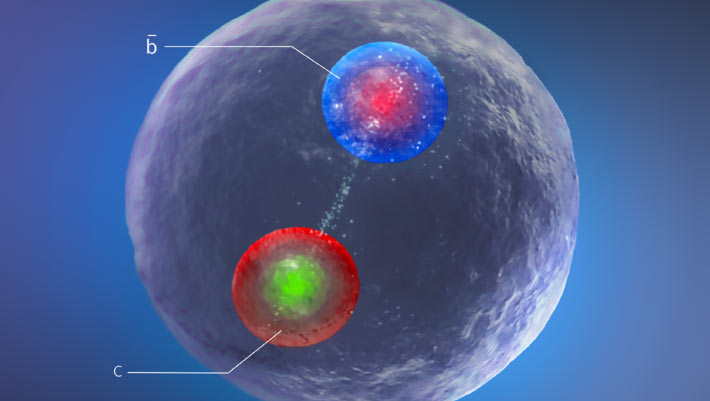
An artist’s impression of the Bc*+ meson. Image credit: Daniel Dominguez / CERN.

Physicists with the ATLAS Collaboration at CERN’s Large Hadron Collider (LHC) have observed the Bc*+ meson, an excited version of the Bc+ meson -- both consist of a charm quark and a bottom antiquark.

The post CERN Physicists Observe New Exotic Particle appeared first on Sci.News: Breaking Science News.

❌