You’ve been paying a tax on being healthy. Four dollars here for hydration, five there for sleep, another subscription for fasting, another for habits, and each one only ever sees its own slice of you. Your Apple Watch is already collecting the whole picture; what’s missing is a set of apps built to work with it, and with each other.
The FunnMedia Premium Plus Bundle Unlock 13 premium apps on your Apple devices for less than $5/month. fixes that with one subscription: 13 premium apps for health, wellness, and productivity, fully unlocked, for $59.99 a year.
What makes it work is that every app comes from the same small indie studio and is built around Apple Health, Apple Watch, and widgets. Because they all read from and write to Health, a log in one app shows up where it should, and the whole set shares one design language instead of feeling like a pile of downloads.
In practice, a day looks like this. SleepMinder scores last night before you’re out of bed. WaterMinder nudges you from your wrist before you’re thirsty. Calory scans your lunch barcode, FastMinder watches your eating window, and Couch to Fit squeezes in a seven-minute workout before dinner. FitnessView pulls all of it into dashboards that show real trends, HabitView keeps your streaks honest, and ZenMinder and RelaxTopia handle the wind-down. When your doctor asks for numbers, HealthExport hands over a PDF. Widgetive, NoteFolio, and ReplyCube cover the productivity side.
This isn’t an unknown lineup. WaterMinder is an Apple Editors’ Choice with more than 10 million downloads!
Bought individually, these subscriptions run past $300 a year. The bundle is $59.99, cancel anytime, and every app FunnMedia releases from here on is added automatically. Subscribe once and the next launch is already yours. Get it at funnmedia.com/bundle.
Equations once used to predict whether populations of rabbits would boom, stabilize, or collapse are now being applied to something potentially even more complicated: romantic relationships.
According to mathematician Laurent Pujo-Menjouet of Claude Bernard University Lyon 1, the forces that determine whether a couple survives life’s inevitable stresses can be studied much like other complex systems. Attraction can strengthen or fade, outside pressures can push a relationship away from stability, and perhaps most importantly, there may be a critical mathematical threshold beyond which recovery becomes increasingly difficult.
In his new book, Love! Valour! Equations! The Mathematics of the Couple, published by CRC Press, Pujo-Menjouet draws on mathematical ecology, psychology, literature, and even film to explore why some couples weather years of conflict, stress, children, illness, and financial hardship while others gradually drift apart.
The goal isn’t to produce an equation that predicts who will fall in love with whom. Instead, Pujo-Menjouet treats relationships as dynamical systems—systems that change over time, respond to disturbances, and can move toward either stability or decline.
“There is no mysterious enchantment ormagic potion. By now, that would be known,” Pujo-Menjouet writes in the book, which draws on mathematics,psychology, literature, and film. “Is all hope lost then? Certainly not. That is precisely where everything becomes interesting.”
From Rabbits to Relationships
The mathematical models Pujo-Menjouet uses originated in ecology. His work uses Malthusian growth models and the Lotka-Volterra equations, originally developed to describe population dynamics in animals such as rabbits. He also studies the Allee effect, a phenomenon that explains how populations struggle to recover if they drop below a particular size.
Pujo-Menjouet adapts these concepts to relationships, using the idea of a critical threshold to examine when a couple may become increasingly vulnerable to separation. He also draws on the research of psychologist John Gottman, who showed that relationship behaviors can be quantified as data.
“Just as we can predict population growth or endangered species, we can model the evolution of feelings within a couple,” Pujo-Menjouet explains. “We’re not trying to predict who you’ll fall in love with, we’re trying to understand why some couples remain stable despite life’s inevitable shocks while others slowly drift apart.”
A Threshold for Falling Apart
The basic idea is simple: a relationship may have a critical threshold, or minimum level of stability needed to keep the bond intact. Pujo-Menjouet’s model considers three main forces: mutual attraction, the gradual weakening of feelings over time, and each partner’s emotional response to the other.
“If your feelings fall below this threshold and stay there, the mathematics predicts an inevitable decline toward separation,” Pujo-Menjouet says. “However, understanding this threshold gives couples a powerful tool: they can recognize danger zones and take corrective action.”
These models emphasize how couples recover from drifting apart. The key question is not whether couples experience conflict, but whether they have the resilience to restore balance afterward.
“Life will always send its wolves: stress, illness, work, children, financial difficulties,” Pujo-Menjouet says, “mathematics helps us understand how to build the brick house rather than the straw one.”
Could AI Become Love’s Early-Warning System?
Researchers such as Pujo-Menjouet are considering whether they could combine these mathematical models with artificial intelligence to create an early-warning system for relationships. Such a system could detect the signs of instability before they become apparent to the people involved.
Pujo-Menjouet compares this method to a GPS for relationships, showing where a couple currently is, where its dynamics may be heading, and the various ways they could arrive at a healthier place. Although the models don’t decide who somebody will love, they can help explain how relationships evolve and what actions might help couples maintain their connection. Early detection of problems would allow partners to make changes before reaching a stage where recovery becomes unlikely.
Why Love Resists a Formula
Pujo-Menjouet admits that present-day mathematical models have limitations. Most of these models are based on data from Western relationships. In contrast, the factors that impact whether a relationship succeeds or fails can differ from one culture, religion, or generation to another. He points out that the model must account for additional factors to be applicable everywhere.
Human behavior also introduces unpredictability that mathematical models cannot fully account for. People can change their habits, strengthen their commitment, seek therapy, or otherwise alter the dynamics of a relationship in ways the equations cannot anticipate. The equations identify tendencies rather than determine an unavoidable outcome.
“Mathematics can illuminate patterns and provide guidance,” Pujo-Menjouet says, “but ultimately, the success of a relationship depends on two people choosing, every day, to nurture their connection. The equations can show you the path, but you still have to walk it together.”
Austin Burgess is a writer and researcher with a background in sales, marketing, and data analytics. He holds an MBA, a Bachelor of Science in Business Administration, and a data analytics certification. His work focuses on breaking scientific developments, with an emphasis on emerging biology, cognitive neuroscience, and archaeological discoveries.
Jaden Caradine knew he wanted to be an engineer at eight years old. He just took a winding road to get there.
Before he enrolled at Embry-Riddle Aeronautical University, before he discovered the field that would become his focus, and before he landed a Pathways internship at NASA’s Langley Research Center in Hampton, Virginia, Caradine spent five years as a mechanic in the United States Marine Corps, four of them stationed in Japan. It was a deliberate detour, one that shaped how he approaches everything since.
“I’ve kind of always known I wanted to be an engineer,” he says. “I just had to figure out what kind.”
NASA Pathways intern Jaden Caradine
Credit: NASA
Finding the Overlap
Caradine grew up in the Salt Lake City area, raised by a mother who put him on a snowboard at four and on a rock face not long after. He was the kind of kid who learned to love science not for its own sake, but for what it could do. “Math is an enabling skill,” he says. “It’s not about doing the math. Math has a purpose and it’s useful.”
By the time someone asked young Jaden what he wanted to be, the answer was immediate. “I was building Legos,” he says, “and I just thought — I want to build stuff. I can’t really see myself being anything other than an engineer.”
Right out of high school, Caradine enlisted in the Marines, trained as a mechanic, and shipped out to Japan. During those five years, between the technical work and the distance from home, he started reading books on decision-making, career planning, and long-term thinking. He found a framework he keeps coming back to: ikigai, a Japanese concept that maps the intersection of what you’re good at, what you enjoy, what the world needs, and what you’re paid to do.
Caradine at the Sapporo Snow Festival in Hokkaido, Japan, while serving as a U.S. Marine Credit: Jaden Caradine
“Your ikigai is the thing where all of those overlap,” he says. Engineering was already in the picture. The question was what kind.
Chasing the Signal
The answer arrived through research and a company Caradine stumbled on while scanning the landscape of emerging aerospace technology. They were using magnets to spin a launch system to 14,000 or 15,000 RPM and release small satellites into orbit, recovering the energy on the way down through the same magnetic system. “I thought that was awesome,” he recalls. “So, I started looking into aerospace engineering, and it was a good fit.”
Once he had the field, the destination wasn’t hard to find. Caradine transferred to Embry-Riddle Aeronautical University’s Daytona Beach campus to study aerospace engineering and immediately started showing up everywhere he could — satellite conferences at Kennedy Space Center, industry events in Orlando, small satellite gatherings back in Salt Lake City. “I went to all the career fairs, even though I wasn’t looking for a job yet,” he says. “I just wanted to learn as much as I could, as fast as I could.”
At every NASA booth, he asked questions. He learned about Pathways, the program that places undergraduate and graduate students at NASA centers with the potential to convert to full-time civil service positions, but he waited a year to apply. “I hadn’t really done the things I wanted to do in order to write a strong application yet,” he says. He wrote the next application with the intention of using it as a practice run. He got in.
His reason for choosing NASA over industry was simple and firm. “NASA doesn’t work for profit,” he says. “We’re here to remove barriers so that industry can eventually do the things they weren’t able to do before.”
“Human beings are far more capable than we give ourselves credit for. A journey of a thousand miles starts with a single step and can only be taken one step at a time.”
Work Worth Doing
At NASA Langley, Caradine is part of the Systems Analysis and Concepts Directorate, where “we help agency leaders figure out why they should make certain decisions, especially those that have lots of moving parts,” he explains. Specifically, he works with the in-space servicing, assembly, and manufacturing (ISAM) team, a group focused on the emerging field of building and maintaining infrastructure in space, rather than simply launching and discarding it.
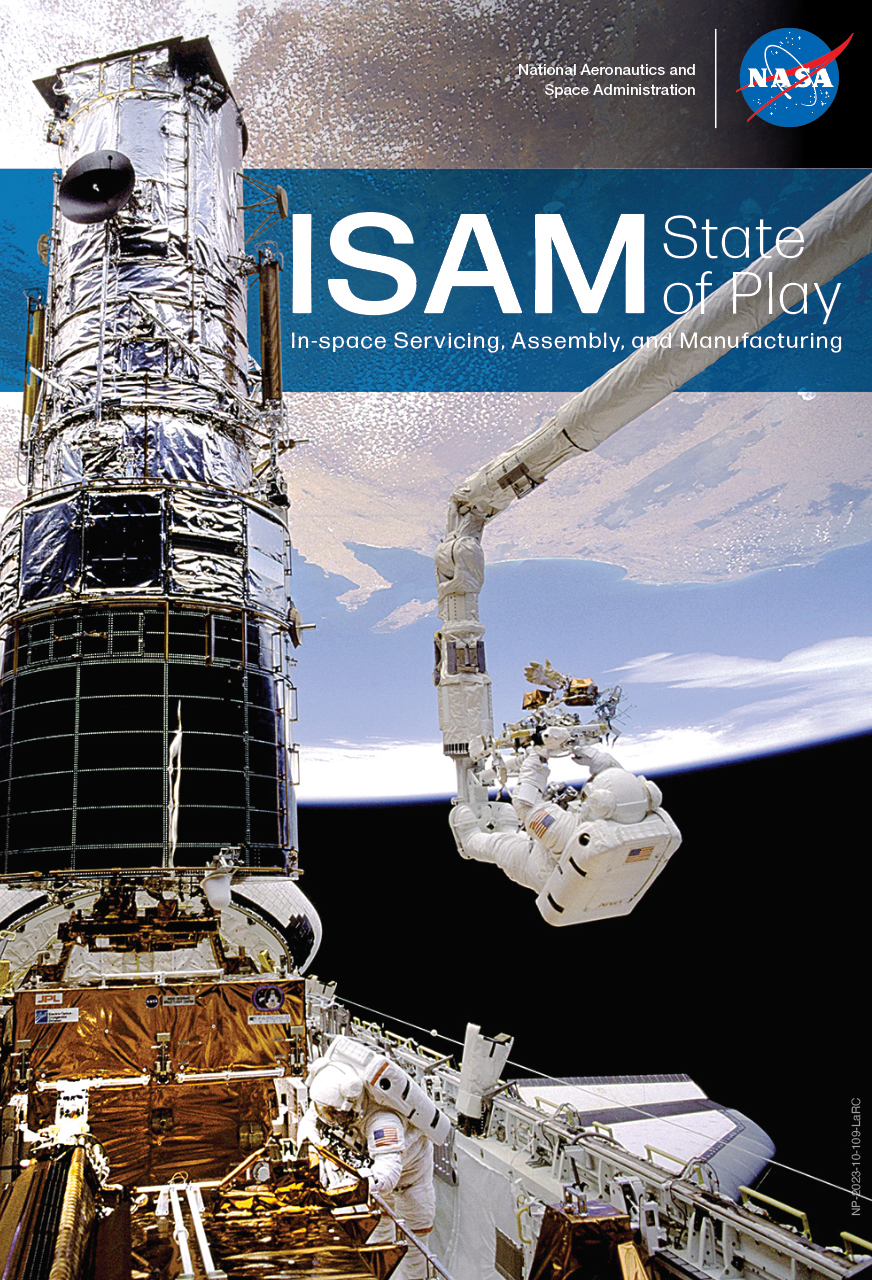
A major part of his summer was curating the State of Play, a comprehensive document that consolidates everything happening in the ISAM sector across government, academia, and industry into a single, navigable resource.
“Jaden joined the team and immediately contributed to this year’s State of Play update,” says Dale Arney, aerospace engineer and Caradine’s mentor. “He also created an automated tool that will help the team create future updates more quickly.”
The ISAM State of Play document is a survey of past, present, and near-future ISAM capabilities across industry, academia, and government agencies.
Credit: NASA
That tool scrapes aerospace news from across the web, compiles relevant updates into organized tables, and produces a readable summary on a regular cadence. “It kind of replaced the need for everyone on the team to spend 30 or 40 minutes every day scrolling through news to keep up,” he says.
“Jaden was constantly looking for ways to improve himself, the team, and our products,” Arney adds. “He was eager to take the lead in trying a number of new processes and ideas to try to make them work for us.”
No Silos
The thing that surprised Caradine most about NASA Langley had nothing to do with the technical work. He had expected some departmental siloing that could develop in large organizations, where people become experts in narrow areas with limited cross-pollination among teams.
“That’s not something I’ve experienced here,” he says. “We all talk to each other, across all teams. We share resources. We collaborate quite extensively.” He describes a culture that expects everyone to engage with the whole problem, not just their corner of it. “Everyone kind of bounces around on different teams to learn the whole aspect of the problem and support each other.”
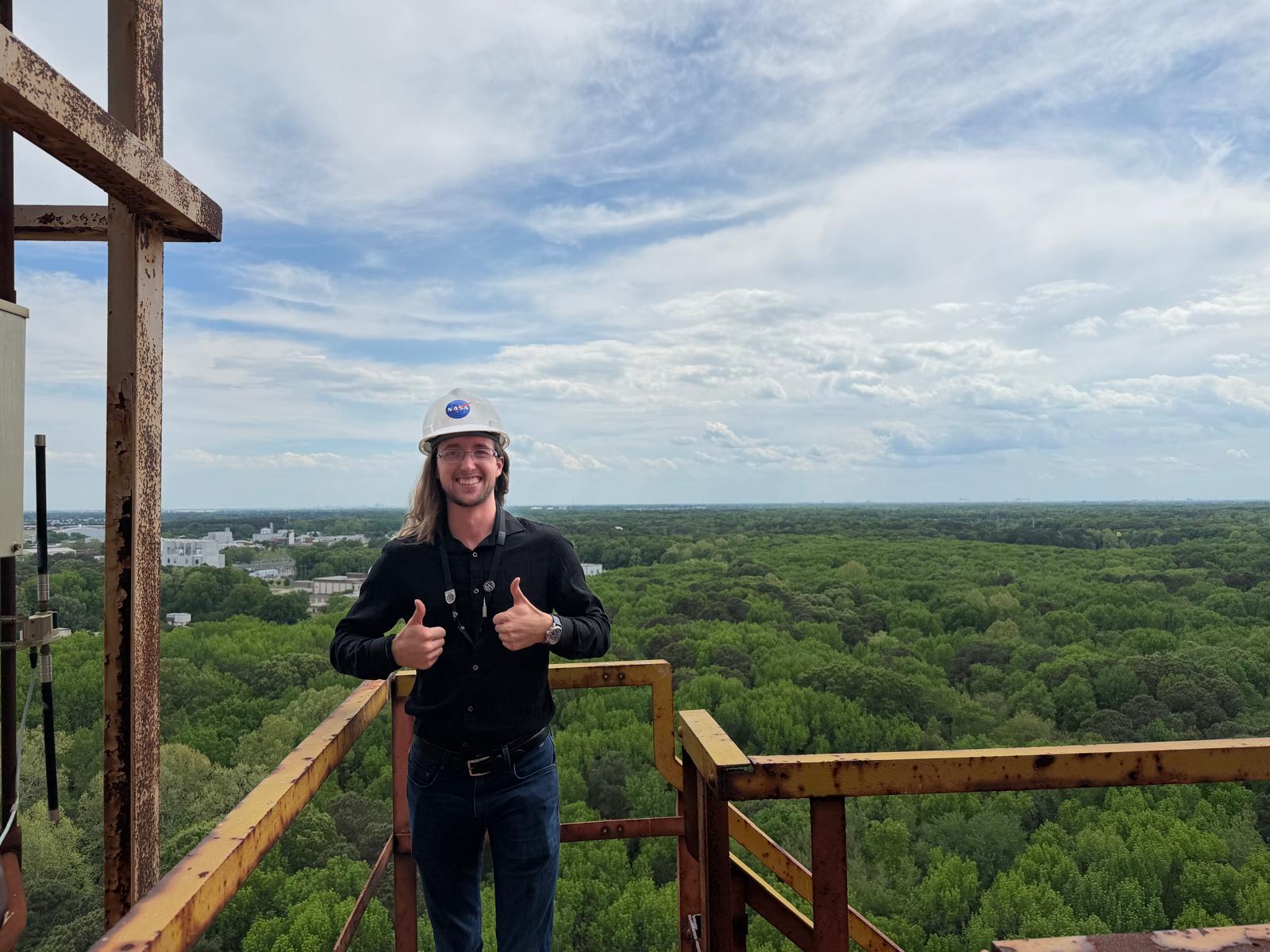
Caradine at NASA Langley’s Impact Dynamics Facility, enjoying the view at the top of the gantry
Credit: NASA
For anyone considering the Pathways program, his advice is direct. “Do it,” he says. “Human beings are far more capable than we give ourselves credit for. If it seems like too much, break it down. A journey of a thousand miles starts with a single step and can only be taken one step at a time.”
Caradine heads back to Embry-Riddle as a junior this fall, with plans to return to Langley next summer. Grad school is on the horizon, and he’s exploring programs that nurture important analysis skills for SMAB, including decision, strategic, and systems analysis.
“Before coming here, I was trying to do everything and cast a wide net,” he says. “Now I know what I need to know how to do. That’ll give me the opportunity to focus my efforts on the high-value skill sets.”
On Caradine’s Sci-Fi Shelf
The Sirens of Titan by Kurt Vonnegut
Dungeon Crawler Carl by Matt Dinniman
Caradine’s instinct runs more toward fantasy than science fiction, but this one, he says, hits something real.
“I enjoy the leveling aspect — constantly improving, constantly getting better. In books it might be physical strength, but in reality, strength takes on many different forms. Constant improvement is quite rewarding in real life, as it is in books.”
The audiobook production, he adds, is its own experience: full sound design, character actors, the works. “It’s like listening to a movie.”
The team also recently convinced him to start Dune, by Frank Herbert. He’s about halfway through.
People online are distressed at men butchering words such as ‘hyperbole’ and ‘hors d’oeuvres’ – highlighting a gender reversal in ‘intelligence gaps’
There are common non-negotiables we look for in a prospective partner. They should be kind, caring and thoughtful. Having a shared interest helps. So does remembering important dates and anniversaries. But how much does it matter if they know how to pronounce the word “gnocchi”?
Turns out that’s a potential dealbreaker, at least according to a (rather judgy) cohort on TikTok. See: the “Illiterate Boyfriend” trend, which is testing some couples on the app. Users have compiled a list of what are essentially SAT words for women to ask their male partners to read. Many of these men – this is an overwhelmingly heterosexual activity – fail to finish the list unscathed. They trip over entries such as “hyperbole”, “cynicism”, “diaphragmatic” and the oft-butchered French term, “hors d’oeuvres”.
It’s Zac here, the developer of Soulver — a notepad calculator you might have heard of. You type your thinking in plain text, and live answers appear in a column alongside as you go.
I started working on Soulver all the way back in 2005. The reason I’m still improving it 20 years on is the enthusiasm of the people who use it: nearly every day, someone writes to tell me how useful it is in their daily work. For many of them it’s one of those apps that stays open all day — for every budget, quote, and what-if.
This summer I released Soulver’s biggest update in 7 years, with 50+ new features. My favorite is trip planning: write out how many nights you’d like to spend in each destination, and Soulver works out the dates of every leg. Rearrange the itinerary and the dates update. There’s nothing quite like it.
Soulver continues to be a one-time purchase, not a subscription. By popular request, it’s now also a universal purchase: buy it once and it’s yours on Mac, iPad & iPhone. And this week, MacStories readers can get Soulver for $20 off: $39 instead of $59. The offer runs through September 11.
Soulver isn’t for everyone. But if you’re the kind of person who likes to think through problems with numbers step by step, give it a try — there’s a free 60-day trial, so you can see if it clicks for you.
At Macstock, Mike Schmitz turns the tables and interviews Chuck Joiner about favorite memories from the event. They review the gathering’s beginnings after Macworld, the friendships formed and renewed each year, memorable moments and how some of the strongest connections come unexpectedly. A big part of Macstock is the the inspiration attendees take home; Mike […]
At the Flip the Script event during WWDC 2026, Arina Shapran, Head of of Social Media and Community for MacPaw, talks about the role of social platforms in modern marketing, intentional online engagement, and building meaningful communities. Arina’s perspective highlights their efforts for developers, vendors, and partnerships behind Setapp, while considering how AI and vibe coding are changing product creation.
Social media scuttlebutt about Mark Zuckerberg’s $300 million superyacht failing to assist stranded boaters off the coast of Alaska was partly corroborated by ship-tracking data—and eventually prompted responses from both the US Coast Guard and a spokesperson for Zuckerberg.
The incident was made public when Michael Love, a passenger aboard the replica steamship Wilderness Legacy during an Alaska cruise, posted about it on the social media platform Bluesky. The ship detoured to rescue a stranded 21-foot skiff with two women, a child and a dog, after the US Coast Guard had supposedly first radioed Zuckerberg’s superyacht, Launchpad, for help without success.
“There was near unanimous booing when the captain announced this,” Love wrote in describing the Alaska cruise passengers’ response to the lack of help from Zuckerberg’s ship.
If you read MacStories, you might have caught John’s Finalist 1.0 review a few years back. A lot has changed since: version 4.0 is out this week, its biggest update yet. Finalist is a paper-inspired daily planner for iPhone, iPad, Mac, and now Apple Watch, giving you one place to plan your day, week and month. It wrangles all your stuff into one cohesive system to help you stay on top of it all: Reminders, Calendars, habits, tasks, notes, weather, and lots more.
New in 4.0 are Notes. Write native notes that sync to your iCloud, or point Finalist at a folder of markdown files and it round-trips cleanly with Obsidian vaults, GitHub, or any editor you like. Markdown tasks inside those files show up in your timelines as real tasks, on the right date, with the right tags. There are even timeline swimlanes per tag, to visualize any endeavour.
The Watch app is also new and it extends Finalist to your wrist. Its Now card answers the day’s current question: your first moves in the morning, the running time block with a countdown, an evening wrap-up with streaks to protect. It has some very nifty complications and a Smart Stack widget.
Or take a look at Broadsheet, a newsprint-inspired layout that shines on big screens. It has delightful touches throughout: tap a World Clock and the whole page retunes to another city, with date, weather, tasks, and appointments all in that timezone. The Timeline tab lets you sketch your day in pencil. Perfect for timeblocking, especially with Pencil Pro and its squeeze menu.
Apple has featured Finalist as App of the Day multiple times, and a large Discord community drives it forward. To help you try it, MacStories readers get 50% off their first year with code MACSTORIES40.
Our thanks to Finalist for sponsoring MacStories this week.
You think faster than you can type. Across a day of email, Slack, notes, and chatbot prompts, that gap quietly eats your time.
Cotypist closes that gap. It’s smart autocomplete for your Mac: as you write, it predicts your next few words and shows them inline, right at your cursor. Press Tab to take the next word or the whole line, then carry on. If a suggestion isn’t what you had in mind, keep typing and it catches up within a letter or two. Accept a word here and a line there, and you’ll have to type far less than you used to.
Most AI writing tools try to do too much and don’t sound like you. Cotypist only fills in the words you’d have typed anyway (just faster), and it picks up your vocabulary as you go, so the result still sounds like you. It works almost everywhere you write: Mail, Messages, Slack, Notes, Obsidian, your browser, even the prompt box in ChatGPT. And it all runs on your Mac, so nothing you type ever leaves your Mac.
Cotypist comes from the maker of Timing, the Mac time-tracker many MacStories readers already know, so it’s built to feel native and stay out of your way. Setup takes about a minute: drag it into Applications, launch it, then start typing, no account required.
Cotypist is free to download, with a 30-day Pro trial and no credit card. When the trial ends, you can keep Pro or drop to the free plan. Until the end of August, MacStories readers get 10% off their first bill at cotypist.app/macstories. Give it ten minutes and see if it can keep up with you.
Our thanks to Cotypist for sponsoring MacStories this week.
Staying up to date has never felt more overwhelming.
Between websites, newsletters, podcasts, social media feeds, and specialized publications, valuable information is scattered across countless apps and platforms. The challenge is no longer finding content – it’s keeping up with it without wasting time or missing what matters.
Inoreader helps you build your own personalized newsfeed by bringing together the sources you care about in one place. Instead of jumping between websites, inboxes, and apps throughout the day, you can keep up with everything from a single interface designed to help you stay informed while cutting through the noise.
Unlike algorithm-driven feeds, Inoreader puts you in control. Follow the websites and creators you trust and receive their updates directly. No engagement-driven recommendations and endless scrolling, just the content you’ve chosen to follow.
For those who need more than a traditional feed reader, Inoreader offers powerful monitoring tools. Create custom feeds to track keywords, brands, companies, competitors, products, or industry trends across the web and receive updates automatically whenever something new appears.
As your reading list grows, Inoreader helps you organize and revisit important information. Save articles for later, highlight key passages, add notes, and build a searchable archive of knowledge and insights that remains accessible long after you’ve finished reading.
To help you process larger volumes of content, Inoreader’s Intelligence features can summarize articles, extract key insights, and help you make sense of information faster. Whether you’re following daily news, researching a topic, or monitoring developments in your industry, Inoreader helps you stay informed without getting overwhelmed.
Advanced filtering and automation tools can further streamline your workflow by automatically organizing incoming content, surfacing what matters most, and reducing distractions – saving you time while ensuring important updates never slip through the cracks.
Inoreader is available on the web, iPhone, iPad, and Android devices, with offline reading support on mobile, so your newsfeed is always available when you need it.
You can get started with Inoreader for free, or explore everything the Pro plan has to offer with a 14-day free trial and no credit card required. New Pro subscribers can also get 30% off their first year.
HomeSnap remembers everything your HomeKit home does, shows you its live status, and tells you the moment something needs attention, right from your iPhone, iPad, or Mac. No accounts, no third-party servers, and your data stays private to you.
Your Home, Remembered
Apple’s Home app shows you this instant. HomeSnap shows you the whole story. It quietly captures a snapshot of your entire setup about once a day and tells you exactly what changed, room by room and device by device. A Timeline and a live Event Log let you scroll back through motion, lights, locks, and doors as they happened, so “did the garage really open at 2 a.m.?” finally has an answer.
Your Home Has an API
This is the part power users tend to love. Flip one switch in Settings and HomeSnap serves your home over your own Wi-Fi, off by default, LAN-only, no cloud and no account involved:
A local web dashboard you can open from any laptop, phone, or tablet on your network: live status tiles, an activity heatmap, charts, and per-room and per-device pages.
A read-only JSON HTTP API with real endpoints for your home, rooms, accessories, scenes, automations, events, change history, health, and battery and temperature trends. Point a script, a shortcut, or a Home Assistant REST sensor at it and pull structured data out of HomeKit without touching a single Apple framework.
An MCP server (Model Context Protocol), so you can connect the AI assistant you already use, like Claude, and ask about your home in plain language: “which batteries will die first?”, “what happened in the garage last night?”, “which lights were on longest this week?” The assistant reads your home, read-only, over your own network.
Markdown and JSON exports of your home and its history, plus live updates over WebSocket for anything you want to build on top.
Everything here is read-only and stays on your network. Nothing about your home is sent to a third party, and you can put a password on it.
Live Status and Smarter Batteries
The My Home tab is your home exactly as it is right now: which lights are on, which doors are open, what every sensor reads. Battery-powered devices are ranked most-urgent-first, and HomeSnap estimates how long each one will last (“about 3 weeks”) from its own history, so a dying sensor never catches you off guard.
Alerts You Actually Want
Build your own notification rules: pick an accessory, pick a trigger (a light turns on, a garage door opens, a fan passes a speed you set), and get told when it happens. Add freeze and overheat temperature alerts, low-battery warnings, and quiet hours so nothing pings you overnight.
Insights Into How Your Home Lives
A native Insights screen shows an activity heatmap of your busiest hours, your most active devices and rooms, each light’s total on-time, and recent door and lock activity. The same numbers power a private web dashboard you can open from any device on your Wi-Fi.
A Vault for Your Setup Codes
HomeSnap saves your HomeKit and Matter pairing codes so you can re-pair a device after a reset. Scan a code or type it in, and it comes back later as a scannable QR or a large, readable number, safely stored in iCloud.
Our thanks to HomeSnap for sponsoring MacStories this week.
If you read MacStories, you’ve likely heard of Halide. For nine years, it’s been the definitive iPhone “pro camera app,” garnering an Apple Design Award, and happy users all over the world. Two years ago, Halide added Process Zero, a feature that lets your iPhone take photos free of AI and algorithms in the spirit of analog photography. Halide Mark III takes that to the next level with its new Looks, Photo Lab, and streamlined design.
Halide Mark III now produces gorgeous photos straight out of camera, thanks to film-inspired Looks developed in partnership with renowned Hollywood colorist Cullen Kelly. For the times you feel like fine-tuning things, Mark III includes a powerful image lab that makes it easy to dial in a perfect look in seconds.
Chip shortages are hitting everyone’s wallets, so we’ve decided to run our first sale in three years, exclusively for MacStories readers. This week only, you can get Halide for 25% off your first year with offer code MACSTORIES2026SUB, or 25% off a one-time-purchase with offer code MACSTORIES2026OTP.
Our thanks to Halide for sponsoring MacStories this week.
Ukrainian drone strikes have forced Russia to completely halt shipping in the Sea of Azov in less than a week, showing once again how a country without traditional naval power can still effectively blockade maritime corridors.
Ukraine’s Unmanned Systems Forces have flown one-way attack drones to target and strike more than 100 Russian tankers and other ships in total, along with posting video evidence showing such drone strikes occurring every night between July 6 and July 14. The campaign has forced Russia to completely shut down the shipping route that flows from Russia’s Don River into the Sea of Azov, and to halt all Kerch Strait shipping transits from the Sea of Azov into the Black Sea, according to Reuters reporting.
The shutdown of such maritime lanes has further isolated the Russian-occupied Crimean Peninsula by cutting off seaborne delivery of fuel in particular. Crimea had already been experiencing severe fuel rationing and power outages as Ukraine stepped up its mid- and long-range drone strike campaign on Russian energy infrastructure and supply lines, leaving behind damaged oil refineries with billowing black smoke and burned-out trucks littering highways.
St. Jude Children’s Research Hospital has reaffirmed its pivotal role in the global fight against pediatric cancer with its recent redesignation as a World Health Organization (WHO) Collaborating Centre for Childhood Cancer. This prestigious status not only honors St. Jude’s deep-rooted commitment to advancing pediatric oncology but also solidifies its unique position as the sole WHO Collaborating Centre exclusively dedicated to childhood cancer worldwide. The designation reflects the hospital’s substantial contributions in providing strategic, scientific, and technical expertise to WHO’s mission, thereby accelerating progress in improving survival rates and care quality for children afflicted by cancer internationally.
At the heart of this collaboration lies a fundamental conviction championed by St. Jude: a child’s geographic location must never dictate their likelihood of surviving cancer. Under the leadership of Dr. James R. Downing, St. Jude’s President and CEO, the institution actively partners with global health bodies, governments, academic institutions, and clinical providers to broaden access to comprehensive cancer care. These alliances are designed to fortify health infrastructures and knowledge exchange systems, ensuring equitable delivery of lifesaving therapies and supportive services for pediatric patients, irrespective of their origin.
St. Jude’s designation is not isolated but part of a sophisticated network of over 800 WHO collaborating centers distributed across more than 80 nations. Uniquely, St. Jude is dedicated exclusively to pediatric malignancies, making it an unparalleled resource in formulating childhood cancer policies and disseminating best practices. Since its inception as a WHO Collaborating Centre in 2018, St. Jude has leveraged its expertise to influence national health policies, boost technical capacity, and nurture multisectoral collaborations. These endeavors have collectively enhanced the global capacity to prevent, diagnose, and treat childhood cancers, shaping a more coordinated and effective response to pediatric oncology challenges.
The influence of St. Jude’s WHO Collaborating Centre extends significantly through the St. Jude Global Alliance, which encompasses over 400 institutions and foundations in more than 90 countries. This expansive network forms a robust implementation infrastructure that translates scientific discoveries into real-world improvements in pediatric cancer outcomes. As described by Dr. Catherine Lam, the Centre’s Director and a faculty clinician-scientist, this alliance fortifies the hospital’s academic and clinical expertise on an international scale, fostering innovation and knowledge transfer essential for tackling global disparities in pediatric oncology.
One of the landmark achievements stemming from this collaboration was the establishment of the WHO Global Initiative for Childhood Cancer (GICC) in 2018. This ambitious program targets a doubling of survival rates globally, aiming for at least 60% survival for childhood cancers by 2030. Complementing this, the 2025 launch of the Global Platform for Access to Childhood Cancer Medicines underscores a coordinated approach to overcoming barriers in medication availability and affordability—critical hurdles in low- and middle-income countries where cure rates have historically lagged behind.
The expanded remit of the WHO Collaborating Centre now includes not only oncology but also the management of catastrophic pediatric diseases such as sickle cell disease, representing an integrated strategy that acknowledges the complex medical and supportive care needs of these patient populations. This progression enhances the Centre’s potential to impact child health comprehensively, integrating palliative care and systems strengthening into its core objectives.
Driving the Centre’s evolving agenda, Dr. Carlos Rodriguez-Galindo, Executive Vice President and Chair of the Department of Global Pediatric Medicine, emphasizes the aim to ameliorate survival rates in regions where it has remained below 30%. Expanding the scope of pediatric care to encompass palliative services and holistic disease management initiatives ensures that children everywhere receive not only curative treatments but also dignified, comprehensive care throughout their disease trajectory.
The WHO recognizes the critical role of collaborating centers such as St. Jude in facilitating technical support, knowledge dissemination, and health system strengthening at the country level. According to Dr. Roberta Ortiz, medical officer at WHO Headquarters and focal point for the GICC, these centers bring invaluable expertise and tools that underpin successful implementation of global childhood cancer strategies. This partnership model is instrumental in translating high-level policy into practical actions that directly benefit pediatric populations.
St. Jude’s profound impact on national cancer control planning ensures that pediatric oncology is meaningfully integrated into broader health systems and governance frameworks. By embedding child-specific needs within policy platforms, the hospital advances a child-centered approach to cancer care that elevates research-driven innovations and frontline clinical breakthroughs. This comprehensive strategy enhances survivorship and quality of life for pediatric patients on a global scale.
In addition to its leadership in pediatric oncology, St. Jude also maintains a longstanding designation as a WHO Collaborating Centre for Influenza, a role it has fulfilled since 1975. This dual recognition highlights the institution’s diverse expertise and sustained contributions to global health, reaffirming its status as a vanguard institution whose research and clinical programs catalyze transformative progress across multiple domains of pediatric medicine.
St. Jude Children’s Research Hospital’s redesignation as the exclusive WHO Collaborating Centre dedicated to childhood cancer embodies the epitome of global health collaboration. Anchored in robust scientific inquiry, innovative care models, and strategic partnerships, this status propels forward a shared vision of equitable cancer care access and improved outcomes for all children—irrespective of geography. As the global pediatric oncology landscape evolves, St. Jude’s leadership and expansive alliance ensure that the journey toward eradicating childhood cancer is both scientifically rigorous and compassionately inclusive.
Subject of Research: Pediatric cancer, childhood oncology, global health collaboration
Article Title: St. Jude Reaffirmed as WHO Collaborating Centre Driving Global Pediatric Cancer Progress
Image Credits: St. Jude Children’s Research Hospital
Keywords: Pediatric cancer, Childhood cancer survival, WHO Collaborating Centre, Global pediatric oncology, St. Jude Global Alliance, Childhood cancer treatment access, Global Initiative for Childhood Cancer, Pediatric oncology research
In an era where education continually evolves through collaboration, the partnership between schools and universities represents a crucial frontier for innovation and professional growth. Yet, despite the increasingly common alliances forged between these educational institutions, evaluating their efficacy and sustaining them over time remains a complex challenge. Addressing this gap, a pioneering doctoral thesis from Tallinn University introduces a robust framework designed to monitor and enhance school–university partnerships systematically.
Edna Milena Sarmiento Marquez, PhD in Educational Sciences, has contributed a transformational approach to understanding how educational collaborations can thrive. She emphasizes that strong partnerships catalyze professional development for educators, enrich the practical application of research within classrooms, and ultimately, elevate student learning experiences. More than just administrative or academic joint ventures, these partnerships can ignite educational innovation, blending theoretical insights with lived classroom realities to the benefit of all stakeholders.
However, despite such promise, many partnerships falter due to a lack of clear indicators for progress, and the difficulty in sustaining engagement over extended periods. This represents a critical obstacle, as partnerships often involve diverse participants—teachers, researchers, administrators—each with differing expectations and needs. Without structured methods to assess their collaboration, these alliances risk stagnation or dissolution.
To navigate this intricate landscape, Sarmiento Marquez developed the SUP.ME (School–University Partnerships) framework. This innovative tool acts as both compass and map, guiding partners through the lifecycle of their joint ventures. SUP.ME moves beyond traditional evaluation metrics—such as goal achievement alone—and integrates qualitative measures like mutual trust, effective communication, and the partners’ capacity to learn collaboratively and adapt to evolving conditions. It transforms assessment into an ongoing, reflective learning process where each participant shares responsibility for monitoring progress.
The conceptual underpinning of SUP.ME is the recognition that partnerships function as dynamic ecosystems. They evolve through a continual exchange of knowledge and experiences among partners who bring complementary perspectives. This iterative process supports collective decision-making that is informed by real-time insights rather than distant or static assessments. By embedding evaluation within partnership activities, SUP.ME ensures that feedback loops remain immediate and actionable.
From a methodological standpoint, the framework demands active engagement with observational data, gathered through interactions, meetings, and cooperative initiatives within the partnership. Utilizing this data, partners collaboratively analyze outcomes and challenges, fostering an adaptive environment. Such an approach aligns with contemporary educational theories emphasizing reflective practice and experiential learning, which acknowledge that collaboration itself can be a transformative pedagogical tool.
Sarmiento Marquez’s research highlights that successful partnerships often manifest flexibility—adjusting goals, roles, and strategies as situations evolve. This adaptability is underpinned by the strength of interpersonal relationships and the development of trust. Partnerships that sustain themselves are not merely about completing tasks but about cultivating a shared vision and mutual respect that motivates continued engagement despite inevitable challenges.
This research adds a critical new dimension to partnership studies by situating evaluation as an integral, continuous component rather than a periodic, external audit. In doing so, it disrupts traditional views on educational collaboration and suggests that long-term sustainability emerges through mutual growth and learning. The framework’s practical application promises to provide schools and universities with a much-needed mechanism to quantify and qualify their joint efforts meaningfully.
Equally important is how SUP.ME emphasizes inclusivity and co-ownership of the evaluation process. It eschews hierarchical models where evaluation is imposed by one institution over the other. Instead, it encourages a democratic evaluation culture, promoting transparency and shared accountability. This shift resonates with broader educational trends aiming to democratize knowledge and empower practitioners at all levels.
The broader implications of this work extend beyond school–university partnerships. The principles of collaborative, embedded evaluation may influence how other cross-sectoral educational initiatives are designed and sustained, including community engagement projects and interdisciplinary research programs. By modeling how partnerships can tactically and effectively self-monitor, SUP.ME offers a blueprint for multifaceted educational transformation.
Reflecting on the metaphor provided by Sarmiento Marquez, managing a partnership without structured evaluation is akin to undertaking a trek through challenging terrain without navigational aids. The SUP.ME framework serves as that critical navigation system, enabling partners to map their journey, recognize landmarks of success, and recalibrate their route in response to unforeseen obstacles.
In essence, this doctoral research contributes not just a theoretical model but a functional toolkit aimed at bridging the often elusive gap between partnership aspirations and tangible outcomes. It empowers educational institutions to harness the full potential of collaboration, nurturing an environment where teachers, researchers, and students collectively thrive through shared knowledge, reflective practice, and adaptive strategy.
The significance of this work lies in its potential to reshape educational collaboration worldwide. As schools and universities confront unprecedented challenges—from digitization and shifting pedagogical paradigms to socio-economic disparities—the capacity to build and maintain vibrant partnerships becomes increasingly critical. SUP.ME offers a beacon of guidance for those navigating this demanding yet rewarding path of joint educational advancement.
By integrating observational data, ongoing reflective dialogue, and adaptive learning cycles, Sarmiento Marquez’s framework transcends traditional boundaries of partnership evaluation. It positions collaboration not merely as a strategic imperative but as a living, evolving practice anchored in trust, communication, and mutual growth. This perspective is not only innovative but essential for fostering the sustained success of educational partnerships in the 21st century.
Ultimately, the SUP.ME framework invites education professionals to embrace partnerships as reciprocal journeys of learning and innovation. It challenges institutions to reconceptualize evaluation from a retrospective checkpoint to a real-time compass guiding continuous improvement. As this approach gains traction, it promises to enhance educational ecosystems, ensuring that collaborations realize their full transformative potential.
Subject of Research: People Article Title: Available from DOI link Web References: http://dx.doi.org/10.60518/etera/148 Image Credits: Edna Milena Sarmiento Marquez and Tallinn University Keywords: Educational Partnerships, School–University Collaboration, SUP.ME Framework, Collaborative Learning, Evaluation Framework, Professional Development, Educational Innovation, Reflective Practice
By Erica McNamee of NASA’s Goddard Space Flight Center in Greenbelt, MD
As a kid, you were always taught to hold tight to balloons—tie them around your wrist, even, to keep them close. This week, a group of a dozen undergraduate students participating in NASA’s 2026 Student Airborne Research Program (SARP), unlearned old balloon-wrangling habits—and let go.
Their purpose: to collect data about the atmosphere with the help of a weather balloon. For this fieldwork day, in a windy area on the Texas Gulf Coast, the group released an ozonesonde, a small instrument attached to a weather balloon that measures ozone concentrations as it rises through the atmosphere.
“I’ve never done any atmospheric fieldwork outside like this, so this has been an awesome new opportunity for me,” said Marin Stevens, SARP intern and chemistry student from the University of Colorado at Colorado Springs.
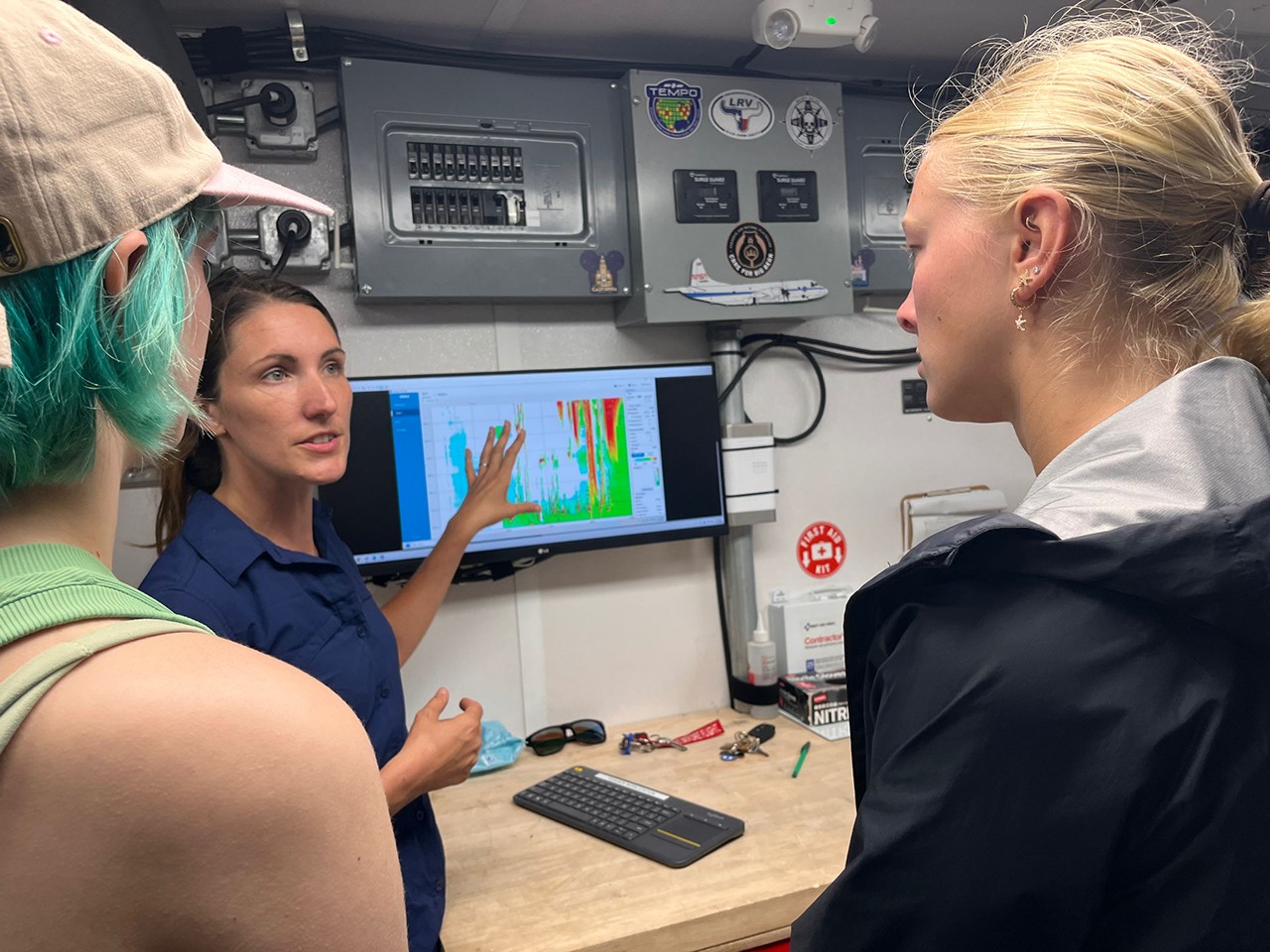
With the support of program mentors and faculty, and aboard the University of Houston’s Mobile Air Quality Laboratory (MAQL), the SARP interns participated in every step of the process.
The Mobile Air Quality Laboratory (MAQL) stands ready for some fieldwork.
NASA/Erica McNamee
Let’s set the scene: About 45 minutes away from this year’s SARP home base at the Lone Star Flight Museum in Houston, the MAQL drove down the Texas City Dike, a long strip of land jutting into the Texas Gulf Coast—an open space perfect for releasing the weather balloon. Among the 45 total students in the program, this group was assigned to meet the mobile lab at the balloon release location at 8 a.m. Central Time, just after a rainstorm rolled through.
Inside the lab, the students prepared ozonesondes for takeoff, completing the final steps that include measuring and pipetting cathode and anode solutions into the instrument cells attached to the sensor and testing each instrument’s response and baseline.
Outside the mobile laboratory, gusts of wind made it difficult to keep the balloon still while it was being filled with helium. Four students donned leather gloves to minimize oils from their fingers touching the balloon, which can make it pop faster after deployment. They wrangled the balloon while faculty advisor Travis Griggs, instructional assistant professor of atmospheric science from the University of Houston, filled it.
SARP students prepare the weather balloon for takeoff by filling it up with helium, while making sure it doesn’t pop or fly away.
NASA/Sofie Bates
Five students worked together to keep the balloon from flying away as they strung it to the ozonesonde, protected in a small foam container.
After confirming the launch location, time, and expected flight path with the Federal Aviation Administration (just a phone call away), it was time to set the weather instrument free.
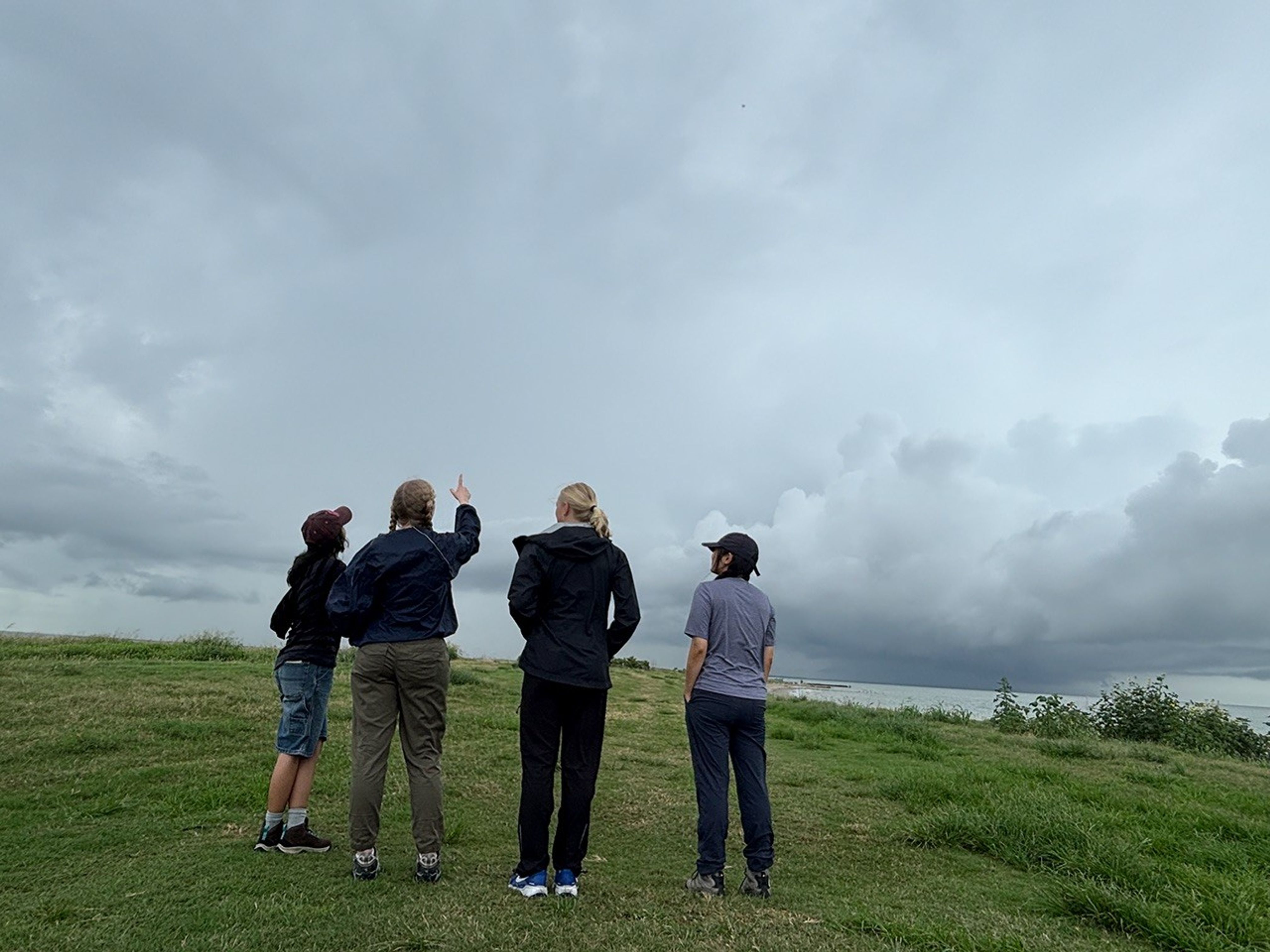
Even though it’s hard to see, there’s a tiny dot up in the sky—that’s the weather balloon! These students are admiring their work, watching their science experiment float up into the atmosphere to collect data.
NASA/Sofie Bates
“It was like a fight to stay on the ground, with the balloon whipping around in the wind,” said Zayna Haider, SARP intern and atmospheric and climate science student from the University of Washington. “It just flew away as soon as we let it go.”
But the work had only just begun. The students huddled back inside the MAQL, monitoring data as long as the balloon kept sending it—until it popped or landed, whichever came first. Throughout the day, they repeated this process with two other balloons.
Students inside the Mobile Air Quality Laboratory reviewed the data from the weather balloon they had just launched.
NASA/Erica McNamee
This day gave many SARP participants, just starting their science careers, their first glimpse at hands-on fieldwork that reached the edges of the atmosphere. Next, they would use this data and what they learned from the experience for their end-of-internship research presentation.
“This is beyond what I ever thought it could be,” Stevens said. “I’m super excited for the next seven weeks.”

 Login