❌

Normal view

Earth is in the firing line of a strange new type of cosmic object, astronomers say

6 October 2026 at 21:41

Researchers have observed the strongest candidate yet for a "microblazar" — a dazzling object that has long been predicted to exist but never spotted.

Observations of microblazars would give astronomers closer views of black holes emitting powerful jets of energy and help them understand how these extreme objects behave.

Blazars are some of the most energetic objects in the universe. They are a type of quasar — a brightly glowing object fueled by a supermassive black hole stripping material from its host galaxy and then ejecting some of it in powerful, opposing jets of particles and radiation. To qualify as a blazar, one of those near-light-speed jets needs to point directly at Earth. Astronomers have previously discovered smaller versions of quasars, dubbed microquasars, and long theorized that there must be smaller versions of blazars as well.

Now, an international team led by astronomers in Spain, the Netherlands and Argentina has described a microblazar in a study accepted for publication in the journal Astronomy and Astrophysics.

"It is the first time that we have a serious candidate," Josep Martí, an astronomer at the University of Jaén in Spain and first author of the study, told Live Science.

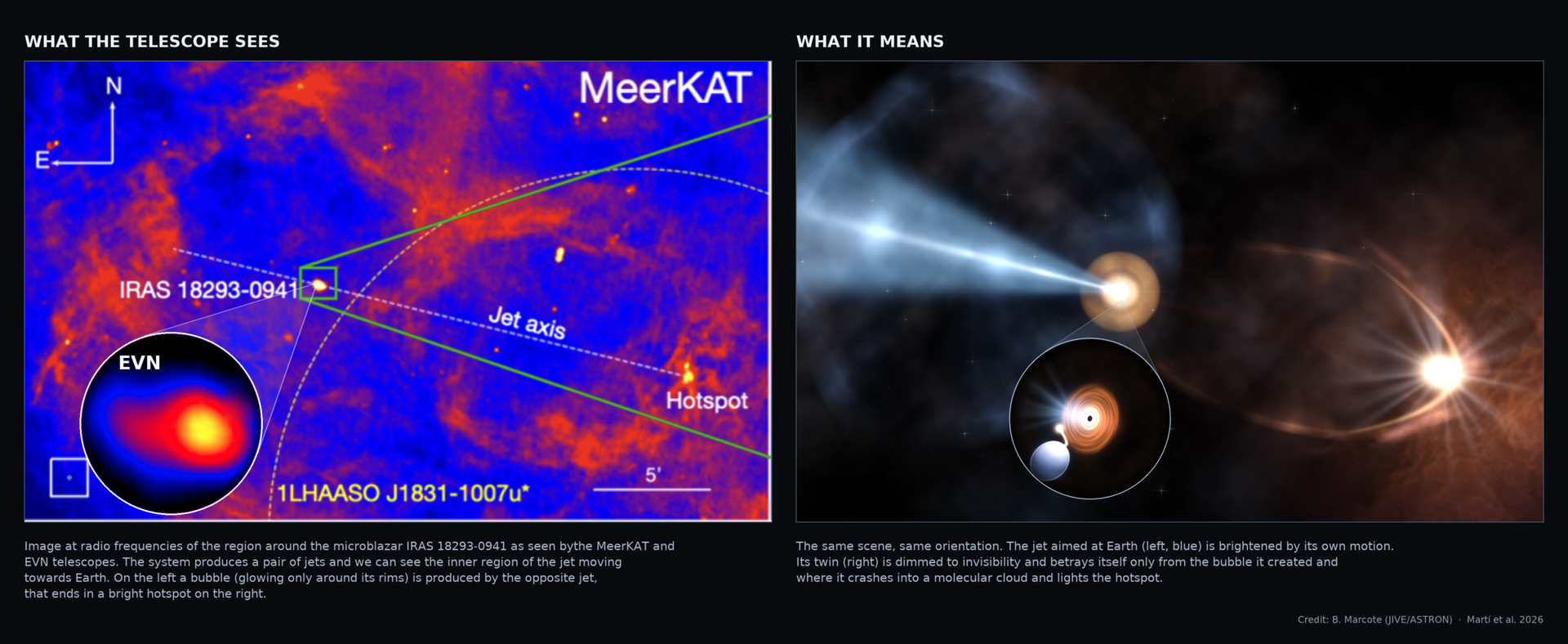
The object, called IRAS 18293-0941, is located in our galaxy, about 12,000 light-years from Earth, and it's hidden behind a veil of dust. It is a binary system that includes a black hole that orbits a hot, gigantic star every 11 days. Matter from the star falls into the black hole, and some of this material is jettisoned into the surrounding environment in two opposing jets. One of those jets flares toward Earth.

An image of a glowing ball of light against a dark background, with a heat map comparison next to it.

Comparison between the astronomical images of IRAS 18293-0941 (left) and the artist's impression (right). (Image credit: B. Marcote (JIVE/ASTRON).)

These objects, as well as microquasars in general, are tricky to observe, Martí said. "Because of stellar evolution, you need to catch the system at the right time," he added. "The microquasar phase of evolution is very short, and so it is difficult to find one in that phase."

Theorists predicted that microblazars would have special characteristics that should help define them. These features include powerful emissions across the electromagnetic spectrum, rapid changes in brightness (variability), and a hotspot behind them where its opposing jet heats up the interstellar medium in the opposite direction of Earth.

To observe IRAS 18293-0941, the study authors used a variety of instruments ‪—‬ including the Calar Alto Astronomical Observatory in Spain, a network of radio astronomy telescopes called the European VLBI Network, and the MeerKAT radio telescope array in South Africa ‪—‬ as well as archival data from the Very Large Array in New Mexico.

They found that IRAS 18293-0941 has all of the expected microblazar characteristics, except one ‪—‬ variability. Microblazars have rapid variability, which means their brightness changes a lot in a short period, because one of the jets is facing Earth and small changes in brightness are amplified by an effect called Doppler boosting.

Martí said IRAS 18293−0941's lack of rapid variability could be explained by the dense cloud of gas surrounding it, which could smooth out quick fluctuations in brightness.

The researchers are currently investigating whether the observed area behind the microblazar is in fact a hotspot, study co-author Pedro Luque-Escamilla, an astronomer at the University of Jaén, told Live Science.

Even with one of the expected features missing, this object is a promising candidate for the first known microblazar. "The claims and the results of the paper are sensible and there are no questionable hidden assumptions," Kinwah Wu, a theoretical astrophysicist at University College London who was not involved in the research, told Live Science in an email. "The source in this paper had shown signatures of interactions between the jets and the ambient material, which naturally leads to [particle] interaction."

Svetlana Jorstad, a senior research scientist at the Institute for Astrophysical Research at Boston University who was not involved in the research, told Live Science in an email that the new study was "very interesting, important and comprehensive."

Itumeleng Monageng, an astronomer at the University of Cape Town who was also not involved in the research, added that the team's observations "presents a previously overlooked mechanism for generating some of the highest energy emissions observed."

Microblazars "may power some of the universe's most energetic processes," Monageng told Live Science in an email.

Martí, J., Luque-Escamilla, P. L., Marcote, B., Abaroa, L., Aguasca-Cabot, A., Combi, J. A., Romero, G. E., Paredes, J. M., García, F., Fogantini, F., Saavedra, E. A., Del Ser, D., & Van Den Eijnden, J. (2026). A Galactic microblazar as a potential accelerator of ultra-high-energy particles. Astronomy and Astrophysics. https://doi.org/10.1051/0004-6361/202661105

See how much you know about black holes with our black hole quiz!

Strange 'fast radio bursts' across the universe could help solve major cosmic mysteries: 'It's only the beginning'

10 September 2026 at 11:00

Though their origins may be shrouded in mystery, fast radio bursts (FRBs) could be used to probe some of the universe's biggest puzzles. This includes probing the nature of dark matter, the invisible sort of matter that somehow dominates the universe, and dark energy, the mysterious force causing the expansion of our universe to accelerate. They could even shed light on the mysteries of neutrinos, or "ghost particles." Let's dive into how.

FRBs are brief but intense blasts of radio waves currently thought to erupt from rapidly rotating dead stars with the universe's strongest magnetic fields, called magnetars. As FRBs travel billions of light-years to reach Earth, they pass through dense clouds of gas and dust in galaxies. This "cosmic fog" changes the original FRB signal. What this means is these blasts of radio waves carry the fingerprints of how matter in the universe is distributed.

Mapping the distribution and "clumpiness" of ordinary matter in galaxies can then help trace the distribution of dark matter, the effect of dark energy and the mass of neutrinos.

"We've established that FRBs are a leading probe of the distribution of matter in the universe," team leader Kritti Sharma, a graduate student working with Vikram Ravi, a professor of astronomy at the California Institute of Technology (Caltech) and also part of the team, said in a statement. "These FRB data can be used to enhance cosmology experiments that are trying to answer questions about dark matter, dark energy, and the mass of neutrinos."

For this research, Ravi and Sharma analyzed a sample of about 100 FRBs. This represents the first time scientists have used FRBs to directly measure the impact of so-called "feedback" from galaxies on the clumpiness of matter in the large-scale regions between galaxies.

Cosmic ghosts and the dark universe

Ordinary matter, composed of atoms made up of electrons, protons and neutrons, accounts for just around 5% of the universe's energy/matter budget despite comprising stars, planets, moons, our bodies, next door's cat and everything we see around us on a day-to-day basis.

Of this budget, the other 95% is composed of dark energy (68%) and dark matter (27%). It's little wonder that scientists are very keen to better understand these two aspects of the cosmos, sometimes collectively referred to as the "dark universe."

Things get even more murky when considering how, of that 5%, the second most abundant particles in the universe, aside from particles of light or photons, are neutrinos. These get their nickname of "ghost particles" because they interact with other matter particles so infrequently that approximately 100 trillion neutrinos pass through your body every second without leaving any trace. This is possible because neutrinos are virtually massless, and scientists are keen to accurately measure the mass of these cosmic ghosts.

These three mysterious elements of the cosmos have played a vital role in the evolution of large-scale cosmic structures like galaxies and galaxy clusters. That means, in turn, that measuring the clustering of matter can reveal details about the aspects of the universe that influenced that clustering.

An orange and purple swirl with a black circle at its center. A bright tail emerges from the black circle

An illustration of a supermassive black hole pumping energy into its surroundings, a type of cosmic feedback that can smooth out clumpy cosmic matter. (Image credit: Robert Lea (created with Canva))

However, to do that, scientists also have to understand how other factors smooth out cosmic clumpiness. That includes the energy pumped out from the hearts of galaxies by feeding supermassive black holes, a type of cosmic feedback that smooths out clumpy cosmic matter lying outside galaxies.

"The feedback process thins the gas around the galaxies, redistributing matter across vast distances. It smooths out clumps of matter in a way that looks astonishingly similar to what massive neutrinos do, or what dark energy or dark matter theories predict," Ravi said. "Unless scientists can independently measure this contribution from feedback, they can't tell these effects apart."

That's where FRBs come in.

Flashes of light appear and disappear across a green oval with a grid pattern

An animation shows the random appearance of fast radio bursts (FRBs) across the sky. Astronomers have discovered about 85 since 2007. (Image credit: NRAO Outreach/T. Jarrett (IPAC/Caltech); B. Saxton, NRAO/AUI/NSF))

The researchers found that, while galactic feedback does indeed smooth surrounding material, making it less clumpy, the effect is weaker than has previously been measured.

"Our analysis of FRBs reveals how gas ejected by astrophysical feedback suppresses cosmic structure," team member Elisabeth Krause of the University of Arizona said in the statement. "This is amazing considering we only had about 100 FRBs in our sample. It's only the beginning."

The investigation of the universe with FRBs could get a major boost in 2029 when Caltech's Deep Synoptic Array (DSA) begins operating in Nevada. This powerful radio telescope is expected to find tens of thousands of FRBs, a major boon for cosmology.

The team's research was published on Tuesday (Sept. 8) in the journal Nature Astronomy.

This 'impossible' black hole merger may be explained by a warp in spacetime

9 September 2026 at 22:00

A "forbidden" merger between two massive black holes may not have been quite as impossible as previously thought. That's according to new research that suggests the black holes involved were smaller than expected.

On Nov. 23, 2023, the gravitational wave detector LIGO (Laser Interferometer Gravitational-Wave Observatory) detected tiny ripples in spacetime caused by the merger of two black holes. What was incredible about this signal, designated GW231123, was that it seemed to be the result of a black hole with 140 times the mass of the sun colliding with another that holds 100 solar masses.

This raised eyebrows among researchers because usual models of stellar evolution struggle to account for such massive black holes, especially ones that seemed to be spinning as fast as these two. While scientists have been attempting to explain how such an odd black hole binary could form. The team behind this new research suggests it doesn't need to be explained at all. They think that the masses of these black holes were an illusion.

The key to this illusion is a phenomenon called gravitational lensing, first predicted by Albert Einstein's 1915 theory of gravity, general relativity, which also first predicted the existence of gravitational waves. This theory says objects with mass cause the curvature of space and time, united as a four-dimensional entity called "spacetime." The more mass an object possesses, the greater the curvature, and because gravity arises from this curvature, the greater the gravitational influence.

Gravitational lensing occurs when light from a background object passes a massive foreground object. The foreground object can warp the fabric of spacetime in such a way that the light's path is curved. This means light from the same background source can reach Earth at different times, depending on how much that light was diverted.

This difference in travel time can magnify a background source, and it has been used to great effect to observe distant and ancient galaxies ordinarily too faint to be seen.

This research team thinks the effect also applies to gravitational waves, suggesting the signal GW231123 is an example of gravitationally lensed ripples in spacetime that made the black holes appear larger than they actually are.

"Like light, gravitational waves can also be deflected, magnified and split into multiple signals by massive objects," team member Miguel Zumalacárregui, group leader in the Astrophysical and Cosmological Relativity Department at the Albert Einstein Institute (AEI), said in a statement. "For gravitational waves, diffraction and interference effects give us an additional way to identify and study lensed signals."

Curved lines of different colors against a grid background

A diagram (not to scale) of how gravitational lensing works. (Image credit: NASA, ESA & L. Calçada)

To investigate this possibility, the team developed a mathematical model of gravitational lensing and created software powerful and fast enough to analyze it.

"If we assume that GW231123 was deflected and distorted by a compact object of about 190 to 850 solar masses — or by an extended structure such as a globular cluster — we can understand the observed high masses," said team member Srashti Goyal, who was based at the AEI when conducting the research. "Moreover, the lensing interpretation does not require unusually high spins."

When the team modeled the event with that consideration factored in, they found the merger involved a system with a mass of 140 solar masses, rather than the 240-solar-mass system initially theorized.

A purple hued image showing two black circles circling around one another in the center. There is a wave of pinkish gas trailing behind each of them.

A simulation of a black hole merger. (Image credit: NASA's Goddard Space Flight Center)

The team doesn't quite know what massive object is responsible for lensing the gravitational wave signal GW231123. But no matter what it is, if the team is correct, the lens could be something quite special.

"The nature of the lens remains a major mystery in our analysis, as individual compact lenses with 100 to 1,000 solar masses should be exceedingly rare," Zumalacárregui said. "Future work will need to establish whether such lenses can form, or whether an ensemble of lighter objects, including stars, can explain this event."

The team can't yet conclusively say if GW231123 is the first gravitationally lensed gravitational wave signal. Finding future signals of the sort will require upgrades to the sensitivity of detectors like LIGO.

Though even before that happens, the research does point to the utility of gravitational wave astronomy to study some of the universe's most violent events.

The team's research was published on August 25 in the Astrophysical Journal Letters.

‘Little Red Dots’ Remain a Cosmic Mystery—and New Research Reveals They May Be Keeping a Very Big Secret

26 August 2026 at 14:03

Little red dots, an astronomical mystery unveiled by NASA’s James Webb Space Telescope, have perplexed researchers since their discovery—and now, according to new findings, we may be closer than ever to unraveling their mystery.

According to new research that appeared in Nature Astronomy, the enigmatic little red dots could be residents of very small, but also very dense galaxies with masses close to a billion times our Sun’s mass.

If confirmed, the new research may set the pace for unraveling how these cosmic curiosities, first detected in 2023, first came to be in the early stages of the universe’s development. Not only that, it could hint at the possibility that these “little” cosmic curiosities may also be keeping a big secret.

What Are Little Red Dots?

One of the reasons little red dots remained unknown until recent years has to do with their great distances from Earth. With the help of the Webb telescope’s powerful eye, these tiny objects were initially detected three years ago and detailed in a formal scientific paper in 2024.

The nature of these objects remains unknown, and astronomers still aren’t certain about what the exact source of the light they produce might be. In past research, some clues have pointed to the possibility of material around these objects at ultraviolet wavelengths—this would potentially offer a strong hint that these faint, distant objects are galaxies, or are at least related to them in some way.

One of the challenges astronomers have encountered is the lack of optical light measurements indicating the presence of galactic material. Because of this, questions remain about the mass that could be present in stellar bodies associated with the little red dots.

Capturing Optical Emissions from Enigmatic Objects

Now, in new research by Xuheng Ding, Lilan Yang, and colleagues, imagery captured by the James Webb Space Telescope of 217 examples of little red dots has produced new clues about their mysterious origin.

A key component of the new imagery includes the detection of optical emissions, albeit faint ones, observed beyond the primary central objects themselves. The detections are strong enough to be clearly observed, and based on the team’s models, these emission lines are indeed most likely linked to the presence of stellar mass, meaning that the little red dots are good candidates for star-forming galaxies, as many astronomers have suspected.

If correct, this would help confirm a potentially big secret about these objects, since it would also mean the little red dots reside at the centers of these galaxies—as supermassive black holes.

Anatomy of a Little Red Dot

Additional clues about these objects include new estimates for their size, clocking in with a radius of about 210 parsecs—roughly 685 light-years—on average. This means that the little red dots are far more compact than the kinds of star-generating galaxies expected to possess comparable mass, which date to around the same time in our universe’s development that the dots are believed to originate.

Based on the new research, little red dots are more than just unusual light sources in the distant universe, and their likely association with star-forming galaxies offers a significant clue toward revealing their exact nature.

Still, a few questions remain, and the team cautions that their analysis deals with the average properties based on the recent collection of Webb imagery of these cosmic features, since many of the individual characteristics of the little red dots remain too faint to characterize on an individual basis.

Going forward, the team believes additional observations that include spectrographic analysis of the light produced by little red dots will offer more clues about not only their origins, but will also help astronomers determine clearer estimates for their distances.

The recent study, “Extended components of little red dots in the rest-frame optical,” appeared in Nature on August 24, 2026.

Micah Hanks is the Editor-in-Chief and Co-Founder of The Debrief. A longtime reporter on science, defense, and technology with a focus on space and astronomy, he can be reached at micah@thedebrief.org. Follow him on X @MicahHanks, and at micahhanks.com.

Featured Image: The Microquasar and the Manatee

17 August 2026 at 17:00

multiwavelength view of SS 433 / W50

The supernova remnant W50 — nicknamed “the Manatee” because its blobby radio emission resembles an aquatic mammal floating through starry waters — harbors an extreme system at its heart. Near the center of the remnant, the microquasar SS 433 exhibits an immense pair of relativistic jets, likely powered by a stellar-mass black hole accreting material from a companion star. In the image of W50/SS 433 above, radio emission is in red, optical light is in yellow, and soft, medium, and hard X-ray emission are in green, cyan, and magenta, respectively. Brydyn Mac Intyre (University of Manitoba) and collaborators focused on the region circled above, using NuSTAR and XMM-Newton to understand the source of the X-ray emission in that region and the potential for SS 433 to accelerate particles to relativistic velocities. These observations suggest that W50/SS 433 accelerates electrons up to energies of more than 100 teraelectronvolts, and it may launch other particles into the highly sought-after petaelectronvolt range. To learn more about the particle-acceleration possibilities in this remarkable region, be sure to check out the full research article linked below.

Citation

“The Western Jet of SS 433/W50: Hard X-Ray Emission, Spectral Evolution, and Comparison to the Eastern Jet,” Brydyn Mac Intyre et al 2026 ApJ 1006 69. doi:10.3847/1538-4357/ae7a47

The post Featured Image: The Microquasar and the Manatee appeared first on AAS Nova.

Water Found in Stellar Envelope Near the Milky Way’s Central Black Hole

11 August 2026 at 20:24

Astronomers using NASA’s James Webb Space Telescope have discovered water molecules inside the enormous envelope of gas and dust surrounding IRS 3, an aging star located remarkably close to the supermassive black hole at the centre of the Milky Way. The finding challenges the long-held assumption that the intense radiation and gravitational turbulence around Sagittarius A, commonly known as Sgr A, would prevent molecules from surviving in such a hostile environment.

IRS 3 lies about 0.6 light-years from Sgr A*, a distance equivalent to roughly 42,000 times the separation between Earth and the Sun. In everyday terms, that is an immense distance. On the scale of the Galactic Centre, however, it places the star in the immediate neighbourhood of a black hole containing approximately four million times the mass of the Sun. The region is crowded with stars, powerful magnetic fields, energetic particles and rapidly changing radiation, making IRS 3 an exceptional natural laboratory for studying how stars evolve under extreme conditions.

The observations were conducted with the Mid-Infrared Instrument, or MIRI, aboard the James Webb Space Telescope. Mid-infrared light is particularly useful for investigating cool dust and molecules that absorb and re-emit radiation at characteristic wavelengths. By analysing the infrared spectrum of IRS 3, researchers led by PD Dr Florian Peißker of the University of Cologne identified the chemical and physical properties of the material surrounding the star with far greater detail than previous observations allowed.

What makes IRS 3 especially striking is the scale of its circumstellar envelope. The structure extends to a radius of approximately 10,000 astronomical units, where one astronomical unit is the average distance between Earth and the Sun. Such envelopes are common around mature, evolved stars, but IRS 3 appears to be unusually isolated in the immediate vicinity of Sgr A*. Its enormous shell of material therefore stands out against a dense background containing millions of other stars.

The new observations indicate that IRS 3 is undergoing a phase known as a superwind. This is a brief but dramatic stage in the late evolution of certain stars, particularly asymptotic giant branch stars. During this phase, powerful stellar winds carry gas and newly formed dust away from the star at extremely high rates. Over periods of only a few centuries, the star can lose a substantial fraction of its outer layers, transforming its surroundings into a thick, expanding envelope that will eventually disperse into interstellar space.

According to the research team, IRS 3 is losing material at a rate equivalent to the mass of Earth every 18 days. Although the comparison makes the scale easier to imagine, the total outflow is far more significant when considered over astronomical timescales. The steady loss of gas and dust explains why the envelope is both unusually large and dense. It also provides the raw material in which molecules can form, shielded within cooler regions of the expanding stellar outflow.

The detection of water is the most surprising aspect of the study. Near Sgr A*, ultraviolet radiation, X-rays and high-energy particles are expected to break apart fragile molecules. Water molecules can be destroyed when energetic photons dissociate them into their constituent atoms, particularly in exposed regions close to powerful sources of radiation. Yet the MIRI observations show that water exists within the envelope of IRS 3, suggesting that the dense outflow from the star creates protected pockets where molecular chemistry can proceed.

This discovery does not mean that the Galactic Centre is a calm or hospitable environment. Instead, it demonstrates that stellar mass loss can temporarily create its own chemical refuge. The material expelled by IRS 3 increases the density of gas and dust around the star, allowing some regions of the envelope to absorb damaging radiation. Within these shielded zones, atoms can combine on dust grains or in the gas phase, producing molecules that would otherwise be rapidly destroyed. The finding offers a new view of how evolved stars may enrich even the most violent regions of a galaxy.

The researchers say that IRS 3 may be actively supplying the area around Sgr A* with elements and molecules that later become part of the broader interstellar medium. Water itself is not evidence of life, but it is a crucial ingredient in planetary formation and a central component of the chemistry that precedes biology. As the envelope expands, some of its contents will eventually mix with surrounding gas, potentially influencing the composition of future stars, planets and smaller bodies formed in the Galactic Centre.

The study, published in Astronomy & Astrophysics, also highlights the scientific value of observing the Milky Way’s centre at infrared wavelengths. Visible light is heavily obscured by dust along the line of sight, while infrared radiation can pass through much of that material and reveal otherwise hidden structures. Future observations with METIS, a next-generation mid-infrared instrument being developed for the Extremely Large Telescope in Chile, could provide sharper views of IRS 3’s envelope, measure its winds in greater detail and determine how its molecular content changes over time. For now, the star’s unexpected water-rich cocoon is offering astronomers a rare glimpse of stellar chemistry unfolding beside one of the most extreme objects in the universe.

Subject of Research: Not applicable

Article Title: Dust production in the harsh environment of Sgr A* – MIRI/JWST observation of the O-rich asymptotic giant branch star IRS 3

News Publication Date: 11-Aug-2026

Web References: https://doi.org/10.1051/0004-6361/202660243

References: Astronomy & Astrophysics

Image Credits: ESO/F. Peissker

Keywords

James Webb Space Telescope, JWST, MIRI, IRS 3, Sagittarius A, Sgr A, Milky Way, Galactic Centre, water molecules, superwind, asymptotic giant branch star, stellar evolution, circumstellar envelope, dust production, black hole, infrared astronomy, Extremely Large Telescope

A Black Hole Far from Its Galaxy’s Center Was Caught Tearing Apart a Star

8 August 2026 at 16:30

A star being torn apart by a black hole is already an unusual sight. In this case, the black hole was in an even stranger place: more than 30,000 light-years from the center of the galaxy that appears to host it. NASA’s Neil Gehrels Swift Observatory helped confirm the event after an automated survey spotted […]

The post A Black Hole Far from Its Galaxy’s Center Was Caught Tearing Apart a Star appeared first on Curiosmos.

Max Planck eROSITA Team Releases the Most Comprehensive Census of the High-Energy Universe Ever Assembled

4 August 2026 at 13:08

The German eROSITA Consortium (eROSITA-DE), led by the Max Planck Institute for Extraterrestrial Physics (MPE), has completed the most comprehensive census of the high-energy universe ever assembled.

Released as eROSITA Data Release 2 (DR2), the new high-energy universe catalog includes nearly two million X-ray sources, essentially doubling the number cataloged in DR1. The team behind the achievement said the new catalog, which has been made available to the wider scientific community, marks a “major step forward” in mapping the entire high-energy universe.

“DR2 is the best inventory of the X-ray sky we have to date and opens the door to robust statistical studies of cosmic populations,” explained Miriam E. Ramos-Ceja, Ground Segment Manager of the eROSITA instrument and lead author of the DR2 publication.

High-Energy Universe Catalog Nearly Doubles Previous Sources

DR2 was built from the first three scans captured by the eROSITA telescope during the Spectrum-Roentgen-Gamma (SRG) mission. According to a statement emailed to The Debrief, the new high-energy map combined data from multiple passes over the sky, significantly increasing the instrument’s survey depth.

After beginning its mission in December 2019, the observatory surveyed the entire sky every six months. This mission length increased the scans’ depth and sensitivity. The new DR2 includes data captured during the mission’s first 556 days. MPE scientists said the final catalog comprises three “full sky surveys.”

“By stacking these observations, the survey reaches significantly fainter fluxes than the first release, enabling the large increase in detected sources,” they explained. 

high-energy universe
The color image shows X-ray sources in the western galactic hemisphere of the X-ray sky. The Galactic plane lies horizontally through the center of the image. Sources in the eROSITA catalog are plotted with their red, green, and blue brightness showing their count rate in soft (0.5-1.0 keV), medium (0.5-1.0 keV), and hard (1.0-2.0 keV), respectively. The sky is plotted using an azimuthal equal-area projection (Image Credit: Jeremy Sanders / MPE).

The approach also revealed a large population of previously uncatalogued systems.

For example, the DR2 catalog includes nearly two million X-ray sources detected in the 0.2–2.3 keV band. The survey also revealed over 1.9 million “point-like sources.” The team said these detections are “primarily stars and actively accreting supermassive black holes.” The survey also added around 64,000 extended sources, including newly cataloged galaxy clusters, nearby galaxies, and supernova remnants.

The Full Diversity of the X-ray Sky

Along with the primary catalog, the new release includes a complementary “hard-band” catalog that includes 15,000 sources detected at higher energies (2.3–5.0 keV). The team said these detections revealed “heavily obscured and intrinsically energetic systems” that scans performed at ‘softer’ X-ray energies typically overlook.

“Together, these catalogues capture the full diversity of the X-ray sky, from nearby stellar coronae to distant supermassive black holes and massive galaxy clusters,” the team explained, adding that many of the cataloged objects are newly identified in X-rays, while others “can now be studied with substantially improved precision.”

Although more analysis is needed to accurately characterize every high-energy source discovered by the new survey, the team said the DR2 includes “multi-wavelength information” that associates the newly cataloged X-ray detections with their most likely optical and infrared counterparts.

“X-ray detection is only the first step,” explains Mara Salvato, eROSITA spokesperson and chair of the follow-up working group. “By linking X-ray sources to their counterparts at other wavelengths, we can work out what these objects are, where they sit on the cosmic distance ladder, and build clean, well-defined samples on an unprecedented scale.”

This data suggests that approximately 88% of the newly discovered sources come from outside the Milky Way Galaxy. The team said the new sources are “dominated by accreting supermassive black holes.” 

Data Suggests Unexpected Abundance of Rapidly Growing Black Holes

When discussing the significance of the new DR2 high-energy catalog, the team highlighted its coincidental release with the latest Sloan Digital Sky Survey (SDSS).

“By combining SDSS spectroscopy with eROSITA’s X-ray data, researchers can build three-dimensional maps of active black holes across the sky, revealing how these rapidly growing objects are distributed and evolve across cosmic time,” they explained.

For example, combining eROSITA’s X-ray catalog with the SDSS spectroscopic and photometric redshift data has already resulted in what the team described as “one of the largest and most detailed studies of accreting supermassive black holes to date.” The researchers said these “elusive objects” formed surprisingly early in the history of the Universe, so capturing new data of their growth at high redshift is invaluable.

“The most luminous black holes at high redshift are like needles in a haystack,” explained the corresponding study’s lead author, William Roster. “Thanks to DR2 we found more needles than expected, suggesting that rapidly growing black holes were more abundant in the early Universe than previously thought” 

New World Record of X-ray Sources Won’t Be the Last

Due to a pre-existing agreement between the German and Russian eROSITA consortia, the new DR2 covers the western Galactic hemisphere. However, the researchers note, within this region of the sky, the new catalog “represents the largest and most homogeneous public X-ray dataset currently available.”

eROSITA Principal Investigator Andrea Merloni said the new dataset of unprecedented scale and completeness has been made available to the global astronomical community. MPE Director Kirpal Nandra agreed, adding that the MPE team hopes the most complete catalog of high-energy sources ever assembled will provide “a unique foundation for discoveries ranging from rare objects to large-scale population studies.”

“eROSITA just set another world record in terms of X-ray source numbers – and it won’t be the last,” Merloni concluded.

The eROSITA-DE DR2 catalogs, upper-flux-limit server, and full documentation are publicly accessible via the eROSITA-DE Science Data Archive.

Christopher Plain is a Science Fiction and Fantasy novelist and has spent the last six years as Associate News Editor and Head Science Writer at The Debrief. Follow and connect with him on X, learn about his books at plainfiction.com, or email him at christopher@thedebrief.org

How do supermassive black holes grow? AI finds 7 spacetime-warping 'quasars' that could help solve the mystery

31 July 2026 at 23:00

Some of the brightest objects in the universe may also hold the key to understanding how galaxies evolve — especially when gravity transforms them into giant cosmic magnifying glasses.

Using artificial intelligence to search through data from the Dark Energy Spectroscopic Instrument (DESI), astronomers have identified seven promising candidates for quasars acting as gravitational lenses — natural cosmic magnifying glasses created when a massive object's gravity bends and magnifies light from a more distant object.

These unusual systems could help researchers better understand how actively growing supermassive black holes evolve, according to a statement from Ohio State University.

"Quasars are like the baby pictures of a supermassive black hole," Everett McArthur, lead author of the study and a graduate student in astronomy at The Ohio State University, said in the statement. "So exploring how we get from quasars to those black holes is really important."

Quasars are the intensely bright centers of galaxies powered by actively feeding supermassive black holes. Studying these objects can help researchers understand how black holes evolve into the enormous ones found throughout the modern universe. But as these black holes pull in gas and dust, they release so much energy that they can outshine their entire host galaxies, making those galaxies difficult to study.

Rare cases where a quasar acts as a gravitational lens offer a way around that problem, giving astronomers a unique opportunity to observe both the quasar and the distant galaxy whose light is magnified by its gravity.

Lots of gravitationally lensed objects in space. They look like different colored dots that are glowing. Some, which are lensed, look more like streaks.

Gravitational lensing can be seen in this cosmic deep field. Notice how some glowing spots are dots while others are lines. (Image credit: Image: NASA, ESA, CSA, STScI, Jose Diego (IFCA), Jordan D'Silva (UWA), Anton Koekemoer (STScI), Jake Summers (ASU), Rogier Windhorst (ASU), Haojing Yan (University of Missouri); Image Processing: Joseph DePasquale (STScI))

However, finding these rare alignments can be exceptionally challenging. To uncover them, the research team began with a catalog of roughly 800,000 quasars identified by DESI and used a machine-learning model to search for subtle signatures of gravitational lensing.

Because so few quasars acting as gravitational lenses are known, researchers had little real-world data to train their AI model. Instead, they generated simulated examples of these cosmic alignments, allowing the algorithm to learn what to look for before searching the DESI catalog. The algorithm narrowed the search to about 200 candidates, which researchers then reviewed manually. That process resulted in seven new quasar lens candidates.

Dense webs of blue and yellow strings above and below an image of the Milky Way.

Two "fans" representing DESI observations above and below the plane of the Milky Way. (Image credit: DESI Collaboration/DOE/KPNO/NOIRLab/NSF/AURA/R. Proctor/ Robert Lea (created with Canva))

The discoveries roughly double the number of known systems found through similar survey searches, according to the statement.

While artificial intelligence played a key role in finding the candidates, the discoveries highlight the scientific potential hidden within the massive datasets produced by modern astronomy. DESI is mapping millions of galaxies and quasars, creating an enormous archive that would be nearly impossible to search by hand.

Follow-up observations will be needed to confirm the newly identified quasar lenses and study their properties in greater detail. If verified, they could offer astronomers a powerful new way to investigate how supermassive black holes shaped the galaxies around them while demonstrating how AI can uncover rare cosmic phenomena hidden within the enormous datasets produced by modern sky surveys.

Their findings were published July 22 in The Astrophysical Journal.

Wandering Supermassive Black Hole Found at the Edge of its Galaxy

30 July 2026 at 13:00

Astronomers have long thought supermassive black holes can escape their home galaxies — now they've found one roaming its host's galactic outskirts.

The post Wandering Supermassive Black Hole Found at the Edge of its Galaxy appeared first on Sky & Telescope.

X-ray spacecraft detects the 36-million-degree 'breath' of an ancient black hole

29 July 2026 at 14:00

Using NASA's Chandra X-ray space telescope, astronomers have spotted the blisteringly hot exhaust fumes of one the earliest quasars, cosmic "breath" with temperatures as great as 36 million degrees Fahrenheit. This intensely bright titan is powered by a feeding supermassive black hole engine.

The Chandra X-ray telescope observed a relatively silent quasar that existed 2.1 billion years after the Big Bang. The cosmic "exhaust fumes" from this black hole engines extend out for around 100,000 light-years around a quasar at the heart of a still-forming galactic cluster, or "proto-cluster" called MQN01. These blisteringly hot gas structures will eventually become the atmospheres that envelope modern clusters of galaxies, known as the intracluster medium (ICM).

Thus, this research reveals for the first time the exact moment in cosmic history that these galactic atmospheres began to form and gather.

"The central scientific question is to understand how this hot phase forms: what are the physical conditions of the gas during its formation and what processes contribute to its heating," team member Sebastiano Cantalupo of the University of Milan-Bicocca said in a statement.

"[The data] show extraordinary properties of the gas that could provide us with the first insights into how this hot phase of the circumgalactic medium, which we now see as intracluster medium, formed."

Start your engines...

The team behind this research spotted this hot gas structure after 180 hours of X-ray observations conducted by Chandra. Until now, X-ray detections such as this have only been made for quasars that sit in active galactic nuclei (AGNs) at the heart of "radio-loud" galaxies.

The X-ray emissions from these radio galaxies come from jets of particles blasted out from around feeding supermassive black holes at near-light speeds.

But the quasar at the heart of MQN01 differs from these because it is radio-quiet. This means the X-rays detected by Chandra from this quasar are uncontaminated by plasma jets, so the observation is entirely the result of the cosmic "motorbreath" from the quasar.

"We are facing one of the most distant detections of extended thermal X-ray emission associated with the formation of hot gas in dense regions of the universe, which will likely evolve into the known local ICM," Cantalupo said.

"We believe we have identified a phase in its life in which cold gas falls towards the gravitational potential of this massive halo and is heated by gravitational shocks, reaching temperatures of about 20 million Kelvin [36 million degrees Fahrenheit (20 million degrees Celsius)].

"The densities and pressures we measured are high: one to two orders of magnitude higher than those of clusters in our local universe."

a multi-colored swirl of light with a black orb in the center. the black orb is blasting out a white line of light

An illustration of a supermassive black hole powering a quasar in the early cosmos (Image credit: Robert Lea (created with Canva))

The observations of this radio-quiet galaxy were possible thanks to the application of a technique usually used to analyze Seyfert galaxies, which host feeding supermassive black holes in the local universe (the area of space found within 1 billion light-years of Earth). The challenge the team faced was isolating the faint light from the gas from the blinding glare of gas closer to the central black hole.

"We were initially extremely skeptical ourselves," team leader Andrea Travascio of the INAF said. "Given the exceptional nature of the data, we sifted through every alternative explanation: from artificial outflows to instrumental contamination or other unsuspected effects. But each alternative scenario encountered insurmountable theoretical limitations. The thermal explanation is the only one consistent with the physical data."

Travascio and the team are now analyzing archival datasets from hundreds of other quasars to discover if this heating phase is common to protoclusters or if MQN01 is a rarity.

"Considering how unique the result was and also taking into account Chandra's technical difficulties in the final phases of its mission, the satellite has once again demonstrated its extraordinary ability to produce scientifically relevant results even after decades of operation," Travascio said.

The team's research was published on Friday (July 24) in the journal Astronomy & Astrophysics.

First-Generation Stars Provide Better Fit than a Black Hole for Early-Universe Gas Clump

27 July 2026 at 17:00

Star formation in the early universe.

An unusual clump of gas 450 million years after the Big Bang may contain stars hailing from the universe’s elusive first generation of stars. New research examines an alternative explanation involving an accreting black hole.

Meet Hebe

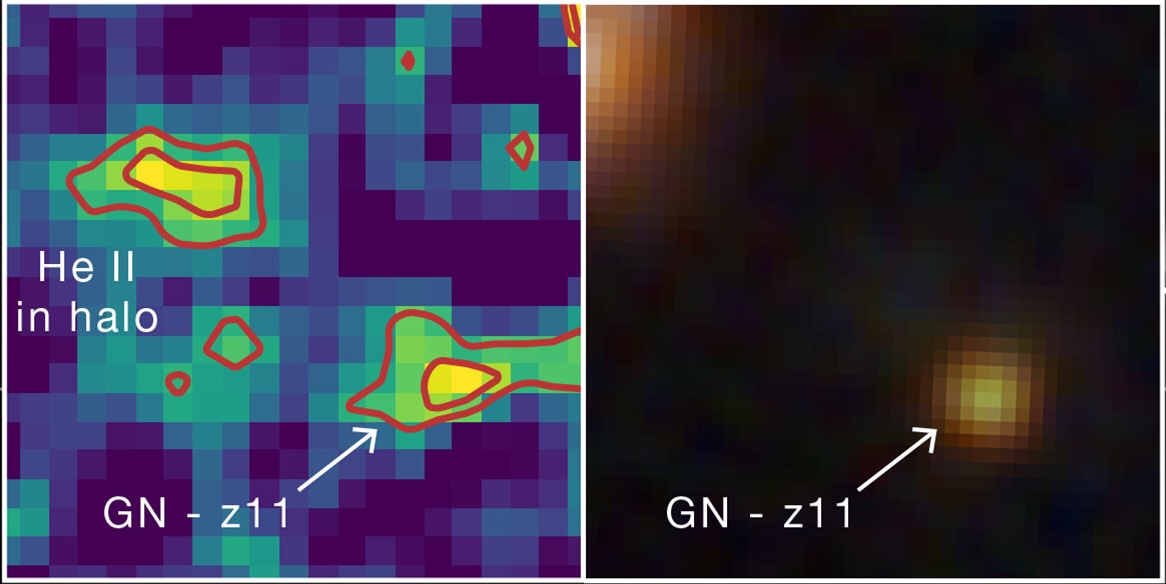
Hebe and GN-z11

Hebe is visible in the image on the left as a prominent blob of helium emission up and to the left from GN-z11, a luminous galaxy hosting an accreting supermassive black hole. On the right is an infrared image of the same region, in which Hebe is not visible. Click to enlarge. [Adapted from NASA, ESA, CSA, Ralf Crawford (STScI)]

Initially spotted in 2024, an early-universe gas clump nicknamed Hebe has now been identified as a possible hiding place of Population III (Pop III) stars — the universe’s first generation of stars. Pop III stars are thought to be massive and chemically pristine, containing only hydrogen, helium, and a whisper of lithium. This exciting hypothesis was prompted by the detection of recombination lines from helium, which could be ionized by the high-energy radiation of the first stars.

Before the community settles on this exciting explanation, however, the hypothesis must withstand all the tests astronomers can throw at it. In a recent research article, Junehyoung Jeon, Tae Bong Jeong, and Saiyang Zhang (The University of Texas at Austin) along with Volker Bromm (The University of Texas at Austin) attempted to explain Hebe’s properties in another way.

Considering Alternatives

Hebe glows with distinctive helium emission that requires a source of high-energy radiation. This radiation could be provided by a cluster of Pop III stars, but it could also, in theory, arise from an accreting supermassive black hole embedded within the gas clump.

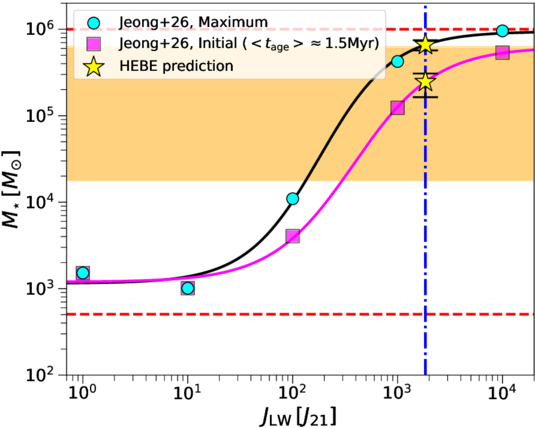
predicted Pop III star mass in Hebe

Predicted total mass of Hebe’s Pop III stars as a function of the Lyman–Werner flux from the nearby galaxy GN-z11. Click to enlarge. [Jeon et al. 2026]

The authors used models to explore both possibilities. For the first scenario, in which the telltale helium emission is driven by a cluster of Pop III stars, the team calculated the maximum possible mass of the cluster, which sets how much high-energy radiation is produced. The cluster mass is moderated by high-energy radiation from another source: GN-z11, a starburst galaxy situated about 10,000 light-years from Hebe. For the second scenario, the team modeled the spectral energy distribution arising from a supermassive black hole — either a direct-collapse black hole or a primordial black hole — accreting pristine gas from the surrounding cloud.

Still a Leading Explanation

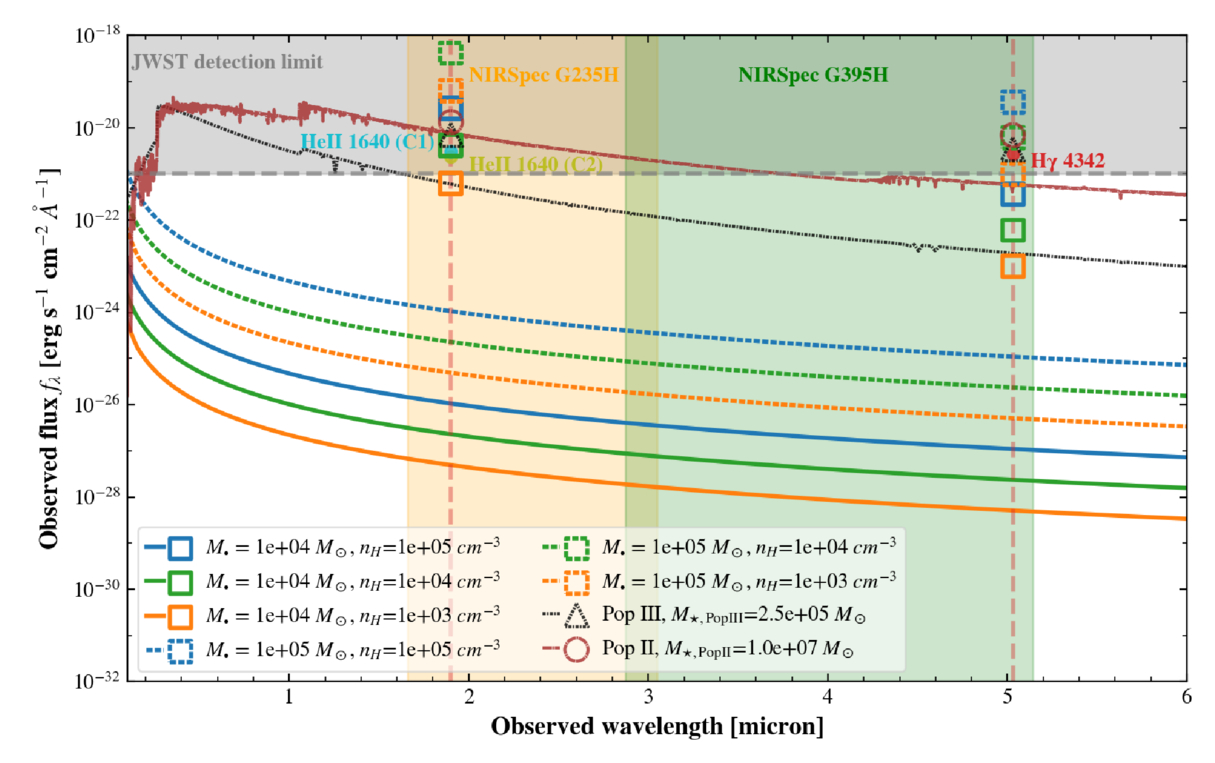
While the black hole scenario could, with reasonable black hole masses, gas densities, and accretion rates, reproduce individual flux measurements drawn from JWST observations, this hypothesis struggled to simultaneously match multiple measurements. The Pop III star cluster scenario, with a cluster mass of a few hundred thousand solar masses, provided the best fit to the JWST data.

modeled spectral energy distributions for Hebe based on the black hole or Pop III star hypotheses

Modeled spectral energy distributions (lines) and predicted line flux densities (open symbols) for the accreting black hole, Pop III star, and Pop II (second-generation) star hypotheses. The observed JWST line fluxes are shown as filled circles. Click to enlarge. [Jeon et al. 2026]

As a final test, the team introduced a third possibility involving a population of second-generation stars, which are more chemically enriched than Pop III stars. While this model fit well, the number of stars necessary to match the data — roughly 10 million — would produce a stellar continuum detectable (but so far not seen) by JWST.

While a cluster of Pop III stars is still the leading explanation for Hebe’s properties, the team noted that the Pop III star and black hole hypotheses aren’t mutually exclusive; Hebe could very well harbor a primordial black hole and a smattering of Pop III stars. Regardless of what powers its characteristic helium emission, Hebe offers an enticing glimpse into the early universe, and more work is needed to understand this intriguing object.

Citation

“What Is Powering the Enigmatic He II Emitter Hebe: The First Stars or Black Holes?” Junehyoung Jeon et al 2026 ApJ 1006 27. doi:10.3847/1538-4357/ae7bea

The post First-Generation Stars Provide Better Fit than a Black Hole for Early-Universe Gas Clump appeared first on AAS Nova.

NASA’s Swift Sees ‘Wandering’ Mega Black Hole Shredding Star

27 July 2026 at 17:06
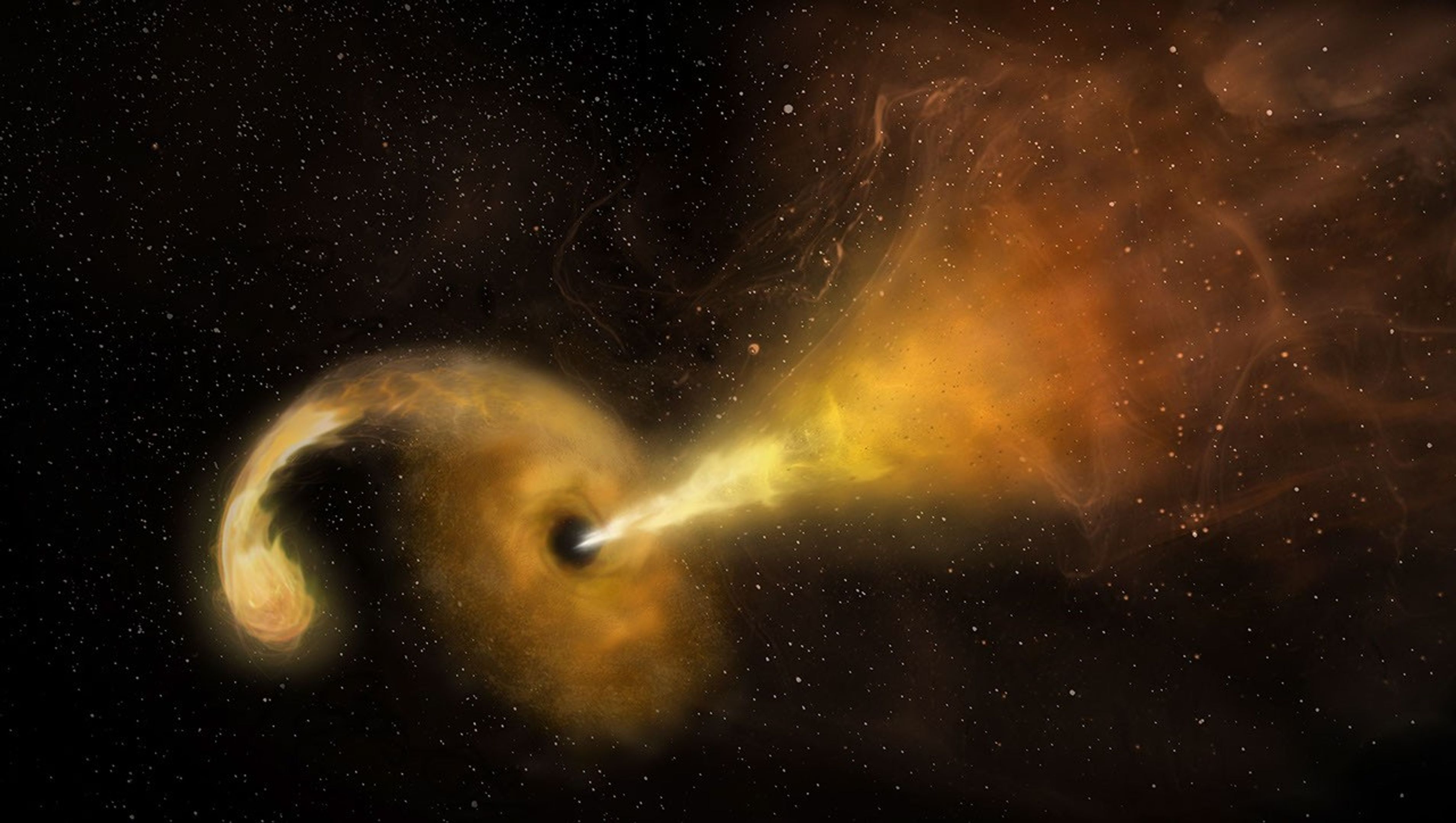
An artist's concept of a tidal disruption event
This artist’s concept depicts a tidal disruption event, which occurs when a star passes fatally close to a supermassive black hole. Crumbs of the splintering star heat up as they swirl around the black hole, creating a glow astronomers can see from far across the cosmos, and the black hole launches a relativistic jet into space.
NRAO/AUI/NSF/NASA

NASA’s Neil Gehrels Swift Observatory captured an “orphan” black hole lighting up as it devoured a star on the outskirts of a faraway galaxy. These phenomena are rare to begin with, and none had ever before been seen so far outside of a galaxy’s core.

“We were looking for these star-shredding events as a way to find otherwise invisible supermassive black holes wandering away from the galactic cores where they usually reside,” said Robert Stein, a research fellow at The University of Maryland, College Park and NASA’s Goddard Space Flight Center in Greenbelt, Maryland. “With this discovery, which is one of just a couple that have been confirmed so far, we’ve validated a new technique and can use it to hunt for more.”

A paper describing the results, led by Stein, was published Monday in The Astrophysical Journal Letters.

Researchers saw an ultrabright flare unleashed by a star being torn apart by extreme gravitational forces after drifting too close to a monster black hole — a phenomenon called a tidal disruption event. The black hole behind the blast weighs in at about a million times the Sun’s mass. Its existence was first flagged in November 2025 as an unusual brightening in a galaxy about 750 million light-years away by ZTF (Zwicky Transient Facility), a survey conducted by the Palomar Observatory in Southern California.

“Out of the half million flashes ZTF detects each night, our new artificial intelligence algorithm automatically recognized a flare that looked a lot like a tidal disruption event, despite its unusual location in the outskirts of a galaxy,” Stein said. For a few months, the tidal disruption event outshone its entire host galaxy in ultraviolet wavelengths, temporarily radiating with the light of about 10 billion suns.

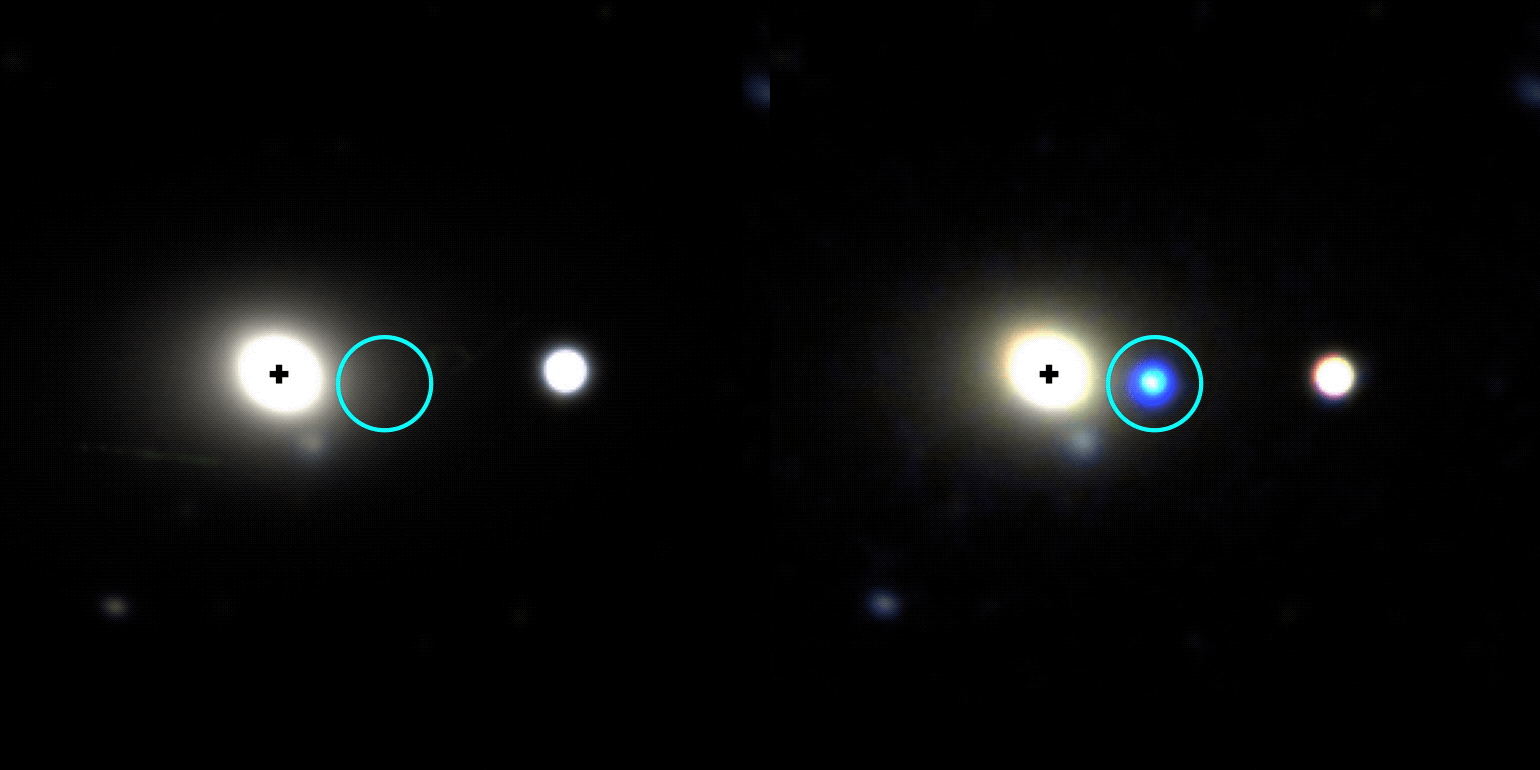
Animated observation showing the appearance of a blue orb
This gif shows the galaxy WISEA J014656.04-152214.7, located about 750 million light-years away in the constellation Cetus, before and after a tidal disruption event was spotted on its outer edge in November 2025. The image at left was taken by the DESI (Dark Energy Spectroscopic Instrument) Legacy Survey and the one at right is from the Lowell Discovery Telescope.
Lowell Discovery Telescope/Legacy Survey/Robert Stein

Other telescopes, including the SOAR (Southern Astrophysical Research) telescope in Chile, followed up on the ZTF source to look at the event’s spectrum, which revealed features supporting that it was likely a tidal disruption event. Astronomers then used NASA’s Swift to look at wavelengths they can’t detect with ground-based telescopes to uncover new information. For example, Swift’s UVOT (Ultraviolet/Optical Telescope) took the blip’s temperature and found that it had quite a fever at about 54,000 degrees Fahrenheit (30,000 degrees Celsius).

“The combination of all this data helped us rule out other explanations and confidently say it’s a tidal disruption event, despite its strange location,” said Jonathan Carney, a doctoral student at the University of North Carolina at Chapel Hill, who took the first spectra that supported the flare’s interpretation as a tidal disruption event.

Hidden heavyweights

Nearly every galaxy in the universe is anchored by a supermassive black hole sitting right in the center. About once every 100,000 years, a star will drift too close to this invisible heavyweight and trigger a tidal disruption event.

While they’re rather rare in any given galaxy, scientists scour millions of galaxies for them. Each year, astronomical surveys typically spot about 30 tidal disruption events occurring somewhere in the universe.

Prior to 2024, they’d only been seen in galaxy cores. That’s partly because astronomers mainly looked for them there; after all, it’s where all the known supermassive black holes were, and you can’t get a tidal disruption event without one (the gravitational pull of lighter black holes isn’t strong enough).

Then scientists saw the telltale signs of a star being shredded 2,600 light-years from the center of its host galaxy. That inspired more astronomers to look beyond galaxy cores for similar events, and now a team has identified one more than 30,000 light-years away from a galaxy’s center.

This video visualizes a star approaching a supermassive black hole so closely that it’s stretched to a breaking point by the black hole’s strong gravity. Intense tidal forces crack the star open and hurl its gaseous guts outward. Stellar debris forms a spinning accretion disk as it continues to spiral into the black hole.
NASA, ESA, STScI, Ralf Crawford (STScI)

Oddball origin story

So how did the newfound black hole become so off-kilter?

“It must have originated in a galaxy’s center, but not the one it’s in the outskirts of now,” Stein said. “We think the host galaxy’s supermassive black hole is still at its core, but the one eating the star could have started off in a small galaxy that merged with the big one we see today.”

The researchers have outlined two possibilities. Three or more galaxies may have merged together, and the gravitational tug-of-war between their central supermassive black holes may have flung the lightest black hole out to the galaxy’s edge.

Or a dwarf galaxy could be midway through a merger. As the dwarf’s stars fell into the larger galaxy, one may have passed too close to the dwarf’s supermassive black hole.

“Further discoveries could reveal the origin of this apparent ‘orphan’ black hole,” Stein said. “The key science question we want to answer is: How common are wandering black holes?”

The answer may soon be within reach. “Pointed science observations with Swift’s UVOT and XRT (X-Ray Telescope) instruments are temporarily suspended as the mission awaits an orbit boost, which is planned for this summer,” said co-author S. Bradley Cenko, Swift’s principal investigator at NASA Goddard. The spacecraft, whose primary mission ran from 2004 to 2006, is slowly sinking toward Earth due to atmospheric drag after more than 20 years of observations of the changing universe. Nudging it to a higher orbit could extend its lifetime even longer. “Once it resumes normal operations, Swift could continue searching for more examples of out-of-place black holes.”

In the coming years, scientists will use the new technique to search for disintegrating stars in observations from the newly operational Vera C. Rubin Observatory, jointly funded by the U.S. Department of Energy and National Science Foundation, in Chile and NASA’s upcoming Nancy Grace Roman Space Telescope.

“Rubin’s wide, deep surveys will reveal a much larger sample of tidal disruption events than current observatories are capable of collecting, including ones that are off-center,” Carney said. “And Roman’s space-based surveys will extend the current search zone by seeing ones that are farther away, looking back through 9 billion years of cosmic history.” Adding their observations to Swift’s and those from ground-based observatories will bring astronomers closer than ever before to completing a census of the universe’s behemoth black holes.

To learn more about the Swift mission, visit:

https://nasa.gov/swift

By Ashley Balzer
NASA’s Goddard Space Flight Center, Greenbelt, Md.

Media contact:

Claire Andreoli
NASA’s Goddard Space Flight Center, Greenbelt, Md.
301-286-1940

An off-the-shelf camera could help us find more black holes smashing together

25 July 2026 at 14:00

Fixing a problem inside one of the world's most sophisticated scientific observatories might seem like the kind of challenge that demands a multimillion-dollar upgrade or revolutionary new technology.

But for scientists working on the Laser Interferometer Gravitational-Wave Observatory (LIGO), which listens for ripples in spacetime generated by cosmic collisions like merging black holes, the solution to a mild but persistent engineering challenge turns out to be as simple as an off-the-shelf camera.

By pairing commercially available thermal imaging cameras with computer models, a team led by Jonathan Richardson at the University of California, Riverside, has developed a technique that corrects tiny, heat-induced distortions in the observatory's mirrors — an elusive flaw that scientists say currently limits how far into deep space the facility can look.

"It doesn't require any new technology development, which is almost unheard of for solving a LIGO instrumentation problem," Richardson said in a statement.

Once incorporated into LIGO's upcoming upgrade, Richardson and his team estimate the fix would extend the observatory's reach by roughly 33 million light-years.

That gain might sound like a drop in the ocean against the unimaginably vast scale of the universe, but because space expands in three dimensions, pushing a detector's reach even slightly opens up an exponentially larger window of space. Being able to look further into the universe will allow astronomers to "hear" many more cosmic ripples, in turn increasing the potential for discovering the universe’s most violent collisions that lie beyond LIGO's reach today.

LIGO detects these cosmic ripples, known as gravitational waves, using twin L-shaped facilities in the U.S. — in the states of Washington and Louisiana. Inside each detector, a laser beam shoots down two 2.5-mile-long (4-kilometer-long) tunnels, bouncing off pristine mirrors at each end. When a gravitational wave passes through Earth, it subtly stretches one tunnel and squeezes the other. That microscopic shift alters the laser beams ever so slightly, producing a tiny flicker of light that alerts scientists to a distant cosmic event.

Two people earing white lab coats and other protective lab gear polish a white clear object within a gray cylinder. The view is from within the cylinder.

Researchers in Richardson's group testing a novel adaptive optics device designed to precisely reshape the surfaces of LIGO's main mirrors. (Image credit: LIGO Laboratory/Arnaud Pele)

Because these cosmic signals are inconceivably small, preserving every single photon is crucial. To accomplish this, LIGO relies on mirrors polished to reflect 99.9999%t of the laser light that strikes them, ranking them among the purest optical components ever built.

Yet even these near-perfect mirrors have had one unavoidable flaw. The mirrors still absorb a tiny fraction of that intense laser light. That energy turns into heat, warping the mirror's surface by just a few nanometers, enough to distort the laser beam and reduce the observatory's overall sensitivity.

Physicists already knew they could counteract these distortions by applying targeted heat to the back of the mirrors. The difficult part was measuring the distortions accurately enough such that the correcting heat could be applied with exact precision.

An aerial shot of a brown plain. There is a white building toward the bottom left and two extremely long arms shoot out from the building, forming a 90 degree angle.

An aerial view of LIGO Hanford Observatory in the state of Washington. (Image credit: Public domain/LIGO Hanford Observatory)

The new technique uses infrared thermal images and existing computer models to reconstruct a map of distortions across the mirror's surface.

"You can think of it like taking an infrared picture of a car engine," Richardson said in the statement. "An engineer can look at the temperature pattern on the outside and infer what's happening inside the engine. We're doing the same thing with LIGO's mirrors."

And the technique isn't just a fix for LIGO. It is also expected to become part of the foundational design for Cosmic Explorer, a proposed next-generation U.S. gravitational-wave observatory targeted for the mid-2030s.

With 25-mile-long (40-km-long) arms — 10 times larger than LIGO's — Cosmic Explorer is already designed to detect gravitational wave events far beyond the reach of today's observatories. This new technique will only supercharge its ultimate reach.

"The goal for the next generation of gravitational-wave detectors is to achieve about 10 times the sensitivity of today's instruments," Richardson said in the statement. "One of the key obstacles to achieving that is reducing the fundamental quantum mechanical noise that limits the precision of the measurements."

The technique is described in a paper published July 16 in Classical and Quantum Gravity.

NASA's Roman Space Telescope could reveal black holes ripping up stars. It's set to launch Aug. 30

22 July 2026 at 19:01

The launch of NASA's next super telescope, the Nancy Grace Roman Space Telescope (Roman), may mean there is nowhere left for violent black holes to hide.

In fact, these cosmic cannibals may not even be able to hide from Roman at "cosmic noon," a period of the universe's history that occurred around 11 billion to 12 billion years ago. The study of these gory stellar events so early in the history of the universe could help reveal how supermassive black holes grew so big, so rapidly.

Occurrences of black holes ripping apart stars are called tidal disruption events (TDEs), and they happen when an unfortunate star's orbit brings it too close to the immense gravitational influence of a supermassive black hole. This simultaneously squashes and squeezes the star in a process called "spaghettification," with plasma pasta wrapping around the black hole and being fed gradually to it.

Because supermassive black holes are wrapped in a one-way, light-trapping boundary called an event horizon, the only way to study them is when they are actively consuming surrounding matter. Such matter swirls around them in what are known as accretion disks.

However, lighter supermassive black holes aren't ravenous feeders, making them harder to investigate. That is, until a star gets too close and is shredded in an incredibly bright TDE that can outshine the combined light of every star in the supermassive black hole's host galaxy. TDEs are more common to supermassive black holes with masses of about 100,000 to 100 million suns, because supermassive black holes with masses over 1 billion solar masses tend to immediately swallow their stellar snacks.

Previous research has suggested TDEs wouldn't be common in the early universe, because the first supermassive black holes wouldn't even have a mass of 100,000 times that of the sun and thus wouldn't shred stars. However, a new study has reassessed the frequency of TDEs around 1 billion to 2 billion years after the Big Bang, finding they could be more common than previously estimated. Especially during the crowded conditions found during cosmic noon.

Set to launch on Aug. 30, 2026, scientists are hoping Roman's High-Latitude Time-Domain Survey, which will repeatedly revisit a region of the sky equivalent to 90 full moons, will be a powerful tool in the hunt for TDEs in the early universe and their subsequent study. This team estimated that Rubin will detect thousands to tens of thousands of TDEs each year, with 100s dating back to cosmic noon.

"The Roman Space Telescope is going to be transformative for transient science [transients are astronomical events that light up the sky then fade away]," research team leader Mitchell Karmen of the Johns Hopkins University said in a statement. "Thanks to Roman's high sensitivity, we can find multiple tidal disruption events out to greater distances and earlier cosmic times than ever before."

This means Roman is ideally poised to solve a puzzle that has developed since its predecessor, the James Webb Space Telescope (JWST), began beaming data back to Earth in July 2022.

How could early TDEs solve the puzzle of black hole growth

Supermassive black holes with masses equivalent to millions or even billions of suns are found at the hearts of all large galaxies. When they are seen in the relatively local universe, that isn't so problematic; they have had plenty of time to grow via mergers and feeding.

However, the JWST has been routinely spotting supermassive black holes prior to the universe being even 1 billion years old. That is troubling because these early black holes should have had to undergo at least 1 billion years of mergers and gluttonous feeding to reach supermassive status. Scientists have two prevailing theories as to how this growth may have happened.

The first suggests supermassive black holes grow from "light seeds," beginning with black holes with masses just a few hundred times that of the sun that are born from the death and collapse of massive stars.

Such black holes might weigh up to a few hundred times the mass of the sun. These black holes would then merge over time, as well as consume surrounding gas at an incredible rate that facilitates rapid growth. For this theory to be the right one, every young galaxy would have to harbor a massive black hole at its center.

An illustration shows a black hole surrounded by red matter.

An illustration shows a direct collapse black hole forming at the heart of an ancient galaxy. (Image credit: Robert Lea (created with Canva))

The second theory suggests early supermassive black holes grew from "heavy seeds" created directly from the collapse of vast clouds of primordial gas and dust. This would allow rapid growth because black holes could begin the whole merger and feeding process before the first stars lived and died.

Should this be the correct pathway, however, the fact that collapse events would be rare would make massive black holes at the heart of cosmic noon galaxies less common.

Because TDEs are common to less massive supermassive black holes, counting their occurrence at cosmic noon could give an indication of the masses of black holes during that epoch — the key to determining between heavy seeds and light seeds.

"Tidal disruption events help us probe the population of light supermassive black holes, which can help us discriminate between these models," Karmen said.

"Just by counting the number of TDEs as a function of redshift [a measure of cosmic distance], you can put meaningful constraints on the population of million-solar-mass black holes. Roman will be transformative in that it can probe tidal disruption events out to greater distances, so you can look at how the rate of TDEs evolves over time," team member Suvi Gezari, an associate professor of astronomy at the University of Maryland, said. “Just like the JWST has transformed our understanding of distant, high-redshift [very distant] galaxies, Roman is poised to transform our understanding of high-redshift transients."

The team's research was published on July 14 in The Astrophysical Journal.

Stephen Hawking's famous 'leaky' black hole theory gets much-needed update

16 July 2026 at 17:00

There may be an easier way to describe how black holes "leak" energy than the theory Stephen Hawking proposed — and the newly suggested process is similar to how we describe a boiling pot of water. This simple (well, relatively simple) description could be used to model black holes in many situations such as during their formation, mergers with other black holes, eventual evaporation and even explosive death.

In the 1970s, legendary theoretical physicist Stephen Hawking wrote a letter to the journal Nature entitled "Black hole explosions?" explaining how these objects may leak thermal radiation, evaporate and eventually implode at the end of their lives. This radiation eventually became known as Hawking radiation.

But in new research, scientists have suggested an alternative to Hawking radiation. It involves describing the increase in disorder, or entropy, of black holes. Boiling water, as an example, is also often described based on its increase in entropy. For black holes, this measure of entropy is connected to characteristics like spin and energy, which means it could be used to understand how these cosmic titans respond to different events.

"Hawking's laws of black hole mechanics provided a satisfying connection between extreme and ordinary physics and have been the paradigm for 50 years, but they have a serious limitation," team leader Abhay Ashtekar of the Eberly College of Science at Penn State University said in a statement. "They were formulated for black holes at equilibrium — or unchanging over time — but black holes are constantly changing; they form, merge, and eventually evaporate. We wanted to find a way to overcome this limitation and extend the laws to black holes that are out of equilibrium."

Black holes, Einstein and Hawking

To investigate the origins of black holes, one has to go back to history's most famous physicist (sorry Hawking, you're number two), Albert Einstein.

In 1915, Einstein revealed his theory of gravity, general relativity. One consequence of the equations underpinning that theory was the possibility of a singularity, a point at which the equations of general relativity go to infinity. This represents the heart of a black hole.

Another consequence of the general relativity equations is a region of space around this singularity at which gravity is so extreme that the escape velocity of the area increases to a value greater than the speed of light. That region is the light-trapping outer boundary of the black hole known as the event horizon, which prevents us from ever seeing the singularity at the heart of the black hole or receiving information from it. In fact, until Hawking's work in 1974, this is why it was proposed that nothing at all can escape a black hole.

"The laws of black hole mechanics came directly from Einstein's equations," team member Daniel E. Paraizo, a graduate student in physics at Penn State, said. "Because you cannot see into a black hole, it seemed that there could be an infinite number of ways to make a black hole, making their entropy infinite as well. They were also thought to only absorb energy and never radiate, so their temperature was zero."

However, the advent of Hawking radiation somewhat changed this paradigm. By suggesting that black holes actually radiate thermal energy, Hawking redefined them in such a way that suddenly the laws of thermodynamics could be applied to black holes.

"This changed the thinking about the thermodynamic properties of black holes from a sort of mathematical concept described by equations, to being more of a physical reality," Paraizo said. "This opened the door to finding analogies in black holes of entropy and temperature used in thermodynamics."

A dark center surrounded by exploding yellow patterns.

An illustration of an exploding black hole. (Image credit: Robert Lea (created with Canva))

In Hawking's recipe for black holes, the area of the event horizon is proportional to its temperature and entropy, and is inversely proportional to its mass and its spin.

"There is a problem, though," team member Jonathan Shu, also from Penn State, said in the statement. "These analogies only really work for a black hole that is at equilibrium. In dynamic situations, event horizons can form and grow in what we call flat regions of space-time, where nothing is happening."

Shu added that a consequence of this is the properties of black holes cannot be determined just by the local physics of the black hole. Instead, determining the properties of black holes relies on the prediction of events that may or may not happen in the future.

"Therefore, the area of event horizons cannot be a measure of the physical entropy of dynamical black holes," Shu argues. "If we want to understand black holes that are growing, evaporating and merging, we need a viable alternative."

For the team, this meant replacing the event horizon of a black hole with something they call a "dynamical horizon," already used when scientists simulate black holes. Now, the first law of thermodynamics — which states the energy of a closed system cannot be created or destroyed but rather can only change forms — can be applied to black holes even when they are involved in dynamic acts. It also means black holes are subject to the second law of thermodynamics, which says the total entropy of an isolated system will always increase over time, during their birth, merger and death.

"This allows us to extend the first and second laws of thermodynamics to black holes that are not at equilibrium, thereby overcoming the limitations of the paradigm that has been used for over half a century," Ashtekar said. "We can apply these generalized laws to better understand evaporating black holes in quantum theory and black hole mergers."

The team's research was published in June in the journal Physical Review Letters.

❌