❌

Normal view

The ozone layer was supposed to be healing. So why is this year's Antarctic ozone hole so big?

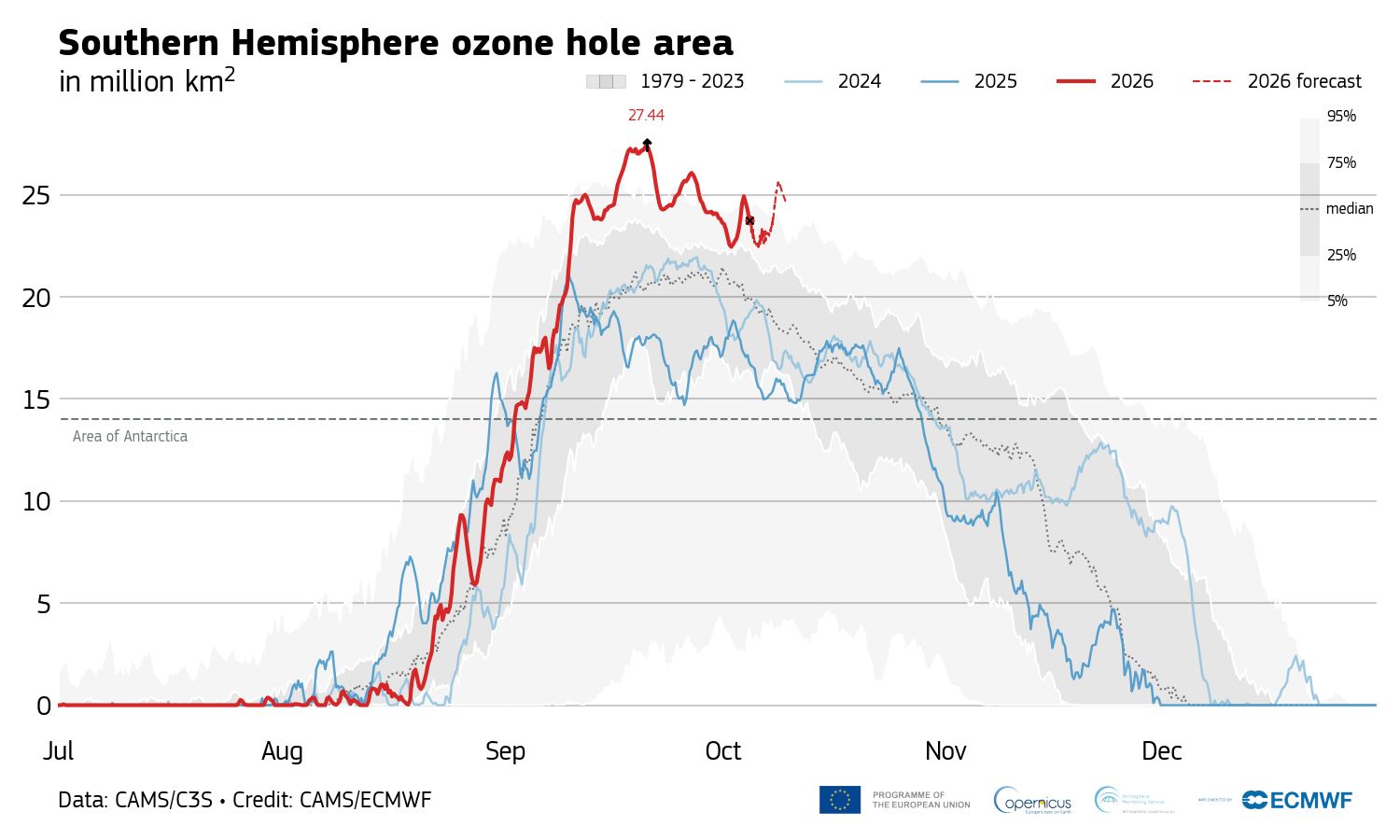
On Sept. 20, the Antarctic ozone hole peaked at 10.6 million square miles (27.4 million square kilometers), the second-largest size ever observed for this time of the year.

The last time the ozone hole was this big was in October 2015, when it reached a whopping 10.8 million square miles (27.9 million square km), records from the Copernicus Atmosphere Monitoring Service show. So why is the hole in the ozone layer β€” the shield that protects life on Earth from harmful ultraviolet solar radiation β€” so big this year, despite other clues telling scientists that it is recovering as expected from the damage human-made chemicals did in the 20th century?

The ozone hole's extent is due to extremely low temperatures in the stratosphere, but it's also possible that we could be seeing a new long-term trend of large, persistent holes, experts told Live Science.

"This year's ozone hole shouldn't be a cause for alarm," Hannah Kessenich, a postdoctoral physicist at the University of Otago in New Zealand who predicted the 2026 ozone hole's extent using satellite data and a computer model, told Live Science in an email. "However, there are still many unanswered questions. It's something we need to keep a close eye on."

Accurate predictions

The latest figures from the Copernicus Atmosphere Monitoring Service indicate that the size of Antarctica's ozone hole has dropped to around 8.9 million square miles (23 million square km) since Sept. 20, making it unlikely that this year will break the 2015 record. However, scientists think the hole will remain large and fluctuate over the next few weeks, Kessenich said.

Graph showing the extend of the 2026 Antarctic ozone hole over time compared with other years.

Antarctica's 2026 ozone hole peaked Sept. 20 and has been shrinking since. (Image credit: Copernicus Atmosphere Monitoring Service)

Antarctica's ozone hole expands every year during the Southern Hemisphere's winter and spring. It typically reaches its maximum size between mid-September and early October, when temperatures are still freezing in the stratosphere and sunlight illuminates the frozen continent for the first time after months of darkness. The hole then shrinks again until late January as surrounding ozone-rich air mixes into the depleted region.

Antarctica's ozone hole was caused by emissions of ozone-destroying chlorofluorocarbons (CFCs) between the 1930s and late 1980s. These chemicals increased concentrations of chlorine in the stratosphere, thereby promoting a reaction that depletes the ozone layer. While countries signed the Montreal Protocol to phase out CFC use beginning in 1989, major CFCs have atmospheric lifetimes of 50 to 100 years, so the hole's recovery could take six decades, researchers estimate.

The ozone layer is particularly vulnerable above Antarctica due to the frigid conditions in the polar stratosphere. Temperatures below minus 108 degrees Fahrenheit (minus 78 degrees Celsius) trigger the formation of high-altitude clouds, whose icy surfaces turn inactive chlorine into its ozone-destroying form in the presence of sunlight. These conditions don't exist to the same extent in the Arctic, because warmer air from the midlatitudes mixes more readily with cold Arctic air than with Antarctic air, thereby blocking the formation of high-altitude clouds.

Changes in the polar vortex

This year's large ozone hole is caused by a very strong polar vortex, a wall of wind that encircles Antarctica and the Southern Ocean in the winter, trapping cold air above the continent. The polar vortex created colder-than-usual conditions in the stratosphere over Antarctica, accelerating the growth of the ozone hole.

We have to look at the longer term trends, and those metrics continue to tell us that the ozone hole is slowly recovering as expected.

Susan Solomon, professor of chemistry and environmental studies at MIT

Researchers haven't detected an increase in reactive chlorine, but the colder polar vortex has triggered more ozone depletion than usual, said Susan Solomon, a professor of chemistry and environmental studies at MIT who pioneered the study of Antarctica's ozone hole in the 1980s.

This size of this year's ozone hole is most likely a product of natural variability in atmospheric dynamics, Kessenich said.

"We expect ups and downs in the size of the hole from year to year," Solomon told Live Science in an email. "A year or a few years of bigger or smaller holes doesn't tell us anything about ozone loss or recovery; it is just variability. We have to look at the longer term trends, and those metrics continue to tell us that the ozone hole is slowly recovering as expected."

It's also reassuring that the ozone hole, while large, isn't as "thin" as in years past. The hole's extent is calculated based on the area above the continent with ozone values below 220 Dobson units, a measure of how many ozone molecules occur in a vertical column through Earth's atmosphere. Although the area of this year's ozone hole is huge, ozone values haven't dropped as low as in previous big-ozone-hole years, suggesting that there is less ozone "missing" from the hole compared with those years, Kessenich and her colleagues wrote in The Conversation.

But there's also the possibility that we've shifted to a new long-term trend of big ozone holes persisting until late spring, Kessenich said. Changes in global atmospheric dynamics unrelated to CFCs could be making longer-lived holes more likely, she and her colleagues wrote in the article.

There is also some evidence that climate change will strengthen the Antarctic polar vortex over time, which could lead to colder temperatures in the stratosphere and greater ozone losses in the spring, Kessenich said. If this year's polar vortex stays robust, the ozone hole could remain large well into November, she noted.

"It's too soon to tell what has been driving dynamical variability in recent years, but more research is needed," she added.

Help us improve Live Science Pro: We're always trying to make our content better. Leave us feedback about Pro here.

A Discovery Hidden in Antarctica’s Soil is Unlike Anything Found Elsewhere on Earth, Challenging Past Assumptions

1 September 2026 at 12:59

Scientists at the University of Colorado at Boulder’s Cooperative Institute for Research in Environmental Sciences (CIRES) have discovered that some microbes in Antarctica’s soil don’t exist anywhere else on Earth, upending the long-held belief that microbes move freely around the planet and inhabit many regions.

The researchers behind the discovery said understanding that some microbes are endemic to Antarctica’s soil challenges previous assumptions and offers valuable insights for future research and present-day conservation efforts.

Microbes in Antarctica’s Soil Live in an Extreme Environment

Announcing the findings, study leader and postdoctoral researcher Nick Dragone and co-author Noah Fierer, a CIRES Fellow and Director of the Center for Microbial Exploration, noted that scientists have always assumed that microbial species were widespread.

β€œThere is a long-standing assumption in microbiology that β€˜everything is everywhere,’” Dragone explained.

That’s because, unlike plants and animals, which are generally restricted to certain global zones or latitudes, microbes are highly mobile. For example, a simple updraft could propel microbes into an atmospheric jet stream, then deposit them hundreds or even thousands of miles away.

Still, Dragone and Fierer propose that, given Antarctica’s remote location, if there were a spot on Earth containing species unlike the rest of the globe, it would be on the planet’s southernmost continent.

β€œIf we do find we’re looking for endemic microorganisms, a good place to start is Antarctica, because it’s an entire continent that is geographically isolated, ” Fierer said.

The study coauthor also noted that the unique conditions found in Antarctica’s soil aren’t usually found in other soil environments. β€œ[Being] cold is the obvious one,” Fierer said, β€œbut also super dry; Antarctica is a desert.”

Comparing 100 Antarctic Strains with 500 Worldwide Strains

Instead of starting with any microbial species, the CIRES team focused on bacterial strains within theΒ Arthrobacter group. First, these strains grow well in lab conditions, which was critical to the team’s experiments. Second, Arthrobacter group bacterial strains are found in diverse environments ranging from the tropics to Colorado, and most critically, to Antarctica’s soil.

Byron Adams, professor of biology at Brigham Young University and a co-author of the study, said the species is widespread, but also diverse.

β€œArthrobacterΒ as a group may be found all over the planet, but when we look closely at individual strains, just like penguins, Antarctica clearly has its own distinctive biological history,” the professor explained.

To start, the team collected soil samples from Antarctica. They also collected comparison samples from similarly cold, arid regions like the Tibetan Plateau, Svalbard in the Arctic, and Chile’s Atacama Desert.

When examining the sampled soils, the team tested over 100 Antarctic bacterial strains and 500 worldwide strains.

Dragone and Fierer both noted that the research was made possible by β€œlong-term collaborations among international research teams who have spent decades collecting samples across the continent for various projects.”

Genetic Sequencing Finds 90% of Antarctic Microbes are Endemic

After sequencing the genomes of the Arthrobacter strains found in samples from Antarctica’s soils, the team compared them with worldwide strains. For the worldwide species, the team obtained genomes from international research databases.

As hoped, the genetic comparison found species in Antarctica’s soil that were not found anywhere else in the world. Perhaps even more shocking, 90 percent of the Antarctic strains they’d sequenced were completely endemic, with no matches anywhere in the world.

Fierer said previous studies had identified β€œa few endemic microbes found in very specific environments.” However, the researcher also noted that finding such a large and unexpected number of endemic microbial species β€œdoes suggest there could be some in other locations.”

β€œ[Determining] whether other microbial groups show these patterns is a good direction to go,” Fierer added.

Next, the team ran a follow-up experiment to see whether the endemic Antarctic strains showed signs of adaptation to the local, extreme environment. This included growing strains of the collected Antarctic Arthrobacter strains in the laboratory. Critically, the team mimicked the continent’s harsh environmental conditions.

First, the experiments showed that the strains collected from Antarctica’s soil were extremely resilient. They also grew more slowly than non-endemic strains. The team suspects these results show that ArthrobacterΒ strains β€œare uniquely adapted to Antarctica.”

β€œWe already knew that a broad diversity of microbes can survive the inhospitable conditions of Antarctica,” Fierer said. β€œNow we know that some of those microbes are also unique to Antarctica and are uniquely adapted to life on the southern continent.”

β€œSome of Antarctica’s Most Distinctive Species are Microscopic”

When discussing the implications of their findings, Adams pointed to a potential shift in public perception of what species diversity means.

β€œWe tend to think of biodiversity in terms of penguins, seals, and whales, the researcher explained, β€œbut this shows that some of Antarctica’s most distinctive species are microscopic.”

Along with the study’s scientific and public relations value, the team said it β€œsets the stage for future research on microbial life in Antarctica.” They also noted that the findings will aid efforts to preserve Antarctica’s biological diversity, including its microbial species.

β€œProtecting Antarctic biodiversity also means protecting the biological history contained in a handful of soil,” Adams concluded.

The study, β€œEvidence for endemism and local adaptation in Antarctic soil bacteria,” was published in theΒ Proceedings of the National Academy of Sciences.Β 

Christopher Plain is a Science Fiction and Fantasy novelist and has spent the last six years as Associate News Editor and Head Science Writer at The Debrief. Follow and connect with him on X, learn about his books at plainfiction.com, or email him at christopher@thedebrief.org.

Mystery Russian β€œSpace Hazard” Warning Forces U.S. Air Force Flight to Turn Back from Antarctica

20 August 2026 at 17:18
space hazard C-17 Globemaster New Zealand
C-17 Globemaster III undergoing maintenance in Christchurch, NZ (Public Domain)

Welcome to this edition of The Intelligence Brief… This week, a U.S. Air Force C-17 Globemaster bound for Antarctica was forced to return to New Zealand after its crew received a warning of a β€œpotentially hazardous” space-related activity reportedly involving a planned Russian missile launch. In our analysis, we’ll be looking at 1) how a Russian air traffic management warning prompted New Zealand authorities to issue a NOTAM affecting international airspace, 2) why the alert caused the Antarctic-bound U.S. military flight to reverse course, 3) the lingering uncertainty over whether the reported Russian missile launch ever actually occurred, and 4) why some analysts suspect the mysterious warning may represent another example of Russia’s broader campaign of information operations and β€œhybrid warfare” against the West.

Quote of the Week

β€œThe plane turned around on the advice of New Zealand authorities who indicated that there was a space-related hazard enroute.”

– U.S. Pacific Command Statement

If you enjoy the news and perspectives offered by The Debrief, make sure that you aren’t missing our stories by making us one of your β€œpreferred sources” on Google News. You can simply follow this link to add The Debrief to your list of favorites, and you can read more about Google’s preferred sources in our article here.


RECENT NEWS from The Debrief


β€œSpace Hazard” Near Antarctica Forces U.S. Military Flight to Turn Back

This week, an alarming story from the southernmost continent made headlines, as it was reported that a United States Air Force C-17 Globemaster aircraft on its way to Antarctica required an unexpected change of course after its crew was warned of a β€œpotentially hazardous” space activity occurring in the area.

Within just hours of departing from Christchurch, New Zealand, at approximately 9 a.m. on Tuesday, the American military aircraft was forced to turn around following the release of a Notice to Airmen (NOTAM) issued by New Zealand’s Civil Aviation Authority (CAA).

Early reports offered few details, indicating only that an unspecified β€œspace hazard” had been what prompted the NOTAM, inevitably prompting speculation about what might have caused the unusual turn events.

So what do we currently know about the space-related mystery near Antarctica this week that caused a U.S. military aircraft to change its course?

Incident En Route to Antarctica

Departing Christchurch under the call sign ICE28, the American C-17 Globemaster was on its way to Antarctica’s famous McMurdo Station. A logistics hub operated by the U.S. via the National Science Foundation, the station supports as many as 1,200 residents at the height of Antarctica’s busy summer science seasonβ€”a number that shrinks back to around 200 workers who weather the colder Antarctic months.

The aircraft had only been traveling for three hours when a NOTAM came to its crew’s attention, prompting the Antarctic-bound aircraft to return to New Zealand. Early reports indicated that some kind of potential β€œhazard” had been identified; it was soon revealed that knowledge of this had reportedly been conveyed to CAA officials by the Russian State Air Traffic Management (ATM) Corporation.

A Russian Missile Launch?

Little else was known at that time, and on Wednesday, the New Zealand Herald reported that the country’s Foreign Minister, Winston Peters, had reached out to Moscow for more information after it was learned that Russian officials had reportedly planned to launch a missile in the area.

Officials with New Zealand’s CAA later confirmed that the Russian State ATM Corporation had alerted them about a β€œplanned missile launch and associated potential hazard to international airspace,” specifically impacting New Zealand’s Oceanic Flight Information Region, an area of international waters over the South Pacific Ocean, Southern Ocean, and Tasman Sea covering as much as 29 million square kilometers, which is managed by Airways New Zealand.

Responding to the alert, the CAA issued a NOTAM for the area, which did not restrict all flights through the area, but which reportedly advised pilots to β€œmake their decisions based on the information available,” according to a CAA statement issued this week.

Russian Weapon, or β€œHybrid Warfare”?

To date, there is little evidence that any real weapons test ever even occurred. According to The Diplomat, there were reportedly never any Russian ships or aircraft confirmed around the time of the alleged launch. By contrast, a significant Russian presence was visible in the region earlier this year during a long-range ballistic missile launch conducted by China.

β€œSo it appears that Russia’s warning is a dummy warning of a dummy missile,” Anne-Marie Brady wrote of the incident at The Diplomat, further characterizing the situation as a likely β€œinformation operation” evincing Moscow’s ongoing hybrid warfare efforts.

Similar incidents have been occurring for several years now. In December 2024, Andrea Kendall-Taylor with the Center for a New American Security characterized such events as part of a broader β€œhybrid war” Moscow has been continually waging against the West.

β€œWhile individually all these acts seem not to be important, when you bring them all together, they’re part of Russia’s hybrid war against the West,” Kendall-Taylor said.

As of Thursday, it remains unclear whether the alleged Russian missile launch ever really occurred, or if the incident that interrupted a U.S. Air Force aircraft’s annual flight to Antarctica was simply a false alarm prompted by a Russian β€œwarning”—one that may yet prove to have been part of a broader issue the West has encountered with Moscow in recent years.

That concludes this week’s installment ofΒ The Intelligence Brief.Β You can readΒ past editions of our newsletter at our website, or if you found this installment online,Β don’t forget to subscribeΒ and get future email editions from us here. Also, if you have aΒ tip or other information you’d like to send along directly to me, you can email me at micah [@] thedebrief [dot] org, or reach me on X: @MicahHanks.

Here are the top stories we’re covering right now…

β€œI Couldn’t Do It Anymore” – Antarctic Guides Quit Their Dream Jobs After Witnessing Tourism’s Damage

Snowfall Frozen Tourists AntarcticaAntarctic guides walked away from their dream jobs after tourism’s environmental damage became impossible to ignore. β€œYou’d see massive glacier calvings, and you’d just want to cry. But all the guests would be cheering. And you’d be like … β€˜Can you not put two and two together?’” Those are the words of a former Antarctic [...]

Microbial DNA hidden under Antarctica offers new clues about how the continent’s mysterious Blood Falls came to be

At the end of a glacier deep in East Antarctica's Taylor Valley, there is a haunting waterfall that oozes red brine like a bleeding wound in the ice. Scientists explained the brine's gory hue several years ago, finding that it is exceptionally rich in iron. And now, they may have identified the salty water's origin.

Microbes in the crimson waterfall, called Blood Falls, suggest the brine is composed of ancient seawater that was trapped in a pool beneath the glacier when ocean levels fell and the glacier advanced. However, it's unclear exactly when that happened, researchers noted. Previous studies had already proposed a seawater origin for the brine, based on various chemical signatures and bacteria detected in the liquid, but the new results add molecular and genetic evidence to the mix of clues.

"Findings in this study reveal a dominance of marine eukaryotic lineages in the Blood Falls area" compared with the broader region, known as the McMurdo Dry Valleys, the authors wrote in the study, published Monday (Aug. 3) in the journal Nature Geoscience. "This marine signal is less prominent but still detectable in the prokaryotic structure," the researchers added.

Eukaryotes' cells contain a membrane-bound nucleus and other closed internal compartments. Prokaryotes, by contrast, are single-celled organisms whose DNA floats around freely in the cell, unbounded by a membrane.

To characterize the types of microorganisms present within Blood Falls, the researchers used a suite of genetic techniques to analyze 167 samples of water, sediment and air from around the falls and the broader McMurdo Dry Valleys.

Some researchers argue that Blood Falls' water does not originate from seawater, and suggest the marine bacteria and chemical signatures that point to seawater may have instead reached the falls from the ocean via intense winds, which are common in the McMurdo Dry Valleys. By analyzing samples from various sites in the Dry Valleys, the team behind the new study compared microorganisms from the wider region with those at Blood Falls to determine if Blood Falls has a distinct microbial assemblage potentially left over from ancient conditions.

The researchers found that the crimson brine and associated red-tinted sediments at Blood Falls shared a higher proportion of eukaryotes with nearby oceanic samples than other sites in the Dry Valleys did. Whereas Blood Falls had a little over 9% of its eukaryotes in common with the ocean, the Dry Valleys showed only about 1% similarity, according to the study. The remaining eukaryotes and most of the prokaryotes identified in the paper had freshwater and terrestrial origins.

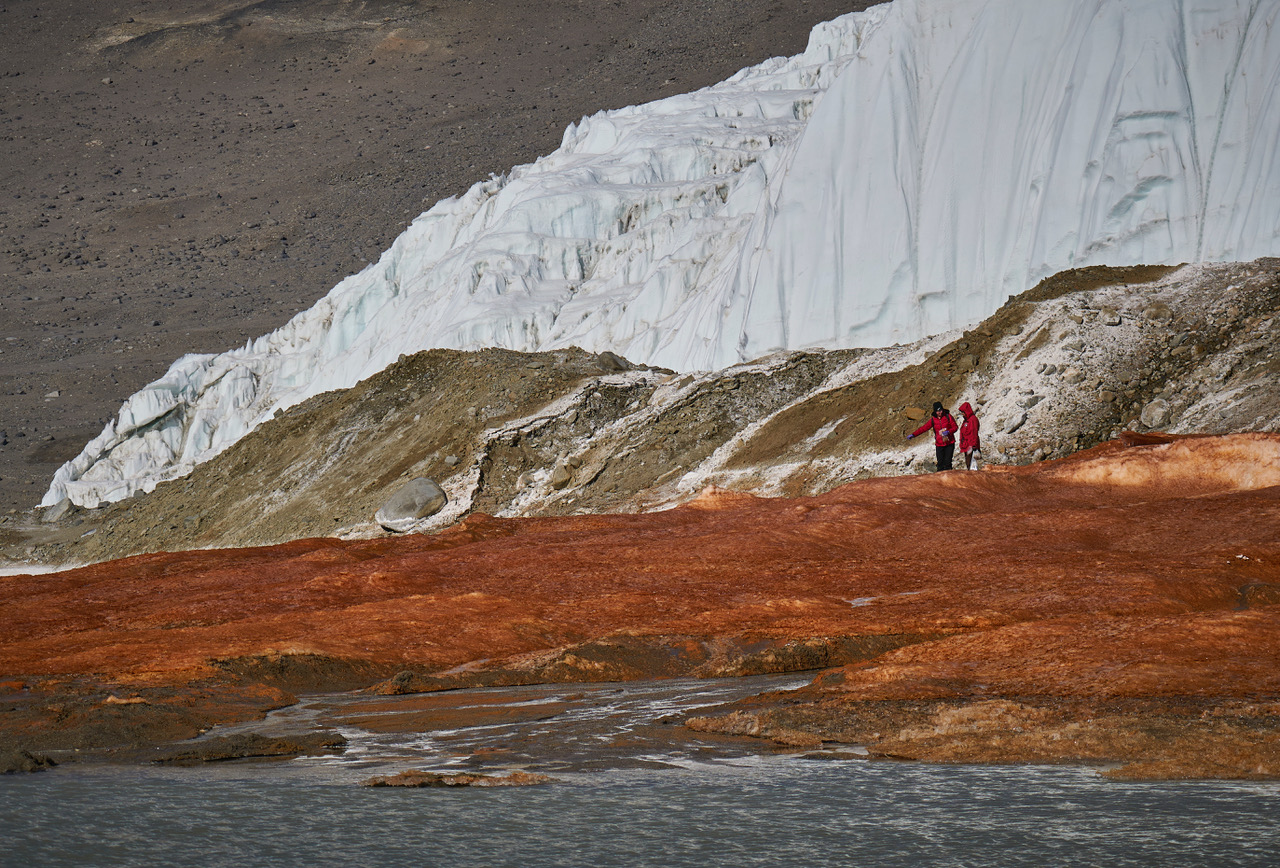
Two researchers stand on red-stained sediments near Blood Falls in Antarctica.

Researchers tried to determine if microbes at Blood Falls are distinct community from the surrounding region's assemblages. (Image credit: Bryan Minnea)

The results also showed that the air near Blood Falls contained only a tiny proportion of marine microorganisms, suggesting that present-day winds can't fully explain the microbial composition of Blood Falls, the researchers wrote.

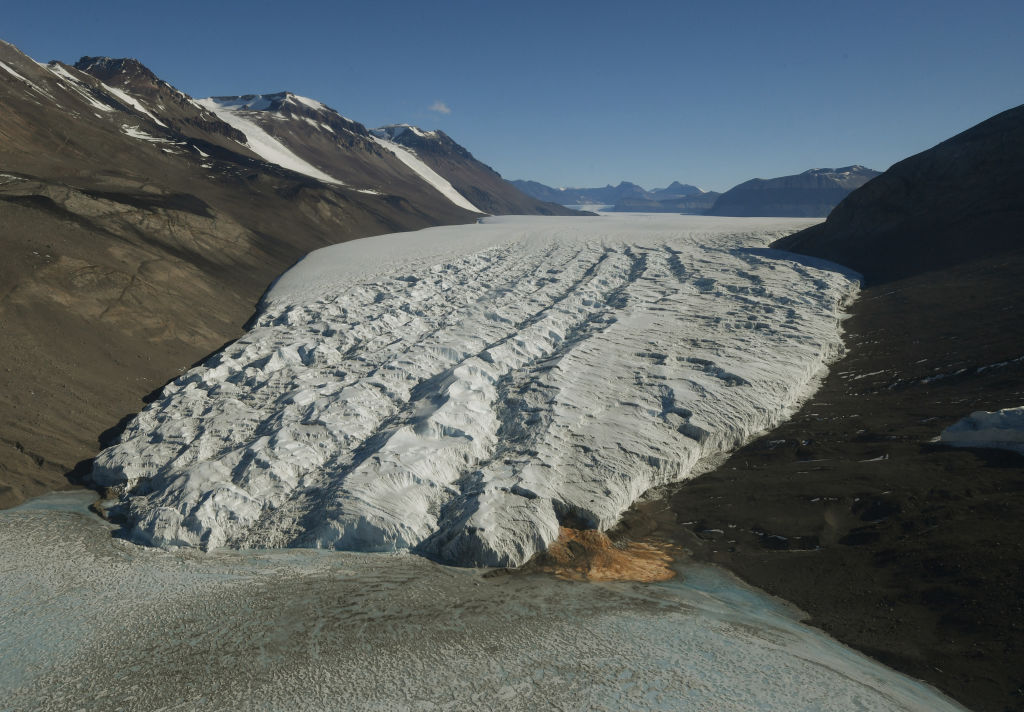
Aerial view of Taylor Glacier and Blood Falls in Antarctica.

The most likely origin for the brine that feeds Blood Falls is ancient seawater that was trapped when sea levels dropped and the Taylor Glacier advanced, the study found. (Image credit: MARK RALSTON/POOL/AFP via Getty Images)

Therefore, an ancient seawater origin is the most likely explanation for the microorganisms found at Blood Falls today, the team concluded. Winds may have played a role in shaping the community in the past, but now, their influence is probably insignificant, the team added.

The brine that feeds Blood Falls may have become entrapped more than 1 million years ago, during a warm period with higher sea levels and less ice cover than there is now, previous estimates suggested. However, further work, including more comprehensive genetic profiling and mapping of microorganisms, is needed to pinpoint when Taylor Valley's glacier grew to cover the brine, the researchers wrote.

Antarctica quiz: Test your knowledge on Earth's frozen continent

Antarctica just experienced minus 119 F, Earth's coldest temperature since 2012 β€” here's why

29 July 2026 at 19:54

While millions around the world grappled with extreme heat this month, a research station in Antarctica recorded Earth's coldest temperature since 2012.

The high-altitude research station, named Concordia, logged a low of minus 119.4 degrees Fahrenheit (minus 84.1 degrees Celsius) on July 18, according to data from the station.

Concordia is located in the interior of the Antarctic continent, which is currently in the dead of winter with no sunlight. Temperatures at the station regularly fall below minus 112 F (minus 80 C) this time of year β€ͺ—‬ so the new reading isn't unprecedented, but it's still significant.

"Even here, where extreme cold is expected, temperatures below minus 84 C are remarkable and highlight how variable Antarctic weather can still be," Gabriele Carugati, the station leader at Concordia for Italy's National Antarctic Research Program (PNRA), told Live Science over a video call from the station.

The French Polar Institute Paul-Γ‰mile Victor, which runs Concordia with the PNRA, sent Live Science raw data from July 18, which showed the temperature dropping to minus 84.1 C twice, at 6:25 a.m. and 6:34 a.m. local time.

The extreme chill at Concordia stands in sharp contrast to the sweltering heat that many countries are currently experiencing. North America and Europe have been battling heat waves this summer, with Western Europe recording the hottest June on record. Meanwhile, wildfires are raging in Canada, the U.S., France, Spain and other countries.

Globally, average temperatures are going up as humans pump more heat-trapping greenhouse gases into the atmosphere. However, Earth's weather systems are complex, and climate change doesn't mean that everywhere gets hotter all of the time.

"Climate change describes the long-term global trends, while individual weather events can still [bring] exceptional cold," Carugati said. "Antarctica is influenced by complex atmospheric processes, so an extreme low temperature at one location does not contradict the broader picture of global warming."

"Astronauts of ice"

Concordia is considered the most remote and extreme research station in the world. Built on top of a 10,800-foot-thick (3,300 meters) ice cap, the station is used for a variety of purposes, including seismic observations, astronomy and the modeling of Earth's past climates, according to the French Polar Institute Paul-Γ‰mile Victor.

"Concordia is a special place because it sits at over 3,200 meters [10,500 feet] above sea level on the Antarctic Plateau, and more than 1,000 kilometers [600 miles] from the coast," Carugati said. "During winter, there is no sunlight for months, the atmosphere is extremely dry and stable, and under clear skies, heat continuously escapes to space because there are no clouds, allowing temperatures to fall to extraordinary levels."

Concordia's environment is so harsh and isolated that the station is also used to improve our understanding of the physical, mental and social challenges astronauts experience in space. Carugati noted that the only person at the station who is not researching the environment is a European Space Agency biomedical doctor, who is studying the researchers who work there, nicknamed "astronauts of ice."

Planes can't fly to Concordia once winter sets in, and it's around 370 miles (600 kilometers) from the nearest research station. That technically makes crews more isolated than astronauts on the International Space Station, which orbits about 250 miles (400 km) above Earth, according to the European Space Agency.

What is the coldest temperature ever recorded?

The coldest temperature ever recorded at Concordia was minus 120.5 F (minus 84.7 C), logged in the winter of 2010, according to the Italian Antarctic Meteo-Climatological Observatory. However, another high-altitude research station in East Antarctica has the all-time record for the coldest temperature ever recorded on Earth. Russia's Vostok weather station, the nearest station to Concordia, recorded a temp of minus 128.6 F (minus 89.2 C) in July 1983, according to the World Meteorological Organization.

Satellite data suggests that temperatures can drop as low as minus 144 F (98 C) in East Antarctica, according to a 2018 study published in the journal Geophysical Research Letters. However, even though Antarctica is the coldest and driest continent, it's not immune to global warming.

Major glaciers and the ice sheet they support are at risk in West Antarctica, with the Antarctic Peninsula β€” which extends out of the western side of the continent β€” experiencing the most rapid warming. A study published in February in the journal Frontiers in Environmental Science found that decisions made on greenhouse gas emissions today will determine how much the peninsula will change in the coming centuries, with sea ice, ice shelves and glaciers, along with the penguins that live on them, at risk of disappearing.

Concordia sits on the largest ice sheet on Earth. This sheet in East Antarctica is more stable than the smaller sheet of West Antarctica, but it is still vulnerable to rising temperatures. An unprecedented Antarctic winter heat wave in March 2024 saw temperatures near Concordia rise to a record high of 15.1 F (minus 9.4 C) β€ͺ—‬ about 32 F (18 C) warmer than the previous March maximum. This East Antarctic heat wave was amplified by global warming, according to a study published in April in the journal npj Climate and Atmospheric Science.

Earth recently entered an El NiΓ±o, the warm phase of a multiyear natural climate pattern, which could bring unprecedented temperature extremes to an already-warming world. Carbon Brief, a U.K. based outlet that reports on climate news and policy, has predicted that 2026 is likely to be the second-warmest year on record, behind 2024, with the intensifying El NiΓ±o increasing the likelihood that 2027 will be the warmest year ever recorded.

For now, at Concordia, the researchers are continuing their work in the blistering cold of Antarctica's winter. Carugati noted that the latest extreme-temperature data will inform forecasts and long-term climate monitoring.

"Extreme observations like this help scientists better understand atmospheric processes and improve the climate models," he said.

Antarctica’s Unusual Islands, 5,000-Year-Old β€˜Sophisticated’ Egyptian Technology, and a 1.4-Million-Year-Old Fossil Surprise

28 July 2026 at 15:59
Egypt
(Image Credit: Egyptian Ministry of Tourism and Antiquities)

This week in stories we’re covering atΒ The Debrief… Recent NASA satellite imagery has revealed something odd about the color of Antarctica’s Danger Islandsβ€”and what that means for one of Earth’s most fragile ecosystems. Elsewhere, a 5,000-year-old Egyptian tomb discovery has revealed β€œsophisticated” knowledge that challenges past thinking on the origins of the pyramids. And lastly, scientists were recently very surprised when they learned what left these 1.4-million-year-old fossilized footprints on an ancient lakeshore.

Here are the top stories we’re covering right now:

Satellite Images Revealed Something Unusual About the Color of These Antarctic Islandsβ€”Here’s the Odd Reason Behind Their Appearance

28 July 2026 at 15:42

Seen from space, the Danger Islands along Antarctica’s rocky coastline have a distinctive pink-orange coloration, with tiny trails of pink closer to its shorelines.

However, the unique colors of these islands aren’t attributable to minerals, colorful lichens, or other kinds of usual causes. According to NASA, the Danger Islands look the way they do because of their iconic residents.

Now, data about the influence these creatures have on their surrounding habitat his helping scientists monitor the health of an entire Antarctic ecosystem from space.

A Colorful Surprise Spotted from Space

According to a new study’s findings, the vast colonies of AdΓ©lie penguins on the Danger Islands are the culprit behind their coloration. More specifically, it is the guano these flightless birds produce that has permanently altered their coloration when seen from space, resulting in pink stains along the shoreline environments where these waddling creatures reside.

Surprisingly, the guano stains offer an effective means of tracking the diets of these birds, which can serve as a good proxy for the broader changes occurring in Antarctica’s marine environment.

NASA Danger Islands
NASA image based on Landsat satellite imagery by Michala Garrison, showing pink guano stains along the coastlines of Heroina and Beagle Island (Image Credit: USGS/NASA Earth Observatory/Michala Garrison).

Primarily, this is because these large penguin colonies can deposit enough guano that their presence is detectable in satellite imagery, as is revealed in Landsat satellite imagery collected since the mid 1980s. The distinctive pinkish hue observed on the Danger Islands today indicates a diet rich in krill, whereas eating more fish would produce very different color signaturesβ€”all of which can be detected through satellite observations.

Decades of Penguin Activity Revealed

For the new research, scientist Casey Youngflesh with the Department of Biological Sciences at Clemson University, along with her coauthors, analyzed more than three decades of Landsat satellite imagery collected from 1984 through 2013.

These observations, combined with samples collected from field studies involving penguin colonies, helped the researchers establish links between specific color patterns and the balance of krill and fish in the birds’ diets.

Among the team’s findings, the data revealed a very close relationship between penguin food sources and the extent of sea ice in the surrounding area, particularly during the breeding season of these shore-dwelling birds.

penguins
In the drone image above, a colony of penguins can be seen in two large circular groups along Antarctica’s coastline (Image Credit: Thomas Sayre-McCord/WHOI/MIT)

Colonies of penguins along the warmer Antarctic Peninsula and West Antarcticaβ€”locations where there is less sea iceβ€”revealed a greater reliance on krill. By contrast, Eastern Antarctic penguins consumed more fish in areas where sea ice persisted for longer. This higher-quality food source is also linked to improved chick growth and a greater degree of overall population success in the long term.

β€œSea ice is such a hugely important factor in the Antarctic marine environment,” said Youngflesh. β€œThe structure of the region’s food web is changing in response.”

The Future of Antarctic Environments

Along with what the team’s findings reveal about the lives and sustenance patterns of penguins, they also bring to mind several questions about the future of their habitat.

Although sea ice in Antarctica was found to be primarily stable during the years Youngflesh and her team examined, since 2013 it has shrunken significantly, reaching record low levels. Further declines are expected in the decades ahead, signaling changes that could push AdΓ©lie penguins toward increasingly krill-dependent diets.

This could become complicated as commercial krill fishing has seen expansion in recent years, and recovering populations of whales and seals are also competing for the same food source.

Right now, researchers are working to produce new computer models based on data obtained from the Landsat 8 and Landsat 9 satellites, which will help them continue to observe penguin diets from orbit. This data provides an unusualβ€”but also a remarkably effectiveβ€”means of monitoring the changing health of Antarctica’s fragile ecosystem.

The findings were reported in a new study, β€œSpace-based monitoring of penguin diet links sea ice, food webs, and population change,” which appeared in the journal Current Biology on July 20, 2026.

Micah Hanks is the Editor-in-Chief and Co-Founder of The Debrief. A longtime reporter on science, defense, and technology with a focus on space and astronomy, he can be reached atΒ micah@thedebrief.org. Follow him on XΒ @MicahHanks, and atΒ micahhanks.com.

Scientists Solve the Mystery of Why Antarctica Froze Before the Arctic

16 July 2026 at 12:04
Antarctica CoastlineAntarctica’s first ice sheet may have begun with a geological head start hidden deep beneath the continent. Millions of years before thick ice spread across the Northern Hemisphere, forces inside Earth lifted East Antarctica into a vast region of mountains and plateaus. The higher terrain became cold enough to preserve snow even when the planet [...]

Antarctica’s Future May Be More Predictable Than Scientists Thought

22 June 2026 at 22:58
Vanderford GlacierA new study suggests Antarctic ice loss may be reliably projected over the next several decades. Scientists say the next 30 to 50 years could be a crucial period for understanding and preparing for Antarctic ice loss and its impact on rising sea levels. A new study published in Nature and led by Monash University [...]

A Texas-size chunk of winter sea ice is missing from Antarctica β€” and it's probably not coming back

16 June 2026 at 17:39

A colossal chunk of sea ice roughly the size of Texas is missing from the west coast of Antarctica, and scientists fear it might never form again.

Antarctica is currently in winter, which runs from March to October on the southernmost continent. During the winter months, floating sea ice surrounding the continent typically grows, driving currents that regulate Earth's climate. But this year, there's a notable ice gap over the Bellingshausen Sea, on the western side of the Antarctic Peninsula.

Satellite observations have revealed that around 250,000 square miles (650,000 square kilometers) of sea ice hasn't formed yet, compared with the average amount of sea ice between 1991 and 2020, The Guardian reported last week. For comparison, the ice gap covers an area slightly larger than France or nearly the size of Texas.

Will Hobbs, a sea ice-ocean interaction scientist at the University of Tasmania, told The Guardian that he was "concerned" by the lack of sea ice and that it was "depressing." Hobbs noted that this year represents the third time in four years that the region's sea has been very low.

"I don't think we will see sea ice there any more," he said. "It's done."

Researchers still have a lot to learn about sea ice changes in Antarctica. Hobbs said that the sea ice loss was likely linked to changes in the ocean and that scientists are trying to determine whether global warming was a factor.

Sea ice has declined much more slowly in Antarctica than in the Arctic. But in recent years, scientists have been witnessing an astonishing change in the sea ice extent. One record low in 2016 was followed by another in 2022 and then a third in 2023.

Edward Doddridge, a physical oceanographer at the Institute for Marine and Antarctic Studies in Australia, told ABC News (Australia) that he was no longer surprised by sea ice loss.

"It's not good news, but it has become a pattern that we're expecting now," Doddridge said. "A warming world is going to have less sea ice."

The diminished winter sea ice is likely to have a variety of knock-on effects. For example, this area of sea ice normally provides important habitat for animals like krill and penguins. Sea ice also plays an important role in regulating the climate, including by driving key ocean currents, insulating the ocean from the sun, and protecting ice shelves at the mouths of glaciers.

Down the coast from the missing sea ice, researchers have warned that a key ice shelf is about to disintegrate from Antarctica's Thwaites Glacier β€” nicknamed the "Doomsday Glacier" because its collapse could raise sea levels by 2.1 feet (65 centimeters) in the coming centuries, flooding coastal communities worldwide. The ice shelf helps protect the mouth of the glacier by acting as a buttress, thereby restraining the flow of ice from the glacier into the sea.

Thwaites Glacier has been melting rapidly since the 1980s, which is part of a wider concern for the West Antarctic Ice Sheet that it helps to support. The collapse of such an ice sheet is considered one of the major environmental tipping points, or "points of no return," that humanity must avoid in the fight to rein in climate change.

Scientists Reveal What Happened When 12 People Were Trapped Together in Antarctica for 10 Months

12 June 2026 at 15:44
Tension Doctors Arguing Fighting ConflictA study at one of Earth’s most isolated research stations offers new clues about how teams adapt during long periods of confinement. When people are isolated in extreme environments, it seems intuitive that spending more time together would strengthen social bonds. But new research suggests that under the right conditions, constant contact may actually create [...]

Vast Hidden Structure Discovered Under Miles of Ice in East Antarctica

11 June 2026 at 11:34
EAFBP East AntarcticaScientists have discovered a colossal hidden structure beneath Antarctica that could reshape our understanding of the continent’s past and present. Scientists have identified a massive hidden geological formation beneath East Antarctica, revealing a continent-scale structure buried under some of the thickest ice on Earth. The discovery was made by an international team of researchers that [...]

Geoscientists Find Vast Fan-Shaped Structure beneath Antarctica’s Ice

8 June 2026 at 16:17
Fault-controlled basins and interpreted structural frame in the newly-identified East Antarctic Fan-Shaped Basin Province. Image credit: Armadillo et al., doi: 10.1038/s41561-026-01991-6.

By combining seismic, gravity and topographic data, a team of researchers from Italy, Switzerland, Germany and the United Kingdom found that several well-known subglacial basins in East Antarctica are part of a single fan-shaped province whose origins trace back to ancient continental stretching.

The post Geoscientists Find Vast Fan-Shaped Structure beneath Antarctica’s Ice appeared first on Sci.News: Breaking Science News.

The 'Doomsday Glacier' is poised to lose its ice shelf this year. An Antarctic researcher explains what that means for global sea levels

28 May 2026 at 09:04
Researchers have warned that the Thwaites Glacier, one of the largest glaciers in the world, is about to lose its eastern ice shelf. We spoke to marine geophysicist Robert Larter about what this means for the "Doomsday Glacier."

❌