❌

Reading view

Flotation process recovers nearly 100% of silver during solar panel recycling

Australia's growing mountain of solar panel waste could become far more valuable, with University of Newcastle researchers taking a major step toward making solar panel recycling economically sustainable. The team has successfully scaled up a process that recovers valuable silver from end-of-life solar panels, demonstrating almost 100% silver recovery during the world's first continuous pilot-scale flotation trial for solar-panel recycling.

  •  

Why your Amazon order confirmation emails have become so unhelpful

Earlier this summer, Amazon customers began noticing that emails related to their online orders looked sparse: Order confirmation emails didn't name specific items anymore, and instead listed only item categories.

"Your Beauty item is confirmed!" an email about my retainer cleaning tablets read. Shoppers have posted other iterations of the redacted emails as well: "Ordered: 1 Hardware item," "Your Drugstore, Shoes, and other items are here!" and "1 Nutrition & Wellness, 1 Wireless Accessories," for example. The emails have clip art-style illustrations of general product categories, and a shopper has to exit their email and go to Amazon to …

Read the full story at The Verge.

  •  

Neutral salt layer could address one of perovskite solar cells' biggest drawbacks

One of the most promising technologies is perovskite solar cells. They are highly efficient at converting sunlight into electricity, can be manufactured as thin and flexible devices, and require less energy and lower production costs than conventional silicon modules. However, their commercial adoption has long been limited by a fundamental challenge—insufficient long-term stability when exposed to moisture, heat and oxygen.

  •  

GuliKit’s new Switch controller features next-generation anti-drift thumbsticks

The GuliKit ES Max wireless controller on a wooden desk next to a laptop.

GuliKit announced its first wireless controller to use an improved version of the anti-drift tunneling magnetoresistance (TMR) thumbsticks featured in its budget-friendly ES Pro that debuted nearly a year ago. Available now for $49.99, the new GuliKit ES Max is more expensive than last year's $29.99 ES Pro, but still cheaper than Nintendo's Switch 2 Pro Controller, while offering more features and functionality without the risk of stick drift that plagued the original Switch.

The TMR thumbsticks in the ES Max don't feature a complete reimagining of the technology but measure stick movement in a slightly different way that improves performa …

Read the full story at The Verge.

  •  

Bumble now lets men make the first move

An illustration of the Bumble logo.
Bumble backtracks on “women make the first move.” | Image: The Verge

Bumble was famously built around exclusively giving women the power to initiate messages in heterosexual matches when it first launched in 2014 - but now the times they are a-changin' for the dating app. Today, Bumble has announced a "global evolution to its signature conversation experience": anyone can now send the first message, and the deadline to respond before the match expires has been extended from 24 hours to a 72-hour window.

"While women making the first move was a radical idea, being women-first was never about prescribing just one way to connect. It was about designing an experience with women's needs in mind to create better o …

Read the full story at The Verge.

  •  

London Underground is trialing live face scanning from today as privacy groups say it 'treats the public like suspects' — here's how to avoid it

  • Facial recognition systems are expanding to the London Underground
  • British Transport Police say images will be checked against a watchlist
  • Privacy groups are calling the technology intrusive

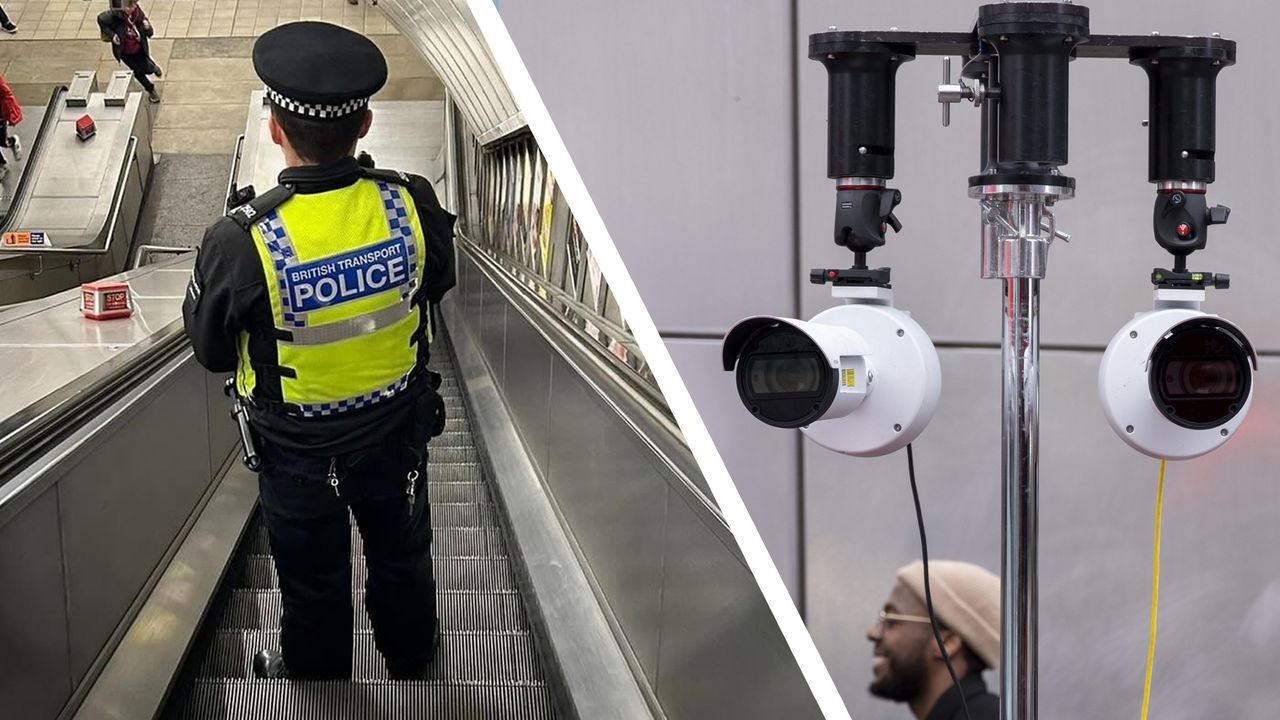
The debate over public surveillance and privacy is only getting more intense, with the British Transport Police (BTP) the latest organization to stoke the fires: it's expanding a trial of Live Facial Recognition (LFR) technology across several London Underground stations from today.

As per the BTP's official statement, this will start at Victoria and then rotate around other stations until November. "Our deployments are intelligence-led and focused on identifying people wanted by the police or courts, including those suspected of serious offences and those who may be breaching bail conditions or court orders," says the BTP.

The cameras work by comparing scanned faces to a watchlist of suspects and criminals wanted by the police. If there's a match, it's reviewed by a police officer — if not, the image is "immediately and permanently" deleted. The tech is already in use at other transport hubs in London, but is now being expanded to the Tube.

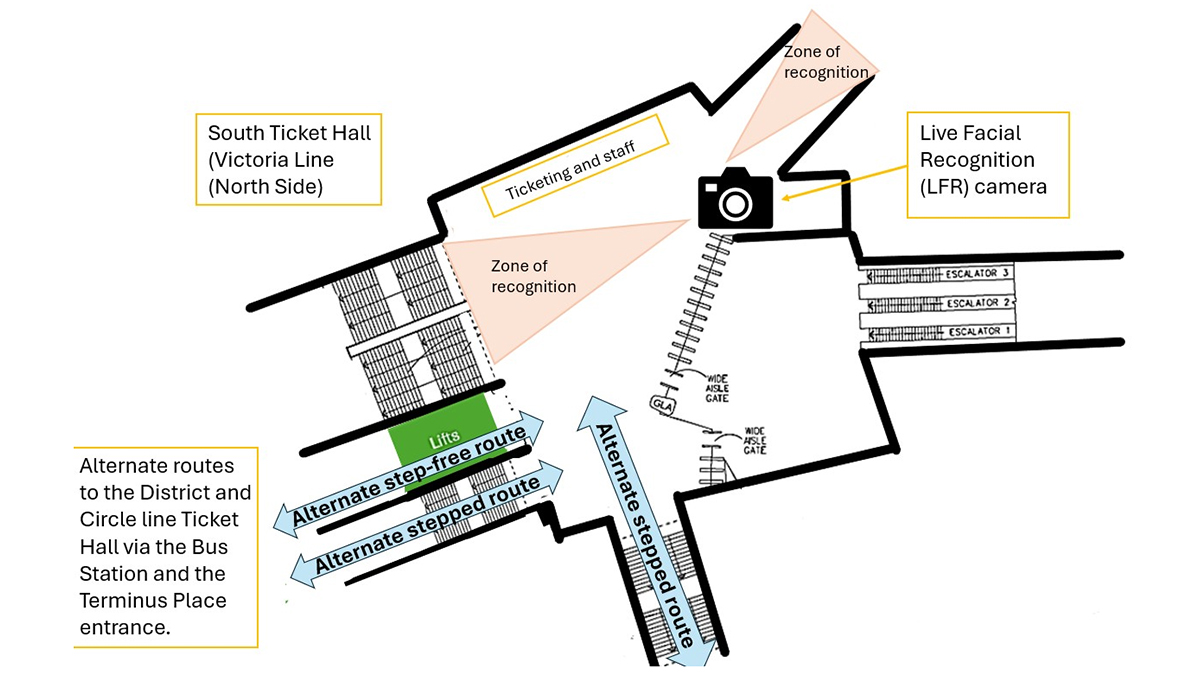
As for opting out of being surveilled, the police say the cameras will come with clear signage, and that "alternative routes" will be available too — which presumably the criminals can also sneak through. It's not clear if sunglasses and a hood would help you avoid being scanned, but you might be politely asked to remove them.

A 'dystopian' expansion

Victoria underground map

A map of Victoria Tube station showing the alternative routes (Image credit: British Transport Police)

According to the BBC, the BTP are looking out for people wanted in connection with serious offences, including sexual assault, robbery, and knife crime. Police intelligence data will be used to select the stations covered by the cameras, with the aim of reducing violence and harassment.

However, as the BBC points out, scans of some 530,000 faces across UK railway stations since February have resulted in zero matches, zero arrests, and one false identification. That's based on the BTP's own deployment logs, suggesting that to date the technology isn't helping much.

Big Brother Watch director Silkie Carlo suggests that the tech "treats the public like suspects" and is a "disturbing and dystopian expansion" of facial recognition systems. The privacy rights group has long been campaigning against the use of these cameras, arguing that they're intrusive and unnecessary.

The reaction online has been mostly negative too: comments in one Reddit thread question the effectiveness of this type of facial recognition, and air concerns about more nefarious uses of the tech further down the line. However, others also point out that public transport stations are already extensively covered by camera monitoring.

  •  

Claude will apply invisible watermarks to AI text and images

The Claude logo on a computer screen on an orange background.

Anthropic has pledged to start marking Claude-generated text and images with machine-readable data, in an effort to comply with European rules for AI transparency. "Generated text will carry embedded watermarks, and generated files will include digitally signed provenance metadata where supported," Anthropic says on a new Claude support page. The changes are invisible to human eyes, but will make it easier for people and online platforms to detect if content was generated by Claude models.

These updates are a future commitment rather than something that will go into effect immediately. New AI labeling and transparency obligations under the …

Read the full story at The Verge.

  •  

“Magic-Angle” Graphene Uses Faint Light to Transform an Insulator Into a Metal, Revealing a New Way to Make the Unseen Visible

A material that normally blocks the flow of electricity can suddenly begin behaving like a metal when exposed to remarkably weak light, according to a new experiment involving one of the strangest forms of graphene ever created. The breakthrough reveals that an unusual quantum effect could eventually provide a new way to detect some of the faintest radiation around us.

Researchers working with “magic-angle” twisted bilayer graphene found that faint, long-wavelength radiation can effectively melt the material’s fragile correlated insulating state, causing its electrical resistance to plummet. Remarkably, the experiments showed that even relatively weak radiation could trigger a dramatic transition from an insulator to a metal.

Beyond revealing an unusual way that light can manipulate matter, the discovery could provide the foundation for extremely sensitive detectors capable of spotting faint terahertz and far-infrared radiation.

With further development, detectors operating at these wavelengths could have applications ranging from security imaging and material inspection to astronomy and environmental sensing.

The study, published in Nature Communications, centers on magic-angle twisted bilayer graphene, or MATBG—a material produced by stacking two sheets of graphene and rotating them relative to one another at a carefully controlled angle.

Under the right conditions, interactions between electrons can cause magic-angle graphene to enter exotic collective states, including superconducting and insulating phases.

“Here we show that this expectation does not apply to magic-angle twisted bilayer graphene (MATBG) and demonstrate giant photoresponse of MATBG to low-intensity long-wavelength photons when it is tuned to half filling of the moiré band,” researchers write. “Far-infrared photons selectively overheat the low-heat-capacity electronic subsystem, driving a collapse of the correlated order and producing a giant photoresistive response.”

Ordinarily, changing an insulator into a conductor with light requires supplying enough energy to alter how electrons can move through the material fundamentally. Previous experiments involving light-induced insulator-to-metal transitions have frequently depended on intense, ultrafast excitation.

Magic-angle graphene offers another route.

Twisting graphene sheets at carefully controlled angles creates a larger repeating structure known as a moiré superlattice, dramatically changing how electrons within the material interact. Those interactions have already produced some remarkable results.

As The Debrief reported last year, researchers studying magic-angle twisted trilayer graphene uncovered new evidence of unconventional superconductivity, including unusually tightly bound electron pairs and a distinctive superconducting energy gap.

That work was part of a greater effort to understand whether these exotic materials could eventually help scientists design superconductors capable of operating at much higher temperatures.

In the new study, researchers exploited another unusual state that can emerge in magic-angle graphene. At certain electron densities, interactions between electrons become unusually important, allowing them to organize into what physicists call a “correlated insulator.”

That collective state is extremely fragile. The correlated insulating gap exists at an energy scale of only a few millielectronvolts. Previous measurements cited by the researchers indicate that a gap of approximately 1 millielectronvolt at very low temperatures gradually closes as the material warms and disappears around 10 kelvin.

The researchers realized that weakness could become an advantage.

Their experimental device consisted of magic-angle graphene sandwiched between layers of hexagonal boron nitride and configured as a field-effect transistor. A graphite back gate allowed them to precisely control the number of charge carriers and tune the graphene into its correlated insulating state.

They then exposed it to millimeter-wave and far-infrared radiation.

Instead of needing to inject large numbers of charge carriers, the incoming photons heated the graphene’s low-heat-capacity electronic system. That relatively small temperature increase was enough to destabilize the cooperative electronic order, retaining the insulating state.

The gap collapsed, resistance dropped dramatically, and the material became metallic.

Measurements in darkness and under illumination reinforced that interpretation. Without radiation, the graphene displayed the temperature-sensitive resistance expected from an insulator. Under millimeter-wave illumination, it instead exhibited behavior representative of a metal.

Researchers compare the mechanism to superconducting bolometers, highly sensitive radiation detectors in which incoming energy interrupts a superconducting state. But their graphene device essentially operates in reverse: instead of destroying a zero-resistance state, approaching photons destroy a high-resistance correlated insulating state and turn it metallic.

That makes the insulator-to-metal transition more than an unusual demonstration of quantum physics. It becomes the detector’s signal.

The team found that the device responded across wavelengths ranging from 85 to 2,140 micrometers, encompassing far-infrared and millimeter-wave radiation.

That portion of the electromagnetic spectrum is particularly interesting because it can reveal things ordinary cameras cannot. Terahertz radiation can penetrate some materials opaque to visible light, while interactions between this radiation and matter can provide information about a material’s composition.

More capable detectors could therefore eventually contribute to technologies such as security scanners looking for concealed objects, systems inspecting manufactured components without cutting them open, or sensors identifying substances using characteristic spectral markers.

Astronomy offers another potential application. Cold dust, star-forming regions, and other objects that may be faint or obscured at visible wavelengths emit radiation in the far-infrared. Detecting those extremely weak signals requires exceptionally sensitive instruments, making improved detector technology valuable for future astronomical observatories.

The experimental graphene detector exhibited considerable intrinsic sensitivity. The researchers measured an internal voltage responsivity of approximately 17 million volts per watt of absorbed power. They note that its internal responsivity exceeds that of many commercial bolometers operating in the same spectral region.

However, researchers caution that practical external performance is presently limited partly by how efficiently radiation is absorbed, meaning the experimental device is not equivalent to a finished commercial detector. Better antennas, cavities, metamaterials, or other structures designed to funnel radiation into the graphene could potentially improve its performance considerably.

There are other hurdles. The effect currently requires ultra-low temperatures, and the unusually strong response depends upon generating high-quality magic-angle graphene structures. Those requirements mean practical security scanners or telescope cameras based on the technology remain prospective rather than imminent.

Still, there are encouraging characteristics. The photoresponse persisted at temperatures around 6 to 7 kelvin and remained robust in magnetic fields of several tesla, with substantial reduction appearing only above roughly 4 tesla. That magnetic-field tolerance could make the technology attractive for specialized scientific instruments where superconducting detectors may meet limitations.

The current device also has an estimated practical response time of roughly 50 nanoseconds, largely because of its electrical design. The underlying electron cooling occurs much faster, and researchers estimate that smaller devices could reduce that practical limit by at least an order of magnitude. They also envision twisted multilayer materials, wafer-scale growth, and large-format detector arrays as potential directions for future development.

For now, the experiment demonstrates that in certain quantum materials, changing electrical behavior does not necessarily require pumping large amounts of energy into individual electrons. Sometimes, a small amount of light only needs to destabilize the collective state that those electrons have constructed together.

For physicists, the discovery offers a new way to investigate how fragile collective states of matter collapse and recover. For engineers, that same fragility could become useful precisely because extraordinarily weak radiation can trigger an extraordinarily large electrical response.

“Our experiments can be further generalized for time-domain interrogation of the CI state itself,” researchers write. “Radiation-driven excitation confined within the flat band, combined with time-resolved monitoring of the CI photoresistance, would allow direct access to the intrinsic timescale of correlated-order suppression and recovery, thereby probing the collective dynamics within the ground state.”

Study: Elesin, L., Shilov, A. L., Kravtsov, M. et al. “Correlated Insulator Moiré Bolometer.” Nature Communications (2026).

Tim McMillan is a retired law enforcement executive, investigative reporter and co-founder of The Debrief. His writing typically focuses on defense, national security, the Intelligence Community and topics related to psychology. You can follow Tim on Twitter: @LtTimMcMillan.  Tim can be reached by email: tim@thedebrief.org or through encrypted email: LtTimMcMillan@protonmail.com 

  •  

The AI takeover of mathematics has begun

Graphing calculator with the OpenAI logo on the screen

Mathematician James Maynard has spent a lot of time this past year "soul searching." A professor at the University of Oxford and winner of the prestigious Fields Medal, Maynard told The Verge he's been grappling with the future of his field as the traditionally slow-moving discipline hurries to adapt to AI.

Days before we spoke, OpenAI revealed it had produced the solutions to 10 long-standing mathematics problems, some of which had confounded academics for decades. Like generative AI used to produce text and images or propose ideas in science and medicine, the technology learns patterns and connections from the vast amount of material it' …

Read the full story at The Verge.

  •  

NGMN identifies top telecom agentic AI needs

Trade body the Next Generation Mobile Networks Alliance (NGMN) outlined a need for significant moves across several areas including standards and security ahead of widespread use of agentic AI for automated networks.  

The group backs the technology as a likely key enabler for Level 4 autonomous networks as defined by the TM Forum, but highlighted work was still required in architecture, operations, governance and other supporting areas.

In a newly-released report detailing the opportunities and areas to address, the NGMN explained operators need “robust mechanisms for governance, trust, policy adherence, observability, explainability, operational safety, determinism, assurance, security and cost control”.

Real-world
Mobile operator technical teams were cautiously optimistic about the NGMN’s findings.

Orange CTO and NGMN chair Laurent Leboucher said operators are at a “decisive inflection point as the telecoms industry enters a new phase of network automation”.

“The rapid arrival of agentic AI has introduced the prospect of autonomous systems able to reason, plan, collaborate and execute actions within and across multiple operational domains”.

He noted network complexity and high customer experience demands mean “general-purpose agentic AI technologies must be used carefully”, highlighting a need for safeguards and the ability to “bring humans in the loop when needed”.

“This is a learning process in itself, where operators will have to take controlled risks.”

Fellow NGMN board member and China Mobile chief expert Guangyi Liu noted reviews from standards development organisations, industry initiatives and open-source activities showed “encouraging momentum” for agentic AI use, but “despite this, the landscape remains largely complex and unevenly mature”.

He endorsed increased collaboration across a wide range of organisations to “achieve confidence in the opportunity of large-scale deployments and provide a more unified end-to-end perspective”.

Vodafone Group head of R&D Luke Ibbetson, also on the NGMN’s board, agreed about the need for protections and trust being in place before agentic AI could be fully employed by the telecoms sector.

The post NGMN identifies top telecom agentic AI needs appeared first on Mobile World Live.

  •  

Mark Zuckerberg doesn’t understand how to live

Mark Zuckerberg wearing sunglasses

Recently, a man I was rock climbing with told me about how he'd used AI to make a motivational poster for himself, which he'd hung on his bedroom wall: a bear, walking a slackline over a canyon, holding a sign that said, "Do cool shit." I made what I hoped was a polite noise. What reaction was this man looking for? He probably hoped someone, maybe me, would say it was cool or inspiring. It seemed I was not the first person he'd told about this poster. "You know, it's funny," he said to me. "No one ever says anything about it."

I have been thinking about this now for several days. There's a sort of turducken of things that I find off-puttin …

Read the full story at The Verge.

  •  

Developer Cold Iron Studios shuts down cloud version of $60 game with no refunds

Following its announcement in March, game developer Cold Iron Studios has shut down the servers for the cloud version of Aliens: Fireteam Elite on the Nintendo Switch. The game originally cost $30 (or $60 for an “Ultimate” version with additional content).

Cold Iron Studios hasn't offered customers refunds.

TheGamer reported that affected players are entitled to a discount for the Nintendo Switch 2 version of the game, which is a 2021 co-op, third-person shooter based on the Alien film franchise. However, that would mean paying money for a game that you have already paid money for once.

Read full article

Comments

© Cold Iron Studios/Steam

  •  

Anker’s travel charger works in almost any country and is down to $20

Anker Nano Travel Adapter
Anker’s Nano Travel Adapter can power up to five devices at once. | Image: Anker

If you’ve got international travel coming up, an adapter is essential for keeping your phone, earbuds, power banks, and other gadgets charged. Anker’s Nano Travel Adapter is one of our picks from our guide to the best gadgets for summer travel because it can charge up to five devices at once, yet it’s small enough to fit in the palm of your hand. It’s also available in black for just $19.99 ($6 off) at Amazon, Best Buy, and directly from Anker (with code WS7DV2BNB82J) matching its best price to date.

The Nano’s four built-in sets of prongs should keep you covered in “over 200 countries and regions,” according to Anker. It also features two USB-C ports and two USB-A ports, along with an AC outlet for plugging in a standard wall charger. A single USB-C port delivers up to 20W, which should be enough to get an iPhone 17 to 50 percent in less than 30 minutes. That’s not enough power to charge most laptops, making the USB ports better suited for smaller gadgets like phones, tablets, earbuds, and power banks. You can still charge your laptop, however, by plugging its wall charger into the AC outlet.

What’s more, it’s designed to take up as little space as possible. The adapter’s only an inch thick with its prongs folded in and, at 3.8 ounces, weighs less than a smartphone. Just keep in mind that the Nano doesn’t convert voltage, so you’ll want to make sure gadgets like hair dryers and electric razors support the voltage at your destination before plugging them in. 

  •  

Zuckerberg’s superyacht ignored emergency channel, failed to aid stranded boat

Social media scuttlebutt about Mark Zuckerberg’s $300 million superyacht failing to assist stranded boaters off the coast of Alaska was partly corroborated by ship-tracking data—and eventually prompted responses from both the US Coast Guard and a spokesperson for Zuckerberg.

The incident was made public when Michael Love, a passenger aboard the replica steamship Wilderness Legacy during an Alaska cruise, posted about it on the social media platform Bluesky. The ship detoured to rescue a stranded 21-foot skiff with two women, a child and a dog, after the US Coast Guard had supposedly first radioed Zuckerberg’s superyacht, Launchpad, for help without success.

“There was near unanimous booing when the captain announced this,” Love wrote in describing the Alaska cruise passengers’ response to the lack of help from Zuckerberg’s ship.

Read full article

Comments

© Sylvain Lefevre/Getty Images

  •  
❌