❌

Reading view

Hubble Spies One-Sided Spiral

3 min read

Hubble Spies One-Sided Spiral
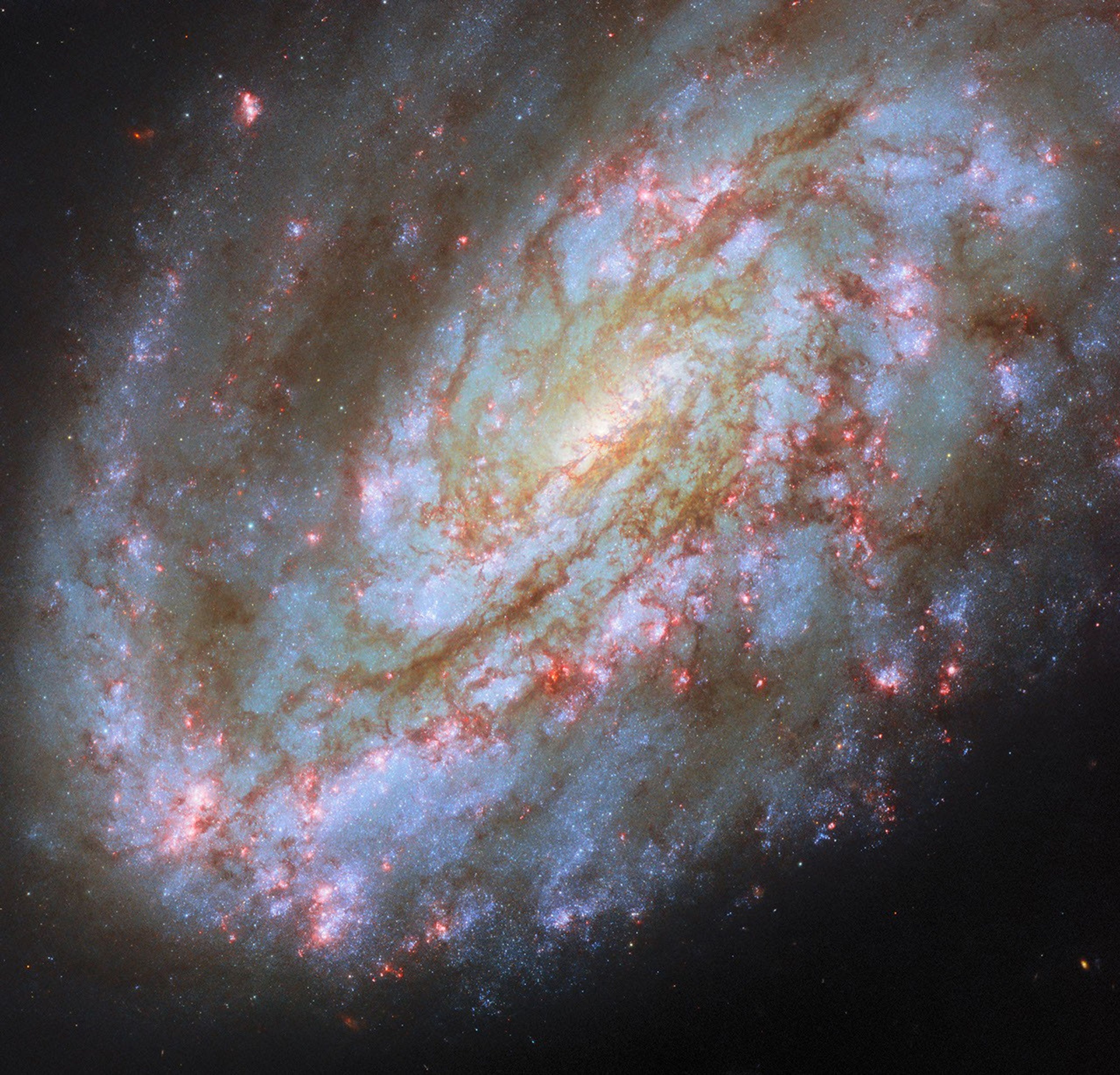
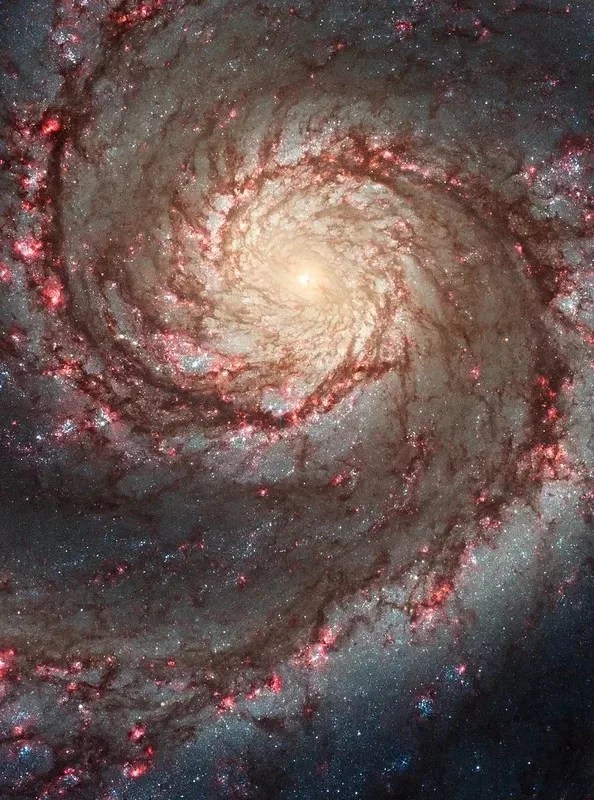
A spiral galaxy. It has a prominent spiral arm on one side (lower left) and a wide, glowing core. Dark brown filaments of dust swirl through its disk, while blue clusters of stars are visible mostly going out to its arm. On the opposite side of the arm (upper right), gas trails off from the disk, beyond the field of view in this image. A matching spiral arm is not visible on this side. The galaxy lies on a dark background.
This NASA/ESA Hubble Space Telescope image features the spiral galaxy NGC 4654, located 72 million light-years away in the constellation Virgo (the Maiden).
NASA, ESA/Hubble, D. Thilker, J. Lee, and the PHANGS-HST Team

The subject of this NASA/ESA Hubble Space Telescope image is a spiral galaxy struggling against titanic forces that appear on galactic scales in space. This is NGC 4654, an intermediate spiral galaxy in the constellation Virgo (the Maiden). It is classified as an “intermediate” because its overall shape lies between spiral galaxies that have a bar across their centers and those that don’t. NGC 4654 has a weak bar structure at its center and is located 72 million light-years from Earth in the Virgo Cluster, a particularly massive and populous galaxy cluster.

NGC 4654 is particularly asymmetric, with a rounded and clearly-defined edge on one side and a long tail of gas stretching out from the opposite side — outside the field of view captured in this image. This gaseous tail is the result of ram pressure stripping, a force that galaxies can experience as they plow through space. NGC 4654 moves with such high velocity that it sweeps up and rams through the hot, rarefied gas filling the space between the Virgo Cluster’s galaxies. This intracluster medium in turn exerts a “ram pressure” on the galaxy, compressing the galaxy’s leading edge and dragging its gas behind the galaxy, creating the elongated tail.

It’s not just the galaxy’s gas that is unevenly distributed: its stars are too, and this is more unusual for a spiral galaxy. While the spiral arm on its leading edge is rich with stars and gas, the opposite arm noticeably lacks stars, influencing the galaxy’s lopsided spiral shape. Astronomers think that ram pressure alone is unlikely to cause this effect. Rather, NGC 4654 was also subjected to the gravitational force of fellow Virgo Cluster galaxy NGC 4639. While the two galaxies are far apart now, it’s thought that a fly-by interaction between them around 500 million years ago ripped away NGC 4654’s gas along one side, limiting star formation there and creating the asymmetry in its shape.

Many galaxies that undergo ram pressure stripping suffer reduced star formation rates as the cold gas that collapses to form their stars is pulled away and lost. NGC 4654, however, is still forming nearly two Suns’ worth of stars every year, a rate comparable to other galaxies of similar size. The active star formation is visible in the latest Hubble data included in this image. The data picks up on a wavelength of red light emitted by the clouds of energized gas where newborn stars lurk. The bright pink bubbles that appear across NGC 4654 — from its forward spiral arm, to around its weak bar, and out to the edge of its disk — are areas where these newborn stars shine.

The data used in this image came from two observing programs (#15654, #17502) that aim to link the gas in galaxies with star formation. By observing many prominent galaxies in the vicinity of our own, researchers hope to better understand how gas moves in galaxies, where and when it collapses to form stars and star clusters, and what effect those new stars have on the gas around them.

Text Credit: ESA/Hubble

Media Contact:

Claire Andreoli
NASA’s Goddard Space Flight Center, Greenbelt, MD
claire.andreoli@nasa.gov

  •  

New Gravity Theory Suggests How Cosmic Order Emerges Despite Rising Entropy

Galaxies, stars, and living cells are all examples of local order emerging in the universe. At first glance, that seems to contradict one of physics’ oldest principles.

However, a recent study in Physical Review D offers a mathematical explanation for how these structures form while still obeying the second law of thermodynamics.

The second law of thermodynamics states that entropy, or disorder, in an isolated system always increases over time. Einstein famously said that “the second law of thermodynamics occupies a unique position among the laws of Nature,” reflecting how fundamental he believed the principle to be.

In its early days, the universe was smooth and uniform, with low entropy. As it expanded, gravity pulled gas into stars, stars into galaxies, and eventually made life possible. Each step seems to create order in one place, even though the universe as a whole became more disordered. Cosmologists have usually explained this by pointing to the universe’s growing volume.

Gravity as a Ledger, Not a Force

Mathematician Ginestra Bianconi at Queen Mary University of London addressed this problem with a framework called Gravity from Entropy. Rather than treating gravity as a fundamental force, the Gravity from Entropy framework proposes that it emerges from an information-based difference between two descriptions of spacetime geometry. One metric describes the actual shape of spacetime, while the other describes the geometry that matter and curvature would create. When these two match, gravity disappears. When they differ, gravity arises from the difference.

In the low-energy, weak-curvature limit, the framework reduces to general relativity. In the new study, Bianconi adds a thermodynamic perspective. She applies Gravity from Entropy to the standard model of an expanding universe and shows that the local geometric degrees of freedom follow the first law of thermodynamics, with their own temperature and pressure emerging from the equations.

Falling Density, Rising Total

One of the study’s central findings is the distinction between total entropy and entropy per unit volume. As the universe grows, the total entropy increases, just as the second law demands. However, the study found that entropy per unit volume decreases over time even as the universe’s total entropy continues to increase. Within the Gravity from Entropy framework, Bianconi proposes that this declining local entropy density may help explain how galaxies and other cosmic structures emerge.

The study also shows that these geometric temperatures change depending on what dominates the universe. In a universe dominated by matter or radiation, the temperature decreases over time. In a universe dominated by dark energy, like our own, they remain nearly constant. The framework even assigns a temperature and pressure to empty spacetime.

A Theory Still Waiting to Be Tested

“This work reveals how the Gravity from Entropy theory can tackle the challenging question of reconciling the second law of thermodynamics with the emergence of complexity in our universe,” stated Bianconi. “These results may open new avenues for investigating the long-standing problem of reconciling the foundations of cosmological irreversibility, the emergence of complex structures, and ultimately life with fundamental gravitational dynamics.”

So far, Gravity from Entropy has not been confirmed by observations. The theory makes predictions that future observations of large-scale cosmic structures and other gravitational phenomena could test. While it remains unproven, Bianconi believes it could offer a new way to link gravity, thermodynamics, quantum mechanics, and the rise of complexity in the universe.

Austin Burgess is a writer and researcher with a background in sales, marketing, and data analytics. He holds an MBA, a Bachelor of Science in Business Administration, and a data analytics certification. His work focuses on breaking scientific developments, with an emphasis on emerging biology, cognitive neuroscience, and archaeological discoveries.

  •  

He’s the Last Great Land Artist You’ve Never Heard Of

Charles Ross spent 50 years building “Star Axis,” a naked-eye observatory in New Mexico. Now his masterwork is ready. How to share it with a changed world?
  •  

Galaxy cluster's magnetic field reconstructed for 1st time with record-breaking astronomy map

For the first time, astronomers have reconstructed the magnetic field of an entire cluster of galaxies, from its central nucleus to its outer limits.

The record-breaking achievement is the product of the deepest-ever observations of the galaxy cluster Abell 2255, located around a billion light-years away — and those observations are thanks to the European radio telescope LOFAR (Low Frequency Array).

Abell 2255 has long been known for its complexity in radio waves. Its vast, diffuse radio emissions are created by particles called electrons racing at near-light, or relativistic, speeds and interacting with magnetic fields of galaxies in the cluster. Thus, using Abell 2255 as a cosmic laboratory to study the universe in radio waves could lead scientists to a better understanding of how magnetic fields come about and evolve. These observations could also help paint a picture of the dynamics of hot gas in galaxy clusters. This could reveal how the largest structures in the universe are constructed.

As part of the LOFAR Galaxy Cluster Ultra-Deep Field project, this team used 224 hours of radio image collection to discover that the distribution of large-scale magnetic fields throughout Abell 2255 (which itself stretches out for several million light-years) are not randomly distributed. Instead, these magnetic fields seem to be organized by the motion of gas that occurred during the formation of this galactic cluster.

"Obtaining very sensitive images of galaxy clusters at radio wavelengths is crucial to understanding how electrons are accelerated to relativistic speeds and magnetic fields are amplified on large cosmic scales," team leader Andrea Botteon, of the Italian National Institute for Astrophysics (INAF), said in a statement. "The complexity of these studies is due to the elusiveness of the radio signal from electrons moving in very weak magnetic fields. We believe that the mechanism that 'turns on' these gigantic radio emissions is linked to the formation process of galaxy clusters."

Botteon added that for this research he and his colleagues combined the deepest radio observations ever made with an innovative data analysis technique that allowed them to reconstruct the shape of a galaxy cluster's magnetic field for the first time.

"The coherence of the magnetic field lines observed in some regions of the cluster suggests that the morphology of the field is intimately linked to the dynamics of the gas in which it resides, where it can be 'stretched' or 'compressed' by the motions associated with the formation of the cluster itself," Botteon said.

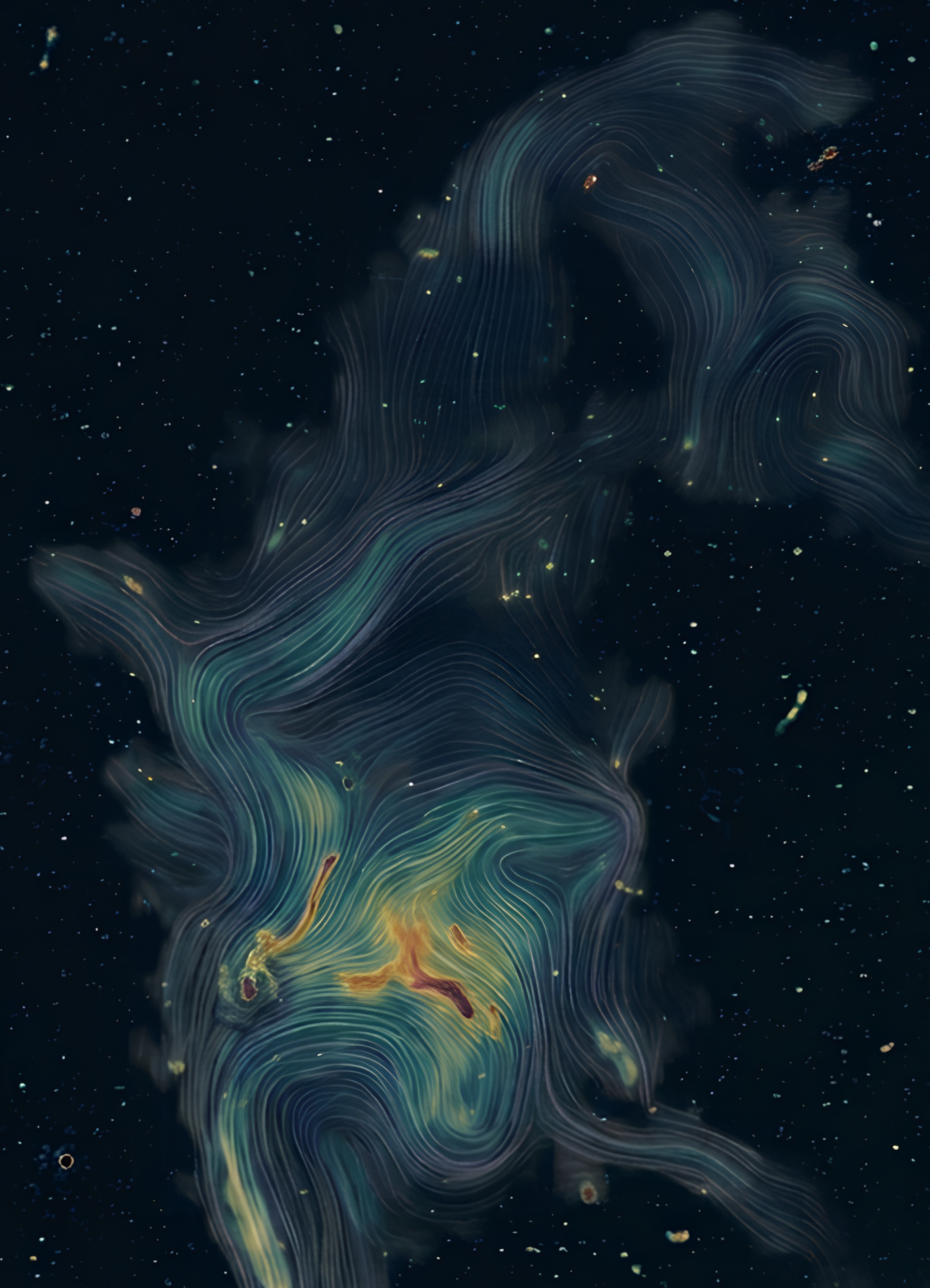
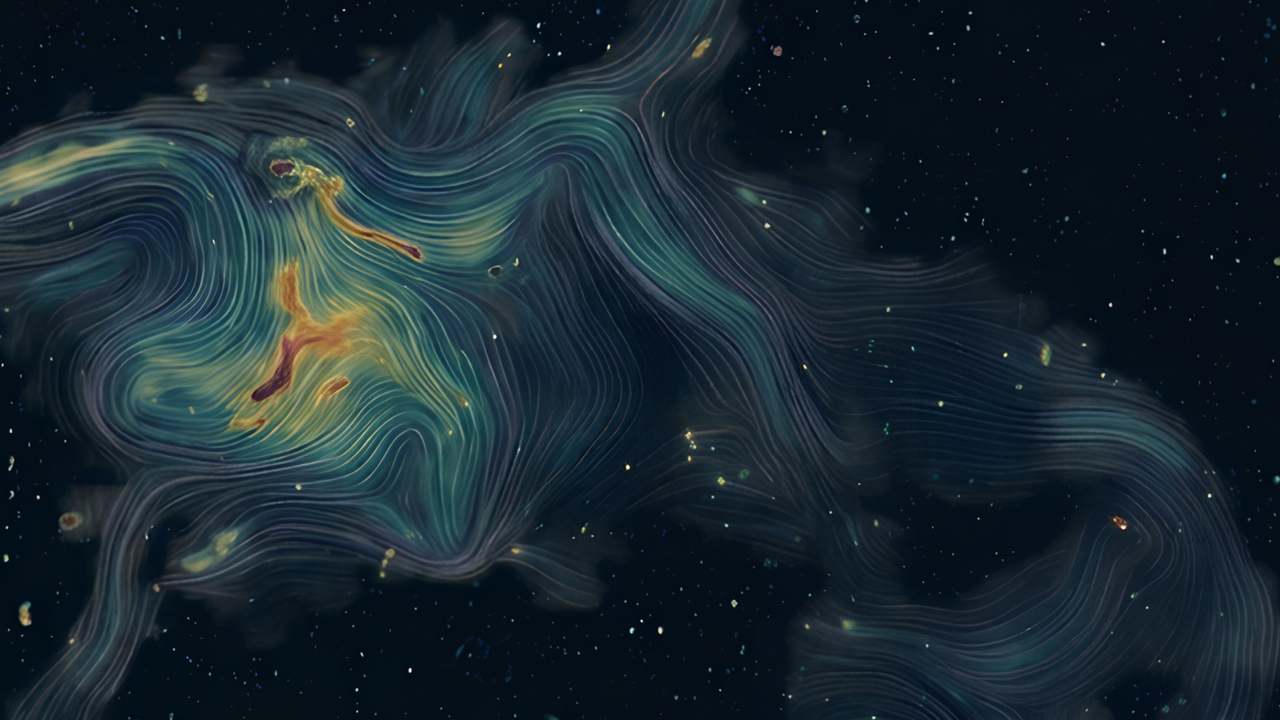
Blue and yellow swirls against a section of space.

The invisible texture of the magnetic field in the central region of the galaxy cluster Abell 2255. (Image credit: A. Botteon et al. (INAF), A&A 2026)

This analysis revealed that, in some regions, the magnetic fields follow very specific directions, stretching radially along extended radio emissions. In contrast to this, in regions dominated by shock waves, magnetic fields are orientated at tangents. This suggests magnetic fields in Abell 2255 are carved out by the same dynamics that allow clusters to accrete gas and grow.

This serves as the first observational evidence that the same mechanisms that allow galaxies to grow and cluster, creating the largest structures in the universe, also shape their magnetic fields.

The team's research has been accepted for publication in the journal Astronomy & Astrophysics and is available as a pre-peer-reviewed paper on the repository site arXiv.

  •  

Featured Image: A Rare Pair of Galaxies Lacking Dark Matter

This image, which combines a background view from the Dark Energy Camera Legacy Survey with two inset images from the Very Large Telescope, shows an unusual pair of galaxies in the Fornax Cluster. The galaxies FCC 224 and FCC 240 are under scrutiny because they may have formed via a high-velocity collision between dwarf galaxies — the so-called “bullet-dwarf” model. Using new spectroscopy from the Very Large Telescope, Maria Luísa Buzzo (Yale University) and collaborators analyzed the ages and kinematics of the galaxies’ stars as well as the unusually bright globular clusters swirling around each galaxy. These data suggest that both galaxies are deficient in dark matter, and their stellar populations and globular clusters are all roughly 10 billion years old. The lack of dark matter and the uniform stellar ages are both consistent with the bullet-dwarf model, in which the collision strips away dark matter and ignites a burst of star formation. Since this type of collision can create more than two remnants, the team suggests searching along the trajectory defined by FCC 224 and FCC 240 for more fragments from the collision, some of which may contain the galaxies’ lost dark matter. To learn more about these galaxies and what they might mean for the bullet-dwarf mechanism, be sure to check out the full research article linked below.

Citation

“Dark-Matter-Deficient Twins: FCC 224 and FCC 240 as Possible Analogs of NGC 1052-DF2 and DF4,” Maria Luísa Buzzo et al 2026 ApJ 1005 15. doi:10.3847/1538-4357/ae7349

The post Featured Image: A Rare Pair of Galaxies Lacking Dark Matter appeared first on AAS Nova.

  •  
❌