❌

Reading view

Satélite Sentinel-1A diz adeus depois de mais de uma década a vigiar a Terra. Legado continua em órbita

Ao longo da missão, o Sentinel-1A registou milhões de imagens usadas para monitorizar cheias, incêndios, gelo marinho, culturas agrícolas, infraestruturas, tráfego marítimo e operações de resposta a catástrofes.

The post Satélite Sentinel-1A diz adeus depois de mais de uma década a vigiar a Terra. Legado continua em órbita appeared first on Tek Notícias.

  •  

Ingram Micro avança para a versão 2.0 da empresa com aposta reforçada em Portugal

A reorganização da operação da Ingram Micro em Portugal já está em marcha e Jaime Soler descreve as mudanças como uma evolução que traz benefícios aos clientes no mercado português.

The post Ingram Micro avança para a versão 2.0 da empresa com aposta reforçada em Portugal appeared first on Tek Notícias.

  •  

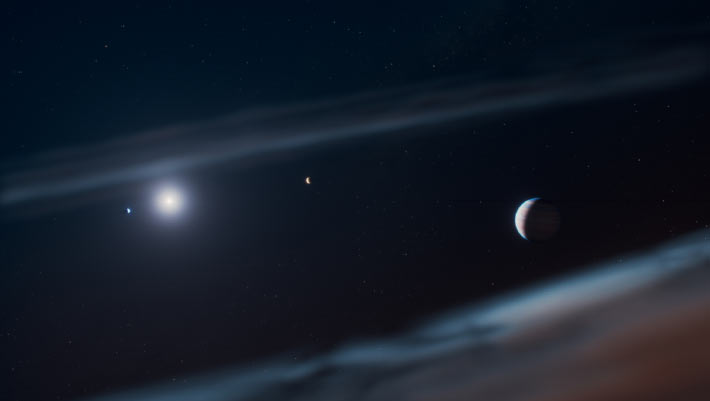
Astronomers Discover and Directly Image Third Planet in Beta Pictoris System

This artist’s concept shows the Beta Pictoris system with the discovered giant exoplanet Beta Pictoris d at the right. Image credit: NASA / ESA / CSA / STScI / Ralf Crawford, STScI.

Named Beta Pictoris d, the newly-discovered world is 100 times fainter than Beta Pictoris b -- the first planet discovered around the A5-type star Beta Pictoris -- and is among the lightest exoplanets ever to be imaged from the ground.

The post Astronomers Discover and Directly Image Third Planet in Beta Pictoris System appeared first on Sci.News: Breaking Science News.

  •  

Conferência internacional reúne astronautas e especialistas para debater o futuro espacial dos Açores

Entre os dias 22 e 25 de julho, a ilha de Santa Maria acolhe a conferência Atlantic Space Hub: Designing the Future of Space, com quatro dias de reflexão e debates sobre o papel dos Açores como centro atlântico para a exploração e investigação espacial.

The post Conferência internacional reúne astronautas e especialistas para debater o futuro espacial dos Açores appeared first on Tek Notícias.

  •  

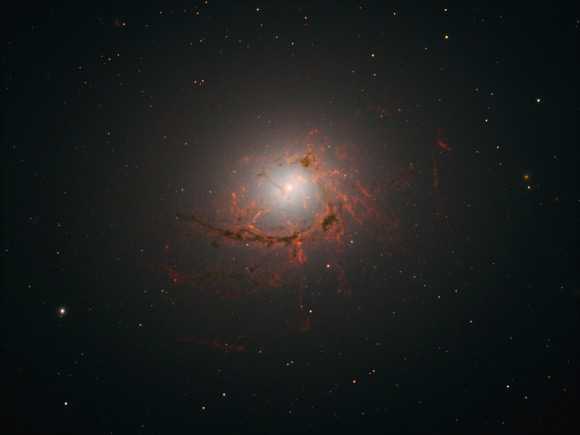
Webb Catches Supermassive Black Hole Feeding from Cosmic Gas Streams

This Hubble image shows the elliptical galaxy NGC 4696. Image credit: NASA / ESA / Hubble / A. Fabian.

New images of the giant elliptical galaxy NGC 4696 from the NASA/ESA/CSA James Webb Space Telescope reveal gas filaments funneling material into a spinning disk around a supermassive black hole 800 light-years across.

The post Webb Catches Supermassive Black Hole Feeding from Cosmic Gas Streams appeared first on Sci.News: Breaking Science News.

  •  

Astronomers Discover Four New White Dwarfs in Solar Neighborhood

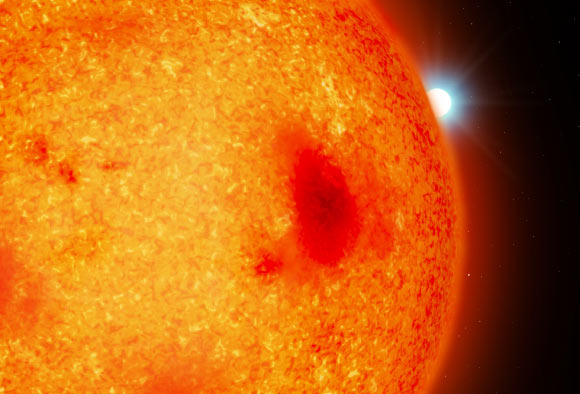
An artist’s impression of a red dwarf with a white dwarf binary companion peeking out from behind. Image credit: Mark A. Garlick / University of Warwick.

Using near-UV spectroscopic data from the Space Telescope Imaging Spectrograph (STIS) on the NASA/ESA Hubble Space Telescope, astronomers discovered four white dwarfs orbiting nearby red dwarf stars.

The post Astronomers Discover Four New White Dwarfs in Solar Neighborhood appeared first on Sci.News: Breaking Science News.

  •  

Euclid Discovers Earliest Quasars Ever Seen

This collage shows 15 of the 31 newly discovered quasars by ESA’s Euclid space telescope. EUCL J172902.75+641018.1 and EUCL J125308.55+705432.3 are visible on the first row, the first and second from the left, respectively. Image credit: ESA / Euclid / Euclid Consortium / NASA / Euclid Science Ground Segment / Antoine Basset, CNES.

Astronomers using ESA’s Euclid space telescope have discovered 31 ancient quasars from a time when the Universe was just 670 to 800 million years old. One of these objects, dubbed EUCL J172902.75+641018.1, sets the new record for the most distant quasar ever reported.

The post Euclid Discovers Earliest Quasars Ever Seen appeared first on Sci.News: Breaking Science News.

  •  

ESA’s Euclid Telescope Just Spotted Two Record-Breaking Ancient Giants Among the Most Remote Objects in the Cosmos

The European Space Agency’s (ESA) Euclid Space Telescope has just revealed new evidence for the existence of more than two-and-a-half dozen objects that are among the oldest and most remote in the universe.

These 31 massive objects, known as quasars, rank among the oldest objects astronomers have ever seen, including two that are believed to originate from a period in the universe when our cosmos was only 5% of its current age.

The discoveries, revealed in a new study appearing in the journal Astronomy & Astrophysics, provide a remarkable look at the earliest generations of galaxies, as well as a rare look at the dynamics of the ancient black holes that once powered them.

Quasar Questions

As some of the brightest objects anywhere in our universe, quasars are remote objects resembling stars in appearance that emit unprecedented amounts of energy. They are the result of creation processes that involve enormous quantities of gas and dust, which spiral into supermassive black holes.

During the gravity-driven inward acceleration process, immense friction causes temperatures that can reach millions of degrees, which generates large amounts of energy. The resulting celestial features produce enough light to outshine entire galaxies.

Despite their brightness, the 31 newest additions to our growing collection of known quasars were difficult for astronomers to spot, given their extreme distances from Earth. The light that documents their ancient presence in the universe has traveled more than 13 billion years to make its way here, causing it to be extremely faint, and thereby very difficult to distinguish from surrounding stars whose light normally outshines them with ease.

Rotating Quasars from the Early Universe

A dozen of the newly discovered collection of quasars date to within the first 770 million years our universe existed. Add to that the fact that two of the ancient objects are believed to have formed just 670 million years after the Big Bang—at such ages, these quasars are among the oldest astronomers have ever observed.

The weight of the discoveries goes beyond just record-breaking astronomical observations, since the data they provide could help astrophysicists unravel some of the most enduring mysteries of cosmology. For instance, these quasars could help to reveal answers to questions about how supermassive black holes grew so quickly while the universe was still in its infancy.

Additionally, studying these energetic ancient giants could help to provide new insights into the formation of the earliest galaxies and the evolution of the universe while it was still in its relative infancy.

Answering Questions About the Cosmos

The recent research, led by the ESA and with contributions from its partners at NASA, has helped to place the Euclid mission in an ideal place to carry out its mission of mapping billions of galaxies. Doing so may help scientists uncover clues about the questions surrounding mysterious dark energy, which is widely believed to be the force behind the accelerating expansion of the cosmos.

Additionally, the Euclid mission’s findings could be pivotal in helping shape the future work of NASA’s Nancy Grace Roman Space Telescope, which will continue the quest to unravel the nature of dark energy and help astronomers understand the nature of the universe at large scales. Additional details about the recent quasar discoveries by Euclid can be found at the ESA’s website and on NASA’s FAQ page.

The new findings were detailed in a recent study, “Euclid: Discovery of 31 new quasars at 6.6 < z < 7.8” published in Astronomy and Astrophysics. 

Micah Hanks is the Editor-in-Chief and Co-Founder of The Debrief. A longtime reporter on science, defense, and technology with a focus on space and astronomy, he can be reached at micah@thedebrief.org. Follow him on X @MicahHanks, and at micahhanks.com.

  •  

Deep Inside the Earth’s Molten Core, a Sudden ‘Reversal’ Now Has Scientists Searching for Answers

The molten iron core deep within our planet could be much more dynamic and complicated than previously known, as revealed in new studies that point to a current of liquid metal under the Pacific Ocean that reversed directions unexpectedly more than a decade ago.

The new findings provide additional insights into a sort of hidden “engine” driving the planet’s protective magnetic field, as detailed in new reporting featured in the Journal of Studies of Earth’s Deep Interior.

According to the research, long-held assumptions about large-scale flows occurring in Earth’s outer core are now being challenged, pushing back on previous notions that they evolve only gradually over time. Now, researchers say a broad region of molten iron beneath the equatorial Pacific abruptly shifted from a weak westward flow to a strong eastward current sometime around 2010.

Earth’s Magnetic Field

Since our planet’s magnetic field is produced by the movement of superheated, electrically conductive liquid iron that is close to 2,200 kilometers (1,370 miles) below the surface, sometimes even the most nuanced changes within these deep currents can fundamentally alter the magnetic field that shields the planet from harmful charged particles emitted by the Sun.

Discovering this unexpected reversal required scientists to combine close to three decades of ground-based magnetic observations with satellite data collected from 1997 until 2025. The European Space Agency’s (ESA) Swarm Mission provided measurements, which, combined with previous observations made possible through German CHAMP and Danish Ørsted satellites, helped researchers behind the new work to construct a precise model of the changing flow patterns occurring at the boundary between Earth’s core and mantle.

“The large-scale flow reversal beneath the Pacific raises new questions about the behavior of Earth’s deep interior,” said lead author Frederik Dahl Madsen of the University of Edinburgh’s School of Geosciences.

“Scientists now want to understand whether the reversal represents a short-lived fluctuation, part of a repeating oscillation, or a new stable equilibrium for core circulation,” Madsen said.

A Weakening Current

Among their findings, the team also said they uncovered evidence that the strong eastward current appears to have weakened since 2020, raising the possibility that the reversal could represent part of a longer natural cycle.

According to Madsen, the shift coincided with changes inferred within Earth’s solid inner core, which suggests previously unrecognized links between the planet’s deepest layers.

“The rise of the strong eastward flow in the Pacific is contemporary with a change in behaviour in the inner core, as inferred from geodesy and seismology, and we hypothesize that these changes in the deep interior are associated with the changes in flow beneath the Pacific,” Madsen said.

While such processes occur thousands of kilometers beneath our planet’s surface and pose no direct dangers, they nonetheless have a vital part in sustaining Earth’s magnetic field.

Although invisible, the magnetic shielding capability it provides protects our atmosphere from solar radiation, while supporting the technologies many of us rely on daily for navigation, space weather monitoring and forecasting, and a range of other things.

ESA scientists say that in the long term, satellite missions like its Swarm mission provide a detailed picture of what’s happening in Earth’s hidden interior. That data is also revealing how the planet’s molten core may be considerably more variable and complex than once thought.

Going forward, Madsen says he and his colleagues will continue to look at how the molten flow deep within the earth is changing over time.

“Continued monitoring will be essential to determine how the flow evolves over the coming years,” Madsen said of the team’s ongoing work.

The team’s recent study, “Principal component analysis of the 2010 reversal of core-surface flow beneath the Pacific Ocean,” was published in the Journal of Studies of Earth’s Deep Interior.

Micah Hanks is the Editor-in-Chief and Co-Founder of The Debrief. A longtime reporter on science, defense, and technology with a focus on space and astronomy, he can be reached at micah@thedebrief.org. Follow him on X @MicahHanks, and at micahhanks.com.

  •  
❌