Une nouvelle espèce de requin vient d'être identifiée dans les eaux de Papouasie-Nouvelle-Guinée. Sa particularité ? Comme les autres rares « requins marcheurs », il utilise ses nageoires pour se déplacer sur les récifs peu profonds, une adaptation étonnante qui intrigue les scientifiques.
Domestic cats (Felis catus) develop the same patterns of brain shrinkage and neurological decline as aging humans, and scientists think that makes them an ideal window into dementia and aging.
Segundo um relatório da Kaspersky, as burlas mais comuns nas aplicações de mensagens em Portugal incluem falsas entregas de encomendas, assim como esquemas de investimento e fraudes românticas.
I further develop "spiritual physics" to explore the dynamics of UFOs, linking their behavior to concepts of exotic energy and matter. By applying Newtonian kinematics and imaginary numbers, the model suggests UFOs harness unseen energy and achieve incredible speeds. The interplay between real and imaginary mass could explain their elusive movements.
Um incidente com mensagens falsas levou a Defesa Civil do Brasil a desativar temporariamente o sistema de alertas de emergência no país. As autoridades suspeitam que se trate de um ataque informático, mas, afinal, o que se passou?
A presidência do Conselho da União Europeia e os representantes do Parlamento Europeu chegaram hoje a um acordo provisório sobre a atualização das regras europeias de direito penal relativas ao abuso sexual de crianças e à exploração sexual de menores, incluindo para os casos em que são usadas tecnologias como IA.
During future space missions, humans may finally encounter extraterrestrial life forms, settling the age-old question of whether we are alone in the cosmos. But what if alien biology is so different from that of Earthlings that its presence could become a potential global hazard?
This is the concern raised by researchers Frederick I. Moxley and Anthony Ricciardi in a new study, which argues that in an era of sample return missions and space missions that are carrying humans and our robotic probes farther into the cosmos than ever before, we need to be prepared to enact measures to protect our planet against the unforeseen consequences of any potential alien encounters the future may hold.
“The advancement of space exploration into an era of sample return missions from Mars, asteroids, and icy moons raises the potential for biological contamination either to or from Earth,” the authors write in their recent study, published in the journal Ambio. Given the potential for such contamination, Moxley and Ricciardi approach the question of alien contact from the perspective of past examples where invasive species on Earth have caused major disturbances to the environments they encounter.
“We consider the possibility that extraterrestrial organisms introduced to Earth could behave analogously to invasive species by destabilizing ecosystems or interacting unpredictably with their new environment,” the authors write, pointing to the multitude of examples known to science, many of which involve the introduction of microbial organisms into new environments—often with devastating consequences.
This, the authors say, challenges the idea that extraterrestrial life might not even be capable of surviving on Earth, as expressed by some past research.
“The plausibility of encountering extraterrestrial life warrants stringent planetary protection measures grounded in biosafety and biosecurity principles,” the authors warn.
So how do they suggest protecting Earth against such potentially catastrophic events involving future encounters with extraterrestrials?
According to Moxley and Ricciardi, building a quarantine facility on the Moon could serve as Earth’s last line of defense against any unintended alien invasions that could radically disrupt Earth’s fragile ecosystems.
“Due to its proximity, natural isolation, and apparent lack of a biosphere, the Moon can serve as a secure site for biocontainment of extraterrestrial samples,” the authors write. In their study, they examine historical instances where biological invasions have led to catastrophic environmental changes and argue that constructing a biocontainment facility on the Moon “should form the cornerstone of modern astrobiological risk mitigation strategies.”
Artist’s concept of a future lunar base (Image Credit: NASA/SAIC/Pat Rawlings)
At a cost of close to $30 billion, the effort will help to facilitate an ongoing human presence on the Moon by as soon as 2028, according to current mission timelines, and will serve as a science hub in support of future lunar exploration.
For Moxley and Ricciardi, incorporating a quarantine facility within our future lunar infrastructure that can house any extraterrestrial life forms we may encounter could prove to be vital. Ultimately, having such a facility may play the important role of shielding Earth against unintentional contamination by a potentially invasive alien species.
Micah Hanks is the Editor-in-Chief and Co-Founder of The Debrief. A longtime reporter on science, defense, and technology with a focus on space and astronomy, he can be reached atmicah@thedebrief.org. Follow him on X @MicahHanks, and at micahhanks.com.
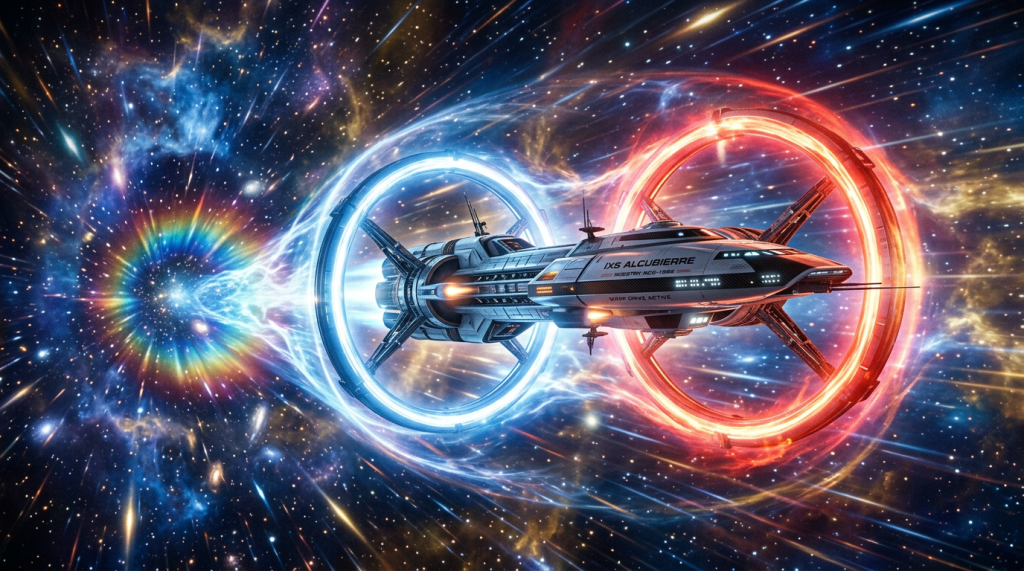
The exploration of faster-than-light travel, particularly through the concept of warp drive, presents significant theoretical challenges. While models exist, such as the Alcubierre drive, practical implementation remains impossible due to the non-existence of the required negative energy. Thus human exploration of neighboring star systems must be concluded as impossible.

 Login