❌

Reading view

NASA’s Lucy Reveals Wobbling, Peanut-Shaped Asteroid

Even small asteroids lead complex lives. During its flyby of the asteroid Donaldjohanson last year, NASA’s Lucy spacecraft revealed the asteroid to be a wobbly, peanut-shaped body that has undergone a lot of activity in its relatively short history. Formed as fragments coalesced after a violent collision 155 million years ago, the asteroid was transformed by the small but inexorable force of the Sun’s radiation, all while retaining signs of the brief presence of liquid water in its distant past.

Zooming through the main asteroid belt toward one of the Jupiter Trojan asteroid groups, the Lucy spacecraft collected the first close-up images and other data at Donaldjohanson on April 20, 2025, as it passed 650 miles away from the asteroid. The data revealed that, instead of spinning simply around one axis like most other asteroids and planets, Donaldjohanson has a more complicated two-axis rotation. Scientists also saw Donaldjohanson’s peanut shape and the craters and ridges on its surface.

A timelapse video made from images taken by NASA’s Lucy spacecraft as it approached the asteroid Donaldjohanson on April 20, 2025. The L’LORRI (Lucy Long Range Reconnaissance Imager) instrument, the spacecraft’s high-resolution black-and-white imager, collected these images over two hours as the spacecraft rapidly closed in on the asteroid from an initial separation of more than 58,000 miles (93,000 km), until the spacecraft passed a mere 650 miles (1000 km) from the 5-mile- (8 km-) wide asteroid.
NASA/Goddard/SwRI/JHU-APL

Lucy’s encounter with the asteroid was planned as a dress rehearsal for the spacecraft and mission team before its primary asteroid encounters, which begin with Lucy’s flyby of the Trojan asteroid Eurybates on Aug. 12, 2027. The instruments performed as expected, and, as a bonus, scientists got a rare opportunity to study a previously unexplored asteroid up close and to compare it to two asteroids with similar compositions but different histories: Bennu, the target of NASA’s OSIRIS-REx sample-return mission, and Ryugu, the site of JAXA’s (Japan Aerospace Exploration Agency) Hayabusa2 sample-return mission.

Here’s what Lucy’s science team has learned so far from Lucy’s encounter with Donaldjohanson, as reported on June 18 in the journal Science.

Wobbling rotation

With Earth-based telescopes, observers saw fluctuations in the light Donaldjohanson reflects, regular patterns of peaks and valleys, typical of an elongated object rotating once every 10.5 Earth days. But Lucy’s data revealed another pattern: Donaldjohanson appears to be rotating like a wobbly top. Paper authors reported that the asteroid rotates end-over-end once every 10.5 Earth days, and wobbles back and forth around its long axis once every 26.5 days.

The asteroid Donaldjohanson is shown slowly rotating in a tumbling, non-principal axis motion, with its angular momentum vector and rotation axes indicated. The surface is colored by gravity slope, which measures the angle between the local surface and the direction of gravity. Higher values (warmer colors) indicate steeper terrain relative to the local gravitational pull. Regions with limited stereo image coverage have been masked out where the shape model is less well constrained.
Kel Elkins/NASA’s Science Visualization Studio/DLR

Peanut shape

While the Earth-based observations hinted at Donaldjohanson’s elongated shape, the Lucy flyby revealed a “bilobate” structure: two lobes connected by a neck, like a peanut. These lobes are likely two fragments from an asteroid collision that gently came together afterward by their mutual gravity.

Donaldjohanson likely rotated at least 10 times faster when it formed, having slowed to its current rate in the last 20 to 60 million years, the team estimates. As it slowed, the balance between the centrifugal force pushing things apart and gravity pulling things together changed and loose rocky material slid down slopes creating the worn-down appearance of many craters, as the flyby images showed.

The paper’s authors say that the asteroid’s slowing rotation is likely caused by a subtle consequence of solar heating known as the YORP effect. Each part of the asteroid’s Sun-warmed surface radiates heat away as infrared light, and that radiation imparts a tiny recoil force to the surface. Because the asteroid’s shape isn’t symmetric, this results in a net torque, or twist, that can change the asteroid’s rotation. Thus, YORP can slow asteroid spins down or speed them up, as in the case of Bennu (once every four hours) and Ryugu (once about every seven hours), which both likely used to rotate much slower than they do today.

Fleeting water

As it passed by Donaldjohanson at 30,000 mph, Lucy recorded the signatures of iron-rich clay minerals on the surface. These clays must have formed in the distant past with the help of liquid water. However, the exposure must have been brief, Lucy scientists concluded, because iron in clays tends to be replaced with other elements, such as magnesium, as water lingers.

Indeed, scientists saw magnesium-rich clays at Bennu and Ryugu, which suggested prolonged water exposure, perhaps lasting millions of years, when they were still part of larger asteroids.

This difference in water exposure history, and other characteristics, may mean that the parent bodies of these asteroids formed at different times or in different regions of the solar system before relocating to the main belt.

Compare, contrast

Donaldjohanson is thought to be made from rocky remnants of a larger, carbon- and water-rich asteroid that collided with another object in the main asteroid belt. Bennu and Ryugu are thought to have formed in the same way and in the same region.

But Donaldjohanson is different. At 155 million years old, it is much younger than Bennu and Ryugu, which formed 1 to 2 billion years ago. Donaldjohanson also has remained in the asteroid belt since birth, while its wandering cousins migrated into orbits around the Sun that bring them close to Earth’s orbit about once a year (which made them perfect close targets for sample return missions).

Black background graphic with a large white title at top. Upper left shows a gray, pea-nut-shaped, rock-like object. Upper right shows a rectangular inset image of a dark textured rock fragment. Near the center are a mission patch logo and a small globe with Antarctica highlighted. Lower half contains two side-by-side charts with axes, tick marks, and blue and green plotted lines with scattered blue data points. Additional white, blue, and green labels appear throughout the graphic.
During its April 20, 2025, encounter with the main-belt asteroid Donaldjohanson, NASA’s Lucy spacecraft discovered evidence for iron-rich clays on the surface using its infrared spectrometer. These clays, which are similar to those found in carbon-rich meteorites such as QUE 97990, indicate that water was briefly present in the asteroid during the distant past.
NASA/Goddard/SwRI/Dan Gallagher

“It’s helpful for scientists to compare Donaldjohanson with asteroids like Bennu and Ryugu, which are seemingly similar asteroids, because every subtle difference is another clue to our origin story,” said Simone Marchi, Lucy deputy principal investigator and lead author of the study at the Boulder, Colorado, office of the Southwest Research Institute.

“Once we start learning more about the Trojans, a completely different population of space rocks with very different histories, our understanding of solar system formation is destined to be challenged,” said Marchi.

Named after a fossilized skeleton of a human ancestor discovered in Ethiopia in 1974, NASA’s Lucy will be the first mission to explore Jupiter’s Trojan asteroids, a population of well-preserved space rocks that formed early in our solar system’s history and could help scientists understand how the planets formed and moved around before settling in their current configuration.

Download story graphics from NASA’s Scientific Visualization Studio.

About Lucy:

Lucy’s principal investigator is based out of the Boulder, Colorado, branch of Southwest Research Institute, headquartered in San Antonio. NASA’s Goddard Space Flight Center in Greenbelt, Maryland, provides overall mission management, systems engineering, and safety and mission assurance. Lockheed Martin Space in Littleton, Colorado, built the spacecraft. Lucy is the 13th mission in NASA’s Discovery Program. NASA’s Marshall Space Flight Center in Huntsville, Alabama, manages the Discovery Program for the agency’s Science Mission Directorate in Washington.

For more information on NASA’s Lucy mission, visit:

By Lonnie Shekhtman

NASA’s Goddard Space Flight Center, Greenbelt, Md.

and

Katherine Kretke

Southwest Research Institute, Boulder, Colo.

Media Contacts:

Karen Fox / Molly Wasser

Headquarters, Washington
240-285-5155 / 240-419-1732
karen.c.fox@nasa.gov / molly.l.wasser@nasa.gov

Sarah Frazier

NASA’s Goddard Space Flight Center, Greenbelt, Md.
202-853-7191
sarah.frazier@nasa.gov

Simplified Summary

Zooming through the main asteroid belt toward one of the Jupiter Trojan asteroid groups, the Lucy spacecraft collected the first close-up images and other data at Donaldjohanson on April 20, 2025, as it passed 650 miles away from the asteroid. The data revealed that, instead of spinning simply around one axis like most other asteroids and planets, Donaldjohanson has a more complicated two-axis rotation. Scientists also saw Donaldjohanson’s peanut shape and the craters and ridges on its surface.

The post NASA’s Lucy Reveals Wobbling, Peanut-Shaped Asteroid appeared first on NASA Science.
  •  

NASA’s Lucy Reveals Wobbling, Peanut-Shaped Asteroid

Even small asteroids lead complex lives. During its flyby of the asteroid Donaldjohanson last year, NASA’s Lucy spacecraft revealed the asteroid to be a wobbly, peanut-shaped body that has undergone a lot of activity in its relatively short history. Formed as fragments coalesced after a violent collision 155 million years ago, the asteroid was transformed by the small but inexorable force of the Sun’s radiation, all while retaining signs of the brief presence of liquid water in its distant past.

Zooming through the main asteroid belt toward one of the Jupiter Trojan asteroid groups, the Lucy spacecraft collected the first close-up images and other data at Donaldjohanson on April 20, 2025, as it passed 650 miles away from the asteroid. The data revealed that, instead of spinning simply around one axis like most other asteroids and planets, Donaldjohanson has a more complicated two-axis rotation. Scientists also saw Donaldjohanson’s peanut shape and the craters and ridges on its surface.

A timelapse video made from images taken by NASA’s Lucy spacecraft as it approached the asteroid Donaldjohanson on April 20, 2025. The L’LORRI (Lucy Long Range Reconnaissance Imager) instrument, the spacecraft’s high-resolution black-and-white imager, collected these images over two hours as the spacecraft rapidly closed in on the asteroid from an initial separation of more than 58,000 miles (93,000 km), until the spacecraft passed a mere 650 miles (1000 km) from the 5-mile- (8 km-) wide asteroid.
NASA/Goddard/SwRI/JHU-APL

Lucy’s encounter with the asteroid was planned as a dress rehearsal for the spacecraft and mission team before its primary asteroid encounters, which begin with Lucy’s flyby of the Trojan asteroid Eurybates on Aug. 12, 2027. The instruments performed as expected, and, as a bonus, scientists got a rare opportunity to study a previously unexplored asteroid up close and to compare it to two asteroids with similar compositions but different histories: Bennu, the target of NASA’s OSIRIS-REx sample-return mission, and Ryugu, the site of JAXA’s (Japan Aerospace Exploration Agency) Hayabusa2 sample-return mission.

Here’s what Lucy’s science team has learned so far from Lucy’s encounter with Donaldjohanson, as reported on June 18 in the journal Science.

Wobbling rotation

With Earth-based telescopes, observers saw fluctuations in the light Donaldjohanson reflects, regular patterns of peaks and valleys, typical of an elongated object rotating once every 10.5 Earth days. But Lucy’s data revealed another pattern: Donaldjohanson appears to be rotating like a wobbly top. Paper authors reported that the asteroid rotates end-over-end once every 10.5 Earth days, and wobbles back and forth around its long axis once every 26.5 days.

The asteroid Donaldjohanson is shown slowly rotating in a tumbling, non-principal axis motion, with its angular momentum vector and rotation axes indicated. The surface is colored by gravity slope, which measures the angle between the local surface and the direction of gravity. Higher values (warmer colors) indicate steeper terrain relative to the local gravitational pull. Regions with limited stereo image coverage have been masked out where the shape model is less well constrained.
Kel Elkins/NASA’s Science Visualization Studio/DLR

Peanut shape

While the Earth-based observations hinted at Donaldjohanson’s elongated shape, the Lucy flyby revealed a “bilobate” structure: two lobes connected by a neck, like a peanut. These lobes are likely two fragments from an asteroid collision that gently came together afterward by their mutual gravity.

Donaldjohanson likely rotated at least 10 times faster when it formed, having slowed to its current rate in the last 20 to 60 million years, the team estimates. As it slowed, the balance between the centrifugal force pushing things apart and gravity pulling things together changed and loose rocky material slid down slopes creating the worn-down appearance of many craters, as the flyby images showed.

The paper’s authors say that the asteroid’s slowing rotation is likely caused by a subtle consequence of solar heating known as the YORP effect. Each part of the asteroid’s Sun-warmed surface radiates heat away as infrared light, and that radiation imparts a tiny recoil force to the surface. Because the asteroid’s shape isn’t symmetric, this results in a net torque, or twist, that can change the asteroid’s rotation. Thus, YORP can slow asteroid spins down or speed them up, as in the case of Bennu (once every four hours) and Ryugu (once about every seven hours), which both likely used to rotate much slower than they do today.

Fleeting water

As it passed by Donaldjohanson at 30,000 mph, Lucy recorded the signatures of iron-rich clay minerals on the surface. These clays must have formed in the distant past with the help of liquid water. However, the exposure must have been brief, Lucy scientists concluded, because iron in clays tends to be replaced with other elements, such as magnesium, as water lingers.

Indeed, scientists saw magnesium-rich clays at Bennu and Ryugu, which suggested prolonged water exposure, perhaps lasting millions of years, when they were still part of larger asteroids.

This difference in water exposure history, and other characteristics, may mean that the parent bodies of these asteroids formed at different times or in different regions of the solar system before relocating to the main belt.

Compare, contrast

Donaldjohanson is thought to be made from rocky remnants of a larger, carbon- and water-rich asteroid that collided with another object in the main asteroid belt. Bennu and Ryugu are thought to have formed in the same way and in the same region.

But Donaldjohanson is different. At 155 million years old, it is much younger than Bennu and Ryugu, which formed 1 to 2 billion years ago. Donaldjohanson also has remained in the asteroid belt since birth, while its wandering cousins migrated into orbits around the Sun that bring them close to Earth’s orbit about once a year (which made them perfect close targets for sample return missions).

Black background graphic with a large white title at top. Upper left shows a gray, pea-nut-shaped, rock-like object. Upper right shows a rectangular inset image of a dark textured rock fragment. Near the center are a mission patch logo and a small globe with Antarctica highlighted. Lower half contains two side-by-side charts with axes, tick marks, and blue and green plotted lines with scattered blue data points. Additional white, blue, and green labels appear throughout the graphic.
During its April 20, 2025, encounter with the main-belt asteroid Donaldjohanson, NASA’s Lucy spacecraft discovered evidence for iron-rich clays on the surface using its infrared spectrometer. These clays, which are similar to those found in carbon-rich meteorites such as QUE 97990, indicate that water was briefly present in the asteroid during the distant past.
NASA/Goddard/SwRI/Dan Gallagher

“It’s helpful for scientists to compare Donaldjohanson with asteroids like Bennu and Ryugu, which are seemingly similar asteroids, because every subtle difference is another clue to our origin story,” said Simone Marchi, Lucy deputy principal investigator and lead author of the study at the Boulder, Colorado, office of the Southwest Research Institute.

“Once we start learning more about the Trojans, a completely different population of space rocks with very different histories, our understanding of solar system formation is destined to be challenged,” said Marchi.

Named after a fossilized skeleton of a human ancestor discovered in Ethiopia in 1974, NASA’s Lucy will be the first mission to explore Jupiter’s Trojan asteroids, a population of well-preserved space rocks that formed early in our solar system’s history and could help scientists understand how the planets formed and moved around before settling in their current configuration.

Download story graphics from NASA’s Scientific Visualization Studio.

About Lucy:

Lucy’s principal investigator is based out of the Boulder, Colorado, branch of Southwest Research Institute, headquartered in San Antonio. NASA’s Goddard Space Flight Center in Greenbelt, Maryland, provides overall mission management, systems engineering, and safety and mission assurance. Lockheed Martin Space in Littleton, Colorado, built the spacecraft. Lucy is the 13th mission in NASA’s Discovery Program. NASA’s Marshall Space Flight Center in Huntsville, Alabama, manages the Discovery Program for the agency’s Science Mission Directorate in Washington.

For more information on NASA’s Lucy mission, visit:

By Lonnie Shekhtman

NASA’s Goddard Space Flight Center, Greenbelt, Md.

and

Katherine Kretke

Southwest Research Institute, Boulder, Colo.

Media Contacts:

Karen Fox / Molly Wasser

Headquarters, Washington
240-285-5155 / 240-419-1732
karen.c.fox@nasa.gov / molly.l.wasser@nasa.gov

Sarah Frazier

NASA’s Goddard Space Flight Center, Greenbelt, Md.
202-853-7191
sarah.frazier@nasa.gov

Simplified Summary

Zooming through the main asteroid belt toward one of the Jupiter Trojan asteroid groups, the Lucy spacecraft collected the first close-up images and other data at Donaldjohanson on April 20, 2025, as it passed 650 miles away from the asteroid. The data revealed that, instead of spinning simply around one axis like most other asteroids and planets, Donaldjohanson has a more complicated two-axis rotation. Scientists also saw Donaldjohanson’s peanut shape and the craters and ridges on its surface.

  •  

Hubble Glimpses Merging Galaxy Clusters

2 min read

Hubble Glimpses Merging Galaxy Clusters

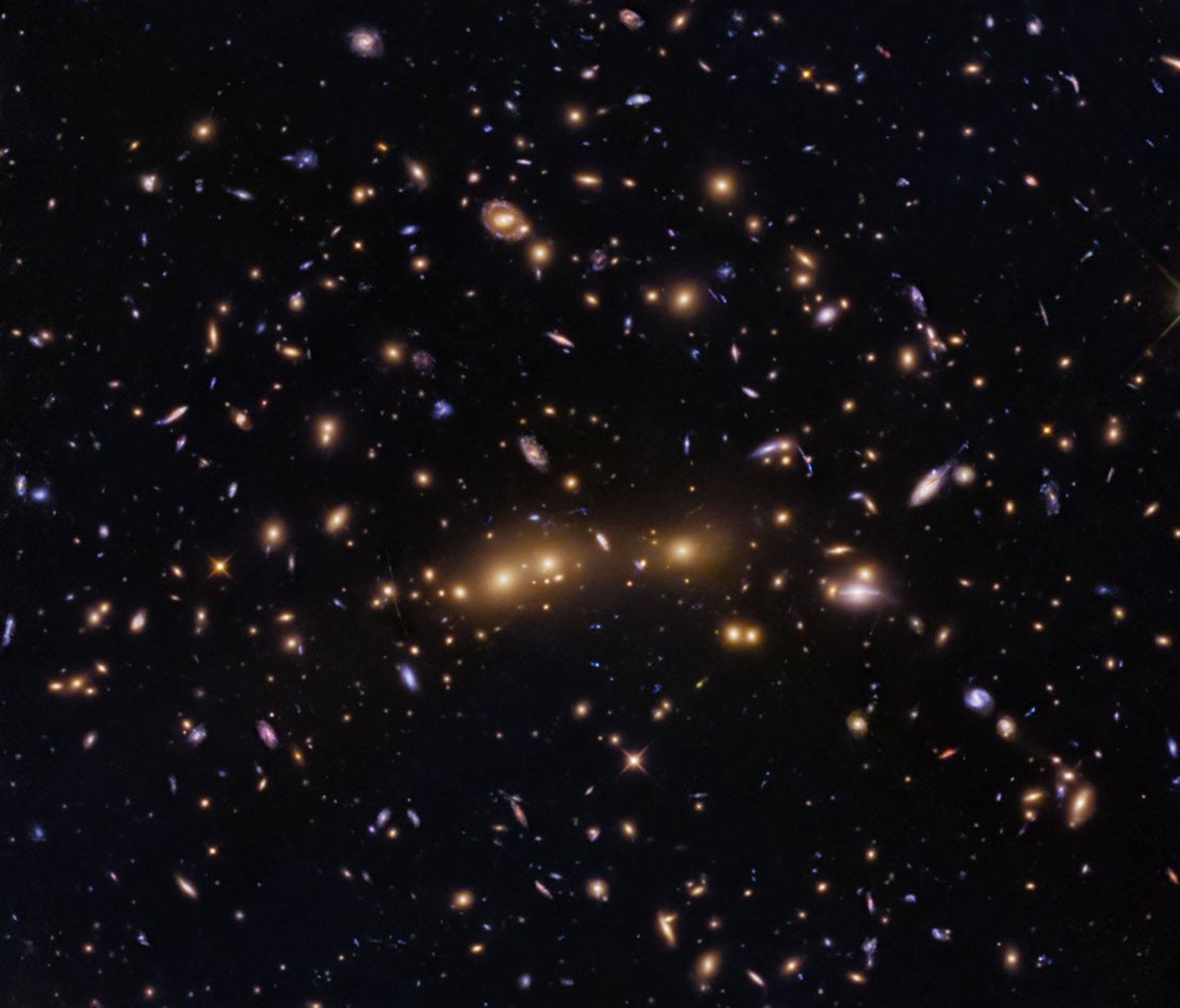
Several massive elliptical galaxies appear to sit in a nearly horizontal line across the center of the image. Numerous spiral, lenticular, and smaller elliptical galaxies dot the space surrounding the giant ellipticals.
This NASA Hubble Space Telescope image features a swarm of galaxies in the galaxy cluster called CL0016+1609 or MACS J0018.5+1626.
NASA, ESA, H. Ebeling (University of Hawaii), D. Coe (STScI, ESA, JWST); Image Processing: G. Kober (NASA/Catholic University of America)

This NASA Hubble Space Telescope image features a galaxy cluster, called CL0016+1609 or MACS J0018.5+1626, that is very bright at X-ray wavelengths and is one of the most extensively studied clusters at X-ray and radio wavelengths. The X-ray observations of this cluster revealed that it is two clusters merging along our line of sight.

Researchers requested time to observe CL0016+1609 with Hubble’s Advanced Camera for Surveys because that data would help them accurately measure the cluster’s dark-matter distribution, which helps them study the merger and the role of CL0016+1609 in the large-scale structure of the universe. Hubble can’t directly see dark matter, but its infrared and visible light observations can detect dark matter’s gravitational lensing effects on the normal matter Hubble observes.

The data in this image also includes observations with Hubble’s Wide Field Camera 3 taken as part of an observing program that obtained the first Hubble infrared images of 46 massive galaxy clusters and looked for distant galaxies gravitationally lensed by these clusters. Called RELICS (Reionization Lensing Cluster Survey), this survey found some 300 high-redshift candidate galaxies lensed by these clusters.

You can see the faint vertical arc of one of these distant galaxies in the image above. Look for it just to the left of the large elliptical galaxies in the center of the image. Another brighter, though shorter arc is visible just above and to the right of the large elliptical galaxies in the center of the image.

Media Contact:

Claire Andreoli
NASA’s Goddard Space Flight Center, Greenbelt, MD
claire.andreoli@nasa.gov

  •  

NASA’s Fermi Mission Uncovers Possible Sibling Supernova Remnants

6 min read

NASA’s Fermi Mission Uncovers Possible Sibling Supernova Remnants

A new study of two supernova remnants, the debris left behind after stars explode, suggests the explosions came from stellar siblings that once orbited each other. The first star’s detonation sent its binary companion hurtling through space, and then, after traveling for thousands of years, the surviving star blew up too.

Infrared, visible, and ultraviolet image of the area around the Jellyfish Nebula
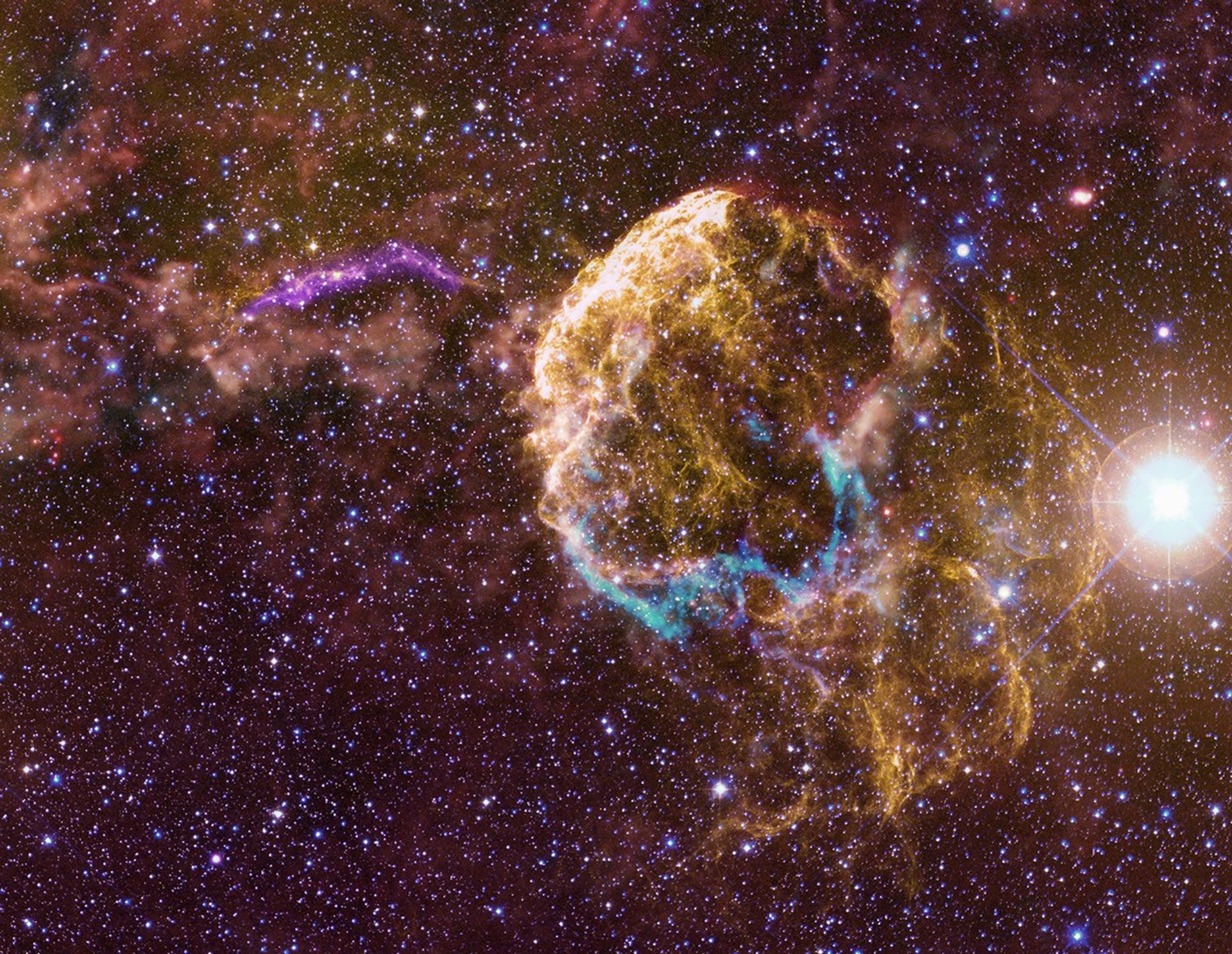
This multiwavelength scene shows the Jellyfish Nebula supernova remnant (right), the interstellar cloud it’s interacting with, and a distinctive curving filament to its upper left. The filament, which is shown here both in optical and ultraviolet (UV) light, is the visible part of an overlapping supernova remnant, G189.6+3.3, that is more prominent in radio and X-rays. Visible light is shown in yellow, UV from NASA’s Neil Gehrels Swift Observatory is shown in violet, and infrared light from NASA’s retired WISE (Wide-field Infrared Survey Explorer) mission appears in cyan, red, and orange. Both remnants are located about 6,000 light-years away in the constellation Gemini. The brilliant star at far right is Propus, also known as Eta Geminorum.
NASA Goddard Space Flight Center and M. Michailidis et al. 2026; optical: DSS; infrared: NASA/WISE/JPL-Caltech/UCLA; ultraviolet: NASA/Swift

“Using 16 years of data from NASA’s Fermi Gamma-ray Space Telescope, our analysis uncovered gamma rays associated with a supernova remnant that was hidden in the glare of its neighbor, the Jellyfish Nebula, one of the brightest gamma-ray-emitting supernova remnants known,” said Miltiadis Michailidis, a postdoctoral fellow in the physics department at Stanford University in California. “There are so many striking connections between the two remnants that we conclude they’re likely related, giving us the first known example of a binary system where both stars have undergone supernova explosions.”

Michailidis presented the findings Wednesday at the 248th meeting of the American Astronomical Society in Pasadena, California. A paper describing the results will appear in a future edition of Nature Communications.

The study focused on a faint supernova remnant called G189.6+3.3, which is mainly visible in X-rays. It is upstaged by its brighter and better-known neighbor, the Jellyfish Nebula (IC 443). The two star wrecks, both located in the constellation Gemini, appear to partially overlap as seen in X-rays. Recent X-ray evidence suggests that hot plasma likely associated with G189.6+3.3 may extend across the entire region, a hint that the overlap may be nearly total.

A massive star explodes when its energy-producing core runs out of fuel and collapses under its own weight, triggering an explosion that blows the star apart. The explosion’s shock wave encloses a hot cloud of debris that rapidly expands into space. So far, astronomers have cataloged about 300 supernova remnants in our galaxy.  

The Fermi mission is part of NASA’s fleet of observatories monitoring the changing cosmos to help humanity better understand how the universe works. More than a decade ago, observations from Fermi’s LAT (Large Area Telescope) showed that the shock waves of supernova remnants accelerated particles to within a fraction of the speed of light, a process first proposed by physicist Enrico Fermi — the mission’s namesake — in 1949.

These high-speed particles, called cosmic rays, interact with interstellar gas to produce gamma rays, the highest-energy form of light. Protons make up 99% of cosmic ray particles. To prove that accelerated protons are responsible for the glow, astronomers search for a specific gamma-ray feature. When cosmic-ray protons smash into interstellar gas, they produce a short-lived particle called a neutral pion, which almost immediately decays into a pair of gamma rays. This emission occurs within a specific band of energies associated with the neutral pion’s mass and lies within the range detected by Fermi’s LAT instrument.

In 2013, Fermi observations proved that the Jellyfish Nebula, which is interacting with part of a glowing cloud of hydrogen gas known as Sharpless 249, produced gamma rays through this mechanism. Its neighbor, G189.6+3.3, was discovered in 1994 as part of an X-ray survey by the German-led ROSAT (Roentgen Satellite) mission.

A bright filament of gas lies between the overlapping remnants. New observations of this feature reveal that the shock wave from G189.6+3.3 slammed into dense interstellar gas there and dramatically slowed, key evidence that both remnants are interacting with the same cloud system.

Multiwavelength composite showing high-energy light from the G189 supernova remnant
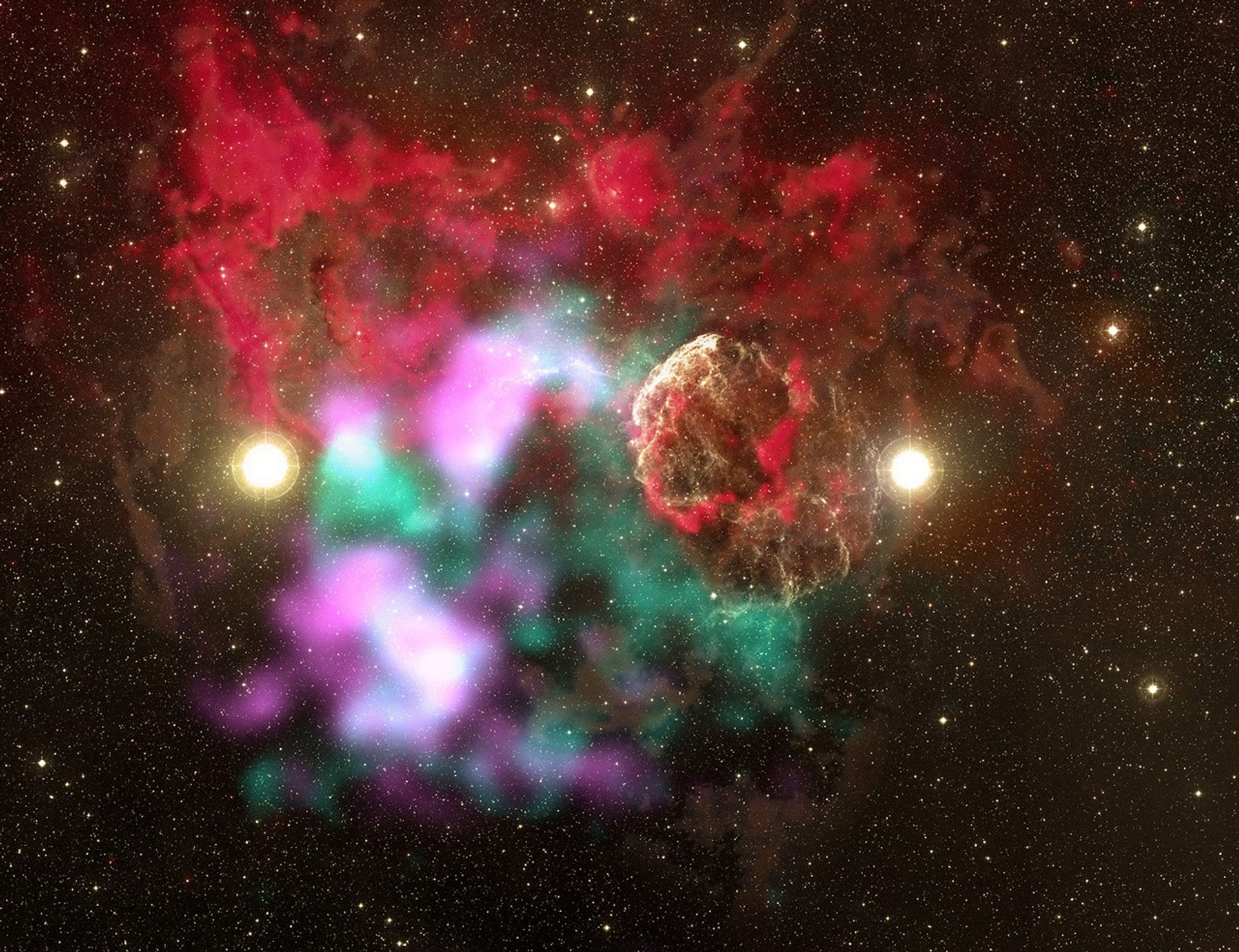
The well-known supernova remnant IC 443 (right) has an older, fainter neighbor (shown here in blue-green and magenta) called G189.6+3.3. A filament of gas between them, glowing in visible and ultraviolet light (violet arc at center), traces the neighbor’s shock wave and shows that both remnants are interacting with the same molecular cloud, shown in red, orange, brown for infrared and radio data and yellow for visible light. Blue-green shows X-rays from the fainter remnant, while magenta shows gamma rays with energies greater than 10 billion electron volts; for comparison, visible light has energies between about 2 and 3 electron volts. In this view, high-energy light from the much brighter IC 443 has been removed for clarity. Gamma-ray emission near the filament stems from protons accelerated in the supernova’s shock wave as it expands into the cloud.
NASA Goddard Space Flight Center and M. Michailidis et al. 2026; radio, MWISP and ESA/Planck; infrared: NASA/WISE/JPL-Caltech/UCLA; optical: DSS; ultraviolet: NASA/Swift; X-ray: SRG/eROSITA; gamma ray: NASA/DOE/Fermi LAT Collaboration

Astronomers think the Jellyfish Nebula is also a candidate PeVatron, a cosmic particle accelerator capable of boosting protons to energies so high they could nearly escape our galaxy. Such particles can produce gamma rays with trillions of times more energy than visible light. Finding a second particle accelerator near the Jellyfish Nebula could offer scientists new clues for how supernova remnants develop into PeVatrons.

“The overlapping remnants, a connecting gas filament, and the availability of data from Fermi and other facilities motivated us to delve into this complex but little-studied region,” said co-author Marianne Lemoine-Goumard, an astrophysicist at the French National Centre for Scientific Research (CNRS) based at the University of Bordeaux. “With Fermi’s LAT instrument, we found gamma-ray emission associated with accelerated protons in the northern part of the fainter remnant. If both remnants are interacting with the same structure, then they must share a common distance from us.”

The team concludes the remnants lie about 6,000 light-years away, their explosion centers are separated by roughly 40 light-years projected onto the plane of the sky, and the original stars may have been 20 or more times the Sun’s mass.

Estimates of the remnants’ ages vary widely, but the team concludes that the age of the Jellyfish Nebula is 8,000 to 9,000 years, while G189.6+3.3 is between 20,000 to 110,000 years old. This means the delay between the explosions could have extended for up to 100,000 years.

In addition, the team conducted computer simulations of a million massive binary systems. They show that systems where the stars orbit close enough to exchange matter and interact during their lives can readily produce dual supernova explosions with similar separations and time delays as those found for the remnants. The team also estimated that the chance of randomly encountering this combination of observed spatial alignment and compatible distances to be less than 1%, strongly supporting a physical association.

“The evidence we’ve compiled — including observations across the spectrum, the chemical and physical properties of the remnants, simulations, and more — paints a compelling picture of a dual supernova event,” said Michailidis.

This study identifies a unique possible example of a binary system where both stars exploded as supernovae and left behind separate, detectable supernova remnants. Astronomers think that most massive stars form in binary or multiple-star systems. The Jellyfish Nebula/G189.6+3.3 complex offers astronomers a rare opportunity to study how massive binary stars evolve, exchange matter, explode, and experience velocity changes — called kicks — induced by the supernova blast. It also provides a powerful new laboratory for understanding how coupled supernova remnants behave, including how they accelerate particles, generate gamma rays, and shape their surrounding environments.

“Fermi’s gamma-ray observations of supernova remnants continue to reveal the dynamic lives of stars,” said Elizabeth Hays, the Fermi project scientist at NASA’s Goddard Space Flight Center in Greenbelt, Maryland. “We can now connect the glowing remains of two massive stars to a powerful pair that evolved together over thousands of years.”

By Francis Reddy
NASA’s Goddard Space Flight Center, Greenbelt, Md.

Media Contact:
Claire Andreoli
301-286-1940
NASA’s Goddard Space Flight Center, Greenbelt, Md.

  •  

Hubble Glimpses Merging Galaxy Clusters

2 min read

Hubble Glimpses Merging Galaxy Clusters

Several massive elliptical galaxies appear to sit in a nearly horizontal line across the center of the image. Numerous spiral, lenticular, and smaller elliptical galaxies dot the space surrounding the giant ellipticals.
This NASA Hubble Space Telescope image features a swarm of galaxies in the galaxy cluster called CL0016+1609 or MACS J0018.5+1626.
NASA, ESA, H. Ebeling (University of Hawaii), D. Coe (STScI, ESA, JWST); Image Processing: G. Kober (NASA/Catholic University of America)

This NASA Hubble Space Telescope image features a galaxy cluster, called CL0016+1609 or MACS J0018.5+1626, that is very bright at X-ray wavelengths and is one of the most extensively studied clusters at X-ray and radio wavelengths. The X-ray observations of this cluster revealed that it is two clusters merging along our line of sight.

Researchers requested time to observe CL0016+1609 with Hubble’s Advanced Camera for Surveys because that data would help them accurately measure the cluster’s dark-matter distribution, which helps them study the merger and the role of CL0016+1609 in the large-scale structure of the universe. Hubble can’t directly see dark matter, but its infrared and visible light observations can detect dark matter’s gravitational lensing effects on the normal matter Hubble observes.

The data in this image also includes observations with Hubble’s Wide Field Camera 3 taken as part of an observing program that obtained the first Hubble infrared images of 46 massive galaxy clusters and looked for distant galaxies gravitationally lensed by these clusters. Called RELICS (Reionization Lensing Cluster Survey), this survey found some 300 high-redshift candidate galaxies lensed by these clusters.

You can see the faint vertical arc of one of these distant galaxies in the image above. Look for it just to the left of the large elliptical galaxies in the center of the image. Another brighter, though shorter arc is visible just above and to the right of the large elliptical galaxies in the center of the image.

Media Contact:

Claire Andreoli
NASA’s Goddard Space Flight Center, Greenbelt, MD
claire.andreoli@nasa.gov

The post Hubble Glimpses Merging Galaxy Clusters appeared first on NASA Science.

  •  
❌