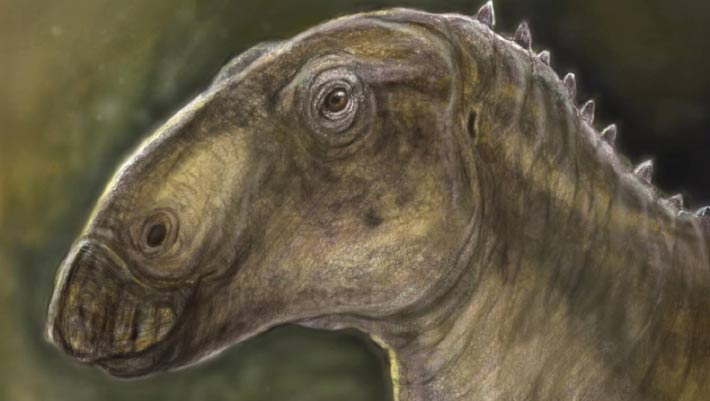
An international team of paleontologists from Romania, Hungary and Italy has identified a new genus and species of herbivorous, duck-billed dinosaur from an incomplete skeleton unearthed in the Hațeg Basin, a bowl-shaped depression in the Carpathians of present-day Romania.
Amazon now has hundreds of flight-ready satellites standing idle in Florida, waiting to join the company's low-Earth orbit Internet constellation, an Amazon official said Tuesday.
"They're built, and sitting in a payload processing facility waiting for trips to orbit," said Steve Metayer, vice president of Amazon Leo Production Operations, during a teleconference with reporters. "And we're currently manufacturing several satellites a day."
Metayer spoke on the eve of the company's next mission, during which an Ariane 64 rocket will launch three dozen Amazon Leo satellites into orbit from a spaceport in French Guiana. Liftoff is targeted for 7:53 am ET (11:53 UTC) on Wednesday.
Embora repita padrões de adoção, a inteligência artificial está a transformar o trabalho, o processo de tomada de decisão e onde o valor é criado — e não apenas a infraestrutura. Sérgio Silvestre afirma que, por caminhos diferentes, contudo, provavelmente chegaremos igualmente a soluções híbridas.
Está a meio de uma tarefa no computador, mas não quer perder um vídeo do YouTube? A boa notícia é que não precisa de escolher. Os principais browsers já dispõem de uma funcionalidade integrada que abre uma janela flutuante para reproduzir vídeos do YouTube, enquanto trabalha noutras aplicações.
AirPods Pro 3 shown with an iPhone and live translation features. | Photo by Amelia Holowaty Krales / The Verge
Now that we're clear of WWDC and all of the new AI-powered features coming to Apple's platforms, Bloomberg reporter Mark Gurman has more details about rumored new hardware, like the camera-equipped AirPods he'd previously written about. He says they are currently on schedule for a late 2027 launch, and that while we're checking out beta releases for this fall's iOS 27 update, the new earbuds are internally being tested with next year's update, iOS 28.
With cameras mounted in their stems and lights to indicate when data is being uploaded to the cloud, they could give the upgraded version of Siri "visual context" about your surroundings, be …
En 2026, le choix est tranché : pour la grande majorité des joueurs, un PC portable équipé d'une RTX 5070 entre 2 000 et 2 500 euros offre le meilleur rapport performance/prix du marché. Assez puissant pour encaisser les jeux les plus gourmands (AAA) en 1440p Ultra sans broncher, il laisse la...
Uma investigação da Check Point revela que o setor da hotelaria e turismo enfrentam em média 2.291 ciberataques semanais por organização, com criminosos a explorar a época alta de férias para campanhas de phishing que imitam marcas como Booking.com, Airbnb e Skyscanner.
Scientists have uncovered compelling new evidence that early human ancestors, likely Homo erectus, were deliberately bringing fire into Wonderwerk Cave in South Africa as far back as 1.79 million years ago.
Além de uma câmara principal de 200 MP e de uma telefoto periscópica ZEISS APO, o dobrável Vivo X Fold 6 será compatível com um teleconversor, que permite alcançar uma distância focal equivalente até 200 mm.
L'oggetto più costoso mai realizzato dal genere umano detiene un record ufficiale sul Guinness dei Primati, avendo superato un costo complessivo stimato in oltre 150 miliardi di dollari — una cifra superiore al PIL annuale di numerosi Stati. Presentato inizialmente nel 1984 con una previsione di budget di appena 8 miliardi, il progetto ha subìto una massiccia escalation finanziaria a causa di continui ridisegni strutturali, obsolescenza dell'hardware in corso d'opera e problemi di standard qualitativi da parte dei partner internazionali. A questi dati si aggiungono i costi operativi e di manutenzione, che si attestano stabilmente su oltre 3 miliardi di dollari all'anno. L'avamposto completerà il suo ciclo vitale nel 2030, anno in cui è previsto il suo definitivo ritiro attraverso un'operazione di smantellamento e rientro atmosferico guidata da SpaceX, dal valore di quasi un miliardo di dollari.
Há histórias escritas nas regiões mais ténues e quase invisíveis do Universo. E são precisamente essas histórias cósmicas que a missão ARRAKIHS pretende desvendar.
Tesla didn’t report a single at-fault “Robotaxi” crash in the latest NHTSA autonomous-vehicle data — its only fresh incident was a Model Y getting rear-ended while stopped, clearly the other driver’s fault.
That sounds like good news for Tesla’s safety record. But live fleet data points to the real reason the crashes have dried up: Tesla’s robotaxis are barely running, and the active fleet is shrinking a year into the program.
Lavare i pomodori aiuta, ma non elimina sempre i pesticidi. La scienza mostra che i residui possono restare sulla buccia o resistere alla semplice acqua. Scegliere prodotti di qualità e adottare buone abitudini resta la strategia più efficace.
Drew Baglino spent nearly two decades building Tesla’s batteries, motors, and power electronics. Now the former Tesla SVP is quietly building the one home energy product Tesla talked up for years and never shipped: a residential heat pump.
His startup, Sadi Thermal Machines, is a direct bet on an idea Tesla floated openly in 2022 — before the company reoriented itself around humanoid robots and robotaxis.
O Parlamento Europeu aprovou hoje alterações ao regulamento europeu de inteligência artificial com 423 votos a favor. A proibição de ferramentas de IA que geram imagens sexuais não consentidas ainda precisa da "luz verde" do Conselho da UE para avançar oficialmente.
Baidu’s Apollo Go has received a Level 4 autonomous driving permit in Switzerland for AmiGo, a robotaxi service it is running with Swiss Post’s PostBus, putting the Chinese tech giant ahead of Waymo and Tesla in deploying driverless vehicles into European public transport.
The Federal Roads Office (FEDRO) special permit covers an 80 km² service area across three eastern cantons, and Baidu says the project is on track to become the largest planned automated public transport operation of its kind in Europe.
Depois dos auscultadores G325 X, lançados no início do ano, a Logitech G fecha o ecossistema da Série G3 com a chegada de um rato sem fios de 59 gramas e um teclado mecânico com ecrã de matriz de pontos. Ambos estão preparados para uma taxa de atualização de 8 kHz.
An international team of researchers led by Dr. Liora Kolska Horwitz of the Hebrew University of Jerusalem’s National Natural History Collections, working at the site of the oldest dated intentional use of fire by ancient human ancestors, South Africa’s Wonderwerk Cave, has found new evidence pushing that date even earlier into prehistory.
The research team behind the potentially history-altering findings said the discovery, which suggests that ancient hominins intentionally controlled fire, resulting in charred animal bones sometime between 1.07 and 1.79 million years ago, provides researchers with previously unavailable insights into how our ancestors first began to harness one of the most important tools in the evolution of human society and culture.
The study also introduced the archaeological community to a promising new method for analyzing burned bone samples by monitoring its light-emitting properties.
Intentional Use of Fire Provided Human Ancestors with a Critical Tool
According to a statement announcing the study, Dr. Horwitz, who is co-director of the Wonderwerk Cave project with Prof. Michael Chazan at the University of Toronto, and colleagues note the historical significance of fire, ranging from warmth and predator protection to extended daylight and the cooking of meat. However, historians have struggled to identify a single moment or historical period where humanity’s ancient ancestors first started to use fire intentionally.
“Evidence of fire from such ancient sites is often subtle and difficult to detect,” Dr. Horwitz explained.
Before the new analysis, the oldest agreed-upon evidence for intentional fire use also came from Wonderwerk Cave. Situated within the Kalahari Desert of South Africa, the cave provided evidence placing fire use to approximately 1 million years ago.
While that study used the most advanced techniques available, the team behind the new study decided to employ a non-invasive process that involves illuminating ancient bone fragments with specific wavelengths of light to determine whether they had been exposed to intense heat. In cases where bones have been heated to fire-like temperatures, the right wavelength of light will cause them to glow.
Remains Likely Left by Homo Erectus
Because evidence from ancient sites is scarce, the team’s non-invasive technique allowed them to study tiny fossilized rodent bones left in the cave by owls without damaging them. The team noted that using remains that accumulated naturally on the ancient cave floor provides an “independent, non-anthropogenic record” of ancient events within the local area.
White (#5 on right) is the most burnt, while yellow-beige (on left #1) is unburnt. Image Credit: Wonderwerk Cave Project.
After exposing the ancient bone to specific wavelengths of light, the team found what they described as “clear signs of burning.” Dr. Horowitz confirmed the findings, noting that the team’s analysis reveals “fire was repeatedly present deep inside Wonderwerk Cave.”
Because the deposits were found over 30 meters deep in the cave, the team ruled out wildfires as a possible source of combustion. The layer also lacked bat guano remains, which the team noted “rules out spontaneous combustion.”
A chemical analysis of the charred bones dated them to between 1.07 and 1.79 million years ago, redating the 2012 findings. Critically, the evidence for ancient fire use was in an archaeological layer “associated with artifacts” from the initial Acheulean period, which is consistent with the dating. If correct, this would make the likeliest early human ancestor that used fire Homo erectus.
Although the findings appear to extend the chronology of one of the earliest known records of fire use associated with hominins by as much as 790,000 years, the research team said the findings do not suggest that these early proto-humans could create fire “at will.” Instead, the likeliest scenario involves early human ancestors collecting fire from natural sources, such as lightning-induced wildfires on the African savanna, and bringing it into the cave.
“The early humans introduced this fire into the cave on multiple occasions and maintained it there before it eventually died out,” the team’s statement explained.
The team did not immediately pinpoint what methods these early hominins used to maintain a burning fire. However, they suggested that burning owl pellets as additional fuel may inadvertently have scorched the rodent bones.
A New Tool for Identifying Traces of Burning
When discussing the implications of the new, earlier date for the first intentional use of fire, Dr. Horwitz said the discovery shows that early human ancestors “were not simply passive observers of natural fires,” but instead were “actively engaging with fire and incorporating it into their lives.”
Beyond offering an earlier date range for early fire use, the work provides clues into how our ancestors used fire before they could make it on their own. The study also debuted a new, non-invasive, portable tool for investigating early fire use, which the study authors note “can be applied to large collections of fossils without damaging them.”
“Our study provides new tools for identifying traces of ancient burning,” Dr. Horwitz explained, with the team adding that application of this new technique to sites around the world “may help clarify the origins and development of one of the most consequential technologies in human history.”
Christopher Plain is a Science Fiction and Fantasy novelist and Head Science Writer at The Debrief. Follow and connect with him on X, learn about his books at plainfiction.com, or email him directly at christopher@thedebrief.org.

 Login