❌

Reading view

NASA’s Chandra Finds Unexpected Fireworks in Aftermath of Stellar Explosions
6 Min Read

NASA’s Chandra Finds Unexpected Fireworks in Aftermath of Stellar Explosions

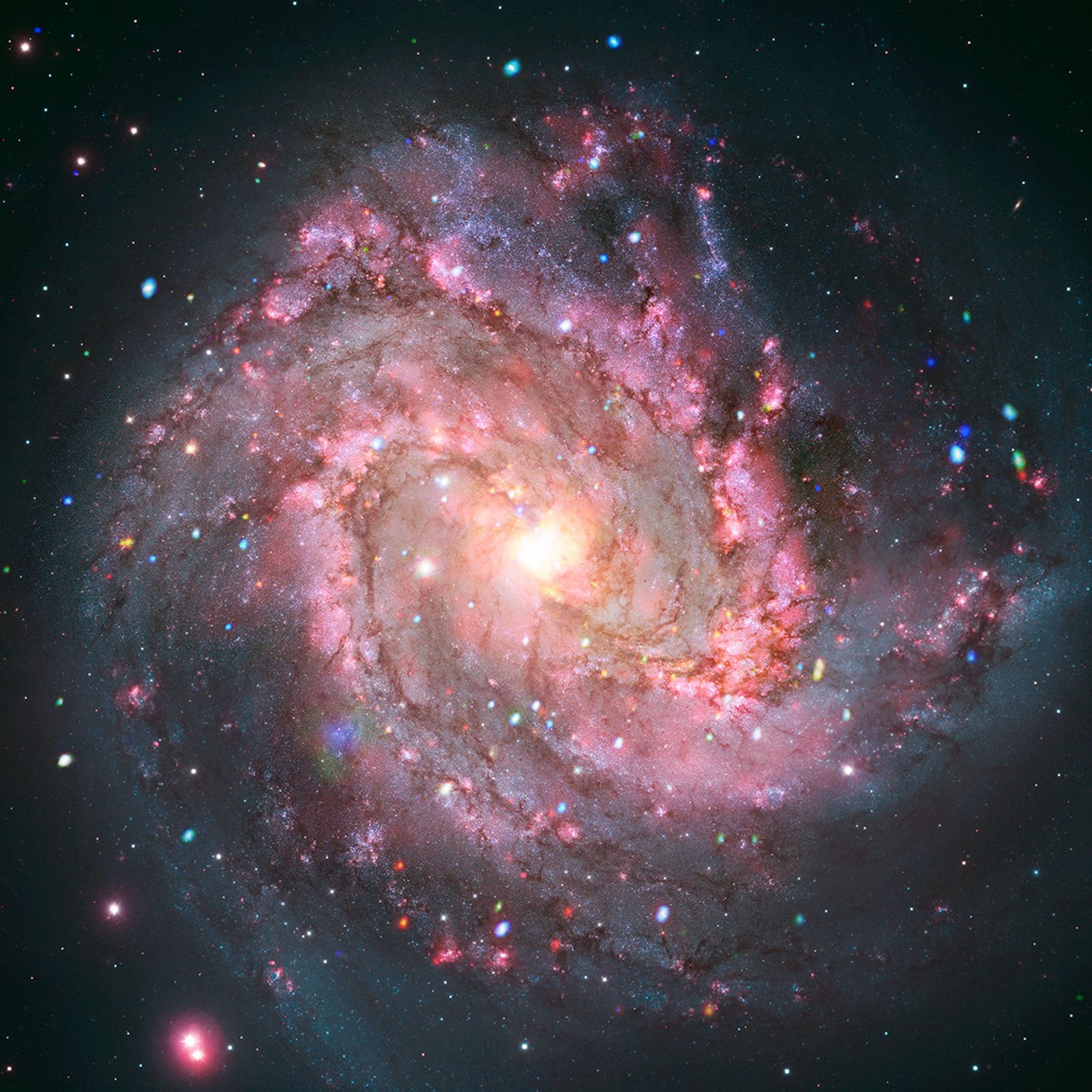
A full field composite image of M83 with X-rays from Chandra (red, green, and blue) and optical light data from Hubble (red, green, and blue).
A composite image of the nearby galaxy Messier 83, and short timelapse videos of two curious supernova remnants hidden inside.
X-ray: NASA/CXC/SAO; Optical: NASA/ESA/AURA/STScI, Hubble Heritage Team, W. Blair (STScI/Johns Hopkins University) and R. O’Connell (University of Virginia); Image Processing: NASA/CXC/SAO/A. Jubett, L. Frattare and P. Edmonds

The aftermath of a supernova, a stellar explosion, is usually a slowly fading cloud of hot gas. So when astronomers pointed NASA’s Chandra X-ray Observatory at the nearby galaxy Messier 83 (M83), they did not expect to find a population of supernova remnants, or the debris from these explosions, showing dramatic changes in their brightness. The new results were presented at the American Astronomical Society meeting in Pasadena, California, and published in The Astrophysical Journal.

The galaxy M83, located about 15 million light-years from Earth, is forming stars at a high rate. Researchers analyzed 14 years of Chandra data of the galaxy, spanning 2000 to 2014.

Using this extensive set of data, the researchers caught surprising variations in the X-ray brightness of sources previously identified as supernova remnants. The researchers expected supernova remnants older than a century or so to fade gradually in X-rays, but not change dramatically in brightness.

The team found that roughly half of the 22 X-ray sources associated with supernova remnants in their sample showed changes in X-ray brightness over the 14-year span of observations — a result that was completely unexpected.

“We knew that individual X-ray sources could vary dramatically,” said Andrea Prestwich, of the Catholic University of America who led the study. “But finding that so many supernova remnants were behaving this way was a real surprise. Something unusual is going on in these objects. Pinpointing the cause remains a challenge, as M83’s distance limits the detail we can observe.”

One of the 22 variable supernova remnants has a straightforward explanation: SN 1957D, the debris from a supernova first observed nearly 70 years ago, is ramming into material surrounding the explosion site, producing the observed X-ray flares. But this cannot explain the rest of the sample. There is no evidence to suggest that all 22 remnants were formed within the last century. Something else must be driving the variability.

The most likely explanation is that the team has uncovered a population of stellar survivors stars that lived through their partner’s destruction in a supernova explosion. In this scenario, each variable X-ray source began as a pair of massive stars orbiting each other. The more massive star collapsed and exploded as a supernova, leaving behind a black hole or ultra-dense neutron star. Its companion survived.

A full field composite image of M83 with X-rays from Chandra (red, green, and blue) and optical light data from Hubble (red, green, and blue).
Galaxy M83 in X-ray and Optical Light.
X-ray: NASA/CXC/SAO; Optical: NASA/ESA/AURA/STScI, Hubble Heritage Team, W. Blair (STScI/Johns Hopkins University) and R. O’Connell (University of Virginia); Image Processing: NASA/CXC/SAO/A. Jubett, L. Frattare and P. Edmonds

“It may be that this galaxy contains a collection of supernova remnants where one massive star survives the supernova and becomes locked into an orbit with a black hole or neutron star,” said co-author Michael McCollough of the Center for Astrophysics | Harvard & Smithsonian (CfA). “The neutron star or black hole can then start pulling material from the massive star’s surface.”

That infalling material is superheated by the intense gravitational pull, producing the X-rays Chandra detects. These types of systems, known as high-mass X-ray binaries (HMXBs), are among the most variable X-ray sources in the universe. Researchers say they may be the cause of the variations seen in M83’s supernova remnants.

Astronomers have known about HMXBs for decades, but the difference with this group in M83 is their connection to supernova remnants. Previously, only a handful of supernova remnants associated with HMXBs had been identified across observations of all galaxies. It is unprecedented to find more than 20 strong candidates in just one galaxy.

The authors found that the variable supernova remnants are in regions with higher concentrations of massive stars than in other parts of the galaxy, increasing the chances of a link between the remnants and HMXBs.

There is another possible explanation: Instead of pulling in material from a companion star, the black hole or neutron star may be recapturing some of the material blasted outward by the original explosion.

“This could be an example of cosmic recycling, where debris from the explosion falls back onto the very object the supernova created,” said co-author Roy Kilgard of Wesleyan University. “And it’s quite possible that both explanations are at play — different sources in our sample may have different origins.”

These results are not unique to M83. A follow-up study of the nearby star-forming galaxy M51 by Zoe Hoiland of Vassar College and Kilgard has uncovered a similar population of variable X-ray sources associated with supernova remnants, suggesting that such systems may be a feature of galaxies undergoing vigorous star formation.
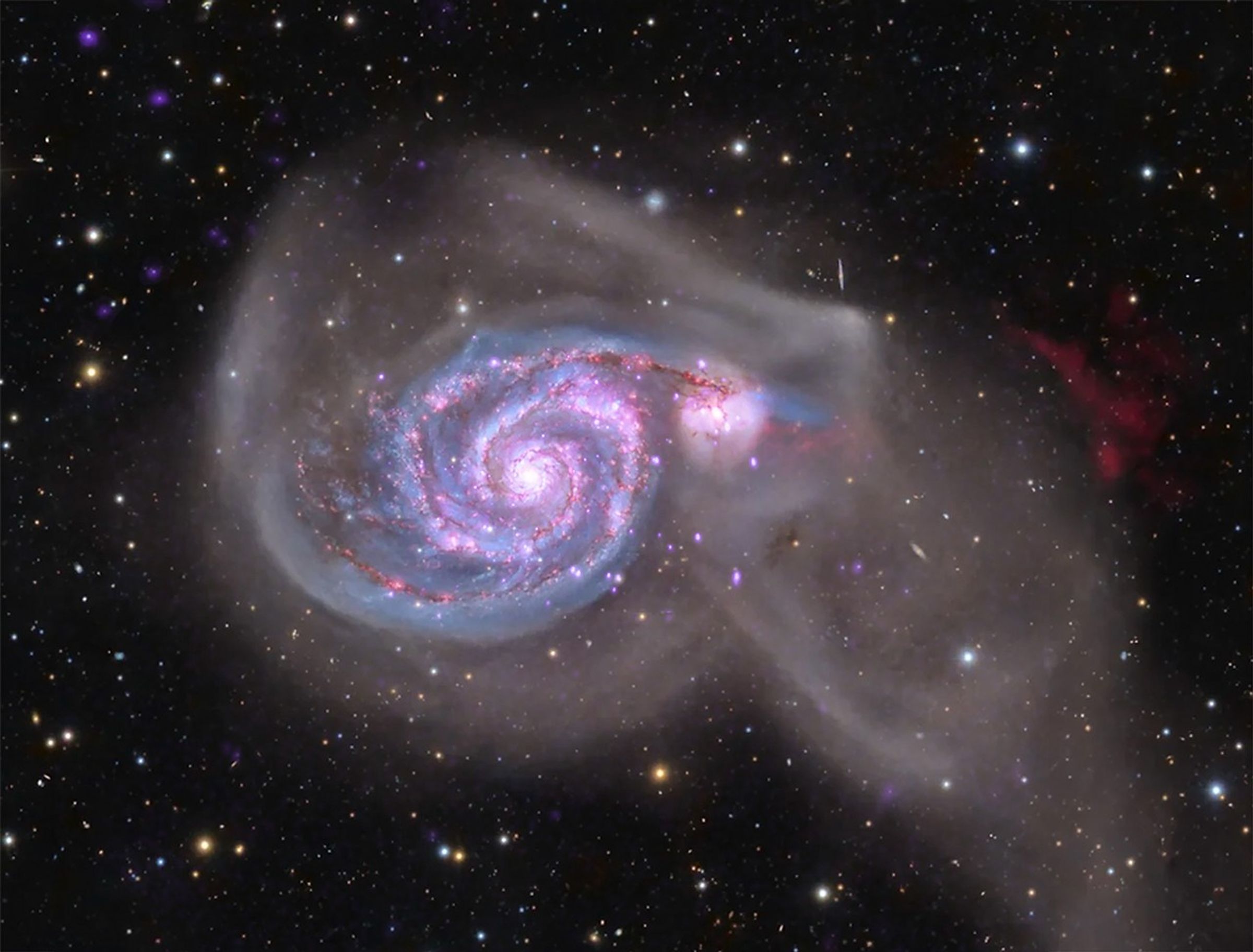
This is a composite image of the galaxy M51 combining data from NASA's Chandra X-ray Observatory (purple) with optical data (red, green and blue) taken with ground-based telescopes by a team of astrophotographers. A surprisingly high number of X-ray sources associated with supernova remnants in M51 show large changes in brightness, similar to the behavior seen in M83.
This is a composite image of the galaxy M51 combining data from NASA’s Chandra X-ray Observatory (purple) with optical data (red, green and blue) taken with ground-based telescopes by a team of astrophotographers. A surprisingly high number of X-ray sources associated with supernova remnants in M51 show large changes in brightness, similar to the behavior seen in M83.
Chandra X-ray Data: NASA/CXC/SAO; Astrobin/Optical Groundbased: C.Björk, T.Bähnck, S.Donoso, J.Gentillon, A. and D.Grelin, S.Guberski, R. Hall, T.Heuberger, J.Jacks, P.Kent, Br.Meyers, W.Ostling, N.Puig, T.Schaeffer, F.Schöfbänker, M.Vasilev

The Chandra data for M83 began with single observations in 2000 and 2001, followed by 10 observations from 2010 to 2011 and another observation in 2014.

NASA’s Marshall Space Flight Center in Huntsville, Alabama, manages the Chandra program. The Smithsonian Astrophysical Observatory’s Chandra X-ray Center controls science operations from Cambridge, Massachusetts, and flight operations from Burlington, Massachusetts.

Visual Description

This release features a composite image of the nearby galaxy Messier 83, and short timelapse videos of two curious supernova remnants hidden inside.

In the composite image, Messier 83, or M83, is shown to have a spiral structure, viewed straight on. At the center is a brilliant white and yellow pool of light. From that light, spiral arms of hot pink cloud corkscrew out in wide, sweeping arches. The galaxy is covered in a faint grey haze, and flecked with red, green, blue, white, and yellow dots.

In an annotated version of the composite image, two tiny dots to our lower right of center are highlighted by white circles. These are two of the supernova remnants being considered by researchers. Each is examined further in a separate timelapse video.

Over a 14-year period from 2000 to 2014, astronomers pointed NASA’s X-ray observatory at the M83 galaxy. They discovered that about half of the X-ray sources believed to be supernova remnants, the aftermath of stellar explosions, were exhibiting dramatic changes in brightness. This result was entirely unexpected.

Those changes in brightness are highlighted in the timelapse videos. In each video, a series of static images flashes by, focused on one of the two X-ray sources once believed to be supernova remnants. In the videos, the X-ray sources appear as bright blue blobs with glowing cores. But in each image, taken months or years apart, the shapes change, as does the intensity of the blue color, and the brightness of the core. By presenting the substantively different images of the same objects one after another in quick succession, short timelapse videos are created.

The most likely explanation for the changes in brightness is that the team has uncovered a population of stellar survivors, stars that lived through an orbiting partner’s destruction in a supernova explosion. Material is being pulled from the surviving star onto the black hole or neutron star that formed in the supernova, a process known to cause rapid changes in X-ray brightness.

Read more from NASA’s Chandra X-ray Observatory

To learn more about NASA’s Chandra mission, visit:

https://science.nasa.gov/chandra

https://chandra.si.edu

News Media Contact

Megan Watzke
Chandra X-ray Center
Cambridge, Mass.
617-496-7998
mwatzke@cfa.harvard.edu

Joel Wallace
Marshall Space Flight Center, Huntsville, Alabama
256-544-0034
joel.w.wallace@nasa.gov

About the Author

Lee Mohon

Share

Details

Last Updated
Jun 16, 2026
Editor
Lee Mohon
Contact
Joel Wallace
Location
Marshall Space Flight Center
  •  

NASA’s Chandra Finds Unexpected Fireworks in Aftermath of Stellar Explosions

6 Min Read

NASA’s Chandra Finds Unexpected Fireworks in Aftermath of Stellar Explosions

A full field composite image of M83 with X-rays from Chandra (red, green, and blue) and optical light data from Hubble (red, green, and blue).
A composite image of the nearby galaxy Messier 83, and short timelapse videos of two curious supernova remnants hidden inside.
X-ray: NASA/CXC/SAO; Optical: NASA/ESA/AURA/STScI, Hubble Heritage Team, W. Blair (STScI/Johns Hopkins University) and R. O'Connell (University of Virginia); Image Processing: NASA/CXC/SAO/A. Jubett, L. Frattare and P. Edmonds

The aftermath of a supernova, a stellar explosion, is usually a slowly fading cloud of hot gas. So when astronomers pointed NASA’s Chandra X-ray Observatory at the nearby galaxy Messier 83 (M83), they did not expect to find a population of supernova remnants, or the debris from these explosions, showing dramatic changes in their brightness. The new results were presented at the American Astronomical Society meeting in Pasadena, California, and published in The Astrophysical Journal.

The galaxy M83, located about 15 million light-years from Earth, is forming stars at a high rate. Researchers analyzed 14 years of Chandra data of the galaxy, spanning 2000 to 2014.

Using this extensive set of data, the researchers caught surprising variations in the X-ray brightness of sources previously identified as supernova remnants. The researchers expected supernova remnants older than a century or so to fade gradually in X-rays, but not change dramatically in brightness.

The team found that roughly half of the 22 X-ray sources associated with supernova remnants in their sample showed changes in X-ray brightness over the 14-year span of observations — a result that was completely unexpected.

“We knew that individual X-ray sources could vary dramatically,” said Andrea Prestwich, of the Catholic University of America who led the study. “But finding that so many supernova remnants were behaving this way was a real surprise. Something unusual is going on in these objects. Pinpointing the cause remains a challenge, as M83’s distance limits the detail we can observe.”

One of the 22 variable supernova remnants has a straightforward explanation: SN 1957D, the debris from a supernova first observed nearly 70 years ago, is ramming into material surrounding the explosion site, producing the observed X-ray flares. But this cannot explain the rest of the sample. There is no evidence to suggest that all 22 remnants were formed within the last century. Something else must be driving the variability.

The most likely explanation is that the team has uncovered a population of stellar survivors stars that lived through their partner’s destruction in a supernova explosion. In this scenario, each variable X-ray source began as a pair of massive stars orbiting each other. The more massive star collapsed and exploded as a supernova, leaving behind a black hole or ultra-dense neutron star. Its companion survived.

A full field composite image of M83 with X-rays from Chandra (red, green, and blue) and optical light data from Hubble (red, green, and blue).
Galaxy M83 in X-ray and Optical Light.
X-ray: NASA/CXC/SAO; Optical: NASA/ESA/AURA/STScI, Hubble Heritage Team, W. Blair (STScI/Johns Hopkins University) and R. O’Connell (University of Virginia); Image Processing: NASA/CXC/SAO/A. Jubett, L. Frattare and P. Edmonds

“It may be that this galaxy contains a collection of supernova remnants where one massive star survives the supernova and becomes locked into an orbit with a black hole or neutron star,” said co-author Michael McCollough of the Center for Astrophysics | Harvard & Smithsonian (CfA). “The neutron star or black hole can then start pulling material from the massive star’s surface.”

That infalling material is superheated by the intense gravitational pull, producing the X-rays Chandra detects. These types of systems, known as high-mass X-ray binaries (HMXBs), are among the most variable X-ray sources in the universe. Researchers say they may be the cause of the variations seen in M83’s supernova remnants.

Astronomers have known about HMXBs for decades, but the difference with this group in M83 is their connection to supernova remnants. Previously, only a handful of supernova remnants associated with HMXBs had been identified across observations of all galaxies. It is unprecedented to find more than 20 strong candidates in just one galaxy.

The authors found that the variable supernova remnants are in regions with higher concentrations of massive stars than in other parts of the galaxy, increasing the chances of a link between the remnants and HMXBs.

There is another possible explanation: Instead of pulling in material from a companion star, the black hole or neutron star may be recapturing some of the material blasted outward by the original explosion.

“This could be an example of cosmic recycling, where debris from the explosion falls back onto the very object the supernova created,” said co-author Roy Kilgard of Wesleyan University. “And it’s quite possible that both explanations are at play — different sources in our sample may have different origins.”

These results are not unique to M83. A follow-up study of the nearby star-forming galaxy M51 by Zoe Hoiland of Vassar College and Kilgard has uncovered a similar population of variable X-ray sources associated with supernova remnants, suggesting that such systems may be a feature of galaxies undergoing vigorous star formation.

This is a composite image of the galaxy M51 combining data from NASA's Chandra X-ray Observatory (purple) with optical data (red, green and blue) taken with ground-based telescopes by a team of astrophotographers. A surprisingly high number of X-ray sources associated with supernova remnants in M51 show large changes in brightness, similar to the behavior seen in M83.
This is a composite image of the galaxy M51 combining data from NASA’s Chandra X-ray Observatory (purple) with optical data (red, green and blue) taken with ground-based telescopes by a team of astrophotographers. A surprisingly high number of X-ray sources associated with supernova remnants in M51 show large changes in brightness, similar to the behavior seen in M83.
Chandra X-ray Data: NASA/CXC/SAO; Astrobin/Optical Groundbased: C.Björk, T.Bähnck, S.Donoso, J.Gentillon, A. and D.Grelin, S.Guberski, R. Hall, T.Heuberger, J.Jacks, P.Kent, Br.Meyers, W.Ostling, N.Puig, T.Schaeffer, F.Schöfbänker, M.Vasilev

The Chandra data for M83 began with single observations in 2000 and 2001, followed by 10 observations from 2010 to 2011 and another observation in 2014.

NASA’s Marshall Space Flight Center in Huntsville, Alabama, manages the Chandra program. The Smithsonian Astrophysical Observatory’s Chandra X-ray Center controls science operations from Cambridge, Massachusetts, and flight operations from Burlington, Massachusetts.

Visual Description

This release features a composite image of the nearby galaxy Messier 83, and short timelapse videos of two curious supernova remnants hidden inside.

In the composite image, Messier 83, or M83, is shown to have a spiral structure, viewed straight on. At the center is a brilliant white and yellow pool of light. From that light, spiral arms of hot pink cloud corkscrew out in wide, sweeping arches. The galaxy is covered in a faint grey haze, and flecked with red, green, blue, white, and yellow dots.

In an annotated version of the composite image, two tiny dots to our lower right of center are highlighted by white circles. These are two of the supernova remnants being considered by researchers. Each is examined further in a separate timelapse video.

Over a 14-year period from 2000 to 2014, astronomers pointed NASA’s X-ray observatory at the M83 galaxy. They discovered that about half of the X-ray sources believed to be supernova remnants, the aftermath of stellar explosions, were exhibiting dramatic changes in brightness. This result was entirely unexpected.

Those changes in brightness are highlighted in the timelapse videos. In each video, a series of static images flashes by, focused on one of the two X-ray sources once believed to be supernova remnants. In the videos, the X-ray sources appear as bright blue blobs with glowing cores. But in each image, taken months or years apart, the shapes change, as does the intensity of the blue color, and the brightness of the core. By presenting the substantively different images of the same objects one after another in quick succession, short timelapse videos are created.

The most likely explanation for the changes in brightness is that the team has uncovered a population of stellar survivors, stars that lived through an orbiting partner’s destruction in a supernova explosion. Material is being pulled from the surviving star onto the black hole or neutron star that formed in the supernova, a process known to cause rapid changes in X-ray brightness.

Read more from NASA’s Chandra X-ray Observatory

To learn more about NASA’s Chandra mission, visit:

https://science.nasa.gov/chandra

https://chandra.si.edu

News Media Contact

Megan Watzke
Chandra X-ray Center
Cambridge, Mass.
617-496-7998
mwatzke@cfa.harvard.edu

Joel Wallace
Marshall Space Flight Center, Huntsville, Alabama
256-544-0034
joel.w.wallace@nasa.gov

About the Author

Lee Mohon

Share

Details

Last Updated
Jun 15, 2026
Editor
Lee Mohon
Contact
Joel Wallace
Location
Marshall Space Flight Center

The post NASA’s Chandra Finds Unexpected Fireworks in Aftermath of Stellar Explosions appeared first on NASA Science.

  •  

Rocket Attached to Aircraft for Katalyst-NASA Swift Boost

A rocket attached to the belly of a large airplane
A Northrop Grumman Pegasus XL rocket is affixed to the bottom of the company’s Stargazer, a modified L-1011 aircraft, and ready for departure, as seen on June 12, 2026, at NASA’s Wallops Flight Facility in Virginia. Inside the rocket is Katalyst Space’s LINK robotic servicing spacecraft, which will launch to boost the orbit of NASA’s Neil Gehrels Swift Observatory.
NASA/Ron Beard

Engineers attached a Northrop Grumman Pegasus XL rocket to the company’s Stargazer aircraft at NASA’s Wallops Flight Facility in Virginia on Friday, June 12.

The rocket will carry LINK, a robotic servicing spacecraft from Katalyst Space, into orbit ahead of an attempt to boost NASA’s sinking Neil Gehrels Swift Observatory.

All spacecraft in low Earth orbit experience drag caused by our planet’s atmosphere, which gradually reduces their altitudes unless they have propulsion systems to counteract the effect.

A recent bout of solar activity magnified this effect on Swift, and its orbit has lowered faster than anticipated.

Katalyst selected Northrop Grumman’s Pegasus XL rocket as the best launch option for reaching the observatory in time for LINK to perform the boost procedure, based on the mission’s orbital and programmatic needs. Northrop Grumman will deploy the rocket using Stargazer, the company’s modified L-1011 airplane.

LINK will launch from Kwajalein Atoll, part of the Republic of the Marshall Islands in the South Pacific Ocean, later this month.

Learn more about the Swift boost:

https://science.nasa.gov/mission/swift/swift-boost-mission/

By Jeanette Kazmierczak
Goddard Space Flight Center, Greenbelt, Md.

The post Rocket Attached to Aircraft for Katalyst-NASA Swift Boost appeared first on NASA Science.

  •  

A tiny lab-made universe may help solve the mystery of time

Time seems like one of the most basic parts of everyday life. We use clocks to measure it, plan our days around it, and experience it as a steady flow from the past into the future. But according to some of the deepest theories in physics, time may not actually exist in the way we […]

The post A tiny lab-made universe may help solve the mystery of time appeared first on Knowridge Science Report.

  •  

Black Holes Aren’t Real? Astronomers Propose Elusive Formation Mechanism for “Gravastar” Alternative That is “Easier to Accept”


Scientists from Goethe University, Frankfurt, studying alternatives to black holes have suggested a mathematically viable formation mechanism for one proposed alternative called a ‘Gravastar.’

Although the team behind the newly proposed gravastar formation mechanism conceded that black holes still represent the simplest and most natural solution to gravitational collapse, they also suggest that the physics behind the alternative, which doesn’t require a single point where spacetime curves infinitely, called a “singularity,” can make them “easier to accept” than black holes.

If correct, and some or all black holes are, in fact, gravastars that mimic their expected properties, the work would establish a valid formation mechanism that could rewrite decades of accepted science and open a new field of research dedicated to understanding this previously misunderstood phenomenon.

Meet Gravastar: The Black Hole Mimicker without a Singularity

According to standard cosmology theories, black holes form when extremely massive stars stop generating energy, allowing the force of gravity to take over and collapse the remaining matter into a single point, or singularity. Unfortunately, the research team behind the new study notes that “the laws of physics break down” within the singularity, making the formation of the resulting black hole a difficult phenomenon to predict.

“How can spacetime be curved infinitely at that point, the singularity?” asks the team’s statement announcing the new approach. They also note that no information escapes a black hole, including light, making studying its inner workings effectively impossible, and opening up the possibility that “black holes are in fact entirely different objects.”

Some options have been proposed, including ‘horizonless’ black hole mimickers. The team notes that these proposed options are “mathematically consistent alternatives” that also address the physics challenges posed by traditional black holes. 

Still, how these alternative objects form has remained largely unclear. The research team said this lack of a formation mechanism constitutes “a significant open problem” since understanding how they form is the “first step” to determining if they truly exist.

New Model Creates a ‘Big Bang’ Inside a ‘Mini-Universe’

In the new formation model, theoretical physicists Daniel Jampolski and Theoretical Astrophysics Professor Luciano Rezzolla from Goethe University showed that the collapse of a dying star may not go far enough that it reaches the point of no return, where “the collapse to a black hole is inevitable.”

Instead, the collapse slows down near a point scientists call the Schwarzschild radius, then stops. The result is what the team termed a “miniature universe” within the collapsing matter, which they compared to the dynamics of the Big Bang, which most theorists agree formed the entire universe.

Since the universe’s expansion was driven by dark energy, the new model proposes that the dark energy within the mini-universe establishes an “equilibrium” with the counteracting force of gravity, therefore halting the collapse of the star “before a black hole can form.”

“The Big Bang of the emerging universe can unfold once the star has already collapsed almost to the point of becoming a black hole,” explained Jampolski, who discovered the black hole alternative gravastar solution in his master’s thesis while under the supervision of Professor Rezzolla.

Maintaining an Unbiased Approach Toward “What We Do Not Know”

When discussing the impact of their proposed black hole alternative formation model, Jampolski said that from a mathematical and physics standpoint, it is “easier to imagine that the Big Bang occurs only at a very late stage, when matter has already been compressed to an extreme degree, thereby giving rise to new effects.” The team also notes that the unresolved behavior of matter in this environment “leaves room for new physics.”

Although the team’s model offers a mathematically sound formation for an alternative to black holes, Rezzolla notes that the search for gravastars or other alternatives “should not suggest a skepticism towards black holes,” which, he adds, “still represent the most natural and simplest solution to the fate of gravitational collapse.”

Instead, the Goethe professor explained, his general role as a scientist and his specific discipline as a theoretical physicist make it essential that he and his colleagues “maintain an unbiased approach towards what we do not know and hence explore both the accepted wisdom and the more exotic interpretations.”

“History teaches us that it is not unusual for the latter to become the former,” the professor added.

The paper “Formation of gravastars” was published in the journal Physical Review D.

Christopher Plain is a Science Fiction and Fantasy novelist and Head Science Writer at The Debrief. Follow and connect with him on X, learn about his books at plainfiction.com, or email him directly at christopher@thedebrief.org.

  •  

This Philosopher Thinks Physics May Be Asking the Wrong Question About Space-Time


Einstein’s equations have withstood every experimental test for more than a century. However, according to one philosopher, they have not withstood careful scrutiny of the language used to describe them.

Daryl Janzen, an astronomer and instructor at the University of Saskatchewan, recently published a philosophical challenge in The Conversation. Janzen’s critique does not question the mathematics but instead focuses on how physicists and philosophers describe the nature of space-time itself. He argues that over the past century, the language used to describe space-time has gradually merged two separate concepts into one.

Existence vs. Occurrence

The main focus of this argument is the idea of the “block universe.” In this view, also known as eternalism, space-time is a fixed, four-dimensional structure. All past, present, and future events are equally real within this block, according to this interpretation. Time does not flow, and there is no single present moment. The block contains everything that has ever occurred.

Janzen does not object to the geometry itself. His concern lies with the way the word “exists” is used in this context.

Janzen distinguishes between existence and occurrence. Objects exist because they endure through time. Events occur at a specific place and moment, and then they are over. For example, an elephant standing in a room exists. A cross-sectional snapshot of that elephant, representing a single instant removed from its timeline and frozen in place, does not exist in the same way; it only occurs.

In the block universe model, space-time holds every moment of the elephant’s existence as a four-dimensional world line. This world line shows the animal’s full path through space and time. A single cross-section, or one slice of that path, is not the elephant itself; it is only a record of what the elephant was doing at a certain moment. Janzen says the block is better understood as a representational framework rather than a physical object in the usual sense.

A Problem of When

This confusion leads to a fundamental problem. The entire block universe is said to exist, but it is unclear when it exists. A timeless structure that never unfolds cannot endure as the elephant endures from moment to moment. Meanwhile, if the whole block occurs at once, like a single flash, there is no internal experience of time that could be considered an illusion. 

To keep the sense of time passing in a block universe, the four-dimensional structure would need to endure in some sense. This would mean adding a fifth dimension, a second time axis outside the block, for the block itself to exist within; however, this extra axis is not part of Einstein’s original theory.

Janzen uses a simpler analogy. He compares the situation to describing a song that exists all at once, complete but unperformed. A song only becomes a song when it unfolds over time.

Austrian-British philosopher Ludwig Wittgenstein warned that philosophical problems arise when “language goes on holiday.” Janzen argues that physics has been in this situation for decades, reusing words such as “timeless,” “exist,” and “become” in technical senses without considering their everyday connotations.

Implications for Physics and Philosophy

One of the biggest unsolved problems in physics is how to bring together general relativity, which explains gravity and the large-scale universe, with quantum mechanics, which describes matter at the smallest scales. These two frameworks do not fit together, and every real attempt to unify them demands a clear definition of what space-time actually is.

If the language physicists use to describe space-time has been internally inconsistent for more than a century, Janzen suggests the resulting confusion may extend beyond philosophy. Clarifying what physicists mean when they talk about space-time could influence how researchers think about attempts to reconcile general relativity and quantum mechanics.

Janzen does not propose a replacement for the current framework but instead suggests that the fundamental question is not how space-time curves, but how to properly define them in the first place.

Austin Burgess is a writer and researcher with a background in sales, marketing, and data analytics. He holds an MBA, a Bachelor of Science in Business Administration, and a data analytics certification. His work focuses on breaking scientific developments, with an emphasis on emerging biology, cognitive neuroscience, and archaeological discoveries.

  •  
❌