Login

Hey, Siri, here’s what I actually want from AI
I'm desperate for a personal AI assistant, but do I really want to become the kind of person who can't function without the friendly robot voice in my phone?



NASA astronaut Andre Douglas, ESA (European Space Agency) astronaut Luca Parmitano, and NASA astronauts Randy Bresnik and Frank Rubio take a photo together on June 9, 2026. The four were announced as the Artemis III crew.
NASA’s Artemis III mission in low Earth orbit will test integrated operations between the Orion spacecraft and one or both commercial landers from SpaceX and Blue Origin respectively.
Learn more about the next Artemis mission and the crew.
Image credit: NASA/Robert Markowitz
The US space agency unveiled the crew for its Artemis III mission on Tuesday during an enthusiastic event at Johnson Space Center in Houston.
For this spaceflight into low-Earth orbit, which will see the Orion spacecraft rendezvous and dock with lunar lander prototypes, NASA chose an experienced, all-male crew with military backgrounds. They were revealed inside a darkened Teague Auditorium where hundreds of friends, family members, and NASA employees cheered enthusiastically.
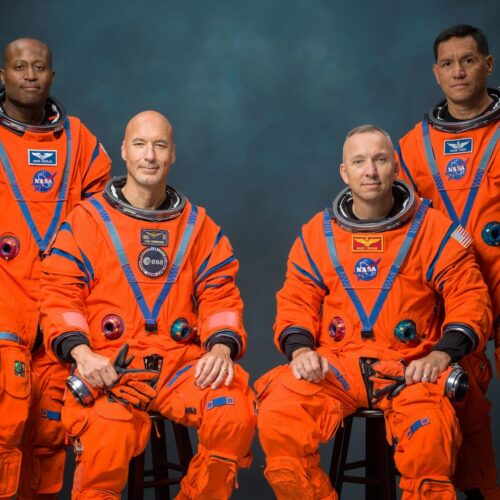
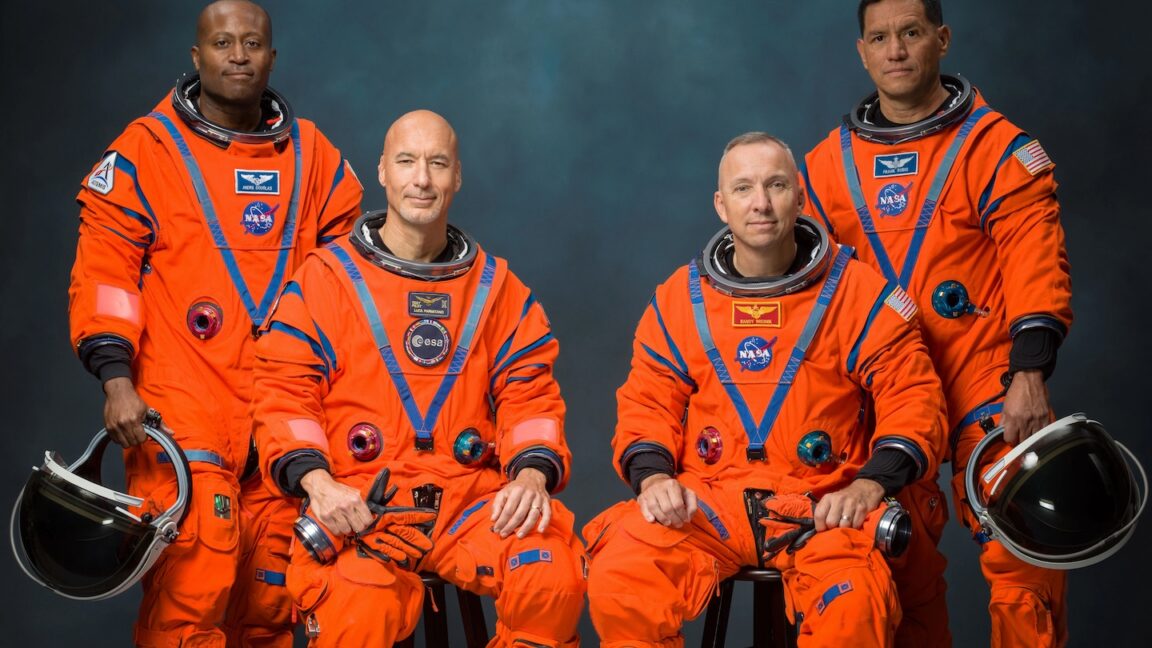
The four crew members are:
© NASA


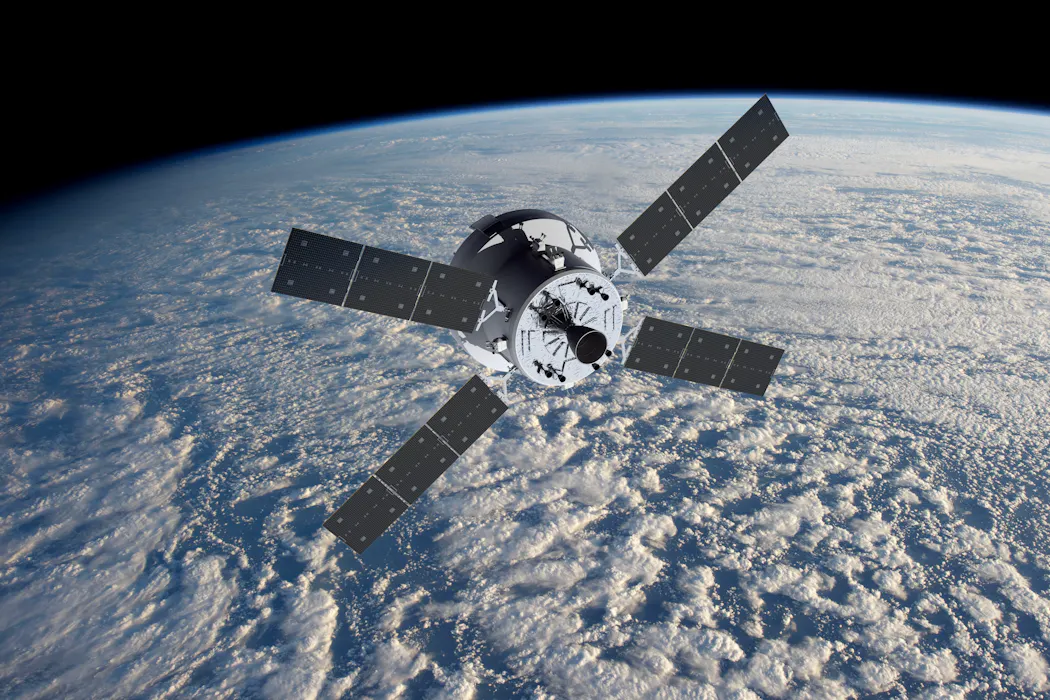
Nasa has named the crew of its next Artemis mission, which it promised would be an “extraordinary demonstration of what is possible”. Artemis is the ambitious American-led effort to return humans to the lunar surface by 2028.
However, the Artemis III mission will not travel to the Moon. Instead, the Orion spacecraft will stay in low Earth orbit and aim to dock with lunar landing vehicles launched separately by one or two space companies.
Nasa astronauts Randy Bresnik, Frank Rubio and Andre Douglas and Italian European Space Agency astronaut Luca Parmitano will carry out the mission in late 2027.
There are two potential landers that could fly on their separate mission to then rendezvous with the Orion spacecraft; one made by Elon Musk’s SpaceX and the other by Jeff Bezos’ firm Blue Origin. They will carry astronauts down to the Moon’s surface on subsequent missions.
However, the timetable for Artemis III and the first mission to return astronauts to the lunar surface (Artemis IV) has been thrown into doubt by the recent explosion of a New Glenn rocket. This rocket is intended to launch Blue Origin’s lander, called Blue Moon.
The blast could add significant delay to the Artemis schedule and there is speculation that it could even put the US out of contention to reach the Moon before China, which is planning its own Moon landing mission for 2030.

On May 28, 2026, Blue Origin’s New Glenn rocket, which is able to carry heavy payloads, was undergoing a standard engine fire test. For reasons which are still unclear, a huge explosion destroyed the rocket and damaged Blue Origin’s only launchpad, located at Cape Canaveral Air Force Station in Florida.
To reduce costs, Nasa’s Artemis programme relies on companies like Blue Origin to deliver key elements for lunar missions, like the landers.
Rockets capable of lifting heavy payloads into orbit will be needed for launching the building blocks of Nasa’s Moon base, which will be assembled over the next few years.
Under previous plans, SpaceX’s Starship vehicle would have been used as the lander for the first two Artemis missions to touch down on the Moon. However, Starship ran into problems during flight tests, so Nasa hatched a plan B.
This backup plan brought Blue Origin’s Blue Moon lander into the mix for Artemis IV, the first mission back to the lunar surface. Now, with the explosion, even their Plan B seems to have moved out of reach.
How bad is the situation though? Blue Origin only has one launch pad that, at the moment, cannot be used. But recent updates by the company’s CEO, Dave Limp, indicated that the situation may not be as dire as it might have been. He indicated that New Glenn might even return to launch before the end of the year.
The propellant farm (which stores the rocket fuel and oxidiser that are pumped into the rocket just before launch), as well as the water tower were undamaged. So were the booster and upper stages of another New Glenn rocket held in the pad’s integration facility. The launch tower will only need to be repaired and not rebuilt.
To gain some insight into the potential impact on the timescale for a next launch, we might be able to look at a similar situation faced by SpaceX in September 2016 where a Falcon 9 rocket exploded on one of their launchpads.
They were able to continue only four months after, but from one of their alternative launch sites, none of which were fully operational at that time. But Blue Origin has no alternative site at all. SpaceX needed more than a year to start up operations again on their damaged launch site.
Kiko Dontcev, vice president of launch at SpaceX, commented on the task ahead for Blue Origin. He described the rebuild as a high precision dissection of the damaged site to help better understand the incident. “In the initial days and weeks after you’re using a scalpel not a bulldozer,” he commented on X.
This might cast doubt on hopes that New Glenn could launch again this year. Indeed, Nasa’s chief Jared Isaacman told CNBC that the launch pad might not be restored until 2028. Currently, we just do not have the full picture of the damage and work needed. So, we can only hope that New Glenn launches can resume as soon as possible.
Nasa is already trying to limit the impact of the New Glenn explosion by urging Blue Origin to look at other rockets for launching its Blue Moon lunar landers. This would allow Nasa to still meet its deadline of landing astronauts on the Moon in 2028.
But New Glenn is still needed to land hardware such as the lunar terrain vehicles for Artemis missions and a robot rover called Viper, which will scout for water ice at the Moon’s south pole.
However, with 2030 approaching fast, the knock-on effects of the explosion could lead to China beating the US to the Moon. But the Artemis programme had already been hit by delays as a result of Nasa’s dependence on government whims and variable funding. Overall, the Artemis programme has had a relatively tight budget to work with.
Space agencies like Nasa must try (as much as possible) to decouple their efforts in space from ongoing turmoil in domestic politics. It could also do well to rely less on ventures led by billionaires, who often have their own private objectives.
One could view the Chinese lunar programme as being more stable, because of their one-party state as well as their strong sense of national pride. However, there is also a lack of transparency in their space programme and a focus on propaganda.
As an outside observer, it appears that Nasa’s current timeline for landing on the Moon and establishing a permanent lunar base is slipping away. But this may not be the disaster some in the space industry think it is. Perhaps we should embrace a pride in exploring space as a community of nations working together.

Daniel Brown does not work for, consult, own shares in or receive funding from any company or organisation that would benefit from this article, and has disclosed no relevant affiliations beyond their academic appointment.

 Nel corso del briefing odierno della Commissione Europea il portavoce Thomas Regnier ha risposto al duro statement di Apple sulla questione DMA. Mettendo in dubbio tutto quanto dichiarato dall’azienda americana.
... Leggi tutto


Taking another step toward one of the most complex human spaceflight missions in recent history, NASA on Tuesday provided new Artemis III details and announced the four prime crew members and a backup for the test flight. The mission will undertake a series of challenging tests in Earth orbit in 2027, essential for Artemis IV, the first planned crewed mission to the lunar South Pole in 2028.
During Artemis III, the agency’s SLS (Space Launch System) rocket will launch the Orion spacecraft and its crew from NASA’s Kennedy Space Center in Florida to low Earth orbit. After Orion systems checkouts, the spacecraft will, for the first time, demonstrate rendezvous and docking capabilities with test versions from one, or both, American commercial human landing systems in development by Blue Origin and SpaceX. This highly choreographed mission includes a dramatic multi-launch campaign of the world’s most powerful rockets, testing integrated hardware between Orion and the landers, including system interfaces, software, propulsion, and communications.
Crew assignments are as follows:
As part of Tuesday’s event, NASA astronaut Bob Hines was named as a backup crew member. The crew will begin training immediately on Orion spacecraft systems, as well as assist in the development and operations of the test versions of Blue Origin and SpaceX landers.
“Today we take another bold step in humanity’s return to the Moon, building on the extraordinary foundation laid by the Artemis II astronauts,” said NASA Administrator Jared Isaacman. “Their achievements reignited global excitement for exploration, and now they pass the torch to the Artemis III team, Randy, Luca, Frank, and Andre. Artemis III will demonstrate the power of American innovation and international partnership as we test complex rendezvous and docking operations and advance the technologies that will one day carry us deeper into the solar system. This mission will require the most awe-inspiring coordination of heavy-lift rocket launches in history, drawing on the talent and capability of teams across government and the spaceflight community. The Artemis III astronauts, alongside ESA and our international partners, and the tens of thousands of the best and brightest across the agency and industry, are ushering in a new Golden Age of exploration carrying forward the hopes and dreams of the next generation just as the Apollo astronauts did for so many of us.”
This also is the first time an ESA astronaut has been assigned an Artemis mission.
“Artemis III will push the boundaries of spacecraft operations in orbit. Luca’s assignment as pilot reflects the depth of European expertise in human spaceflight and draws on his extensive operational experience in high-pressure situations,” said Josef Aschbacher, ESA’s director general. “At the same time, ESA’s European Service Module will once again provide the critical capabilities that power Orion, demonstrating Europe’s enduring role at the very heart of the Artemis program. The news out of Houston today is a powerful recognition of ESA’s role in enabling humanity’s return to the Moon – and a key advancement in our partnership with NASA. Europeans can take pride in being part of this exciting journey.”
Mission progress
NASA and its partners are making progress preparing for the test flight.
Engineers will connect the Orion crew module and service module this summer and integrate the spacecraft’s docking system, which will fly for the first time. Heat shield testing continues with individual blocks having undergone ultra-sonic inspections and installation onto the heat shield structure.
Rocket processing also is well underway. Technicians for SLS are integrating the engine section to the rest of the core stage ahead of installing the four RS-25 engines this summer. With all solid rocket booster segments now at NASA Kennedy and mobile launcher refurbishments on track, rocket stacking also is scheduled to begin this summer. NASA continues design and fabrication of a spacer that will replace the upper stage on Artemis III.
Blue Origin is developing a crewed lunar version of the company’s Blue Moon lander, while SpaceX is developing a crewed lunar lander version of the company’s Starship, with both companies building test articles for Artemis III. NASA is supporting both lander providers hands-on throughout design, development, testing, and evaluation, including sharing agency expertise and capabilities gained from previous missions.
In addition to status updates from NASA and both commercial partners, the agency discussed details during the event about the planned operations for Artemis III, which will support an increased mission cadence, ramp up production, and drive supply chain improvements for the Artemis program.
The Artemis III mission builds on the successful Artemis II flight completed in April and will help the agency prepare to send the first astronauts, Americans, to Mars.
Artemis III includes launching the world’s most powerful rockets in short order. Blue Origin’s lander pathfinder, which is able to stay in orbit for multiple weeks, will launch first and await the crew. NASA will send the astronauts aboard Orion by SLS to orbit Earth, before rendezvousing in space with the company’s lander test article and spending about two days docked together for tests and technology demonstrations, including entering the lander.
After completing docked operations with Blue Origin, Orion will detach and await Starship. SpaceX’s Starship pathfinder will launch and meet up with Orion to spend about a day connected for checkouts and testing. After that, Orion and its crew will undock and return home, splashing safely down in the Pacific Ocean where a team from the U.S. Navy and NASA will recover the astronauts.
In total, the crew is expected to remain in space for about two weeks, with exact mission length to be determined in real-time based on launch, rendezvous, and docked operations.
Learn more about Artemis III crew members
This will be the third mission to space for Bresnik, having launched aboard space shuttle Atlantis on the STS-129 mission to the International Space Station in 2009. He later flew on the Soyuz MS-05 spacecraft from the Baikonur Cosmodrome in Kazakhstan to the space station, serving as a flight engineer for the station’s Expedition 52 and commander of Expedition 53. A California native, he graduated from The Citadel with a degree in mathematics and was selected by NASA in the 2004 astronaut candidate class. A retired U.S. Marine colonel, he has logged more than 7,000 hours in 95 types of aircraft and is a fellow in the Society of Experimental Test Pilots. Since 2018, he has served as assistant to the chief of the Astronaut Office for exploration, overseeing the development and testing of the spacecraft and systems that will operate during Artemis missions.
Artemis III also will be the third spaceflight for Parmitano. Selected by ESA as an astronaut in 2009, he first served as a flight engineer on the Italian Space Agency’s (ASI) first long-duration mission to the space station, launching on a Soyuz from Baikonur in 2013. He returned to the orbital laboratory in 2019 aboard Soyuz MS-13 for his second mission, during which he served as commander of Expedition 61, becoming the third European, and the first Italian, to command the station. Parmitano earned a bachelor’s degree in political sciences from the University of Naples Federico II and a master’s degree in experimental flight test engineering from the Institut Supérieur de l’Aéronautique et de l’Espace in Toulouse, France. A graduate of the Italian Air Force Academy, he became a test pilot in 2007 and was promoted to colonel in 2019. He has logged more than 2,000 flight hours across 40 types of aircraft.
Rubio is making his second trip to space. He launched aboard the Soyuz MS-22 spacecraft from Baikonur to the space station on Sept. 21, 2022, and returned on Sept. 27, 2023, breaking the record for the longest single-duration spaceflight by an American astronaut with 371 days in orbit. Rubio was selected by NASA in the 2017 astronaut candidate class. A Florida native, he graduated from the U.S. Military Academy in 1998, earned a doctor of medicine from the Uniformed Services University of the Health Sciences in 2010, and has served for more than 28 years in the U.S. Army as an aviator, a physician, and an astronaut.
The mission is Douglas’ first spaceflight. Selected by NASA in the 2021 astronaut candidate class, he previously served as a backup and closeout crew member for the agency’s Artemis II mission. A Virginia native, Douglas earned a bachelor’s degree in mechanical engineering from the U.S. Coast Guard Academy and four postgraduate degrees from various institutions, including a doctorate in systems engineering from George Washington University. During his time in the Coast Guard, he conducted search and rescue, maritime salvage, and drug interdiction operations. Additionally, his time at the Johns Hopkins University Applied Physics Laboratory involved designing and testing multidomain autonomous vehicles, space exploration systems, and numerous undersea warfare platforms.
Serving as a backup crew member, Hines will train alongside Bresnik, Parmitano, Rubio, and Douglas. Should a primary crew member be unable to participate in the mission, he would join the Artemis III crew. Hines previously served as pilot of NASA’s SpaceX Crew-4 mission to the International Space Station. Selected by NASA in the 2017 astronaut candidate class, he served as a research pilot at the agency’s Johnson Space Center prior to his selection. He is a colonel in the U.S. Air Force with more than 27 years of service as an instructor pilot, fighter pilot, and test pilot.
As part of the Golden Age of innovation and exploration, NASA will send Artemis astronauts on increasingly difficult missions to explore more of the Moon for scientific discovery, economic benefits, establish an enduring human presence on the lunar surface, and to build on our foundation for the first crewed missions to Mars.
Learn more about NASA’s Artemis program:
-end-
Bethany Stevens / Amber Jacobson
Headquarters, Washington
202-358-1600
bethany.c.stevens@nasa.gov / amber.c.jacobson@nasa.gov
Anna Schneider
Johnson Space Center, Houston
281-483-5111
anna.c.schneider@nasa.gov

Denmark has provisionally approved Tesla’s “Full Self-Driving” (Supervised) system, making it the fourth European country to clear the software in roughly eight weeks.
The Danish Road Traffic Authority, Færdselsstyrelsen, confirmed the decision today — notably after Denmark had previously raised concerns about the technology at the EU level.