Le immagini ad alta risoluzione della sonda Lunar Reconnaissance Orbiter della NASA hanno rivelato un recente impatto sulla faccia nascosta della Luna. Un asteroide o frammento cometario ha scavato una cavità di oltre 200 metri di diametro, sollevando detriti incandescenti e dimostrando la continua vulnerabilità del suolo lunare al bombardamento cosmico.
Confermata l'esistenza dell'esopianeta più giovane mai individuato, un pianeta della massa di Giove a 450 anni luce da noi che sta rivoluzionando i modelli sulla formazione dei sistemi planetari.
Gli astronomi hanno catturato in tempo reale gli esiti di una devastante collisione frontale tra due giovani pianeti in orbita attorno alla stella Gaia20ehk. L'impatto ha generato una gigantesca nube di detriti e polveri incandescenti che ha oscurato la luce visibile della stella, provocando al contempo un forte picco di emissione infrarossa. L'evento, avvenuto a una distanza dalla stella pari a quella tra la Terra e il Sole, offre una rara finestra osservativa sui processi violenti che quattro miliardi di anni fa portarono alla formazione della Luna.
Opposition to wind farms is fuelling support for Alternative for Germany (AfD), with locals who protest that their country "is not a wind farm" turning to the climate sceptic party, which has pledged to tear them down.
Gli astronomi hanno scoperto 84 misteriose sorgenti di raggi X in sei galassie vicine. Chiamate “hypersoft X-ray sources”, potrebbero essere sistemi binari contenenti nane bianche, stelle di neutroni o buchi neri e aiutare a risolvere due importanti enigmi dell'astrofisica.
Nuove analisi digitali di un'antica iscrizione suggeriscono che Meretneith, vissuta circa 5.000 anni fa, potrebbe aver governato l'Egitto come una vera sovrana durante la Prima Dinastia.
Uno studio giapponese durato dieci anni ha rilevato un'associazione tra sanguinamento delle gengive e rischio di demenza e Alzheimer. Il gruppo con più sanguinamento presentava un rischio di Alzheimer del 61% più elevato, ma la ricerca non dimostra che i problemi gengivali siano una causa della malattia.
Une tache lumineuse sur une image de la Lune. Suffisant pour mettre les spécialistes en alerte. Car derrière ce point brillant se cache une découverte aussi rare qu’instructive pour l’exploration spatiale.
Na China, marcas como Huawei, Xiaomi, Honor e Vivo já disputam um mercado onde os dobráveis estão longe de ser uma novidade. Para o iPhone Duo, o desafio será diferenciar-se das rivais e transformar a dimensão do ecossistema da Apple numa vantagem, sobretudo através das aplicações, apontam os analistas da Omdia.
Report finds 57% of UK organizations opted to extend legacy system use rather than replace the tech
This is despite almost half of UK businesses are scaling AI
Meanwhile, over three quarters of UK businesses have gone over budget on modernization, with over two thirds have paused or abandoned the process
Does technological progress necessarily mean replacing old gear? New research from Ensono claims businesses are keeping hold of legacy tech, with older systems extended and upgraded to support modern applications.
This is happening while businesses scale their AI use, focusing budgets on affordable upgrades for existing PCs, laptops, and servers on one hand, and embracing AI on the other. It’s a balancing act, one that is being managed by around 52% of businesses – 57% in the UK, and 48% in the US.
However, the driving factor for this reliance on older tech may not be smart budgeting and foresight. Across the US and UK, 61% of businesses have been forced to pause, scale back, delay, or even completely abandon IT modernization in the past two years.
IT modernization?
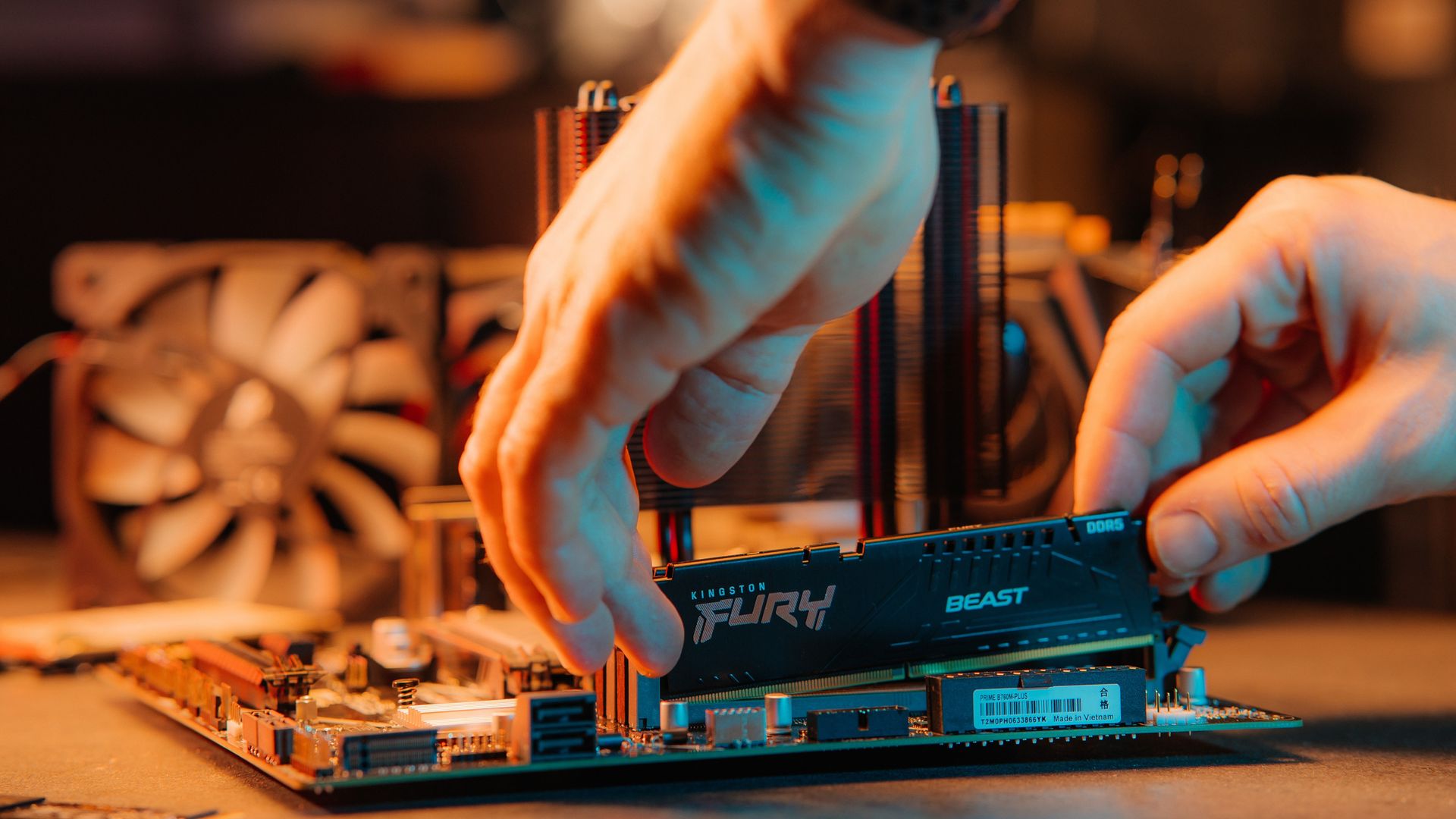
Ensono’s second annual State of IT Modernization Report seems to point to a change in how IT modernization is achieved: rather than replacing old tech, businesses are upgrading. The takeaway is that IT budgets are dictating a focus on AI spending, so where possible PCs, laptops, and some lower-end servers are increasingly being upgraded with faster, higher capacity storage and RAM.
Other key statistics in the report include the news that 71% of IT modernization projects have exceeded budgets, with workflow challenges (33%) and limitations with existing infrastructure (28%) among the roadblocks to an ROI on AI spending.
Underpinning all of this is the growth in decision makers declaring that AI is accelerating modernization, up from 39% last year to 54%.
Rediscovering legacy systems
Budget demands seem to be driving the reliance on older tech within organizations striving to keep up with AI modernization.
“AI is expanding the possibilities for modernization, enterprises are discovering that legacy systems, like the mainframe, are intensely powerful, reliable and efficient sources of computing that can now be augmented and made more agile thanks to AI," noted Brian Klingbeil, Chief Strategy Officer at Ensono.
This means that IT leaders are being forced to decide what needs to be preserved, and where to use AI investment wisely.
“These systems contain decades of data and business logic that drive many businesses,” says Klingbeil. “The advantage will go to organizations that understand their environments well enough to distinguish what should be replaced vs. what should be augmented, and embrace new modernization methods that simply were not available even 18 months ago."
Salesforce UK&I CEO pushes her skilling "mission" across the country
Salesforce doubles down on UK&I recruitment and upskilling goals
Jobs could be repatriated back to the UK from abroad
Salesforce’s UK&I CEO has doubled down on her company’s commitment to investing in skills training and upskilling of young people.
With the UK recently seeing a change in Prime Minister, Zahra Bahroloumi was asked in a media roundtable attended by TechRadar Pro what her outlook for the future looked like.
“Irrespective of government, we are committed to, and very active to the skilling of people,” Bahroloumi said, “we're not stopping, we remain true to our mission, and we remain active and true to our customers, irrespective of government”.
Closing the AI literacy gap
Bahrololoumi has long been a key voice in promoting skills training in the UK, using her company’s influence and scale across the country to push a number of key initiatives.
In June 2026, she outlined the Salesforce’s “incredibly bold” vision for the UK, which includes $6 billion investment committed to the country through 2030, and its role in backing the UK government’s aim to train 10 million UK workers by 2030.
Alongside Bahrololoumi, Paul O’Sullivan, SVP Solution Engineering and Salesforce UKI CTO also looked to outline how Salesforce’s future Trailblazer program is “closing the AI literacy gap”.
O’Sullivan noted how Salesforce is going through “a surge of hiring”, including doubling the size of its forward-deployed engineer team in the UK.
“We are not just looking to attract the best possible talent to come and join Salesforce, we’re also heavily investing in our apprenticeship scheme, doubling down on our graduate opportunities, and aiming to double the size of the team in the next six months,” he noted.
“This is our opportunity to reinvest in the next generation.”
Looking forward, Bahrololoumi was keen to promote the role of the UK in the AI-enabled and augmented future, noting that while the country was, “an empowered market”, there was still potential for more growth.
“We need more talent,” she added, “I feel so confident, and we’ve got the evidence and the proof points that this technology and our platform can work and automate jobs, and augment jobs, and expand human capacity in an organisation effectively.
“But I would like to see more jobs being repatriated from offshore and low-cost locations and jobs being created back in the UK - so I would like to see a stronger drive around automation and repatriation.”
Bahrololoumi gave the example of when there 300 jobs in a low-cost location, outside of the UK - “why can I not create a hundred jobs in the UK and still do 300 plus worth of capacity?”
“That’s something we’re really focused on, because we’ve got the capability to do that now… but I think we've got the opportunity now to create jobs in the UK,” she concluded, “we're on a mission.”
O telescópio espacial Roman poderá finalmente permanecer em operação por muito mais tempo do que o previsto. A NASA havia dimensionado a missão para cinco anos de observações principais, aos quais poderiam somar-se mais cinco anos. As novas estimativas mudam…
It’s been just over two years since Dyson introduced its second pair of headphones, the OnTrac, to the world. While they were a significant improvement — both in terms of sound and general design — over the Zone, I ultimately found in my Dyson OnTrac review that they still couldn’t quite challenge the class leaders — namely Sony and Bose.
A strong factor in that realisation was their exorbitant AU$799 price tag. Not only was that too much for the Dyson headphones (regardless of brand name), it also allowed other manufacturers to charge AU$700 or more for their premium cans — here’s looking at you, Sony, Bose and Sennheiser.
Now, two years later, the Dyson OnTrac has plummeted to a much more acceptable AU$299 during Dyson’s Spring Sale event. At this price, I think they’re worth a look. The noise cancellation is very good, and a 55-hour battery life gives them greater stamina than the closest competitors. I also can’t really fault the ability to customise them, since it’s a feature that’s still pretty unique. That being said, they’re incredibly heavy, so I found I could only wear them for short stints.
At this price, the Dyson OnTrac becomes a lot easier to recommend, although I’d still tread with caution. Their looks may make them stand out from the crowd, but where audio quality is concerned, they can be beaten. Although I don’t see them getting any cheaper, even during Black Friday 2026 sales in Australia later this year.View Deal
However, for your AU$300, or thereabouts, you’re not short of great alternatives. So, if you’ve got a burning desire to invest in a new set of mid-priced headphones, take a look at my top recommendations below.
For just under AU$200 (for the white model), the Nothing Headphone (a) are a terrific buy. A vast improvement over the Headphone (1), this newer set delivers a detailed, expansive soundstage coupled with good noise cancellation. Plus, their 135-hour battery life eclipses the OnTrac by some margin. View Deal
QuietComfort SC: was $499.95 now $349.99 Nearly as good as the premium QuietComfort Ultra, the SC misses out on the Immersive Audio mode — though they do come with a soft case. They have dropped to well below AU$300 before, which could happen during the next Prime Day sales event. View Deal
If your budget can stretch, the Sony WH-1000XM5 will reward you with superior sound quality, incredible comfort and excellent ANC. They’re comfortable to wear for long periods and benefit from a smartphone app that opens up a huge world of customisation.View Deal
It likely won't take you long to reach the ending of Neagley on Prime Video — all eight episodes have been released on the streamer — and when you do, it's nothing short of dramatic.
In a nutshell, the Reacher spinoff is following two story strands simultaneously: the death of a young man that's linked to the Echo Canyon Farm cult, and the reasoning behind why Neagley (Maria Sten) has a lifelong fear of being touched and touching others.
We learn that the cult has a secret facility that is being used to test an illegal drug, called Tranqlara, on human subjects, which is all being funded by a Swedish billionaire known as Rawlings. Neagley and her team try to simultaneously avenge her friend's death in episode 1 and save the innocent followers from the effects of Tranqlara, though they're not overly successful.
What it does lead to, however, is the group blowing up the Echo Canyon Farm facility after the death of leader Lawrence (Damon Herriman), walking in the other direction as if they're in the iconic Reservoir Dogs scene.
It's my favorite moment in the entire series (it looks and feels so effortlessly cool), but according to Sten, none of it was filmed in the way that I thought it would be.
'It wasn't as impressive as what you see'
"I thought it was cool, but I could spoil things and say that there was no such explosion behind us as we walk away," Sten tells me. "There was actually a wind turbine. But we played the music that was going to be played and definitely got in the vibe.
Greyston Holt, who plays detective newcomer Hudson Riley, adds, "We knew what it would be. But in the moment, it certainly didn't look as impressive as what you see on screen."
For the first time in what feels like forever, I've been fooled by CGI. If you were to ask me whether the season finale explosion scene was real or digitally generated, I'd have firmly been in the former camp.
However, that doesn't mean everything we see in Neagley was CGI generated. "In the first episode there's a big truck that blows up, and that was a practical explosion. It's a matter of whether we can blow up the set of not," Sten laughs. "It's not always possible, but we always vouch for it."
If Neagley season 2 does get confirmed (come on, Amazon), I'm hoping for even bigger and better actions sequences. Sure, discovering more about Neagley's backstory has been incredibly satisfying, but clearly, nothing truly beats blowing stuff up.
New research led by University of the Witwatersrand and University of Southern California paleoanthropologists sheds more light on one of the most debated transitions in human evolution: when our ancestors stopped regularly climbing trees and committed fully to walking on two legs.
The US Treasury's FinCEN arm asks financial institutions to file scam center suspicious activity reports under a new keyword
FinCEN says that it flagged financial moves across 33,904 different filings, but actual losses might differ significantly, as the approach is prone to double-counting transactions
Only 1,300 institutions filed reports, with 10,082 (29.7%) of them centering around exploitation of the elderly by scammers
The US Treasury's Financial Crimes Enforcement Network has issuespublished an alert and a companion data analysis telling banks, credit unions, digital asset exchanges, and securities firms that it needs sharper reporting on the overseas scam centers that it says target Americans at an industrial scale.
FinCEN puts total damages, per its reporting mechanism, at roughly $12.7 billion linked to suspected digital asset investment scams between September 2023 and the end of 2025.
The number comes from adding up the dollar values of 33,904 Bank Secrecy Act filings that referenced the keyword from its 2023 "pig butchering" alert, which may be overstated, as it includes both attempted and successful transactions as well as both inbound and outbound reports, often of the same transactions, causing significant overlap.
FinCEN's new requirement is a keyword
While the $12.7 billion is a measure of what institutions have flagged and is prone to double-counting and errors, victim losses, a significant chunk of which go unreported, may be considerably higher.
This has prompted Gene Lange, who effectively works as the Under Secretary for Terrorism and Financial Intelligence, to call these scams "one of the most significant fraud threats facing Americans today."
It has also prompted a new suspicious activity report keyword: "FIN-2026-SCAMCENTERS," which institutions are expected to use to indicate that a scam center is potentially involved.
FinCEN also wants chat logs, scammer phone numbers, social media handles, wallet addresses, transaction hashes, and the URLs victims were told to deposit into, filed in the structured cyber indicator fields rather than left out.
Institutions to volunteer more information to stop scams
The move is part of its push to have institutions volunteer more information under the US Patriot Act, as it aims to confront what is a growing intelligence problem: scammers tend to route victims through several institutions in sequence; most filers see only one slice of a scam's lifecycle and often have difficulty tracing it all the way.
For example, a crypto exchange might see a customer buying USDT and sending it off-platform, a bank might see a wire to that exchange, and a brokerage might see a retirement account liquidated. None of them would have the bigger picture of what essentially happened or what triggered the transaction.
Combined, with properly linked information, it makes it much easier to identify a potential scam; separately, these incidents can inflate the number of reports, which often aren't linked, and investigations can lack insight into the origin or final destination of the funds.
FinCEN's Rapid Response Program has interdicted $1.8 billion and recovered just over $1 billion for 5,790 US victims since 2015, which, against the flagged totals, is a very limited recovery at best compared with the actual funds at stake. This highlights a larger fundamental problem: institutions mostly detect these schemes after the money is gone, and reporting them correctly and thoroughly may yield limited dividends at best against an industry that has morphed, relatively unchecked, into a multi-billion-dollar juggernaut.
Tenzing shifts one of mountaineering’s most famous stories toward the Himalayan climber whose name has long shared a place in history with Edmund Hillary. Apple Original Films has released the trailer for the upcoming adventure drama, with Genden Phuntsok playing Tenzing Norgay and Tom Hiddleston portraying Hillary during the 1953 expedition that reached the summit of Mount Everest.
Directed by Jennifer Peedom, the film reaches select theaters on October 9 before streaming globally on Apple TV on October 16. The cast also includes Willem Dafoe, Caitríona Balfe, Thinley Lhamo, and Tenzin Dalha.
Rather than presenting the expedition simply as a survival story about reaching the world’s highest point, the film approaches the ascent through Tenzing’s position within the British-led team, his relationship with the mountain, and the social divisions surrounding the expedition.
That perspective gives the familiar Everest story a different dramatic center.
Tenzing puts the Himalayan climber at the front of the story
Tenzing Norgay and Edmund Hillary reached the summit of Everest on May 29, 1953, during an expedition led by Colonel John Hunt. Their ascent became one of the defining achievements in mountaineering history, but the new film is explicitly structured around Tenzing rather than treating the two climbers as interchangeable figures.
Phuntsok plays Tenzing as an experienced Himalayan climber who has already spent years pursuing the possibility of reaching the summit. The story follows his attempt to secure a meaningful place on the climbing team instead of being viewed primarily as someone there to support Western expedition members.
Hiddleston’s Hillary enters that story as another outsider within the expedition hierarchy. Apple describes the relationship between the two men as one built gradually through mutual respect and trust as the dangers and pressures of the ascent increase.
Dafoe plays Hunt, the expedition leader, while Balfe portrays expedition secretary Jill Henderson, who becomes an ally to Tenzing. Thinley Lhamo plays Dawa, Tenzing’s wife, whose support forms another part of the film’s emotional foundation.
The Apple TV listing also identifies Johnny Flynn as George Mallory and Tenzin Dalha as a younger Tenzing.
The 125-minute film therefore has room to explore more than the final climb itself. Its central conflict begins before Tenzing and Hillary ever approach the summit.
Image Credit: Apple Inc.
The Everest story looks beyond conquest
One of the distinctions emphasized in Apple’s description of Tenzing is the different meaning the mountain holds for its characters.
The film contrasts the Western climbers’ view of Everest as something to be conquered with Tenzing’s reverence for Chomolungma as the sacred mother goddess.
That contrast gives director Jennifer Peedom a way to examine the expedition through competing cultural perspectives rather than framing the mountain solely as an obstacle.
The trailer also points toward tensions involving class, hierarchy, nationality, and the legacy of empire. Tenzing must establish that he belongs among the expedition’s climbers instead of accepting a supporting position defined by others.
Historical accounts from the Royal Geographical Society record that Hillary and Tenzing left their final camp on the morning of May 29, 1953, using supplemental oxygen. They reached the summit at approximately 11:30 a.m. after negotiating the steep section of rock and ice that became known as the Hillary Step.
The achievement has been recounted in books, documentaries, photographs, and films for decades. Tenzing approaches the material by asking how the same expedition looks when the Himalayan climber occupies the center of the frame.
Peedom shares story credit with Luke Davies, who wrote the screenplay.
The project is a natural fit for Peedom, whose filmmaking career has repeatedly engaged with mountains, extreme environments, and the people drawn to them. Here, however, the physical scale of Everest serves a character story built as much around identity and recognition as technical climbing.
Genden Phuntsok leads an established ensemble
Casting Tenzing Norgay was particularly consequential because the film surrounds its lead with several internationally recognizable performers.
Hiddleston arrives as Hillary with a career spanning major franchise work and dramatic television. Dafoe brings a more imposing presence to Hunt, while Balfe plays Henderson as one of the figures willing to challenge the assumptions surrounding Tenzing’s role.
Phuntsok nevertheless remains the narrative anchor.
Apple’s synopsis describes the climber’s journey as both a lifelong ambition and a spiritual calling. That gives the performance two demands: convincing audiences of Tenzing’s physical capability at extreme altitude while conveying why reaching Chomolungma carries meaning beyond becoming part of the first confirmed ascent of Everest.
Lhamo’s Dawa is also positioned as more than background to the expedition. Apple specifically identifies her encouragement as part of what drives Tenzing toward the opportunity, adding a personal relationship to a story otherwise dominated by expedition politics and physical risk.
Behind the camera, Davies joins Peedom as a producer. Desray Armstrong also produces, alongside Liz Watts, Iain Canning, and Emile Sherman of See-Saw Films.
See-Saw has an established relationship with Davies, whose previous screenwriting credits for the company include Lion. Norbu Tenzing, Simon Gillis, and David Michôd serve as executive producers.
Image Credit: Apple Inc.
Tenzing gets a theatrical window before Apple TV
Apple is giving Tenzing a short theatrical run before bringing the film to its streaming service.
Select theaters will begin showing the movie on October 9, with the global Apple TV premiere following one week later on October 16. The Apple TV listing categorizes the film as a drama and adventure title and gives it a PG rating in the U.S. for thematic elements, language, smoking, and some peril.
The release continues Apple Original Films’ practice of using theatrical distribution selectively before making features available to subscribers.
For Tenzing, the cinema component has an obvious creative advantage. A film built around Everest, dangerous climbing conditions, and the physical scale of the Himalayas has material suited to a large screen, even as its narrative emphasis remains on the people inside that landscape.
The trailer arrives with less than a month remaining before the theatrical debut, giving Apple a relatively concentrated promotional window.
It also introduces Phuntsok to a much wider international audience alongside performers including Hiddleston, Dafoe, and Balfe without letting the better-known names displace the person identified in the title.
Tenzing will begin its theatrical run on October 9, followed by its Apple TV release on October 16. Its 1953 destination is already known; the new question is how the film reconstructs the journey by placing Tenzing Norgay’s perspective, relationships, and understanding of Chomolungma at the center of the ascent.
A pseudonymous GitHub account has published what it calls a reconstruction of Stuxnet malware that purportedly took out a fifth of Iran's centrifuges before being discovered
The original source has never surfaced, and the 'Stuxnet' moniker that the account uses comes from Symantec's coining of the name weeks after it was discovered
The code remains unverified and untested, with some users indicating that it is likely an AI-generated replication of the original binaries' behavior, which has been widely documented
A GitHub account has published what it describes as a faithful reconstruction of Stuxnet, the worm that sabotaged Iranian uranium-enrichment centrifuges.
It also became the first piece of software widely accepted as having caused physical destruction in the real world, highlighting how malicious software can often do much more harm to people and hardware than just stealing or manipulating data.
The repository surfaced via a Show HN submission, which mainstream media outlets then picked up, highlighting the as-yet-unknown researcher's reverse-engineered code.
Not the first or last Stuxnet repository
The original Stuxnet source, written by whoever built it, has never been leaked and did not leak last week. The repository's README explicitly states that it is a reconstruction assembled from decompiled binaries, and those binaries have been in public circulation since Belarusian firm VirusBlokAda pulled samples from an Iranian customer's machines in June 2010.
Everything that followed, including Symantec's W32.Stuxnet Dossier and Ralph Langner's To Kill a Centrifuge, was built on those samples and how they reacted in test environments.
This is also not the first time readable C-language code aiming to replicate Stuxnet has been published online. Malware researcher Amr Thabet published a decompilation of the MRxNet rootkit carrying a 2010 to 2011 copyright notice. Christian Roggia followed with a dropper decompilation called open-myrtus, copyrighted 2012 to 2014, which has since been forked into a long chain of repositories.
The irony is that if such code were a faithful replication of the infamous malware, it would not have mentioned "Stuxnet" in multiple places, including registry keys. This is because the moniker is not one the developers likely used, but one Symantec switched to from its original 'W32.Temphid' identifier.
The thread where it was first brought to attention by a user called Sadpainy also has mixed views from developers, many of whom have branded it 'AI slop' or a 'fake' that relies on a mixture of already existing repositories, even as the about page on its GitHub repo states that it was reproduced by the researcher for educational purposes and is designed to only work on Windows XP and Windows 7.
For those looking to test it, a virtual machine might be their best bet, especially given Stuxnet's ability to physically damage hardware, but it is also a stark reminder of what a rogue AI agent could do if left unchecked without specific instructions or safeguards.
AirPods 5 bring Active Noise Cancellation to Apple’s most affordable current AirPods while pushing the open-ear design closer to capabilities previously associated with more expensive models. The new generation starts at $129 and uses redesigned acoustics and computational audio to remove up to 50% more external noise than AirPods 4 with Active Noise Cancellation.
Apple is also splitting the range into two versions. The standard $129 AirPods 5 include ANC and USB-C charging, while a $149 model adds a Wireless Charging Case, longer battery life, a case speaker for Find My, and volume adjustment directly from the stems.
Both models are available for preorder ahead of their September 18 release in the U.S. and more than 65 other countries and regions.
The changes make the distinction between Apple’s entry-level AirPods and its more advanced headphones less dependent on headline software features. Adaptive Audio, Transparency, Conversation Awareness, Personalized Spatial Audio, Live Translation, and Siri AI are all part of the AirPods 5 experience.
Image Credit: Apple Inc.
AirPods 5 push open-ear ANC further
Active Noise Cancellation is particularly difficult to implement in an open-ear earbud because there is no silicone tip forming a physical seal inside the ear canal.
Apple has approached that limitation with a new multiport acoustic architecture, revised computational audio algorithms, and the H2 headphone chip. The company says AirPods 5 can cancel up to 50% more noise than AirPods 4 with ANC.
That improvement does not turn the design into an AirPods Pro-style sealed earbud. AirPods 5 remain open-ear headphones, retaining the fit preferred by people who dislike the pressure or isolation associated with in-ear tips.
The acoustic system has also been redesigned around a wider variety of ear shapes. Next-generation Adaptive EQ continuously adjusts sound based on how each earbud sits, while Apple says the revised architecture produces richer and more detailed playback.
Transparency mode has been updated to reproduce voices and environmental sounds more naturally. Adaptive Audio can move between Transparency and noise cancellation according to surrounding conditions, while Conversation Awareness automatically reduces media volume when the wearer begins speaking to someone nearby.
Personalized Spatial Audio with dynamic head tracking remains supported for compatible music, movies, and other content.
AirPods 5 are rated IP57 for dust, sweat, and water resistance, making them better suited to workouts and changing weather conditions, although they are not waterproof.
Two AirPods 5 models create a meaningful $20 decision
Apple’s pricing makes the $149 Wireless Charging Case version more than a different charging option.
Standard AirPods 5 provide up to four hours of listening on one charge with ANC enabled and up to 20 hours when the USB-C case is included.
AirPods 5 with Wireless Charging Case increase those figures to five hours from the earbuds and up to 22 hours with the case while ANC is active.
The upgraded case can charge through USB-C, an Apple Watch charger, or a Qi-certified wireless charger. It also contains a speaker that can assist with locating the case through Find My.
The more expensive model introduces another difference directly on the earbuds. Users can swipe up or down on a stem to adjust volume, bringing a control familiar from AirPods Pro to Apple’s open-ear form factor.
That leaves buyers with a relatively straightforward tradeoff. The $129 version provides the central audio experience, including ANC, without requiring a step up for the main listening features. Spending another $20 adds more convenient charging, slightly longer battery life, Find My assistance from the case speaker, and physical volume adjustment.
Placing either AirPods 5 model in its charging case for five minutes provides about one additional hour of listening.
Image Credit: Apple Inc.
Siri AI and Live Translation extend the earbuds beyond music
AirPods 5 arrive as Apple makes voice interaction a larger part of the AirPods experience.
When paired with a compatible iPhone, Siri AI can be accessed hands-free. The assistant can work with personal context from information such as messages, emails, and photos, respond to open-ended questions, and perform supported actions in apps.
Head gestures remain part of the experience. Users can nod to accept certain Siri prompts or shake their head to decline them, allowing calls and notifications to be handled without speaking or touching the earbuds.
Live Translation provides another use for the microphones and ANC system.
After compatible languages are downloaded and the feature is configured through Apple’s Translate app, a user can hear another person’s speech translated through AirPods. Translation can be started through Siri, the iPhone Action button, the Translate app, or by pressing and holding both AirPods stems simultaneously.
When two people are each using compatible AirPods and supported iPhones, both participants can hear translated versions of the conversation in their chosen languages.
Live Translation requires an Apple Intelligence-enabled iPhone 15 Pro or later, compatible AirPods, current software, and the latest AirPods firmware, with availability varying by language and region. Apple also notes that generated translations can contain errors, making verification appropriate when accuracy is especially significant.
AirPods 5 narrow the gap within the lineup
The fifth-generation model represents a different kind of upgrade from simply adding another listening mode.
ANC is now standard across both AirPods 5 configurations, instead of requiring buyers to choose a separate ANC version as they did with AirPods 4. Apple has then moved the pricing distinction toward charging, battery endurance, Find My hardware, and physical controls.
The earbuds continue to use Bluetooth 5.3 and the H2 chip, with dual beamforming microphones, an inward-facing microphone, optical in-ear detection, motion and speech accelerometers, and force sensors built into the stems.
Each earbud weighs 4.3 grams, preserving the lightweight character of the open-ear line despite the additional capabilities.
The new acoustic architecture may be the more consequential change over time. Open-ear earbuds cannot rely on a tight seal to block surrounding sound, so gains in ANC depend heavily on microphone placement, acoustic design, fit, and real-time processing. Apple’s claim of up to 50% more noise removal over the previous generation represents a substantial step for that format rather than simply matching the behavior of sealed earbuds.
AirPods 5 start at $129, while AirPods 5 with Wireless Charging Case cost $149. Both reach stores on September 18, giving the open-ear AirPods line a standard feature set that now includes noise cancellation without pushing buyers to a higher-priced model to get it.

 Login