Apollo Global Management, known for leveraged buyouts and hefty financing deals, has started investing in AI and related hardware startups with the ambition to lend money to them in the future.
In one previously unreported deal, Apollo has already invested in the low tens of millions of dollars in Mercor’s latest funding round, which is set to value the data-labeling startup at $20 billion, according to people familiar with the matter. It has also invested in chip startup SiFive and in Hadrian, which says it’s building AI-powered factories, in transactions the companies disclosed earlier this year. It expects to make more investments in these categories, the people said.
Comment définir les contours d'un champignon et estimer sa longévité ? Des questions qui semblent simples, mais auxquelles la science peine encore à répondre. Rencontre avec Ayla Mongès, chercheuse en écologie fonctionnelle, qui tente de percer les mystères de ces organismes hors normes.
Sul Galaxy Store è stato individuato un servizio Samsung chiamatoGallery Cloud Sync. La descrizione parla della possibilità di effettuare il backup di foto e video su 'Google Cloud' e di ritrovarli sugli altri dispositivi. Il riferimento sembra essere proprio a Google Foto, che verrebbe quindi integrato direttamente nella Galleria Samsung
La funzione non è ancora disponibile pubblicamente, ma è già stato possibile attivarla in anteprima. Nelle impostazioni della Galleria compare una voce per collegare l'account Google, con l'indicazione dello spazio di archiviazione disponibile, la possibilità di scegliere quali album sincronizzare e alcune opzioni relative all'uso del Wi-Fi e del roaming.
Per chi utilizza oggi OneDrive il funzionamento dovrebbe quindi cambiare poco: foto e video continuerebbero a essere gestiti dalla Galleria Samsung, mentre il backup passerebbe dai server Microsoft a quelli Google. I contenuti sincronizzati risulterebbero poi accessibili anche tramite Google Foto.
Samsung ha già iniziato a rimuovere l'opzione OneDrive dalla Galleria per alcuni utenti. Chi ha già utilizzato il servizio Microsoft non perderà comunque le foto salvate nel cloud: semplicemente, una volta terminata l'integrazione, non saranno più visibili direttamente dalla Galleria Samsung e resteranno accessibili tramite OneDrive.
Al momento Samsung non ha ancora annunciato ufficialmente il debutto di Gallery Cloud Sync con Google Foto. Considerando però l'imminente fine dell'integrazione con OneDrive, il lancio potrebbe arrivare tra la fine di settembre e l'inizio di ottobre.
L’UE dà il via libera allla riforma doganale: piattaforme e venditori extra-UE diventano importatori responsabili e arriva una nuova “handling fee”, distinta dal dazio da 3 euro... Leggi tutto
upgraded to Golden gate. getting this message to login to facetime with an email i’ve not used in years. it’s not the emai for my current apple account.
the window keeps appearing and wont go away. any ideas how to fix this? thanks.
Mercoledì 16 settembre parte con una selezione di offerte tech decisamente corposa, soprattutto tra Amazon e Unieuro. La giornata mette insieme smartphone di fascia alta, smartwatch appena arrivati sul mercato, auricolari true wireless, monitor gaming e qualche prodotto smart home.
Tra i prodotti più interessanti spiccano diversi tagli del Google Pixel 11 Pro, compresa la versione da 1TB proposta allo stesso prezzo del modello da 512GB, almeno al momento della rilevazione. Sempre in casa Google, da segnalare anche il Pixel 11 Pro XL e il più accessibile Pixel 10a, mentre Unieuro punta forte sui Samsung Galaxy S26 e Galaxy S26 Ultra, con prezzi finali particolarmente aggressivi grazie alla promozione con valutazione dell’usato.
Proprio nel caso delle offerte Unieuro è importante leggere bene le condizioni: per alcuni prodotti lo sconto indicato tiene conto di 300 euro applicati al checkout e della supervalutazione dell’usato, valida con ritiro in negozio. In almeno un caso è richiesta anche l’adesione a Unieuro Club.
Firefox 156 is the second release since Mozilla moved to a twice-monthly release schedule, and the blog OMG Ubuntu notes it has faster start-up times for its built-in PDF viewer and also lower CPU usage when viewing large JPEG images:
In Firefox 156, the browser now uses libjpeg-turbo's IDCT scaling to reduce images during decoding, rather than loading a full-size image into memory and then shrinking it. Benchmarks from the bug report show up to 20Ã-- less memory used during very large image loading, and decoding is up to twice as fast. Since these speeds were quite fast already, there's no perceptible difference to users. Behind the scenes, it's more efficient.
Firefox's built-in PDF viewer starts up to 45% faster in this release. The browser now loads the background PDF.js worker sooner, rather than launching it only when needed.
Sponsored suggestions in the address bar are live for users in France, Germany and Italy (Ouais!, Juhu!, etc). These are already available in some other locales. Don't want them? Disable them via Settings > Search > Firefox Suggest > Suggestions from Sponsors.
Besides that, the rest of this release is primarily bug fixes — worthwhile and welcome as always.
And in about two weeks Firefox 157 will be released, reports PC World. "That update should add support for JPEG XL (JXL), a modern image format that offers the same quality as JPEG at a significantly smaller size. Although JPEG XL was launched in 2021, Safari is the only browser to support it yet. For a short period, Chrome also supported it, but that ended in 2022."
Also, a recent Firefox blog post emphasized that it supports whatever level of AI engagement "is right for you... Because the only person telling you how much AI you need should be you."
Opting out of upcoming and current AI features on your browser should not require endless navigation through multiple Settings pages. That's why Firefox offers an AI controls section within its General Settings panel. A single, easily located place where you can block current and future AI features and related pop-ups with the swipe of a toggle...
For the many people who sit in the middle of the AI usage spectrum, we made sure you can opt in and out of specific features in line with your preferences. Capabilities like AI translations, image alt text in Firefox PDF viewer, tab group suggestions, and key points in link previews can all be individually switched on and off, ensuring you can enjoy such offerings on a case by case basis as it suits your needs...
Smart Window is Firefox's most integrated AI experience, but that doesn't mean it compromises our commitment to choice, privacy, and transparency. Our newest window type, which we've been polishing and testing in beta, uses only the context you share with it to help you move work forward and across the finish line. When permitted by you, its built-in, AI-powered assistant can work directly with your open tabs and browsing history to connect the dots. This means comparing information, generating recommendations, summarizing pages, and planning projects without having to feed every crumb of context from your previous and current browsing activity each time you enter a new prompt.
And if you want to block Google's AI Overviews, there's over 100 extensions to choose from.
Com a crise de componentes e os preços dos dispositivos da Valve nas alturas, a companhia revelou oficialmente que nada disso impactará o lançamento do Steam Deck 2. Isso significa que os valores do portátil atual de US$ 789, do Steam Frame de US$ 1.059 e do Steam Machine por US$ 1.049 não são um novo padrão.
Ao IGN, o desenvolvedor da companhia, Pierre-Loup Griffais, revelou que os planos que já têm sobre o hardware “não mudaram muito” em relação às altas nas memórias RAM e armazenamentos, assim como datas. Claro, a fala carrega um “porém”: o aparelho não será lançado em breve, possivelmente após a conclusão dos aumentos.
“Falamos antes sobre como queremos garantir que haverá um salto de desempenho para algo similar ao ‘futuro Steam Deck’, acredito que continuamos a seguir o mesmo caminho”, afirmou o porta-voz.
O que ele realmente quer dizer? Eles só trarão um novo console portátil ao mundo quando notarem uma exigência maior por um produto de alta performance. Essa situação pode ocorrer apenas no instante em que esta crise chegar ao fim, logo eles não enxergam a forma que todo o caos nos hardwares pode impactar os negócios da Valve para o modelo.
A empresa já revelou trabalhar no Steam Deck 2, contudo é possível que o dispositivo ainda esteja em estágio embrionário. Ou seja, há chances de que já saibam como fazê-lo dar certo, no entanto podem aguardar por uma queda de valores e a possibilidade de produzi-lo em grande escala sem prejuízos.
Nada mudou para a Valve
Griffais também explica que os planos seguem iguais aos que foram declarados no passado. Para ele, “no que temos trabalhado, conforme a experiência dos jogadores progride e o que o produto pretende construir, os objetivos são bem similares”.
A declaração serve para acalmar o público que não deseja ver o Steam Deck 2 a preços estelares. Com um acréscimo expressivo no custo de vários hardwares, todos os produtos da sua linha tiveram de ser vendidos a preços elevados.
No entanto, o cenário pode não ser um problema no momento em que o console portátil for lançado. Se levarmos em conta que as mudanças podem ocorrer apenas entre 2029 e 2030, talvez tudo isso já seja uma história que ficou para trás.
Across the stories today, a common thread emerges: the boundaries we once drew around “the environment” — between land and sea, sky and orbit, economy and ecology — keep dissolving, revealing how deeply intertwined these systems have become.
Start with the sky, in more ways than one. The US government’s confirmation that it has deployed a weapon in Earth’s orbit marks a genuine turning point, not just for defense policy but for how we think about the commons above our heads. Space has long been treated as neutral ground; now it’s becoming contested territory, raising quiet but urgent questions about debris, escalation, and what “environment” even means when it extends past the atmosphere. Meanwhile, back on solid ground, the UK’s climate advisers delivered a pointed message to Heathrow: a third runway cannot proceed unless airlines help pay for the emissions it would unleash, potentially through carbon removal costs. It’s a small but telling signal that growth and climate accounting are becoming inseparable in policy conversations — expansion is no longer a given, even for infrastructure long considered inevitable.
That tension between growth and limits runs through much of today’s coverage. A Guardian analysis found that the world’s twenty largest private equity firms back energy portfolios emitting more greenhouse gases than all but three countries on Earth — a stark reminder that climate accountability often hides behind layers of finance most people never see. In Venezuela, a US-backed push for “legitimate” mining and a new oil megadeal are drawing warnings from environmental and human rights groups who see familiar risks dressed in new language. And in Guinea-Bissau, industrial fishmeal factories are quietly hollowing out a food fish that coastal communities have relied on for generations. Behind the numbers are real communities adapting in real time — from Vietnamese fishers losing thousands of dollars per vessel to tangled plastic waste, to Dhaka residents like Yeasmin Begum, who has spent her life breathing the smoke of a landfill she never chose to live beside.
Yet alongside these pressures, the day’s coverage also points to growing momentum around resilience and repair. Ukrainians are turning to rooftop solar to keep homes running amid bombardment — a portrait of adaptation born from necessity. A Congolese NGO now co-manages a national reserve for the first time, a homegrown model of stewardship. Moon bears rescued from bile farms are stretching their limbs in Suffolk enclosures, and three wild dog brothers wandered 2,500 miles across Zambia in search of a mate, offering an unlikely note of hope for their species. Even Griffith Park’s mountain lion — photographed beneath the Hollywood sign — helped inspire the world’s largest wildlife crossing, proof that a single image can shift infrastructure decisions.
It’s a reminder that progress and pressure often arrive together. Some communities are innovating their way through crisis; others, like the land defenders now forming self-defense units amid rising violence, are simply trying to survive it. As Brazil’s upcoming election looms over the Amazon’s future, and Chief Raoni Metuktire — one of its most storied protectors — enters palliative care, the coming months may reveal whether today’s momentum toward stewardship can outpace the forces pulling the other way.
Nunca produzimos tantos dados. Ainda assim, uma parcela enorme deles permanece isolada dentro de empresas, hospitais, universidades e centros de pesquisa. A Comissão Europeia já estimou que 80% dos dados industriais coletados nunca chegam a ser utilizados. O problema, portanto, não é apenas gerar mais informação, mas criar condições para que dados dispersos possam gerar conhecimento e inovação sem exigir que todos sejam transferidos para um único lugar.
Essa fragmentação tem consequências concretas. Um hospital pode possuir milhares de exames capazes de contribuir para o desenvolvimento de um modelo de inteligência artificial, mas não pode simplesmente entregar sua base a uma empresa de tecnologia. Uma indústria farmacêutica pode dispor de resultados experimentais valiosos, mas compartilhar essas informações pode envolver propriedade intelectual, confidencialidade e requisitos regulatórios. Em outro ponto do ecossistema pode estar exatamente o algoritmo, a capacidade computacional ou o conhecimento científico necessário para resolver o problema.
O resultado é um paradoxo: os ativos existem, mas permanecem separados.
É nesse contexto que a computação federada ganha importância. Em vez de começar pela pergunta “como reunir todos os dados?”, a lógica muda para “como permitir que diferentes organizações colaborem mantendo maior controle sobre seus próprios ativos?”.
Segurança e governança precisam entrar na arquitetura
Em muitas arquiteturas federadas, o processamento ou o modelo pode ir até o ambiente onde os dados estão. Compartilham-se apenas informações, parâmetros ou resultados previamente autorizados. Aprendizado federado é uma das técnicas que podem fazer parte dessa arquitetura, mas o princípio é mais amplo: colaborar não precisa significar centralizar.
Para setores como saúde e indústria farmacêutica, essa diferença é decisiva. Não basta proteger os dados. É preciso saber quem pode acessá-los, onde podem ser processados, quais evidências devem ser registradas e quais regras se aplicam ao produto ou à tecnologia que será desenvolvida. Segurança, governança e regulação deixam de ser verificações feitas no final e passam a orientar a arquitetura desde o início.
A tecnologia, porém, resolve apenas parte do problema. Existe uma segunda fragmentação, menos visível: a das competências.
Quem conhece o desafio nem sempre possui os dados necessários. Quem possui os dados pode não ter o algoritmo. Quem desenvolve o algoritmo pode depender de infraestrutura computacional ou científica externa. Por isso, o desafio central passa a ser orquestrar organizações diferentes em torno de um problema comum.
Essa discussão está no centro do framework 3C, desenvolvido pelo World Economic Forum com a Capgemini. A primeira etapa é combinar tecnologias e capacidades; a segunda é fazê-las convergir para gerar novas soluções; a terceira é criar um efeito cumulativo, no qual conhecimento, padrões e relações construídos em um projeto reduzem o risco e aceleram os seguintes. Em 2026, o próprio Fórum reforçou que orquestrar pessoas, dados e fluxos de trabalho é crítico para transformar combinações tecnológicas em impacto real.
O avanço da inteligência artificial tende a exigir menos concentração e mais capacidade de coordenação. Em muitos casos, o valor estará em fazer tecnologias, dados e competências distribuídas trabalharem juntas com segurança, governança, validação científica e viabilidade regulatória. A próxima vantagem competitiva não está em possuir todos os ativos, mas na capacidade de conectá-los sem perder o controle sobre eles.
É essa lógica que orienta o ConvergeLab. Mais do que concentrar tecnologias ou dados em uma organização, a proposta é criar condições para que capacidades distribuídas possam trabalhar juntas com segurança, governança, validação científica e viabilidade regulatória.
Em um cenário no qual a inteligência artificial depende cada vez mais de dados de qualidade, talvez a próxima vantagem competitiva não esteja em possuir todos os ativos. Pode estar na capacidade de conectá-los sem perder o controle sobre eles.
Author: José Luis Granados Mateo is a postdoctoral researcher in the Department of Philosophy at the University of the Basque Country (EHU) and a member of the Integrated History and Philosophy of Science (iHPS) research group. His work focuses on history and philosophy of science, science and values, and the epistemology of scientific practices.
Water is H₂O. Few scientific formulas look more familiar, more compact, or more final. Two atoms of hydrogen, one of oxygen: the phrase seems to say what water really is beneath the shifting appearances of ice, vapour, rain, rivers and the liquid in a glass.
Yet that little subscript was not easy to earn.
By the early nineteenth century, chemists had good reasons to treat water as a compound of hydrogen and oxygen. The old idea of water as a simple element had lost its authority, as we saw in Is Water H₂O? (1) From Element to Compound. Electrolysis then gave that claim a new experimental force, making hydrogen and oxygen appear under electrical action, although not without raising puzzles of its own, as discussed in Is Water H₂O? (2) The Puzzle of Water Electrolysis. What remained unsettled was a more delicate question. Not whether water had constituents, but how many of each entered one molecule.
Was water HO? H₂O? Something else?
Today the answer feels almost automatic. In the first decades of atomic chemistry, it was not. Dalton’s atomic theory made HO the natural formula: one atom of hydrogen, one atom of oxygen. Avogadro proposed something much closer to the modern answer very early, but his proposal did not settle the matter. For more than half a century, some of the best chemists in Europe disagreed over the formula of one of the most ordinary substances in the world.
The confusion was public enough to become comic. In the 1860s, when agreement was finally beginning to form, an author identifying himself as a certified lunatic at Hanwell Asylum wrote to Chemical News mocking the chemists’ inability to agree even about water. One could contemplate the bewildering variety of formulas, he suggested, until the brain first became confused, then swam, and finally softened.
The joke had bite because the embarrassment was real. Chemical tables were full of combining weights, volumes, radicals, equivalents and atomic symbols. Water had long ceased to be elementary. Yet the old difficulty remained: to know the formula, chemists had to count atoms; to count atoms, they would have had to see them. And they could not.
Liebig put the matter painfully in 1851. Chemists possessed no direct means of ascertaining the number of atoms even in the simplest compound, because that would require seeing and counting them. Atomic chemistry needed numbers for entities no one could inspect.
So the problem was not that the answer lay beyond all reach. It lay beyond direct reach. Chemists had to learn to count invisible things by making them answer to operations that could be performed.
A number, and two worlds
The difficulty begins with a ratio.
Hydrogen and oxygen combine in fixed proportions by weight. In round modern numbers, water contains one part hydrogen for eight parts oxygen. Chemists could establish the ratio; the difficulty began when that ratio had to be translated into atoms.
Suppose water is HO. One atom of hydrogen combines with one atom of oxygen. Since the oxygen contribution weighs eight times as much as the hydrogen contribution, the oxygen atom must weigh eight times as much as the hydrogen atom.
Now suppose water is H₂O. Two atoms of hydrogen combine with one atom of oxygen. The same measured ratio now yields a different atomic weight: oxygen must weigh sixteen times as much as hydrogen.
The laboratory ratio has not changed. The invisible architecture has.
That was the circular trap. Molecular formulas required atomic weights; atomic weights required molecular formulas. Measurement gave combining proportions, not little labelled particles waiting to be counted. A consistent chemistry could be built with HO and oxygen as 8. Another could be built with H₂O and oxygen as 16. Once the difficulty spread across many compounds, chemists were no longer facing a local uncertainty about water. They were choosing among possible atomic worlds.
The difficulty appeared at the worst possible place: the point where atomic chemistry had to begin producing reliable numbers.
Dalton’s necessary guess
Dalton knew that atomic theory needed a starting point.
He approached water from within a broader problem. Chemical substances combined in fixed proportions; in some cases, the same elements combined again in different but still simple ratios. Atomic theory offered a machinery for these regularities. If matter consisted of particles with definite weights, then chemical combination could be understood as their joining in determinate numbers, and the arithmetic of chemistry began to point towards an unseen order. What it still failed to provide was the count itself: the number of atoms entering each compound.
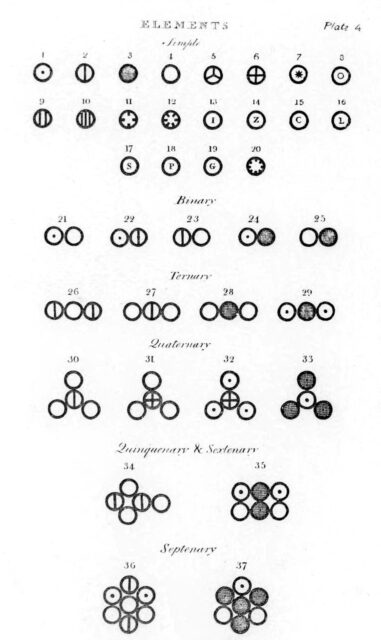
Dalton therefore introduced rules of simplicity. They were not decorative assumptions added to an otherwise complete theory. They were what allowed the theory to produce numbers at all. When only one compound of two elements was known, Dalton assumed the simplest possible atomic constitution: one atom of each. Since water was the known compound of hydrogen and oxygen, its formula became HO. Hydrogen could be assigned atomic weight 1, oxygen 8, and the system could begin to move.
Judged from later chemistry, Dalton’s rule has an air of innocence. It was a methodological expedient rather than an experimental result, a way of allowing atomic theory to proceed when direct counting was unavailable. Dalton was not looking into water molecules and counting badly; he was working with weights, tables and regularities, in a period before spectroscopy, quantum theory or a settled molecular chemistry had made atoms answerable in other ways.
HO was wrong. It was not random. It belonged to a method that could bring order to combining weights before chemistry had better ways of counting atoms.
Figure 1. Dalton’s atomic symbols, from A New System of Chemical Philosophy (1808), Plate IV. Dalton’s table did not merely decorate atomic theory; it made atoms calculable through symbols, weights and simple combinations. In this scheme, water or steam appears as a binary compound of one atom of oxygen and one atom of hydrogen. Source: Wikimedia Commons, public domain.
What gas volumes seemed to promise
Another route opened through gases.
Volumes could be measured, and gases combined with a striking regularity. Gay-Lussac showed that gases entered reactions in simple volume ratios. Two volumes of hydrogen combine with one volume of oxygen to form water vapour; other gases display similarly neat relations. To anyone looking for a way to count invisible particles, this was tempting.
If equal volumes of gases contained equal numbers of particles, volume could become a counting device. It would not show atoms individually, but it might give chemists a way to infer how many particles were involved.
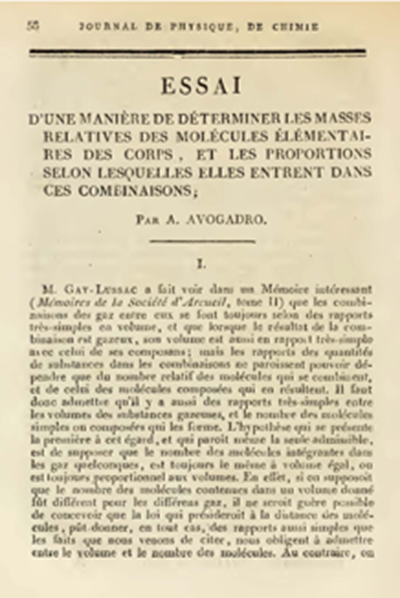
Avogadro made that move. Equal volumes of gases, under the same conditions, contain equal numbers of molecules. Grant that, and the formation of water vapour changes shape. Two volumes of hydrogen and one volume of oxygen produce two volumes of water vapour. The arithmetic works if hydrogen and oxygen gases are themselves molecular, H₂ and O₂, and if water is H₂O:
2H₂ + O₂ → 2H₂O
Figure 2. Opening page of Avogadro’s 1811 essay on the relative masses of elementary molecules. Avogadro’s hypothesis made gas volume into a possible way of counting molecules: equal volumes of gases, under the same conditions, could be treated as containing equal numbers of molecules. The proposal pointed towards H₂O, but it did not immediately command the field. Source: Amedeo Avogadro, ‘Essai d’une manière de déterminer les masses relatives des molécules élémentaires des corps…’, Journal de Physique, 73, 1811; Wellcome Collection / Classic Chemistry.
There it is, almost modern chemistry.
Yet the hypothesis did not conquer the field. The reasons were not merely psychological, nor reducible to conservatism. Avogadro solved one problem while creating others that looked serious at the time. Dalton saw no obvious reason why atoms of the same element should join into stable pairs. In his picture, atoms were surrounded by repulsive atmospheres of caloric; piling like atoms together was hardly the natural assumption. For electrochemical dualists, the difficulty sharpened further. Like atoms ought to have like electrical characters, and like electrical characters ought to repel. Why should oxygen atoms pair with oxygen atoms? Why should hydrogen atoms pair with hydrogen atoms? Why stop at pairs?
The hypothesis also asked chemists to treat elementary gases as molecules containing several atoms of the same element, and to imagine those molecules splitting during chemical combination. To those who trusted weights more readily than invisible gas particles, this was a large demand.
Even sympathetic chemists found the route uneven. Dumas tried, for a time, to develop Avogadro’s approach, but vapour-density results did not behave with perfect neatness. Mercury, phosphorus and sulphur made it hard to treat every elementary vapour on the model of hydrogen or oxygen.
Avogadro had offered a powerful clue. It was not yet the common language of chemistry. Water could have been H₂O in 1811; historically, that was not enough.
Atoms with handles
Behind the disagreement over water lay a larger problem. Nineteenth-century chemists were learning how to handle atoms at all: as weights, as volumes, as equivalents, as electrical units, as radicals, as centres of substitution.
For some, atoms were bearers of weight. For others, units in an electrochemical opposition. In Avogadro’s programme, gases offered a way of counting particles by volume. In organic chemistry, atoms and radicals became things that could be moved, exchanged and followed through reactions. Later structural chemistry would give them positions and patterns of connection.
Atoms entered chemistry through these practices unevenly: as things to be weighed, counted, exchanged, classified or connected.
A formula could be useful in one setting and awkward in another. Atomic weights could seem natural when derived from one class of operations and arbitrary when forced into another. Equivalents worked well for neutralisation and replacement. Volumes worked well for gases, though not without trouble. Substitution worked powerfully in organic chemistry. Electrochemical dualism arranged substances by polarity and affinity.
No single practice simply revealed atoms as they were. Each gave atoms a handle.
That is why the history of H₂O is not just a story about choosing the correct formula. The formula became convincing when atoms could be made to enter operations: weighed in one context, counted in another, substituted in a third, arranged elsewhere by their capacities for connection. Seeing was unavailable; work had to do the job of sight.
The caution of equivalents
One response to the circular trap was to avoid stepping fully into it.
Many chemists were cautious about atoms. Atomic language sounded metaphysical, or at least more speculative than the discipline required. Equivalent weights appeared safer. One substance could neutralise, replace or combine with another in a definite proportion, and those relations could be measured without deciding what atoms really were or how many of them sat inside a molecule.
Equivalents allowed calculation while holding invisible architecture at arm’s length. A chemist could say how much of one substance answered to another in reaction, without committing to a microscopic count.
This caution was productive. It helped chemists calculate, compare and classify. It also preserved ambiguity. In practice, an equivalent could behave rather like an atomic weight, even when chemists insisted that they were avoiding speculative atomism.
Water once again exposed the difficulty. If oxygen’s equivalent was 8 relative to hydrogen, HO looked natural. If oxygen’s atomic weight was 16, H₂O became natural. The issue depended on the passage from observable combining relations to invisible atomic units.
The appeal to equivalents allowed chemists to postpone bolder claims about atoms, while leaving a theoretical judgment embedded in the passage from measurable reactions to invisible units.
The detour through organic chemistry
The decisive work did not come from staring harder at water.
That is one of the surprises in this history. H₂O gained its strength elsewhere: in the movement of radicals, in substitutions, in families of organic compounds. Organic chemistry gave chemists a way to manipulate groups of atoms and to follow their replacements through reactions.
The key idea was the water type.
If water is H₂O, oxygen can be treated as holding two units together. In water, the two units are hydrogens. In alcohols and ethers, one or both hydrogens can be replaced by organic radicals. Water, alcohols and ethers could therefore be seen as members of a family, built around oxygen’s capacity to connect two branches.
At first this sounds like a tidy diagram. It became much more than that.
Williamson’s work on etherification gave the water type experimental substance. The older Liebig-Dumas view treated etherification largely as a removal of water from alcohol under the dehydrating action of sulphuric acid. Williamson rewrote the process as a traffic of groups. Sulphuric acid took an ethyl group from alcohol, leaving water behind; the resulting sulphovinic acid then handed that ethyl group to another alcohol molecule, taking hydrogen in return. Sulphuric acid was regenerated, and ether was produced.
The formula was doing work. It allowed chemists to follow the movement of groups through a sequence of transformations instead of merely recording elemental proportions at the beginning and the end.
Then came the sharper test. If the water-type picture was right, oxygen could hold two different radicals at once. Williamson therefore contrived ethers containing different combinations of methyl, ethyl and amyl groups. These were mixed ethers, not mere mixtures of symmetrical ethers. Under the rival Liebig-Dumas scheme, such mixed ethers should not have appeared as distinct compounds at all; at most, the experiments should have produced mixtures of symmetrical ethers.
Their production gave the water type operational force.
Figure 3. A modern schematic representation of the Williamson ether synthesis. The diagram is not a reproduction of Williamson’s nineteenth-century notation, but it captures the substitutional logic that made his work so important: ethers could be produced by replacing hydrogen in alcohols with organic radicals. This helped make the “water type” experimentally powerful, since water, alcohols and ethers could be understood as related compounds organised around oxygen’s twofold combining capacity. Source: Wikimedia Commons, CC0.
H₂O gained strength because it travelled. It helped chemists understand not only water, but alcohols, ethers and families of organic compounds. It made substitutions intelligible. It made room for oxygen as an atom with a definite combining capacity.
The problem had widened. Water was no longer an isolated substance to be analysed, but the simplest expression of oxygen’s capacity to bind, exchange and organise chemical groups.
Counting by substitution
Substitution reactions gave atoms a kind of experimental visibility.
No one saw oxygen holding two hydrogens. No one watched radicals attach themselves like beads on a wire. But chemists could replace one group with another and see what sort of compound resulted. If an atom or radical could be substituted without the molecule falling apart, that said something about the architecture of the compound. If replacing a central atom broke the molecule into two products, that said something else.
Here the language of valency began to acquire force. Oxygen and sulphur behaved as if they could bind two units. Chlorine behaved differently, as if it had only one hand. The metaphor is crude, but useful; later it would be disciplined into valency.
Water became the simplest member of a larger argument. If oxygen could connect two radicals in ethers, then the two hydrogens in water no longer looked like an arbitrary doubling. They were the simplest expression of oxygen’s twofold combining capacity.
The older picture of a central binding atom would later lose its privileged status. What remained was more durable: a number attached to an element’s capacity for combination.
This was a different kind of counting from Dalton’s simplicity rule or Avogadro’s gas volumes. Dalton counted by assuming the simplest combination. Avogadro counted through equal volumes. Organic chemists counted through substitutions, replacements and families of compounds. None of these methods made atoms visible. Each made them usable in a different way.
H₂O became embedded in a network of operations in which oxygen’s twofold capacity could be tested across many compounds. The formula began to earn its keep.
Cannizzaro and the story we like to tell
There is a familiar heroic version of the story. Avogadro discovered the key; chemists forgot it; Cannizzaro revived it at Karlsruhe in 1860; the fog lifted; H₂O won.
There is some truth in this. Not enough.
Cannizzaro’s intervention mattered. His presentation of atomic and molecular weights was clear, forceful and timely. By using Avogadro’s ideas, he gave chemists a way to distinguish atoms from molecules, molecular weights from atomic weights, formulas from combining proportions. His pamphlet circulated after Karlsruhe and influenced younger chemists who were looking for order in a confusing field.
The achievement was real. It was not miraculous.
By the time of Karlsruhe, many of the crucial battles had already been fought elsewhere. Organic chemistry had done a great deal of the work. Substitution, types, radicals and valency had given chemists practical ways to count and sort atoms. Cannizzaro clarified and spread a system that was already becoming workable; he did not unlock the problem by himself.
Nor did his account contain the strongest organic side of the story. Williamson, types, radicals and substitution had already made H₂O useful in ways that a purely Avogadrian argument could not.
Consensus emerged because several practices began to reinforce one another. Volumes, atomic weights, substitution patterns, organic structures and valencies gradually pulled in the same direction. H₂O did not win because an old hypothesis was finally remembered. It won because chemists had learned to make the formula work across a widening range of operations.
A formula becomes harder to doubt when it begins to do work elsewhere.
When H₂O became workable
By the 1860s, H₂O was no longer an isolated claim about water. It belonged to a broader chemical world.
Hydrogen was monovalent. Oxygen was divalent. Water belonged to a family of compounds in which oxygen could connect two units. Gas volumes supported the distinction between atoms and molecules. Organic substitutions gave chemists ways to test combining capacities. Atomic weights and molecular formulas could now be adjusted together with less arbitrariness than before.
Agreement on H₂O did not mean agreement on the reality of formulas. Some chemists treated them as useful instruments; others took them as claims about molecular architecture; many occupied positions somewhere between those poles. Chemical atomism became operationally secure before philosophical realism about atoms became uncontested.
The settlement also did not turn chemistry into a single perfectly unified language. Equivalent weights, atomic weights, empirical formulas, structural formulas and physical atomism did not collapse into one view. The field was rearranged. H₂O became stable within that rearrangement, not because every older tension disappeared, but because enough practices now supported the same count.
Once that happened, HO no longer looked like a reasonable simplification. It looked wrong. But it looked wrong from inside a later practice.
What H₂O hides
H₂O looks almost weightless on the page. Three symbols, one subscript, a formula learnt so early that it seems to have no history at all.
It has a long one.
Before chemists could write that subscript with confidence, water had to lose its ancient simplicity, acquire hydrogen and oxygen as constituents, and then submit to a harder demand. Its invisible parts had to be counted.
That last demand was the strangest. Weights could be measured, gases collected, volumes compared, substances replaced, compounds arranged into families. Yet no one could open a molecule and inspect its furniture. The number two had to come from elsewhere.
It came from operations. From volumes that made gases countable; from equivalents that allowed calculation; from substitutions that let radicals change places; from families of compounds in which oxygen repeatedly behaved as a twofold centre of combination. A count that no eye could read became stable through chemical work.
This is what the formula now conceals. H₂O is neither a convention nor a snapshot of an invisible object. It is a compressed history of practices, a small sign in which balances, gases, paper formulas, ethers, substitutions and valencies have disappeared into familiarity.
Water is H₂O. The difficulty lies in remembering how much chemistry had to be invented before that sentence could become obvious.
References
Avogadro, A. (1811). ‘Essai d’une manière de déterminer les masses relatives des molécules élémentaires des corps, et les proportions selon lesquelles elles entrent dans ces combinaisons’. Journal de physique, de chimie, d’histoire naturelle et des arts, 73, pp. 58–76.
Cannizzaro, S. ([1858] 1910). Sketch of a Course of Chemical Philosophy. Alembic Club Reprints, no. 18. Edinburgh: The Alembic Club.
Chang, H. (2012). Is Water H₂O? Evidence, Realism and Pluralism. Dordrecht: Springer. DOI 10.1007/978-94-007-3932-1.
Dalton, J. (1808). A New System of Chemical Philosophy, Part I. Manchester: Printed by S. Russell, for R. Bickerstaff, Strand, London.
Gay-Lussac, J. L. (1809). ‘Mémoire sur la combinaison des substances gazeuses, les unes avec les autres’. Mémoires de physique et de chimie de la Société d’Arcueil, 2, pp. 207–234.
Klein, U. (2003). Experiments, Models, Paper Tools: Cultures of Organic Chemistry in the Nineteenth Century. Stanford: Stanford University Press.
Liebig, J. von. (1851). Familiar Letters on Chemistry, in Its Relations to Physiology, Dietetics, Agriculture, Commerce, and Political Economy. 3rd ed. London: Taylor, Walton, & Maberly.
Rocke, A. J. (1984). Chemical Atomism in the Nineteenth Century: From Dalton to Cannizzaro. Columbus: Ohio State University Press.
Rocke, A. J. (2010). Image and Reality: Kekulé, Kopp, and the Scientific Imagination. Chicago: University of Chicago Press.
Williamson, A. W. (1850). ‘Theory of Ætherification’. The London, Edinburgh, and Dublin Philosophical Magazine and Journal of Science, 3rd series, 37(251), pp. 350–356.
Williamson, A. W. (1852). ‘On Etherification’. Quarterly Journal of the Chemical Society of London, 4, pp. 229–239. DOI 10.1039/QJ8520400229.
MacRumors‘ Joe Rossignol reports that Apple is preparing to add iPhone Car Key support in the Wallet app to three more automakers: Lincoln, Lucid Motors, and China’s Freelander.
The finding comes from backend code first spotted by MacRumors contributor Aaron Perris, who posted that Apple’s systems now list the three brands for Car Key support. No launch window or specific models are included in the code.
Car Key lets owners lock, unlock, and start a compatible vehicle with an iPhone or Apple Watch instead of a traditional fob. The latest version of the industry standard, Digital Key 3.0 from the Car Connectivity Consortium, uses Bluetooth LE, NFC, and Ultra Wideband for secure, proximity-based access. Express Mode can work without unlocking the iPhone.
The feature already works with vehicles from Audi, BMW, Hyundai, Kia, Genesis, Mercedes-Benz, Volvo, Cadillac, Lexus, MINI, Polestar, Porsche, RAM, Rivian, Toyota, and others. Availability and exact capabilities still vary by brand and model. Some manufacturers tie the digital key to a connected-services subscription.
Lucid had previously been named by Apple among brands expected to add Car Key support. Lincoln’s addition would bring Ford’s luxury division into the fold. Freelander, a Chinese brand, would further expand the feature in that market. Apple has not confirmed which vehicles will actually ship with the capability or when drivers will be able to add a key to Wallet.
MacDailyNews Take: Backend references of this kind have preceded other Car Key rollouts, but they are not a guarantee of immediate availability. Owners of current Lincoln, Lucid, or Freelander vehicles should not expect the feature until the automakers and Apple formally enable it on supported models.
Please help support MacDailyNews — and enjoy subscriber-only articles, comments, chat, and more — by subscribing to our Substack: macdailynews.substack.com. Thank you!
Console de jeu hydride récente et adaptée aux jeunes joueurs comme aux adultes, la Nintendo Switch 2 séduit de nombreux joueurs depuis son lancement en juin 2025. En ce moment, et alors que son prix officiel vient de passer à 499,99 €, vous pouvez vous l'offrir pour moins de 420 € sur Amazon.
We've put the batteries in Apple's newest iPhones to the test
There are upgrades here, but not huge ones
Apple has been touting major boosts in battery life on these handsets
Sift through the press releases that Apple pushed out while announcing the new iPhone 18 Pro and iPhone 18 Pro Max, and you'll see some big battery life increases touted — including "the largest increase in battery life ever" on an iPhone with the Pro Max model (compared to the iPhone 17 Pro Max).
We know that the iPhone 18 Pro and iPhone 18 Pro Max come with 4,056 mAh and 5,391 mAh capacity batteries respectively (at least in Europe), but does that translate into much better battery life? We put both of these new handsets through their paces in the TechRadar labs (as part of our full iPhone 18 Pro review) to see if Apple's claims held up under some real-world testing.
Our standard test involves having the iPhone automatically cycle through a series of websites over a cellular connection, until the battery dies. Features like location services, Wi-Fi, and Bluetooth are all turned off while the test is being run, and the battery management features in iOS are disabled too.
The iPhone 18 Pro managed 16 hours and 17 minutes in the test, compared to 15 hours and 21 minutes on the iPhone 17 Pro, a boost of around 6% overall. The iPhone 18 Pro Max managed 18 hours and 27 minutes compared to 17 hours and 54 minutes on the iPhone 17 Pro Max, an increase of roughly 3% in total.
Those increases are of course welcome, but perhaps aren't quite as impressive as Apple is making out, though there are a lot of different variables (like screen brightness) involved. Apple's own figures usually make use of video playback time — as in how long a single battery charge lasts when you've watching a video.
For the iPhone 17 Pro and iPhone 17 Pro Max, Apple quotes 33 hours and 39 hours respectively, while for the iPhone 18 Pro and iPhone 18 Pro Max those numbers go up to 36 hours (a 9% increase) and 45 hours (a 15% increase). That last jump is indeed significant, but may only apply in quite a narrow set of scenarios.
"All battery claims depend on network configuration and many other factors," explains Apple in the small print on its comparison page. "Actual results will vary. Batteries have limited recharge cycles and may eventually need to be replaced. Battery life and charge cycles vary by use and settings."
We can safely say that you should see better battery life on the iPhone 18 Pro and Pro Max compared to the models that preceded them, but based on our own testing, don't expect the kind of improvements Apple is promising unless you're doing nothing but watching videos in long stretches between recharges.
Microsoft appears keen to go ahead with plans to build a data center in Slough, England. Plans could be submitted as soon as this autumn, according to The Slough Express.
Recently, a consultation was held to receive feedback from local residents about the data center. In that process, Microsoft said: "Data centres have become integral to our lives, with social media, contactless payments and remote working all reliant on the functionality they provide."
The tech giant added, "The UK needs more new data centres to power the economy of the future."
The consultation covered several topics related to the proposed data center, including on-site parking and if the building of the data center would affect local traffic.
Councillor Chandra Muvvala discussed the impacts of data centeres with the Local Democracy Reporting Service (LDRS). "Not having a data centre is not a problem, but having a data centre is certainly a problem," said Muvvala.
The councillor also noted things Microsoft could do to help the community, such as planting trees or improving local parks.
A petition to pause the data center project has over 600 signatures at the moment. Petitioners want an independent assessment to be completed to determine the impacts of the project.
Controversial data centers
The proposed data center in Slough is not alone in drawing criticism. Microsoft has also faced pushback about its planned data center in Leeds, England.
The complaints about the project in Leeds are similar to those from people in Slough. Residents in both areas have expressed concerns about the environmental impact of the data centers and raised flags about potentially high noise levels and other ways the data centers could harm their respective surrounding areas.
Microsoft has already received the go-ahead to build the data center from the Leeds City Council, which voted unanimously to approve the project. But the final decision on the project will come from Chief Planning Officer Martin Elliot.
Join us on Reddit at r/WindowsCentral to share your insights and discuss our latest news, reviews, and more.
The Corps of Discovery Expedition set out in 1804, directed by President Thomas Jefferson to survey the United States’ newly acquired Louisiana Purchase. The exploration forms a core piece of early U.S. history. Picture a scene from the journey: It’s a cool morning, the silence punctuated by birdsong and the rustle of the breeze through the cottonwood trees. To one side, Commander William Clark, his rifle leaning against a plum tree and his rucksack nearby, squats over a latrine pit, unceremoniously heeding the call of nature.
The Louisiana Purchase constituted a territory of around 828,000 square miles, which the U.S. had bought from France in 1803. This was, it is worth noting, largely without the consent of the Indigenous groups who had lived there for millennia. The purpose of the expedition was threefold: to find a practical trade route westward to the Pacific coast, to explore and document the territory, and to stake a claim to the area before any other European powers butted in. Led by Meriwether Lewis and William Clark, the 40-man team, plus their guide Sacagawea, spent more than two years trekking westward.
Believe it or not, the holes that were used as toilets along the march to the Pacific have been invaluable for archaeologists and historians. This is thanks especially to a type of treatment included in the expedition’s medical kit.
How Lewis and Clark went to the bathroom
Everybody poops—it’s a universal human need. But most accounts of the Corps of Discovery’s journey leave out the details of how the Corps members dealt with bathroom business.
Each of the campsites where the expedition spent time had an accompanying latrine pit, situated well away from camp for sanitary (and privacy) reasons. The latrines would have seen a lot of use, because the Corps of Discovery’s diet wasn’t the best for gut health.
American artist Charles Marion Russell painted this piece entitled “Lewis and Clark on the Lower Columbia” in 1905. Image: Public Domain
While the expedition members relied heavily on foraged and hunted food, they also carried backup rations. These included nearly 14,000 pounds of dry goods, including flour, salt, coffee, dried pork, and lard. All told, each member of the Corps ate around nine pounds of meat per day. All of that protein without lots and lots of fiber added up to frequent constipation. The untreated water they drank from rivers and creeks they encountered probably didn’t help their circumstances. Enter…Dr. Rush’s Bilious Pills.
The mercury constipation pills known as “thunderclappers”
In 1803, as preparation for the upcoming expedition, William Clark traveled to Philadelphia for a two-week medical crash course with Dr. Benjamin Rush. Rush was a prominent physician in his day, and a Founding Father of the United States. His signature is one of the 56 on the Declaration of Independence.
Rush taught Clark some basic field skills, such as bone-setting and wound treatment. Clark left Philadelphia with new skills and a well-stocked medical kit that included 50 dozen of Doctor Rush’s Bilious Pills. These were compounded tablets about the size of a raisin, composed of powerful laxative ingredients. The pills were nicknamed “thunderclappers” because of the speed with which they took effect. The main ingredient of the thunderclappers was calomel, or mercury chloride.
Mercury, historically also called quicksilver, has been thought to have curative effects for centuries. It’s a metal that is liquid at room temperature, which seems miraculous in and of itself.
It was also a popular treatment for syphilis. This is not to say it was an effective treatment for syphilis. When it was administered for that disease, slowly in low doses, patients were more likely to die from mercury poisoning than from the STI.
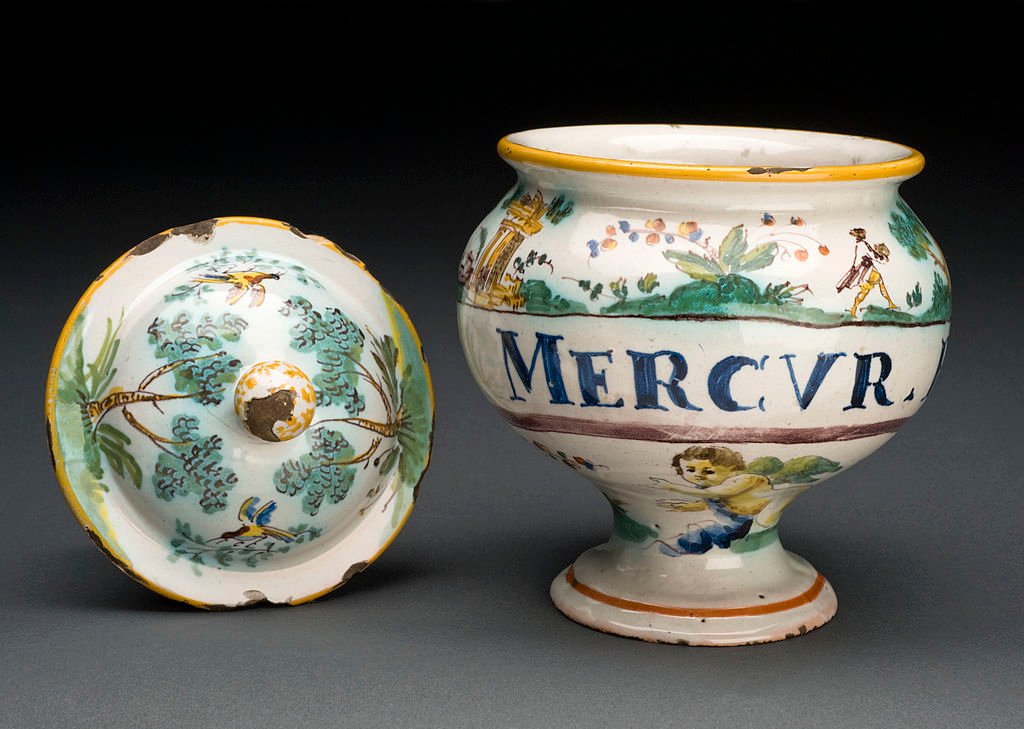
This drug jar for mercury pills was made in Italy sometime between 1731 and 1770, several decades before Meriwether Lewis and William Clark set out on their historic expedition. Image: Science & Society Picture Library / Contributor / Getty Images Jaron Chubb
When taken in larger doses, though, as in the thunderclapper pills, it prompted a quick evacuation, the body’s way of ejecting poison. The men of the Lewis and Clark expedition used these pills freely as a way to compensate for their high-protein and low-fiber diet. As a result, all the latrine pits they used between the Midwest and the Pacific coast were laced with high concentrations of mercury.
Lewis and Clark pooped mercury. Today archaeologists use it to map their route.
As many an environmentalist will caution, mercury does not decompose when it’s in the ground. It stays put, and is detectable through modern soil testing techniques. The 600-plus latrines dug and used by the Corps of Discovery form a trail of their own, marked by mercury.
The expedition was a government-sanctioned military expedition, so Lewis and Clark both kept copious notes on every aspect of their travels. Historians have tried to pinpoint the locations of these camps based on the expedition journals, with minimal success.
The only campsite that archaeologists have been able to confirm so far is the Traveler’s Rest camp, just outside of Missoula, Montana. This is all thanks to the remains of Dr. Rush’s Bilious Pills, which left enough mercury in the ground to differentiate the remains of a latrine pit (or “sink” as they were called in the 1800s) from animal burrows or agricultural ditches.
Archaeology is all about reconstructing the lives of people in the past, and it’s worth remembering that this means all aspects of life. Our own bodily functions remind us that we all share complex and interwoven histories, and that even the most mundane parts of our lives can be important in the future.
In That Time When, Popular Science tells the weirdest, surprising, and little-known stories that shaped science, engineering, and innovation.

 Login




 L’UE dà il via libera allla riforma doganale: piattaforme e venditori extra-UE diventano importatori responsabili e arriva una nuova “handling fee”, distinta dal dazio da 3 euro